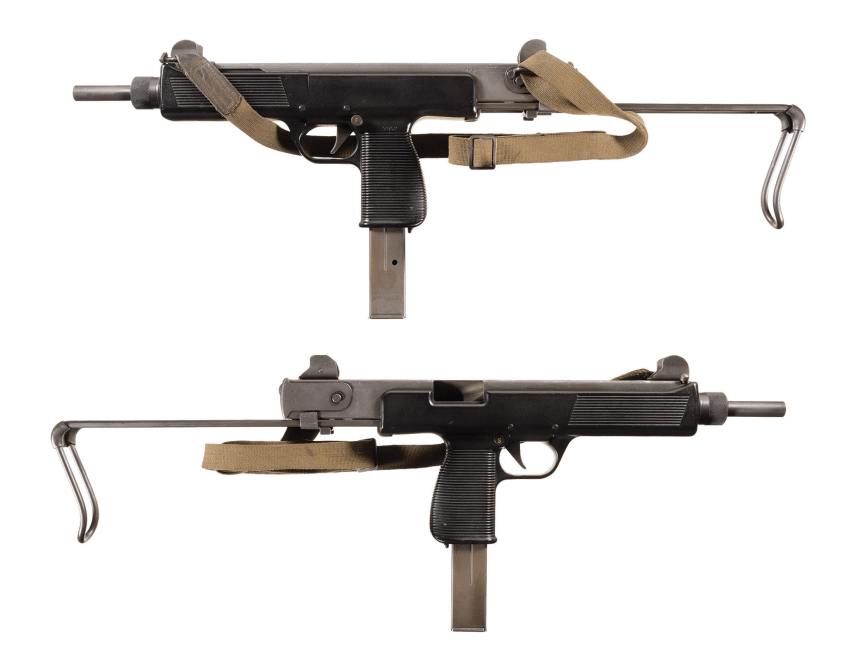
Developed in the late 1960s and introduced in 1969/70 the MPi 69 was Steyr’s entry into an already crowded European submachine gun market. Heavily influenced by the Israeli Uzi it had a bolt which telescoped over the barrel and fed from a box magazine that was inserted through a magazine well-come-pistol grip.
The MPi 69 weighed 6.5lbs (2.93kg) unloaded and had a polymer lower receiver into which a stamped metal upper inserted. Unlike the Uzi it had a collapsing, rather than folding stock, similar to the M3 submachine gun’s, and was cocked not by a handle but by pulling the sling (which was acted on the bolt) to the rear.
Steyr MPi 69 (Rock Island Auction Company)
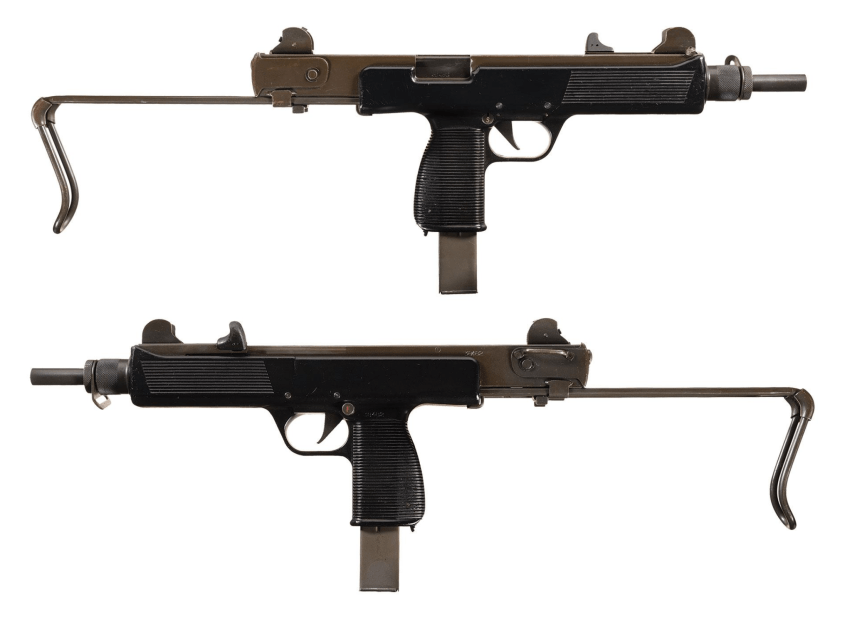
The MPi 69 remained in production into the early 1980s when it was replaced by the improved MPi 81. Moving away from the slick-cocking ‘gimmick’ the MPi 81 had a conventional, non-reciprocating, charging handle on the left side of the receiver. The MPi’s polymer lower allows it to be a pound lighter despite being slightly longer as a result it also balances better than the standard Uzi carbine.
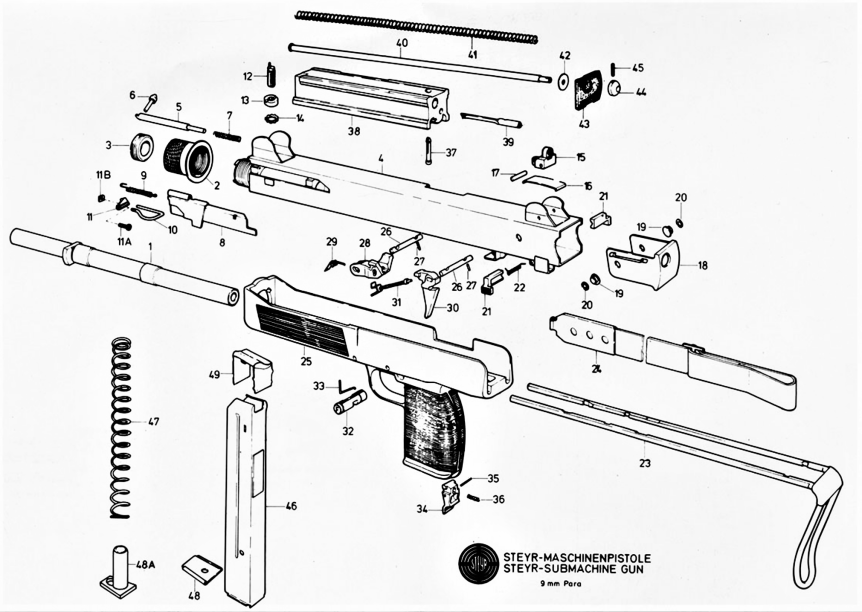
Steyr MPi 69 diagram (Steyr Manual)
The MPi submachine guns fed from 25 or 32 round box magazines and both guns had a heel-type magazine release paddle in the base of the pistol grip. They also shared their magazines with the AUG 9x19mm submachine gun conversion. Check out our earlier video on the Steyr AUG conversion here.
Steyr MPi 81 (Rock Island Auction Company)
The MPi submachine guns fire from an open bolt and had a 10in barrel and has a push through safety with settings for safe, semi and full auto and unlike the Uzi it does not have a grip safety – simplifying manufacture.
The MPi also has a progressive trigger which when set to full-auto will allow the user to fire semi when pulled to the first stage and full when pulled fully to the rear. While the MPi 69 had a cyclic rate of around 500 per minute, the MPi 81 increased this rate to ~750rpm.
Steyr MPi 69 disassembly diagram (Steyr Manual)
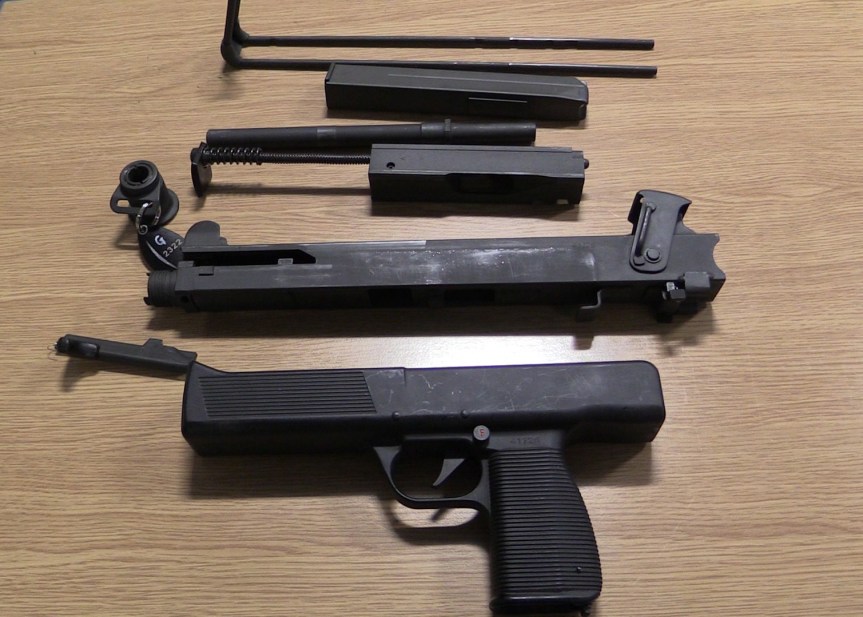
The MPi can be field stripped by simply rotating the receiver end cap up 90-degrees and pulling the bolt out the rear. The gun can be further stripped but the moulded polymer lower receiver can be difficult to remove from the upper. Like the Uzi the barrel nut is unscrewed to remove the barrel.
The MPi 81 fully disassembled (Vic Tuff)
It is unclear just how many MPi submachine guns were produced but they didn’t see any significant contracts beyond a few small sales to police forces and militaries.
The MPi 81 remained in production into the early 1990s when it was replaced by the smaller and more compact Steyr TMP in 1992. In turn the TMP design was sold to B&T a decade later.
Our thanks to the collection that let us take a look at this MPi 81 and to our friend Miles Vining for sharing some of his shooting footage of the MPi 81 with us, check out his video here and more of his work at www.silahreport.com.
The need for compact weapons capable of being carried with ease by troops who would be getting in and out of vehicles, jumping from planes and fighting in close quarters had been proven during World War Two. While it may look unusual the Hotchkiss ‘Type Universel’ was an extraordinary attempt at creating an extremely compact submachine gun.
Right-side Hotchkiss Type Universel (Matthew Moss)
Submachine guns had proven themselves to be an useful weapon during the war, their small size and high rate of fire made them invaluable, especially in close-quarter situations. The post-war French army found itself armed with a plethora of surplus submachine guns, which included: the German MP40, the British STEN and the American Thompson as well as their own pre-war MAS-38s, in 7.65x20mm Longue, which had been designed before the war. By 1946 they had already begun the process of selecting a new, more compact submachine gun. Seeking to standardise on a single weapon and calibre they selected 9x19mm and launched a programme to find a new submachine gun or Pistolet Mitrailleur.
MAS-38 (Rock Island Auction Company)
The French War Ministry launched a call for state arsenals and civilian manufacturers, such a Hotchkiss and Gevelot/Gevarm, to submit submachine guns for trials. Hotchkiss submitted the Type 010 or Type Universel, often anglicised as Universal, despite this the guns are typically marked ‘CMH2’ – ‘Carabine Mitrailleuse Hotchkiss’.
Chambered in 9x19mm, the Hotchkiss fed from MP40-pattern magazines, used the ubiquitous blowback action, it fired from a closed bolt and had a cyclic rate of approximately 650-rounds per minute. The Hotchkiss is select fire with a push through selector that allows for semi and full-auto fire. It appears that the weapon’s only safety mechanism is to close the ejection port cover and lock the bolt in place – much like a US M3 Grease Gun.
Right side collapsed Hotchkiss Type Universel (Matthew Moss)
Designers went to extraordinary lengths to minimise the size of the Universel. Not only did the stock fold beneath the barrel but the magazine well and magazine could be rotated forward to sit beneath the barrel with the magazine fitting between a U-shaped cut-out in the butt stock. The weapon is a curious mix of stamped metal and complex machining with a difficult to machine bolt and barrel contrasting with a stamped sheet metal lower receiver and wide stamped trigger.
Left side collapsed Hotchkiss Type Universel (Matthew Moss)
In 1950 Hotchkiss sales material described their weapon as “the individual defense weapon meeting the requirements of the most modern Armies and Police. Folded up, it is very compact, easy to transport, conceal and parachute. It is quick to set up and comes unfolded in the form of a carabiner…”
The weapon’s pistol grip was hollow and when folding up the stock, the grip folds forward to cover the trigger. The Universel’s most interesting feature is its telescoping barrel which retracts several inches inside the receiver. These features brought the Hotchkiss’ length down from 30.6 inches (77.6cm) when the stock was extended, to 22 inches (54cm) with the stock folded, and an impressive 17.25 inches (43.5cm) when fully collapsed. The nature of how the pistol grip folded with the stock meant the weapon could not be fired with its stock collapsed. When fully collapsed the weapons’ depth was just 6 inches or 15.3cm.
A partially collapsed Hotchkiss, with magazine in folded position and barrel extended (Royal Armouries)
To Deploy:
First we unfold the stock by pushing the knurled collar forward to unhook it from the base of the magazine well. When fully unfolded a spring detent locks into the rear of the receiver.
At the same time the pistol grip also unfolds. If we had a magazine loaded into the weapon we would deploy the barrel first – in order to allow the magazine to slide back through the magazine well and fold down to lock into position. The bolt follows the barrel forward so once the magazine is locked into position the weapon has to he be charged to chamber a round.
The collapse the weapon again, first fold the stock, then depress the lever just behind the trunnion to unlock the barrel, push the barrel assembly and bolt to the rear until it locks.
Left side Hotchkiss Type Universel (Matthew Moss)
The Universel’s extreme compactness was both its best and worst feature, the complexity of having every protruding part fold or retract made the weapon expensive to produce. It also gave the weapon poor ergonomics with a narrow butt, an uncomfortable pistol grip and narrow sights which weren’t ideal for quick target acquisition.
The Hotchkiss was one of a whole host of compact folding submachine guns developed after World War Two. These included the MAS MLE 1948, the MAC Mle 1947 and of course the MAT-49 from French state-arsenals. The French guns were by no means the first to have folding magazines, that concept dates back to submachine guns like the SIG MKMO. Incidentally, SIG’s last developmental iteration of their submachine guns, the MP48, was also developed in the late 1940s and retained the MKMO’s folding magazine housing.
Close up of the Hotchkiss Type Universel’s receiver (Matthew Moss)
A 2001 article from the Gazette des Armes, by Michel Malberbe, includes an account from a Legionnaire sergeant who describes using the Hotchkiss in Indochina:
“I saw for the first time the submachine gun Hotchkiss in ‘Indo’. We were responsible for the security of the RC4 [Route Coloniale 4], and the staff sent us wooden cases containing these famous submachine guns. As the documents were not very complete, our company commander… had trouble explaining how it worked. It was quite funny, because folded, this submachine gun did not look very serious. It was like a rectangular scrap metal package… We used it for the first time on the Lang Son side, during a serious collision between the Viets and a convoy… I remember that this machine worked very well. But it lacked a little precision. Anyway, it was much better than the small MAS-38 submachine gun, whose magazine always blocked [jammed] at the wrong time! On the other hand, I think I remember that the Hotchkiss did not stand up to mud and that it was misery to clean it. In addition it was quite difficult to unfold because of the buttons found everywhere. We never knew which one to press. We, in any case, always transported them in the firing position…”
While the Type Universel definitely wouldn’t win any prizes for its aesthetics, it was a ambitiously-engineered and well-built submachine gun. Despite this the design was simply too complex, as we have heard troops in the field rarely took advantage of its compact features preferring to carry the weapon at the ready. The Universel sacrificed a lot to achieve its compactness and the ergonomics of the weapon leave a lot to be desired with an extremely small butt and a hollow pistol grip that just feels wrong.
It is believed that in total just 7,000 Hotchkiss Universels were produced between 1948 and 1952. The French military rejected the Hotchkiss feeling the weapons was too complex and too expensive to manufacture. Instead, the MAT-49 submachine gun, designed by Tulle, was eventually adopted. The MAT-49 also had a folding magazine housing making it almost as compact as the Universel but without its complexities.
Close up of right side of the Hotchkiss Type Universel’s receiver (Matthew Moss)
While it underwent some field testing with the French in Indochina no major military contracts were won but small numbers were purchased by the French police, the colonial police in Morocco and some were sold to the military of Venezuela. The Universel would be one of the last firearms produced by Hotchkiss et Cie, who had built numerous armaments for the French army during the 19th and 20th centuries, before it closed its weapons manufacturing arm in the early 1950s refocusing on automobile manufacture.
Special thanks to Battlefield Vegas for allowing us to take a look at their Hotchkiss.
In 1976, the West German Police issued a specification for a new small, lightweight service pistol to replace their stocks of Walther P38/P1′s and various 7.65×17mm (.32 ACP) pistols.
The police specification limited the new pistols weight to 2.2lb/35oz/1kg, it was to be no larger than 18x13x3.4cm and was to be quick to draw and safe to carry with a round in the chamber.
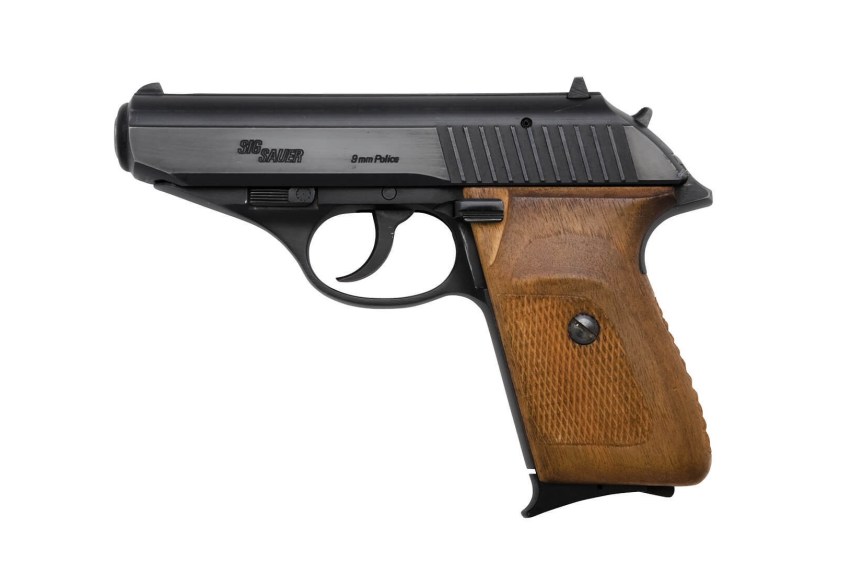
SIG Sauer P230 (Edelweiss Arms)
Earlier trials had taken place in 1974 examining pistols chambered in the 9×18mm Ultra round. Walther had submitted the PP Super and SIG-Sauer had entered the P230 for testing but with increasing criminal and terrorist activity in West Germany during the 1970s it was decided to adopt a pistol chambered in the more powerful 9×19mm round.
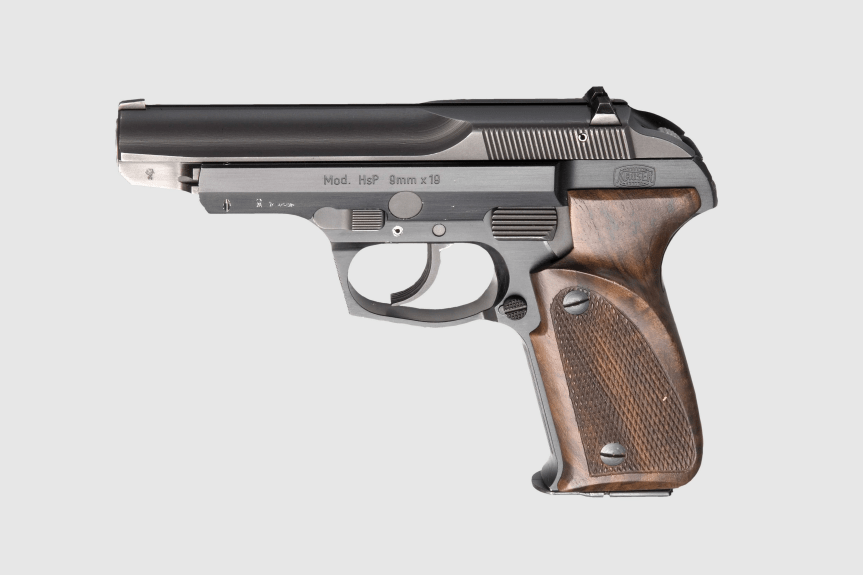
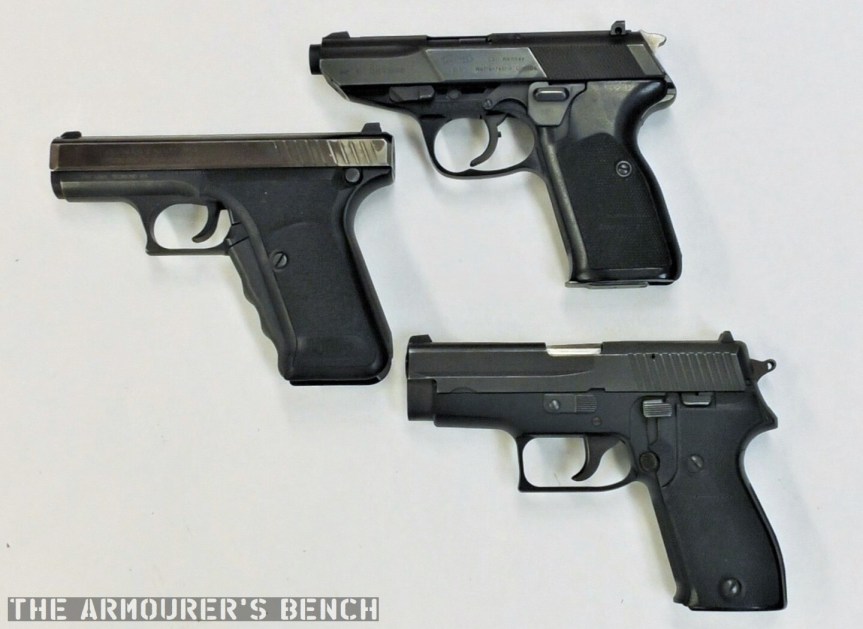
As a result a new round of trials with the new specifications was arranged. Mauser, Walther, SIG-Sauer and Heckler & Koch all submitted designs. Mauser offered the HsP,Walther offered the P5, SIG-Sauer entered the P225 (which became the P6) and Heckler & Koch submitted the PSP, later known as the P7.
The trials involved a gruelling 10,000 round endurance test (with cleaning after every 1,000 rounds), a rapid-rifle 500 round test and accuracy testing at 25 metres. One of the main problems of producing the desired sub-compact sized pistol in 9×19mm was that after approximately 1,000 rounds the pistol’s recoil spring may become prone to failure.
The police specification called for a 10,000 round lifespan. Each had their own approach; Walther’s P5 tackled the problem by using the dual-spring system used in the P38/P1 while Heckler & Koch used a gas-delayed blowback system in the P7. SIG-Sauer, however, employed the simplest solution – a heavy gauge braided spring to give increased strength combined with the Short Recoil action. This was also substantially cheaper to manufacture.
Clockwise: Walther P5, SIG Sauer P6, HK P7 (Matthew Moss)
The short-recoil, lever-locked Mauser HsP was eventually dropped due to durability issues, while the Walther P5, SIG-Sauer’s P6, and Heckler & Koch’s P7 were successful and deemed fit for service and adopted by various German police departments.
The P5 was adopted by Baden-Württemberg and Rhineland-Palatinate’s State Police as well as the Dutch national police. TheP6 was the most widely adopted as it was the cheapest option available, with a total of seven German state police forces adopting it along with orders from the border police, railway police and the Federal Criminal Police Office. The most expensive of the pistols, the P7 was favoured by more specialist units like GSG9.
Our thanks to our friends at Gunlab for allowing us to take a look at these pistols.
The Walther P5 was developed in the mid-1970s as an response to the West German police’s continued search for a 9x19mm service pistol to replace the older smaller calibre pistols then in service, like the Walther PP. It was developed to fit the new police specification for a small, handy pistol which could be brought into action quickly. Walther’s design competed against pistols from Mauser, Heckler & Koch and SIG Sauer.
Walther P38 (Rock Island Auctions)
The P5′s design evolved from the P38, combining the lock work and dual recoil springs of the P38 (re-designated the P1 in 1963) with a shortened barrel and a full length slide. While a shortened P38k had been produced in the early 1970s, this was only an as an interim solution. The P38K retained the same slide and frame as the original P38s, but had the front sight mounted on the front strap of the frame and none of the pistol’s contours were rounded to aid drawing and returning to a holster. Only around 2,600 P38Ks were produced.
Following the attack on the 1972 Munich Olympics games West German police began the search for a new service police. Walther’s response, the P5, was introduced in 1978. The P5 is a locked-breech pistol and has double-action/single-action (DA/SA) trigger. It uses the same short-recoil operated system and locking mech as the P38. This means that the barrel and slide recoil together for a short distance before the locking block falls and allows the slide to continue moving rearward, ejecting a spent case and chambering a new round.
Walther P5 (Matthew Moss)
Walther moved the P5’s decocker from the slide to the frame and this also served as the slide stop and slide release. I would say that the P5’s decocker is easier to operate, with a shorter length of travel, than the SIG P6’s.
Following the West German police specification Walther designed the pistol to be safely and rapidly brought into action, and as a result dispensed the manual safety. Instead, the pistol could be carried in condition two – with a round in the chamber and the hammer down. This was safely achieved by some upgrades to the P5’s hammer and firing pin. There is a small recess in the pistol’s hammer for the firing pin. The firing pin only moves into alignment with the hammer surface when the trigger is pulled.
The P5 has a 3.5 inch (9cm) barrel and fed from an 8-round, single stack, magazine with a heel release. Like the P38 the pistol ejects to the left rather than the right. The P5 has a stronger and more durable fully enclosed slide which is contoured to aid holstering. The pistol has an alloy frame, with full-length slide rails and an enlarged trigger guard for use with gloves.
Diagram showing the P5’s parts and internal layout (Walther)
In addition to the P5, Walther also developed a compact model for plain clothes use which had a slightly shorter barrel (3.1 inches), slide and a truncated hammer. It was introduced in 1988 and had a lighter alloy frame with the P5 Compact weighing 750g (1.65lbs) rather than 795g (1.75lbs). While early production pistols retained the heel magazine release the majority had a thumb release. A small number of P5-Lang, long barrel target pistols were also produced in the late 1980s.
Disassembly is simple and comes directly from the P38. The slide is retracted a little until the barrel catch can be rotated. The slide and barrel can then be slid forward off the frame once the trigger is pulled.
The P5 proved to be an accurate and reliable pistol and once it was accepted by the police trials (along with the designs from Heckler & Koch and SIG-Sauer – the P7 and P6 respectively.) It was adopted by uniformed officers of Baden-Württemberg and Rhineland-Palatinate’s State Police – these pistols were marked ‘BMI’ for Bundesministerium des Innern – the Federal Ministry of the Interior. This pistol is a BMI-marked gun and dates from February 1983.
Walther P5 brochure cover (Walther)
It also became the standard issue sidearm of the Dutch police who purchased around 50,000 pistols, becoming Walther’s largest customer for the P5. The Dutch guns were later fitted with aftermarket Houge rubber grips and some changes to the hammer safety system were later made in the mid-1990s. The Dutch police retired the P5 in 2013 replacing it with the P99Q.
The P5 also saw some military sales with elements of the Portuguese Army adopting it and the P5 Compact was also adopted by the British Army. Selected in the late 1980s for issue as a personal protection side arm. It was designated the Pistol L102A1 and was extensively issued to British troops in Ireland for use while in plain clothes or off duty.
The P5 on screen: Sean Connery as James Bond in, the technically unofficial, 1983 Bond movie Never Say Naver Again. Roger Moore’s Bond also carried it in Octopussy (also in 1983)
While certainly one of Walther’s lesser known pistols the P5 is a well-made, well-designed duty pistol, with comfortable ergonomics – the fiddly magazine catch not withstanding – and the slide and decocker are very smooth to operate. The trigger pull in both the single and double action modes is also pretty good. Overall, around 100,000 pistols were produced before production came to an end in 1993.
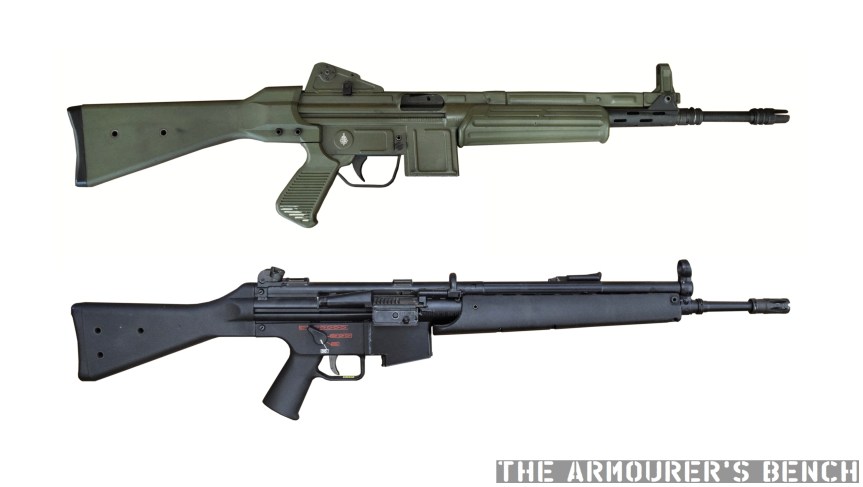
In this week’s video we compare two of the last roller-delayed production rifles: the Spanish CETME Modelo L and the Heckler & Koch G41. These rifles represent the last evolutions of two strands of the roller-delayed development tree – the Spanish and the German.
The CETME L & HK G41 (Matthew Moss)
Both rifles use the roller-delayed blowback action and are both chambered in NATO SS109 5.56x45mm ball round, have have 1:7 twist barrels and feed from STANAG magazines. Both were developed during the 1980s and both are also capable of firing rifle grenades.
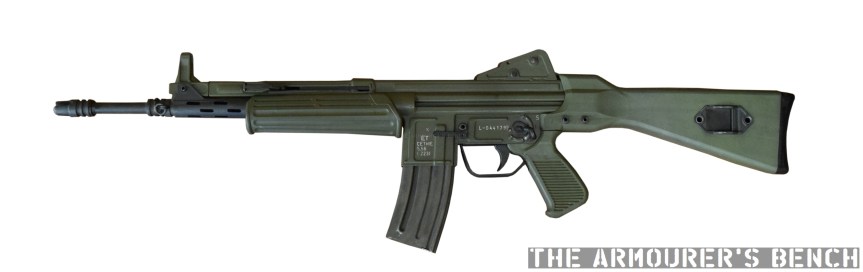
The CETME L
Left-side profile of the CETME L (Matthew Moss)
The CETME has a bit of a reputation for being cheap but this relatively unbattered example feels solid enough. Both of the rifles disassemble in much the same way with the butt assembly being removed to allow the bolt to be pulled out of the rear.
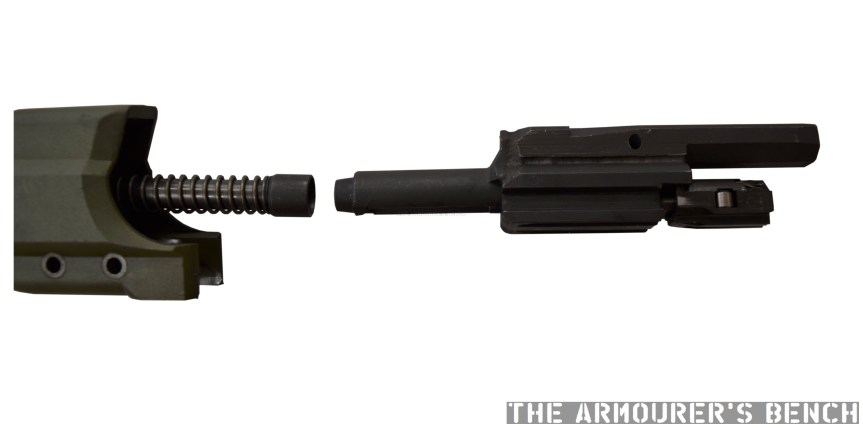
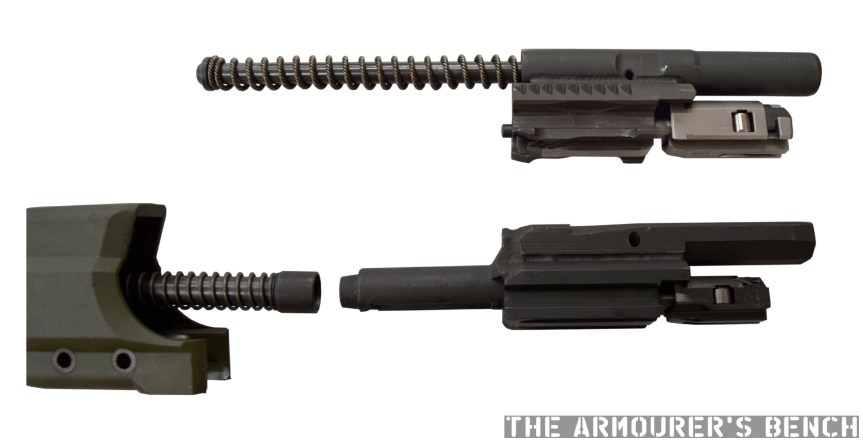
Most notable about the CETME’s bolt is the long rod protruding out the back of the bolt assembly. This acts on the recoil spring housed inside the butt. The L’s recoil spring, unlike the G41s, is captive inside the butt rather than nested inside the rear of the bolt carrier. The CETME’s bolt is also much squarer than the G41’s which probably simplified the machining of the bolt and designing the receiver stamping.
The L’s bolt and butt assembly (Matthew Moss)
The L does not have a provision to lock its bolt back in a slot like the HK (no CETME slap for Spanish soldiers), however, it does have a bolt hold open, with the release located in the rear sight base.
The CETME has simpler folding aperture sights with 200–400m adjustments. It weighs in a 3.72kg or 8.2lbs unloaded and is 92.5cm or around 36in in length. The CETME has a simpler fire control group, with safe, semi and full-auto settings. It is not ambidextrous and only has a selector on the left side of the receiver. The CETME L has largely been replaced by the weapon that superseded the G41 – the gas-operated HK G36.
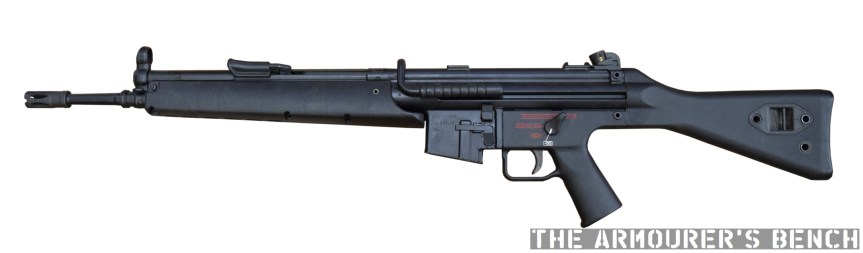
Heckler & Koch G41
The left-side profile of the G41 (Matthew Moss)
We have full article and video examining the G41 in detailhere.
HK finalised the G41’s design in 1979, a refinement of the 5.56x45mm HK33, it sought to modernise the platform and borrowed features from the M16 family of rifles including a bolt release catch, dust cover and forward assist.
The G41 has a butt assembly that fits into the receiver rather than around it. So its cross pins are at the top and bottom of the receiver rather than both at the bottom. This spreads the stresses on the receiver vertically rather than laterally.
Comparison of the G41 and Model L’s bolts (Matthew Moss)
The G41 has both the classic HK hold open notch and a AR-style paddle bolt release. HK’s dioptre drum sights have adjustments from 100 to 400m, and can mount a scope using an HK claw mount. G41 is the heavier of the two rifles, weighing in at 4.31kg or 9.5lbs. The G41 is also slightly longer than the L at nearly 100cm or 39in in length.
The HK has an ambidextrous selector with positions for safe, semi, 3-round burst and finally full-auto. The G41, unlike the L, also has a folding carrying handle near its point of balance.
The G41 represents the last evolution of HK’s infantry rifles using the roller-delayed blowback action. It comes from a period when HK were developing what they hoped would be the next generation of small arms technology and with the collapse of the G11 programme and the lack of sales of the G41 saw it superseded in the 1990s by the gas-operated G36.
The SAR-80’s story begins in the early 1970s, when Frank Waters, the Sterling Armaments Company’s chief designer, began developing a 5.56x45mm rifle for sale to foreign militaries. While two initial prototypes were produced the project lapsed when Sterling secured a license to manufacture Eugene Stoner’s AR-18.
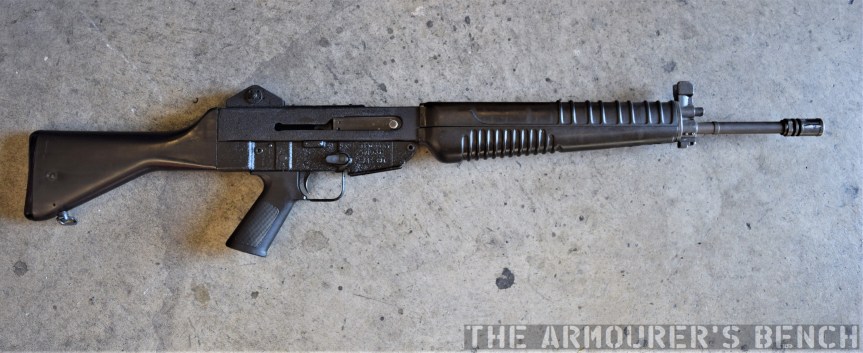
Right-profile view of the SAR 80 (Matthew Moss)
In the late 70s the project was resurrected and in February 1977, two prototypes were sent to Chartered Industries of Singapore (CIS)[later known as ST Kinetics] who had been seeking a 5.56x45mm rifle design to produce for export to sustain production at their factory. The initial prototypes reportedly suffered issues with obturation with some cartridges and Sterling engineers worked to rectify this with another batch of half a dozen prototypes being sent to CIS in late 1977. CIS produced their first pre-production prototypes in 1978, for testing by the Singapore Army. CIS opted for a plastic buttstock and redesigned the handguards too.
Factory brochure photo of Singaporean soldier with SAR 80 (CIS)
Initially described as the Sterling Light Automatic Rifle and later the Sterling Combat Rifle the rifle, however, as it finally entered production in 1979, it became known as the Singapore Assault Rifle 80 or the SAR-80. Some of the earlier rifles are also marked ‘Sterling Assault Rifle’.
The first SAR-80s were delivered to the Singapore Armed Forces in early 1981 for troop trials. Faults with these early production rifles included poor fit and finish and extractors which bent leading to extraction and ejection issues. Refinements made rectified these faults and subsequent production runs had improved reliability.
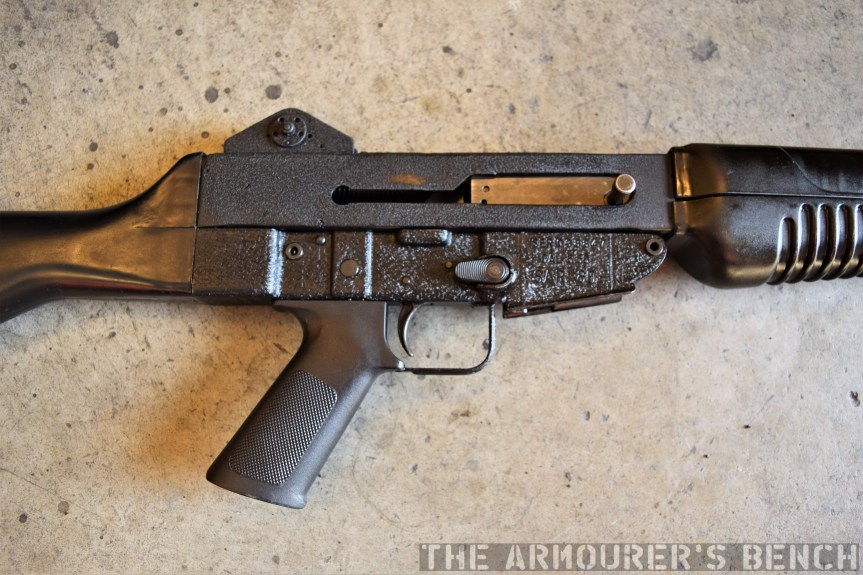
Close up of the receiver, note the sliding dust cover is missing from this rifle (Matthew Moss)
The SAR-80 can be described as a clone of the Armalite AR-18 with their internal designs almost identical. The SAR-80 is gas-operated, with a short-stroke gas piston and a rotating bolt. The bolt has 7 locking lugs, the internal mechanics of the rifle are more or less identical to that of the AR-18, using dual recoil springs and a rectangular bolt carrier. The bolt geometries differ slightly to the AR-18’s and the SAR-80 also has an additional weight inside its bolt – which adds mass and helps slow the rate of fire down to around 600rpm. Like the AR-18 its charging handle is attached directly to the bolt carrier and is reciprocating.
The rifle feeds from standard STANAG magazines and is select-fire, with a selector on the left side of the rifle and a magazine release on the right. The selector layout is modelled after the M16’s and the front handguard’s design was also influenced by the M16. The SAR-80 has simple stamped receiver, similar in profile to the AR-18’s, it has a crackle-paint finish, like that seen on the commercial Sterling Mk4 SMGs. It has a two-position folding rear peep sight and is 97cm (38in) long and weighs 3.7 kg (8.2 lb) unloaded.
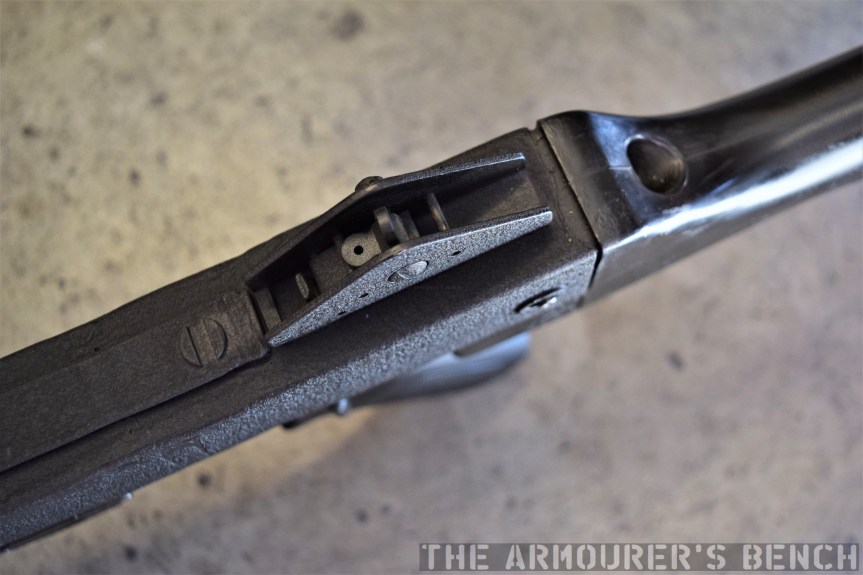
Close up of the rifle’s sights, note the rudimentary scope mounting rail (Matthew Moss)
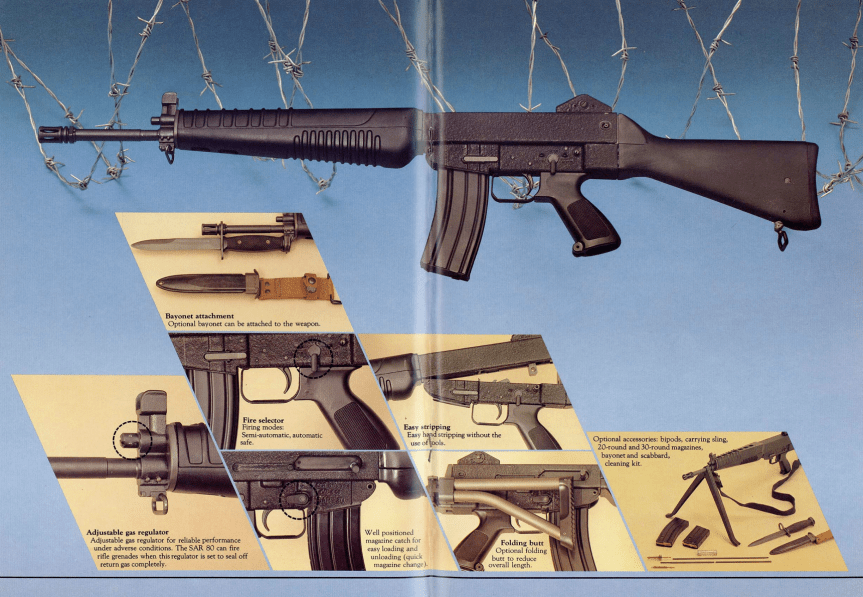
The SAR-80 had a bayonet lug just beneath its adjustable gas block and mounted an M16-pattern bayonet, other accessories included a scope mount, bipod and a blank-firing adaptor. And of course a folding stock variant was also available.
Graphic showing the rifle’s features from factory brochure (Matthew Moss)
I didn’t have a chance to strip the rifle but here you can see the hammer inside the receiver – its worth noting that this rifle does not have the sliding dust cover seen on other examples, and the charging handle slot is completely open.
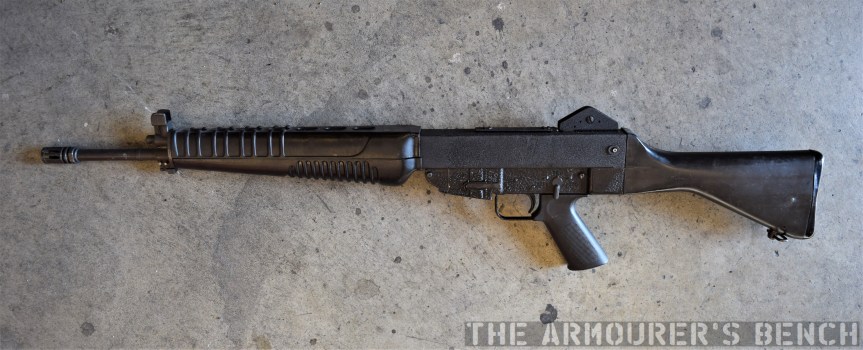
Left-profile view of the SAR 80 (Matthew Moss)
Developed with cost in mind, contemporary literature from CIS state an export price of around $300 per rifle, the equivalent to day of about $930. CIS produced more than 80,000 between 1980 and 1988, it saw limited service with Singapore’s military but did enjoy some export sales, with the SAR-80 used by the Central African Republic’s Gendarmerie, the Croatian Army, the Papua New Guinea Defence Force and the Slovenian Territorial Army. CIS replaced the SAR-80 with the SR-88, a rifle co-developed with Sterling as the SAR-87, but this proved unsuccessful and has since been superseded by the SAR-21 bullpup.
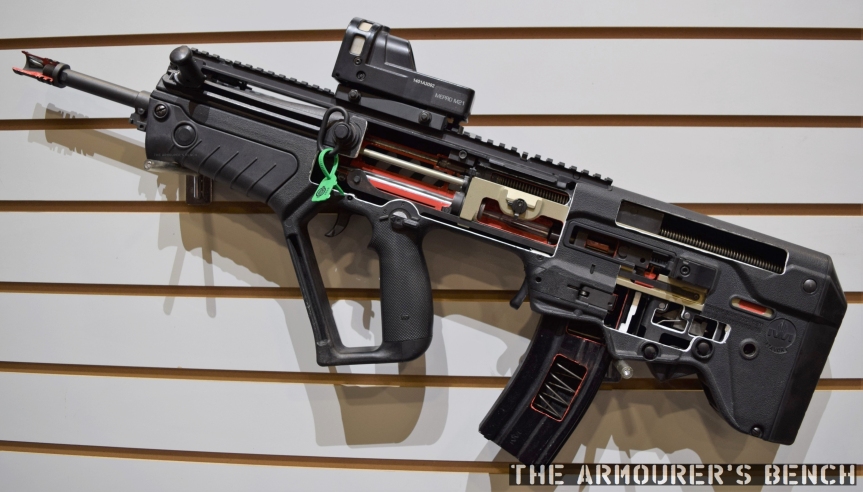
Last week Matt attended SHOT Show 2020 and spotted a pair of Tavor cutaway demonstration guns at the IWI booth. Above is a quick video, put together on the fly, looking at the cutaway guns and showing how they illustrate the Tavor’s working parts and operation.
Cutaway IWI Tavor (Matthew Moss)
Developed in the mid-1990s to meet IDF requirements for a reliable and compact rifle to replace the M16s & M4s in service. The rifle had to be shorter to deal with the close quarter urban fighting the IDF often found itself in.
The Tavor or TAR-21 uses a long strike gas piston system inspired by the AK and has a rotating bolt. The bullpup configuration gave the desired compact weapon without sacrificing barrel length.
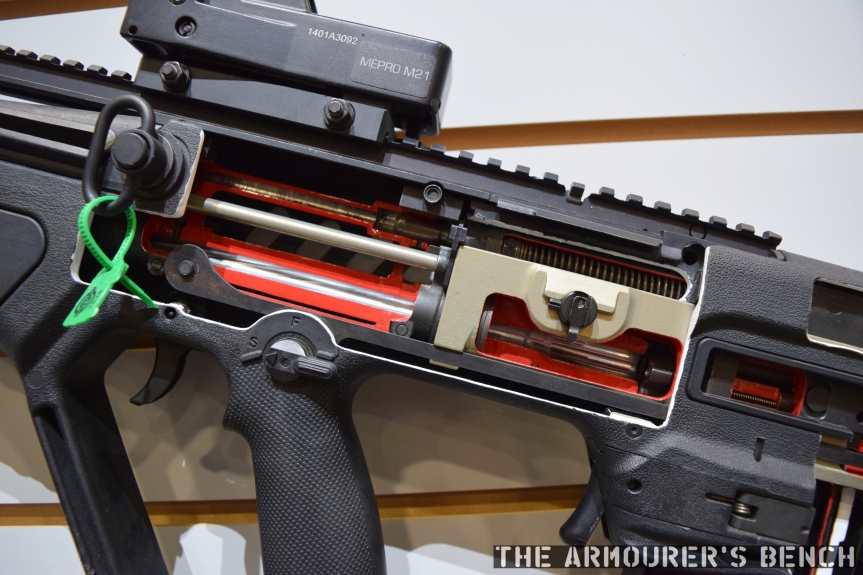
A closer look at the gas piston system, the barrel, chamber and the bolt face (Matthew Moss)
The cutaway rifles on display at the IWI booth were actually civilian, semi-auto only, Tavor SARs but they give us a good look at the rifle’s internals and how the Tavor functions. We can see the gas piston system, the charging rod and the barrel at the bottom. Moving back we can see the chamber, the bolt carrier group, the sear assembly and the bolt hold open mechanism.
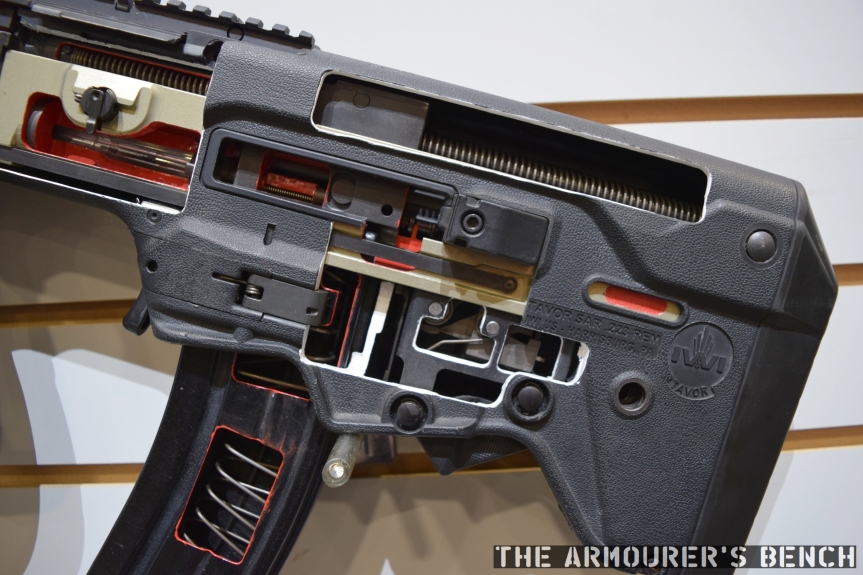
In this photo we can see the cutaway magazine as well as the mainspring at the top of the photo and below it the bolt carrier group and the bolt release mechanism (Matthew Moss)
They also cutaway the magazine so we can see the spring inside. At the top of the weapon we can see the mainspring that stretches back into the butt. The model was fully functional so on pulling the trigger the connecting rod acted on the sear release to trip the firing pin.
Additionally, the bolt release, just behind the magazine, also functioned and when operated the bolt went forward onto battery. The Tavor entered service in the early 2000s and has been superseded by the X95 and joined by the 7.62 chambered Tavor 7.
We will have a more in-depth video on the Tavor in the future.
In the second video Matt tackles the Heckler & Koch G11 and gives an update on the colouring book and the channel:
Thanks for watching chaps & thanks so much for your support in 2019, we greatly appreciate it. It’s been a busy year and we hope that you’ve all enjoyed our videos!
You can still pick up a copy of the ACR colouring book and the G11 sticker at www.armourersbench.com/shop. we’re very much looking forward to seeing your artistic sides when you send us some photos of your colouring to – contact@armourersbench.com.
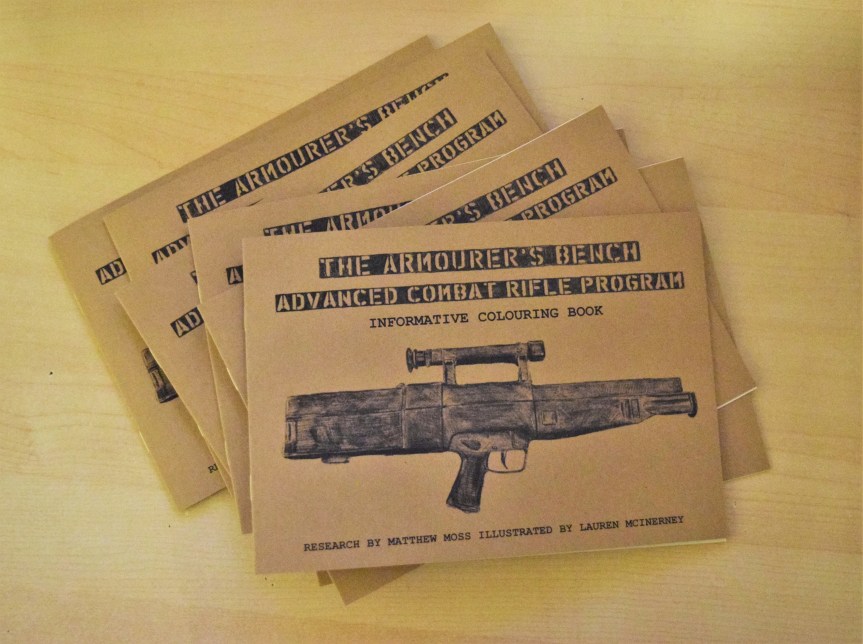
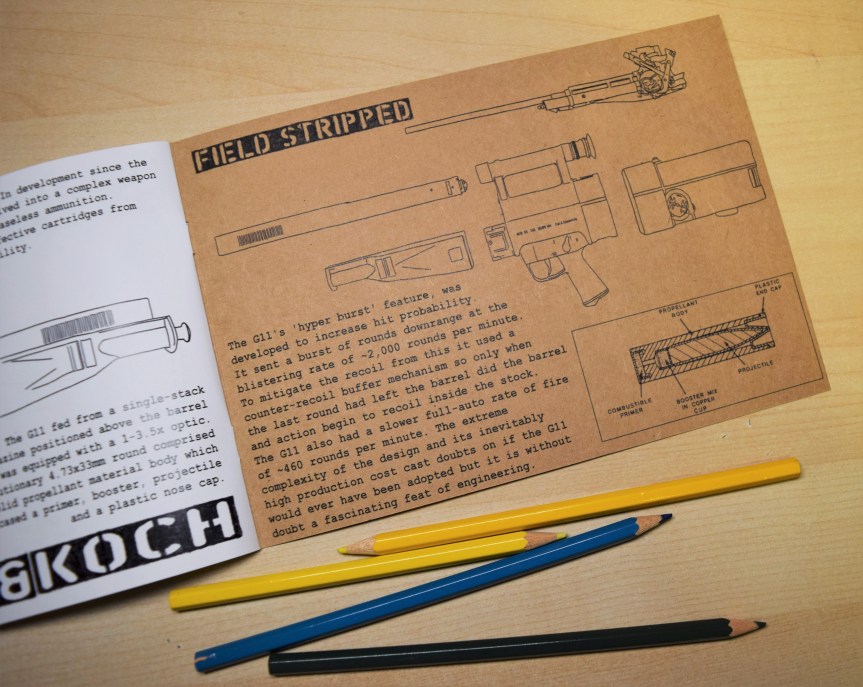
The Armourer’s Bench are proud to introduce our very first ‘informative colouring (coloring) book’. Not only can you colour in the prototypes from the US Army’s Advanced Combat Rifle trials but you can also learn about the guns, how they worked, performed and the outcome of the trial as you colour!
Why a colouring book? Well, simply put, no one else has done one before! With the help of our brilliant illustrator, Lauren McInnerney, we put the book together to give you guys something a bit different, something fun!
We have a limited run of these little books and we will do our very best to get them our ASAP if you order them for Christmas.
The book includes detailed original illustrations of each of the four ACR guns: the AAI, Colt, Steyr and of course the iconic HK G11. The 8-page booklets are 8×6″ (or A5 sized) and are available now from our website for $6.00, plus shipping.
All the funds raised from the sale of the books will go toward supporting TAB through 2020.
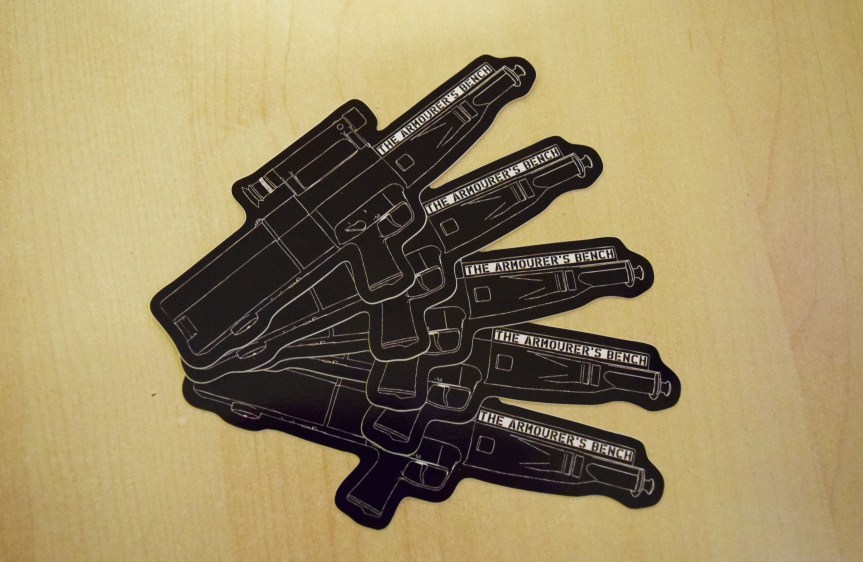
But wait! That’s not all! We also have some extremely cool new stickers available. These 4″ cutout vinyl stickers feature the TAB logo on an illustration of the G11.
And last but not least we also have a small run of TAB logo badges available too!
Today, we’re going to take a look at a little known type of weapon which rose to prominence in around the time of the First World War with a number of examples being developed and some even tested. As you can see from this footage it’s something pretty unconventional, seen here mounted on the back of a truck – is a centrifugal machine gun.
I found this short footage while doing some digging through the online catalogue of the US National Archives. The centrifugal machine gun was not a new concept by the time this footage was filmed in the early 1920s, sadly the footage notes done give an exact date.
A still from footage of the demonstration (US National Archives)
While the technology had risen to a new prominence what was the allure of centrifugal machine guns? The principle of centrifugal force – an inertial force which appears to act on objects moving in a circular path, directs them away from the axis of rotation. As a result a centrifugal machine gun required no propellant powder to propel the projectile, or a case to contain it, nor a conventional rifled barrel to stabilise the projectile. Once released from the axis of rotation the projectile travels on a linear trajectory until it expends its energy. It works along the same principle as a primitive sling. The primary issue is providing power to exert the centrifugal force and a means of accurately firing the projectiles.
Some of the earliest work on centrifugal guns was done in the late 1850s in the US. The hand-crank or steam powered guns patented by William Joslin (US #24,031), C.B. Thayer patent for a ‘machine gun’ in August 1858 (US #21,109) and Charles S. Dickinson (US# 24,997) in 1859. Dickinson went on to secure financial backing from a wealthy Maryland industrialist Ross Winans and developed a steam powered version of his gun. Despite gaining much press attention Dickinson’s centrifugal gun saw no action during the US Civil War. In 1862 G.C. Eaton and S.W. Turner also patented a ‘machine gun’ (US #37,159).
An illustration of the Winans Steam Gun, Frank Leslie’s Illustrated Newspaper, May 1861
It wasn’t until World War One that the concept began to be considered again. In June 1918, Major Edward T. Moore and Saul Singer filed a patent for a centrifugal machine gun powered by an electrical motor (US #1,332,992). The motor spooled up the centrifugal barrel assembly to rotate extremely quickly and impart centrifugal force on projectiles. According to Julian Hatcher the gun could fire steel ball bearing projectiles at approximately 1,200 feet per second. Fire was controlled by a stop pin in the ammunition feed tube. Moore claimed the weapon could fire a projectile 1.5 miles with enough force to kill a man. He also suggested the weapon’s rate of fire approached 2,000 rounds per minute. It appears that Moore’s gun may have been tested in 1918 but Hatcher described its accuracy as ‘extremely poor’.
Photograph of Moore’s gun during testing (Hatcher)
Another centrifugal design developed during World War One was E.L. Rice’s half-inch centrifugal gun, sadly I’ve been unable to find any photographs or drawings of Rice’s design but the weapon was submitted to the US National Research Council in 1917. The NRC’s 1919 report states that the gun had been further developed by the NRC’s Physics Division in Pittsburgh but work had been slowed by “a common defect which has been difficult to eliminate”. Despite what the report described as ‘considerable headway’ the weapon was subsequently abandoned amid some controversy about credit for the design.
There seems to have been something of a centrifugal machine gun craze with several more patents filed between 1917 and 1926. A Scientific American article from March 1918, even noted that “every so often the daily press becomes enthused over a new centrifugal gun.”
One of the earliest patents granted appear to have been for a design by E.E. Porter, granted in January 1917. This was followed in July 1919 by inventor, Herbert A. Bullard being granted a patent (US #1,311,492) on a design which fired a disc rather than a ball. At the same time T.A. Gannoe was granted a patent (US #1,309,129) for a large, complex looking gun shown mounted on a pedestal.
In 1920, F.R. Barnes (US #1,327,518) and W.W. Case (US #1,357,028) were also granted patents which had been filed in 1917. In late 1921, Levi Lombard was granted a patent he had filed in March 1918, his gun even appeared in Scientific American. It appears to be notably smaller than Moore’s gun and has a spade grip for aiming. This was followed in 1923, by an interesting patent from Joseph T. McNaier for a centrifugal gun that could be powered by an electric or petrol engine, some of the patent diagrams show how the gun might be placed in an armoured car or aeroplane (US #1,472,080). Intriguingly, McNaier and Moore appear to have known each other quite well and were partners in a law firm together.
Here’s a gallery of some of the various patents mentioned above, not all are as detailed or as advanced as others:
The question is which of these guns is featured in the footage. The most likely bets are the Moore or the Czegka. Sadly, with only a side view and just 18 seconds of footage we don’t have much to go on. The accompanying reel notes, describing what is seen in each section of the film, describes the gun as being in the “experimental stages only” and that the prototype seen here “is intended for use as aircraft armament, for tanks and for landing parties of the Front line trenches.”
Sadly, we don’t get to see how the gun works but we can see the operator feeding the ball bearing projectiles into the hopper which has a powered feed system – he empties two cylindrical containers of balls into it one after another. It is unclear how many rounds might be in the containers, perhaps 50 each. The gun and its motor are mounted on a truck bed with a soldier in uniform, possibly aiming the weapon via a tiller.
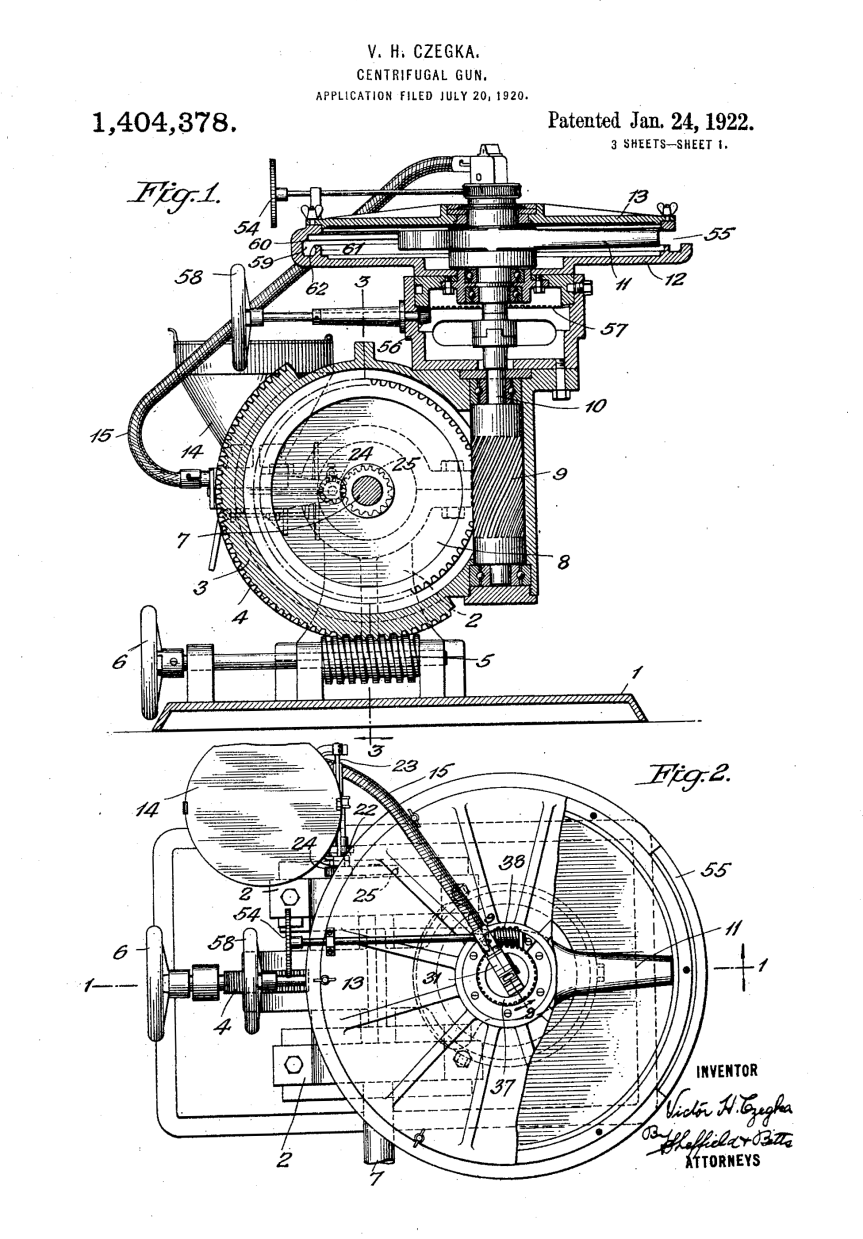
Another of the later designs dating from the period came from Victor Czegka, a US Marine Corps Technical Sergeant, who is perhaps best known as the supply officer of Admiral Richard Byrd’s first two expeditions to the Antarctic. Czegka was granted a patent for a centrifugal machine gun in January 1922 (US #1,404,378).
Czegka’s 1922 patent (US Patent Office)
With some further digging I managed to find several articles referring to the gun in the US Army Ordnance Journal. Interestingly, a photo from the same demonstration is printed in one article, from late October 1920, with the caption confirming the man loading the weapon is the inventor, however, he isn’t named. The footage was filmed during the Second Annual Meeting of the US Army Ordnance Association. Another article dating from May 1921, also notes that the tests took place at Aberdeen Proving Ground, with the gun firing at 16,000 revolutions per minute which required 98 horsepower from the engine powering it. The gun apparently needed a “very rapid increase in power required for operation” when the speed of its revolutions was increased incrementally from 12,000 to 16,000 rpm. The article concluded that “a horsepower above 100 would have no material effect in increasing the speed” suggesting that a much more powerful, and therefore larger, engine would be needed to increase the revolution rate.
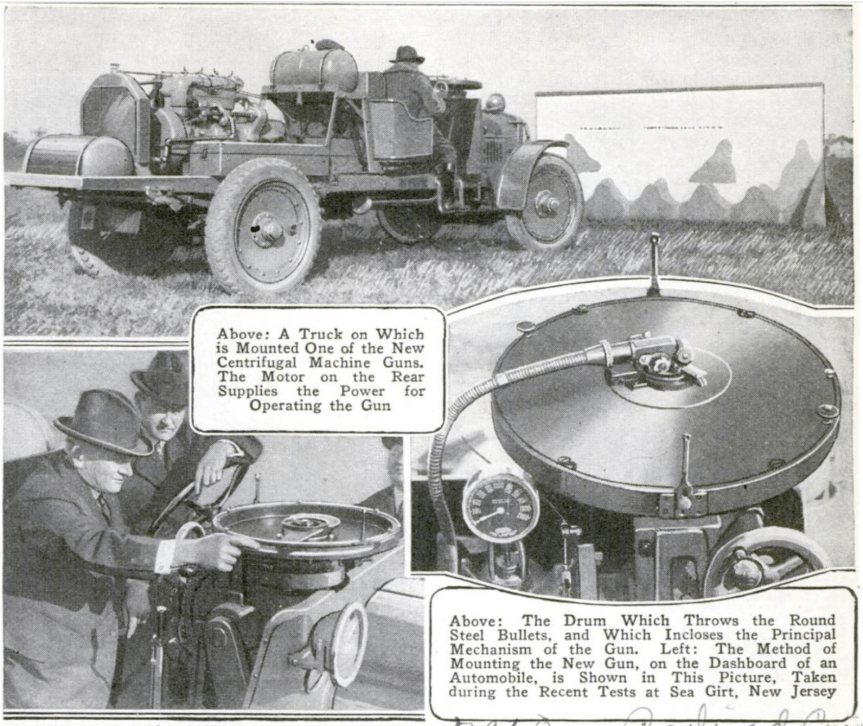
While researching I came across this set of images from a March 1922 edition of Popular Mechanics showing an unnamed centrifugal gun set up on a truck, powered by an engine on the truck bed. From the images it appears to be a gun similar to Moore’s with a single rotating ‘barrel’. The captions also note that the photographs were taken in New Jersey and Moore was a Major with the New Jersey National Guard, which may also indicate the gun is Moore’s.
Despite various designs seeing some US military testing none were ever adopted and relatively little information on them is available. It seems that they were relatively cumbersome weapons with extremely varying accuracy but this footage at least proves the concept. A short report in a may 1921 edition of Scientific American may shed some light, stating an unnamed gun was rejected “because of its great weight and its inability to obtain high initial velocity” concluding that “no centrifugal gun can have military value”. It appears that the range of the centrifugal guns was limited to the speed of their revolution, which in turn was limited by the power of the engine and motor that powered them. The larger the motor, the more cumbersome the weapon system was.
There are very few photos of centrifugal machine guns so stumbling across actual footage of one guns actually operating is very exciting. They are a fascinating tangent to the history of the machine gun – one that occasionally still garners interest.
Update
A viewer shared a Pathe Newsreel with us which included more footage from the same demonstration. The footage title suggests it dates from 1938, however, I believe this to be incorrect.
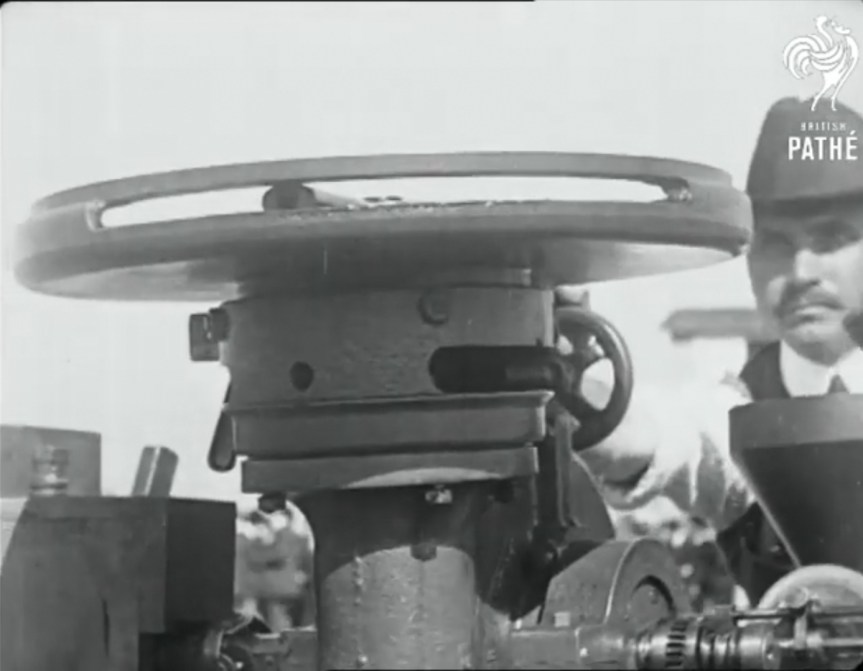
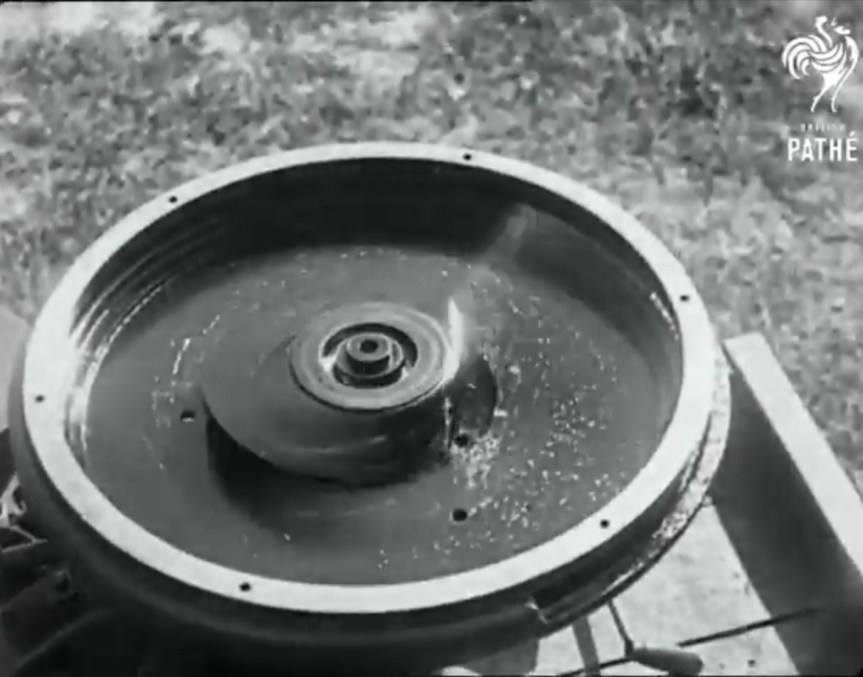
Despite the incorrect date the footage shows us the internals of the centrifugal gun and its aiming mechanism!
Here are few screen captures from the footage:
The gun’s hopper being loaded (Pathe)A front view of the weapon, showing the slit from which projectiles fired through, and a better look at the operator’s face (Pathe)The gun with its top cover and feed system removed showing the centrifugal barrel spinning up – a info card from the footage suggests it is spinning at 12,000 rpm (Pathe)












 The Armourers Bench