William Mason’s T-Charging Semi-Auto Rifle

Earlier this year I had the pleasure of visiting my friends at the Cody Firearms Museum and while having a look through their collection we came across a really interesting rifle. The rifle isn’t currently on display and was safely tucked away in one of the museum’s vaults. When we began looking through the vault’s racks we came across what we initially thought were a number of John Browning prototypes from his work with the Winchester Repeating Arms Company. One of the prototypes immediately caught our eye as it had a T-shaped charging handle, something today which is synonymous with the AR-15/M16 platform.
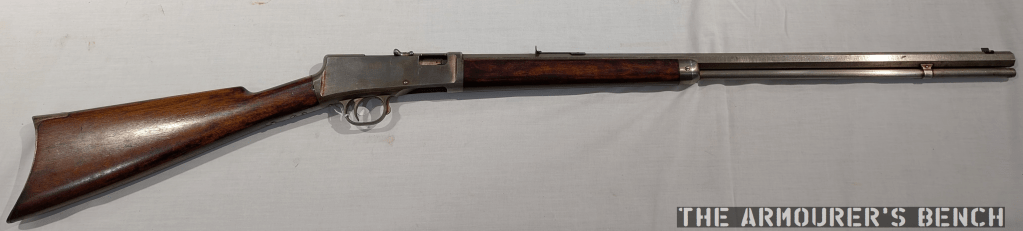
Right side profile of the prototype (Matthew Moss)

In the past I’ve had the pleasure of examining over a dozen of John Browning’s prototypes (some videos are already published on the channel others will be published in the future – stay tuned), this rifle, however, isn’t a Browning. It’s a Mason.

William Mason is probably best known as the man behind the Colt Single Action Army, the Model 1877 and what would become the Model 1889. In 1882, Mason left Colt and joined Winchester. While originally he has been recruited to work on revolvers for Winchester, a topic for another day, he became Winchester’s Master Mechanic and was responsible for bringing many of John Browning’s designs to production. Following the Brownings’ schism with Winchester in 1903, the company continued to develop their own designs and a number of these came from Mason.
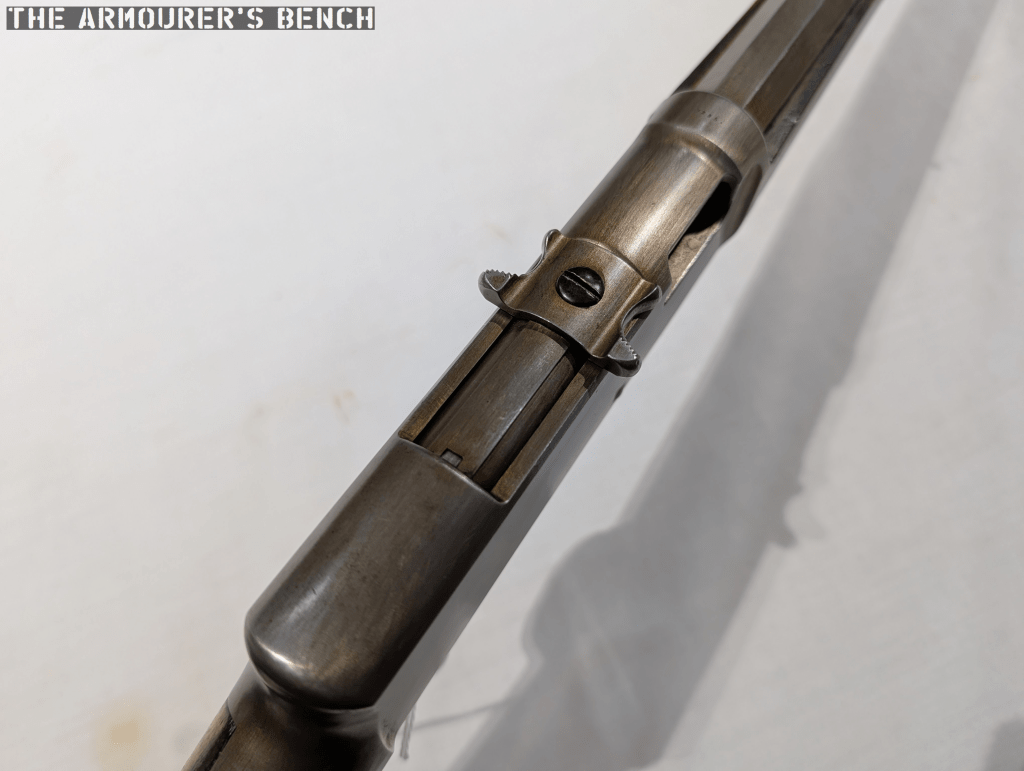
Rear right quarter view of the prototype’s receiver and charging handle (Matthew Moss)

This rifle’s patent was filed in March 1905, and granted on 12 March, 1907 as No.846,591. It is a .22 calibre, semi-automatic rifle which feeds from a conventional tube magazine but has a number of interesting features.
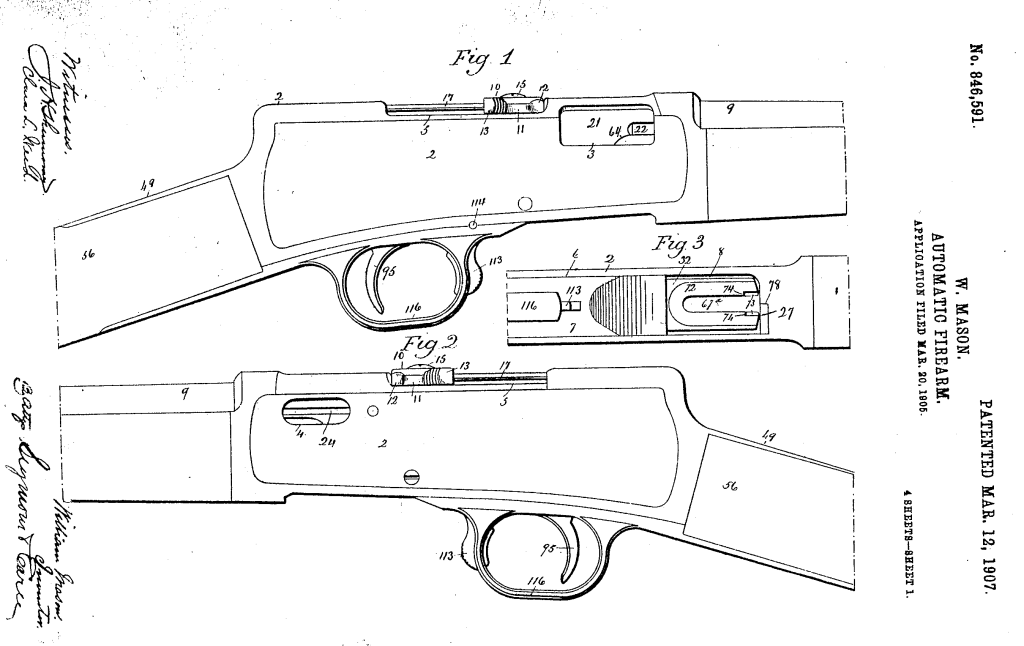
US Patent No.846,591

The Action

Mason, in his patent for the rifle, describes the weapon’s action as a ‘automatic balanced breech-block gun’, by which he means what we now know as a blowback. He describes this as: “a breech-block which is not positively locked in its closed and recoil-taking position but weighted with reference to the energy developed by the explosion of the cartridge to be used in the gun, so that its inertia takes the initial shock of recoil.”

The only marking visible on the firearm is on the top of the receiver, a number marking: ‘7295’.
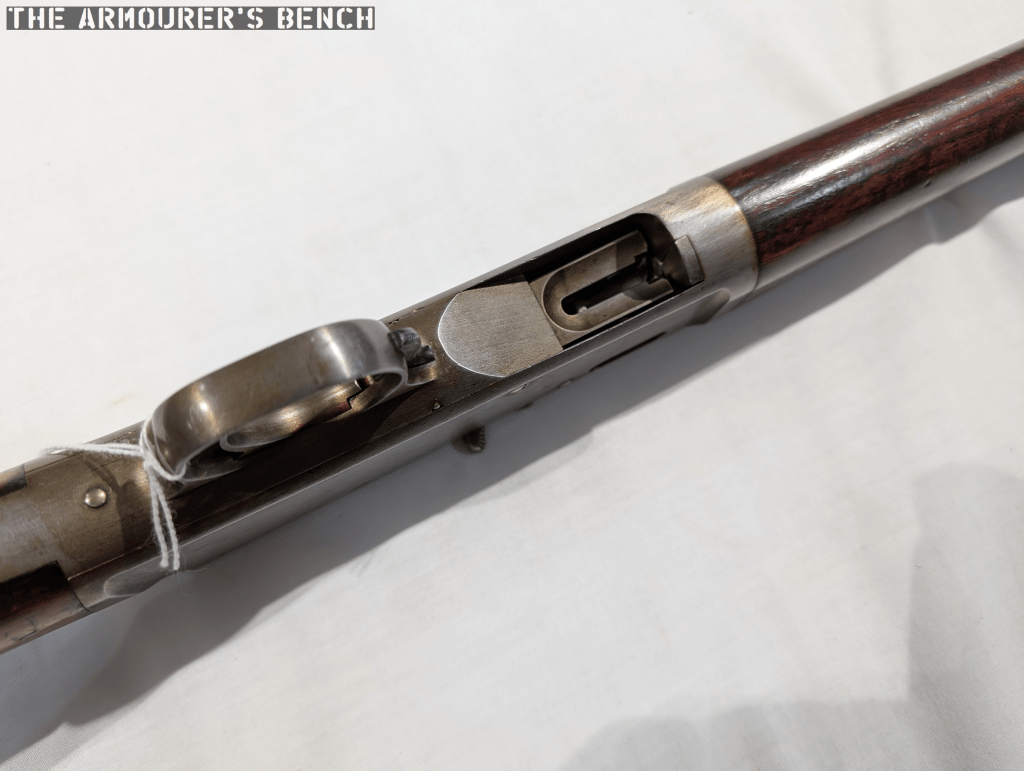
View of the underside of the prototype’s receiver and loading port (Matthew Moss)

Safety

The rifle also has a trigger locking safety located at the front of the trigger guard. The patent describes this:

“provide the gun with a ‘safety’ in the form of a lever, suspended by its upper end from a pivot in the lower tang and having its lower end entered into a slot in the forward reach of the trigger-guard, which is a part of the said lower tang. The said lever is formed with a stop-shoulder, co-acting with a stop-finger at the forward end of the trigger. When the safety is pushed rearwardly, its shoulder is moved under the finger, whereby the trigger is locked against operation under any circumstances.”
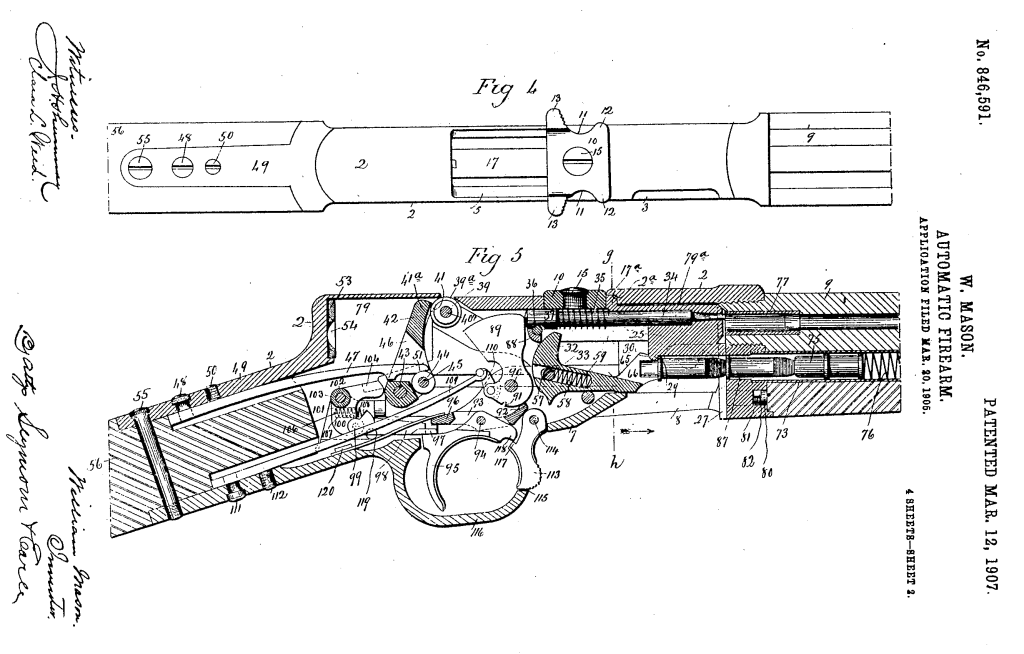
US Patent No.846,591

Loading

The rifle has a swinging carrier which when the breech block cycles it acts on what Mason calls the ‘carrier arm’ via a cam which moves the arm up and down allowing a round to move into the action from the tube magazine when the bolt had moved sufficiently to the rear. The rifle’s tube magazine is loaded by pushing the carrier up and thumbing cartridges into the magazine.

Anti-friction Rollers

Another intriguing feature of the rifle’s action is the set of rollers located in the top of the breech block which prevent friction from the block against the receiver. The rollers also act on a lever which is under spring tension which returns the breech block forward – Mason used this in the place of a more conventional return spring assembly. Instead the lever is acted on by a flat spring which Mason felt allowed him to “secure a marked economy of space” in the receiver, not requiring a coil spring and the space needed to compress it. Additionally, at the rear of the receiver there is also a buffer made from ‘vulcanised fiber’, vulcanisation is a process which strengthens and improves the durability of a material. As we didn’t fully disassemble the rifle we can’t confirm the buffers presence in the prototype.
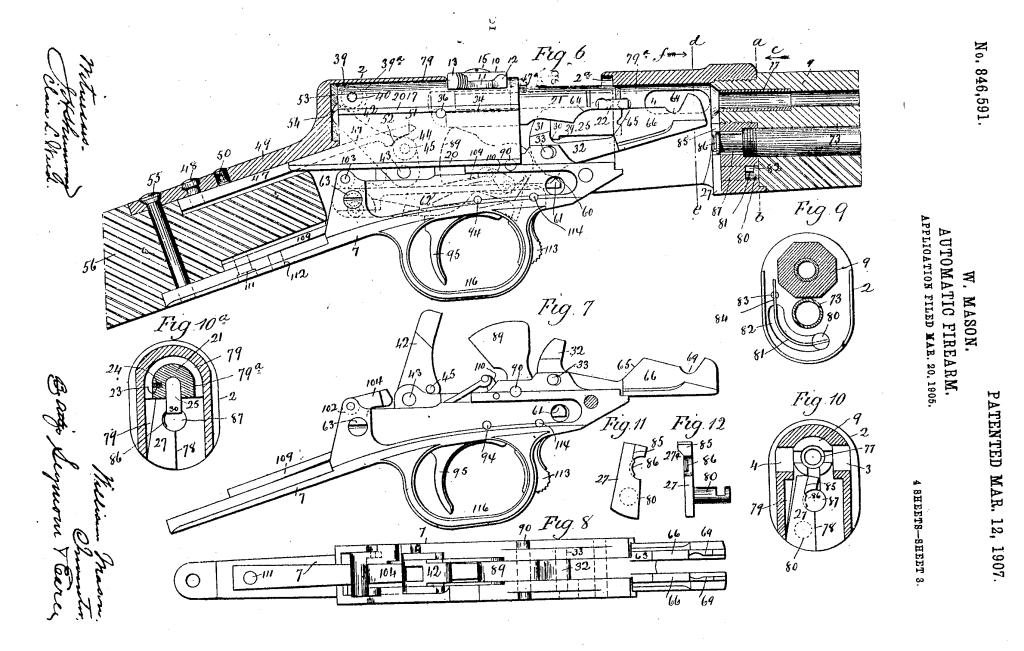
US Patent No.846,591

Mystery Hole

On examining the rifle I was a bit perplexed by what the purpose for a smaller hole opposite the ejection port was. It is too small to be an ejection port and on the same side as the ejector{?} On reading Mason’s patent it became clear that this was an emergency gas port to allow gas to escape the receiver in the event of a major failure. Mason explains this:

“gas-escape opening is so constructed and arranged with reference to the construction and arrangement of the breech-block that it permits the escape of gas through it when the breech-block is in its closed position, so that in case there should be a leakage of gas due, for instance, to the splitting of the head of a cartridge the gas will work back and escape through the said opening without damage to the gun, whereas in the absence of such a gas-escape opening, the breech-block might be broken or deformed by the force of the gas bending it from left to right toward the ejection-opening.”
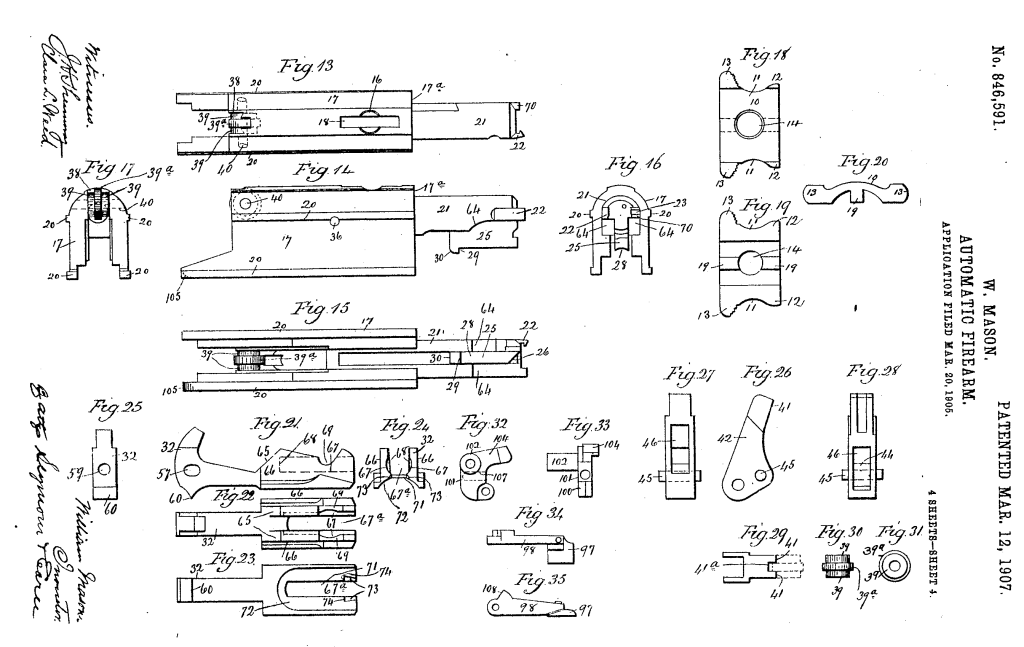
US Patent No.846,591

Charging Handle

Perhaps the most intriguing external feature is the charging handle. Is it the first rifle with a T-shaped charging handle? Here’s how Mason’s patent describes it:

“breech-block handle arranged transversely with respect to the top of the gun-frame and in length exceeding the width thereof. The ends of this handle are formed with finger-cuts, flanked at their forward ends by ears and at their rear ends by knurled, or roughened fingers, extending outwardly beyond the planes of the side walls of the frame, so as to be readily engaged by the finger and thumb, respectively. The said handle is also formed with a centrally-arranged screw-hole, receiving a screw, entering a screw-hole in the forward end of a longitudinally-reciprocating non-rotatable balanced breech-block.”
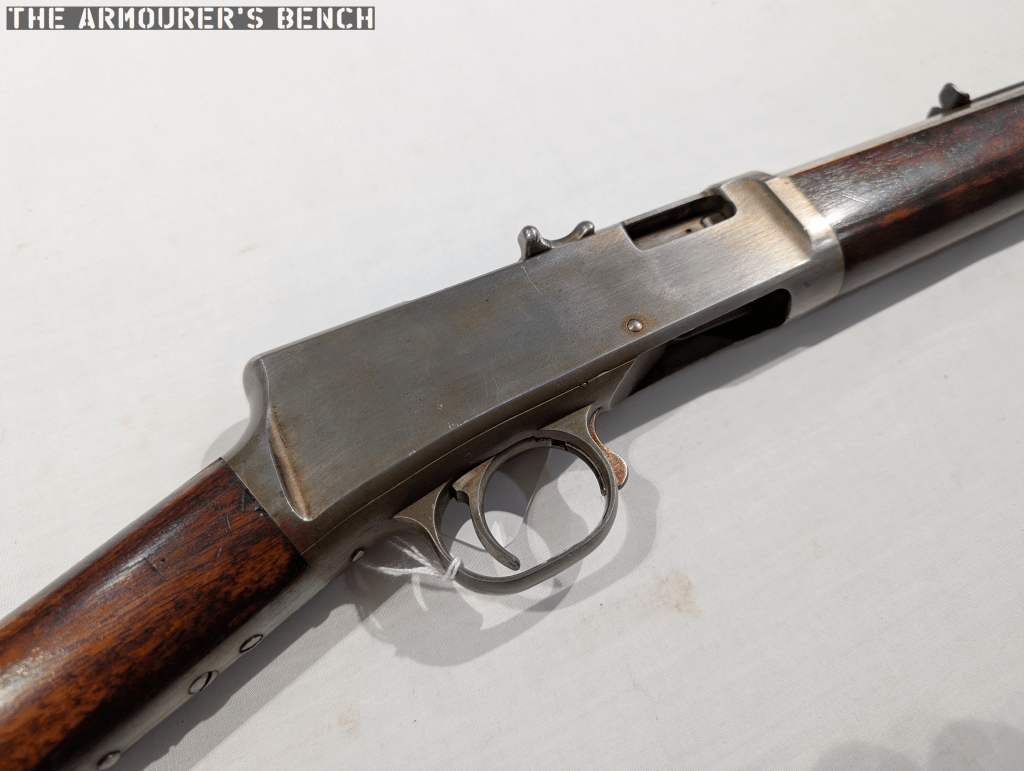
View of the prototype’s receiver (Matthew Moss)

All-in-all it’s a really interesting patent and well worth a read to understand some of the nuances I don’t have time to cover here.

Despite the prototype’s interesting design it never made it into production. In 1903, Winchester had introduced the Model 1903, a tube magazine-fed, blowback rifle, chambered in .22 Winchester Automatic. The Model 1903 was designed by another of Winchester’s engineers, T.C. Johnson, and instead of a T-shaped charger used a plunger, which I think is a little less elegant but the Model 1903 was a success, remaining in production for decades, so it seems that Mason’s design wasn’t needed. As a result it would be another 60 years before a rifle using a T-shaped charging handle became popular in the US. Mason continued to work for Winchester until his death in July 1913, aged 76.

Massive thanks to my good friends at the Cody Firearms Museum for allowing me to examine this rifle and thank you to my friend Tyler Berger for his help filming this video. Please do check out the museum online at centerofthewest.org/our-museums/firearms/ and if you can head out there this summer to visit one of the best publicly displayed collections of firearms in the world.


Support Us: If you enjoyed this video and article please consider supporting our work here. We have some great perks available for Patreon Supporters – including early access to custom stickers and early access to videos! You can also find us on the History of Weapons & War app. Thank you for your support!

Periscope Rifles in Ukraine

With the war in Ukraine’s current trench-bound stalemate often resembling the First World War it isn’t too surprising to see an early 20th century innovation making a comeback. Several variations on the concept of a periscope rifle have been seen in Ukraine since the summer of 2023.

A still from Heroes of Gallipoli (1915) showing a periscope rifle (via IWM)

The concept actually pre-dates the First World War, with sights like William Youlten’s Hyposcope dating to 1900, but really emerged during the war with many nations developing similar periscope-based systems that allowed service rifles to be mounted in frames and fired over the parapet removing the need for soldiers to expose themselves when sniping.

The first design featured in an article by Jeff Farrell in June 2023, Farrell interviewed a Czech veteran of the International Legion, Marian Simunek, who was wounded and has since developed a periscope which a rifle can be mounted in. In a pair of videos Simunek demonstrated fitting the rifle into the periscope mount and how it would be fired. Simunek manages to mount an AK-74 in the periscope mount within 30 seconds. The stock folds down from the body of the periscope and is secured with the pistol grip and trigger assembly being lined up, the stock of the rifle is secured by two straps and then the trigger cable is attached to the rifle’s trigger.

A second periscope design emerged in late January 2024, when a short video showing a tall tripod-mounted periscope was shared. The video shows the testing of a prototype gun mount which can be raised up to above parapet height and allows the gun to be aimed using the periscope the gun is show being tested in both semi-automatic and fully automatic. The trigger is attached to a command cable which runs down to a front grip with an exposed trigger in front of it. The tall monopod isn’t the most stable platform but the user demonstrating it supports the assembly using the integrated stock and pistol grip assembly and holds the stand with his off hand. While the ability to quickly raise and lower the rifle mounted on the stand is useful, especially for reloading, but it may lack stability in the field.

The third variation on the periscope rifle concept was shared on 18 March, with a short 22 second clip showing an AK-pattern rifle with its stock removed, mounted on a well fabricated pole with a periscope, an off hand support grip, a stock shaped like an AKS-74 folding stock and a pistol grip and trigger assembly which uses what appears to be a brake cable. In another video of the mount in the same position an individual demonstrates the articulation of the mount (albeit without a weapon installed). The mount has a wide tripod base and appears to be well made. The gun is set up in an urban environment behind a wall, likely for demonstration proposes. The this periscope rifle may be a more developed version of the previous design but I’ve been unable to find the original source for the video.

Interestingly, another video of as similar periscope rifle set up was shared, the design is clearly the same as that seen in the previous video. The shape of the stock has changed and the position and design of the stabilising forward hand grip differs.

While trench periscopes have been in use since the early weeks of the war, a more modern approach is the use of digital camera aimed remote weapons. These include the Shablya (sabre) remote weapon station developed by Roboneer, which has been in development since 2015 and has been tested with numerous different types of machine guns including PKs and M2 Brownings. Another similar system is the Tarantul, developed by engineers of the 118th Territorial Defence Brigade. This is a concept that Russian forces have also been experimenting with with a number of systems seen in test videos.

The available imagery of periscope rifle systems originating from the war in Ukraine is relatively small so its difficult to gauge their utility fully, I’ve yet to see any evidence of their front line use. They are a specialist piece of kit which depending on the design is suited to some environments more than others. If you’ve seen other examples of periscope rifle systems or evidence of their use in combat please do let me know!


Support Us: If you enjoyed this video and article please consider supporting our work here. We have some great perks available for Patreon Supporters – including early access to custom stickers and early access to videos! Thank you for your support!


Making Belt Boxes For Ukraine’s Machine Guns

Earlier this month Popular Mechanics published an article I wrote about GRaft, a Ukrainian company which has manufactured belt boxes for almost every type of machine gun being used by the Ukrainian armed forces.

While belt boxes might not seem like the most exciting pieces of military equipment, they’re no less vital than the guns they’re paired with; the boxes are essential for storing and carrying ready-to-use belts of linked ammunition, and they allow machine gunners to move around unencumbered by hanging belts that can become tangled.

M240 GPMG with GRaft 100-round belt box (GRaft)

GRaft initially designed and manufactured furniture including benches and tables but with the full-scale Russian invasion in February 2022, they have since turned their attention and skills to belt boxes. With machine guns being transferred to Ukraine by a plethora of different countries this has led to a wide variety of machine guns entering service with the Ukrainian armed forces. In many cases the machine guns transferred to Ukraine are often without enough belt boxes.

I spoke to one of GRaft’s engineers who explained that their impetus to begin designing and manufacturing belt boxes came from friends’ experience with old boxes for PK-pattern machine guns. He explained that the old aluminium PK boxes had seen decades of service and there was a general shortage of them.

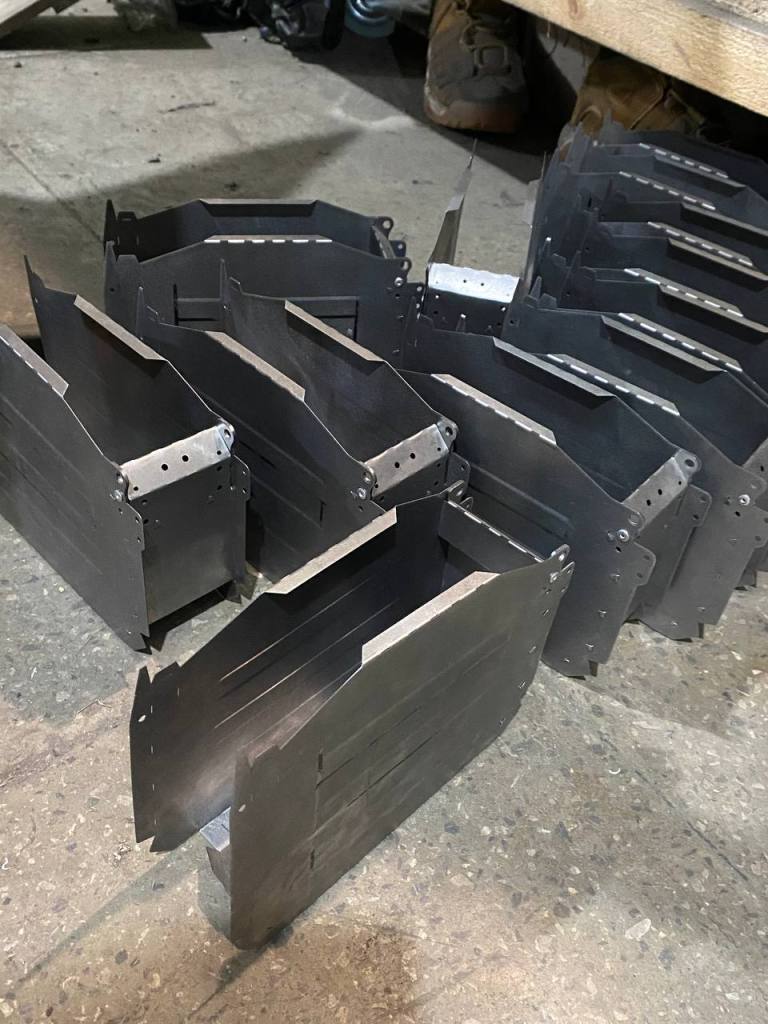
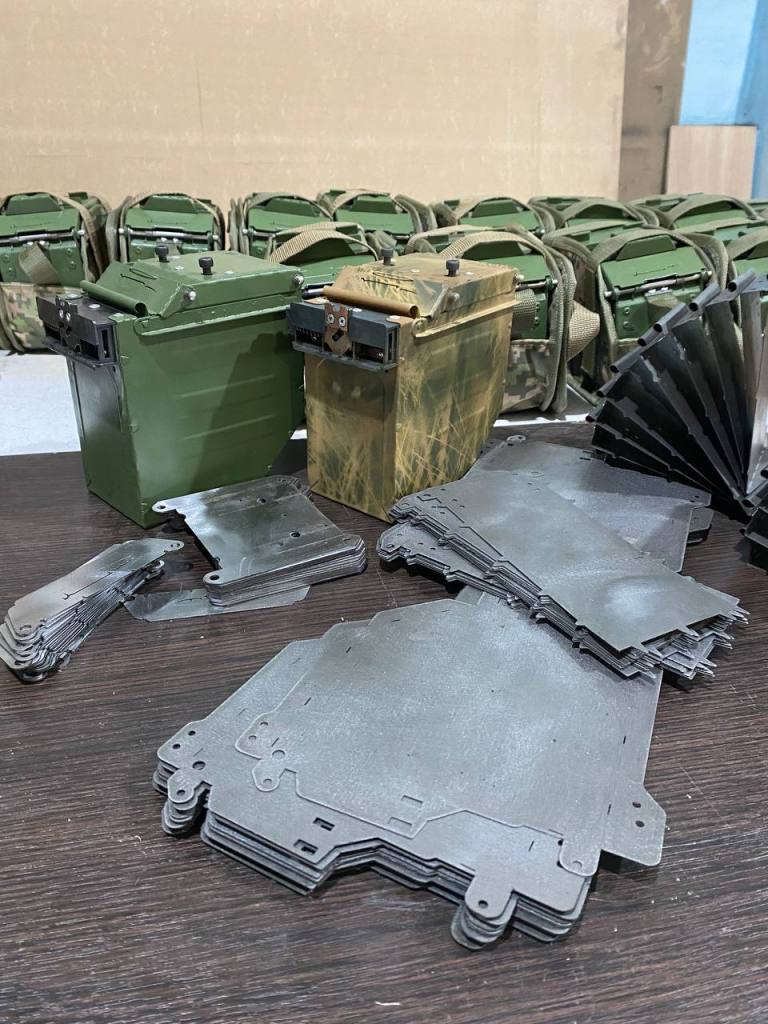
GRaft belt boxes at various stages of fabrication (GRaft)

GRaft began work on their PK box in April 2022 and within a month had a design ready for manufacture. GRaft refined its designs based on direct user feedback and soon began working on belt boxes for other weapons ranging from 14.5mm KPVs to 5.56x45mm and 7.62x51mm FN Minimis.

GRaft kindly shared some videos from their workshop showing how the belt boxes are fabricated. They use laser cutting to cut sheet metal into blanks which are then shaped and riveted and spot welded into their final form. They work with a small paint shop that then powder coat the boxes.

PK GPMG with GRaft belt box (GRaft)

The company also developed 75 and 100-round boxes for the FN MAG/M240, the 100 round box was designed with an angled wall so the mass of the belt sits closer to the weapon’s center of balance, improving the weapon’s handling. Similarly they have also begun producing boxes for 7.62x51mm MG42-pattern machine guns. Their goal, the engineer told me, is “satisfied machine gunners” but really they’d like to get back to producing furniture.

Check out my full article on GRaft’s work over at Popular Mechanics.


Support Us: If you enjoyed this video and article please consider supporting our work here. We have some great perks available for Patreon Supporters – including early access to custom stickers and early access to videos! Thank you for your support!


The Hammerless 1911

Ever since I picked up a copy of John Browning and Curt Gentry’s 1964 biography of John M. Browning I’ve been fascinated by this hammerless .45 calibre pistol, one of Browning’s prototypes for the US Army’s semi-automatic pistol trials.

The Browning .45 calibre pistol prototype with a shrouded hammer (Matthew Moss)

Last year I had the opportunity to visit the John M. Browning Museum in Ogden, Utah and I was thrilled to see the ‘hammerless’ prototype on display. Very little has been written about the development of this particular pistol with Browning and Gentry explaining that during the US Army’s long process to select a new service pistol John Browning decided to provide two versions of his .45 ACP pistol – one with an exposed hammer and the other with a shrouded hammer similar to that seen on his Colt 1903 and 1908 Pocket Hammerless commercial pistols. 

The ‘hammerless’ pistol is identical in operation to the exposed hammer prototype which was eventually selected as the M1911. It uses the same improved tilting barrel action which is covered by the patent filed in February 1910, US #984,519. The slide and frame profiles of the ‘hammerless’ pistol have been reshaped with the slide extending back further shrouding the hammer while the rear of the frame projects back, lining up with the rear of the slide rather than forming a beavertail. The pistol grip angle, at near 90-degree, is more akin to the Colt Pocket Hammerless and earlier Colt-Browning semi-automatic pistols.

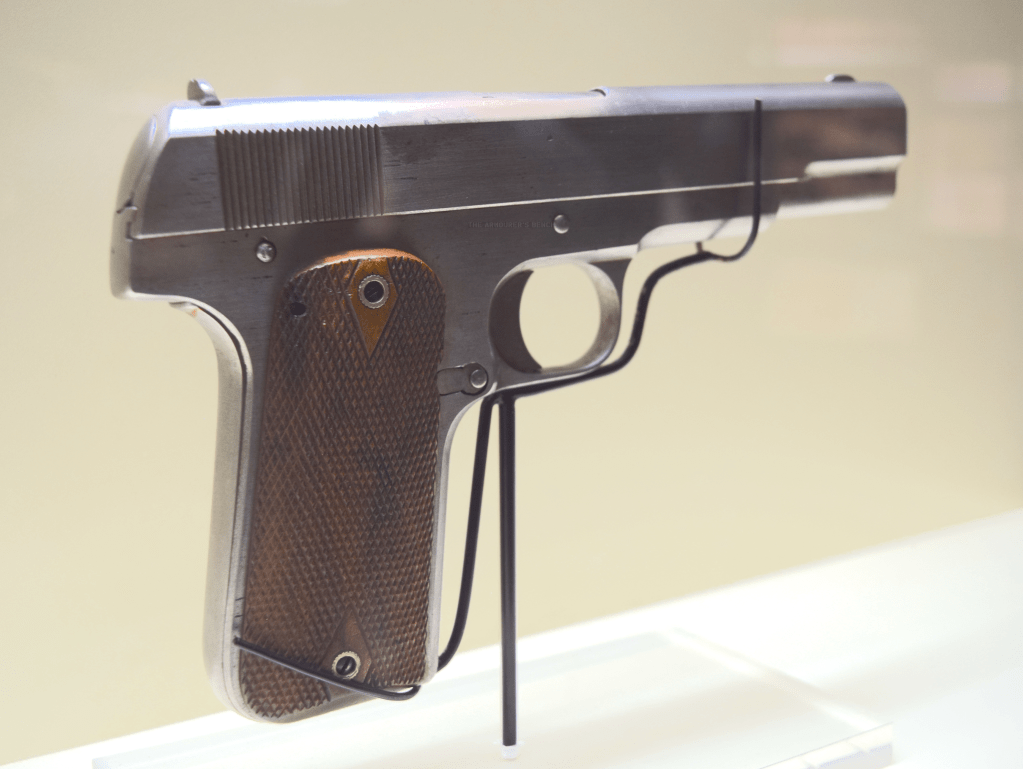
The Browning-Gentry book lists the pistol as 8 inches in length overall with a 3.75-inch barrel and a weight of 2lbs 4oz. The pistol has a grip safety and a frame-mounted safety and a push-button magazine release on the left side of the frame. Sadly the pistol was behind glass and with time short we couldn’t get a better look at the gun. 

The Browning .45 calibre pistol prototype with shrouded hammer on display at the Browning Museum (Matthew Moss)

The chronology of the various prototypes’ development is sometimes difficult to track as Browning’s hands-on style left few written descriptions of the designs as they evolved. The museum dates the pistol to 1905 but displays it alongside the pattern of pistol often referred to as the Model 1910. Interestingly, the ‘hammerless’ pistol also has the frame-mounted safety which was reportedly added late in the refinement of the 1910 pistols. The ‘hammerless 1911’ was never commercially marketed by Colt and the exposed hammer .45 ACP pistol went on to win the US military pistol trials and became an iconic design. 

Huge thanks to the Browning Museum in Ogden for allowing us to film in their collection – we have some really exciting videos from the museum coming up. 


Support Us: If you enjoyed this video and article please consider supporting our work here. We have some great perks available for Patreon Supporters – including early access to custom stickers and early access to videos! Thank you for your support!


Bibliography

John M. Browning: American Gunmaker, J. Browning C. Gentry (1987)

The Guns of John Browning, N. Gorenstein, (2021)

Handguns of the World, E.C. Ezell (1981)

‘Rarest of the rare: Browning 1910 & Hammerless .45’, American Handgunner, (source)

Second World War Anglo-American Ammunition Contract

Recently a very interesting document surfaced in an online auction, while it eventually sold for more than I could afford, I thought it was worth sharing some of the interesting images of the document that were shared in the auction.

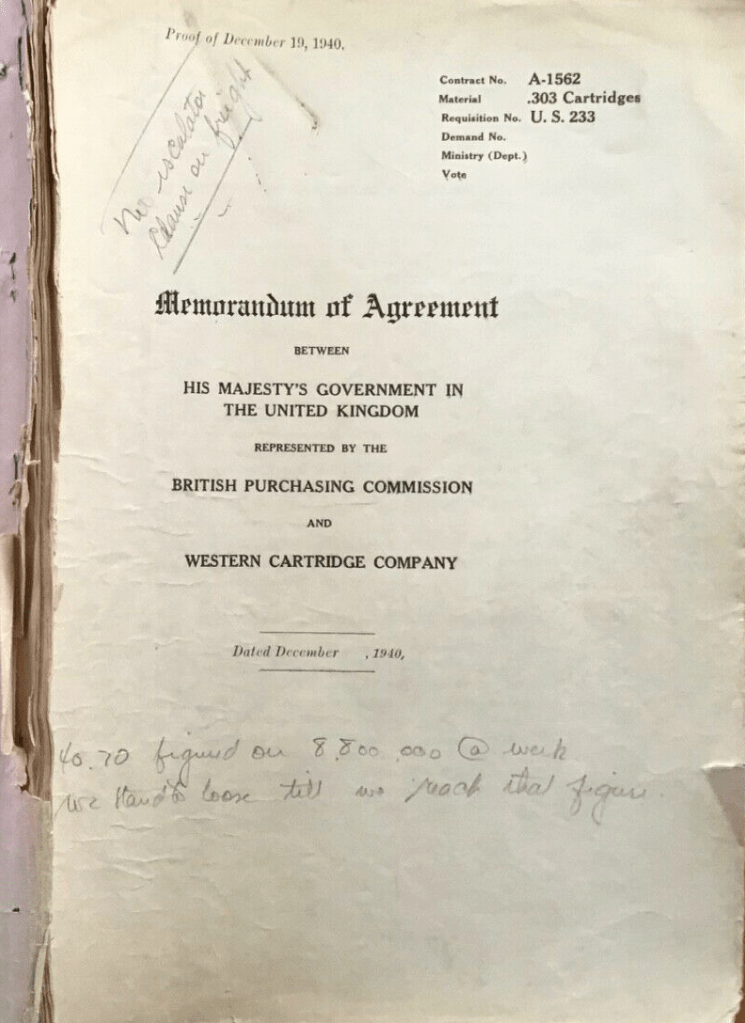
Front page of a draft contract for ammunition, drawn up between the British Purchasing Commission and the Western Cartridge Co. (via War-Office)

The document is a draft of a contract to order .303 ammunition from the Western Cartridge Company, part of the Olin Corporation. Before the US passed the Lend-Lease Act, in March 1941, which cleared the was for greater material assistance from the US to Britain the British Purchasing Commission was tasked with procuring arms, ammunition and materials from US companies.

First page of the contract (via War-Office)

The document, originally drawn up in December 1940 called for a mind-blowing 75 million cartridge per month. To do this the Western Cartridge Company needed to expand its production capacity. The contract deals with the intricacies of expanding the company’s manufacturing base and how this expansion would be paid for.

A still from a British newsreel c.1942, showing a British ammunition factory.

The contract states that the .303 ammunition would be for aircraft, for use in weapons like the belt-fed .303 Browning machine guns used in the RAF’s bombers and fighters. The contract mentions that a total of 750 million rounds are required. 20% of these could be requested, at a month’s notice, to be tracer rounds.

It is fascinating to see not only the typed and stapled amendments but also the handwritten notes in the contract’s margins which change quantities, dates and other details. The ammunition is described in ‘Exhibit F’ of the contract as being ‘MkVII .303’. The contract also mentions that the Western Cartridge Company could use its own smokeless powder for the first 100 million rounds and subsequently either their own or powder from Du Pont or the Hercules Powder Company. This means that the ammunition was probably MkVIIIz, as the cartridges did not use Cordite. It is unclear whether the projectiles to be used in the Western Cartridge Co. cartridges used the MkVIIIz boat tail .303 projectile.

A still from a British newsreel c.1942, showing .303 ammunition being tested at a British ammunition factory. The ammunition is being tested in a Vickers Gun, a Bren LMG, a Vickers K and a .303 aircraft Browning

The Western Cartridge Company was not the only US ammunition manufacturer to produce .303. Winchester, another Olin Corporation manufacturer, and the Peter’s Cartridge Company also produced .303 MkVIIIZ.

Sadly we don’t have the rest of the document to examine but these pages offer a really interesting insight into how Britain was procuring ammunition for various weapons during the early part of the war when the situation looked increasingly desperate.

Pages from the March 1941 contract (via War-Office)

A subsequent auction listing for ‘Contract No. A-1562. Requisition No. U.S.233. Dated March, 1941’ also calls for a substantial amount of ammunition, some 400,000,000 rounds. The 42 page contract refers to the ammunition as MkVII and notes the use of Hercules Hivel 300 powder and describes it as ‘S.A. Ball .303 with American modifications dated 7 November, 1940’. The March 1941 contract also states that depending on testing it could be used for ground or air use.

If you found this interesting check out our article/video on a unique Remington M1903 Prototype chambered in .303 built for Britain around the same time!


If you enjoyed this video and article please consider supporting our work here. We have some great perks available for Patreon Supporters – including custom stickers and early access to videos! Thank you for your support!


Bibliography:

The .303 British Service Cartridge, R. Tebbutt, (source)
Original WW2 British Contract for Manufacture of .303 Ammunition by Winchester, Dec. 1940 eBay/War-Office (source)
Original WW2 British Contract for Manufacture of .303 Ammunition by Winchester, Mar. 1941 eBay/War-Office (source)

British Military Small Arms Ammo, (source)

The Browning Machine Gun – Rifle Calibre Browning Abroad, D. Goldsmith, (2006)
British 303 Cartridge Case Identification, S. Taylor, (source)

Footage:

Manufacture and testing of 0.303″ Ammunition in 1942 (source)

Making Mills Bombs

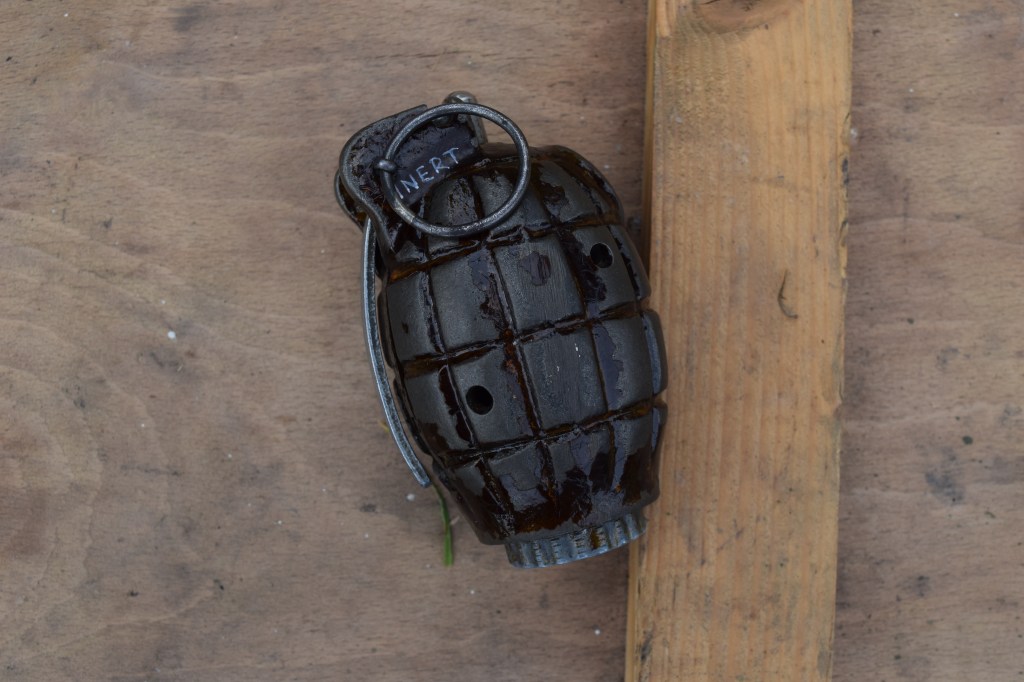
The No.36 or Mills Bomb was one of the longest serving grenades, developed during the First World War it originated from a Belgian design by Albert Dewandre and Capitaine Léon Roland. It was improved by a British industrialist, William Mills, who owned several metal forging factories.

A No.36 Grenade (Matthew Moss)

It entered service in late 1915 as the No.5 Mk1 and continued to be improved during the war with several iterations before it finally became the No.36M Mk1. We’ll look at the Mills bombs development more closely in a future video/article – today, with the help of some 1940s newsreels from New Zealand we’re going to look at how they were manufactured. While the newsreel doesn’t state the factories featured they were made by a number of factories including Anderson Engineering in Christchurch (these were marked with an “A” below the filler plug), Booth Mcdonald, of Christchurch (marked BM), Scott Brothers, also of Christchurch (marked SB), and Mason & Porter, of Mt Wellington, in Ackland (marked MP).

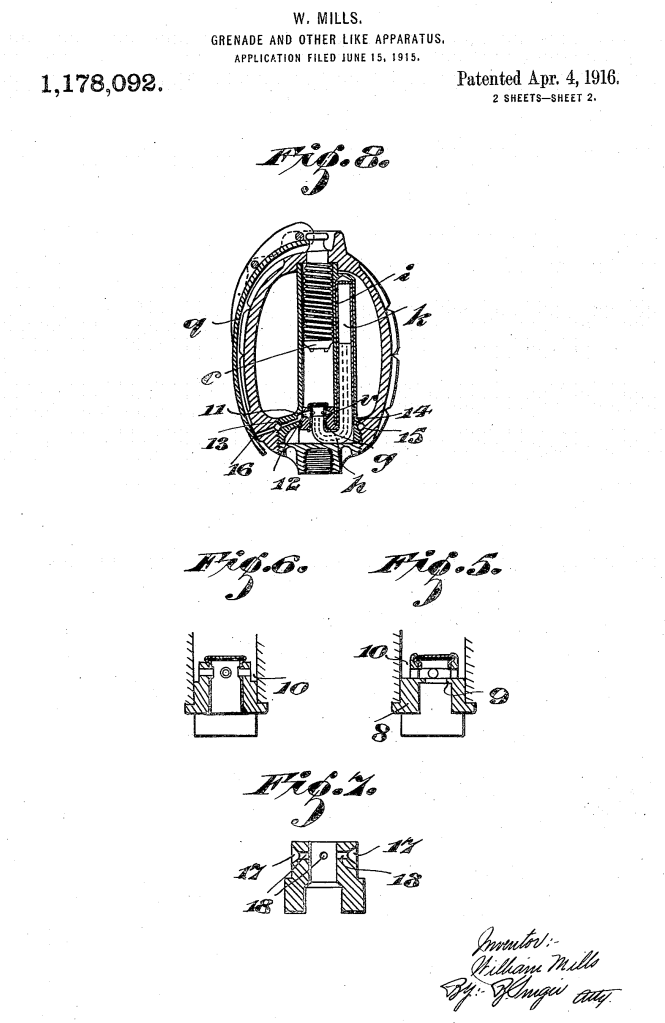
William Mills’ 1916 Patent for the grenade.

In the first newsreel, courtesy of Archives New Zealand (Weekly Review No. 70 (1943)), we see No.36 grenades being cast – the newsreel takes a slightly humorous approach of describing the process as a recipe – making ‘pineapples’ – a slang name by which grenades were sometime’s known. The factory is using the sand casting method with a pattern pressed into the sand and then removed. The two halves of the grenade’s body are pressed into sand, a pressed sand core could then be placed inside which would allow the grenade’s body to be poured hollow to allow room for explosives and detonator. If we again pause here we can see a machinist is centring and counter-sinking the filling hole’s first thread for its plug.

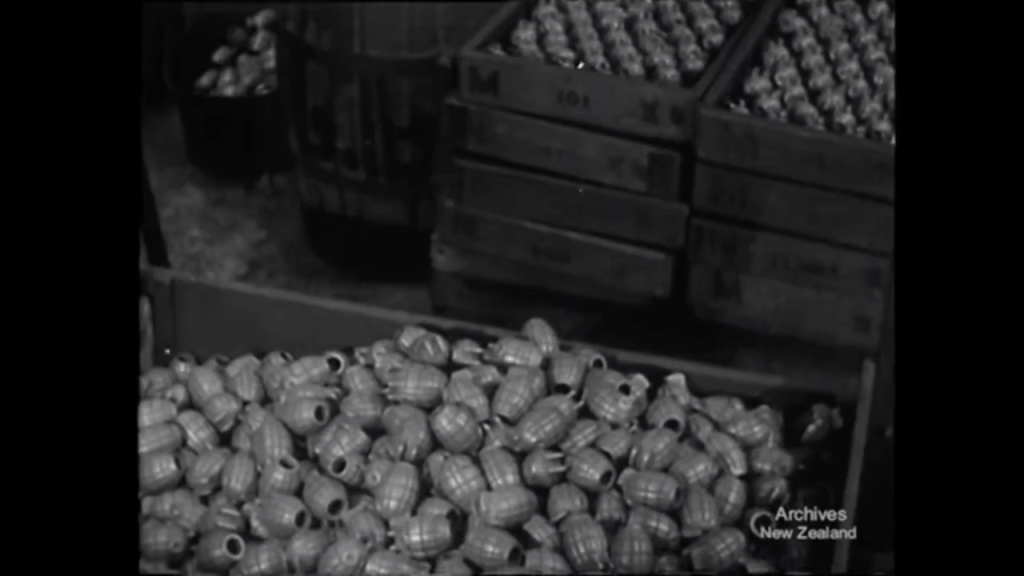
Cast grenade bodies ready for filling (Archives New Zealand)

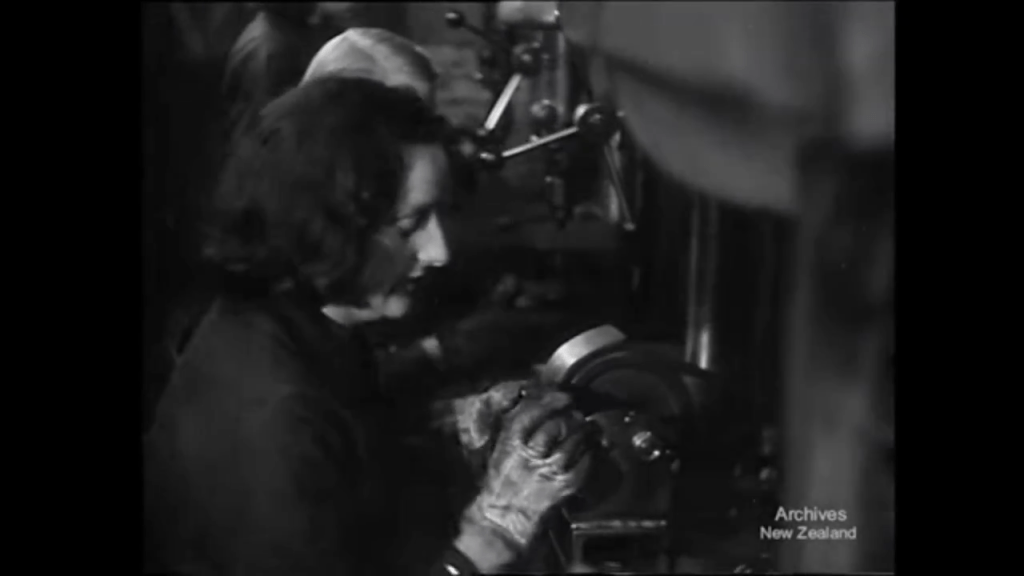
The footage includes a brief shot we see a woman factory worker drilling out the top of the grenade’s body and perhaps de-burring the side of the safety lever holder. In the next shot we see more machinists at work with one lady linishing the body of the grenade, removing imperfections from the casting on a grinder or polishing wheel and in the background some women a working on milling machines or drill presses. 

Women factory workers linishing the grenade body castings (Archives New Zealand)

At the very end of the film we can see the grenade bodies are stacked ready for the next phase of production. Sadly, we don’t see the threading of the filling hole or base in this film nor the painting or filling of the grenades.

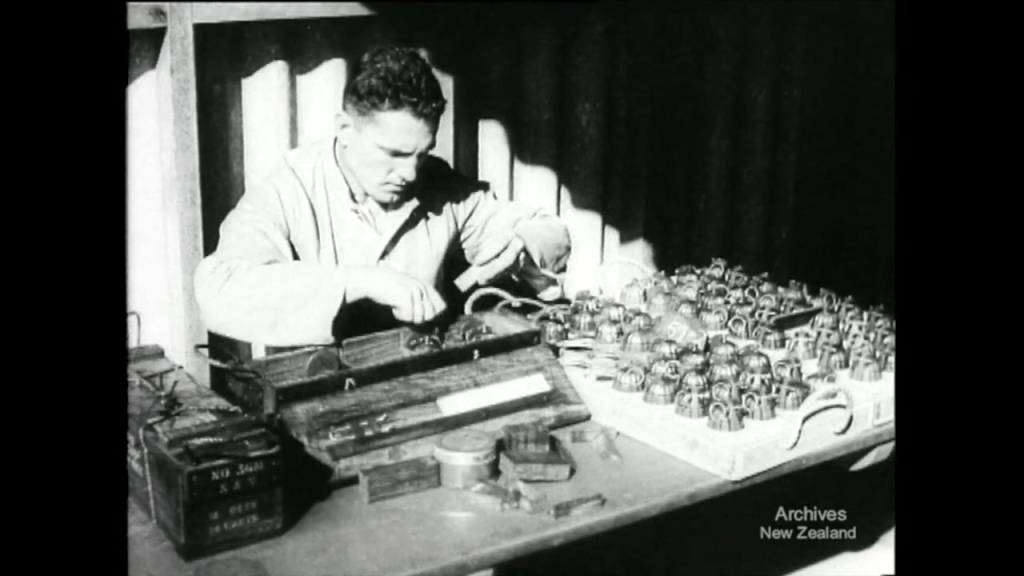
In the second newsreel (Weekly Review No. 63 (1942)), however, which celebrates the production of 1 million grenades, we do seem more of the production process. In this short segment we see how the grenades are filled and how they work. We see the cast bodies of the grenades being transported on a conveyor after being shellacked to keep moisture out. If we pause here we can see this worker packing a case with “gascheck” discs and fuses.

Loading grenades, fuses and gas checks into a transit case (Archives New Zealand)

The gas check disc and a 7 second fuse was used when the grenade was being fired from a rifle’s cup discharger, while a 4 second fuse was favoured when throwing by hand. In this final clip we see the internals of a grenade – which was filled with just over 2oz of explosive through the round filling-hole (on the side opposite the safety lever) which was then screw plugged. The newsreel then concludes the grenade segment by showing the striker spring inside being compressed and a No.27 Detonator, with fuse, being inserted into the sectioned grenade.

We’ll examine more British grenades, including the No.36 in future videos and articles.


If you enjoyed this video and article please consider supporting our work here. We have some great perks available for Patreon Supporters – including custom stickers and early access to videos! Thank you for your support!


Bibliography:

Weekly Review No. 63 (1942)

Weekly Review No. 70 (1943)

W. Mills, ‘Grenade and Other Like Apparatus’, 4 Apr. 1916, US Patent #1178092, (source)

NZ Mills Grenades, Lexpev.nl, (source)

No.36 Mk1 Grenades, MillsGrenades, (source)

Old Gun Ads: How Did Colt Advertise Its Guns?

In this video we’re taking a look at something very rare, a pre-1911 catalogue produced by Colt. But it isn’t a catalogue to order guns from. Instead, it’s a catalogue to order gun advertisements from! Old firearms ad from this period are fascinating and give us an insight into who markets company’s were aiming their products at.

The catalogue includes illustrations of pistols and entire print ads which could be printed locally. It covers most of the commercial Colt line ranging from Colt Model 1908 Vest Pocket pistols, to Colt Police Positive revolvers and Colt’s military automatic pistols.

New fangled Colt automatics (Matthew Moss)

The catalogue’s introduction explains Colt’s advertising strategy, saying:

“we advertise in the big national mediums to CREATE A DEMAND ON YOU for our arms; these advertisements are read by thousands of perspective customers IN YOUR LOCALITY, therefore YOU can obtain the benefit of SALE by local advertising.” It’s a sound enough strategy.

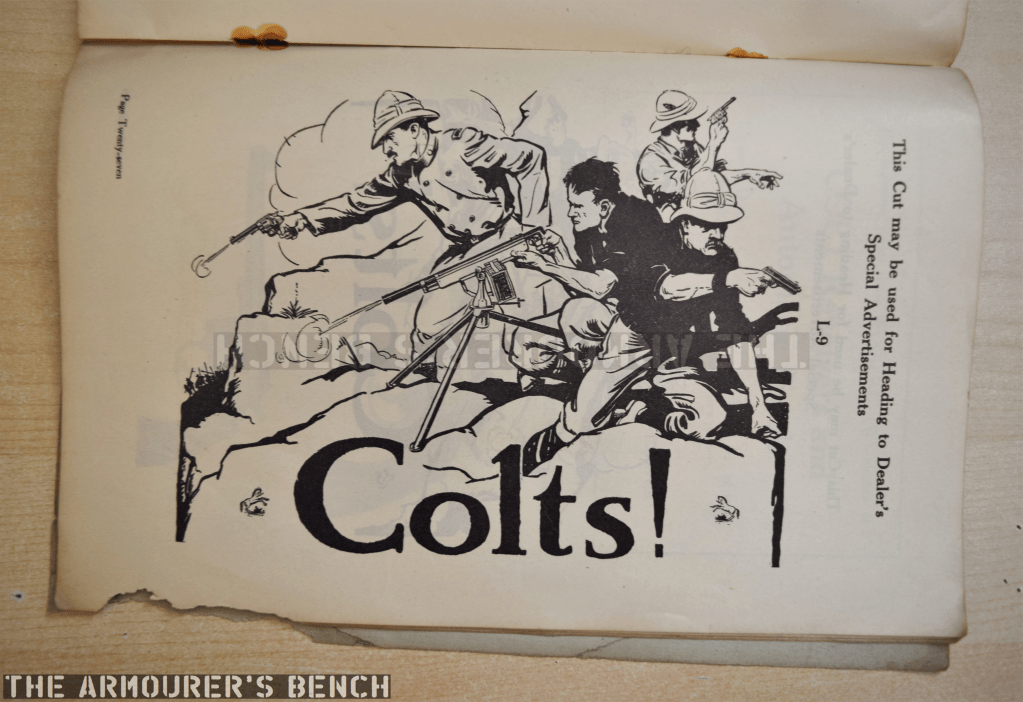
My favourite ad, featuring Browning’s Colt M1895 machine gun (Matthew Moss)

Only one ad includes a Colt product that isn’t a pistol. The ad above features an illustration which includes John Browning’s first machine gun, the Colt-produced Model 1895. It’s an evocative advert including revolvers, a semi-automatic pistol and the 1895.

Colt Model 1907 Military pistols, the predecessor of the 1911 (Matthew Moss)

One of my favourite parts of the catalogue covers Colt’s burgeoning automatic pistol line. This section actually helps us date the catalogue as there are no 1911s. It includes the Colt 1907 Military, the Colt 1902 Military, the Colt 1903 Pocket Hammer and the Colt 1903/1908 Pocket Hammerless automatic pistols.

Some of the illustrations of Colt’s revolvers available for printing (Matthew Moss)

The catalogue includes printable illustrations of the Colt ‘New Service’, the Colt ‘Army Special’, the Officers Model Target, the Police Positive Special, Police Positive and Police Positive Target. As well as some classics, with a full page of Colt Single Action Army revolvers.

Some cutaway diagrams of the Colt Pocket Hammerless (Matthew Moss)

The Colt advertisement catalogue is now part of our reference collection and we were able to bring this video/article thanks to the support of our Patrons. We have many more videos on important and interesting primary source materials in the works. If you enjoy our work please consider supporting us via Patreon for just a $1. Find out more here.

Check out videos on items from our reference collection here.

John Browning’s Forgotten Rifle Prototypes

Over the past year we’ve looked at a number of John Moses Browning’s lesser known rifle prototypes. Each offers something innovative, a detachable box magazine, a slide action and an en bloc loading system. These prototype rifles are unique and likely the only ones of their type in existence. The prototypes were originally sold to the Winchester Repeating Arms Company, but like many of the arms Browning sold to the company they never went into production.

Browning’s 1895 slide action prototype (Matthew Moss)

Winchester bought the designs from Browning simply to prevent their competitors from getting their hands on them – as a result they are largely forgotten. The rifles became part of the Winchester factory collection and today they are all held at the Cody Firearms Museum at the Buffalo Bill Center of the West – we appreciate their assistance and kindness in allowing us to examine them.

Browning’s Detachable Box Magazine Lever Action Rifle

In 1891, Browning designed a new rifle that fed not from a tube magazine but from a detachable box magazine. Box magazines were a relatively new concept with James Paris Lee leading the field. This one-of-a-kind Browning toolroom prototype uses the same locking mechanism as the Winchester 1886 and is in ‘musket’ configuration.

Browning’s 1892 En Bloc Lever-Action Prototype

This fascinating rare prototype uses a conventional lever-action but departs from Browning’s earlier designs for Winchester. Instead it feeds from a 5-round en bloc clip rather than a tube magazine. The rifle is in a military – ‘musket’ configuration suggesting it was designed for the military market.

Browning’s 1895 Slide Action Rifle Prototype

This final design was patented in 1895, it uses a slide action and like the other designs was purchased by Winchester but never manufactured. Instead, Winchester went with the iconic lever-action Model 1895. This rifle has an integral box magazine which was loaded from below.


If you enjoyed these videos and this article please consider supporting our work here. We have some great perks available for Patreon Supporters. You can also support us via one-time donations here. Thank you for your support!
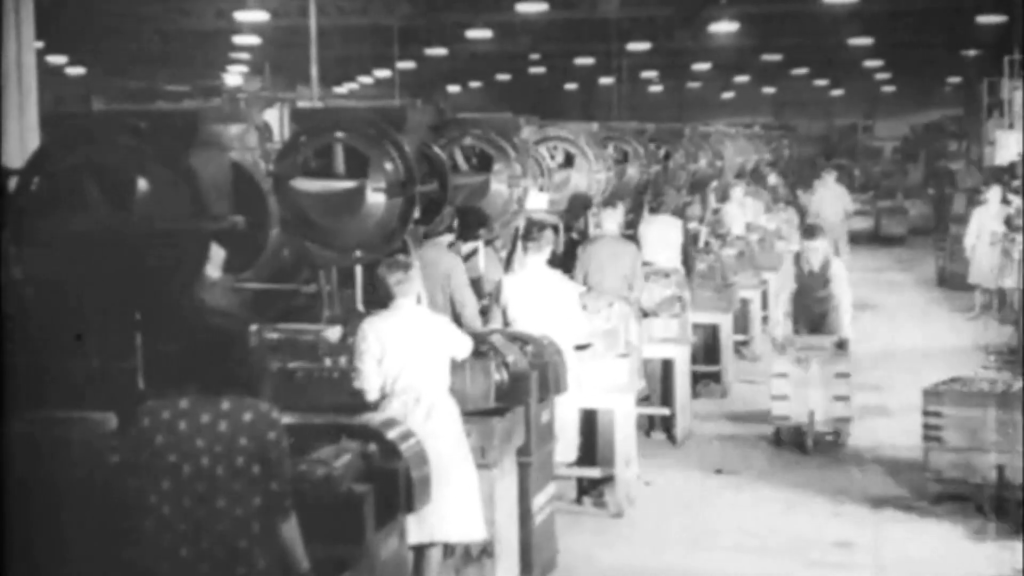

John Browning’s 1895 Slide-Action Prototype

By 1895 Winchester had been considering a slide-action rifle for some time, in 1882 William Mason had begun work on one (US Patent #278987) to counter Colt’s slide-action Lightning only to drop it. Finally in 1890, Winchester introduced a slide-action .22 calibre rifle developed by John Browning. The Model 1890 became extremely popular.

Between 1887 and 1895 Browning patented four slide-action rifle designs. The first of these, US patent #367336, was granted in July 1887, this was followed in 1888 by US patent #385238. In September 1890, the Browning brothers were granted US patent #436965, which along with the previous 1888 patent protected what became the Model 1890. Three years later Winchester introduced the Model 1893 pump action shotgun, that would eventually evolve into the famous Winchester Model 1897.

Right-side close up of the rifle with its action open (Matthew Moss)

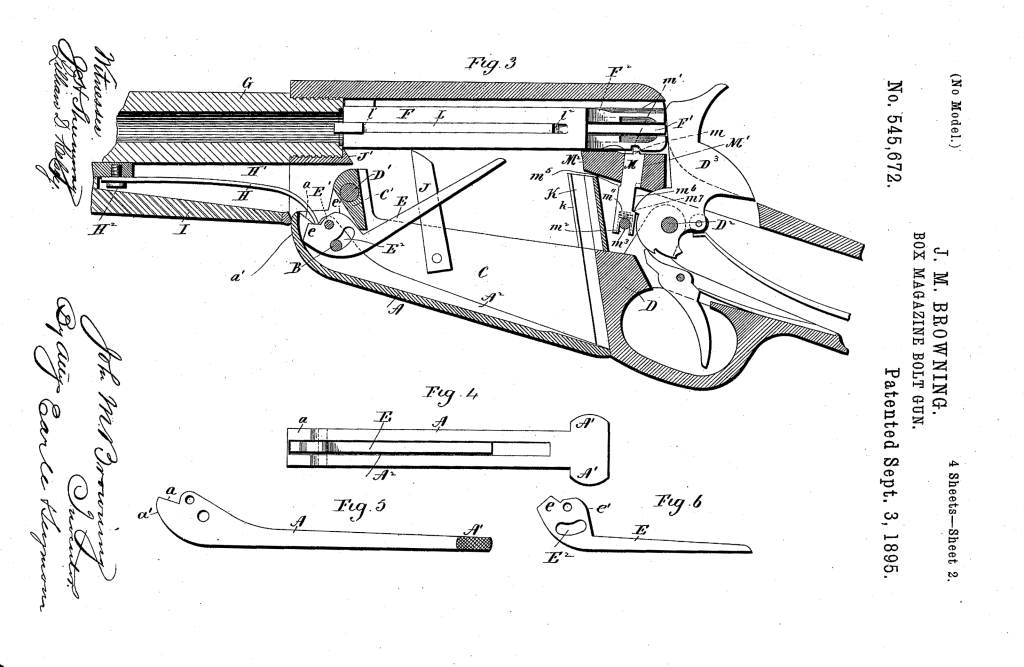
Finally, April 1895, Browning filed a patent for a design for a .30 calibre rifle which was granted in September 1895 (US patent #545672) This patent covers the rifle we’re examining here. The rifle itself is a slide or pump action in long barrelled configuration which Winchester described as a ‘Musket’.

The September 1895 slide-action design was purchased by Winchester but like so many other Browning designs, it never entered production and Winchester purchased the design purely to secure it and prevent other rival manufacturers picking it up. Winchester instead went with a lever-action design, patented in November 1895 (US #549345), which became the famous Winchester Model 1895.

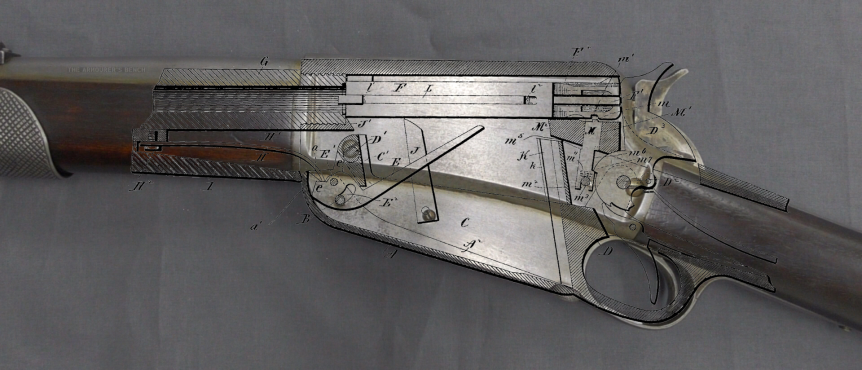
A left-side view of the rifle’s receiver with Browning’s patent overlaid (Matthew Moss)

The September 1895 slide or pump-action rifle design had a laterally camming locking breechblock. As we can see, externally Browning’s toolroom prototype looks somewhat similar to the contemporary Winchester Model 1895, with a single-stack integrated box magazine but with a pump sleeve rather than a lever. 

An action-bar connects the slide/pump to the front of the breechblock/bolt carrieron the right-hand side of the rifle. The slide handle itself is made of a U-shaped piece of metal which wraps around the rifle’s forend. The slide has been roughly cross hatched to improve grip. There is a channel cut into the furniture for the action arm’s attachment point to travel. The slide is attached to the arm by a pair of screws.

A close up of the rifle’s slide/pump handle (Matthew Moss)

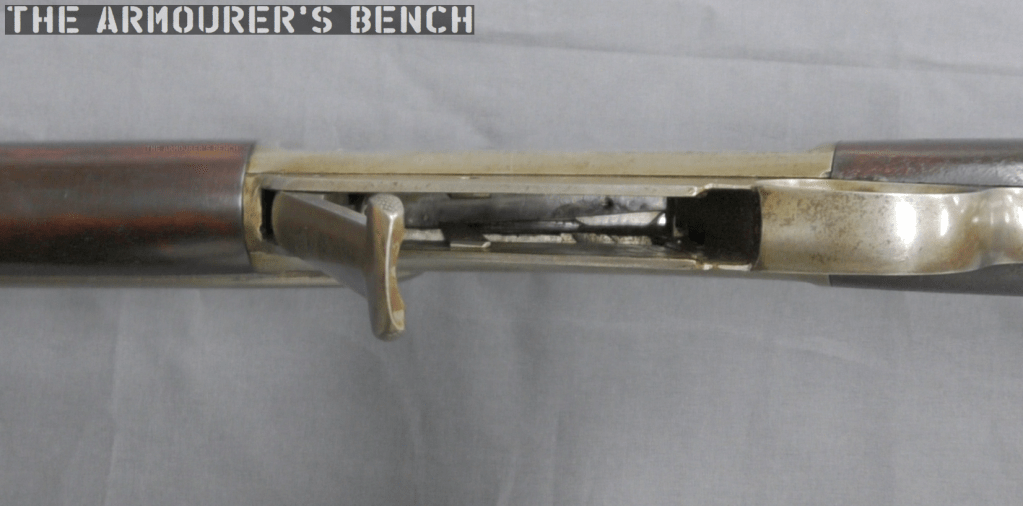
However, Browning developed this prototype to allow loading of the magazine from below rather than through the top of the receiver. He added a hinged floor plate, with a spring loaded follower, that allowed loose rounds to be dropped into the magazine and then closed.

As we open the magazine, hinging the cover plate down, we see the carrier flip down against the plate to allow loading. The rifle was designed to be loaded from below with the bolt forward.

Browning’s September 1895 patent (US Patent Office)

In the patent description Browning explained that his aim was to improve breech-loading box-magazine firearms by designing:  

“…a simple, compact, strong, highly effective, and safe gun, containing comparatively few parts and constructed with particular reference to provision for charging the box-magazine with cartridges from the bottom of the frame of the arm while the breech-bolt is in its closed position, so that the arm may be charged without operating its action mechanism or disturbing the cartridge in the gun-barrel, if one is there.”

Browning’s September 1895 patent (US Patent Office)

From the original patent drawings we can see the flat spring which acted on the carrier running below the barrel, ahead of the magazine. Inside the magazine are a pair of what Browning refers to as ‘spring fingers’ these act on the cartridges inside the magazine and keep them properly aligned, seen here in Fig.7 of the patent. In Fig.8 we can see what Browning calls a ‘box-like guideway’ which guide the rims of the cartridges, “preventing the cartridges from being displaced while being fed upwards.”

The rifle’s breechblock locked into a recess in the left side of the receiver, tilting at an angle with the rear of the breechblock canting to the left. When the pump handle was pulled rearwards the breechblock cammed laterally to unlock the action, extracted and ejected any spent casing and when the slide/pump was returned forward a new cartridge was picked up from the magazine, chambered the breechblock locked again ready to fire. The rifle’s hammer was cocked by the rearward movement of the breechblock.

A left-side view of the rifle with its action open, note the complex machining on the rear of the breech bolt (Matthew Moss)

Externally, the slide-action’s receiver looks similar to that of the production Model 1895 but internally they are very different. The action is certainly less open than the Model 1895’s but the lateral locking mechanism is less robust. Additionally, with no lever, as in the Model 1895, the slide-action rifle lacks the safety mechanism which prevents the action from opening accidentally.

A view inside the open magazine with the floorplate hinged open (Matthew Moss)

The model is in the white and while externally the machining and tool work is very neat, inside the action we can see where the cuts in the receiver wall have been more crudely made. In terms of design, the slide-action prototype was certainly simpler and had fewer working parts than the Model 1895 lever-action.

Winchester purchased the .30 calibre slide-action design but never produced it, it is believed that only Browning’s prototype was built to prove the concept. The prototype was part of Winchester’s collection and may now be found at the Cody Firearms Museum.

Check out our earlier videos on Browning’s lever-action box magazine-fed prototype and his en bloc clip-fed prototype.


If you enjoyed the video and this article please consider supporting our work here. We have some great perks available for Patreon Supporters. You can also support us via one-time donations here.


Bibliography:

‘Box Magazine Bolt Gun’ J.M. Browning, US Patent #545672, 3 Sept. 1895 (source)

‘Box Magazine Firearm’, J.M. Browning, US Patent #549345, 5 Nov. 1895 (source)

John M Browning: American Gunmaker, J. Browning & C. Gentry (1964)

Winchester Repeating Arms Company, H. Houze, (2004)

Screw-Breech Percussion Rifle Prototype

In this video and article we’ll examine a somewhat mysterious screw breech percussion rifle – if you, like me ever wondered what a Ferguson with a percussion lock might look like then you’ll find this one fascinating. If you haven’t seen our earlier video on Patrick Ferguson’s 18th century breechloading rifle, check that out!
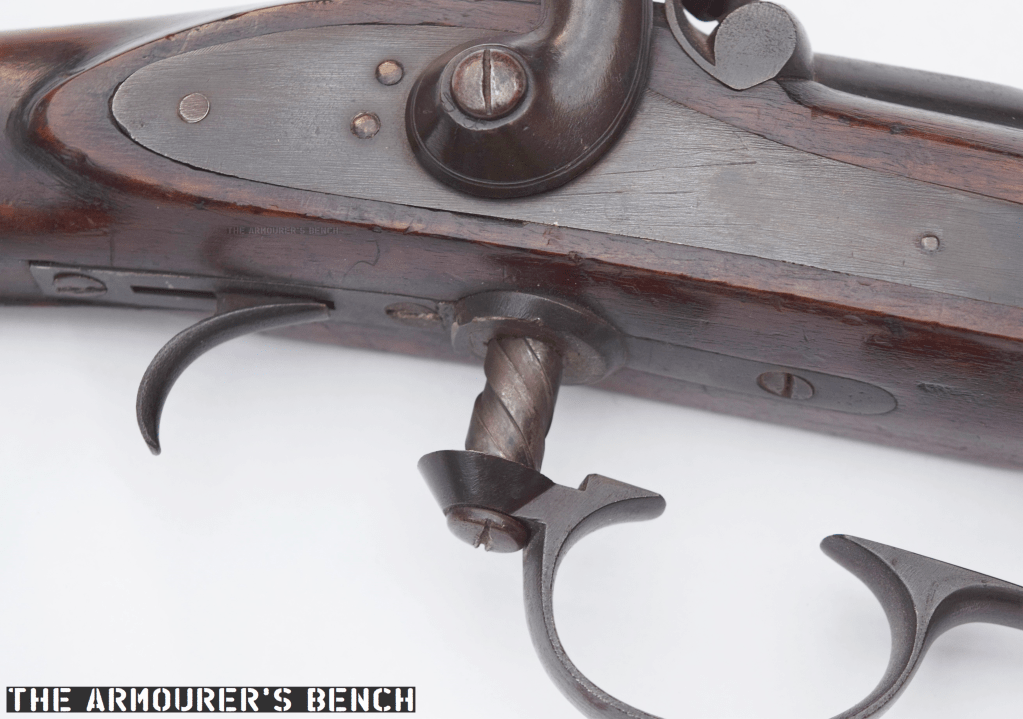
Right profile of the rifle (Matthew Moss)

This rifle likely dates to the mid-1860s and from some research is believed to be based on a design patented by Lewis Wells Broadwell, an American inventor. Broadwell was granted his first patent in 1861, protecting a sliding breech design for artillery. During the 1860s & 70s Broadwell was employed as the European Sales Agent for the Gatling Gun Company. He held a number of firearms and ordnance related patents, granted between 1861 and 1876. With several relating to artillery carriages, ammunition and magazine systems. His screw breech (US #33876) and a gas check (US #167981) designs for artillery were used by Krupp in some of their guns including the popular 68mm breechloading Mountain Gun.

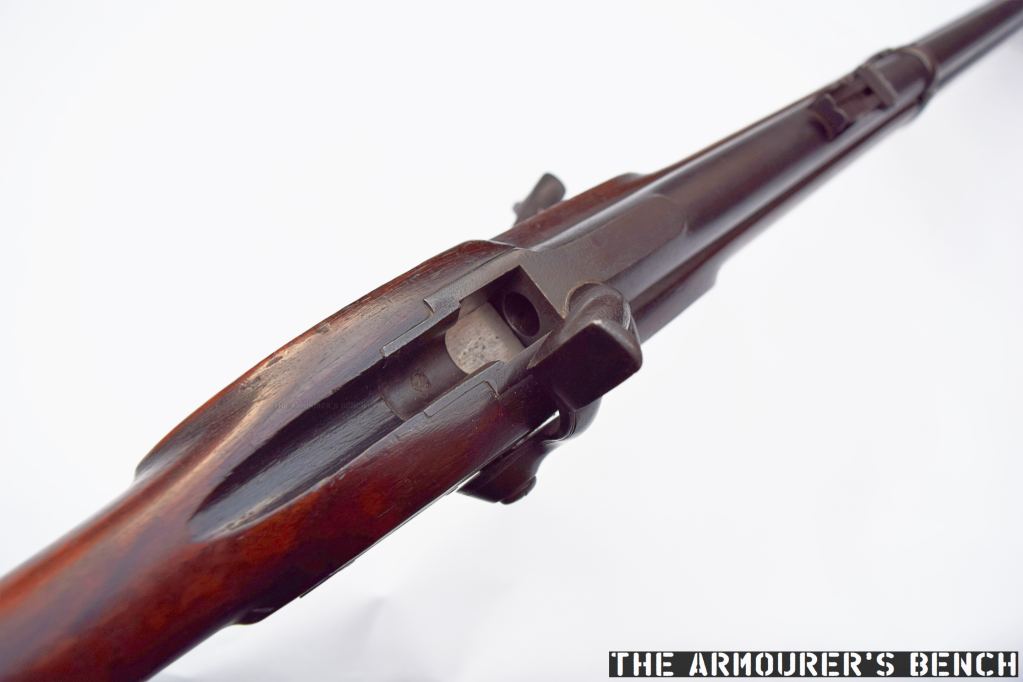
The rifle with its trigger guard rotated forward and its breech open (Matthew Moss)

Like the earlier Ferguson rifle, which drew heavily on earlier screw breech designs, this rifle has a rotating trigger guard which acts as a lever to unscrew the breech. Rotating the trigger guard drops a rectangular breechblock and opens the action. Unlike the Ferguson the threaded piece does not act as the breech plug itself, instead the separate breech block takes the brunt of the cartridge ignition.

The rifle with its breech open (Matthew Moss)

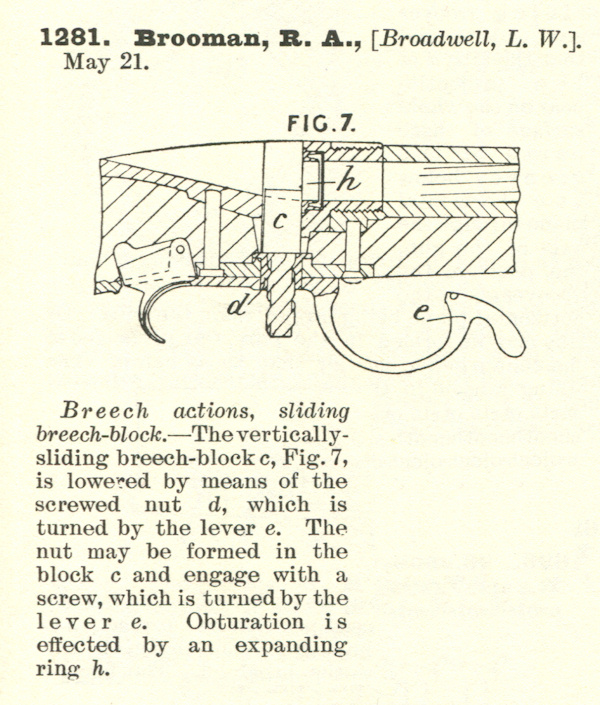
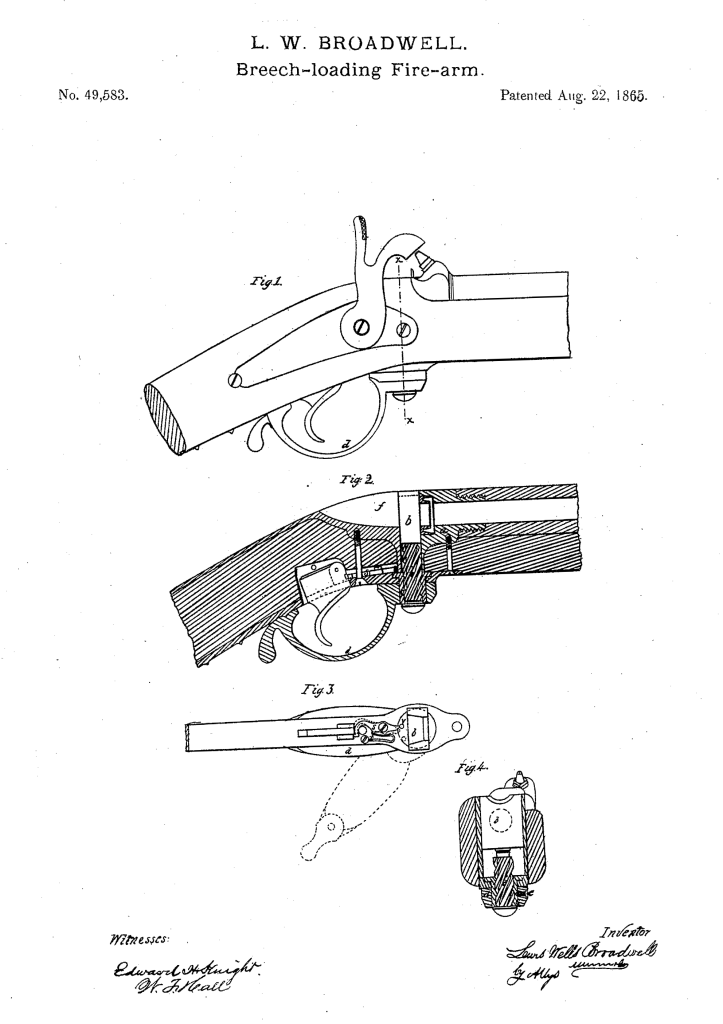
Broadwell filed the patent believed to correspond to this rifle first in Britain, in May 1863, and subsequently in the US in August 1865 (US #49583). The patent protected the breech action and depicts what Broadwell described as a ‘screwed nut’ below a rectangular vertically sliding breech block. This idea of a sliding breech-block builds on his earlier patent for a sliding cannon breech.

Broadwell’s UK patent, dated 1863 (UK Patent courtesy of Research Press)

In Britain, Broadwell used Richard Brooman, of Robertson, Brooman and Company, as a patent agent. At the time Brooman’s company offered a service by which he acted as the inventor’s deputy and was listed as the patent holder, while the inventor was listed as the ‘communicator’. The service cost the not insignificant sum of £45 (at the time a labourer could earn just 3 shillings 9 pence per week – or 15% of £1 – that’s just under a year’s average wages). This initial sum covered the patent for three years. It is likely Broadwell employed an agent because at the time he was living in St Petersburg in Russia, undertaking negotiations with the Russian Government to establish Gatling Gun production. Brooman was also the editor of The Mechanics’ Magazine, a Victorian science and industry journal.

Broadwell’s slightly different 1865 US patent which is also similar to the rifle we are examining (US Patent Office)

The breech plug has a screw thread with a very wide pitch with flat crests. Broadwell’s US patent describes the breech plug as having a ‘three to six threaded screw’. The breech blog falls enough to allow loading after turning the lever around 200-degrees – ensuring a rapid action. Interestingly the British patent shows the lever not attached to the base of the screw plug but instead shows it at the mid-point of the screw. This may be an error in the drawing. It seems that if the rifle we are examining is a Broadwell prototype it was decided to simplify the action by attaching the lever at the base of the plug.

A close up of the rifle’s trigger guard and screw (Matthew Moss)

This rifle itself, has no markings whatsoever, not even range markings on the rear sight. Typically rifles of this period would at least have a marker’s or patent holder’s mark on the barrel or lock plate. This suggests that the rifle is either unfinished or more likely a prototype which did not require extensive markings.

The rifle’s unmarked rear sight (Matthew Moss)

The breechblock is not blued and is possibly case hardened. Much like the Ferguson, and other earlier screw-breech rifles the trigger guard also acts as the breech lever. Which with a rotation of approximately 200 degrees, descends enough to open the breech and allow access to the chamber. The threaded screw is around 0.5 in (1.2cm) thick and acts on a rectangular breechblock which sits above it. This basic layout matches Broadwell’s 1863 UK patent.

The rifle with its breech partially closes, there is no method of extraction indicating it used a combustible cartridge (Matthew Moss)

The rectangular shape of the breechblock ensures a strong action as it butts up against a pair of narrow shoulders (about 1mm in width) at the rear of the receiver. The rifle has a two band stock and a cleaning/ramrod which indicates a military-style rifle but interestingly, there is no obvious provision for fixing a bayonet.

The rifle is believed to be chambered in a cartridge using a .451 Westley Richards projectile. There is no method for extraction so we can safely assume the rifle used a combustible cartridge, ignited by a percussion cap rather than a self-contained metallic cartridge. Interestingly, the UK patent also suggests the use of a “tubular magazine… formed in the hammer, containing self-acting feeding apparatus for supplying ignition wafers or patches to the nipple.” This is not mentioned in the later US patent and the rifle we’re examining has a conventional capped percussion lock.

A close up of the Note rectangular breech with the action closed (Matthew Moss)

The US patent describes a ‘mechanism to prevent the gun from being fired when the breech is open’, this is formed by a lever which disengages with the trigger when the breech lever is rotated. There is a small leather flange in the base of the stock where the screw ascends and descends, this prevents the ingress of dirt and also acts to keep the screw clean.

Left profile of the rifle (Matthew Moss)

Compared to Patrick Ferguson’s action Broadwell’s design simplifies the breech plug using a simpler to manufacture rectangular breechblock and a thinner screw plug. The use of a self-contained cartridge would have sped up loading but the need to cap the rifle’s nipple was still a limiting factor. The screw breech concept became increasingly obsolete with the introduction of self-contained metallic cartridges with integral primers as well as the introduction of faster actions including bolt actions, falling block actions and toggle-locked lever actions.

Lewis Broadwell was born in Cincinnati, Ohio, on 18th July 1820. He is perhaps best known for his drum magazine design for the Gatling Gun. The Broadwell Drum consisted of a series of single stack, gravity assisted magazine columns arrayed around a central pivot point. These columns held between 15 and 20 rounds depending on calibre and typically there were 16 columns of ammunition. Broadwell patented the drum’s design in December 1870. It was used extensively during the 1870s by a number of militaries around the world, including by the British Army. Broadwell was granted his last patent in 1876 and died, aged 86, in May 1906.

Special thanks to the Hayes collection for letting us take a look at this very interesting rifle. Thanks to David over at the Research Press for help finding the patent and to John Walter for his help finding information on Broadwell himself.


If you enjoyed the video and this article please consider supporting our work here. We have some great perks available for Patreon Supporters. You can also support us via one-time donations here.