In this special video I had the privilege of field stripping a Heckler & Koch G11. We strip the rifle down into its major assemblies and then explain how the ‘space magic’ works!
I explain how the recoil management system, which compensated for the recoil of firing a 3-round burst at ~2,000rpm, worked and how rifle’s ingenious rotating breech operated. This video demonstrates just how complex and ambitious the HK G11 was!
For more information and more photographs of the G11 disassembled check out the original article – here.
This is a remaster of an earlier video with a new fun intro and the full 1990 Aberdeen Proving Ground video filmed by HK, it is the best available look at the G11 in action. I’ve been meaning to remaster this video and make some additions for a while. Hope you enjoy it.
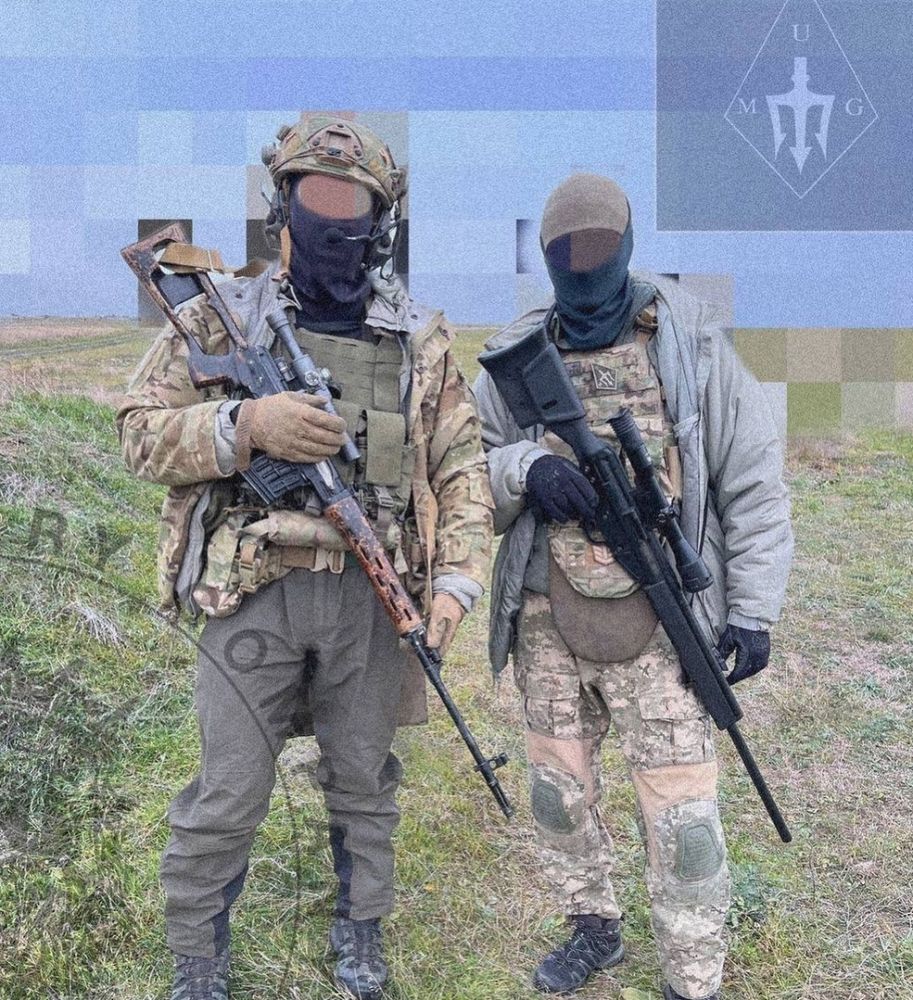
This week has seen photographs of two intriguing 7.62x51mm Heckler & Koch rifles appear, they feature what appears to be an iconic, and extremely rare, PSG1 and an HK G28E. The first photograph was shared by pmc_ua and universal_mobility_group on Instagram on 14 November. In the photograph a pair of two Ukrainian marksmen pose with an SVD and a PSG1, no further images of the rifle have been shared.
What appears to be a PGS1 at a Ukrainian range session (via social media)
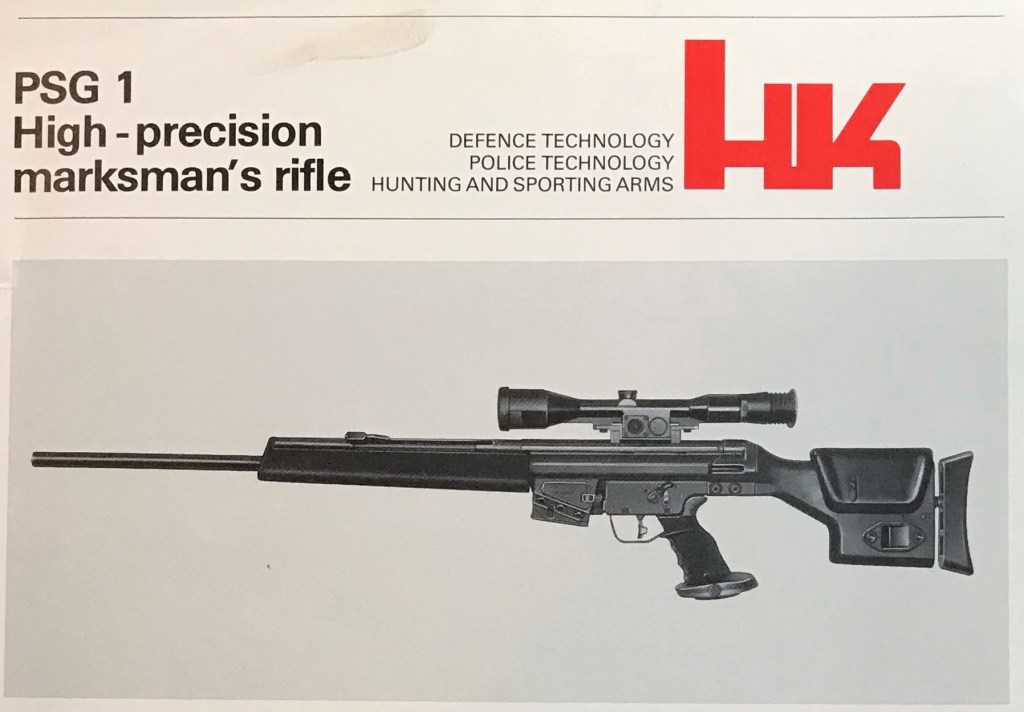
The PSG1 was introduced by HK in the early 1970s as a semi-automatic precision rifle. It is unclear where the PSG1 was acquired from but this is the first time I’ve seen one of the rifles appear in Ukraine. The PSG1 is based on the G3, and as such uses a roller-delayed blowback operating system. Its accuracy is reputed to be better than 1 MOA, the rifle appears to have an original Hensoldt ZF 6×42 PSG1 scope.
Illustration from an H&K catalogue page for the PSG1
PMC_ua, who shared the photograph, confirmed that the rifle is “used where there is an opportunity, fighting and training” but gave no further details. The PSG1 may have been acquired via civilian channels or may have been transferred to Ukraine as aid by one of the many countries who acquired the PSG1 in small numbers over the years. While the PSG1 is of Cold War vintage, the rifle continued to be offered into the 2010s by HK and it is still a very accurate, capable rifle.
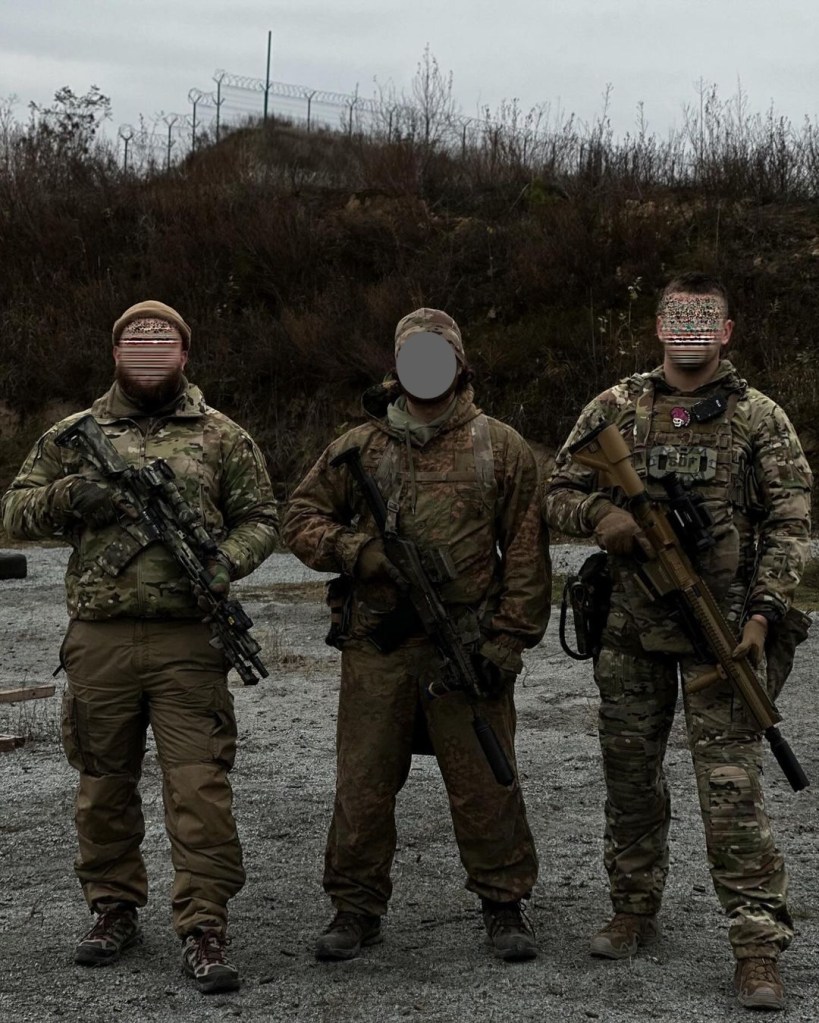
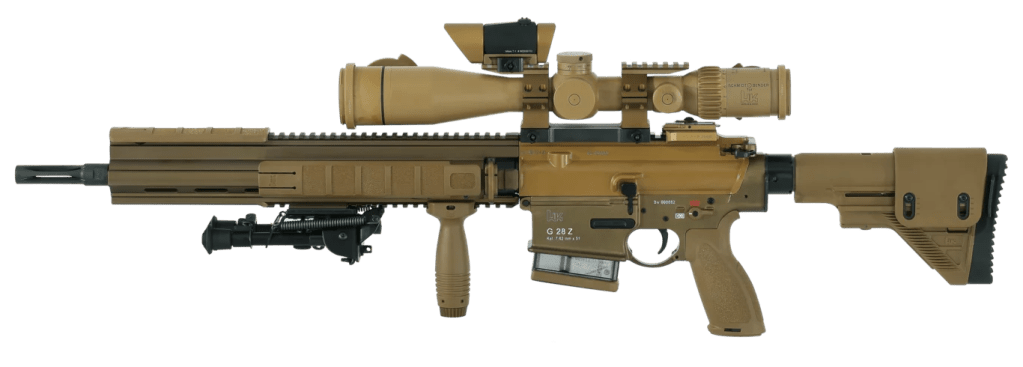
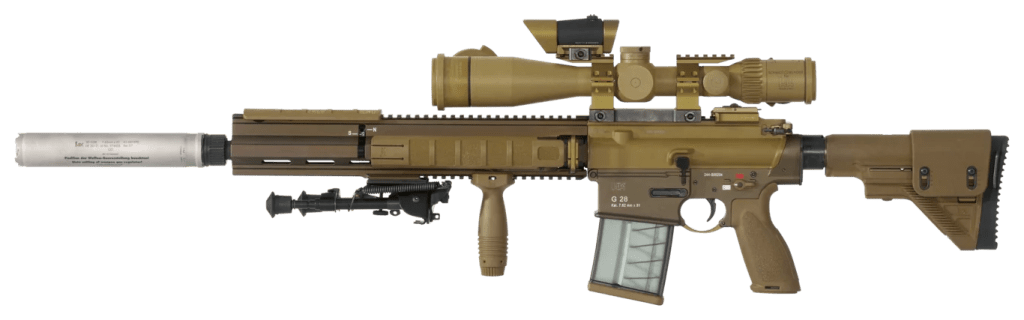
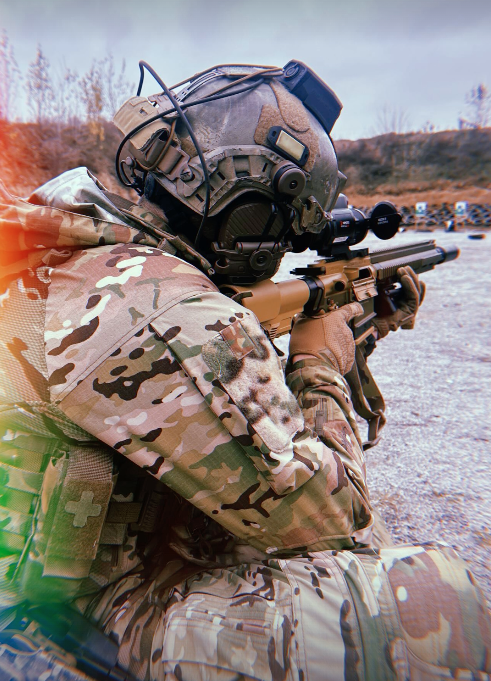
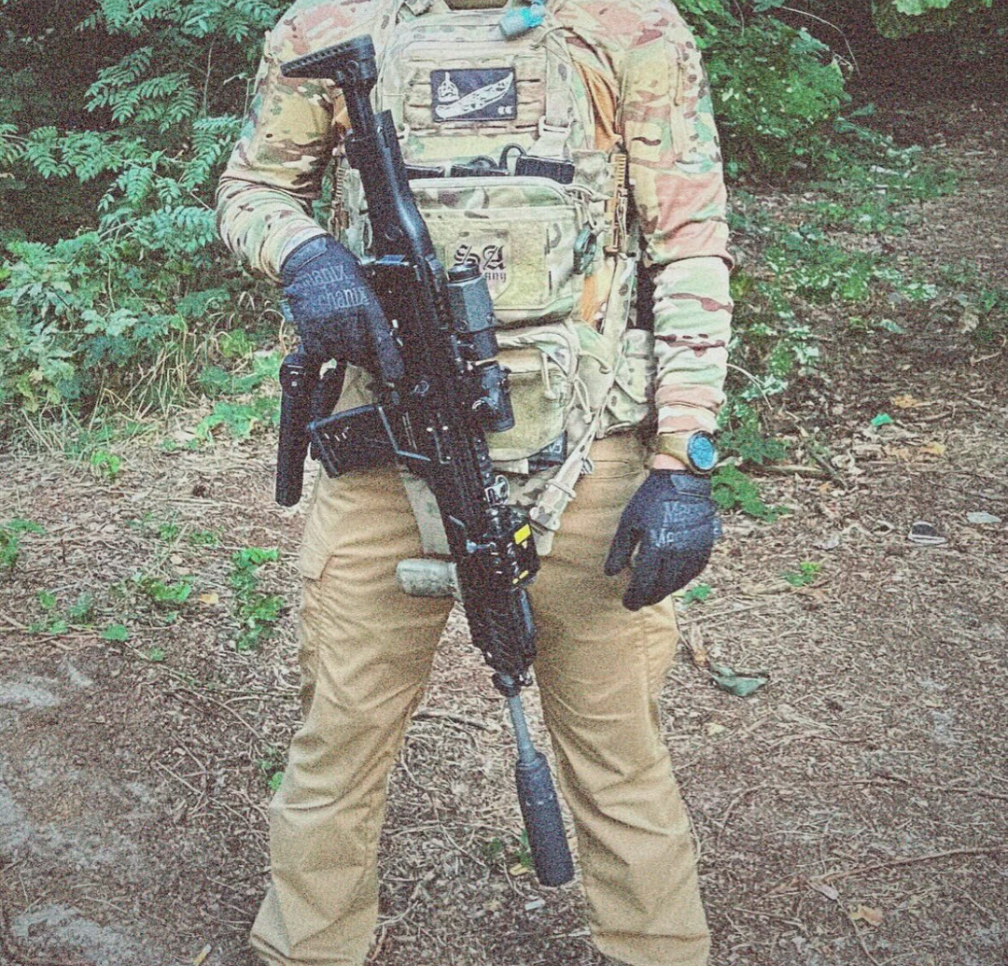
The second image was shared on Instagram, on the 17 November, and features what at first glance appeared to be an HK G28 but may also be the civilian-available HK G28Z. The rifle is held by a member of the 3rd Separate Assault Brigade and is equipped with a thermal weapon sight.
A probable HK MR308 A3-28 at a Ukrainian range (via social media)
The rifle has free-floated 16.5 inch barrel, a bi-pod and a vertical front grip mounted on its forend. It is loaded with a 10-round magazine and is fitted with what appears to be an Ase Utra DUAL762-S-BL suppressor. A small number of the RAL 8000-coloured MR308 A3-28s have recently appeared on the civilian market in Ukraine, with one private listing one of the rifles for 29,5000 UAH or $7,145.
HK G28Z (Heckler & Koch)HK G28 (Heckler & Koch)
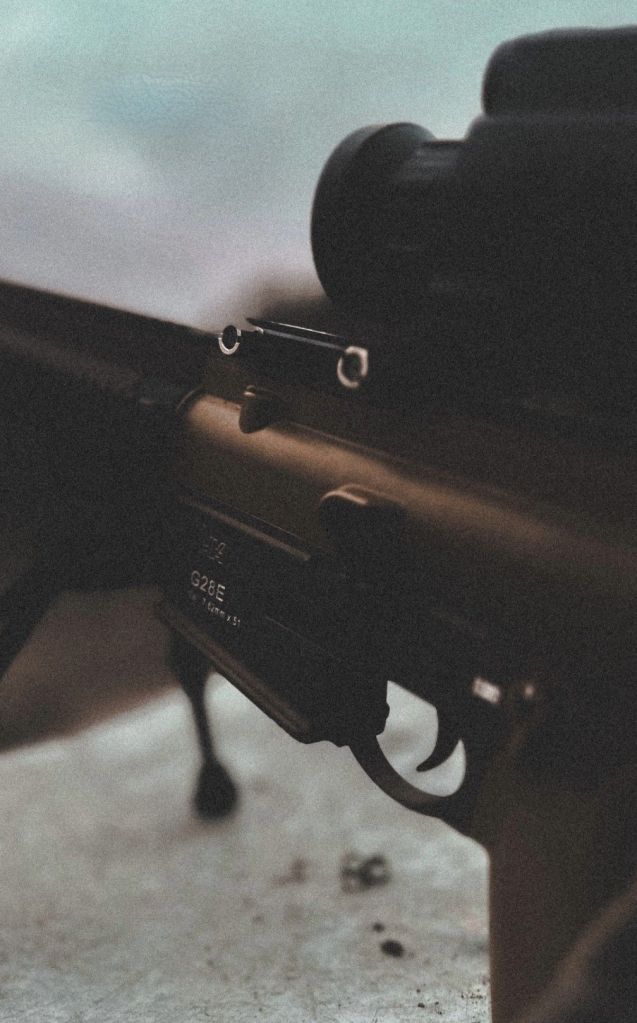
An additional photograph showing the rifle being fired was shared in an Instagram story by one of the individuals in the first photograph. This photograph gives us a better look at the receiver of the rifle and shows that the upper is painted/coated rather than treated. This indicates that the rifle is either a G28 or the civilian G28Z variant. [Thank you to CaliFlori for pointing out this detail].
It’s not uncommon to see civilian, semi-automatic, firearms used by Ukrainian personnel. This is more common in terms of precision platforms but various semi-automatic 5.56x45mm platforms are also regularly seen, including HK MR223s and patrol variants of the MR308.
A second photograph of the MR308 A3-28 at the range (via social media)
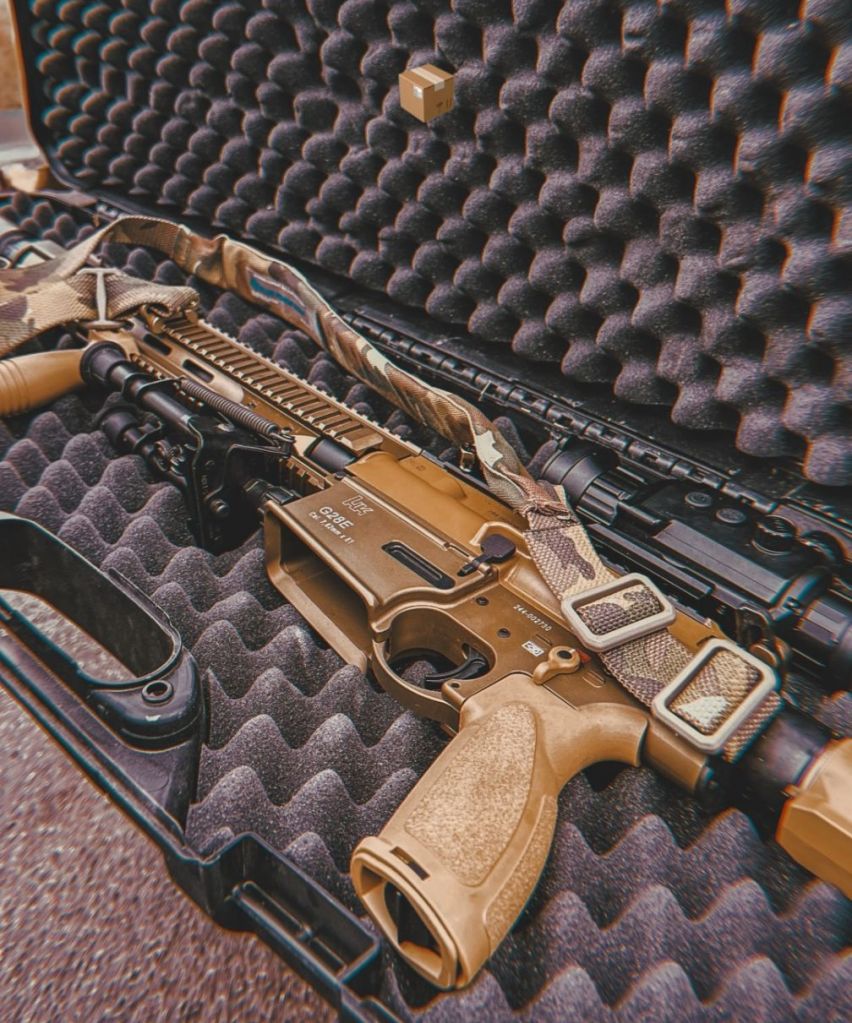
Two subsequent photographs shared by one of the individuals in the initial photograph clearly show the rifle’s lower receiver markings, confirming that the rifle is an HK G28E, not a commercial G28Z. The ‘E’ suffix indicates ‘export’.
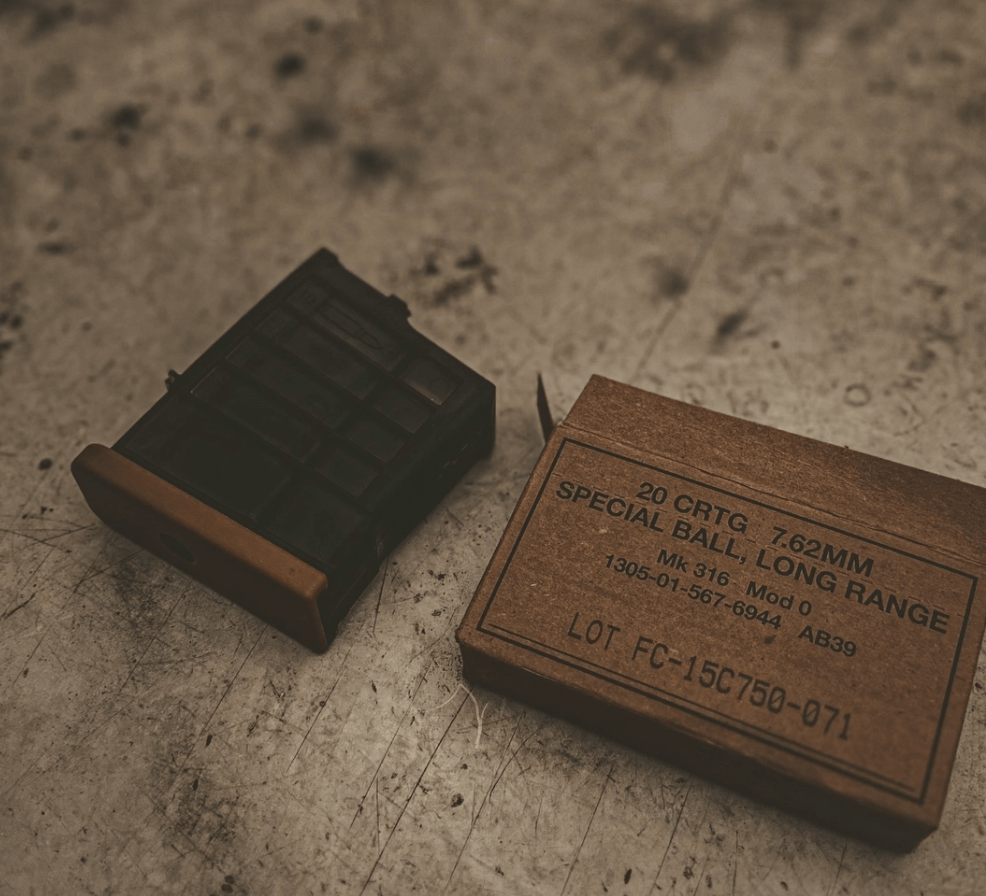
The same Ukrainian combatant, who appears to be a member of the GUR, also shared a photograph of ammunition he is using with the rifle. US-manufactured Mk316 Mod 0 is a match-grade cartridge which uses a 175gr projectile. While the ammunition was likely provided by the US, the origins of the rifle are unconfirmed.
It is intriguing to see two generations of Heckler & Koch’s semi-automatic precision rifles appear in Ukraine within days of each other.
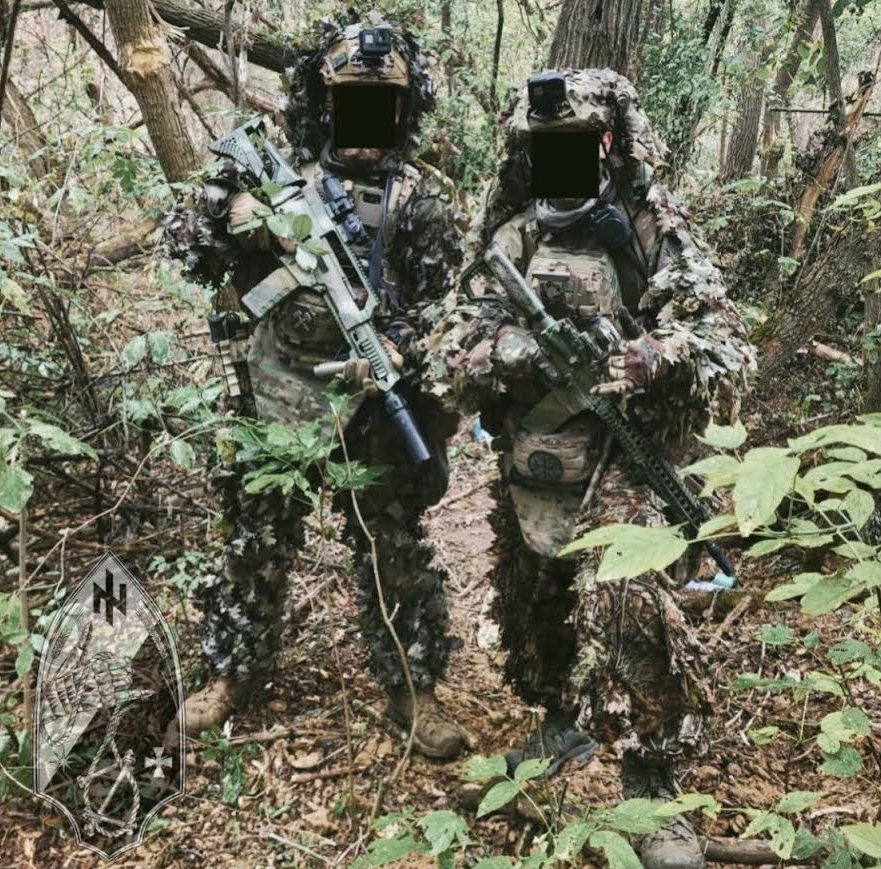
In mid-August there began to be sightings of small numbers of interesting Heckler & Koch rifles with Ukrainian special operations units. We’ve previously seen HK416s in use with a variety of units, check out our earlier article/video on those. However, it now appears that alongside H416s there are now a limited number of G36s and HK433s in use in Ukraine.
The first image of these appeared on 12 August, when Assault Bastards, a team affiliated with Ukraine’s Intelligence Directorate’s (the GUR) Kraken regiment, shared a photograph of a combatant with a suppressed G36KA4 at the range. On the 18 August, shybenyk.squad, a team associated with the Kraken Operations Unit, posted a team photo with the caption “GUR MOrning. Kill & travel”, with one combatant on the far right seen holding an HK G36KA4. The rifle has an HKey forend, HK’s proprietary mounting system, and is equipped with an Aimpoint RDS and a 3X-C magnifier and an Ase Utra DUAL556-S-BL suppressor.
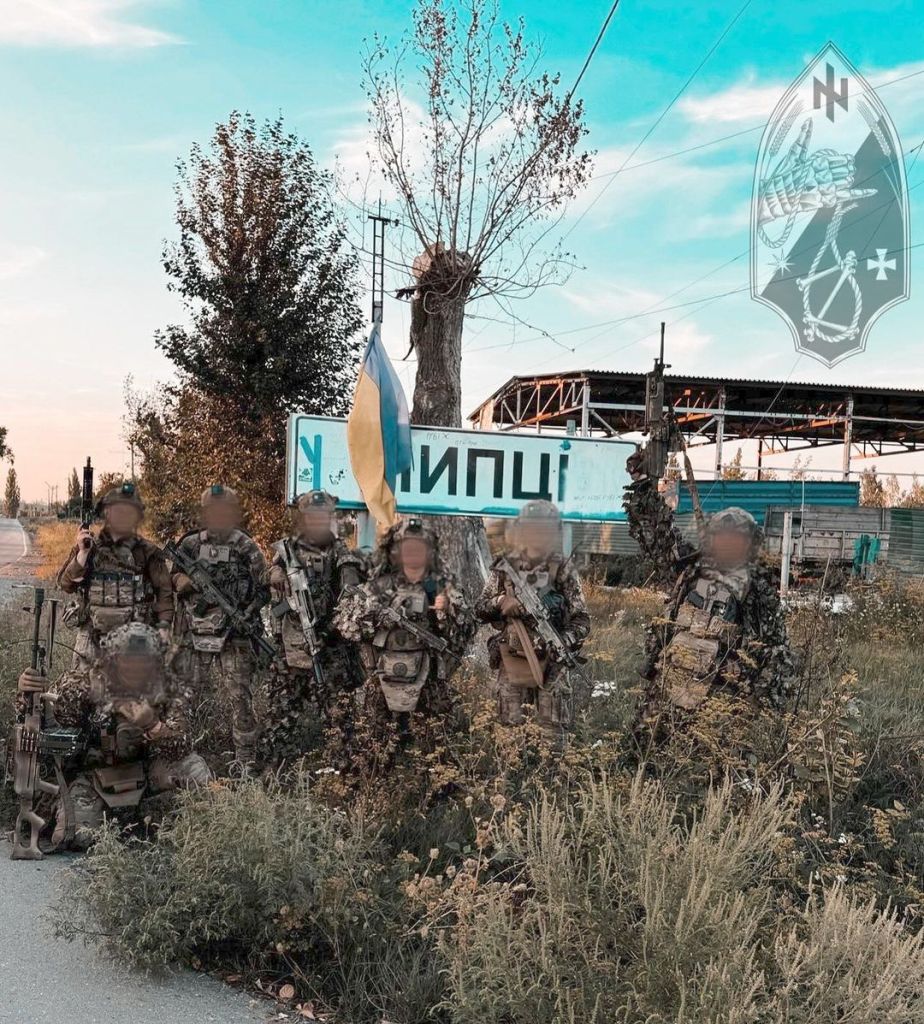
On 23 August, shybenyk.squad shared a group photo posing in front of a signpost for the village of Lyptsi in the Kharkiv oblast. In the photo we can make out a pair of G36KA4s. Intriguingly both appear to be loaded with STANAG pattern polymer magazines rather than HK’s translucent magazines. This would indicate that either some of the rifles were shipped with magazine well adapters or were shipped with them.
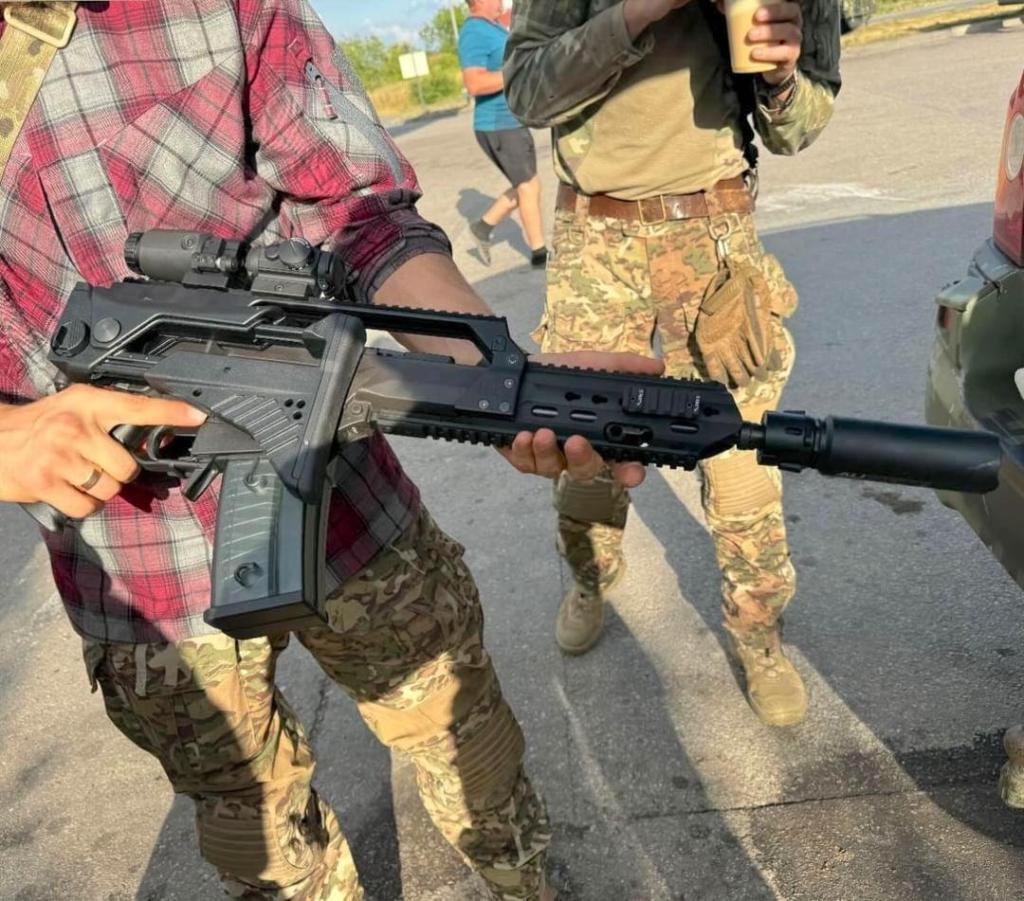
Shortly after these photos emerged a member of the Kraken regiment shared a close up photo of one of the G36KA4s with my colleagues at StreakingDelilah. It has an HK translucent magazine and is fitted with an Aimpoint T2 RDS and Aimpoint 3X-C magnifier and an Ase Utra DUAL556-S-BL [Correction: DUAL QM-2] suppressor. This appears to be the common setup and likely how the rifles were shipped. On the HKey forend we can see a short rail segment has been attached for mounting a light or laser aiming device. The rifle looks in great condition, appearing as if new out the box.
shybenyk.squad shared another group photo alongside the Assault Bastards group on the 24 August. The photo again features two previously seen G36KA4s. Speaking to Shybenyk.squad they noted that they only received a couple of the rifles.
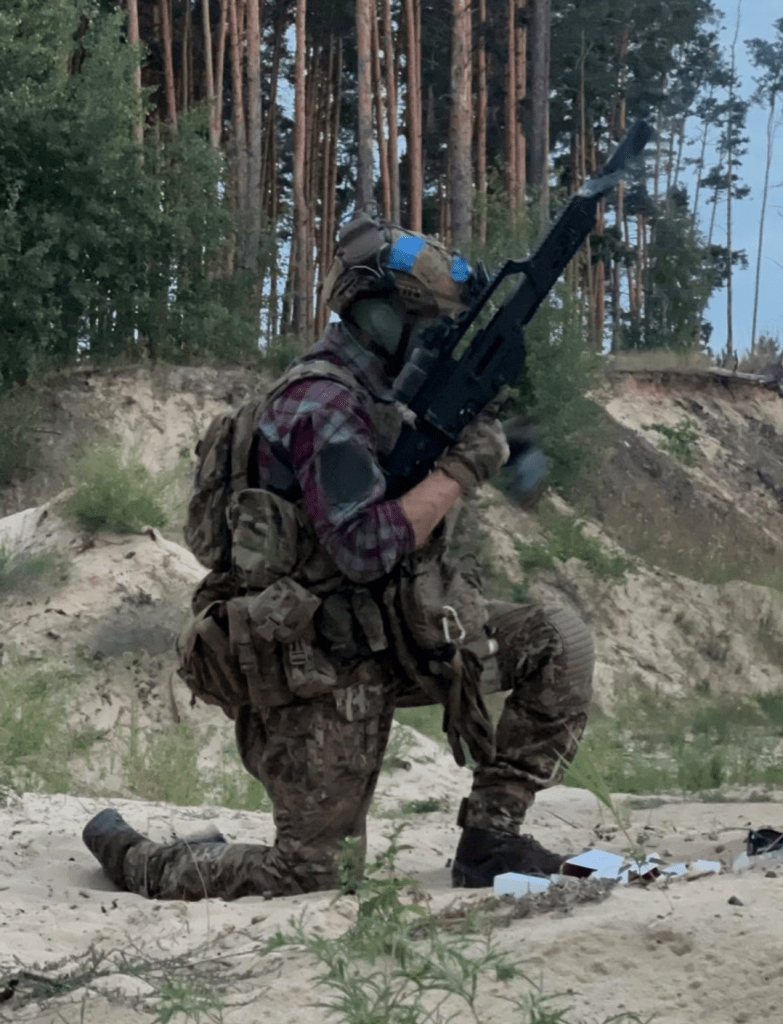
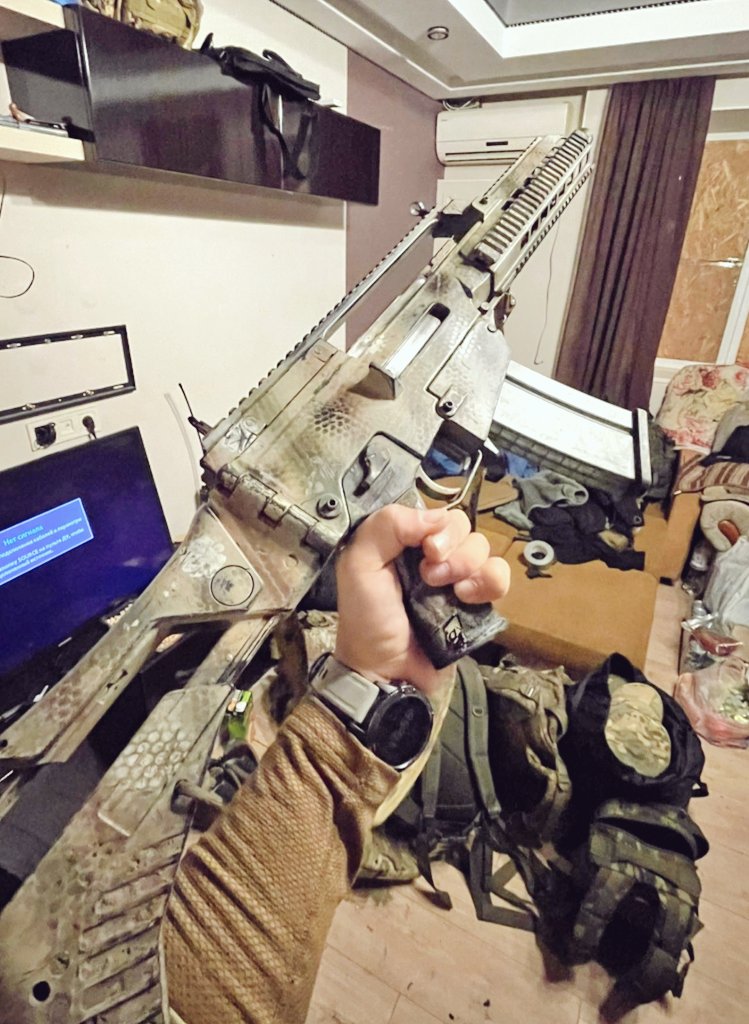
On the 26 August another member of Kraken shared photographs of himself firing a G36KA4 at a range. The rifle has the usual accessories and is loaded with an HK translucet 30-round magazine. On 30 August, shybenyk.squad shared another image of a combatant with an G36KA4 again fitted with Aimpoint optics and an Ase Utra suppressor. The rifle has been painted up and is seen loaded with a polymer MAG (what appears to be a Mission First Tactical Extreme Duty Magazine). Again indicating magazine well adaptors are in use.
But there may have been some earlier sightings dating back to 2023. In mid-June 2023, Tyskshared a series of three photos of a Ukrainian serviceman with a G36K with a railed forend. The rifle doesn’t have any optics mounted and the folding back-up iron sights are deployed. Tysk noted that they had been sent the photos by a serving subscriber but there was no further detail on where the photos were taken – be it in Ukraine or during training abroad.
Several months later in October, a member of the 12th Assault Brigade (Azov) shared a photograph of another G36K series rifle, again with no optics and a paint job similar to the earlier rifle. The combatant who shared the photograph noted that it wasn’t his rifle but claimed that a number of them were in his unit’s armoury for a time. In early November, a German colleague DEAidUA, contacted the BMVg (German MoD) who stated to him that they had “no knowledge of the transfer of these weapons to Ukraine.” Additionally, there has been no mention of the rifles on the German government’s extensive list of aid to Ukraine. The only small arms mentioned include a number of pistols, some MG3s and the HK MG5s we’ve examined in a previous article/video.
HK433
In addition to the G36s yet another Heckler & Koch rifle has appeared in Ukraine recently – the HK433. The first sighting of an HK433 in Ukraine actually predates the recent sightings of G36s. At the very end of July a member of Kraken posted a photograph featuring an HK433 equipped with a Aimpoint T2 RDS, an Aimpoint 3X-C magnifier, a Magpul RGV front grip, a Steiner DBAL A2 laser aiming module and a Norwegian A-TEC ‘A-Flow’ suppressor. The combatant who shared the photo stated that his platoon had received 10 of these rifles for testing and evaluation purposes, though he did not state if they had been provided directly by HK. On speaking to the combatant about the rifles he noted that they had performed well but that they had not yet been used in combat but they had been taken out on operations.
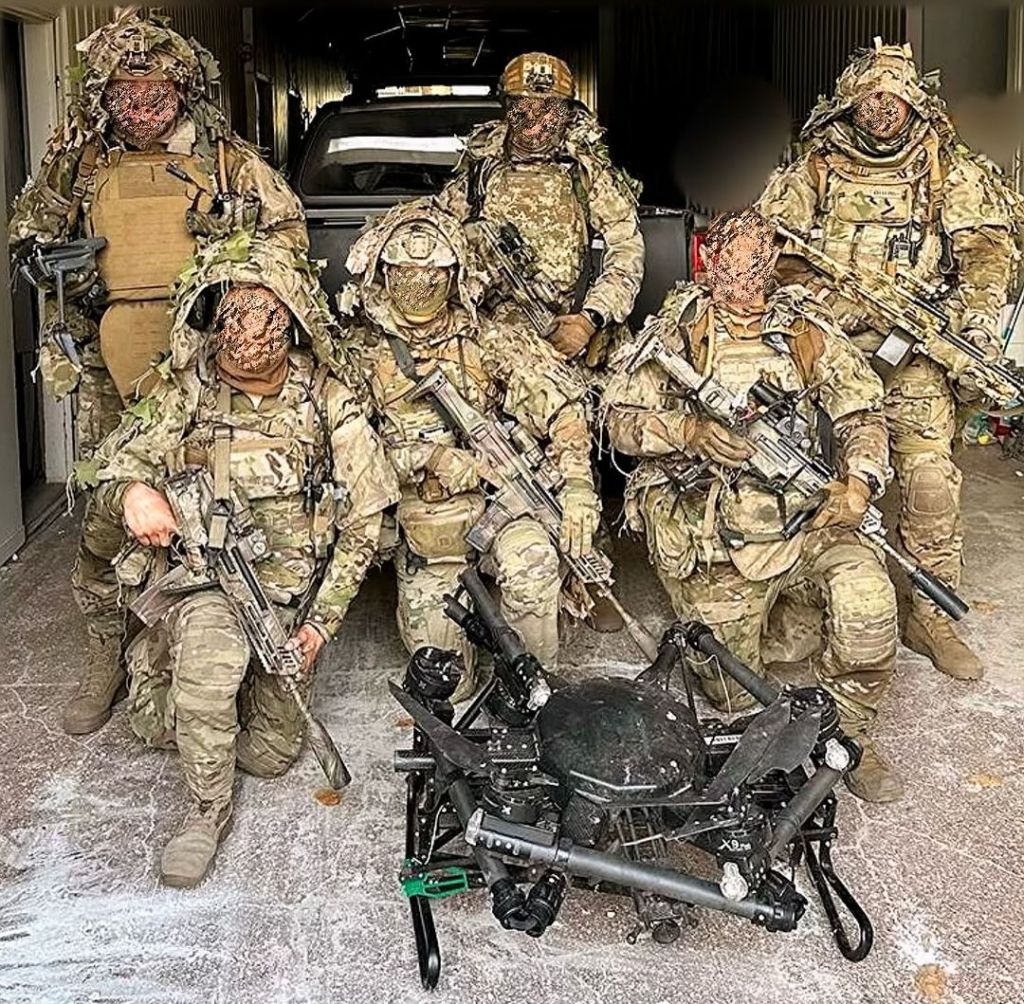
It was over a month before another image of the HK433s surfaced, on 18 September four HK433s, three with Aimpoint Micro T2s and magnifiers and one with an EOTECH XPS and a magnifier, they all appear to have the A-TEC suppressors. The photo appears to be of a recce squad and was shared by Kraken’s 3rd assault company.
The most recent photo of an HK433 to surface was shared on Telegram with a caption noting the combatant that submitted the photo was part of the Ministry of Internal Affairs of Ukraine and operating in the Kharkiv oblast. The combatant is possibly part of the National Guard’s 12th Assault Brigade.
It would seem that Ukraine has received small numbers of G36s and HK433s and that these have been issued to teams associated with. the Kraken regiment and the 12th Assault Brigade. The source of these rifles is unclear, while the G36KA4s may have come from one of the Baltic nations the HK433s are newer, less common rifles and have not yet been adopted by any militaries in the 5.56x45mm configuration. This may indicate that the rifles were provided by Heckler & Koch themselves, its unclear if the G36s may have been included in the same batch.
Update – 5/10/24: Another G36 with magazine adapter and PMAG. (Source)
Update – 6/10/24: The hammer insignia would suggest the combatant is from the same unit as the rifle pictured above.
Another sighting of a G36 in #Ukraine. Notably this one is using standard G36 mags, unlike some of the others that have been seen with STANAG mag adapters.
— Matthew Moss | Historical Firearms (@historicfirearm) October 6, 2024
Update – 7/10/24:
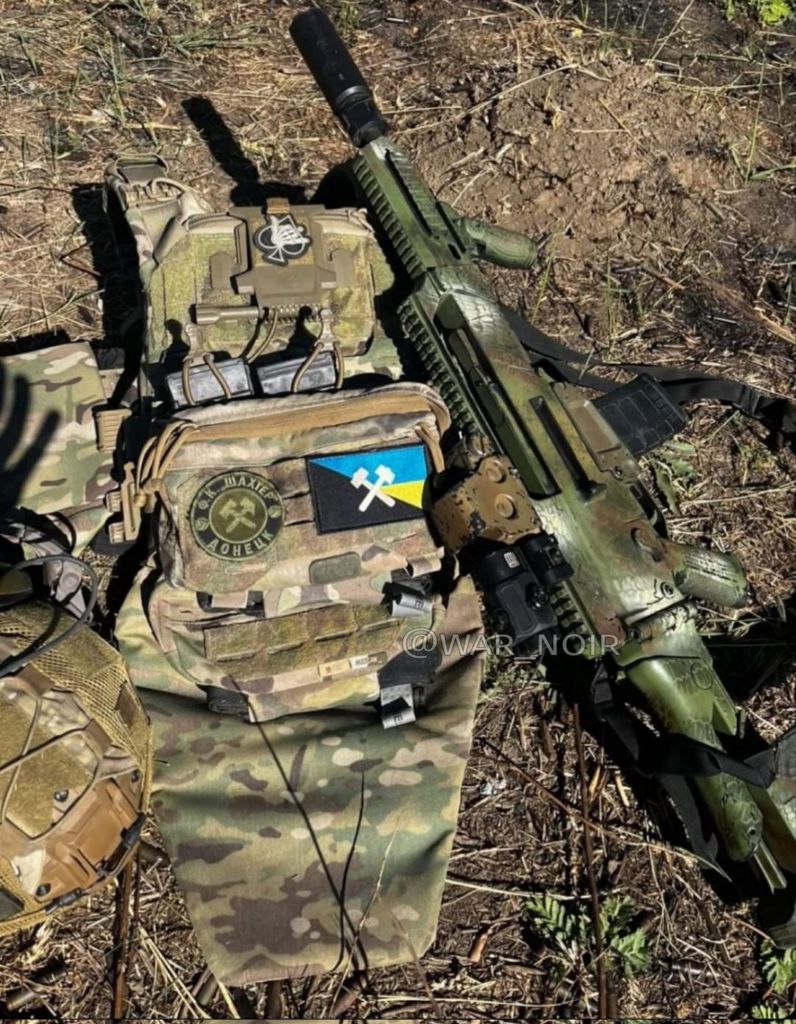
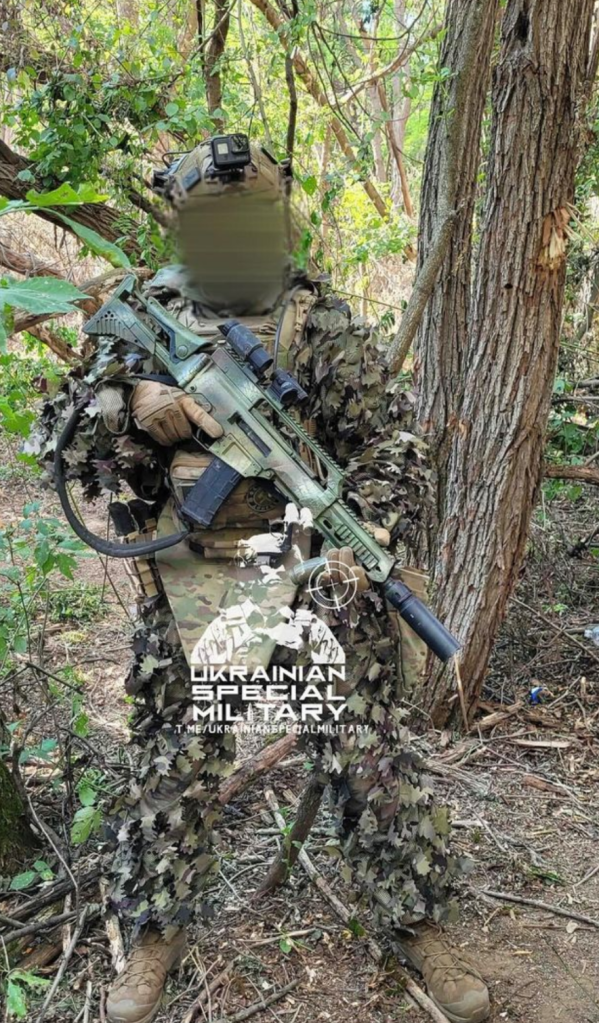
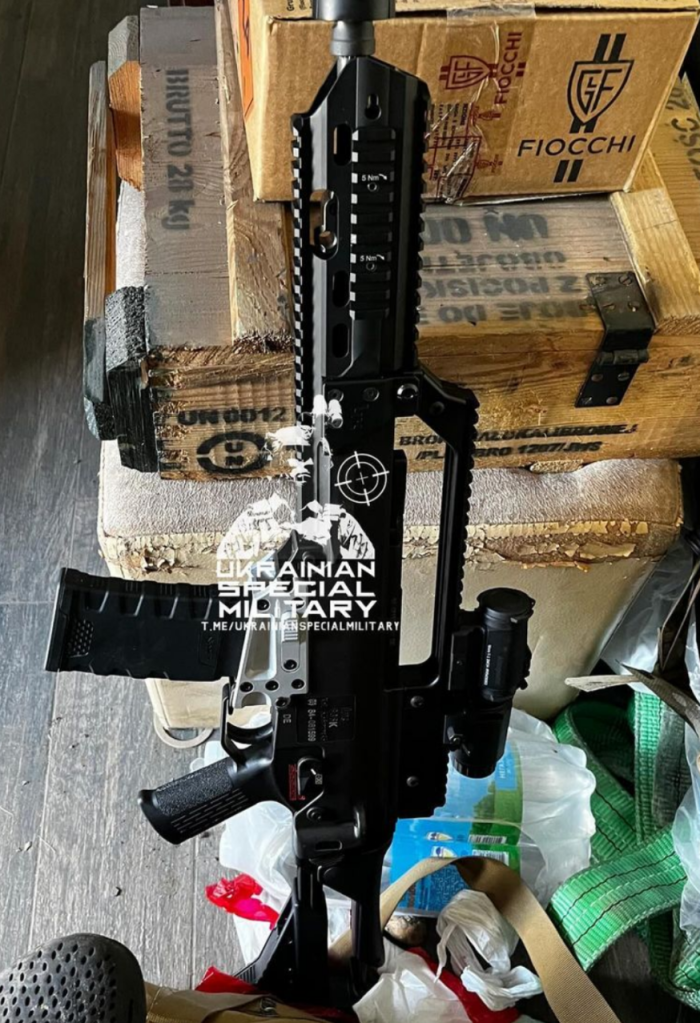
A couple of additional images of HK G636s in Ukrainian service shared by Ukrainian Special Military on IG. Again the rifles are seen evidently using magazine adapters. The rifle on the right has an unusual magazine adapter, which I’ve so far been unable to ID. It seems to be either in-the-white or, perhaps more likely, 3D printed.
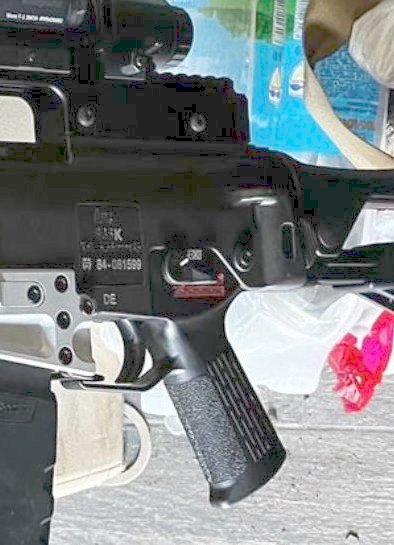
Intriguingly, in photograph on the right the rifle’s serial number and markings are visible. With an ’84’ serial number prefix and a ‘DE’ marking visible. It’s pictograph selector markings (rather than S-E-F) are also visible.
In 1976, the West German Police issued a specification for a new small, lightweight service pistol to replace their stocks of Walther P38/P1′s and various 7.65×17mm (.32 ACP) pistols.
The police specification limited the new pistols weight to 2.2lb/35oz/1kg, it was to be no larger than 18x13x3.4cm and was to be quick to draw and safe to carry with a round in the chamber.
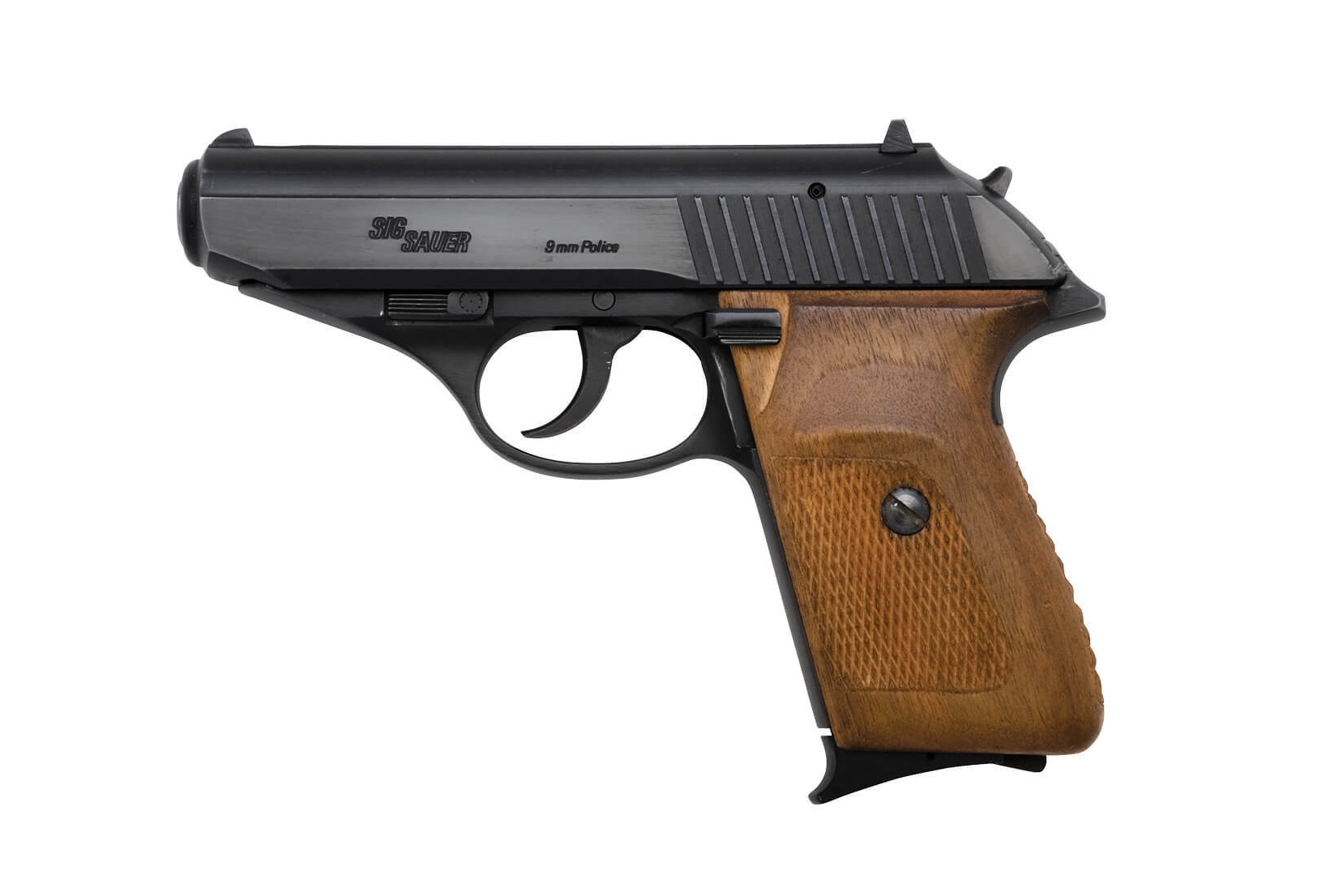
SIG Sauer P230 (Edelweiss Arms)
Earlier trials had taken place in 1974 examining pistols chambered in the 9×18mm Ultra round. Walther had submitted the PP Super and SIG-Sauer had entered the P230 for testing but with increasing criminal and terrorist activity in West Germany during the 1970s it was decided to adopt a pistol chambered in the more powerful 9×19mm round.
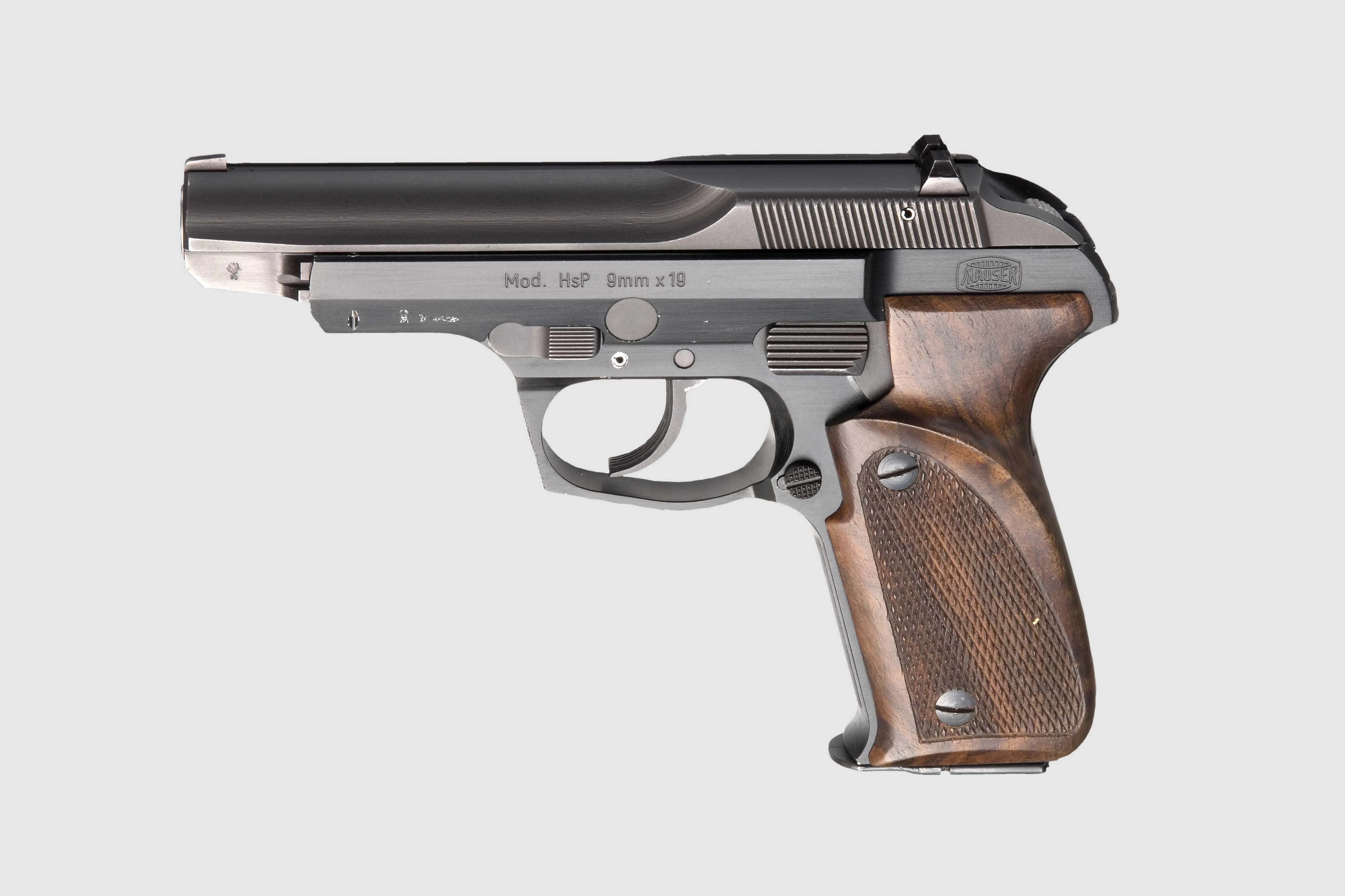
As a result a new round of trials with the new specifications was arranged. Mauser, Walther, SIG-Sauer and Heckler & Koch all submitted designs. Mauser offered the HsP,Walther offered the P5, SIG-Sauer entered the P225 (which became the P6) and Heckler & Koch submitted the PSP, later known as the P7.
The trials involved a gruelling 10,000 round endurance test (with cleaning after every 1,000 rounds), a rapid-rifle 500 round test and accuracy testing at 25 metres. One of the main problems of producing the desired sub-compact sized pistol in 9×19mm was that after approximately 1,000 rounds the pistol’s recoil spring may become prone to failure.
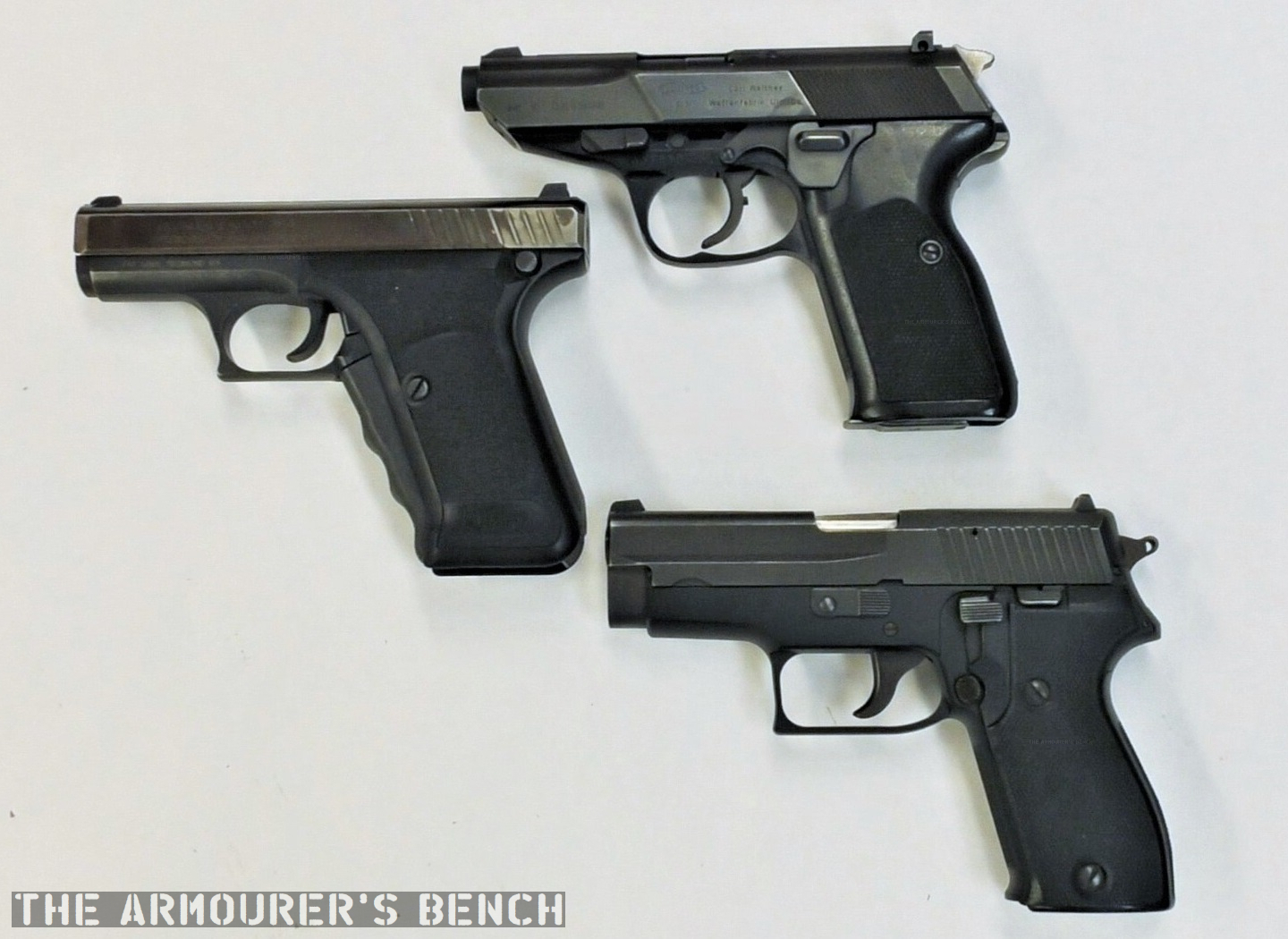
The police specification called for a 10,000 round lifespan. Each had their own approach; Walther’s P5 tackled the problem by using the dual-spring system used in the P38/P1 while Heckler & Koch used a gas-delayed blowback system in the P7. SIG-Sauer, however, employed the simplest solution – a heavy gauge braided spring to give increased strength combined with the Short Recoil action. This was also substantially cheaper to manufacture.
Clockwise: Walther P5, SIG Sauer P6, HK P7 (Matthew Moss)
The short-recoil, lever-locked Mauser HsP was eventually dropped due to durability issues, while the Walther P5, SIG-Sauer’s P6, and Heckler & Koch’s P7 were successful and deemed fit for service and adopted by various German police departments.
The P5 was adopted by Baden-Württemberg and Rhineland-Palatinate’s State Police as well as the Dutch national police. TheP6 was the most widely adopted as it was the cheapest option available, with a total of seven German state police forces adopting it along with orders from the border police, railway police and the Federal Criminal Police Office. The most expensive of the pistols, the P7 was favoured by more specialist units like GSG9.
Our thanks to our friends at Gunlab for allowing us to take a look at these pistols.
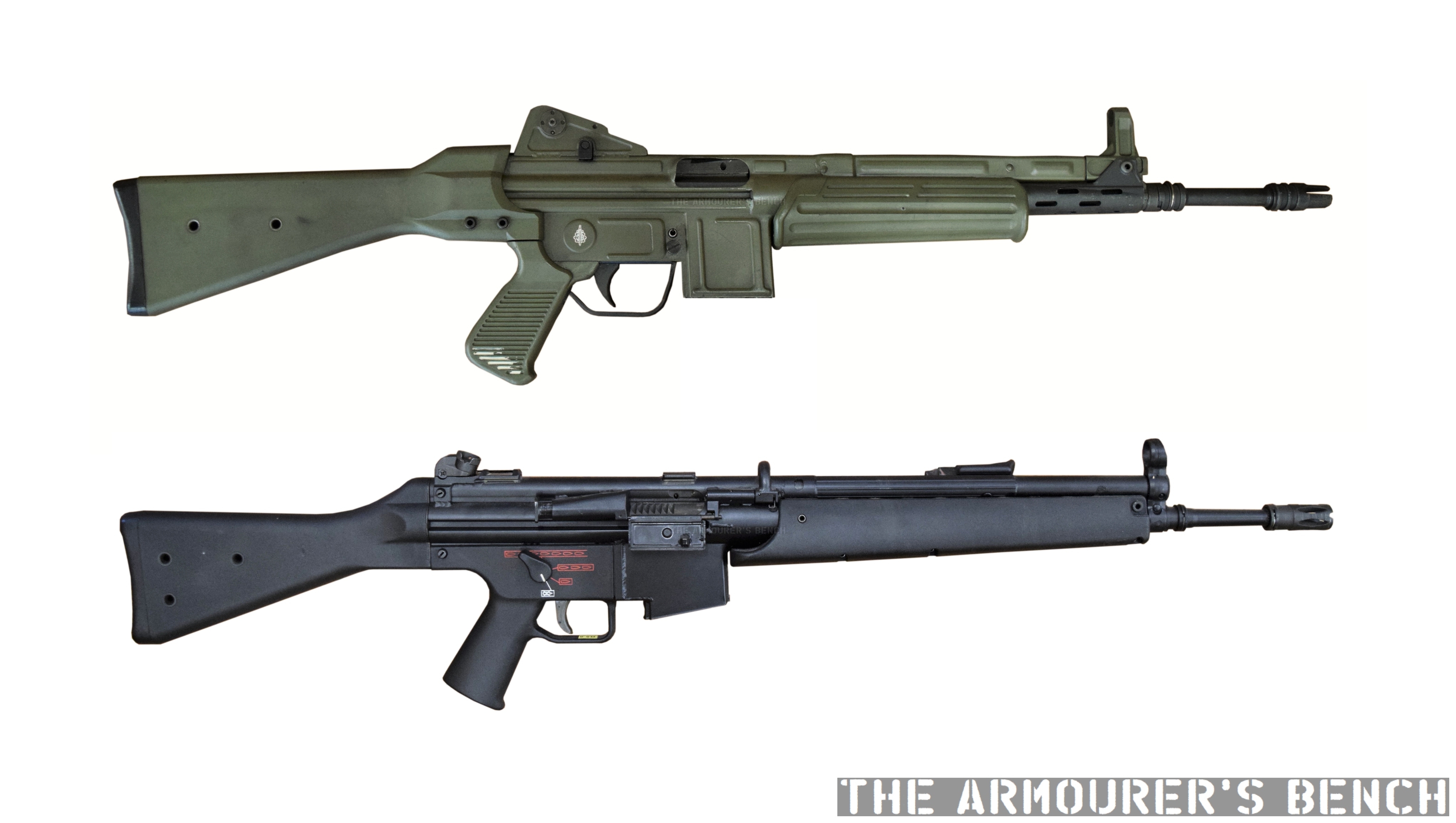
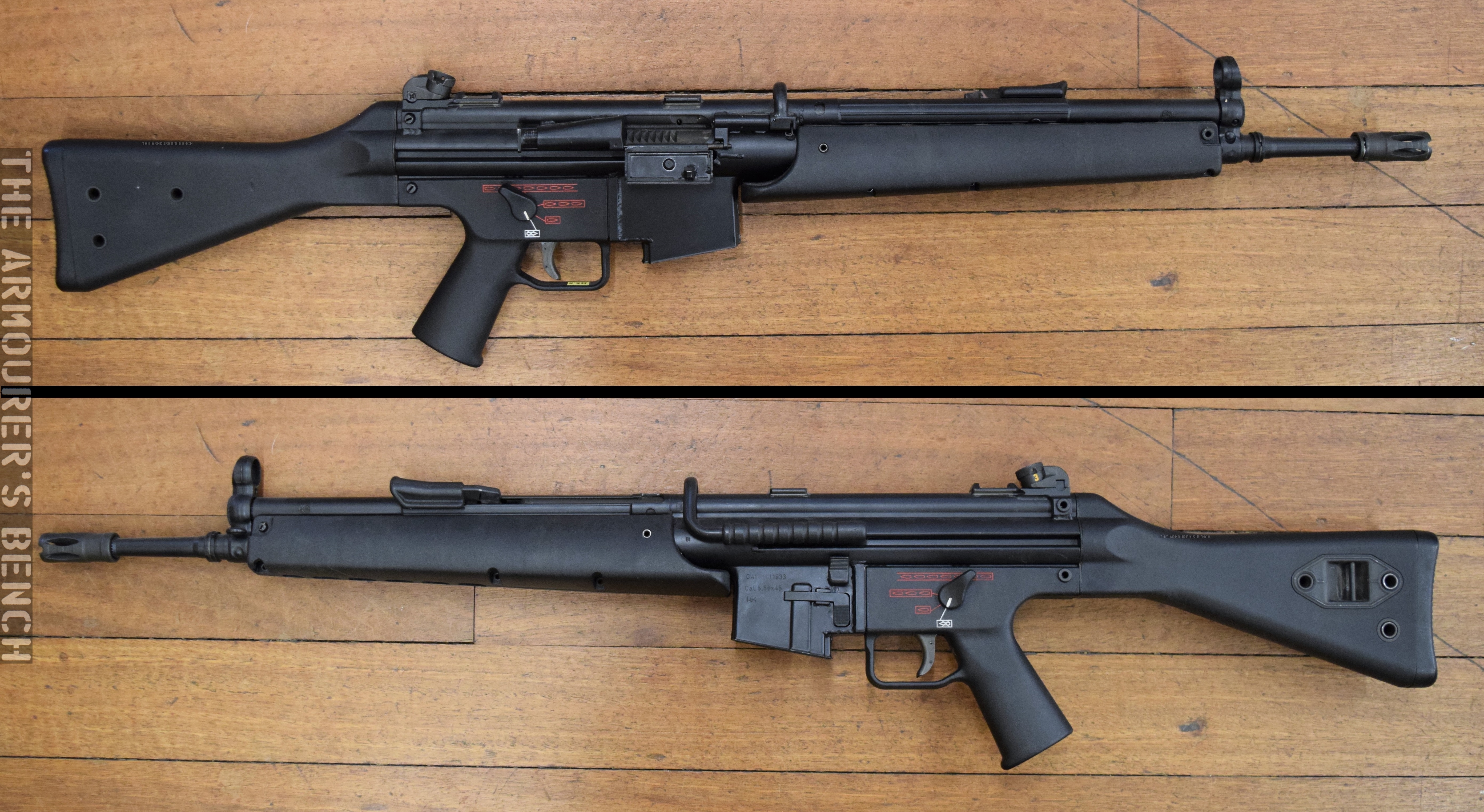
In this week’s video we compare two of the last roller-delayed production rifles: the Spanish CETME Modelo L and the Heckler & Koch G41. These rifles represent the last evolutions of two strands of the roller-delayed development tree – the Spanish and the German.
The CETME L & HK G41 (Matthew Moss)
Both rifles use the roller-delayed blowback action and are both chambered in NATO SS109 5.56x45mm ball round, have have 1:7 twist barrels and feed from STANAG magazines. Both were developed during the 1980s and both are also capable of firing rifle grenades.
The CETME L
Left-side profile of the CETME L (Matthew Moss)
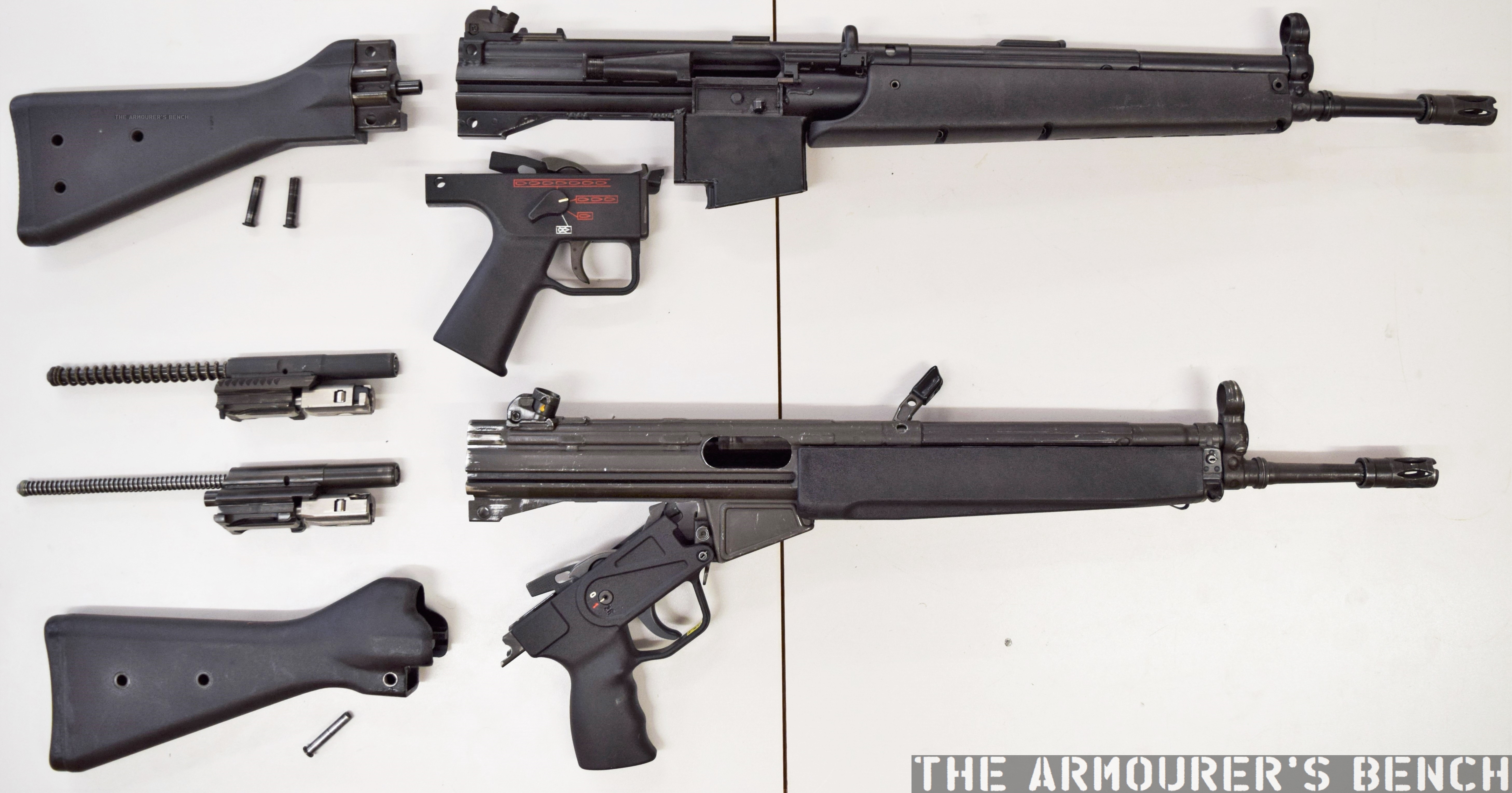
The CETME has a bit of a reputation for being cheap but this relatively unbattered example feels solid enough. Both of the rifles disassemble in much the same way with the butt assembly being removed to allow the bolt to be pulled out of the rear.
Most notable about the CETME’s bolt is the long rod protruding out the back of the bolt assembly. This acts on the recoil spring housed inside the butt. The L’s recoil spring, unlike the G41s, is captive inside the butt rather than nested inside the rear of the bolt carrier. The CETME’s bolt is also much squarer than the G41’s which probably simplified the machining of the bolt and designing the receiver stamping.
The L’s bolt and butt assembly (Matthew Moss)
The L does not have a provision to lock its bolt back in a slot like the HK (no CETME slap for Spanish soldiers), however, it does have a bolt hold open, with the release located in the rear sight base.
The CETME has simpler folding aperture sights with 200–400m adjustments. It weighs in a 3.72kg or 8.2lbs unloaded and is 92.5cm or around 36in in length. The CETME has a simpler fire control group, with safe, semi and full-auto settings. It is not ambidextrous and only has a selector on the left side of the receiver. The CETME L has largely been replaced by the weapon that superseded the G41 – the gas-operated HK G36.
Heckler & Koch G41
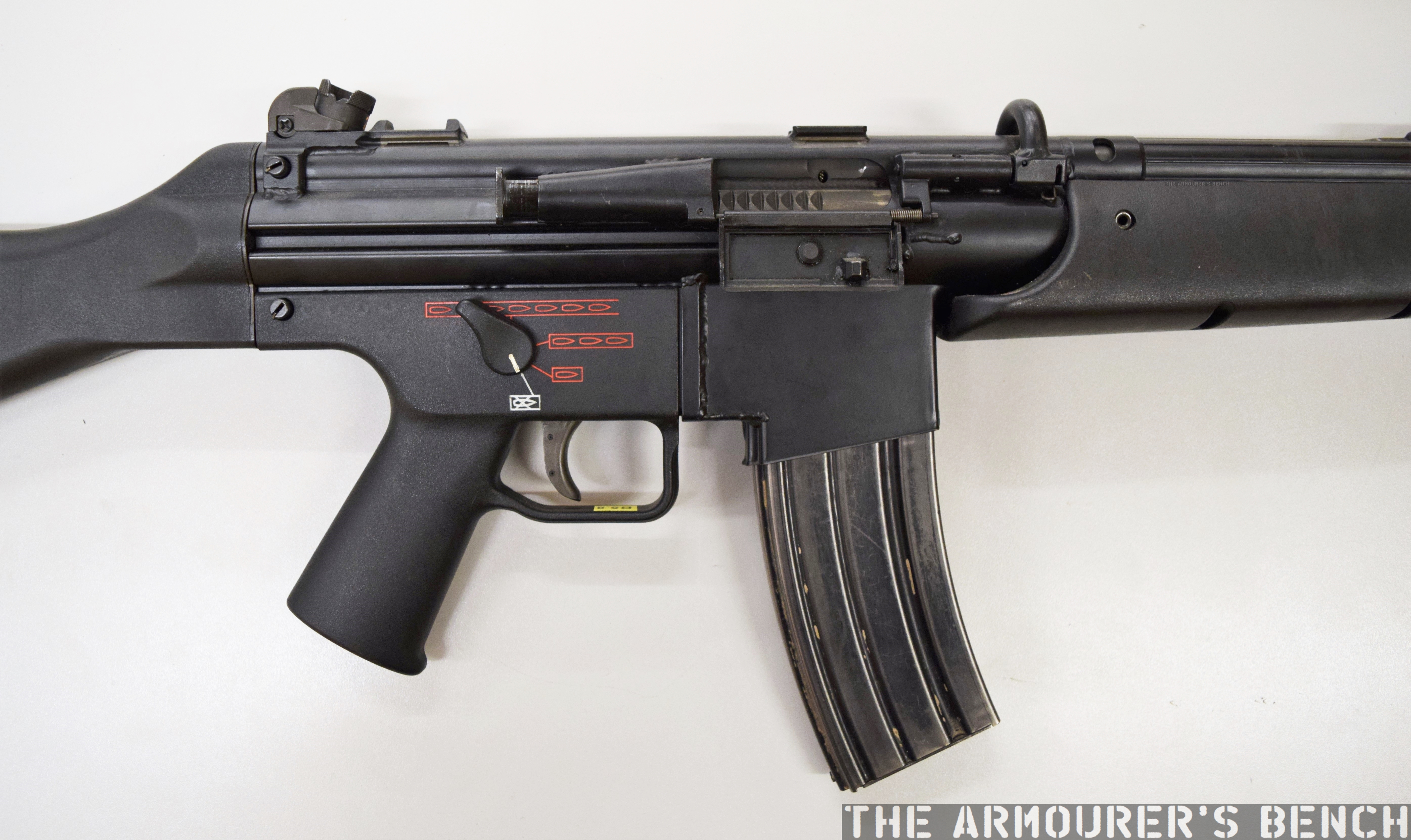
The left-side profile of the G41 (Matthew Moss)
We have full article and video examining the G41 in detailhere.
HK finalised the G41’s design in 1979, a refinement of the 5.56x45mm HK33, it sought to modernise the platform and borrowed features from the M16 family of rifles including a bolt release catch, dust cover and forward assist.
The G41 has a butt assembly that fits into the receiver rather than around it. So its cross pins are at the top and bottom of the receiver rather than both at the bottom. This spreads the stresses on the receiver vertically rather than laterally.
Comparison of the G41 and Model L’s bolts (Matthew Moss)
The G41 has both the classic HK hold open notch and a AR-style paddle bolt release. HK’s dioptre drum sights have adjustments from 100 to 400m, and can mount a scope using an HK claw mount. G41 is the heavier of the two rifles, weighing in at 4.31kg or 9.5lbs. The G41 is also slightly longer than the L at nearly 100cm or 39in in length.
The HK has an ambidextrous selector with positions for safe, semi, 3-round burst and finally full-auto. The G41, unlike the L, also has a folding carrying handle near its point of balance.
The G41 represents the last evolution of HK’s infantry rifles using the roller-delayed blowback action. It comes from a period when HK were developing what they hoped would be the next generation of small arms technology and with the collapse of the G11 programme and the lack of sales of the G41 saw it superseded in the 1990s by the gas-operated G36.
In the second video Matt tackles the Heckler & Koch G11 and gives an update on the colouring book and the channel:
Thanks for watching chaps & thanks so much for your support in 2019, we greatly appreciate it. It’s been a busy year and we hope that you’ve all enjoyed our videos!
You can still pick up a copy of the ACR colouring book and the G11 sticker at www.armourersbench.com/shop. we’re very much looking forward to seeing your artistic sides when you send us some photos of your colouring to – contact@armourersbench.com.
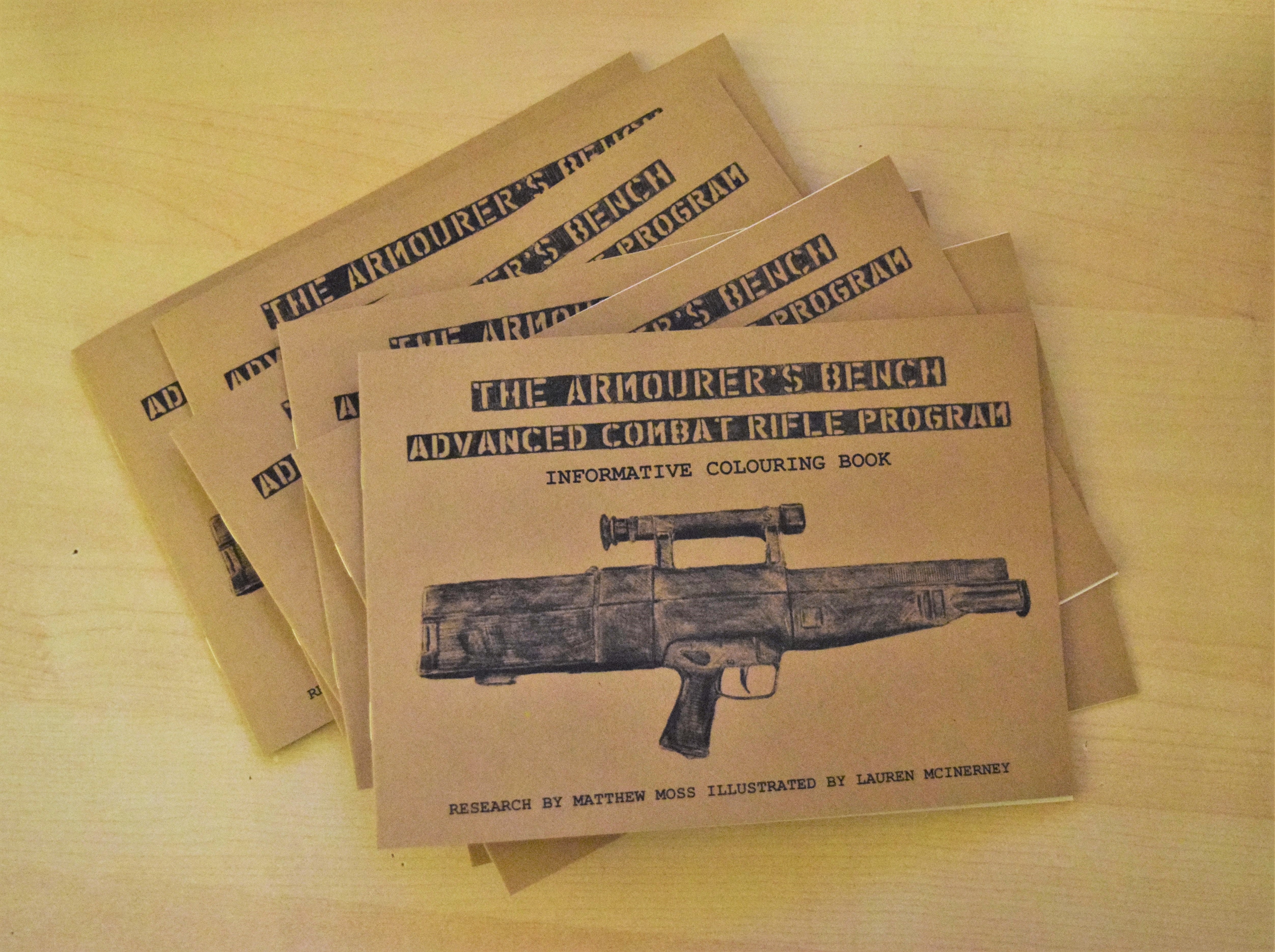
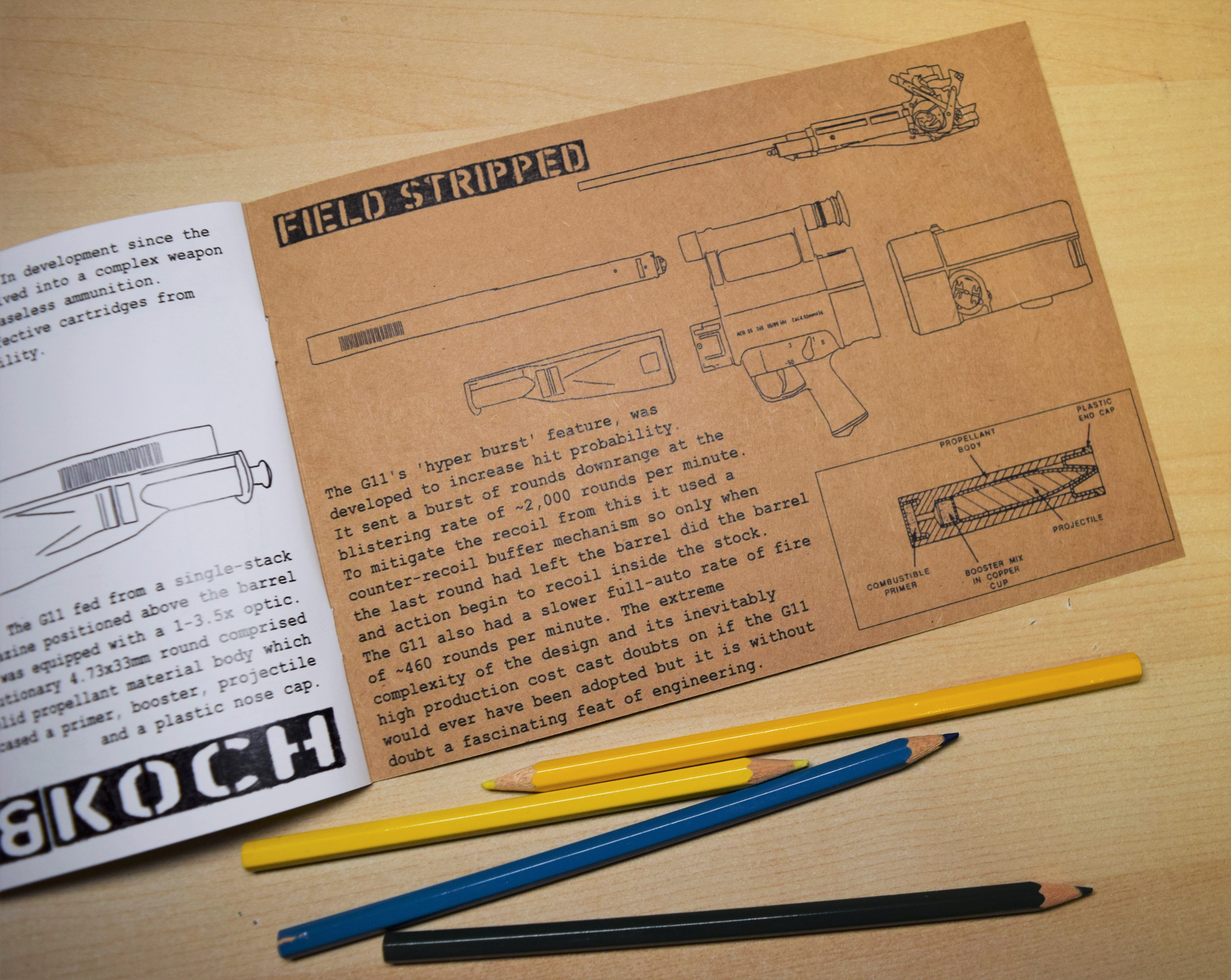
The Armourer’s Bench are proud to introduce our very first ‘informative colouring (coloring) book’. Not only can you colour in the prototypes from the US Army’s Advanced Combat Rifle trials but you can also learn about the guns, how they worked, performed and the outcome of the trial as you colour!
Why a colouring book? Well, simply put, no one else has done one before! With the help of our brilliant illustrator, Lauren McInnerney, we put the book together to give you guys something a bit different, something fun!
We have a limited run of these little books and we will do our very best to get them our ASAP if you order them for Christmas.
The book includes detailed original illustrations of each of the four ACR guns: the AAI, Colt, Steyr and of course the iconic HK G11. The 8-page booklets are 8×6″ (or A5 sized) and are available now from our website for $6.00, plus shipping.
All the funds raised from the sale of the books will go toward supporting TAB through 2020.
But wait! That’s not all! We also have some extremely cool new stickers available. These 4″ cutout vinyl stickers feature the TAB logo on an illustration of the G11.
And last but not least we also have a small run of TAB logo badges available too!
In 1981, Heckler & Koch introduced what would be their last infantry rifle that used their tried and tested roller-delayed blowback action, the HK G41. In October 1980, following NATO’s smalls arms and ammunition testing during the late 1970s, a meeting of NATO Armament Directors, agreed to standardise to the 5.56x45mm round favoured by the United States since the mid-1960s. Standardisation Agreement (STANAG) 4172 saw NATO standardise on the Belgian/FN SS109 ball round. At the same time Draft STANAG 4179 proposed adopting US 30-round M16 magazines as the standard 5.56 magazine pattern, while this proposal wasn’t ratified the M16’s magazine became the de facto standard.
At this time Heckler & Koch were engaged in a major engineering project to develop the G11 caseless ammunition-firing individual weapon. Their main offering for the 5.56x45mm rifle market at the time was the HK33, a rechambered version of the 7.62x51mm G3 developed by Tilo Moller, which was introduced in 1965. The HK33, however, used a proprietary HK magazine and was not compatible with the M16’s magazines. In 1977, as the NATO trials began and it became clear that 5.56x45mm would be adopted, HK began to develop what would become the G41. In 1979 with initial development completed HK submitted 18 G41s for testing with the West German Army. It wasn’t until 1981 that HK introduced the G41 onto the market.
Left and right profile views of the G41 (Matthew Moss)
While continuing to use the same roller delayed blowback operating system as the G3, HK33 and MP5, the G41 embodied a number of improvements. While still using a stamped metal receiver it utilised 1mm thick high tensile steel rather than the 1.2mm thick steel used by the HK33. This helped to lighten the receiver. The new rifle also used a lighter bolt assembly, paired with a new recoil spring which comprised of five wound strands around a central coil, rather than a single coil, which had a longer stroke. This acted to lower the felt recoil. The G41, however, had a higher rate of fire at around 850 rounds per minute compared to the 750 rounds per minute of the HK33. Some of the G41’s bolt geometries were reworked and a new extractor was added.
The G41’s lower receiver was redesigned to allow the rifle to feed from STANAG magazines rather than HK’s earlier proprietary magazines. The cocking lever and forward assist were taken from the HK21A1 (XM262) general purpose machine gun, developed for the US SAW trials.
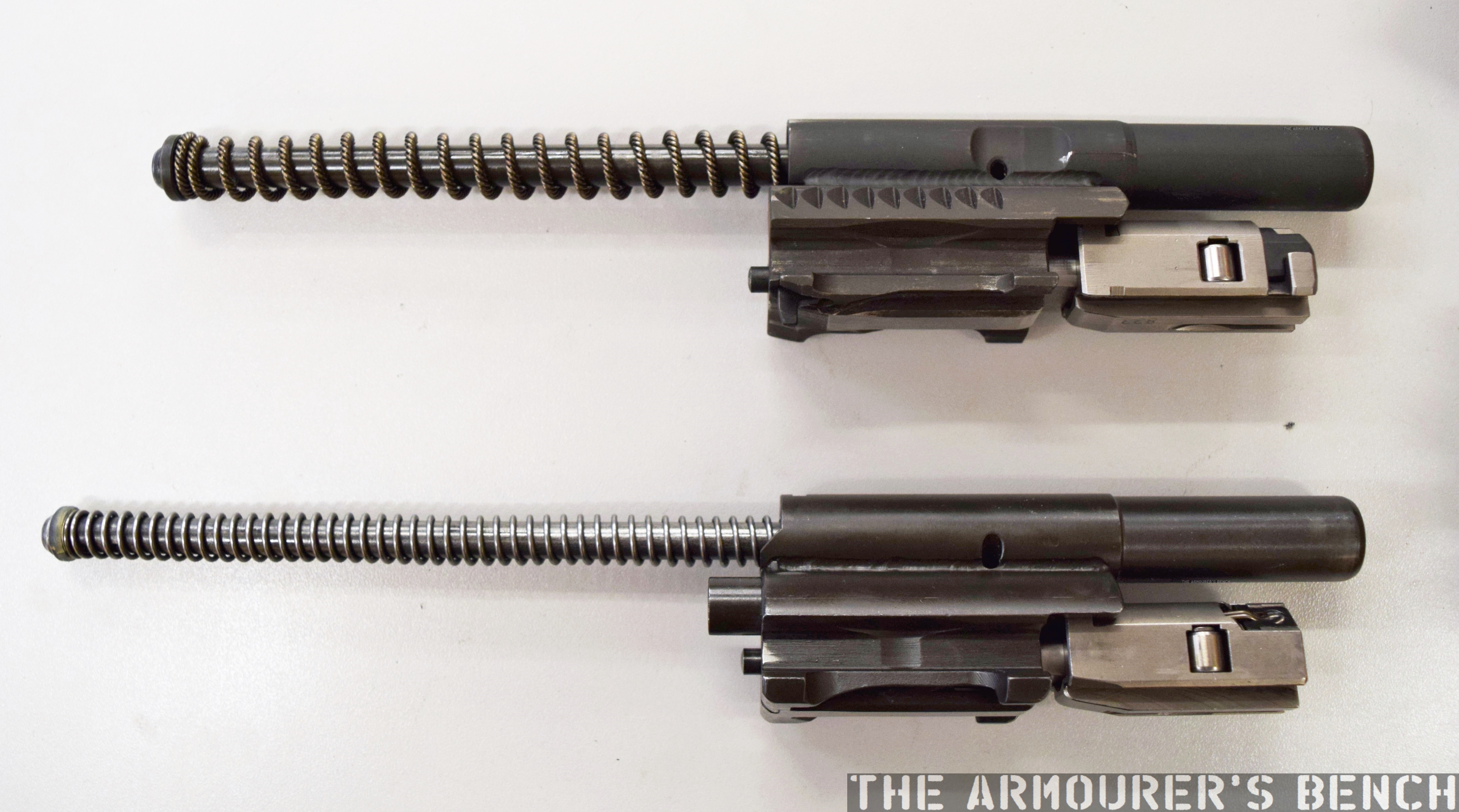
HK G41 (top) and HK33 (bottom) field stripped (Matthew Moss)
It also had a new more triangular polymer foregrip and added a plastic dust cover to the ejection port, a NATO pattern optics mount (meeting STANAG 2324) replaced HK’s claw-mount system, and a spring-loaded folding carrying handle near the centre of balance was added. Importantly it also added a last round hold open device and a bolt release catch, on the left side of the lower receiver.
The usual thumb serrations on the side of the bolt, for pushing the bolt home, were replaced by a prominent forward assist, similar to that found on the M16A1 and other HK weapons such as the HK21 light machine gun and the PSG-1 sniper rifle. HK sales literature described it as a ‘low noise’ forward assist and the manual describes the “quiet cocking of the weapon” – essentially riding the cocking handle back into battery and then pushing the forward assist to lock the action, the system is not as ‘low noise’ as advertised.
Right side of the G41, note the addition of a forward assist and dust cover (Matthew Moss)
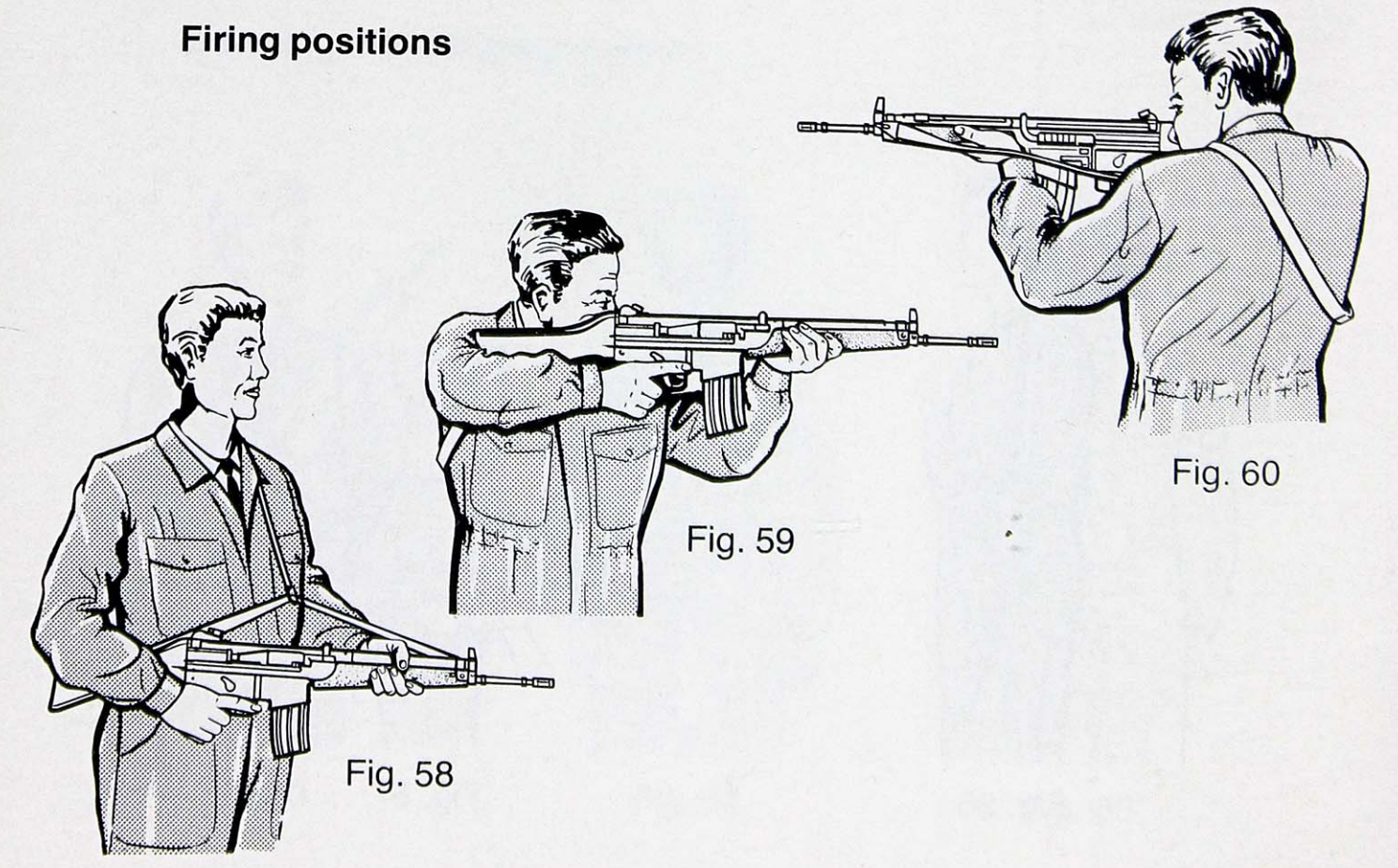
Another important feature of the rifle was the inclusion of a three-round burst setting alongside semi and fully automatic. The G41 could mount a standard G3 bayonet, fit an M16 bipod and had a flash hider designed to enable it to fire NATO standard rifle grenades. The 40mm HK79 under barrel grenade launcher could also be mounted to all variants of the G41, simply swapping it out for the polymer forend. HK referred to this set up as the G41-TGS or ‘Tactical Group Support system’.
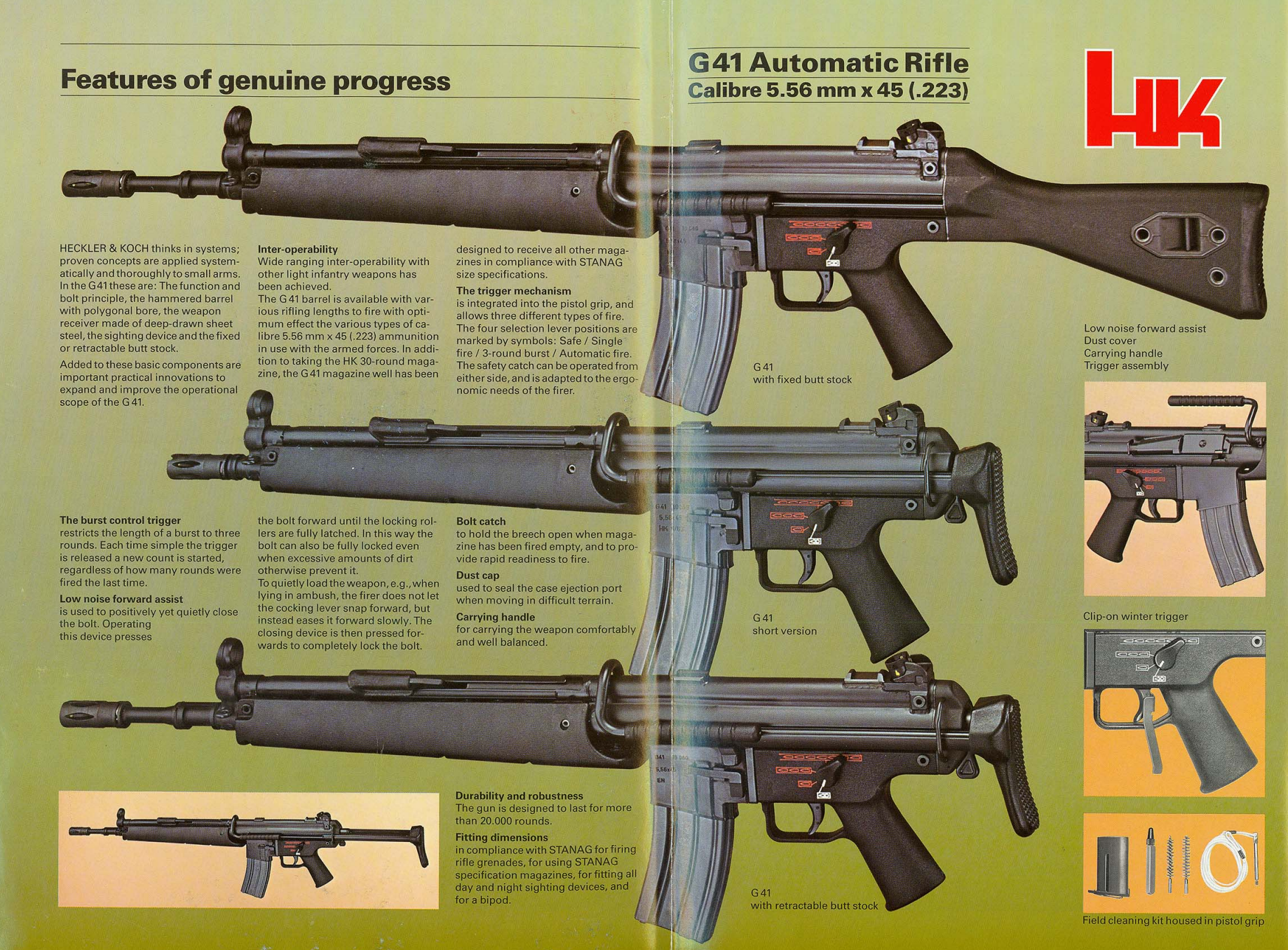
Spread from a 1985 HK promotional product brochure showing the various G41 configurations (HK)
The G41 came in a number of variants with designations A1 to A3. The base rifle had a fixed buttstock and its rifling had 1 turn in 7 inches with a right-hand twist, in a 18.9 inch barrel. The A1 had a 1 in 12” twist barrel and fixed buttstock. The A2 had a collapsing, single position stock and 1 in 7” inch twist rifling, while the A3 had 1 in 12” inch twist rifling. The 1 in 7” rifling was optimised for the new SS109, while the 1 in 12” optimised for the US M193 round. There was also a shortened G41K model which had a collapsing stock and a 15 inch barrel available with both rifling types.
One of the main issues with the G41 was its weight. Despite efforts to lighten the sheet metal receiver, it weighed more than its predecessor the HK33. According to measurement data compiled by researcher Nathaniel F, unloaded the G41 weighs in at 4.31kgs or 9.5 lbs, this is a full pound heavier than the HK33. A contemporary M16A2 weighed 3.39kg or 7.5 lbs while the Spanish CETME L, a similar stamped receiver rifle chambered in 5.56×45, weighed 3.72kg or 8.2 lbs. The rifle eventually adopted by the Bundeswehr, the HK G36, weighed 3.13kg or 7.3 lbs. The G41K with its collapsing steel stock wasn’t much lighter, weighing 4.3kg or 9.5 lbs, according to HK sales literature. Another potential issue may have been reliability with the move to the STANAG magazine rather than the optimised proprietary HK magazines may have introduced some issues.
The bolts of the HK G41 (top) and HK33 (bottom), note the redesigned extractor, forward assist serrations on the bolt carrier and the G41’s thicker but shorter recoil spring (Matthew Moss)
Following NATO’s decision the early 1980s saw a large number of countries looking to replace their ageing 7.62x51mm battle rifles. Sweden began to look for a 5.56x45mm rifle to replace its licensed version of the G3, the Ak4, in the late 1970s. HK could initially only offer the HK33 but the G41, tested later, was also rejected by the Swedes in favour of FN’s FNC. Italy sought to replace the BM59 with a more modern rifle and HK entered into an agreement with Luigi Franchi which saw them offer both the original HK configuration and the develop their own, slightly modified version, the Franchi mod. 641, but the Beretta AR70/90 was selected. Similarly, in 1984 Spain decided to adopt the indigenously developed CETME L. In 1986 the HK G41 was also submitted to the Irish Army’s trials to replace the FN FAL, it was beaten by the Steyr AUG. Initially West Germany had hoped to procure up to 20,000 HK G11 rifles per year, with a total of 224,000 in service by 2003.
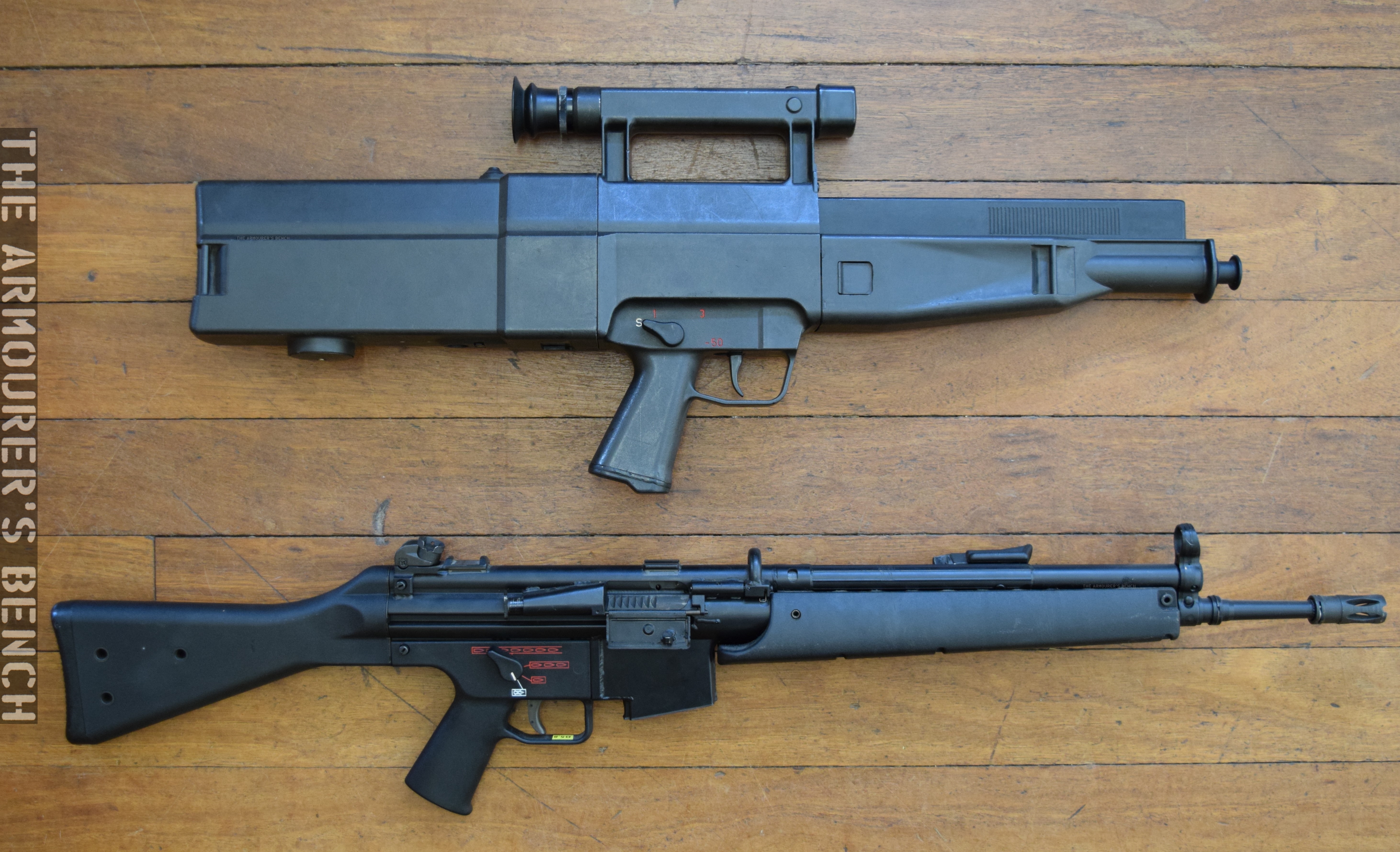
HK’s G11 and G41 (Matthew Moss)
The collapse of the Soviet Union and the subsequent reunification of Germany saw Federal budgets stretched and the G11 programme was subsequently abandoned entirely. The Bundeswehr still needed a suitable rifle to replace the G3 and in the 1990s sought a lighter weight rifle. HK felt their HK50 project, in development since the mid-1970s was a better bet than the heavier G41, and following Bundeswehr trials the G36 was subsequently adopted in 1997. Sadly, I have not been able to get a hold of any of the trials reports from the nations that tested the G41, so can not say with certainty why the countries mentioned above rejected HK’s rifle.
Graphic from HK’s manual for the G41 (HK)
From photographs of members of the Turkish Gendarmerie special operations group training at the Foça Commando School, dating from the early 2010s, it appears that Turkey either purchased a number of G41s or Turkey’s state-owned defence manufacturer, MKEK, produced an unknown number under license.At some point in the 1980s the British Army also tested a small number G41s with serial numbers #11131, #11832 and #11833 remaining in UK collections.
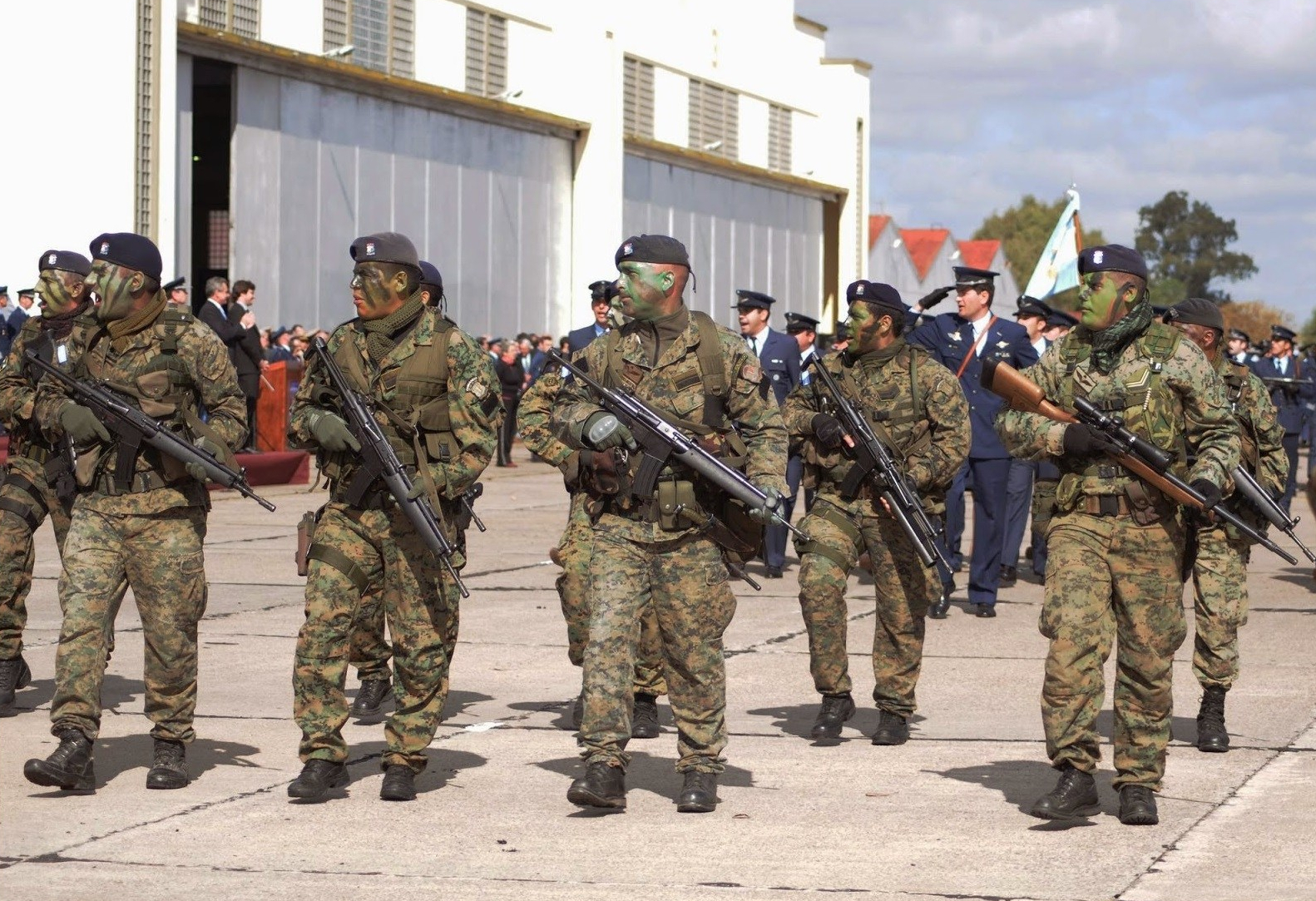
Denmark’s elite Jaegerkorpset and Froemandskorpset used the G41 for a time and Argentina’s special forces, including the Grupo de Operaciones Especiales, have also been photographed with both HK G41s and G41A2(collapsing stock) fitted with the TGS package comprising of the HK79 under barrel grenade launcher.
Argentina’s Grupo de Operaciones Especiales on parade with G41s and the G41-TGS, grenade launcher package (source)
The G41 represents the last evolution of HK’s infantry rifles using the roller delayed blowback action. It comes from a period when HK were developing what they hoped would be the next generation of small arms technology and with the collapse of the G11 programme and the lack of interest in the G41 the company faced financial uncertainty throughout the early 1990s. HK’s move away from the roller delayed blowback action to a more conventional gas operated rotating bolt system, combined with lightweight polymers, in the G36 proved to be more successful than the ill-fated G41.
If you enjoyed the video and this article please consider supporting our work here.
Our thanks to the collection that holds the G11 for the privileged and nerve-wracking opportunity to field strip it and take a look inside. If you’d like to know more about the history of the G11’s development you can check out our video and full blog on it here. Vic has done a great series of videos looking at the G11 and the other prototype rifles from the US Army’s abortive Advanced Combat Rifle trials – you can find those here.
In this blog we’ll take a closer look at some of the G11’s components, for a demonstration of dissassembly and and explanation of how the rifle works in principal check out the video above.
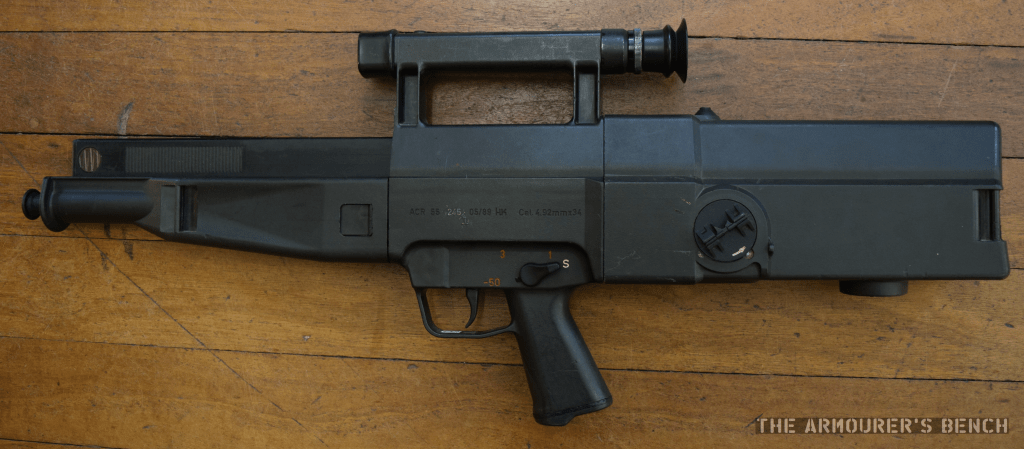
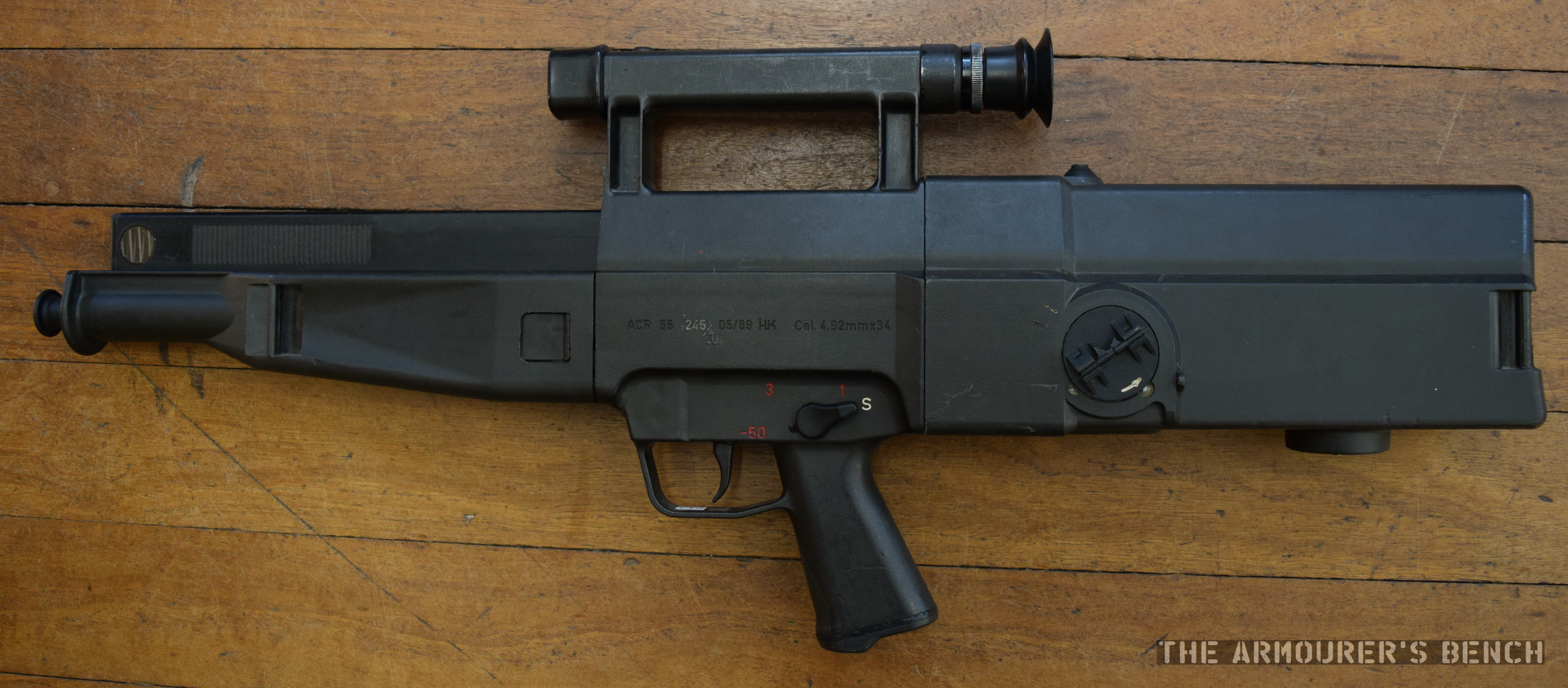
Firstly, lets take a look at the exterior of the rifle. The weapon has a box-like polymer coated outer shell. The shell is made up of three parts, with the butt assembly and forend locking into the centre assembly which includes the pistol grip, trigger mechanism and optical sight. The forend and butt are locked into the centre assembly by plastic locking tabs. While stiff and somewhat difficult to depress the tabs are reportedly prone to breaking.
Left side view of the G11 (Matthew Moss)
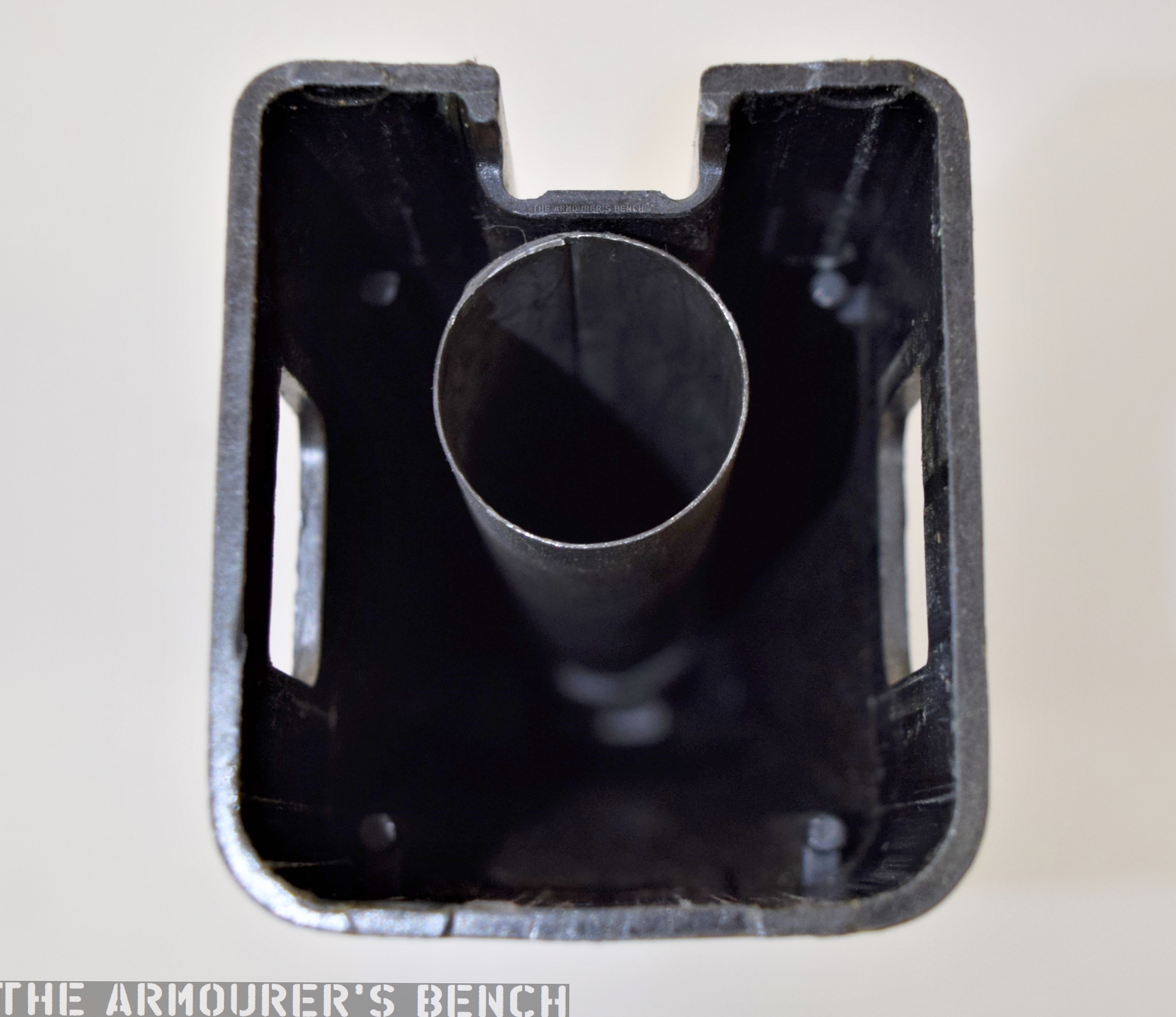
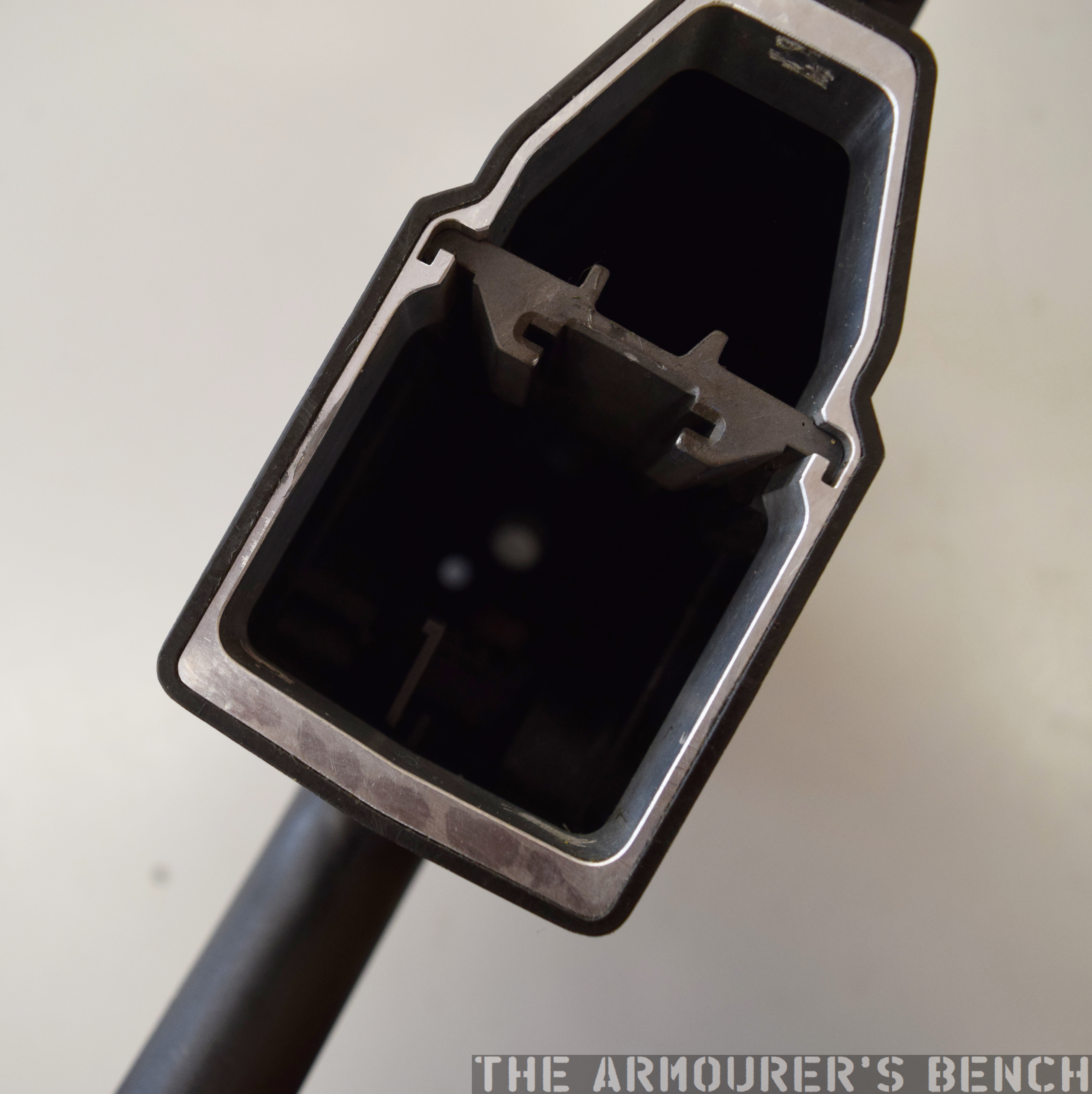
Before we look at the G11’s internals lets take a look at the shell components. Here we can see the inside of the forend, we can see a metal (aluminium I believe) barrel tube into which the barrel slides.
Close up of the the inside of the G11’s forend (Matthew Moss)
Below is a photograph of the rear of the centre assembly looking forward, the small white circle (sadly slightly out of focus) is the bushing the barrel protrudes through into the forend.
The G11’s centre assembly houses a metal guide rail and magazine guide as well as the trigger mechanism (Matthew Moss)
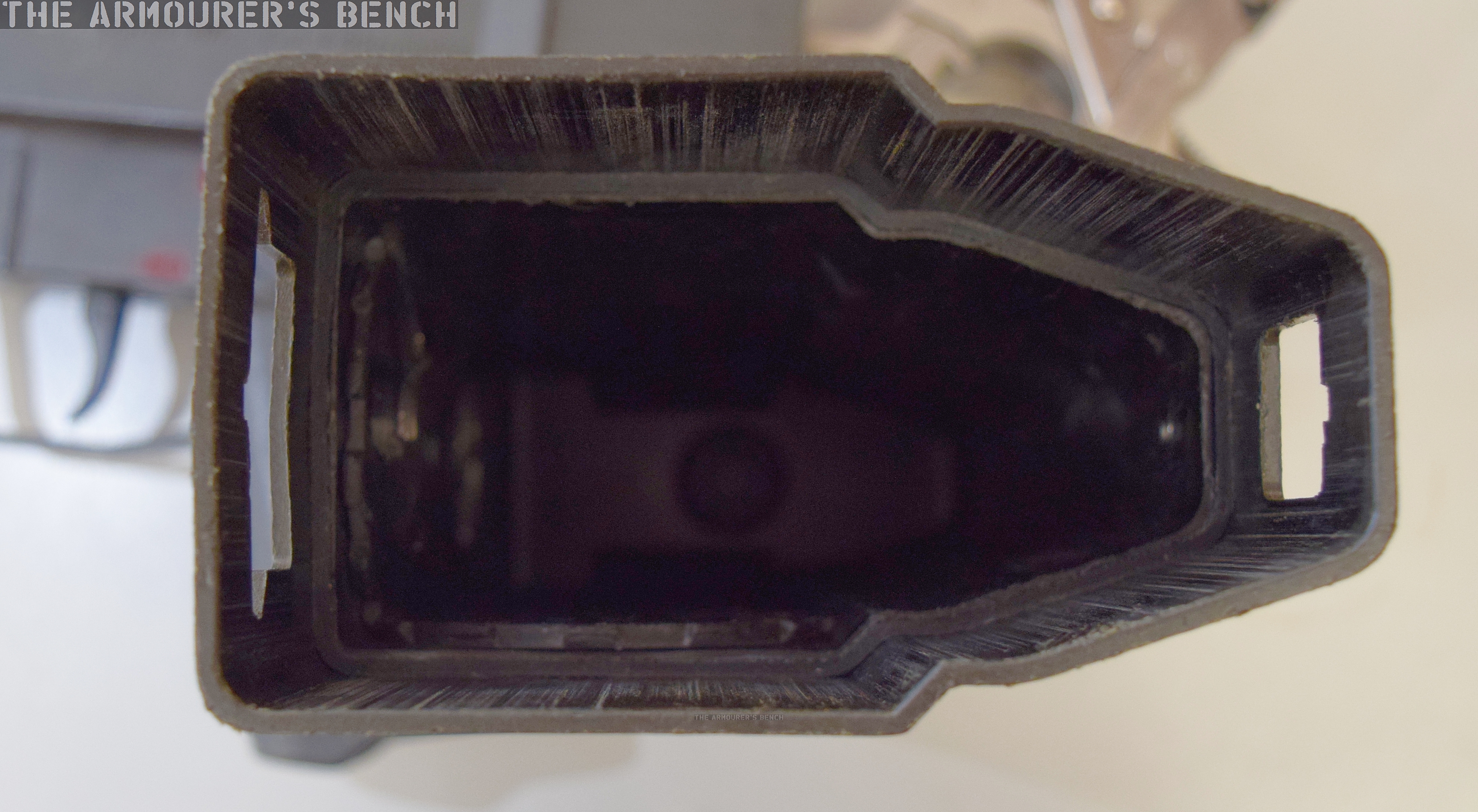
Next we have a view of the inside of the rifle’s butt assembly. Note the scuff marks on the inside where the centre assembly has scrapped the plastic. We can also see the locking tab windows which are on the top and bottom of the butt.
A view inside the G11’s butt stock (Matthew Moss)
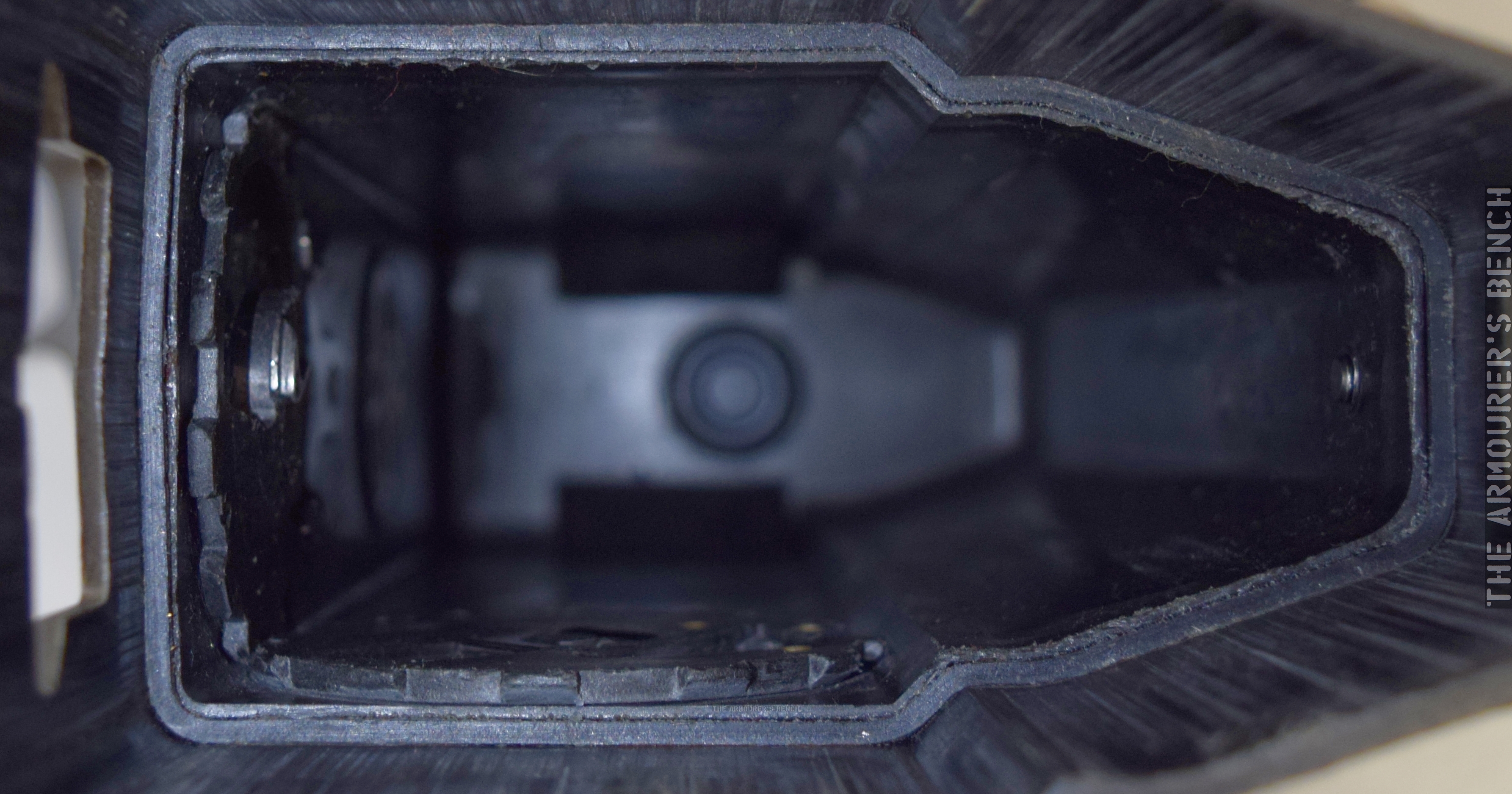
Inside the butt we can see the ‘toothed wheel’ and ‘sealing gear’ which are turned when the cocking piece is rotated. These plastic pieces act directly on the action. Behind that is the gas escape valve, which will tap off excess gas if over pressure problems occur with the rifle.
A close up of the sealing gear and toothed wheel that interface with the cocking handle (Matthew Moss)
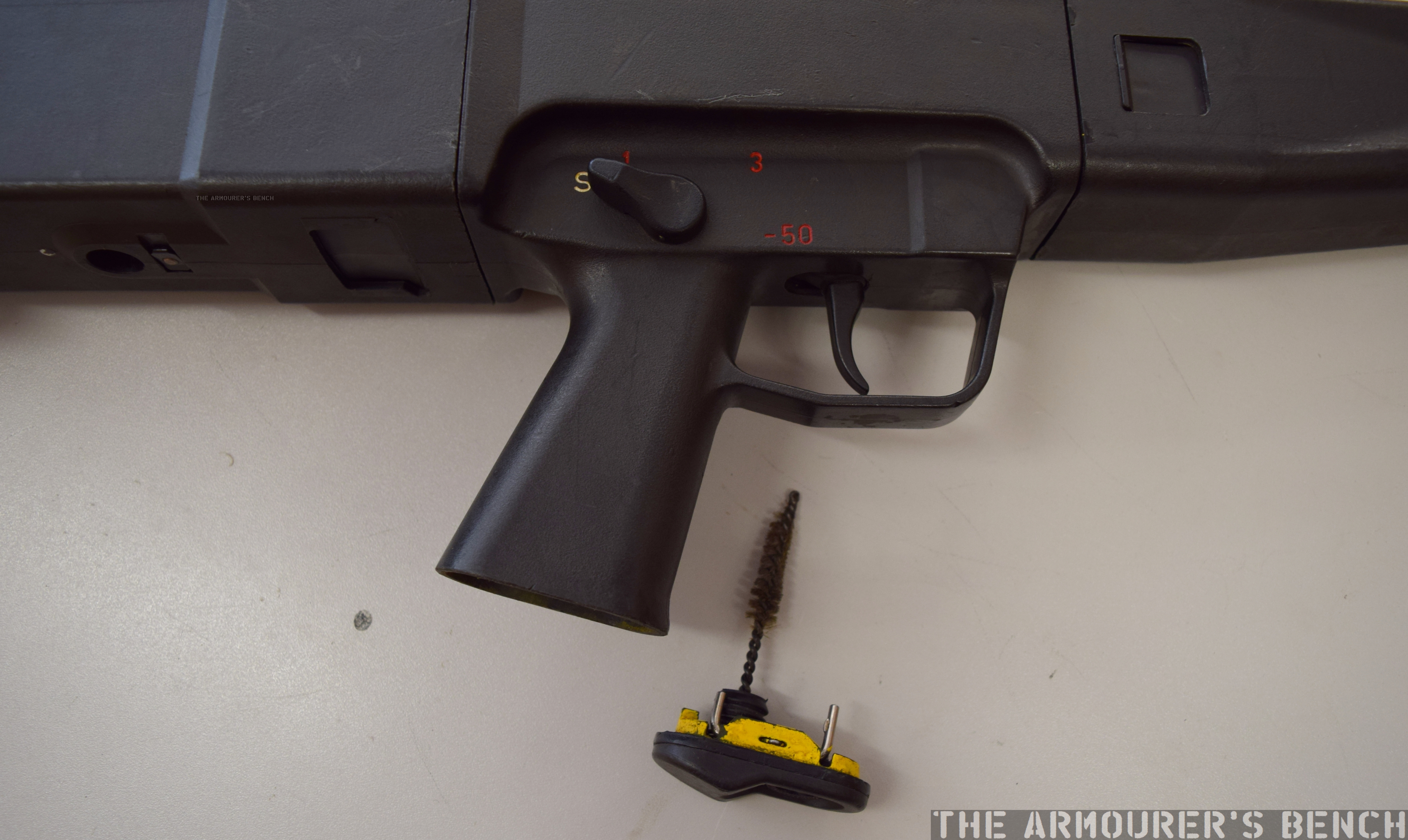
The first step to disassembling the G11 is ensuring the weapon is clear by pushing the cleaning brush up into the breech.
Close up of the G11’s cleaning brush, housed inside the pistol grip (Matthew Moss)
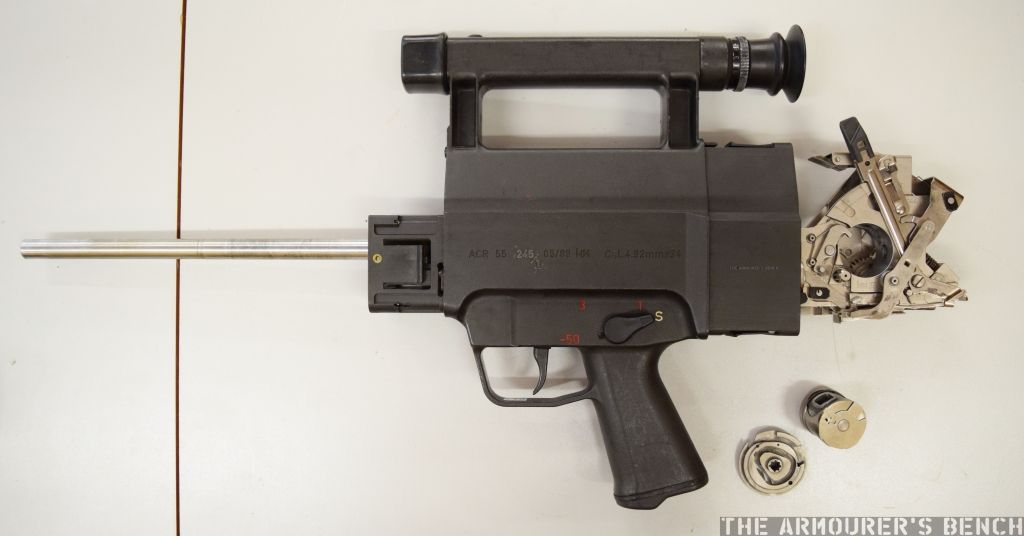
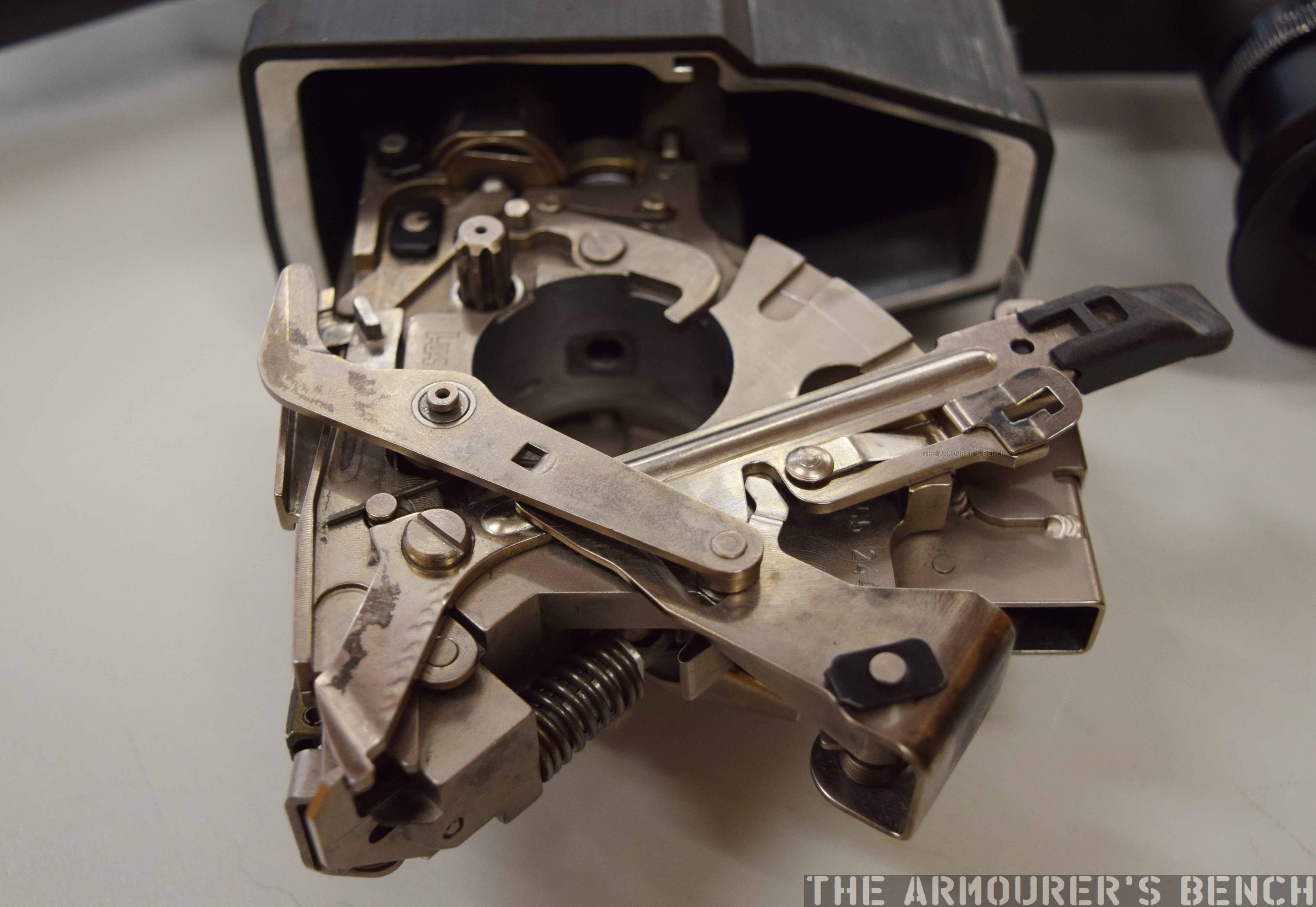
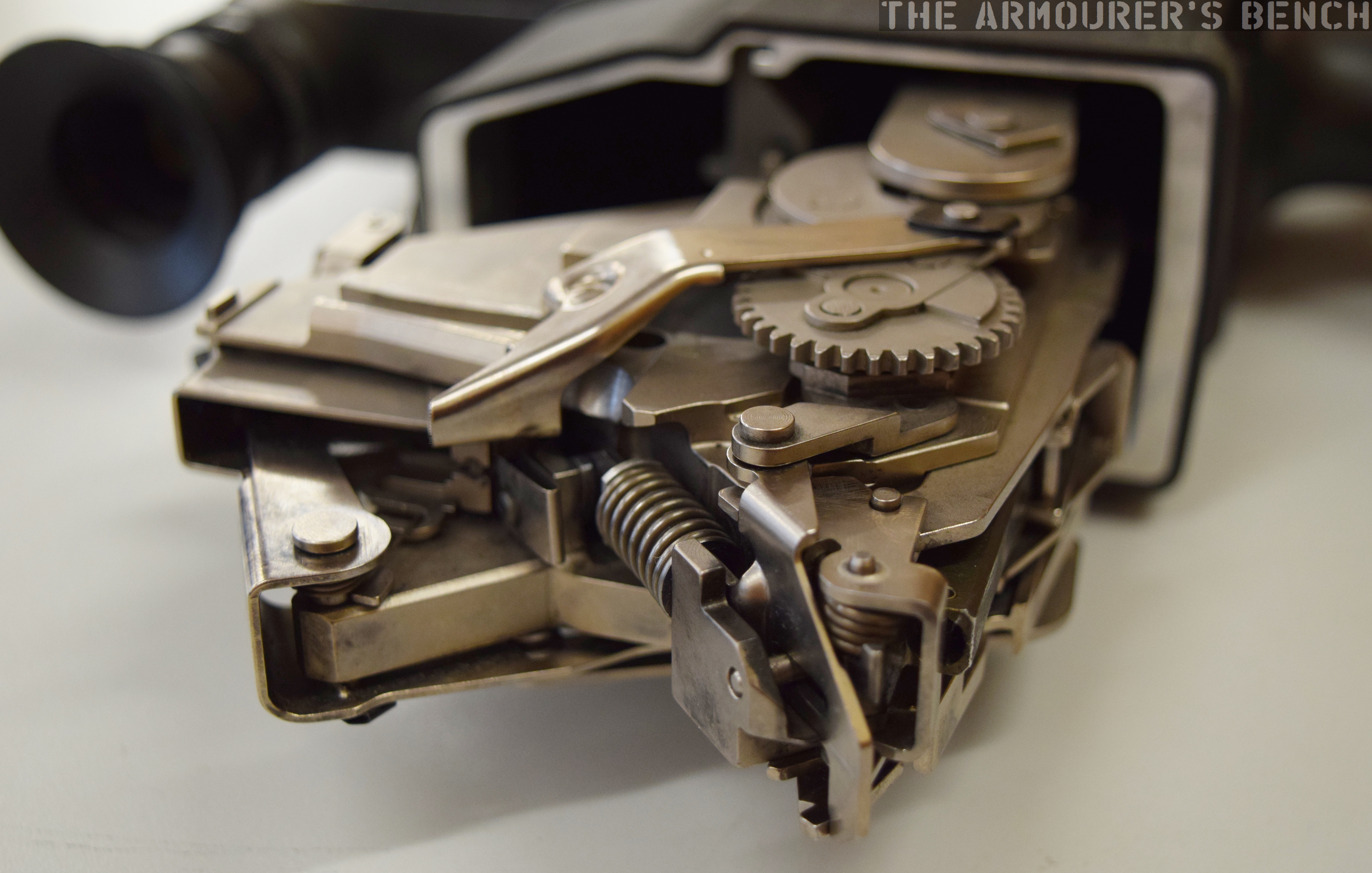
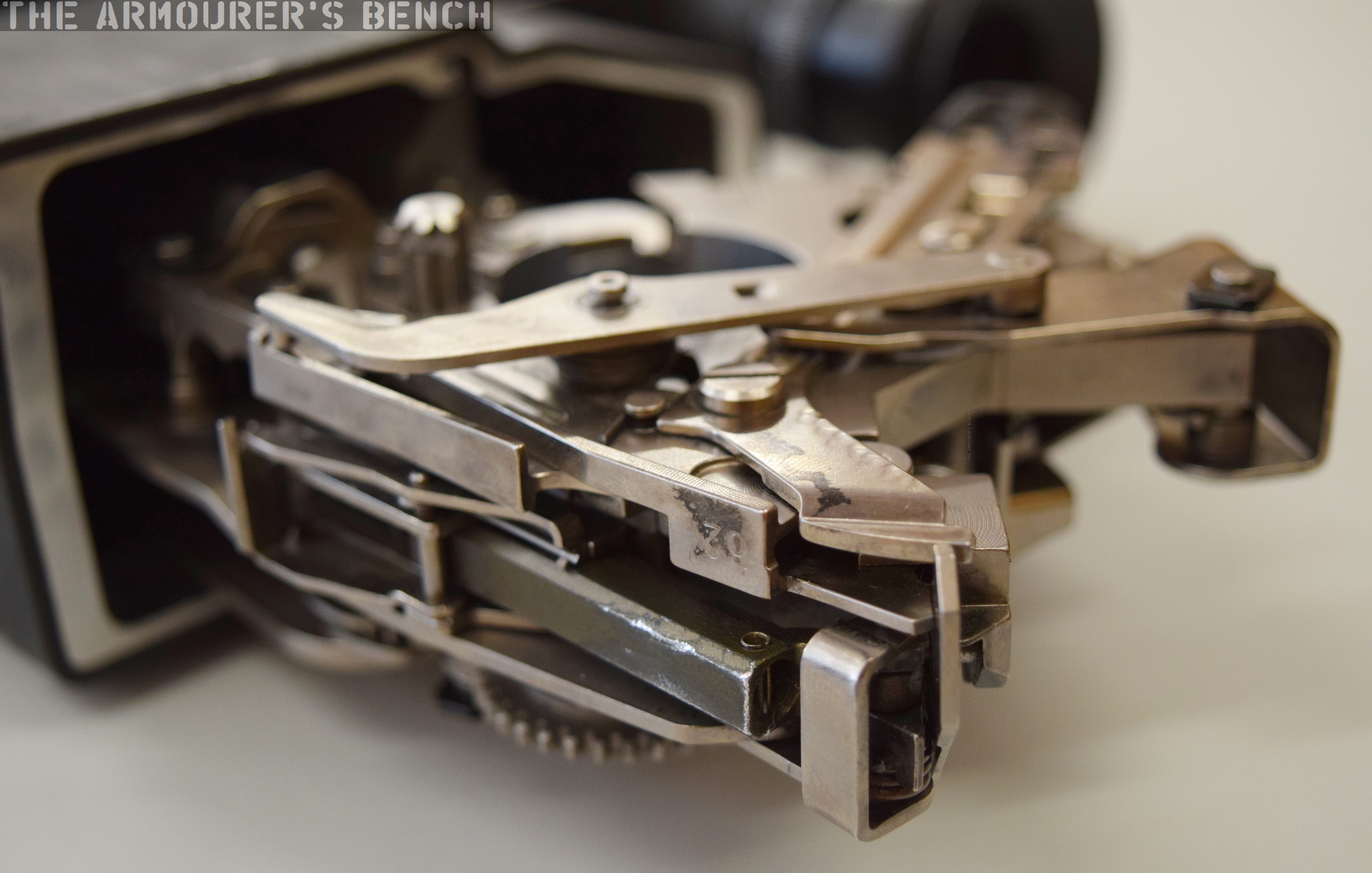
Lets now take a look at the rifle’s action up close, below we can see the G11 with its forend and butt assembly removed. Next to it is the breech cylinder and control disk.
The G11 field stripped (Matthew Moss)
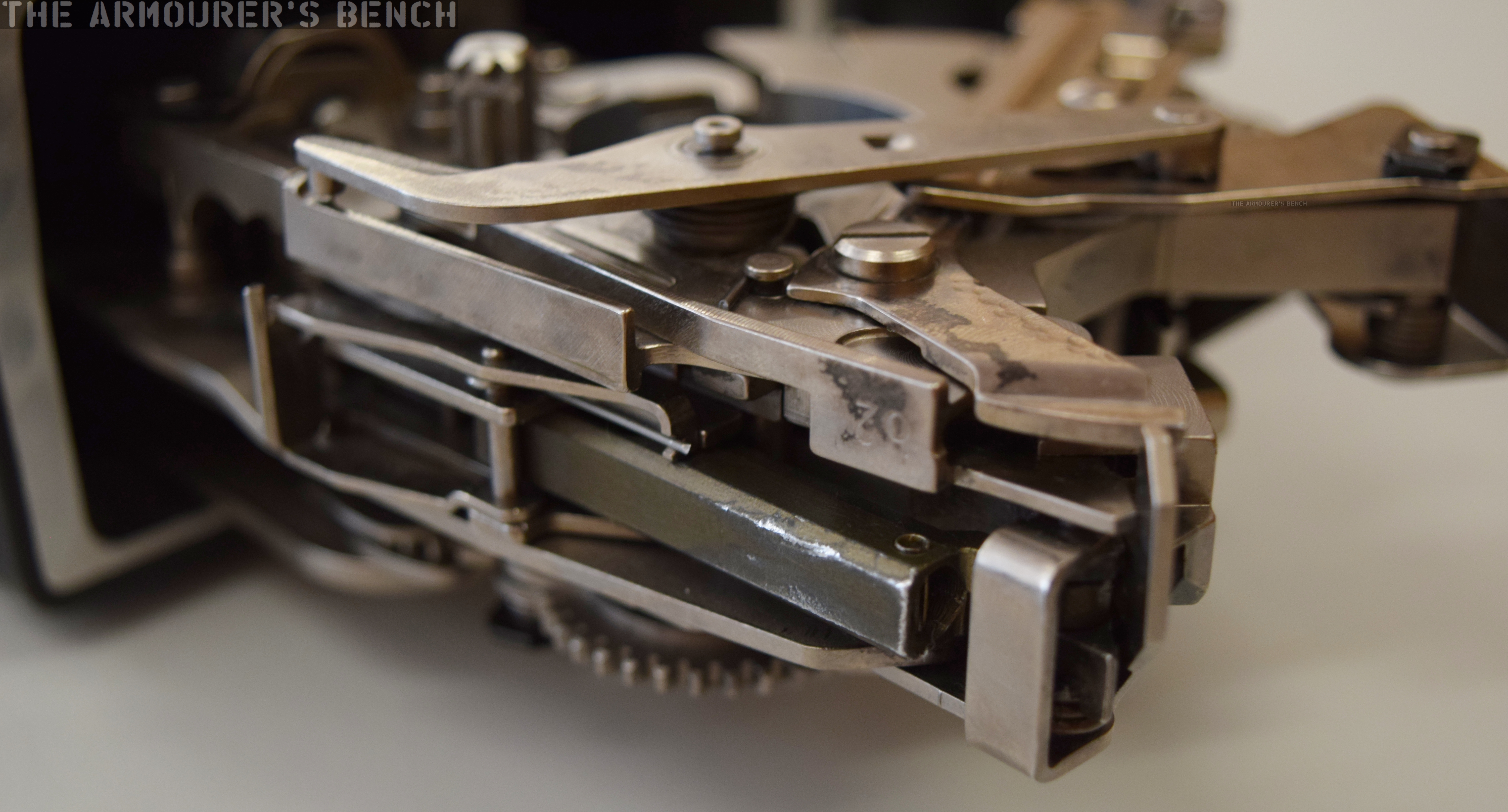
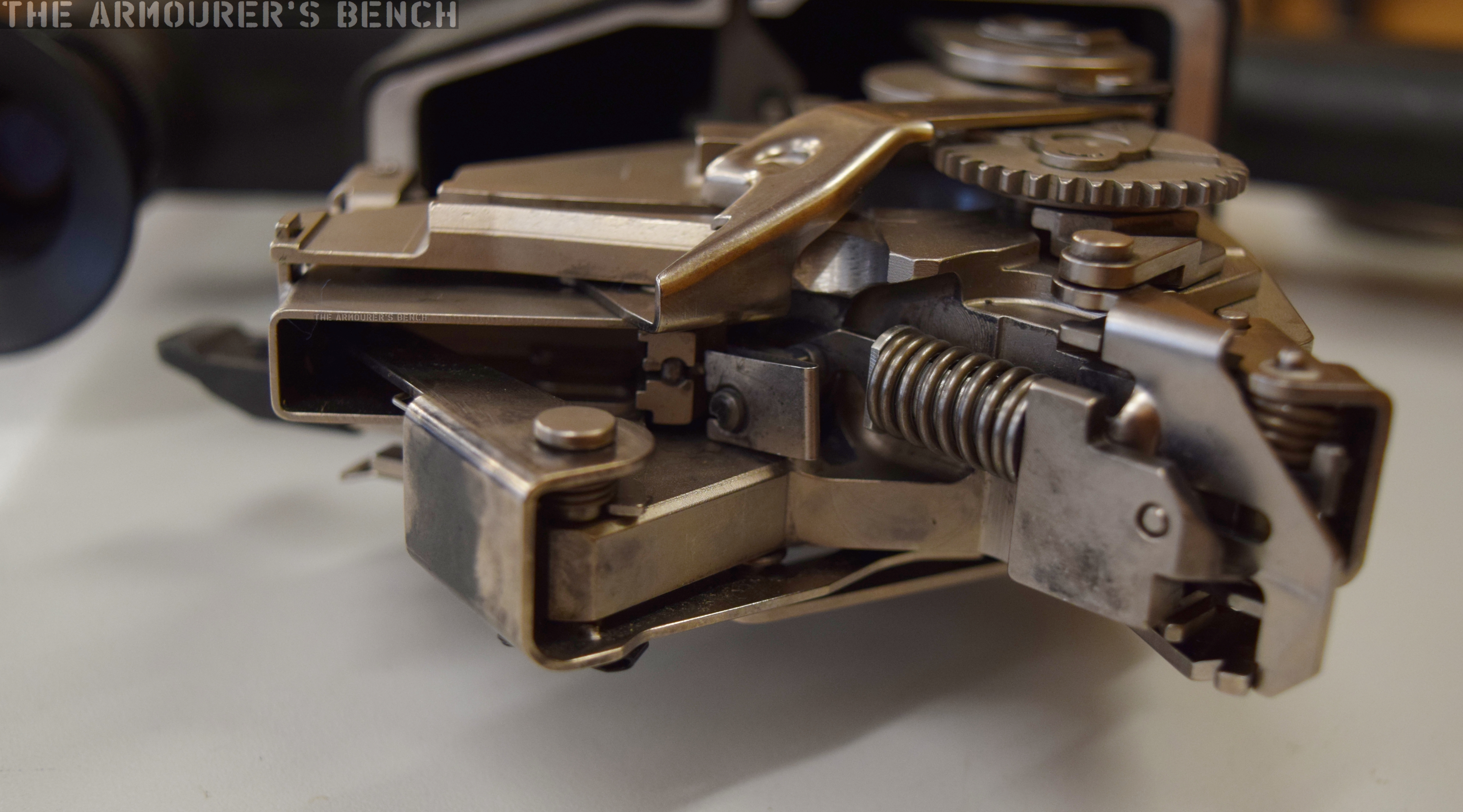
Here are some photos of the action from various angles:
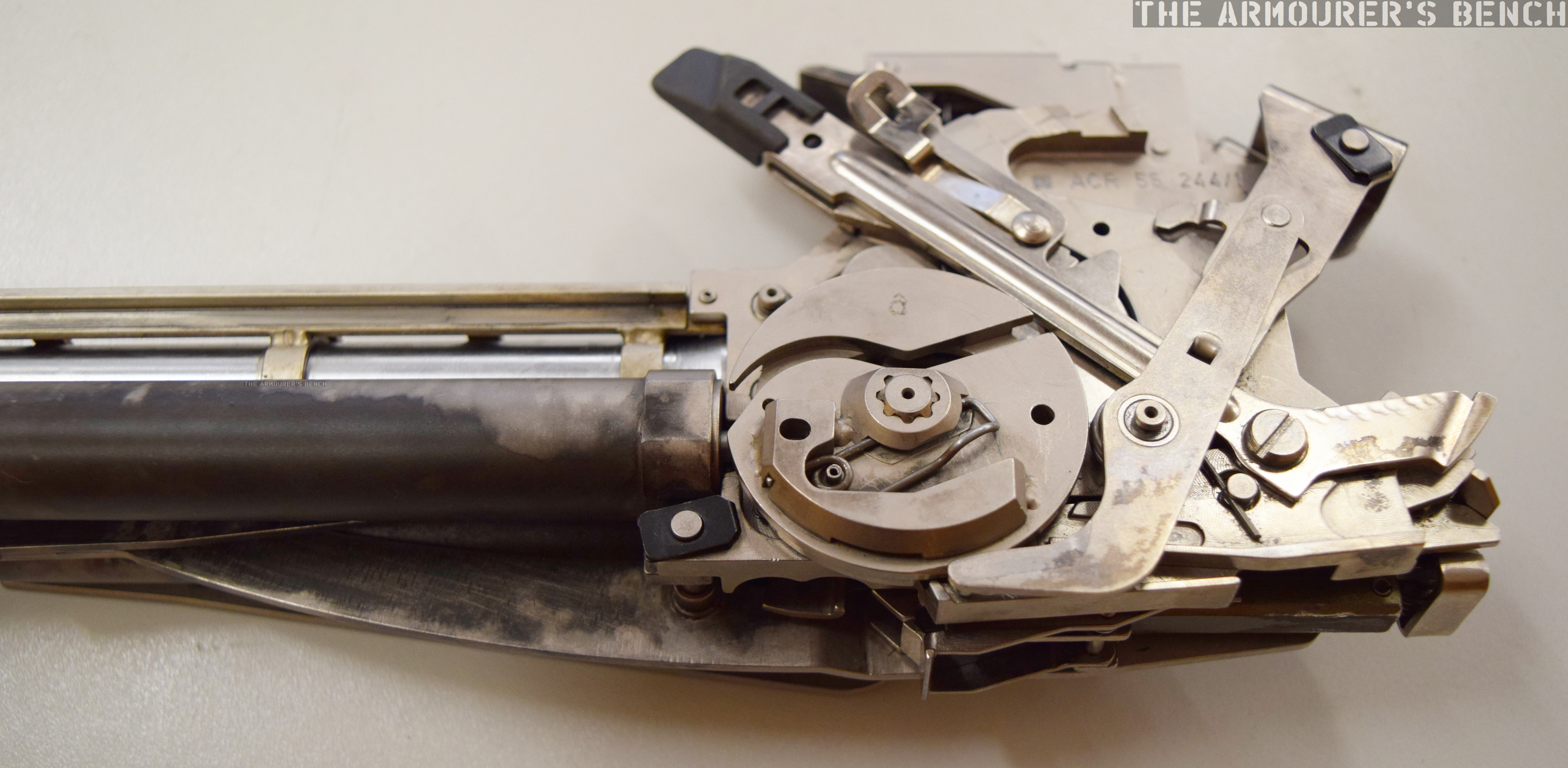
A view of the action from the rear. We can see the striker assembly, clamping plate, ejector lever and cylinder retaining catch (Matthew Moss)
From the right side of the gun we can see the two gears which work the breech cylinder – the spur gear and the actuating gear (Matthew Moss)
On the underside of the action we can see the rear of the clamping plate, the slide – which is slightly worn, and the sear projecting below it (Matthew Moss)
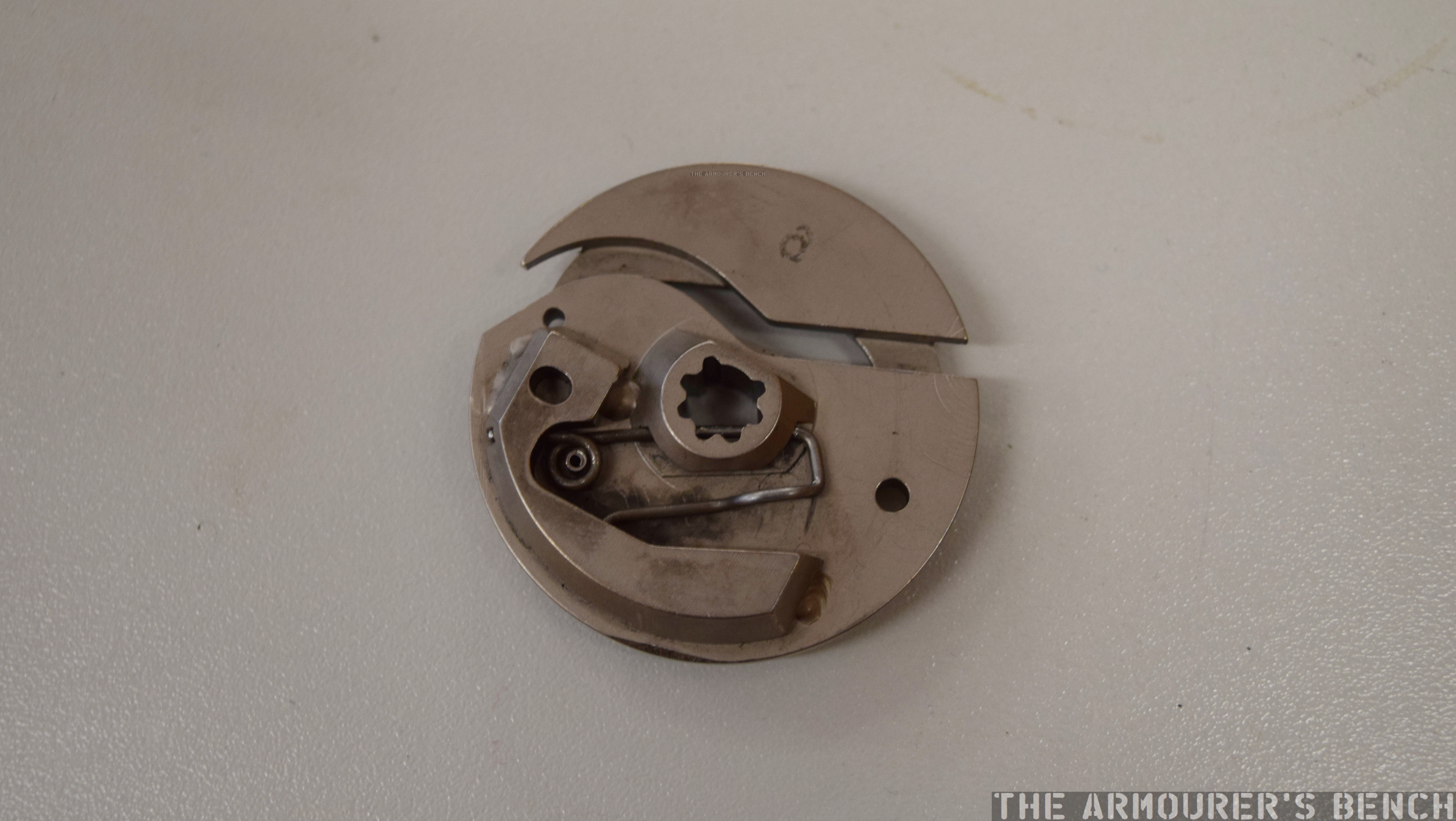
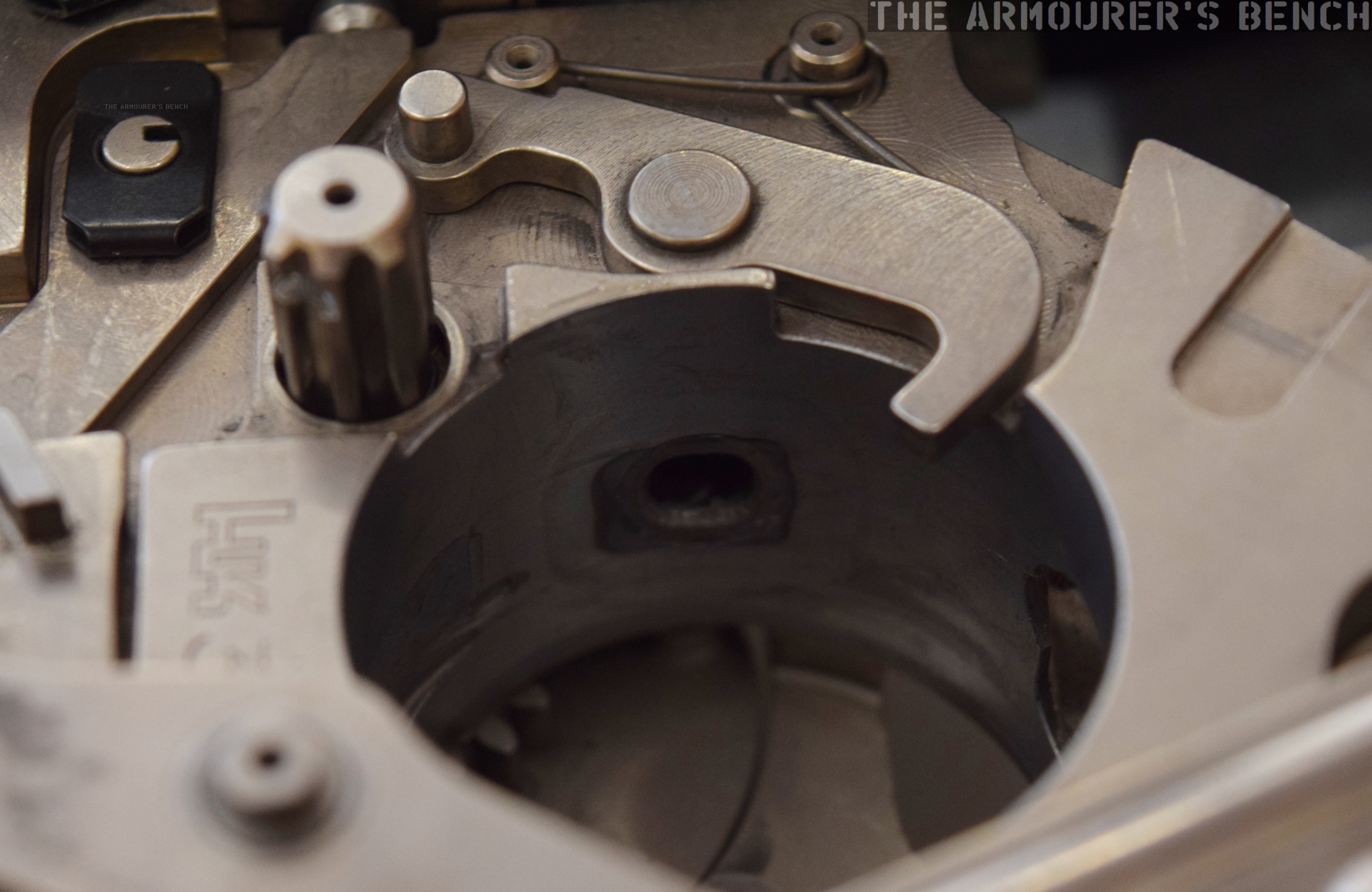
Here’s some close ups of the breech cylinder and control disk:
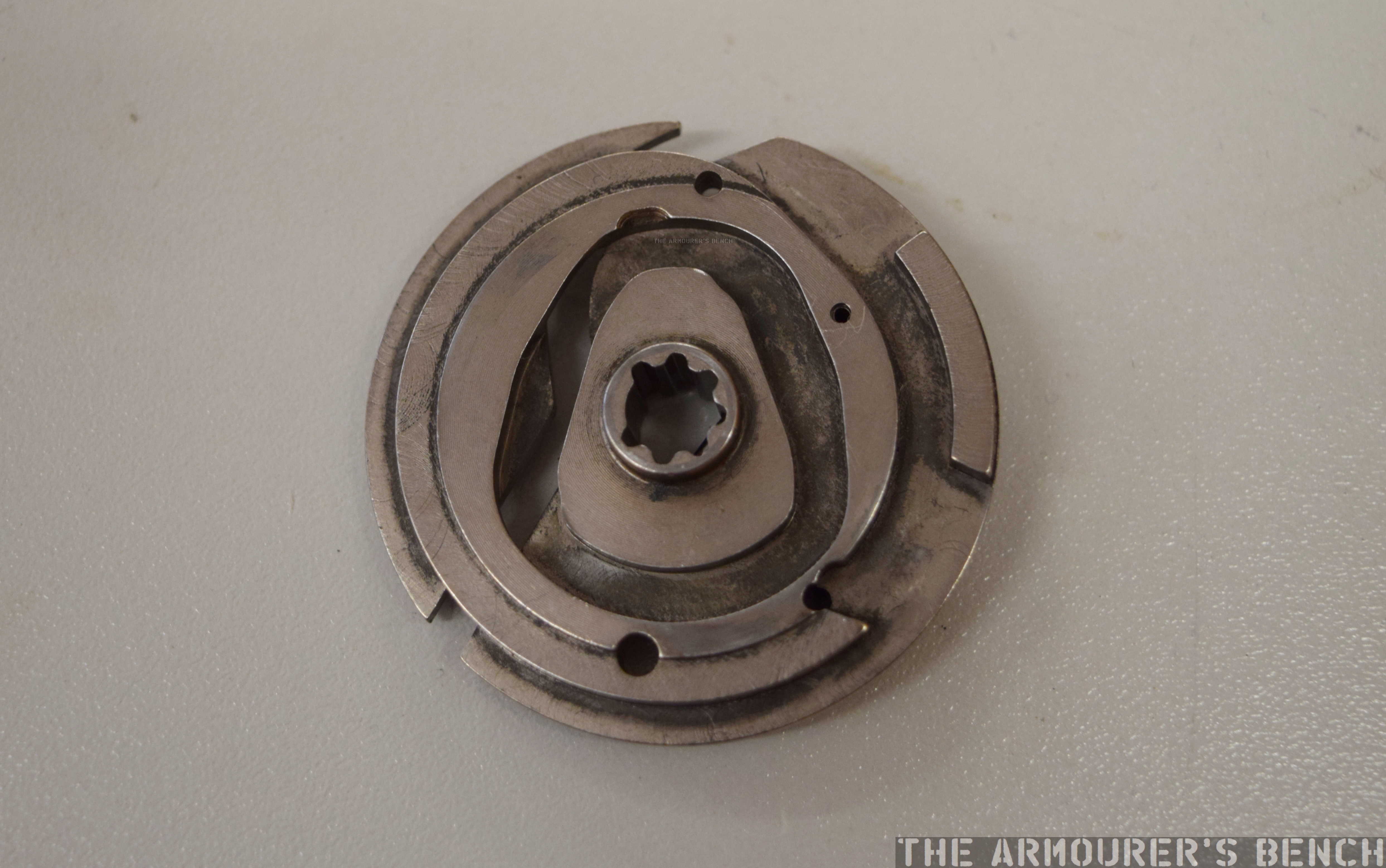
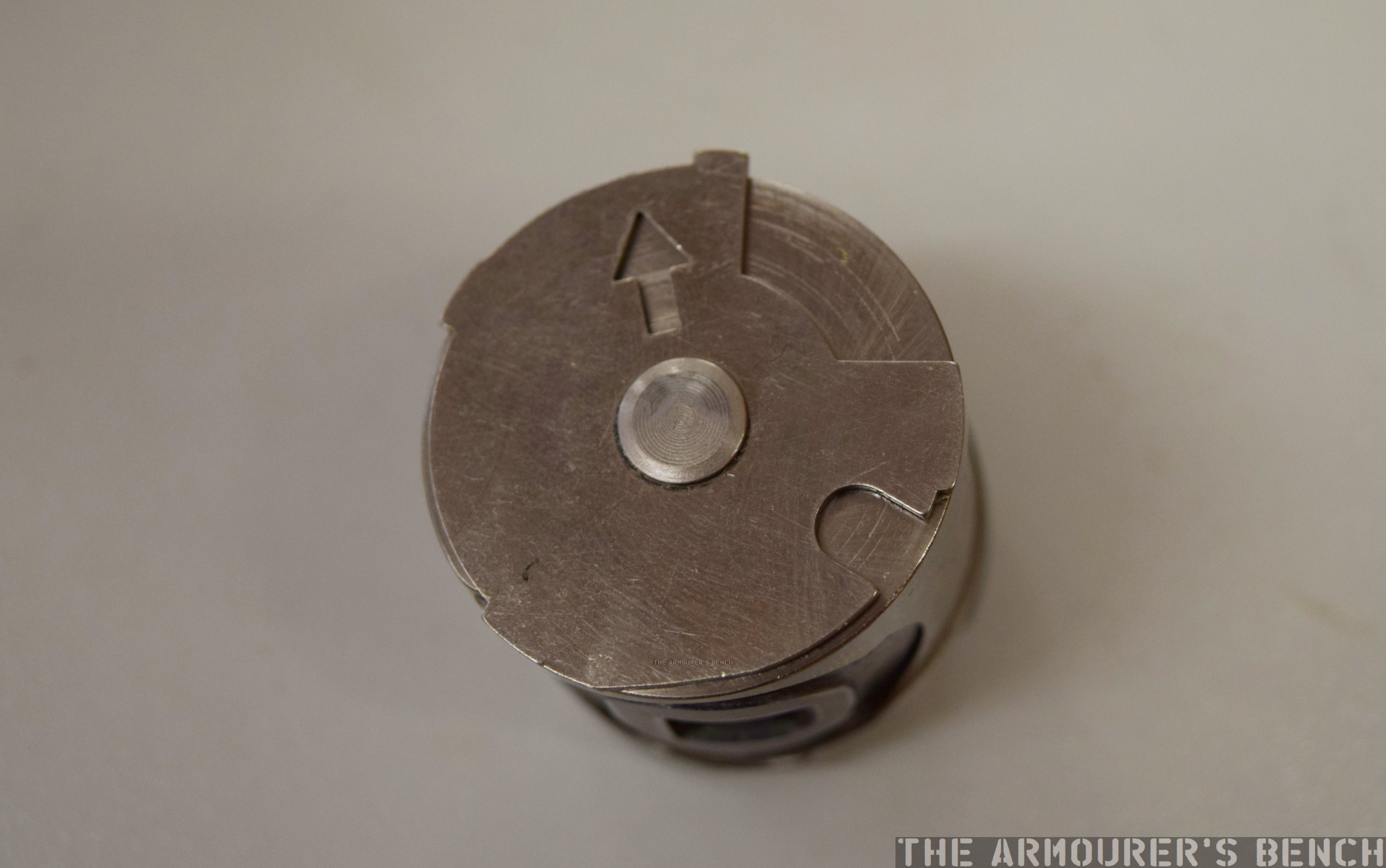
The top of the control disk, which has to be removed before the breech cylinder can be (Matthew Moss)
Underside of the control disk (Matthew Moss)
Top view of the breech cylinder (Matthew Moss)
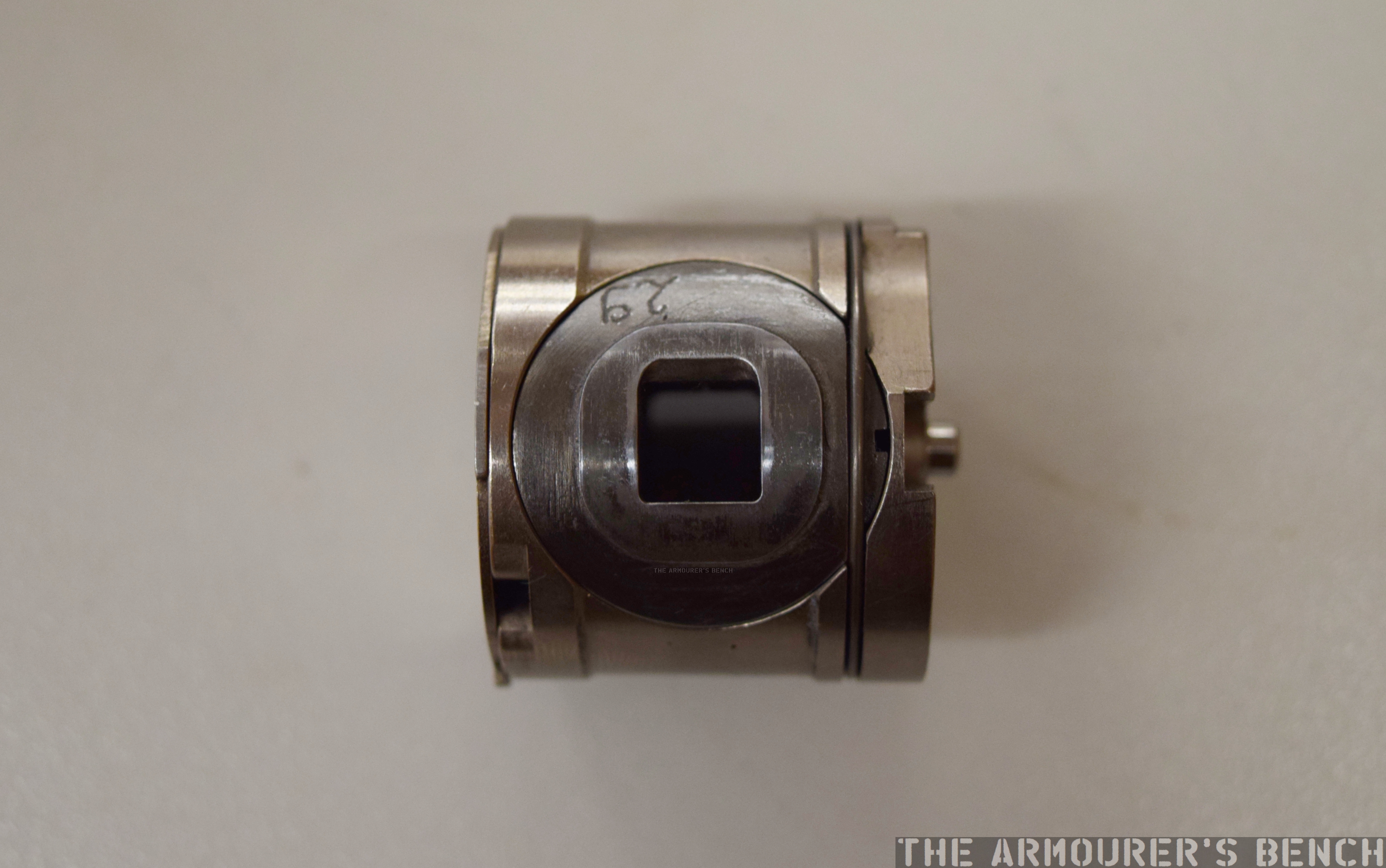
A view of the square chamber which is a replaceable part which is held in the breech cylinder by a circular retaining spring – seen on the right (Matthew Moss)
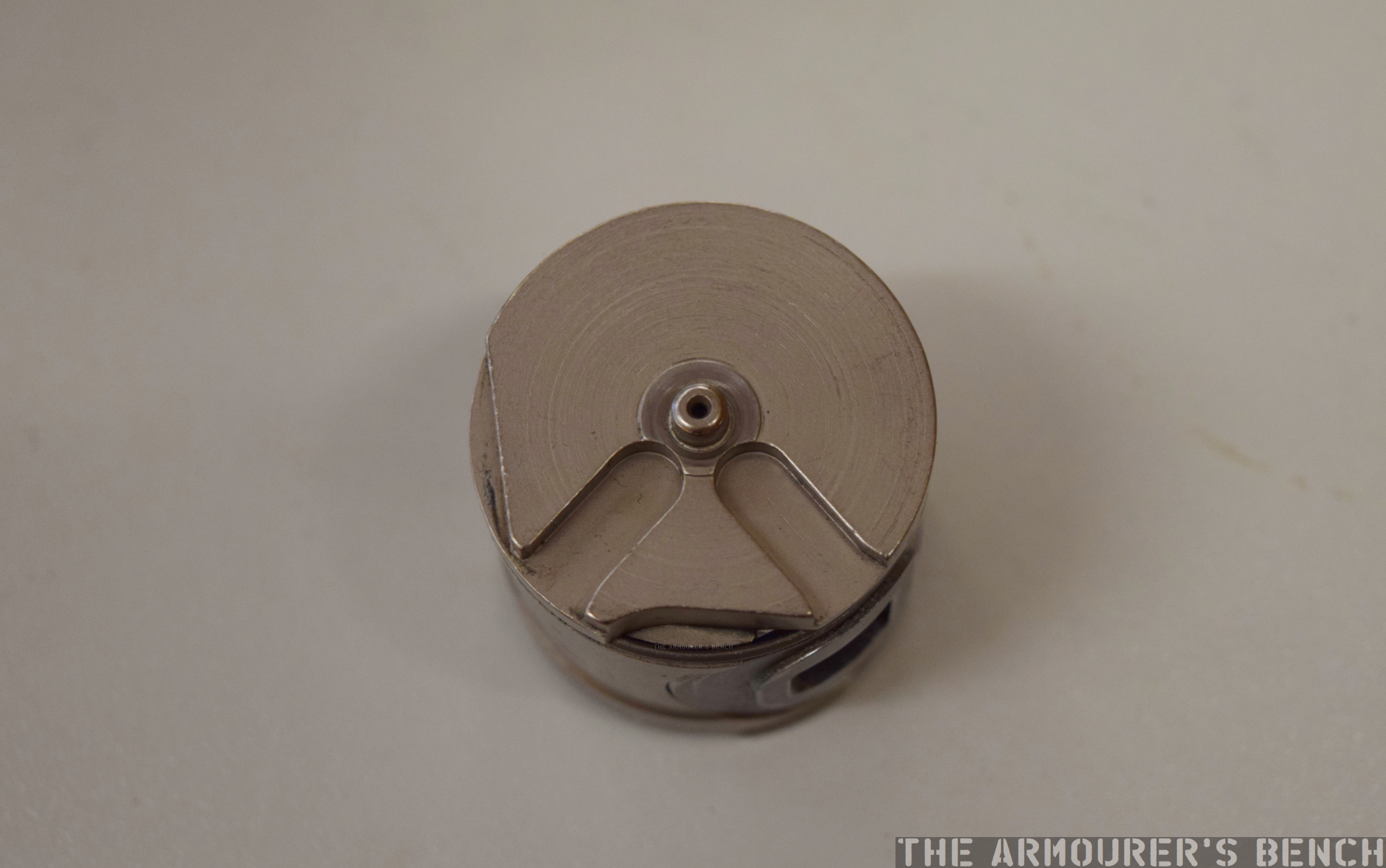
The base of the breech cylinder with notches where the actuating gear interfaces (Matthew Moss)
Here are some close ups of the various parts of the action:
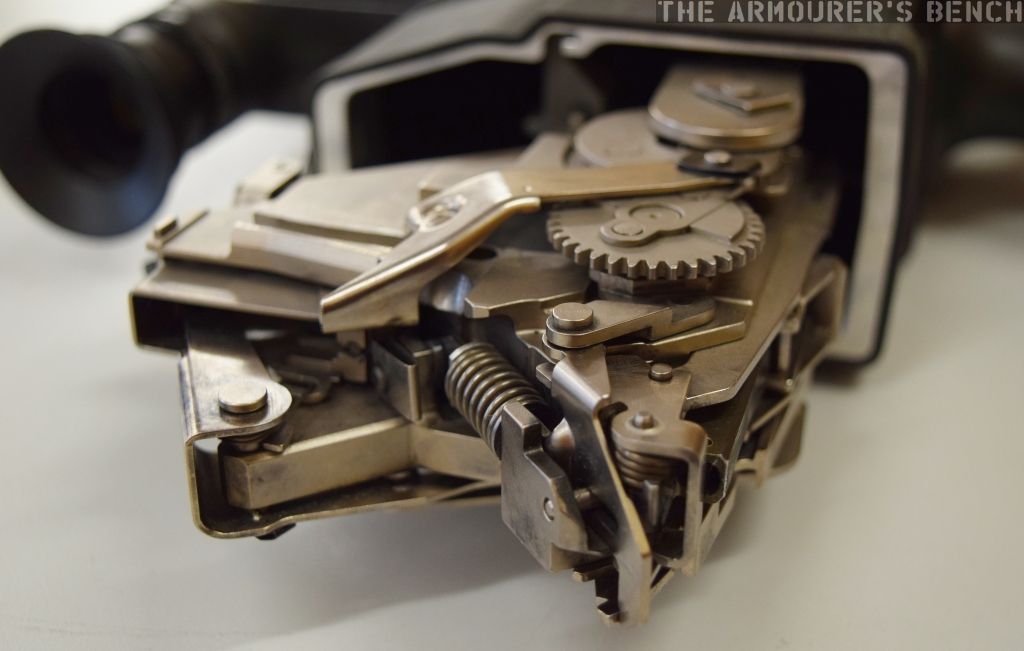
A close up of the rifle’s spur gear – which gives the G11 its almost clockwork appearance (Matthew Moss)
Another close up of the underside of the action (Matthew Moss)
Close up of the end of the barrel, with the square outline of the breech chamber visible – the G11’s caseless ammunition was rectangular but the projectile was round in diameter (Matthew Moss)
Another shot of the rear of the action showing the striker / firing pin assembly and spring (Matthew Moss)
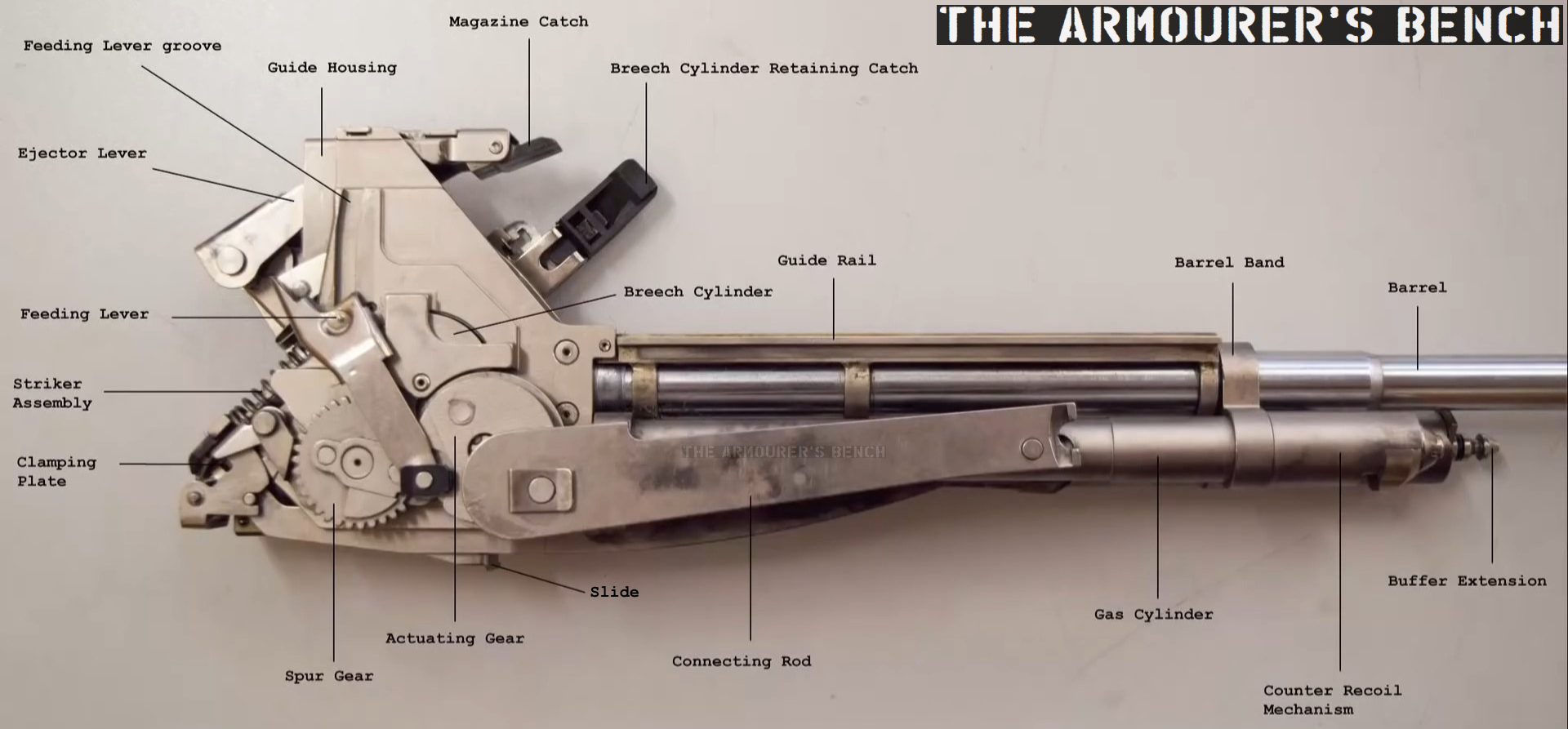
According to the 1989 armourer’s manual, provided for the ACR trials, the G11 is made up of a total of nearly 450 individual parts. 144 of those make up the G11’s breech assembly.
With the breech and barrel assembly removed from the centre assembly here’s a diagram I put together showing most of the component parts of the G11’s action:
Next lets take a look at the G11’s barrel assembly with its recoil management system and gas piston:
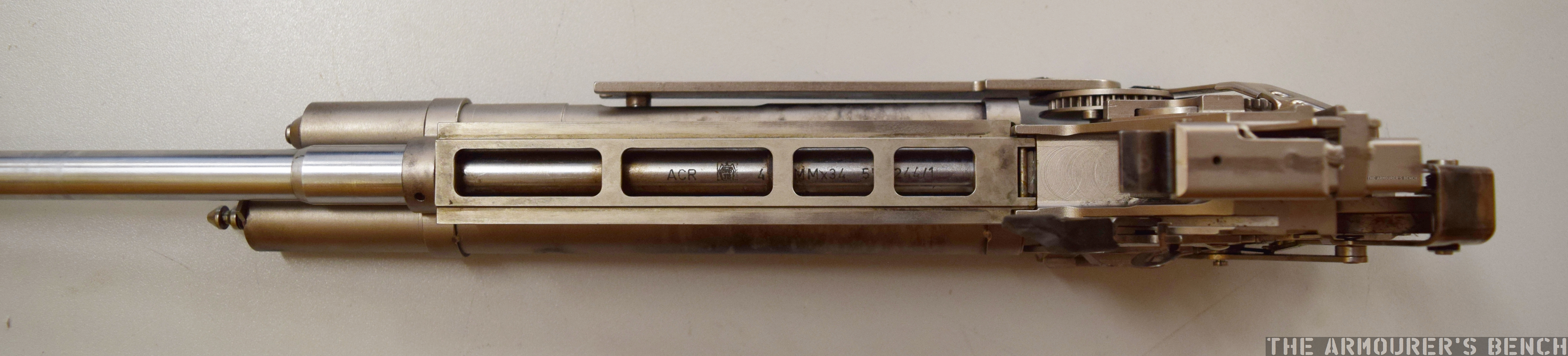
A bird’s eye view of the G11’s breech and barrel assembly, note the barrel markings (Matthew Moss)
A side view of the breech with the cylinder and control disk in position (Matthew Moss)
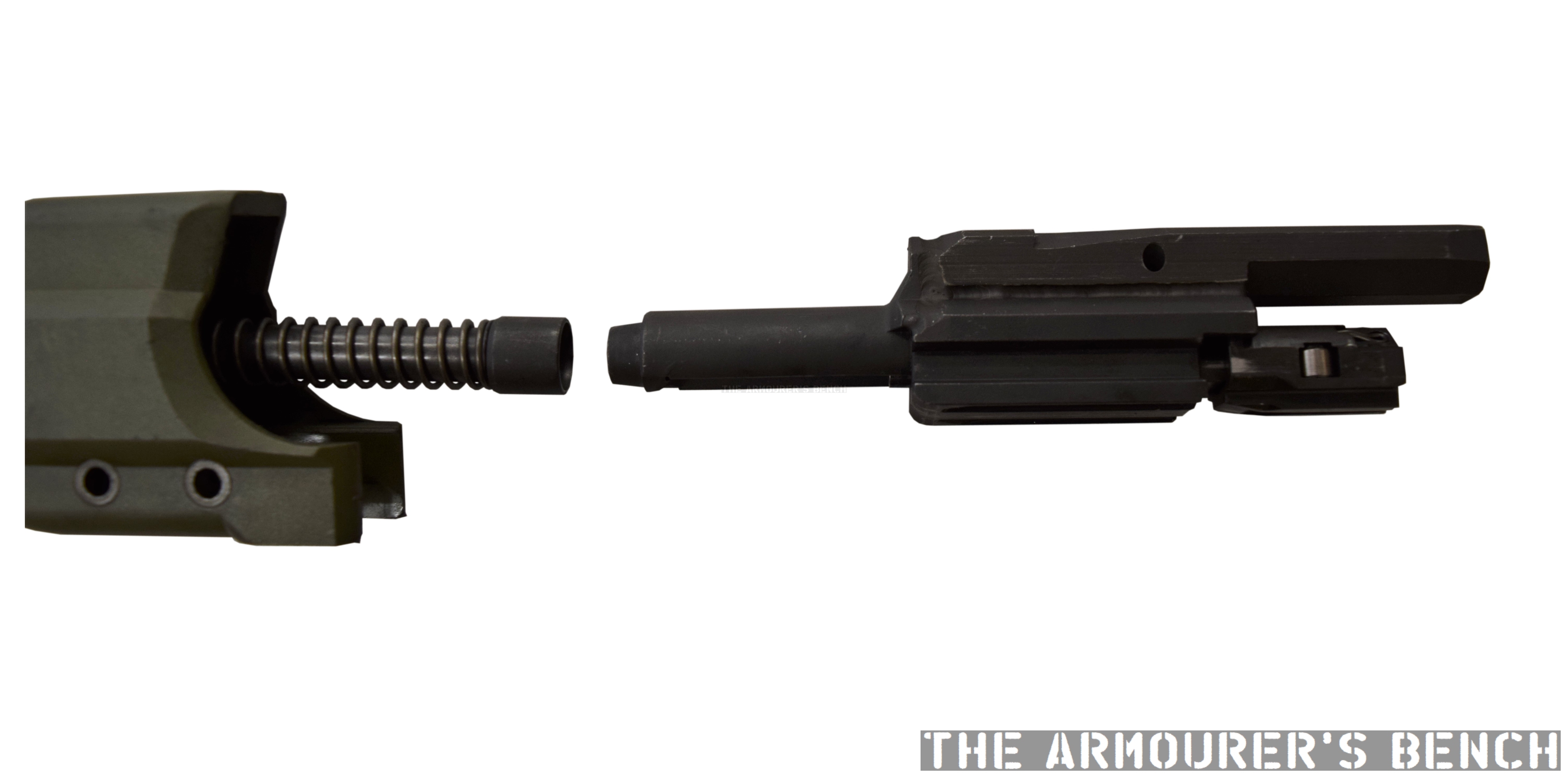
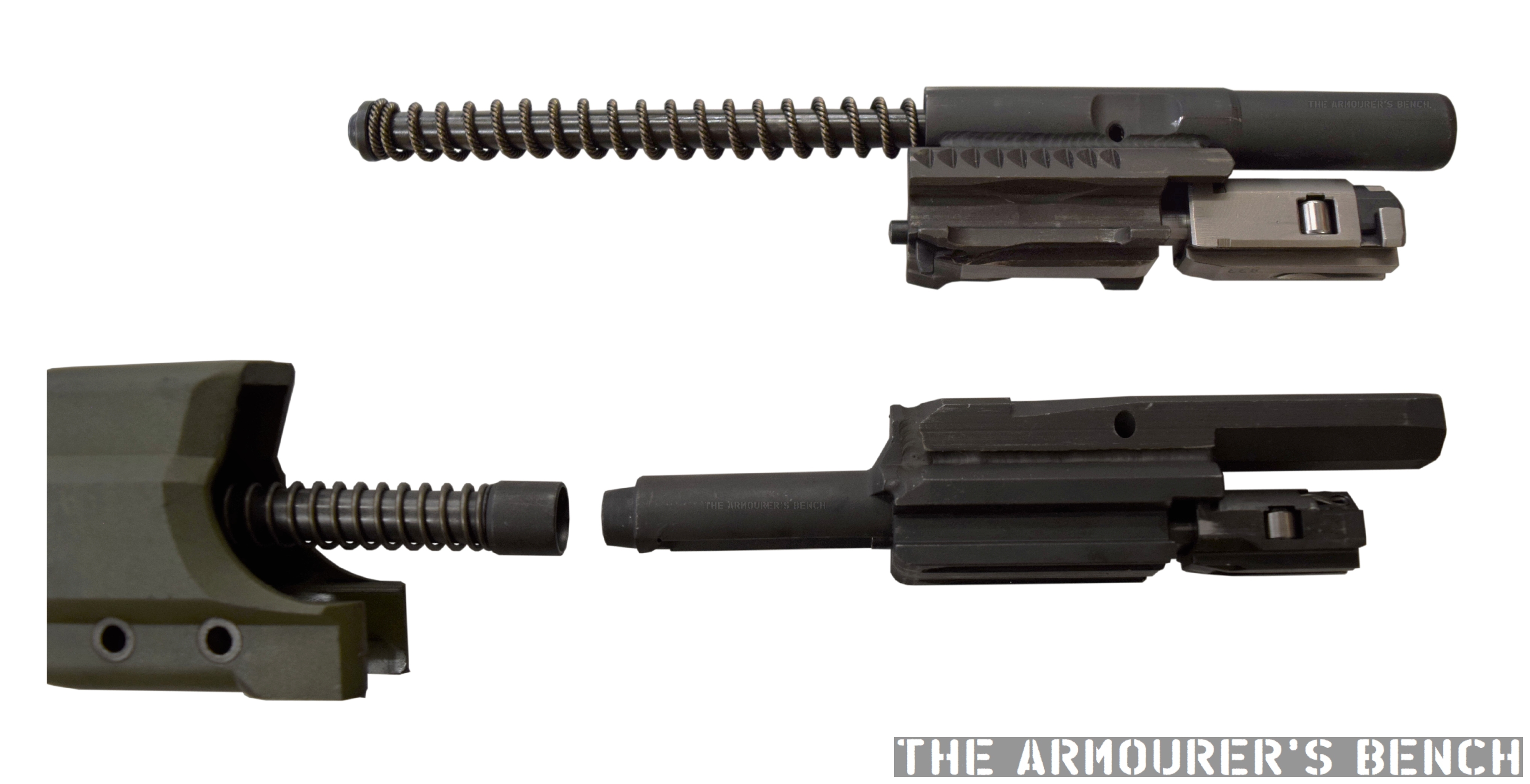
A view of the housing of the recoil mitigation system, on the other side is the gas piston system (Matthew Moss)
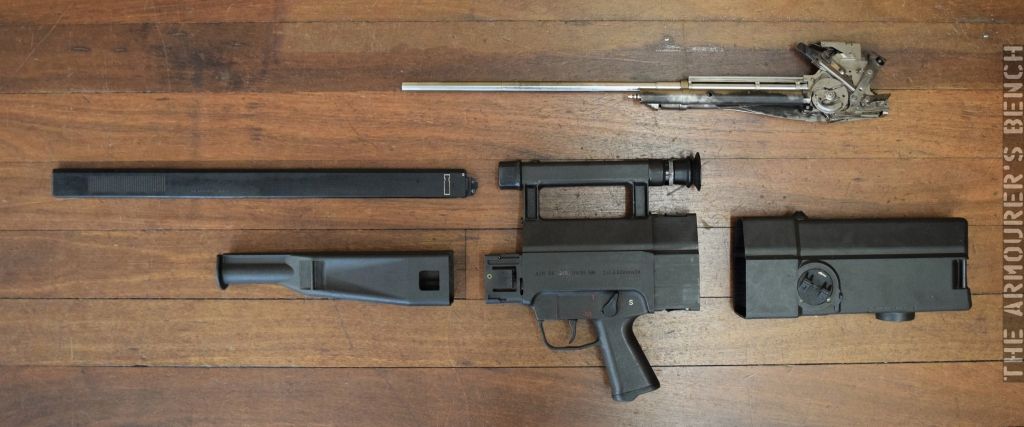
Finally, here’s a photo of the G11 broken down into its major component assemblies: magazine, forend, centre assembly breech & barrel assembly and butt stock:
G11 field stripped (Matthew Moss)
If you enjoyed the video and this article please consider supporting our work here.
Bibliography
HK G11- ACR. Armourer’s Manual for Maintenance of Repair of Rifle, 4.92mm, ACR, March 1989 (source)
In 1968 Heckler & Koch launched the HK33, chambered in 5.56x45mm, to compete with Colt’s AR-15/M16. The HK33, and later HK53, used the same roller-delayed blowback action developed for the G3 in the mid 1950s. However, few major contracts were forthcoming with the German military opting to continue using the 7.62x51mm G3.
Due to the modularity of the HK33′s design users could replace the butt of the standard rifle with a collapsible telescopic metal stock. H&K also subsequently designed a carbine version of the full-length HK33, the HK33K with a telescopic metal stock and 12.7 inch barrel. In the mid-1970s H&K began development an even shorter version. The result was essentially an intermediate calibre submachine gun similar to the Colt Commando and the Soviet AKS-74U. H&K designated this new weapon the HK53, it used the same telescopic stock as the HK33K and MP5 and a cut down 11 inch barrel, the HK53 also utilised a polymer forearm similar to the MP5s.
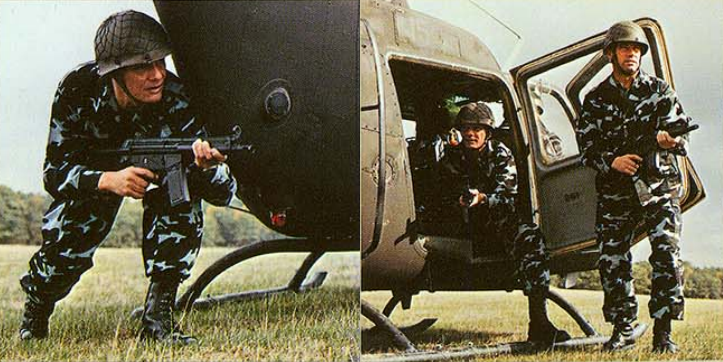
Contemporary promotional photos dating from 1985 (source)
Like the HK33, the HK53 fed from 25, 30 or 40 round box magazines. The weapon weighed just over 3kg (7lb), almost a 1 kg less than its parent rifle the HK33. Unlike the HK33, the HK53 has a four prong flash hider. A number of police forces and militaries adopted the HK53 for a variety of roles. Special forces units around the world including the British SAS, Royal Military Police Close Protection Unit and Royal Marines, designated the L101A1 in British service, who typically used it during close protection duties and operations involving close quarter battle.
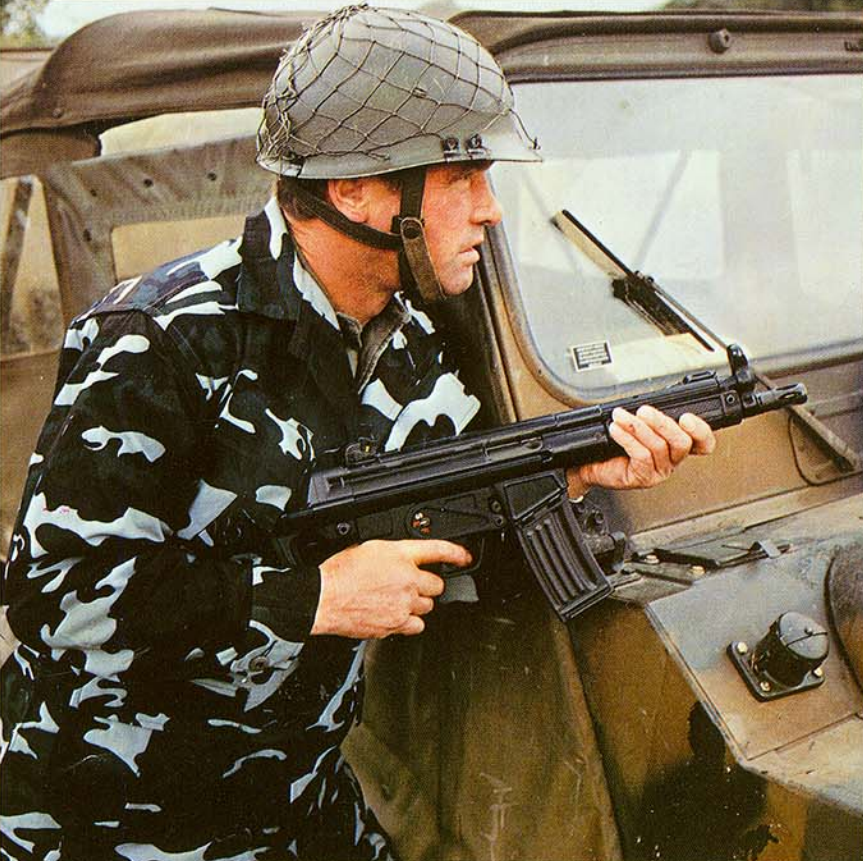
Contemporary promotional photo dating from 1985 (source)
As shown in various MoD Equipment Failure Reports dating from the early 1990s the HK53’s in British service suffered from repeated damage and failure of the carbines’ locking rollers. This issue arose when using a number of different ammunition types including brass cased blank ammunition (H&K recommend the use of their proprietary blank cartridges). Following a meeting between the Army Technical Support Agency’s Directorate of Engineering and H&K a new design for the locking pieces were developed. These changes “increased the roll of blowback force during the unlocking phase… in turn this will reduce the mean energy of the recoiling mass of breech block and carrier” this was intended to reduce bolt bounce. The Royal Military Police Close Protection Unit’s L101A1’s were also fitted with a new two stage buffer within a fixed stock. In British service the L101 was replaced by the L22A2 carbine and the L119A1 (C8 Carbine).
HK53, stock collapsed, (Matthew Moss)
Due to its short length the HK53 also found itself pressed into the port-firing weapon role. Designated the HK53 MICV in this role the foregrip and stock was removed and a specially designed endcap and a spent case bag could be attachment. During its service life the HK53 went through a series of changes to furniture mouldings, buttstock types and fire selector options. It remained in production into the early 2000s, when Heckler & Koch replaced the HK33 and HK53 with the G36 and G36K.
If you enjoyed the video and this article please consider supporting our work here.
Itemised list of L101A1’s which suffered damaged locking rollers, MoD Equipment Failure Report, 15 Nov. 1994, (via Small Arms Review Reference Library)









 The Armourers Bench
