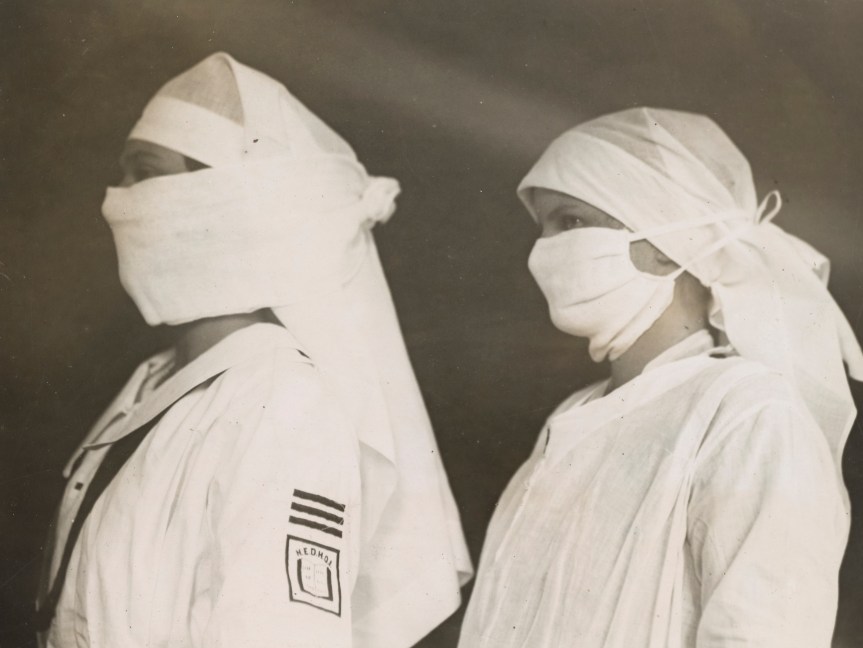
While doing some archival digging I came across this short clip showing Red Cross Nurses in Boston preparing gauze masks to wear while caring for those sick with the Spanish Flu in 1918-19. I was surprised to see the clip end with some advice that remains relevant in the current Coronavirus Outbreak. I thought it was worth sharing as it shows we’ve tackled crisis like these before and come through them – and will again.
Nurses in Boston wearing masks, c.1918 (US National Archives)
The Spanish Flu epidemic of 1918-1920 infected approximately 500 million people and likely killed more people than World War One. To illustrate the impact of the epidemic, in October 1918, the US Army Philadelphia Quartermaster Depot reported that of 1,489 staff were absent with the virus, the report ended “situation not improving”.
A flyer outlining precautions US Naval personnel were to take to avoid contracting influenza or Spanish Flu. The flyer was issued by the US Navy’s senior medical officer, Captain G.L. Angeny, at the Portsmouth Navy Yard in February 1920 (US National Archives)
Continuing our series looking at US tanks of World War One, in which we have already taken a look at the Ford M1918 3-Ton Tank, in this video/article we will take a look at the M1917 Light Tank.
The US Army entered the Great War with no tanks or experience in armoured warfare. When the American Expeditionary Force’s Tank Corps was formed in early 1918, it was equipped with French and British tanks. With plans to rapidly expand the US Tank Corps with battalions training in the US, France and Britain, a large number of tanks would be needed. The corps trained with the French Renault FT light tank and the British MkV but with French production stretched to capacity they could not hope to provide the US with the tanks it was expected to need for operations during 1919.
Renault FT on the Western Front (US National Archives)
As a result the US negotiated with France for a license to produce the FT in the US, commissioned a smaller 3-ton light tank from Ford and entered into an agreement with Britain to build a new heavy tank – the MkVIII. The American-made FTs were designated the Model 1917 6-ton light tank. 4,400 were ordered, with deliveries to begin in April 1918. The Ordnance Department finalised the M1917s design and contracted a number of private companies to build the tanks.
Delays in production, however, meant that the first American tanks were completed in October 1918, and none of the M1917s reached the Western Front before the war ended. As a result, the primary US tank of the war was the original French Renault FT, revolutionary for its turret which could rotate 360-degrees and its rear-mounted engine. It was cheaper to manufacture than the heavier British tanks and could be transported by lorries behind the lines. The FT equipped the 1st Provisional Tank Brigade, what would become the 304th Tank Brigade, commanded by Lt. Colonel George S. Patton. The American FT’s saw action for the in September 1918, at the Battle of St. Mihiel.
US-operated Renault FTs on the Western Front (US National Archives)
144 US FT’s took part in the battle and both the tanks and crews performed well. The Five of Hearts, a 37mm-armed FT with the 344th Tank Battalion took part in the Meuse-Argonne offensive and while making an isolated attack on German positions in support of bogged down US Infantry, the tank was immobilised and its gun mantle jammed by enemy small arms fire. The tank’s commander Sergeant Arthur Snyder recalled:
“My wounded driver kept filling pistol clips and I produced as much fire as possible with our pistols and the crippled 37mm. I paid more attention to the volume of fire than its accuracy for I fear the enemy would close in if the volume diminished. Three machine guns were set up at very close range, but just out of range of our piece with its limited elevation. The fragmentation of our shells did afford some protection but I could not train this fire on the German field piece. The constant hammering of these machine guns at close range was terrific. The hinges on the doors could not stand up under it for long, but it was the mushroom ventilator on top of the turret that gave way. I was hit in the back of my head with fragments of it and bullet splinters.”
Luckily for Snyder the German infantry made no attempt to rush the tank, content to pepper it from a distance, and they quickly retreated when infantry from the 16th Infantry arrived.
In terms of protection Snyder felt that “the armor plate on those old French Renaults was good, but when you came to close quarters the splinters from bullets hitting around the vision slits did considerable damage.” Two of Snyder’s drivers were badly wounded one by bullet splash splinters and the other in the throat.
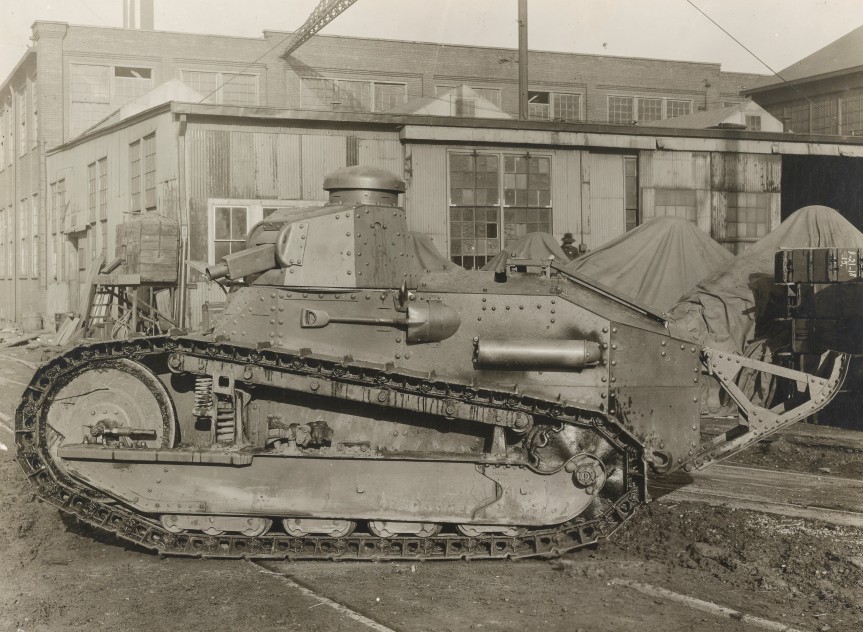
A newly completed M1917 at the Van Dorn Iron Works, 1919 (US National Archives)
The M1917 was manufactured by the Van Dorn Iron Works, the Maxwell Motor Co., and the C.L. Best Co. Of the original wartime order for over 4,000 tanks, in total just 952 M1917s were produced. 375 of these are believed to have been equipped with 37mm M1916 cannons, while 526 armed with Marlin M1917 tank machine guns. The remaining 50 were outfitted as unarmed signal tanks.
The M1917 has a number of small differences from the FT. Its exhaust is located on left rather than right side of the tank. A new US-designed gun mount and mantlet was used. Solid steel idler wheels at the front of the tank rather than the spoked type used by the French. Additional vision slits for the driver were added and a bulkhead sectioned off the engine from the cab. Like their French cousins the M1917 was manned by a two-man crew, the driver and the commander who also acted as loader and gunner.
Marlin M1917 Tank Machine Gun (US National Archives)
A different, American-made, engine – a water-cooled 4 cylinder engine built by the Buda Engine company was used. Developing 42 horsepower, it had more torque than its French counterpart but was no faster, with a top speed of between just 6 – 8 miles per hour. The tank weighed just over 7 US tons and was 16.5 feet long and 7ft 7” tall. Its armour was 0.25″ to 0.6″ (6.35mm to 15.25mm) thick – slightly thinner than its French counterpart. The majority of the tanks were armed with machine guns, using the .30 calibre M1917 Marlin tank machine gun, rather than the French Hotchkiss. The ‘male’ or cannon armed tanks had a 37mm gun and carried more than 230 shells for the gun. The Marlin was later supplanted by the early iteration of the M1919 Browning tank machine gun. 50 command and signals tanks were also built, these unarmed tanks were similar to the French TSF (télégraphie sans fil) and fitted with a wireless radio.
An M1917 climbing Pikes Peak, April 1919 (US National Archives)
Perhaps the M1917s most impressive feat stemmed from a publicity stunt in April 1919, when a M1917 climbed Pikes Peak, a mountain in Colorado. At the time the road up Pikes Peak was said to be the ‘World’s Highest Motor Drive’, a single tank was driven up the mountain as part of fund raising efforts for the fifth, and final, round of Liberty Bond sales, which hoped to raise $4.5 billion from the sale of government bonds. We’ll have a separate looking at this exploit at a later date!
None of the M1917s reached the frontline but many were used a props for selling war bonds – in this photo dated April 1918, a platoon of M1917s is seen after they arrived at Camp Meritt by train, they are about to be painted up in camouflage for a Victory Loan parade in New York.
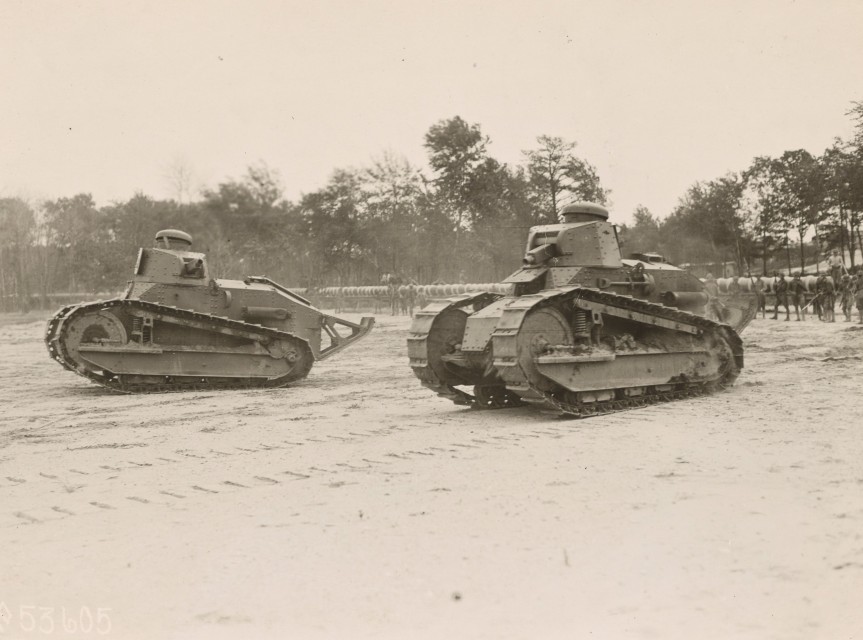
US M1917s exercising with infantry, at Camp Meade, 1920 (US National Archives)
After the war the M1917, along with just over 200 French-made FTs brought back from France, formed the backbone of the US Tank Corps. In these photos we can see several tanks taking part in a mock-battle with supporting infantry at Camp Meade in May 1919. This photo show men learning to service their vehicles at Camp Meade, in December 1919.
Obsolete M1917s arriving in Canada in 1941 (Library & Archives Canada)
But by 1921, the Corps had lost its independence and been all but disbanded with the Infantry given control of America’s tank force. A handful of the M1917s were deployed briefly overseas with the USMC, during the 1920s, but the M1917 was resigned to training as it became increasingly obsolete. They were finally removed from service in the mid-1930s. When World War Two broke out the remaining M1917s were sold to Canada and were reportedly used to help train the Royal Canadian Armoured Corps before many of them were finally scrapped.
Footage courtesy of the US National Archives (source)
Camp Colt to Desert Storm: The History of U.S. Armored Forces, G.F. Hofmann & D.A. Starry (1999) Tanks: 100 Years of Evolution, R. Ogorkiewicz (2015)
Light Tank M1917, Tank Encylopedia, C. Moore, (source)
The Saga of the Five of Hearts, Armor, July-Aug. 1988, Maj. Gen. W.R. Kraft Jr. (source)
In the late 1950s the US military began development of a bomb capable of destroying deeply buried bunkers. The result was a bunker busting unguided thermonuclear bomb. Durng a visit to the Atomic Testing Museum, in Las Vegas, Matt had the chance to take a look at a decommissioned B53 up close.
B53 on display at the Atomic Testing Museum (Matthew Moss)
The B53 is a two-stage high-yield thermonuclear weapon, designed as a bunker buster, that could deliver a massive shockwave deep underground to the deepest Soviet command and control bunkers. Developed between 1958 and 1961, the B53 was intended to combat deeply emplaced Soviet bunkers with a yield of 9 megatons. It used a highly enriched uranium core as its primary fission stage with Lithium-6 deuteride as its second stage fusion element. The warhead itself was developed from the earlier Mk46 warhead, the experimental TX-53 was tested at the Pacific Proving Grounds as part of Operation HARDTACK I, which saw no less than 35 nuclear test detonations. Codenamed HARDTAK OAK, the TX-53 was detonated aboard a floating barge on 28th June 1958, with a yield of 8.9 megatons. The detonation created a cloud 78,000 feet (23.8 km) tall.
Cloud produced by HARDTACK OAK (Los Alamos National Laboratory Archive)
Designed to be dropped from the Strategic Air Command’s B-47, B-52 or B-58 bombers, the B53 is a gravity bomb which free fell to its target and could be air or surface detonated. The bomb itself weighed 8850 lbs or 4014kg and the casing is 12.5 feet long (3.8m) and just about 50in (1.27m) in diameter. The bomb’s outer-casing is split into a nose section, a two-piece central casing and the rear assembly with four fins which housed the parachute assembly. They were built by the Atomic Energy Commission between 1962 and 1965, over 340 bombs were built. Initially designated the Mk53 it was re-designated the B53 in 1968, when the US Air Force updated its ordnance nomenclature.
The bomb itself could be deployed in four ways: a delayed surface burst, a free fall air burst, a parachute retarded air burst (the B53 had five parachutes at the rear which can be deployed) or an immediate contact surface burst. Here we can see the panel to control the parachute deployment, with markings for safe, free fall and retard.
Declassified general diagram showing the assemblies of the B53 (US DoD)
The B53 was obsolete in terms of its safety by the early 1980s with none of the more modern safety features such as an Enhanced Nuclear Detonation Safety (ENDS) additionally its explosive lens, consisting of a mix of RDX and TNT was not an insensitive munition – meaning it wasn’t designed to resist detonation from external stimuli or damage. The B53 also had no Fire-Resistant Pit (which prevents the spread of radioactive material in the event of a far), Permissive Action Link (which prevent unauthorised arming) or Command Disable safety measures.
B53 at the Pantex Plant in Texas about to begin the dismantling process (National Nuclear Security Administration)
Many of the B53s in US inventory were decommissioned in the mid-1980s, and by 1987 just 50 were retained in inventory. The last of these were disassembled and decommissioned by October 2011 – after being in service for 50 years. The B53 was replaced in its bunker busting role by the smaller B61 Mod 11.
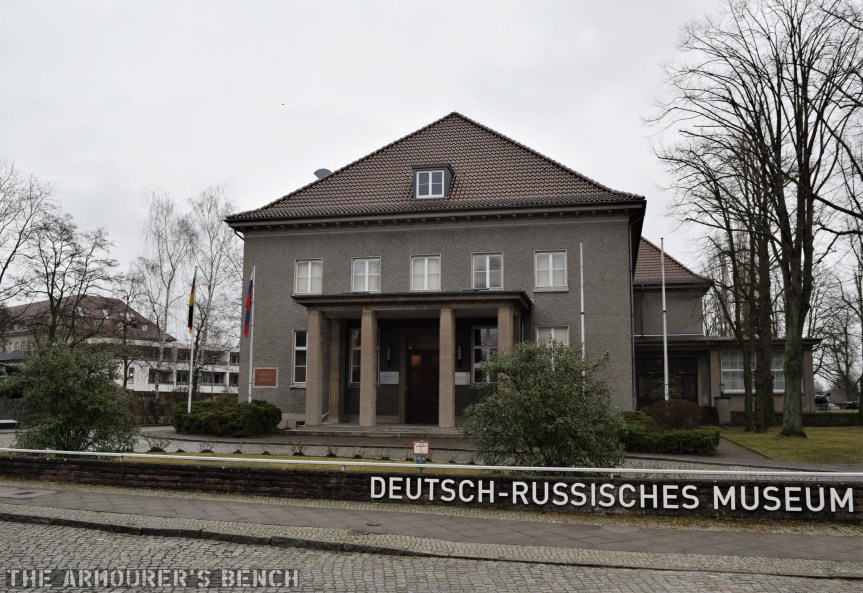
Matt recently visited Berlin and took the opportunity to visit the German-Russian Museum in Karlshorst, the site of Nazi Germany’s unconditional surrender. The museum’s centrepiece is the hall in which the surrender documents were signed, restored to how it appeared at that historic moment.
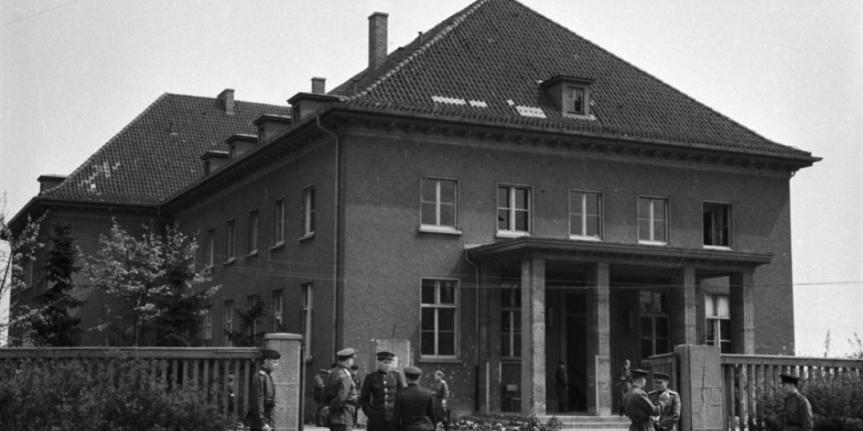
The hall itself is inside what used to be the officers’ mess of the Wehrmacht’s pioneer corps training school No.1 (Pionierschule 1) which was established in 1936 in Karlshorst, an eastern suburb of Berlin. The officers’ mess building was built in the late 1930s. Later, in 1942 the school was renamed the Fortress Pioneer School (or Festungspionierschule).
The Pioneer School’s Officers’ Mess under Soviet occupation, c.1945
During the Battle for Berlin and the Soviet push into the centre of the German capital, the school was occupied by a Soviet battalion on 23rd April. The Soviet military maintained a presence at the former pioneer school for the next 40 years, with parts used by the KGB.
After the war the building housed the Soviet Military Administration in Germany until 1949, when the German Democratic Republic was formed. Today, much of the school has been reclaimed for housing and the mess the building is home to the awkwardly named, German-Russian Museum which tells the story of WWII from the Russian perspective.
The former Officers’ Mess today (Matthew Moss)
The surrender was signed by three representatives of the German high command, Field Marshall Wilhelm Keitel, Admiral Von Friedeburg and Colonel General Stumpff early on the 9th May, 1945 – in the presence of Soviet commander in chief Marshal Georgy Zhukov and Air Chief Marshal Arthur Tedder – Deputy Supreme Commander at Supreme Headquarters Allied Expeditionary Force.
The hall in which the surrender was signed (Matthew Moss)
The initial instrument of surrender had been signed in Riems, in France, the day before but the documents were officially ratified in Berlin at 00:16, on 9th May. The Soviets believed it was more fitting that the surrender be signed in the German capital – highlighting the Soviet role in victory. The surrender ended both the last of the fighting around Berlin as well as the war in Europe.
In 1967 the Soviet Armed Forces in Berlin established the museum, then called the ‘Museum of Unconditional Surrender of Fascist Germany in the Great Patriotic War 1941-1945’, the hall was restored to look as it did on the night of the surrender.
It was a surreal experience being in a room which was witness to one of history’s most defining moment and you could certainly feel the history of the room.
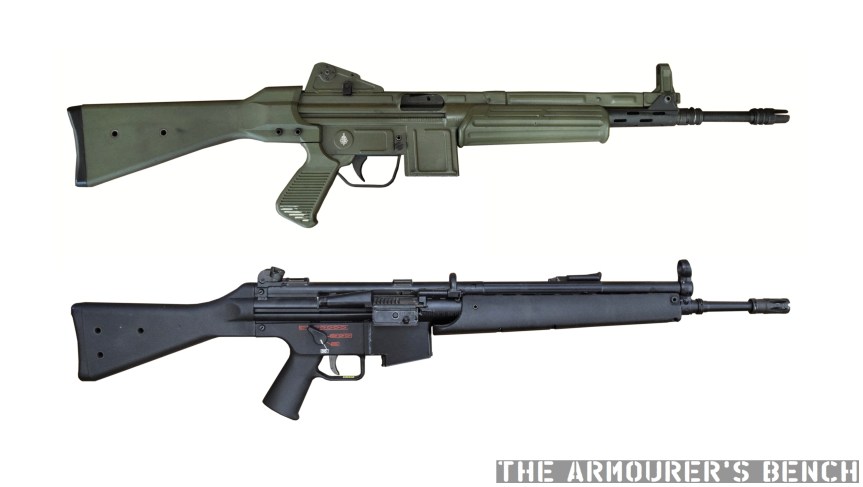
In this week’s video we compare two of the last roller-delayed production rifles: the Spanish CETME Modelo L and the Heckler & Koch G41. These rifles represent the last evolutions of two strands of the roller-delayed development tree – the Spanish and the German.
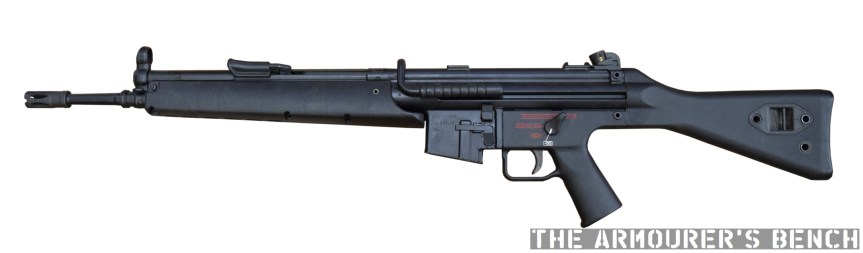
The CETME L & HK G41 (Matthew Moss)
Both rifles use the roller-delayed blowback action and are both chambered in NATO SS109 5.56x45mm ball round, have have 1:7 twist barrels and feed from STANAG magazines. Both were developed during the 1980s and both are also capable of firing rifle grenades.
The CETME L
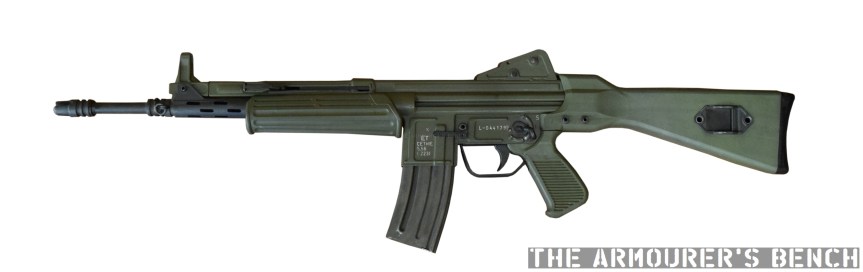
Left-side profile of the CETME L (Matthew Moss)
The CETME has a bit of a reputation for being cheap but this relatively unbattered example feels solid enough. Both of the rifles disassemble in much the same way with the butt assembly being removed to allow the bolt to be pulled out of the rear.
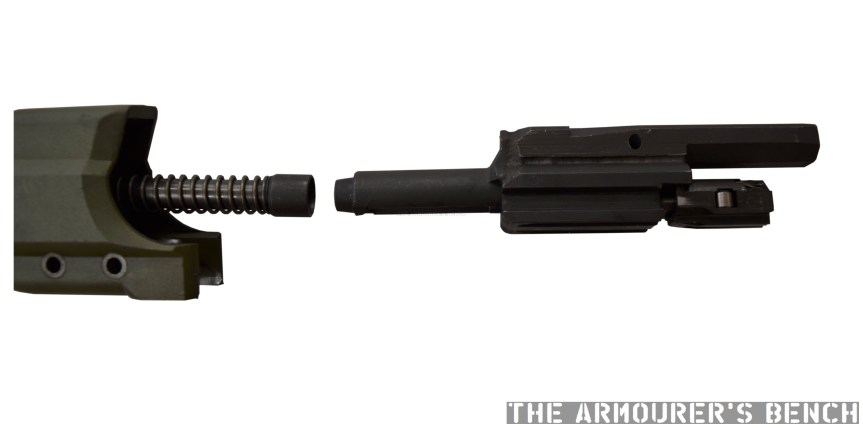
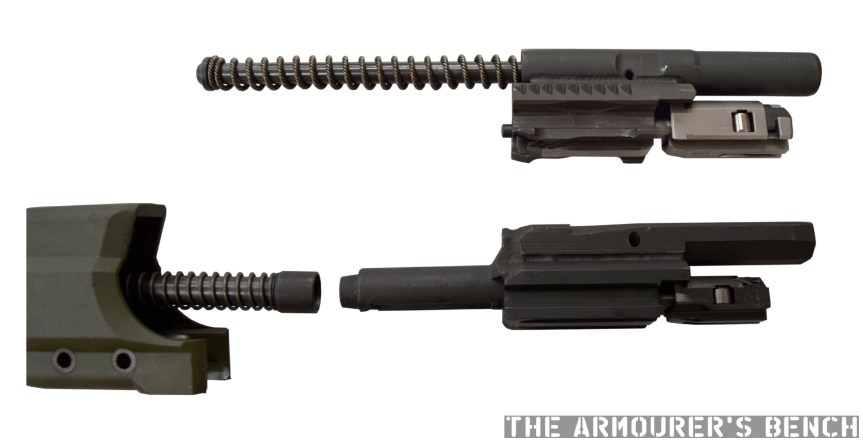
Most notable about the CETME’s bolt is the long rod protruding out the back of the bolt assembly. This acts on the recoil spring housed inside the butt. The L’s recoil spring, unlike the G41s, is captive inside the butt rather than nested inside the rear of the bolt carrier. The CETME’s bolt is also much squarer than the G41’s which probably simplified the machining of the bolt and designing the receiver stamping.
The L’s bolt and butt assembly (Matthew Moss)
The L does not have a provision to lock its bolt back in a slot like the HK (no CETME slap for Spanish soldiers), however, it does have a bolt hold open, with the release located in the rear sight base.
The CETME has simpler folding aperture sights with 200–400m adjustments. It weighs in a 3.72kg or 8.2lbs unloaded and is 92.5cm or around 36in in length. The CETME has a simpler fire control group, with safe, semi and full-auto settings. It is not ambidextrous and only has a selector on the left side of the receiver. The CETME L has largely been replaced by the weapon that superseded the G41 – the gas-operated HK G36.
Heckler & Koch G41
The left-side profile of the G41 (Matthew Moss)
We have full article and video examining the G41 in detailhere.
HK finalised the G41’s design in 1979, a refinement of the 5.56x45mm HK33, it sought to modernise the platform and borrowed features from the M16 family of rifles including a bolt release catch, dust cover and forward assist.
The G41 has a butt assembly that fits into the receiver rather than around it. So its cross pins are at the top and bottom of the receiver rather than both at the bottom. This spreads the stresses on the receiver vertically rather than laterally.
Comparison of the G41 and Model L’s bolts (Matthew Moss)
The G41 has both the classic HK hold open notch and a AR-style paddle bolt release. HK’s dioptre drum sights have adjustments from 100 to 400m, and can mount a scope using an HK claw mount. G41 is the heavier of the two rifles, weighing in at 4.31kg or 9.5lbs. The G41 is also slightly longer than the L at nearly 100cm or 39in in length.
The HK has an ambidextrous selector with positions for safe, semi, 3-round burst and finally full-auto. The G41, unlike the L, also has a folding carrying handle near its point of balance.
The G41 represents the last evolution of HK’s infantry rifles using the roller-delayed blowback action. It comes from a period when HK were developing what they hoped would be the next generation of small arms technology and with the collapse of the G11 programme and the lack of sales of the G41 saw it superseded in the 1990s by the gas-operated G36.
The SAR-80’s story begins in the early 1970s, when Frank Waters, the Sterling Armaments Company’s chief designer, began developing a 5.56x45mm rifle for sale to foreign militaries. While two initial prototypes were produced the project lapsed when Sterling secured a license to manufacture Eugene Stoner’s AR-18.
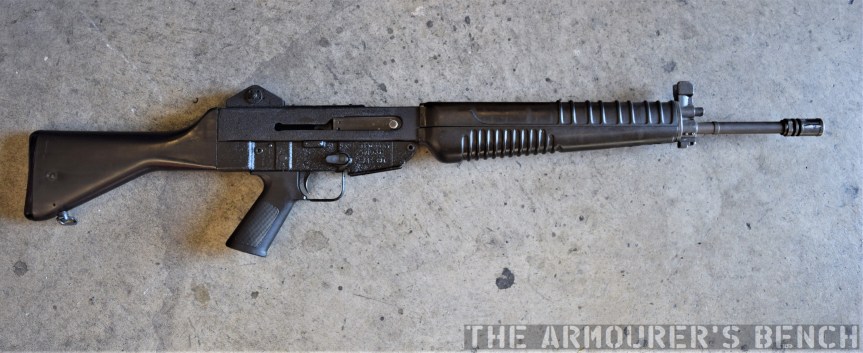
Right-profile view of the SAR 80 (Matthew Moss)
In the late 70s the project was resurrected and in February 1977, two prototypes were sent to Chartered Industries of Singapore (CIS)[later known as ST Kinetics] who had been seeking a 5.56x45mm rifle design to produce for export to sustain production at their factory. The initial prototypes reportedly suffered issues with obturation with some cartridges and Sterling engineers worked to rectify this with another batch of half a dozen prototypes being sent to CIS in late 1977. CIS produced their first pre-production prototypes in 1978, for testing by the Singapore Army. CIS opted for a plastic buttstock and redesigned the handguards too.
Factory brochure photo of Singaporean soldier with SAR 80 (CIS)
Initially described as the Sterling Light Automatic Rifle and later the Sterling Combat Rifle the rifle, however, as it finally entered production in 1979, it became known as the Singapore Assault Rifle 80 or the SAR-80. Some of the earlier rifles are also marked ‘Sterling Assault Rifle’.
The first SAR-80s were delivered to the Singapore Armed Forces in early 1981 for troop trials. Faults with these early production rifles included poor fit and finish and extractors which bent leading to extraction and ejection issues. Refinements made rectified these faults and subsequent production runs had improved reliability.
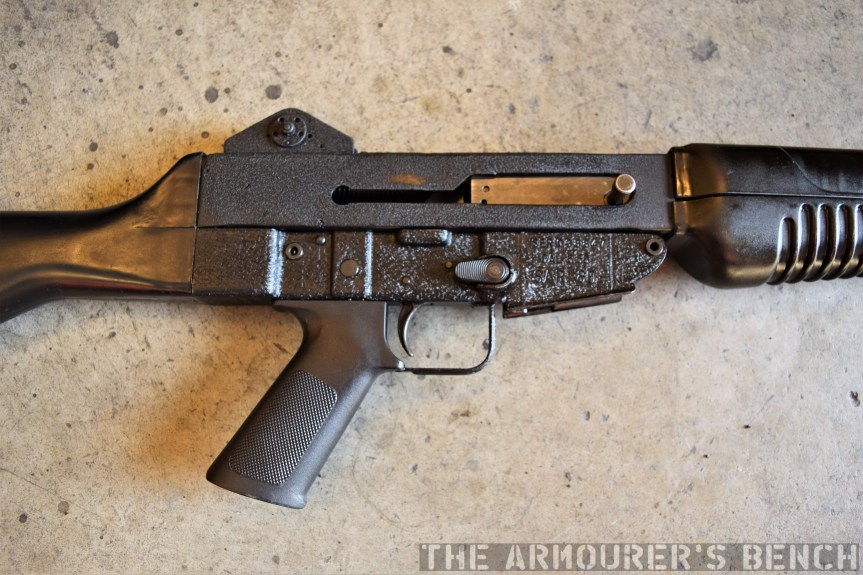
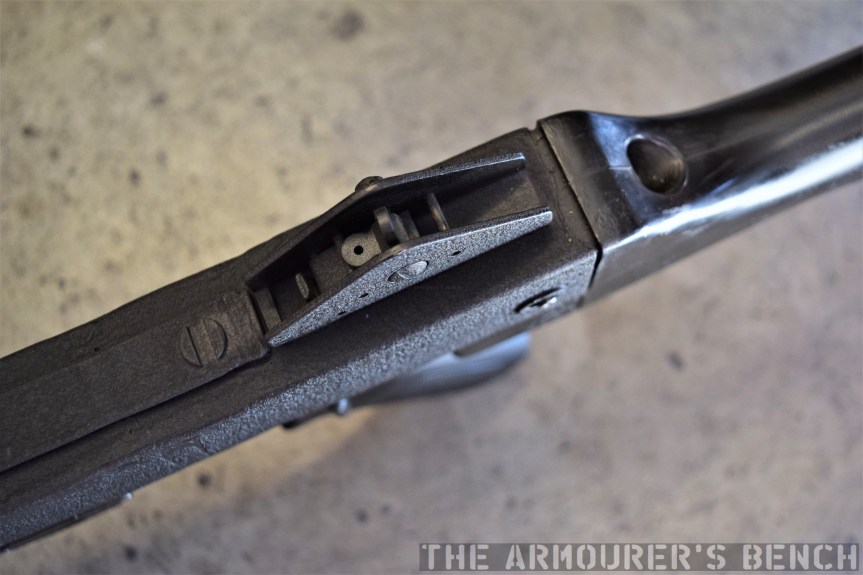
Close up of the receiver, note the sliding dust cover is missing from this rifle (Matthew Moss)
The SAR-80 can be described as a clone of the Armalite AR-18 with their internal designs almost identical. The SAR-80 is gas-operated, with a short-stroke gas piston and a rotating bolt. The bolt has 7 locking lugs, the internal mechanics of the rifle are more or less identical to that of the AR-18, using dual recoil springs and a rectangular bolt carrier. The bolt geometries differ slightly to the AR-18’s and the SAR-80 also has an additional weight inside its bolt – which adds mass and helps slow the rate of fire down to around 600rpm. Like the AR-18 its charging handle is attached directly to the bolt carrier and is reciprocating.
The rifle feeds from standard STANAG magazines and is select-fire, with a selector on the left side of the rifle and a magazine release on the right. The selector layout is modelled after the M16’s and the front handguard’s design was also influenced by the M16. The SAR-80 has simple stamped receiver, similar in profile to the AR-18’s, it has a crackle-paint finish, like that seen on the commercial Sterling Mk4 SMGs. It has a two-position folding rear peep sight and is 97cm (38in) long and weighs 3.7 kg (8.2 lb) unloaded.
Close up of the rifle’s sights, note the rudimentary scope mounting rail (Matthew Moss)
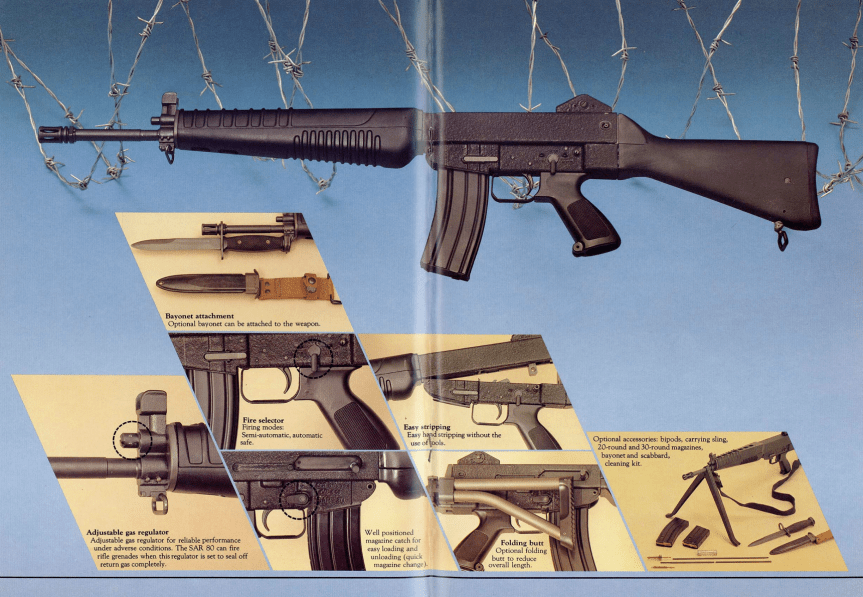
The SAR-80 had a bayonet lug just beneath its adjustable gas block and mounted an M16-pattern bayonet, other accessories included a scope mount, bipod and a blank-firing adaptor. And of course a folding stock variant was also available.
Graphic showing the rifle’s features from factory brochure (Matthew Moss)
I didn’t have a chance to strip the rifle but here you can see the hammer inside the receiver – its worth noting that this rifle does not have the sliding dust cover seen on other examples, and the charging handle slot is completely open.
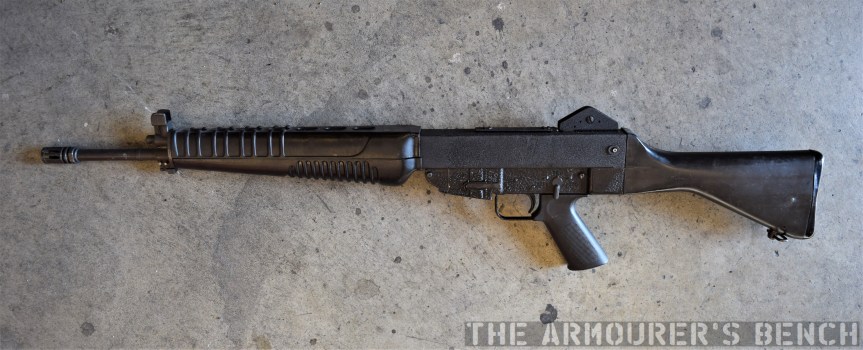
Left-profile view of the SAR 80 (Matthew Moss)
Developed with cost in mind, contemporary literature from CIS state an export price of around $300 per rifle, the equivalent to day of about $930. CIS produced more than 80,000 between 1980 and 1988, it saw limited service with Singapore’s military but did enjoy some export sales, with the SAR-80 used by the Central African Republic’s Gendarmerie, the Croatian Army, the Papua New Guinea Defence Force and the Slovenian Territorial Army. CIS replaced the SAR-80 with the SR-88, a rifle co-developed with Sterling as the SAR-87, but this proved unsuccessful and has since been superseded by the SAR-21 bullpup.
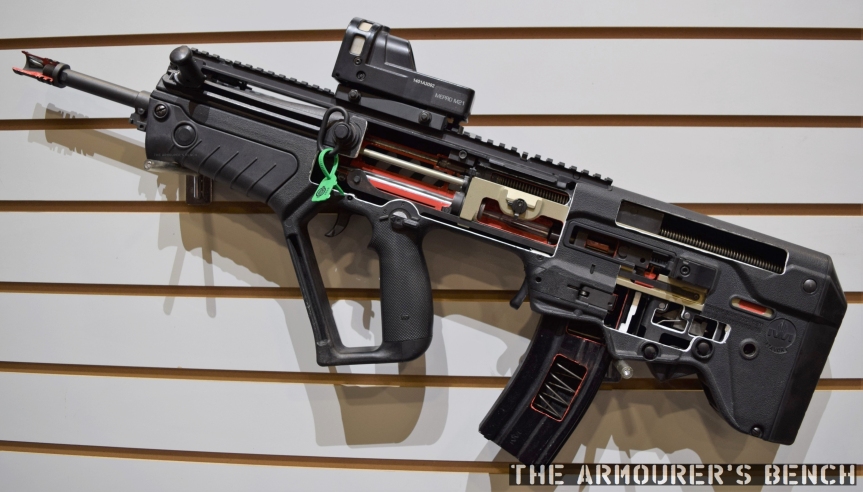
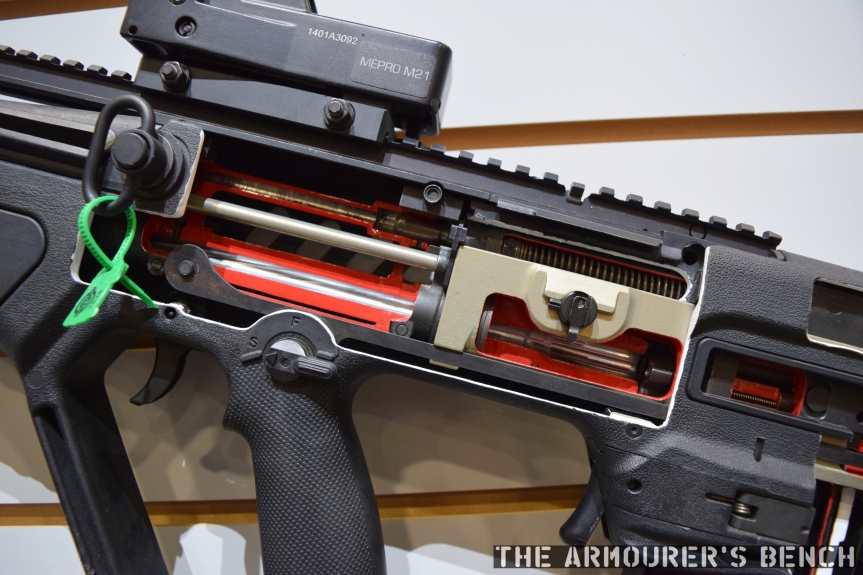
Last week Matt attended SHOT Show 2020 and spotted a pair of Tavor cutaway demonstration guns at the IWI booth. Above is a quick video, put together on the fly, looking at the cutaway guns and showing how they illustrate the Tavor’s working parts and operation.
Cutaway IWI Tavor (Matthew Moss)
Developed in the mid-1990s to meet IDF requirements for a reliable and compact rifle to replace the M16s & M4s in service. The rifle had to be shorter to deal with the close quarter urban fighting the IDF often found itself in.
The Tavor or TAR-21 uses a long strike gas piston system inspired by the AK and has a rotating bolt. The bullpup configuration gave the desired compact weapon without sacrificing barrel length.
A closer look at the gas piston system, the barrel, chamber and the bolt face (Matthew Moss)
The cutaway rifles on display at the IWI booth were actually civilian, semi-auto only, Tavor SARs but they give us a good look at the rifle’s internals and how the Tavor functions. We can see the gas piston system, the charging rod and the barrel at the bottom. Moving back we can see the chamber, the bolt carrier group, the sear assembly and the bolt hold open mechanism.
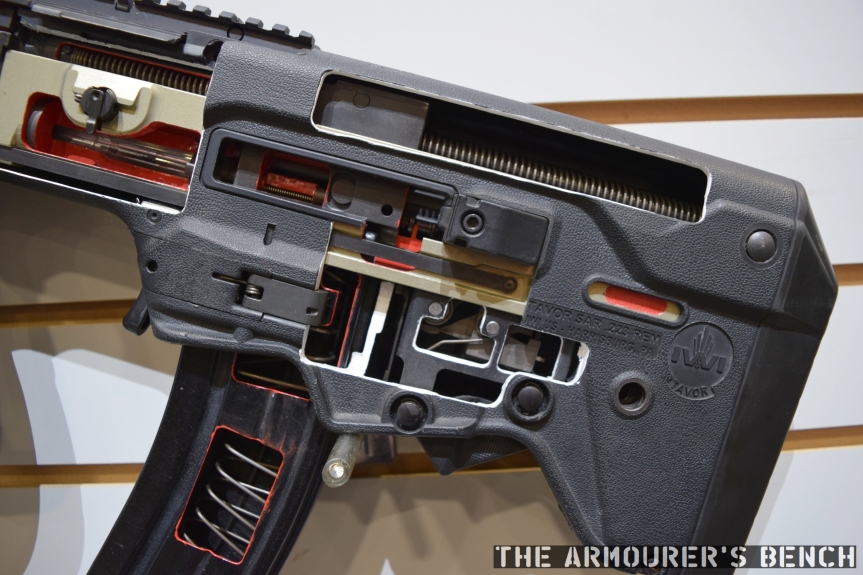
In this photo we can see the cutaway magazine as well as the mainspring at the top of the photo and below it the bolt carrier group and the bolt release mechanism (Matthew Moss)
They also cutaway the magazine so we can see the spring inside. At the top of the weapon we can see the mainspring that stretches back into the butt. The model was fully functional so on pulling the trigger the connecting rod acted on the sear release to trip the firing pin.
Additionally, the bolt release, just behind the magazine, also functioned and when operated the bolt went forward onto battery. The Tavor entered service in the early 2000s and has been superseded by the X95 and joined by the 7.62 chambered Tavor 7.
We will have a more in-depth video on the Tavor in the future.
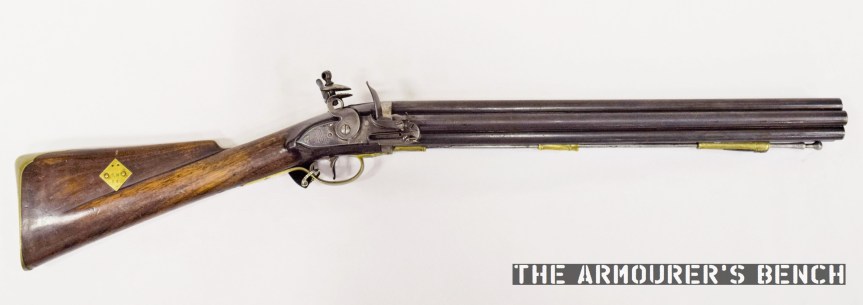
Commonly referred to as Nock Guns, the seven barrel volley guns were actually designed by James Wilson. Wilson presented his design to the Board of Ordnance for testing in July 1779. Following testing at Woolwich Arsenal the Board of Ordnance decided that the guns, while of no use to the Army, might be useful aboard the Royal Navy’s ships. The volley gun’s impressive firepower could be devastating at the relatively short ranges aboard ships. The Navy had historically used blunderbusses/musketoons and the Board of Ordnance probably viewed Wilson’s gun as an advancement of this concept. London gunmaker Henry Nock was given an order for two ‘seven barrelled rifle guns’ for Admiralty testing but these proved slow to load in action and subsequent guns had smoothbore barrels.
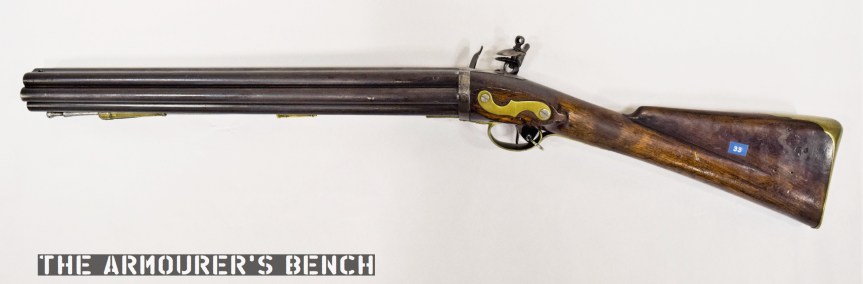
Right-side profile of the volley gun (Matthew Moss)
The Admiralty envisioned equipping first rate ships of the line (vessels with 75 guns or more) with 20 volley guns, while second and third rates would have 16 and 12 volley guns respectively, and frigates would carry 10 Nock guns. This represented a sizeable order. The Admiralty eventually purchased 500 guns, paying £13 per gun, to equip Royal Marines and sailors manning the fighting tops (at the top of ship’s masts). The Navy felt that the volley guns’ firepower would be useful when boarding enemy vessels or in repelling boarders by pouring down fire on enemy boarding parties.
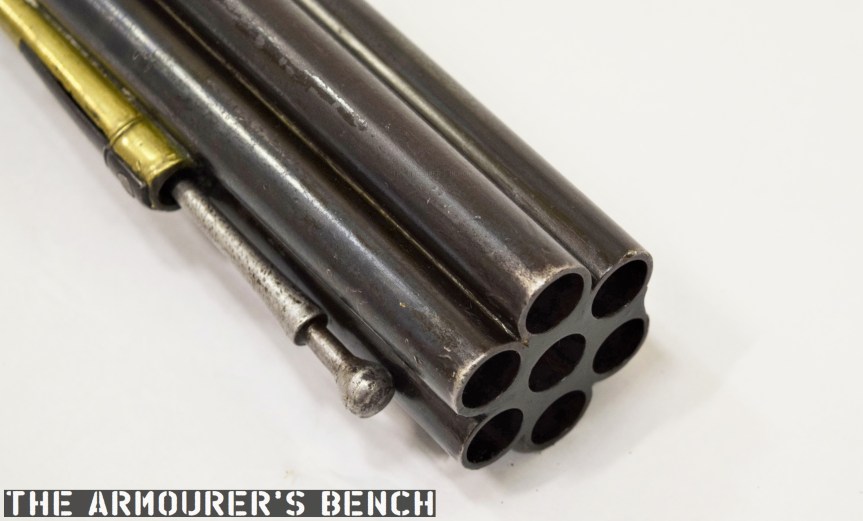
A close up of the gun’s muzzel-end, not also the ramrod which appears to have been lengthened at some point in its life (Matthew Moss)
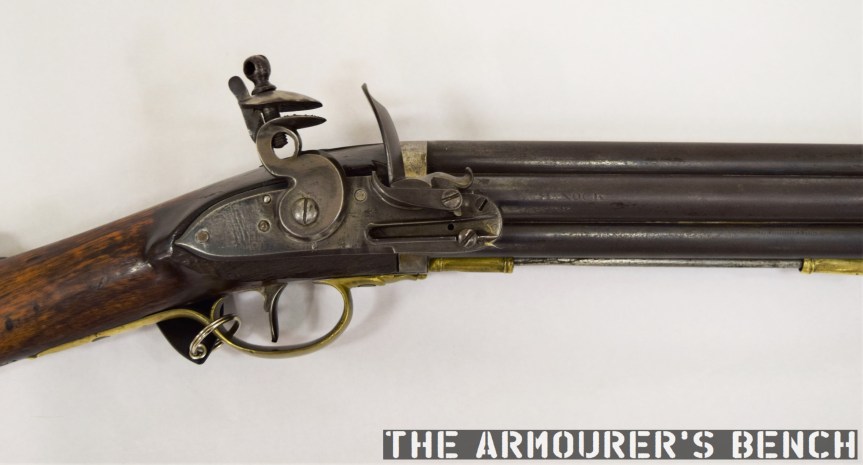
Henry Nock, better known for producing high quality duelling pistols and sporting guns, became the sole supplier of Wilson’s volley guns to the Royal Navy. The weapon’s 0.46 inch calibre outer barrels were arranged around the seventh centre barrel. The 51cm or 20in barrels were brazed together and screwed to an iron plate set into a walnut stock. The outer barrels had vents drilled through them to the central barrel while the central barrel had a vent leading from the lock. Once the flintlock ignited the powder charge in the central barrel, the surrounding barrels were ignited through the vents. As the vents had to be drilled with the barrels already brazed into position, the outer barrels all have plugged drill holes on their outer surfaces.
A close up of the lock and the ‘H. NOCK’ makers mark (Matthew Moss)
All seven barrels fired almost at once producing significant recoil, reputedly able to dislocate shoulders. The service load was originally 2.5 drams of finer rifle powder (which I believe equals 68gr) for each barrel – totalling 476gr. Despite the gun weighing 12lbs, this did little to mitigate the weapon’s recoil and a reduced charge or 1.5 drams of standard musket powder was ordered.
The Board of Ordnance and the Admiralty granted Wilson an awarded of £400 (equal to £48,000 or $63,000 today) in May 1780. He played no further role in the testing and development of the volley gun. In 1787 the Navy ordered a further 100 guns from Nock.
Left-side profile of the Nock Gun (Matthew Moss)
Entering service just too late for service during the American War of Independence the first reported use of the guns came with Admiral Howe’s fleet at the siege of Gibraltar in 1782. They continued to be carried aboard other vessels during the 1790s, but few accounts refer to them and little is known about their service.
Howard Blackmore suggests that naval officers, including Admiral Nelson who disliked placing marksmen in his tops, disliked the guns. There were some fears that the volley guns’ wads could set the ships sails and rigging on fire. Reputedly it was also not uncommon for some of the volley gun’s barrels to fail to ignite. As a result the guns were seldom used on board ships and removed from Royal Navy service in 1804. In 1805, Wilson, then a captain of the Marines suggested the Navy reissue the guns to the Sea Fencibles, a naval militia which helped defend the British coast, however, his recommendation was not followed up.
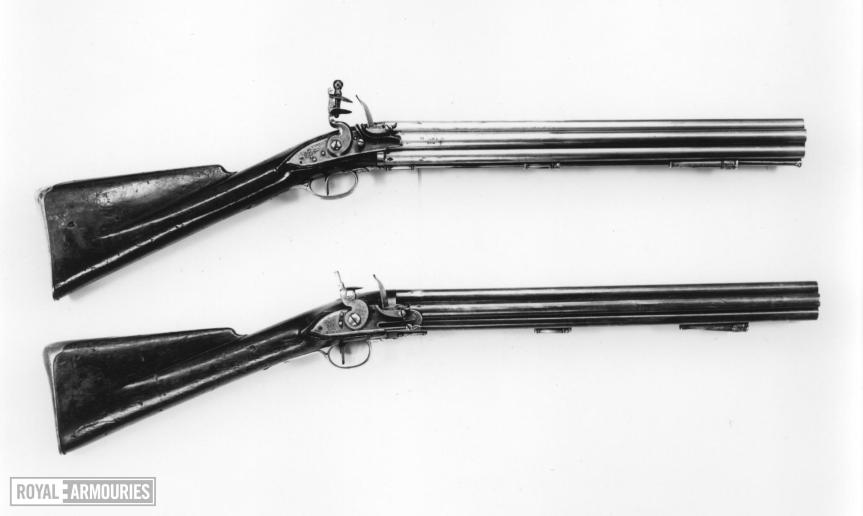
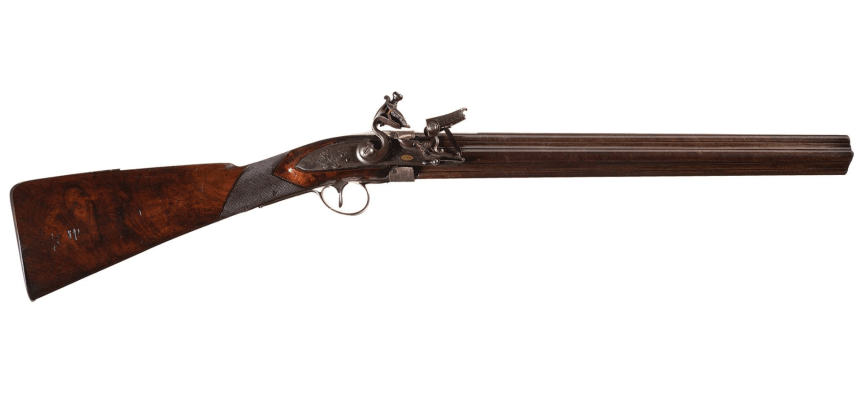
The early (top) and later (bottom) patterns of Nock volley gun (Royal Armouries)
This particular example has the second pattern of lock used on the Nock guns with a smaller lock positioned a little lower on the gun. The earlier pattern was a back action lock, fitted high on the gun with the front of the lock plate in line with the side of the barrel.
The gun has a maker’s mark of ‘H. NOCK’ on the second barrel on the left and various barrel proof marks. Unlike other examples the lock itself isn’t Tower and ‘GR’/Crown cypher marked but does have the Ordnance Broad Arrow just behind the pan. Interestingly, the steel ramrod appears to have an extension brazed onto the end of it, this might indicate that the shorter rod used with the initial charge had to be extended when less powder was used for the lighter 1.5 dram load.
Why did the Nock Volley Guns fall out of favour?
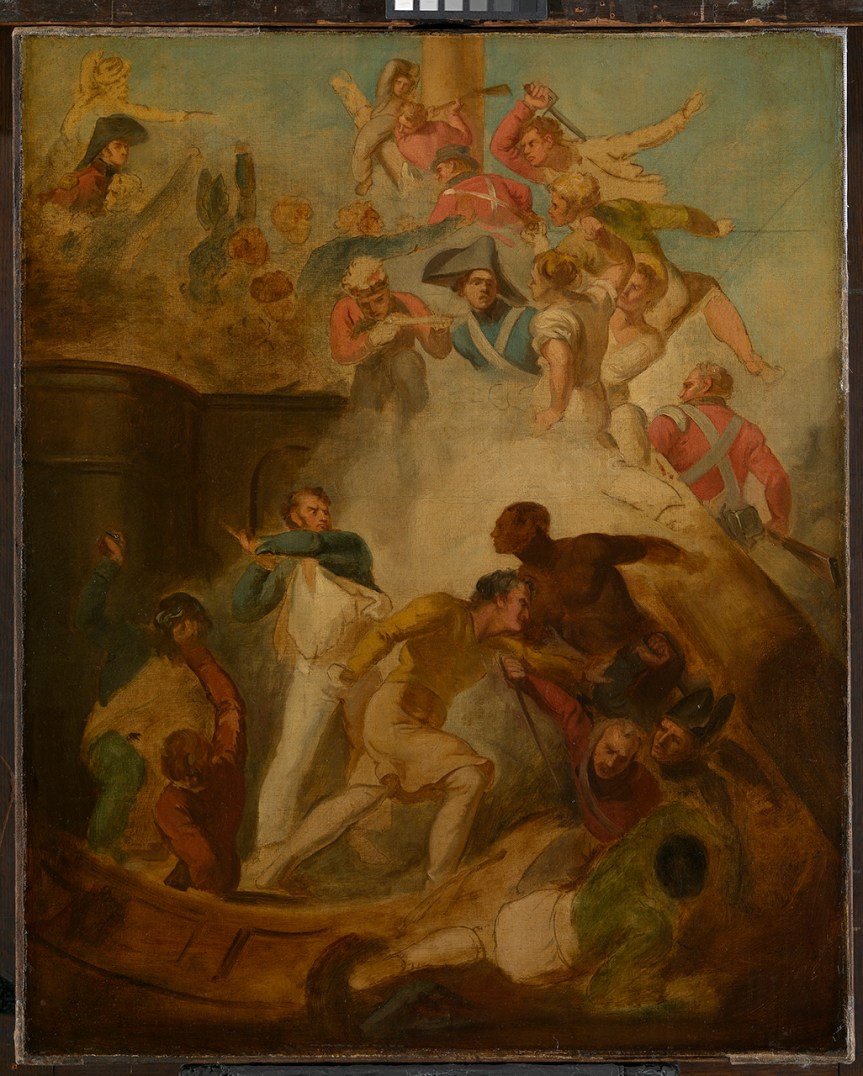
As I mentioned earlier the recoil of the initial service load was significant, Howard Blackmore hypothesised that there may have also been some weakness to the lock springs leading to misfires. One key factor is that close quarters fighting aboard ships often relied on edged weapons like cutlasses, boarding axes and pikes. These paintings give us some feel for what fighting aboard a Napoleonic Man-of-War might have been like – a close, chaotic, terrifying affair.
Boarding Party by D. Drummond, (National Maritime Museum)
While pistols were commonly used they were disposable and may not have been reloaded during a fight – more likely they were dropped or used as a club. The Nock Gun would have offered a devastating first volley, and while its 20 inch barrels would have given it better accuracy and range than a musketoon, how much of an impact a single volley of seven .32 bore projectiles would have had especially once the fighting became hand to hand is a matter for debate. At close quarters the Nock Gun quickly becomes a short, ill-balanced, 12lb club.
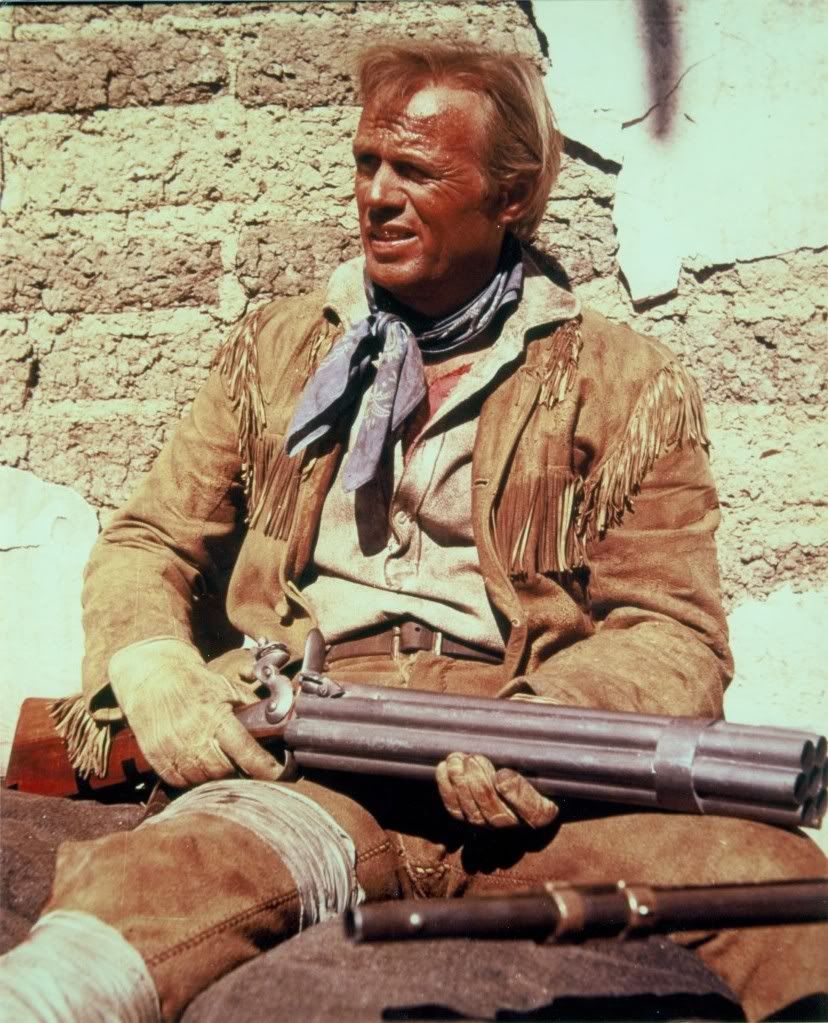
The Nock Volley Gun is perhaps best known for appearing in the Sharpe series of books and films as Sergeant Harper’s weapon of choice but it first appears on screen in the 1960 classic The Alamo with Richard Widmark’s Jim Bowie carrying one and more recently a fleeting, anachronistic, appearance in Master & Commander: Far Side of the World.
Richard Widmark as Jim Bowie in The Alamo (1960) with his pretty rough mocked-up Nock Gun
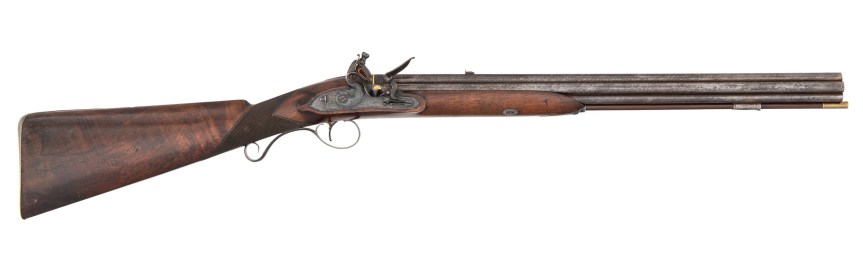
Despite a relatively short and undistinguished service life the Nock Volley Guns also saw some civilian sales with a number of ornate hunting guns with wooden forends, engraving, rifling and rear leaf sights.
A civilian Nock Volley Gun, note the rear sights, wooden forend and fine craftsmanship (Cowan’s Auctions)
Later in 1818, Nock’s workshop manufactured a design by Artemus Wheeler, an American gun designer with a fondness for revolving guns.
Wheeler’s carbine resembles the earlier volley gun externally but is in fact a manually rotated, self-priming flintlock ‘pepperbox gun’ with six barrels arranged around a central axis. Unlike the earlier volley gun the pepperbox carbine was never trailed or purchased by the Admiralty. Henry Nock’s workshops produced approximately 655 volley guns between 1780 and 1788. The Nock Gun is a weapon that would greatly benefit from some in-depth contemporary research as the current best source is over 50 years old and relatively little is known about the gun’s service history.
In the second video Matt tackles the Heckler & Koch G11 and gives an update on the colouring book and the channel:
Thanks for watching chaps & thanks so much for your support in 2019, we greatly appreciate it. It’s been a busy year and we hope that you’ve all enjoyed our videos!
You can still pick up a copy of the ACR colouring book and the G11 sticker at www.armourersbench.com/shop. we’re very much looking forward to seeing your artistic sides when you send us some photos of your colouring to – contact@armourersbench.com.










 The Armourers Bench