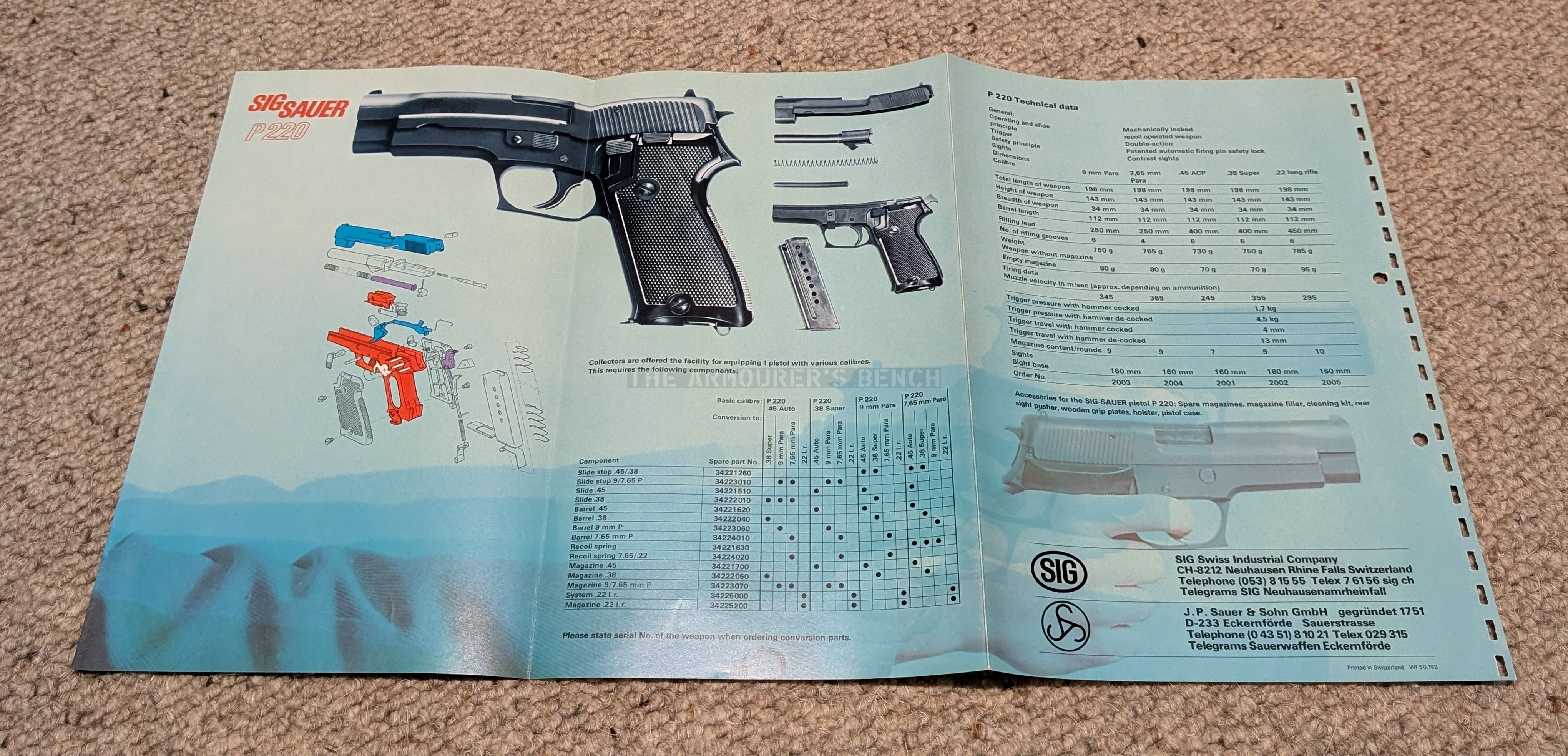
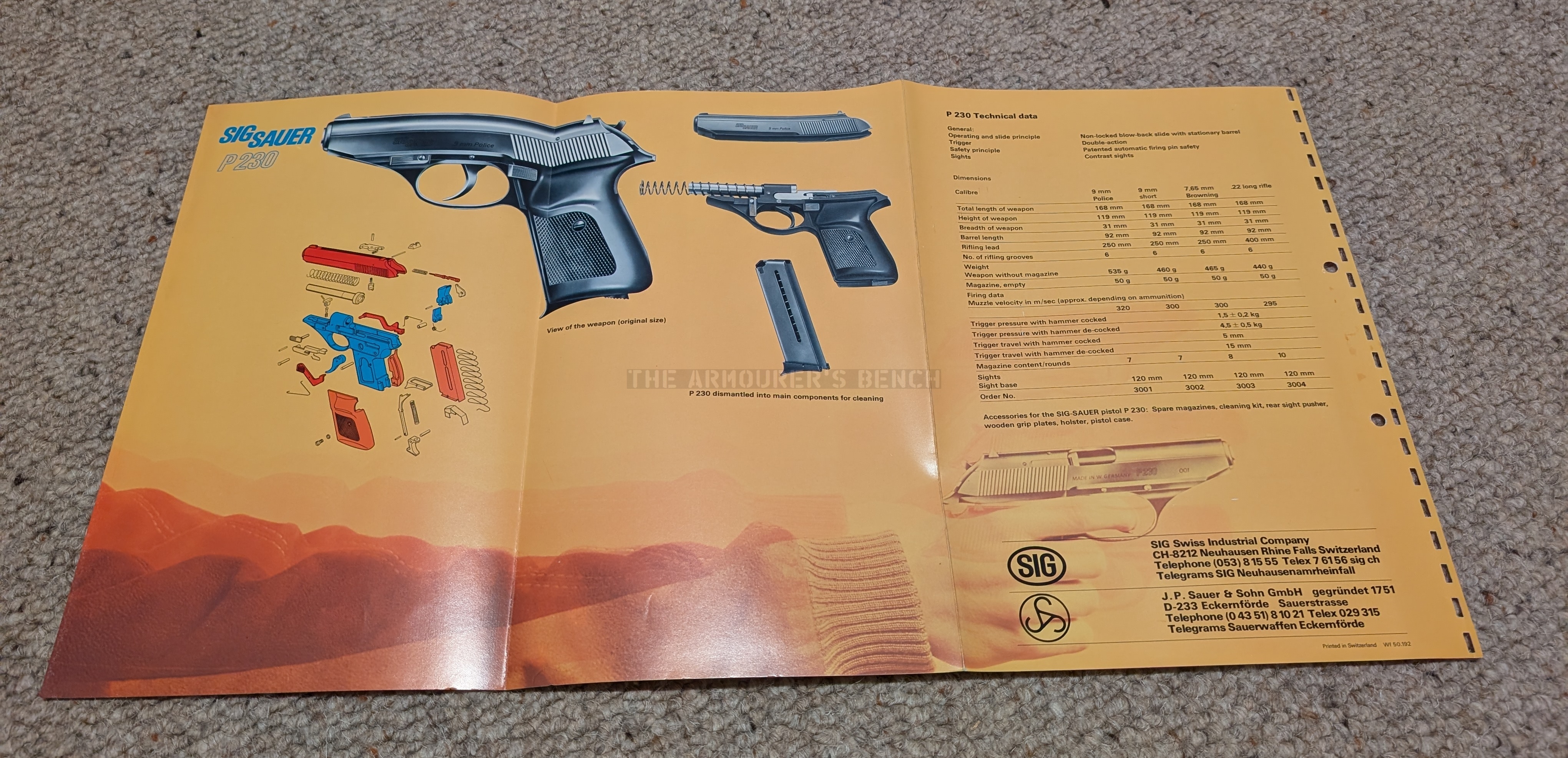
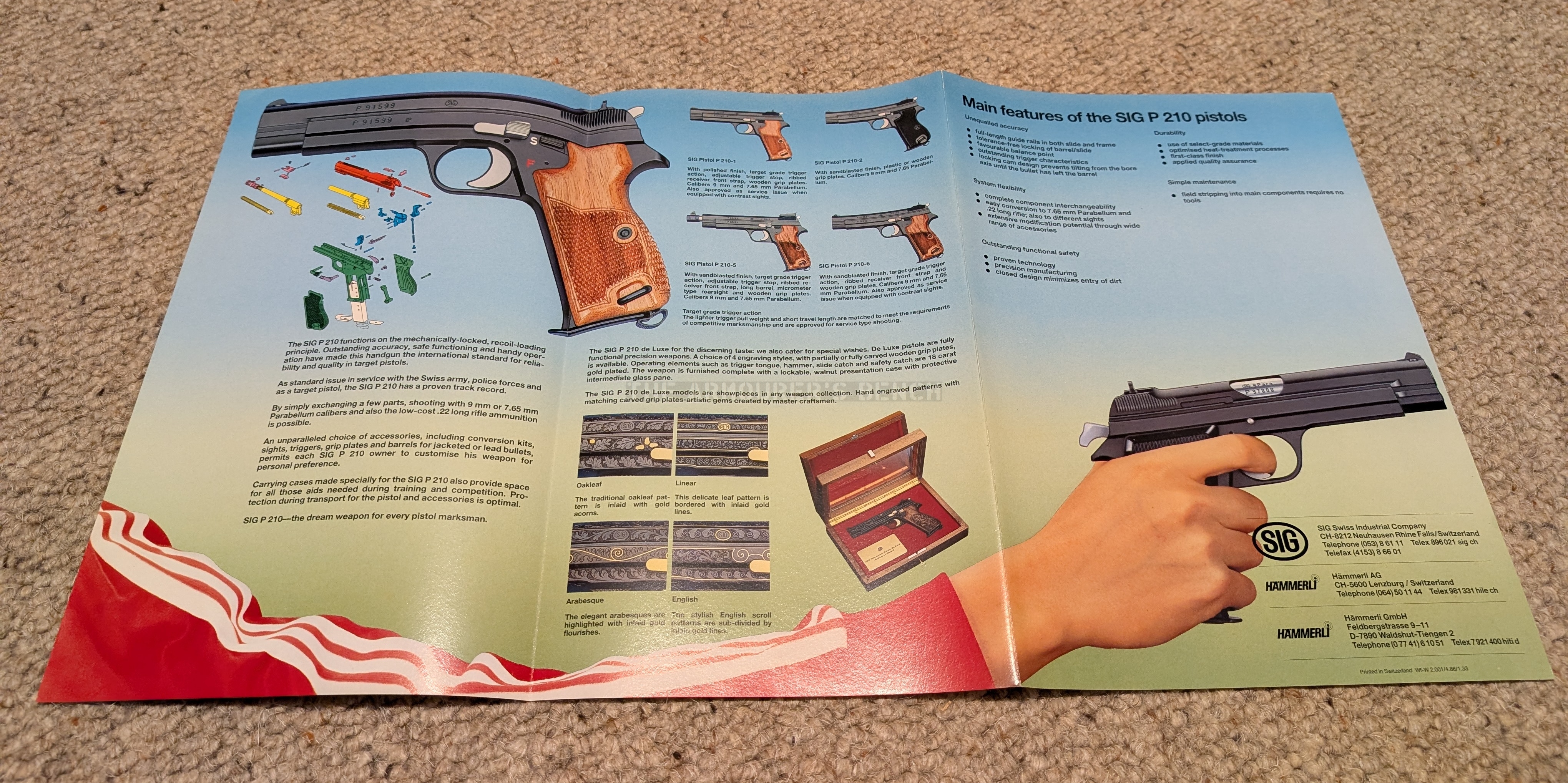
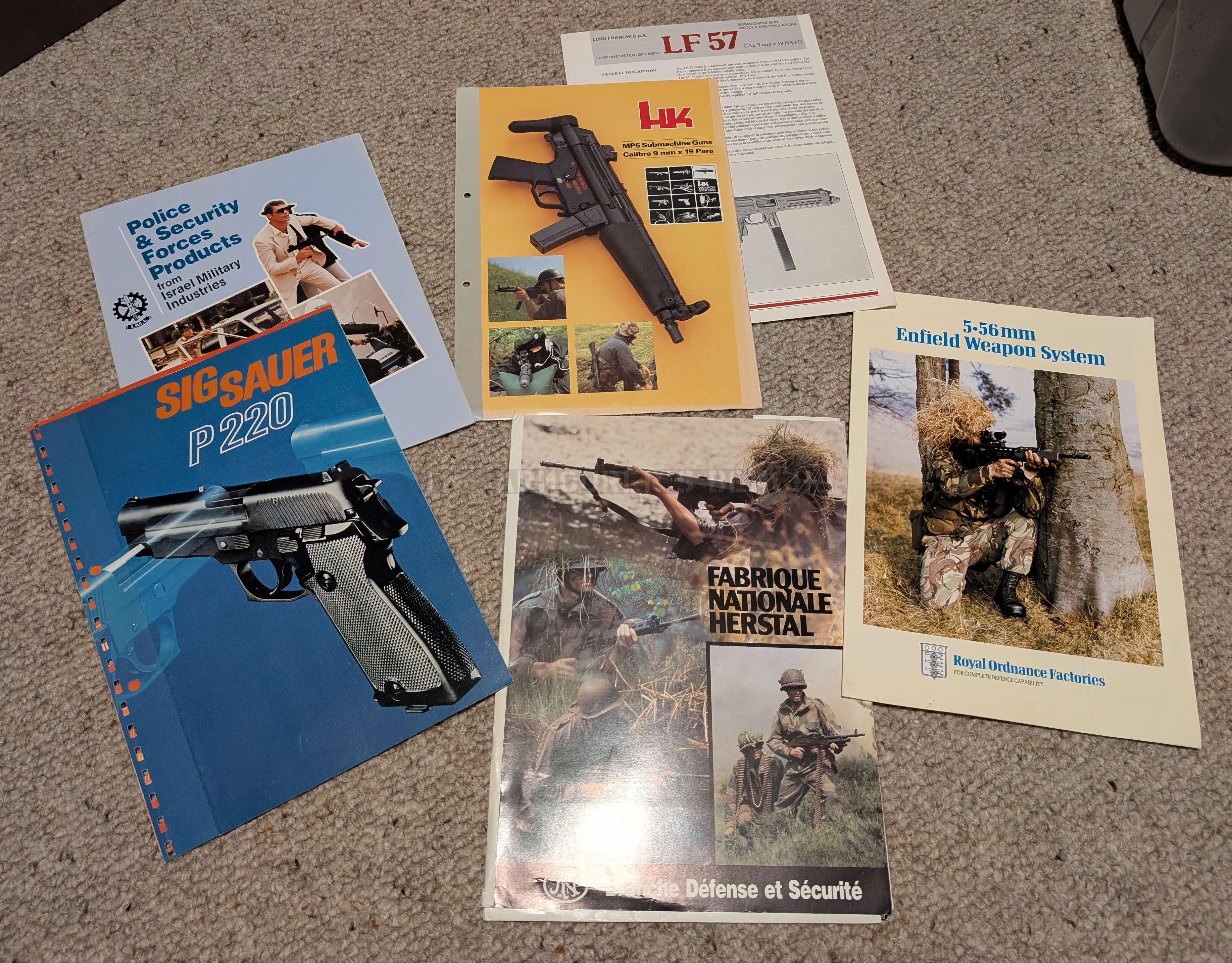
POV – You’re just back from an exciting day walking around the 1989 Arms Expo. You begin unpacking all of the brochures about the latest cutting edge firearms that you picked up! You start with some SIG brochures a nice man from Bern enthusiastically gave you….
Support Us: If you enjoyed this video and article please consider supporting our work here. We have some great perks available for Patreon Supporters – including early access to custom stickers and early access to videos! Thank you for your support!
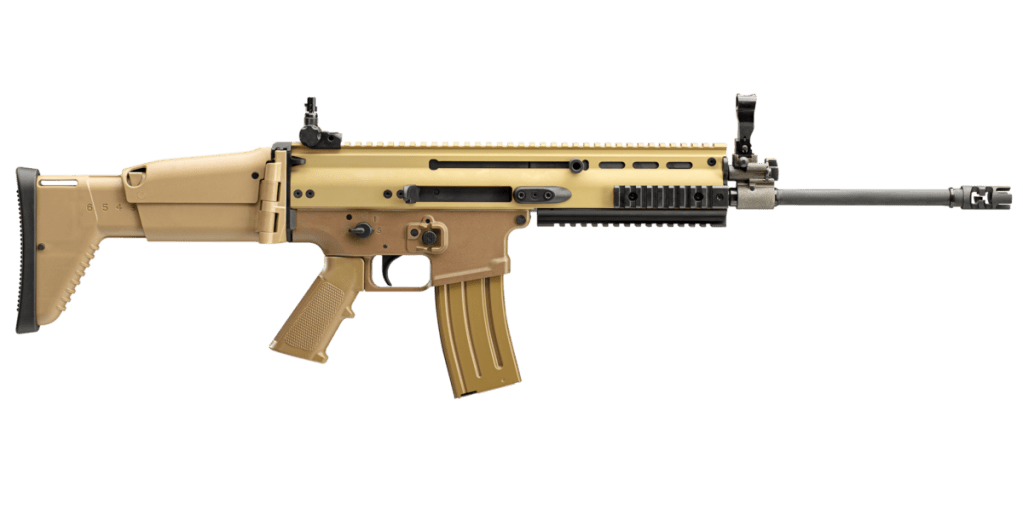
This week, some surprising news broke: FN America confirmed that production of all SCAR variants had ceased. Rumours began to circulate last week, and a subsequent post on r/FNSCAR claimed that “both the US and Belgium plants have ended production of all (RCH and NRCH) SCAR 16S, 17S, AND 20S and all that is left is what is currently on the market.”
FN SCAR-L (16S) (FN America)
This led to FN social media channels being inundated by questions asking if the rumours were true. On Wednesday, FN America’s social media team began confirming the news, replying to posts on X, Facebook and Instagram. However, this raised additional questions: Is production in Belgium also set to end, or just in the US? What about spares and support? What about ongoing military contracts and support for weapons already in service around the world? Notably, many of FN America’s replies referred to the ‘legacy SCAR’, suggesting that there may be an updated ‘non-legacy’ SCAR in the works.
SCAR Series on FN America’s website
Finally, on 16 October, FN America posted a statement confirming the news officially. This statement explained that while production of all SCAR variants (except the SCAR 15P pistol) in the US was ending, “none of this affects FN’s global military SCARs – these are still in demand and still in production.”
Naturally, there was a lot of speculation about what FN would replace the SCAR with. The FN IWS, developed by engineers at FN America, was often highlighted as the probable successor. The FN Individual Weapon System, chambered in steel-cased 6.5x43mm round, was developed for a requirement set out by the Irregular Warfare Technology Support Directorate (IWTSD). It has since garnered interest from the special forces of a number of nations an FN recently announced they’d supplied operational test samples to enable ‘critical feedback’ for further refinement. Despite this the IWS isn’t yet a fully matured system.
The FN IWS on display at SHOT Show 2023 (Matthew Moss)
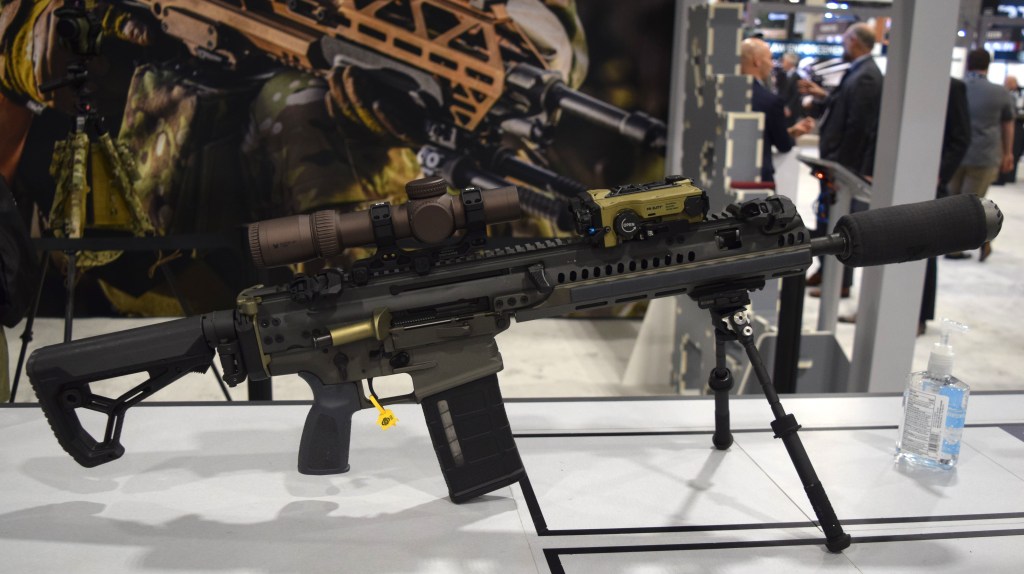
There is also the Mid Range Gas Gun (MRGG) rifles which were developed for US SOCOM. MRGG-A is a requirement for a 6.5 Creedmoor chambered ‘assault’ rifle. FN’s MRGG-A submission introduced internal changes, a new combination forward assist and brass deflector as well as ejection port cover and added an AR-style charging handle. I took a look at one of the prototypes at SHOT 2023.
FN’s MRGG-A submission displayed at SHOT 2023 (Matthew Moss)
As such, I think FN are likely to introduce a new generation of SCAR embodying improvements developed in recent years. The SCAR Mk3 will probably be a product improvement with new features and refinements bringing it in line with the latest weapons from competitors like the HK433, SIG SPEAR-LT and CZ Bren 3.
We may already have seen the FN’s successor to the legacy SCAR in a photo taken at the 2025 Cranfield Close Combat Symposium. At the centre of the photograph is a SCAR-like rifle with some noticeable changes to the upper and lower receivers, the gas system and the forend.
Will the new rifle be called SCAR Mk3? This remains to be seen. Clues began to emerge earlier this year when FN trademarked a new product name, registering the name ARKA around the world [UK, Australia, US]. ARKA is listed as a trademark for a firearm/assault rifle. It remains to be seen if ARKA will be the name of the new FN rifle but it would align well with the new designation scheme started with the EVOLYS. Time will tell which approach FN takes and what their next generation of infantry rifles will look like.
Introduced in 2004, the SCAR has had an interesting service life all around the world, and while the Mk2’s days appear to be coming to a close it’s likely the SCAR’s legacy will continue within the engineering genetics of FN’s rifles for some time to come.
Support Us: If you enjoyed this video and article please consider supporting our work here. We have some great perks available for Patreon Supporters – including early access to custom stickers and early access to videos! Thank you for your support!
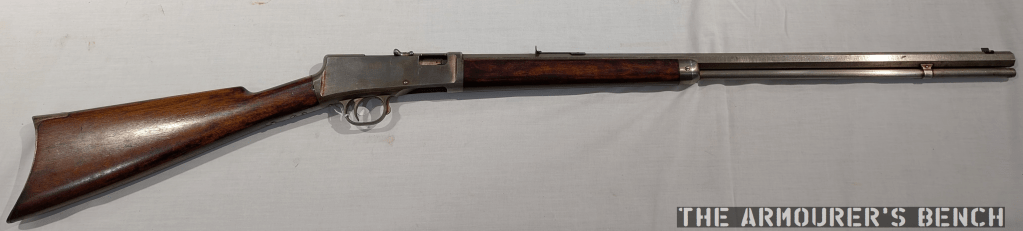
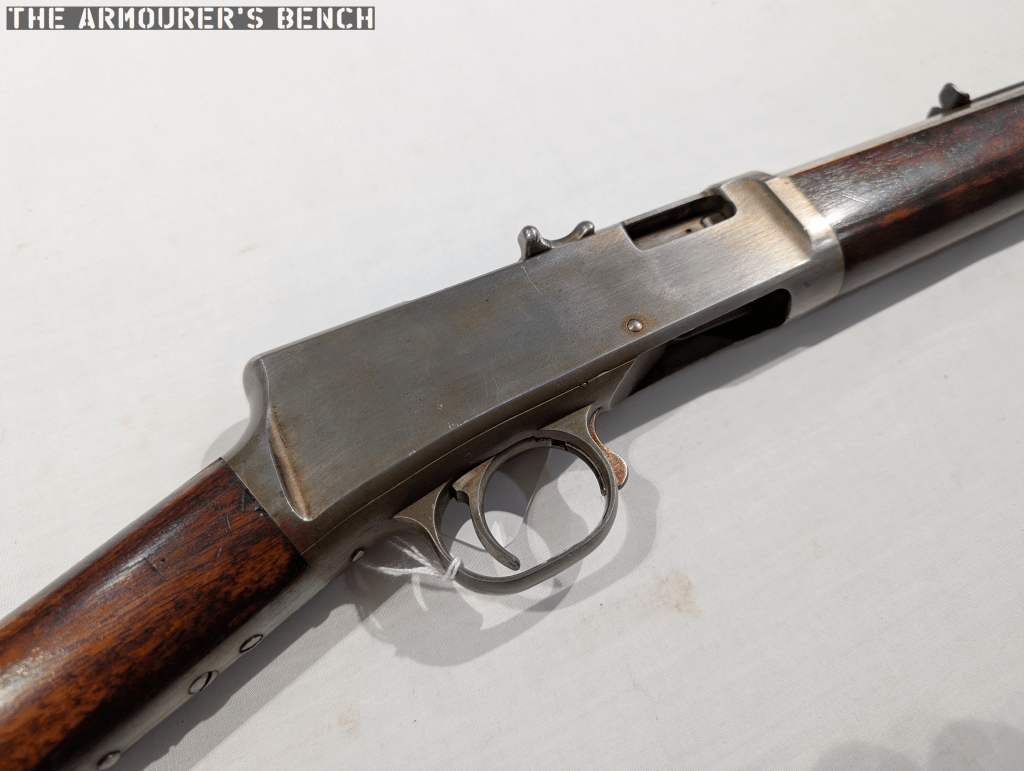
Earlier this year I had the pleasure of visiting my friends at the Cody Firearms Museum and while having a look through their collection we came across a really interesting rifle. The rifle isn’t currently on display and was safely tucked away in one of the museum’s vaults. When we began looking through the vault’s racks we came across what we initially thought were a number of John Browning prototypes from his work with the Winchester Repeating Arms Company. One of the prototypes immediately caught our eye as it had a T-shaped charging handle, something today which is synonymous with the AR-15/M16 platform.
Right side profile of the prototype (Matthew Moss)
In the past I’ve had the pleasure of examining over a dozen of John Browning’s prototypes (some videos are already published on the channel others will be published in the future – stay tuned), this rifle, however, isn’t a Browning. It’s a Mason.
William Mason is probably best known as the man behind the Colt Single Action Army, the Model 1877 and what would become the Model 1889. In 1882, Mason left Colt and joined Winchester. While originally he has been recruited to work on revolvers for Winchester, a topic for another day, he became Winchester’s Master Mechanic and was responsible for bringing many of John Browning’s designs to production. Following the Brownings’ schism with Winchester in 1903, the company continued to develop their own designs and a number of these came from Mason.
Rear right quarter view of the prototype’s receiver and charging handle (Matthew Moss)
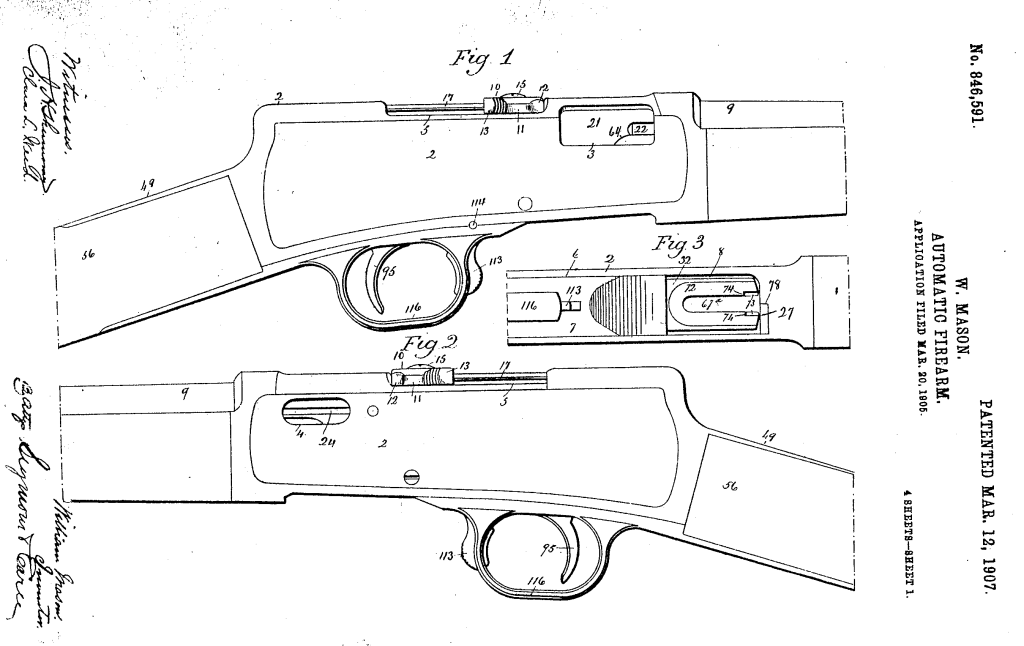
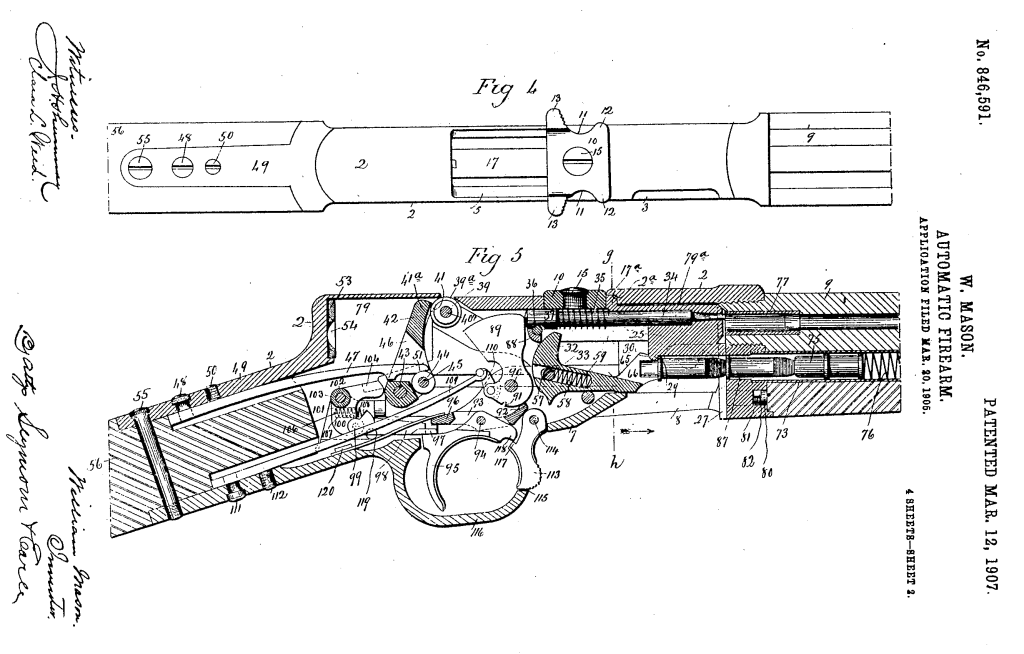
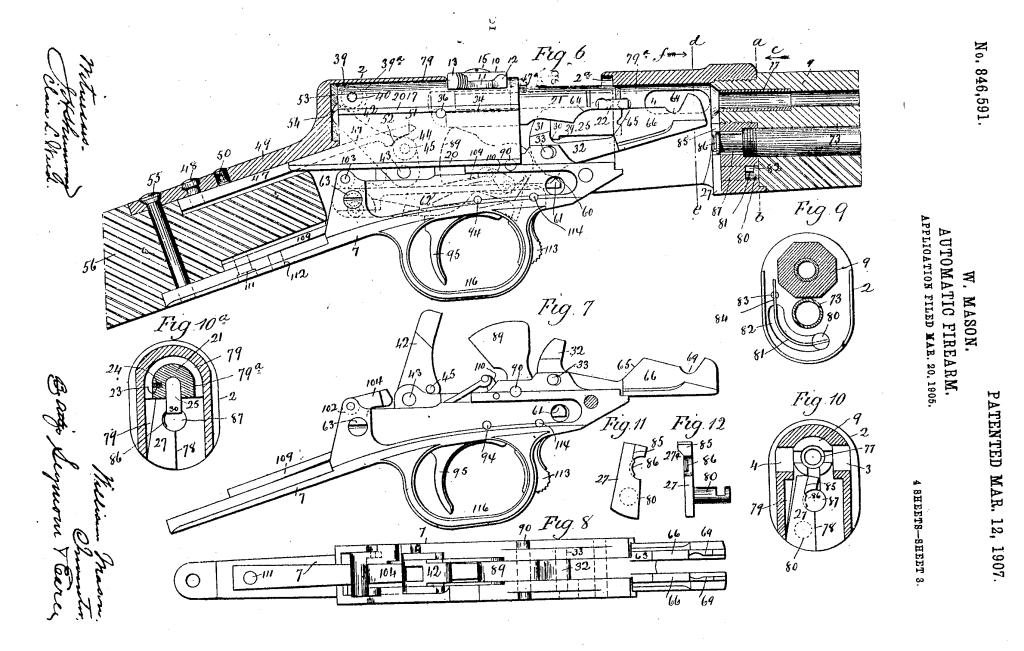
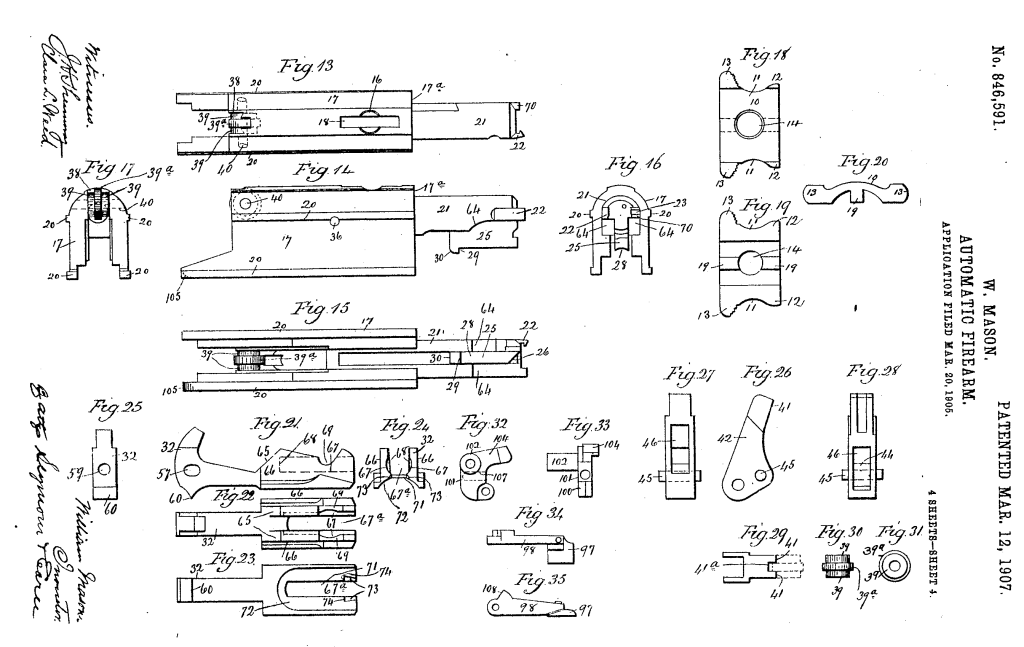
This rifle’s patent was filed in March 1905, and granted on 12 March, 1907 as No.846,591. It is a .22 calibre, semi-automatic rifle which feeds from a conventional tube magazine but has a number of interesting features.
Mason, in his patent for the rifle, describes the weapon’s action as a ‘automatic balanced breech-block gun’, by which he means what we now know as a blowback. He describes this as: “a breech-block which is not positively locked in its closed and recoil-taking position but weighted with reference to the energy developed by the explosion of the cartridge to be used in the gun, so that its inertia takes the initial shock of recoil.”
The only marking visible on the firearm is on the top of the receiver, a number marking: ‘7295’.
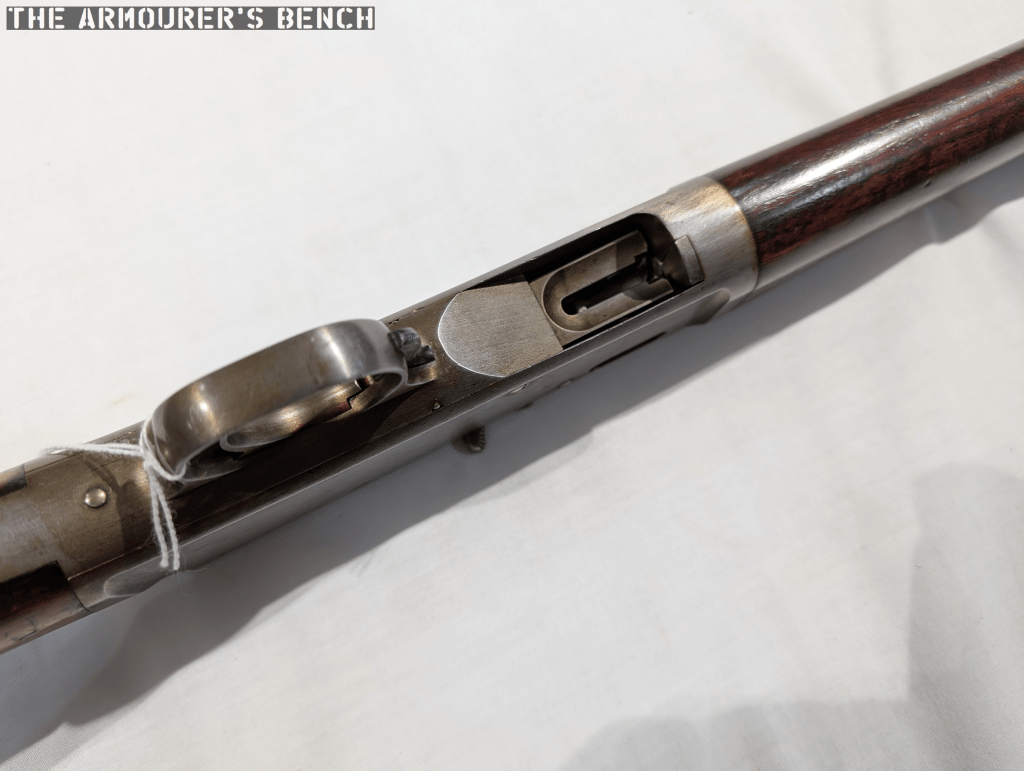
View of the underside of the prototype’s receiver and loading port (Matthew Moss)
Safety
The rifle also has a trigger locking safety located at the front of the trigger guard. The patent describes this:
“provide the gun with a ‘safety’ in the form of a lever, suspended by its upper end from a pivot in the lower tang and having its lower end entered into a slot in the forward reach of the trigger-guard, which is a part of the said lower tang. The said lever is formed with a stop-shoulder, co-acting with a stop-finger at the forward end of the trigger. When the safety is pushed rearwardly, its shoulder is moved under the finger, whereby the trigger is locked against operation under any circumstances.”
The rifle has a swinging carrier which when the breech block cycles it acts on what Mason calls the ‘carrier arm’ via a cam which moves the arm up and down allowing a round to move into the action from the tube magazine when the bolt had moved sufficiently to the rear. The rifle’s tube magazine is loaded by pushing the carrier up and thumbing cartridges into the magazine.
Anti-friction Rollers
Another intriguing feature of the rifle’s action is the set of rollers located in the top of the breech block which prevent friction from the block against the receiver. The rollers also act on a lever which is under spring tension which returns the breech block forward – Mason used this in the place of a more conventional return spring assembly. Instead the lever is acted on by a flat spring which Mason felt allowed him to “secure a marked economy of space” in the receiver, not requiring a coil spring and the space needed to compress it. Additionally, at the rear of the receiver there is also a buffer made from ‘vulcanised fiber’, vulcanisation is a process which strengthens and improves the durability of a material. As we didn’t fully disassemble the rifle we can’t confirm the buffers presence in the prototype.
On examining the rifle I was a bit perplexed by what the purpose for a smaller hole opposite the ejection port was. It is too small to be an ejection port and on the same side as the ejector{?} On reading Mason’s patent it became clear that this was an emergency gas port to allow gas to escape the receiver in the event of a major failure. Mason explains this:
“gas-escape opening is so constructed and arranged with reference to the construction and arrangement of the breech-block that it permits the escape of gas through it when the breech-block is in its closed position, so that in case there should be a leakage of gas due, for instance, to the splitting of the head of a cartridge the gas will work back and escape through the said opening without damage to the gun, whereas in the absence of such a gas-escape opening, the breech-block might be broken or deformed by the force of the gas bending it from left to right toward the ejection-opening.”
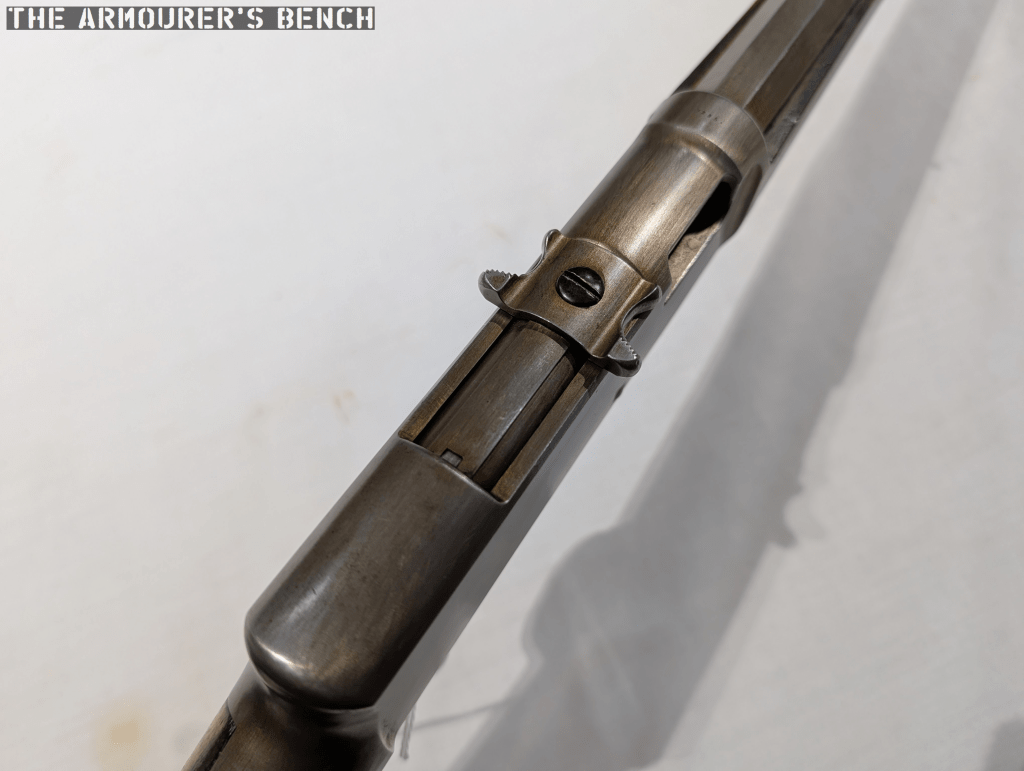
Perhaps the most intriguing external feature is the charging handle. Is it the first rifle with a T-shaped charging handle? Here’s how Mason’s patent describes it:
“breech-block handle arranged transversely with respect to the top of the gun-frame and in length exceeding the width thereof. The ends of this handle are formed with finger-cuts, flanked at their forward ends by ears and at their rear ends by knurled, or roughened fingers, extending outwardly beyond the planes of the side walls of the frame, so as to be readily engaged by the finger and thumb, respectively. The said handle is also formed with a centrally-arranged screw-hole, receiving a screw, entering a screw-hole in the forward end of a longitudinally-reciprocating non-rotatable balanced breech-block.”
View of the prototype’s receiver (Matthew Moss)
All-in-all it’s a really interesting patent and well worth a read to understand some of the nuances I don’t have time to cover here.
Despite the prototype’s interesting design it never made it into production. In 1903, Winchester had introduced the Model 1903, a tube magazine-fed, blowback rifle, chambered in .22 Winchester Automatic. The Model 1903 was designed by another of Winchester’s engineers, T.C. Johnson, and instead of a T-shaped charger used a plunger, which I think is a little less elegant but the Model 1903 was a success, remaining in production for decades, so it seems that Mason’s design wasn’t needed. As a result it would be another 60 years before a rifle using a T-shaped charging handle became popular in the US. Mason continued to work for Winchester until his death in July 1913, aged 76.
Massive thanks to my good friends at the Cody Firearms Museum for allowing me to examine this rifle and thank you to my friend Tyler Berger for his help filming this video. Please do check out the museum online atcenterofthewest.org/our-museums/firearms/ and if you can head out there this summer to visit one of the best publicly displayed collections of firearms in the world.
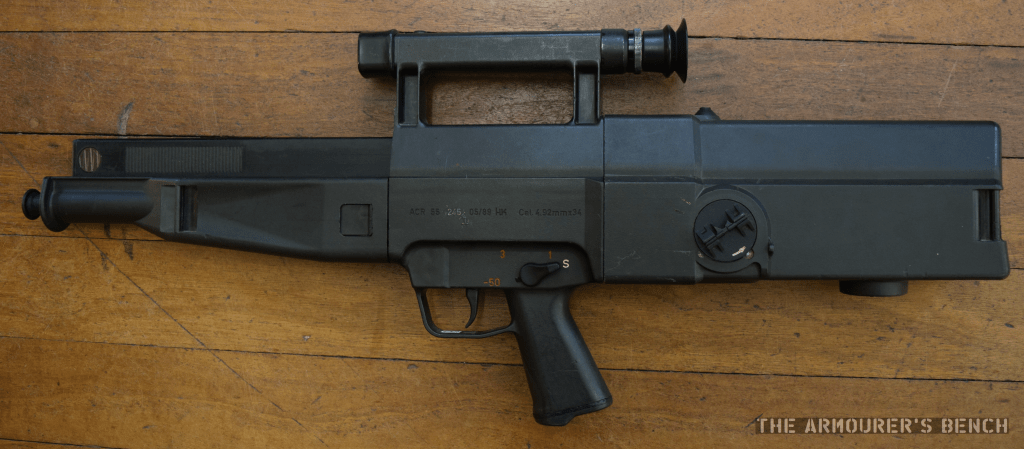
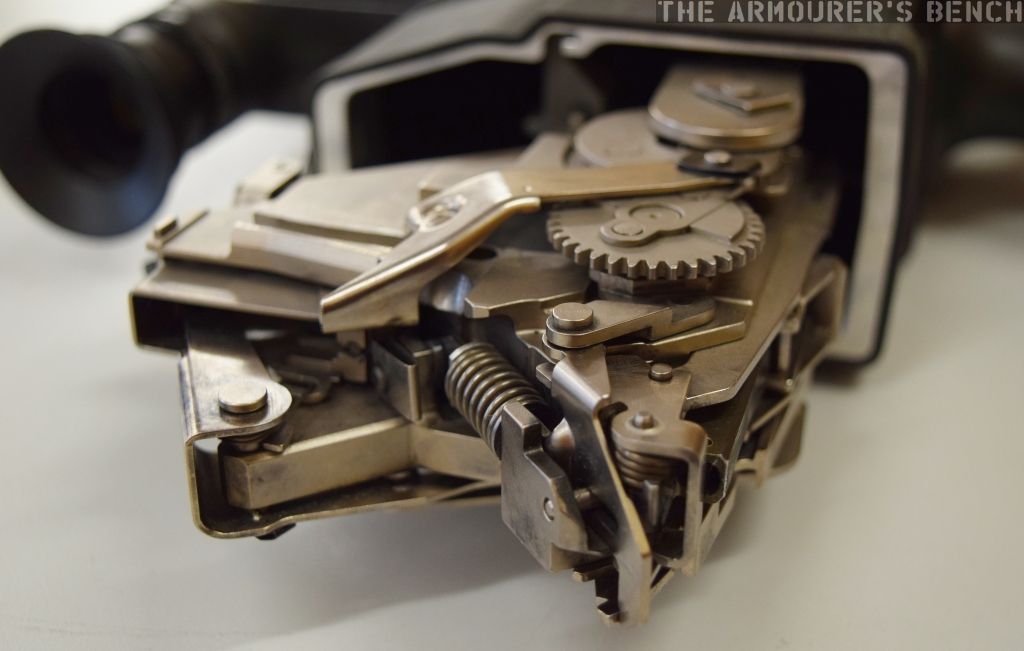
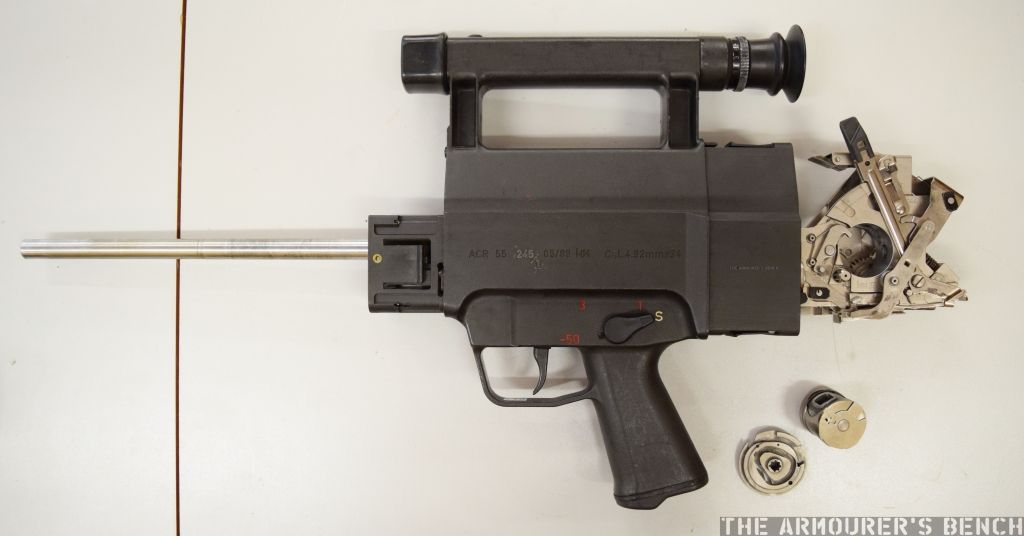
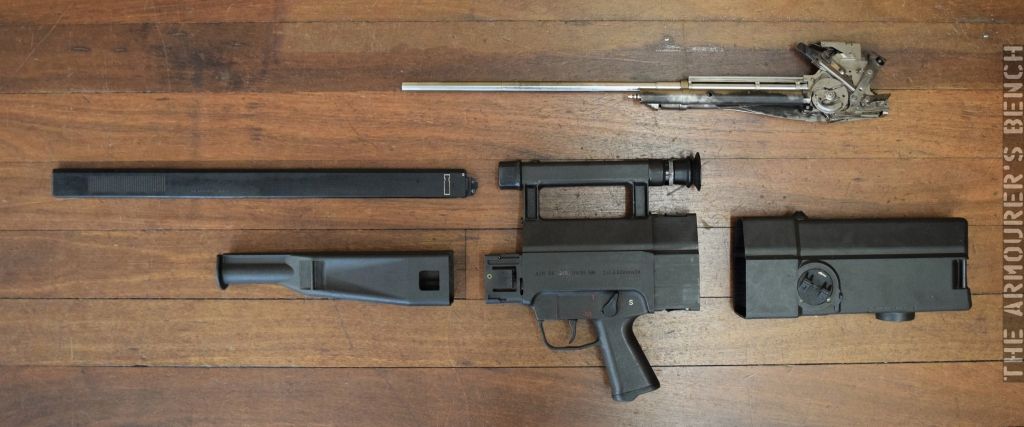
In this special video I had the privilege of field stripping a Heckler & Koch G11. We strip the rifle down into its major assemblies and then explain how the ‘space magic’ works!
I explain how the recoil management system, which compensated for the recoil of firing a 3-round burst at ~2,000rpm, worked and how rifle’s ingenious rotating breech operated. This video demonstrates just how complex and ambitious the HK G11 was!
For more information and more photographs of the G11 disassembled check out the original article – here.
This is a remaster of an earlier video with a new fun intro and the full 1990 Aberdeen Proving Ground video filmed by HK, it is the best available look at the G11 in action. I’ve been meaning to remaster this video and make some additions for a while. Hope you enjoy it.
The MkIV is the missing link between the most utilitarian Sten, the MkIII, and the final iteration – the wooden-stocked MkV. Very little is known about the MkIVs development and more archival research is needed.
The weapon was on display at the Morphy Auctions booth. While they couldn’t disclose which collection it was on consignment from, they noted it was believe to have been brought home by what they described as ‘a US Commando’. Not the clearest provenance but more might be explained in the auction catalogue when it publishes in a couple of months’ time.
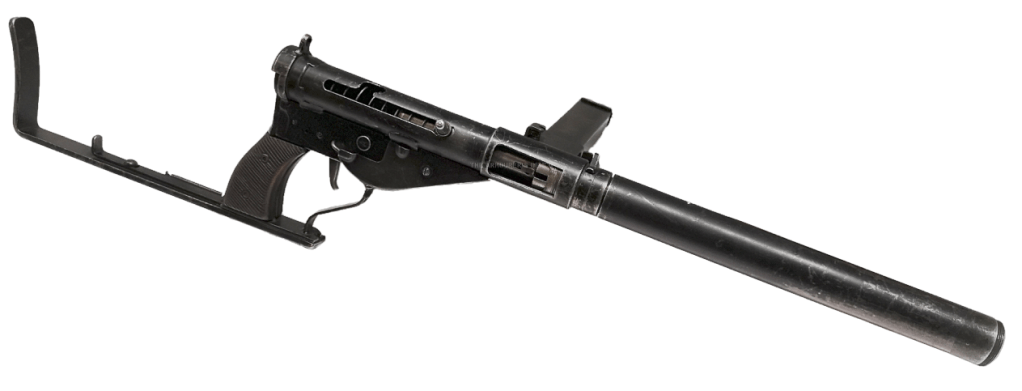
There are several variants of the MkIV – what have become known as the MkIVA and MkIVB. This weapon is one of three examples of suppressed MkIVAs, the others are in the Royal Armouries’ collection.
A suppressed Sten MkIVA with stock folded (Matthew Moss)
The Royal Armouries also has unsuppressed examples of the MkIVA and MkIVB. This is an unsuppressed MkIVA. I couldn’t find any decent resolution photographs of the MkIVB but as you can see it has its pistol grip and trigger assembly moved forward significantly.
The gun appears to have been using a Sten MkII receiver and its magazine housing is marked as such. Interestingly, it doesn’t have a MkII serial number, instead it is marked ‘3’. This is similar to one of the MkIV’s held by the Royal Armouries. On the underside of the magazine housing is a further serial number ‘R83297’. Morphy’s noted that they believed the gun, or the MkII receiver used to make it, was produced by BSA.
The trigger mechanism has been moved forward about 1 inch (2.5cm) and unlike any other Sten is enclosed by a large bow trigger guard, suitable for cold weather use with gloves. The unsuppressed MkIVA has a 3.5 inch barrel tipped with a conical flash hider, however, this example is suppressed with what Peter Laidler, in his Sten book, mentions is an MG-D 3748 silencer designed by the Armament Design Department.
One of the most interesting differences is the shorter cocking handle slot in the receiver and the different design of cocking handle. The receiver has been shortened as has the Mk4’s barrel – which has six small ports drilled into it. This gun’s cocking handle is reportedly designed to be rotated 90 degrees to lock the bolt in the forward position. This is a departure from the earlier locking method of pushing the cocking handle down to lock into a hole in the other side of the receiver.
A suppressed Sten MkIVA with stock unfolded (Matthew Moss)
The other most distinguishable feature is the folding stock. This design is shared by the A and B variants and is made of a tick steel bar which pivots. The pivot point is in line with the front of the pistol grip. To deploy or fold the stock a small spring-loaded catch is pull towards the butt, this allows the stock to be pivoted through 180-degrees to the left. While the catch locks positively, if the small coil spring which provides tension was damaged the stock would unlock making it difficult to use. The coil spring is also exposed which could allow it to snag on things or become clogged with mud.
But who was the MkIV designed for? According to FWA Hobart’s book on submachine guns the MkIV was developed for airborne troops – a prior to this paratroops had dropped with the stock removed from their Stens. Hobart suggests that the MkIV guns were abandoned because they didn’t fare well in trials due to a high, uncontrollable rate of fire. Whatever the reason they never entered service and only a handful of prototypes were made.
Thank you to Morphy Auctions for letting me take a look at the MkIV – its set to be on sale at their upcoming Firearms Auction in April.
One thing I’m looking forward to doing this year is doing some archival work, digging into the surviving records regarding the Sten and hopefully uncovering more on the MkIV.
Close up of the right side of the Sten’s receiver (Morphy’s Auctions)
Update – 01/03/23:Morphy’s auction listing for the weapon has been published and offers some detail on the Sten’s origins and some excellent photographs. Below is an extract detailing the Sten’s provenance:
“This particular specimen was issued to an American officer who was training in England and was intended to be landed in Japan as part of pre-invasion operations in 1945. According to the officer at the time of the gun’s purchase, when the invasion was called off the authorities never asked for the gun’s return. The officer brought the gun back to the United States and subsequently registered it with the BATF.”
Ian over at Forgotten Weapons has also had a chance to look over the weapon and shoot it. Well worth checking those videos out.
Bibliography:
Special thanks to my friend Hrachya Hayrapetyan for helping with the ad-hoc filming of this video!
Entries in the Royal Armouries collection catalogue: 1 2 3 4
Pictorial History of the Submachine Gun, F.W.A. Hobart, (1971)
Support Us: If you enjoyed this video and article please consider supporting our work here. We have some great perks available for Patreon Supporters – including early access to custom stickers and early access to videos! Thank you for your support!
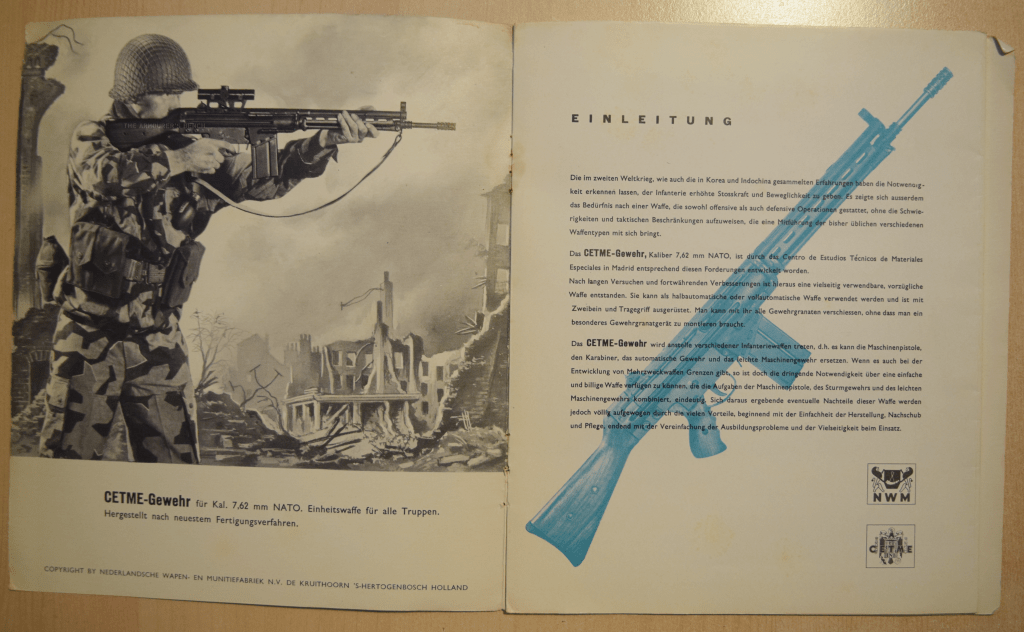
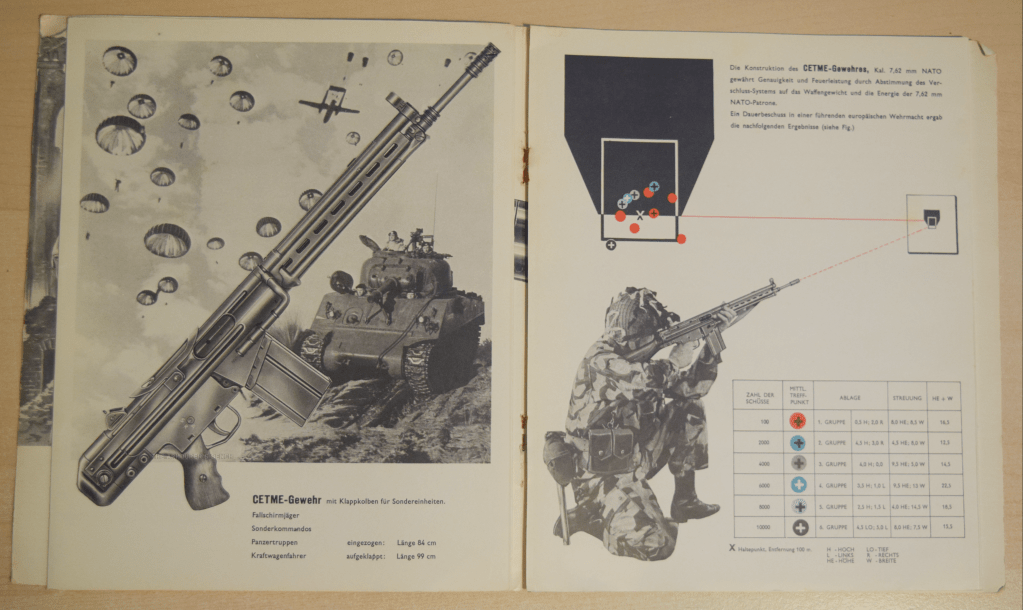
In this video/article we’ll examine an original 1950s brochure for the CETME ‘Rifle 58’, which was manufactured under license by Nederlandse Wapen en Munitiefabrik (NWM) in the Netherlands. The rifle would later become more widely known as the G3 when a version of the weapon was adopted by the Bundeswher.
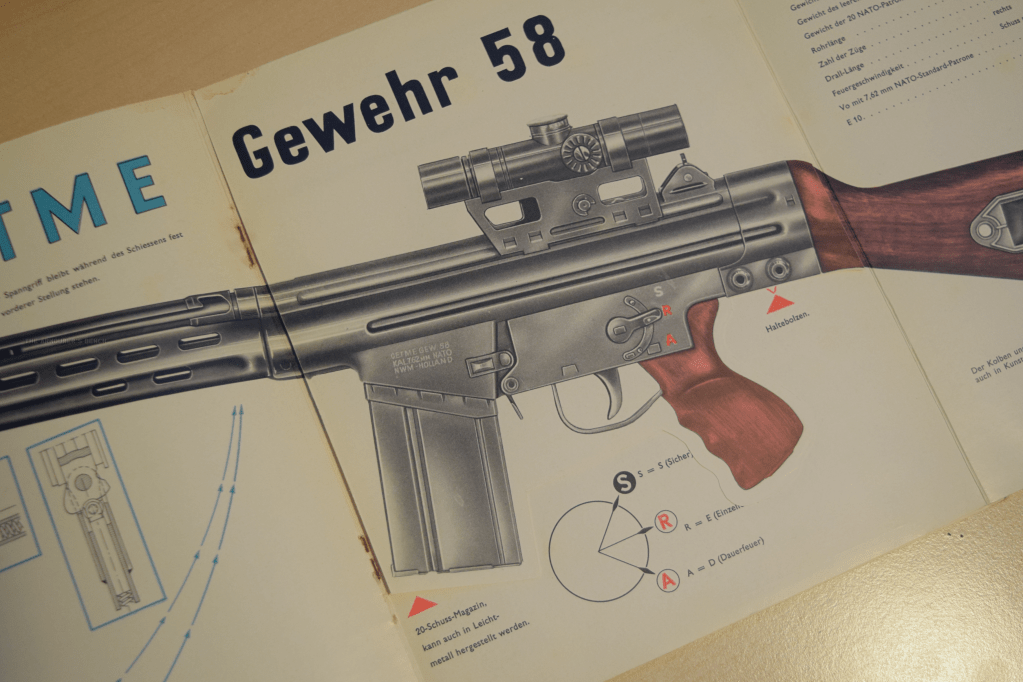
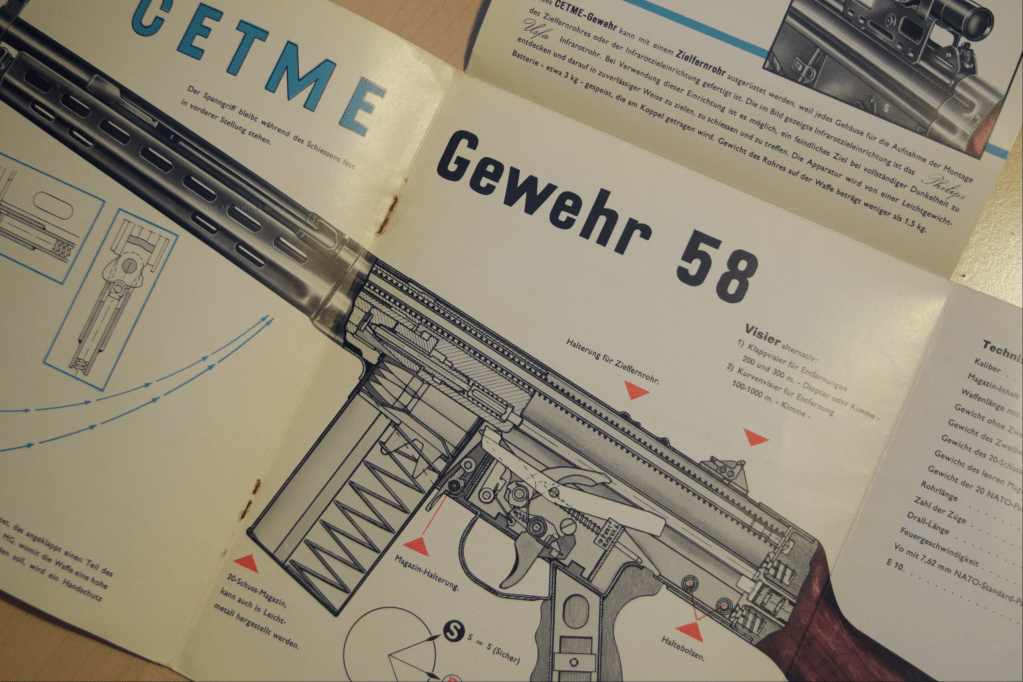
Printed in 1957, the brochure is in German and refers to the ‘Gewehr 58’, it is a quality publication and a considerable outlay appears to have been made with good photographs, excellent graphic design and a very clever ‘fold out’ central section which highlights the features of the rifle.
The brochure details the rifles operation, attributes and some of its accessories including optics, bipods, rifle grenades and what appears to be an intriguing suppressor. The brochure represents an interesting period in the G3’s history as it began to enter service in Spain and in West Germany. (though in slightly different chamberings).
Once adopted the rifle would later be produced in West Germany by Rheinmetall (see example below) and Heckler & Koch. Heckler & Koch would eventually acquire the sole rights to production and the G3 would become synonymous with the company.
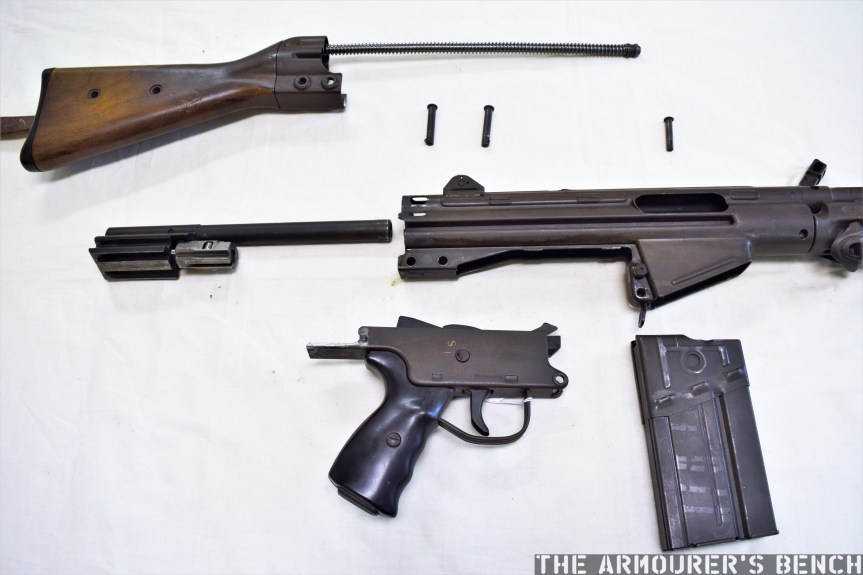
Rhinemetall-produced G3 field stripped (Matthew Moss)
If you enjoyed this video and article please consider supporting our work here. We have some great perks available for Patreon Supporters – including custom stickers and early access to videos! Thank you for your support!
In this video/article we’ll examine Ukraine’s other bullpup – the Fort-221 – the Ukrainian Tavor.
In a recent video/article we looked at the Ukrainian designed and produced IPI Vulcan, a bullpup based on the AK platform, and the two have been confused in some media. The Fort-22 series Tavors originate from Israel’s IWI. Introduced in the early 2000s the IWI Tavor has been purchased and seen service with militaries around the world. Ukraine’s Tavors were offered by RPC Fort or State Research and Production Association “Fort” of the Ukrainian Ministry of Internal Affairs. The company was originally established in 1991, initially as a regional organisation and in 1998 it became a state enterprise. Located in Vinnytsia, in western Ukraine, the company initially focused on a line of pistols, pump-action shotguns and AKM variants.
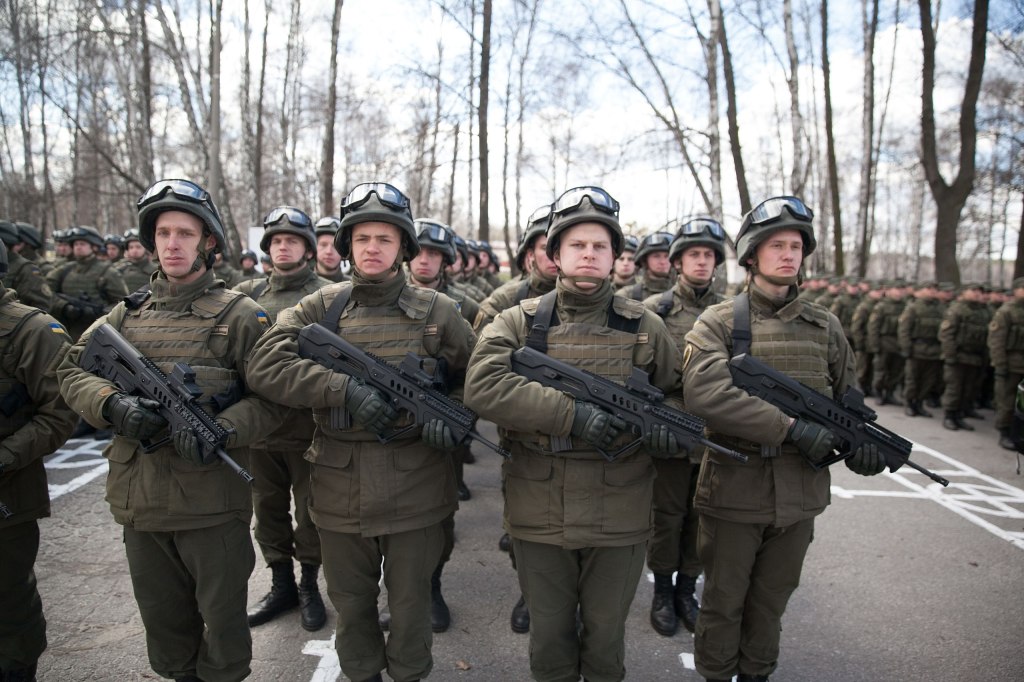
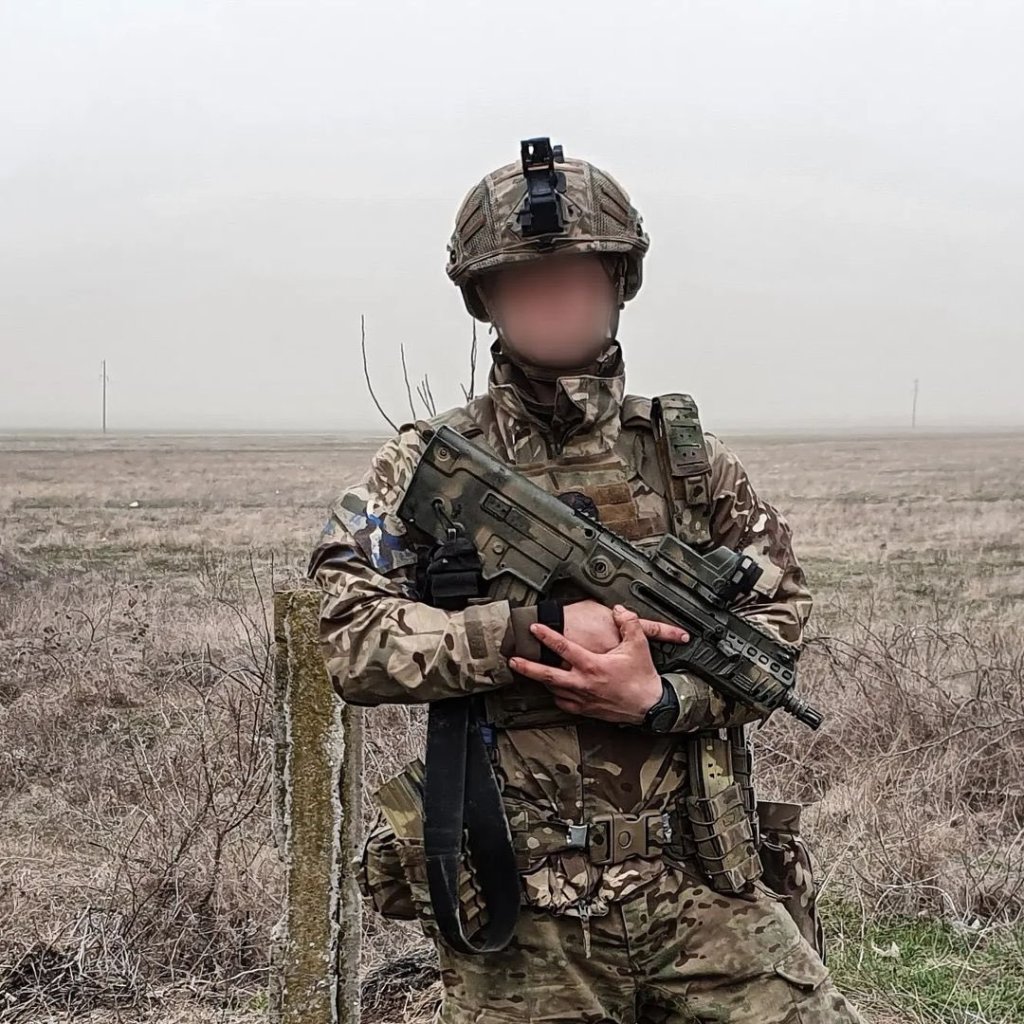
National Guard personnel armed with Fort-221 with M5 optics (Ukrainian National Guard)
From a survey of Fort’s website we know that IWI weapons first began to appear in the company’s product lists in late 2008 following an agreement to potentially license manufacture IWI products in Ukraine. This included pistols, submachine guns, rifles and the Negev light machine gun.
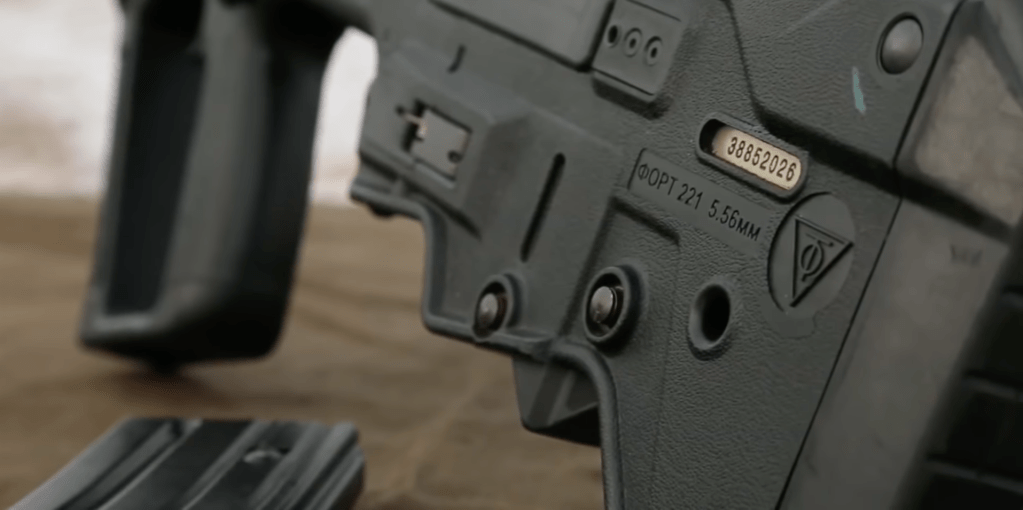
In 2011-12 media reports suggested the Tavor was being produced in Ukraine and the guns appeared at a number of trade shows with RPC-Fort markings, including a company crest in the moulded stock. There is, however, some doubt about whether the weapons were manufactured in Ukraine, merely assembled or if they were produced in Israel with some Fort markings and shipped to Ukraine. The nature of the partnership is undisclosed but it has been suggested that if Fort gained substantial sales for the weapons then further manufacturer may have been transferred to Ukraine.
Close up of the RPC Fort on a 5.56×45mm Fort-221 (Ukrainian National Guard)
In 2014, Colonel Vitaly Otamaniuk, the head of the artillery and missile management board of the Ukrainian Armed Forces, announced that the Fort-221 and Fort-223/224 carbines were adopted for arming the Ukrainian army, with an initial 500 ordered. While no further orders were publicly recorded we know that Police and internal security forces were issued the rifle as of 2016. The adoption of the rifles by Ministry of Internal Affairs units and the Ukrainian National Guard (which falls under the Ministry’s control) may be explained by the fact the Ministry owns RPC Fort.
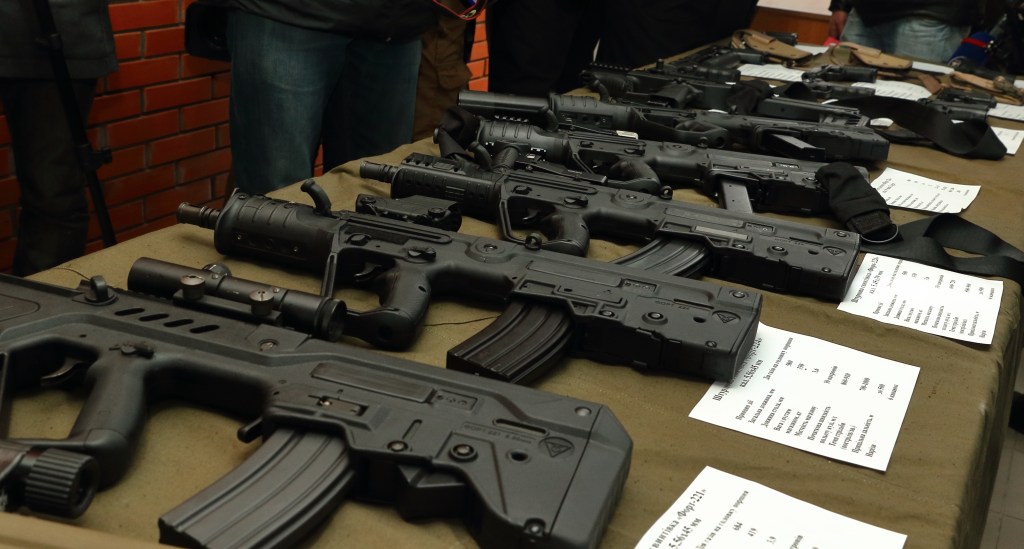
Various Fort-22 series rifles on display (Ukrainian National Guard)
From photographs released before the February invasion we know that National Guard units including the Special Purpose units like the “Scorpion” Special Forces Detachment (Nuclear industry protection) and elements of the Special Operations Forces or SSO. These units are believed to include the 1st and 3rd Special Purpose Detachments based in Kyiv and the 8th Special Purpose Regiment in Khmelnytskyi as well as elements of the Ukrainian Ministry of Internal Affairs.
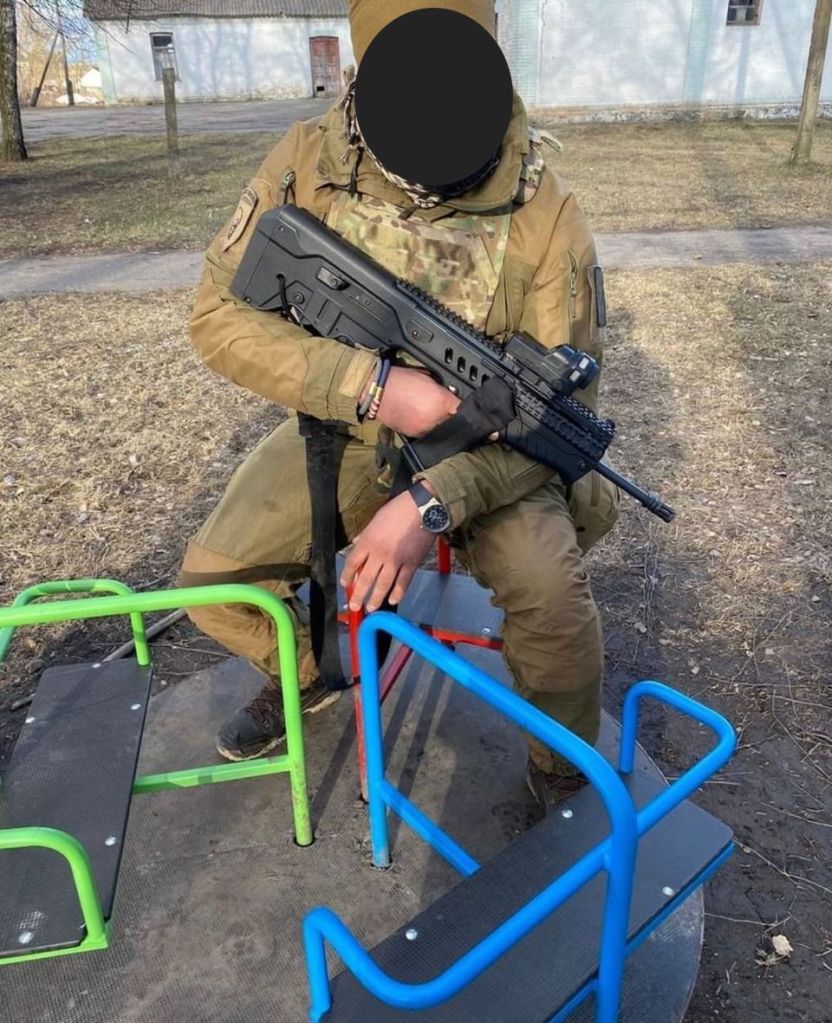
Member of the Ukrainian armed forces with a Fort-224 carbine (via social media)
There is some confusion around the Fort-22 series’ designations. From Fort’s website, circa 2020, we can see here that the majority of the IWI rifle range was on offer. There is some confusion around the designations with Fort-222 and Fort-223 not being listed here but there are photographs of Fort-223 marked 5.56 X-95 pattern guns seen trade shows, which suggests that for a time at least the 223 designation was used. But as we’ve seen from Fort’s 2010 website Fort-223s were not listed. The Tavors are listed as follows:
Fort-221 in 5.56x45mm and 5.45x39mm (TAR-21) – 468mm / 18.4in
Fort-224 in 5.56×45 and 5.45x39mm (X-95) – 330mm / 13in
Fort-224 in 9×19 (X-95 SMG) – 330mm / 13in
We can also see that the Uzi Pro is listed as the Fort-226 while the 5.56x45mm Galil Ace is listed as the Fort-227, the 7.62x39mm chambered version is the Fort-228 and the 7.62x51mm version is the Fort-229. The Ukrainians designed the Galatz accurised Galil the Fort-301 and the Negev light machine gun the Fort-401 both of which have been fleetingly seen in the field.
Further survey of Fort’s website shows that the Tavor series of rifles ceased to be listed on the page in March 2021 and IWI and Meprolight were removed from the site’s ‘Partners’ section in April 2021. Perhaps suggesting the end of the IWI-Fort partnership. The Tavor-pattern rifles are not listed by SpetsTechnoExport, Ukraine’s state export enterprise, but the IPI Vulcan is.
Member of the Ukrainian armed forces with a Fort-221 rifle (via social media)
Despite this we have seen a considerable number of the Ukrainian Tavor variants in the field. Since the Russian invasion in February the Fort-22 series have been most frequently seen with internal security forces and Ukrainian Army and National Guard special forces.
Within 48 hours of the Russian offensive Russian forces shared videos from what was said to be a captured Ukrainian National Guard depot. The video shows more than a dozen Fort-221s piled on top of crates. Around the same time they were seen to be equipping Ukrainian forces said to be linked to the Azov Brigade.
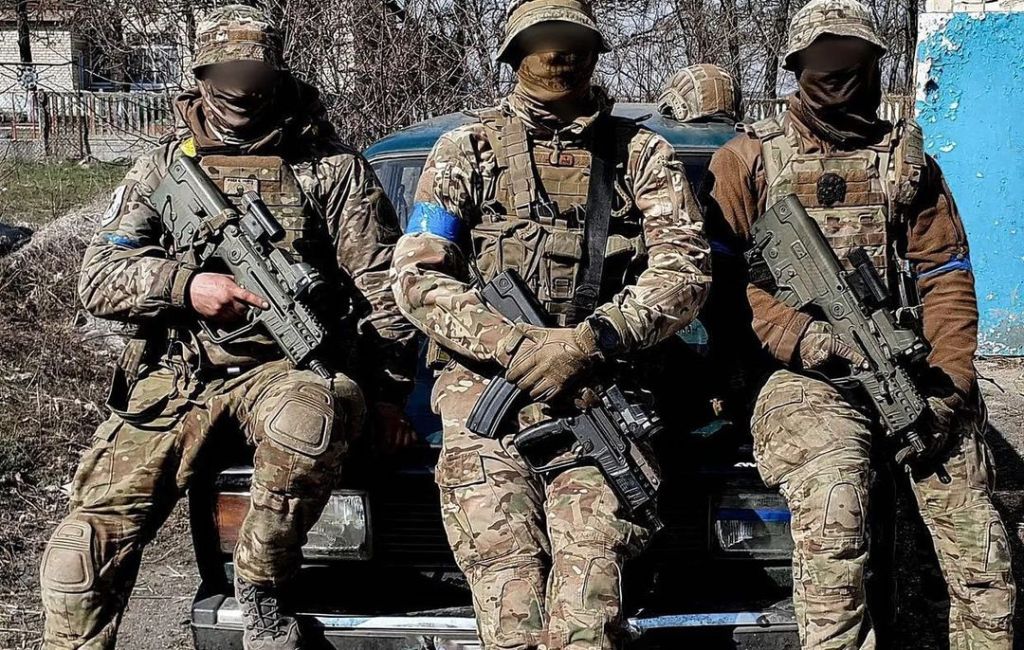
Members of the Ukrainian armed forces with a Fort-224 carbines (via social media)
On 7 March former Ukrainian presidents Petro Porochenko and Oleksandr Turchynov were seen. Rallying Territorial Defence Force units in Kyiv, Turchynov was seen armed with a Fort-221.
On 9 March an unknown number were captured by Russian forces which seized the National Guard armoury near the Zaporizhzhia Nuclear Plant. At least one Fort-221 was shown by Russian state media.
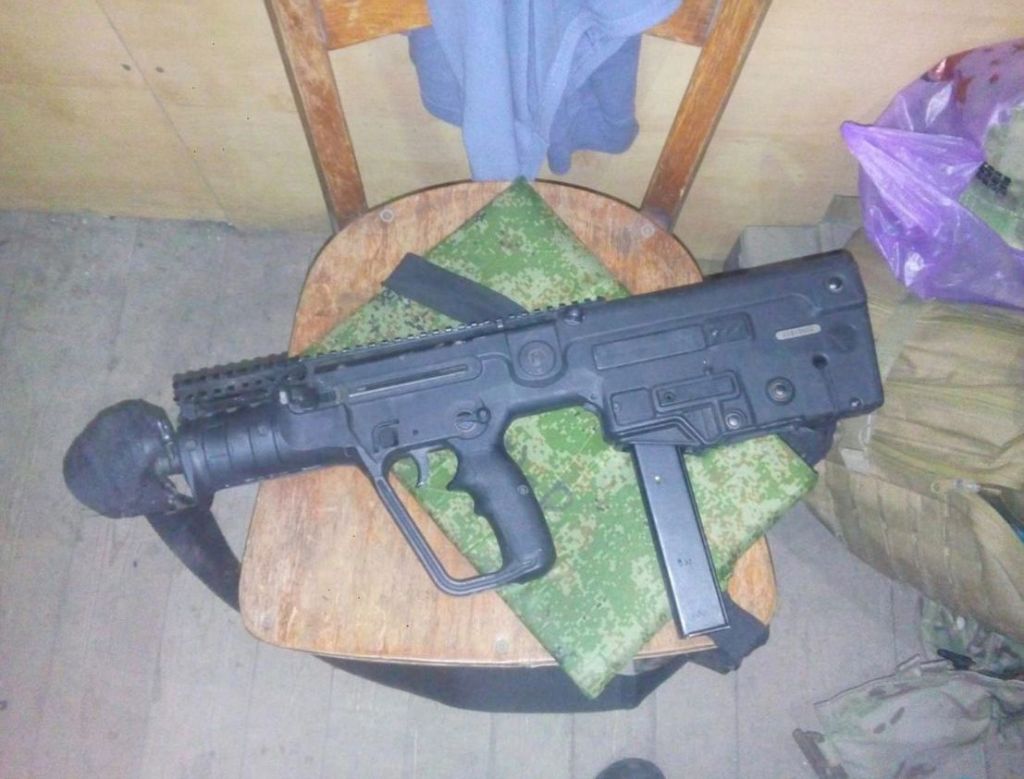
A Fort-224 in 9×19mm (via social media)
The Ukrainian Tavors continue to surface in imagery from the conflict but it is difficult to tell where they’re being used and by which units.
Both the Fort-221 rifle and the 224 carbine have been seen in the field, though it is often difficult to determine their chambering as the clearest indiction – the shape of the magazine – is invariably tucked under the user’s arm. They are most often seen equipped with Meprolight M5 and M21 sights and a number of the weapons have also been seen to be sporting camouflage paint jobs.
Thank you to those who have helped me collect images of the Ukrainian Tavors in the field, including Sad_Sand and DixieMauser and thank you also to Remigiusz Wilk.
Update – 21/6/24:
My colleague Ian over at Forgotten Weapons has shared a video which gives us a great close up of a Ukrainian Fort 221.
If you enjoyed this video and article please consider supporting our work here. We have some great perks available for Patreon Supporters – including custom stickers and early access to videos! Thank you for your support!
From the late 1960s into the 1990s, Northern Ireland suffered a long period of sectarian violence, commonly known as The Troubles. Without going into too much detail about the conflict, other sources do a much better job than I can today, the violence saw Irish Republican paramilitary groups, Ulster Loyalist paramilitary groups and British security forces involved in a protracted low-level conflict with a Republican insurgency fighting not just British forces but Loyalist paramilitaries like the Ulster Volunteer Force (UVF), the Ulster Protestant Volunteers (UPV) and the Ulster Defence Association (UDA). This article/video has no intention to comment on the conflict itself, merely examine a weapon produced during the period.
This copy or clone of a Sterling Mk4 / L2A3 submachine gun is believed to have been assembled by Loyalist paramilitaries although which group and its origins are unclear. Loyalist groups during the 60s and 70s tended to be less well armed and relied more heavily on improvised small arms and weapons stolen from military and police armouries and personnel than Republican groups. When tensions rose in the late 1960s, the Loyalists were largely equipped with obsolete and outdated weapons.
Right side view of the Sterling clone (Matthew Moss)
Sammy Duddy, a member of an early Loyalist group, the Westland Defence Association, and later a press officer for the Ulster Defence Association, recalled the dire state of their arsenal at that time:
“[…] we had no guns. The IRA had automatics [machine-guns], high-velocity sniper rifles, powerful pistols, the lot, but we had fuck all. There were virtually no guns on the Loyalist side. The only weapons we had were baseball bats and I just thought to myself, ‘what the fuck are we going to do when they [the IRA] come in with their machine-guns? Throw bats at them?’”
The Ulster Volunteer Force (or UVF) took to stealing what weapons and spare parts they could from the British military and Royal Ulster Constabulary. Weapons assembled from damaged captured Sterlings and Sterling spare parts kits became common. In this case, this weapon has a number of cannibalised original Sterling parts which have been paired with a craft-made receiver tube. From examination we can see that the weapon’s end cap has a Sterling part number stamp ‘CR110’ inside. Similarly the weapon has a factory-made plastic grip. Other factory made parts include the helically grooved bolt, the two recoil springs and the charging handle. There is also seemingly a factory-made trigger group and magazine release button. The magazine is well sized and utilises various parts from a Sterling’s magazine release including the button, an set screw and catch piece.
The weapon uses a Sterling’s factory-made pistol grip and trigger mechanism – a remarkably sophisticated craft-made weapon (Matthew Moss)
The trigger assembly housing is welded and ground smooth where it joins with the tube receiver. On factory-made guns there is a visible seam. The poorer quality tube steel of the receiver also appears to have drooped or bent a little around the middle of the weapon. The holes in the barrel shroud are of uniform size but they are roughly drilled and not equally spaced. At the front of the receiver we can see they have retained the barrel with a pair of large bolts, suggesting that the barrel may have been factory made too. There is now end cap catch at the rear nor provision for a folding stock either. While whoever made the receiver tube went to the trouble of added hand stops found on the actual Sterling they are clearly only lightly welded on.
Close up of the weapon’s magazine housing, with salvaged Sterling magazine release button (Matthew Moss)
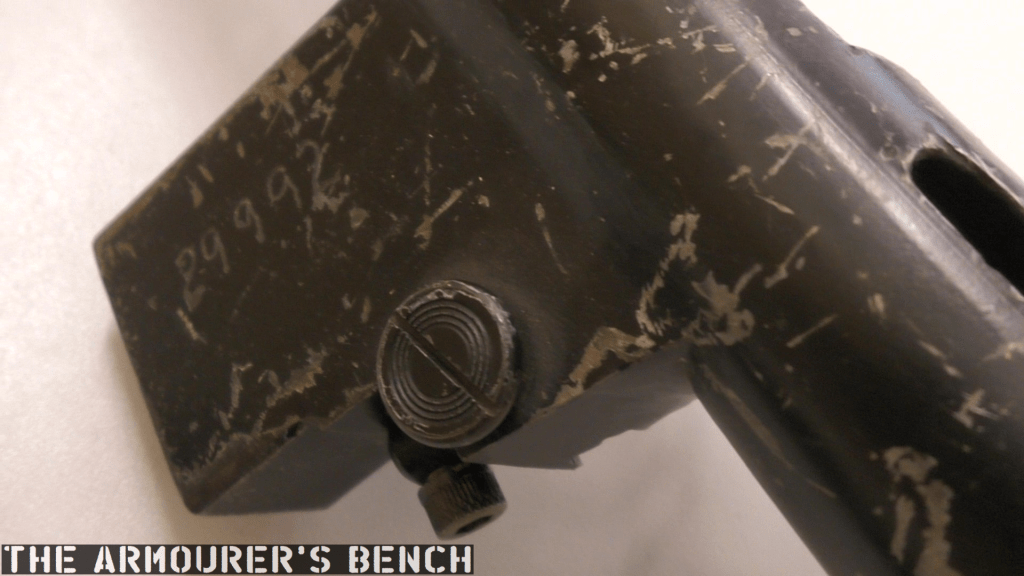
Another difference is the absence of a bayonet lug on the left side of the barrel shroud, and a much cruder fixed sight sat within a U-shaped piece of metal welded to the tube receiver – to act as a front sight protector. The factory-made Sterling’s front sight is adjustable and the sight protectors are folded forward and aligned across the tube receiver. The rear sight and its protectors appears to have sheared off at some point. The only marking on the weapon, ‘29992’, is crudely electro pencilled on the top of the magazine housing, where you’d normally see markings saying ‘Sterling Mk4’ or ‘L2A3’. When that crude serial number was added is unclear. The black paint on the receiver is wearing thin and we can clearly see some file marks in places.
Hundreds of craft-made submachine guns were built to feed from Sterling and Sten magazines and there are numerous surviving examples of guns made from box tubing – often parts were clandestinely made in Northern Ireland’s factories and at shipyards like Harland & Wolf in Belfast – giving rise to the name ‘shipyard special’. Other nicknames included ‘rattlers’ and table leg guns.
Left side view of the Sterling clone (Matthew Moss)
The origins and story behind this particular weapon remain unknown, it is today part of a UK Ministry of Defence collection and said to have been found in Northern Ireland during the Troubles. Regardless it’s a very interesting piece of clandestine engineering which shows considerable skill in its assembly. Which is unsurprising as there are numerous accounts of skilled machinists working on illegal firearms parts during the period.
If you enjoyed this video and article please consider supporting our work here. We have some great perks available for Patreon Supporters. You can also support us via one-time donations here.Thank you for your support!
Bibliography:
The Northern Irish troubles | This Week | 1972, Thames TV, (source)
Terminal Effects: The Guns of the Loyalist Paramilitaries, Balaclava Street, (source)
Improvised Weapons of the Irish Underground (Ulster), D. Shea, Small Arms Review, (source)
Beyond State Control: Improvised and Craft-produced Small Arms and Light Weapons, G. Hays and N.R. Jenzen-Jones, Small Arms Survey, (source)
In this video we’re taking a look at something very rare, a pre-1911 catalogue produced by Colt. But it isn’t a catalogue to order guns from. Instead, it’s a catalogue to order gun advertisements from! Old firearms ad from this period are fascinating and give us an insight into who markets company’s were aiming their products at.
The catalogue includes illustrations of pistols and entire print ads which could be printed locally. It covers most of the commercial Colt line ranging from Colt Model 1908 Vest Pocket pistols, to Colt Police Positive revolvers and Colt’s military automatic pistols.
New fangled Colt automatics (Matthew Moss)
The catalogue’s introduction explains Colt’s advertising strategy, saying:
“we advertise in the big national mediums to CREATE A DEMAND ON YOU for our arms; these advertisements are read by thousands of perspective customers IN YOUR LOCALITY, therefore YOU can obtain the benefit of SALE by local advertising.” It’s a sound enough strategy.
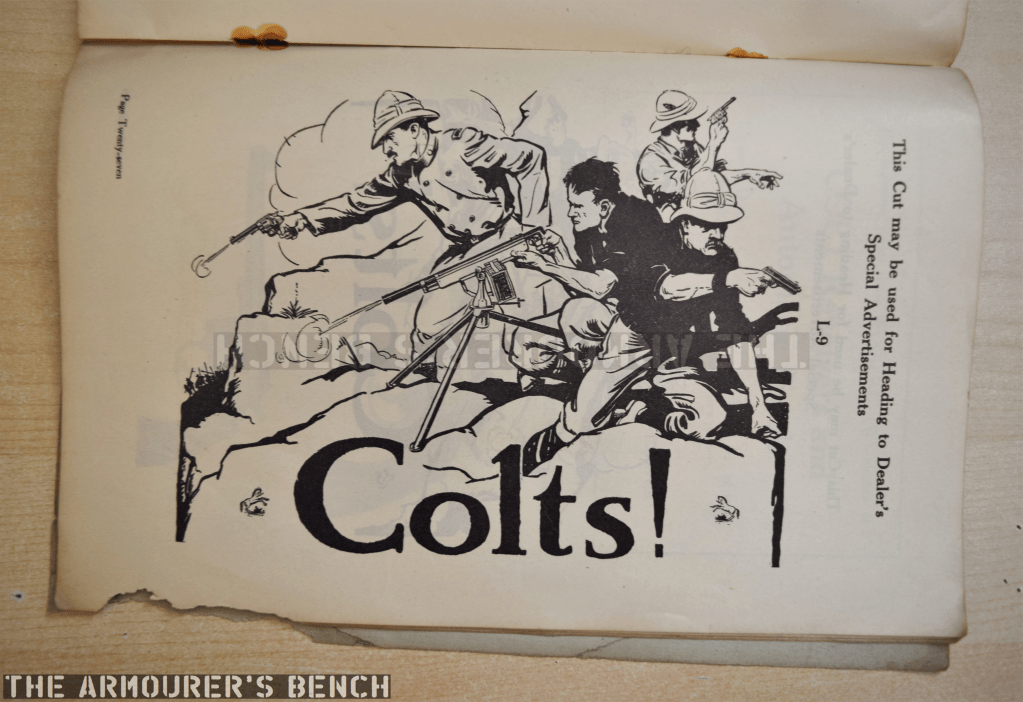
Only one ad includes a Colt product that isn’t a pistol. The ad above features an illustration which includes John Browning’s first machine gun, the Colt-produced Model 1895. It’s an evocative advert including revolvers, a semi-automatic pistol and the 1895.
Colt Model 1907 Military pistols, the predecessor of the 1911 (Matthew Moss)
One of my favourite parts of the catalogue covers Colt’s burgeoning automatic pistol line. This section actually helps us date the catalogue as there are no 1911s. It includes the Colt 1907 Military, the Colt 1902 Military, the Colt 1903 Pocket Hammer and the Colt 1903/1908 Pocket Hammerless automatic pistols.
Some of the illustrations of Colt’s revolvers available for printing (Matthew Moss)
The catalogue includes printable illustrations of the Colt ‘New Service’, the Colt ‘Army Special’, the Officers Model Target, the Police Positive Special, Police Positive and Police Positive Target. As well as some classics, with a full page of Colt Single Action Army revolvers.
Some cutaway diagrams of the Colt Pocket Hammerless (Matthew Moss)
The Colt advertisement catalogue is now part of our reference collection and we were able to bring this video/article thanks to the support of our Patrons. We have many more videos on important and interesting primary source materials in the works. If you enjoy our work please consider supporting us via Patreon for just a $1. Find out more here.
Check out videos on items from our reference collection here.
A couple of weeks ago we looked at some photographs showing an interesting modification seen on a STEN MkII held by Deputy Prime Minister Clement Attlee. The STEN Attlee posed with had a front grip added, something the MkII didn’t typically come with.
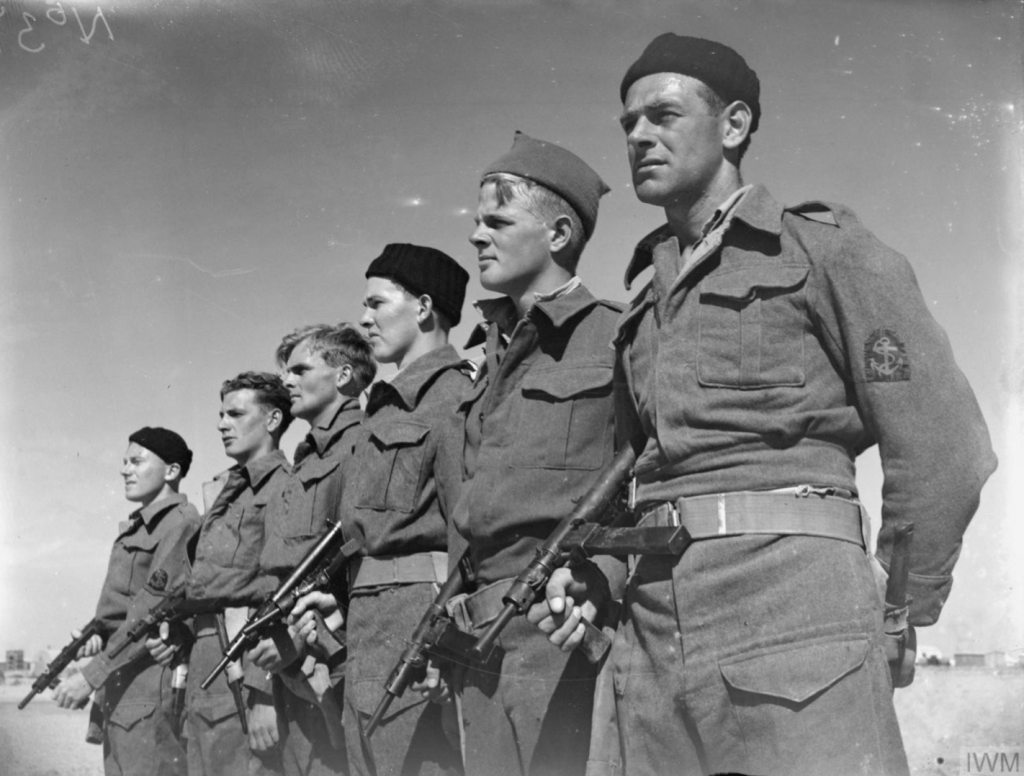
A few people very kindly sent me some other contemporary photos showing other ad hoc STEN front grips so I thought a follow up video was needed. I also found a group of photographs taken in June 1943 at the Combined Training Centre at Kabrit, in Egypt. The photos show groups of Commandos and the Royal Navy’s Naval Beach Parties armed with Stens with a pretty standardised style of front grip.
Commandos on parade with STEN MkIIs equipped with ad-hoc front grip, at Kabrit in June 1943 (IWM A17755)
In these photos we can see the men training with the STENs and the front grips are quite clear. It’s especially interesting in that it isn’t just the Commandos who have the front grips but also men of the Naval Shore Parties. It’s also relatively rare to see STENs in North Africa. You might have seen some of these photos, taken by Royal Navy photographer Lieutenant L.C. Priest, in our video looking at the unusual fighting knives the Commandos are equipped with.
The plethora of photos from Kabrit show a fairly standardised design for the grip. A metal ring, seemingly tightened by a wingnut on the left side and a generous wooden grip that was long enough to fit all four fingers on. The grip appears to have some finger grooves and a fairly standard shape. A photo (see above) of Naval Commandos on parade shows the men with the STENs tucked under their arms, holding the front grips. This is identical to how the STEN MkI with its front grip was paraded with. The photo also gives us a good look at the uniformity of the grips.
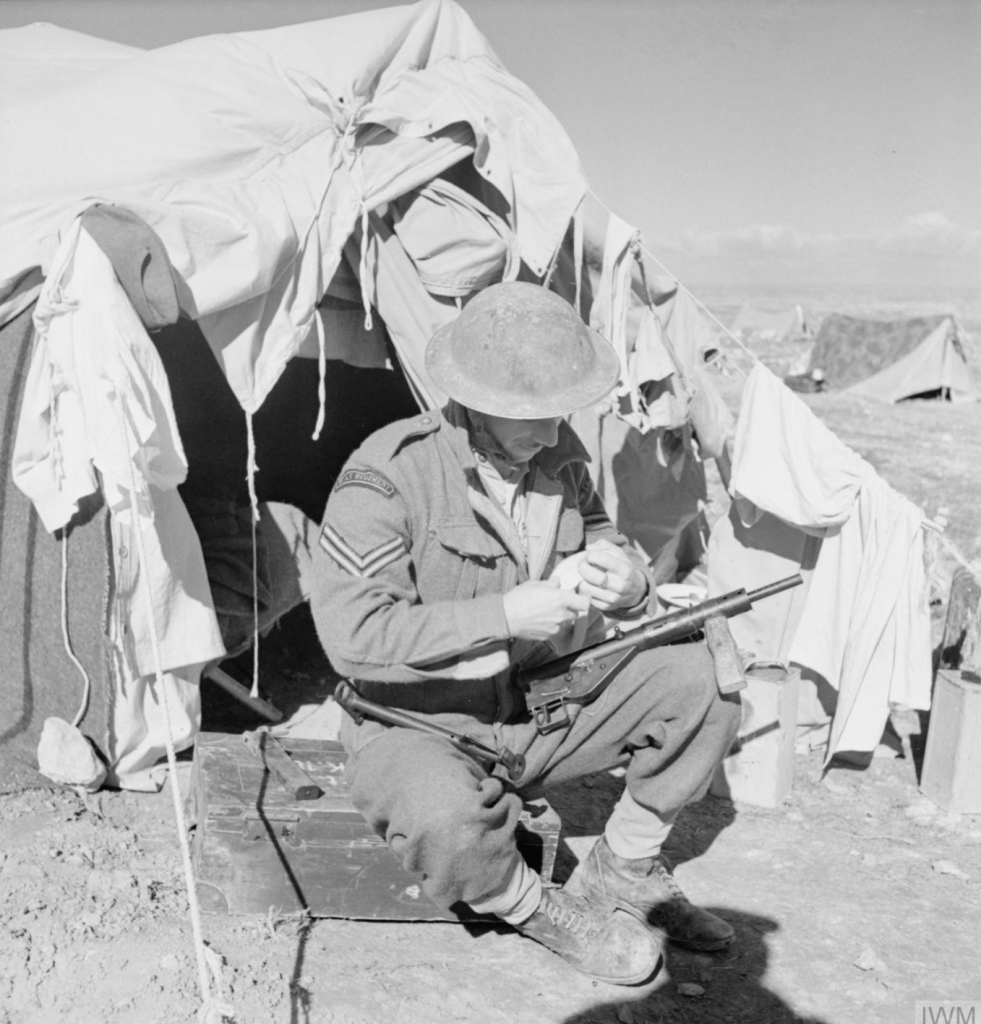
RAF Regiment Corporal cleans his STEN MkII, equipped with a makeshift front grip (IWM CM4296)
While the photos from the Combined Training Centre at Kabrit represent the largest number STEN front grips seen in one place and several units there are a few other photos which are really interesting. First up is this photograph of a Corporal from the RAF Regiment taken in Libya sometime in 1943. The Regiment had been formed just a year earlier. The corporal is sat cleaning his STEN MkII with the butt removed but the bolt still in the weapon. On the barrel nut of his weapon he has a wooden front grip. Again seemingly attached to a metal band around the barrel nut. The wooden grip appears to have some rudimentary finger grooves. Sadly, I couldn’t find any other photos of this Corporal and his STEN. But the design of his front grip is very similar to those seen in the Kabrit training photos and could well be of the same origin.
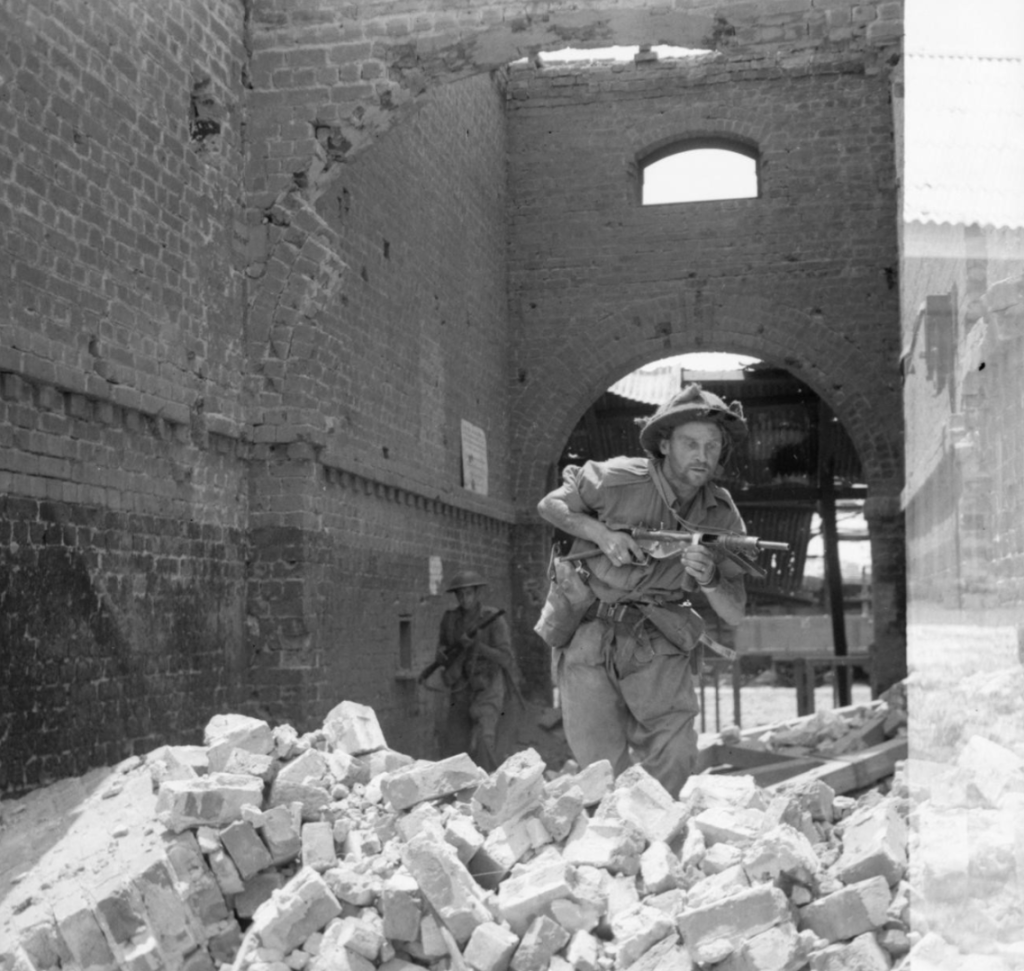
Finally, we have a photograph from a completely different theatre – Burma. The caption for this photograph reads: “Men of the 2nd York and Lancaster Regiment searching the ruins of a railway station for Japanese snipers, during the advance of 14th Army to Rangoon along the railway corridor, 13 April 1945.” This soldier’s STEN MkII has a grip just in front of the trigger mechanism cover and behind the magazine housing and ejection port. It’s actually in a position close to that of the original STEN MkI’s integral folding pistol grip.
Soldier of the 2nd York and Lancaster Regiment with a STEN MkII outfitted with a homemade front grip, Burma 1945 (IWM SE3804)
At the end of the day the adaptation is a good idea, a front grip provides a means of pulling the weapon into the shoulder and a more natural place to grasp other than the barrel nut, the trigger mechanism housing or the magazine – which was discouraged. It is interesting to note that I’ve yet to see any examples of a MkIII being fitted with a front grip like these.
This is certainly something I’m going to do more research into to see if there’s any documentary reference to the use of front grips like these. With the introduction of the MkV, with its front grip, it seems that the idea was sound enough. If you know of any other examples let me know in the comments!
If you enjoyed this video and article please consider supporting our work here. We have some great perks available for Patreon Supporters. You can also support us via one-time donations here.Thank you for your support!













 The Armourers Bench