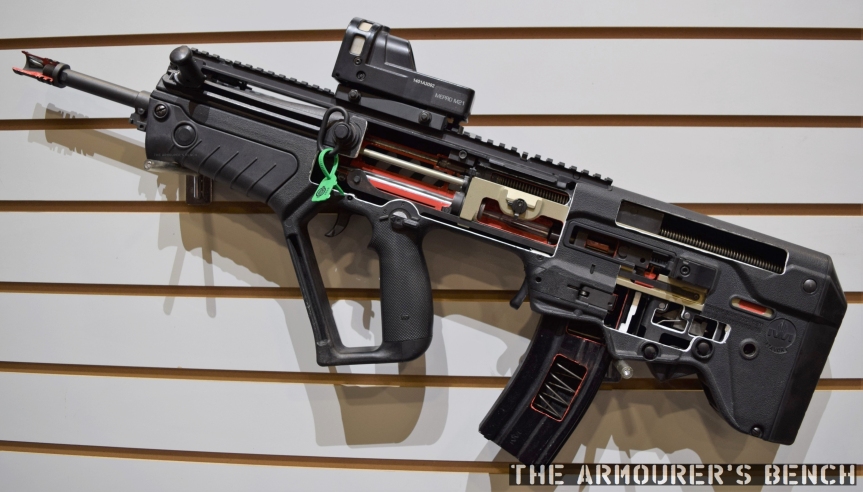
Last week Matt attended SHOT Show 2020 and spotted a pair of Tavor cutaway demonstration guns at the IWI booth. Above is a quick video, put together on the fly, looking at the cutaway guns and showing how they illustrate the Tavor’s working parts and operation.
Cutaway IWI Tavor (Matthew Moss)
Developed in the mid-1990s to meet IDF requirements for a reliable and compact rifle to replace the M16s & M4s in service. The rifle had to be shorter to deal with the close quarter urban fighting the IDF often found itself in.
The Tavor or TAR-21 uses a long strike gas piston system inspired by the AK and has a rotating bolt. The bullpup configuration gave the desired compact weapon without sacrificing barrel length.
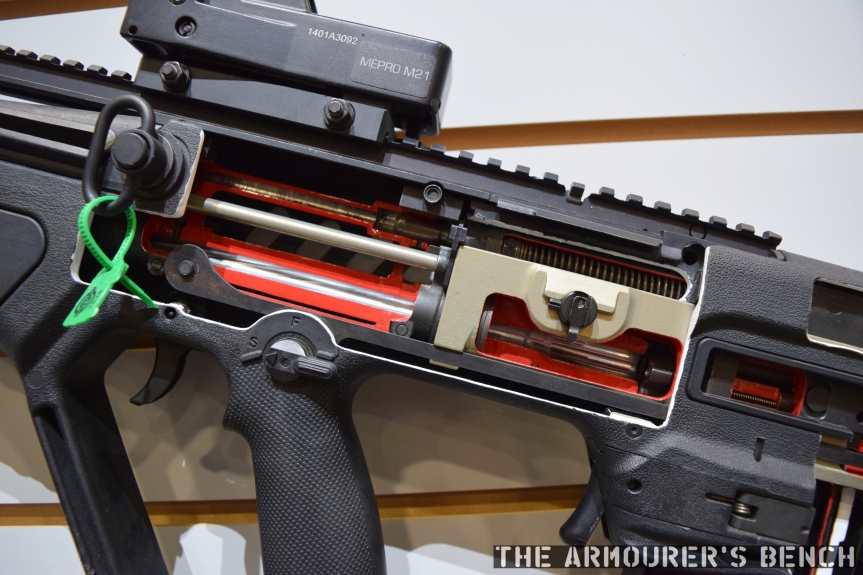
A closer look at the gas piston system, the barrel, chamber and the bolt face (Matthew Moss)
The cutaway rifles on display at the IWI booth were actually civilian, semi-auto only, Tavor SARs but they give us a good look at the rifle’s internals and how the Tavor functions. We can see the gas piston system, the charging rod and the barrel at the bottom. Moving back we can see the chamber, the bolt carrier group, the sear assembly and the bolt hold open mechanism.
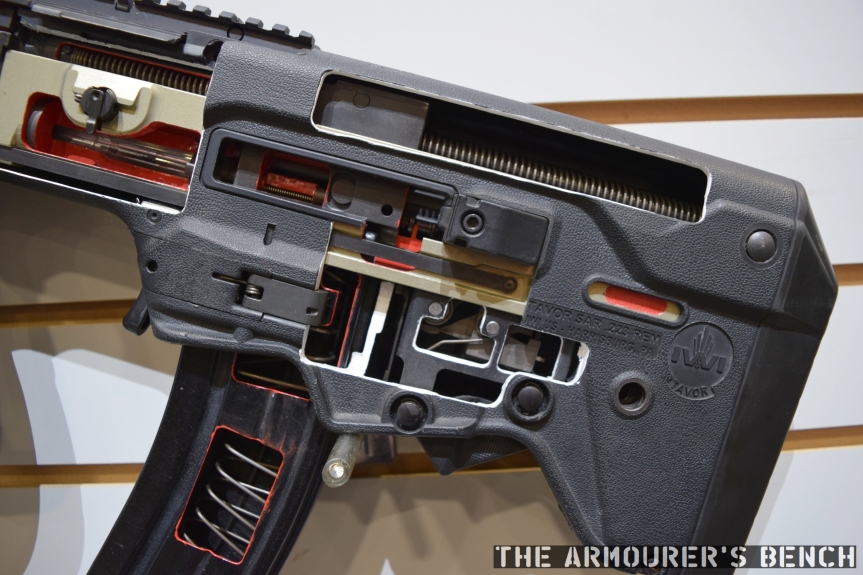
In this photo we can see the cutaway magazine as well as the mainspring at the top of the photo and below it the bolt carrier group and the bolt release mechanism (Matthew Moss)
They also cutaway the magazine so we can see the spring inside. At the top of the weapon we can see the mainspring that stretches back into the butt. The model was fully functional so on pulling the trigger the connecting rod acted on the sear release to trip the firing pin.
Additionally, the bolt release, just behind the magazine, also functioned and when operated the bolt went forward onto battery. The Tavor entered service in the early 2000s and has been superseded by the X95 and joined by the 7.62 chambered Tavor 7.
We will have a more in-depth video on the Tavor in the future.
Commonly referred to as Nock Guns, the seven barrel volley guns were actually designed by James Wilson. Wilson presented his design to the Board of Ordnance for testing in July 1779. Following testing at Woolwich Arsenal the Board of Ordnance decided that the guns, while of no use to the Army, might be useful aboard the Royal Navy’s ships. The volley gun’s impressive firepower could be devastating at the relatively short ranges aboard ships. The Navy had historically used blunderbusses/musketoons and the Board of Ordnance probably viewed Wilson’s gun as an advancement of this concept. London gunmaker Henry Nock was given an order for two ‘seven barrelled rifle guns’ for Admiralty testing but these proved slow to load in action and subsequent guns had smoothbore barrels.
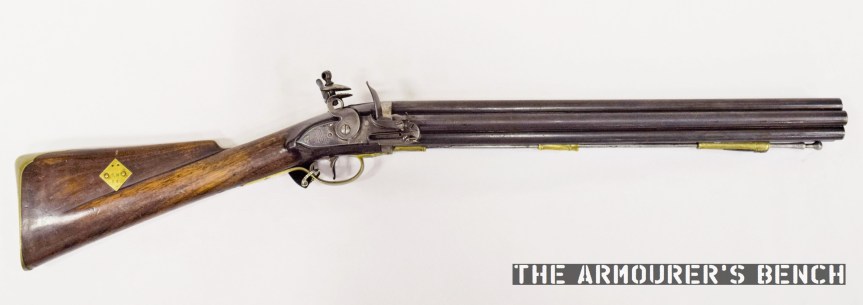
Right-side profile of the volley gun (Matthew Moss)
The Admiralty envisioned equipping first rate ships of the line (vessels with 75 guns or more) with 20 volley guns, while second and third rates would have 16 and 12 volley guns respectively, and frigates would carry 10 Nock guns. This represented a sizeable order. The Admiralty eventually purchased 500 guns, paying £13 per gun, to equip Royal Marines and sailors manning the fighting tops (at the top of ship’s masts). The Navy felt that the volley guns’ firepower would be useful when boarding enemy vessels or in repelling boarders by pouring down fire on enemy boarding parties.
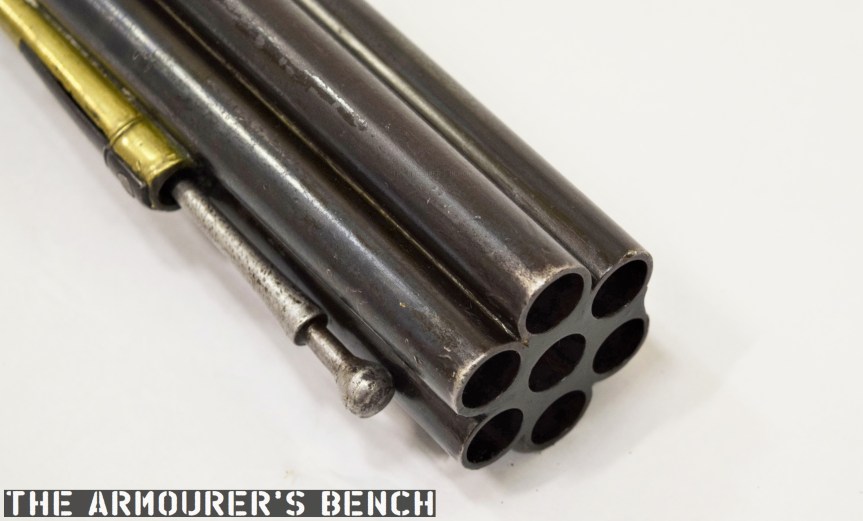
A close up of the gun’s muzzel-end, not also the ramrod which appears to have been lengthened at some point in its life (Matthew Moss)
Henry Nock, better known for producing high quality duelling pistols and sporting guns, became the sole supplier of Wilson’s volley guns to the Royal Navy. The weapon’s 0.46 inch calibre outer barrels were arranged around the seventh centre barrel. The 51cm or 20in barrels were brazed together and screwed to an iron plate set into a walnut stock. The outer barrels had vents drilled through them to the central barrel while the central barrel had a vent leading from the lock. Once the flintlock ignited the powder charge in the central barrel, the surrounding barrels were ignited through the vents. As the vents had to be drilled with the barrels already brazed into position, the outer barrels all have plugged drill holes on their outer surfaces.
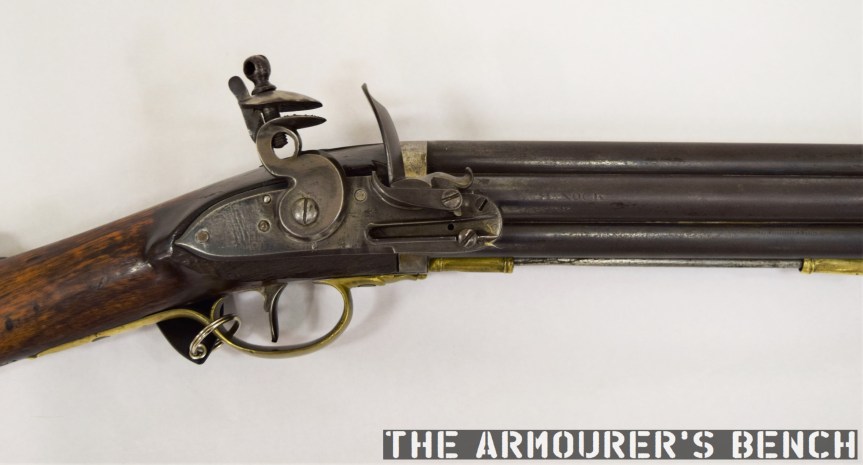
A close up of the lock and the ‘H. NOCK’ makers mark (Matthew Moss)
All seven barrels fired almost at once producing significant recoil, reputedly able to dislocate shoulders. The service load was originally 2.5 drams of finer rifle powder (which I believe equals 68gr) for each barrel – totalling 476gr. Despite the gun weighing 12lbs, this did little to mitigate the weapon’s recoil and a reduced charge or 1.5 drams of standard musket powder was ordered.
The Board of Ordnance and the Admiralty granted Wilson an awarded of £400 (equal to £48,000 or $63,000 today) in May 1780. He played no further role in the testing and development of the volley gun. In 1787 the Navy ordered a further 100 guns from Nock.
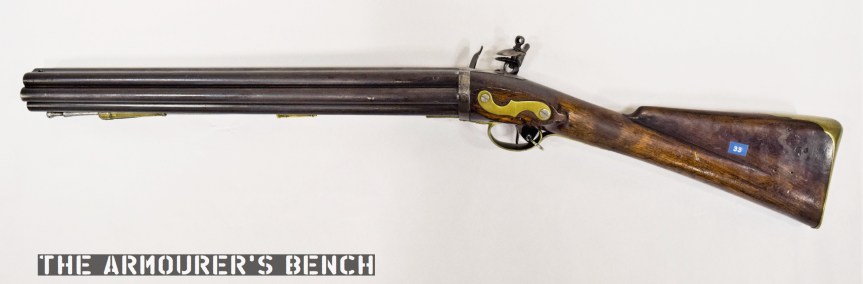
Left-side profile of the Nock Gun (Matthew Moss)
Entering service just too late for service during the American War of Independence the first reported use of the guns came with Admiral Howe’s fleet at the siege of Gibraltar in 1782. They continued to be carried aboard other vessels during the 1790s, but few accounts refer to them and little is known about their service.
Howard Blackmore suggests that naval officers, including Admiral Nelson who disliked placing marksmen in his tops, disliked the guns. There were some fears that the volley guns’ wads could set the ships sails and rigging on fire. Reputedly it was also not uncommon for some of the volley gun’s barrels to fail to ignite. As a result the guns were seldom used on board ships and removed from Royal Navy service in 1804. In 1805, Wilson, then a captain of the Marines suggested the Navy reissue the guns to the Sea Fencibles, a naval militia which helped defend the British coast, however, his recommendation was not followed up.
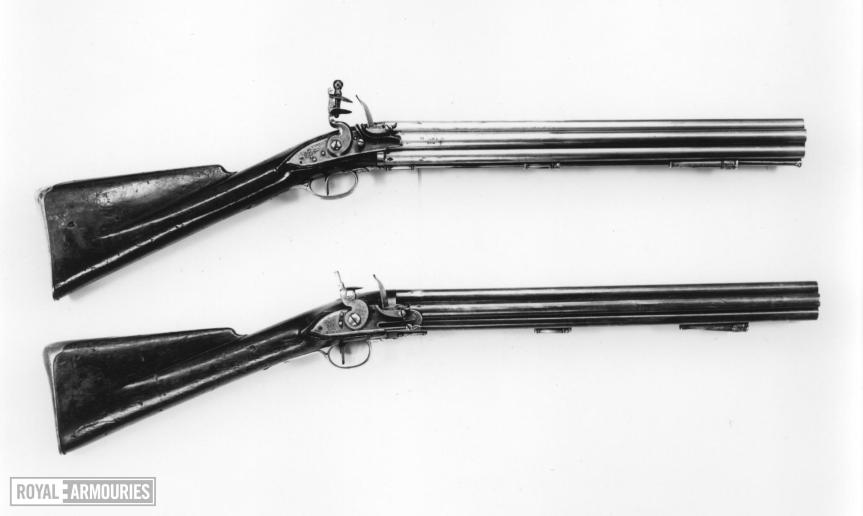
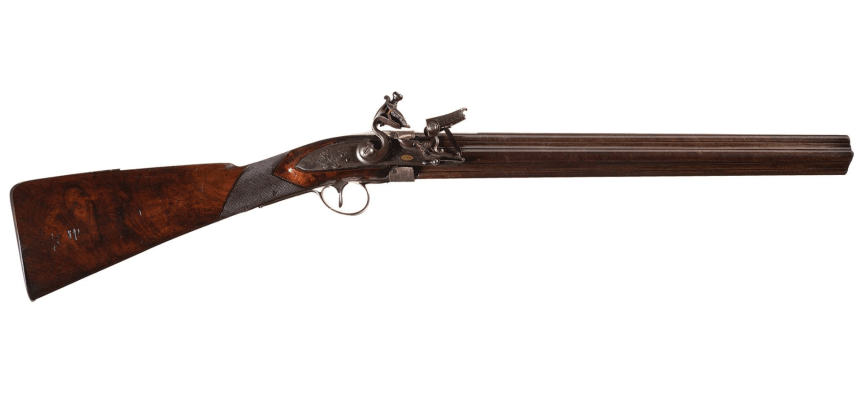
The early (top) and later (bottom) patterns of Nock volley gun (Royal Armouries)
This particular example has the second pattern of lock used on the Nock guns with a smaller lock positioned a little lower on the gun. The earlier pattern was a back action lock, fitted high on the gun with the front of the lock plate in line with the side of the barrel.
The gun has a maker’s mark of ‘H. NOCK’ on the second barrel on the left and various barrel proof marks. Unlike other examples the lock itself isn’t Tower and ‘GR’/Crown cypher marked but does have the Ordnance Broad Arrow just behind the pan. Interestingly, the steel ramrod appears to have an extension brazed onto the end of it, this might indicate that the shorter rod used with the initial charge had to be extended when less powder was used for the lighter 1.5 dram load.
Why did the Nock Volley Guns fall out of favour?
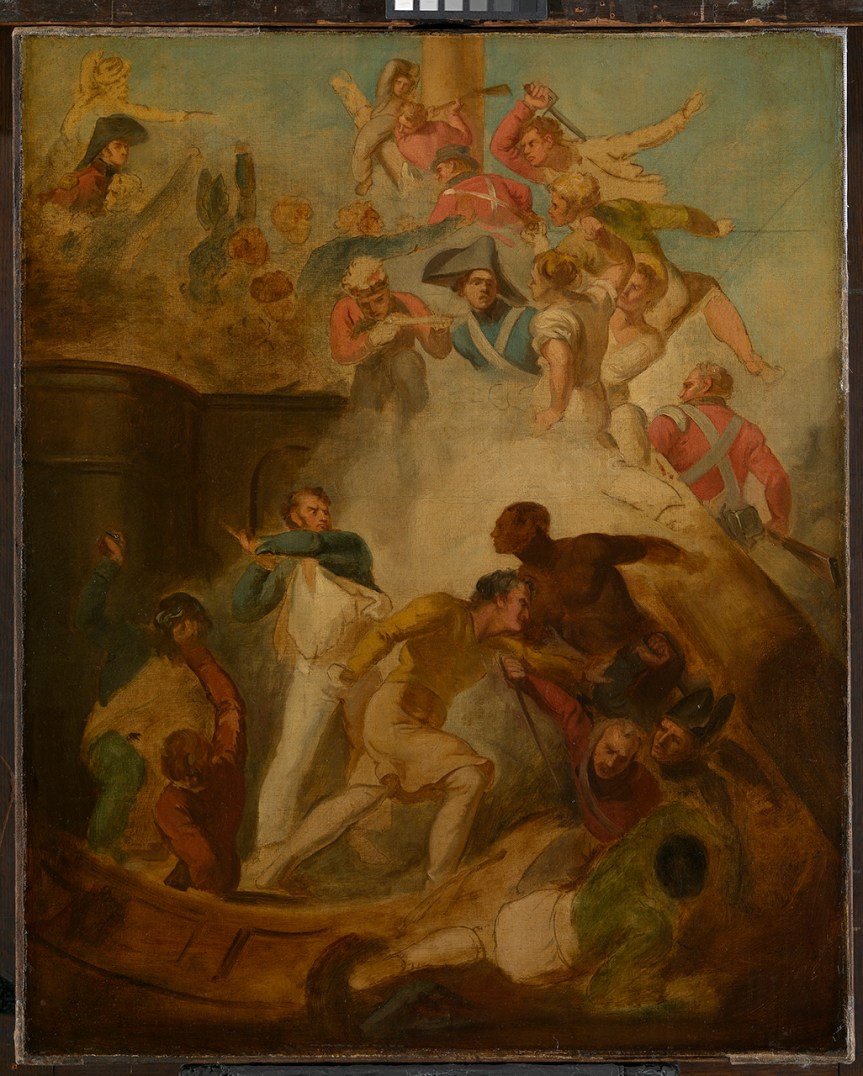
As I mentioned earlier the recoil of the initial service load was significant, Howard Blackmore hypothesised that there may have also been some weakness to the lock springs leading to misfires. One key factor is that close quarters fighting aboard ships often relied on edged weapons like cutlasses, boarding axes and pikes. These paintings give us some feel for what fighting aboard a Napoleonic Man-of-War might have been like – a close, chaotic, terrifying affair.
Boarding Party by D. Drummond, (National Maritime Museum)
While pistols were commonly used they were disposable and may not have been reloaded during a fight – more likely they were dropped or used as a club. The Nock Gun would have offered a devastating first volley, and while its 20 inch barrels would have given it better accuracy and range than a musketoon, how much of an impact a single volley of seven .32 bore projectiles would have had especially once the fighting became hand to hand is a matter for debate. At close quarters the Nock Gun quickly becomes a short, ill-balanced, 12lb club.
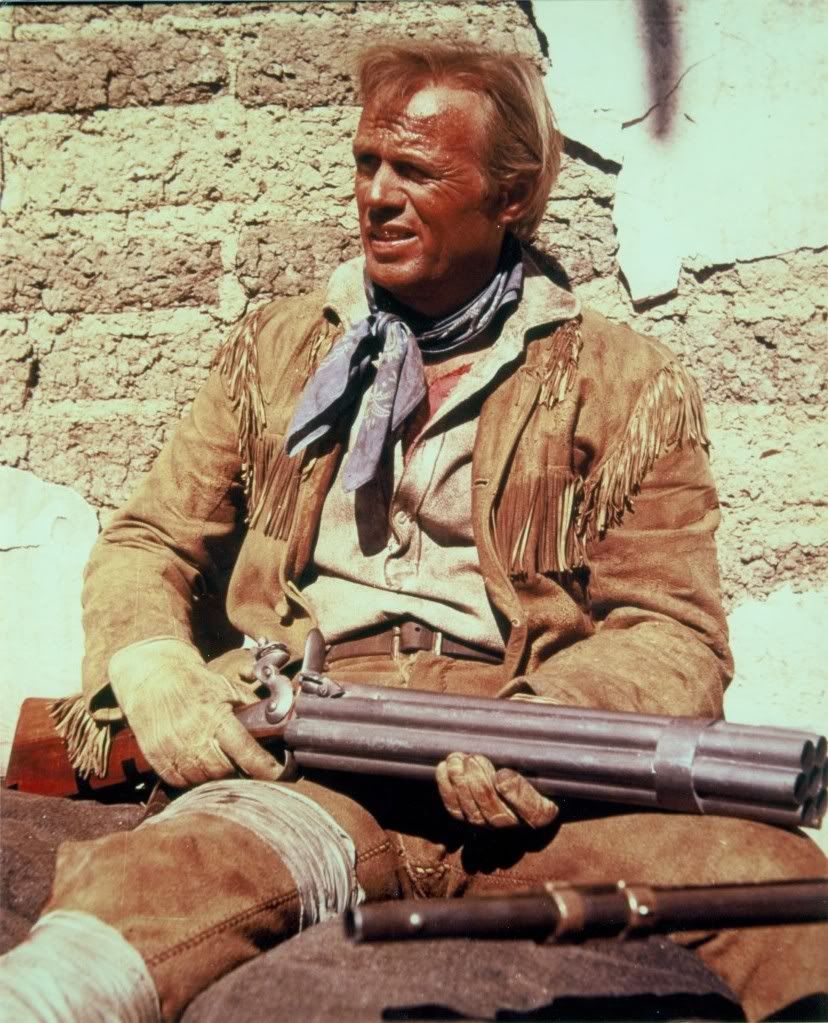
The Nock Volley Gun is perhaps best known for appearing in the Sharpe series of books and films as Sergeant Harper’s weapon of choice but it first appears on screen in the 1960 classic The Alamo with Richard Widmark’s Jim Bowie carrying one and more recently a fleeting, anachronistic, appearance in Master & Commander: Far Side of the World.
Richard Widmark as Jim Bowie in The Alamo (1960) with his pretty rough mocked-up Nock Gun
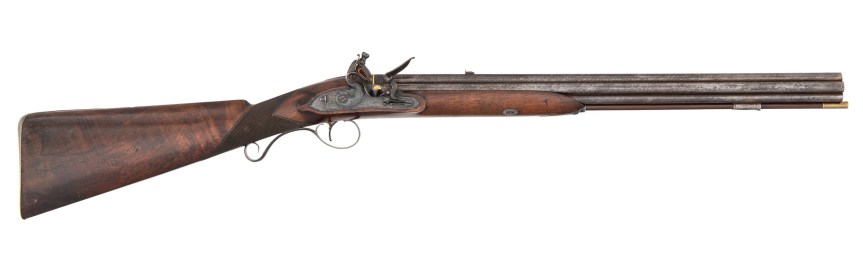
Despite a relatively short and undistinguished service life the Nock Volley Guns also saw some civilian sales with a number of ornate hunting guns with wooden forends, engraving, rifling and rear leaf sights.
A civilian Nock Volley Gun, note the rear sights, wooden forend and fine craftsmanship (Cowan’s Auctions)
Later in 1818, Nock’s workshop manufactured a design by Artemus Wheeler, an American gun designer with a fondness for revolving guns.
Wheeler’s carbine resembles the earlier volley gun externally but is in fact a manually rotated, self-priming flintlock ‘pepperbox gun’ with six barrels arranged around a central axis. Unlike the earlier volley gun the pepperbox carbine was never trailed or purchased by the Admiralty. Henry Nock’s workshops produced approximately 655 volley guns between 1780 and 1788. The Nock Gun is a weapon that would greatly benefit from some in-depth contemporary research as the current best source is over 50 years old and relatively little is known about the gun’s service history.
In the second video Matt tackles the Heckler & Koch G11 and gives an update on the colouring book and the channel:
Thanks for watching chaps & thanks so much for your support in 2019, we greatly appreciate it. It’s been a busy year and we hope that you’ve all enjoyed our videos!
You can still pick up a copy of the ACR colouring book and the G11 sticker at www.armourersbench.com/shop. we’re very much looking forward to seeing your artistic sides when you send us some photos of your colouring to – contact@armourersbench.com.
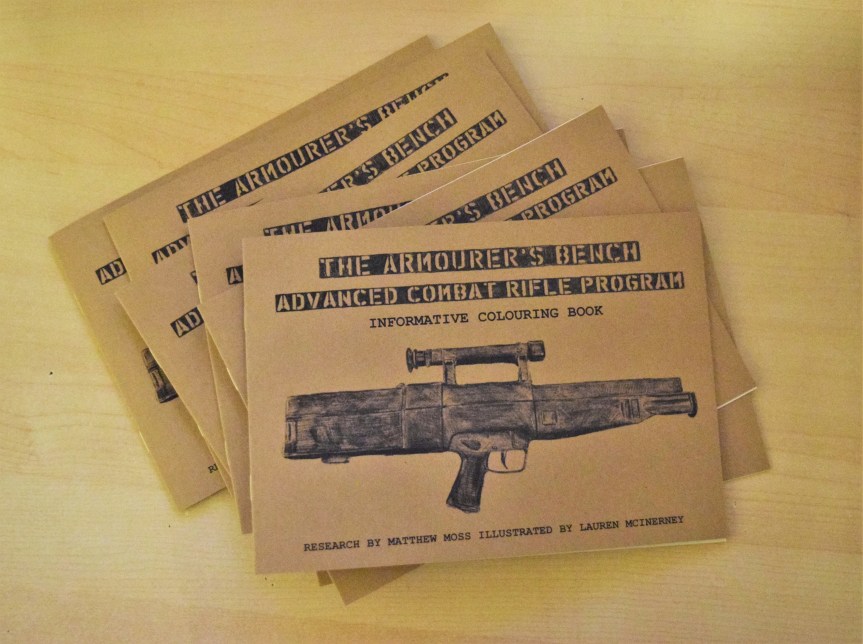
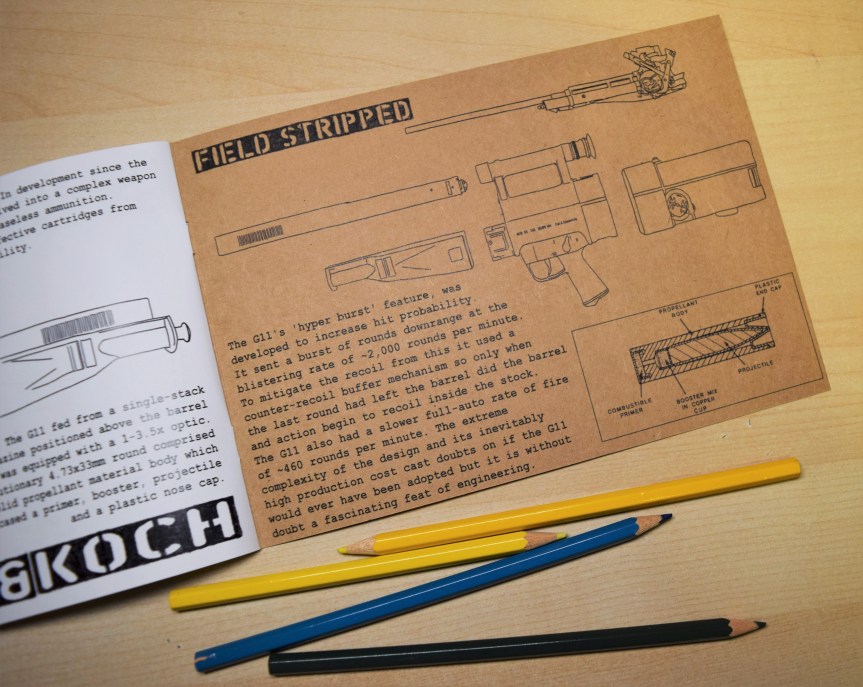
The Armourer’s Bench are proud to introduce our very first ‘informative colouring (coloring) book’. Not only can you colour in the prototypes from the US Army’s Advanced Combat Rifle trials but you can also learn about the guns, how they worked, performed and the outcome of the trial as you colour!
Why a colouring book? Well, simply put, no one else has done one before! With the help of our brilliant illustrator, Lauren McInnerney, we put the book together to give you guys something a bit different, something fun!
We have a limited run of these little books and we will do our very best to get them our ASAP if you order them for Christmas.
The book includes detailed original illustrations of each of the four ACR guns: the AAI, Colt, Steyr and of course the iconic HK G11. The 8-page booklets are 8×6″ (or A5 sized) and are available now from our website for $6.00, plus shipping.
All the funds raised from the sale of the books will go toward supporting TAB through 2020.
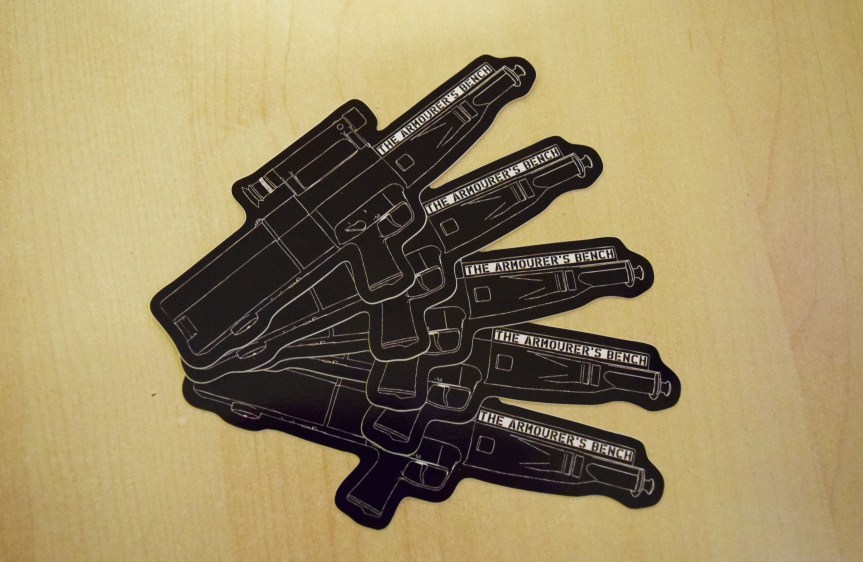
But wait! That’s not all! We also have some extremely cool new stickers available. These 4″ cutout vinyl stickers feature the TAB logo on an illustration of the G11.
And last but not least we also have a small run of TAB logo badges available too!
Today, we’re going to take a look at a little known type of weapon which rose to prominence in around the time of the First World War with a number of examples being developed and some even tested. As you can see from this footage it’s something pretty unconventional, seen here mounted on the back of a truck – is a centrifugal machine gun.
I found this short footage while doing some digging through the online catalogue of the US National Archives. The centrifugal machine gun was not a new concept by the time this footage was filmed in the early 1920s, sadly the footage notes done give an exact date.
A still from footage of the demonstration (US National Archives)
While the technology had risen to a new prominence what was the allure of centrifugal machine guns? The principle of centrifugal force – an inertial force which appears to act on objects moving in a circular path, directs them away from the axis of rotation. As a result a centrifugal machine gun required no propellant powder to propel the projectile, or a case to contain it, nor a conventional rifled barrel to stabilise the projectile. Once released from the axis of rotation the projectile travels on a linear trajectory until it expends its energy. It works along the same principle as a primitive sling. The primary issue is providing power to exert the centrifugal force and a means of accurately firing the projectiles.
Some of the earliest work on centrifugal guns was done in the late 1850s in the US. The hand-crank or steam powered guns patented by William Joslin (US #24,031), C.B. Thayer patent for a ‘machine gun’ in August 1858 (US #21,109) and Charles S. Dickinson (US# 24,997) in 1859. Dickinson went on to secure financial backing from a wealthy Maryland industrialist Ross Winans and developed a steam powered version of his gun. Despite gaining much press attention Dickinson’s centrifugal gun saw no action during the US Civil War. In 1862 G.C. Eaton and S.W. Turner also patented a ‘machine gun’ (US #37,159).
An illustration of the Winans Steam Gun, Frank Leslie’s Illustrated Newspaper, May 1861
It wasn’t until World War One that the concept began to be considered again. In June 1918, Major Edward T. Moore and Saul Singer filed a patent for a centrifugal machine gun powered by an electrical motor (US #1,332,992). The motor spooled up the centrifugal barrel assembly to rotate extremely quickly and impart centrifugal force on projectiles. According to Julian Hatcher the gun could fire steel ball bearing projectiles at approximately 1,200 feet per second. Fire was controlled by a stop pin in the ammunition feed tube. Moore claimed the weapon could fire a projectile 1.5 miles with enough force to kill a man. He also suggested the weapon’s rate of fire approached 2,000 rounds per minute. It appears that Moore’s gun may have been tested in 1918 but Hatcher described its accuracy as ‘extremely poor’.
Photograph of Moore’s gun during testing (Hatcher)
Another centrifugal design developed during World War One was E.L. Rice’s half-inch centrifugal gun, sadly I’ve been unable to find any photographs or drawings of Rice’s design but the weapon was submitted to the US National Research Council in 1917. The NRC’s 1919 report states that the gun had been further developed by the NRC’s Physics Division in Pittsburgh but work had been slowed by “a common defect which has been difficult to eliminate”. Despite what the report described as ‘considerable headway’ the weapon was subsequently abandoned amid some controversy about credit for the design.
There seems to have been something of a centrifugal machine gun craze with several more patents filed between 1917 and 1926. A Scientific American article from March 1918, even noted that “every so often the daily press becomes enthused over a new centrifugal gun.”
One of the earliest patents granted appear to have been for a design by E.E. Porter, granted in January 1917. This was followed in July 1919 by inventor, Herbert A. Bullard being granted a patent (US #1,311,492) on a design which fired a disc rather than a ball. At the same time T.A. Gannoe was granted a patent (US #1,309,129) for a large, complex looking gun shown mounted on a pedestal.
In 1920, F.R. Barnes (US #1,327,518) and W.W. Case (US #1,357,028) were also granted patents which had been filed in 1917. In late 1921, Levi Lombard was granted a patent he had filed in March 1918, his gun even appeared in Scientific American. It appears to be notably smaller than Moore’s gun and has a spade grip for aiming. This was followed in 1923, by an interesting patent from Joseph T. McNaier for a centrifugal gun that could be powered by an electric or petrol engine, some of the patent diagrams show how the gun might be placed in an armoured car or aeroplane (US #1,472,080). Intriguingly, McNaier and Moore appear to have known each other quite well and were partners in a law firm together.
Here’s a gallery of some of the various patents mentioned above, not all are as detailed or as advanced as others:
The question is which of these guns is featured in the footage. The most likely bets are the Moore or the Czegka. Sadly, with only a side view and just 18 seconds of footage we don’t have much to go on. The accompanying reel notes, describing what is seen in each section of the film, describes the gun as being in the “experimental stages only” and that the prototype seen here “is intended for use as aircraft armament, for tanks and for landing parties of the Front line trenches.”
Sadly, we don’t get to see how the gun works but we can see the operator feeding the ball bearing projectiles into the hopper which has a powered feed system – he empties two cylindrical containers of balls into it one after another. It is unclear how many rounds might be in the containers, perhaps 50 each. The gun and its motor are mounted on a truck bed with a soldier in uniform, possibly aiming the weapon via a tiller.
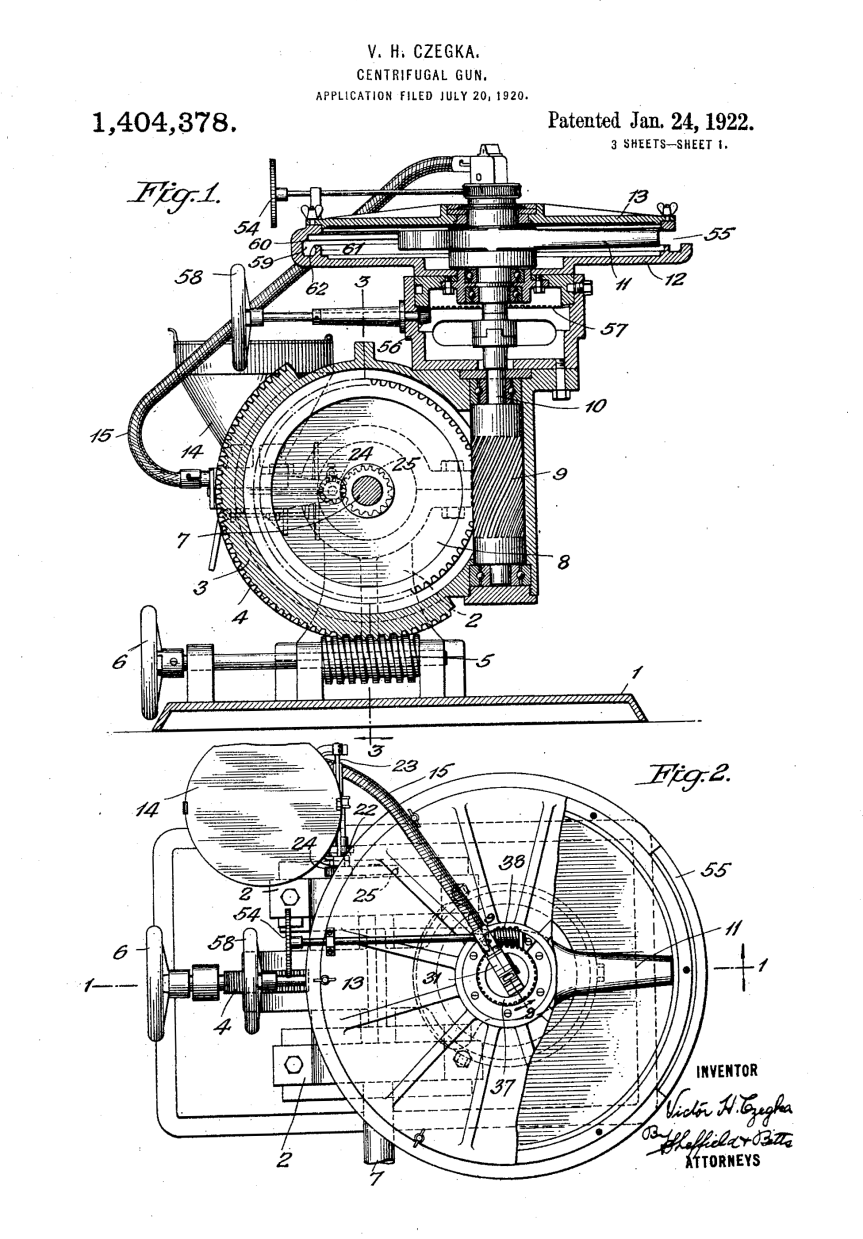
Another of the later designs dating from the period came from Victor Czegka, a US Marine Corps Technical Sergeant, who is perhaps best known as the supply officer of Admiral Richard Byrd’s first two expeditions to the Antarctic. Czegka was granted a patent for a centrifugal machine gun in January 1922 (US #1,404,378).
Czegka’s 1922 patent (US Patent Office)
With some further digging I managed to find several articles referring to the gun in the US Army Ordnance Journal. Interestingly, a photo from the same demonstration is printed in one article, from late October 1920, with the caption confirming the man loading the weapon is the inventor, however, he isn’t named. The footage was filmed during the Second Annual Meeting of the US Army Ordnance Association. Another article dating from May 1921, also notes that the tests took place at Aberdeen Proving Ground, with the gun firing at 16,000 revolutions per minute which required 98 horsepower from the engine powering it. The gun apparently needed a “very rapid increase in power required for operation” when the speed of its revolutions was increased incrementally from 12,000 to 16,000 rpm. The article concluded that “a horsepower above 100 would have no material effect in increasing the speed” suggesting that a much more powerful, and therefore larger, engine would be needed to increase the revolution rate.
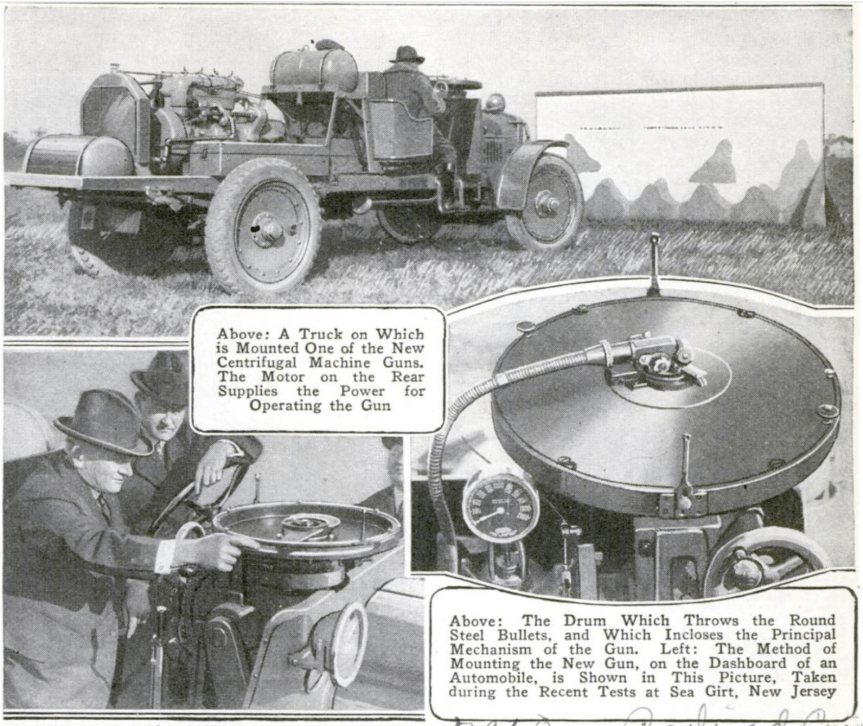
While researching I came across this set of images from a March 1922 edition of Popular Mechanics showing an unnamed centrifugal gun set up on a truck, powered by an engine on the truck bed. From the images it appears to be a gun similar to Moore’s with a single rotating ‘barrel’. The captions also note that the photographs were taken in New Jersey and Moore was a Major with the New Jersey National Guard, which may also indicate the gun is Moore’s.
Despite various designs seeing some US military testing none were ever adopted and relatively little information on them is available. It seems that they were relatively cumbersome weapons with extremely varying accuracy but this footage at least proves the concept. A short report in a may 1921 edition of Scientific American may shed some light, stating an unnamed gun was rejected “because of its great weight and its inability to obtain high initial velocity” concluding that “no centrifugal gun can have military value”. It appears that the range of the centrifugal guns was limited to the speed of their revolution, which in turn was limited by the power of the engine and motor that powered them. The larger the motor, the more cumbersome the weapon system was.
There are very few photos of centrifugal machine guns so stumbling across actual footage of one guns actually operating is very exciting. They are a fascinating tangent to the history of the machine gun – one that occasionally still garners interest.
Update
A viewer shared a Pathe Newsreel with us which included more footage from the same demonstration. The footage title suggests it dates from 1938, however, I believe this to be incorrect.
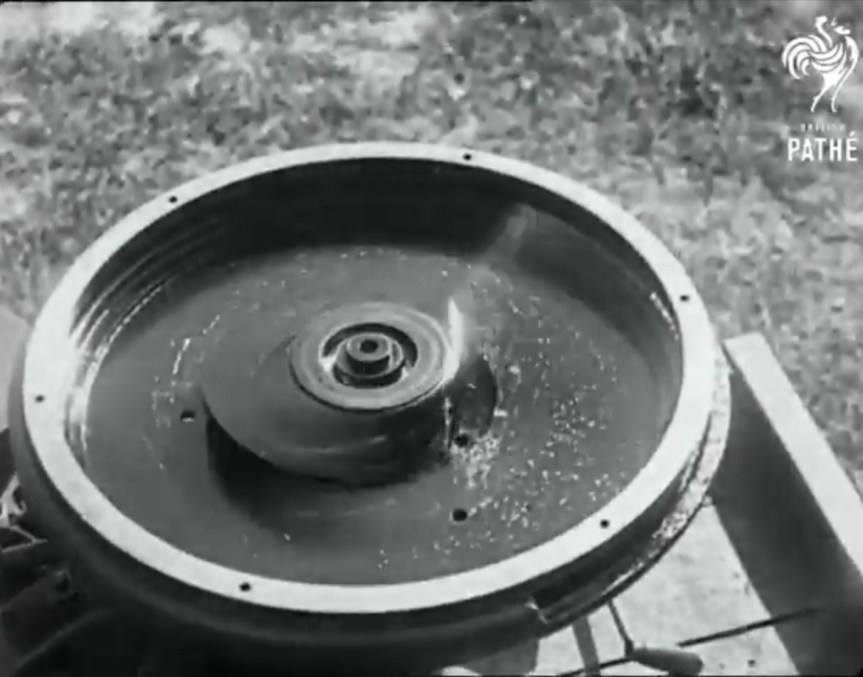
Despite the incorrect date the footage shows us the internals of the centrifugal gun and its aiming mechanism!
Here are few screen captures from the footage:
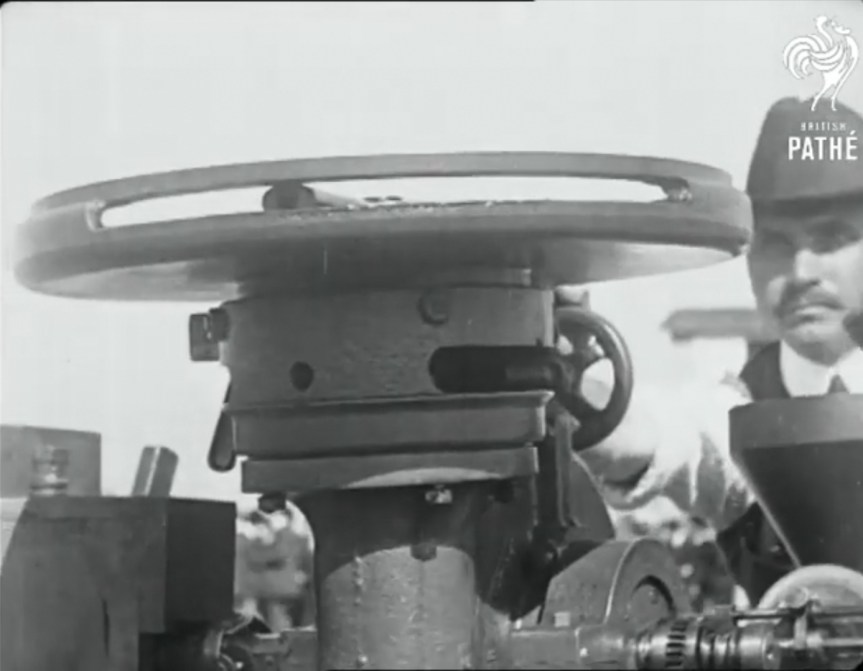
The gun’s hopper being loaded (Pathe)A front view of the weapon, showing the slit from which projectiles fired through, and a better look at the operator’s face (Pathe)The gun with its top cover and feed system removed showing the centrifugal barrel spinning up – a info card from the footage suggests it is spinning at 12,000 rpm (Pathe)
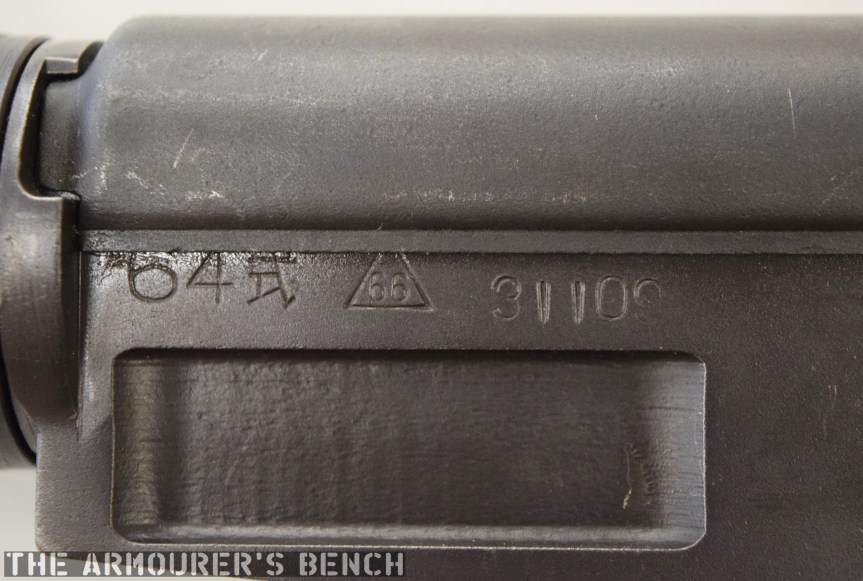
The Type 64 is an integrally suppressed submachine gun designed in China in the early 1960s, taking several design elements from other Combloc small arms. The guns were manufactured at one of China’s State Factories (with the factory’s ‘66’ in a triangle marking in the left side of the receiver – this indicates the factory number, although available sources differ on which it refers to, either 66, 626 or 366).
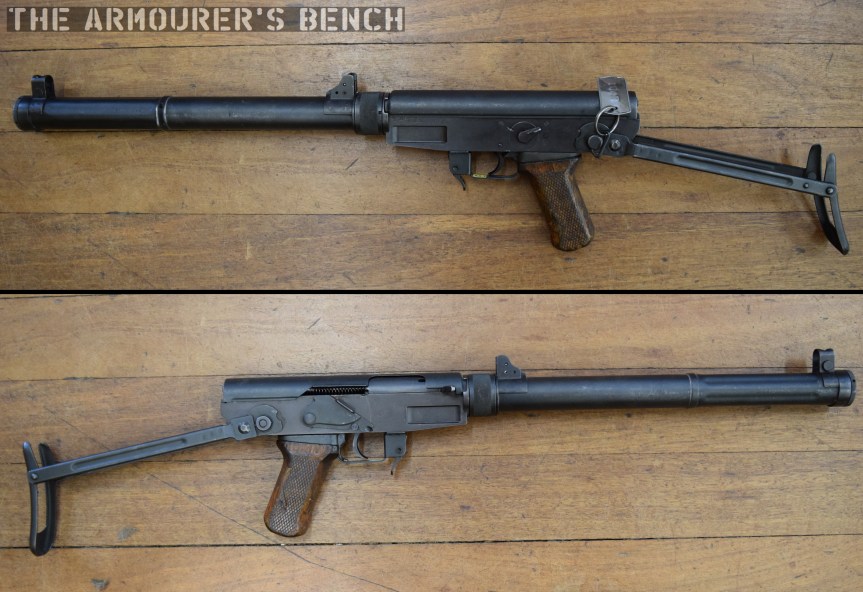
Right side of the Type 64, with stock folded (Matthew Moss)
Designed concurrently with the Type 64 suppressed pistol during the 1960s, the Type 64 SMG was developed for Communist China’s special forces for use in clandestine operations. Chambered in the standard 7.62×25 ComBloc pistol round, the Type 64 functioned best with Type 64 subsonic ammunition, a special subsonic spitzer projectile variation of the standard 7.62mm pistol round. It did not chamber the low power 7.65x17mm round used by the Type 64/67 pistols.
A close up of the weapon’s markings, including the State Factory 66 stamping (Matthew Moss)
The Type 64 fed from 20 or 30 round double stack magazines which were reportedly developed from or at least influenced by the Soviet PPS-43’s double stack, double feed magazines. The weapon used a conventional blowback action and fired from an open bolt. Its maximum effective range was approximately 200 metres with two position flip up sights ranging out at 100 and 200 metres.
The Type 64 had a milled receiver with lightening cuts and weighed in at 7.6lb or 3.5kg unloaded. It took its bolt from the Russian PPS-43 submachine gun and a trigger group inspired by the ZB vz.26 light machine gun’s, which was well liked by the Chinese military.
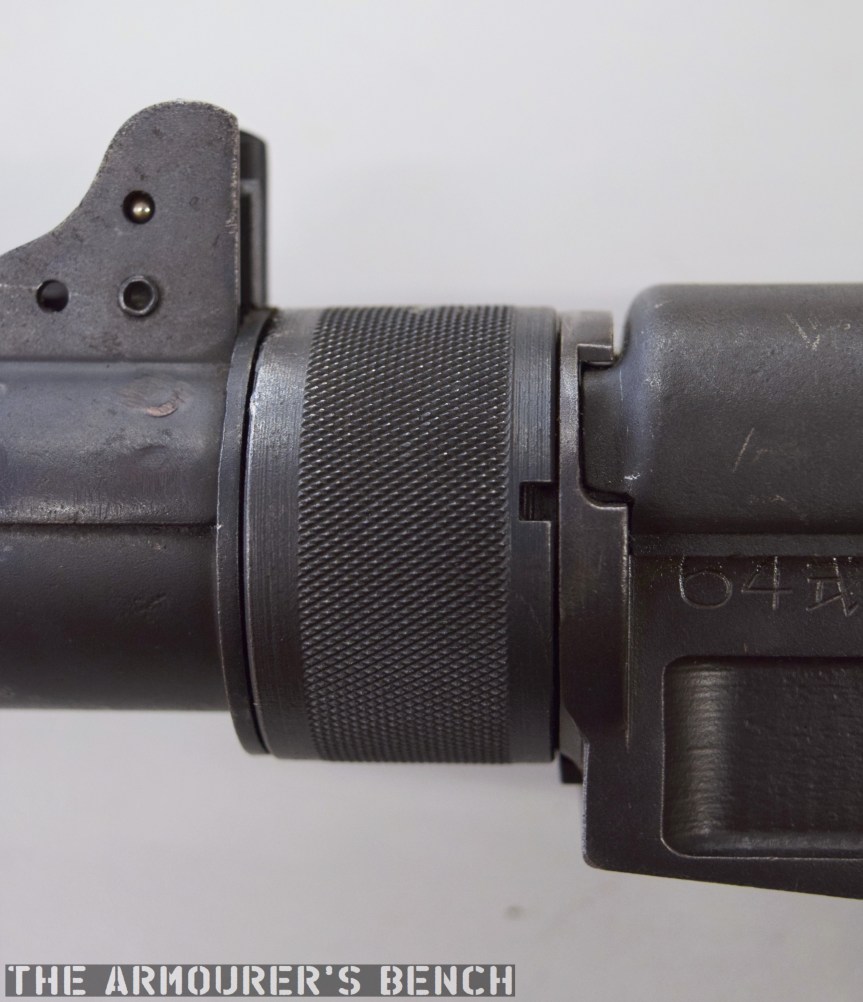
The suppressor housing is unscrewed at the trunnion with an interrupted thread (Matthew Moss)
The Type 64 shared a number of external similarities with the standard Type 56 AK-clone including its pistol grip, safety lever and under-folding stock (which is similar but slightly different to the Type 56-I’s under-folding stock).
The Type 64’s fire selector (Matthew Moss)
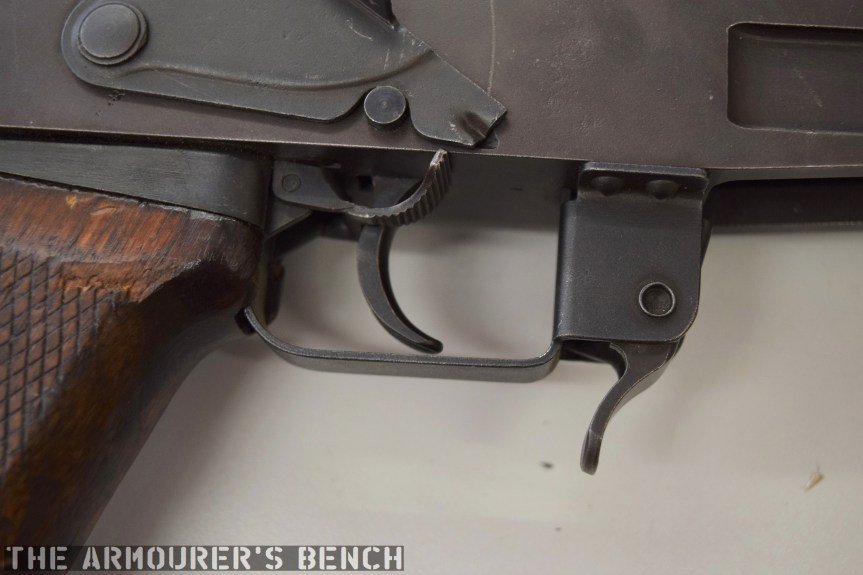
The weapon has a number different controls including a conventional AK-style safety-come-dust cover, on the right side of the receiver – which blocks the travel of the bolt. On the opposite side of the receiver it has a two-position fire selector for semi and full-auto – you can just about reach these when the stock is folded. The forward position is for semi and the rearward position is full-auto. Finally, the 64 also has an additional trigger block safety, taken from the SKS, which pivots forward to prevent the trigger from being pulled.
A close up of the magazine release, trigger block safety and lever safety (Matthew Moss)
According to a report written in October 1971, by the Small Arms Systems Lab of the US Army Weapons Command Research and Engineering Directorate, the weapon has an extremely high rate of fire of over 1,300 rpm.
A cyclic rate that high was the result of a combination of back pressure from the suppressor, the ammunition used and its blowback action. The Type 64’s chamber was fluted with three longitudinal cuts to aid extraction at its high rates of fire. It should be noted, however, that the 1971 US army tests were carried out with standard velocity ammunition – rather than the specialised subsonic Type 64.
The Type 64 with stock deployed, left & right profiles (Matthew Moss)
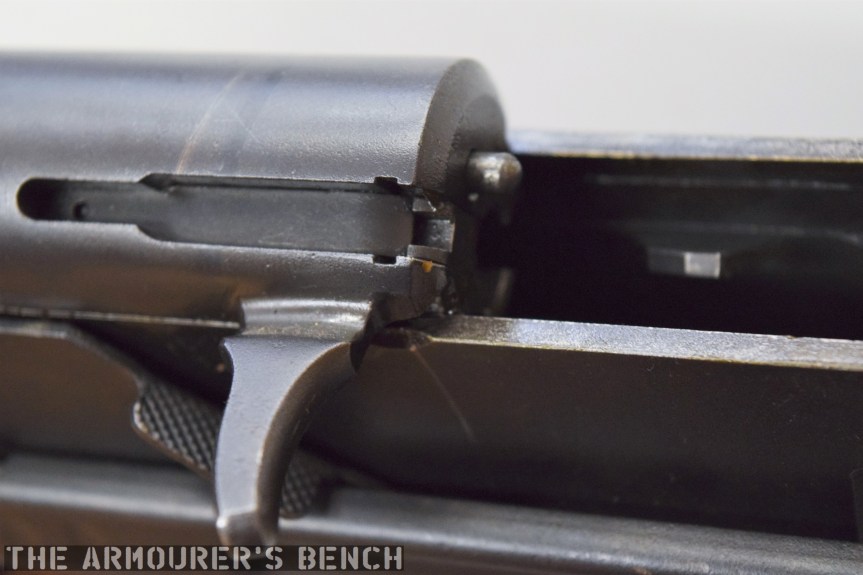
The top cover is removed by pushing in what at first appears to be a spring-loaded detent, but is actually the recoil spring guide rod. The front of the top cover is held in the receiver by a lip which fits into a slot just above the breech. The top cover itself is a thin piece of stamped sheet metal with the serial number stamped at the rear.
With the receiver cover removed and the action cocked. The Type 64 fires from an open bolt. Note the buffer at the rear of the receiver (Matthew Moss)
With the top cover removed we can see inside the action. The 64 has a single recoil spring held in place by a guide rod. At the rear of the receiver is a small plastic buffer, designed to both soak up some of the recoil energy and to help reduce action cycling noise. There is an ejector on the left side of the receiver and guide rails along which the bolt moves. To remove the bolt it is pulled fully to the rear and then tilt it upwards.
A close up of the bolt face (Matthew Moss)
The Type 64 is a pretty compact weapon despite the length of its suppressor. It has an under-folding stock, with two spring-loaded buttons at the rear of the receiver which have to be pushed in to fold and unfold the stock. When folded the weapon is 25in (or 63.5cm) long, with the stock adding 8 inches when it is deployed. The weapon can be used with the stock folded, although some of its controls are partially obscured.
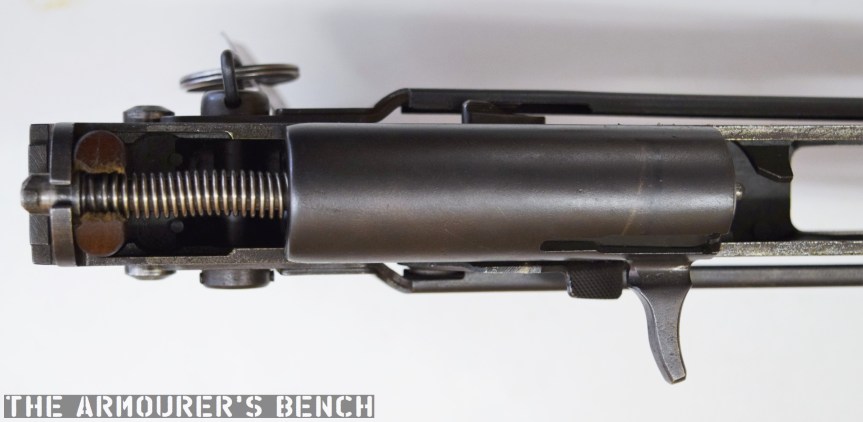
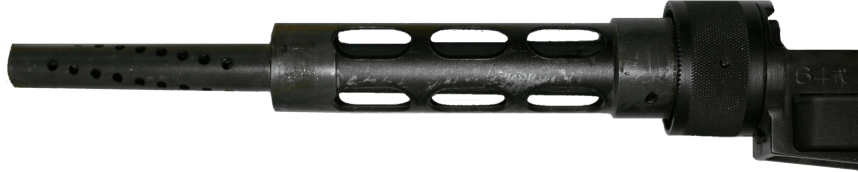
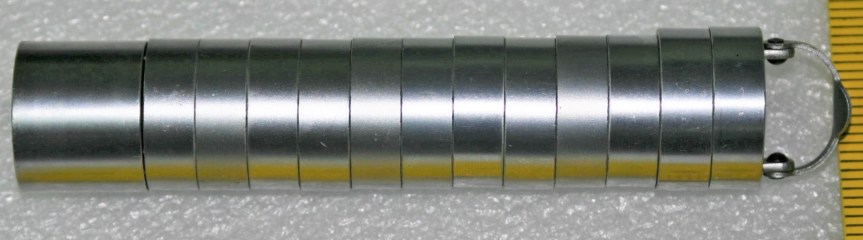
The suppressor is contained by a housing which attaches to the receiver by an interrupted thread. The Type 64’s barrel was ported with 36, 3mm vents at the muzzle-end while the suppressor has 12 metal dished baffles held captive on a pair of guide rods. The weapon’s sights are mounted on the suppressor housing which attaches to the receiver by an interrupted thread. Sadly, I didn’t have time to strip the suppressor itself but the photos below, from my friend Chuck over at Gunlab, show the Type 64’s ported barrel and baffles well.
With the suppressor housing and baffle system removed. Note the series of holes in the barrel (GunLab)
The 1971 Small Arms Systems Lab report found that the audible report of the gun, was 150db at the rear of the receiver and 157db 12 feet down range, however, this is probably not the best indication of the Type 64’s capabilities as the report states that the gun was tested with Chinese Type 51 standard velocity 7.62x25mm ammunition. Ideally, the weapon would have been used with subsonic Type 64 ammo specially developed for China’s suppressed pistol-calibre weapons. Chinese sources reportedly put the weapons noise level at 84db when using subsonic ammunition. The US report did note that while its noise suppression wasn’t outstanding, it very effectively hid its muzzle flash.
The baffle system held together a pair of guide rods (GunLab)
It appears to have been primarily used by Chinese scouts and special forces and saw action during the 1979 Sino-Vietnamese War. In the late 80s the Chinese replaced the Type 64 with the suppressed version of the Type 85 submachine gun, also chambered in 7.62x25mm, which used the same magazines, the Type 85 had a tube metal and stamped receiver which was simpler to manufacture than the 64’s machined receiver. The Type 85 has subsequently been superseded by guns like the bullpup Type 05.
Special thanks to the collection that holds this weapon for allowing me to take a look at it. As always guys thank you for watching. If you enjoyed the video please share it with friends and help us
‘Technical Notes: Chinese Communist 7.62mm Type 64, Silenced Submachine Gun’, US Army Weapons Command Research & Engineering Directorate Small Arms Systems Laboratory, J.J. Boccarossa, 27/09/1971
Secondary Sources:
Chinese Type 64 SMG, Small Arms Review, F. Iannamico (source)
Type 64 submachine gun (PR China), Modern Firearms, (source)
Chinese Type 64 suppressed SMG, ForgottenWeapons.com (source)
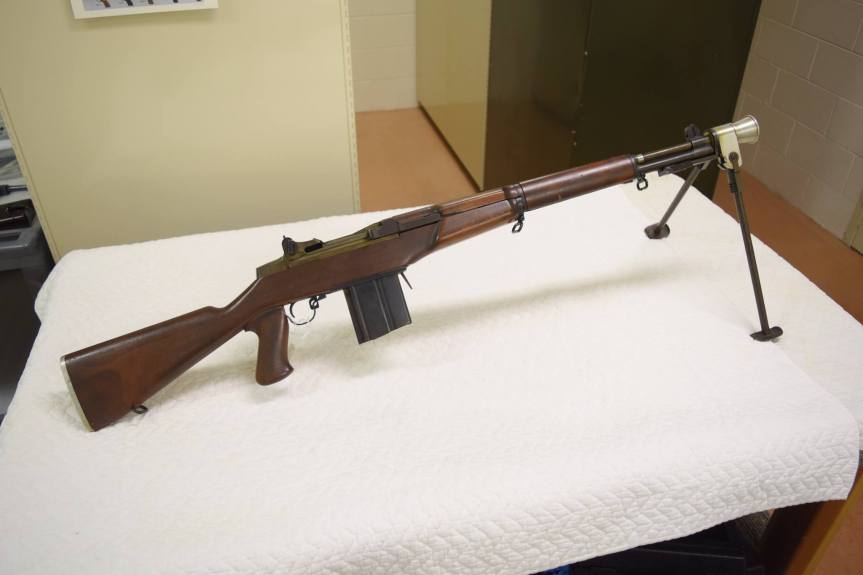
The Cody Firearms Museum, at the Buffalo Bill Centre of the West, holds a number of interesting select-fire M1 Garand rifles, adapted by Winchester during the 1940s. In this article we’re going to examine one of the prototypes, the rifle is believed to date to the late 1940s, and appears to be chambered in one of the earlier iterations of the T65 .30 Light Rifle round, which would eventually be adopted as 7.62x51mm.
Very little information is available about the rifle and little has been written about it previously. It is believed to have been developed by Winchester engineer Harry H. Sefried II with former Cody Firearms Museum curator Herbert Houze crediting Sefried with the rifle, which he described as adaptation of the M1 into a ‘squad automatic rifle’. After some archival research and combing Winchester’s patents from the period we can now attempt to shed light on a little more of the rifle’s history.
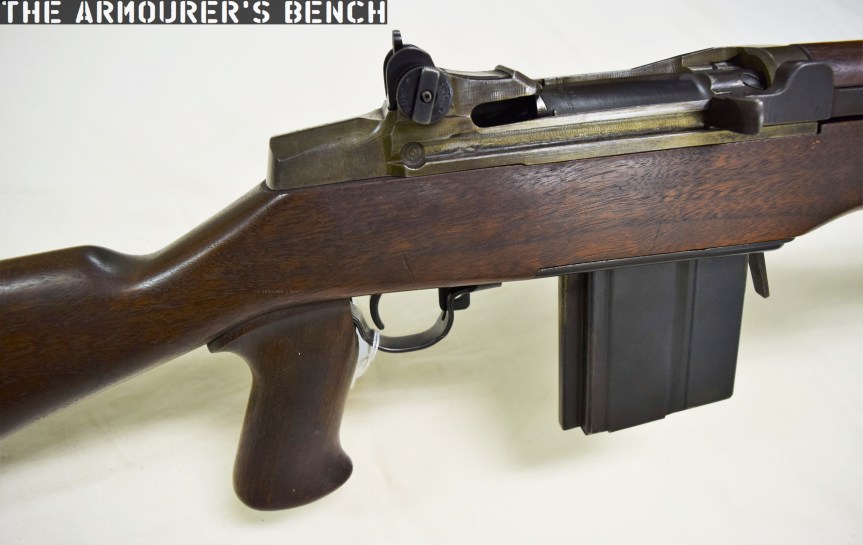
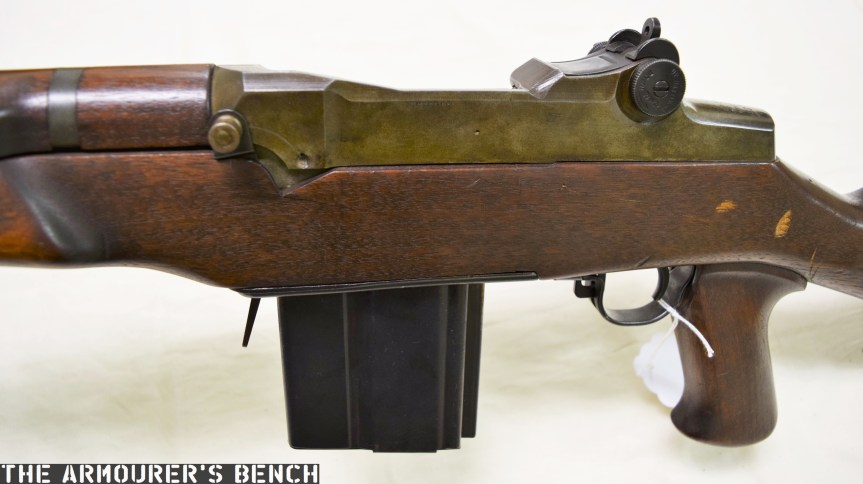
Externally, the rifle has a number of instantly recognisable distinctions from the standard M1 Garand. It has a reshaped stock with an added pistol grip, a proprietary box magazine and a combined bipod and conical flash hider. If we look closer we’ll notice that the stock has a swell just ahead of the breech, flaring out in an almost triangular bulge. These changes to the stock also distinguish this rifle from Winchester’s other select-fire M1 adaptations, which retain the standard Garand stock profile.
From the patents available combined with an examination of the rifle we can learn a lot. We cannot rely on patents to tell the whole story of the rifle, however, as many of the elements that make up the weapon appear to have gone unpatented. The substantial external and internal changes made to the rifle suggest that this was not an attempt to adapt the M1 with a minimal number of component parts changes but rather an effort to generally improve the rifle, making it conducive to fully automatic fire.
Detail photo showing the rifle’s pistol grip, altered stock and magazine (Matthew Moss)
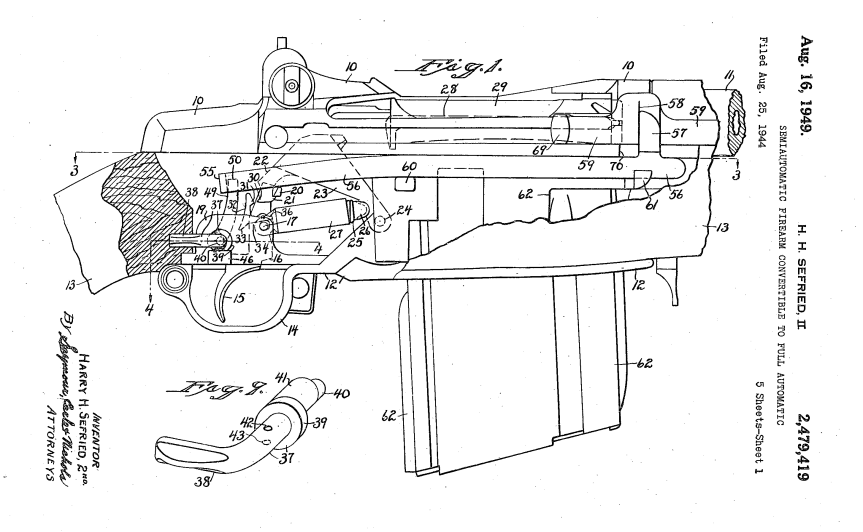
In summer 1944, Winchester’s CEO Edwin Pugsley directed Sefried to begin work on a select-fire conversion for the M1, to rival those being developed at Springfield Armory and Remington. Winchester’s select-fire Garand went though a number of iterations which resulted in two patents from Sefried. The first, filed in August 1944 (US #2479419), incorporated an elongated sear actuating lever and a selector on the lower, right side of the receiver. Winchester’s first attempts at a select-fire M1 conversion resulted in rifles with extremely high, uncontrollable rates of fire of over 900 rounds per minute. Sefried filed a second patent later in January 1948 (US #2464418) which used a catch to hook the sear. The rifle we are examining appears to have yet another select-fire system, one for which I have so far been unable to find a corresponding patent for. Winchester’s work on the select-fire adaptation came to a halt with the end of the war. It appears, however, that Winchester again began to work on adapting the M1 in the late 1940s, with Sefried again working on the project, filing his second select-fire mechanism patent in 1948 (US #2464418).
Sefried’s 1949 patent for another select-fire M1 conversion (US Patent Office)
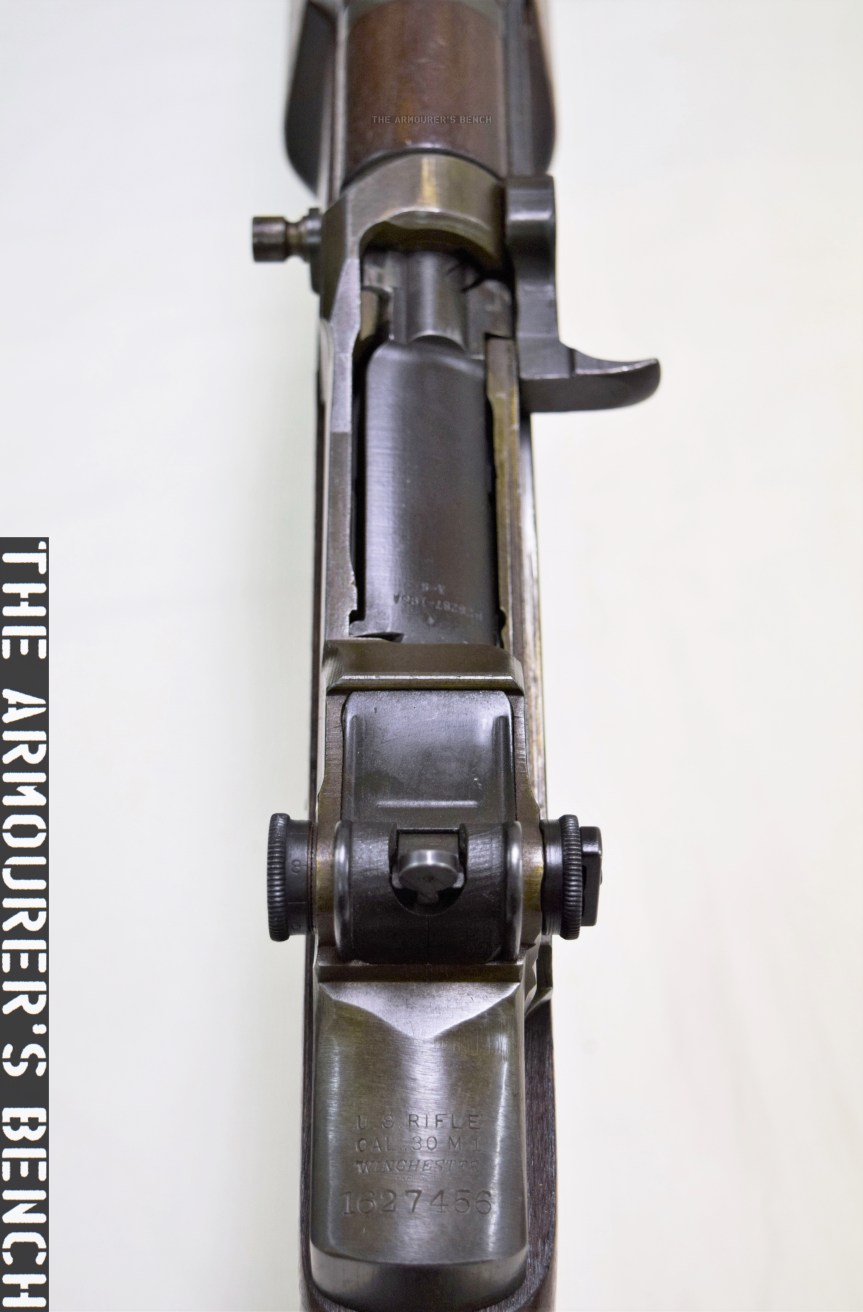
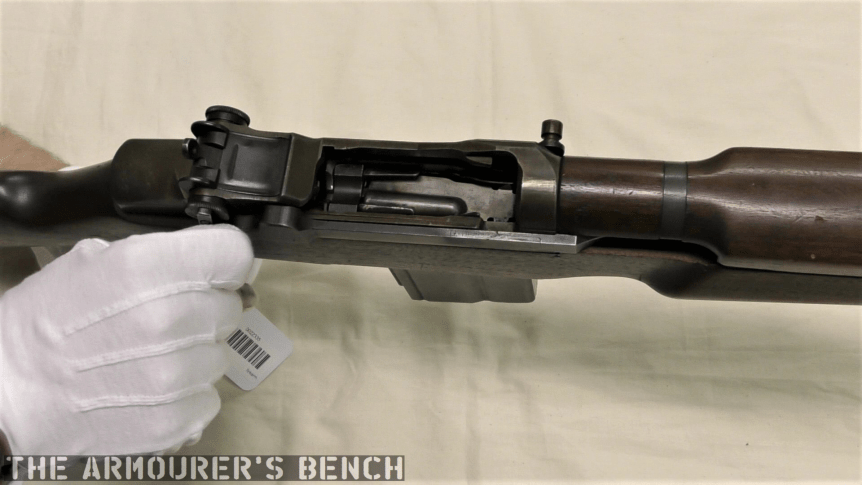
The rifle’s receiver was originally a standard Winchester-made .30-06 M1 with a serial number of 1,627,456. This means its wartime production gun, dating from May 1945. It would appear that rather than the rifle being lifted from the rack finished, it seems that it was earmarked for prototype development because the receiver forging lacks the cuts/forgings needed for the en bloc clip release lever. This makes sense if it was known that the receiver was destined for use in a prototype which fed from a box magazine. However, the timeline of the rifle gets more complex when we consider that it was a late-war production rifle. There are a number of possibilities. The rifle may have been simply set aside for internal prototype work in May 1945 and not used until a T65 chambered rifle was developed later. Alternatively, it is possible that the rifle was converted during the initial attempts to create a select-fire M1 but was later rechambered from .30-06 to the new developmental T65 round.
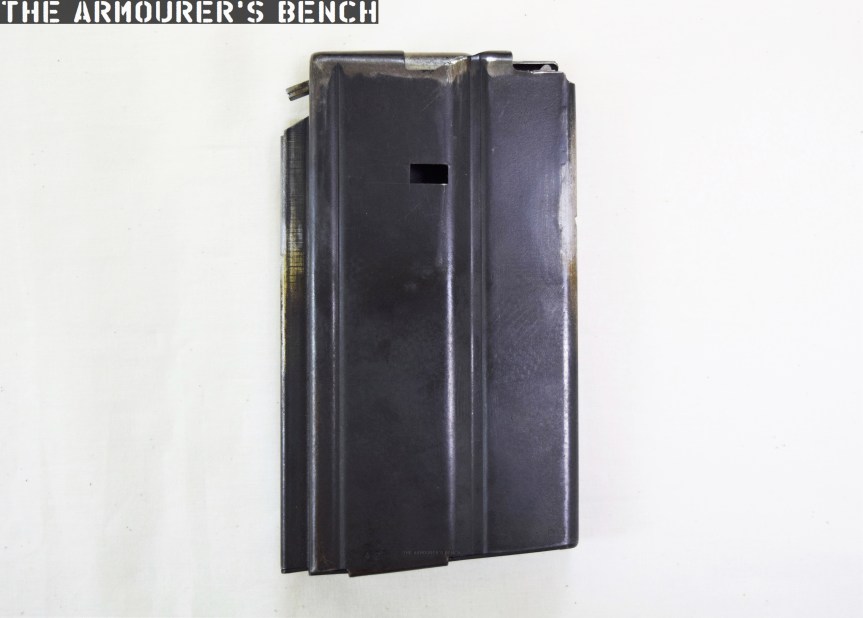
This prototype’s trigger guard assembly, which also comprises the magazine well floorplate, is a self-contained assembly and does not interact with the weapon’s trigger mechanism or action. While Sefried had a patent for his own magazine system (US #2386722) this rifle uses a slightly different magazine release and floorplate, which is similar to one seen in Stefan Janson’s 1956 patent for a stripper clip-loading box magazine for the M1 (US #2894350). The magazine used in this prototype, however, is not the same as Janson’s. It has fixed feed-lips and a projection at its rear which appears to house an anti-tilt tab for the follower.
The rifle’s magazine (Matthew Moss)
The rifle does not to appear to use the full-automatic system seen in either of Sefried’s patents. Similarly, the safety selector is located on the left side of the receiver, forward, in line with the breech. It has two positions with an arc of about 90 degrees. This position does not match Sefried’s patents for select-fire conversion, however, it does match the position patented by David Marshall Williams but not Williams’ selector’s orientation of travel. I have been unable to find a patent which matches this rifle’s selector or method fully-automatic conversion.
Left-side view of the rifle’s receiver showing the fire-selector (Matthew Moss)
The pistol grip is an interesting addition as neither of the other Winchester select-fire prototypes nor the original select-fire Springfield prototypes incorporated one. Visually it is very similar to that seen on the later Italian Beretta BM 59 Mark II. In an effort to lighten the rifle the prototype also has an aluminium buttplate. One of ingenious internal changes is the milling of the bottom of the barrel flat, this not only has the effect of lightening the rifle but also allows a new, straight operating rod to travel rearwards under the barrel. How this impacted on the barrel’s harmonics is unclear. The rifle certainly feels lighter and handier (when unloaded) than you would expect, weight is estimated to be around 7 or 8 lbs.
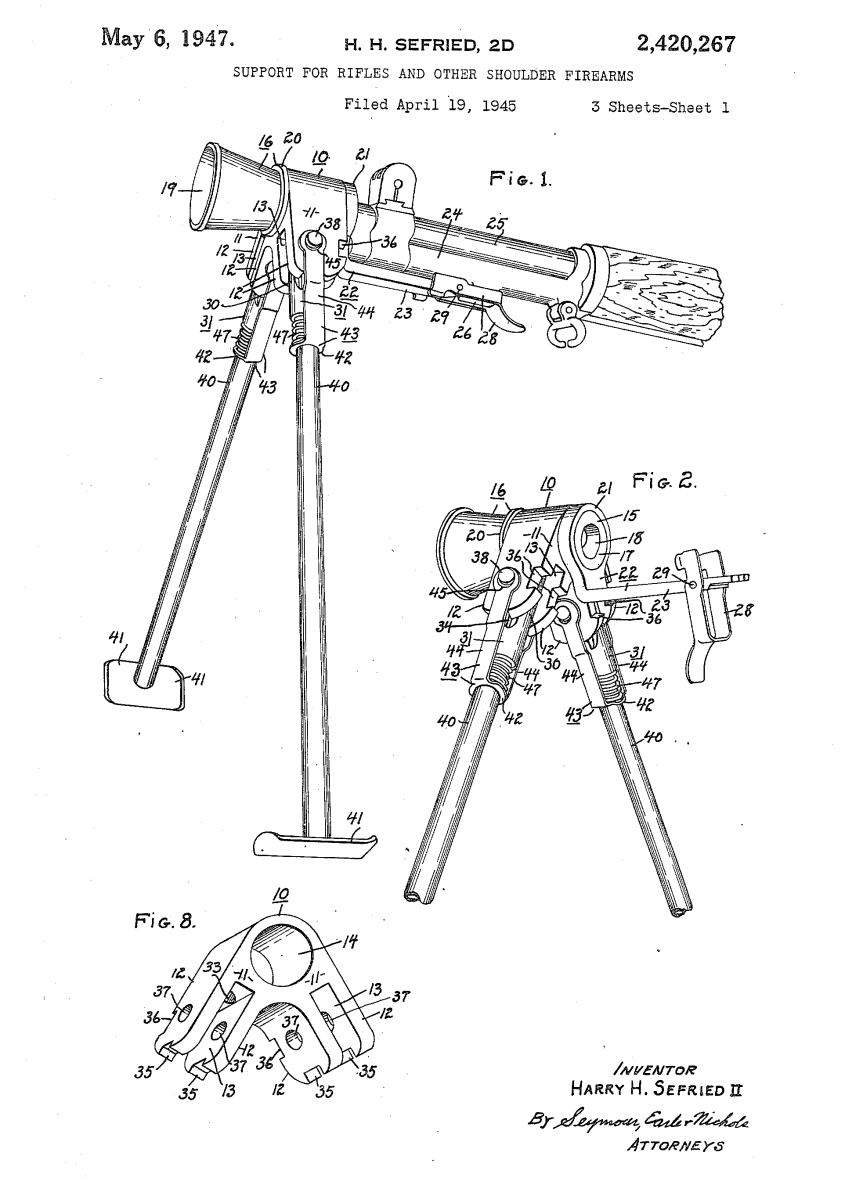
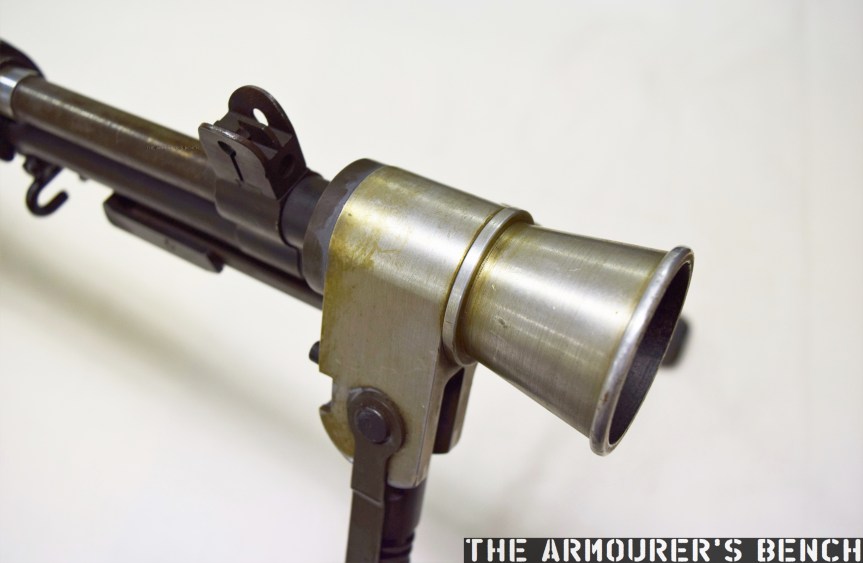
The bipod, patented by Sefried in April 1945, (US #2420267) comprises a pair of tube steel legs, which have a set height, and a conical aluminium flash hider. The legs are spring-loaded and the entire assembly attaches via a latch which seats over the rifle’s bayonet lug. The bipod is the only element of this rifle that can be attributed to Sefried directly. And by the bipod’s very nature of attachment may simply have been attached later.
Sefried’s 1947 patent for the bipod-flash hider (US Patent Office)
The best documentary source available for the prototype is the entry in the Winchester Factory Museum’s collection inventory offers some tantalising clues but no definitive answers:
#1504 U.S. Model M-1 rifle (Garand)
Cal. 30-06; experimental semi or full auto.
3rd type 20 shot box mag.
Special butt plate for shoulder rest
Bipod and aluminum flash hider attached
From H. Sefried 10-26-45
The suggestion that the rifle is chambered in .30-06 is seemingly an error given the internal changes made to the rifle. ‘3rd type’ suggests an iterative development of the rifle’s magazine while “special butt plate for shoulder rest” may allude to the aluminium butt plate but the prototype’s plate has nothing resembling a ‘shoulder rest’, instead it is a simple chequered aluminium plate about 5mm thick. While ‘From H. Sefried 10-26-45’ may refer to the whole rifle, I believe it more likely refers simply to his bipod.
A close up of Sefried’s bipod-flash hider (Matthew Moss)
The prototype appears to be chambered in an iteration of the .30 Light Rifle round, which later became known as the T65. The rechambering was achieved by installing a metal block which shortened the magazine well. Unlike earlier Winchester select-fire conversions this rifle feeds from a proprietary magazine designed to feed the T65 round. This magazine does not appear to closely follow the pattern used by Winchester on several other designs during the period. The projection from the rear of the magazine slides along a channel cut in the metal magazine well block. It has font and rear locking shelves, with the front shelf acted on by the magazine release lever.
A look at the rifle’s receiver and serial number markings from above (Matthew Moss)With the action open. Note the magazine insert at the rear of the magazine well (Matthew Moss)
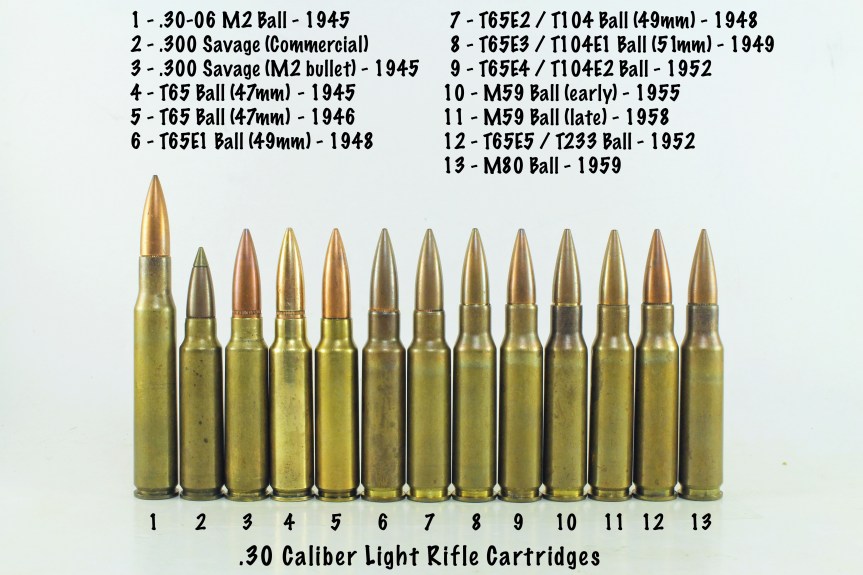
Development of the .30 Light Rifle round, which would eventually become 7.62x51mm, began in 1944, with the round first being referred to as the T65 in 1946. It appears that the rifle is chambered in a version of the T65 cartridge, but which iteration exactly is unknown. However, its chambering does support the theory that the prototype may date from 1947-48. The T65 didn’t take on the now standard 7.62x51mm dimensions until 1949 in the form of the T65E3 round but without a chamber casting it is impossible to know the rifle’s exact chambering.
A photo representing the evolution of the .30 light rifle round (Courtesy of DrakeGmbH)
While Winchester continued to work on adapting the M1 Garand into a select-fire rifle none of their rifles were seriously considered by US Ordnance. At the same time John Garand was working on his own series of select-fire, magazine-fed prototypes (the T20 series) at Springfield while Remington had also been awarded a contract to develop a similar rifle, tested under the designation T22. These projects subsequently gave way to a number of other designs, all chambered in the T65 round, including the T25/47, T44 and T48. These were all tested before the Garand-influenced T44 was eventually selected in 1957, becoming the M14.
Addendum:
Harry Sefried II served in the US Army Air Corps during World War Two before joining Winchester as a firearms designer in 1944. In the 1950s he left Winchester to become Ruger’s chief engineer until he retired in 1979. He died in 2005, aged 84.
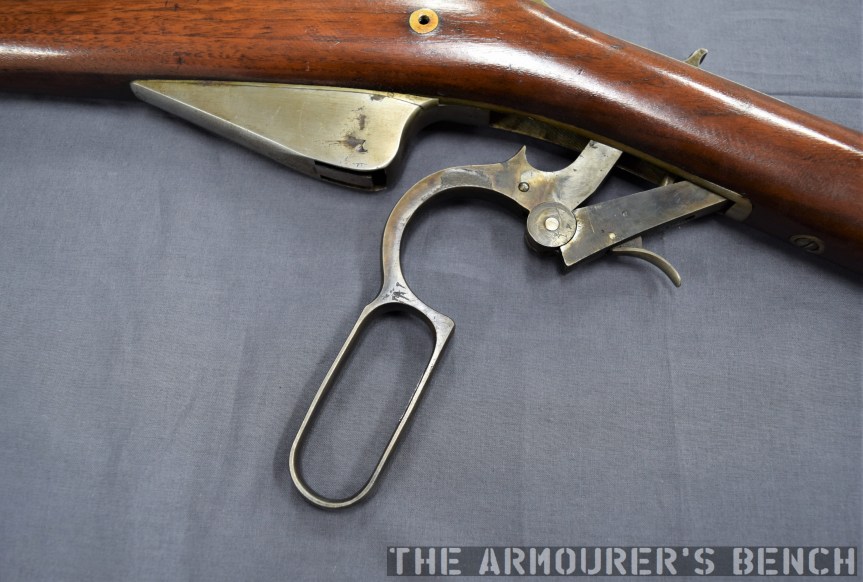
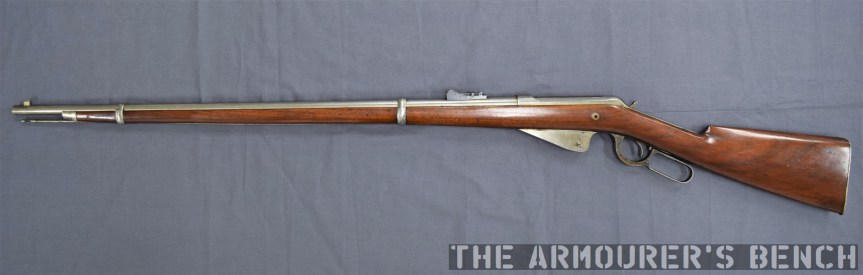
The 1890s were one of John Browning’s most prolific periods, during which he developed a host of firearms which would never actually see production. Here, we’re lucky enough to be able to examine one of those prototypes that were never produced. Dating from 1892, this rifle departs from Browning’s earlier lever-action rifle designs in a number of interesting ways. Perhaps the most interesting aspect of the design is its use of en bloc clips, instead of the tube magazine traditionally used by Winchester’s repeating rifles. John Browning, and his brother Matthew, filed the patent covering the design in June 1892.
Right side of the rifle, note its ‘musket’ configuration (Matthew Moss)
The rifle is in what is typically referred to at the time as a ‘Musket’ configuration, signifying that it is a military long-arm. It has a long 32.5 inch barrel, which is held in place by two barrel bands. Overall the rifle is around 50 inches in length and weighs just over 9lbs. The rifle is chambered in a .30 calibre cartridge, likely the then new .30-40 Krag round given its proposed market. It has a ladder-style rear sight with range graduations from 100 to 1,000 yards.
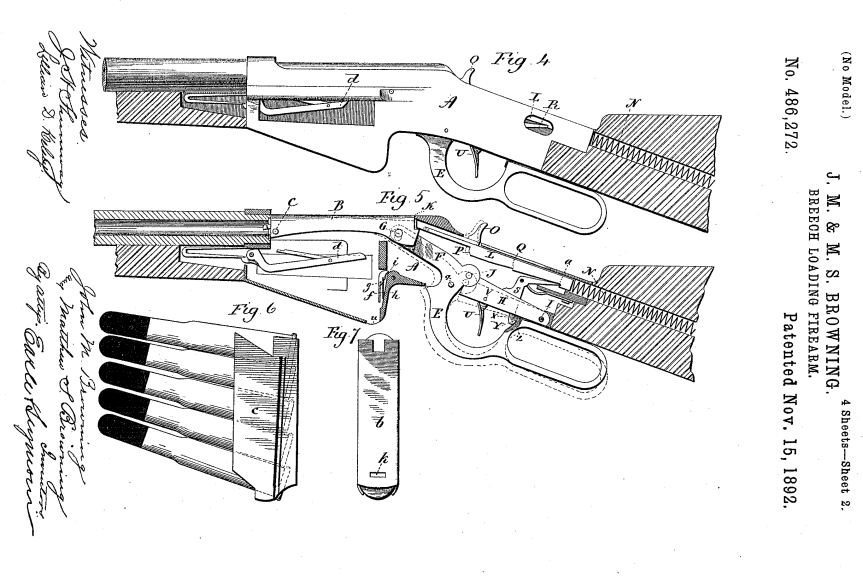
Browning’s patent drawing showing the rifle’s action (US Patent Office)
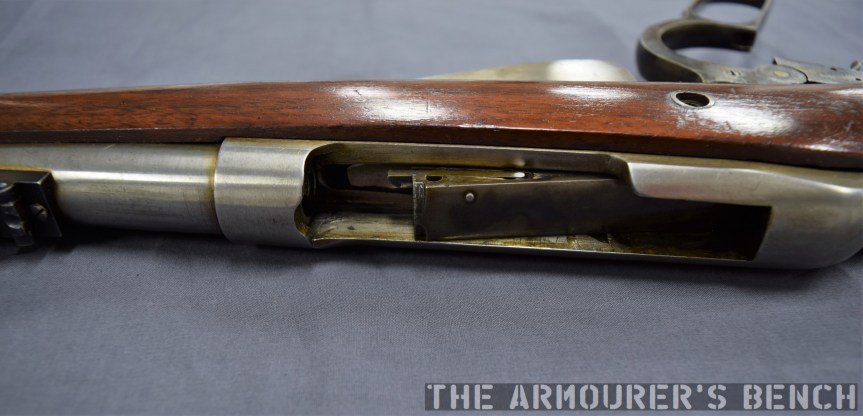
Okay, let’s take a closer look at the prototype. During the 1890s Browning experimented with a series of magazine systems including an en-bloc clip system. This rifle uses a 5-round magazine which is fed from an en-bloc clip. The idea of an en-bloc clip was relatively new with Ferdinand Mannlicher patenting the idea in the 1880s and using it in his Model 1886 and 1888 rifles. It is unclear if Browning was familiar with Mannlicher’s system but the two are very similar. If you’re unfamiliar with en bloc clips it means that the cartridges are loaded into the weapon in the clip rather than stripped from the clip.
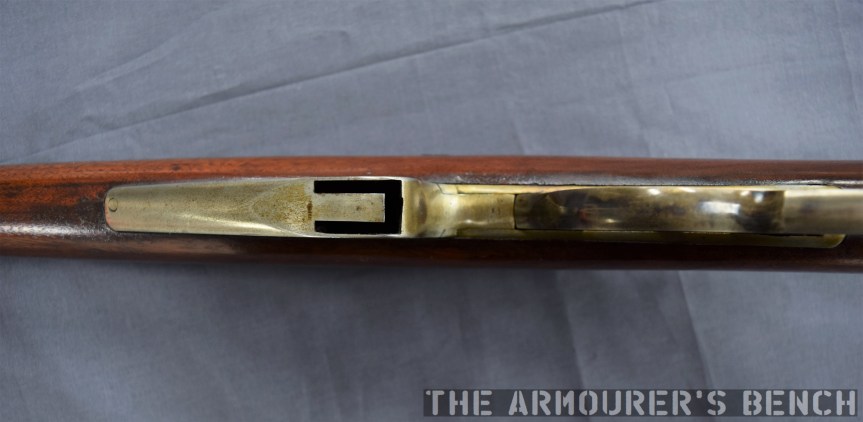
A look at the ejection port for the en-bloc clip (Matthew Moss)
Browning’s prototype holds five rounds in its clip, which from patent drawings we can see was not reversible. Sadly, we don’t have an example of Browning’s clip to examine but his 1892 patent (see above) gives us a good idea of what it would have looked like. It clearly has a cut at the top of the clip which appears to have been used to help guide the round up into the chamber.
Rounds were pushed up into the action by a follower arm which was actuated by a v-spring located at the front of the magazine housing. The bottom of the fixed magazine housing has a cut-out corresponding to the clip to allow it to fall or be pushed clear by a new clip once it was empty.
The rifle’s lever fully-forward with its action open and striker cocked (Matthew Moss)
The rifle also departs from the traditional hammer system and uses a striker-fired action. From the patent drawings we can see how the rifle’s striker worked, with a coil spring extending into the stock and a sear holding the striker to the rear. The striker is made up of two pieces with the striker hitting a long firing pin inside the bolt.
The striker has, what the patent refers to as, a ‘thumb piece’ to enable re-cocking and to indicate if its cocked or not. The striker was cocked by the cycling of the lever and held in place by the trigger sear.
A view inside the action with the bolt partially retracted before it moves down and back into the rifle’s wrist (Matthew Moss)
The lever was held in the close position, preventing out of battery discharges, by what Browning’s patent calls a downward-projecting dog, which projected through a small hole in the trigger assembly link and locked into a catch in the front of the lever loop.
The use of a striker, rather than an exposed hammer, allows the rifle bolt’s travel to be enclosed rather than have the bolt project out of the rear of the receiver, as in previous Winchester lever-actions, we can see that this rifle’s bolt slides back at an angle partially down into the wrist of the stock. This is arguably more ergonomic and potentially helps to prevent ingress of dirt.
The first half of the lever’s travel pulls the bolt to the rear, while the second part cocks the striker. An arm extending from the lever pushed the bolt rearward until the trigger sear was engaged. In order to give the lever enough throw to open the action far enough to allow a round to be loaded the trigger mechanism has to be pivoted out of the action, much like the earlier Winchester 1886.
The bolt has a pair of trunnions which project from the sides of the bolt, these run inside longitudinal grooves either side of the receiver, while the rear of the bolt is free to angle up and down as it cycles. The action is locked by the rear of the bolt secured against the rear of the receiver, rather than with a rising locking bolt.
Left side of the rifle (Matthew Moss)
During the period Browning was also working on other lever action and, even more unusual, so-called pull-apart actions as well as various magazine types including a revolving magazine, stripper-clip box magazines and of course as we’ve already seen a detachable box magazine-fed rifle. The 1890s were a truly prolific period for Browning.
The design was purchased by Winchester and the Brownings’ patent was granted in November 1892. The gun, like many of Browning’s other designs of the period, never saw production. Making this rifle a rare one-of-a-kind prototype. It’s an elegant design and the action is smooth. When Winchester did finally seek to produce a military lever-action they chose another of Browning’s designs which retained his traditional rear-locking bolt, which became the Model 1895.
This rifle is a unique prototype and it was an honour to examine it. It’s now on display at the newly refurbished Cody Firearms Museum at the Buffalo Bill Centre of the West. Our thanks to the museum for allowing us to film items, like this one, from the museum’s collection.
Matt recently had the pleasure of attending the Autumn 2019 Soviet Threat event at the Hack Green Nuclear Bunker in Cheshire. One of the people Matt had the chance to speak to was Allen from the MECo group of collectors and reenactors.
Allen portraying a member of the Royal Army Service Corps, c.1964 (Matthew Moss)
Allen was portraying a member of the Royal Army Service Corps, with uniform representing that of 1964, the year before the corps became the the Royal Corps of Transport. Allen was kind enough to explain his uniform and kit on camera.
Check out our earlier video with Rifleman Moore discussing his 60s PARA portrayal here.
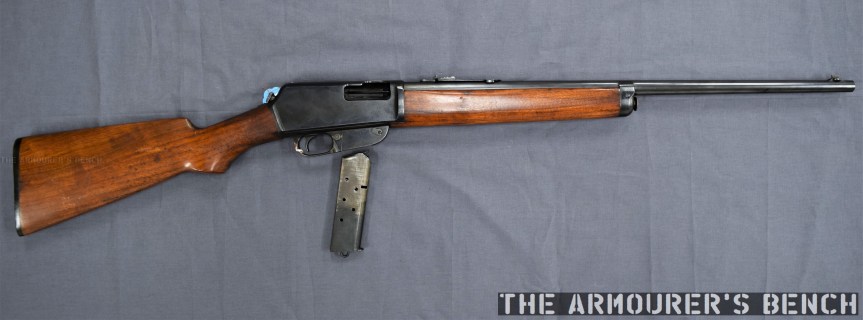
During my recent visit to the Cody Firearms Museum I was lucky enough to examine a number of interesting firearms (more videos soon). In this video we take a look at a Winchester Model 1905 chambered in .45 ACP.
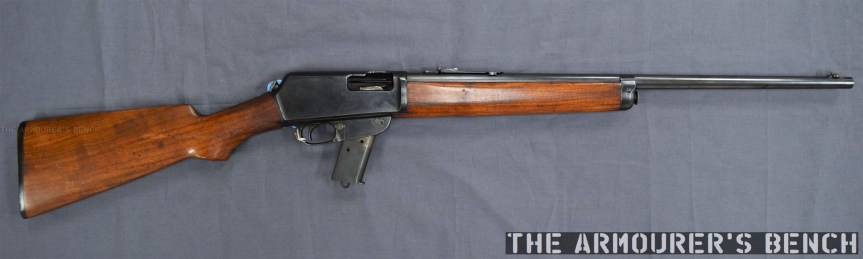
The Model 1905 was originally designed by Thomas Crossley Johnson, as a commercial rifle chambered in either .32 or .35 Winchester Self Loading. It was the second of a series of blowback operated rifles Johnson designed between 1903 and 1910.
Right-side profile of the converted Model 1905 (Matthew Moss)
The origins of this gun, however, are less clear. It is part of the Cody Firearms Museum’s impressive collection and is believed to be a Winchester-made prototype. Dating the rifle is more difficult. It was originally believed to have been developed during the First World War but the Winchester Arms Collection’s records date the rifle to 1919. It has also been suggested that the conversion may have been developed by Winchester as an auxiliary arm for the US Army, as a replacement for the 1911 pistol for some troops – much along the lines of the later .30 carbine. There are no records, however, to suggest the .45 ACP Model 1905 was ever officially tested.
Herbert Houze, former curator of the Cody Firearms Museum, believed the conversion was actually developed after World War Two. No patents or Winchester documents are known to refer to it but Houze believed that one of Winchester’s engineers, Harry H. Sefried, developed the conversion as a side project with a potential aim to interest law enforcement agencies in a carbine chambered in the readily available .45 ACP round.
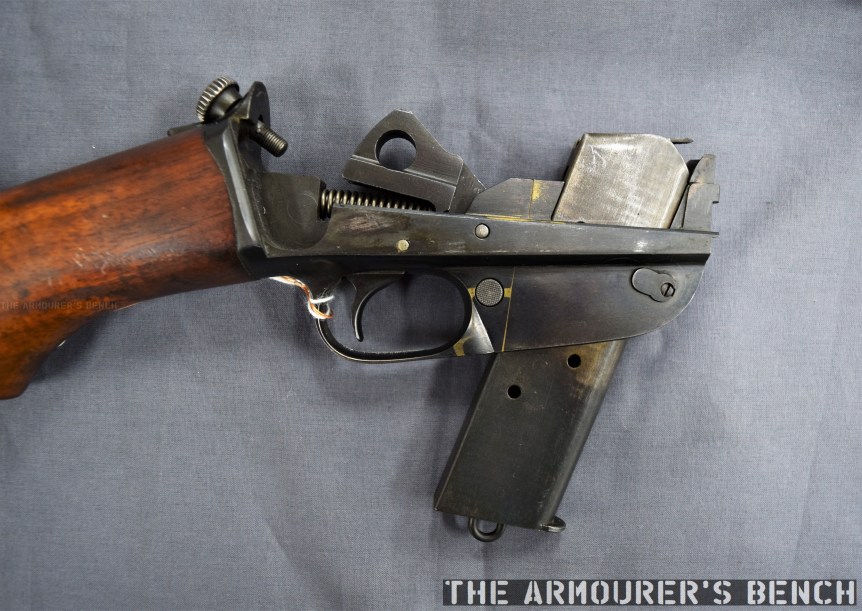
The carbine with the 1911 magazine removed and the bolt back (Matthew Moss)
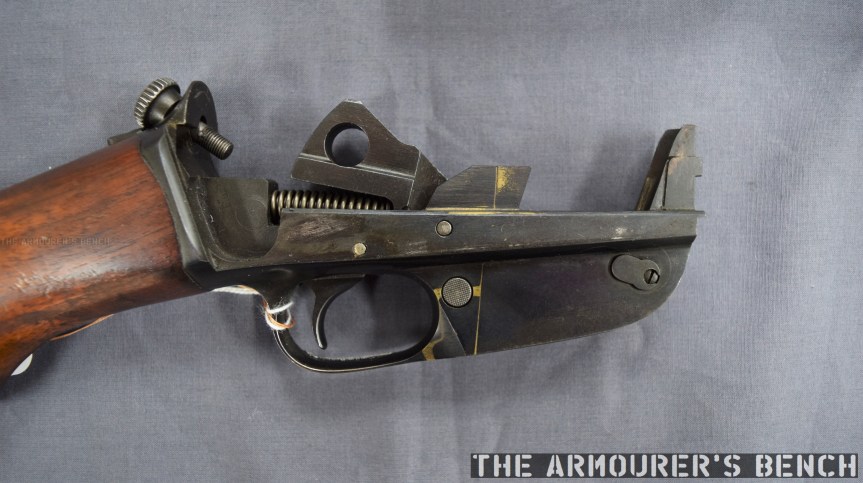
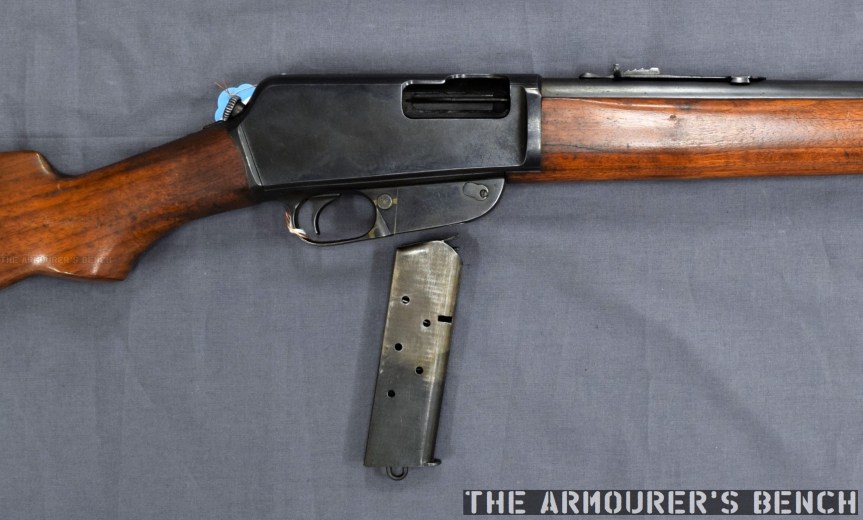
Taking a stock rifle a number of changes were made, the rifle was re-barrelled and rechambered for the .451-inch .45 ACP round and the bolt face was modified slightly. The 1905 originally fed from straight 5 or 10-round box magazines. In order to feed from a Colt 1911 magazine a new magazine housing was added. The curved front of the trigger guard has been machined back and is now flush with the rear of the conversion housing which appears to be integral to the lower receiver’s frame. On close inspection we can clearly see that parts have been brass brazed together around the original magazine release and inside the magazine well.
With the 1905’s upper receiver removed we can see how the 1911 magazine aligns with the bolt and breech (Matthew Moss)
The rounded magazine housing has a new magazine release positioned at the front of the magazine, as in the 1911 and allows the magazine to be inserted at an angle. The ejection port has also been altered with an additional cut-out being made at the top to aid ejection.
With the rifle stripped down and the magazine removed we can see the conversion magazine housing, note what appears to be brass brazing (Matthew Moss)
Take down remains the same, with the upper and lower separating once the take down screw at the rear of the receiver is loosened. The conversion appears to be well thought out and the finish and care taken would indicate this was rifle wasn’t a rough proof of concept prototype. Sadly, there is no information on how the conversion performed.
A close up of the rifle’s receiver and Colt 1911 magazine (Matthew Moss)
Regardless of the origins of the conversion Winchester never offered the chambering commercially and this prototype is the only example known to exist. Today, it is held by the Cody Firearms Museum at the Buffalo Bill Centre of the West in Wyoming. The museum has just undergone a major renovation and is well worth visiting. Our special thanks to the CFM for letting us examine this rare rifle.
Herbert Houze, the former Curator of the Cody Firearms Museum who is mentioned in this article and video, recently passed away – this video is dedicated to his memory.