In addition for the full episode on the Winchester Experimental Submachine Gun, we have also put together a video showing the reassembly process for the N2 prototype that we disassembled and examined in the main video. Check it out below:
My thanks to the Cody Firearms Museum at the Buffalo Bill Center of the West for allowing me to examine and film the Winchester submachine gun prototypes. Special thanks to the CFM’s assistant curator Danny Michael for helping disassemble and reassemble the N2.
If you enjoyed the video and this article please consider supporting our work here.
Held in the collection of the Cody Firearms Museum (CFM), at the Buffalo Bill Centre of the West, is a most intriguing Cold War submachine gun. The weapon came from the collection of the old Winchester Firearms Museum, which the CFM inherited, it is not a test & evaluation weapon made by another company but a submachine gun designed and developed by Winchester. Those who know their Winchester history will know the company had no prior background in submachine gun design, instead being best known for their rifles and shotguns.
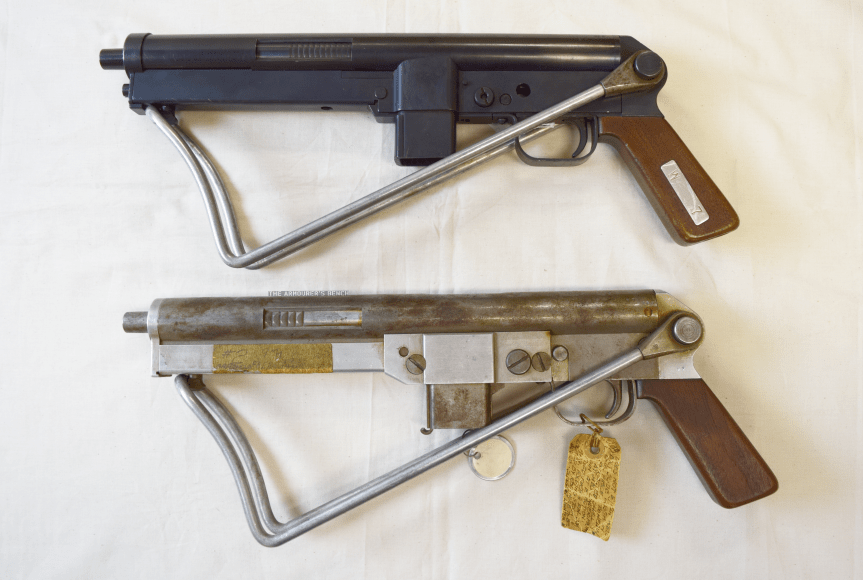
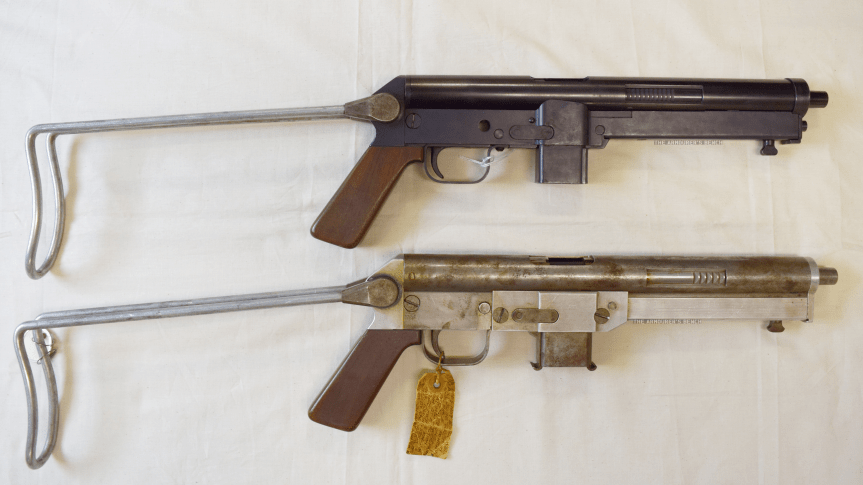
Left side profile view of the N4 and N2 Winchester submachine gun prototypes with their stocks folded (Matthew Moss)
Very little is known about Winchester’s submachine gun project, but two prototype examples survive, an early ‘in the white’ model labelled ‘N2’ and another which Herbert Houze, the CFM’s former curator, designated ‘N4’ . The documentary evidence for the Winchester submachine guns is sparse, amounting to just entries in the Winchester Museum’s inventory and a faded battered item tag attached to N2. A confusing element is that the inventory simply refers to the two prototypes as N-1 and N-2, with no mention of an N4.
There is also believed to be original engineering drawings housed in the Winchester Archival collection, currently held by the McCracken Research Library, but searches by myself and library staff have been unable to locate these.
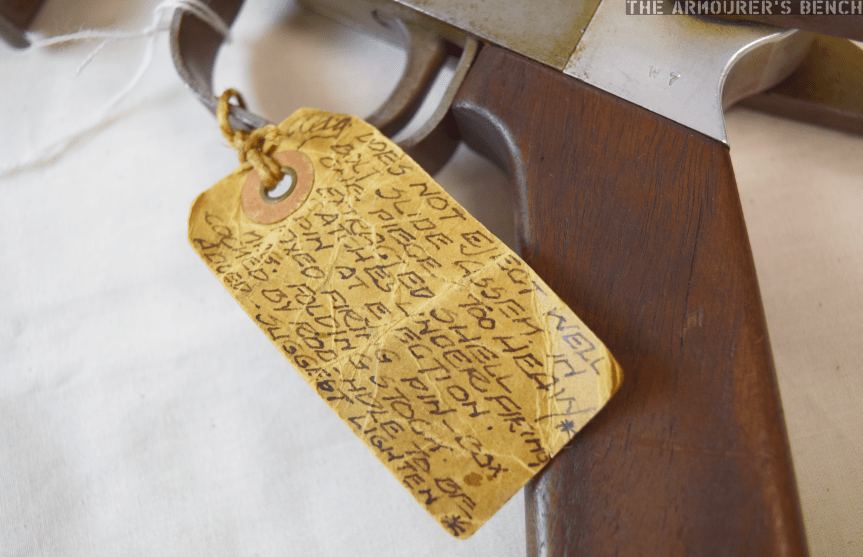
It is unclear if the tag from N2 is contemporary, perhaps added when the gun was handed over to Winchester’s museum, or if it was added later. In under 100 words it give us a short potted history of the N2 itself and the company’s programme to develop a submachine gun.
Close up of the N2’s item tag detailing the gun & program’s history (Matthew Moss)
Houze suggests the development programme began in 1955 and the tag attached the N2 suggests that development ceased in 1957, whether this is solely for that gun or the entire programme is unclear. This would make Winchester’s weapon a contemporary of the famous Israeli UZI.
The tag describes the N2 as a 9mm blowback ‘NATO Burp Gun’, followed by the name A.A. Arnold, a Winchester engineer perhaps best known for writing a series of manuals for Winchester firearms, followed by ‘dropped Dec ’57’. In his 1994 book, Winchester Repeating Arms Company: Its History & Development from 1865 to 1981, Houze suggests that the weapons were designed by A.A. Arnold and Melvin M. Johnson in 1955, for possible adoption by NATO. The association with NATO might also be the origins of the ‘N’ prefix. I have been unable to find any published patents attributed to Arnold, Johnson or the company relating to the experimental submachine gun.
I contacted NATO’s Archives who advised that they were unable to find any reference or documentation relating to a direct NATO submachine gun requirement. Another possibility is that the weapon was developed to market more broadly to NATO member nations. The submachine gun market at this time in Europe, however, was already saturated by both wartime surplus and a new generation of guns, including the Sterling, the UZI, the Madsen M50, and the Carl Gustav m/45.
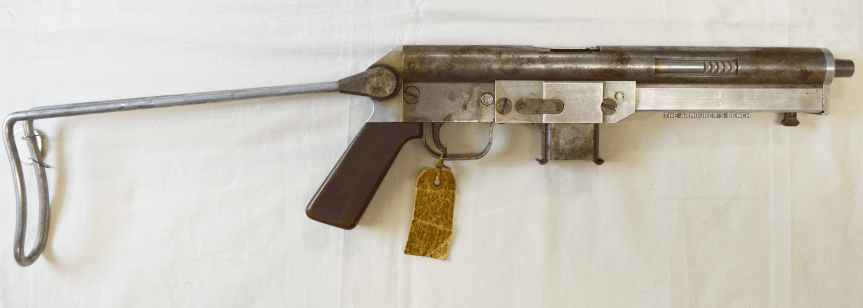
Right side profile view of the N2 ‘in-the-white’ prototype with its stock deployed (Matthew Moss)
The reverse of the N2’s label documents the prototype weapon’s reliability and feeding problems. The tag states that the N2 did “not eject well” and that the bolt slide assembly was too heavy. It also highlights failures to cycle properly with extracted cartridge cases catching under the firing pin. The label then gives a brief description of some of the N2’s features: “fixed firing pin, 33x Mag. Folding stock.” Interestingly, it also notes that the weapon would be cocked by a rod – the hole for which had not yet been added. The tag ends with a suggestion that the heavy one piece bolt assembly should be lightened.
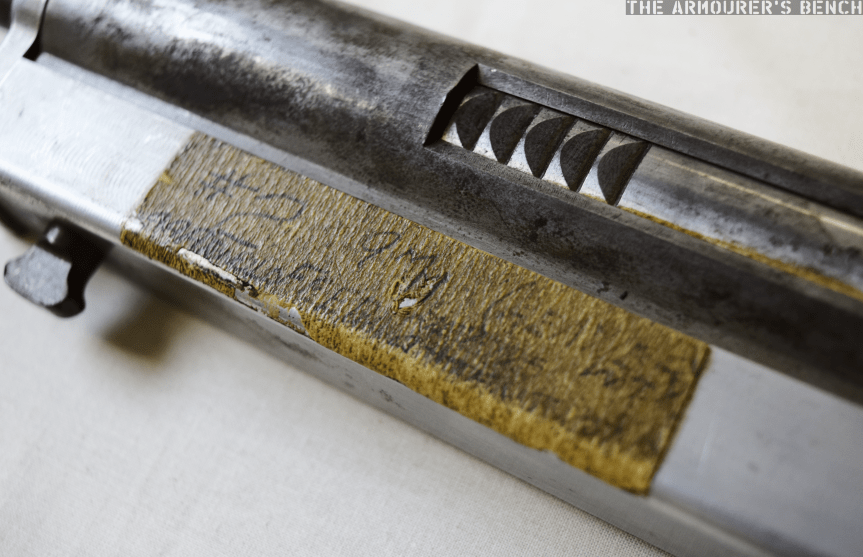
Close up of the N2’s difficult to decipher tape note (Matthew Moss)
N2 itself also has a piece of masking tape, on the recoil spring assembly cover, with its serial number and calibre written on it, along with A.A. Arnold’s name and some words that are too difficult to make out, but include ‘feed’.
Houze has also suggested that Melvin Johnson, designer of the Johnson rifle and light machine gun who joined Winchester as a designer and adviser in the early 1950s for a short time, and Stefan Janson, designer of the Brtish E.M.2 bullpup and subsequent Winchester engineer, both worked on the project. However, I have been unable to find any documentary evidence of their involvement.
Examining the N2:
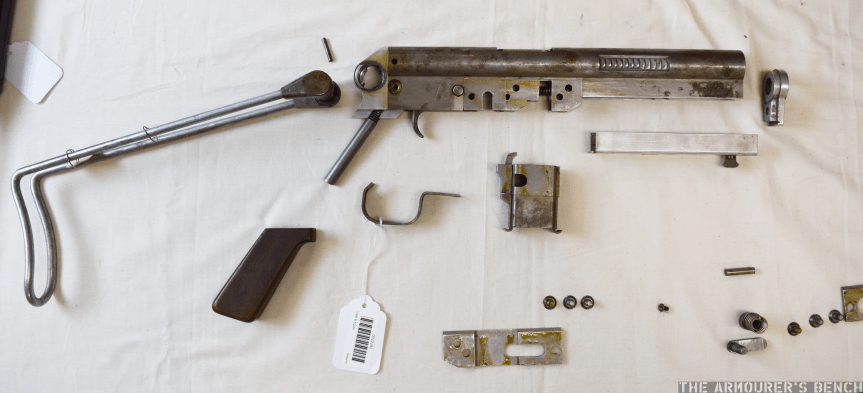
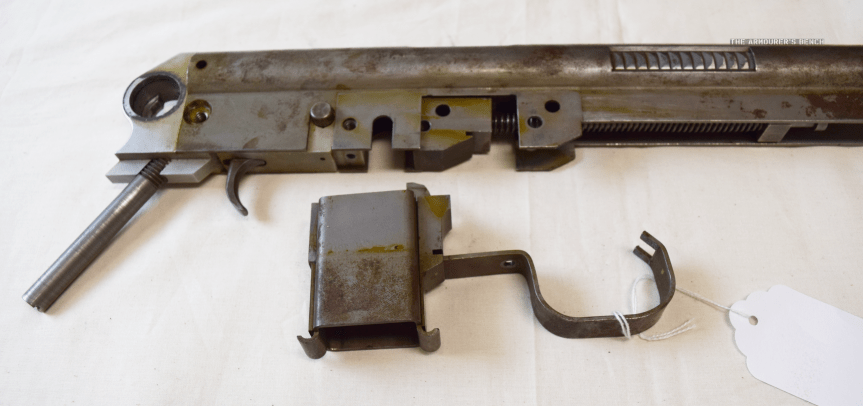
Winchester N4 and disassembled N2 prototype (Matthew Moss)
We can learn a lot from hands on examination of the two Winchester ‘N’ prototypes. Examining N2 we find that the receiver is made up of a piece of shaped sheet metal with a rounded upper half containing the barrel, bolt and cutouts for the grip points on the bolt assembly that allow charging. The bolt assembly rides over the rear portion of the barrel and projects back into the receiver. The lower section of the stamped receiver is rectangular and has a cut out for a separate magazine housing and fire control mechanism consisting of a trigger and push through safety – which we did not remove during disassembly. The N4 is missing its safety.
Close up of the N2’s magazine housing and trigger guard, note also the trunion freed from the receiver (Matthew Moss)
In the N2, the magazine housing is held in place by the stamped metal trigger guard which rocks into a notch behind the trigger and at the front interfaces with a notch in the magazine housing which has to be placed in the receiver at the same time, both are then held in place by a screw. This was changed in the later ‘N4’ with the trigger guard as a separate independent piece.
Winchester N2 Prototype Reassembly:
The side plates, muzzle end cap and recoil spring assembly cover all made from Aluminium – ostensibly to reduce weight. The submachine gun prototypes both use a pinch cocking method similar to that seen in the earlier British BSA WELGUN developed during WWII. The recoil spring proved to be too strong to cock easily, the addition of ‘rod’ cocking handle is suggested on the N2’s tag. The blued, later N4 prototype, however, is still lacking a conventional cocking handle. The pinch cocking method is not ergonomic, the user’s fingers could easily be caught by reciprocating bolt in charging cut outs in the receiver.
The N2 prototype disassembled, sadly we were unable to free the bolt from the receiver (Matthew Moss)
Another ergonomic consideration is the Winchester’s submachine gun’s unusually swept back pistol grip angle, the angle of the forward grip made by stock when folded is also similarly angled. Both the weapons have a push though safety selector just above the trigger (likely safe & fully automatic, but could not check as gun unable/difficult to cycle the prototypes easily). The weapon likely fed from a double stack, single feed magazine – either of an similar pattern to the MP40 or proprietary. The N4 seen in Houze’s 1994 book is shown with an MP40 magazine. UZI magazines fit the weapon but don’t lock into place.
The basic design does not change substantially between the prototypes with the control configuration, folding wire stock, pistol grip angle and magazine housing dimensions remaining the same. The N4, however, differs from the earlier prototype in a number of respects. The N4’s nose cap now fits over the rounded half of the receiver, rather than sitting flush and the cut outs in the upper receiver to access the bolt assembly for charging have been moved back slightly.
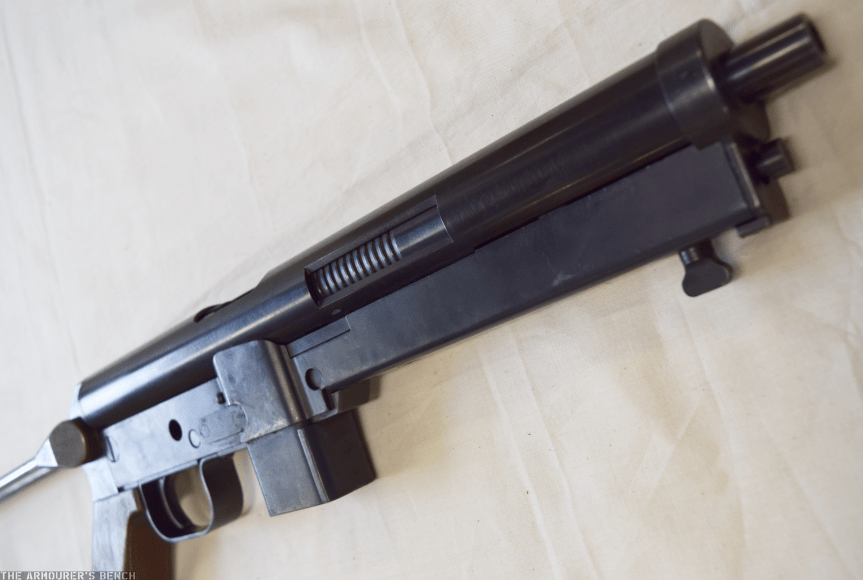
Right side view of the N4 blued prototype, note the half cocked bolt and the narrower grip serrations on the bolt assembly. Note also the intersection points of the recoil spring assembly cover and the upper receiver (Matthew Moss)
The later N4 model has pins in place of some of the screws used on the N2. The side plates have been replaced by a one-piece recoil spring assembly cover which projects back further over the magazine housing to the rear of the receiver. The most fundamental difference between the two is that it appears that the front part of the N4’s receiver has been significantly altered with the lower receiver at the front of the gun removed. It appears to have been replaced by the recoil spring assembly cover which appears to slot into the receiver. Sadly, we didn’t have time to disassemble the N4 to examine this.
The N4’s bolt assembly also has more serrations, in a slightly different orientation, on its bolt assembly gripping area, but still no charging handle as recommended on the N2’s tag. The ejection port on the blued prototype is also at a position closer to 12 o’clock when compared to the N2s.
Right side profile view of the two prototypes with their stocks deployed (Matthew Moss)
The N2 has a metal trunnion block, that the recoil spring guide rod screws into, this is held in place within the receiver by a cross pin. The bolt appears to be removed through the rear of the receiver once the stock assmbly/end cap is removed and the bolt assembly freed.
The folding stock was retained by spring tension of the wire metal stock against a wingnut-shaped catch that is riveted onto the recoil spring assembly cover. The stock is locked by a spring loaded push button system similar to the MP40s, this is not particularly sturdy. The shape of the wire stock itself is reminiscent of the US M3. When folded the butt of the wire stock acts as a front grip, the retention of the stock is surprisingly strong and stable.
Intriguingly, the Winchester Museum inventory notes that the guns are designated the N-1 and N-2, with an additional wooden model of the ‘Nato Burp Gun’ being transferred along with a box of duplicate parts in steel for the N2’s aluminium parts.
If you enjoyed the videos and this article please consider supporting our work here.
Winchester Repeating Arms Company: Its History & Development from 1865 to 1981, H. Houze (1994)
My thanks to the Cody Firearms Museum at the Buffalo Bill Center of the West for allowing me to examine and film the Winchester submachine gun prototypes. Special thanks to the CFM’s assistant curator Danny Michael for helping disassemble the N2.
All photographs taken by Matthew Moss, courtesy of the CFM & the Buffalo Bill Center of the West. Please do not reproduce photographs without permission or credit.
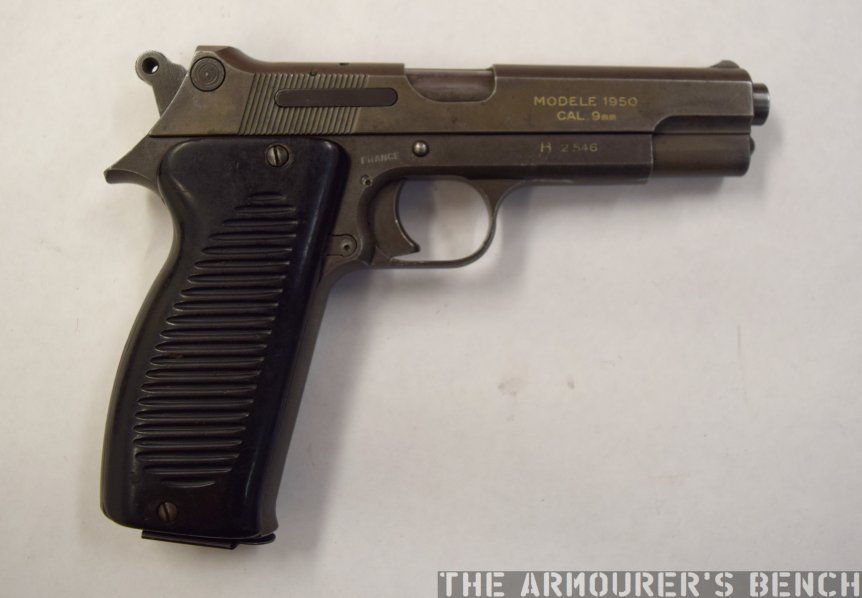
In this live fire video we’re going to take a look at the MAC Modèle 1950, a French 9x19mm service pistol. The Modèle 1950 replaced the earlier M1935A and M1935S pistols, both chambered in 7.62mm longue.
In 1946, the French Army began the process of selecting a new service pistol, chambered in the more powerful 9x19mm round. A number of designs were tested including the SIG P210. The Modèle 1950 was developed by Manufacture Nationale d’Armes de Saint Étienne (MAS) and while suffering initial reliability problems it was refined and eventually adopted.
The Modèle 1950 combined elements from the previous 1935 pistols but added a larger, more ergonomic grip. The pistol feeds from a 9-round single stack magazine, has a single action trigger and has a slide mounted safety which blocks the hammer.
Riht side view of the French MAC Modèle 1950 service pistol (Matthew Moss)
Shooting the Modèle 1950
I enjoyed shooting the Modèle 1950, its large grip size makes it pleasant to shoot but felt like it should have held a larger double stack magazine. The pistol has a decent set of combat sights, easy to pick up in good light.
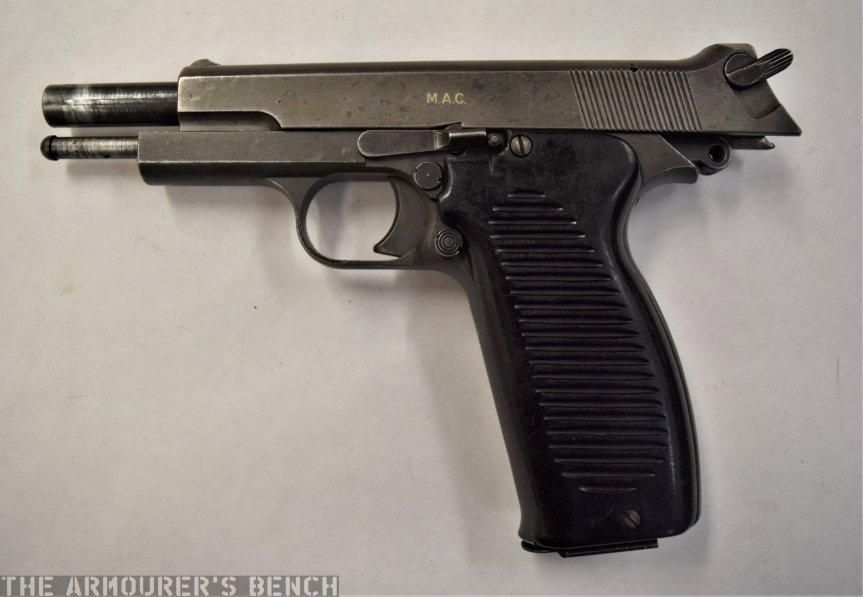
Through firing several magazines through the pistol it became clear that you had to be sure not to accidentally engage the safety when racking the slide. This is something I encountered and explain in the video. It took me a few of seconds to realise the problem, take the safety off and recock the hammer. In the safe position the catch juts out the back of the slide, while this is a good indicator of the weapon’s condition it seems possible it could be disengaged while in a holster.
A view of the left side of the Modèle 1950, note the slide mounted safety catch in the safe position (Matthew Moss)
Produced at both MAS and Manufacture Nationale d’Armes de Châtellerault (MAC), over 340,000 Modèle 1950 were manufactured. The pistol is still in limited French service but has largely been replaced in service by the PAMAS G1, a licensed version of the Beretta 92.
We will have a full video and blog looking at the earlier Modèles 1935A & S and the 1950, examining the design, development and history of pistols in the future. My thanks to my friend Chuck Kramer over at Gun Lab for helping us with this video, check out his blog here.
If you enjoyed the video and this article please consider supporting our work here.
Today we’re examining an intriguing firearm with a fascinating history. It is difficult to understate the potential importance of the Curtis Rifle. Despite being designed in Britain in the 1860s the firearm gained more notoriety when it was offered as evidence in a legal battle between the Winchester Repeating Arms company and Francis Bannerman. What makes the firearm most noteworthy, however, is its fundamentally unconventional layout. Designed by William Joseph Curtis in the mid-1860s, it is arguably one of the earliest ‘bullpups’ and almost certainly the first repeating bullpup.
William Curtis’ 1866 ‘bullpup’ rifle, built in 1895 by Winchester (Photo by Matthew Moss, courtesy of the Cody Firearms Museum)
For the purpose of this article it would be wise to first define what a bullpup actually is. It can be defined as a weapon with a somewhat unconventional layout which places the action and magazine behind the weapon’s trigger group. This has the benefit of maintaining a conventional rifle’s barrel length while making the overall length of the rifle more compact.
Bullpup rifles became popular with a number of militaries around the world during the 1970s and 1980s – namely the Austrian Steyr AUG, the French FAMAS and the British SA80, and more recently with rifles from China and Singapore as well as the Tavor series of rifles from Israel.
Thorneycroft, Farquhar and Hill’s 1905 carbine patent (source)
The bullpup, however, dates back much further with some argument to be made for the first firearms to utilise the concept being 19th century percussion target shooting rifles. The earliest military bullpups date to the beginning of the 20thth century, these include a rifles designed by Samuel McClean, the initial designer of the Lewis Gun, patented in 1896 (US #723706), by Major Philip Godsal (US #808282) and a carbine developed by James Baird Thorneycroft in 1901. Thorneycroft subsequently worked with Moubray Gore Farquhar and Arthur Henry Hill to patent a refined version of the carbine in 1905 (US #827893). While the Thorneycroft was tested by the British army it was rejected due to ergonomic and reliability shortcomings.
In 1908 Lieutenant-Colonel Armand-Frédéric Faucon of the Troupes Coloniales (French Colonial Infantry) began developing what he termed a ‘Fusil Équilibré’ or balanced rifle. Faucon patented his concept in France in 1911 (FR #422154) and continued to work on the balanced rifle during World War One, utilising a Meunier A5 semi-automatic rifle in working prototypes. The Faucon-Meunier rifle was tested in 1918 and 1920 but eventually rejected. It would be nearly 45 yeas before the bullpup concept was revisited by a major power. Engineers working at the Royal Small Arms Factory at Enfield and at the British Armament Design Department in the 1940s began to develop designs based around the bullpup concept. (Some of these will hopefully be the focus of future videos!)
William Curtis’ design, however, predates all of these. Patented in Britain on 10th July, 1866, Curtis is listed by the London Gazette as a Civil Engineer. His design is unlike anything that had been seen before. Based on a slide-action with a drum magazine, it was placed over the shoulder – much like a modern shoulder-fired anti-tank weapon.
William Joseph Curtis’ July 1866 patent for ‘Breech actions, sliding breech-block & stocks’ (courtesy of Research Press)
Curtis’ rifle is probably the very first bullpup magazine rifle, one of the earliest to have a drum magazine (an Italian, Marco Antonio Francois Mennons, patented an earlier design for a drum magazine in March 1862, GB #637) and also an early striker-fired design. Clearly a design well ahead of its time and radically unconventional.
This unconventional gun’s designer was born in Islington, London in 1802, as a civil engineer he worked on Britain’s rapidly growing railway network. He died in 1875, placing the development of his rifle nearer the end of his life. With hindsight Curtis’ design clearly had revolutionary potential but it appears that his concept was never taken up. It appears that he only patented his design in the United Kingdom. If not for a corporate lawsuit on another continent, decades later, then it is possible Curtis’ design, like so many others, would have slipped into historical obscurity.
Francis Bannerman vs. the Winchester Repeating Arms Company
In 1890, Francis Bannerman VI, a successful entrepreneur specialising in junk, scrap and later surplus, purchased the Spencer Arms Company and the rights to their patents. The company had been founded by Christopher Miner Spencer, designer of the Spencer Rifle, they produced the first commercially successful slide or pump-action shotgun. This pump action shotgun was designed by Spencer and Sylvester H. Roper and patented in April, 1882 (US #255894). Bannerman continued producing the shotgun as the Bannerman Model 1890, however, in 1893 the Winchester Repeating Arms Company, introduced the John Browning-designed Model 1893 pump shotgun (US #441,390).
Spencer & Roper’s 1882 patent for their pump action shotgun (source)
In response in October 1894, Bannerman filed a law suit against the Winchester Repeating Arms Company claiming that the slide/pump actions used by Winchester’s Model 1890 and new Model 1893 shotgun infringed on the patents that he owned.
He called for the court to force Winchester to halt production and claimed $10,000 in damages and royalties for the sale of guns which he believed infringed his patent. Winchester temporarily halted production of the Model 1893, in the meantime Bannerman continued producing and improving his shotgun introducing the 1894 and 1896 models.
News report on the ruling of the Bannerman vs Winchester case from The Times (Philadelphia), 27th June, 1897
Various contemporary newspaper reports suggest between 100,000 and 500,000 people were directly interested in the case as ordinary owners were liable under the conditions of Bannerman’s suit.
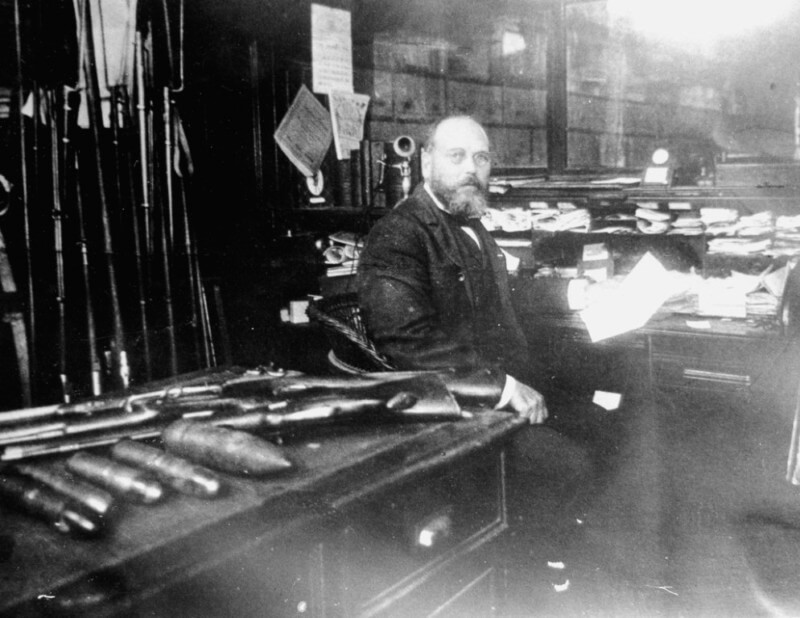
Winchester dispatched George D. Seymour to Europe to scour the French and British patent archives for any patents for similar actions that had been filed there before those now owned by Bannerman. Winchester discovered four patents: three British and one French. The earliest of these was Alexander Bain’s patent of 1854. Two more patents held by Joseph Curtis and William Krutzsch were found, dating from 1866. The later French patent was filed by M.M. Magot in 1880. All of these designs, including the Curtis we are examining here, never progressed beyond the development stage and were largely forgotten until rediscovered by Winchester.
Model of William Krutzsch’s pump action rifle (Photo by Nathaniel F, courtesy of Cody Firearms Museum)
Winchester claimed that these earlier designs invalidated Bannerman’s patent claims. To illustrate their defence Winchester decided to build working models of each of the designs, breathing life into long forgotten patent drawings. This must have been a major engineering task as the patent designs would not have had all the information needed to produce a working model.
In 1895-96 Winchester engineers, including T.C. Johnson, assembled working models of each of the designs to prove their viability. These were tested and Winchester’s lawyers took them into court and submitted them as evidence, even offering a firing demonstration. The court declined the demonstration and made its decision on June 27th 1897. Judge Hoyt H. Wheeler of the United States District Court for the Southern District of New York ruled in favour of Winchester and threw out Bannerman’s suit.
Winchester had produced some 34,000 Model 1893s before, in November 1897, they introduced the improved Model 1897 which proved to be hugely popular on both the civilian and military markets. Bannerman unveiled a final shotgun, the Model 1900, but production ended in the early 1900s.
Curtis’ Unconventional Design
Right side, rear quarter, view of the Winchester-made Curtis Rifle (Photo by Matthew Moss, courtesy of the Cody Firearms Museum)
Curtis’ design encapsulates a number of features which, in 1866, were unheard of and arguably revolutionary. Not only is it probably the first magazine-fed repeating bullpup but it also uses a drum magazine, something that would not see substantial military use until the First World War. It has a folding shoulder support or stock, uses a striker fired action and makes use of self-contained ammunition.
This slideshow requires JavaScript.
The Curtis’ rifle is placed over the top of the user’s shoulder with a folding leather strap which fits into the shoulder pocket. Curtis’ original patent also suggests a fixed hook and strap. The user then grasps the loop near the muzzle with their support hand and the trigger and bolt handle with their other hand. Novel, but not the most ergonomic of designs.
Illustration of how the Curtis Rifle was ‘shouldered’ (Courtesy of the Cody Firearms Museum)
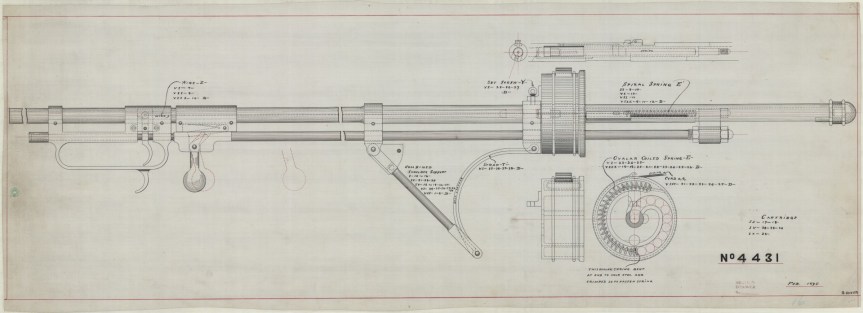
The magazine appears to hold at least 13 or more rounds according to the available patent and Winchester’s engineering drawings. The magazine is fixed in place and rounds appear to have been fed into it through the loading/ejection port on the left side of the weapon. This would have also put spent cases being ejected right next to the user’s neck. Curtis’ patent explains that the magazine has a spring inside which has a length of string attached to the top of it which the user can pull back to depress it and allow cartridges to be loaded into the drum. The magazine has a single stack or loop of cartridges. Once loaded the string can be released, allowing the magazine spring to push rounds into the action.
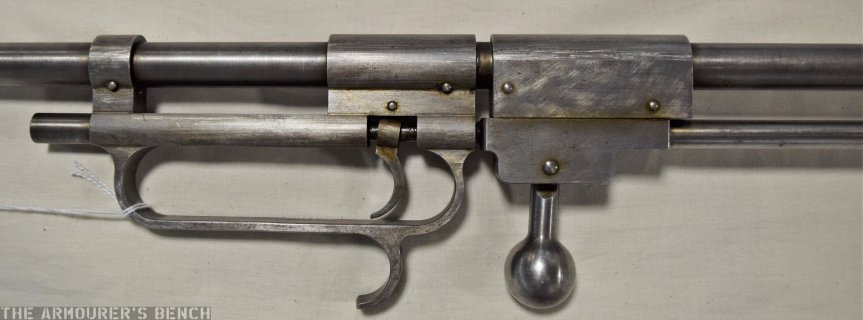
Close up of the left side of the Curtis’ trigger, bolt assembly and hand loop (Photo by Matthew Moss, courtesy of the Cody Firearms Museum)
The Curtis rifle’s action appears to lock at the front of the weapon with the bolt handle acting on a hinged, spring-loaded, locking piece or flapper which dropped into place when locked. To unlock the action the bolt handle was sharply pulled to the rear which pushed the locking piece out of engagement and unlocked the action allowing the operating rod to be cycled.
The weapon’s chamber appears to be just forward of the centre of the drum magazine with the striker assembly located behind it. To operate Curtis’ rifle the magazine was loaded and then the user had to unlock the action by pulling the bolt handle backwards. This then allowed the operating rod to be pulled backwards, like a pump action, which pushed the bolt and striker assembly to the rear, cocking the striker, the bolt handle was then returned forward and locked back into position. This chambered a round ready to be fired.
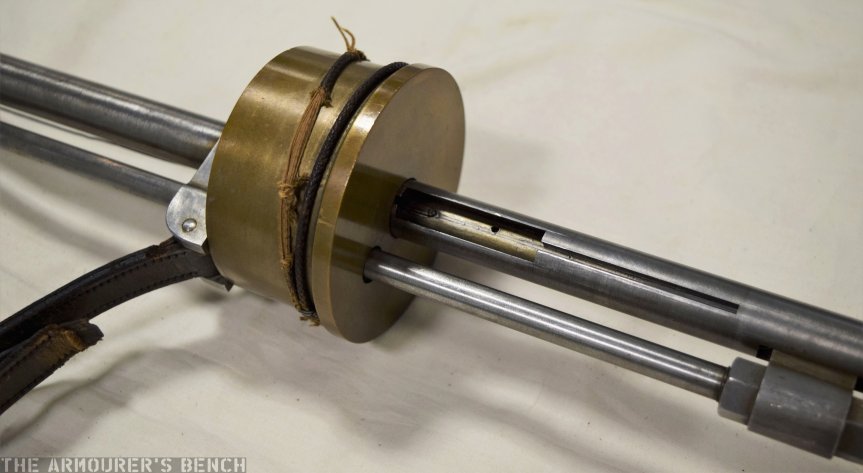
Close up of the Curtis’ brass drum magazine and loading/ejection port (Photo by Matthew Moss, courtesy of the Cody Firearms Museum)
The trigger at the front of the firearm is connected to the striker assembly by a long length of wire. When pulled the wire becomes taught and trips a sear to release the striker, firing the weapon.
Originally Curtis’ patent describes how ‘small punches’ on the bolt face would pierce the cartridge base during firing to enable the spent case to be extracted once the action was cycled. From Winchester’s engineering drawings, however, it appears they replaced this with a more reliable and conventional extractor at the 7 o’clock position of the bolt face.
Given that the weapon would have fired black powder cartridges it is unclear how well the rifle would have faired with sustained firing. The drum magazine would have been susceptible to jamming as a result of powder fouling. This, however, would not have been an issue for Winchester later version of the rifle.
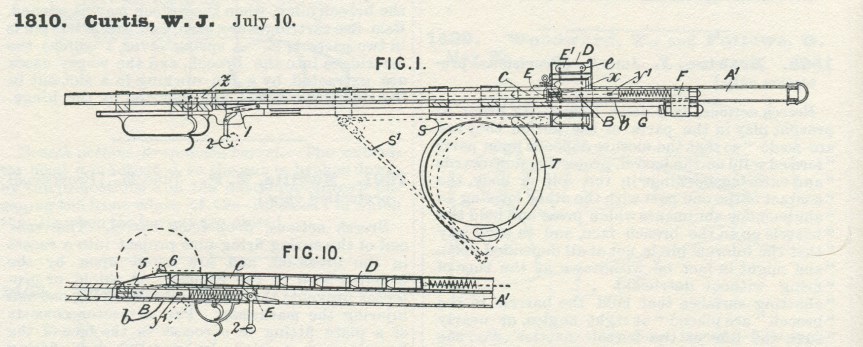
Detail of Fig.1 & Fig.10 from Curtis’ 1866 patent (courtesy of Research Press)
But the Curtis has one more interesting surprise. The original 1866 patent also includes what might be one of the earliest descriptions of a gas operated firearm. One of the most fascinating sections of Curtis’ original patent details how the rifle might have been adapted for gas operation:
“An arrangement is shown in Fig.10, in which the rod G is dispensed with; in this case the barrel may be shorter, not projecting beyond the shoulder; the butt is similar. The breech may be opened automatically by the powder gases, which pass by an opening in the barrel to a cylinder with which works a breech operating plunger.”
Curtis does not go into further detail but he is clearly describing a piston-driven, gas operated system. The patent drawing also depicts an alternative tube magazine instead of the drum magazine.
It is unknown if Curtis ever put his theory to the test and developed his gas system idea further. It is tempting to wonder if, in 1895 when Winchester were assembling their model of the Curtis, if John Browning or William Mason, who were also developing their own gas operated systems at the time, were aware of Curtis’ idea from 30 years earlier. As such Curtis’, admittedly vague, gas system pre-dates the first patents on gas operation by just under 20 years.
If you enjoyed the video and this article please consider supporting our work here.
Specifications:
Action: Slide action
Calibre: .32 Winchester Centre Fire
Feed: ~12 round drum magazine
My thanks to the Cody Firearms Museum at the Buffalo Bill Center of the West for allowing me to examine and film the Curtis. Special thanks to the CFM’s assistant curator Danny Michael for making extra time to open up the case where the rifle Curtis is on display so we could examine it and for also sharing Winchester’s technical drawings and other records.
Thanks also to David Minshall of Research Press.co.uk for his assistance finding Curtis’ original British patent abridgement and to John Walter for digging up some additional information about Curtis’ life.
Bibliography:
‘Winchester Suit Decided’, The Times (Philadelphia), 27th June, 1897
‘Recollections of the Forming of the Pugsley & Winchester Gun Collections: A Talk Given by Mr. Edwin Pugsley at the New Haven Meeting of the AS of AC’, September, 1955.
The Hotchkiss Portative was one of the earliest light machine guns to see general service. It was used in action by a number of countries during the First World War, the example we’re examining today is a British Mk1 Hotchkiss Portative light machine gun.
British Portative’s were chambered in .303, and were initially issued to cavalry regiments as a light machine gun before arming some of Britain’s early tanks during World War One.
The gun was also known as the Hotchkiss Model 1909 and saw service with France, chambered in 8mm Lebel and the US, chambered in .30-06, where it was known as the 1909 Benét–Mercié Machine Rifle.
To cock the weapon the charging handle at the rear of the gun is turned to the unlocked position, at 12 o’clock, and pulled to the rear. It is then returned forward and the gun can be put in either safe, semi and full automatic.
Weighing around 25 lbs or 12kg the Portative was extremely heavy for a light machine gun. It had a small, unergonomic pistol grip to which the stock attached. This makes it difficult to hold the pistol grip and the stock attachment jabs into the hand during firing. The low position of the Hotchkiss’s stock provides a chin weld at best.
The Portative feeds from a 30-round metallic feed strip. Rounds are placed in the metallic strips and loaded into the weapon with the cartridges facing down. If not seated properly in the strip, vibration from firing can loosen the rounds causing them to fall out or induce jams. The strips were so fragile a sizer, used to realign bent or misshapen strips, was standard issue. Once the strip is empty it is thrown out of the gun with some force.
The Portative’s tripod while small and highly adjustable is poorly designed, it is unsuited to use in the field. As the gun is already top heavy and unbalanced, due to feeding from a side-loading ammunition strip, the gun has a tendency to topple over if not held firmly by the operator. This also complicates clearing jams and stopages.
We will have a full video and blog exploring the design, development and history of the Hotchkiss Portative in the future. My thanks to Chuck Kramer of Gun Lab for letting me shoot his Hotchkiss and helping with filming, check out his blog here.
If you enjoyed the video and this article please consider supporting our work here.
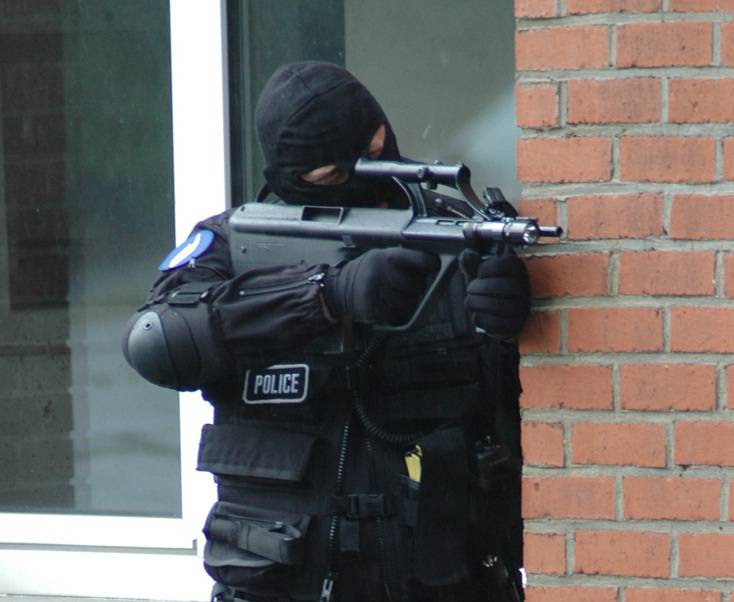
The Steyr AUG or Armee Universal Gewehr (Army Universal Rifle), is one of the earliest Bullpup military issued rifles (if not the earliest) adopted by a military, i.e. the Austrian Military as the Stg77 in 1977. Other early bullpups being the British L85 (SA80), and the French FAMAS. The AUG went on to be adopted by the Australian military and eventually licence built there as the Austeyr F88, the New Zealand Defense Forces, Irish Army, and various other military and police forces worldwide.
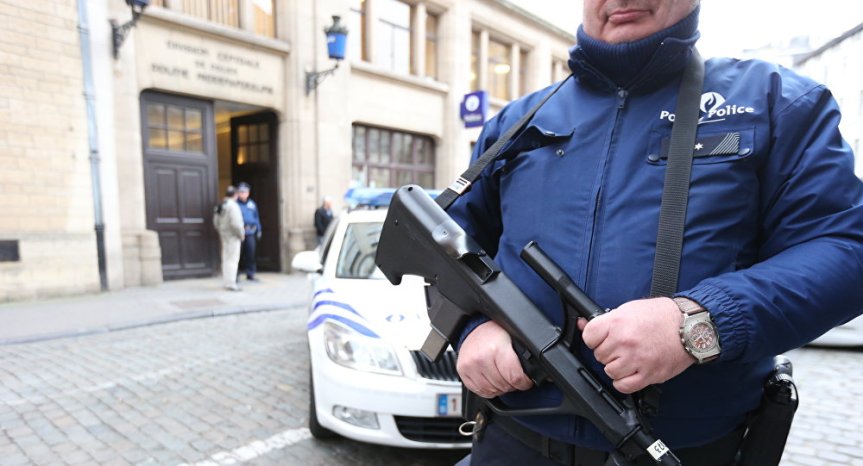
Belgian Federal Police officer with AUG 9x19mm SMG (source)
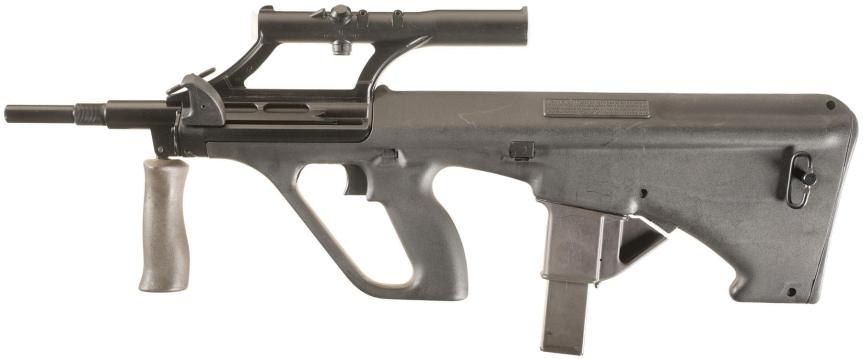
In 1990, Steyr developed the first variant of the AUG/9mm Carbine and a 9mm conversion for the AUG-A1 rifle. The conversion consists of a new bolt group, barrel and magazine-well insert. The AUG/9mm Carbine uses the standard 25 round or 32 round magazines from the Steyr MPi 69/81 submachine gun series which is also a Steyr product. Whilst the conversion of standard rifles with the conversion kit is perfectly viable there were difficulties with the standard ejection port due to fired cases rebounding back into the action and also striking the firer!
The 9mm conversion ‘kit’ was replaced with the second variant of the ‘dedicated’ AUG Carbine in 9mm with an improved magazine-well adapter and an ejection-port shield or barrier, this could also be retrofitted on existing 5.56mm housings as an improved conversion kit including an ejection-port shield. However, in 1995 a dedicated AUG /9mm Carbine was introduced with the ejection-port shield molded as an integral part of its stock/housing (the marketing of the 9mm conversion kit being discontinued).
Steyr AUG-SA 9x19mm Carbine Conversion (RIA)The latest iteration of the weapon the Steyr AUG A3 XS, note the lack of ejection port on the left side and the picatinny optics mounting rail (source)
The AUG/9mm Carbine the barrel does not have a flash suppressor, but has a threaded section behind the muzzle to allow the mounting of aftermarket suppressors etc. The barrel mounts exactly the same as the 5.56mm barrel but does not have a gas tappet system as the 9mm carbine functions as a closed-bolt, blowback. The bolt of the 9mm variant is integral with what is normally the bolt carrier in the standard AUG, the bolt face is machined directly in the bolt carrier face.
Belgian Federal Police officer with AUG SMG with ejection port case deflector (source)
Users of the 9mm variant are mostly police or security forces, notably the Kuwaiti Military Police fielded the 9mm SMG/carbine for some time until surplused a few years back. Ironically the 9mm SMG/carbine is fielded by the Belgian Federal Police whilst the Austrian Gendarmerie used to field the FN (Belgium) manufactured UZI!
If you enjoyed the video and this article please consider supporting our work here.
My thanks to the Cody Firearms Museum, at the Buffalo Bill Centre of the West, for allowing me to film the revolver. I am very lucky to have handled it as it is normally on display.
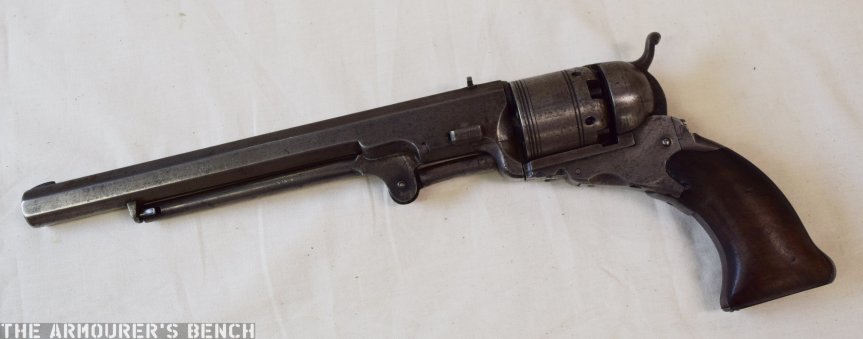
The US Patent Office granted Samuel Colt a patent for his ‘Revolving Gun’ in February 1836 (US #9430X). Colt had already patented his design in Britain in October 1835 – at the age of just 21. He subsequently patented his design across Europe and worked with Baltimore gunsmith John Pearson to build a number of prototype revolvers. Colt’s pistol was not the first revolver but it did embody a number of important features combining the use of percussion caps and a bored-out cylinder with a single action trigger mechanism and cylinder locking bar.
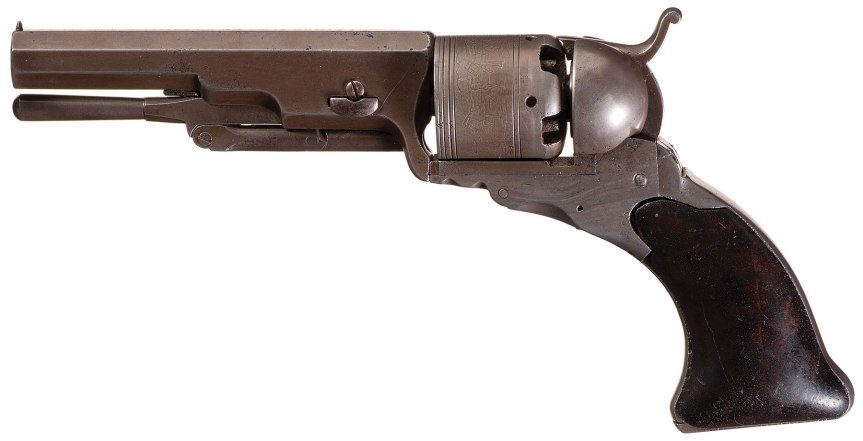
With backing from his cousin and other investors Colt established the Patent Arms Company, building afactory in Paterson, New Jersey in late 1836. The Patent Arms Company produced a variety of revolvers in different sizes including pocket, belt and holster models. The .28 calibre Pocket Model No.1 being the smallest and the .36 calibre No.5 holster revolver being the largest. The company produced approximately 2,300 – 2,800 firearms (sources have various estimates on just how many revolvers and revolving rifles were manufactured) before the company collapsed, due to insufficient sales, in 1842.
The Colt Paterson
It was the No.5 which saw the greatest sales with small numbers being purchased by the Texas Rangers, Texan Navy and private citizens. The US Army reportedly tested Colt’s revolver in February and June 1837, finding a number of weaknesses to the design. Despite the approval of President Andrew Jackson the US military remained largely uninterested in the Paterson.
Small numbers of the revolvers were purchased by the U.S. government including 100 for the Navy in 1841 and 50 for the Army in 1845 after the company had collapsed. The Republic of Texas also purchased 180 revolvers for its navy in 1839.
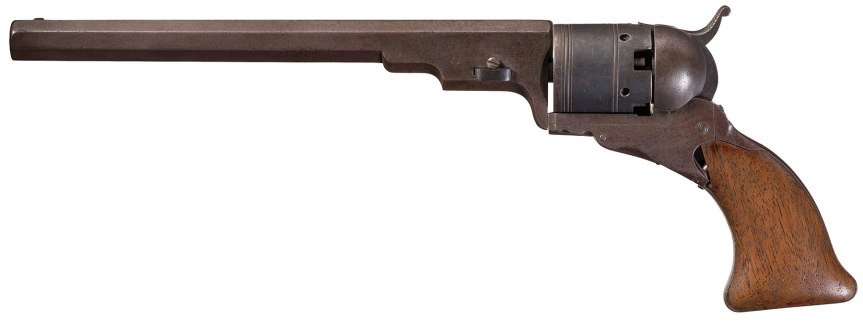
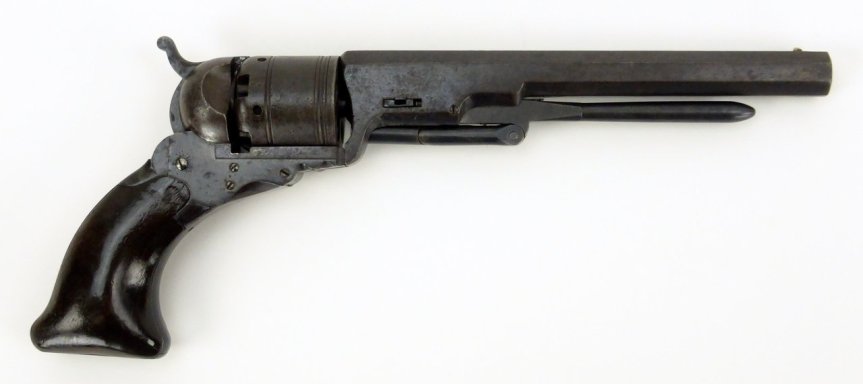
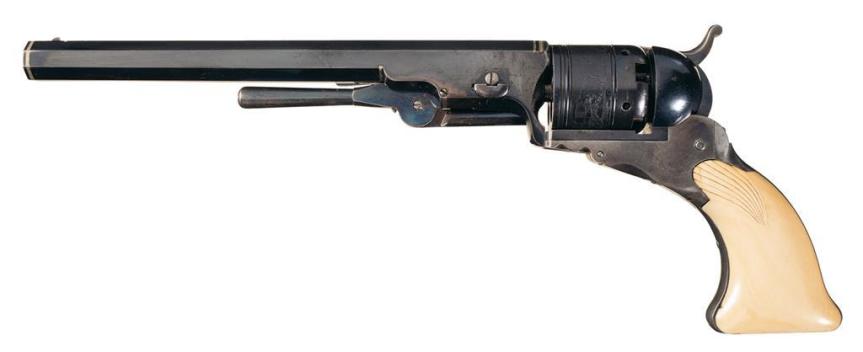
The Paterson has a number of interesting features and lacks some components that would become standard on Colt’s later revolvers. The Patersons had octagonal barrels and were sold in a number of barrel lengths ranging from 2.5 to 9 inches, with 7.5 and 9 inches being the most popular. The barrel assembly attached to the receiver via the cylinder axis pin which was locked together by a wedge – a method which would be used in Colt pistols for over 30 years. They had a small front sight and a notch cut into the hammer that acted as a rear sight. The pistols had no trigger guard, instead they had a folding trigger, which deployed when the weapon was fully cocked. Initially, the Patersons lacked a loading lever beneath the barrel. Instead the cylinder was removed to enable loading and capping with a separate loading tool. Another characteristic of the belt and holster Patersons was their flared pistol grips.
Despite this Colt’s .36 calibre No.5 revolvers proved popular with Texas Rangers, so much so that workers often referred to it as ‘The Texas Arm’, who were frequently engaged in skirmishes with Mexicans and Native Americans. During one engagement with a large Comanche warriors along the Guadeloupe River one ranger recalled: “They were two hundred in number, and fought well and bravely, but our revolvers as fatal as they were astonishing, put them speedily to flight.”
Patent Arms Company ‘Colt Paterson’ No.5 holster revolver (Rock Island Auctions)
Despite the Patterson’s relatively small calibre, lack of an integral loading arm and the frailties of the design (such as a bent axis pin) the revolver’s five round cylinder offered the men wielding them five times the firepower of their muzzle-loading, single shot pistols.
Despite the limited success of Colt’s revolver the design still needed improvements and Colt became determined that the path to success was through military contracts. Sadly, for Colt there weren’t forthcoming and the Patent Arms Company collapsed in 1841/2.
It was the Mexican–American War (1846-48) that revived Colt’s fortunes. Captain Samuel Walker, of the Texas Rangers and the US Army’s Regiment of Mounted Riflemen, was an admirer of Colt’s revolver having carried them in the field for a number of years. So much so that he wrote to Colt in 1846 saying:
“The pistols which you made… have been in use by the Rangers for three years, and I can say with confidence that it is the only good improvement I have seen. …Without your pistols we would not have had the confidence to have undertaken such daring adventures.”
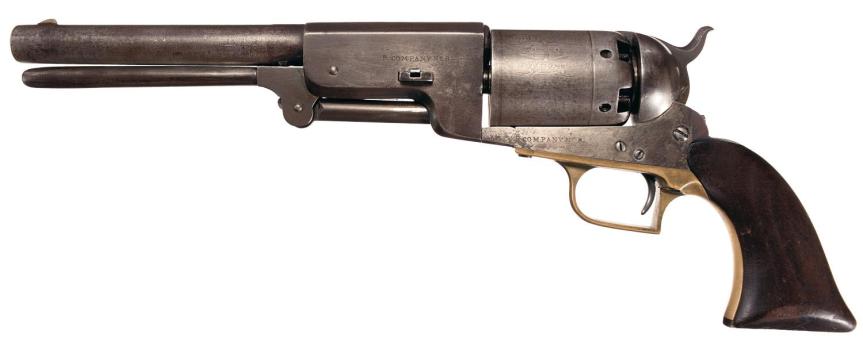
Subsequently, the US government contracted Colt to produce 1,000 large calibre revolvers, the Model 1847. These huge, robust pistols had a fixed trigger and a loading lever as standard.
Colt’s Patent Manufacturing Company Model 1847 ‘Colt Walker’ Army Revolver (Rock Island Auctions)
In 1847 Colt began manufacturing what has since become known as the ‘Colt Walker’, a large, .44 calibre revolver with a six-shot cylinder, that weighed 4lbs 9oz (2.07kg). He subcontracted the production to Eli Whitney Jr. who set up tooling to manufacture the new pistols. These were issued to the US Army’s mounted regiments including the Texas Mounted Volunteers, the US Mounted Riflemen and Dragoons. The success of the Colt Model 1847 Army Revolver paved the way for Colt’s future success.
Adapted Colt Paterson with Loading Lever
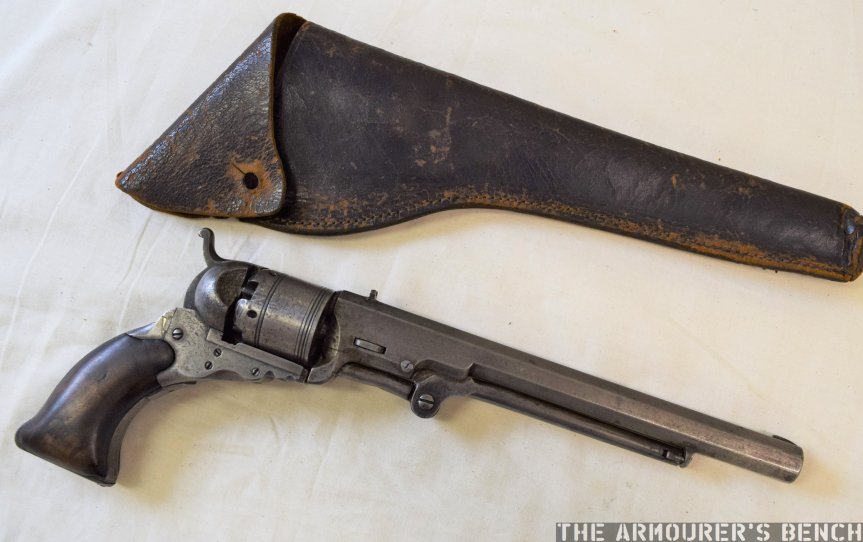
Adapted Colt Paterson No.5 Holster Model with contemporary holster (Photo: Matthew Moss, Courtesy of Cody Firearms Museum)
The Colt Paterson was an expensive item when it first appeared on the market, costing between $40 and $50 – well over $1,000 today. So then, as now, it makes sense that people who invested a considerable amount in a revolver would adapt and upgrade it if they could.
Below is another example of a Colt Paterson which was adapted. A No.5 Holster model, serial number 951, which had had its barrel cut down to 5 inches. This was done after it left the factory as the cut interrupts the original factory marker’s markings. The pistol also has a new cone front sight added.
Adapted Colt Paterson No.5 with factory loading lever, with a shortened barrel and new front sight. (Rock Island Auctions)
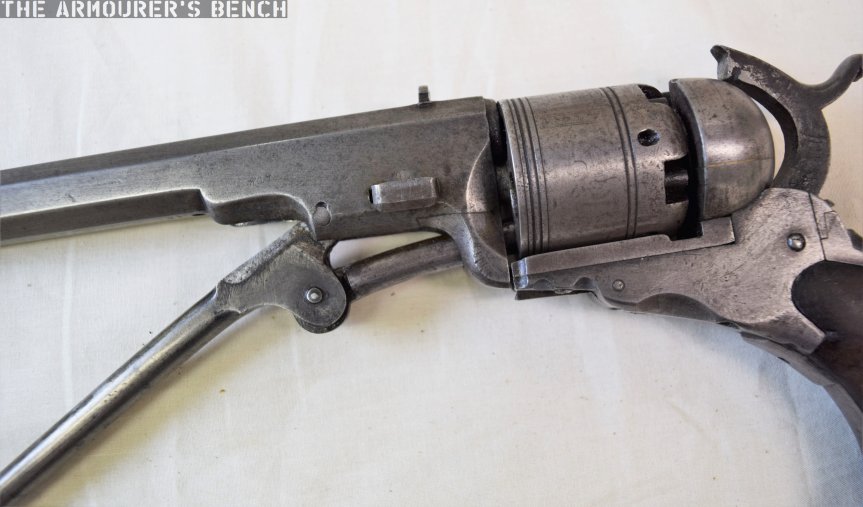
The pistol we are examining in this blog/video, is part of the Cody Firearms Museum’s collection – serial number 954. It had a number of alterations to the revolver, principally the addition of a captive loading lever and a new rear sight. While the Patent Arms Company had begun adding a loading lever to their revolvers in 1839, these were of a different style and shape. Below we can see two original examples of Patent Arms Company factory loading levers.
Colt Paterson with long loading lever and scalloped cutout to allow capping, Serial number 818 (Collector Firearms)Colt Paterson with a short loading lever, serial number 515 (Rock Island Auctions)
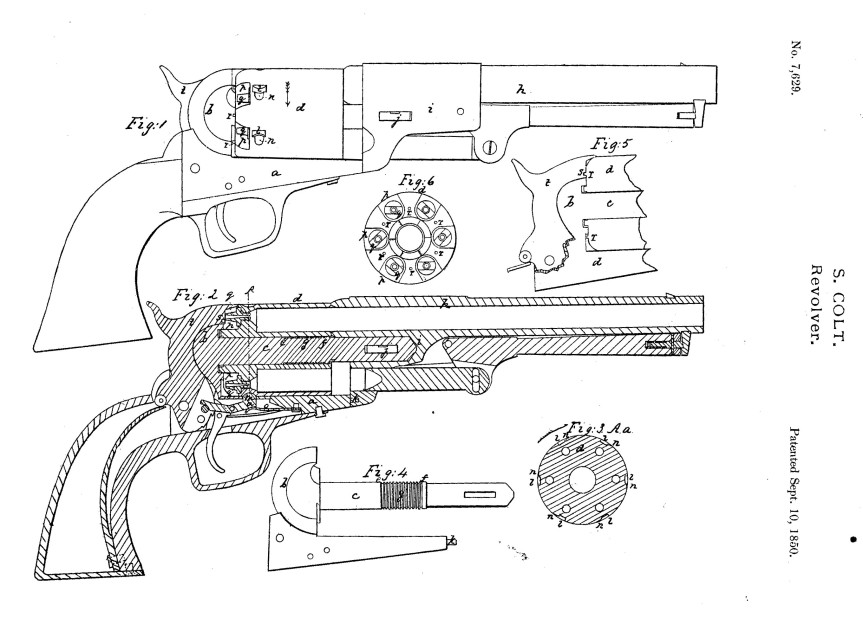
It appears that loading levers of different designs were used on the post-1839 Patersons. The top revolver appears to use a lever similar to the one later utilised in the Model 1847. Both of the examples above differ significantly to that seen on serial number 954 (below), which is more akin to the loading levers seen on the Colt Model 1848 Percussion Army Revolver (or Colt Dragoon) and the later Model 1851 Navy. The profile of the levers and design and location of the pivot point differ. They both also lack any retention point near the end of the lever. This would suggest that #954’s lever is not a factory addition but something which was added later, copying the 1851 Navy’s retained lever which was patented in September 1850 (US #7,629). On close examination the cap cutout at the rear of the cylinder and the cut into the barrel assembly just in front of the cylinder to facilitate loading appear to differ from Patersons with factory loading levers.
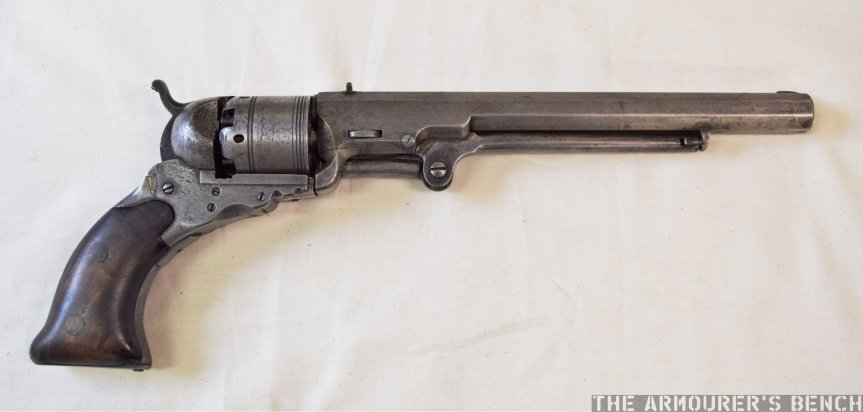
Colt Paterson No.5 serial number 954 held by the Cody Firearms Museum, note the 1851-style loading lever (Photo: Matthew Moss, Courtesy of Cody Firearms Museum)
A similar retention latch system can be seen in Colt’s 1850 patent:
Samuel Colt’s 1850 Patent, featuring a loading lever retention system (US #7,629)
As with other Colt percussion revolvers with loading levers, the rammer acts on the 6 o’clock cylinder. To load, the revolver was brought to half cock, powder was poured into the chamber, followed by round ball projectile. This was seated enough to allow it to line up with the rammer and the lever could then be pulled to ram the ball home. The cylinder could then be capped. The 1839 Paterson’s had a scalloped cutout to allow caps to be placed on the cylinder nipples without removing the cylinder.
Left-side view of the Colt Paterson No.5 (Photo: Matthew Moss, Courtesy of Cody Firearms Museum)
Interestingly the revolver has a slightly bent rammer but seems to function fine despite this. This is perhaps an indication of hand-fitting by the gunsmith who adapted the revolver.
Close up of the Colt Paterson at half cock, note the slightly bent rammer (Photo: Matthew Moss, Courtesy of Cody Firearms Museum)
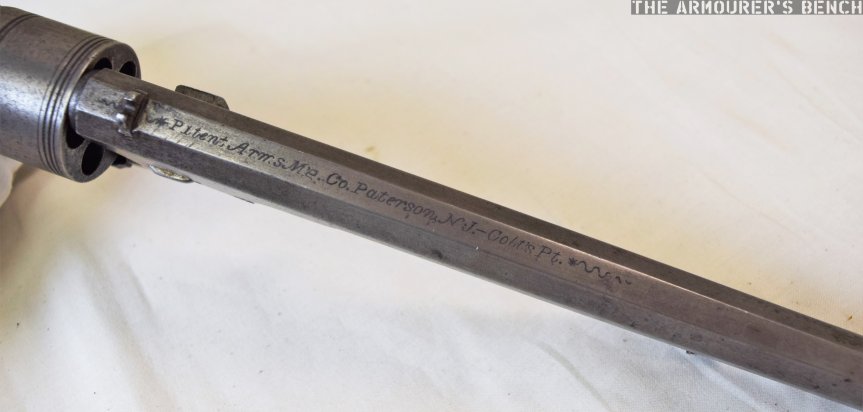
At some point, perhaps at the same time as the fitting of the lever, a new set of sights were fitted. With a more prominent front sight and a rear notch sight added to the top of the barrel, just in front of the cylinder. This was a feature that the 1851 Navy did not have, and no Colt revolver would have until decades later. The gunsmith appears to have cut the dove tail for the sight though the original decorative scroll engraving surrounding the maker’s mark.
Close up of the revolver’s markers markings and added rear sight, which cuts through some of the original decorative scroll work (Photo: Matthew Moss, Courtesy of Cody Firearms Museum)
More Photographs of the Adapted Colt Paterson:
Adapted Colt Paterson No.5 Holster Model with contemporary holster (Photo: Matthew Moss, Courtesy of Cody Firearms Museum)
Close up of the Colt Paterson’s brazed on loading lever retention catch (Photo: Matthew Moss, Courtesy of Cody Firearms Museum)
Close up of the serial number, 954, on the CFM’s Paterson No.5 (Photo: Matthew Moss, Courtesy of Cody Firearms Museum)
The revolvers produced at the Patent Arms Company’s Paterson factory in the late 1830s and early 1840s date from a fascinating period of American history, on the cusp of an era dominated by Samuel Colt’s revolvers. While the exact circumstances of the adaptations/upgrades made to the revolver we have examined at the Cody Firearms Museum are unclear it tells us that Colt’s revolvers, even early examples, were highly prized.
If you enjoyed the video and this article please consider supporting our work here.
Specifications (for No.5 Holster model, #954):
Overall length: 13.5 in (35cm)
Barrel length: 8 in (20cm)
Calibre: .36
Capacity: 5-shot cylinder
Weight: ~2lb 10oz (1.2kg)
Bibliography:
‘Revolving Gun’, S. Colt, US Patent #9430X, 25 Feb. 1836 (source)
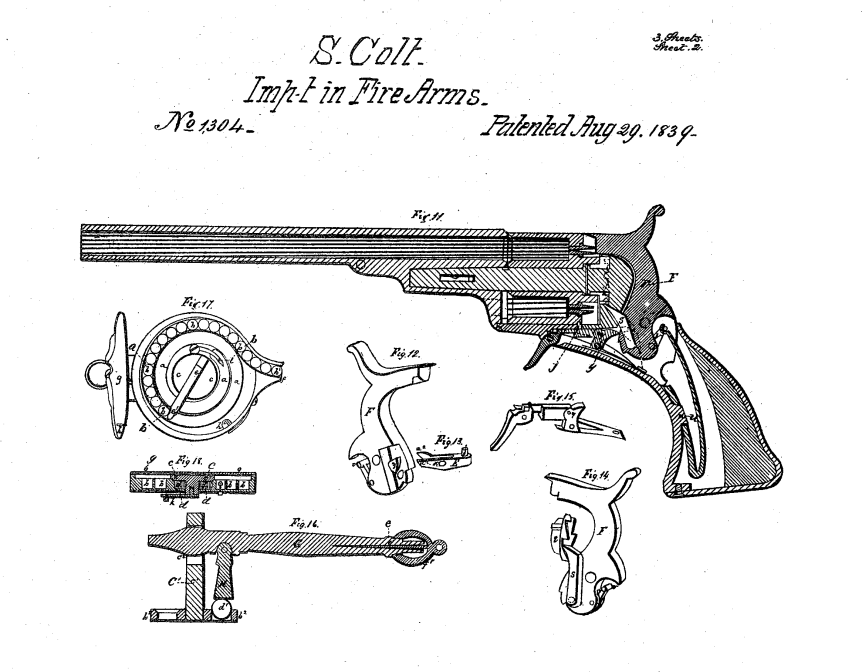
‘Improvement in fire-arms and in the apparatus used therewith’, S. Colt, US Patent #1304, 29 Aug. 1839 (source)
‘Improvement in revolving chambered fire-arms’, S. Colt, US Patent #7629, 10 Sep. 1850 (source)
I’m very pleased to present the first of the videos filmed during my recent research trip to the US. My thanks to my friend Chuck Kramer, of the excellent GunLab blog, for his generous help and assistance making this video on a special little rifle. – Matt
The Volkssturmgewehr
By early 1945 Nazi Germany’s situation was desperate, with no real hope of victory left desperate holding actions became the order of the day. It was hoped by many on Hitler’s staff that if they could hold back the Russian’s long enough the Western Allies would reach Berlin first. This was not to be as the Red Army was making rapid progress into German territory, covering up to 35 km a day by March 1945. Once the Soviets encircled Berlin on the 20th April there was no possibility of a surrender to the Western Allies who in reality had long since lost interest in the ‘Race to Berlin’.
While the war had seemed hopeless for many months the German High Command continued its efforts to construct a formidable defence against the oncoming Russian forces. This saw the activation of the German militias and the forming of a new corps, the Volkssturm or in English: ‘people’s storm’. This optimistically named force made up of all men aged between 13 and 70 were called up and expected to defend their local areas, much like the British Home Guard formed in 1940.
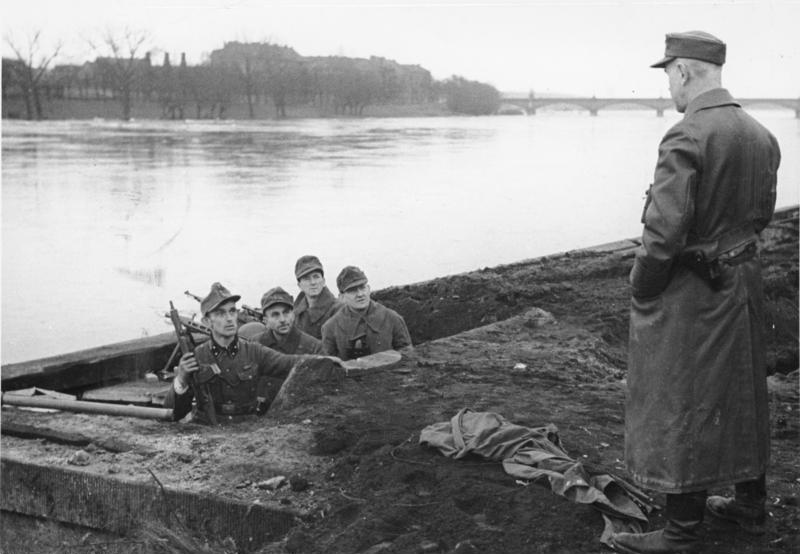
A well equipped, uniformed Volkssturm unit defend the banks of the Oder in this propaganda photograph, the man in the foreground holds a VG.1-5 (source)
In order to arm these men stores of older weapons were re-issued and the Volkssturm were issued Mauser G98s and old MG08s along with a large variety of captured foreign weapons which were in store including French, Polish and Russian small arms.
There were not enough modern weapons to equip the struggling regular forces let alone the newly improvised ‘volunteer’ force. As such Germany’s weapons factories were directed to create prototypes of simpler, cheaper weapons that might be mass produced quickly with minimal tooling. This project was dubbed the Primitiv-Waffen-Programm. These primitive weapons had to be made quickly with the materials at hand. This spawned a number of prototypes with varying degrees of sophistication, the so-called VolksGewehr or ‘people’s guns’. The best known of these is perhaps the Gustloff Volkssturmgewehr or MP 507 -often referred to as the VG 1-5.
The Gustloff Volkssturmgewehr was undeniably the most complicated of the Primitiv-Waffen. A semi-automatic, delayed blowback operated, carbine chambered in Germany’s new intermediate 7.92x33mm Kurz cartridge. This weapon will hopefully be the topic of a future blog/video.
Rheinmetall Volkssturm Carbines
The focus of today’s blog/video, however, is another Primitiv-Waffen chambered in 7.92x33mm developed by Rheinmetall. Rheinmetall developed a series of several prototypes, the VG45 or VG3 was the only prototype to be tested, however, a stamped receiver prototype was also developed.
Formed in 1935 as Rheinmetall-Borsig AG, Rheinmetall while perhaps best known for their larger calibre guns, they also developed a number of small arms designs – including several weapons for the Volkssturm. The VG45, chambered in 7.92mm Kurz, was developed in late 1944 and according to Wolfgang Peter-Michel, in his book Volksgewehre which quotes a contemporary British report, the VG45 was somewhat similar to the Walther designed VG1 in design, but chambered in 7.92 Kurz rather than 7.92x57mm Mauser. There is only a single, grainy photograph purporting to be the VG3 (with a missing bolt), which can be seen here.
Using a tube receiver simple forgings, spot welds and rivets the VG45’s design was utilitarian with one-piece beech wood furniture. It weighed around 6.8lbs or 3.1kg unloaded and had an overall length of 34 inches / 86cm. With a simple two lug bolt and no safety the carbine was extremely utilitarian. In October 1944, rifles from five companies were submitted in response to a call for a weapon of “simplified construction for mass production.” Rheinmetall’s design was not one of these first five designs.
However, by mid December Rheinmetall had submitted their carbine, the VG45, for testing. It reportedly performed well during testing in Kummersdorf, firing some 2,000 rounds and 20 rifle grenades successfully without major malfunctions. A report to Heinrich Himmler, dated 28th December, who had been tasked with overseeing the Volkssturm’s formation, noted that “most of the rifles’ stocks cracked when shooting the rifle grenades… the rifles are not yet [fully] examined and the current status of development do not yet permit a final test-firing.” Of the rifles submitted to testing only the designs from Mauser and Rheinmetall continued to be considered. While the VG1 and VG2 were ‘officially’ accepted Rheinmetall also received an order for 25,000 of their VG45 carbines – later referred to as the VG3.
Full scale production never began as the factory was heavily bombed in the closing stages of the war. Prototypes of the VG45 were found by the Allies when they captured the Rheinmetall plant in Sömmerda in Thuringia, central Germany. The British tested one of these rifles, marked ‘Rh Nr.4 VG45K’ on the receiver.
The British also captured another prototype 7.92mm Kurz bolt action carbine. It had a two-piece stamped receiver – welded together at the top of the receiver, with spot-welded inserts that formed the magazine housing simple two-lug bolt and a two-piece stock. It is unclear if this prototype carbine was submitted for testing. It is likely that it was still in development at the time of the December 1944 testing.
Another 7.92mm Kurz Carbine
Ermawerke, or Erfurter Maschinen- und Werkzeugfabrik GmbH, was established in Erfurt, Thuringia in the early 1920s, throughout the war they manufactured the Erma EMP, the MP38/40 and developed the prototype MP44 submachine gun. In late 1944, Erma set about developing their own entry for the Primitiv-Waffen program.
Profile photographs of the original incomplete Ermawerke Carbine prototype, missing its bolt and reportedly with replacement more elaborate wooden furniture (Photographs originally taken by US Army)
Erma’s prototype is very similar to Rheinmetall’s stamped prototype – a small, light, bolt action carbine chambered in the 7.92x33mm cartridge and able to feed from standard 30-round Sturmgewehr magazines. Unlike the Rheinmetall’s carbines, Ermawerke’s had a rudimentary trigger block safety at the rear of the trigger guard. Erma’s rifle also went through the December 1944 tests with no function issues. It appears that very few were manufactured and that only one or two examples survived the war. One surviving carbine, said to be in Russia, is missing its bolt and has had reportedly had replacement furniture fitted.
The Ermawerke carbine also made extensive use of stampings and simple forgings with rivets used to attached crudely finished wooden furniture. The receiver is similar to a VG-2 with an ejection port on the right. It weighed 6lbs or 2.7kg and had a 16.5 inch or 42cm barrel. The original carbine reportedly had no Wehrmacht/Waffenamt (WaA) acceptance marks. In his book, Deutsche Sturmgewehre, Peter Senich suggests that an example of the rifle was tested at the US Army’s Aberdeen Proving Ground in 1945.
VG45K replica bolt #5 (Matthew Moss)
VG45K replica bolt #4 (Matthew Moss)
VG45K replica bolt #3 (Matthew Moss)
VG45K replica bolt #2 (Matthew Moss)
VG45K replica bolt #1 (Matthew Moss)
Shooting the Rheinmetall Volkssturm Carbine
Check out our short live fire & slow motion video with the carbine here
Rheinmetall’s stamped Volkssturm carbine used a simple two-lug rotating bolt action which was cocked on opening. It had a simple fixed rear notch sight and weighed just over 6.5lbs or 2.95kg unloaded, had a 15.45 inch or 39cm barrel and an overall length of 34 inches / 86cm. Unlike the VG45, the stamped prototype had a lever on the left side of the receiver which acted on the trigger sear to prevent it being depressed.
This video features a replica of Rheinmetall’s stamped Volkssturm carbine produced by Range Facilities (Burnham), one of a small batch made, which attempts to reproduce the original prototype. I had the opportunity to handle and fire one of the carbines. As such my appraisal of the rifle’s handling characteristics and shooting experience are based on the replica not the original. But I feel my experience with the reproduction is representative of how the original Rheinmetall carbine, and the other Primitive Waffen 7.92mm Kurz carbines might have handled.
Both the carbine and the 10-round magazine featured in the video were handmade to a high standard. There are, however, a number of key differences between the replica and the original, as described in the original British intelligence report. No markings were reported on the stamped prototype, however, the reproduction borrows markings from the VG45 and is marked ‘Rh Nr.5 VG45K‘ on the left side of the rifle. Another key difference is the addition of a utilitarian safety bar which blocked the trigger rather than a lever reported to be used by the original prototype. The replica also had a rounded bolt handle while the original is described as having a “straight and hollowed out bolt with no bolt knob, similar to the VG1. The reproduction has had a cleaning rod added beneath the barrel and its wooden furniture may also differ slightly.
A close up of the rifles forend, cleaning rod, barrel and foresight (Matthew Moss)
A look at the carbine’s markings. The reproduction’s manufacturer information is stamped horizontally on the magazine housing (Matthew Moss)
The carbine’s simple wooden stock is similar to that seen on the VG1-5, not the most ergonomic shape but utilitarian (Matthew Moss)
Close up of the carbine’s simple notched rear sight (Matthew Moss)
The replica was very well made and care has been taken to give it a suitably aged appearance. Light and handy the carbine handled well and the 7.92x33mm Kurz chambering made it a light shooting carbine. While the replica’s bolt was a little stiff, this is probably quite representative of how the original would have handled.
The softer shooting 7.92 Kurz round certainly would have made sense for a rifle designed to be issued to poorly trained volunteer units made up of old men and young boys. The very basic rear sight necessitated the use of some Kentucky windage as the rifle shot a little low and to the left at ~70 metres. But within firing a single 10-round magazine I was able to quickly bring my shots to within a man-sized target with relative ease.
Here’s some photos of the carbine’s safety and magazine release:
This slideshow requires JavaScript.
While both the VG1, VG2 and VG1-5 all entered limited production the war ended before serial production of the the VG45/VG3 could begin. Rheinmetall’s stamped prototype probably did not see official evaluations and probably only one or two were produced before the bombing and subsequent capture of the factory.
However, the various 7.92mm Kurz Volkssturm carbines and the other Primitive Waffen remain important examples of the desperate measures Nazi Germany was forced to resort to at the end of the war in an effort to equip its troops.
If you enjoyed the video and this article please consider supporting our work here.
Specifications for Original Prototype Rheinmetall Volkssturm Carbine:
During my recent research trip to the US I was lucky enough to handle and examine a lot of very interesting firearms. This short video is a bonus, while we were opening one of the cases at the Cody Firearms Museum to examine another firearm (that video is coming soon) I noticed a sectioned British Pattern 14 rifle, made by Winchester for the British government during the First World War. It was too good an opportunity to pass up so I filmed this quick video taking a look at the P14’s internals.
The P14 would go on to be the basis of the US M1917 rifle built by Winchester, Remington and Eddystone.
Cutaway of a Winchester-made Pattern 14, note the rear volley sight and sectioned magazine and chamber (Matthew Moss)
The cutaway shows the internals of the rifle’s actions as well as the barrel, chamber and magazine. It was cool to see a cutaway of the P14 up close and I couldn’t resist grabbing some footage.
My thanks to the Cody Firearms Museum, at the Buffalo Bill Center of the West, for allowing me access to their collection. You can find out more about the CFM here.
The .22 Semi-Automatic was John Browning’s third .22 calibre rifle to enter production following the extremely popular pump-action Winchester Model 1890 and the beautifully simple Winchester Model 1900 single shot bolt action rifle. Since its first appearance 100 years ago the .22 Semi-Automatic has been sold by three manufacturers; Remington, FN Herstal and Browning themselves.
Right-side view of a FN .22 Semi-Automatic (Matthew Moss)
The .22 Semi-Automatic (SA22/.22 SA) is radically different from Browning’s earlier .22, whereas the Model 1900 had been simple and inexpensive the .22 SA is a masterclass in balance, ergonomics and operation. It feeds from a tube magazine located in the rifle’s butt and is blowback operated.
One of the patent drawings for Browning’s .22 SA (US Patent Office)
The most interesting aspect of the SA .22’s action is that the bolt is at the base of the receiver with the cocking handle protruding downwards. This makes the rifle truly ambidextrous as the spent cartridge casings are ejected straight down rather than up or to the right of the receiver as in most contemporary rifles.
John Browning poses with what appears to be a Remington Model 24 (source)
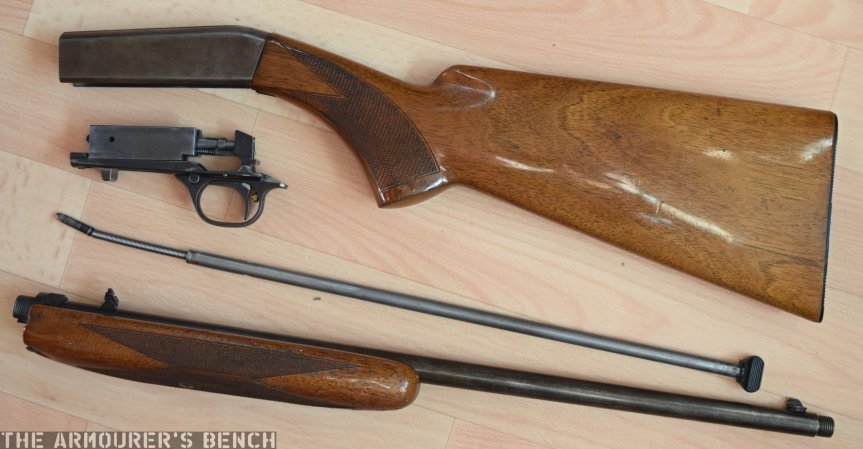
The rifle is one of the most balanced of Browning’s designs and it can be balanced on a single finger placed just in front of the trigger guard behind the bolt handle. Ergonomically the rifle is extremely pointable with an easily acquirable sight picture. Another interesting feature is the rifle’s takedown mechanism. Once the bolt is retracted a small catch in the base of the forestock can be pushed forward allowing the rifle’s barrel to be unscrewed from the receiver. This makes the rifle extremely handy and easily portable weighing just 4.75 lbs or 2.15kg.
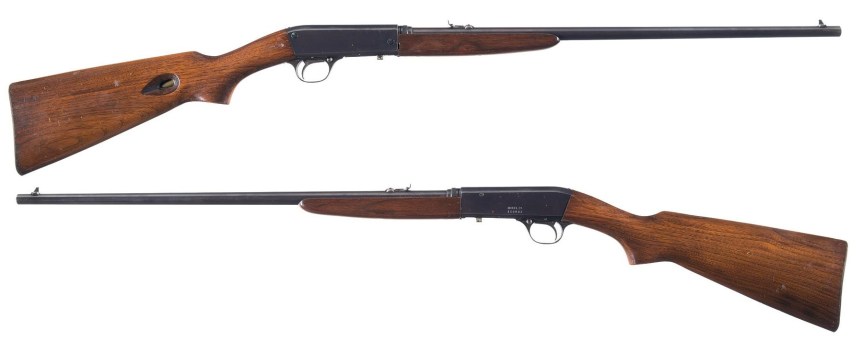
Browning originally designed the rifle in 1912 with the patents being filed in March 1913 and granted in January 1914. At which time the production rights were immediately taken up by Browning’s European partners FN Herstal of Belgium who sold the rifle throughout Europe. Production was interrupted by the outbreak of World War One and the subsequent German occupation of Belgium. However, production began again in 1919 and continued until it was again interrupted by World War Two. Initial FN models had a small loading port located on the wrist of the stock in contrast to later models which located the loading port on the right side of the butt-stock.
Production rights in the US were taken up by Remington who began production of what they designated the Model 24 in 1922, four years before Browning’s death. The Model 24 initially was only chambered in .22 Short but was modified to chamber .22LR as well. Up until this point the T.C. Johnson-designed Winchester Model 1903 had dominated the .22 semi-automatic market.
The Model 24 remained in production until 1935 when it was replaced by a the Model 241 ‘Speedmaster’ which built on the original design but introduced a longer 23.5-inch barrel and was heavier, weighing 6 lbs or 2.7kg. Developed by Crawford C. Loomis, the Model 241, had a tilting cartridge guide and a slightly different take down system – moving the take-down catch from the bottom to the left side of the receiver.
Around 100,000 Model 241s were made before Remington ended production in 1949 and sales of the rifle ended in 1951. At which point the Browning Firearms company moved to reintroduce the rifle in the US, marketing it as the Browning .22 Semi-Automatic in 1956. Initially the rifles were produced by FN in Belgium however, all Browning production shifted to Japan in 1976. China’s Norinco have also produced the JW-20/ATD22, a direct copy of the SA .22.
John Browning’s .22 Semi-Automatic has been in almost continuous production for 100 years, another fine example of Browning’s enduring legacy of timeless firearms designs.
If you enjoyed the video and this article please consider supporting our work here.