Examining a Gustloff Volkssturmgewehr

By early 1945 Nazi Germany’s situation was desperate, with no real hope of victory left desperate holding actions became the order of the day. In order to try and stem the advance of the Red Army in the East and the Allies in the West (and south), the German government raised a new militia, the Volkssturm (or in English: ‘people’s storm’).  This optimistically named force made up of all men aged between 13 and 70, they were expected to defend their local areas, much like the British Home Guard formed in 1940.

In order to arm the Volkssturm and the remnants of the rest of Germany’s armed forces, stores of older weapons, such as Gewehr 98s and 88s and MG08s were re-issued and a broad variety of captured foreign weapons.
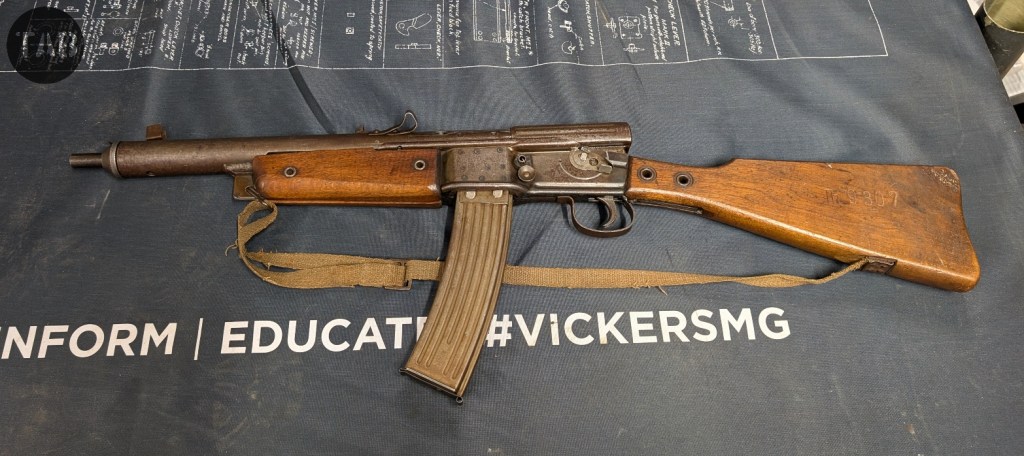
Left-side profile Volkssturmgewehr (Matthew Moss)

Even so there was still not enough weapons to equip the newly improvised ‘volunteer’ force. As such, in Autumn 1944, German industry was directed to create prototypes of simpler, cheaper weapons that might be mass produced quickly with minimal tooling. This project was dubbed the Volksgewehr-Programm, which evolved from the earlier Primitiv-Waffen-Programm which began in 1943 and saw the development of the EMP44. . These primitive weapons had to be made quickly with the materials at hand. The Volksgewehr-Programm spawned a number of prototypes with varying degrees of sophistication, the so-called VolksGewehr or ‘people’s guns’.

The best known these ‘people’s guns’ is perhaps the Gustloff Volkssturmgewehr – often referred to as the VG 1-5. Such was the chaos and rapid development of the weapon we’re examining today it was known by a plethora of names in various wartime documents, including: Selbstladegewehr [self-loading rifle], Selbstladekarabiner [self-loading carbine] and Volks-Selbstladekarabiner 45 [self-loading carbine 45]. As W. Darrin Weaver points out in his book ‘Desperate Measures‘ these carbines were never officially referred to as the VG 1-5. Weaver’s suggests instead that the proper name would the ‘Volkssturmgewehr‘ while Wolfgang Peter-Michel suggested in his 2017 book ‘Volksgewehre: Die Langwaffen des Deutschen Volkssturms‘ that ‘Volksmaschinenpistole’ was the term officially used.
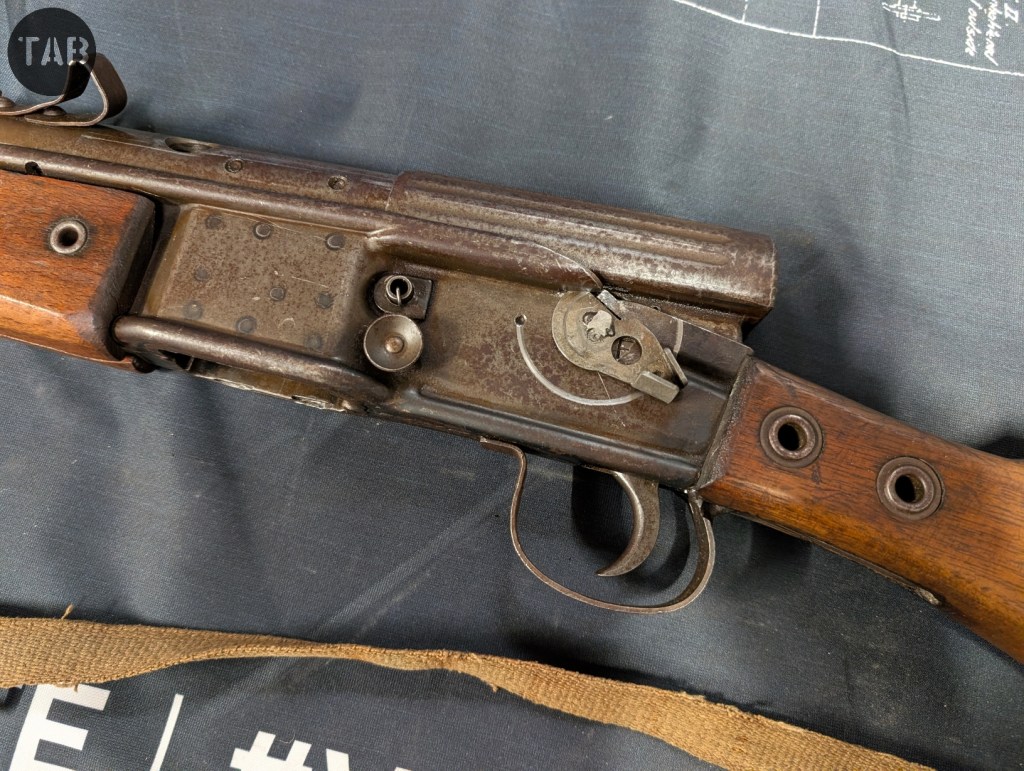
Volkssturmgewehr receiver close up (Matthew Moss)

The Gustloff Volkssturmgewehr was undeniably the most complicated of the Volksgewehr-Programm guns. A semi-automatic, gas delayed blowback operated carbine chambered in Germany’s new intermediate 7.92x33mm Kurz cartridge. Developed by Karl Barnitzke, Gustloff Werke’s chief designer, initial versions of the weapon were select-fire and designated the MP 507. Gustloff submitted a semi-automatic variant of the carbine to the Volksgewehr-Programm trials but was rejected in November 1944, ostensibly due to cost, comparative complexity and ammunition consumption.

Field stripping the Gustloff Volkssturmgewehr:

First check the weapon is in a safe condition. Then unscrew the knurled nose cap by lifting the retaining flat spring. Then slide out the weapon’s mainspring. Remove the single retaining pin [which does not fit into any of the slots in the stock, despite looking like it will]. Remove the safety catch, this is retained by a raised flat that sits under one of the stamped receiver’s folds. Lift trigger assembly up, out of the rear of the receiver, then slide the bolt and barrel shroud assembly forward and off the barrel.
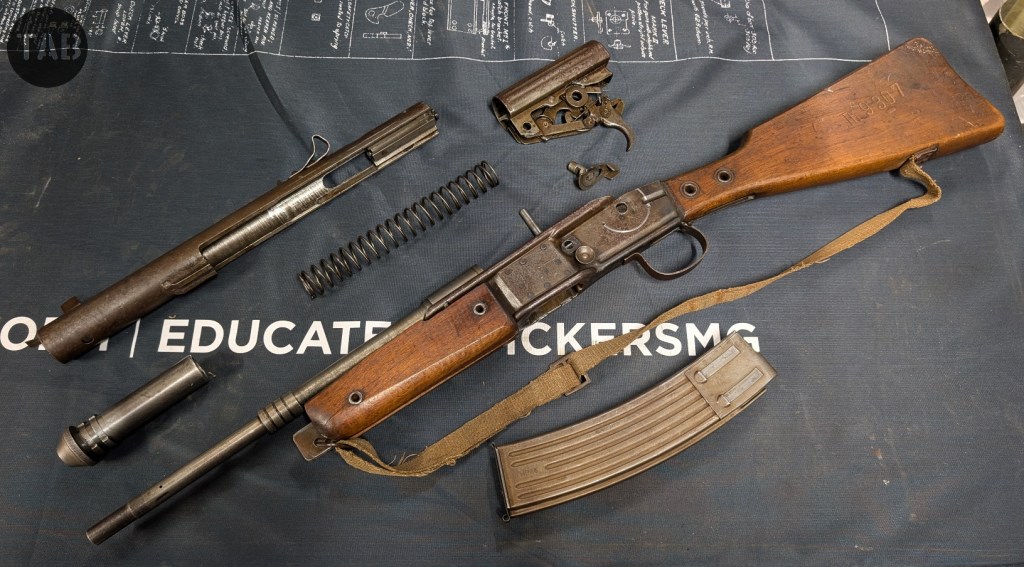
Volkssturmgewehr disassembled (Matthew Moss)

Looking over the disassembled weapon we can see the two coarse interupted threads which retain the nose cap. We can see one of the four gas ports and gas expansion chamber rings. The trigger and firing mechanism are one complete assembly. the breach block is pinned into the barrel shroud (which also acts as the body of the gas expansion chamber). Note the rough welds on the lower guide piece. Not the extremely rudimentary charging handle and front and rear sights.

How It Works:

The Volkssturmgewehr‘s design uses a gas-delayed blowback action. On firing, once the projectile leaves the muzzle, the propellant gases expand and push the spent case and the unlocked breech rearwards, the case is ejected and the barrel shroud/gas cylinder/bolt assembly recoils. As the weapon fires and the projectile passes through the barrel the weapon vents gas from the barrel through four small holes, the gas expands into the cylinder/chamber, which is formed around the barrel by the shroud, this is intended to slow the rearward movement of the bolt assembly. The mass of the barrel shroud/gas chamber/bolt assembly also aids in slowing the opening of the breech.

As the situation continued to deteriorate, Gauleiters (or regional leaders) were given carte blanche to direct local weapon production and procurement and the Gustloff Volkssturmgewehr was resurrected and put into production Thuringia’s Gauleiter Fritz Sauckel. As such the weapons do not have the typical Waffenamt acceptance markings. The first guns were completed in late 1944, with the production line ramping in January 1945. This particular example, with the serial Th. 9307 stamped into the stock, was assembled near the end of production.
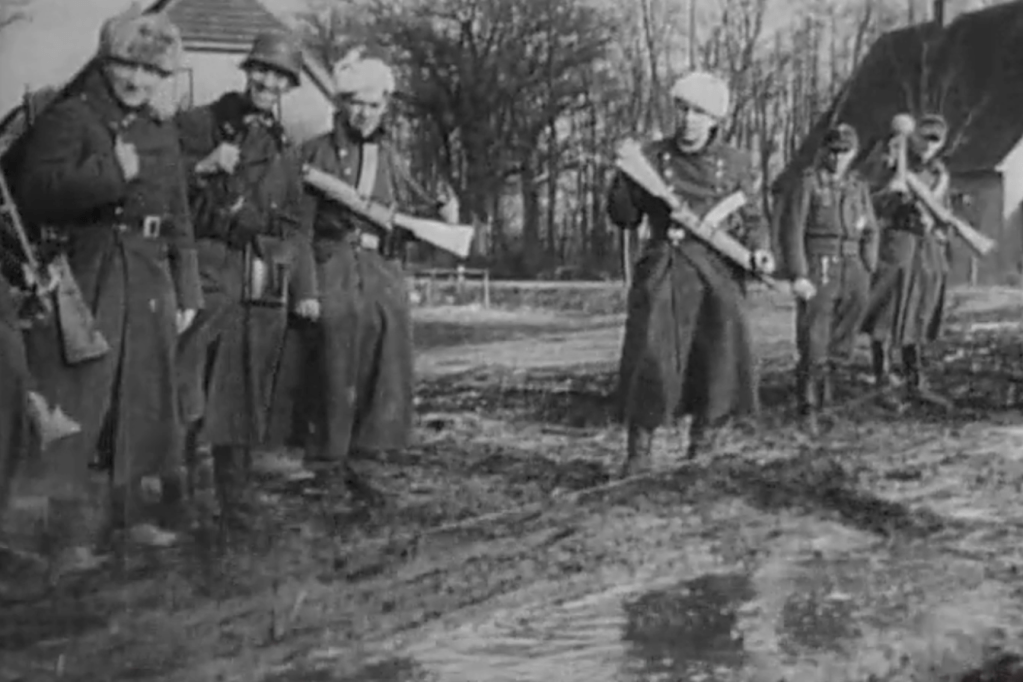
Well-equipped Volkssturm battalion members with Volkssturmgewehrs (United States Holocaust Memorial Museum)

Barnitzke claimed that the weapons took only 3 hours to manufacture and that approximately 10,000 were built. The Volkssturmgewehr has fewer than 40 metal components and is built around a two piece riveted stamped receiver. It has a roughly machined barrel, a stamped receiver cover and simple wooden furniture. The characteristic sling often seen with the were permanently attached to the weapons furniture and are believed to be derived from a gas mask canister straps with extra reinforcement.

Unlike the other Volkssturm weapons there is contemporary imagery in the form of photos and newsreel footage which show that Volkssturmgewehr reached the front and was used. It is believed that the weapons predominantly saw use with Volksturm units on the Oder Front, to the east of Berlin.
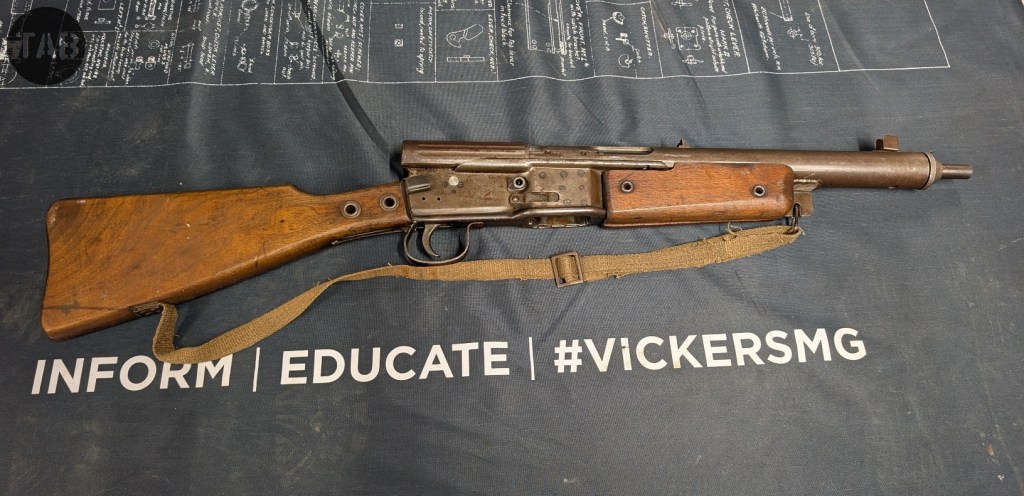
Right-side profile Volkssturmgewehr (Matthew Moss)

As the war ended the US Army captured a number of examples of the weapon and one was sent to the US Army’s Aberdeen Proving Ground for evaluations in July 1945. The report, which is likely the first document to refer to the weapon as the VG 1-5, found the Volkssturmgewehr ‘crudely made’ concluding that “accuracy was poor, general functioning was fair with the exception of recurrent feed failures… in general, the weapon appeared capable of fulfilling the mission for which it was designed” [Report No. 06-64-TM-OC, July 1945]

Special thanks to the Vickers Machine Gun Collection for allowing me to film this item from their incredible collection, I can’t encourage you enough to check out their videos, website and amazing collection.


Bibliography:

Desperate Measures : The last-Ditch Weapons of the Nazi Volkssturm, W.D. Weaver (2005)

Deutsche Sturmgewehre bis 1945, P. Senich (1998)

Volksgewehre: Die Langwaffen des Deutschen Volkssturms, W. Peter-Michel (2017)

German Submachine guns & Assault Rifles of World War II, Aberdeen Proving Grounds Series (1968)


Support Us: If you enjoyed this video and article please consider supporting our work here. We have some great perks available for Patreon Supporters – including early access to custom stickers and early access to videos! Thank you for your support!

The 7.92mm Kurz Rheinmetall Volkssturmgewehr

I’m very pleased to present the first of the videos filmed during my recent research trip to the US. My thanks to my friend Chuck Kramer, of the excellent GunLab blog, for his generous help and assistance making this video on a special little rifle. – Matt


The Volkssturmgewehr

By early 1945 Nazi Germany’s situation was desperate, with no real hope of victory left desperate holding actions became the order of the day.  It was hoped by many on Hitler’s staff that if they could hold back the Russian’s long enough the Western Allies would reach Berlin first. This was not to be as the Red Army was making rapid progress into German territory, covering up to 35 km a day by March 1945. Once the Soviets encircled Berlin on the 20th April there was no possibility of a surrender to the Western Allies who in reality had long since lost interest in the ‘Race to Berlin’.

While the war had seemed hopeless for many months the German High Command continued its efforts to construct a formidable defence against the oncoming Russian forces. This saw the activation of the German militias and the forming of a new corps, the Volkssturm or in English: ‘people’s storm’.  This optimistically named force made up of all men aged between 13 and 70 were called up and expected to defend their local areas, much like the British Home Guard formed in 1940.

Volkssturm with vg1-5
A well equipped, uniformed Volkssturm unit defend the banks of the Oder in this propaganda photograph, the man in the foreground holds a VG.1-5 (source)

In order to arm these men stores of older weapons were re-issued and the Volkssturm were issued Mauser G98s and old MG08s along with a large variety of captured foreign weapons which were in store including French, Polish and Russian small arms.

There were not enough modern weapons to equip the struggling regular forces let alone the newly improvised ‘volunteer’ force. As such Germany’s weapons factories were directed to create prototypes of simpler, cheaper weapons that might be mass produced quickly with minimal tooling. This project was dubbed the Primitiv-Waffen-Programm. These primitive weapons had to be made quickly with the materials at hand. This spawned a number of prototypes with varying degrees of sophistication, the so-called VolksGewehr or ‘people’s guns’. The best known of these is perhaps the Gustloff Volkssturmgewehr or MP 507 -often referred to as the VG 1-5.

VG1-5
A Gustloff Volkssturmgewehr (RIA)

The Gustloff Volkssturmgewehr was undeniably the most complicated of the Primitiv-Waffen. A semi-automatic, delayed blowback operated, carbine chambered in Germany’s new intermediate 7.92x33mm Kurz cartridge. This weapon will hopefully be the topic of a future blog/video.

Rheinmetall Volkssturm Carbines

The focus of today’s blog/video, however, is another Primitiv-Waffen chambered in 7.92x33mm developed by Rheinmetall. Rheinmetall developed a series of several prototypes, the VG45 or VG3 was the only prototype to be tested, however, a stamped receiver prototype was also developed.

Formed in 1935 as Rheinmetall-Borsig AG, Rheinmetall while perhaps best known for their larger calibre guns, they also developed a number of small arms designs – including several weapons for the Volkssturm. The VG45, chambered in 7.92mm Kurz, was developed in late 1944 and according to Wolfgang Peter-Michel, in his book Volksgewehre which quotes a contemporary British report, the VG45 was somewhat similar to the Walther designed VG1 in design, but chambered in 7.92 Kurz rather than 7.92x57mm Mauser. There is only a single, grainy photograph purporting to be the VG3 (with a missing bolt), which can be seen here.

Replica ermawerke carbine
Rheinmetall stamped Volkssturmgewehr replica (Matthew Moss)

Using a tube receiver simple forgings, spot welds and rivets the VG45’s design was utilitarian with one-piece beech wood furniture. It weighed around 6.8lbs or 3.1kg unloaded and had an overall length of 34 inches / 86cm. With a simple two lug bolt and no safety the carbine was extremely utilitarian. In October 1944, rifles from five companies were submitted in response to a call for a weapon of “simplified construction for mass production.” Rheinmetall’s design was not one of these first five designs.

However, by mid December Rheinmetall had submitted their carbine, the VG45, for testing. It reportedly performed well during testing in Kummersdorf, firing some 2,000 rounds and 20 rifle grenades successfully without major malfunctions. A report to Heinrich Himmler, dated 28th December, who had been tasked with overseeing the Volkssturm’s formation, noted that “most of the rifles’ stocks cracked when shooting the rifle grenades… the rifles are not yet [fully] examined and the current status of development do not yet permit a final test-firing.” Of the rifles submitted to testing only the designs from Mauser and Rheinmetall continued to be considered. While the VG1 and VG2 were ‘officially’ accepted Rheinmetall also received an order for 25,000 of their VG45 carbines – later referred to as the VG3.

Full scale production never began as the factory was heavily bombed in the closing stages of the war. Prototypes of the VG45 were found by the Allies when they captured the Rheinmetall plant in Sömmerda in Thuringia, central Germany. The British tested one of these rifles, marked ‘Rh Nr.4 VG45K’ on the receiver.

The British also captured another prototype 7.92mm Kurz bolt action carbine. It had a two-piece stamped receiver – welded together at the top of the receiver, with spot-welded inserts that formed the magazine housing simple two-lug bolt and a two-piece stock. It is unclear if this prototype carbine was submitted for testing. It is likely that it was still in development at the time of the December 1944 testing.

Another 7.92mm Kurz Carbine

Ermawerke, or Erfurter Maschinen- und Werkzeugfabrik GmbH, was established in Erfurt, Thuringia in the early 1920s, throughout the war they manufactured the Erma EMP, the MP38/40 and developed the prototype MP44 submachine gun. In late 1944, Erma set about developing their own entry for the Primitiv-Waffen program.

Original Ermawerke Carbine
Profile photographs of the original incomplete Ermawerke Carbine prototype, missing its bolt and reportedly with replacement more elaborate wooden furniture (Photographs originally taken by US Army)

Erma’s prototype is very similar to Rheinmetall’s stamped prototype – a small, light, bolt action carbine chambered in the 7.92x33mm cartridge and able to feed from standard 30-round Sturmgewehr magazines. Unlike the Rheinmetall’s carbines, Ermawerke’s had a rudimentary trigger block safety at the rear of the trigger guard. Erma’s rifle also went through the December 1944 tests with no function issues. It appears that very few were manufactured and that only one or two examples survived the war. One surviving carbine, said to be in Russia, is missing its bolt and has had reportedly had replacement furniture fitted.

The Ermawerke carbine also made extensive use of stampings and simple forgings with rivets used to attached crudely finished wooden furniture. The receiver is similar to a VG-2 with an ejection port on the right. It weighed 6lbs or 2.7kg and had a 16.5 inch or 42cm barrel. The original carbine reportedly had no Wehrmacht/Waffenamt (WaA) acceptance marks. In his book, Deutsche Sturmgewehre, Peter Senich suggests that an example of the rifle was tested at the US Army’s Aberdeen Proving Ground in 1945.


Shooting the Rheinmetall Volkssturm Carbine

Check out our short live fire & slow motion video with the carbine here

Rheinmetall’s stamped Volkssturm carbine used a simple two-lug rotating bolt action which was cocked on opening. It had a simple fixed rear notch sight and weighed just over 6.5lbs or 2.95kg unloaded, had a 15.45 inch or 39cm barrel and an overall length of 34 inches / 86cm. Unlike the VG45, the stamped prototype had a lever on the left side of the receiver which acted on the trigger sear to prevent it being depressed.

This video features a replica of Rheinmetall’s stamped Volkssturm carbine produced by Range Facilities (Burnham), one of a small batch made, which attempts to reproduce the original prototype. I had the opportunity to handle and fire one of the carbines. As such my appraisal of the rifle’s handling characteristics and shooting experience are based on the replica not the original. But I feel my experience with the reproduction is representative of how the original Rheinmetall carbine, and the other Primitive Waffen 7.92mm Kurz carbines might have handled.

Both the carbine and the 10-round magazine featured in the video were handmade to a high standard. There are, however, a number of key differences between the replica and the original, as described in the original British intelligence report. No markings were reported on the stamped prototype, however, the reproduction borrows markings from the VG45 and is marked ‘Rh Nr.5 VG45K‘ on the left side of the rifle. Another key difference is the addition of a utilitarian safety bar which blocked the trigger rather than a lever reported to be used by the original prototype. The replica also had a rounded bolt handle while the original is described as having a “straight and hollowed out bolt with no bolt knob, similar to the VG1. The reproduction has had a cleaning rod added beneath the barrel and its wooden furniture may also differ slightly.


The replica was very well made and care has been taken to give it a suitably aged appearance. Light and handy the carbine handled well and the 7.92x33mm Kurz chambering made it a light shooting carbine. While the replica’s bolt was a little stiff, this is probably quite representative of how the original would have handled.

The softer shooting 7.92 Kurz round certainly would have made sense for a rifle designed to be issued to poorly trained volunteer units made up of old men and young boys. The very basic rear sight necessitated the use of some Kentucky windage as the rifle shot a little low and to the left at ~70 metres. But within firing a single 10-round magazine I was able to quickly bring my shots to within a man-sized target with relative ease.

Here’s some photos of the carbine’s safety and magazine release:


This slideshow requires JavaScript.

While both the VG1, VG2 and VG1-5 all entered limited production the war ended before serial production of the the VG45/VG3 could begin. Rheinmetall’s stamped prototype probably did not see official evaluations and probably only one or two were produced before the bombing and subsequent capture of the factory.

However, the various 7.92mm Kurz Volkssturm carbines and the other Primitive Waffen remain important examples of the desperate measures Nazi Germany was forced to resort to at the end of the war in an effort to equip its troops.

If you enjoyed the video and this article please consider supporting our work here.


Specifications for Original Prototype Rheinmetall Volkssturm Carbine:

Overall Length: 88cm / 34 inches
Barrel Length: 39cm / 15.45 inches
Weight:  2.95kg / 6.5lbs
Action: bolt action
Calibre: 7.92x33mm Kurz
Feed: 10 or 30-round box magazines


Bibliography:

Desperate Measures : The last-Ditch Weapons of the Nazi Volkssturm, W.D. Weaver (2005)

Deutsche Sturmgewehre bis 1945, P. Senich (1998)

Volksgewehre: Die Langwaffen des Deutschen Volkssturms, W. Peter-Michel (2017)

Live Fire: Rheinmetall Volkssturm Carbine

The second in our series of short live fire and slow motion videos looks a reproduction of a Rheinmetall Volkssturm Carbine. Matt had the opportunity to fire a replica of the little known bolt action and captured some great video.

Rheinmetall developed the carbine at the very end of the war for the Primitive Waffen program which was intended to arm the Volkssturm (a militia unit). Chambered in 7.92×33 Kurz the carbine has a simple two-lug rotating bolt.

Replica ermawerke carbine
Rheinmetall prototype carbine replica (Matthew Moss)

It’s a handy little rifle and quite pleasant to shoot, the 7.92 Kurz chambering would have made it ideal for poorly trained Volkssturm members thrust into the fighting on the Eastern Front. The carbine, however, was never fielded and only a handful were built.

We’ll discuss the development, design and history of the rifle in an upcoming full-length video, so stay tuned for that!

My thanks to Chuck Kramer of Gun Lab for helping make this video happen, check out his blog here.


Correction:

The carbine was originally described as a replica of an ErmaWerke Volkssturm Carbine when in fact it is largely based on a Volkssturm carbine prototype captured at Rheinmetall’s factory at the end of the war. While both the Ermawerke and Rheinmetall carbines are chambered in 7.92mm Kurz and share a number of similarities they are distinct designs.

This is explained in our full video and blog on the Rheinmetall Volkssturm carbine here.