The S8 is an 80mm family of unguided rockets developed by the Soviet Union and still in service today. Developed in the 1970s there is a whole range of different types of warheads for the rockets and the S8s are most commonly seen being fired from both Russian and Ukrainian helicopters or Su-25s. We typically see both sides firing salvos of the rockets by pitching up the aircraft and launching, while this no doubt more inaccurate than firing them directly onto a ground target, as originally intended, the practice does keep the valuable aircraft somewhat out of the range of opposing air defences and must have some effect downrange as the practice has continued since the first weeks of the war.
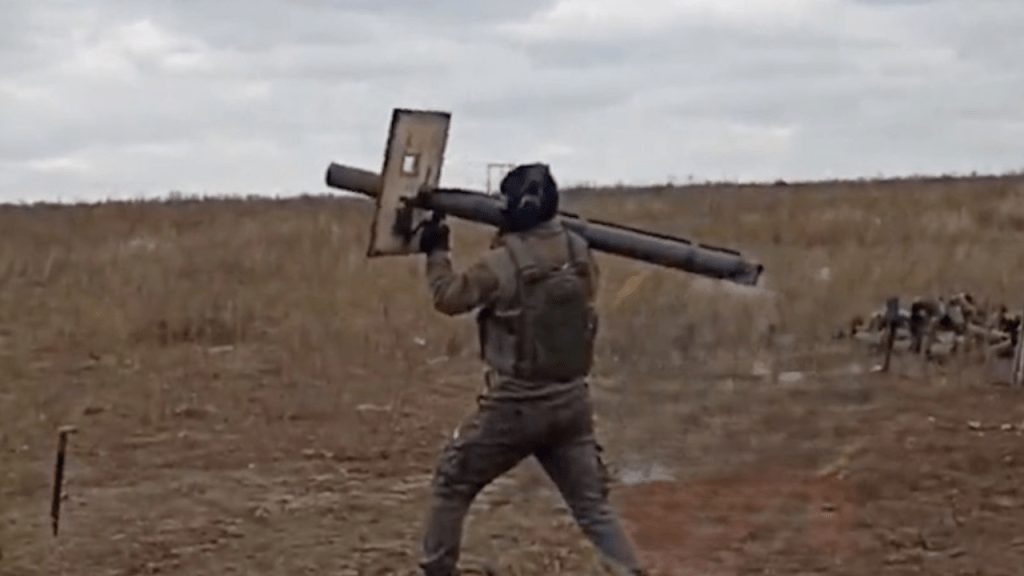
Firing an improvised S8 launcher (via social media)
This week, however, a video of an improvised launcher developed to be fired from the shoulder emerged, seemingly developed by Russian personnel. We can see that the launcher has a pair of pistol grips, a shield made from four planks of wood with a small hole and a plastic screen tacked in place. An electrical box is also mounted on the shield, possibly containing a battery, with a cable tube running to the rear of the launch tube, ostensibly to ignite the rocket motor. It appears that there may be a trigger on the front grip. An individual in the video providing commentary states that the connection is ‘absolutely safe’. The launch tube appears to have at least one bracket welded to it for securing the shield. How the launcher is aimed is unclear, but the individual filming states that they are testing the principle and still need to make some refinements.
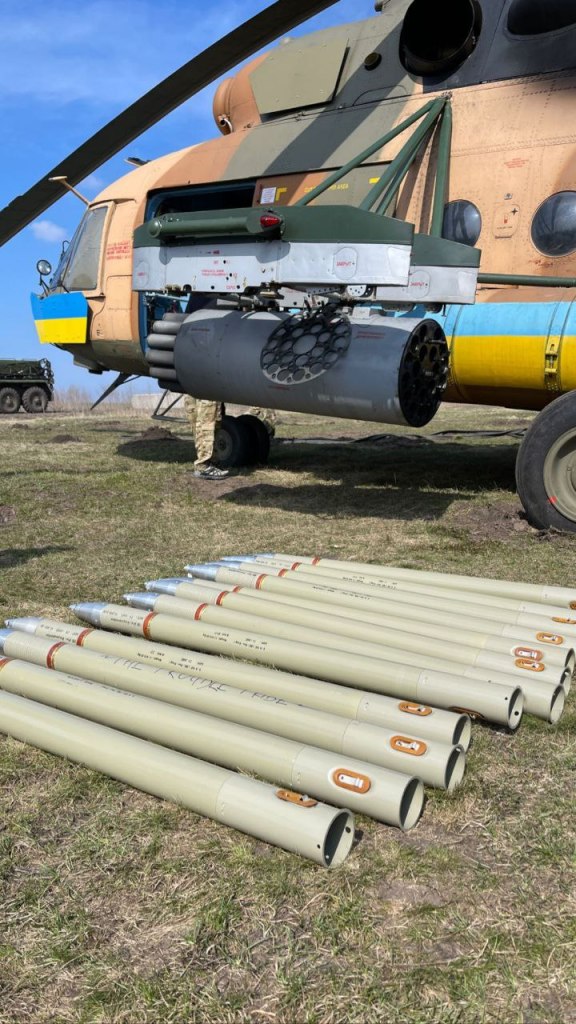
S8 rockets ready to be loaded onto a Ukrainian helicopter, 2023 (via social media)
The S8’s rocket burns for approximately 0.7 seconds, generating around 5,800 Newtons of thrust. Depending on the variant of rocket used the rocket has a velocity of around 450 m/s, some variants are faster, this is around 4x faster than a conventional shoulder-fired rocket system, an RPG-22 for example has a muzzle velocity of approximately 130 m/s.
Shield and pistols grips of the improvised S8 launcher (via social media)
The clip shows the firer shoulder the weapon and fire, the launch is successful with the launcher operating as expected but the recoil from the extremely fast moving rocket was considerable. The exhaust gases also appear to have acted on the shield pushing it back against the operator. The launcher flies completely out of the operators hands just after launching, with the shield – designed to protect against rocket’s exhaust gases, apparently striking him in the face. The individual filming continues to track the flight of the rocket and the firer is not shown again.
Preparing to fire an improvised S8 launcher (via social media)
The idea of shoulder launching an S8 has been explored before in Chechnya and elsewhere but unless the force of the launch can be mitigated then the results are the same. Ground improvisation with S8 rockets isn’t uncommon with lots of improvised multiple-launch rocket systems (DIY MLRS) being used by both sides, these typically use pre-existing rocket pods mounted on vehicles. This is a topic for a future article/video. A single S8 launch tube on a mount or tripod, where the danger to the operator is minimised, might have useful applications, similar mounts have already been developed to fire Grad rockets with some degree of accuracy.
One of the rarer Russian anti-armour weapons to surface during the ongoing war in Ukraine is the RPG-16. The RPG-7’s big brother was developed in the late 1960s and entered service in the early 1970s. It was predominantly developed for Russia’s airborne forces, the VDV, but also saw issue to Spetsnaz units.
The RPG-16 is characterised by its larger diameter tube which can fire a 58mm (2.3 inch) PG-16 rocket-propelled grenade. Unlike the RPG-7s munitions the PG-16 slides flush inside the launcher, while this limits the volume and types of warhead the RPG-16’s ammunition can carry it provides improved accuracy and slightly increased range. The PG-16 is a fin-stabilised high explosive anti-tank (HEAT) round with a rocket booster which propels it at a maximum velocity of 350 metres per second. The rocket weighs around 2.1kgs and has a maximum range of 800 metres, though practical engagement range of vehicles is closer to 300 metres. It can penetrate up to 300mm (12 inch) of rolled homogenous armour.
An RPG-16 seen in a Russian news report, June 2023 (Russia 1)
The RPG-16 can only fire the PG-16 round and following its adoption in the early 1970s it has been surpassed by other anti-armour weapons which have entered Russian service and by the development of more capable PG-7 series warheads. The launcher weighs 12.4 kg (27 lbs) [compared to the 7 kg (15.4 lb) of the RPG-7] when loaded and is 110cm (43.5 in) long but can be broken down into two parts: the rear tube with venturi and the forward tube and fire control group. Unlike the smaller RPG-7 it has a bipod near the muzzle and a grip area on the fire control group, it does not have a second, rear pistol grip.
A reported 120,000 were produced with manufacture continuing into the late 1980s. It had been thought that the RPG-16 went out of Russian service in the early 2000s but evidently some have been drawn from stores and have been used in Ukraine. The RPG-16 was reportedly used against fixed positions during the Soviet war in Afghanistan and may now be pressed into the same role in Ukraine.
It appears from available imagery that the RPG-16 began to be issued in early 2023. Early March 2023 saw Russian state-news outlet RIAshared a report featuring combatants of the 76th Guards Air Assault Division firing small arms and RPGs in woodland. One of the RPGs fired was an RPG-16.
Russian combatant firing an RPG-16, December 2023 (via social media)
In late April, stills from a video of troops said to be with the 98th Guards Airborne Division featured an RPG-16 being fired near Dibrova were shared. I’ve been unable to find the original footage. In June, one of the launchers appeared in a Russia-1 news report featuring Russian forces near Avdiivka, Donetsk Oblast.
On 26 November, a Russian combatant shared a photograph of an RPG-7 and an RPG-16 next to one another, reportedly taken in a depot or armoury. Two days later on 28 November a short clip of marines from the Russian 40th Naval Infantry Brigade was shared showing an RPG-16 in action, location unknown, possibly near Pavlivka.
A week later, on 3 December a video featuring a pair of Russian combatants from the Otvazhnye (Brave) Group, firing an RPG-7 and an RPG-16 was posted on telegram. The footage was probably filmed in near Kreminna where the unit was reportedly active.
Russian combatant poses with an RPG-16 and AK-12, January 2024 (via social media)
On 13 December, a mobilized Russian combatant shared a post on Telegram describing his experiences at the front. He mentions that due to a lack of infantry anti-armour weapons with sufficient range to reach Ukrainian AFVs standing off and firing on their positions his unit began issuing RPG-16s. In late January, two photographs of Russian troops in a trench, location unknown, posed with an RPG-16, and some unrelated RPG-7 munitions.
From the limited imagery available it seems that the RPG-16s have been again issued to largely airborne units, however they have also been seen with Russia’s naval infantry. Exactly why the RPG-16 has returned to service is unclear, as by one Russian combatant suggested, it may be that the greater range offered by the RPG-16 enables engagement of distant targets, another potential reason might be Russia’s desire to use up existing reserve stocks of munitions.
Support Us: If you enjoyed this video and article please consider supporting our work here. We have some great perks available for Patreon Supporters – including early access to custom stickers and early access to videos! Thank you for your support!
Specifications:
Calibre: 58.3 mm Length: – Assembled: 1,104 mm – Disassembled: 645 mm Weight: – Unloaded with optical sight: 10.3kg – Loaded: 12.4kg Velocity: – Initial: 130 m/s – Maximum: 350 m/s Effective range: 800 m Armour Penetration: +300 mm
Bibliography:
Jane’s Infantry Weapons 2014-15, R.D. Jones & L.S. Ness (2014)
The RPG-30 is one of Russia’s more advanced disposable anti-armour weapons. Developed in the early 2000s by Bazalt it is designed to overcome reactive armour and active protection systems. It entered service in 2012 and has seen extensive use during the fighting in Ukraine.
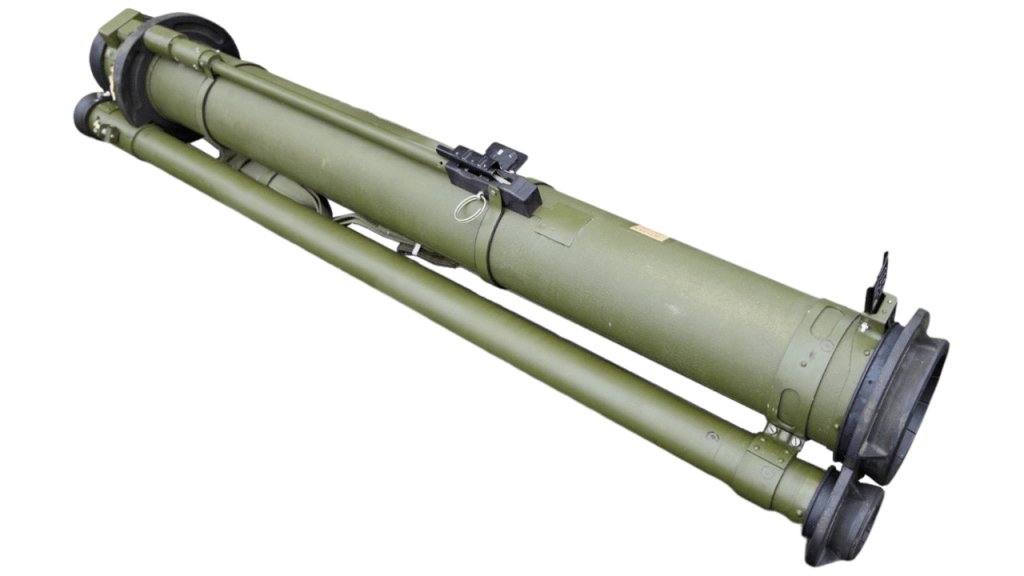
The 7P53 RPG-30 “Kryuk” or ‘Hook’ is a 105mm fin and spin stabilised rocket propelled munition with a tandem HEAT shaped charge warhead. The RPG-30 overcomes ERA and APS by using a 42mm IG-30 decoy projectile, which is believed to be inert, coupled with the main rocket’s tandem warhead. This can be seen in a secondary, thinner tube running along the side of the weapon. The precursor decoy causes premature activation of the APS and allows the main warhead to exploit the gap in the tank’s protection. The theory being that the target’s APS takes some time, perhaps half a second, before it can engage again. The gap between the firing of the two rockets is measured in milliseconds and the lag, while noticeable, does not appear to be significant enough to effect the user’s aim or accuracy on target.
RPG-30 (Vitaly Kuzmin CC BY-SA 4.0)
The RPG-30 uses the PG-30 tandem HEAT warhead, similar to the PG-27 used by the RPG-27. It can reportedly penetrate 750mm of rolled homogeneous armour and up to 650mm of rolled homogeneous armour after ERA. Effective range estimates vary with the average suggesting 200m.
The weapon’s sights are simple and consist of a folding ladder front sight and rear sight – there does not appear to be provision for mounting optics. Flipping up the rear sight also cocks the weapon. The disposable tube(s) is made of aluminium with a fibreglass outer layer. Sources suggest it weighs around 10.3kg (22.7lbs) and has an overall length of just over 1m (1,135mm/44.7in).
A pair of RPG-30s captured in April 2022 (via Social Media)
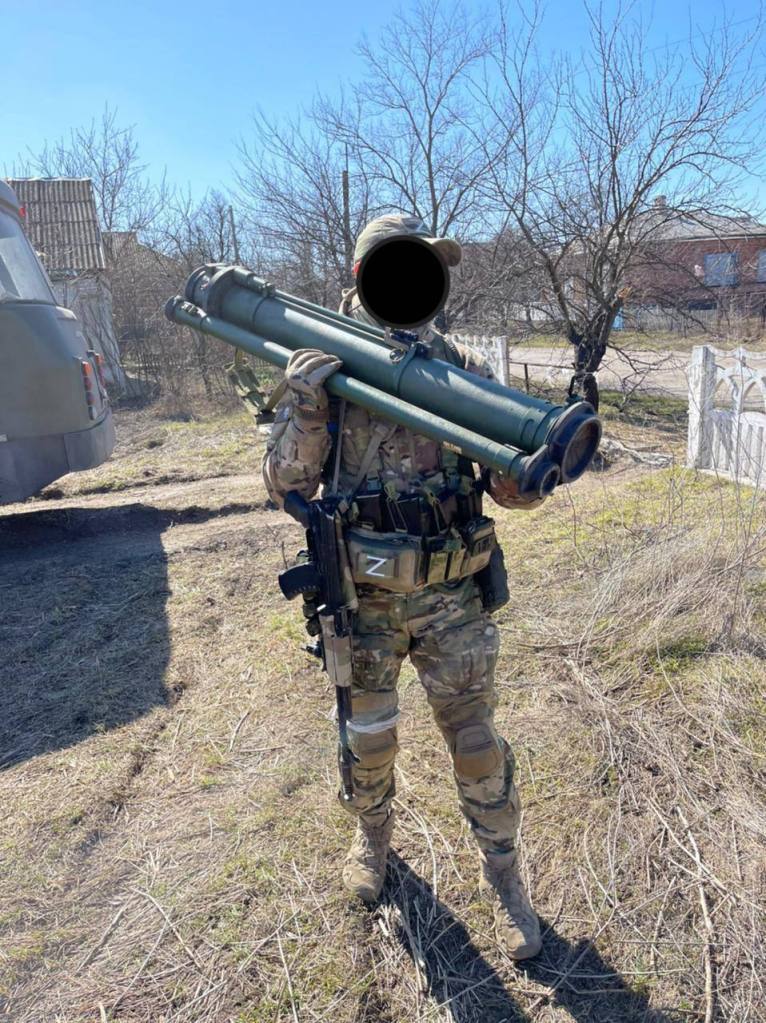
Unlike other Russian weapon systems few videos of its use have been shared by Russian state media or Russia’s defence exports corporation Rosoboronexport. The ongoing war in Ukraine, however, has provided our first real look at the weapon in action. As soon as the Russian invasion was launched on 24 February, RPG-30s began to be seen in use with Russian forces. By late February and early March imagery of captured examples was shared on social media.
Russian soldier posing with RPG-30, March 2022 (via Social Media)
The first images of the weapon came from Russian sources in late February, just after the invasion. This was quickly followed by imagery of captured examples, most notably from the column of Tigr-M armoured infantry mobility vehicles in Kharkiv. A photograph of a further two captured RPG-30s appeared in April, while another example was photographed in Donbas in early May. Later in May a photo of a Russian soldier posing with one was shared on social media and in September significant caches of weapons were captured in Kherson and Balakliya.
Still of a Russian soldier firing an RPG-30, August 2022 (via Social Media)
In late August we got our first brief look at the RPG-30 being fired in a montage video of VDV weapon systems (see image above). Earlier in mid-August a sort of ‘unboxing video’ was shared giving us a good close up look at some of the packaging the RPG-30s are shipped in and the markings on the side the weapon. Most recently in some further video of the RPG-30 being fired on a Russian Western Military District range also surfaced giving us a good look at the weapon in action.
RPG-30s captured in April (via Social Media)
Of course the weapon is designed to be simple to use, anyone with training on a similar shoulder-fired disposable anti-armour weapon can operate it. While it has been said that its widespread use in Ukraine is somewhat ironic given that Ukraine does operate any APS equipped tanks, the weapon is still useful against less sophisticated tanks. While the precursor might potentially deliver some limited kinetic damage to the ERA block, the RPG-30’s tandem warhead is capable of defeating the ERA fitted to most Ukrainian tanks, though of course, the same can be said of Russia’s other anti-armour weapons which use tandem warheads.
Update 27/10/22:
The Georgian Legion recently shared a short video looking at a captured RPG-30. The video also includes firing footage of the weapon.
Extract from a recent Georgian Legion video examining a captured RPG-30.
— Matthew Moss | Historical Firearms (@historicfirearm) August 20, 2024
If you enjoyed this video and article please consider supporting our work here. We have some great perks available for Patreon Supporters – including custom stickers and early access to videos! Thank you for your support!
Since the war in Ukraine began on 24 February, the Ukrainian armed forces have been hastily putting together and sharing training films for various weapon systems. we’re sharing these so they’re saved for the historical record and so they can be easily found by those who might need them. We’ll try and give some context on the weapon’s origins and on who made the training video.
Demonstrating how to deploy the RPG-18, the tube isn’t fully extended as its a live weapon
In this well shot video a Ukrainian soldier demonstrates the features and handling of an RPG-18. The RPG-18 (‘Mukha’ or ‘fly’) was the first of the Soviet/Russian family of extendable tube launchers (very similar to the US M72 LAW). The RPG-18 was developed in the late-1960s and was introduced in the early 1970s. It has since largely been replaced by larger calibre and more capable launchers. The weapon is a simple, smoothbore, single-use launcher. It is constructed from an aluminium tube with an outer layer of fibreglass.
A close up of the RPG-18’s locking system, rear sight and trigger
It isn’t clear how many RPG-18 the Ukrainian Armed Forces’ may have had in inventory before the war began but it appears that the weapon seen in this video was made in East Germany and probably transferred by Germany as part of Germany’s military aid shipments to Ukraine. While Greece have also reportedly transferred a quantity of RPG-18s, we have seen other examples in the field with identical German instructions stickers.
#Ukraine: A rather interesting RPG-18 was captured by DNR forces; as can be seen, it was made by East Germany, and most likely recently transferred by Germany to UA forces. pic.twitter.com/B9WrWSRJvz
— 🇺🇦 Ukraine Weapons Tracker (@UAWeapons) March 16, 2022
The video first surfaced around the 21st March, posted by Vadim Kodachigov (the director of Kort, a military industrial company) on Facebook, though he may not be the original creator. Kodachigov appears to be part of a Territorial Defence Force unit. The video identifies the unit as part of the 112th Territorial Defense Brigade (Kyiv). The production value of the video is relatively high, with a title card, good editing, close ups and some interesting footage of the weapon being fired.
If you enjoyed this video and article please consider supporting our work here. We have some great perks available for Patreon Supporters – including custom stickers and early access to videos! Thank you for your support!
Bibliography:
Earliest video source found: Vadim Kodachigov via facebook (source)
In recent days, with the news that a shipment of M141 SMAW-D anti-structure weapons have arrived in Ukraine as part of the US military aid shipments, a number of media articles and videos have been made on the subject which seem to confuse the SMAW-D with the AT-4 and even the M72. So, I thought it would be useful to take a look at the SMAW-D in a little detail.
M141 (SMAW-D) (US Army Manual)
So What is the SMAW-D?
Its official designation is ‘Rocket and Launcher, 83mm HEDP Bunker Defeat Munition (BDM), M141 (SMAW-D)’ SMAW-D stands for Shoulder-Launched Multi-Purpose Assault Weapon-Disposable. This isn’t to be confused with the Mk 153 Shoulder-Launched Multipurpose Assault Weapon used by the US Marine Corps. Those the SMAW-D did evolve from the SMAW.
The initial Mk 153 SMAW evolved from the Israeli IMI B-300. During the early-1980s McDonnell Douglas further developed the system and it entered service with the US Marine Corps as the Mk 153 in 1984. The SMAW-D shares the same warhead as the Mk 153 SMAW. The SMAW-D was originally developed by McDonnell Douglas and the design was acquired by Talley Defense Systems, whom were subsequently acquired by Norwegian company Nammo.
M141 (SMAW-D) (US Army Manual)
The Mk 153 has a reusable forward launch tube and firing mechanism which has a spotting rifle and can be mounted with an optic. The warhead element of the SMAW is attached at the rear of the launcher. The US Army was initially interested in the Mk153 but preferred a lighter, single use weapon.
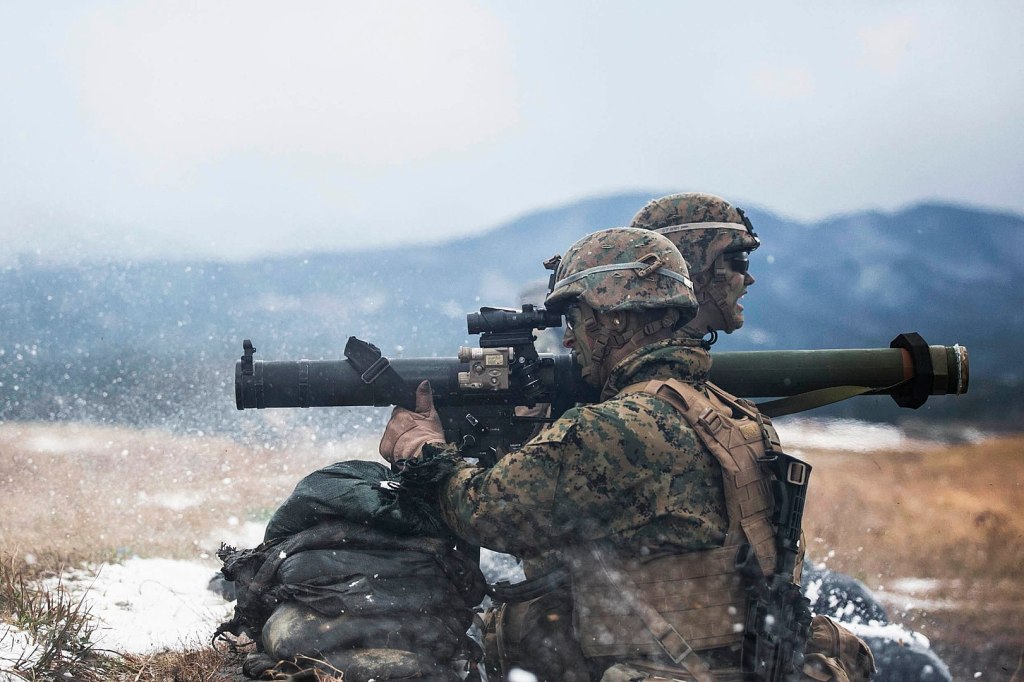
A Marine fires a Mk 153 SMAW (USMC/Cpl. Drew Tech)
In the early 1990s the US Army began the search for a disposable Shoulder-launched Multipurpose Assault Weapon. McDonnell Douglas offered a lighter, disposable version of the Mk 153, taking the Mk 153’s High Explosive, Dual Purpose warhead and pairing it with shorter burn rocket. In 1996 the US Army selected the SMAW-D, beating a Swedish design, the FFV AT8, and the Hunting Engineering LAW80. The SMAW-D entered service in 1999.
US Army advisor demonstrates how to deploy the M141 (Ukraine MoD)
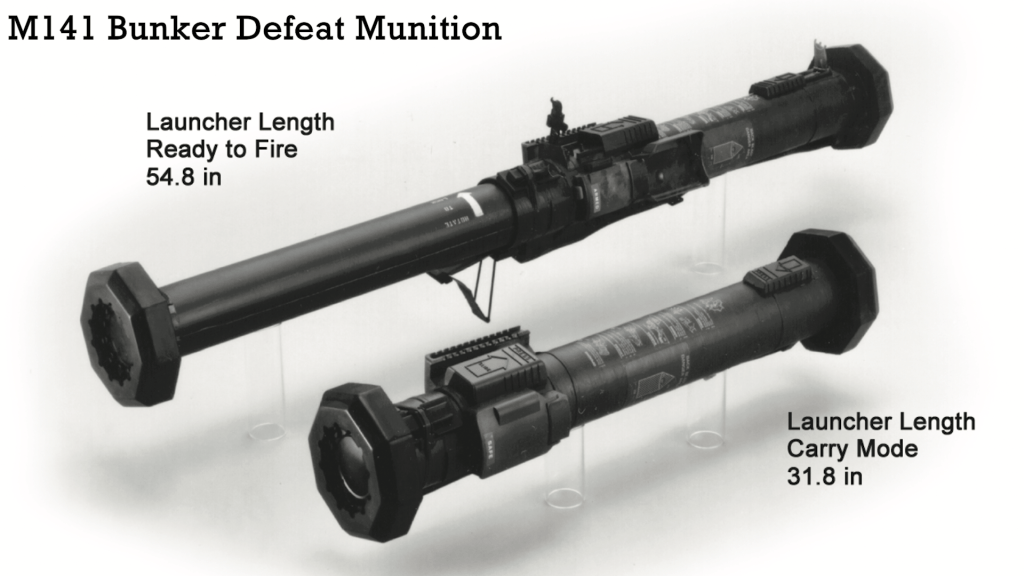
The SMAW-D is similar to the 66mm M72 in that it telescopes with the launch tube extended before firing. When collapsed it measures just under 32 inches in length but extending the inner tube gives the weapon an overall length of 55 inches. The launch tube and rocket weigh 15.7 lbs.
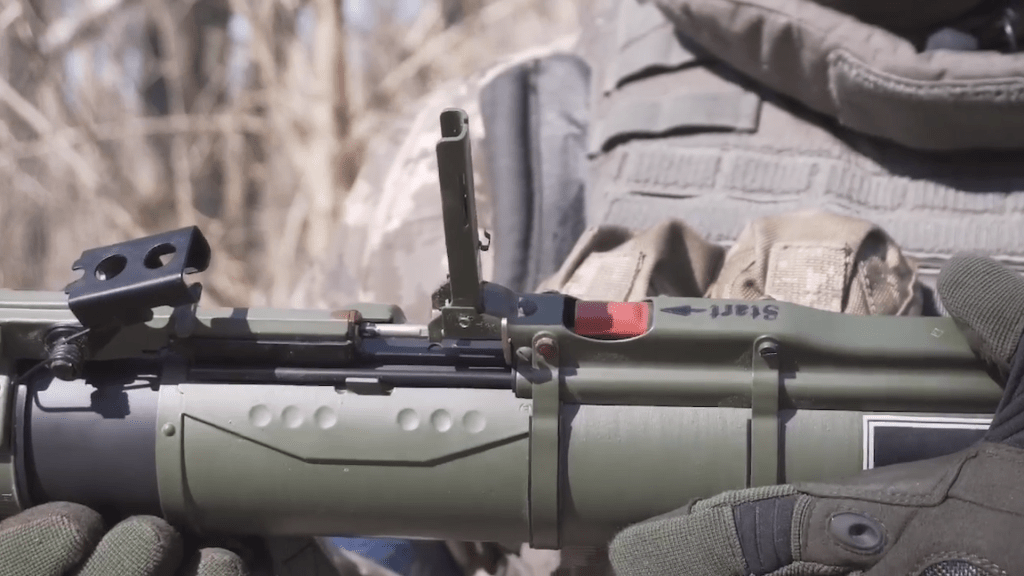
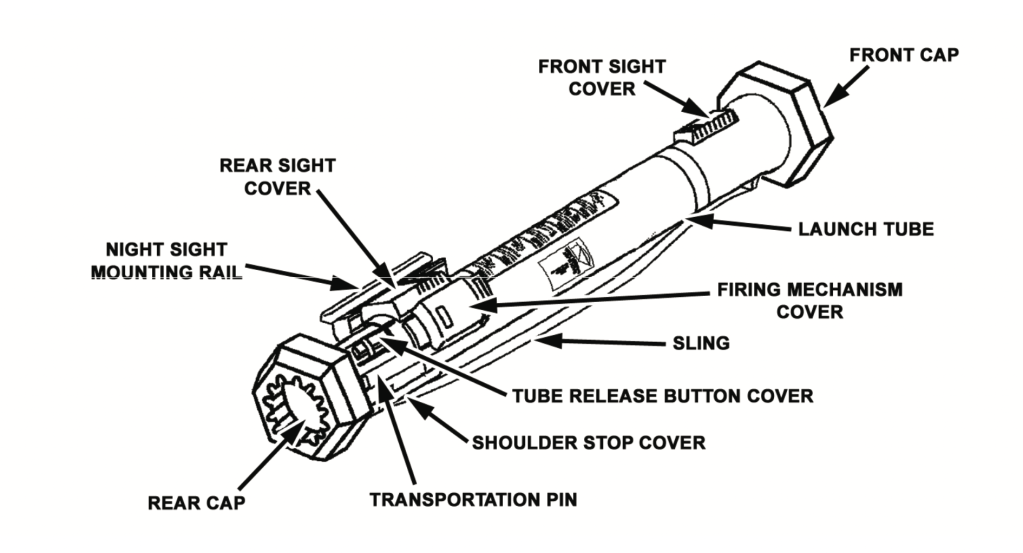
The tube has the firing mechanism mounted on the side under a plastic cover which when opened arms the rocket ready to fire. The weapon has front and rear iron sights for aiming. The SMAW-D can also be fitted with an AN/PVS-4 nightsight and various infrared aiming lasers for night fighting.
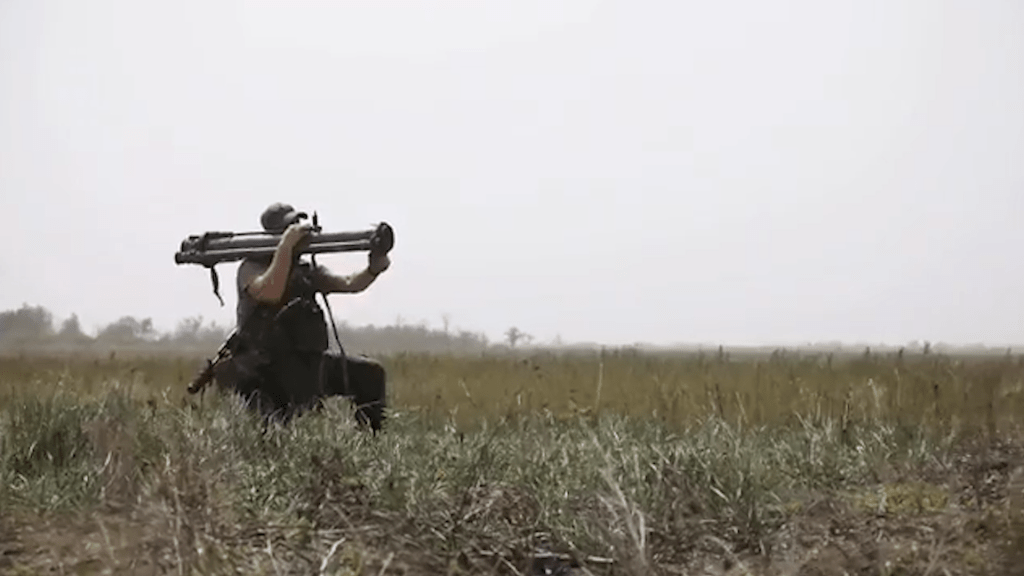
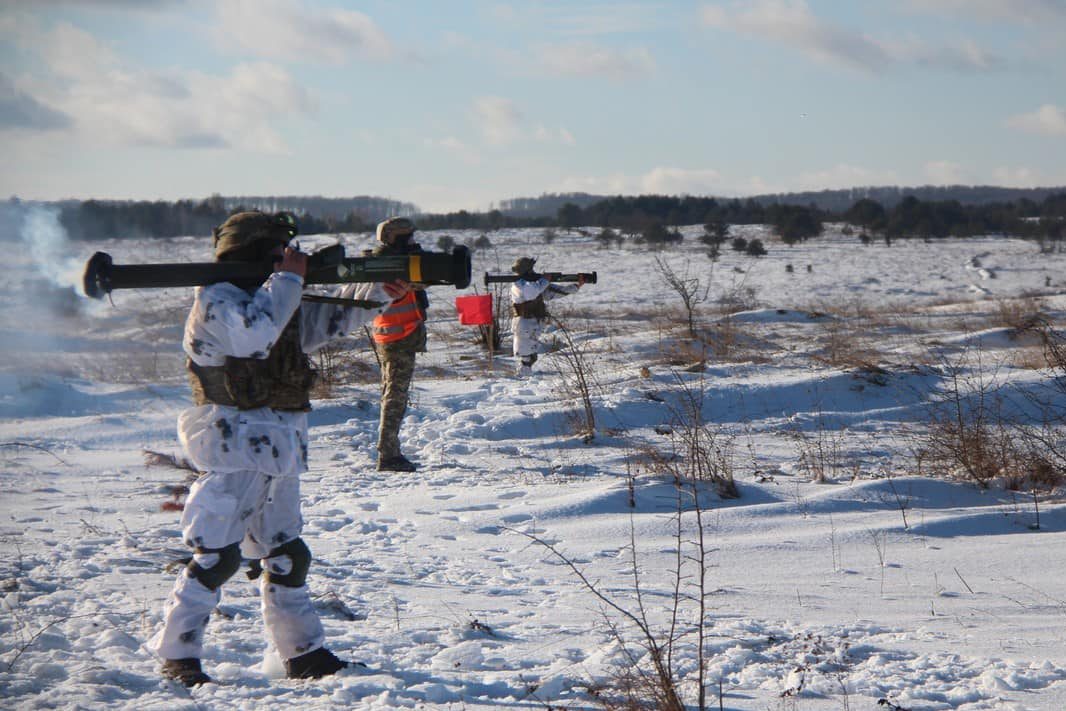
Ukrainian soldiers fire M141 BDMs (Ukrainian MoD)
To fire the M141 the operator removes the locking pin from the front of the launch tube, depresses the tube release button and extends the inner tube rearward. The operator then raises the weapon onto the right shoulder, slides the front sight cover forward and then the same for the rear sight. Then opening the firing mechanism cover pivoting it forward, flush with the tube, this arms the weapon. The operator should then check the backlist area and fire when ready by depressing the safety button and then the red trigger button. The rocket is ignited by an electrical impulse sent by the firing mechanism. Once ignited the rocket burns out before it leaves the muzzle, this protects the operator.
M141 (SMAW-D) (US Army Manual)
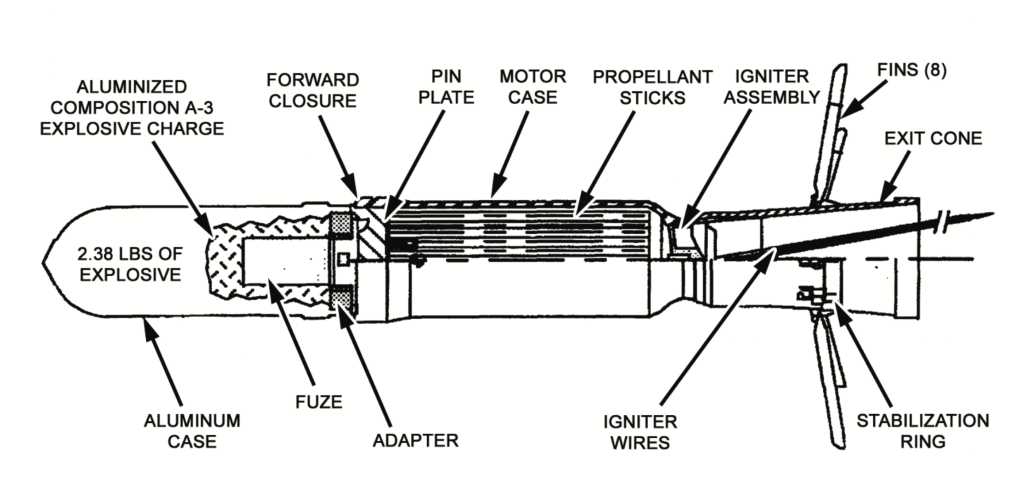
The M141 can engage targets out to 500 metres but is most effective out to 300. Its 83mm unguided, fin-stabilised round has an integral high-explosive, dual-mode warhead with 2.38 lbs of explosive. Detonation is instantaneous when impacting on a hard target, such as a brick or concrete wall, or an armored vehicle. Impact with a softer target, such as a sandbagged bunker, results in a fuze time delay that permits the rocket to penetrate into the target before warhead detonation. It can penetrate up to 200mm (8 inches) of concrete, 300mm (12 inches) of brick and 2m (6 feet 6.74 inches) of earth or sandbags. It can also perforate up to 20mm (0.8 inches) of rolled homogenous steel giving the SMAW-D the ability to take on soft and light armoured vehicles. For training at the range a 21mm sub calibre training system can be used. While the usefulness of the M141 might be questioned, as it isn’t an anti-tank weapon and could be considered more of an offensive rather than defensive weapon it would no doubt prove very useful during urban fighting, which Ukraine anticipates in the event of an invasion.
The SMAW-D saw service with the US Army during the War in Afghanistan and during the Iraq War. Some 6,000 units were initially procured, with an unknown number procured since. It remains an active part of Nammo’s product line.
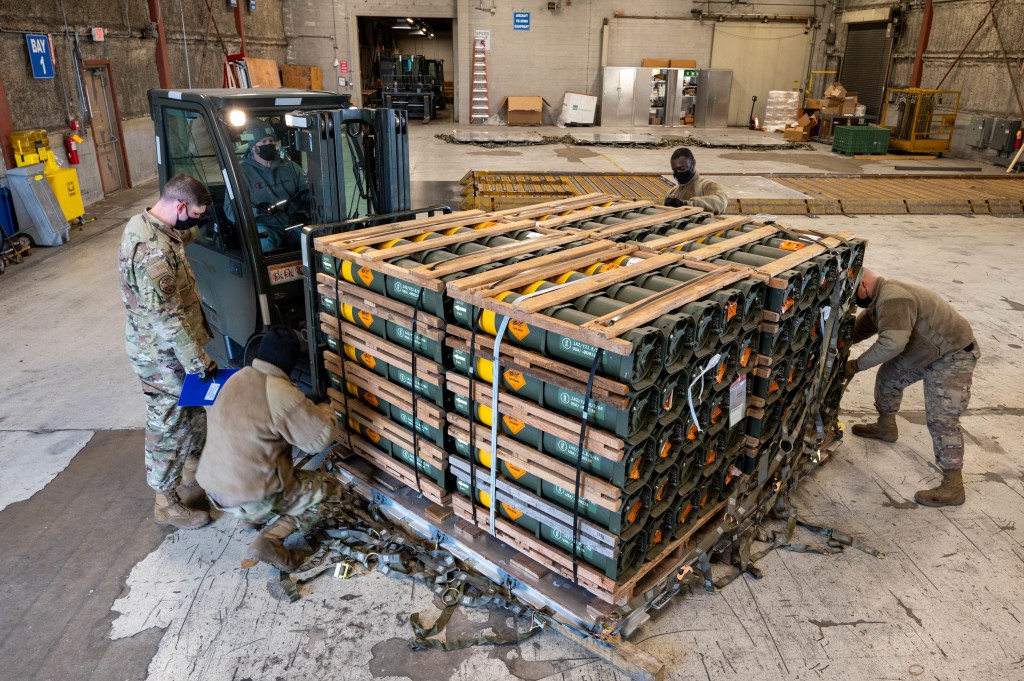
Airmen and civilians from the 436th Aerial Port Squadron palletize ammunition, weapons and other equipment bound for Ukraine during a foreign military sales mission at Dover Air Force Base, Delaware, Jan. 21, 2022. (U.S. Air Force photo by Mauricio Campino)
It is estimated that perhaps 100 M141 BDMs have been shipped to Ukraine so far as part of military aid, alongside small arms and ammunition, Javelin Anti-Tank Guided Missiles and NLAW anti-tank weapons from the UK. From the US Department of Defense’s packaging configuration table for the SMAW-D we know that each metal container holds one round and that 25 containers can be placed on a pallet. This appears to match up to the photos of the weapons being prepared for shipment. The Ukrainian Ministry of Defence and media have shared photographs of Ukrainian personnel training with M141s under the supervision of US troops. The training took place over two days at the 184th Training Center and the International Center for Peacekeeping and Security of the National Ground Forces Academy. These personnel will likely be tasked with then training other Ukrainian units on how to use the weapon.
M141/SMAW-D Specifications:
Length (extended/ready to fire): 1,371mm (54.8inches) Length (closed/carry): 792mm (31.8inches) Weight (ready to fire): 7.12 kilograms (15.7 pounds) Rocket muzzle velocity: 217 meters per second (712 feet per second) Rocket diameter:83mm (3.26 inches) Minimum arming range: 15 meters Maximum effective range: 300 meters Maximum range: 500 meters
If you enjoyed this video and article please consider supporting our work here. We have some great perks available for Patreon Supporters – including custom stickers and early access to videos! Thank you for your support!
Bibliography:
FM 3-23.25 Shoulder-Launched Munitions, 2006, US Army
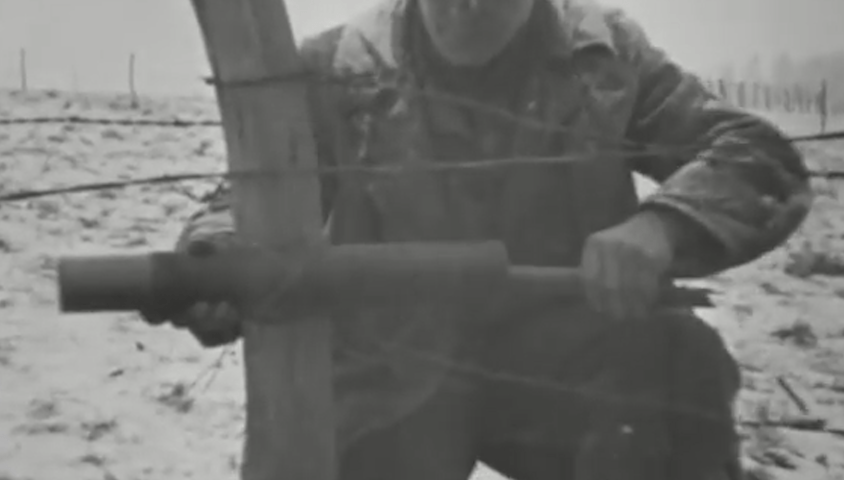
I recently came across an interesting segment in a January 1945 US Army Combat Bulletin newsreel. It showed men of B Company of the 238th Combat Engineers setting up improvised anti-tank mines in Belgium. The mines were fashioned from Bazooka rockets!
A still from Combat Bulletin #39 showing an engineer from the 238th Combat Engineer Battalion setting up an improvised off route rocket mine on a fence post (US Army)
This is a relatively little-known application for the Bazooka’s rockets but a really interesting field expediency. The footage shows engineers cutting the cardboard tubes the Bazooka’s rockets were carried in, down and attaching them to a fence post. Essentially setting up an off-route mine or IED. The engineers run a wire back to cover for remote detonation with some batteries.
Diagram showing how the rocket could be buried (1944 US Army field manual)
While these seems quite ad hoc it was a secondary use for the Rocket Launcher’s ammunition which was laid down in the Bazooka’s 1944 basic field manual. It doesn’t appear in the 1943 technical manual for the M1A1 launcher at all but the 1944 manual explains that
“In addition to its use as a projectile when fired from the launcher, the rocket may be prepared for firing electrically and used as an improvised anti-tank mine.”
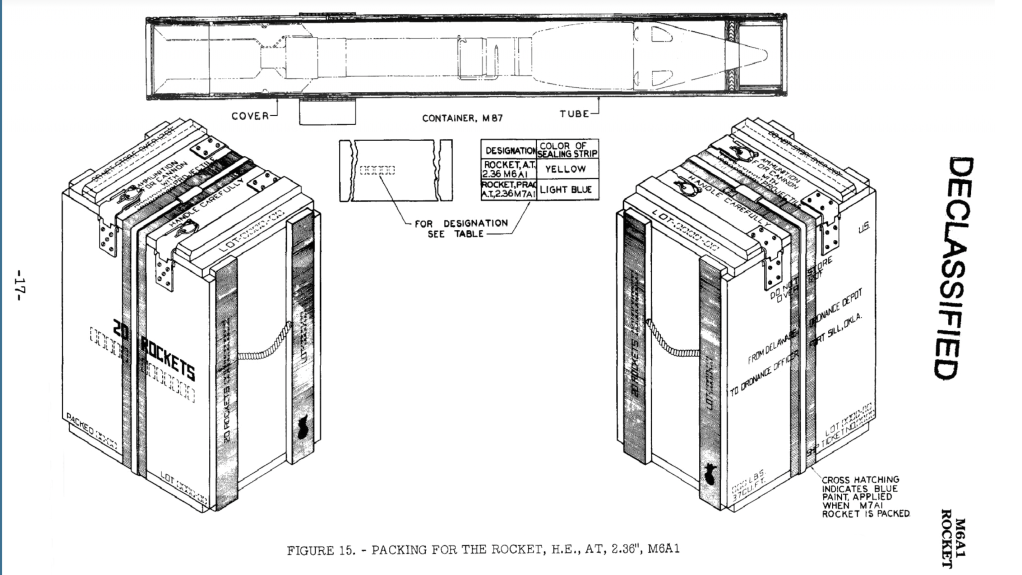
Diagram showing the transport packing and transit cannister tube for the M6 Rocket, the tube could be used as a makeshift launch tube (US Army)
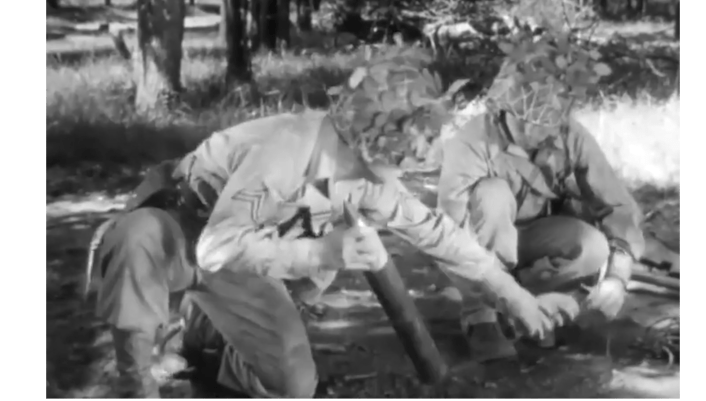
This improvised method of use was also demonstrated in a training film for the Rocket Launcher, a Bazooka team are seen digging a pit in a road and burying a rocket in its makeshift launcher just as laid down in the manual. The training film explains it best…
A still from the 1943 US Army training film for the Bazooka, demonstrating the setting up of an improvised rocket mine (US Army)
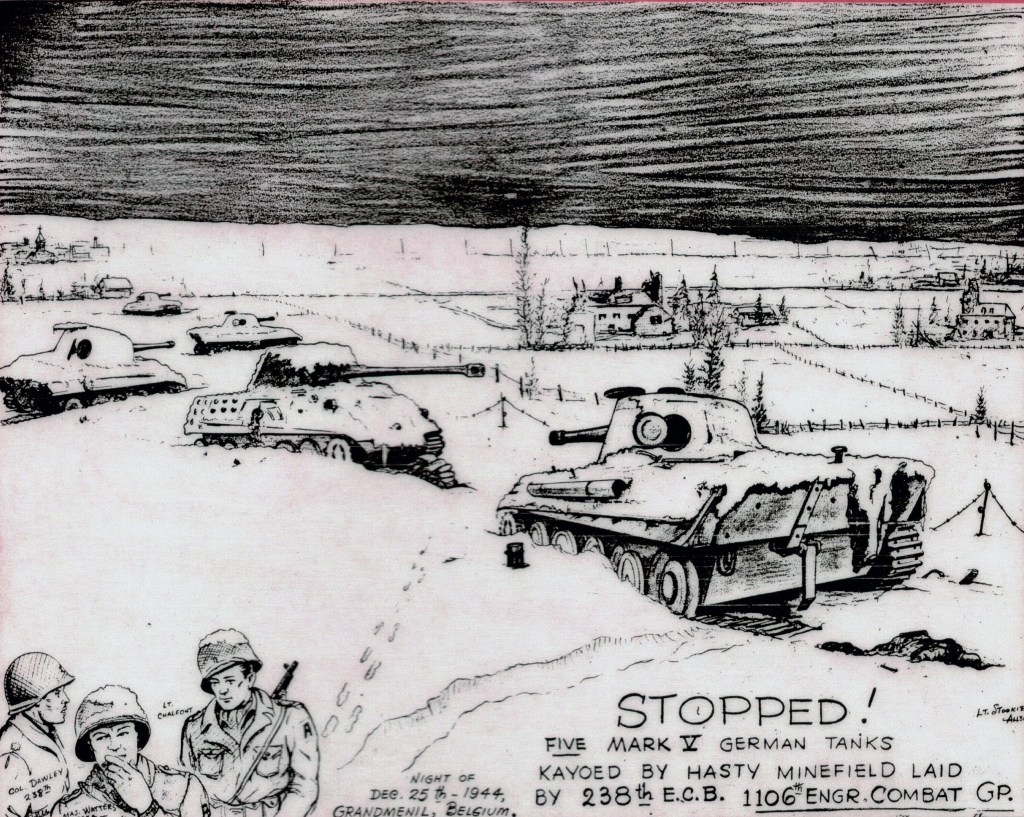
The 238th Combat Engineer battalion fought in the Battle of the Bulge and received a commendation from Major General Matthew B. Ridgeway, commander of XVIII Corps, for helping to establish a line of defence against the German offensive. The commendation read:
“The work of the 238th Engineer Combat Battalion in the construction of the initial barrier in the vicinity of Manhay was outstanding and materially assisted the Corps in holding off the attack of the enemy in that area.”
Illustration from a 238th Combat Engineer Battalion Association book showing knocked out German tanks around Grandmenil (238th Combat Engineer Battalion Association)
Whether this technique of improvising a mine from the rockets was used during the battle is unclear but I found the footage of the engineers demonstrating the set up fascinating. Its always interesting to see suggestions from manuals and training films put into action in the field so I was excited to come across this footage.
If you enjoyed this video and article please consider supporting our work here. We have some great perks available for Patreon Supporters – including custom stickers and early access to videos! Thank you for your support!
Bibliography:
238th Combat Engineer Battalion Association (source)
The Ardennes: Battle of the Bulge, H.C. Cole, 1965, (source)
Footage:
The Anti-Tank Rocket M6” 1943 US Army Training Film; M1 & M1A1 Bazookas, War Department
Here’s a behind the scenes look at the filming Matt did at The Tank Museum for the upcoming ‘Rhineland 45 – Decision in the West’ documentary being produced by Realtime History, the guys behind The Great War!
I’m very excited to say that my second book has been published! It looks at the much maligned and much misunderstood PIAT – Projector, Infantry, Anti-Tank.
The book is available from retailers from the 20th August in the UK/Europe and the 22nd September in the US – but you can order a copy from me now regardless of location. I filmed a short video to show you the book and talk a bit about the process of writing it, check that out above.
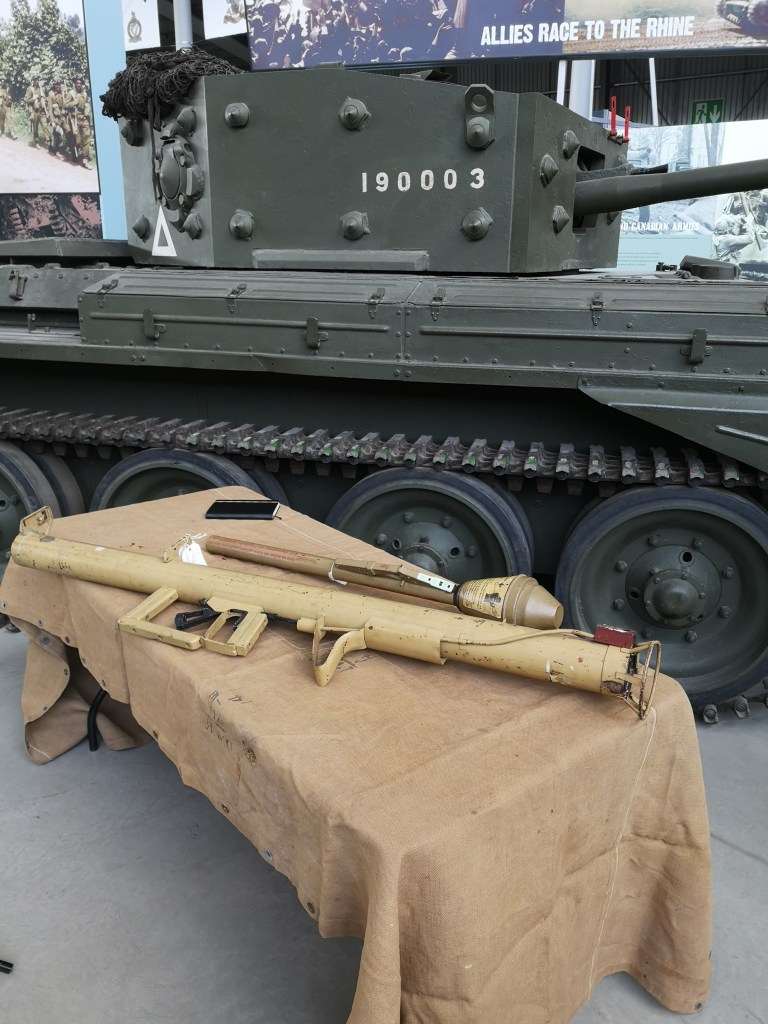
The PIAT was the British infantry’s primary anti-tank weapon of the second half of the Second World War. Unlike the better known US Bazooka the PIAT wasn’t a rocket launcher – it was a spigot mortar. Throwing a 2.5lb bomb, containing a shaped charge capable of penetrating up to 4 inches of armour. Thrown from the spigot by a propellant charge in the base of the bomb, it used a powerful spring to soak up the weapon’s heavy recoil and power its action.
With a limited range the PIAT’s users had to be incredibly brave. This becomes immediately obvious when we see just how many Victoria Crosses, Military Medals and Distinguished Conduct Medals were awarded to men who used the PIAT in action.
The book includes numerous accounts of how the PIAT was used and how explores just how effective it was. I have spent the past 18 months researching and writing the book and it is great to finally see a copy in person and know it’s now available.
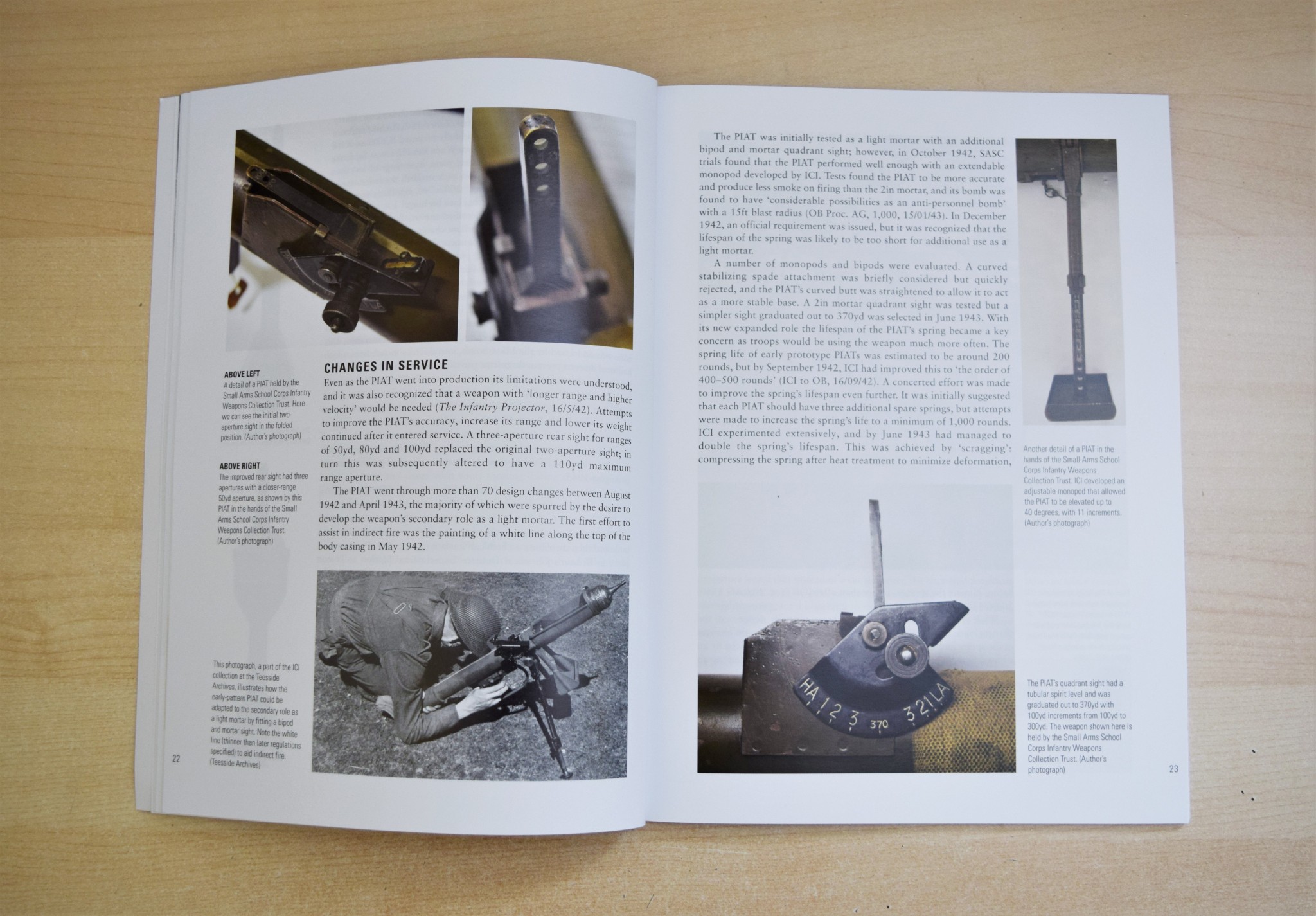
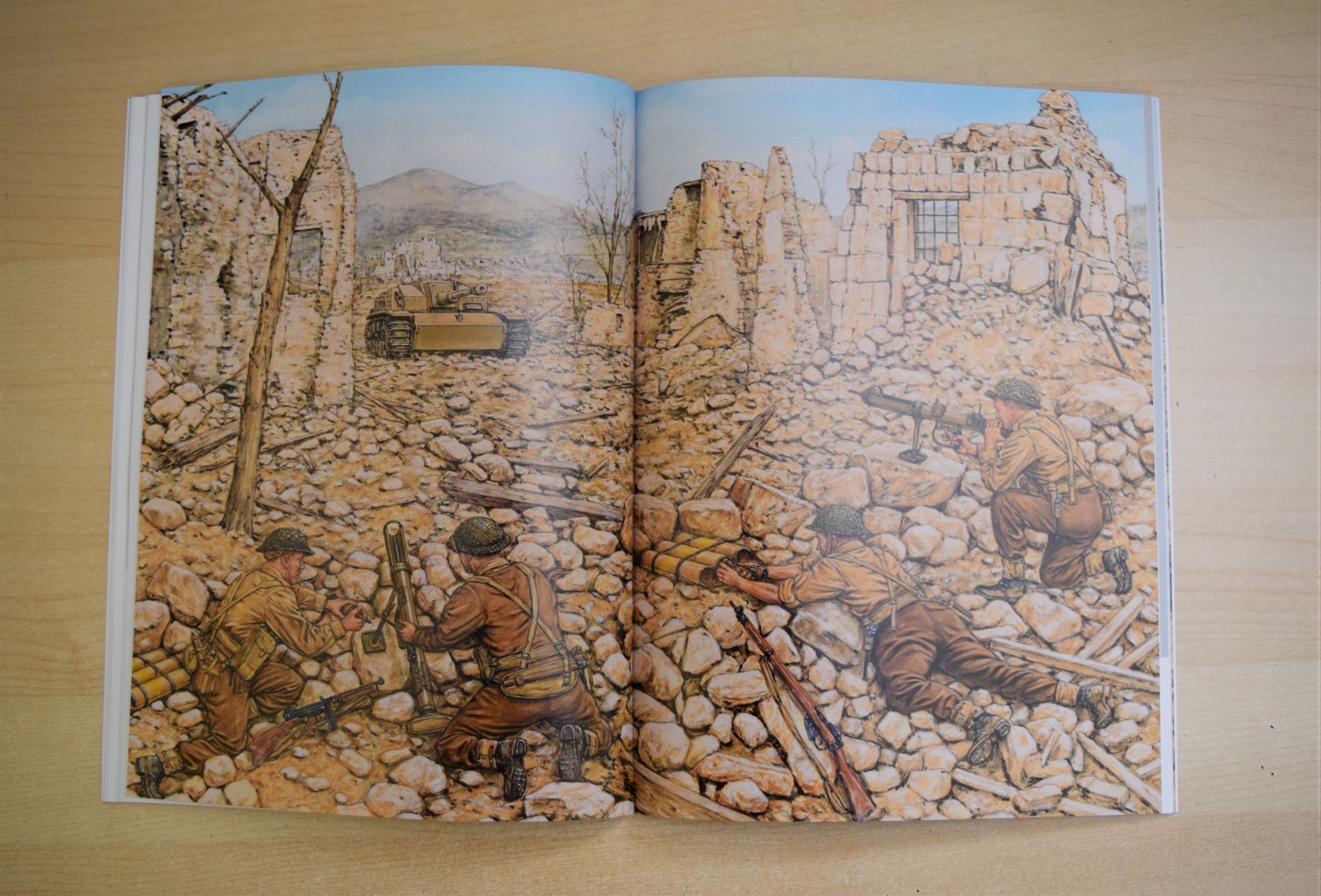
The book includes brand new information dug up from in-depth archival research, never before seen photographs of the PIAT in development and in-service history and it also includes some gorgeous illustrations by Adam Hook and an informative cutaway graphic by Alan Gilliland.
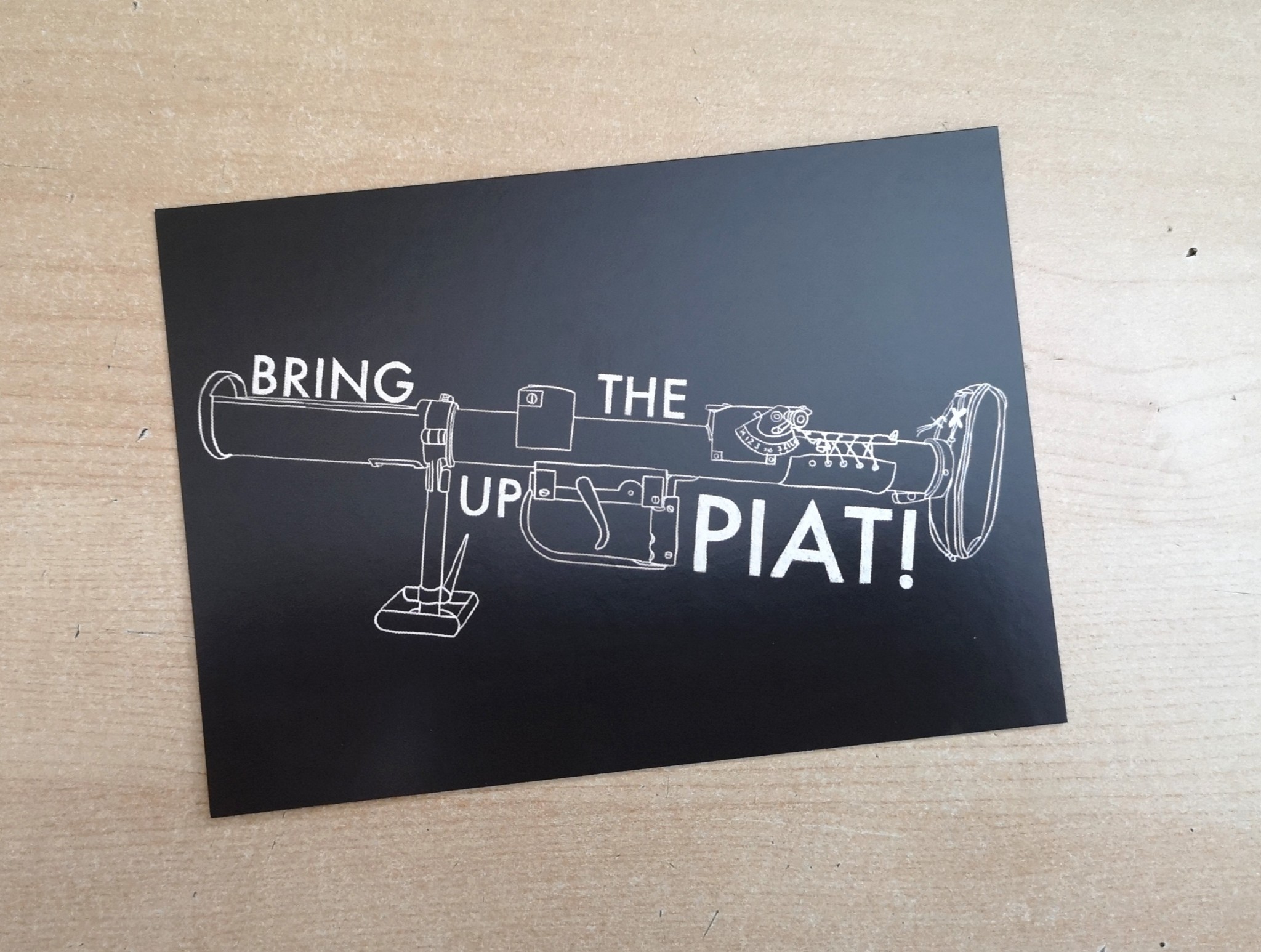
If you order a book directly from me I’ll also include this custom illustrated postcard with a design featuring a PIAT and the famous line from A Bridge Too Far.
It’s immensely exciting to know the book is out in the world for all too enjoy. If you’d like a copy of my new book looking at the PIAT’s design, development and operational history you can order one directly from me here!
Me, bringing up the PIAT…
Thanks for your support and if you pick up a copy of the book I really hope you enjoy it!









 The Armourers Bench