Hands On With SIG Sauer’s Improved M7 Carbine

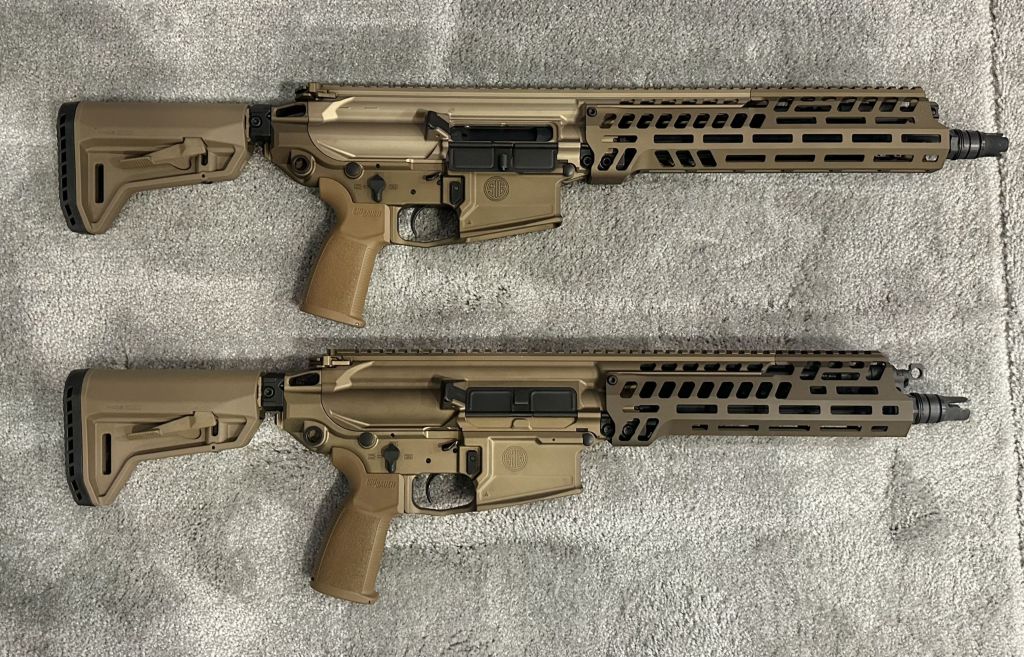
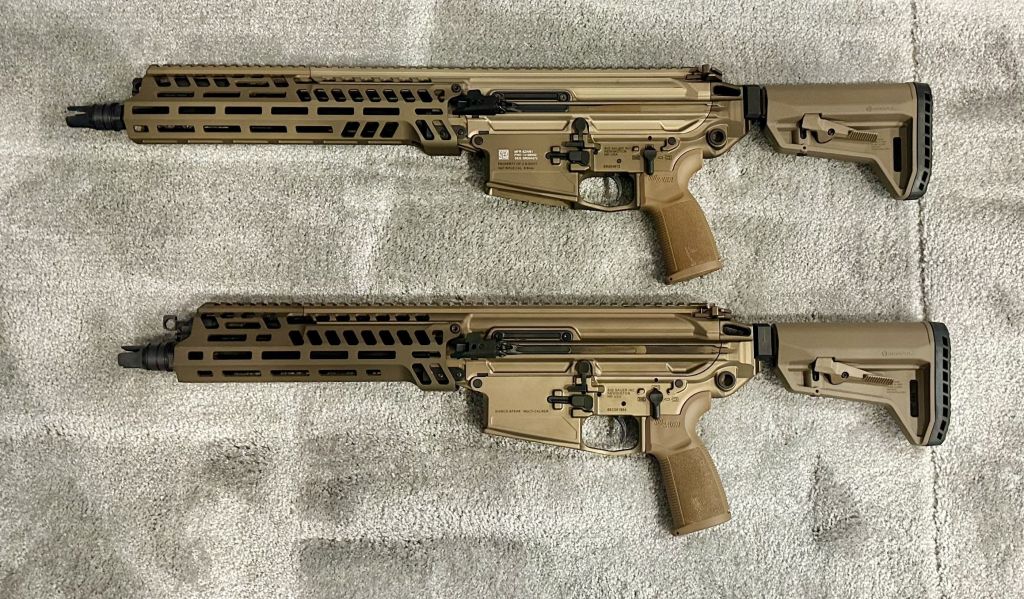
Last week at the DSEI defense exhibition in London, we had the opportunity to handle SIG Sauer’s product improved M7 rifle. Over the past year, SIG Sauer has taken user feedback from the US armed forces and refined the M7; the result is a handier weapon which feels more like a fighting rifle.

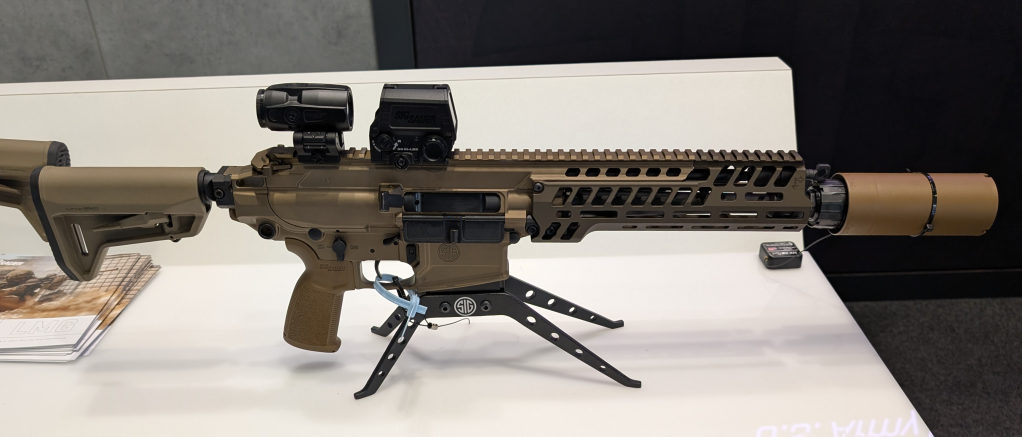
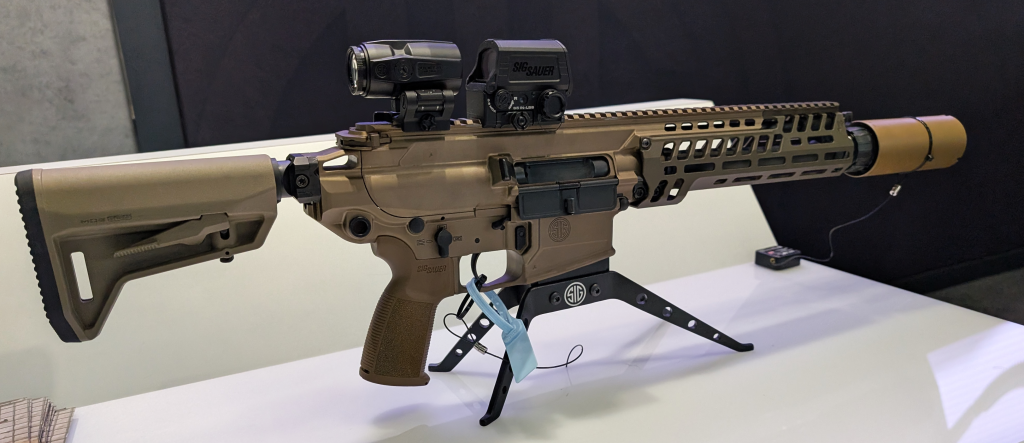
M7 Product Improved, with 10.5in barrel, at DSEI 2025 (Matthew Moss)

One of the key criticisms of the M7 is its weight, with the M7 weighing in at around 9.8 pounds (4.46 kg) with its SLX suppressor. By comparison, the improved M7 weighs in at around 7.5lbs (3.5kg) unloaded, with a suppressor but without an optic. This makes the refined M7 a full kilogram (2.2lbs) lighter. 

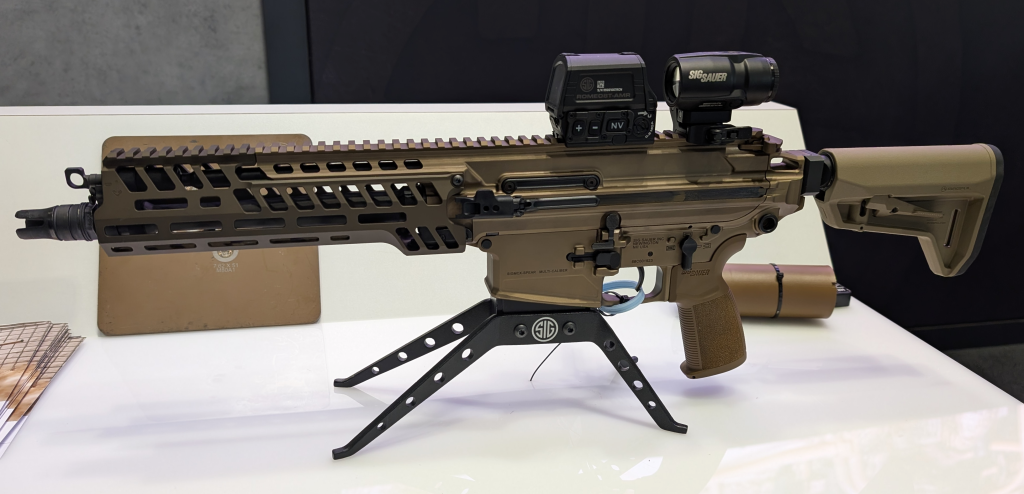
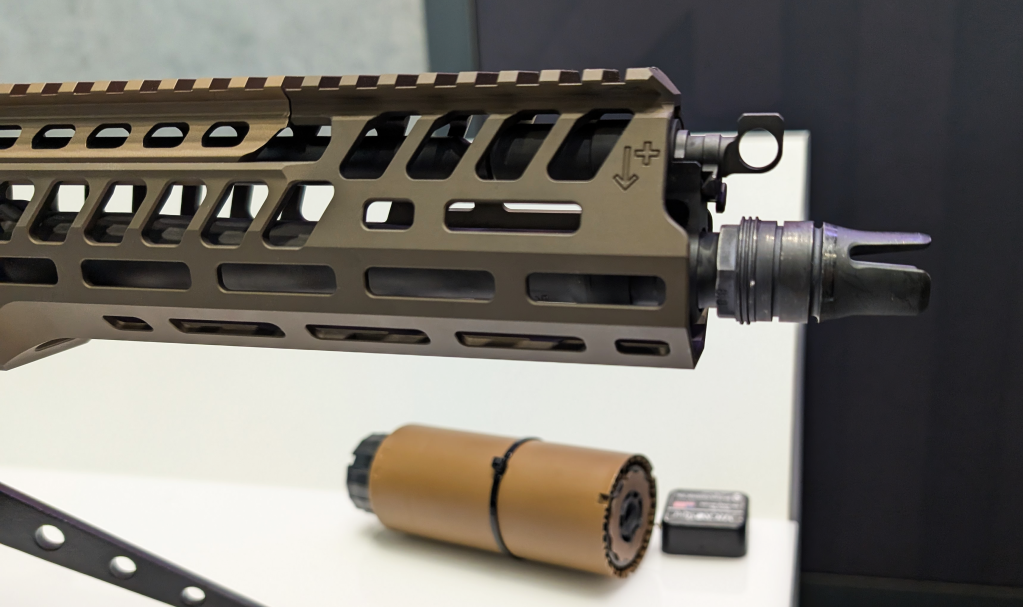
M7 Product Improved at DSEI 2025, with suppressor removed (Matthew Moss)

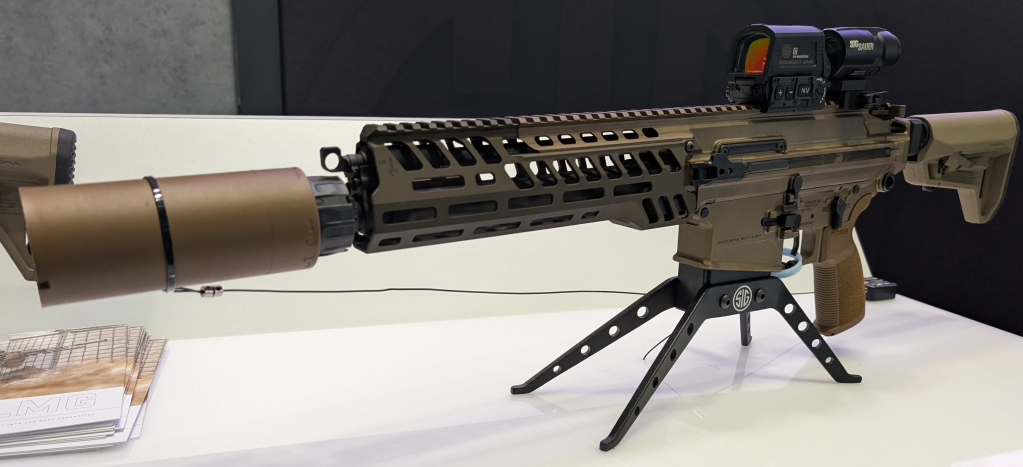
M7 Product Improved at DSEI 2025, with suppressor mounted (Matthew Moss)

SIG Sauer achieved this weight reduction in a number of ways; the barrel has been shortened from 13 to 10.5 inches, and some of the internal components, such as the bolt, have been lightened. SIG explained that the muzzle velocity of the rifle has only been slightly decreased by the barrel length change, with the improved M7 achieving around 2,800-2,900 FPS (870 m/s) compared to the 3,000 FPS with the original 13-inch barrel. SIG say this still more than meets the Army’s ballistic and armor penetration requirements. 

M7 Product Improved with new shorter SLX suppressor at DSEI 2025 (Matthew Moss)

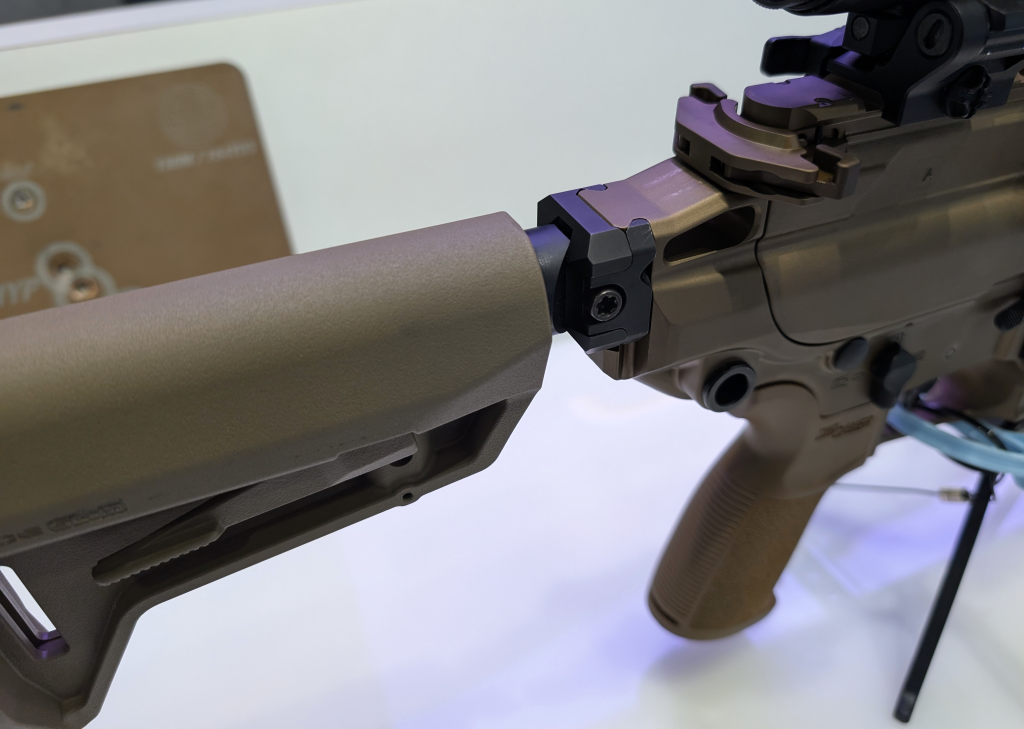
The barrel itself has a lighter profile, and the handguard has been shortened and reprofiled to match the new barrel length. SIG have also removed the folding stock latch, with the fixed stock saving several grams. Arguably, for some applications, this is weight that could be justified to maintain the ability to fold the weapon’s stock for a more compact profile – better suited for vehicle operations.

M7 Product Improved with fixed stock at DSEI 2025 (Matthew Moss)

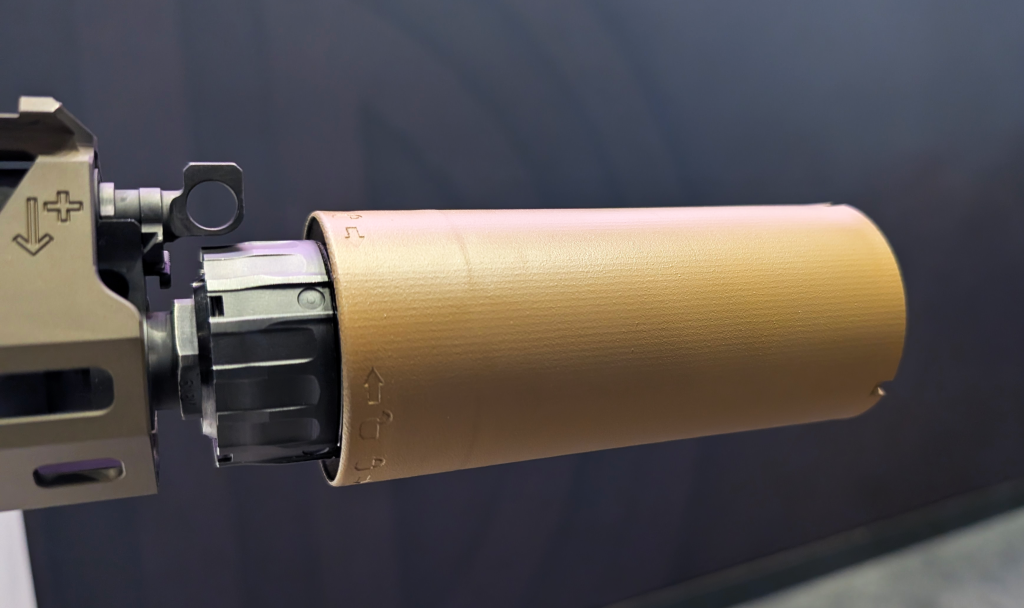
In addition to a shorter barrel, SIG Sauer has also shortened the SLX suppressor which is paired with the M7, by approximately an inch; this helps improve the rifle’s balance. SIG have also paired the new shorter suppressor with a new lightweight thermal shield, which significantly reduces the heat signature of the suppressor. SIG are also offering a mesh shroud (similar to that seen issued with SURG kits) and an anti-mirage shroud. With the thermal shield, the suppressor’s heat glow under night vision and thermal optics only becomes visible at around 100 rounds, rather than 40 rounds without the shield.

M7 Product Improved muzzle close-up at DSEI 2025 (Matthew Moss)

SIG’s work on the M7 was undoubtedly driven by US military feedback and a desire for refinements, but it is worth noting that it is unclear whether the rifle seen at DSEI will be the configuration the military moves towards in the future. Another variant of the improved rifle, with the shorter barrel and new handguard but a new upper receiver profile, was seen recently at the Maneuver Warfighter Conference 2025 in a released (and subsequently redacted) photo shared by the US Army. The rifle is also seen to be equipped with a Millbrook Strategic Services MFMD suppressor.

M7 Product Improved at DSEI 2025 (Matthew Moss)

The US Army now has around 25,000-30,000 M7 rifles in inventory; it is unlikely that rifles already in service will be retrofitted to the new M7 Product Improved spec. The iterative refinement of the M7 isn’t a surprise; testing, feedback and improvement are key to the Next Generation Squad Weapons program’s spiral development strategy. As such the M7 and M250 only recently completed desert environmental testing with troops in August. Time will tell if the configuration seen at DSEI (or something similar) is adopted by the US Army to supplement the M7s currently in service. In the meantime questions regarding the M7 PI’s accuracy, reliability, parts wear and signatures are yet to be definitively answered but it is interesting to see the potential direction of refinement the rifle is moving in.

Update – 24/9/25:

A social media video shared by the US Army highlighting a visit by the Secretary of the Army to the 101st Airborne included a brief shot of a board that offered some details on the “M7 PIE” and the “M7 ‘Carbine'”. (H/T to @TangirayL) PIE standing for ‘Product Improvement Effort’.

The board lists the major changes made to the two rifles and gives some weight and length specs on the variants. This would indicate that rather than just one improved variant there are two and the one shown at DSEI is the M7 ‘Carbine’ (or PIE RAPTOR).

Update 14/10/25:

At AUSA 2025 SIG Sauer displayed both the product improved M7 [which SIG refer to as the M7 Enhanced Rifle] and the product improved M7 carbine. Solider Systems Daily shared good side by side photos illustrating the two new versions of the M7. Noteably the design of the handguard between the M7 PIE Carbine seen at DSEI and AUSA differs in their side MLOK configurations.

SSD also reports that: “regarding barrel life. The program requirement was for 5,000 rounds which is the same specification as the M4. However, SIG has noted barrel life for the M7 in excess of 10,000 rounds.”


Support Us: If you enjoyed this video and article please consider supporting our work here. We have some great perks available for Patreon Supporters – including early access to custom stickers and early access to videos! Thank you for your support!

Mk14 EBRs in Ukraine

In an earlier video/article we examined the M14s which appeared in Ukraine back in March 2022, since then there have been a number of intriguing sightings of what, at a glance, appear to be Mk14 Enhanced Battle Rifles or M39 Enhanced Marksman Rifles. The EBR and EMR emerged during the Global War on Terror in the early 2000s as an improved variant of the 7.62x51mm M14.

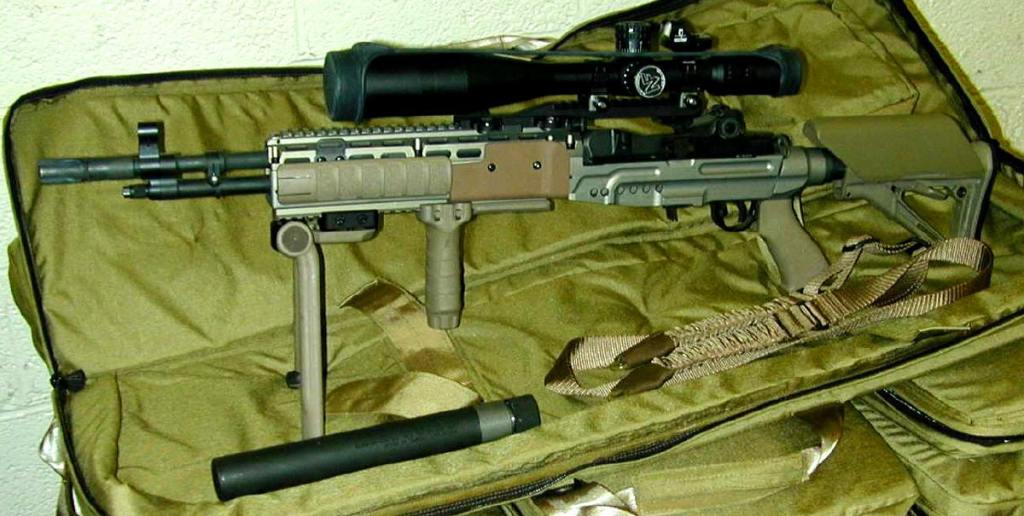
The project to develop a more compact, improved M14 reportedly evolved from a request from US Navy SEALs in 2000 for a rifle for Arctic warfare. This eventually developed into what became the Mk14 EBR with development led by Naval Special Warfare Centre Crane and input from commercial specialists and manufacturers including Smith Enterprise, Inc. and Sage International. The result was a rifle with a 18 inch barrel and new flash hider, with changes to the operating rod guide, a new stock chassis and a raft of accessories. A number of different variants were built including the Mk14 Mod 0, Mod 1 and Mod 2, the M14 EBR-RI and the USMC’s M39 EMR. In total between 2003 and 2011 just over 9,000 of these upgraded variants were assembled.  

An NSCW Crane Mk14 Mod 1 EBR, c.2006 (source)

Given the significant number assembled and the fact they have been replaced by rifles such as the M110 Semi Automatic Sniper System (which has already been seen in Ukraine) and the M110A1 CSASS it would not be unsurprising to see Mk14 EBR variants turn up in Ukraine.

Over the past two years I’ve been tracking sightings of what appear to be Mk14 EBR variants but on closer examination some of them are not what they initially seemed to be, several were in fact kit builds using the standard configuration M14s which reached Ukraine in early 2022. Some, however, do appear to be surplus Mk14s.

Yuri’s Mk14 EBR clone at the range (Nucking_Futs_Yuri)

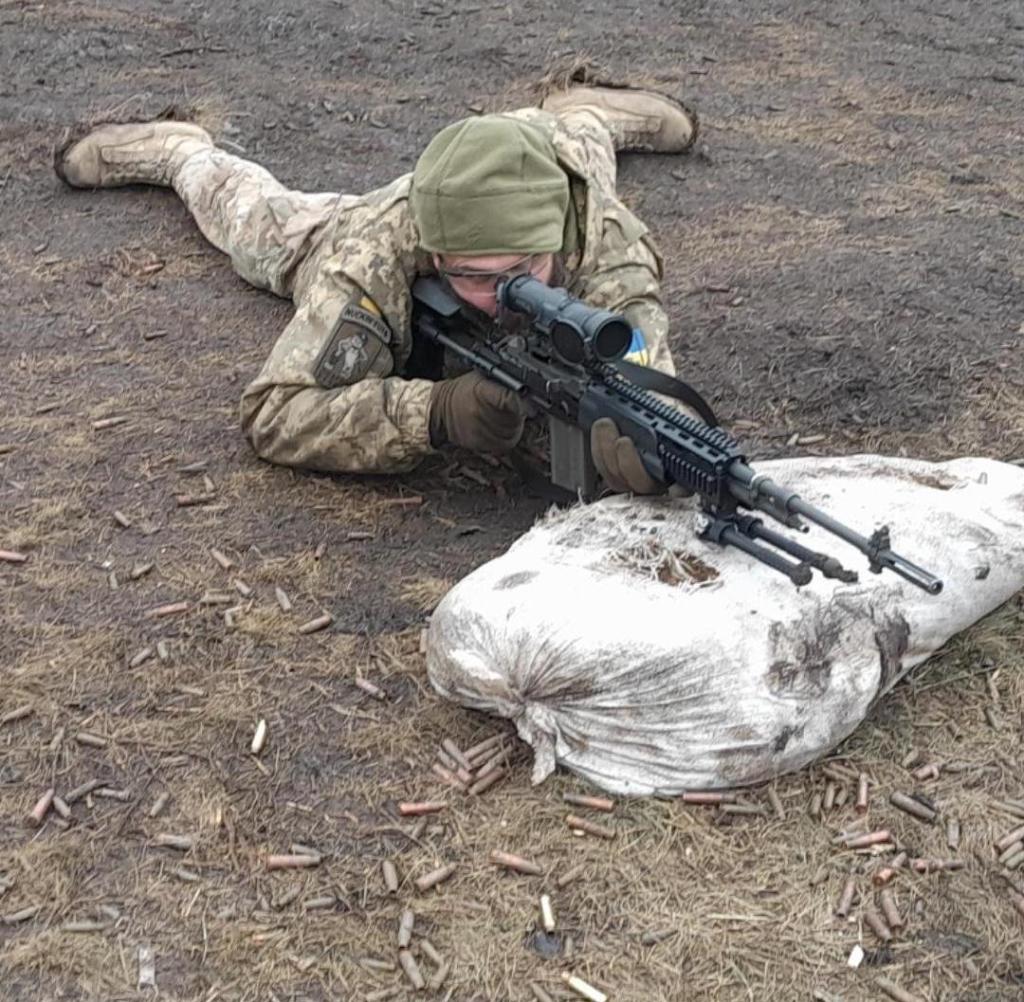
First, let’s examine some of the kit builds seen in theatre. The first appears to have been assembled by Nucking_Futs_Yuri, an American volunteer who enlisted in the Ukrainian Army in early 2022. Yuri explained to me that in late 2022, following combat experience where he wasn’t satisfied with how well 5.56x45mm suppressed a Russian position he decided to assemble an EBR clone using a donated chassis. Yuri noted that parts for the rifle began to arrive in December 2022 and by January the rifle had been assembled. Yuri was seen with the rifle in numerous photographs and in several configurations. It had a standard 22 inch barrel, a Sage International M14ALCS chassis and a M14DCSB (Detachable Cantilevered Sight Base). He mounted a 1.5-6x Elcan SpectreDR optic on the rifle, opting for more of a battle rifle-style set up. The rifle was damaged in February 2023 by a Kornet ATGM blast which bent both the barrel and the chassis.

Yuri’s damaged Mk14 EBR clone (Nucking_Futs_Yuri)

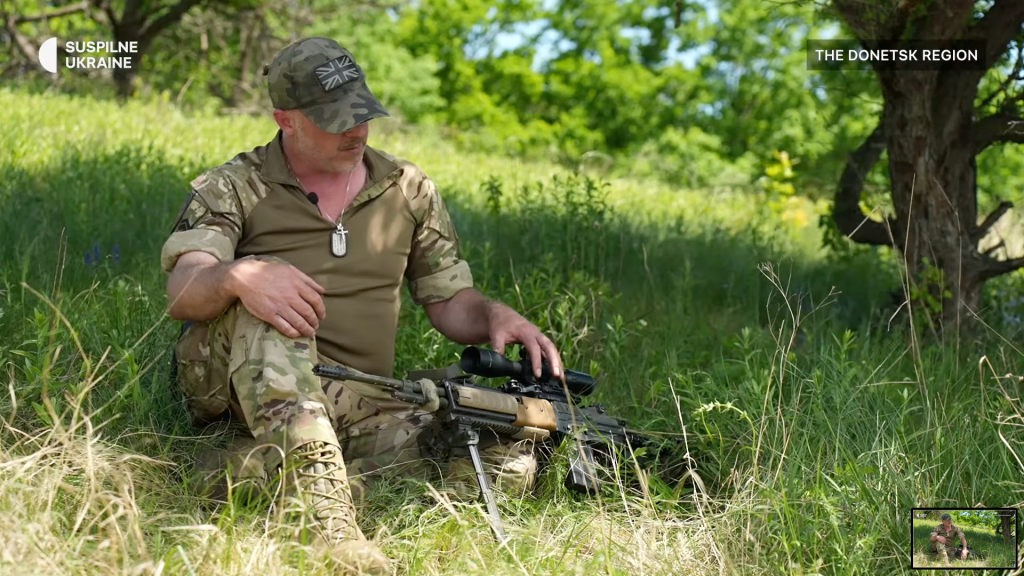
In early May 2023, another rifle which resembled an M14 EBR-RI, with a 22in barrel and a black Sage International M14ALCS chassis, appeared in use with a member an International Legion team. This individual and his rifle was seen again in May 2024 appearing in a number of interviews with Ukrainian media. His callsign was revealed to be ‘Solo’ and he was described as a marksman and a squad leader with a unit of the International Legion’s 3rd Special Purpose Battalion. In the interview he explained that the rifle has originally been a wooden stocked M14 converted with a SAGE chassis sent to him by a friend in the US. Interestingly, between May 2023 and May 2024, it appears the rifle’s set up has evolved with new FDE rail covers added and a short tan Kydex handguard replacing the initial black longer handguard. These parts were likely acquired in Ukraine.

‘Solo’ with his Mk14 clone built off a standard M14 (Суспільне Донбас)

Most intriguingly, in November 2023, the first Mk14 Mod 1 appeared. Mod 1s are characterised by their shorter 18in barrels, a Sage M14ALCS/CV-BS with Magpul CTR FDE stock (with a cheek riser) mounted on a buffer tube extension rather than the earlier collapsing stock. The rifles also have LaRue LT-608 extended Picatinny risers and short tan handguards. The rifle is equipped with a Schmidt & Bender PMII 5-25×56 scope.

A Mk14 Mod 1 EBR with Schmidt & Bender PMII, Nov. 2023 (via social media)

The Mk14 Mod 1 was assembled at NSWC Crane in 2006, around 500 were assembled. The shorter barrel and the general configuration of parts and accessories suggest that this may be a surplus rifle transferred by the US.

A recent sighting of a Mk14 Mod 1 EBR (via Tysk)

Most recently, on 18 October, Ukrainian telegram channel Tysk shared a series of photos of a Ukrainian combatant at the range with another Mk14 Mod 1. This rifle’s parts and accessories closely match those assembled by Crane for the Mod 1, including: an 18in barrel with a SureFire FH762KM14 muzzle device, a TangoDown BG-16 FDE pistol grip, a Sage M14ALCS/CV-BS with a Magpul CTR FDE stock (this time without the cheek riser), a TangoDown BGV-MK46 FDE vertical foregrip, and a TangoDown ACB-4 FDE bipod. The rifle is also equipped with a NightForce NXS 2.5-10x24mm optic and a DOCTER MS01 3.5 MOA red dot sight which were selected to be paired with the Mod 1. [It has been noted that the Mod 1s may also be clones due to some small differences in the chassis profile and accessories used – for instance the model of VFG, scope rings, cheek riser, and the machining on the chassis. If this is the case someone has gone to an improbable amount of trouble to ‘clone’ a Mod 1, a considerable level of effort to expend in a war zone. Thanks to tanodized for input.]

From the very limited imagery available of Mk14 EBR-pattern rifles in Ukraine it appears that numerous clone builds have been assembled in-country and that the only EBRs which can be identified as potential US transfers are the two Mk14 Mod 1 variants seen so far.

A squad designated marksman with an Mk14 EBR-RI (the most common EBR variant), 5th Battalion, 20th Infantry Spin Boldak, Afghanistan, 2012 (US Army)

If the US was to transfer a significant number of Mk14-pattern rifles I would expect them to be the Mk14 EBR-RI, the most common variant, some 6,000 of which were assembled by Rock Island Armory – TACOM [Tank-automotive and Armaments Command]. It is unsurprising clone rifles have been assembled by combatants in Ukraine as Sage International and a number of other US manufacturers offer EBR-pattern chassis which do offer some improvements over the traditional M14 configuration.


Support Us: If you enjoyed this video and article please consider supporting our work here. We have some great perks available for Patreon Supporters – including early access to custom stickers and early access to videos! You can also find us on the History of Weapons & War app. Thank you for your support!


Bibliography:

M14 to MK 14 Evolution of a Battle Rifle, D. Armstrong, via DTIC, (source)

The M14 EBR – a Continuing Evolution D. Armstrong, via DTIC, (source)

The History and Development of the M14 EBR (source)

MRSATURN7085’s ‘M14EBR’ data sheet (source)

Sage International, EBR (source)

Thank you to colleagues who consulted on this video and to Yuri.

The Hammerless 1911

Ever since I picked up a copy of John Browning and Curt Gentry’s 1964 biography of John M. Browning I’ve been fascinated by this hammerless .45 calibre pistol, one of Browning’s prototypes for the US Army’s semi-automatic pistol trials.

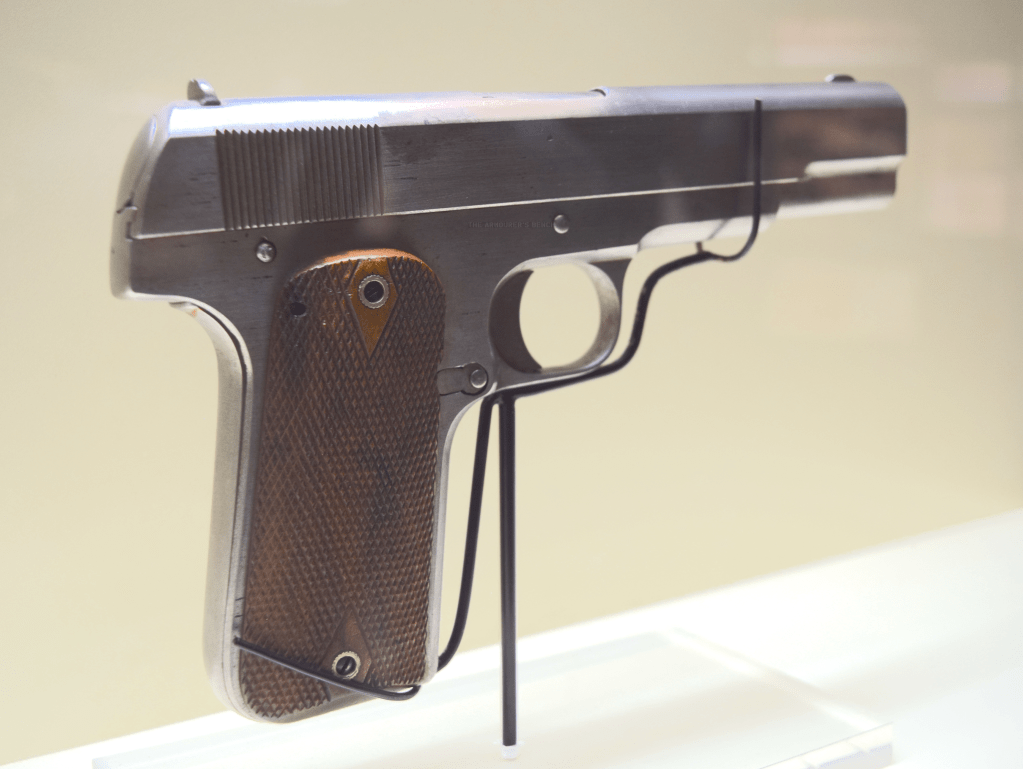
The Browning .45 calibre pistol prototype with a shrouded hammer (Matthew Moss)

Last year I had the opportunity to visit the John M. Browning Museum in Ogden, Utah and I was thrilled to see the ‘hammerless’ prototype on display. Very little has been written about the development of this particular pistol with Browning and Gentry explaining that during the US Army’s long process to select a new service pistol John Browning decided to provide two versions of his .45 ACP pistol – one with an exposed hammer and the other with a shrouded hammer similar to that seen on his Colt 1903 and 1908 Pocket Hammerless commercial pistols. 

The ‘hammerless’ pistol is identical in operation to the exposed hammer prototype which was eventually selected as the M1911. It uses the same improved tilting barrel action which is covered by the patent filed in February 1910, US #984,519. The slide and frame profiles of the ‘hammerless’ pistol have been reshaped with the slide extending back further shrouding the hammer while the rear of the frame projects back, lining up with the rear of the slide rather than forming a beavertail. The pistol grip angle, at near 90-degree, is more akin to the Colt Pocket Hammerless and earlier Colt-Browning semi-automatic pistols.

The Browning-Gentry book lists the pistol as 8 inches in length overall with a 3.75-inch barrel and a weight of 2lbs 4oz. The pistol has a grip safety and a frame-mounted safety and a push-button magazine release on the left side of the frame. Sadly the pistol was behind glass and with time short we couldn’t get a better look at the gun. 

The Browning .45 calibre pistol prototype with shrouded hammer on display at the Browning Museum (Matthew Moss)

The chronology of the various prototypes’ development is sometimes difficult to track as Browning’s hands-on style left few written descriptions of the designs as they evolved. The museum dates the pistol to 1905 but displays it alongside the pattern of pistol often referred to as the Model 1910. Interestingly, the ‘hammerless’ pistol also has the frame-mounted safety which was reportedly added late in the refinement of the 1910 pistols. The ‘hammerless 1911’ was never commercially marketed by Colt and the exposed hammer .45 ACP pistol went on to win the US military pistol trials and became an iconic design. 

Huge thanks to the Browning Museum in Ogden for allowing us to film in their collection – we have some really exciting videos from the museum coming up. 


Support Us: If you enjoyed this video and article please consider supporting our work here. We have some great perks available for Patreon Supporters – including early access to custom stickers and early access to videos! Thank you for your support!


Bibliography

John M. Browning: American Gunmaker, J. Browning C. Gentry (1987)

The Guns of John Browning, N. Gorenstein, (2021)

Handguns of the World, E.C. Ezell (1981)

‘Rarest of the rare: Browning 1910 & Hammerless .45’, American Handgunner, (source)

M110 in Ukraine

Since around September 2022 there have been a small but steady stream of sightings of M110 Semi-Automatic Sniper Systems in use with combatants in Ukraine. The rifles began appearing on the southern Kherson front, before the city was recaptured.  While the Ukrainian 7.62x51mm UAR-10 designated marksman rifles are regularly seen intermittent sighting of M110s have continued. 

From the available evidence it appears that special operations units from the Ukrainian Security Service (the SBU), the Military Intelligence Directorate (GUR), the National guard and the Special Operations Forces (the SSO) are the primary users. Units operating with the rifles are believed to include Alpha Group and the 3rd and 8th Separate Special Forces Regiments, as well as a number of groups which, from the available imagery, have been difficult to link with parent units.

M110 with ATN THOR, taken during a range session, note butt extended (via Social Media)

Developed in the early 2000s by Knights Armament Company in response to the US Army’s requirement for a semi-automatic rifle to equip snipers, spotters and designated marksmen the M110 was adopted in 2008. Based on the SR-25, the 7.62x51mm rifle uses Stoner’s internal piston gas impingement system, and has a 20 inch barrel with a 1 in 11 twist. The rifle comes with a QD Knights suppressor and the initial issue optic was a Leupold 3.5–10× variable power daytime optic few of the rifles seen in use in Ukraine appear to be equipped with US issued optics. Both the US Army and USMC have issued the rifle with some variations in optics used and furniture.

A Ukrainian combatants I spoke to told me: “For a marksman, the top weapon. To work at short distances. The PBS system [meaning the integral suppressor] is standard in the kit. It is quiet compared to other rifles.” But he did note that he isn’t part of his unit’ s sniper group and has only used the rifle on the range. 

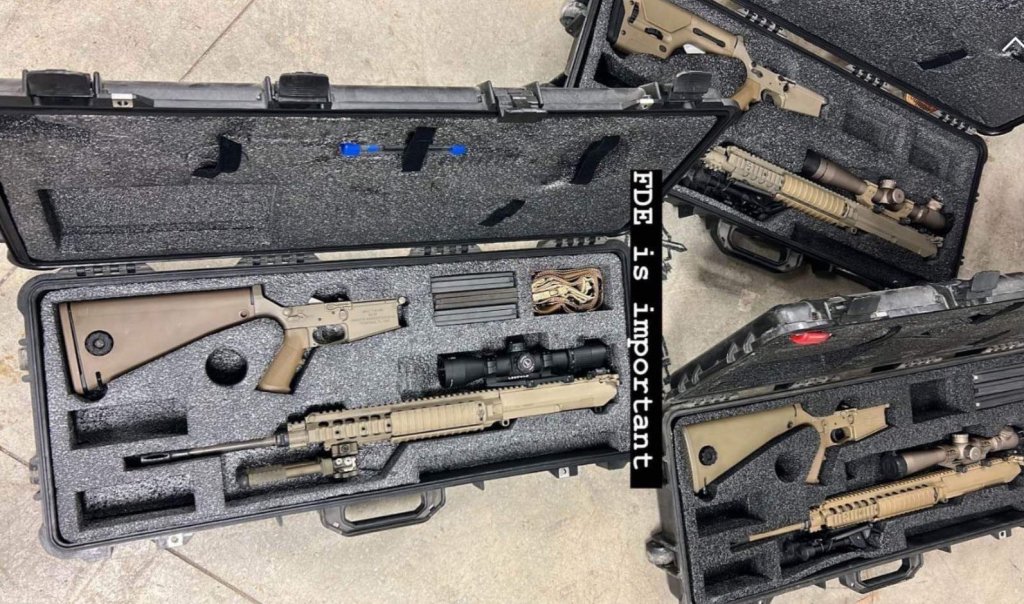
Three M110s with various optics, note suppressors not fitted, in their transit cases (via Social Media)

Most of the examples in Ukraine have the traditional fixed stock which was issued with the rifles, rather than the FDE Magpul PRS stock which is length and height which the USMC snipers have been issued. However, at least one rifle with a PRS has been seen in a photo and a least one rifle has been fitted with LUTH-AR MBA-1 stocks used on the Ukrainian UAR-10. Perhaps out of preference or replacing a damaged stock. In theatre the rifles have been seen paired with a variety of optics ranging from the original Leupold 3.5-10x variable scopes to ATN THOR 4 thermal optics and even a Trijicon 6×48 ACOG.

The earliest image of an M110 in Ukraine was shared on a Ukrainian telegram channel covering news around the city of Kherson in the early autumn of 2022. The original post is no longer available but shows a sniper in a ghillie suit unmistakably armed with an M110.

Early November saw Ukrainian operators share numerous photographs from a range session where the rifle can be seen fitted with an ATN THOR. December saw more photos shared of what is likely the same rifle, now equipped with a Trijicon 6×48 ACOG.

Two M110s photographed during a range session, one fitted with a LUTH-AR stock (via Social Media)

More photos of the same rifle fitted with the ATN THOR were posted by another operator in mid-November. Bravo Group shared a photo featuring an M110 in early December. Around the same time the F Spets instagram account shared a photo of a winter range session with an M110 visible. The same account shared a photo of three M110s in transit cases. Two of the rifles don’t have their suppressors fitted – though these may have been just removed for cleaning. The cases also show slings, various models of bipod an two have three mags apiece stored in one of the cases slots. As mentioned earlier one rifle has a PRS stock.

In late January a Ukrainian operator shared a montage video with a short clip of a range session with the M110 fitted with a 6×48 ACOG. A Japanese volunteer with the International Legion shared a photo of a scope-less M110 with his cat on 27 January. At the end of February an M110 with a LUTH-AR MBA-1 stock, possibly taken from a UAR-10 was shared. The same operator shared some new photos of M110s in March. The rifle with the LUTH-AR stock is seen again, in a photo with the logo of a group called ‘НЕПТУН’ (Neptune). In a second photo shared on 17 March we can see a pair of M110s, one without its suppressor fitted.

M110 with ATN THOR during a range session (via Social Media)

How many M110s are in use in Ukraine remains unclear but from a survey of the available imagery it appears that the number is relatively small. Multiple individuals have shared photographs of what appears to be the same rifles, not doubt because of its notoriety as a relatively rare weapon in theatre. Sources suggest that the rifles were available on a first come first serve basis when they arrived during the second half of 2022. Since they arrived they have been seen in various configurations and with numerous different optics mounted on them.

Update – 19/05/23: A new image of an M110 in the field was shared in mid-May.


Support Us: If you enjoyed this video and article please consider supporting our work here. We have some great perks available for Patreon Supporters – including early access to custom stickers and early access to videos! Thank you for your support!


Bibliography:

My thanks to the guys at the ShriekingDelilah instagram page and to Abraxas Spa, for their help with this article.

Ukrain Adopts New Semi-Automatic Sniper rifle: The UAR-10, TFB, (source)

M110 Semi-Automatic Sniper System, DVIDS, (source)

M16A4s in Ukraine

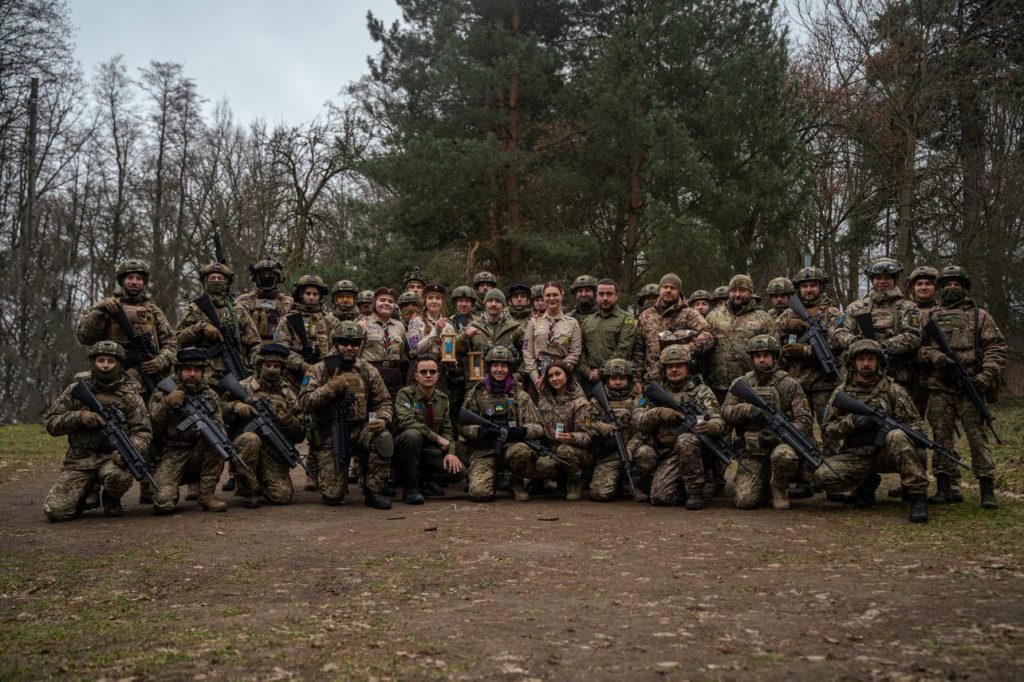
On 12 January, a unit of the Ukrainian Army’s 47th Separate Mechanised Brigade (47 OMBr) was seen equipped with US M16A4s for the first time. The rifles were seen equipped with Trijicon ACOG optics and some, a considerable percentage, were seen with M203 40mm under-barrel grenade launchers, and of course rail covers.

Photo released by 47 OMBr in early January showing M16A4s in Ukraine for the first time (47 OMBr)

Previously, we have seen a considerable number of M4A1 carbines, some equipped with M320 40mm grenade launchers. This, however, is the first time we’ve seen the M16A4. Other elements of the 47 OMBr have been seen equipped with FN FNCs in 5.56x45mm. The 47 OMBr appears to be a unit which has largely been allotted western small arms and equipment. The brigade was formed in November 2022 and, as with a number of other new Ukrainian brigades, has been built up from a battalion (which was raised in August 2022) to a regiment to a brigade level formation.

A close up of an M16A4 with an ACOG and M203 UBGL and rail covers in Ukrainian service (47 OMBr)

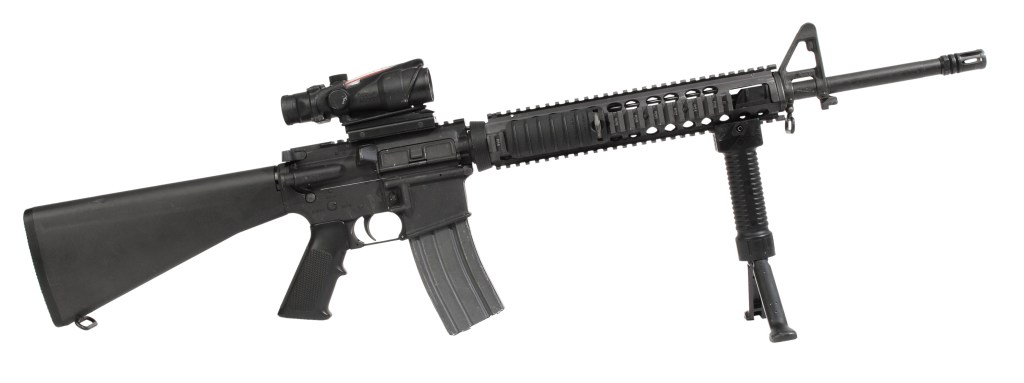
The M16A4 is a 5.56x45mm, select-fire rifle which uses a direct impingement gas system and a rotating bolt locking mechanism. The M16A4 was developed in the late 1990s and entered service in January 1999. It and has seen service with the US Army, USMC and US Navy. The US Army began to move away from the M16A4 in favour of the M4A1 in 2011 while the USMC favoured the rifle’s 20 inch (50.8cm) barrel length and began replacing its M16A2 with A4s in 2002, only in October 2015 did they begin to transition to the M4A1 Carbine and latterly the M27 for infantry Marines. Despite this the M16A4, however, remains in widespread service use.

The photographs and short video where the rifles were seen for the first time were posted to commemorate a visit from members of Plast, Ukraine’s scouts organisation, who brought a lamp of the Fire of Peace to be lit with members of the brigade.

Another photograph was shared on the brigade’s social media on 22 January, showing a close up of an M203-equipped M16A4, which was also mounted with an ACOG. How many of these rifles have been transferred is unknown, the most recent US Department of Defense fact sheet on aid to Ukraine, published on 25 January, lists 13,000 assorted small arms.

An as-issued M16A4 service rifle with quad rail forend, railed receiver, ACOG and grip pod (US Army)

The rifles appear to be straight from US Army or USMC inventory and look to be in good shape. The rifles have been predominantly made by Colt and FN. None of the imagery has been close enough yet to see which manufacturer the now-Ukrainian rifles were made by.

I expect we will be seeing a proliferation of the M16A4 rifles just as we have the M4A1 carbines since the early summer of 2022. The 47 OMBr probably won’t be the only unit to field them and we’ll probably be seeing many more of these in the future as the US military has considerable stocks of the rifles and production lines are still active. If and when we do, I’ll follow up with further videos/articles.


Update 20/03/23: Sergeant with Ukraine’s 47th Brigade seen armed with M16A4 equipped with M203 grenade launcher and an ACOG.


Support Us: If you enjoyed this video and article please consider supporting our work here. We have some great perks available for Patreon Supporters – including early access to custom stickers and early access to videos! Thank you for your support!


Bibliography:

Marine’s Switch from the M16 to the M4, Marine Corps Times, (source)

Weapon Systems 2011, US Army, (source)

5.56 Chronology, D. Watters/LooseRounds, (source)

FN & Colt Will Compete for M16A4 Foreign Military Sales Contracts Worth $380 Million, TFB, (source)

Aid to Ukraine Factsheet, 25 Jan., US Department of Defense, (source)

47 Brigade, Markus Foundation, (source)

Breakdown: How Many Ukrainian Troops Has the US Trained?

The US Department of Defense recently announced that they would be expanding their training of Ukrainian personnel in January. The new training program will aim to train 500 Ukrainians per month giving them instruction on combined arms operations and tactics from the squad to the battalion level. 

Long before the Russian invasion of Ukraine in February the US and other NATO nations had been heavily engaged in training the Ukrainian military to NATO standards. The US, UK and Canada established a Joint Commission for Defence Reform and Security Cooperation In July 2014, which later expanded. The Canadian training operation was known as Unifier while the British operation was known as Orbital, which has now   been superseded by Operation Interflex.

Just before that announcement, however, the US also confirmed how many Ukrainian personnel have been trained so far. A US European Command Spokesperson shared a breakdown of how many troops have been trained on a number of major systems. 

In a statement a European Command spokesperson told me that:

“Training is key to Ukraine’s continued success on the battlefield by ensuring that Ukraine has the skilled forces necessary to sustain its efforts to push back on Russian aggression. Since the U.S. started to provide security assistance to support Ukraine in defense of their nation, the United States has trained approximately 3,100 members of the Ukrainian Armed Forces”. 

The breakdown of training provided to Ukrainian personnel covers a number of different systems and platforms: 

The system which has seen by far the largest number of Ukrainian troops trained is the M777 155mm howitzer. As of 9 December the US has provided Ukraine with ‘142 155mm Howitzers and up to 1,004,000 155mm artillery rounds’. To operate these guns in the field the US has trained approximately 870 Ukrainian gunners. In addition to this 310 personnel have been trained on the M109 155mm self-propelled howitzer, M109s have been donated by the US, UK and Norway.

Other troops have been trained on the lighter 105mm M119 howitzers, 36 of which have been provided by the US with further guns coming from the UK. Around 500 Ukrainian gunners have been trained on the 105mm howitzers by US personnel, with more being trained in the UK by a multi-national training cadre. 220 Ukrainian personnel have also received training on the M120 mortar.

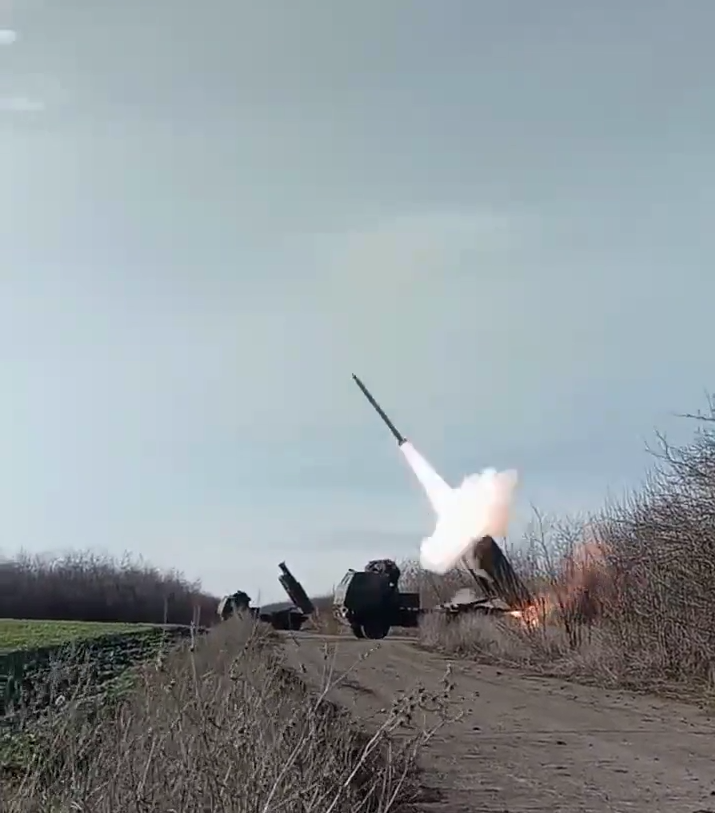
Finally, US EUCOM’s breakdown outlined that approximately 610 Ukrainian personnel have been trained on the M142 High Mobility Artillery Rocket System. So far 38 227mm HIMARs have been transferred to Ukraine by the US.

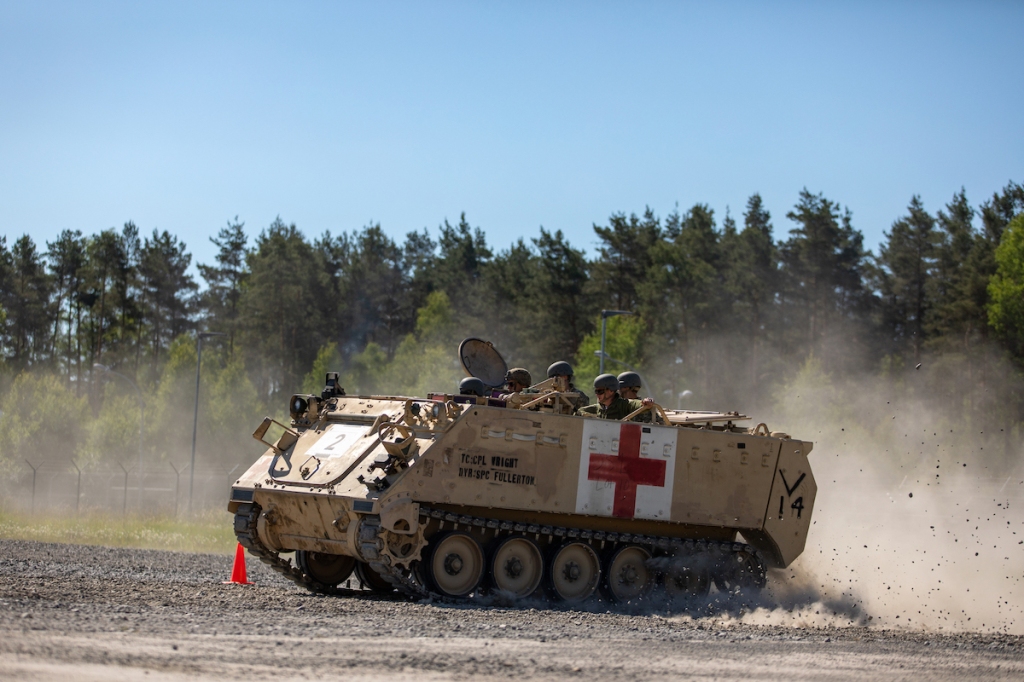
US personnel have also provided training on a number of vehicles, training 140 Ukrainians on M113 armored personnel carriers. With all of the vehicles and weapon systems it is unclear what ratio of these troops included instructors, mechanics and crews. At the time of writing the US has provided 200 M113s with European allies providing including Denmark, Spain, the Netherlands, Australia, Germany, Portugal, Lithuania and Austria also providing a similar number of M113 variants. The EUCOM spokesperson also noted that an unspecified number of Ukrainian troops had been trained on the M1089 Wrecker, a recovery vehicle which is part of the Medium Tactical Vehicles family. The latest Department of Defense factsheet on equipment provided to Ukraine notes that “22 Tactical Vehicles to recover equipment” have been transferred.

While the provided breakdown of systems Ukrainian troops have been trained on by US personnel outside of Ukraine isn’t exhaustive it also included 450 personnel who have received training on ‘other’ systems such as the M1089 and various Unmanned Aerial Vehicle platforms. 

Much of this training has been carried out at US military sites in Poland and Germany but as we’ve already seen in previous videos Ukrainian troops are also being trained in the UK by a multi-national training force, in Lithuania and elsewhere.

This article was adapted from my earlier article at Overt Defense.


Support Us: If you enjoyed this video and article please consider supporting our work here. We have some great perks available for Patreon Supporters – including early access to custom stickers and early access to videos! Thank you for your support!

NGSW: The US Army’s First Suppressed Service Rifle & Some History

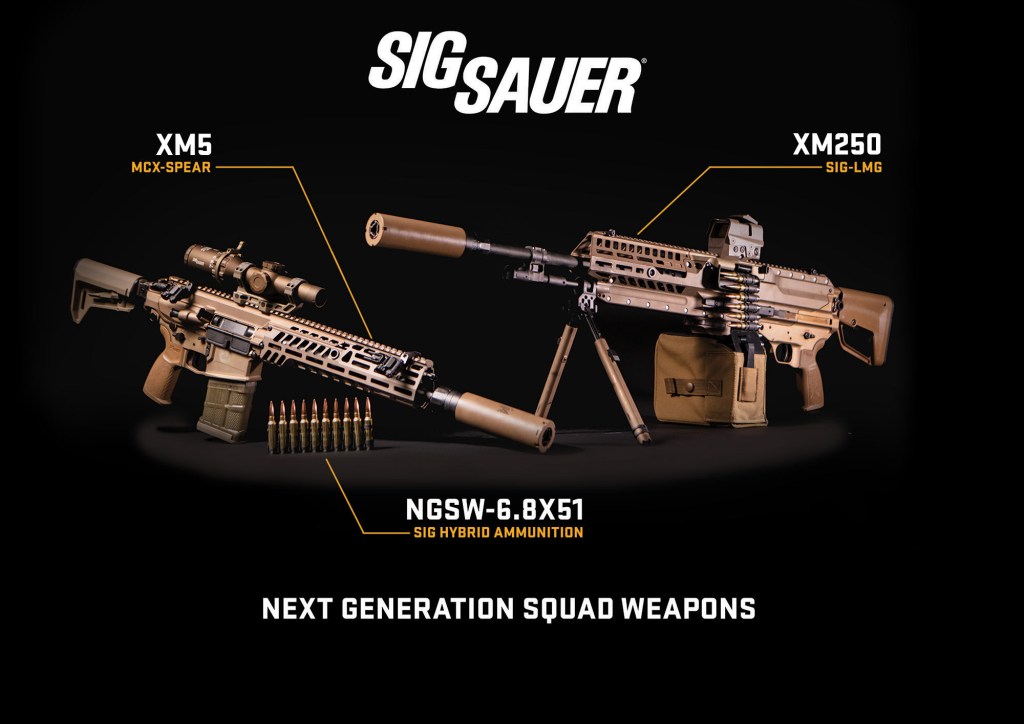
A couple of weeks ago the US Army finally announced the winner of their long running Next Generation Squad Weapon program, selecting the SIG Sauer MCX Spear rifle as the XM5 and the LMG-6.8 as the XM250.

The topic of whether this was the right choice and if the 6.8mm round they chamber is the right direction to move in is the topic for another day. I wanted to highlight one important aspect of the program that’s been somewhat overlooked. The weapons will be issued with suppressors as standard.

All of the NGSW submissions had suppressors developed by various manufacturers as it was an Army requirement. SIG developed their own design in house. When fielded over the next few years the XM5 will become the US Army’s first service rifle to be suppressed as standard.

But this isn’t the first time the US Army has examined large scale issue of suppressors. The US Army first examined the usefulness of suppressors way back in 1910, over a century ago.

XM5 / MCX Spear and XM250 / LMG-6.8 (SIG Sauer)

The first viable firearm suppressors appeared just after the turn of the 20th century with a series of patents being granted on various designs between 1909 and 1920. One of the first suppressor developers was Hiram Percy Maxim, son of Sir Hiram S. Maxim, He experimented with valves, vents and bypass devices, however, he eventually finalised his basic idea based on baffles and developed a series of practical suppressors; which were sold through the Maxim Silent Firearms Company. He filed his first patent on 26th June, 1908, which was granted in March the following year (US 916,885).

During the 1910s Maxim sold a successful range of ‘silencers’, as they were then largely known, on the commercial market. As early as 1907 Maxim was looking at ways to suppress the Army’s new Springfield M1903.

M1903 Springfield with a Maxim Silencer
M1903 Springfield fitted with a Maxim Model 1910 Silencer (Cody Firearms Museum)

The US military first took interest in silencers in 1908. However, the 1909 annual report of the Chief of Ordnance wasn’t too enthusiastic stating that “the silencer be not adopted for use in the service in its present form” citing visible gases leaving the silencer and the difficulty of mounting a bayonet. The following year the Chief of Ordnance believed that the improved the Model 1910 silencer overcame “most of the defects found in the original” and that “five hundred of the silencers are now being procured with a view to the issue of one or more to each organisation for instruction of recruits in target practice, and for issue to the militia, on requisition.”

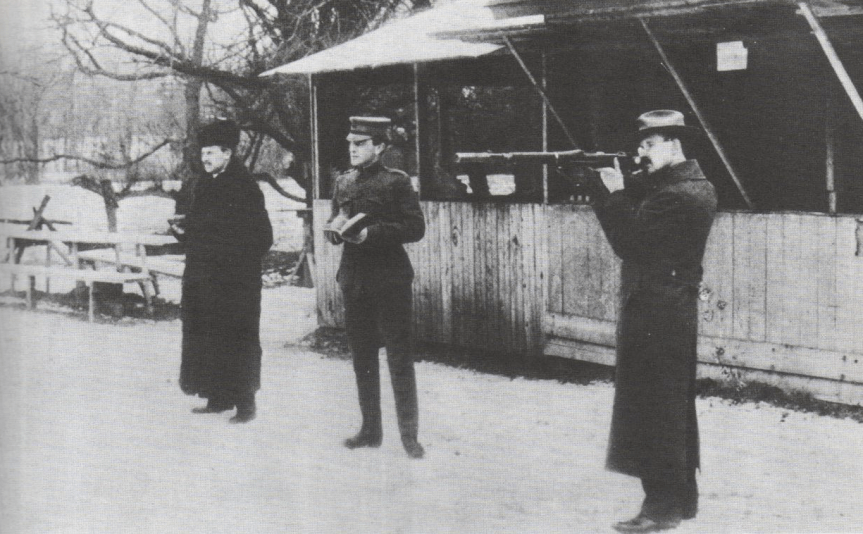
The US School of Musketry also tested the Maxim silencer. Twenty four soldiers were issued silenced M1903s for the test. The School of Musketry’s testing found that the report at the muzzle and the recoil felt by the rifleman was reduced when compared to a normal, unsuppressed, M1903. The School of Musketry’s report noted that:

An M1903 with a Maxim 1910 Silencer being test fired, left to right: H.P. Maxim, Lt.Col. R. Goodman, & Capt. E. Church (from the National Guard Magazine)

“The muffling of the sound of discharge and the great reduction in the total volume of sound which permits the voice to be heard at the firing point about the sound of a number of rifles in action, greatly facilitate the control of the firing line.” They also reported that “the silencer annuls the flash” a quality that they felt was a “positive military advantage in view of the extent to which night operations may be employed in future wars.”

Maxim did his best to develop a robust silencer that would meet the military’s needs. He incorporated a mounting point for a bayonet on the military variant of the Model 1910. The model 1910 silencer for the Springfield M1903, however, required the removal of the rifle’s front sight. This attachment method was felt to be the Model 1910’s weakest point and something Maxim himself actively looked to address.

The Maxim Silencer Company subsequently improved models and encouraged by early military interest Maxim envisioned a military silencer being useful in roles such as sniping, guard harassment and marksmanship training.

But Maxim was not the only designer working in the field and Robert A. Moore, his most competent competitor, also submitted a design for military testing. Moore’s designs used large gas expansion chambers which sat beneath the rifle’s muzzle as well as a series of vortex chambers ahead of the muzzle.

Ordnance Corps photograph of M1903s equipped with Maxim and Moore Silencers (US Army)

US Ordnance tests with Moore silencers began in 1910. When the two silencers were compared the US Army found that there was little difference between the two rival designs with regards to the reduction of sound, recoil and flash. Springfield Armory’s report in July 1912, found that the Moore silencer was more accurate and had a better attachment system. The Maxim silencer, however, was more durable and could withstand more prolonged rapid fire. While the suppressors were tested neither was selected for general issue and large scale contracts didn’t materialise. However, we do know that some of the suppressors were used during the US Army’s 1916 Mexican expedition against Pancho Villa and during the First World War some are confirmed to have made it to the Western Front but don’t appear to have been used in the field despite requests from officers.  

I go into much more detail about the early suppressors, their design, testing and whether they saw action in this article

Now fast-forward 100 years and the US Army is finally poised to adopt suppressors for close combat troops. In recent years the US Army has been testing suppressors at the squad level as far back as 2005 and this fed into requirements for the NGSW programme.

XM5 / MCX Spear (SIG Sauer)

In terms of the weapons selected SIG Sauer have developed their own suppressor designs to pair with the XM5 and XM250. SIG have said that the designs initially grew from their Suppressed Upper Receiver Group for USSOCOM. SIG’s suppressors are manufactured using direct metal laser sintering – essentially 3D printing with metal. SIG Sauer’s suppressor designs reduce sound and flash but also reduce gas blowback into the action and face of users. the SIG suppressors for the XM5 appear to be SLX suppressors, optimised for the reduction of blowback of toxic gases – SIG claim by as much as 70 to 80%) and are quick detach rather than direct thread, using a clutch lock system with an internal tapered seal. One thing the Army has not commented on is the efficiency of the suppressors so we don’t know to what levels the report of the weapons has been lowered to. Another thing that isn’t clear about the XM5 is if the Army had a requirement for mounting a bayonet. It certainly appears not to have been which would make the XM5 the first US Army service rifle not to mount a bayonet.

Of course the US Army are not the first service branch to suppress their rifles. The USMC is currently in the process of issuing Knights Armament QDSS NT4 suppressors for use with their M4A1 carbines and M27 and M38 rifles. The process began in late 2020 with the Corps citing many of the reasons originally identified back in in 1910 – reduced signatures, improved communication and hearing protection. 


If you enjoyed this video and article please consider supporting our work here. We have some great perks available for Patreon Supporters – including custom stickers and early access to videos! Thank you for your support!


Bibliography:

The Next Generation: SLX & SLH Suppressors, SIG Sauer, (source)
US Marine Corps Selects Knight’s Armament Suppressor, TFB, (source)
Marine Corps Begins Widespread Fielding of Suppressors, USMC, (source)
Silencers, Snipers & Assassins: An Overview of Whispering Death, J.D. Truby (1972)
Firearm Silencers, N. Wilson (1983)
War Department, Annual Reports, Report of Chief of Ordnance, 1909, Vol.6 (source)
War Department, Annual Reports, Report of Chief of Ordnance, 1910, Vol.1 (source)
Silencer for Firearms, R.A. Moore, US Patent #1021742, (source)
Firearm, H.P. Maxim, US Patent #1054434, (source)

Javelin In Ukraine

The transfer of Western anti-armour weapons started before the war even began. The United States transferred significant shipments of Javelin anti-tank guided missiles along with M141 SMAW-D Bunker Defeat Munitions and Stinger MANPADS. 

At the same time as an initiative from the Baltic states of Lithuania, Latvia and Estonia – Estonia also delivered Javelin missiles. For reasons of operational security we don’t know how many Javelins have been delivered to Ukraine by the US and Estonia at this time. However, Estonia is believed to have had several hundred in stock.

Ukrainian troops training with January in February 2022 (Ukrainian MoD)

What is Javelin?

Javelin is an infrared guided man-portable fire-and-forget anti-tank missile. It’s been been in service with over a dozen countries for over 20 years and is still produced by a joint venture between Raytheon Missiles & Defense and Lockheed Martin. It weighs about 22kg or 46 lbs ready to fire and had a detachable Command Launch Unit (or CLU) . Its effective range depends on the type of CLU but the improved Lightweight CLU introduced in 2020 can engage targets out to 4,000 metres (about 3 miles). As of 11 March, Lightweight CLU has not yet been seen in Ukraine. The earlier block 0 and 1 CLU can engage targets out to 2,500 meters (1.5 miles). The CLU enables this with a number of optics including a 4x day sight, a 4x night sight a 9.2x thermal sight. The CLU is also a useful tool for reconnaissance when other NVG and thermal imagers aren’t available. Once the gunner has their target and establishes a lock the missile can be launched.

Javelin’s CLU (US Army)

Javelin’s missile has a soft launch system which limits back blast and firing from relatively enclosed spaces. Once launched the main rocket motor kicks in at a safe distance. It uses automatic infrared self-guidance and has two modes of attack: direct for use against lightly armoured targets and structures and top-attack. In top-attack mode the missile climbs above the target and then plunges down on it to penetrate thinner top armour.

The missile has a tandem shaped charge high explosive anti-tank round. The initial charge can detonate any explosive reactive armour used by the enemy target vehicle while the second shaped charge will penetrate the target’s main armour. When the round detonates it super heats the metal of the armour and creates a high velocity stream of metal which enters the vehicle. More on the complex science behind shaped charges here. It can destroy vehicle’s drive systems or if it enters the fighting compartment it can kill or injure the crew and detonate munitions. 

History

Javelin was developed by Texas Instruments in cooperation with Martin Marietta. In the mid-1980s it beat off competition from Ford Aerospace and Hughes Aircraft to win the US Army’s Advanced Anti-Tank Weapon System—Medium program.

A Ukrainian Depot, early March 2022 (Ukrainian MoD)

In June 1989 Texas Instruments and Martin Marietta were awarded a development contract and the Javelin was adopted as the FGM-148. Javelin continued development and testing throughout the 90s before entering service. Since then it’s been adopted by countries including the UK, Australia, France, Norway, Poland, Taiwan, and many others. According to Raytheon the system is scheduled to be in inventory until 2050.

Javelin In Ukraine

Ukraine adopted Javelin in April 2018, ordering 210 missiles and 37 CLUs with a further order for 150 missiles and 10 CLS in December 2019. Since the threat of invasion became increasingly likely the US provided a series of aid packages worth $260 million. Reports suggest that at least 300 Javelin missiles were delivered as part of these packages. Since then the US has agreed a further package worth $350 million. 70% of this package is said to have been delivered as of 9 March. It’s difficult to estimate how many missiles and CLUs have been delivered so far but the number of missiles is likely over 1,000.    

Still from a Ukrainian training film on Javelin (Ukrainian MoD)

From the sparse evidence available we know that at least some of the Javelin transferred to Ukraine are confirmed to be  from older Block 0 stocks, which includes FGM-148A/B/C and D. The vast majority of Javelins in Ukraine are likely to be Block 0 variants. Block I, the FGM-148E came into service with the US in 2008 and has an improved CLU and rocket motor. Javelin’s shelf life is around 20 years, so it makes sense for these older production but still fully capable missiles to be sent first.

In early February the Ukrainian Ministry of Defense shared a short video showing troops testing the newly-arrived Javelins against tank hulks which had been fitted with so-called ‘Javelin Cages’, a metal structure which Russian tanks have recently added to their turrets. It is believed the cage is intended to detonate the initial charge of a Javelin before it contacts with the tanks explosive reactive armour or the hull itself. However, it is also believed that it is intended to defeat drone-fired micro munitions like the Turkish MAM series. The cage detonating the micro munition before it reaches the tank. The footage shared by the Ukrainian MoD showed that Javelin easily defeated the cages.

Update 15/3/22: We have now seen evidence of Block 1 FGM-148Es in Ukraine. Amael Kotlarski, Janes Infantry Weapons Editor, speculates that these may have originated from the Baltic states’ stocks. At least one example of the Block 1 and a number of Block 0s have been captured by Russian forces so far.

Ukrainian Defence Minister announcing arrival of a shipment of Javelin in January 2022

While at the time of publishing this video there has been no confirmed footage of Javelin in action in Ukraine, no doubt due to good Ukrainian OPSEC, we have seen the system in theatre. 

We got our first confirmation on 3 March, when Ukraine’s Operational Command “North” shared photos of troops being briefed on the use of NLAW and Javelin anti-tank weapons. In the photos we could see numerous Javelin transport cases stacked while troops were briefed on the Command Launch Unit (or CLU). On 6 March, the Ukrainian Armed forces shared a short instructional video on Javelin, showing how the battery is inserted and what the CLUs controls do.

How Capable is Javelin?

The penetration capabilities of Javelin are listed as classified with the USMC’s manual stating “The Javelin penetrates all known armor, “well” in excess of 30 inches [or 760mm] of rolled homogeneous steel.” This means Javelin is more than capable of knocking out any Russian armoured vehicle in Ukraine.

Javelin Missile (US Army)

In terms of performance in Ukraine, one report from 3 March, quoted an anonymous US Special Operations officer who is monitoring the conflict, suggested that of 300 Javelin fired, 280 knocked out vehicles. Time will tell.


If you enjoyed this video and article please consider supporting our work here. We have some great perks available for Patreon Supporters – including custom stickers and early access to videos! Thank you for your support!


Bibliography:

Javelin – Close Combat Missile System, Medium, FM3-22.37, US Army, 2008 (source)
Rundown: Western Anti-Tank Weapons For Ukraine, Overt Defense, (source)
Introduction to Crew Served Weapons, USMC, (source)
NLAW In Ukraine, Armourer’s Bench, (source)
As Russia Pounds Ukraine, NATO Countries Rush In Javelins and Stingers, New York Times, (source)
$60 Million Worth of US Military Aid Arrives In Ukraine, Overt Defense, (source)
First batch of Estonia-donated Javelin missiles arrive in Ukraine, EER, (source)
New US Military Aid to Ukraine Includes 300 Javelin, nv.ua, (source) Shaped Charge, Global Security, (source)

The SMAW-D In Ukraine

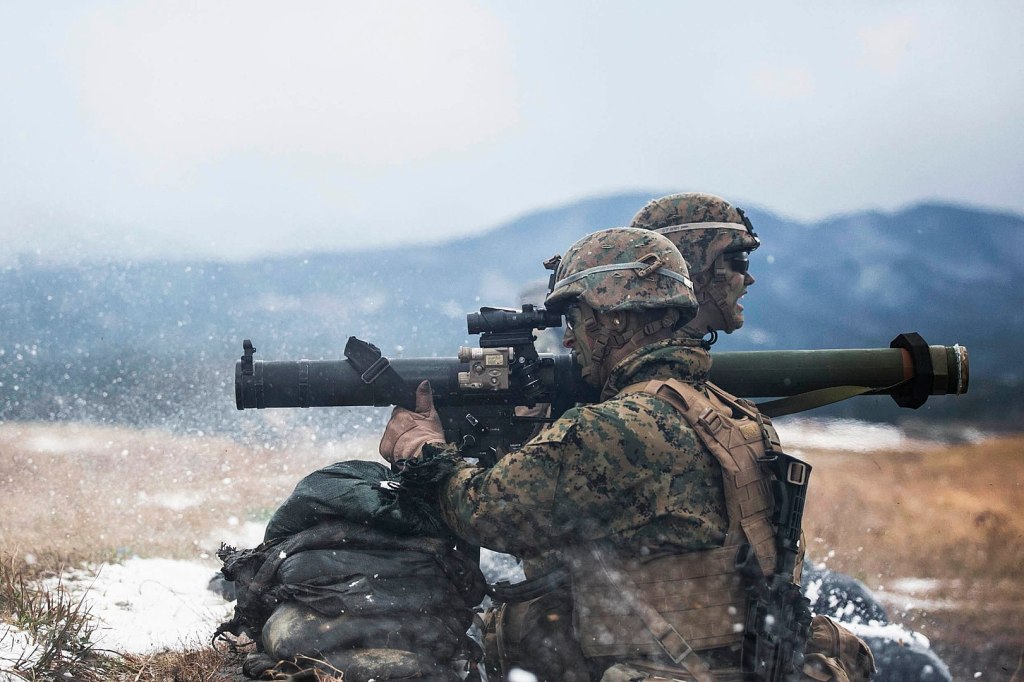
In recent days, with the news that a shipment of M141 SMAW-D anti-structure weapons have arrived in Ukraine as part of the US military aid shipments, a number of media articles and videos have been made on the subject which seem to confuse the SMAW-D with the AT-4 and even the M72. So, I thought it would be useful to take a look at the SMAW-D in a little detail. 

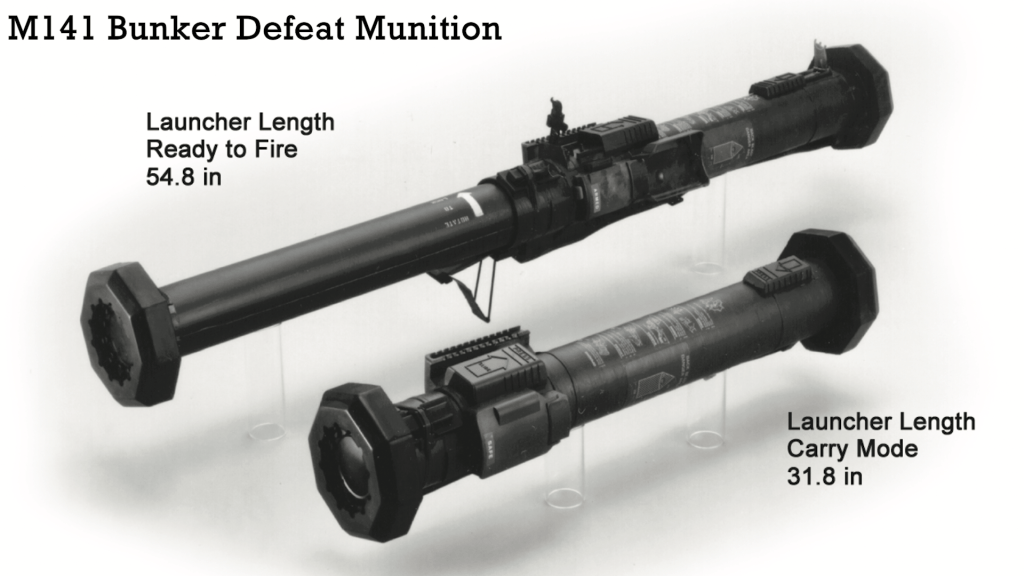
M141 (SMAW-D) (US Army Manual)

So What is the SMAW-D?  

Its official designation is ‘Rocket and Launcher, 83mm HEDP Bunker Defeat Munition (BDM), M141 (SMAW-D)’ SMAW-D stands for Shoulder-Launched Multi-Purpose Assault Weapon-Disposable. This isn’t to be confused with the Mk 153 Shoulder-Launched Multipurpose Assault Weapon used by the US Marine Corps. Those the SMAW-D did evolve from the SMAW.

The initial Mk 153 SMAW evolved from the Israeli IMI B-300. During the early-1980s McDonnell Douglas further developed the system and it entered service with the US Marine Corps as the Mk 153 in 1984. The SMAW-D shares the same warhead as the Mk 153 SMAW. The SMAW-D was originally developed by McDonnell Douglas and the design was acquired by Talley Defense Systems, whom were subsequently acquired by Norwegian company Nammo.

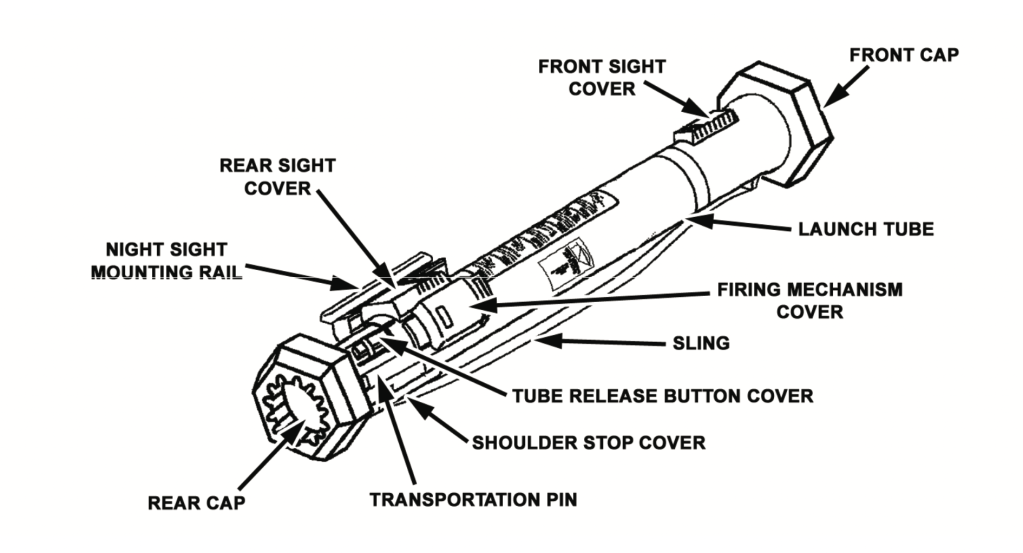
M141 (SMAW-D) (US Army Manual)

The Mk 153 has a reusable forward launch tube and firing mechanism which has a spotting rifle and can be mounted with an optic. The warhead element of the SMAW is attached at the rear of the launcher. The US Army was initially interested in the Mk153 but preferred a lighter, single use weapon.

A Marine fires a Mk 153 SMAW (USMC/Cpl. Drew Tech)

In the early 1990s the US Army began the search for a disposable Shoulder-launched Multipurpose Assault Weapon. McDonnell Douglas offered a lighter, disposable version of the Mk 153, taking the Mk 153’s High Explosive, Dual Purpose warhead and pairing it with shorter burn rocket. In 1996 the US Army selected the SMAW-D, beating a Swedish design, the FFV AT8, and the Hunting Engineering LAW80. The SMAW-D entered service in 1999.

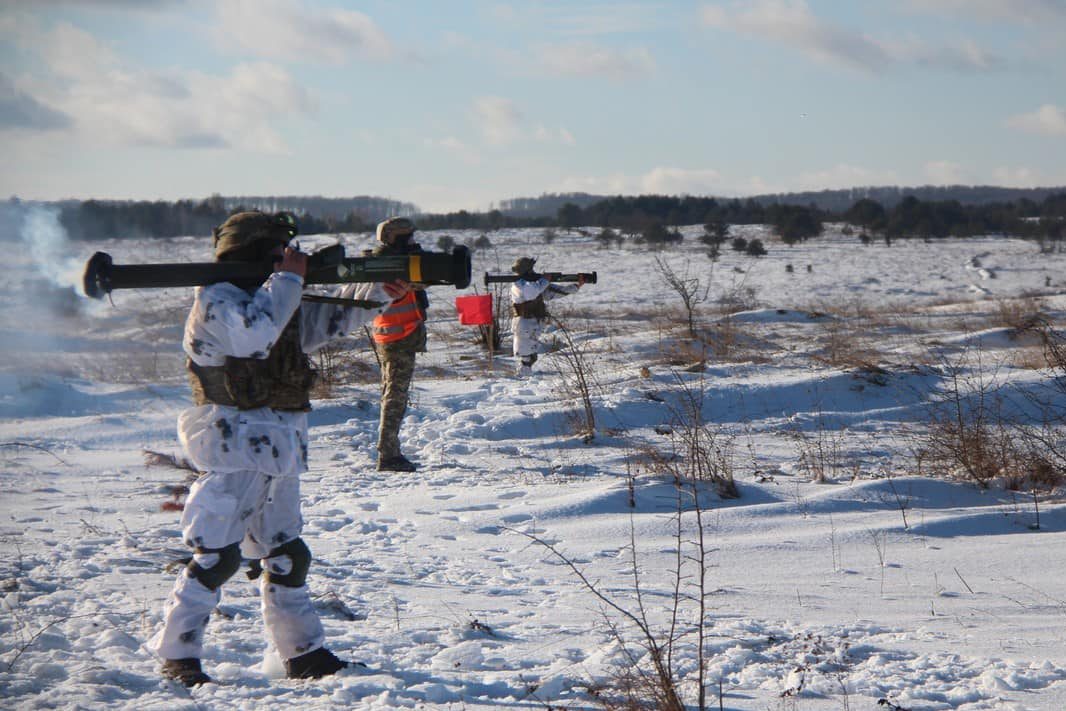
US Army advisor demonstrates how to deploy the M141 (Ukraine MoD)

The SMAW-D is similar to the 66mm M72 in that it telescopes with the launch tube extended before firing. When collapsed it measures just under 32 inches in length but extending the inner tube gives the weapon an overall length of 55 inches. The launch tube and rocket weigh 15.7 lbs.

The tube has the firing mechanism mounted on the side under a plastic cover which when opened arms the rocket ready to fire. The weapon has front and rear iron sights for aiming. The SMAW-D can also be fitted with an AN/PVS-4 nightsight and various infrared aiming lasers for night fighting.

Ukrainian soldiers fire M141 BDMs (Ukrainian MoD)

To fire the M141 the operator removes the locking pin from the front of the launch tube, depresses the tube release button and extends the inner tube rearward. The operator then raises the weapon onto the right shoulder, slides the front sight cover forward and then the same for the rear sight. Then opening the firing mechanism cover pivoting it forward, flush with the tube, this arms the weapon. The operator should then check the backlist area and fire when ready by depressing the safety button and then the red trigger button. The rocket is ignited by an electrical impulse sent by the firing mechanism. Once ignited the rocket burns out before it leaves the muzzle, this protects the operator.

M141 (SMAW-D) (US Army Manual)

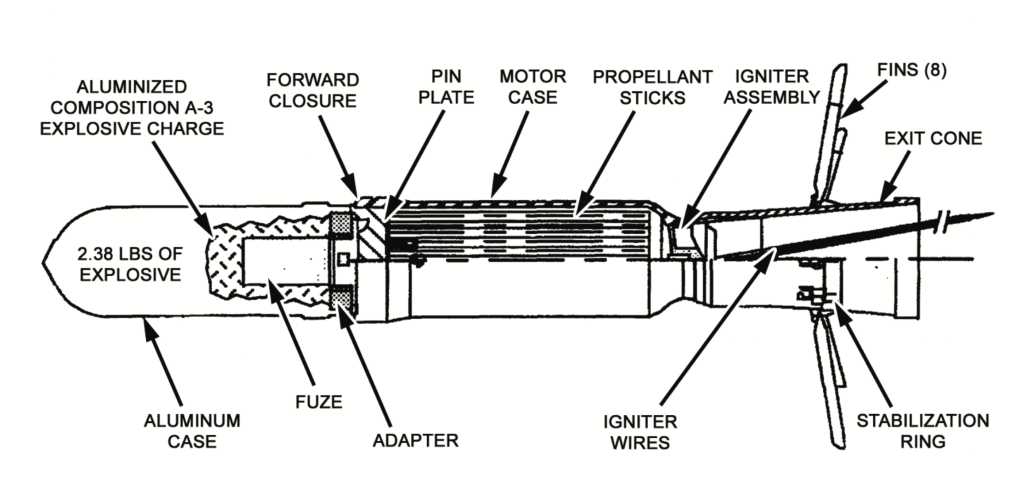
The M141 can engage targets out to 500 metres but is most effective out to 300. Its 83mm unguided, fin-stabilised round has an integral high-explosive, dual-mode warhead with 2.38 lbs of explosive. Detonation is instantaneous when impacting on a hard target, such as a brick or concrete wall, or an armored vehicle. Impact with a softer target, such as a sandbagged bunker, results in a fuze time delay that permits the rocket to penetrate into the target before warhead detonation. It can penetrate up to 200mm (8 inches) of concrete, 300mm (12 inches) of brick and 2m (6 feet 6.74 inches) of earth or sandbags. It can also perforate up to 20mm (0.8 inches) of rolled homogenous steel giving the SMAW-D the ability to take on soft and light armoured vehicles. For training at the range a 21mm sub calibre training system can be used. While the usefulness of the M141 might be questioned, as it isn’t an anti-tank weapon and could be considered more of an offensive rather than defensive weapon it would no doubt prove very useful during urban fighting, which Ukraine anticipates in the event of an invasion.

The SMAW-D saw service with the US Army during the War in Afghanistan and during the Iraq War. Some 6,000 units were initially procured, with an unknown number procured since. It remains an active part of Nammo’s product line. 

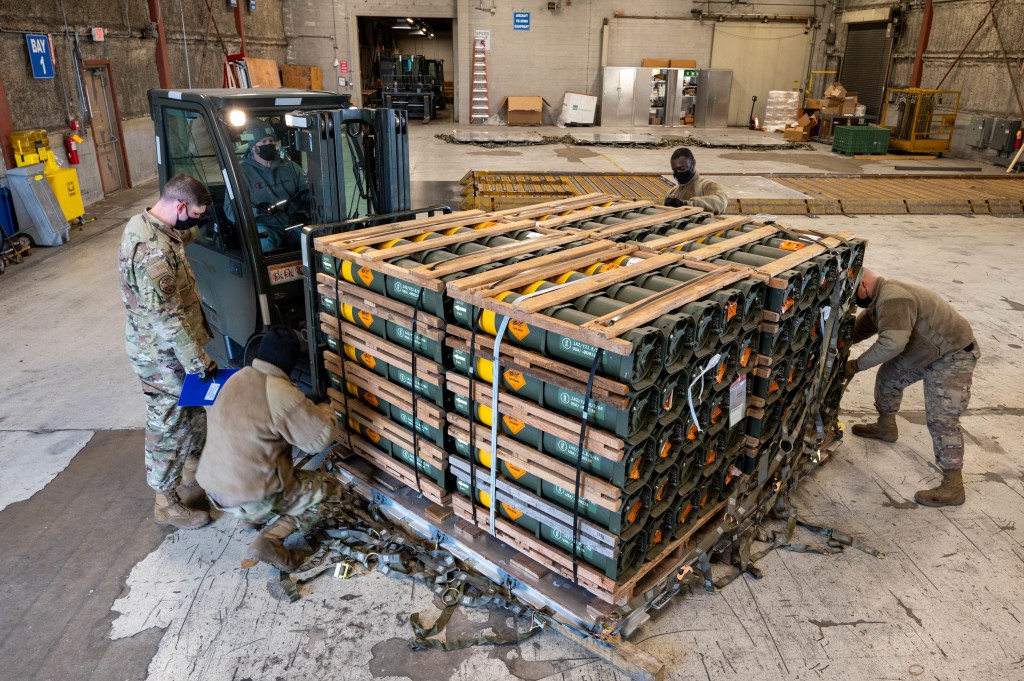
Airmen and civilians from the 436th Aerial Port Squadron palletize ammunition, weapons and other equipment bound for Ukraine during a foreign military sales mission at Dover Air Force Base, Delaware, Jan. 21, 2022. (U.S. Air Force photo by Mauricio Campino)

It is estimated that perhaps 100 M141 BDMs have been shipped to Ukraine so far as part of military aid, alongside small arms and ammunition, Javelin Anti-Tank Guided Missiles and NLAW anti-tank weapons from the UK. From the US Department of Defense’s packaging configuration table for the SMAW-D we know that each metal container holds one round and that 25 containers can be placed on a pallet. This appears to match up to the photos of the weapons being prepared for shipment. The Ukrainian Ministry of Defence and media have shared photographs of Ukrainian personnel training with M141s under the supervision of US troops. The training took place over two days at the 184th Training Center and the International Center for Peacekeeping and Security of the National Ground Forces Academy. These personnel will likely be tasked with then training other Ukrainian units on how to use the weapon.

M141/SMAW-D Specifications:

Length (extended/ready to fire): 1,371mm (54.8inches)
Length (closed/carry): 792mm (31.8inches)
Weight (ready to fire): 7.12 kilograms (15.7 pounds)
Rocket muzzle velocity: 217 meters per second (712 feet per second)
Rocket diameter:83mm (3.26 inches)
Minimum arming range: 15 meters
Maximum effective range: 300 meters
Maximum range: 500 meters


If you enjoyed this video and article please consider supporting our work here. We have some great perks available for Patreon Supporters – including custom stickers and early access to videos! Thank you for your support!


Bibliography: 

FM 3-23.25 Shoulder-Launched Munitions, 2006, US Army

Bunker Defeat Munition (BDM), Nammo, (source)

M141 Training, Ukraine Ministry of Defence, (source)

M141 Training, Ukraine Land Forces, (source)

Thank you to Amael for sharing some of the documents and manuals used to make this video.

Footage/Imagery: 

Marines fire SMAW, have a blast, USMC, (source)

Dover supports strategic partnership with Ukraine, US Air Force, (source)

Dover AFB supports US, Ukraine strategic partnership, US Air Force, (source)

Sadr City 2008 SMAW D, Gold 5 Publishing, (source)
SMAW-D (AT-4) fired in combat Sadr City, Iraq, Bowen11b, (source)

Improvised Bazooka Mine

I recently came across an interesting segment in a January 1945 US Army Combat Bulletin newsreel. It showed men of B Company of the 238th Combat Engineers setting up improvised anti-tank mines in Belgium. The mines were fashioned from Bazooka rockets!

A still from Combat Bulletin #39 showing an engineer from the 238th Combat Engineer Battalion setting up an improvised off route rocket mine on a fence post (US Army)

This is a relatively little-known application for the Bazooka’s rockets but a really interesting field expediency. The footage shows engineers cutting the cardboard tubes the Bazooka’s rockets were carried in, down and attaching them to a fence post. Essentially setting up an off-route mine or IED. The engineers run a wire back to cover for remote detonation with some batteries. 

Diagram showing how the rocket could be buried (1944 US Army field manual)

While these seems quite ad hoc it was a secondary use for the Rocket Launcher’s ammunition which was laid down in the Bazooka’s 1944 basic field manual. It doesn’t appear in the 1943 technical manual for the M1A1 launcher at all but the 1944 manual explains that 

“In addition to its use as a projectile when fired from the launcher, the rocket may be prepared for firing electrically and used as an improvised anti-tank mine.”

Diagram showing the transport packing and transit cannister tube for the M6 Rocket, the tube could be used as a makeshift launch tube (US Army)

This improvised method of use was also demonstrated in a training film for the Rocket Launcher, a Bazooka team are seen digging a pit in a road and burying a rocket in its makeshift launcher just as laid down in the manual. The training film explains it best…

A still from the 1943 US Army training film for the Bazooka, demonstrating the setting up of an improvised rocket mine (US Army)

The 238th Combat Engineer battalion fought in the Battle of the Bulge and received a commendation from Major General Matthew B. Ridgeway, commander of XVIII Corps, for helping to establish a line of defence against the German offensive. The commendation read: 

“The work of the 238th Engineer Combat Battalion in the construction of the initial barrier in the vicinity of Manhay was outstanding and materially assisted the Corps in holding off the attack of the enemy in that area.”

Illustration from a 238th Combat Engineer Battalion Association book showing knocked out German tanks around Grandmenil (238th Combat Engineer Battalion Association)

Whether this technique of improvising a mine from the rockets was used during the battle is unclear but I found the footage of the engineers demonstrating the set up fascinating. Its always interesting to see suggestions from manuals and training films put into action in the field so I was excited to come across this footage. 


If you enjoyed this video and article please consider supporting our work here. We have some great perks available for Patreon Supporters – including custom stickers and early access to videos! Thank you for your support!


Bibliography:

238th Combat Engineer Battalion Association (source)

The Ardennes: Battle of the Bulge, H.C. Cole, 1965, (source)

Footage:

The Anti-Tank Rocket M6” 1943 US Army Training Film; M1 & M1A1 Bazookas, War Department

Combat Bulletin No.39, War Department