Home Guard Improvised Incendiary Weapon

On the 14th May 1940, the British Government announced the formation of the Local Defence Volunteers. By the summer of 1940 nearly 1.5 million men had volunteered to serve. The force was later renamed the Home Guard in July 1940 but remained under-equipped throughout the summer of 1940. Many of the newly raised militia units had just ‘LDV’ arm bands, some civilian firearms and improvised weapons, as uniforms and service weapons were in short supply.

I recently came across a really interesting piece of footage showing a Hampshire Home Guard unit training with an ‘incendiary weapon’. With few heavy weapons available during 1940, some Home Guard units improvised. This remarkable original colour footage appears to show a reasonably effective incendiary weapon of some sort. But beyond what we can see we know very little about the weapon.

The footage shows a battery of five launchers, each seemingly with a 3 man crew. One man aiming, another loading and another firing. The footage is undated but from their arm bands we can see that the men are Home Guard so definitely post July 1940. The men also appear to be quite well equipped with caps, denim trousers and blouses and belts. No webbing is seen but we can potentially date the footage to between late 1940 and mid-1941.
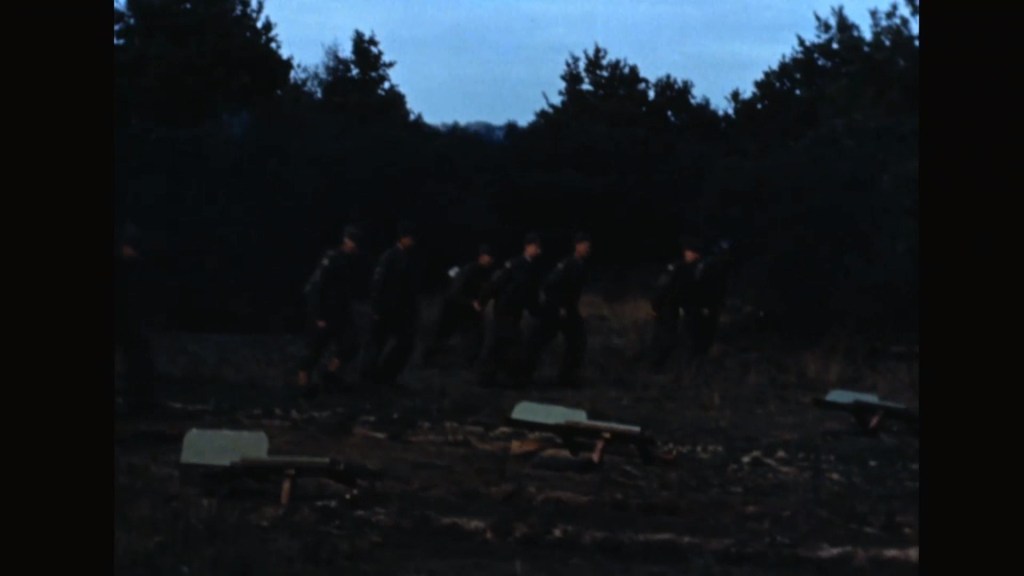
Crews dash to their launchers. Note the rifle stock-shaped pieces to the side of the weapons which appear to have been used to aim the launcher

The incendiary weapon itself is extremely intriguing! I haven’t seen a similar weapon before and I couldn’t find any direct reference to it in the available original documents, newspapers or photos. The footage comes from the Wessex Film and Sound Archive, it is described as showing Home Guard men from Swanmore, a rural village in Hampshire, demonstrating the weapons. Before the incendiary weapon is demonstrated we see a company sized force of Home Guard parading, without rifles or other equipment, and then a single Home Guard member demonstrates loading an SMLE. From the footage we can get an idea of how the weapon would have worked.
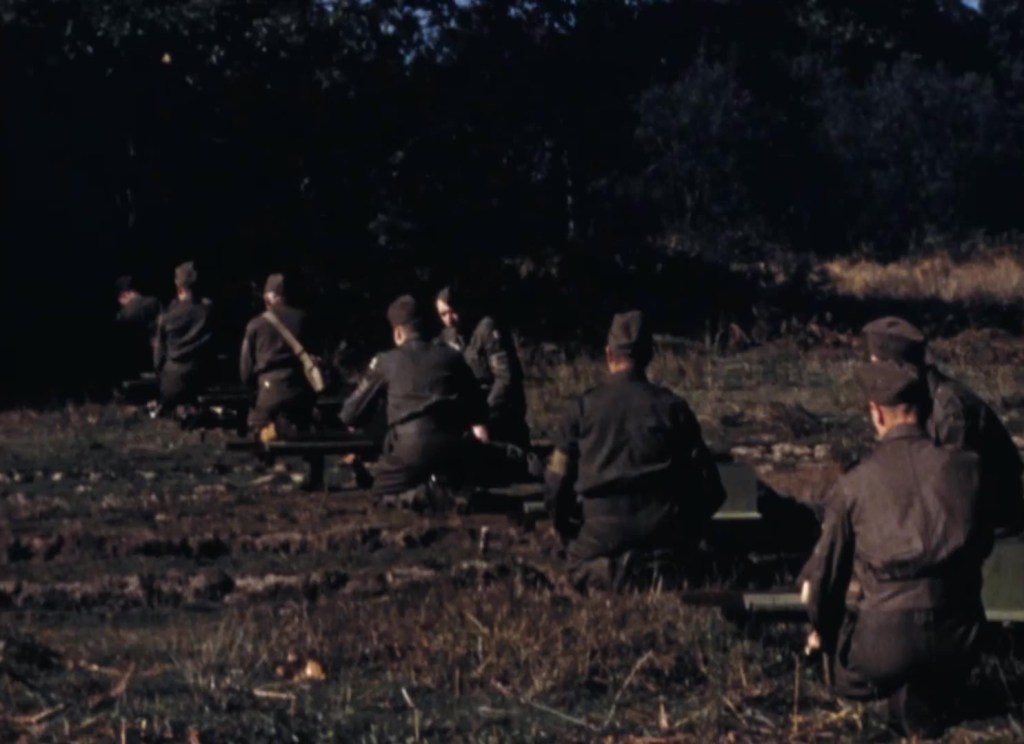
Three-man crews sit by their weapons note the troughs projecting from the front of the launchers

The men run to the launchers, which appear to be made of wooden boards. Beneath them are rifle stock shaped pieces which the man at the rear seems to shoulder – probably to aim the weapon. The other two crew members kneel either side of the launcher. The footage then cuts away to another angle from the other side and shows one of the kneeling men hitting the rear of the projectile with a hammer. Then with a flash and puff of smoke the projectile launches forward. The man who aimed the weapon appears to have moved away, out of shot. Frustratingly the footage is a bit underexposed and quite dark so we can see too much more detail but we can see that the chap with the hammer is definitely hitting the rear of what looks like a length cylinder. The cylinder shoots to the rear while a projectile fires forward and the launcher’s crew look downrange.
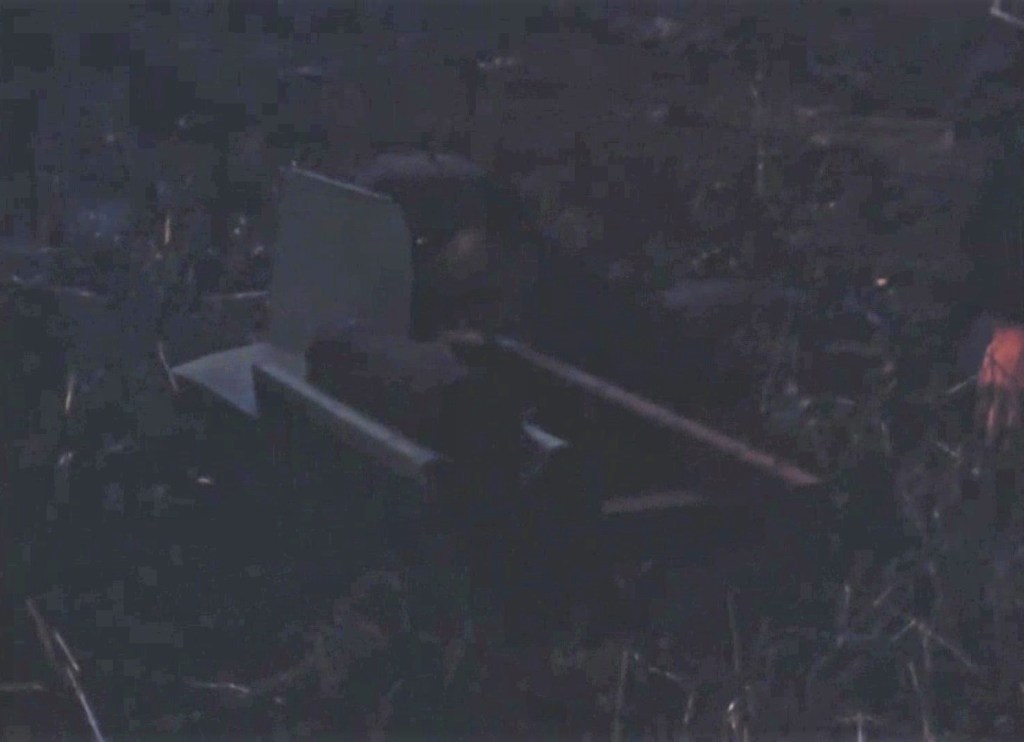
A somewhat low resolution close-up of the launcher. Note the crew member lying behind it aiming it along the wooden piece on the right. The projectile and launch cylinder sit in a trough while behind appears to be a shield to protect the crew member aiming

We then get footage showing what seem to be a series of impacts, likely from the projectile’s fired by the launchers. Then we get another clip of the men running to man the launchers and some more shots of the incendiary weapons exploding. From the available footage its pretty difficult to theorise how the launchers work. They appear to be using an almost proto-recoilless rifle-like principle with the launch cylinder shooting backwards and the projectile leaving the cylinder and firing towards the target. The crew member with a hammer may be hitting a percussion cap to detonate some black powder which projects the incendiary bomb. This system may have been developed to remove the need for a fixed, pressure bearing barrel. Making the weapon much simpler to manufacture.
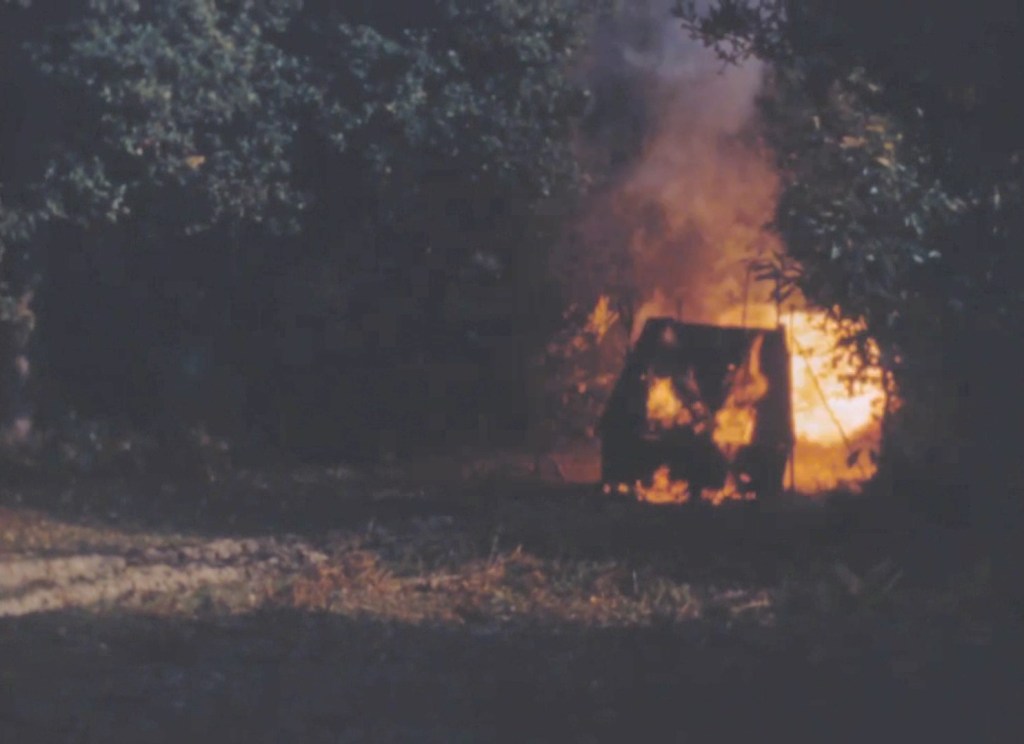
The effect down range – the target well alight

The footage doesn’t give us too much indication of the range of the weapon but it’s distant enough that the men firing the weapon don’t appear to recoil when the projectile hits the target. The incendiary effect downrange is actually quite impressive and a battery of five of the launchers would have been an impressive sight and perhaps quite useful as a road ambush weapon which was something the Home Guard focused heavily on at the time.
It wasn’t until later in 1941 that sub-artillery like the Smith Gun, Northover Projector and the Blacker Bombard began to enter service with the Home Guard. Until then some of the units took it upon themselves to create their own weapons, improvising contraptions like the one featured in this video.

Update 28/07/21:

The weapon somewhat fits the description of the ‘Jones-Wise Projector’ shared by David Lister in his book Forgotten Tanks and Guns. Thanks to BettongMI who brought this to my attention in the comment section of the video. The weapon was apparently developed by a pair of Home Guard officers and while turned down for regular service was used by some elements of the Home Guard in southern England, at least until official sub-artillery began to enter service.


If you enjoyed this video and article please consider supporting our work here. We have some great perks available for Patreon Supporters. You can also support us via one-time donations here. Thank you for your support!


Bibliography

Home Guard and home-movies in Swanmore, Wessex Film and Sound Archive via the BFI, (source)

Britain’s Final Defence: Arming the Home Guard, 1940-1944, D. Clarke (2016)

Forgotten Tanks and Guns of the 1920s, 1930s and 1940s, D. Lister (2018)
Clement Attlee’s Curious MkII STEN Front Grip

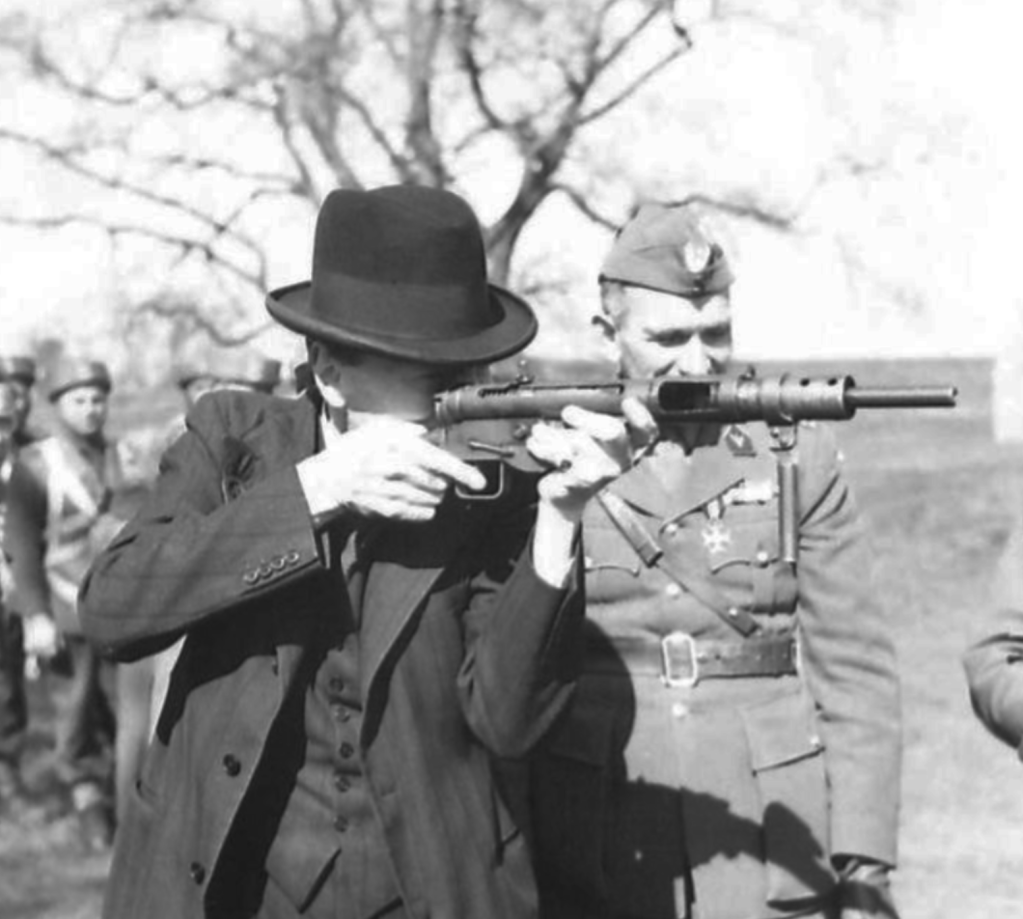
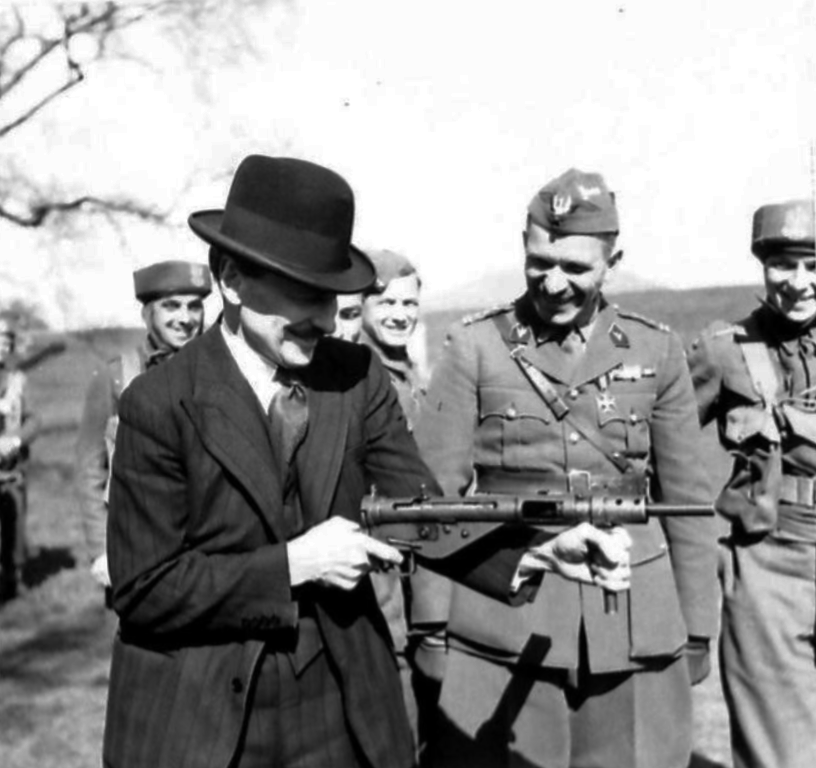
I was recently I was taking a look through the Imperial War Museums’ online image collection when I found a pair of very interesting photographs taken in Scotland in April 1942. They show Deputy Prime Minister Clement Attlee handling a STEN MkII submachine gun while visiting Polish troops. Most interestingly though is the folding front grip which has been added to the Sten!

Clement Attlee with STEN MkII (Imperial War Museum)

The MkII, introduced in August 1941, did not have a folding front grip as standard. The earlier MkI had had a front folding grip, but the MkI*, introduced in October 1942, had eliminated this to speed up production. The original caption of this photo reads:

“Mr Attlee tries the weight and feel of the Sten Sub-machine gun used by the Paratroops.”

Attlee was visiting the 1st Polish Independent Parachute Brigade during a visit to the 1st Polish Corps) at Cupar in Scotland. In the photos he’s accompanied by Colonel Stanisław Sosabowski, the commander of the brigade. In this second photograph, Attlee is holding the Sten by its trigger mechanism cover and we can see the folding grip more clearly.

Clement Attlee with STEN MkII (Imperial War Museum)

It appears to be made up of a band of steel which slid onto the barrel nut housing – much like the later MkV foregrip. The grip appears to possibly pivot on a rivet and the grip itself appears to be tubular metal. Sadly the photos are fairly low resolution so we can’t see too much more detail.

These were the only two photos of the grip I could find and I haven’t yet been able to find any documentary references to them. It may be that the grip was experimental and provided to the Polish paratroops for testing or it was an adaptation unique to the unit – perhaps something the unit’s armourer made. I’ll need to do more research in the future to try and find out more about the curious STEN accessory!

For more on the STEN check out our video on the origins of the STEN and it’s name below:

Bibliography:

The Polish Army In Britain, 1940-1947 series, Imperial War Museum, H 18884 & H 18883


If you enjoyed this video and article please consider supporting our work here. We have some great perks available for Patreon Supporters. You can also support us via one-time donations here. Thank you for your support!

Panther vs M3 Lee

I came across some intriguing newsreel footage while doing some archival digging that shows an Allied M3 medium tank pitted against a German Panther! What do you think?

Bibliography:

Deutsche Wochenschau newsreel, August 1944, via United States Holocaust Memorial Museum, courtesy of National Archives & Records Administration, (source)

Gurkha Battle in the Imphal Area, Indian Inter-Service Public Relations Directorate via IWM, (source)


If you enjoyed this video and article please consider supporting our work here. We have some great perks available for Patreon Supporters. You can also support us via one-time donations here. Thank you for your support!

British Army Thompson Submachine Gun Manual

It’s essential for soldiers to know how to use and maintain their weapons properly. We’ve been collecting training manuals, pamphlets and handbooks (as part of the TAB reference collection) to give us a wider understanding of how troops were trained and how they used their weapons.

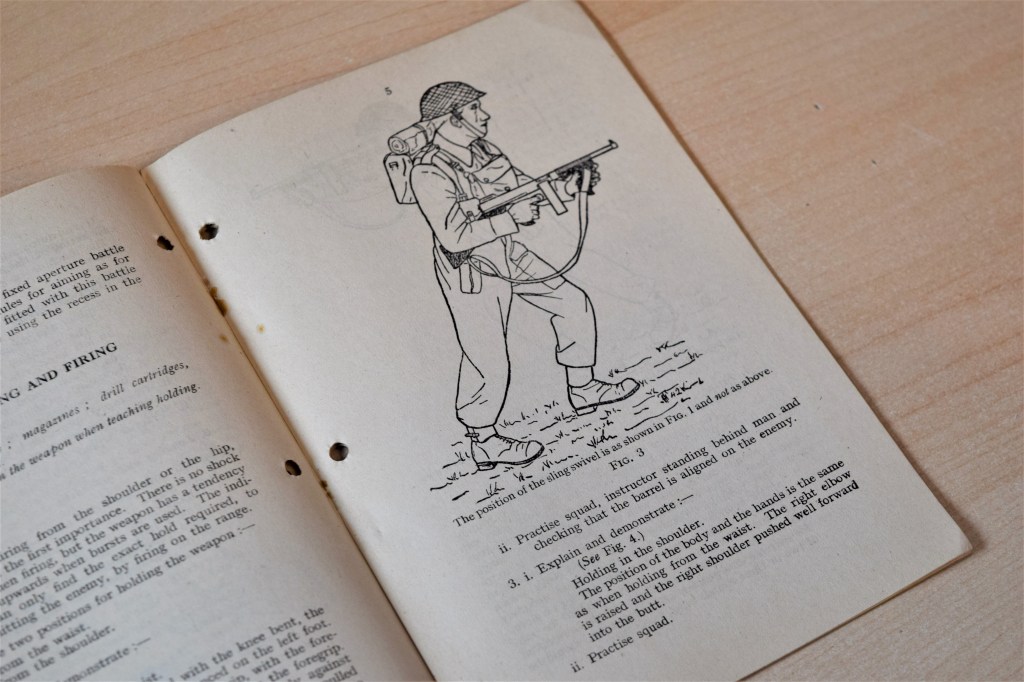
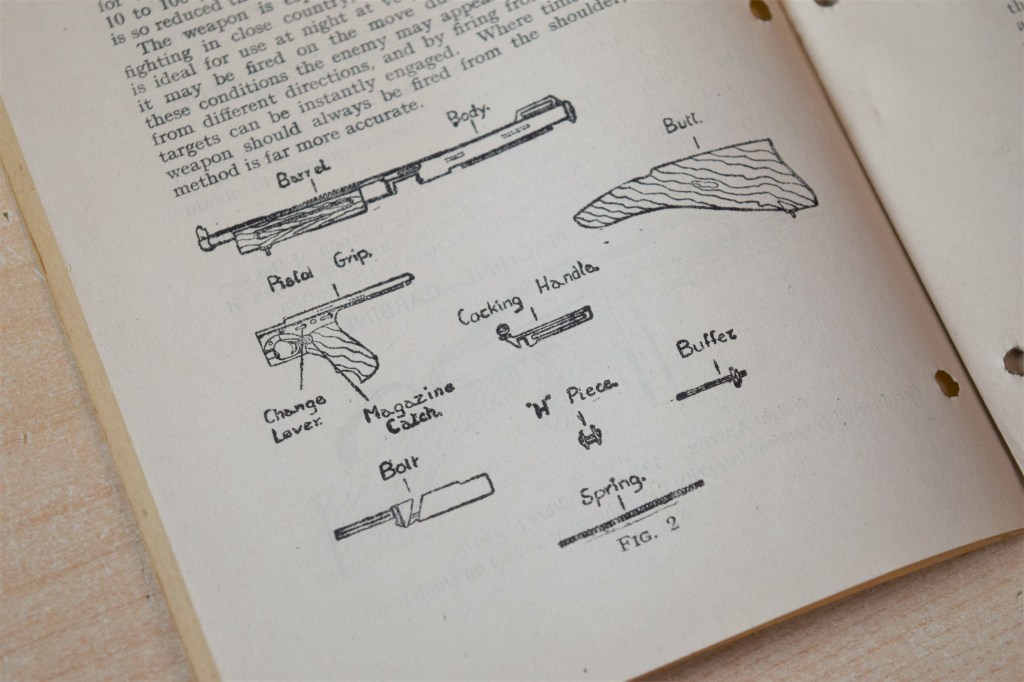
In this video we take a look at the British Army’s 1942 small arms training pamphlet for the ‘Thompson Machine carbine’.

Diagram showing firing the hip (Matthew Moss)

The pamphlet, issued in July 1944, is written for instructors to train troops how to handle, maintain and use the Thompson. The pamphlet was eventually superseded by one covering both the STEN and Thompson.

Diagram showing the Thompson Machine Carbine disassembled (Matthew Moss)

The pamphlet is just 12 pages long but includes some interesting insights and an appendix looking at the ‘spotlight projector’ training instrument.


If you enjoyed these videos and this article please consider supporting our work here. We have some great perks available for Patreon Supporters. You can also support us via one-time donations here. Thank you for your support!

Behind the Scenes at the Tank Museum

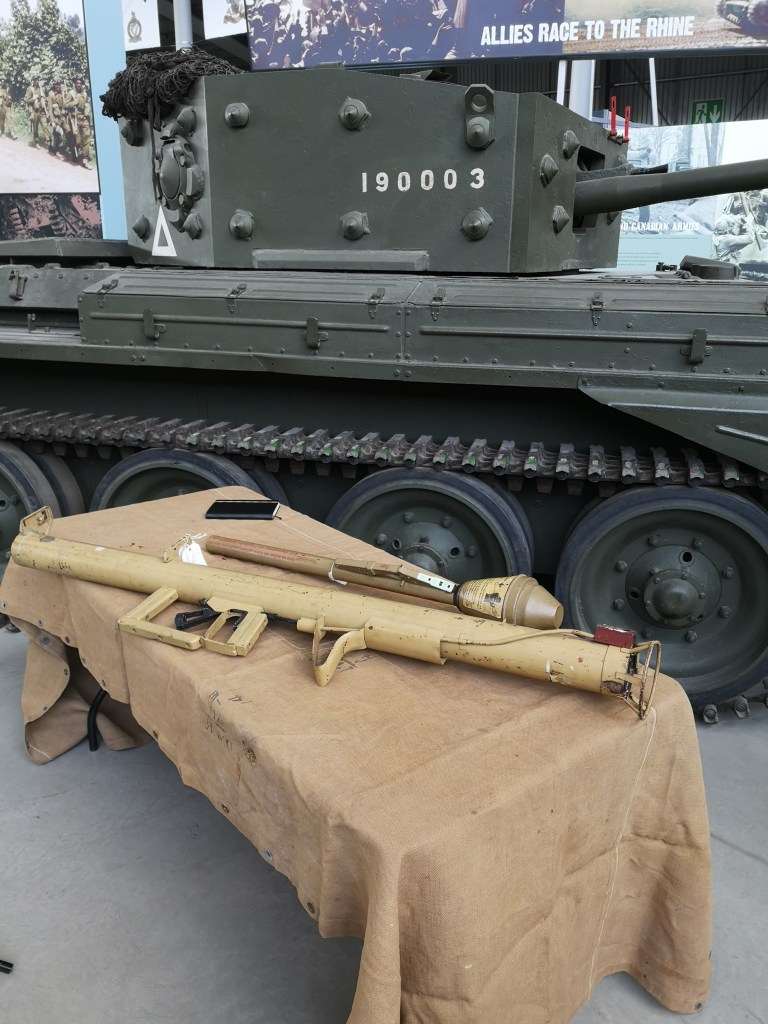
Here’s a behind the scenes look at the filming Matt did at The Tank Museum for the upcoming ‘Rhineland 45 – Decision in the West’ documentary being produced by Realtime History, the guys behind The Great War!

Panzerfaust & Panzerschreck (Matthew Moss)

Be sure to check out the project here.

More behind the scenes footage coming soon with a look at the Vickers Gun shoot!

Fighting On Film: The Way Ahead (1944)

Join us for as we examine the Carol Reed-directed 1944 British classic ‘The Way Ahead’ starring David Niven, Stanley Holloway, William Hartnell, Peter Ustinov and John Laurie. We’re joined by special guest Richard Fisher, of the Vickers MG Collection and Research Association, who picked the film partly due to it’s iconic scene featuring a Vickers Gun! The film follows a platoon of men through their call up, training and up to their first experience of battle!

You can watch ‘The New Lot’ (1943) on the IWM’s site here.

The episode is also available on all other podcast platforms, you can find them here.

Here’s some stills from the film:

Be sure to follow us on Twitter @FightingOnFilm

Thanks for listening!

Fighting On Film: Bataan (1943)

Join us as we look at 1943’s ‘Bataan’ starring Robert Taylor, Robert Walker, Lloyd Nolan, Kenneth Spencer and Desi Arnaz. Directed by Tay Garnett, it’s one of the few films to look at the brutal Battle of Bataan. It’s a classic last stand movie and incorporates elements from the battle which saw some of its hardest fighting 79 years ago this month.

The episode is also available on all other podcast platforms, you can find them here.

Here’s some stills from the film:

Be sure to follow us on Twitter @FightingOnFilm

Fighting On Film: Go For Broke! (1951)

In this episode of Fighting On Film we examine 1951’s ‘Go For Broke!‘, written & directed by Robert Pirosh and starring Van Johnson – who had worked together on ‘Battleground‘ (FoF Episode 6). The film tells the unique story of the 442nd Infantry Regiment, a US Army unit made up of Japanese-Americans who became the most decorated unit of its size of World War Two! 

The episode is also available on all other podcast platforms, you can find them here.

Here’s some stills from the film:

Be sure to follow us on Twitter @FightingOnFilm

Cold War British Vehicles – Anglesey Transport Museum

Late last summer we visited the Anglesey Transport Museum in North Wales. They had a great collection of classic and vintage cars and bikes and most interestingly they had a little collection of British military vehicles.

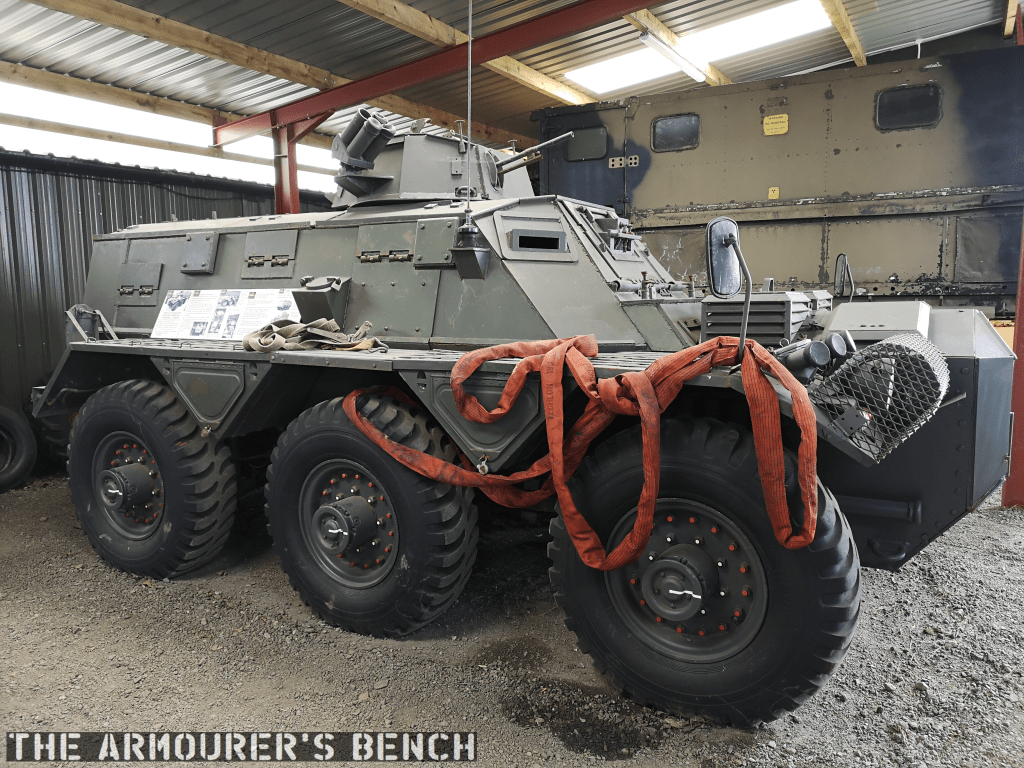
They had a number of trucks and special purpose vehicles from the Royal Engineers, REME and RLC and even a Green Goddess Fire Engine. They also had a couple of pretty cool Cold War British Army armoured personnel carriers.

Alvis Saracen

Alvis Saracen (Matthew Moss)

The Saracen was a six-wheeled armoured personnel carrier (APC) built by Alvis. It entered service in 1952 and was used extensively in Malaya and Northern Ireland. The Saracen could carry an 8 man section along with its 2 man crew. It had a 160HP Rolls Royce engine and depending on when during its service life its turret could be mounted with a .30 calibre M1919A4 or an L37 vehicle-mounted general purpose machine gun.

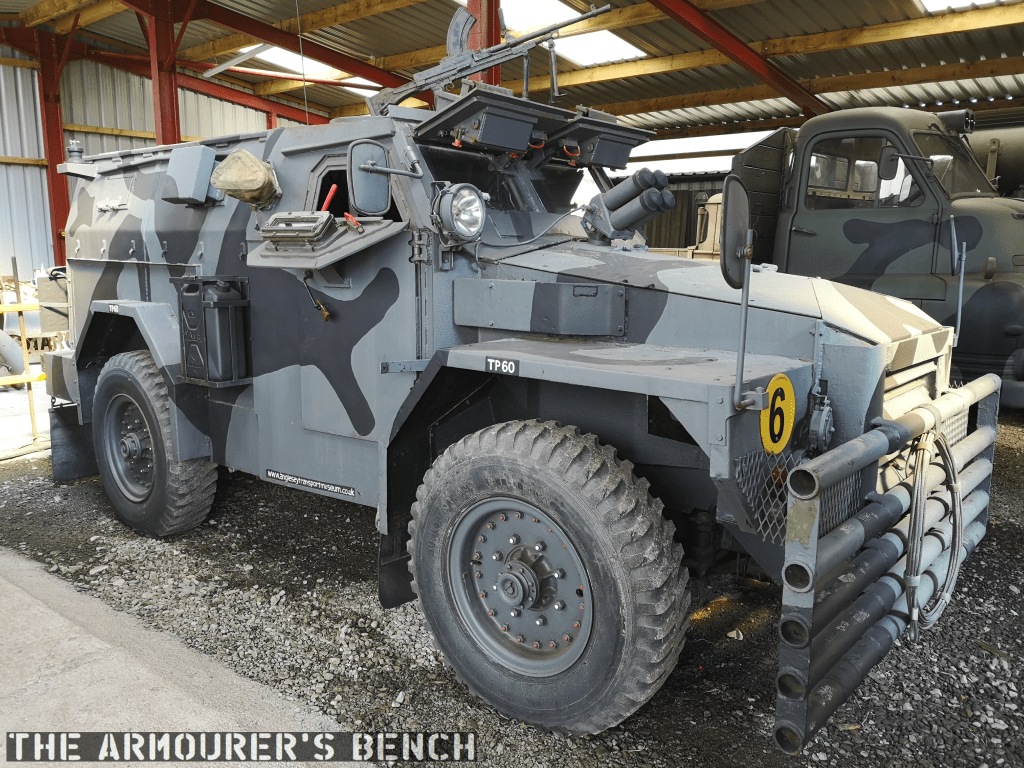
Humber Pig

Humber Pig (Matthew Moss)

Another APC which was in service alongside the Saracen, the ‘Truck, Armoured, 1 Ton, 4×4’, better known as the Humber Pig. Based on a truck chassis, it had a 120HP 6 cylinder engine and room for 6 men on the benches in the back. It could be mounted with an L4 Bren gun. It saw extensive use in Northern Ireland during operation Banner and was in service from 1956 through to the early 90s.

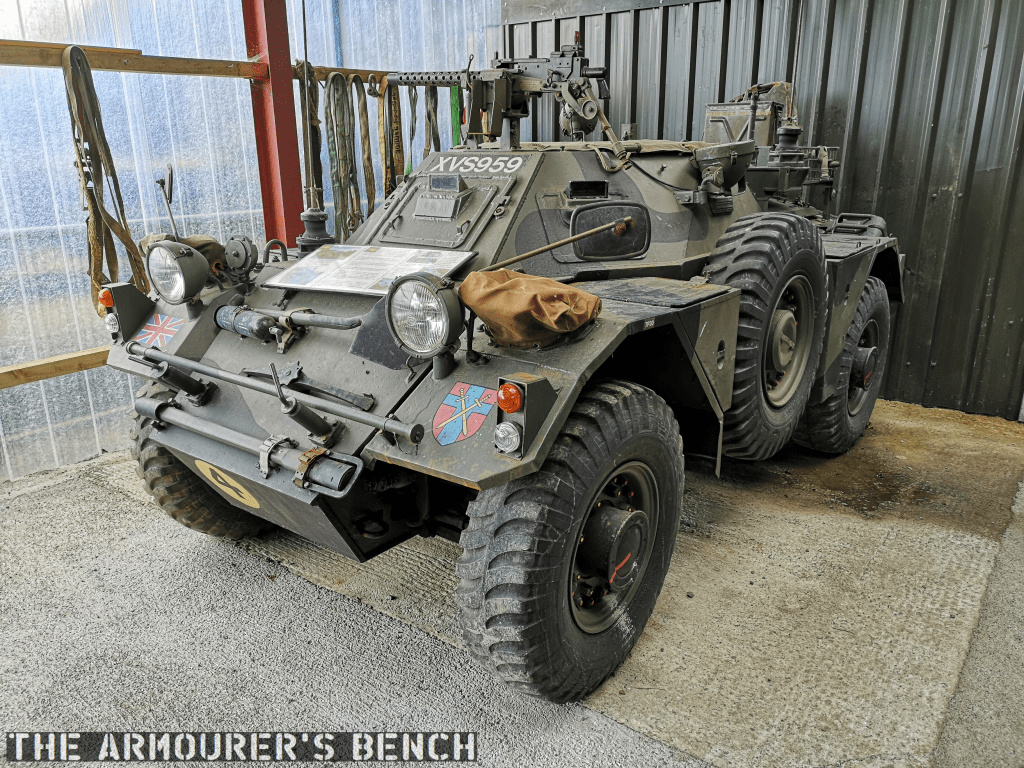
Daimler Ferret Mk1 Scout Car

Daimler Ferret (Matthew Moss)

Next to the Pig in the collection was a Mk1 Daimler Ferret scout car. Fitted out with an M1919A4 and six forward-firing grenade launchers – for smoke grenades. The later Mk2 had a turret but the Mk1 made use of its low profile. This one has its canvas cover over the fighting compartment. The 4×4 Ferret was powered by a 130HP Rolls Royce B60 straight six. Perfect little run-around to do the shopping in.

On the top of the hull is the pintle mounted Browning M1919A4 machine gun. This would have been operated by the Ferret’s commander. We can see the mount allows it to be aimed and fired from somewhat inside the hull. The Ferret entered service in the early 1950s and remained in use into the late 1980s/early 1990s. Just short of 4,500 Ferrets were manufactured.

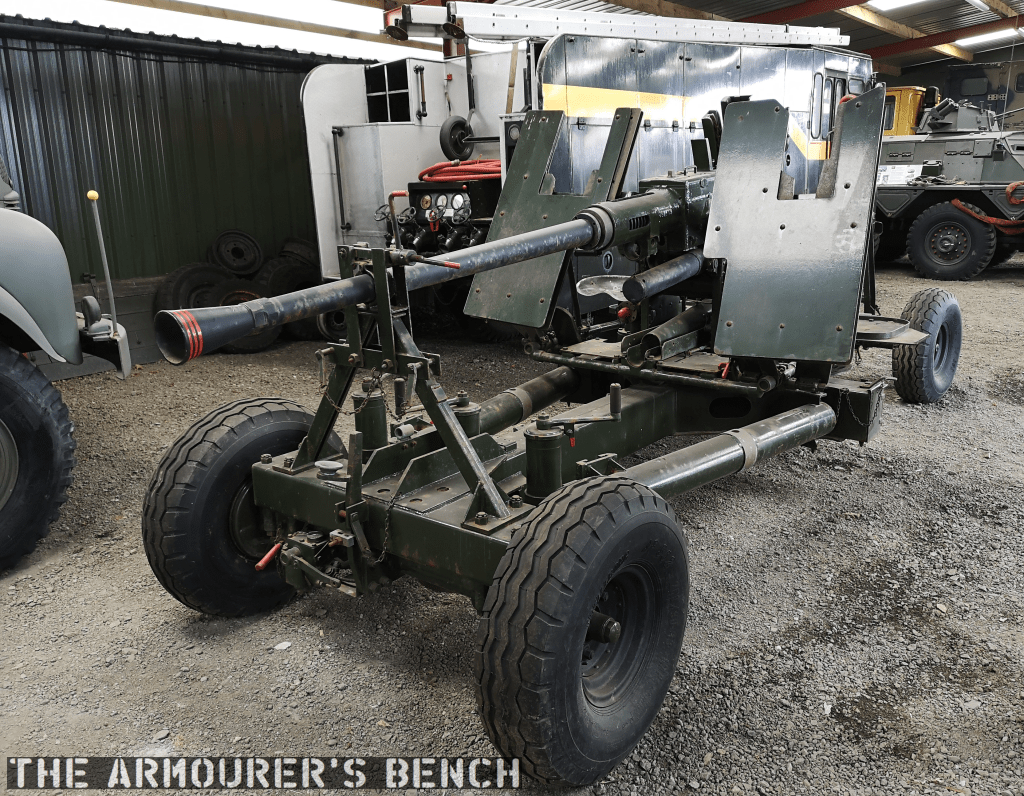
Bofors QF 40mm Mk1

QF 40mm Mk1 (Matthew Moss)

At the centre of the military vehicle collection was a QF 40mm Mk1, better known as a Bofors. Both land and naval versions of the Bofors were used during the Second World War and after. Capable of firing 120 40mm shells per minute, it was normally manned by a four man crew. It filled the British army’s light Anti-Aircraft gun role and remained in service well into the 1980s.

We can see the gun’s huge recoil spring and to the rear of the gun is a case deflector which connected with a trough which channels the spent cases down below the gun. The gun still has most of its controls and traverse and elevation crank handles in place. On top of the gun are the huge guides for the four-round clips of 40mm shells.

Find out more about the museum here.


If you enjoyed these videos and this article please consider supporting our work here. We have some great perks available for Patreon Supporters. You can also support us via one-time donations here. Thank you for your support!


Fighting On Film: Battleground (1949)

In this episode of the Fighting On Film war movie podcast we discuss the Oscar-winning 1949 classic ‘Battleground’. It follows a platoon of the 101st Airborne besieged within Bastogne. Directed by William A. Wellman and staring Van Johnson, Ricardo Montalban, James Whitmore and George Murphy. It cleverly captures the cold confines of the Ardennes and the hardships the men at Bastogne faced.

The episode is also available on all other podcast platforms, you can find them here.

Here’s some stills from the film:

Be sure to follow us on Twitter @FightingOnFilm