William Mason’s T-Charging Semi-Auto Rifle

Earlier this year I had the pleasure of visiting my friends at the Cody Firearms Museum and while having a look through their collection we came across a really interesting rifle. The rifle isn’t currently on display and was safely tucked away in one of the museum’s vaults. When we began looking through the vault’s racks we came across what we initially thought were a number of John Browning prototypes from his work with the Winchester Repeating Arms Company. One of the prototypes immediately caught our eye as it had a T-shaped charging handle, something today which is synonymous with the AR-15/M16 platform.
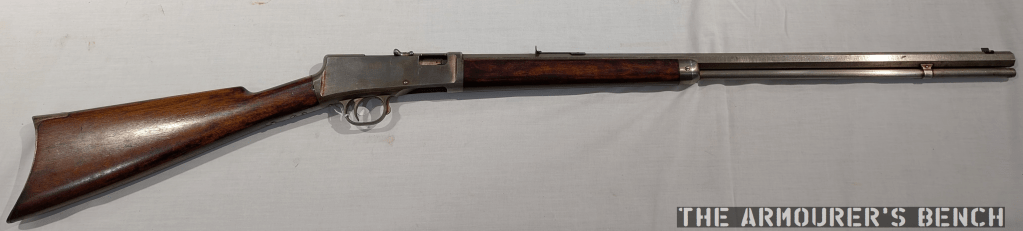
Right side profile of the prototype (Matthew Moss)

In the past I’ve had the pleasure of examining over a dozen of John Browning’s prototypes (some videos are already published on the channel others will be published in the future – stay tuned), this rifle, however, isn’t a Browning. It’s a Mason.

William Mason is probably best known as the man behind the Colt Single Action Army, the Model 1877 and what would become the Model 1889. In 1882, Mason left Colt and joined Winchester. While originally he has been recruited to work on revolvers for Winchester, a topic for another day, he became Winchester’s Master Mechanic and was responsible for bringing many of John Browning’s designs to production. Following the Brownings’ schism with Winchester in 1903, the company continued to develop their own designs and a number of these came from Mason.
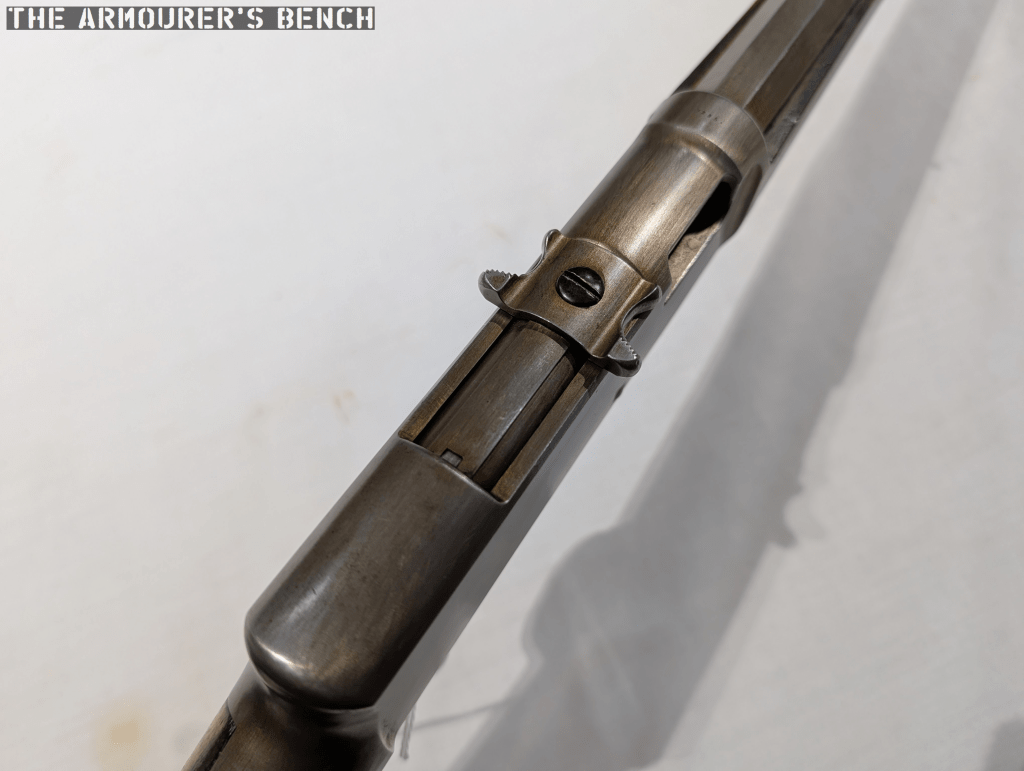
Rear right quarter view of the prototype’s receiver and charging handle (Matthew Moss)

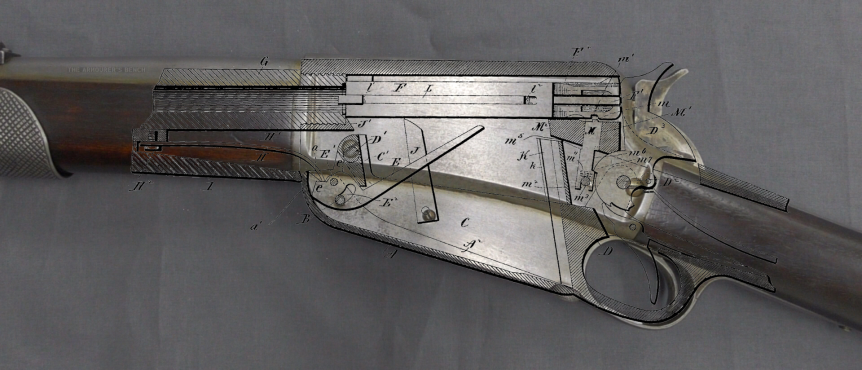
This rifle’s patent was filed in March 1905, and granted on 12 March, 1907 as No.846,591. It is a .22 calibre, semi-automatic rifle which feeds from a conventional tube magazine but has a number of interesting features.
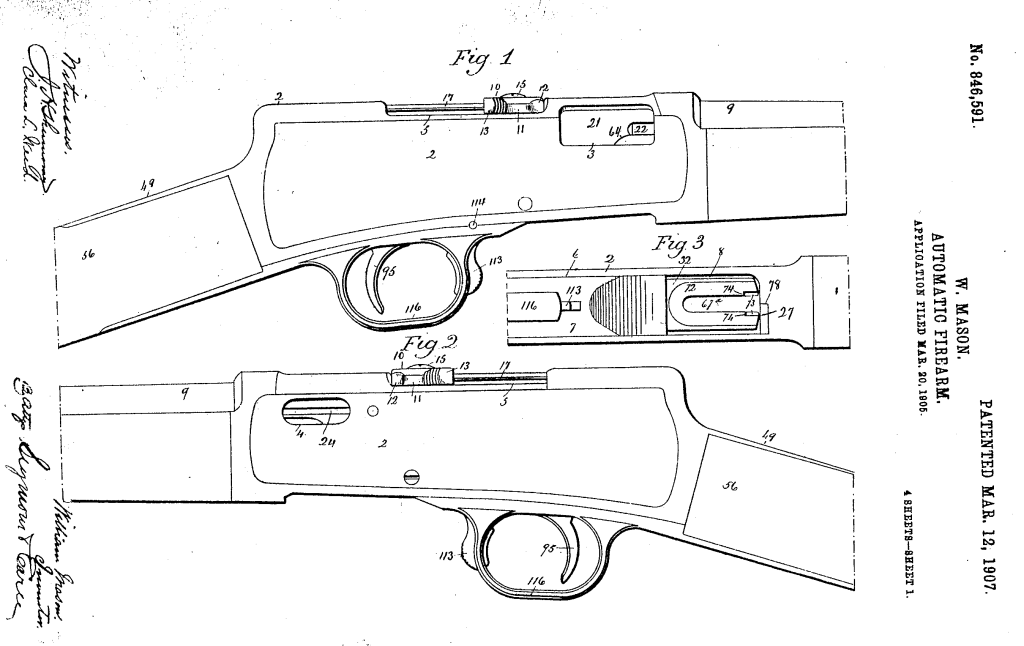
US Patent No.846,591

The Action

Mason, in his patent for the rifle, describes the weapon’s action as a ‘automatic balanced breech-block gun’, by which he means what we now know as a blowback. He describes this as: “a breech-block which is not positively locked in its closed and recoil-taking position but weighted with reference to the energy developed by the explosion of the cartridge to be used in the gun, so that its inertia takes the initial shock of recoil.”

The only marking visible on the firearm is on the top of the receiver, a number marking: ‘7295’.
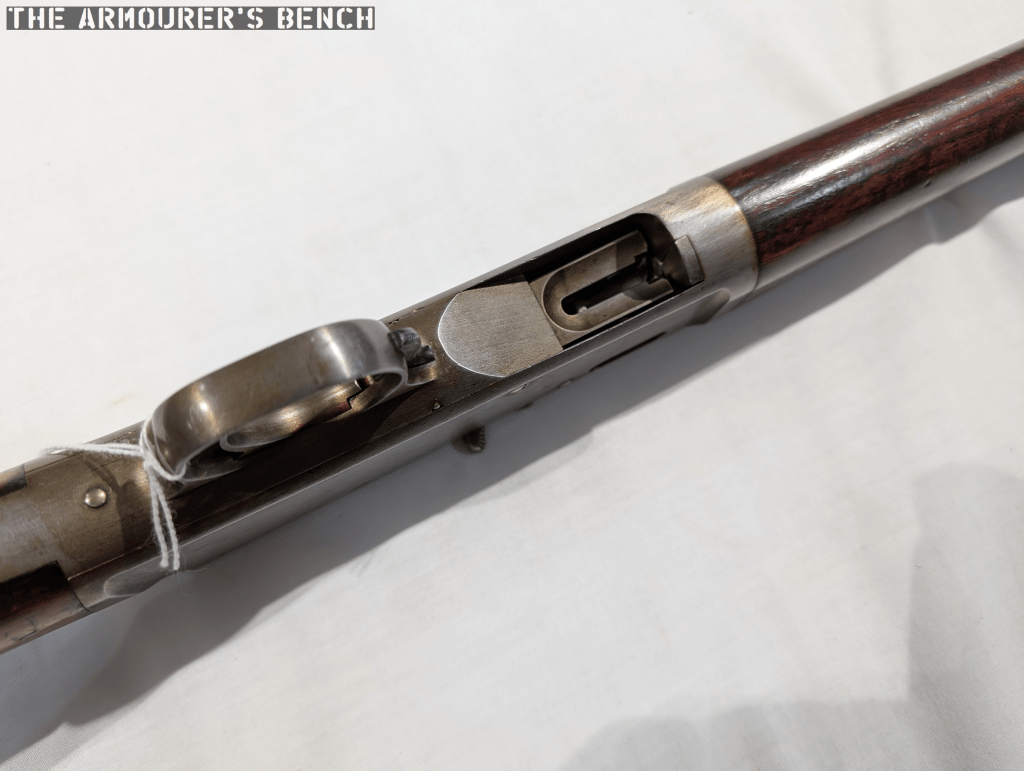
View of the underside of the prototype’s receiver and loading port (Matthew Moss)

Safety

The rifle also has a trigger locking safety located at the front of the trigger guard. The patent describes this:

“provide the gun with a ‘safety’ in the form of a lever, suspended by its upper end from a pivot in the lower tang and having its lower end entered into a slot in the forward reach of the trigger-guard, which is a part of the said lower tang. The said lever is formed with a stop-shoulder, co-acting with a stop-finger at the forward end of the trigger. When the safety is pushed rearwardly, its shoulder is moved under the finger, whereby the trigger is locked against operation under any circumstances.”
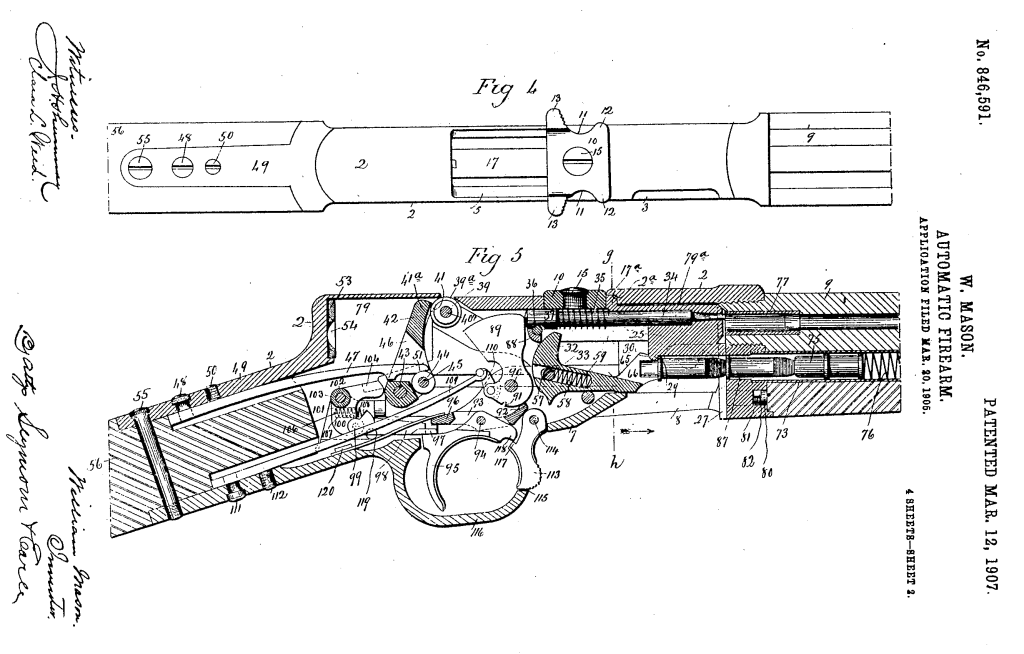
US Patent No.846,591

Loading

The rifle has a swinging carrier which when the breech block cycles it acts on what Mason calls the ‘carrier arm’ via a cam which moves the arm up and down allowing a round to move into the action from the tube magazine when the bolt had moved sufficiently to the rear. The rifle’s tube magazine is loaded by pushing the carrier up and thumbing cartridges into the magazine.

Anti-friction Rollers

Another intriguing feature of the rifle’s action is the set of rollers located in the top of the breech block which prevent friction from the block against the receiver. The rollers also act on a lever which is under spring tension which returns the breech block forward – Mason used this in the place of a more conventional return spring assembly. Instead the lever is acted on by a flat spring which Mason felt allowed him to “secure a marked economy of space” in the receiver, not requiring a coil spring and the space needed to compress it. Additionally, at the rear of the receiver there is also a buffer made from ‘vulcanised fiber’, vulcanisation is a process which strengthens and improves the durability of a material. As we didn’t fully disassemble the rifle we can’t confirm the buffers presence in the prototype.
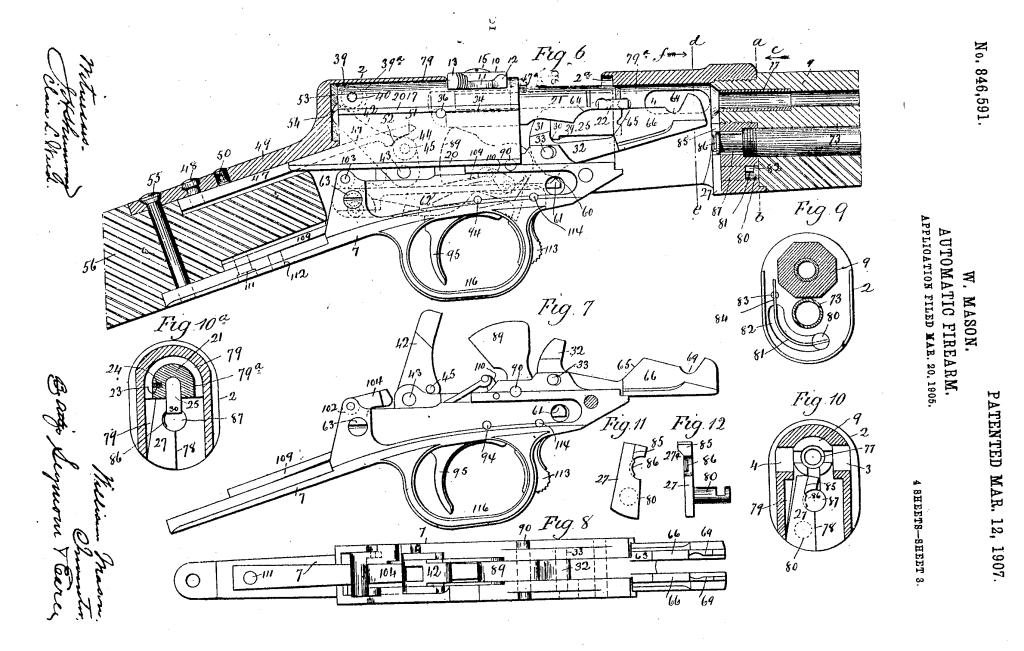
US Patent No.846,591

Mystery Hole

On examining the rifle I was a bit perplexed by what the purpose for a smaller hole opposite the ejection port was. It is too small to be an ejection port and on the same side as the ejector{?} On reading Mason’s patent it became clear that this was an emergency gas port to allow gas to escape the receiver in the event of a major failure. Mason explains this:

“gas-escape opening is so constructed and arranged with reference to the construction and arrangement of the breech-block that it permits the escape of gas through it when the breech-block is in its closed position, so that in case there should be a leakage of gas due, for instance, to the splitting of the head of a cartridge the gas will work back and escape through the said opening without damage to the gun, whereas in the absence of such a gas-escape opening, the breech-block might be broken or deformed by the force of the gas bending it from left to right toward the ejection-opening.”
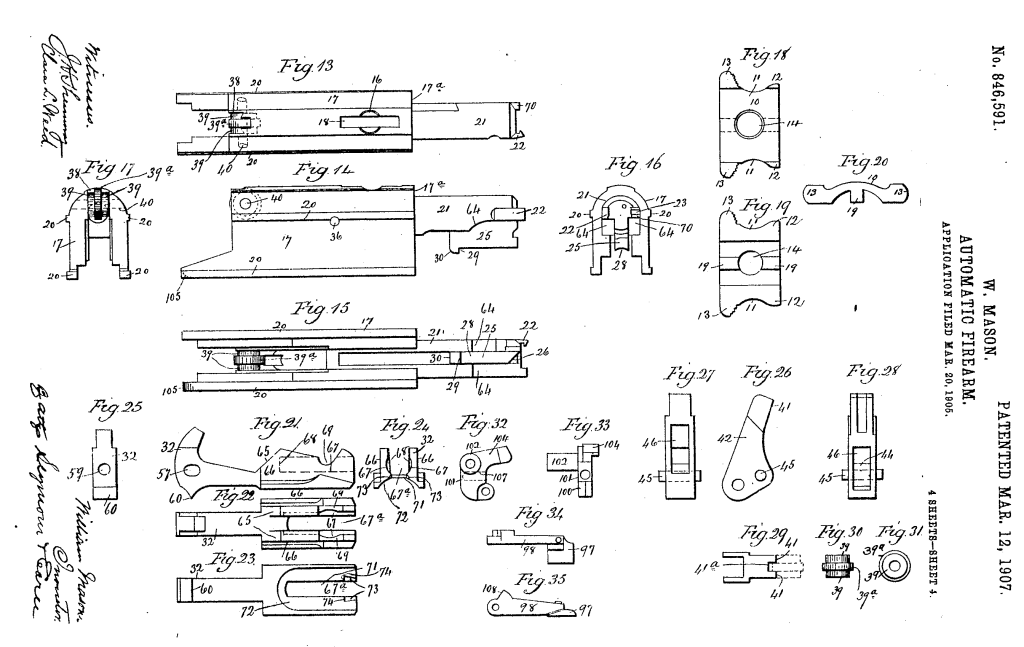
US Patent No.846,591

Charging Handle

Perhaps the most intriguing external feature is the charging handle. Is it the first rifle with a T-shaped charging handle? Here’s how Mason’s patent describes it:

“breech-block handle arranged transversely with respect to the top of the gun-frame and in length exceeding the width thereof. The ends of this handle are formed with finger-cuts, flanked at their forward ends by ears and at their rear ends by knurled, or roughened fingers, extending outwardly beyond the planes of the side walls of the frame, so as to be readily engaged by the finger and thumb, respectively. The said handle is also formed with a centrally-arranged screw-hole, receiving a screw, entering a screw-hole in the forward end of a longitudinally-reciprocating non-rotatable balanced breech-block.”
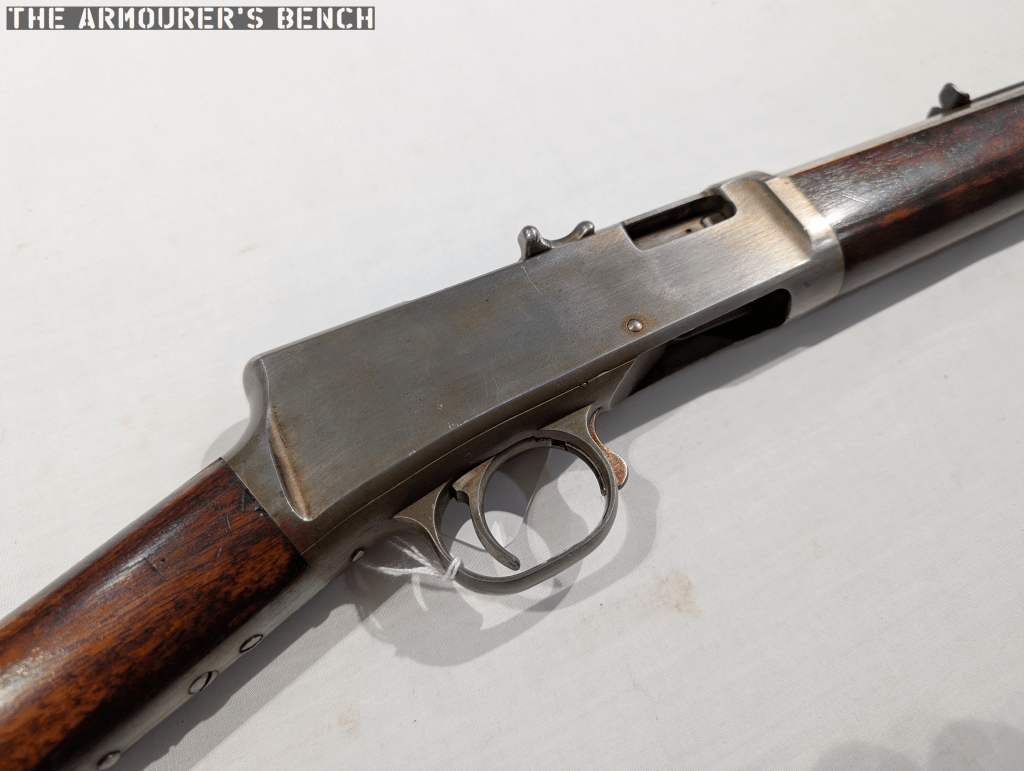
View of the prototype’s receiver (Matthew Moss)

All-in-all it’s a really interesting patent and well worth a read to understand some of the nuances I don’t have time to cover here.

Despite the prototype’s interesting design it never made it into production. In 1903, Winchester had introduced the Model 1903, a tube magazine-fed, blowback rifle, chambered in .22 Winchester Automatic. The Model 1903 was designed by another of Winchester’s engineers, T.C. Johnson, and instead of a T-shaped charger used a plunger, which I think is a little less elegant but the Model 1903 was a success, remaining in production for decades, so it seems that Mason’s design wasn’t needed. As a result it would be another 60 years before a rifle using a T-shaped charging handle became popular in the US. Mason continued to work for Winchester until his death in July 1913, aged 76.

Massive thanks to my good friends at the Cody Firearms Museum for allowing me to examine this rifle and thank you to my friend Tyler Berger for his help filming this video. Please do check out the museum online at centerofthewest.org/our-museums/firearms/ and if you can head out there this summer to visit one of the best publicly displayed collections of firearms in the world.


Support Us: If you enjoyed this video and article please consider supporting our work here. We have some great perks available for Patreon Supporters – including early access to custom stickers and early access to videos! You can also find us on the History of Weapons & War app. Thank you for your support!

The Hammerless 1911

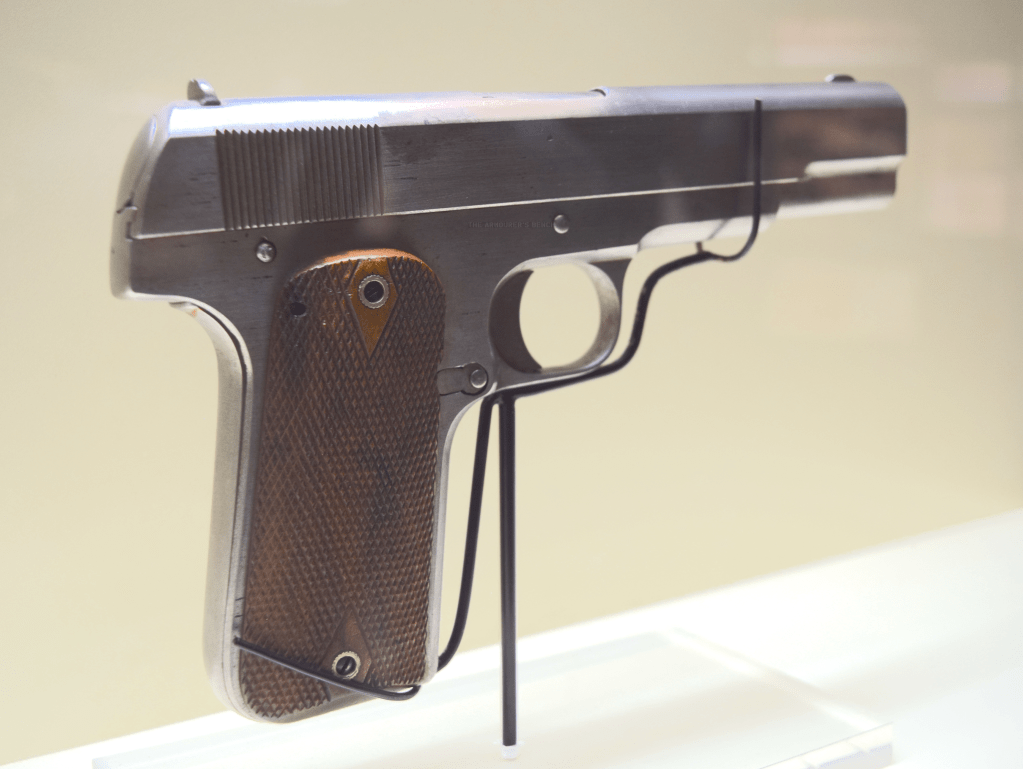
Ever since I picked up a copy of John Browning and Curt Gentry’s 1964 biography of John M. Browning I’ve been fascinated by this hammerless .45 calibre pistol, one of Browning’s prototypes for the US Army’s semi-automatic pistol trials.

The Browning .45 calibre pistol prototype with a shrouded hammer (Matthew Moss)

Last year I had the opportunity to visit the John M. Browning Museum in Ogden, Utah and I was thrilled to see the ‘hammerless’ prototype on display. Very little has been written about the development of this particular pistol with Browning and Gentry explaining that during the US Army’s long process to select a new service pistol John Browning decided to provide two versions of his .45 ACP pistol – one with an exposed hammer and the other with a shrouded hammer similar to that seen on his Colt 1903 and 1908 Pocket Hammerless commercial pistols. 

The ‘hammerless’ pistol is identical in operation to the exposed hammer prototype which was eventually selected as the M1911. It uses the same improved tilting barrel action which is covered by the patent filed in February 1910, US #984,519. The slide and frame profiles of the ‘hammerless’ pistol have been reshaped with the slide extending back further shrouding the hammer while the rear of the frame projects back, lining up with the rear of the slide rather than forming a beavertail. The pistol grip angle, at near 90-degree, is more akin to the Colt Pocket Hammerless and earlier Colt-Browning semi-automatic pistols.

The Browning-Gentry book lists the pistol as 8 inches in length overall with a 3.75-inch barrel and a weight of 2lbs 4oz. The pistol has a grip safety and a frame-mounted safety and a push-button magazine release on the left side of the frame. Sadly the pistol was behind glass and with time short we couldn’t get a better look at the gun. 

The Browning .45 calibre pistol prototype with shrouded hammer on display at the Browning Museum (Matthew Moss)

The chronology of the various prototypes’ development is sometimes difficult to track as Browning’s hands-on style left few written descriptions of the designs as they evolved. The museum dates the pistol to 1905 but displays it alongside the pattern of pistol often referred to as the Model 1910. Interestingly, the ‘hammerless’ pistol also has the frame-mounted safety which was reportedly added late in the refinement of the 1910 pistols. The ‘hammerless 1911’ was never commercially marketed by Colt and the exposed hammer .45 ACP pistol went on to win the US military pistol trials and became an iconic design. 

Huge thanks to the Browning Museum in Ogden for allowing us to film in their collection – we have some really exciting videos from the museum coming up. 


Support Us: If you enjoyed this video and article please consider supporting our work here. We have some great perks available for Patreon Supporters – including early access to custom stickers and early access to videos! Thank you for your support!


Bibliography

John M. Browning: American Gunmaker, J. Browning C. Gentry (1987)

The Guns of John Browning, N. Gorenstein, (2021)

Handguns of the World, E.C. Ezell (1981)

‘Rarest of the rare: Browning 1910 & Hammerless .45’, American Handgunner, (source)

Rare Prototype Spotted In Action: MCEM-2

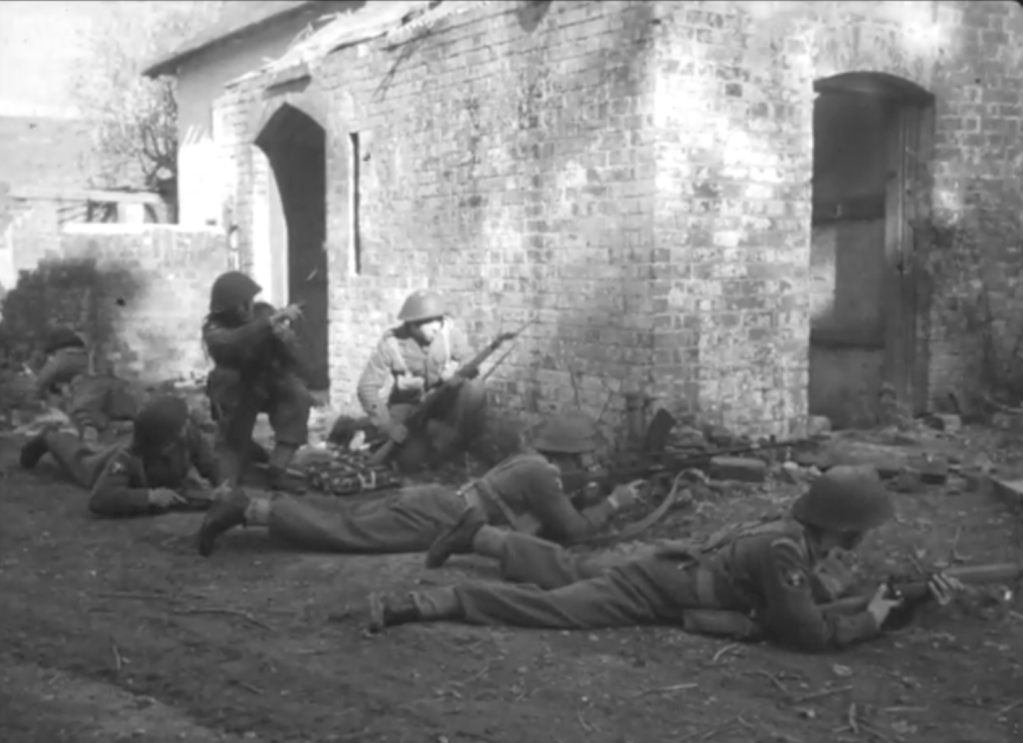
Recently, while looking though British Army Cold War training films, I stumbled upon something I never expected to see: a clip of an MCEM-2 firing! I was searching through British Cold War training films and watching a 1953 film titled ‘Village Clearing’ at first it seemed pretty standard fair albeit showing an impressive set-piece of tanks attacking a village. And then about 8 minutes in I spotted something unusual, the prototype MCEM-2, in the hands of one of the village’s defenders.

A screen capture of the MCEM-2 from ‘Village Clearing’, © IWM DRA 1078, (source)

The 1953 training film shows a company size attack by the Royal Welch Fusiliers on an enemy strongpoint but then shows a section/squad assault on a building. The opposing force or OPFORCE are wearing airborne HSAT helmets and are armed with American weapons including M1 Garands, some first pattern M1918 BARs and a lone MCEM-2! This was likely done to differentiate the British troops from the OPFORCE – either they wanted a generic look or didn’t have any soviet weapons or kit available as is seen in later training films. My guess would be that the prototype may have come from the British Army’s Small Arms School Corps Collection which has historically maintained a working collection of foreign, historic and prototype weapons for familiarisation and training purposes.

A screen capture from ‘Village Clearing’ showing a section of Fusiliers preparing to attack, © IWM DRA 1078, (source)

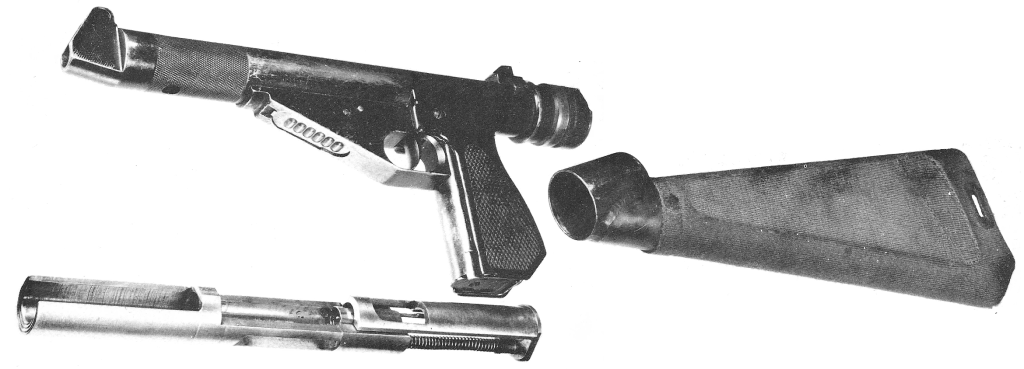
The MCEM-2 or Machine Carbine, Experimental Model No.2 was developed by a Polish engineer, Jerzy Podsedkowski. Work on the design began in 1944 but it was not seriously tested until after the end of the war. We can see from this brief clip that Podsedkowski’s design was small, compact and innovative. It fed from an 18 round magazine which like the later Uzi, Sa.23 and RAK Pm.63 was inserted into the pistol grip. While this kept the weapon compact and theoretically holster-able the MCEM-2’s high rate of fire, around 1,000 rounds per minute, meant that it was expended extremely rapidly. 

The MCEM-2 disassembled (via Firearms.96.lt)

The MCEM-2 (Machine Carbine Experimental Model No.2) was a small, compact, innovative design. The weapon had a holster stock and a wrap-around breech block which was inclosed in a tube metal receiver. We can see the bolt in this photograph. In 1946 Podsedkowski, assisted by another Polish engineer, Aleksander Ichnatowicz, improved the MCEM-2, seeking to slow its rate of fire with a heavier bolt. The MCEM-2 was tested at the Royal Navy’s Gunnery School at HMS Excellent in August 1946. Excellent’s Commandant Michael Le Fanu, later an admiral and First Sea Lord, noted in his report that it was a “well engineered weapon, handy to carry about and suitable for use by seamen” but did note that “the high rate of fire makes the weapon uncontrollable in automatic and dangerous in the hand of semi-skilled users.”

Despite improvements the new MCEM-6 was eventually rejected with a Harold Turpin design favoured before it too was rejected. Hopefully, we’ll be able to take a look at some of these designs upclose in future articles/videos. 

My thanks to Firearms.96.it for their assistance.


If you enjoyed this video and article please consider supporting our work here. We have some great perks available for Patreon Supporters – including custom stickers and early access to videos! Thank you for your support!


Sources:

‘Village Clearing’, IWM, (source)

MCEM-2, Firearms.96.lt, (source)

MCEM-2, Historical Firearms, (source)

John Browning’s Forgotten Rifle Prototypes

Over the past year we’ve looked at a number of John Moses Browning’s lesser known rifle prototypes. Each offers something innovative, a detachable box magazine, a slide action and an en bloc loading system. These prototype rifles are unique and likely the only ones of their type in existence. The prototypes were originally sold to the Winchester Repeating Arms Company, but like many of the arms Browning sold to the company they never went into production.

Browning’s 1895 slide action prototype (Matthew Moss)

Winchester bought the designs from Browning simply to prevent their competitors from getting their hands on them – as a result they are largely forgotten. The rifles became part of the Winchester factory collection and today they are all held at the Cody Firearms Museum at the Buffalo Bill Center of the West – we appreciate their assistance and kindness in allowing us to examine them.

Browning’s Detachable Box Magazine Lever Action Rifle

In 1891, Browning designed a new rifle that fed not from a tube magazine but from a detachable box magazine. Box magazines were a relatively new concept with James Paris Lee leading the field. This one-of-a-kind Browning toolroom prototype uses the same locking mechanism as the Winchester 1886 and is in ‘musket’ configuration.

Browning’s 1892 En Bloc Lever-Action Prototype

This fascinating rare prototype uses a conventional lever-action but departs from Browning’s earlier designs for Winchester. Instead it feeds from a 5-round en bloc clip rather than a tube magazine. The rifle is in a military – ‘musket’ configuration suggesting it was designed for the military market.

Browning’s 1895 Slide Action Rifle Prototype

This final design was patented in 1895, it uses a slide action and like the other designs was purchased by Winchester but never manufactured. Instead, Winchester went with the iconic lever-action Model 1895. This rifle has an integral box magazine which was loaded from below.


If you enjoyed these videos and this article please consider supporting our work here. We have some great perks available for Patreon Supporters. You can also support us via one-time donations here. Thank you for your support!


Centrifugal Machine Guns

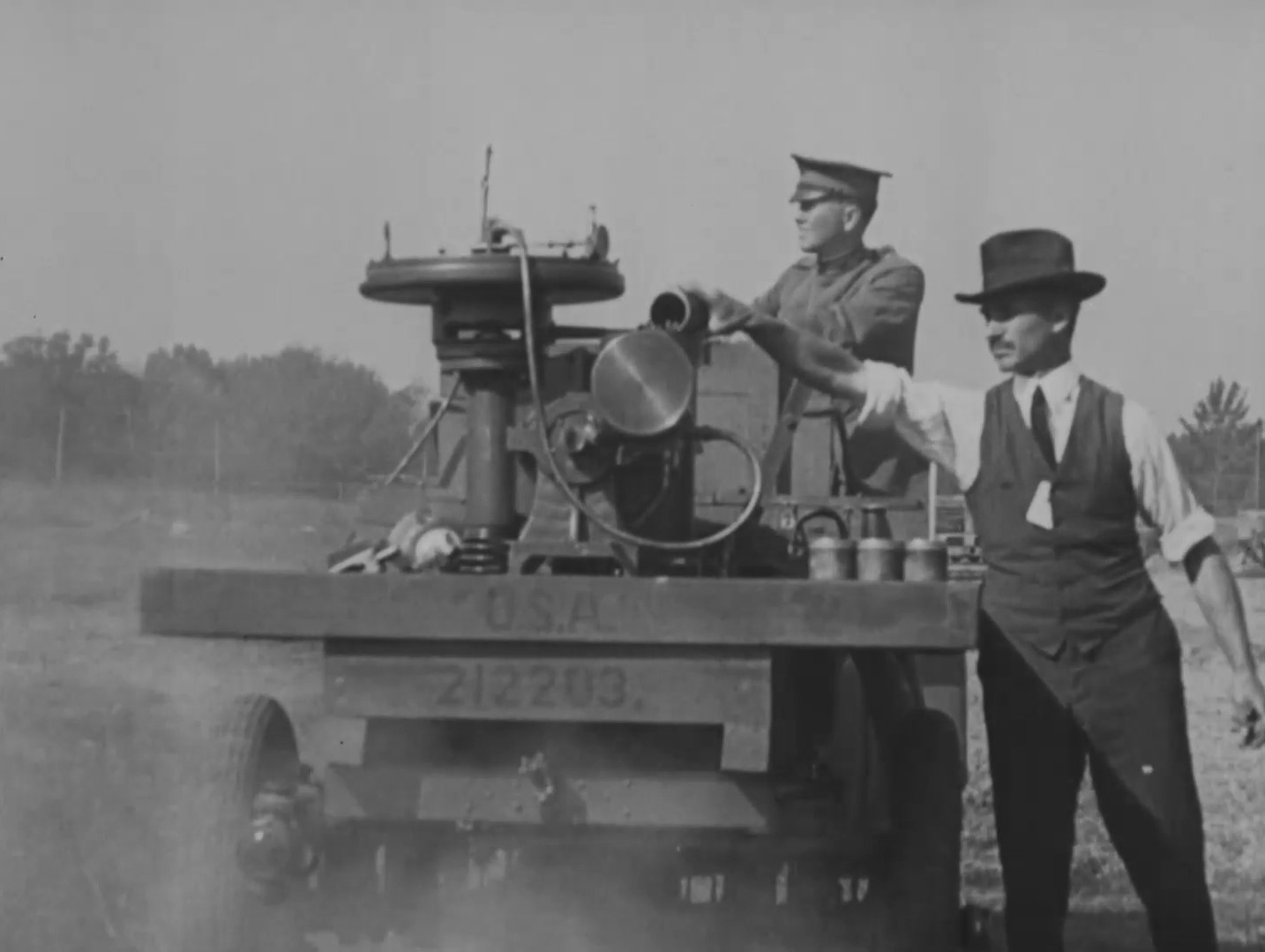
Today, we’re going to take a look at a little known type of weapon which rose to prominence in around the time of the First World War with a number of examples being developed and some even tested. As you can see from this footage it’s something pretty unconventional, seen here mounted on the back of a truck – is a centrifugal machine gun.

I found this short footage while doing some digging through the online catalogue of the US National Archives. The centrifugal machine gun was not a new concept by the time this footage was filmed in the early 1920s, sadly the footage notes done give an exact date.

Centrifugal Machine Gun   111-h-1246-r1_HD_2Mbps_Trim_Moment - Copy.jpg

A still from footage of the demonstration (US National Archives)

While the technology had risen to a new prominence what was the allure of centrifugal machine guns? The principle of centrifugal force – an inertial force which appears to act on objects moving in a circular path, directs them away from the axis of rotation. As a result a centrifugal machine gun required no propellant powder to propel the projectile, or a case to contain it, nor a conventional rifled barrel to stabilise the projectile. Once released from the axis of rotation the projectile travels on a linear trajectory until it expends its energy. It works along the same principle as a primitive sling. The primary issue is providing power to exert the centrifugal force and a means of accurately firing the projectiles.

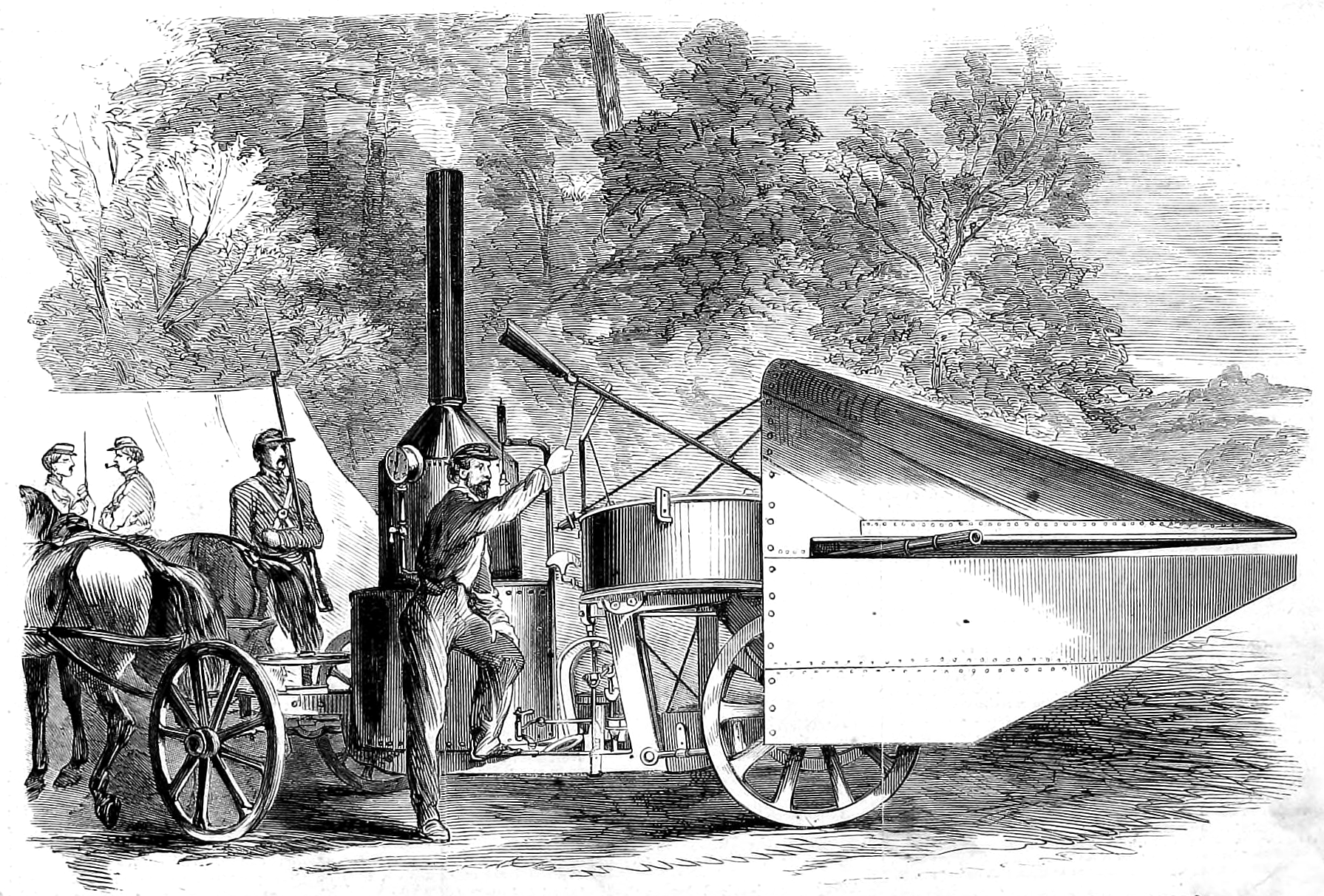
Some of the earliest work on centrifugal guns was done in the late 1850s in the US. The hand-crank or steam powered guns patented by William Joslin (US #24,031), C.B. Thayer patent for a ‘machine gun’ in August 1858 (US #21,109) and Charles S. Dickinson (US# 24,997) in 1859. Dickinson went on to secure financial backing from a wealthy Maryland industrialist Ross Winans and developed a steam powered version of his gun. Despite gaining much press attention Dickinson’s centrifugal gun saw no action during the US Civil War. In 1862 G.C. Eaton and S.W. Turner also patented a ‘machine gun’ (US #37,159).

Frank_Leslie's_Illustrated_Newspaper_-_1861-05-18_-_p1_-_Winans_Steam_Gun

An illustration of the Winans Steam Gun, Frank Leslie’s Illustrated Newspaper, May 1861

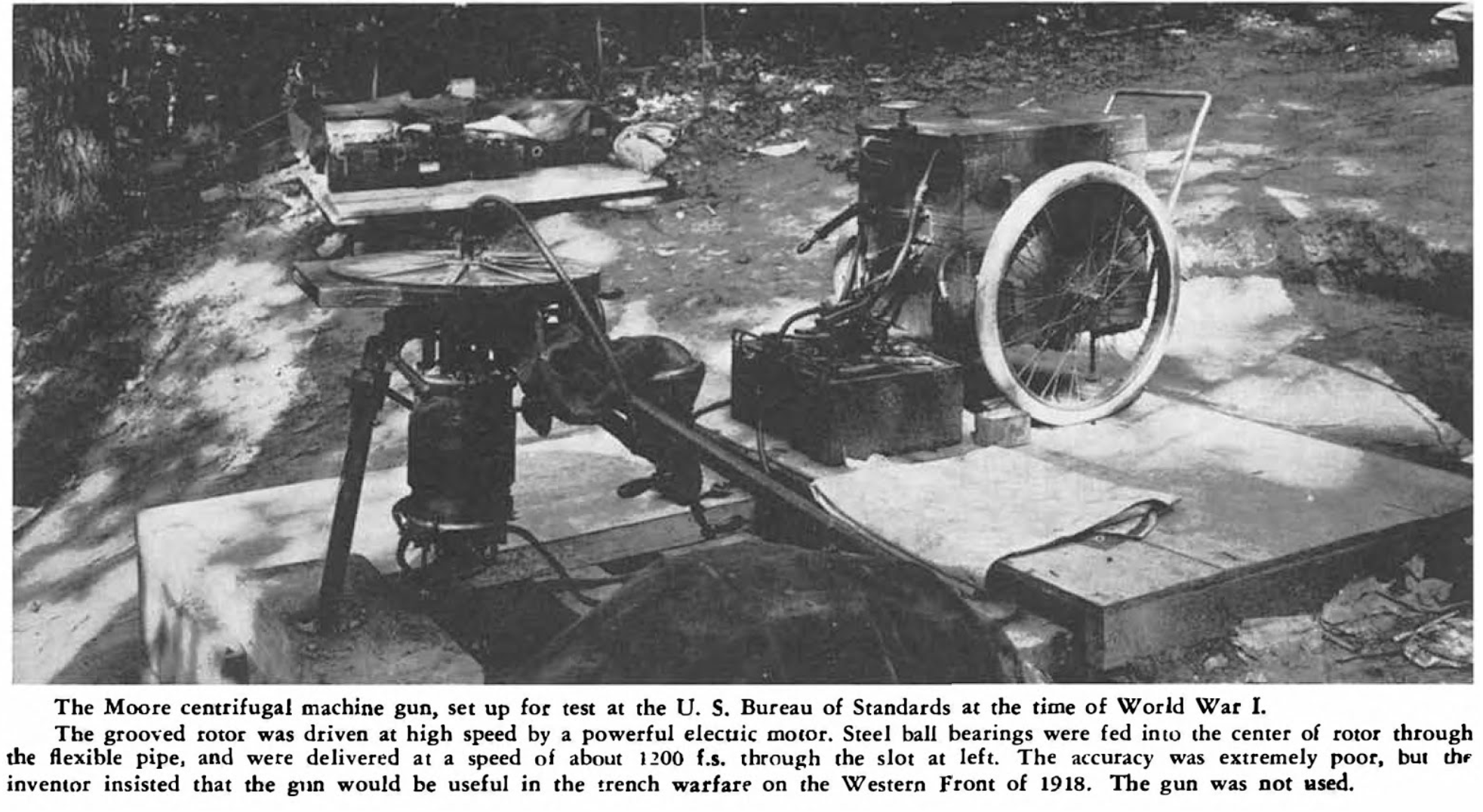
It wasn’t until World War One that the concept began to be considered again. In June 1918, Major Edward T. Moore and Saul Singer filed a patent for a centrifugal machine gun powered by an electrical motor (US #1,332,992). The motor spooled up the centrifugal barrel assembly to rotate extremely quickly and impart centrifugal force on projectiles. According to Julian Hatcher the gun could fire steel ball bearing projectiles at approximately 1,200 feet per second. Fire was controlled by a stop pin in the ammunition feed tube. Moore claimed the weapon could fire a projectile 1.5 miles with enough force to kill a man. He also suggested the weapon’s rate of fire approached 2,000 rounds per minute. It appears that Moore’s gun may have been tested in 1918 but Hatcher described its accuracy as ‘extremely poor’.

Moore Centrifugal Machine Gun from hatcher's

Photograph of Moore’s gun during testing (Hatcher)

Another centrifugal design developed during World War One was E.L. Rice’s half-inch centrifugal gun, sadly I’ve been unable to find any photographs or drawings of Rice’s design but the weapon was submitted to the US National Research Council in 1917. The NRC’s 1919 report states that the gun had been further developed by the NRC’s Physics Division in Pittsburgh but work had been slowed by “a common defect which has been difficult to eliminate”. Despite what the report described as ‘considerable headway’ the weapon was subsequently abandoned amid some controversy about credit for the design.

There seems to have been something of a centrifugal machine gun craze with several more patents filed between 1917 and 1926. A Scientific American article from March 1918, even noted that “every so often the daily press becomes enthused over a new centrifugal gun.”

US1223069-drawings-page-1

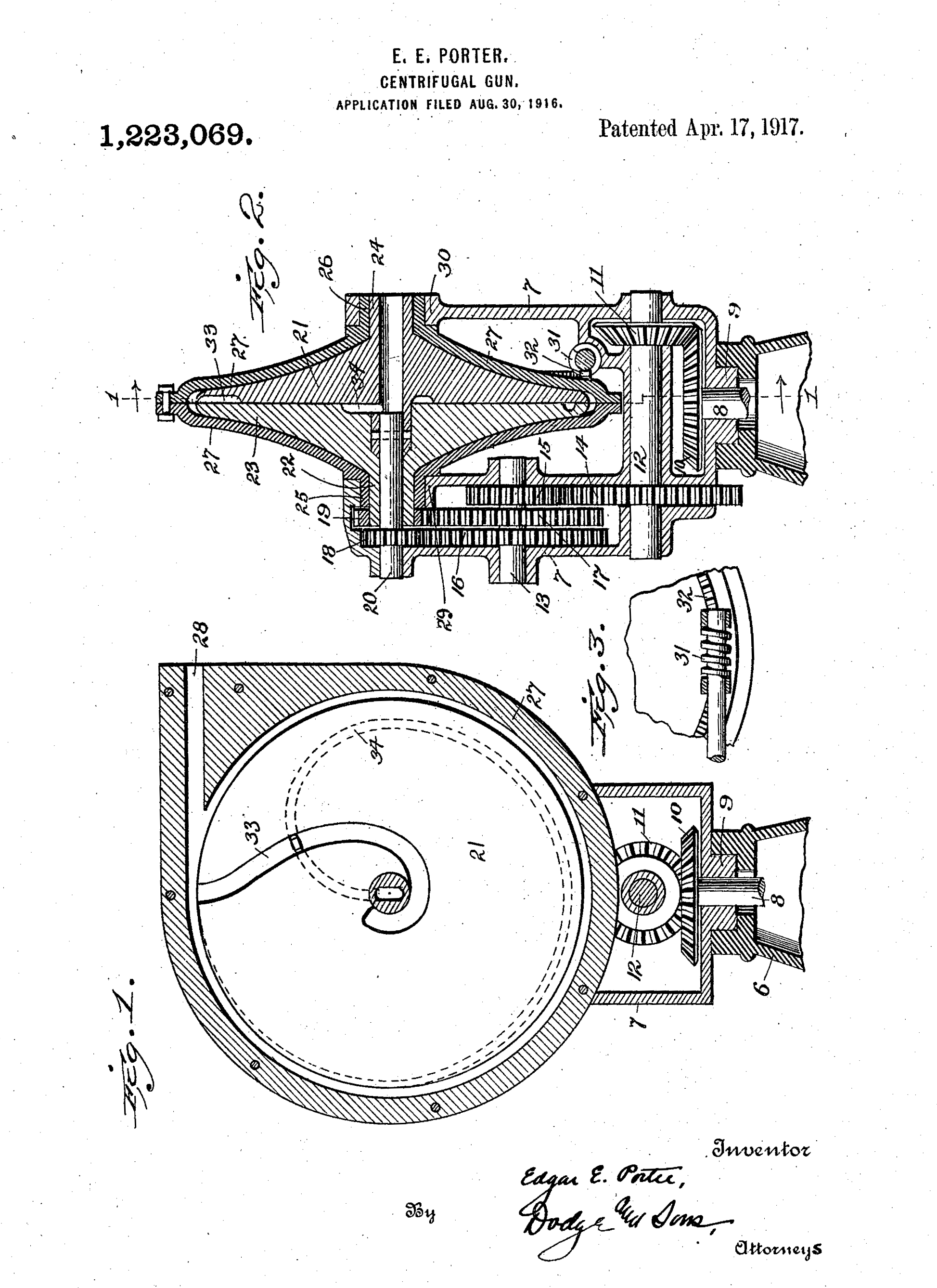
Porter’s Centrifugal Gun patent drawing (US Patent Office)

One of the earliest patents granted appear to have been for a design by E.E. Porter, granted in January 1917. This was followed in July 1919 by inventor, Herbert A. Bullard being granted a patent (US #1,311,492) on a design which fired a disc rather than a ball. At the same time T.A. Gannoe was granted a patent (US #1,309,129) for a large, complex looking gun shown mounted on a pedestal.

In 1920, F.R. Barnes (US #1,327,518) and W.W. Case (US #1,357,028) were also granted patents which had been filed in 1917. In late 1921, Levi Lombard was granted a patent he had filed in March 1918, his gun even appeared in Scientific American. It appears to be notably smaller than Moore’s gun and has a spade grip for aiming. This was followed in 1923, by an interesting patent from Joseph T. McNaier for a centrifugal gun that could be powered by an electric or petrol engine, some of the patent diagrams show how the gun might be placed in an armoured car or aeroplane (US #1,472,080). Intriguingly, McNaier and Moore appear to have known each other quite well and were partners in a law firm together.

Here’s a gallery of some of the various patents mentioned above, not all are as detailed or as advanced as others:

The question is which of these guns is featured in the footage. The most likely bets are the Moore or the Czegka. Sadly, with only a side view and just 18 seconds of footage we don’t have much to go on. The accompanying reel notes, describing what is seen in each section of the film, describes the gun as being in the “experimental stages only” and that the prototype seen here “is intended for use as aircraft armament, for tanks and for landing parties of the Front line trenches.”

Sadly, we don’t get to see how the gun works but we can see the operator feeding the ball bearing projectiles into the hopper which has a powered feed system – he empties two cylindrical containers of balls into it one after another. It is unclear how many rounds might be in the containers, perhaps 50 each. The gun and its motor are mounted on a truck bed with a soldier in uniform, possibly aiming the weapon via a tiller.

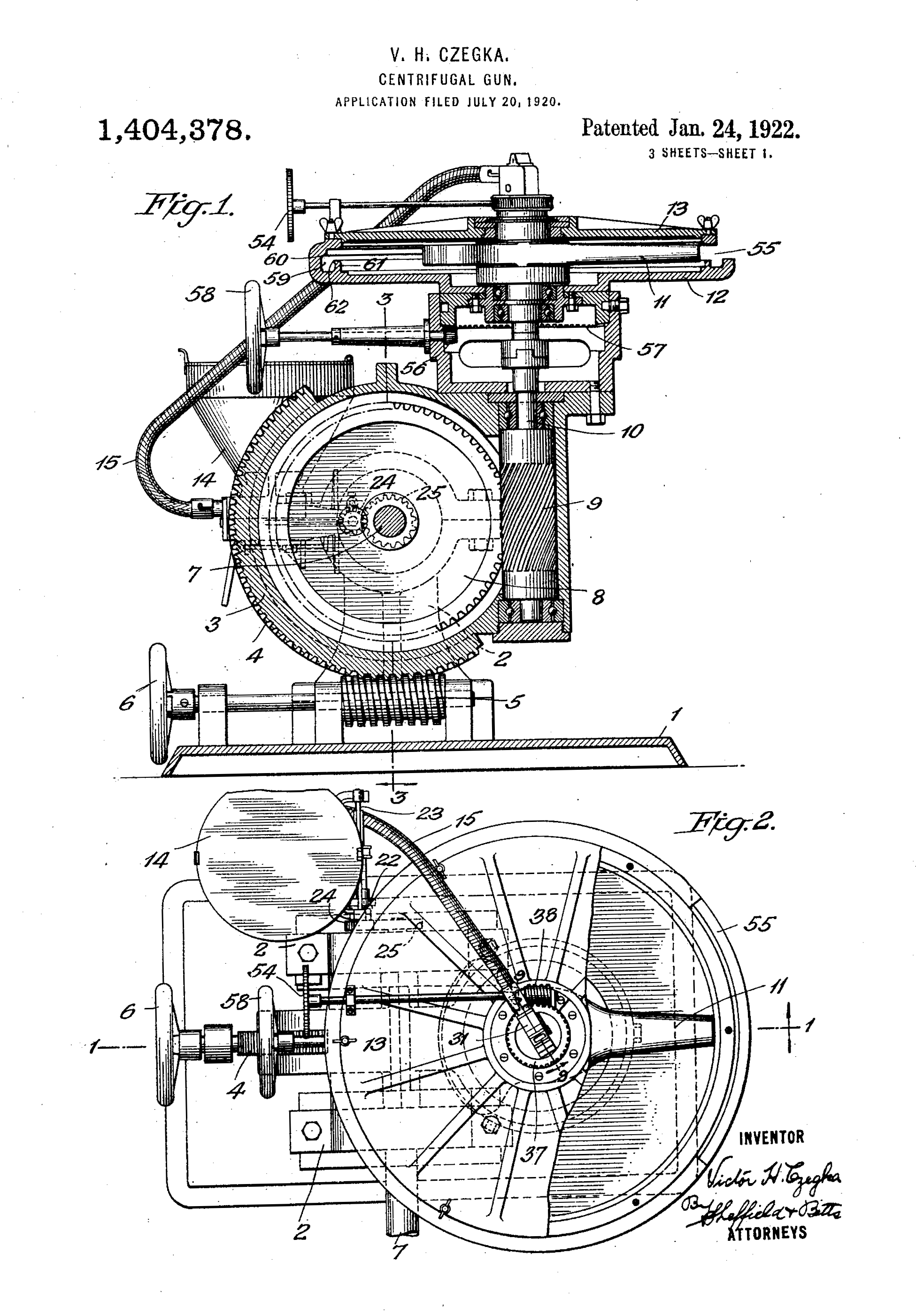
Another of the later designs dating from the period came from Victor Czegka, a US Marine Corps Technical Sergeant, who is perhaps best known as the supply officer of Admiral Richard Byrd’s first two expeditions to the Antarctic. Czegka was granted a patent for a centrifugal machine gun in January 1922 (US #1,404,378).

US1404378-drawings-page-1

Czegka’s 1922 patent (US Patent Office)

With some further digging I managed to find several articles referring to the gun in the US Army Ordnance Journal. Interestingly, a photo from the same demonstration is printed in one article, from late October 1920, with the caption confirming the man loading the weapon is the inventor, however, he isn’t named. The footage was filmed during the Second Annual Meeting of the US Army Ordnance Association. Another article dating from May 1921, also notes that the tests took place at Aberdeen Proving Ground, with the gun firing at 16,000 revolutions per minute which required 98 horsepower from the engine powering it. The gun apparently needed a “very rapid increase in power required for operation” when the speed of its revolutions was increased incrementally from 12,000 to 16,000 rpm. The article concluded that “a horsepower above 100 would have no material effect in increasing the speed” suggesting that a much more powerful, and therefore larger, engine would be needed to increase the revolution rate.

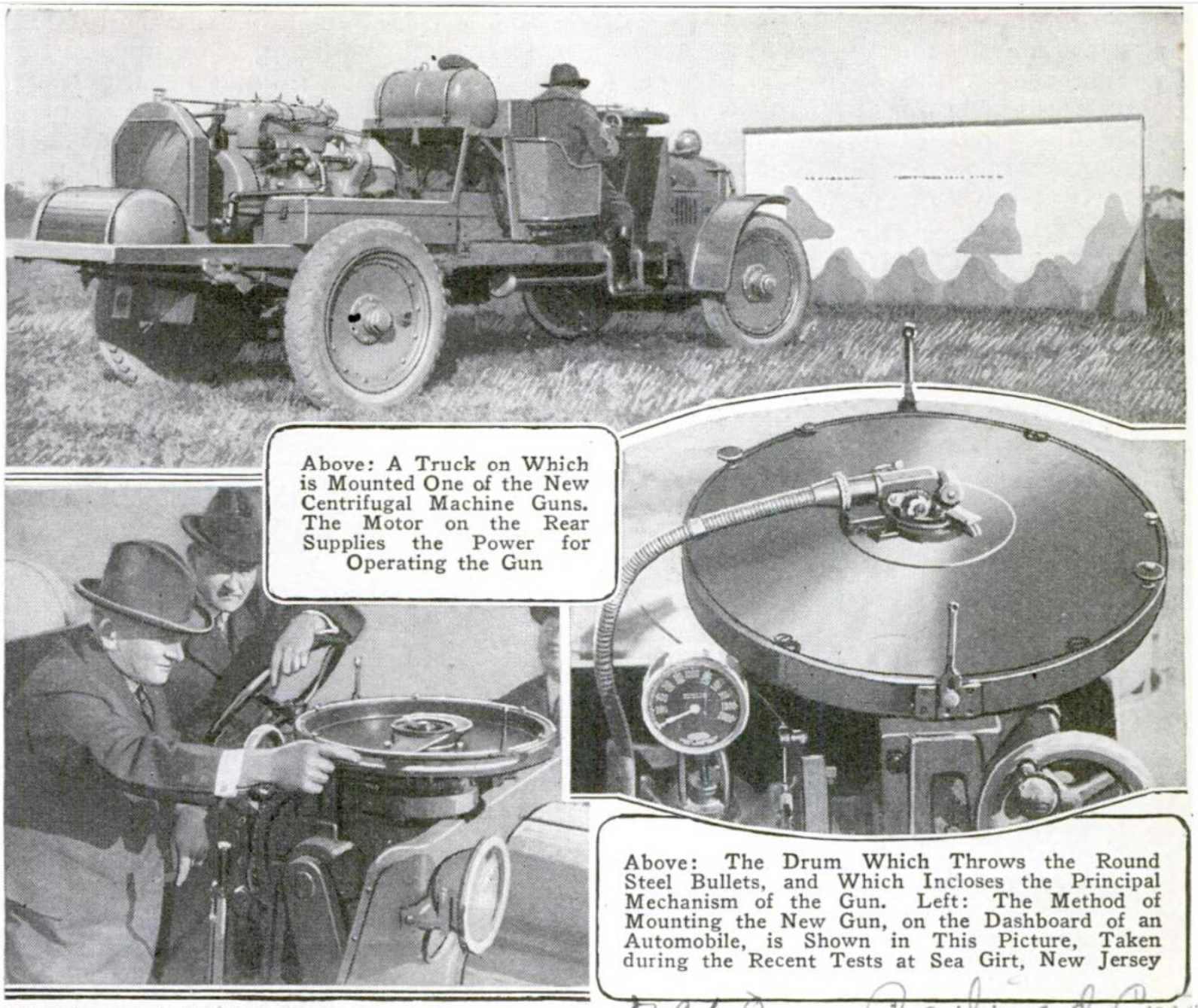
Unnamed Centrifugal Gun from 1922 Popular Mech

While researching I came across this set of images from a March 1922 edition of Popular Mechanics showing an unnamed centrifugal gun set up on a truck, powered by an engine on the truck bed. From the images it appears to be a gun similar to Moore’s with a single rotating ‘barrel’. The captions also note that the photographs were taken in New Jersey and Moore was a Major with the New Jersey National Guard, which may also indicate the gun is Moore’s.

Despite various designs seeing some US military testing none were ever adopted and relatively little information on them is available. It seems that they were relatively cumbersome weapons with extremely varying accuracy but this footage at least proves the concept. A short report in a may 1921 edition of Scientific American may shed some light, stating an unnamed gun was rejected “because of its great weight and its inability to obtain high initial velocity” concluding that “no centrifugal gun can have military value”. It appears that the range of the centrifugal guns was limited to the speed of their revolution, which in turn was limited by the power of the engine and motor that powered them. The larger the motor, the more cumbersome the weapon system was.

There are very few photos of centrifugal machine guns so stumbling across actual footage of one guns actually operating is very exciting. They are a fascinating tangent to the history of the machine gun – one that occasionally still garners interest.

Update

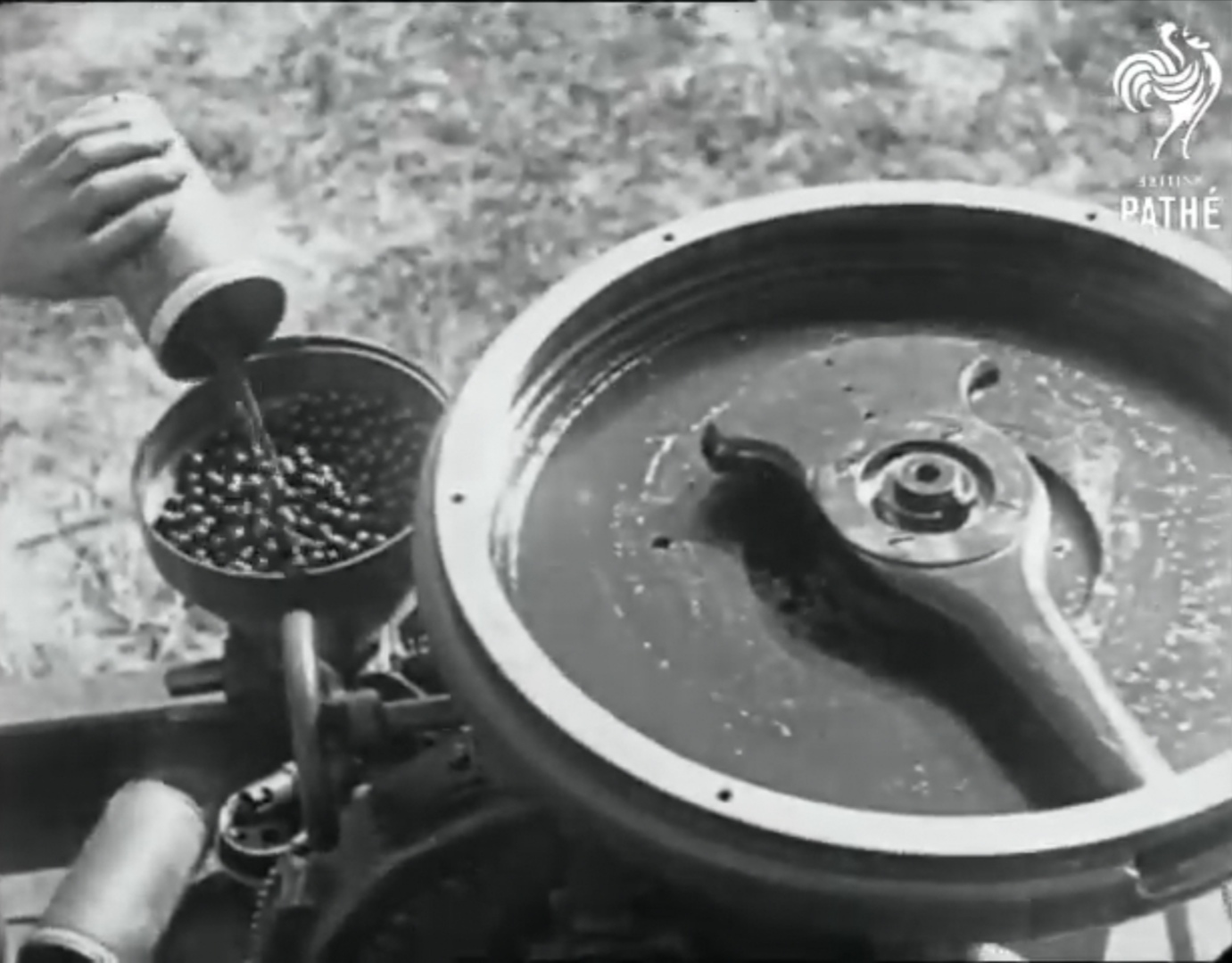
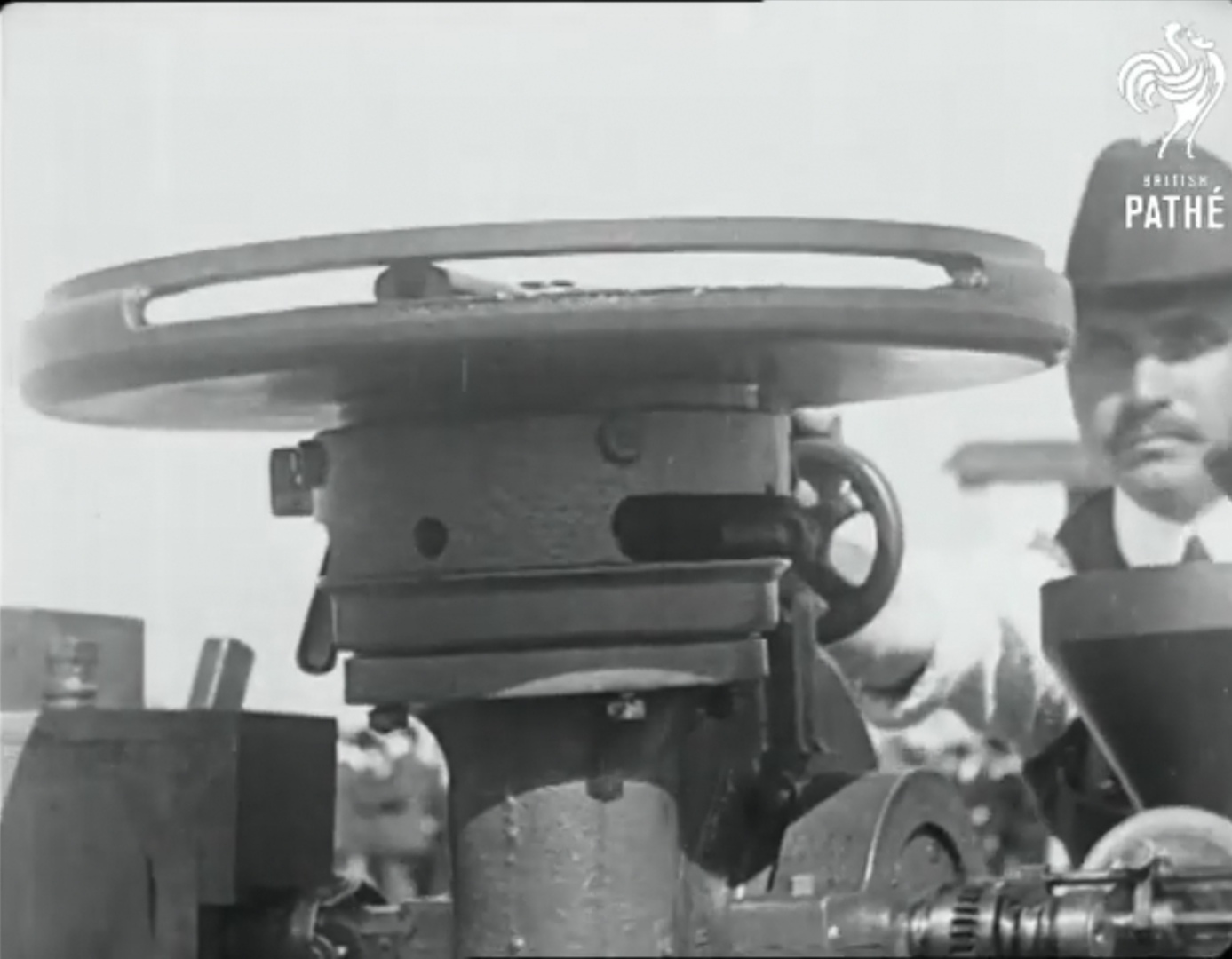
A viewer shared a Pathe Newsreel with us which included more footage from the same demonstration. The footage title suggests it dates from 1938, however, I believe this to be incorrect.

Despite the incorrect date the footage shows us the internals of the centrifugal gun and its aiming mechanism!

Here are few screen captures from the footage:

The gun’s hopper being loaded (Pathe)

A front view of the weapon, showing the slit from which projectiles fired through, and a better look at the operator’s face (Pathe)

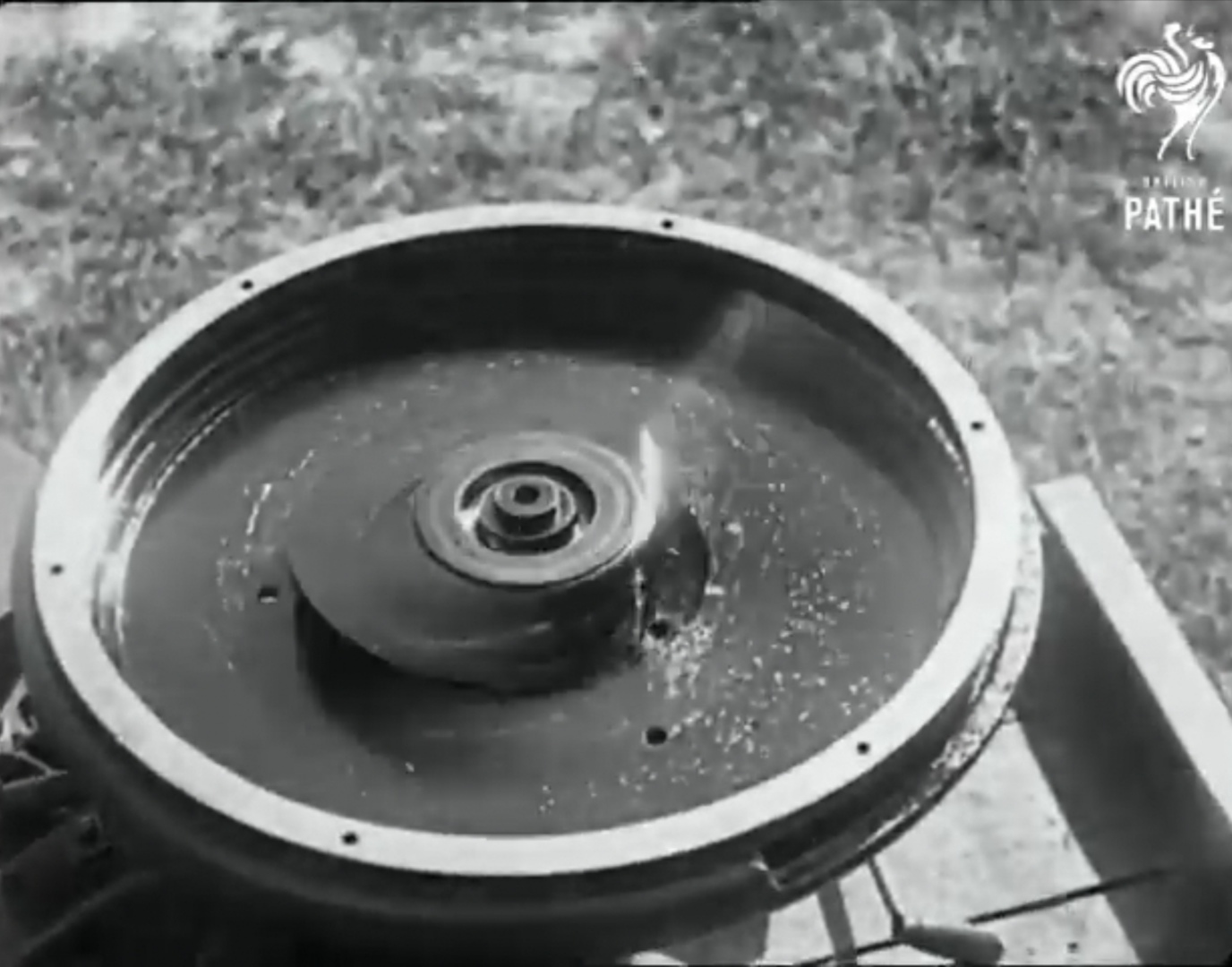
The gun with its top cover and feed system removed showing the centrifugal barrel spinning up – a info card from the footage suggests it is spinning at 12,000 rpm (Pathe)


If you enjoyed the video and this article please consider supporting our work here. We have some great perks available for Patreon Supporters.


Bibliography:

Demonstration of Ordnance Materiel at Aberdeen Proving Grounds, Maryland, 1920-26, US National Archives, (source)

Scientific American v.124, Jan-Jun 1921, (source)

Scientific American v.118, Jan-Jun 1918, (source)

Hatcher’s Notebook, J. Hatcher (1962)

Army Ordnance: The Journal of the Army Ordnance, v.1-2 (1920-1922) (source)

United States Congressional House Documents Vol.119, 1921 (source)