Heckler & Koch G41

In 1981, Heckler & Koch introduced what would be their last infantry rifle that used their tried and tested roller-delayed blowback action, the HK G41. In October 1980, following NATO’s smalls arms and ammunition testing during the late 1970s, a meeting of NATO Armament Directors, agreed to standardise to the 5.56x45mm round favoured by the United States since the mid-1960s. Standardisation Agreement (STANAG) 4172 saw NATO standardise on the Belgian/FN SS109 ball round. At the same time Draft STANAG 4179 proposed adopting US 30-round M16 magazines as the standard 5.56 magazine pattern, while this proposal wasn’t ratified the M16’s magazine became the de facto standard.

At this time Heckler & Koch were engaged in a major engineering project to develop the G11 caseless ammunition-firing individual weapon. Their main offering for the 5.56x45mm rifle market at the time was the HK33, a rechambered version of the 7.62x51mm G3 developed by Tilo Moller, which was introduced in 1965. The HK33, however, used a proprietary HK magazine and was not compatible with the M16’s magazines. In 1977, as the NATO trials began and it became clear that 5.56x45mm would be adopted, HK began to develop what would become the G41. In 1979 with initial development completed HK submitted 18 G41s for testing with the West German Army. It wasn’t until 1981 that HK introduced the G41 onto the market.
dsc_0862a
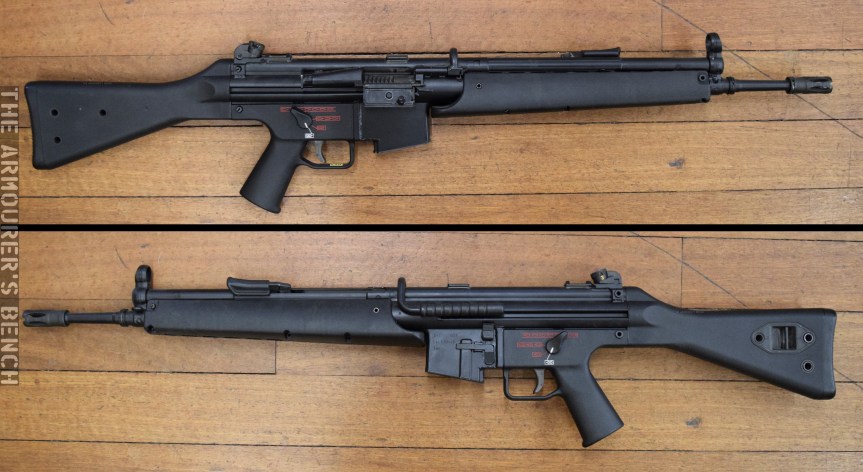
Left and right profile views of the G41 (Matthew Moss)

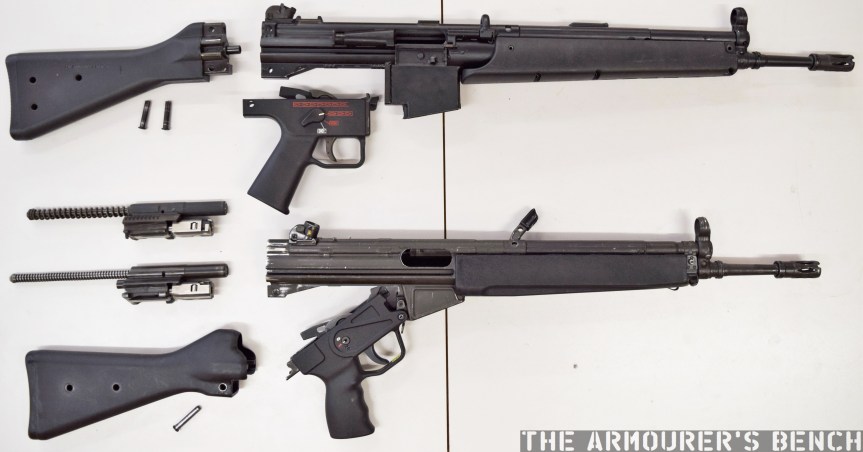
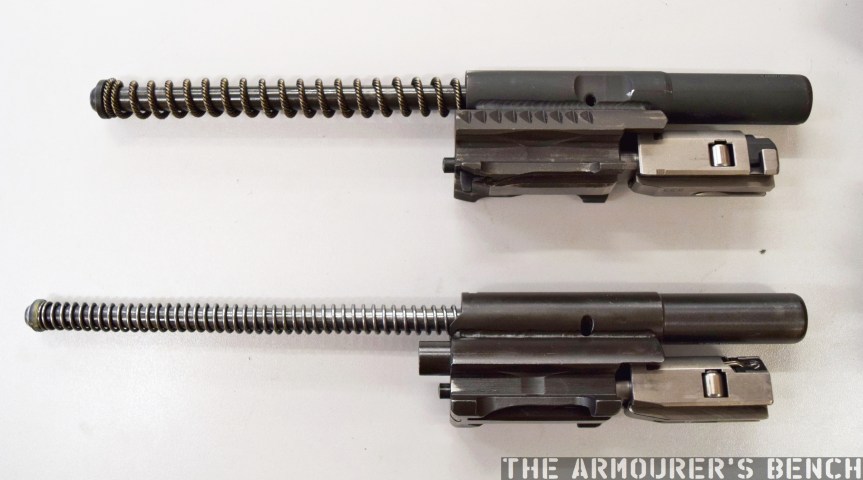
While continuing to use the same roller delayed blowback operating system as the G3, HK33 and MP5, the G41 embodied a number of improvements. While still using a stamped metal receiver it utilised 1mm thick high tensile steel rather than the 1.2mm thick steel used by the HK33. This helped to lighten the receiver. The new rifle also used a lighter bolt assembly, paired with a new recoil spring which comprised of five wound strands around a central coil, rather than a single coil, which had a longer stroke. This acted to lower the felt recoil. The G41, however, had a higher rate of fire at around 850 rounds per minute compared to the 750 rounds per minute of the HK33.  Some of the G41’s bolt geometries were reworked and a new extractor was added.

The G41’s lower receiver was redesigned to allow the rifle to feed from STANAG magazines rather than HK’s earlier proprietary magazines. The cocking lever and forward assist were taken from the HK21A1 (XM262) general purpose machine gun, developed for the US SAW trials.
dsc_0041a
HK G41 (top) and HK33 (bottom) field stripped (Matthew Moss)

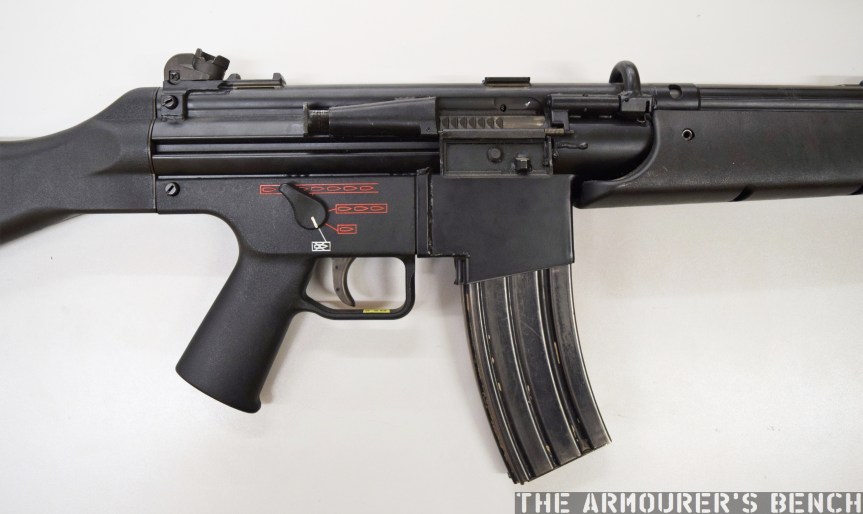
It also had a new more triangular polymer foregrip and added a plastic dust cover to the ejection port, a NATO pattern optics mount (meeting STANAG 2324) replaced HK’s claw-mount system, and a spring-loaded folding carrying handle near the centre of balance was added. Importantly it also added a last round hold open device and a bolt release catch, on the left side of the lower receiver.

The usual thumb serrations on the side of the bolt, for pushing the bolt home, were replaced by a prominent forward assist, similar to that found on the M16A1 and other HK weapons such as the HK21 light machine gun and the PSG-1 sniper rifle. HK sales literature described it as a ‘low noise’ forward assist and the manual describes the “quiet cocking of the weapon” – essentially riding the cocking handle back into battery and then pushing the forward assist to lock the action, the system is not as ‘low noise’ as advertised.
dsc_0876
Right side of the G41, note the addition of a forward assist and dust cover (Matthew Moss)

Another important feature of the rifle was the inclusion of a three-round burst setting alongside semi and fully automatic. The G41 could mount a standard G3 bayonet, fit an M16 bipod and had a flash hider designed to enable it to fire NATO standard rifle grenades. The 40mm HK79 under barrel grenade launcher could also be mounted to all variants of the G41, simply swapping it out for the polymer forend. HK referred to this set up as the G41-TGS or ‘Tactical Group Support system’.

9
Spread from a 1985 HK promotional product brochure showing the various G41 configurations (HK)

The G41 came in a number of variants with designations A1 to A3. The base rifle had a fixed buttstock and its rifling had 1 turn in 7 inches with a right-hand twist, in a 18.9 inch barrel. The A1 had a 1 in 12” twist barrel and fixed buttstock. The A2 had a collapsing, single position stock and 1 in 7” inch twist rifling, while the A3 had 1 in 12” inch twist rifling. The 1 in 7” rifling was optimised for the new SS109, while the 1 in 12” optimised for the US M193 round. There was also a shortened G41K model which had a collapsing stock and a 15 inch barrel available with both rifling types.

One of the main issues with the G41 was its weight. Despite efforts to lighten the sheet metal receiver, it weighed more than its predecessor the HK33. According to measurement data compiled by researcher Nathaniel F, unloaded the G41 weighs in at 4.31kgs or 9.5 lbs, this is a full pound heavier than the HK33. A contemporary M16A2 weighed 3.39kg or 7.5 lbs while the Spanish CETME L, a similar stamped receiver rifle chambered in 5.56×45, weighed 3.72kg or 8.2 lbs. The rifle eventually adopted by the Bundeswehr, the HK G36, weighed 3.13kg or 7.3 lbs.  The G41K with its collapsing steel stock wasn’t much lighter, weighing 4.3kg or 9.5 lbs, according to HK sales literature. Another potential issue may have been reliability with the move to the STANAG magazine rather than the optimised proprietary HK magazines may have introduced some issues.
dsc_0040
The bolts of the HK G41 (top) and HK33 (bottom), note the redesigned extractor, forward assist serrations on the bolt carrier and the G41’s thicker but shorter recoil spring (Matthew Moss)

Following NATO’s decision the early 1980s saw a large number of countries looking to replace their ageing 7.62x51mm battle rifles. Sweden began to look for a 5.56x45mm rifle to replace its licensed version of the G3, the Ak4, in the late 1970s. HK could initially only offer the HK33 but the G41, tested later, was also rejected by the Swedes in favour of FN’s FNC. Italy sought to replace the BM59 with a more modern rifle and HK entered into an agreement with Luigi Franchi which saw them offer both the original HK configuration and the develop their own, slightly modified version, the Franchi mod. 641, but the Beretta AR70/90 was selected. Similarly, in 1984 Spain decided to adopt the indigenously developed CETME L. In 1986 the HK G41 was also submitted to the Irish Army’s trials to replace the FN FAL, it was beaten by the Steyr AUG. Initially West Germany had hoped to procure up to 20,000 HK G11 rifles per year, with a total of 224,000 in service by 2003.
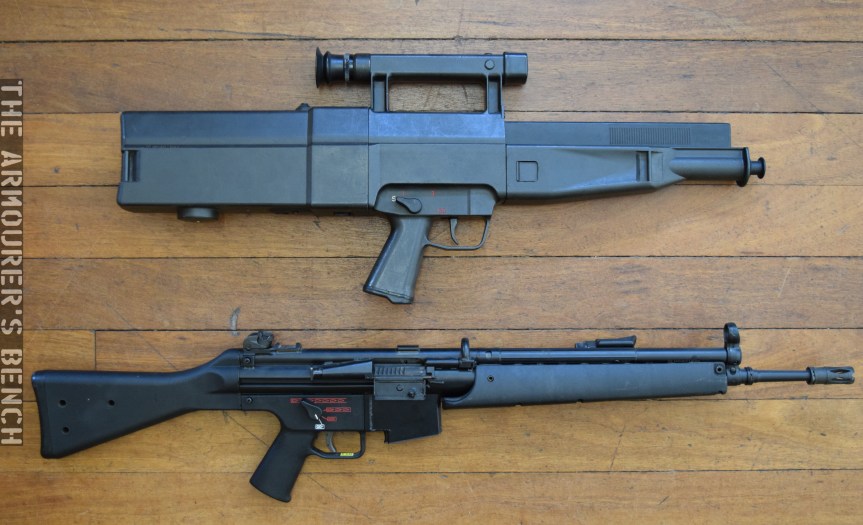
dsc_0921
HK’s G11 and G41 (Matthew Moss)

The collapse of the Soviet Union and the subsequent reunification of Germany saw Federal budgets stretched and the G11 programme was subsequently abandoned entirely. The Bundeswehr still needed a suitable rifle to replace the G3 and in the 1990s sought a lighter weight rifle. HK felt their HK50 project, in development since the mid-1970s was a better bet than the heavier G41, and following Bundeswehr trials the G36 was subsequently adopted in 1997. Sadly, I have not been able to get a hold of any of the trials reports from the nations that tested the G41, so can not say with certainty why the countries mentioned above rejected HK’s rifle.
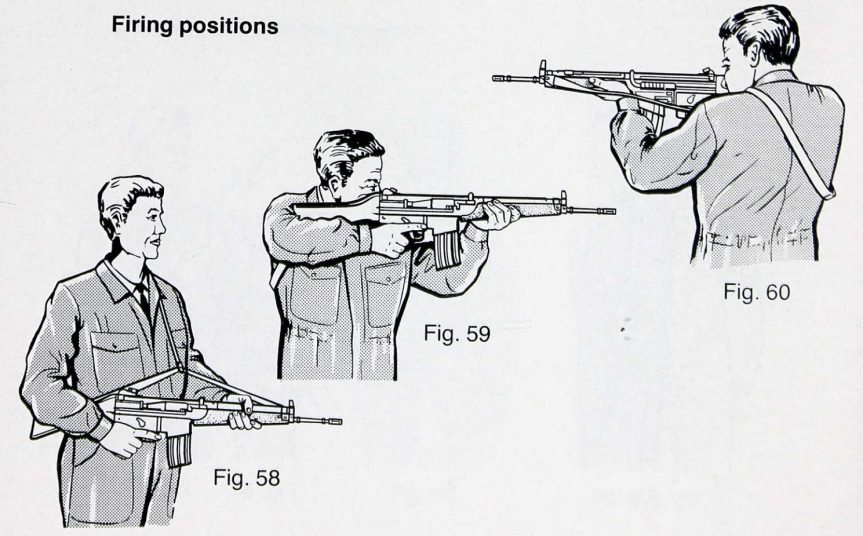
7
Graphic from HK’s manual for the G41 (HK)

From photographs of members of the Turkish Gendarmerie special operations group training at the Foça Commando School, dating from the early 2010s, it appears that Turkey either purchased a number of G41s or Turkey’s state-owned defence manufacturer, MKEK, produced an unknown number under license.At some point in the 1980s the British Army also tested a small number G41s with serial numbers #11131, #11832 and #11833 remaining in UK collections.

Denmark’s elite Jaegerkorpset and Froemandskorpset used the G41 for a time and Argentina’s special forces, including the Grupo de Operaciones Especiales, have also been photographed with both HK G41s and G41A2(collapsing stock) fitted with the TGS package comprising of the HK79 under barrel grenade launcher.
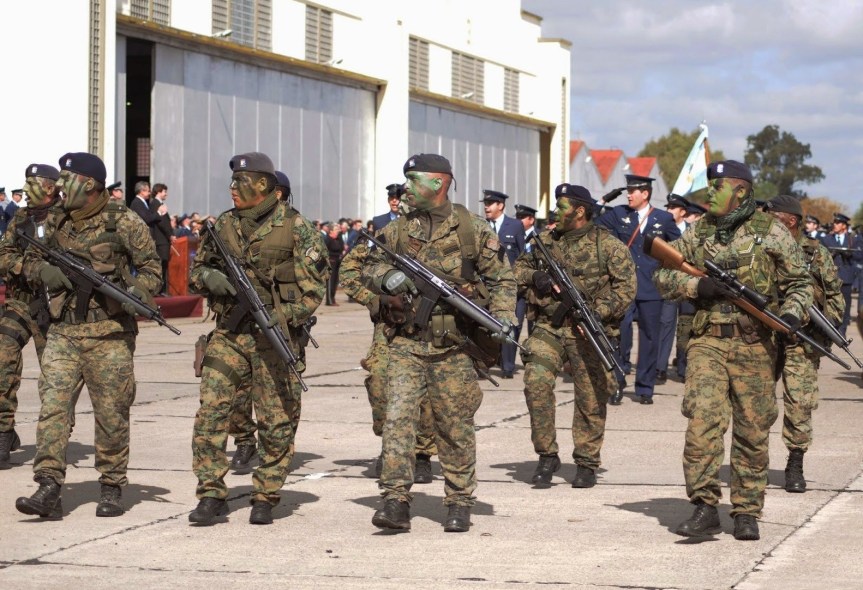
Argentine commandos with HK G41
Argentina’s Grupo de Operaciones Especiales on parade with G41s and the G41-TGS, grenade launcher package (source)

The G41 represents the last evolution of HK’s infantry rifles using the roller delayed blowback action. It comes from a period when HK were developing what they hoped would be the next generation of small arms technology and with the collapse of the G11 programme and the lack of interest in the G41 the company faced financial uncertainty throughout the early 1990s. HK’s move away from the roller delayed blowback action to a more conventional gas operated rotating bolt system, combined with lightweight polymers, in the G36 proved to be more successful than the ill-fated G41.

If you enjoyed the video and this article please consider supporting our work here.


Specifications (standard G41 rifle model):

Length: 39in (99cm)
Weight (unloaded): 4.31kgs or 9.5 lbs
Barrel Length (not including flash hider): 17.7in (45cm)
Action: Roller-delayed blowback
Calibre: 5.56x45mm
Feed: 30 round STANAG magazines
Cyclic Rate: ~850rpm


Bibliography:

The World’s Assault Rifles, G.P. Johnston & T.B. Nelson, (2016)

Die G11 Story, W. Story, (1993)

Full Circle: A Treatise on Roller Locking, R. Blake Stevens (2006)

The 5.56 Timeline, D. Watters, (source)

1985 HK Brochure on the G41 Series (via SAR Archive)

HK G41 Owner’s Manual (via SAR Archive)


Our thanks to the collection that holds this rifle for their kind permission to examine and film it. Please do not reproduce photographs taken by Matthew Moss without permission or credit. ©The Armourer’s Bench, 2019.
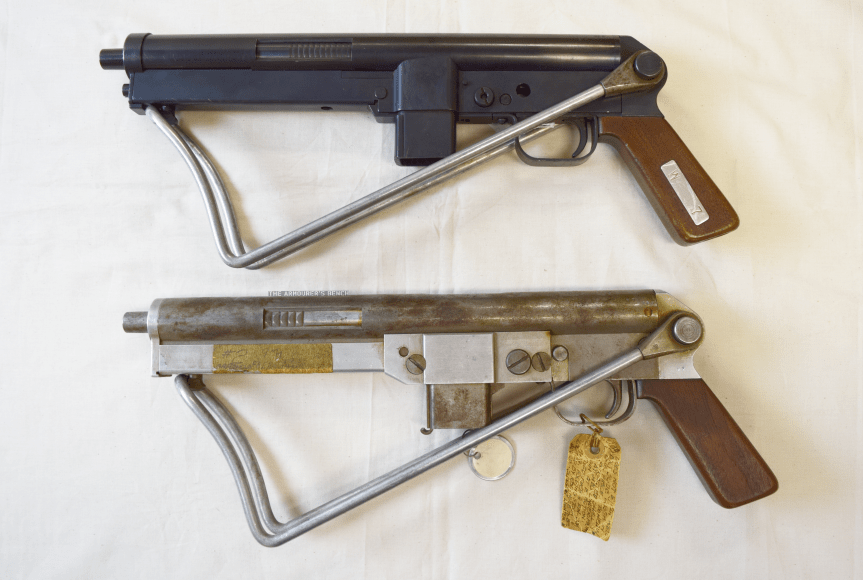
Winchester Experimental Submachine Gun

Held in the collection of the Cody Firearms Museum (CFM), at the Buffalo Bill Centre of the West, is a most intriguing Cold War submachine gun. The weapon came from the collection of the old Winchester Firearms Museum, which the CFM inherited, it is not a test & evaluation weapon made by another company but a submachine gun designed and developed by Winchester. Those who know their Winchester history will know the company had no prior background in submachine gun design, instead being best known for their rifles and shotguns.

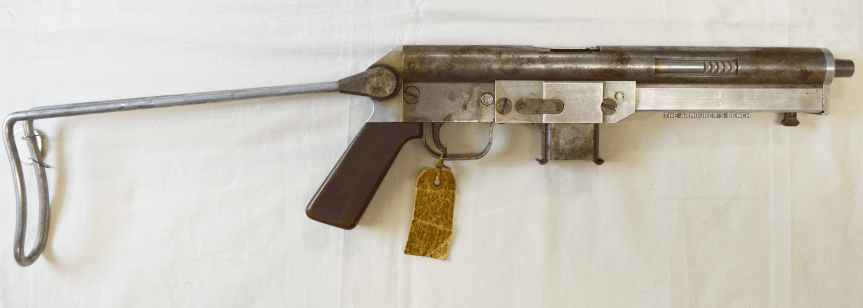
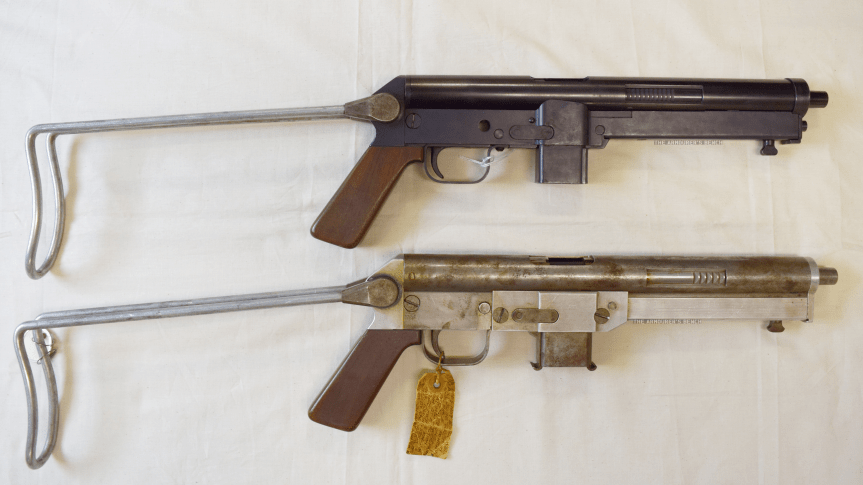
left N4 and N2
Left side profile view of the N4 and N2 Winchester submachine gun prototypes with their stocks folded (Matthew Moss)

Very little is known about Winchester’s submachine gun project, but two prototype examples survive, an early ‘in the white’ model labelled ‘N2’ and another which Herbert Houze, the CFM’s former curator, designated ‘N4’ . The documentary evidence for the Winchester submachine guns is sparse, amounting to just entries in the Winchester Museum’s inventory and a faded battered item tag attached to N2. A confusing element is that the inventory simply refers to the two prototypes as N-1 and N-2, with no mention of an N4.
There is also believed to be original engineering drawings housed in the Winchester Archival collection, currently held by the McCracken Research Library, but searches by myself and library staff  have been unable to locate these.

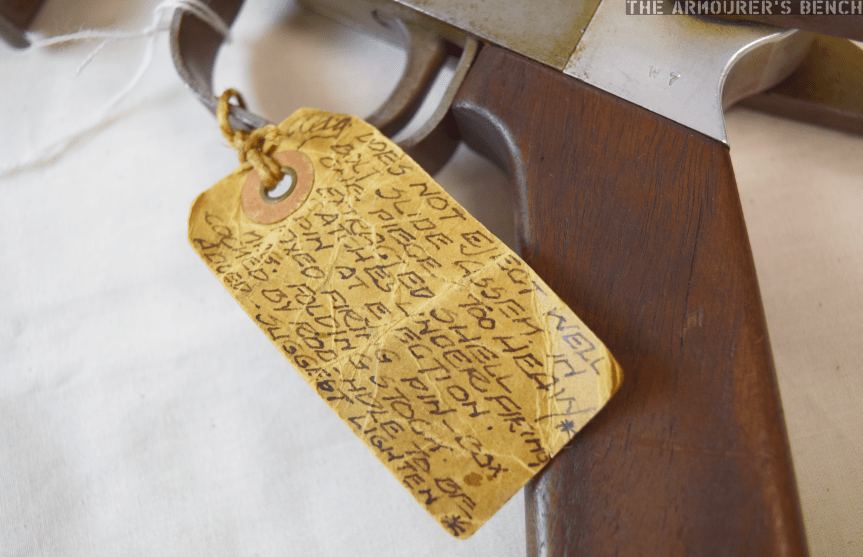
It is unclear if the tag from N2 is contemporary, perhaps added when the gun was handed over to Winchester’s museum, or if it was added later. In under 100 words it give us a short potted history of the N2 itself and the company’s programme to develop a submachine gun.

N2's item tag
Close up of the N2’s item tag detailing the gun & program’s history (Matthew Moss)

Houze suggests the development programme began in 1955 and the tag attached the N2 suggests that development ceased in 1957, whether this is solely for that gun or the entire programme is unclear. This would make Winchester’s weapon a contemporary of the famous Israeli UZI.

The tag describes the N2 as a 9mm blowback ‘NATO Burp Gun’, followed by the name A.A. Arnold, a Winchester engineer perhaps best known for writing a series of manuals for Winchester firearms, followed by ‘dropped Dec ’57’. In his 1994 book, Winchester Repeating Arms Company: Its History & Development from 1865 to 1981, Houze suggests that the weapons were designed by A.A. Arnold and Melvin M. Johnson in 1955, for possible adoption by NATO. The association with NATO might also be the origins of the ‘N’ prefix. I have been unable to find any published patents attributed to Arnold, Johnson or the company relating to the experimental submachine gun.

I contacted NATO’s Archives who advised that they were unable to find any reference or documentation relating to a direct NATO submachine gun requirement. Another possibility is that the weapon was developed to market more broadly to NATO member nations. The submachine gun market at this time in Europe, however, was already saturated by both wartime surplus and a new generation of guns, including the Sterling, the UZI, the Madsen M50, and the Carl Gustav m/45.

N2 prototype
Right side profile view of the N2 ‘in-the-white’ prototype with its stock deployed (Matthew Moss)

The reverse of the N2’s label documents the prototype weapon’s reliability and feeding problems. The tag states that the N2 did “not eject well” and that the bolt slide assembly was too heavy. It also highlights failures to cycle properly with extracted cartridge cases catching under the firing pin. The label then gives a brief description of some of the N2’s features: “fixed firing pin, 33x Mag. Folding stock.” Interestingly, it also notes that the weapon would be cocked by a rod – the hole for which had not yet been added. The tag ends with a suggestion that the heavy one piece bolt assembly should be lightened.

N2 Tape
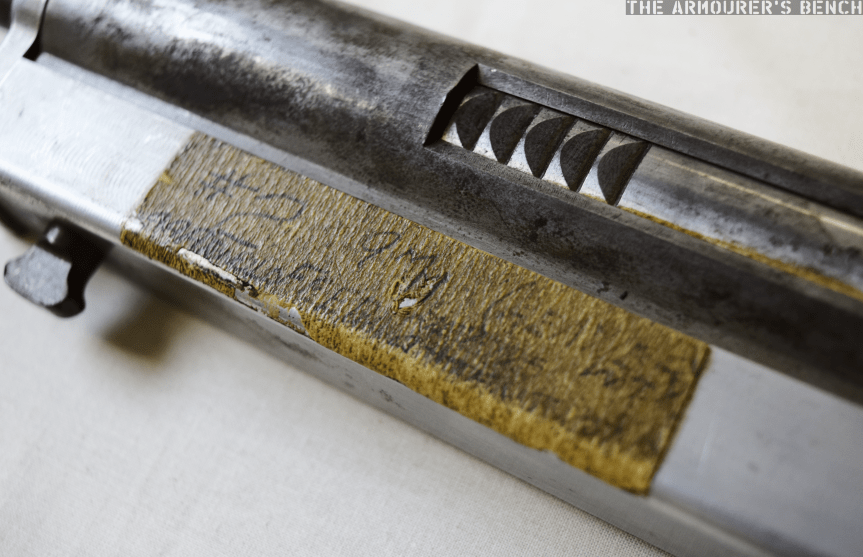
Close up of the N2’s difficult to decipher tape note (Matthew Moss)

N2 itself also has a piece of masking tape, on the recoil spring assembly cover, with its serial number and calibre written on it, along with A.A. Arnold’s name and some words that are too difficult to make out, but include ‘feed’.

Houze has also suggested that Melvin Johnson, designer of the Johnson rifle and light machine gun who joined Winchester as a designer and adviser in the early 1950s for a short time, and Stefan Janson, designer of the Brtish E.M.2 bullpup and subsequent Winchester engineer, both worked on the project. However, I have been unable to find any documentary evidence of their involvement.

Examining the N2:

N4 and stripped N2
Winchester N4 and disassembled N2 prototype (Matthew Moss)

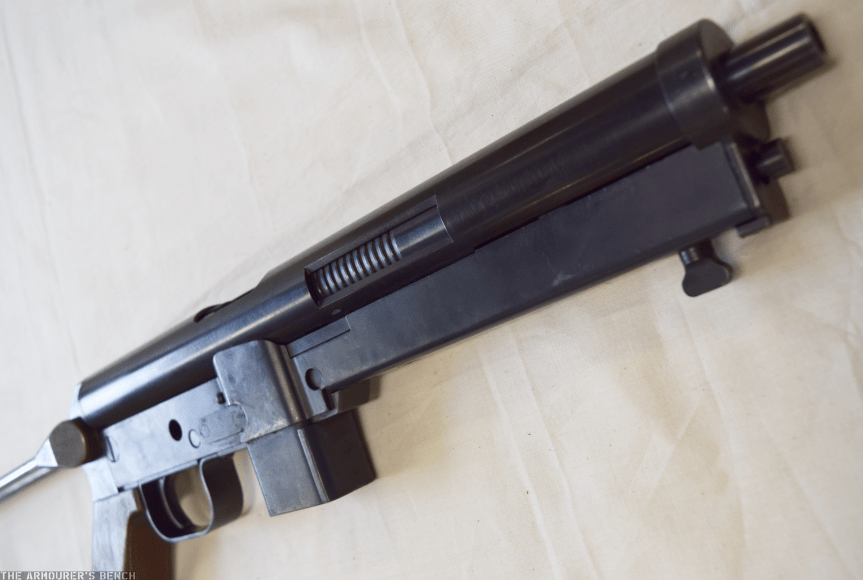
We can learn a lot from hands on examination of the two Winchester ‘N’ prototypes. Examining N2 we find that the receiver is made up of a piece of shaped sheet metal with a rounded upper half containing the barrel, bolt and cutouts for the grip points on the bolt assembly that allow charging. The bolt assembly rides over the rear portion of the barrel and projects back into the receiver. The lower section of the stamped receiver is rectangular and has a cut out for a separate magazine housing and fire control mechanism consisting of a trigger and push through safety – which we did not remove during disassembly. The N4 is missing its safety.

magazine housing
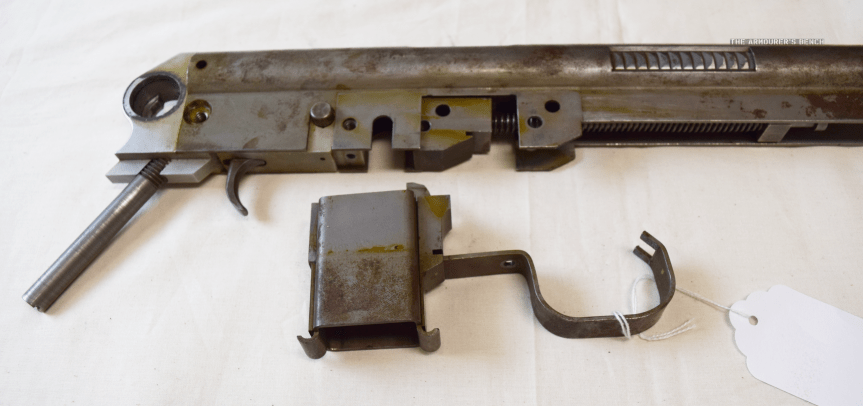
Close up of the N2’s magazine housing and trigger guard, note also the trunion freed from the receiver (Matthew Moss)

In the N2, the magazine housing is held in place by the stamped metal trigger guard which rocks into a notch behind the trigger and at the front interfaces with a notch in the magazine housing which has to be placed in the receiver at the same time, both are then held in place by a screw. This was changed in the later ‘N4’ with the trigger guard as a separate independent piece.

Winchester N2 Prototype Reassembly:

The side plates, muzzle end cap and recoil spring assembly cover all made from Aluminium – ostensibly to reduce weight. The submachine gun prototypes both use a pinch cocking method similar to that seen in the earlier British BSA WELGUN developed during WWII. The recoil spring proved to be too strong to cock easily, the addition of ‘rod’ cocking handle is suggested on the N2’s tag. The blued, later N4 prototype, however, is still lacking a conventional cocking handle. The pinch cocking method is not ergonomic, the user’s fingers could easily be caught by reciprocating bolt in charging cut outs in the receiver.

DSC_0053
The N2 prototype disassembled, sadly we were unable to free the bolt from the receiver (Matthew Moss)

Another ergonomic consideration is the Winchester’s submachine gun’s unusually swept back pistol grip angle, the angle of the forward grip made by stock when folded is also similarly angled. Both the weapons have a push though safety selector just above the trigger (likely safe & fully automatic, but could not check as gun unable/difficult to cycle the prototypes easily). The weapon likely fed from a double stack, single feed magazine – either of an similar pattern to the MP40 or proprietary. The N4 seen in Houze’s 1994 book is shown with an MP40 magazine. UZI magazines fit the weapon but don’t lock into place.

The basic design does not change substantially between the prototypes with the control configuration, folding wire stock, pistol grip angle and magazine housing dimensions remaining the same. The N4, however, differs from the earlier prototype in a number of respects. The N4’s nose cap now fits over the rounded half of the receiver, rather than sitting flush and the cut outs in the upper receiver to access the bolt assembly for charging have been moved back slightly.

N4 close up
Right side view of the N4 blued prototype, note the half cocked bolt and the narrower grip serrations on the bolt assembly. Note also the intersection points of the recoil spring assembly cover and the upper receiver (Matthew Moss)

The later N4 model has pins in place of some of the screws used on the N2. The side plates have been replaced by a one-piece recoil spring assembly cover which projects back further over the magazine housing to the rear of the receiver. The most fundamental difference between the two is that it appears that the front part of the N4’s receiver has been significantly altered with the lower receiver at the front of the gun removed. It appears to have been replaced by the recoil spring assembly cover which appears to slot into the receiver. Sadly, we didn’t have time to disassemble the N4 to examine this.

The N4’s bolt assembly also has more serrations, in a slightly different orientation, on its bolt assembly gripping area, but still no charging handle as recommended on the N2’s tag. The ejection port on the blued prototype is also at a position closer to 12 o’clock when compared to the N2s.

Right side 2 Winchester SMG prototypes
Right side profile view of the two prototypes with their stocks deployed (Matthew Moss)

The N2 has a metal trunnion block, that the recoil spring guide rod screws into, this is held in place within the receiver by a cross pin. The bolt appears to be removed through the rear of the receiver once the stock assmbly/end cap is removed and the bolt assembly freed.

The folding stock was retained by spring tension of the wire metal stock against a wingnut-shaped catch that is riveted onto the recoil spring assembly cover. The stock is locked by a spring loaded push button system similar to the MP40s, this is not particularly sturdy. The shape of the wire stock itself is reminiscent of the US M3. When folded the butt of the wire stock acts as a front grip, the retention of the stock is surprisingly strong and stable.

Intriguingly, the Winchester Museum inventory notes that the guns are designated the N-1 and N-2, with an additional wooden model of the ‘Nato Burp Gun’ being transferred along with a box of duplicate parts in steel for the N2’s aluminium parts.

If you enjoyed the videos and this article please consider supporting our work here.


Specifications:

Calibre: 9x19mm
Action: Blowback
Overall length: ?
Barrel length:  7.5 inches
Weight empty: ?
Magazine capacity: 33 rounds

Bibliography:

Winchester Repeating Arms Company: Its History & Development from 1865 to 1981, H. Houze (1994)


My thanks to the Cody Firearms Museum at the Buffalo Bill Center of the West for allowing me to examine and film the Winchester submachine gun prototypes. Special thanks to the CFM’s assistant curator Danny Michael for helping disassemble the N2.

All photographs taken by Matthew Moss, courtesy of the CFM & the Buffalo Bill Center of the West. Please do not reproduce photographs without permission or credit.

©The Armourer’s Bench 2018

Live Fire: MAC Modèle 1950

In this live fire video we’re going to take a look at the MAC Modèle 1950, a French 9x19mm service pistol. The Modèle 1950 replaced the earlier M1935A and M1935S pistols, both chambered in 7.62mm longue.

In 1946, the French Army began the process of selecting a new service pistol, chambered in the more powerful 9x19mm round. A number of designs were tested including the SIG P210. The Modèle 1950 was developed by Manufacture Nationale d’Armes de Saint Étienne (MAS) and while suffering initial reliability problems it was refined and eventually adopted.

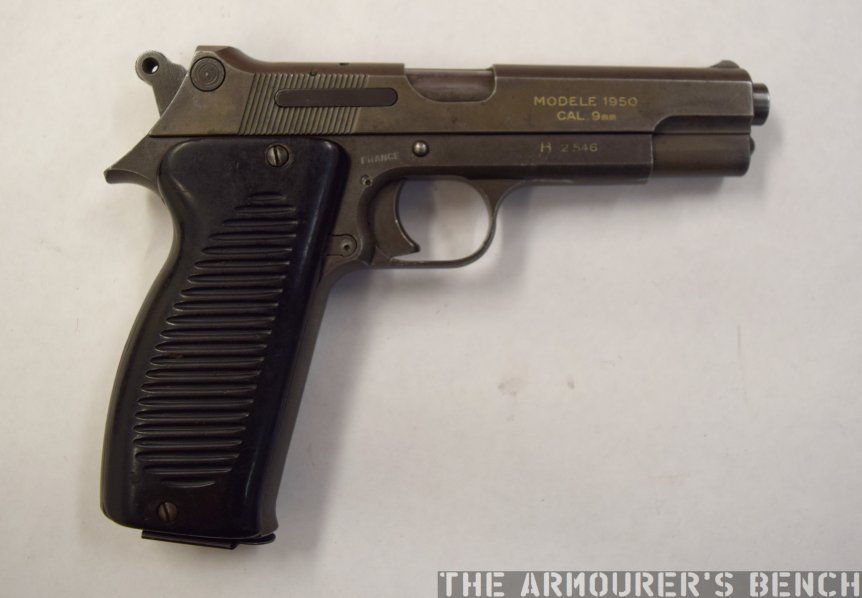
The Modèle 1950 combined elements from the previous 1935 pistols but added a larger, more ergonomic grip. The pistol feeds from a 9-round single stack magazine, has a single action trigger and has a slide mounted safety which blocks the hammer.

DSC_0483
Riht side view of the French MAC Modèle 1950 service pistol (Matthew Moss)

Shooting the Modèle 1950

I enjoyed shooting the Modèle 1950, its large grip size makes it pleasant to shoot but felt like it should have held a larger double stack magazine. The pistol has a decent set of combat sights, easy to pick up in good light.

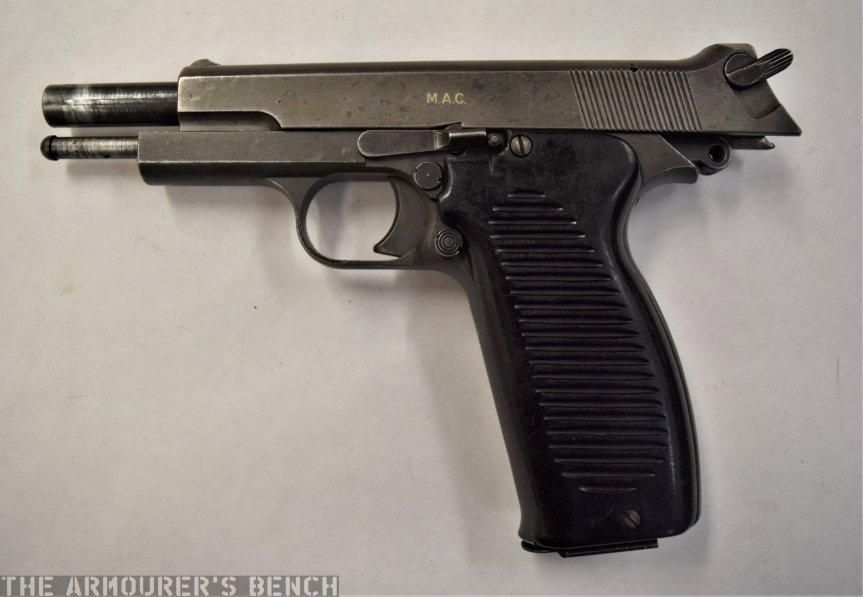
Through firing several magazines through the pistol it became clear that you had to be sure not to accidentally engage the safety when racking the slide. This is something I encountered and explain in the video. It took me a few of seconds to realise the problem, take the safety off and recock the hammer. In the safe position the catch juts out the back of the slide, while this is a good indicator of the weapon’s condition it seems possible it could be disengaged while in a holster.

MAC 1950
A view of the left side of the Modèle 1950, note the slide mounted safety catch in the safe position (Matthew Moss)

Produced at both MAS and Manufacture Nationale d’Armes de Châtellerault (MAC), over 340,000 Modèle 1950 were manufactured. The pistol is still in limited French service but has largely been replaced in service by the PAMAS G1, a licensed version of the Beretta 92.

We will have a full video and blog looking at the earlier Modèles 1935A & S and the 1950, examining the design, development and history of pistols in the future. My thanks to my friend Chuck Kramer over at Gun Lab for helping us with this video, check out his blog here.


If you enjoyed the video and this article please consider supporting our work here.