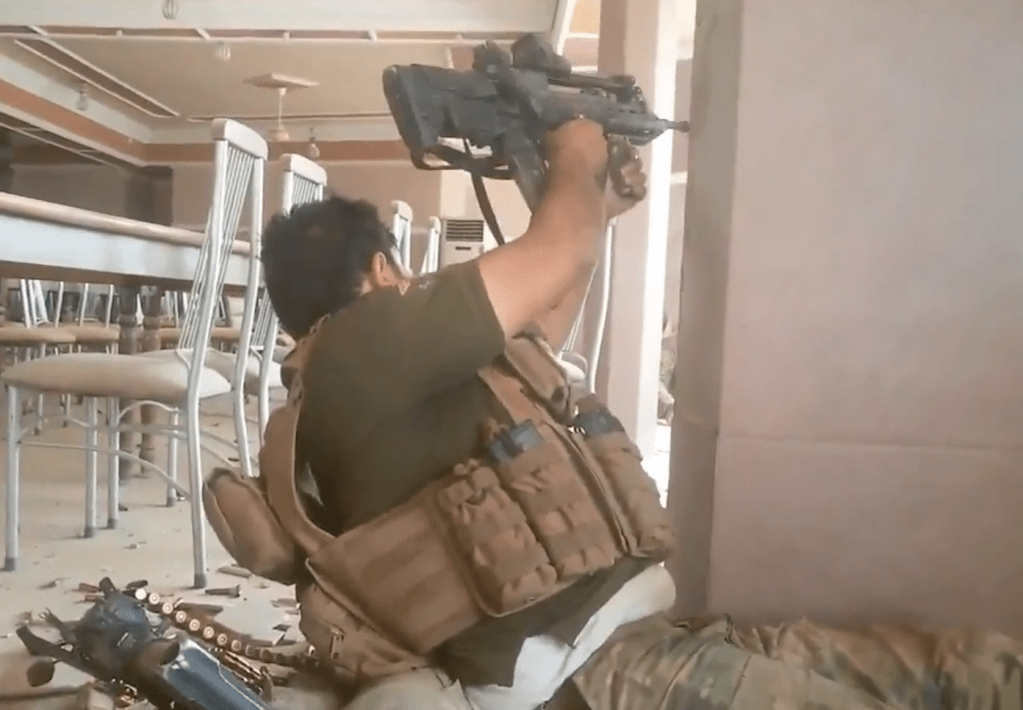
The VHS-2 bullpup rifle manufactured by Croatia’s HS Produkt became one of the most frequently seen rifles during the Iraqi counter-offensives against ISIS during 2015-17. The rifle regularly appeared in news reports and social media posts and became somewhat synonymous with the fighting for Fallujah and Mosul.
A screen capture of combat footage from Iraq c.2016-7 featuring a member of the Emergency Response Division with a VHS-2
Check out the full article accompanying this video at Silah Report.
If you enjoyed this video and article please consider supporting our work here. We have some great perks available for Patreon Supporters – including custom stickers and early access to videos! Thank you for your support!
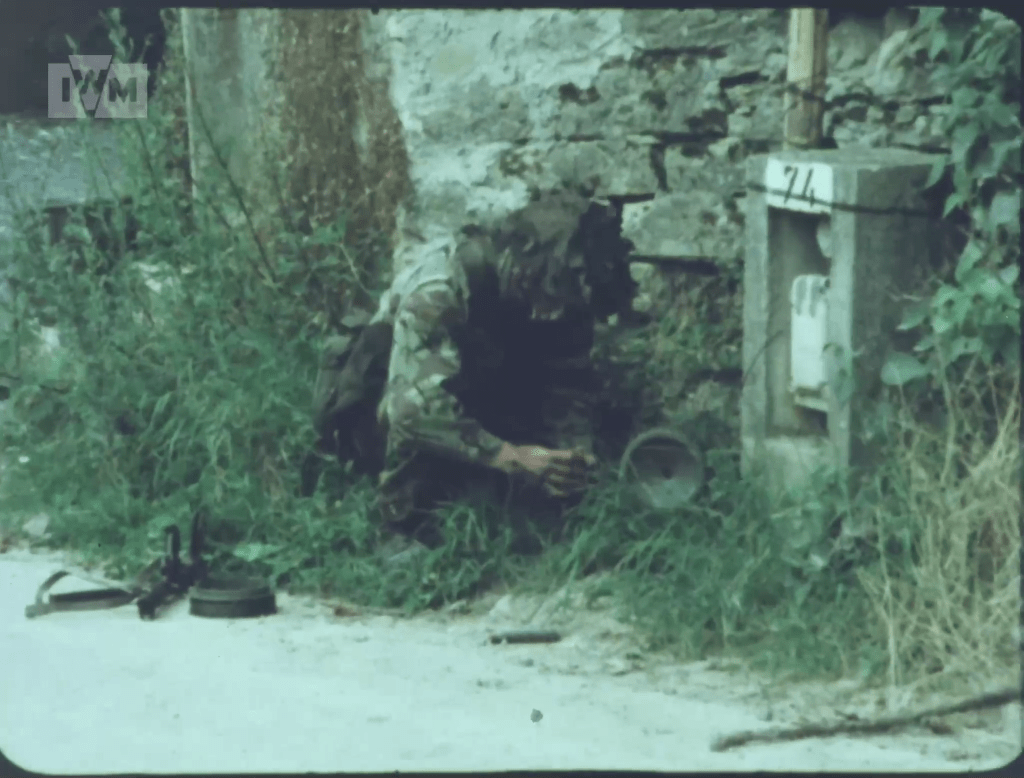
During the Cold War NATO was understandably interested in capable anti-armour weapons. In this video/article we will examine the Off-Route Mine which features in footage from several British Army training films. They show a team of Royal Engineers setting up an L14A1 off-route mine ready to ambush attacking Soviet tanks.
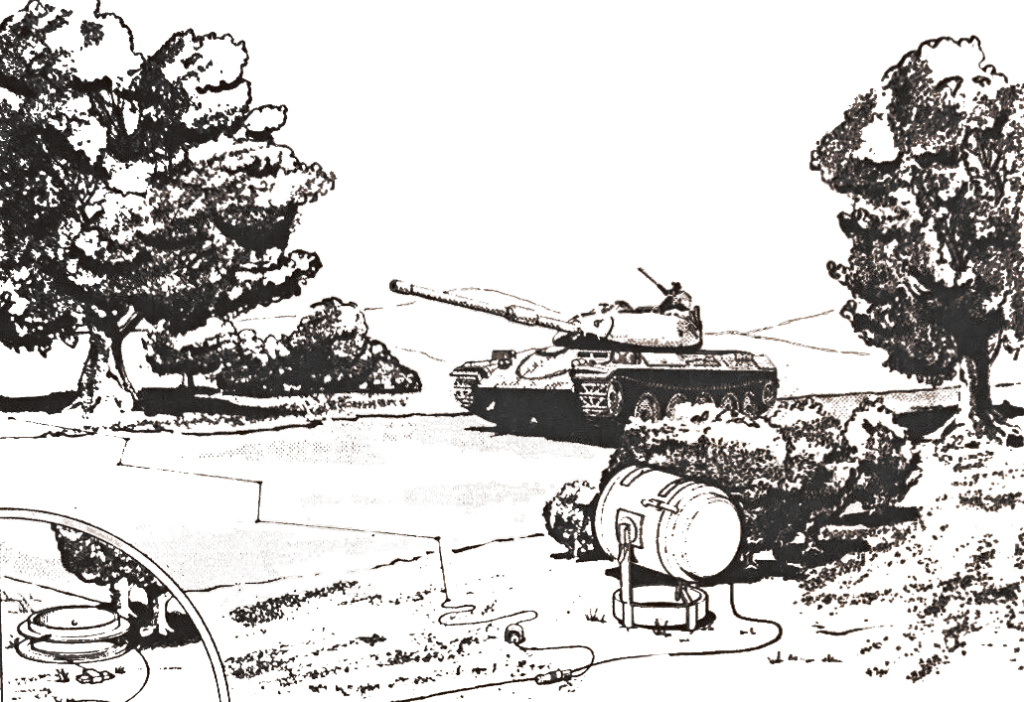
Unlike a conventional mine which detonated vertically when a vehicle drove over it, the Off-Route Mine would be tripped by a breakwire set across a vehicles likely path. When the wire was tripped or broken the mine’s charge would be electrically detonated and the blast would project horizontally.
An Off-Route Mine in position (IWM)
What the British termed the L14A1 was developed in the early 1970s by France’s state arsenals. In French service it was known as the ‘Mine Anti char à action horizontale Modèle F1′ (or MI AC AH F1). It was manufactured throughout the 1970s and 80s by GIAT Industries.
The mine was essentially an electrically fired shape charge, it used the Misznay-Schardin effect rather than the Monroe effect. The former relies on a shallower, concave shape charge, which has a copper cone that is super heated by the explosion and fired out towards the target. This gave it the ability to project its cone further and removed the need for it to detonate in contact with the target vehicle.
An illustration of how the Off-Route Mine works from a British Army manual
The mine had an effective range of between 70 to 80 metres and according to the 1977 French manual the projectile created by the detonation could travel up to 6km. In terms of the mine’s effectiveness the same manual states that 40m was the optimal range but no closer than 2m.
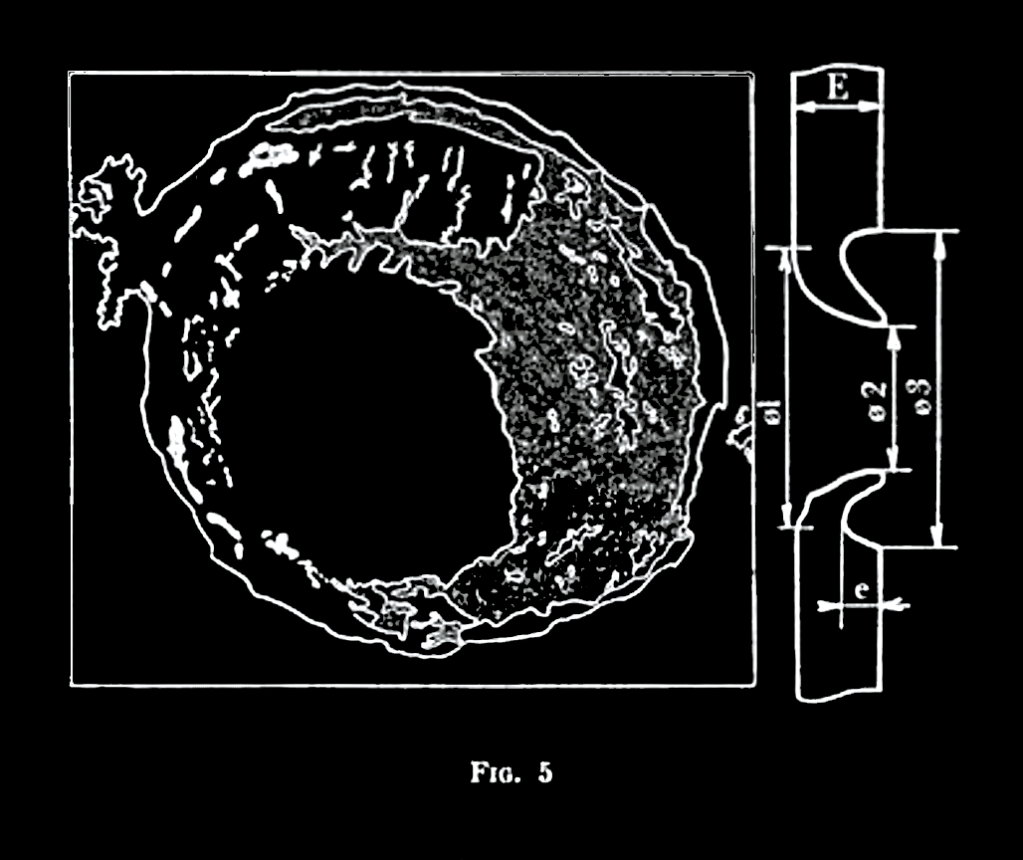
The manual also notes that “the slightest obstacle in the trajectory of the projectile (such as earth or shrubs) considerably reduces performance.” The diagram below from a 1977 French Army manual shows the effect of the mine on 70mm of armour at 40m, with 0-degrees of angle.
Effect diagram from 1977 French Army manual
When detonated the mine could throw fragments in a radius of 100m and could throw armour shards from a successful strike up to 200m from the target. The British mines came in the L27A1 kit which included a pair of the L14A1 off-route mines as well as instructions, the break wires, a night sighting tool, and an adjustable stand for mounting.
The mine’s electorally-powered detonator was powered by D cell batteries, which Sappers complained had to be frequently changed. The mine itself weighed 12kg and was packed with just over 6kg of Hexolite explosive. There was also a training version, the L28A1, which fired a paint-filled sponge to mark the side of the vehicle and confirm a hit.
A Sapper setting up an Off-Route Mine (IWM)
The Miacah F1 was removed from French service in 2001. An improved version, the F2, was manufactured in 1996 and used by the French until the mines were withdrawn in 2004 due to corrosion. While some mines may have remained in stores, as some have been seen as late as 2016, they contravened the 1997 Ottawa Treaty on anti-personnel mines because the break wire could in theory be tripped by a human rather than a vehicle.
It was replaced in British service by the ARGES off-round Anti-Tank Mine which fired a modified 94mm rocket with a tandem HEAT warhead. In 1997 it was reported that 4870 Off-Route mines were held by British Army stores, in line with the Ottawa Treaty this had been reduced to 0 by 1999.
If you enjoyed this video and article please consider supporting our work here. We have some great perks available for Patreon Supporters – including custom stickers and early access to videos! Thank you for your support!
Bibliography:
Landmine Monitor Report, 2004, Landmine & Cluster Munition Monitor, (source) Landmine Monitor Report, 2000, Landmine & Cluster Munition Monitor, (source) CNEMA Report, 2000 (source) British Army User Handbook, Mine Anti-Tank Kit L27A1 (Off Route Mine), 1980 French Army MIACAH F1 Manual, 1977
Footage:
Fighting In Woods, British Army training film, 1982, (held by the IWM, DRA 1472) Fighting In Villages, British Army training film, 1979, (held by the IWM, DRA 1401)
A comment in my recent video about the Royal Bermuda Regiment’s use of the Mini-14 sparked my interest. It noted that Malta, another small island military, uses the AK. I wasn’t aware of this so I decided to do some research.
Malta’s military, known as the Armed Forces of Malta (AFM) is roughly the size of a brigade. In recent years the Armed Forces of Malta have had a strength of between 1,600 and 1,800 personnel. It has three battalions a maritime squadron and an air wing. Malta is a neutral nation and as such the AFM’s role is territorial defence, internal security and border control.
Malta gained independence from the UK in 1964 and became a republic in 1974, this is when the AFM was founded. With the former link to the UK much of the AFM’s initial equipment was of British origin and the 7.62×51mm L1A1 Self-Loading Rifle was used as the AFM’s service rifle for many years this appears to have changed in the late 1970s early 1980s. The FN FAL-derrived L1A1 is still used as the AFM’s standard drill and parade rifle.
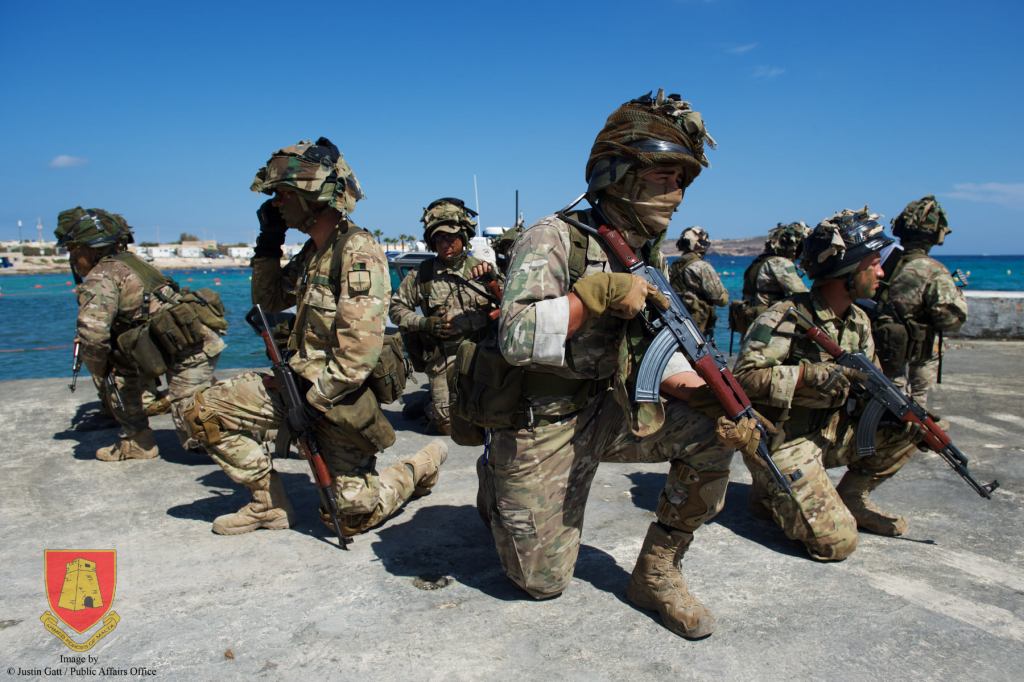
AFM personnel with Type 56/II AK-pattern rifles (AFM)
The AFM celebrated its 50th anniversary in 2020 and shared this time line of their uniform and equipment in their service magazine OnParade which gives us some idea of how their small arms changed over time. We can see that the AK-pattern rifles have been in service since at least the 1980s.
The AFM’s website lists their small arms with personnel being armed with Beretta 92s, a variety of HK MP5s, and what they describe as the ‘AK 47 Variant’. The site lists the rifles as being manufactured by Russia, Romania, China and East Germany. These rifles are all chambered in the 7.62×39mm cartridge.
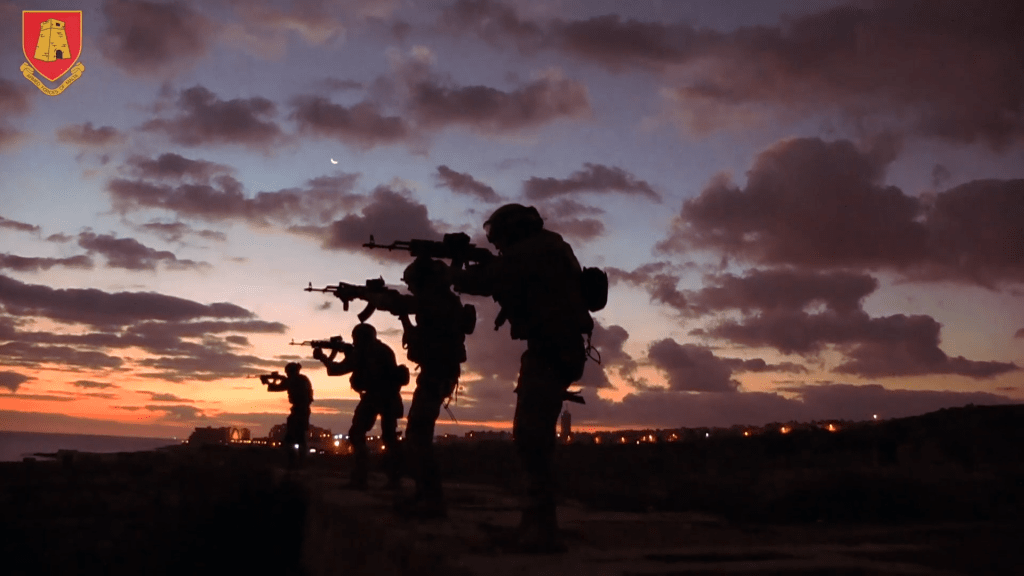
Where the first AK-pattern rifles came from is unclear, although one source suggests the German and Romanian rifles were bought second hand in the 1990s. From a survey of images and video shared by the AFM in recent years it appears that East German MPiKMS, Romanian PM md.63, North Korean Type 68 and Chinese Type 56/II are in service.
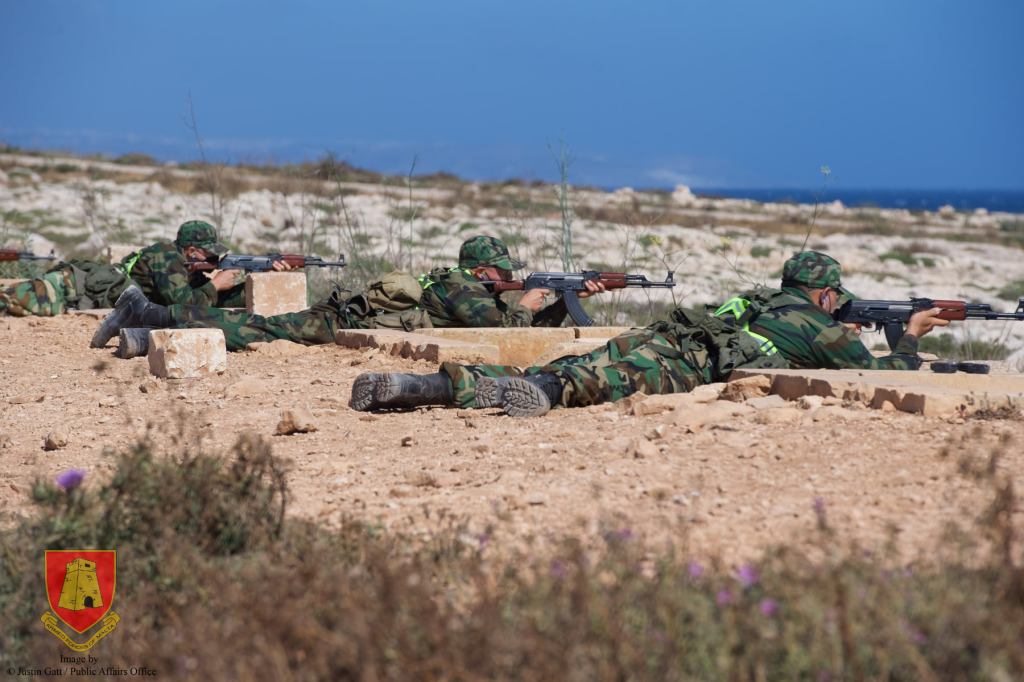
AFM recruits training with Chinese Type 56/II AKs (AFM)
The origins of the Chinese rifles is easy to trace back to a 2003 donation of small arms and light weapons made by the People’s Republic of China. An agreement was signed with China in June 2001 and as part of this a donation of 150,000 Maltese lira-worth of weapons. By 2003, however, it was reported by the Time of Malta that this had increased to 500,000 Maltese lira-worth of weapons. This included Type 56/II rifles, Type 80 general purpose machine guns and RPG-7 clones. The AFM’s acting commander Colonel Carmel Vassallo described the donation as a “dream come true” at the time. It reportedly allowed the entire AFM to be armed with a single type of service rifle.
The reasoning behind the adoption no doubt comes down to financing, Malta being a small island nation does not have an extensive defence budget, reported at 54 million Euros in 2020, and perhaps have chosen to prioritise personnel and procurement of naval and aviation assets over small arms. It is easy to see how the donation of service rifles and other small arms would be welcomed when balancing a modest budget.
AFM personnel with modified AKs (AFM)
Over the last 10 years there have been a number of photos and videos released showing AKs which have been upgraded with some aftermarket modifications. The mods appear to predominantly be sourced from FAB Defense – with their CAA Polymer buttstock and VFR-AK railed forend with a top rail which extends over the top of the receiver cover. This provides the bare bones AKs with some modularity. It’s unclear how widely issued the modified AKs are but from officially release imagery it seems that the basic AK-pattern rifles are more prevalent. In recent years Malta has stood up quick reaction forces and it appears from videos and images shared of the company that they have been equipped with SIG Sauer MCX rifles.
If you enjoyed this video and article please consider supporting our work here. We have some great perks available for Patreon Supporters – including custom stickers and early access to videos! Thank you for your support!
The No.36 or Mills Bomb was one of the longest serving grenades, developed during the First World War it originated from a Belgian design by Albert Dewandre and Capitaine Léon Roland. It was improved by a British industrialist, William Mills, who owned several metal forging factories.
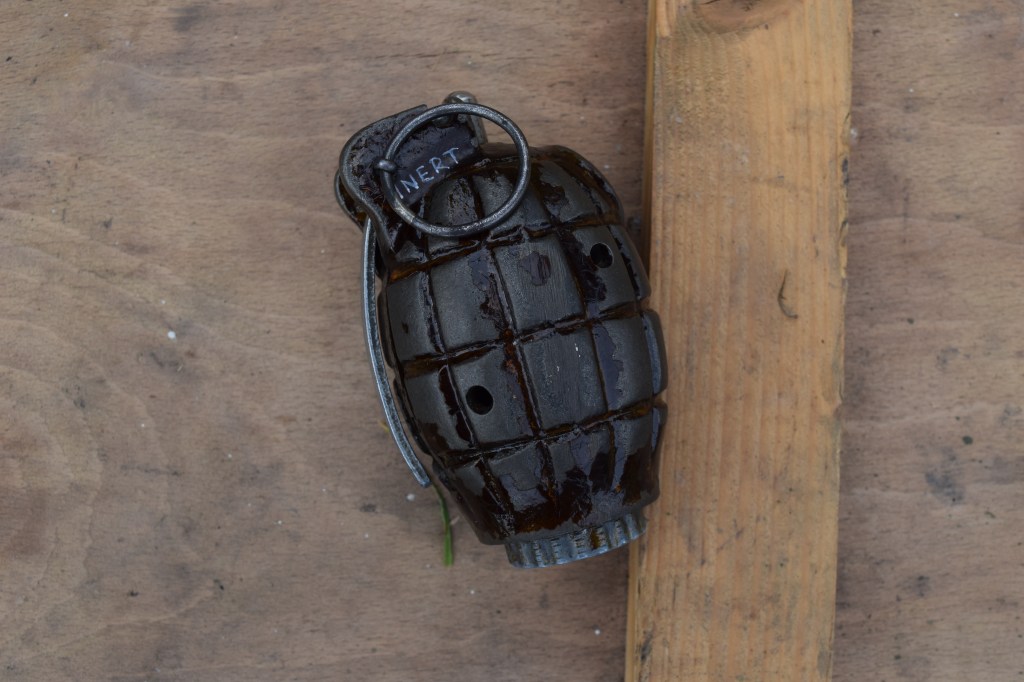
A No.36 Grenade (Matthew Moss)
It entered service in late 1915 as the No.5 Mk1 and continued to be improved during the war with several iterations before it finally became the No.36M Mk1. We’ll look at the Mills bombs development more closely in a future video/article – today, with the help of some 1940s newsreels from New Zealand we’re going to look at how they were manufactured. While the newsreel doesn’t state the factories featured they were made by a number of factories including Anderson Engineering in Christchurch (these were marked with an “A” below the filler plug), Booth Mcdonald, of Christchurch (marked BM), Scott Brothers, also of Christchurch (marked SB), and Mason & Porter, of Mt Wellington, in Ackland (marked MP).
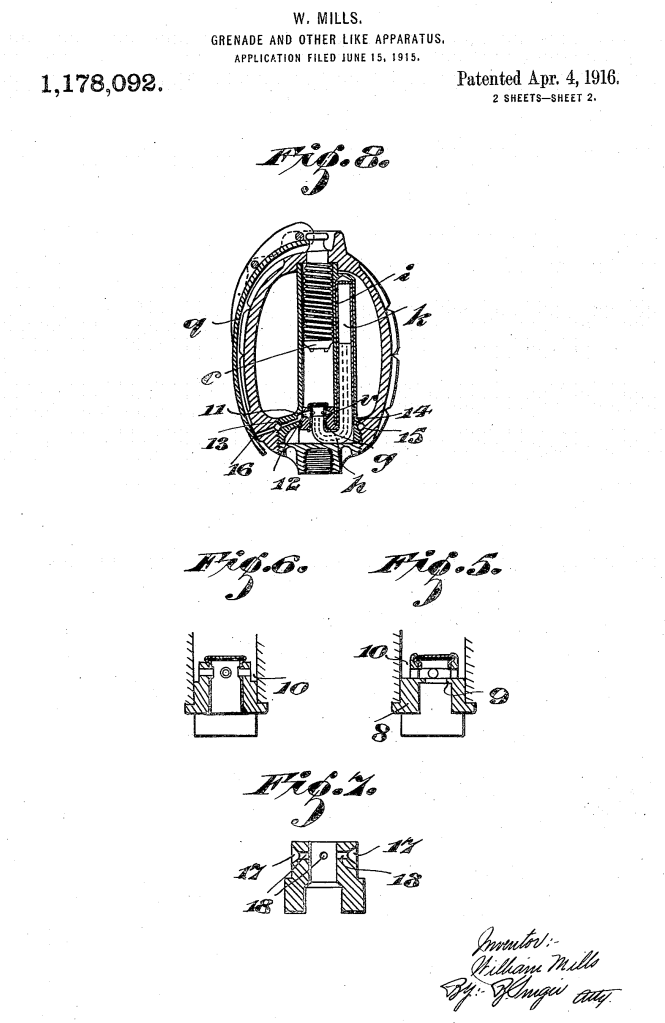
William Mills’ 1916 Patent for the grenade.
In the first newsreel, courtesy of Archives New Zealand (Weekly Review No. 70 (1943)), we see No.36 grenades being cast – the newsreel takes a slightly humorous approach of describing the process as a recipe – making ‘pineapples’ – a slang name by which grenades were sometime’s known. The factory is using the sand casting method with a pattern pressed into the sand and then removed. The two halves of the grenade’s body are pressed into sand, a pressed sand core could then be placed inside which would allow the grenade’s body to be poured hollow to allow room for explosives and detonator. If we again pause here we can see a machinist is centring and counter-sinking the filling hole’s first thread for its plug.
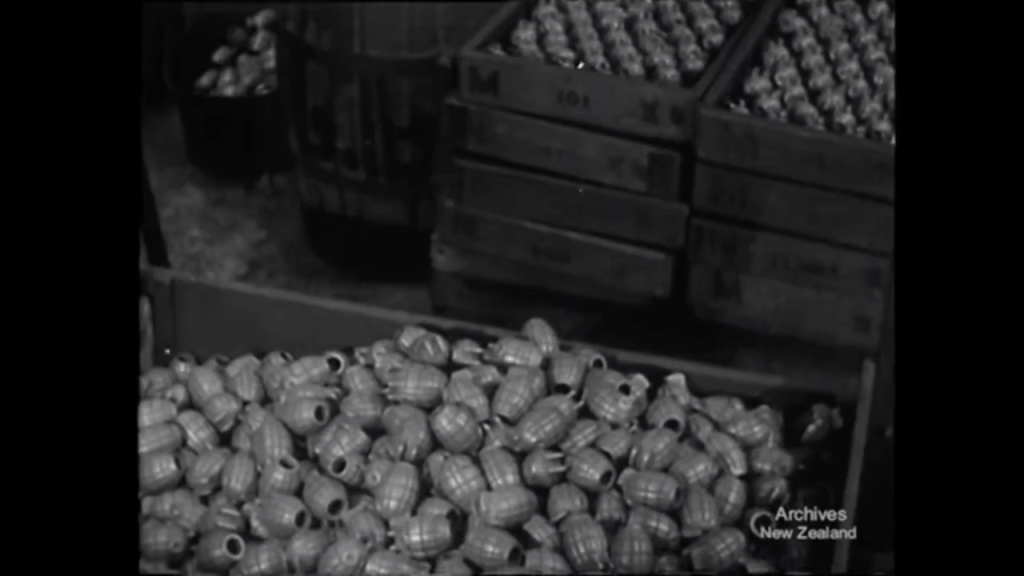
Cast grenade bodies ready for filling (Archives New Zealand)
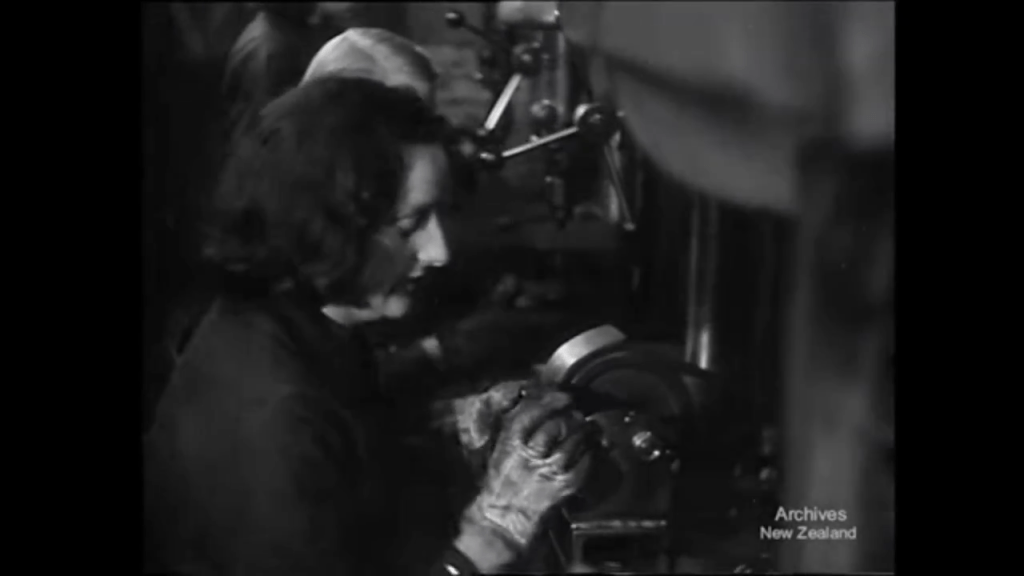
The footage includes a brief shot we see a woman factory worker drilling out the top of the grenade’s body and perhaps de-burring the side of the safety lever holder. In the next shot we see more machinists at work with one lady linishing the body of the grenade, removing imperfections from the casting on a grinder or polishing wheel and in the background some women a working on milling machines or drill presses.
Women factory workers linishing the grenade body castings (Archives New Zealand)
At the very end of the film we can see the grenade bodies are stacked ready for the next phase of production. Sadly, we don’t see the threading of the filling hole or base in this film nor the painting or filling of the grenades.
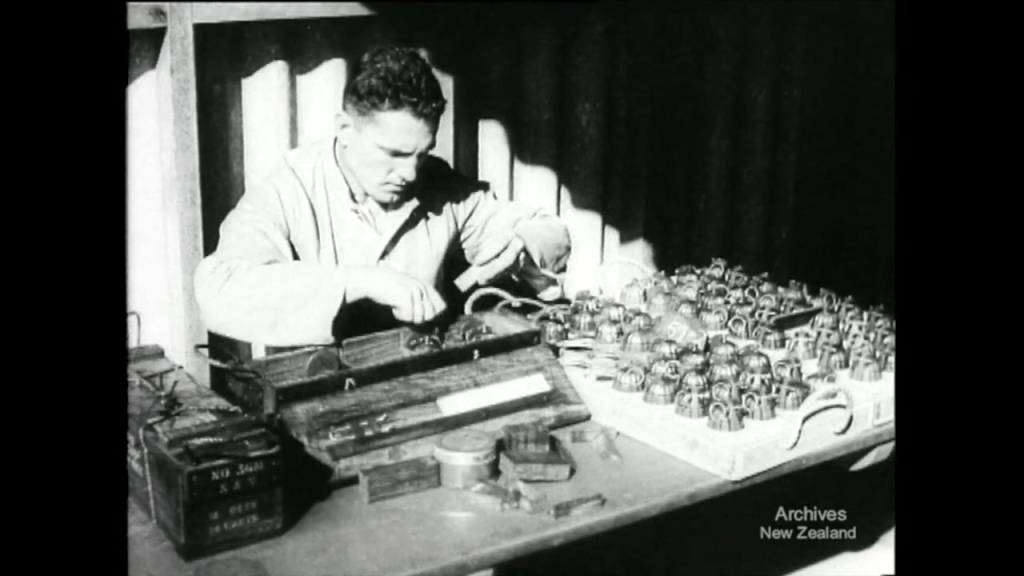
In the second newsreel (Weekly Review No. 63 (1942)), however, which celebrates the production of 1 million grenades, we do seem more of the production process. In this short segment we see how the grenades are filled and how they work. We see the cast bodies of the grenades being transported on a conveyor after being shellacked to keep moisture out. If we pause here we can see this worker packing a case with “gascheck” discs and fuses.
Loading grenades, fuses and gas checks into a transit case (Archives New Zealand)
The gas check disc and a 7 second fuse was used when the grenade was being fired from a rifle’s cup discharger, while a 4 second fuse was favoured when throwing by hand. In this final clip we see the internals of a grenade – which was filled with just over 2oz of explosive through the round filling-hole (on the side opposite the safety lever) which was then screw plugged. The newsreel then concludes the grenade segment by showing the striker spring inside being compressed and a No.27 Detonator, with fuse, being inserted into the sectioned grenade.
We’ll examine more British grenades, including the No.36 in future videos and articles.
If you enjoyed this video and article please consider supporting our work here. We have some great perks available for Patreon Supporters – including custom stickers and early access to videos! Thank you for your support!
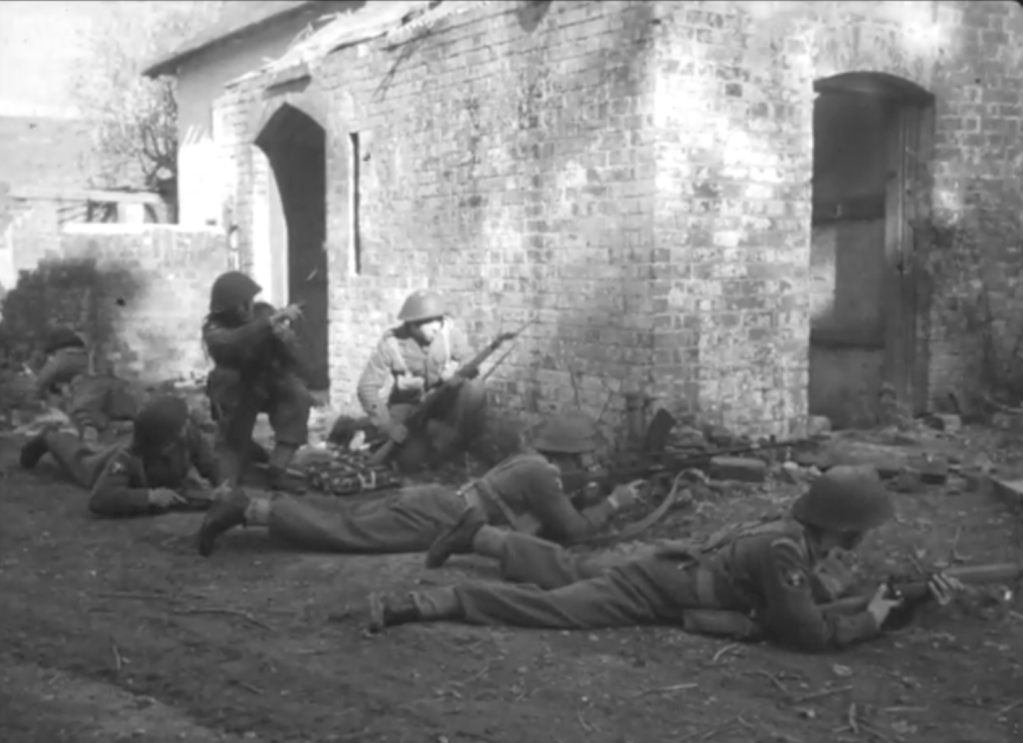
Recently, while looking though British Army Cold War training films, I stumbled upon something I never expected to see: a clip of an MCEM-2 firing! I was searching through British Cold War training films and watching a 1953 film titled ‘Village Clearing’ at first it seemed pretty standard fair albeit showing an impressive set-piece of tanks attacking a village. And then about 8 minutes in I spotted something unusual, the prototype MCEM-2, in the hands of one of the village’s defenders.
The 1953 training film shows a company size attack by the Royal Welch Fusiliers on an enemy strongpoint but then shows a section/squad assault on a building. The opposing force or OPFORCE are wearing airborne HSAT helmets and are armed with American weapons including M1 Garands, some first pattern M1918 BARs and a lone MCEM-2! This was likely done to differentiate the British troops from the OPFORCE – either they wanted a generic look or didn’t have any soviet weapons or kit available as is seen in later training films. My guess would be that the prototype may have come from the British Army’s Small Arms School Corps Collection which has historically maintained a working collection of foreign, historic and prototype weapons for familiarisation and training purposes.
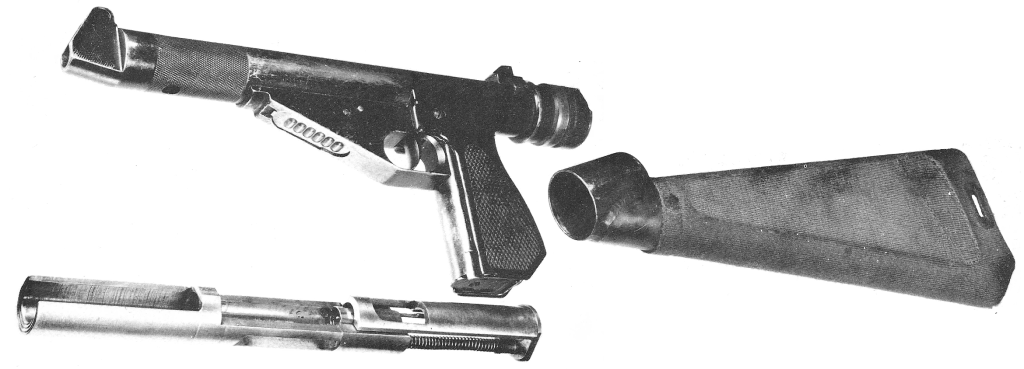
The MCEM-2 or Machine Carbine, Experimental Model No.2 was developed by a Polish engineer, Jerzy Podsedkowski. Work on the design began in 1944 but it was not seriously tested until after the end of the war. We can see from this brief clip that Podsedkowski’s design was small, compact and innovative. It fed from an 18 round magazine which like the later Uzi, Sa.23 and RAK Pm.63 was inserted into the pistol grip. While this kept the weapon compact and theoretically holster-able the MCEM-2’s high rate of fire, around 1,000 rounds per minute, meant that it was expended extremely rapidly.
The MCEM-2 disassembled (via Firearms.96.lt)
The MCEM-2 (Machine Carbine Experimental Model No.2) was a small, compact, innovative design. The weapon had a holster stock and a wrap-around breech block which was inclosed in a tube metal receiver. We can see the bolt in this photograph. In 1946 Podsedkowski, assisted by another Polish engineer, Aleksander Ichnatowicz, improved the MCEM-2, seeking to slow its rate of fire with a heavier bolt. The MCEM-2 was tested at the Royal Navy’s Gunnery School at HMS Excellent in August 1946. Excellent’s Commandant Michael Le Fanu, later an admiral and First Sea Lord, noted in his report that it was a “well engineered weapon, handy to carry about and suitable for use by seamen” but did note that “the high rate of fire makes the weapon uncontrollable in automatic and dangerous in the hand of semi-skilled users.”
Despite improvements the new MCEM-6 was eventually rejected with a Harold Turpin design favoured before it too was rejected. Hopefully, we’ll be able to take a look at some of these designs upclose in future articles/videos.
If you enjoyed this video and article please consider supporting our work here. We have some great perks available for Patreon Supporters – including custom stickers and early access to videos! Thank you for your support!
What connects calculators to the Javelin FGM-148 Anti-tank guided missile? That might sound like an odd question but what links one of the most successful scientific calculator companies and one of the most widely fielded modern infantry anti-tank weapons is the company which developed them.
Texas Instruments is a household name, especially in the US, better know for its calculators than weapons of war but from the 1940s through to the 1990s they were leaders in defence electronics.
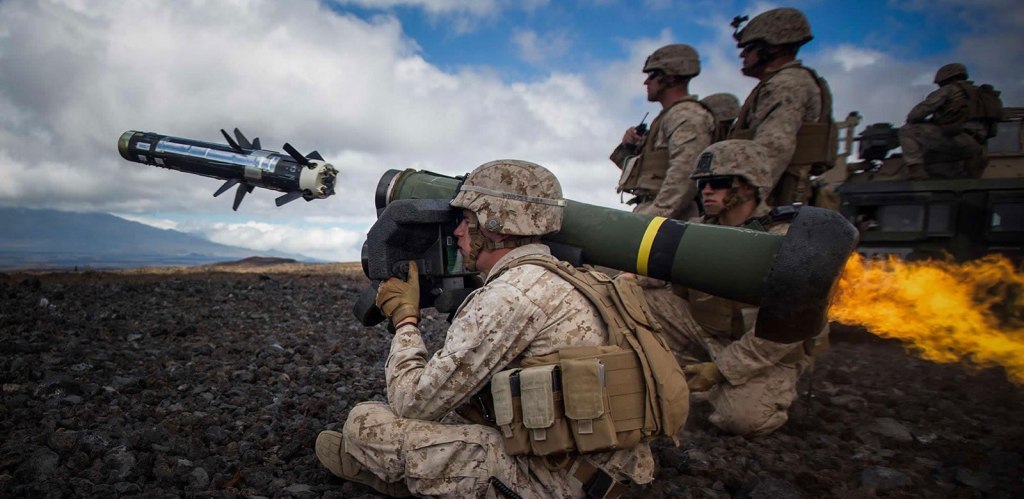
Javelin FGM-148 (US Government)
Javelin was developed by Texas Instruments in cooperation with Martin Marietta (now Raytheon and Lockheed-Martin). In the mid-1980s it beat off competition from Ford Aerospace and Hughes Aircraft to win the US Army’s AAWS-M (Advanced Anti-Tank Weapon System—Medium) program to replace the M47 Dragon. So while the company’s calculator division was running television adverts featuring Dracula the Texas Instruments’ defence arm were developing a next generation anti-tank guided missile.
In June 1989, Texas Instruments and their partner company Martin Marietta were awarded the AAWS-M development contract and the Javelin was adopted as the FGM-148. Javelin continued development and testing throughout the 90s before entering service.
The infrared guided man-portable fire-and-forget anti-tank missile has been in service with over a dozen countries for over 20 years and is still produced under the joint venture between Raytheon Missiles & Defense and Lockheed Martin.
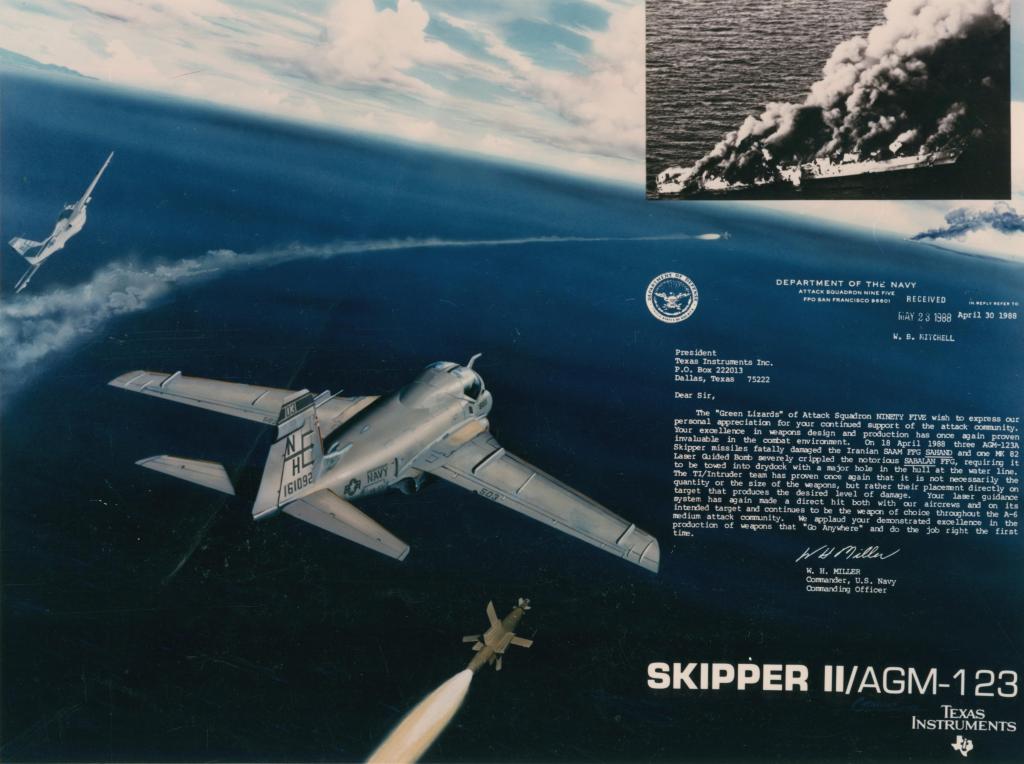
Skipper II AMG-123 (Texas Instruments)
Javelin wasn’t the only weapon Texas Instruments had a hand in developing, they also developed the AGM-88 Harm air-to-surface missile, AGM-123 Skipper anti-ship missile, the AGM-45 Shrike anti-radiation missile, the AGM-154 Joint Standoff Weapon and the Paveway laser-guided bomb. Texas Instruments’ involvement in the defence industry ended in 1997, when they sold off their defence division to Raytheon in a deal worth $2.95 billion at the time.
This short video came from some ongoing research I’m doing at the moment for an upcoming video on another missile called Javelin! Stay tuned for that.
If you enjoyed this video and article please consider supporting our work here. We have some great perks available for Patreon Supporters – including custom stickers and early access to videos! Thank you for your support!
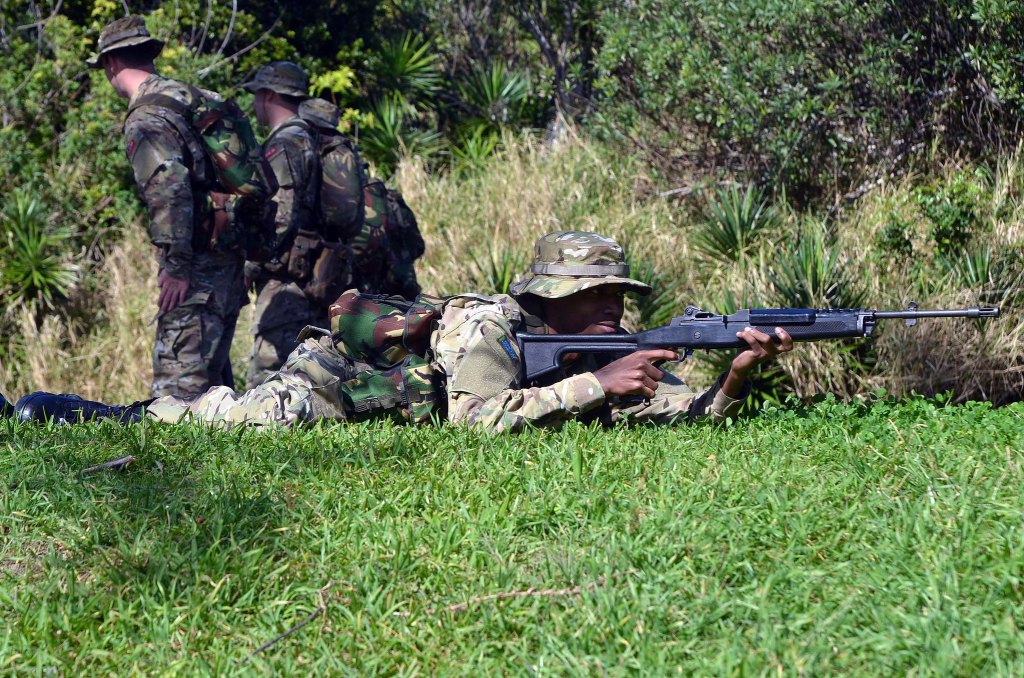
Formed in 1965 the Royal Bermuda Regiment (RBR) is a territorial line infantry battalion, whose primary role is internal security. The regiment is essentially a territorial or Army Reserve battalion with around 600 part-time troops. Bermuda itself is a British Overseas Territory and is one of several territories to have its own British Army overseas regiments. Initially equipped with the British Army’s L1A1 self-loading rifle, the Mini-14 was selected by the Royal Bermuda Regiment in 1983 to replace the L1A1. The 1980s saw a number of other British Army affiliated units move away from the L1A1, with the Falkland Islands Defence Force selecting the Steyr AUG.
A Royal Bermuda Regiment recruit with a Mini-14, c.2012 (RBR)
The Mini-14 GB (Government Barrel) semi-automatic rifle was purchased from Ruger. The Mini-14 GB had a thicker profile barrel with a a flash hider and mounting lug for the US M7 bayonet. The Royal Bermuda Regiment issued the Mini-14s with 20 round magazines. They were initially shipped with standard wooden stocks but in the early 1990s black polymer stocks with pistol grips were procured from Choate. Another unique attribute of the Regiment’s Mini-14s is the regimental crest stamped on the left side of the receiver. Less than a thousand rifles were produced for the Royal Bermuda Regiment.
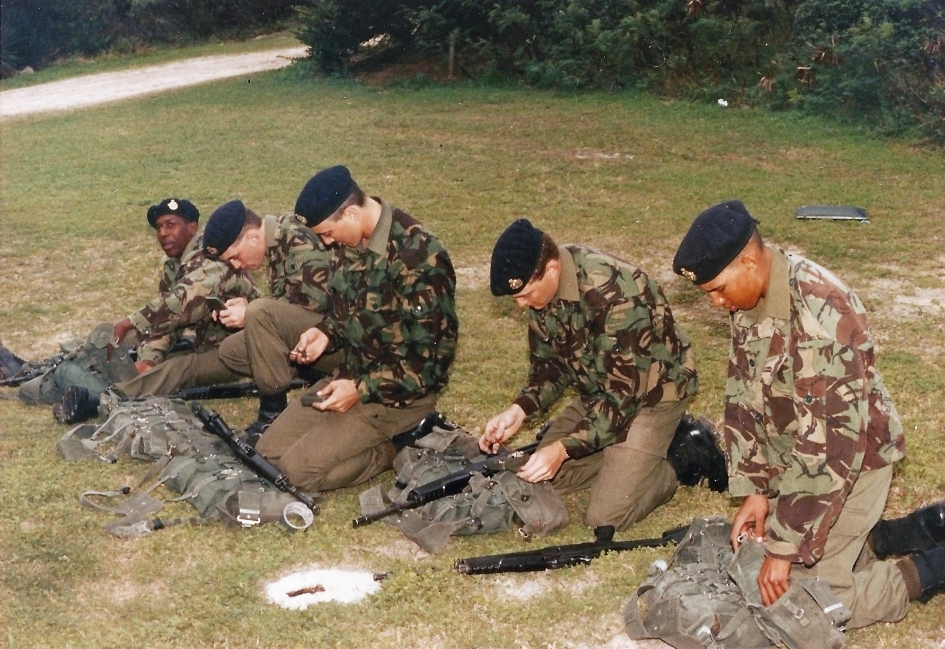
In terms of drill with the Mini-14 it is unclear what drill the RBR adopted with the wooden-stocked rifles though it likely drew on British Army drill with Lee-Enfield pattern rifles. Since the refitting of the rifles with the Choate stock it appears that the Regiment adapted the drill laid down for the L1A1. Both rifles have pistols grips, long butt-stocks and exposed barrels which project from the forend.
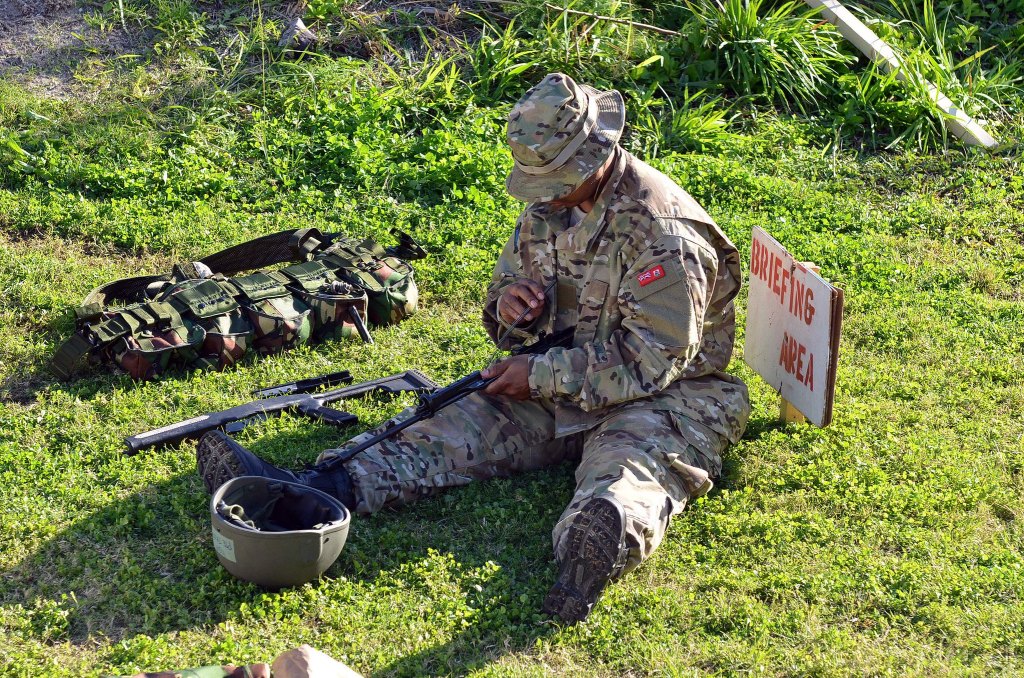
A Royal Bermuda Regiment recruit reassembling a Mini-14, c.2012 (RBR)
The Mini-14 was developed in the late 1960s by L. James Sullivan and William Ruger, chambered in .223 Remington / 5.56x45mm it is a gas operated rifle with a rotating bolt. The rifle was essentially developed as a scaled-down M14 with a cast receiver and a simplified gas system and bolt.
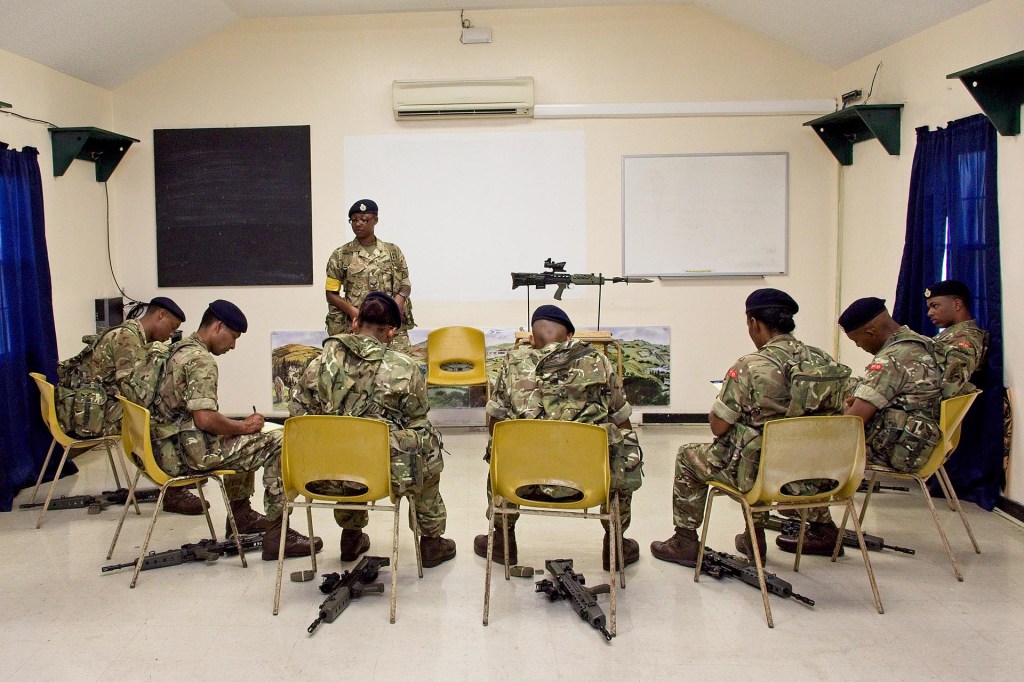
The search for a weapon to replace the Ruger began in the 2010s with the German Heckler & Koch G36 and the US M4 both being tested. The HK G36 was selected but budget constraints saw the British L85A2 adopted instead. In 2012 the Royal Bermuda Regiment had entered into an agreement with the UK’s Ministry of Defence procurement office to allow purchase of some equipment such as the new Multi-Terrain Pattern (MTP) uniforms which replaced Combat Soldier 95 DPM uniforms. It was announced that in the future other personal equipment including boots, body armour and webbing could also be procured via the UK procurement system. This closer cooperation likely paved the way for adoption of RBR configuration L85A2s. The rifles, along with 1,600 magazines and over 400 ACOGs were donated to the regiment. News reports at the time stated the value of the donated equipment was $1.4 million. The switch to the L85A2 began in 2015 and was completed in early 2016.
The rifles appear to have the HK-designed conventional L85A2 plastic hand guards instead of the 2009 A2 configuration which saw the instillation of the Daniel Defence railed forend. The SUSAT sight has been replaced by an ACOG, most commonly seen on what became known as the Theatre Entry Standard (or TES) upgraded rifles. The Bermudan SA80 has a riser picatinny rail for mounting the optic, this was initially developed for British issue L85A2s. In British service the ACOG had been procured earlier first for special forces use and subsequently as a wider urgent operational requirement.
An RBR L85A2 is handed back into the armoury, c.2017 (RBR)
On top of the ACOG is a CQB red dot sight, the ACOG has subsequently been replaced in British service by the ELCAN Spectre. The ACOGs donated to the Royal Bermuda Regiment probably came from surplus stores. We can see on some of the photos released by the regiment that the ACOGs are marked ‘IW-LSW’ indicating that they may have previously been paired with the British Army’s L85 Individual Weapon and the L86 Light Support Weapon.
Recruits introduced to the L85A2, note the sight riser with ACOG mounted (RBR)A Royal Bermuda Regiment recruit at the range with an L85A2, note the IW-LSW marking on the side of the ACOG (RBR)
The Royal Bermuda Regiment’s intriguing use of the Mini-14 represents one of the few military procurements of the rifle.
If you enjoyed this video and article please consider supporting our work here. We have some great perks available for Patreon Supporters – including custom stickers and early access to videos! Thank you for your support!
Bibliography:
RBR Recruits at the range with Mini-14s c.2013, BDA Sun, (source)
Rifles worth $1.4m donated to Regiment, Royal Gazette, (source)
RBR Soldiers Get to Grips with Rifles, RBR, (source)
Regiment Soldiers Continue Training Overseas, BerNews, (source)
Island Warrior 15 B-Roll, USMC/Staff Sgt. Albert J. Carls, (source)
Royal Bermuda Regiment Training, USMC/Lance Cpl. Joel Castaneda, (source)
50 Years Strong! The Royal Bermuda Regiment at 50, Royal Bermuda Regiment, (source)
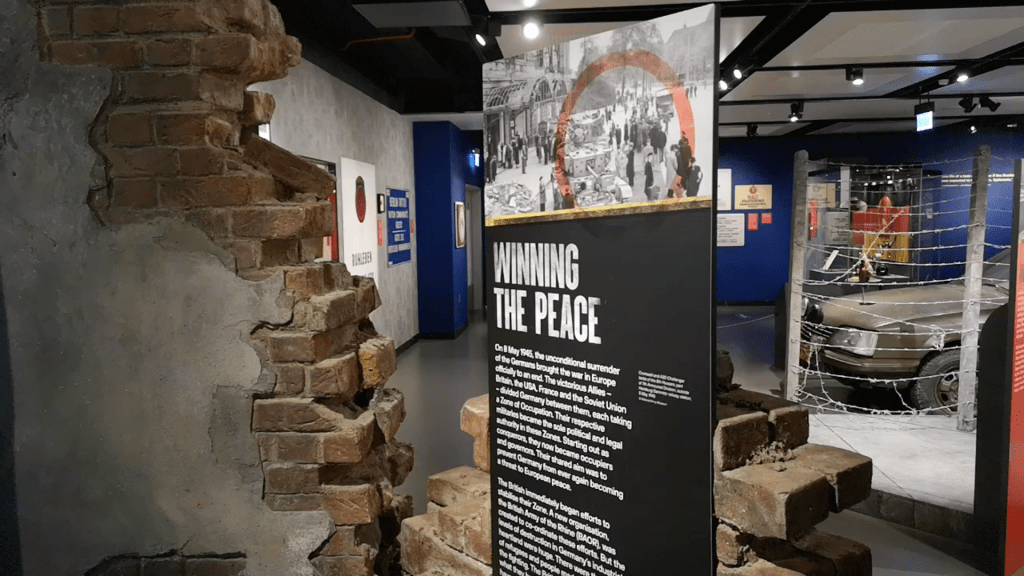
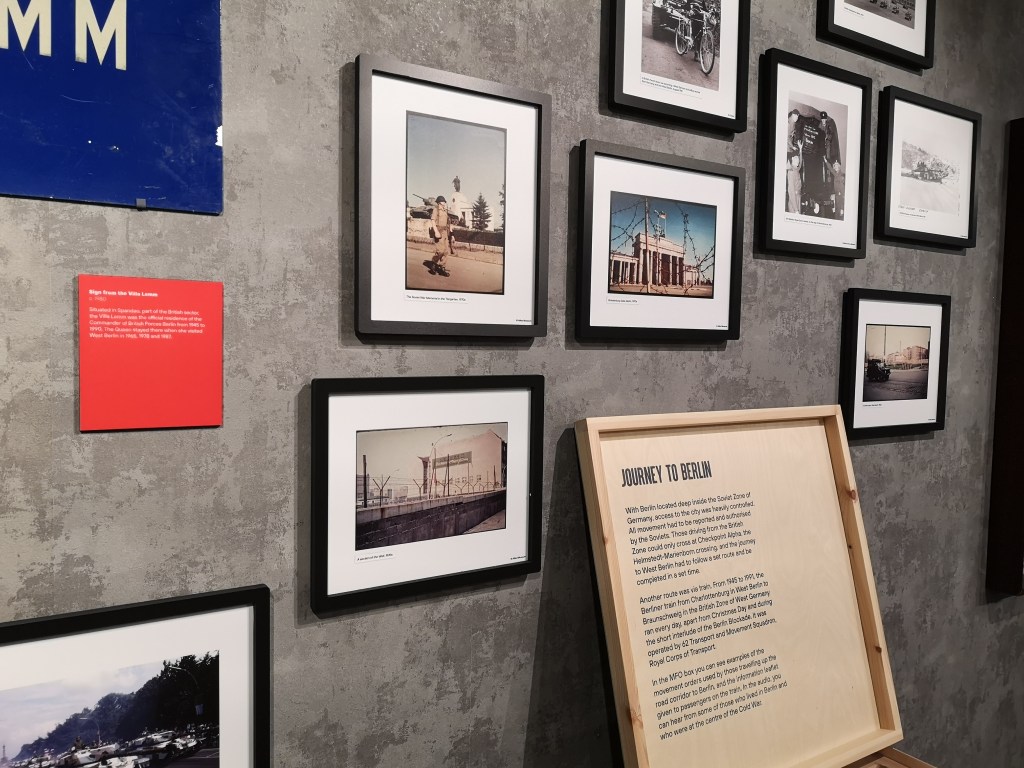
A couple of months ago I visited the UK’s National Army Museum in London. They had an exhibition exploring the history of the British Army in Germany since 1945. Titled Foe to Friend it explores the British Army’s post-war experience in Germany first as an occupier and then as a NATO ally.
Inside the Foe to Friend exhibit (Matthew Moss)
More than a million British soldiers have lived and served in Germany over the past 75 years. The exhibition tries to capture some of their experiences while relating the history of their operations – no small task.
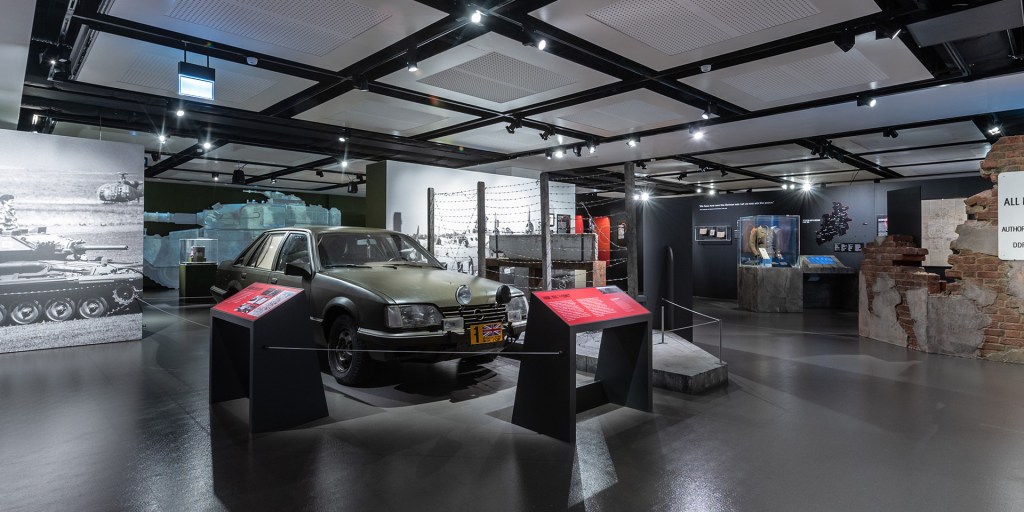
One of the highlights of the exhibit were the small personal items like photos and uniforms but also vehicles like the Brixmis Opel – a car used by British observers to travel through East Germany. There was also an interactive light up display that let you identify various Cold War Soviet vehicles – just like a Brixmis observer!
Inside the Foe to Friend exhibit (National Army Museum)
The exhibition also shows off some of the uniforms and kit used during the UK’s 75 years in Germany as well as some of their weapons including some instantly recognisable Cold War icons like the L1A1 SLR and the Carl Gustav, as well as the SA80 and my old friend the Sterling SMG. Another essential piece of kit – the Boiling Vessel takes centre stage in a multi-media area with a section on the famous food van owned by Wolfgang Meier – he followed British troops on exercise and sold them bratwurst and fish and chips.
Inside the Foe to Friend exhibit (Matthew Moss)
The exhibit covered several rooms but was more sparse than I’d hoped and some of the smaller items seem a little lost. I would have liked to have seen more on the large-scale exercises the British Army of the Rhine took part in, like Lionheart 84. The exhibition does, however, conclude with some displays on the operations some of the men station in Germany took part in, including peacekeeping in Bosnia and the first Gulf War.
It would have been great to have had some interactive displays featuring audio or video interviews from service personnel who had been in Germany during the various periods of the Army’s presence. This is something the West Indian Soldier exhibition, which we recently looked at, did well.
It ends with an excellent graphic depicting how troop numbers in Germany fell dramatically after the Second World War – despite the Cold War, from 780,000 in 1945 to just 135 at the end of the British Army’s deployment in 2020.
The exhibition ran from September 2020 to December 2021.
If you enjoyed this video and article please consider supporting our work here. We have some great perks available for Patreon Supporters – including custom stickers and early access to videos! Thank you for your support!
Further Reading:
‘Active Edge: The Army, Germany and the Cold War’, National Army Museum, (source) ‘Foe to Friend: The British Army in Germany since 1945’, National Army Museum, (source) ‘Foe to Friend: Virtual Tour’, National Army Museum, (source) ‘Army Life in Germany: Virtual Tour’, National Army Museum, (source)
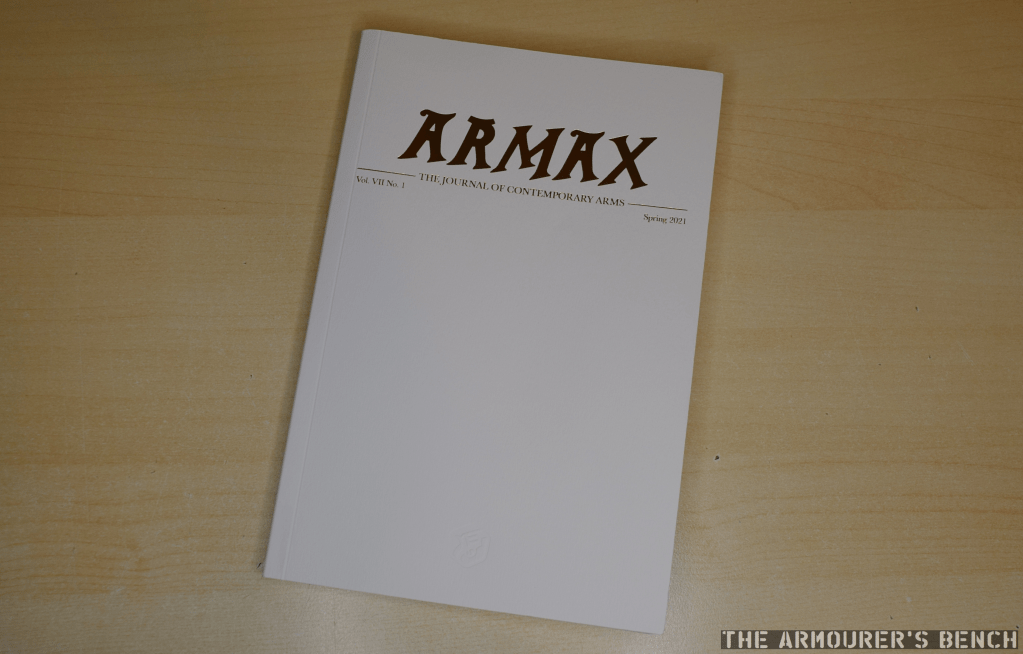
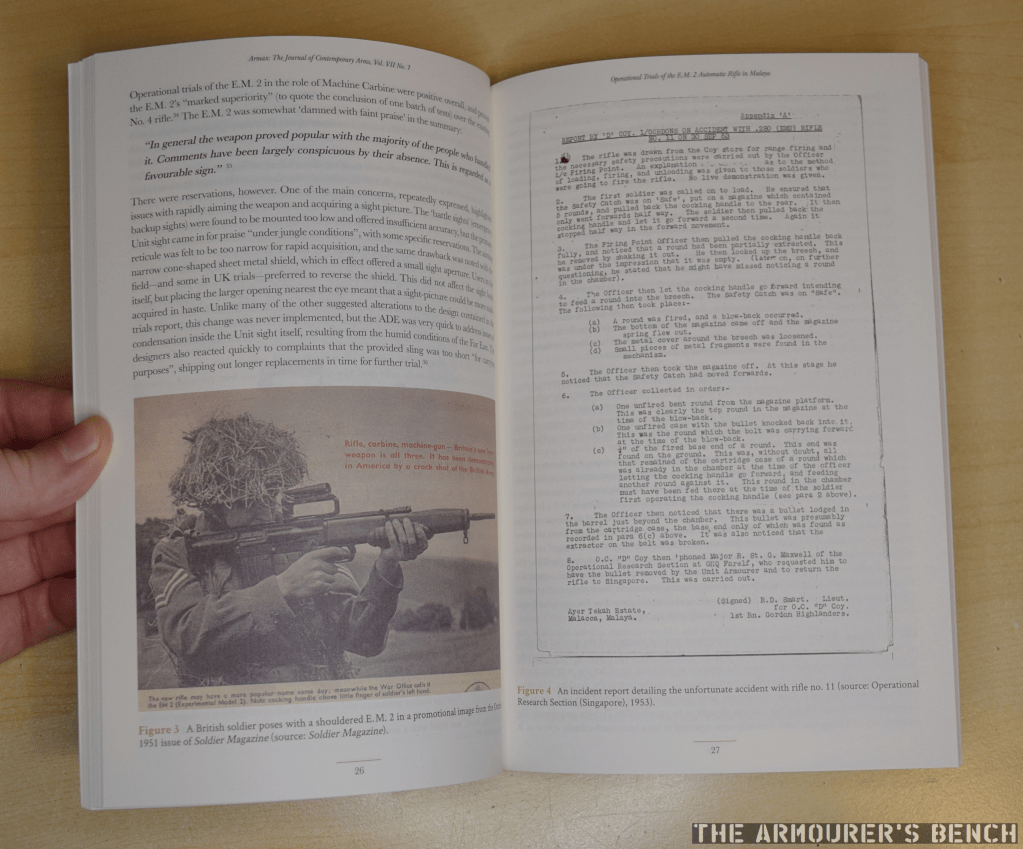
This month sees the relaunch of the ARMAX: The Journal of Contemporary Arms, the academic journal of the Cody Firearms Museum. The first edition of the new ARMAX covers everything from Dutch Uzis to the EM2 in Malaya, from East German AK-74s to a CIA assassination pistol.
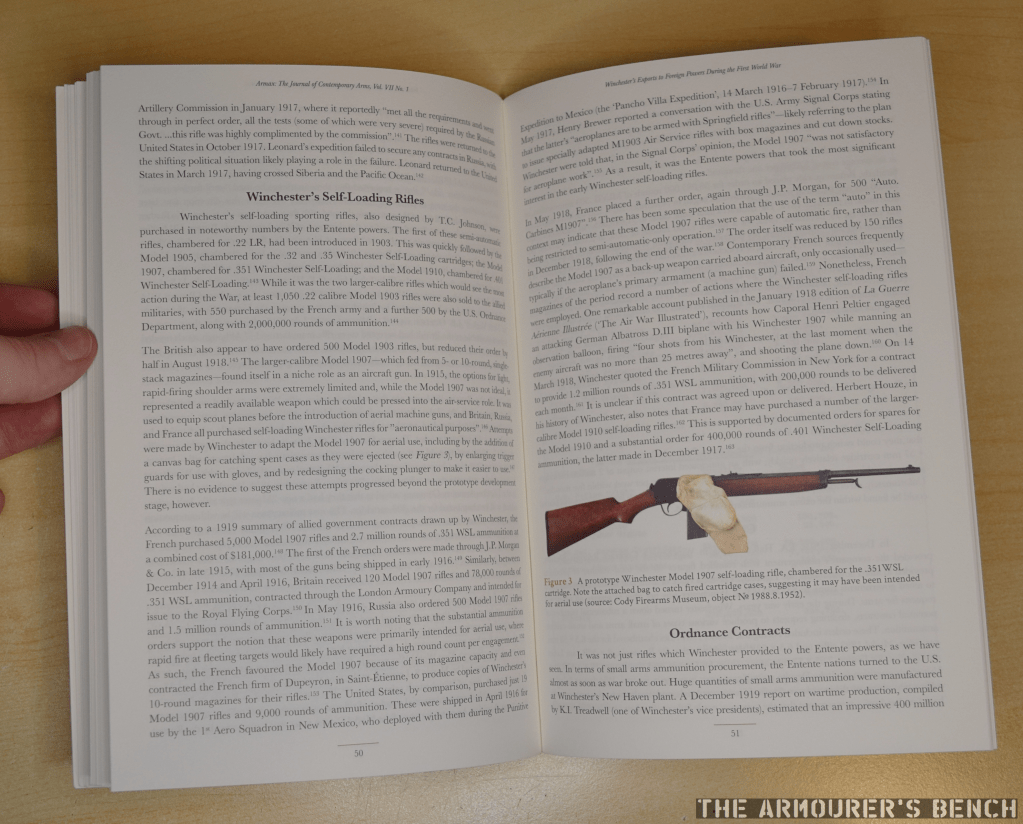
I’m especially excited about the new journal as it contains one of my first published journal articles, it’s titled ‘The Winchester Repeating Arms Company’s Exports to Foreign Powers During the First World War’. The article leverages the research I undertook while a research fellow at the Cody Firearms Museum a couple of years ago. It examines the work of the Winchester Repeating Arms Company during the First World War. Specifically this article explore the breadth and variety of the work done for the Entente powers. I cover everything from the Russian contract Model 1895 lever-action rifles to the air-service self-loading rifles and of course the British Pattern 1914 rifle.
My advanced copy arrived just a day or two ago and I’m so pleased to see my research in print alongside some fantastically interesting work from friends and colleagues. Below are some photos of the journal and above is a first look video.
If you’re interested in up-to-the-minute small arms research then I highly recommend checking out the relaunched ARMAX journal, I’m very excited to see the next edition. Find out more about the journal and read the abstract for my article here.
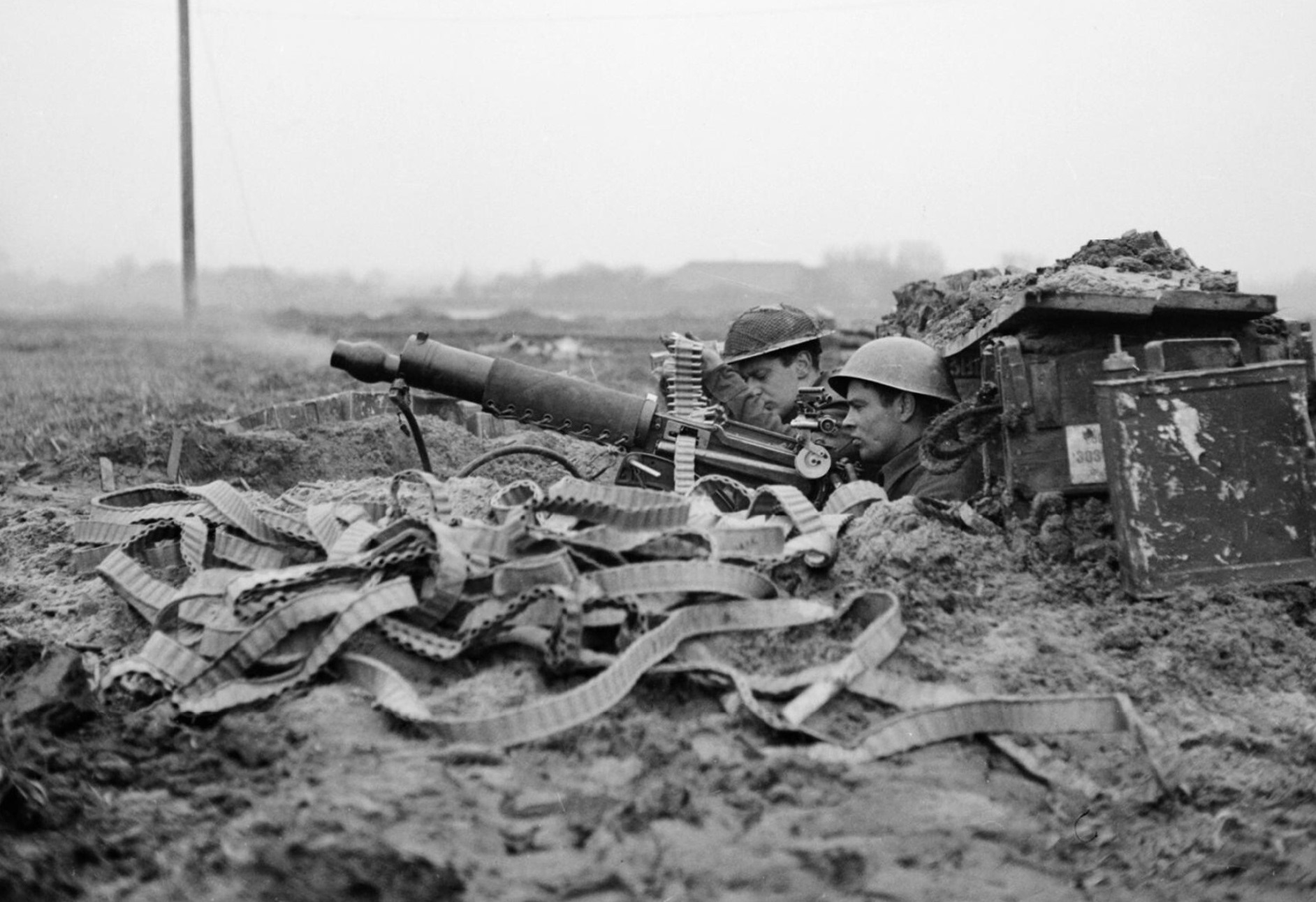
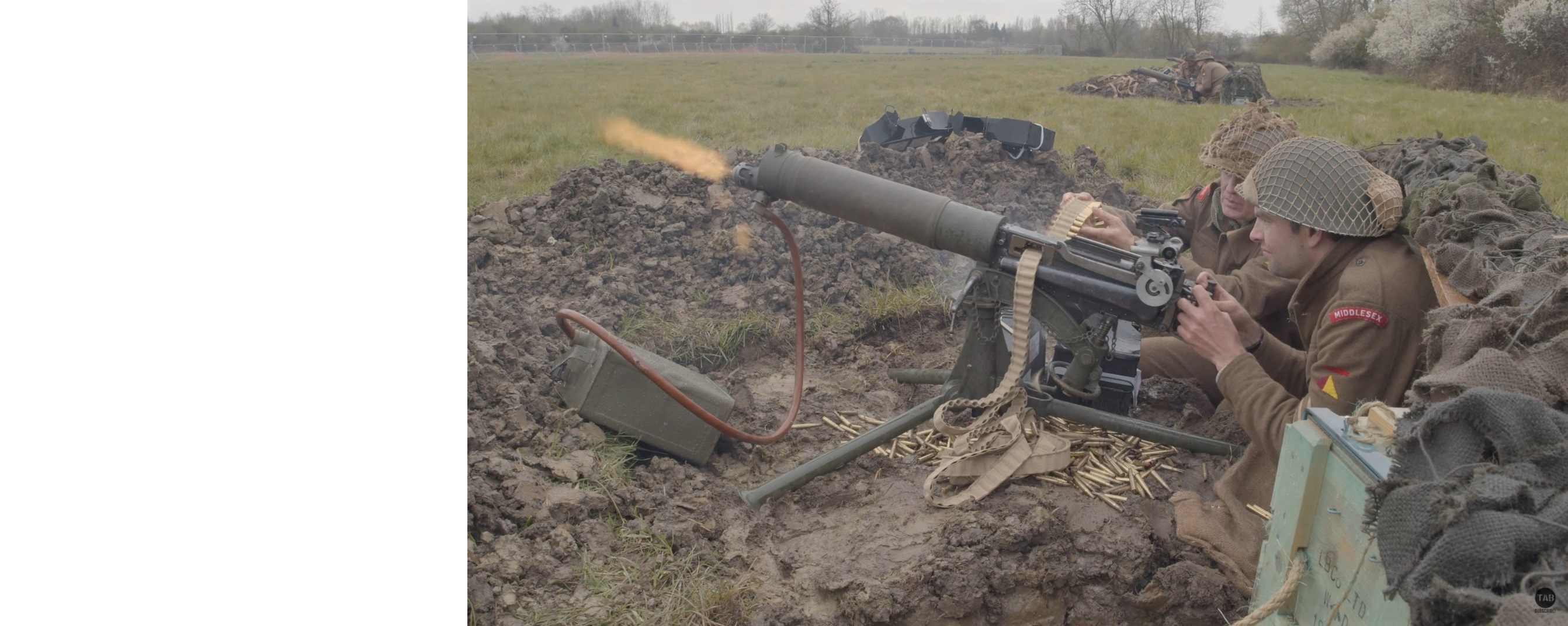
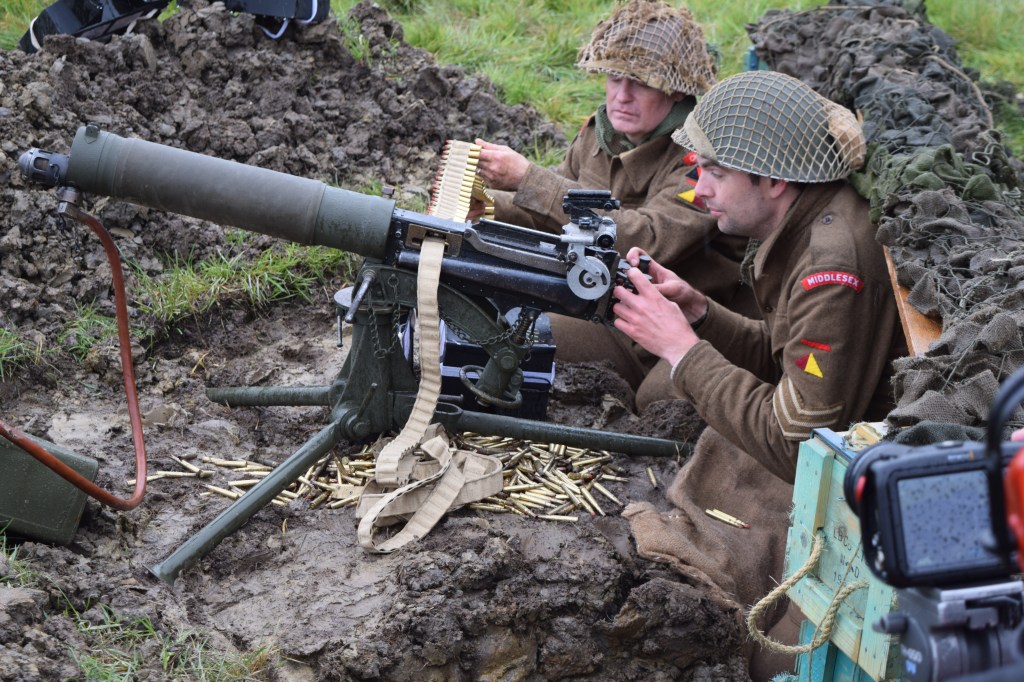
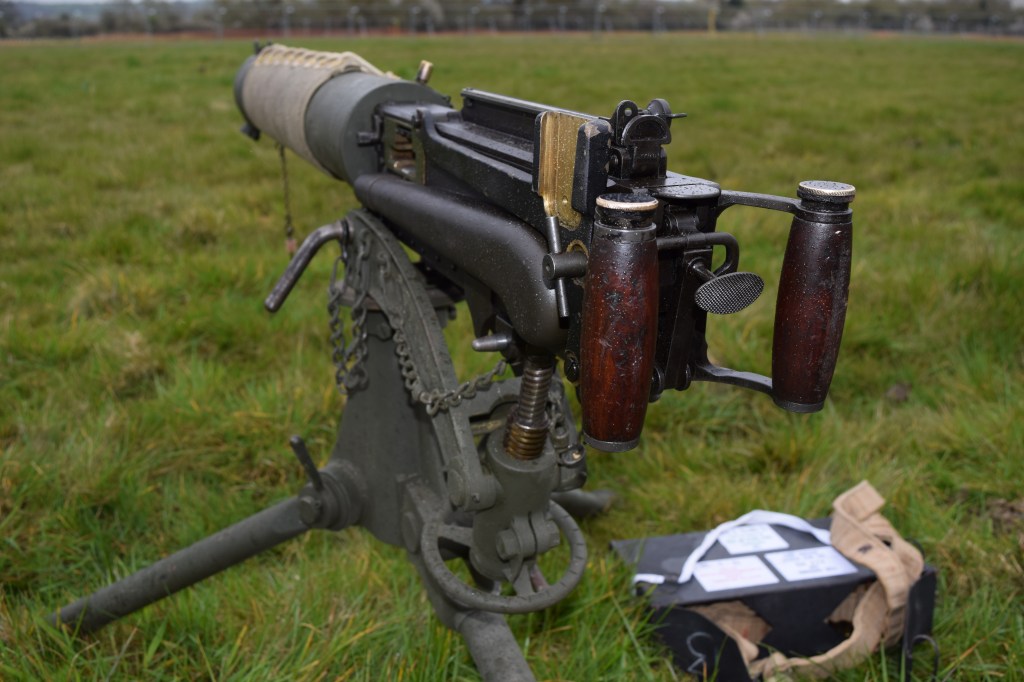
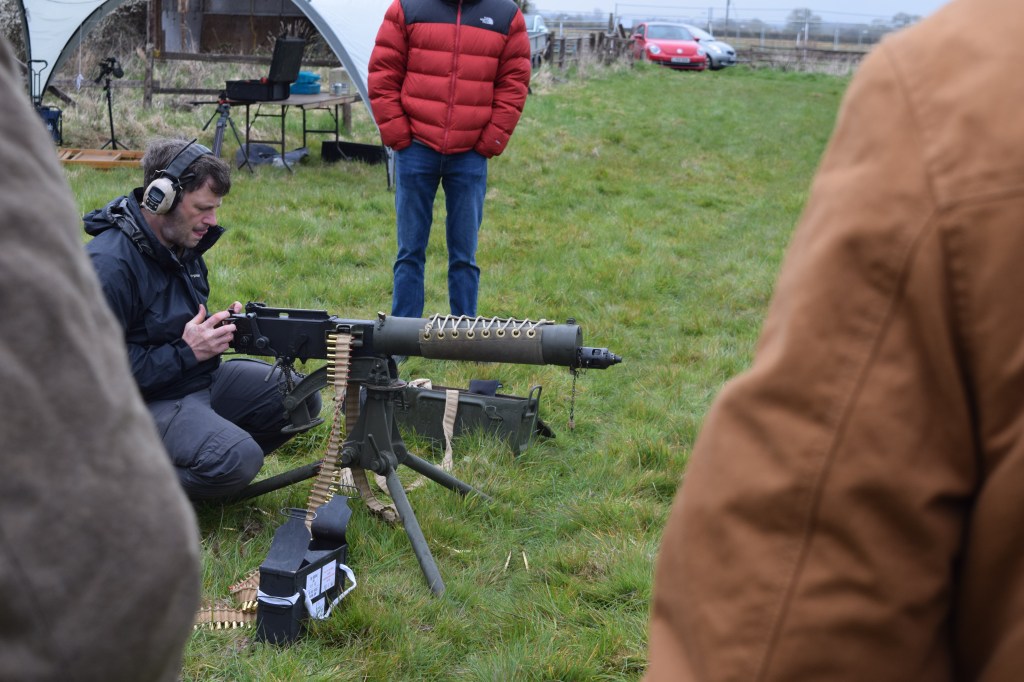
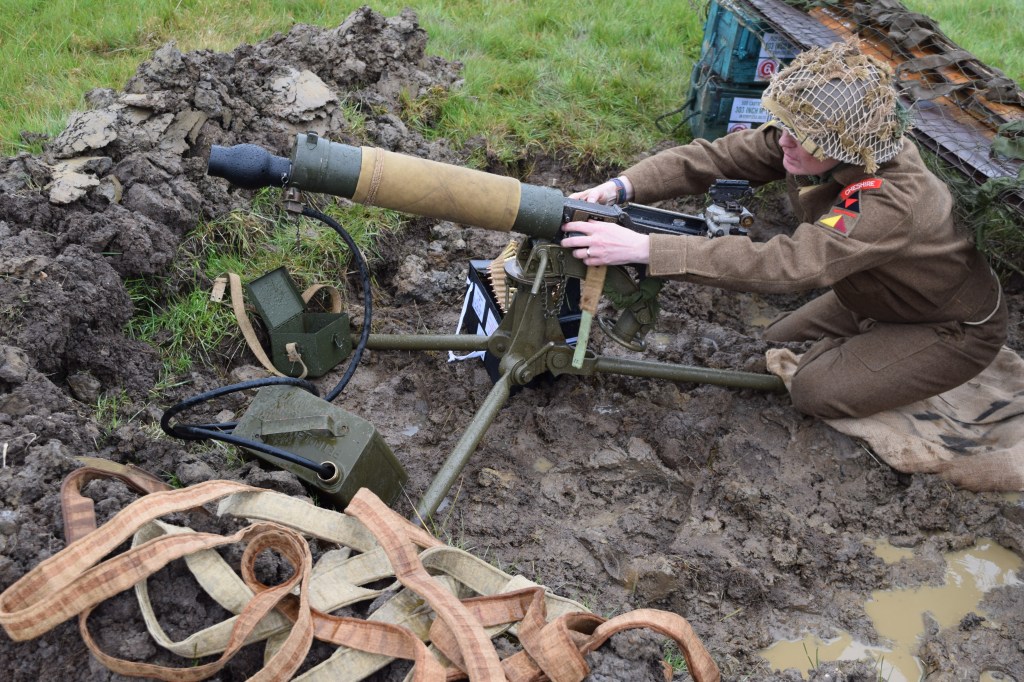
In this final video of the Rhineland Campaign Weapons series we take a look at the little known role of the British and Commonwealth forces’ Vickers Guns. With the help of the Vickers MG Collection & Research Association we recreated a platoon line consisting of 4 Vickers Guns to recreate the Pepperpot tactics used during Operation Veritable – the western Allies’ invasion of Germany.
In this video we examine how Vickers Medium Machine Guns were used en masse to soften up enemy positions before Operation Veritable began and during the subsequent advance into the Rhineland. The Vickers was used alongside artillery, mortars and even anti-aircraft guns in what was known as a ‘pepperpot’ fire plan – where the focus was on weight of fire. The Vickers supported the advance through out the campaign and in this video we aimed to capture some of the feel of what those pepperpot bombardments might have been like – albeit on much, much smaller scale.
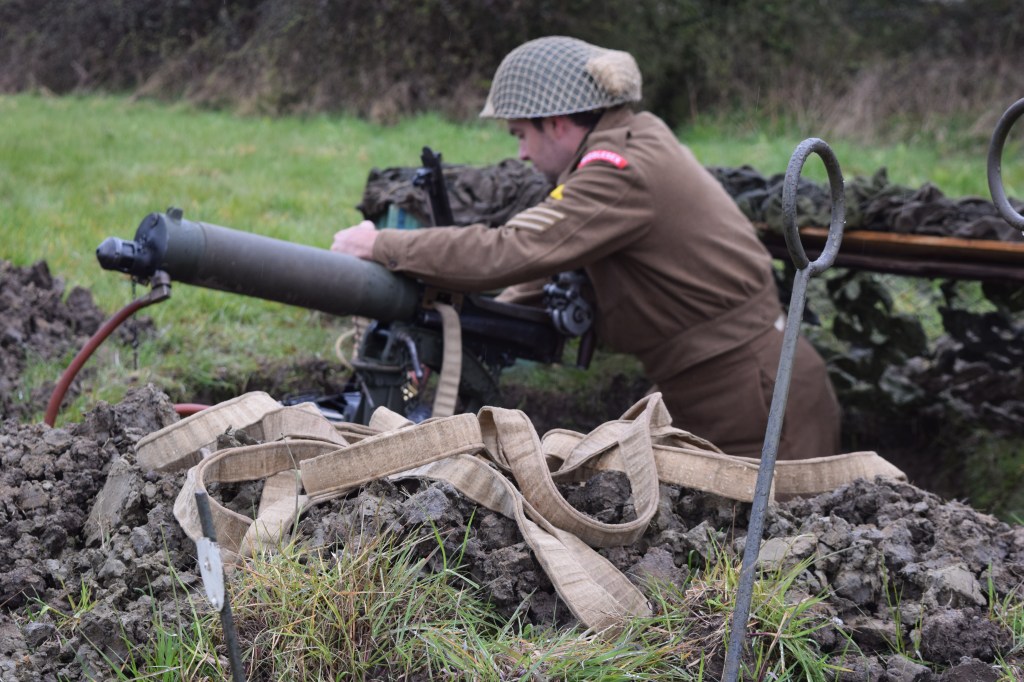
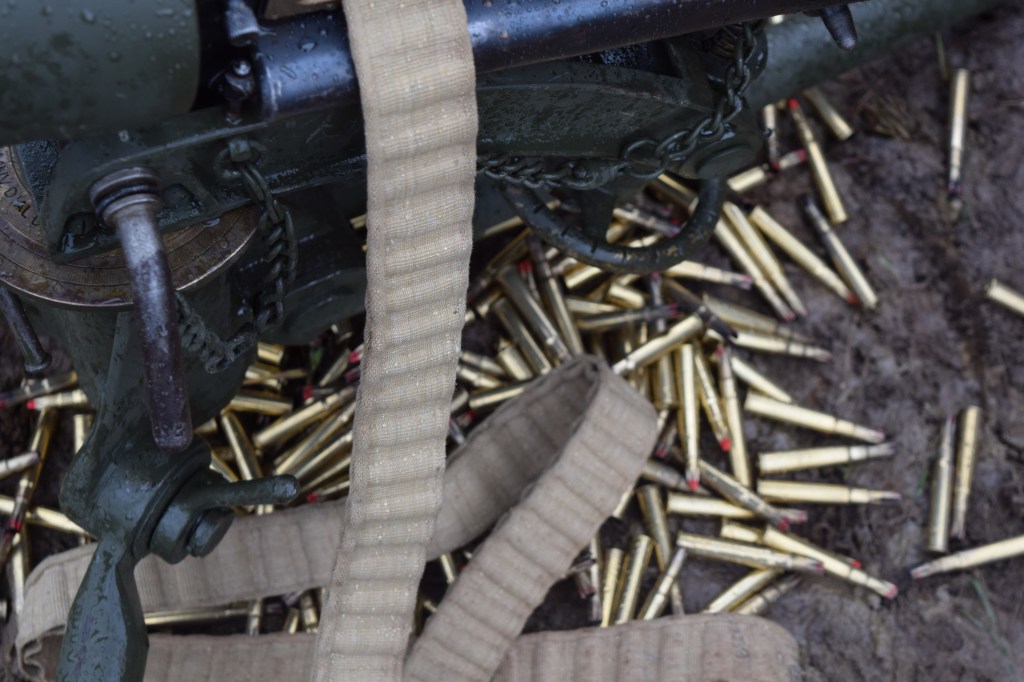
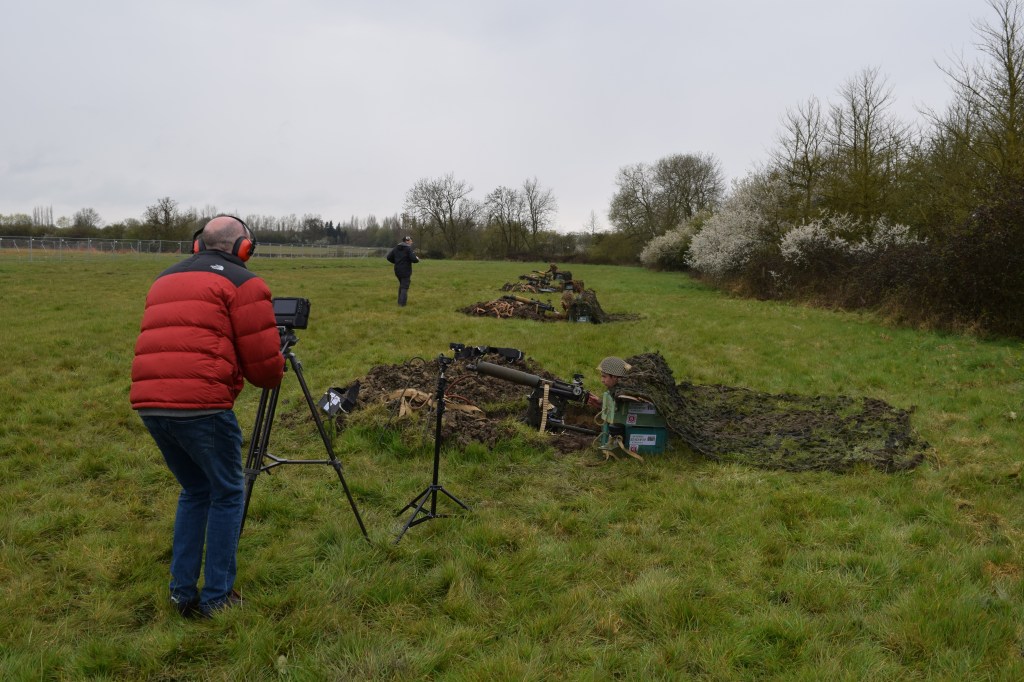
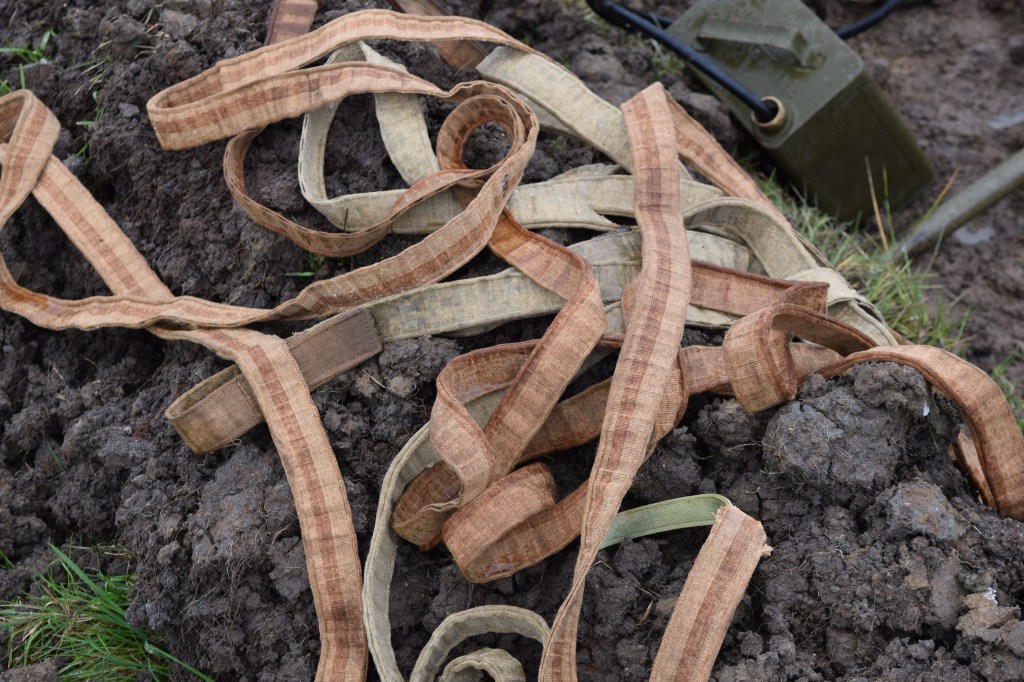
Using contemporary photographs and footage we recreated the gun pits, complete with overhead cover, pits dug to the original manuals and plenty of empty belts and belt boxes. Right down to the gun crews being badged up as Middlesex Regiment. Check out the comparison of our shoot and a contemporary photograph taken during the battle for Goch, 20 February 1945.
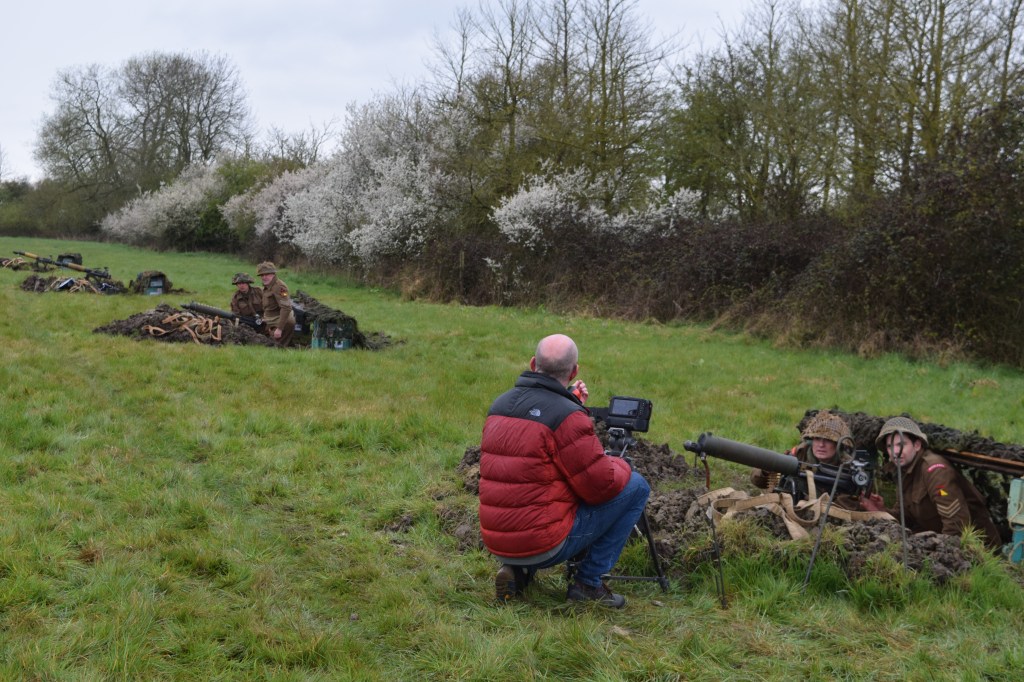
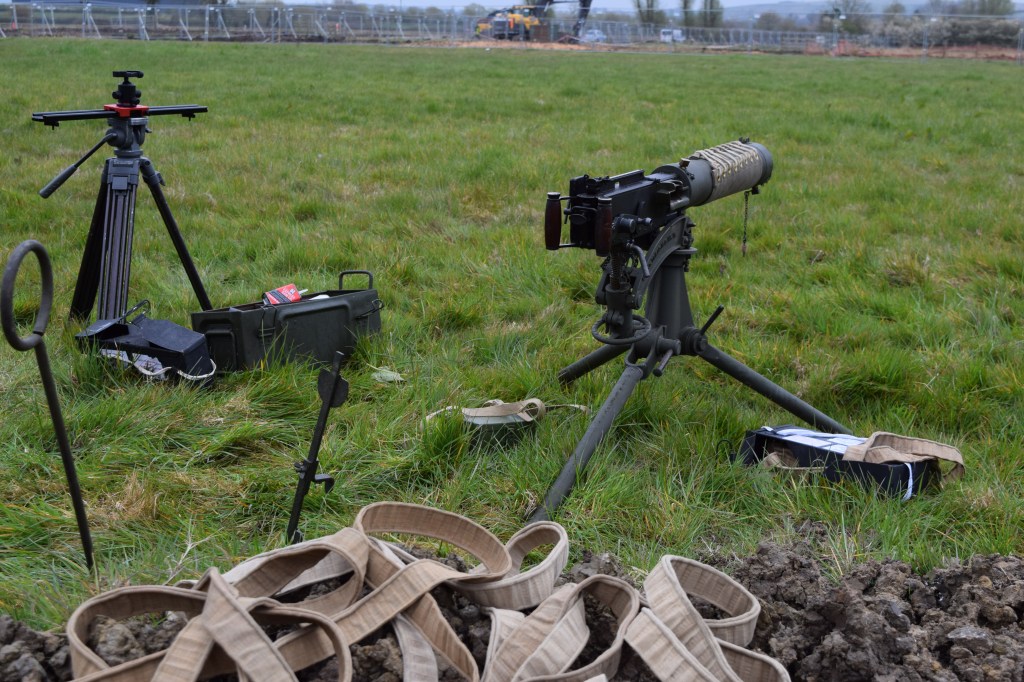
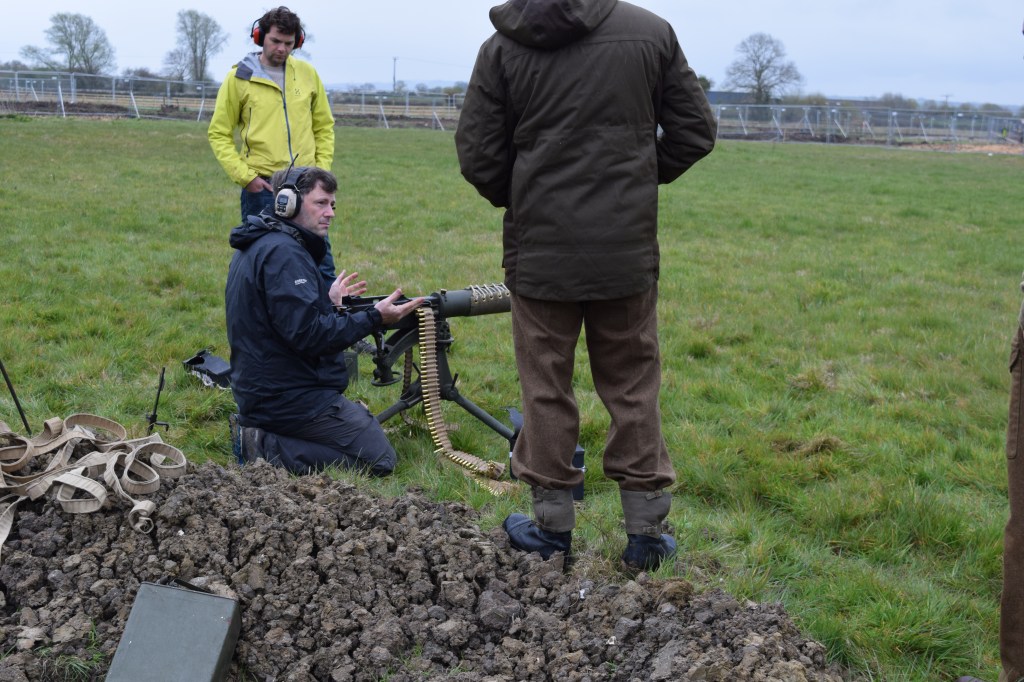
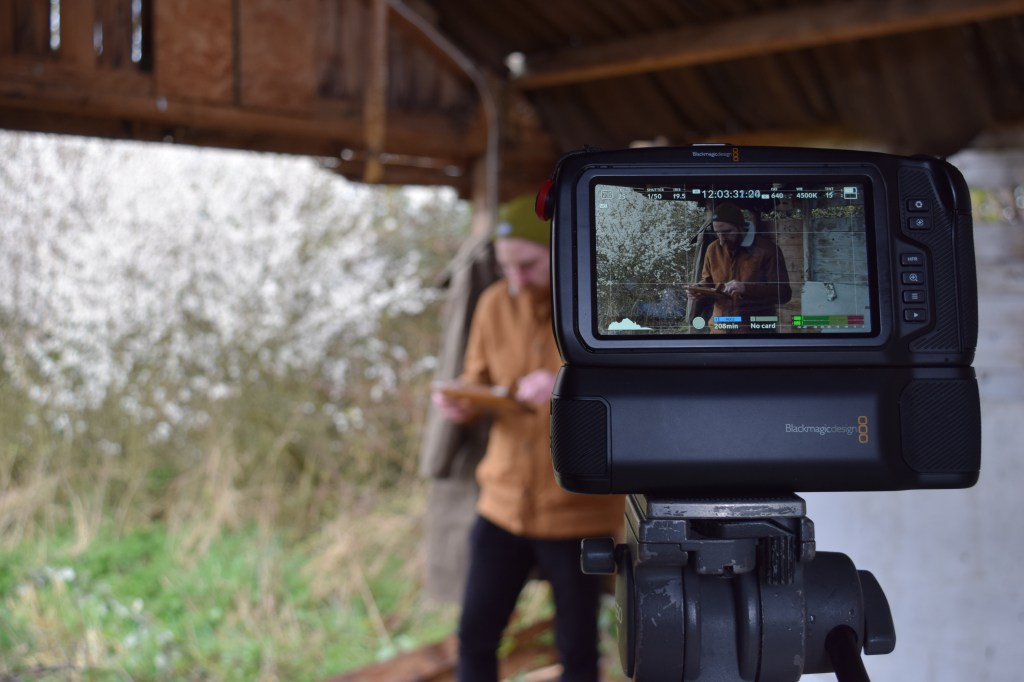
Below are some behind the scenes photos from the shoot taken by myself and Robbie McGuire:
A huge thank you to everyone who made the shoot possible, I’m very proud of what we were able to achieve with this shoot.
If you enjoyed this video and article please consider supporting our work here. We have some great perks available for Patreon Supporters. Thank you for your support!









 The Armourers Bench