15-Inch Vickers Battery at Fortalesa Isabel II


Last summer I was lucky enough to visit the vast Fortalesa Isabel II which defended the port of Mahon, in Menorca. One of the fort’s most impressive sights is its huge 15 inch gun battery.

The Spanish island of Menorca, in the Balearic Islands, has a long and storied military history. The strategically important harbour of Mahon was historically the envy of the British, Spanish and French and was the reason for Fortalesa Isabel II’s construction. The for was the last major fortification built on the island, with the Spanish military beginning construction in 1850. A second phase of major improvements was made during 1853-1864. Work to improve and modernise the fort continued into the 20th century.

Fortalesa Isabel II main gate (Matthew Moss)
The ornate main gate of the fort, defended by a counterguard and rifle slits either side of the gate (Matthew Moss)

The Fortress is built on a beautiful rocky headland of La Mola at the mouth of the harbour and covers about a square kilometre. Construction was a massive undertaking and took over twenty years to complete, costing over nine million pesetas. The fortifications are some of the Mediterranean’s most impressive of the period.

The fort is a maze of tunnels, galleries, casements and buildings surrounded by a deep, dry moat. The fort’s first line of defence consisted of a moat 9 metres (30 feet) deep covered by rifle loop holes for infantrymen and embrasures for artillery. Interlocking fields of fire defend the landward approach to the fort’s main entrance, the Queen’s Gate.
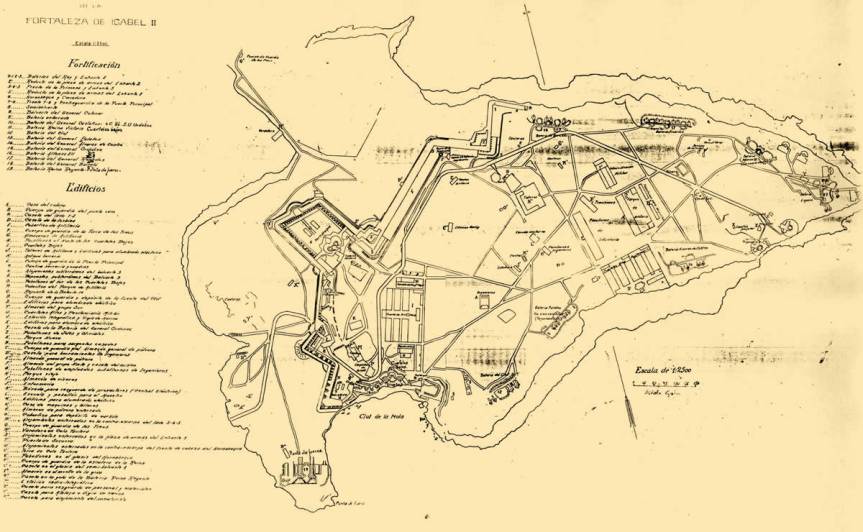
Map of the La Mola peninsular and fort
Map showing the layout of the fort during the 19th century before the 15 inch guns were added (source)

Designed to dominate the entrance to the harbour the fortress was intended to hold 160 artillery pieces of various sizes, including Krupp guns and howitzers, many of these protected by strong stone casements. The fort’s armaments evolved overtime from muzzle-loaders to faster firing breech-loaders.

The Spanish continued to upgrade the fort’s guns over the decades mounting rifled guns and howitzers of various calibres ranging from 15cm to 30.5cm. In addition to the fort’s guns the defences also included mines in the harbour mouth and later a battery of shore launched torpedoes.

By the early 20th century the fort’s guns were increasingly obsolete against the backdrop of the naval revolution that saw Dreadnoughts come to dominate maritime warfare. With advances in naval architecture, armour and guns the Spanish government decided to purchase a number of massive 15 inch naval guns that could fire a 1,895 lb (860kg) shell up to 22 miles.
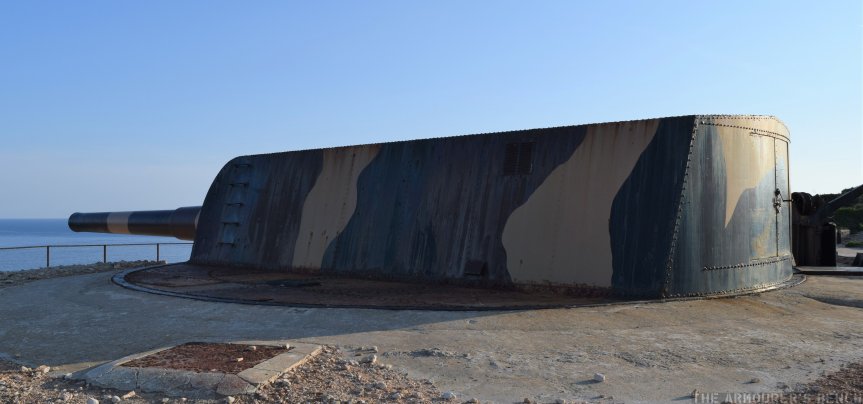
One of La Mola's 15 inch guns in position
One of the fort’s two 15 inch Vickers guns in position on Cape Espero (Matthew Moss)

Spain purchased 18 of these massive guns made by the British Vickers company, they had originally been designed for the cancelled Brazilian battleship Riachuelo. In Spanish service the guns were officially designated the Costa de 38.1cm Modelo 1926. During the 1930s the new coastal guns were installed on both the Spanish mainland and Menorca. Two guns placed in the Castillitos Battery, defending Cartagena, opened fire on a Spanish Nationalist fleet, during the dying days of the Spanish Civil War. While Menorca’s guns never fired a shot in anger, they acted as a deterrent.

The first guns reached Mahon in 1932, with a second arriving in 1936, these were mounted on the cliffs of Cape Espero on the La Mola peninsular. The guns were so huge they had to be transported to the fort on a specially built railway pulled by hand and traction engine. These formidable new guns brought Fortalesa Isabel II’s armament up to date, enabling it to protect Mahon from any modern warship.
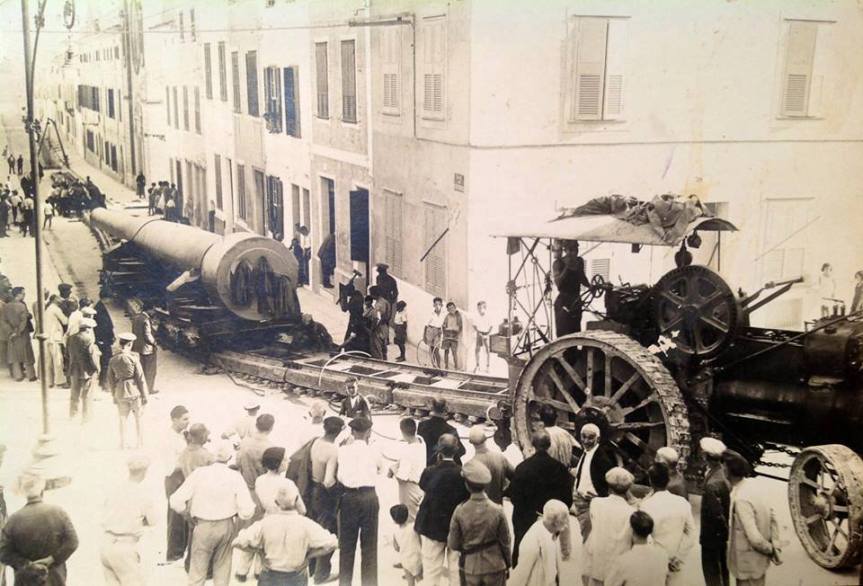
15 inch gun being dragged by a traction engine through mahon
One of the massive 15 inch guns being pulled along its special track by a traction engine through the streets of Mahon (source)

The 15 inch (or 381mm) Vickers battery at the fort was positioned 70m above sea level and commanded the entrance to the harbour. Six guns were eventually sent to Menorca with two  placed on La Mola, two more installed in a battery at Favaritx (the remains of which can be seen here) in the north of the island and a pair at a battery near Llucalari in the south of the island.

While the guns at Favaritx were later removed, the guns at Llucalari remain. The fact that six of these massive and expensive naval guns were placed on Menorca shows its strategic value during the period.
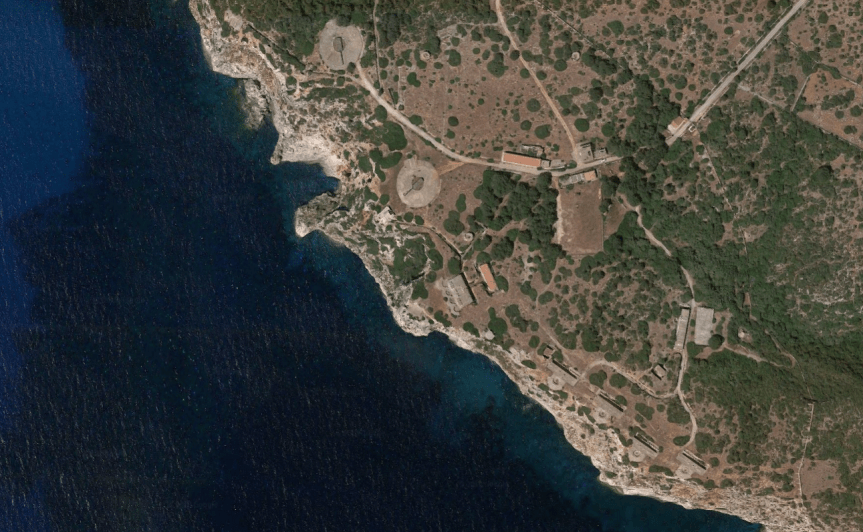
Satellite photo of the 15 inch battery at Llucalari
Satellite photo showing Menorca’s other 15 inch battery at Llucalari (google maps)

The guns were mounted in barbettes which allowed the guns to traverse up to 300 degrees. The gun housing of the turret was armoured but while it would not protect the crew from a direct hit, it would protect against shrapnel. Below the guns were magazine stores for both cordite charge bags and projectiles, the machinery needed to rotate and move the gun and the motors to power it. Inside the turret were controls to open and close the breech, lift and lower the loading tray and aim the gun. The guns had a potential maximum range of 35km or 22 miles, however, the guns at La Mola lacked the necessary range-finding equipment to achieve this range.
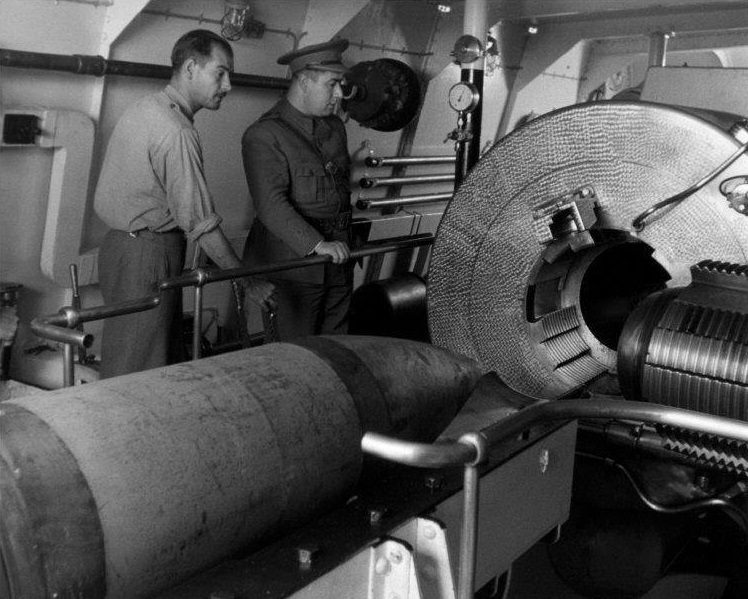
Inside the 15 inch gun turret
A contemporary photograph showing the interior of the gun turret. A shell is sat on the loading try ready to be pushed into the breech. (source)

The ancillary buildings for the battery on La Mola are built just behind the two gun emplacements with offices, stores and barracks built in an old quarry. As well as the two main guns the battery was supported by four faster firing 6 inch Vickers guns.

15 inch Vickers gun firing in the 1980s
One of Menorca’s 15 inch guns firing c.1980s (source)

With the eruption of the Spanish Civil War in 1936, Menorca was initially held by the Republicans. But in 1939, the island fell to General Franco’s Nationalists and the fort’s military prison was used to house a number of prominent Republican prisoners. Throughout the Cold War the fort continued to be used by the Spanish Army as a training centre but the rise of air power, the invention of the cruise missile and nuclear weapons rendered the fort and its guns increasingly obsolete.

The last of Spain’s 15 inch guns were finally decommissioned in the mid-2000s, after nearly 80 years in service. Fortalesa Isabel II and her two massive guns never saw action, and today the site is maintained as an impressive museum which is well worth a visit.

If you enjoyed the video and this article please consider supporting our work here.


Specifications:

Length: 18m or 59 feet
Weight: 86.9 tons
Action: breech-loading
Calibre: 15 inch or 381mm
Elevation -5 / +40 degrees
Traverse: 300 degrees
Rate of fire: 2 rounds per minute


Bibliography:

The Fortress of Isabel II on La Mola in Mahon Harbour (19th 7 20th Century), F. Fornals (2007)

The Conquests and Reconquests of Menorca, M. Mata (1984)

Guns of Cartagena, espele.net, (source)

‘Yo hice la Mili en La Mola de Menorca’, Facebook group with excellent contemporary photos (source)

www.fortalesalamola.com


Please do not reproduce photographs taken by Matthew Moss without permission or credit. ©The Armourer’s Bench 2018.
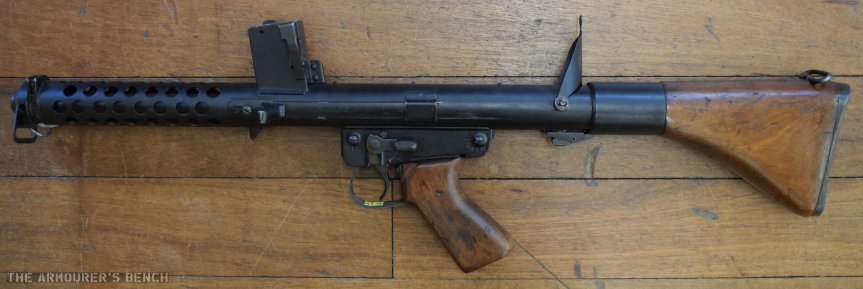
F1 Submachine Gun

The Australian military adopted the F1 submachine gun in 1962, with the first guns reaching troops in April 1963, it replaced the venerable Owen gun. Like the earlier Owen the F1 had a top-mounted magazine – a position that lent itself to prone firing and more comfortable carrying when slung. But it also shared some similarities with the British L2A3 Sterling.

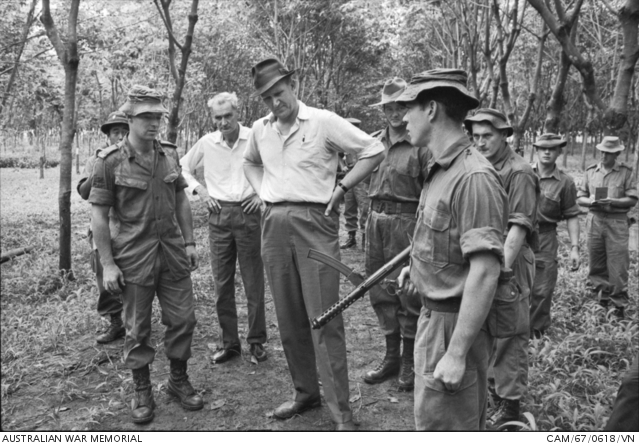
NUI DAT, VIETNAM, 7TH BATTALION, THE ROYAL AUSTRALIAN REGIMENT (7RAR) with F1 SMG
Men of the 7th Battalion, The Royal Australian Regiment demonstrate the F1 to the Australian Army Minister, Malcolm Fraser, in Vietnam in 1967 (Australian War Memorial)

The F1 entered service alongside the Australian L1A1 (self-loading rifle/FN FAL), it shared the rifles butt plate and pistol grip – slightly minimising additional unique parts needed by the submachine gun. Australian Ordnance had begun searching for a replacement for the ageing Owen gun after the Korean War. The Owen had been made quickly and cheaply during the Second World War and while it was well liked by Australian troops it was felt it could be improved upon. Maintenance of the older Owen guns proved difficult as each weapon had been hand fitted to speed up production and some parts proved not to be interchangeable.

F1 SMG (Matthew Moss)
Left side view of an Australian F1 submachine gun, from the 1970 production run (Matthew Moss)

A number of designs were developed including one designated the Kokoda (presumably after the Kokoda Trail campaign fought by Australian troops in 1942). This design was lighter than the Owen but suffered from overheating problems. A series of designs from the Australian Design Establishment, designated the ‘X’ series, were then developed. These weapons incorporated elements from both the Owen and the British Sterling. Including the Sterling’s perforated barrel jacket and magazine and the Owen’s bolt, magazine orientation and forward pistol grip – a feature many troops with experience with both the Owen and F1 lamented to loss of with the adoption of the F1. The first two ‘X’ series weapons developed into the X3 which in 1962, after successful trials, became the F1.

8RAR with F1 SMG (AWM)
Member of 8th Royal Australian Regiment stood too with his F1 SMG (Australian War Memorial)

The F1 used a standard blowback action with a non-reciprocating charging handle. The charging/cocking handle was positioned on the left side of the receiver with its slot protected from the ingress of dirt by a dust cover. The F1 has a two-position fire selector with up for ‘safe’ and down for ‘fire’. The trigger mechanism allowed for firing single shots by pulling the trigger to the half-way point, this allowed the sear to trip into the semi-automatic position (see the diagram below).

Semi-Auto sear position in F1 SMG
Diagram from Australian Army Parts List showing how the F1’s semi-automatic mode works (source)

Chambered in 9x19mm, the F1 fed from a 34-round curved magazine, although it could use straight, single-feed, Sten or Owen magazines. In the 1960s, in order to achieve commonality with Britain and other Commonwealth nations, that used the Sterling Submachine Gun, the Australian government contacted the Sterling Armaments Company to enquire how much a license to produce Sterling’s magazines would cost, only to be quoted an exorbitant fee. The Australian government were unwilling to pay for the license and produced them anyway. And as Sterling could not afford to take legal action were able to continue to do so – with the understanding they would not sell any commercially. The Australian government would later purchase a number of suppressed Mark 5 Sterling-Patchetts, also adopted by the British army as the L34A1.

The weapon’s ejection port was located on the bottom of the receiver ahead of the trigger guard. A small piece of metal was added in front of the ejection port, as a hand stop, to prevent the operator from inadvertently moving their hand over the port. The F1 had an in-line stock fitting into the rear of the tube receiver. The sights were offset to the right, the rear peep sight folded against the receiver when not in use while the front sight, rather than over the muzzle, projected from the right side of the magazine housing.  The F1 could also mount the L1A1 self-loading rifle’s standard L1A2 sword bayonet.

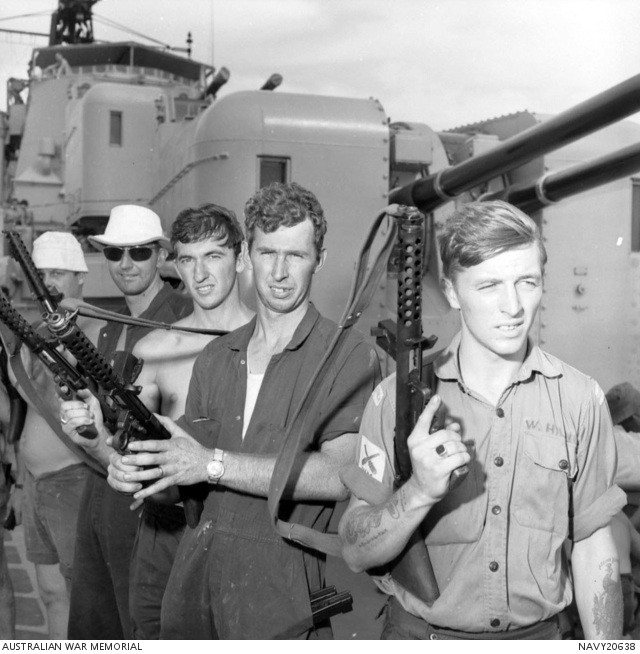
Australian Sailors with F1 SMG
Australian sailors aboard the destroyer HMAS Duchess wait to take part in a live firing exercise with their unloaded F1 submachine guns, c.1969. (Australian War Memorial)

The F1 weighed just over 7lbs (3.2kg), was 28 inches long and had a cyclic rate of approximately 600 rounds per minute. It had a solid butt stock, unlike the Sterling which had a folding stock. The F1 was produced solely by the Lithgow Small Arms Factory with most sources suggesting 25,000 were produced for the Australian military between 1963 and 1973. The Lithgow Small Arms Factory Museum were kind enough to look into the exact number made for us, and reported that there is some uncertainty surrounding the exact number produced with production report totals varying, giving a total of either 21,916 or 24,828.

The F1s saw extensive service in Vietnam and later with Australian peacekeeping troops through to the 1990s. It was issued to rear echelon troops, ACP and aircraft crews and to infantry sections. While the F1 was appreciated for its reliability, for those troops who had experience with the venerable Owen Gun, the F1 lacked a certain something.  Colonel Warren Feakes noted that “every time I picked up an F1 I had the feeling that something was missing.” Another Australian veteran, Warrant Officer Kevin Konemann, who served in Vietnam in 1966-67, recalled: “It was awkward to fire from the shoulder and more awkward to fire from the hip” and that “the F1 wasn’t popular. Soldiers found it more difficult to point and bring on target than the OMC [Owen Gun] and firing from the shoulder… was decidedly more difficult without the front hand grip.”

Despite the shortcomings identified by some troops the F1 remained in service alongside the L1A1 self-loading rifle into the early 1990s, when both were phased out of use as the 5.56x45mm F88 (Steyr AUG) was adopted.

If you enjoyed the video and this article please consider supporting our work here.


Technical Specifications:

Length: 28 inches (71cm)
Weight (unloaded): 7lbs (3.2kg)
Barrel Length: 8.35 inches (19.8cm)
Action: Blowback
Calibre: 9x19mm
Feed: 34 round box magazine
Cyclic Rate: ~600 rpm


Bibliography:


1966 Infantry Training Pamphlet, Platoon Weapons, Sub-machine Gun 9mm, F1, Australian Army, (source)

Repair Parts Scale, 9mm, F1 SMG, Australian Army, (source)

Vietnam ANZACs Australian & New Zealand Troops in Vietnam 1962-1972, K. Lyles (2004)

Military Small Arms of the 20th Century, I. Hogg & J. Weeks (1985)

‘Another Australian Native: The 9mm F1 Submachine Gun’, Arms & Militaria Collector No.21, pp. 53-56, I. Skennerton, (source)

Modern Small Arms, F. Myatt (1979)

The Owen Gun, W. Wardman, (1991)

F1 Sub-machine Carbine, Lithgow Museum, (source)


Please do not reproduce photographs taken by Matthew Moss without permission or credit. ©The Armourer’s Bench 2018.
Special Episode: The ArmaLite AR-10 (Pt.2)


If you missed the first part of our special episode on the AR-10 you can find it here!

Vic brings us the second part of his special episode looking at the story of the AR-10, with a very unique run down of various variants of Eugene Stoner’s weapon. Vic runs us through every production model made by Artillerie Inrichtingen as well as several special prototypes and transitional models.

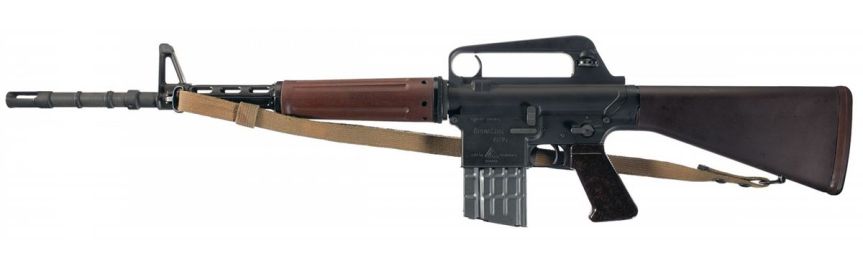
After a recap look at an example of a Hollywood-made rifle Vic shows us how the AR-10 worked using an instructional cutaway model. Throughout the video Vic examines all of the major production guns, beginning with an early A.I. production gun that incorporates the same ‘beer can’ muzzle device as the original American-made rifles. Vic then takes us through a series of rifles that represent the evolution of the design.

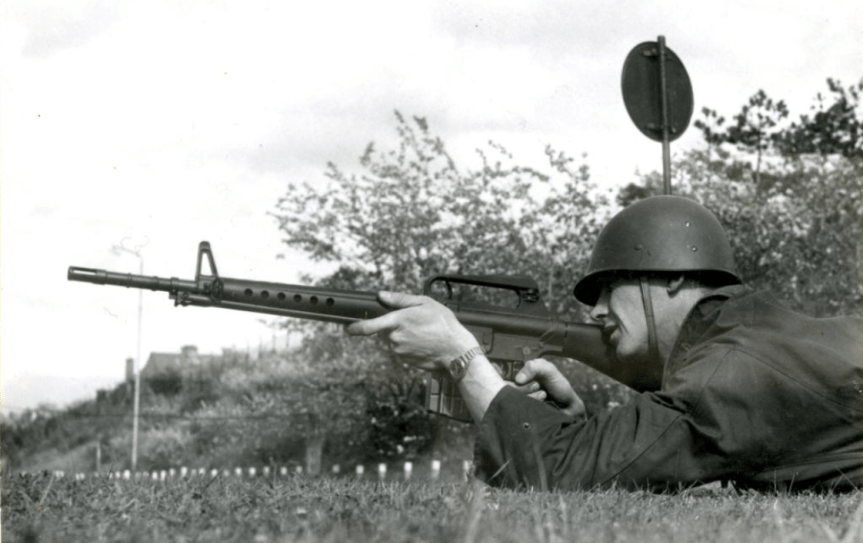
Photograph from the Bundeswehr rifle trials of a German soldier firing an AR-10B in 1957, the German’s classified the AR-10 as the G4 during the trials (source)

Beginning with the Cuban model, with its pencil profile barrel and top mounted gas tube. This model was also trailed by both the Dutch Army and the German Bundeswehr. Later in the video Vic gives us a quick look at the various German trials rifles the FAL (G1), the SIG 510-1 (G2), the H&K/CETME (G3) and the AR-10 (G4).

22222222
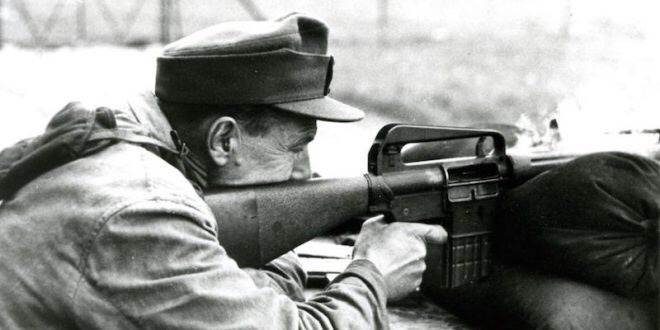
Soldier firing an AR-10 during the Dutch Army trials (source)

Vic follows the Cuban model with a look at the Sudanese Model, with its bayonet lug sleeve, and the Guatemalan variant which swaps out the bayonet lug for rifle grenade launching capability. The Sudanese military ordered 2,508 rifles from A.I.

tumblr_nqmmbtj7FT1s57vgxo5_1280
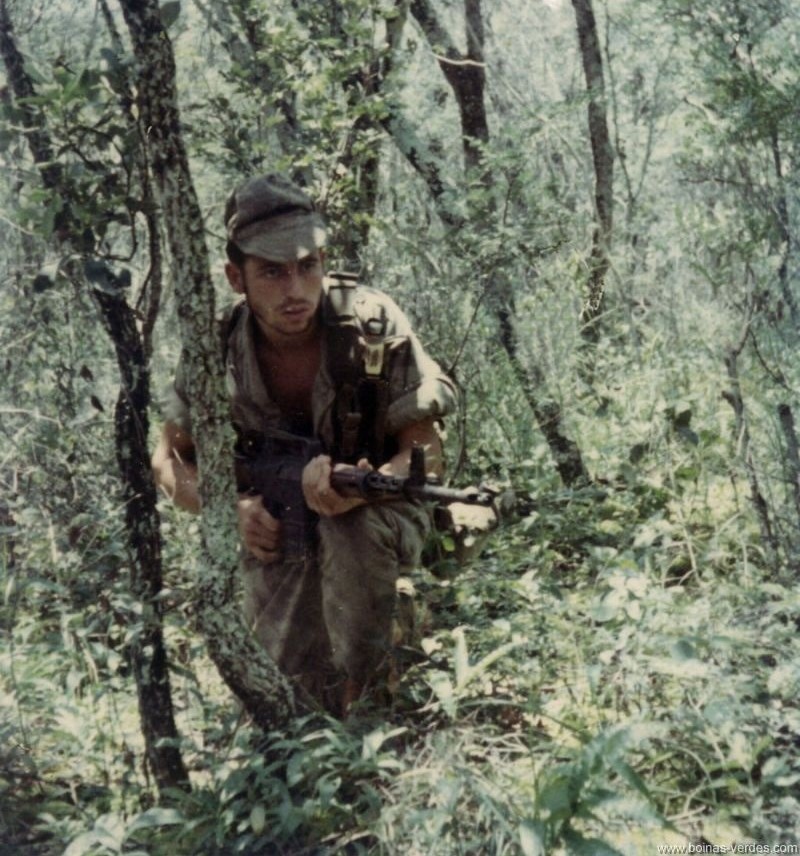
Caçadores Paraquedista with an AR-10 (source)

In addition to these Vic also gives us a look at an extremely rare prototype carbine, a sporter model (the AR-102) and a prototype squad automatic weapon with a heavier profile barrel.  Vic then takes us through the features of the final A.I.-made variant, the Portuguese or NATO model. The rifle was officially adopted by the Portuguese army’s Caçadores Páraquedistas (paratroops) and saw action in Angola, Portuguese Guinea and Mozambique.

Vic then takes a look at a series of rare variants and one-offs, including a rifle with green furniture made for Prince Bernhard, the Royal consort to Queen Juliana of the Netherlands, and a heavy barrelled magazine-fed squad automatic rifle with a rubber butt-pad and additional folding carrying handle.

14554764_3
‘Transitional’ model AR-10 (source)

To round out the story of Artillerie Inrichtingen’s involvement with the AR-10, Vic is lucky enough to take a close look at an M1 Garand adapted to feed from surplus AR-10 aluminium waffle magazines. This concept was developed to equip the NATRES, the Dutch Army Reserve, and was based somewhat on the Italian Beretta BM-59. Vic shows us both a very early prototype BM-59 and one of only two A.I. Garand adaptation prototypes.

In the next part of the series Vic will examine several examples of the belt-fed AR-10. If you missed the first part of the series, which featured the early history of the ArmaLite AR-10 and a very rare original promotional film featuring Eugene Stoner himself, you can find that here!

If you enjoyed the video and this article please consider supporting our work here.


Bibliography:

The Armalite AR-10: World’s Finest Battle Rifle, J. Putnam Evans (2016)

Special Episode: The ArmaLite AR-10 (Pt.1)


In this first part of a TAB special episode examining the history of the ArmaLite AR-10 Vic discusses the early origins, history and development of the now legendary 7.62x51mm rifle. At the heart of this episode is a remastered version (certainly the best currently available online) of the c.1958 ArmaLite/Fairchild promotional film that features Eugene Stoner and shows many of the early ‘Hollywood’ Armalites in action! The first part of this special documentary concludes with Vic examining a Hollywood-made AR-10B (the last iteration of the US-made AR-10s).

Part two of the episode can be found here and includes an overview of almost every Artillerie Inrichtingen (A.I.)-made model of AR-10, including the Cuban, Sudanese and Portuguese variants. 


Armalite & the AR-10’s Early History

Much has been written about the AR-10, Eugene Stoner and the genesis of the AR-15’s parent rifle. It’s a design which owes much to many: Stoner, George Sullivan, Melvin Johnson and later the engineers at Artillerie Inrichtingen.

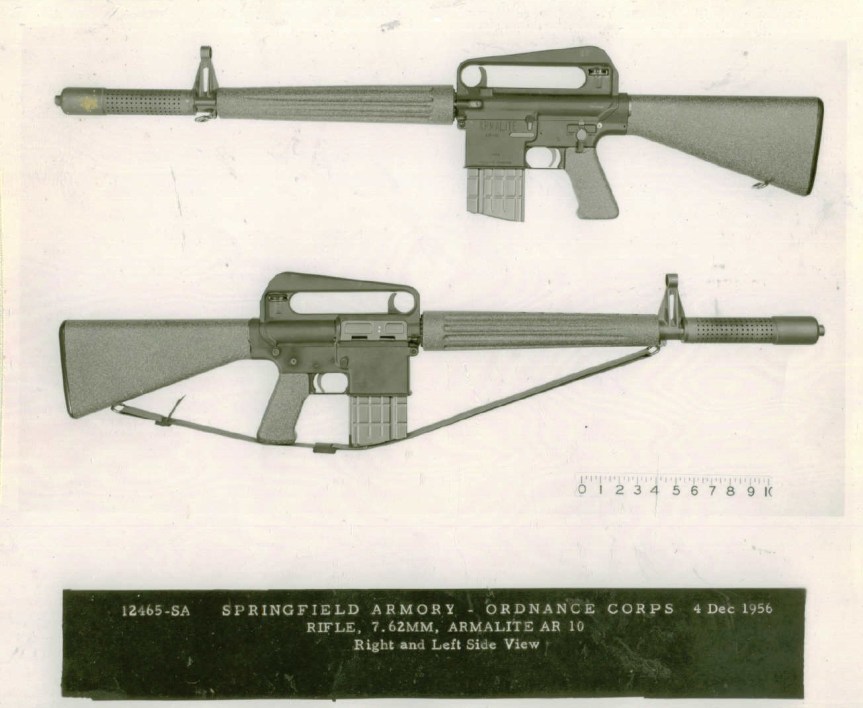
12465-SA.A.1
Photographs taken during Springfield Armory’s evaluation of the AR-10B (source)

ArmaLite, formed by George Sullivan with the help of Richard Boutelle, President of the Fairchild Engine and Aircraft Corporation, began work on the first AR-10 prototypes in 1955. Designed by Eugene Stoner, using his patented direct gas impingement system. Stoner patented this system in 1956, with the patent being granted in September 1960 (US #2,951,424).

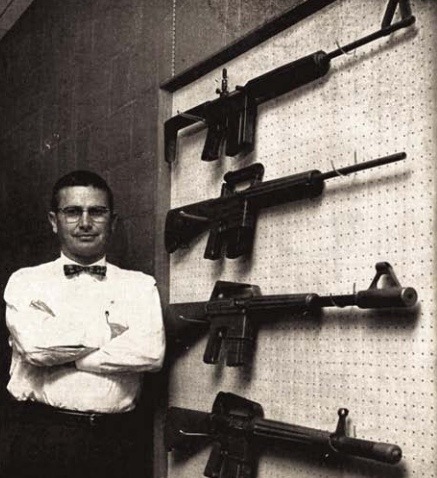
tumblr_nhoqdrHlUE1s57vgxo1_500
Stoner pictured with some of the Hollywood AR-10 prototypes for a 1958 article in Guns magazine (source)

The AR-10 had an aluminium-alloy forged receiver, an in-line stock, polymer furniture and chrome-lined steel parts. While conventional steel barrels were the norm an ill-fated attempt to use an aluminium/steel composite barrel during US Army evaluations proved disastrous when the steel inner parted from the aluminium outer and caused the barrel to burst. As a result of these weight saving efforts the rifle weighed just ~3.4kgs/7.5lbs unloaded. The Armalite AR-10 had a side mounted gas tube, a top mounted charging handle and fed from 20-round box magazines. One of the most interesting features was the large aluminium muzzle device, fitted to some ArmaLite-made Rifles, which reduced sound and flash.

In 1957, ArmaLite sold the AR-10 manufacturing rights to the Dutch small arms manufacturer Artillerie Inrichtingen, while US manufacture was licensed by Colt in February 1959. With minimal financial returns Fairchild sold their interests in ArmaLite in 1962.

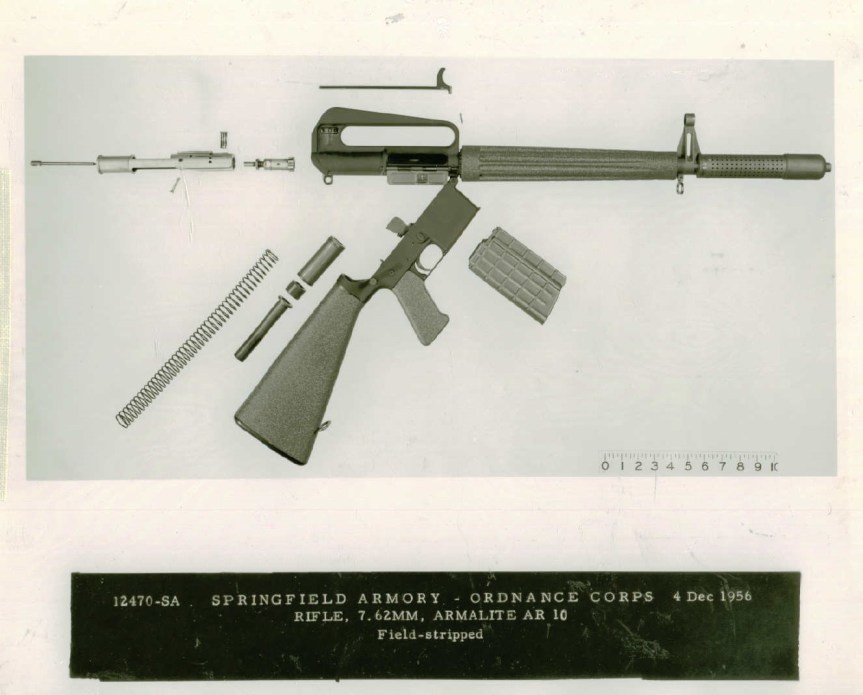
12470-SA.A.1
A Springfield Armory file photograph of the AR-10B disassembled, taken during evaluations in 1956 (source)

Featured in the first part of Vic’s special episode on the AR-10 is an original Armalite/Fairchild promotional film, originally filmed in 16mm, that dates from around 1958. While a version of this film has been shared online for a number of years it is grainy, washed out and of relatively low audio quality. Vic reproduced the very rare promotional sales film in the 1990s onto VHS (a process he explains in the video). He has managed to take an original VHS copy and digitally remaster it to regain some of the original’s clarity and detail.

1111111
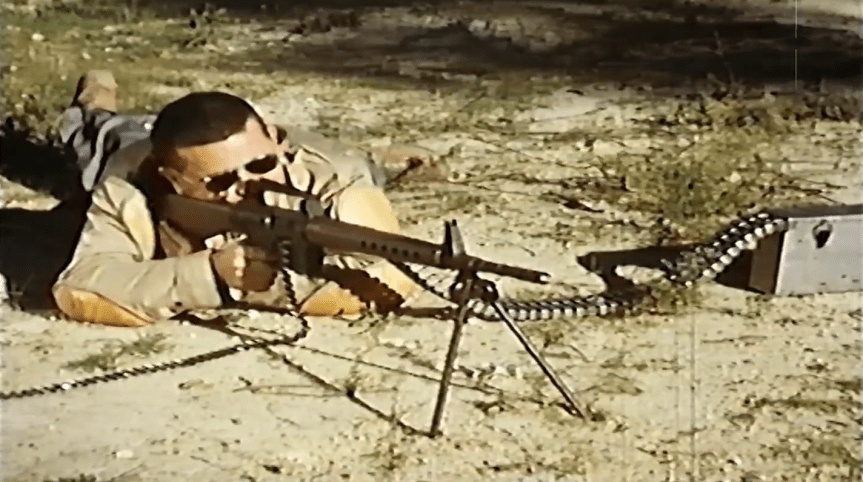
A still from Vic’s remastered 1958 promo film showing Stoner firing the belt-fed variant of the AR-10 (source)

The promotional film was originally used by salesmen to showcase the AR-10 to potential clients and features Hollywood-produced guns. Both Stoner and Charles Dorchester (ArmaLite’s production manager) are seen in the film demonstrating the AR-10. The rifle’s action, function and controls are explained and various variants, including rifle and light machine gun, are demonstrated. The demonstration segment included a sub-zero test, covering in sand and much and Stoner himself dumping 5 magazine’s through the rifle in quick succession. The promotional film concluded with demonstrations of firing rifle grenades and a belt-fed AR-10.

Vic concludes the first part of the AR-10 overview episode with an examination of an AR-10B rifle held by the Netherlands’ Nationaal Militair Museum. In the second part of the episode Vic will look at nearly a dozen AR-10 variants made by Artillerie Inrichtingen (A.I.) between 1957 and 1961.

Part 2 of the AR-10 special can be found here!

If you enjoyed the video and this article please consider supporting our work here.


Bibliography:

The Armalite AR-10: World’s Finest Battle Rifle, J. Putnam Evans (2016)

ArmaLite AR-10 Promotional Video (courtesy of Vic Tuff)

Heckler & Koch HK53

In 1968 Heckler & Koch launched the HK33, chambered in 5.56x45mm, to compete with Colt’s AR-15/M16. The HK33, and later HK53, used the same roller-delayed blowback action developed for the G3 in the mid 1950s. However, few major contracts were forthcoming with the German military opting to continue using the 7.62x51mm G3.

11111111111
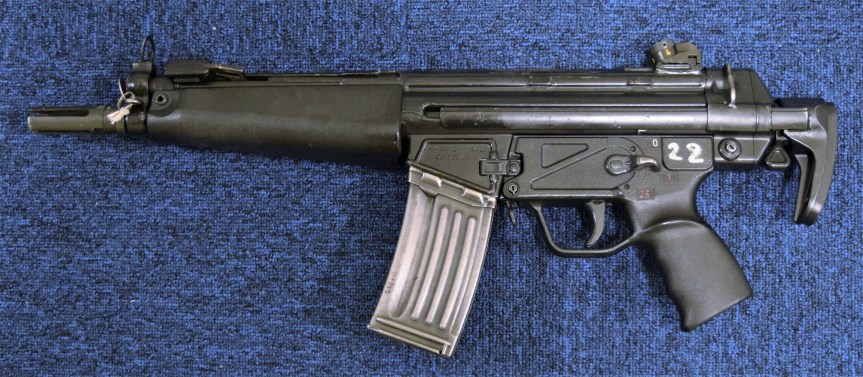
Heckler & Koch HK53 (with ‘navy’ lower reciever) brochure c.1987 (source)

Due to the modularity of the HK33′s design users could replace the butt of the standard rifle with a collapsible telescopic metal stock. H&K also subsequently designed a carbine version of the full-length HK33, the HK33K with a telescopic metal stock and 12.7 inch barrel. In the mid-1970s H&K began development an even shorter version. The result was essentially an intermediate calibre submachine gun similar to the Colt Commando and the Soviet AKS-74U. H&K designated this new weapon the HK53, it used the same telescopic stock as the HK33K and MP5 and a cut down 11 inch barrel, the HK53 also utilised a polymer forearm similar to the MP5s.

1
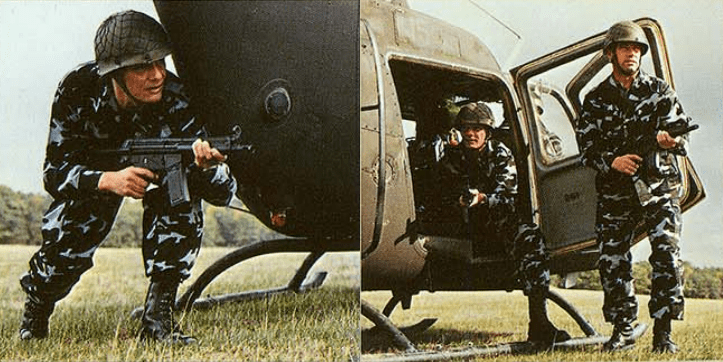
Contemporary promotional photos dating from 1985 (source)

Like the HK33, the HK53 fed from 25, 30 or 40 round box magazines. The weapon weighed just over 3kg (7lb), almost a 1 kg less than its parent rifle the HK33. Unlike the HK33, the HK53 has a four prong flash hider. A number of police forces and militaries adopted the HK53 for a variety of roles. Special forces units around the world including the British SAS, Royal Military Police Close Protection Unit and Royal Marines, designated the L101A1 in British service, who typically used it during close protection duties and operations involving close quarter battle.

2
Contemporary promotional photo dating from 1985 (source)

As shown in various MoD Equipment Failure Reports dating from the early 1990s the HK53’s in British service suffered from repeated damage and failure of the carbines’ locking rollers. This issue arose when using a number of different ammunition types including brass cased blank ammunition (H&K recommend the use of their proprietary blank cartridges). Following a meeting between the Army Technical Support Agency’s Directorate of Engineering and H&K a new design for the locking pieces were developed. These changes “increased the roll of blowback force during the unlocking phase… in turn this will reduce the mean energy of the recoiling mass of breech block and carrier” this was intended to reduce bolt bounce. The Royal Military Police Close Protection Unit’s L101A1’s were also fitted with a new two stage buffer within a fixed stock. In British service the L101 was replaced by the L22A2 carbine and the L119A1 (C8 Carbine).

DSC_0843
HK53, stock collapsed, (Matthew Moss)

Due to its short length the HK53 also found itself pressed into the port-firing weapon role. Designated the HK53 MICV in this role the foregrip and stock was removed and a specially designed endcap and a spent case bag could be attachment. During its service life the HK53 went through a series of changes to furniture mouldings, buttstock types and fire selector options. It remained in production into the early 2000s, when Heckler & Koch replaced the HK33 and HK53 with the G36 and G36K.

If you enjoyed the video and this article please consider supporting our work here.


Technical Specifications (from 1987 H&K brochure):

Length (with stock extended): 76.5cm (30in)
Weight (collapsible stock, unloaded): 3.35kg (7.4lb)
Barrel Length: 22.5cm (8.5in)
Action: Roller delayed blowback
Calibre: 5.56x45mm
Feed: 25, 30, or 40-round box magazine
Cyclic Rate: approx. 700 rpm


Bibliography:

The World’s Assault Rifles, G.P. Johnston & T.B. Nelson, (2010)

Heckler & Koch HK33 & HK53 manual (source)

HK53 factory colour brochure, 1987, (via Small Arms Review Reference Library)

Itemised list of L101A1’s which suffered damaged locking rollers, MoD Equipment Failure Report, 15 Nov. 1994, (via Small Arms Review Reference Library)

Army Technical Support Agency report on receiver damage to HK53 and G3 rifles, 1996,(via Small Arms Review Reference Library)


Please do not reproduce photographs taken by Matthew Moss without permission or credit. ©The Armourer’s Bench 2018.

M45 Quadmount

Matt recently had the opportunity to visit the excellent Menorcan Military Museum at Es Castell, on the Spanish Balearic Island of Menorca. The museum is well worth a visit with some very rare and extremely interesting weapons on display. 

M16
An M45 mounted on a M16 half-track during World War Two (source)

The M45 Quadmount was developed by the W.L. Maxson Corporation for the US Army. It mounted four .50 calibre M2 Browning Heavy Machine Guns on a lightweight, rotating powered mount.  I recently had the opportunity to take a closer look at an M45 while visiting the Menorcan Military Museum.

Introduced in 1943, the M45 was capable of 360 degrees of rotation and 90 degrees of elevation. It was manned by a three man crew: two loaders, who loaded the M2 Browning’s 200-round belt drums, and a gunner.

The M45 was extremely versatile and could be mounted on a number of trailers and vehicles including the M20 and M17 trailers and the M16, M17 and M51 half-tracks.

M45 TM
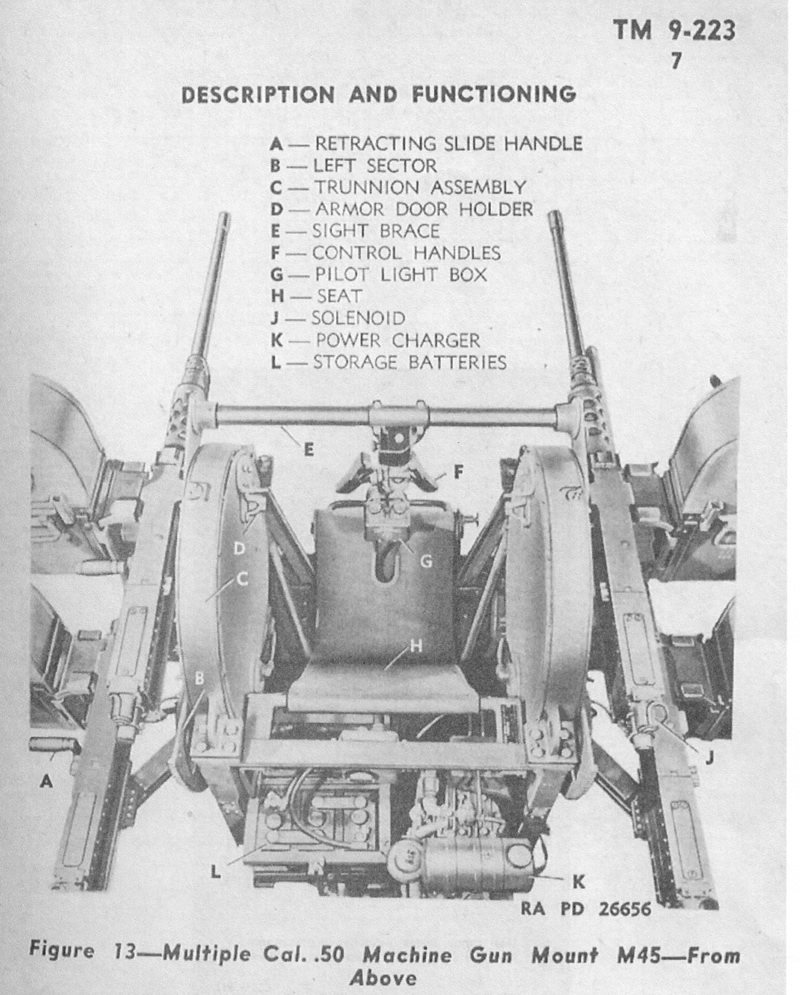
Diagram from the M45’s manual showing the layout and some of the Quadmount’s parts (source)

The gunner sat on a canvas seat inside the M45, between the two pairs of guns. He controlled the aiming of the guns with two control handles and aimed the M45 through a reflex sight which was mounted to a sight bar.

The M45 was powered by two 6-volt batteries and weighed approximately 2,400lb (1,090kg). The gunner was protected by an armoured plate at the front with two hinged armour plates either side of the M1X reflex sight. The M45 mounted four M2 TT (Turret Type) varriant machine guns – these were fired by solenoids. All four of the guns could be fired at once but gunners normally alternated between the upper and lower pairs in order to allow the guns to cool and loaders to replenish the drums.

US_Army_M16_MGMC_AA_Half-track
An M45 mounted on an M17 half-track during the Korean War (source)

When all the guns were fired together the M45 had an impressive rate of fire of approximately 2,300 rounds per minute. The Quadmount saw action throughout World War Two, the Korean War and in Vietnam. However, with the beginning of the jet age the M45 became increasingly obsolete in the anti-aircraft role. It continued to be used against ground targets with many mounted on vehicles to create ‘gun trucks’.

If you enjoyed the video and this article please consider supporting our work here.


Maxim-Tokarev Light Machine Gun

Matt recently had the opportunity to visit the excellent Menorcan Military Museum at Es Castell, on the Spanish Balearic Island of Menorca. The museum is well worth a visit and the Maxim-Tokarev was one of the very rare and extremely interesting weapons they have on display. 

maxim_tokarev_3
Soviet troops disassembling an MT light machine gun, note the hinged stock pivoted down to allow access to the action (source)

The Maxim-Tokarev (MT) Light Machine Gun was developed at the request of the Soviet military high command in the early 1920s, following the end of the Russian Civil War. Influenced by the German MG08/15, Tokarev set out to lighten the Maxim M1910. The MT was one of two designs submitted for testing. Designed by Fedor Tokarev, at the Tula Arms Factory, the MT was tested along side Ivan Kolesnikov’s similar Maxim-Kolesnikov light machine gun. Development ended in 1924 and the MT went into initial production in 1925 with the first weapons successfully tested against the Maxim-Kolesnikov.

Maxim Koleshnikov
The MT’s principle rival the Maxim-Kolesnikov, note the unconventional butt stock (from Chinn’s The Machine Gun Vol.2)

Production continued until at least 1928, while many sources suggest 1927, the example featured in the video dates from 1928. Sources suggest Tula produced 3,500, however, this number does not match with the suggested export numbers and the featured example is serial number 5283.

Tokarev-s-synom
Tokarev, and his son, posing with several MT light machine guns, c.1925 (source)

The MT is based upon the Russian M1910 Maxim gun, using the same short recoil, toggle locked action. It was hoped that established tooling would be able to make some of the new light machine gun’s parts. The weapon weighed 12.9kg unloaded and Tokarev made extensive efforts to lighten the weapon with the the water-cooled barrel jacket replaced by a perforated shroud to allow air cooling. The receiver also has a large number of lightening cuts to shave off weight.

In his 1952 book ‘The Machine Gun Vol.2, Pt. VII’, George Chinn suggested that the Tokarev may have been influenced by an earlier design patented in 1909, by Vickers Sons & Maxim Ltd. designers Arthur Dawson and George Buckham. The patent shows a Maxim-derived light machine gun with a very similar layout to the MT.

US942167-0
Dawson & Buckham’s patent for a Maxim light machine gun (Patent)

The M1910’s spade grips were replaced by a wooden butt stock and a new trigger mechanism and a non-adjustable bi-pod was added at the muzzle. The butt-plate was hinged to offer additional stability and the weapon’s barrel could be changed in the field.

The MT fed from a 100-round canvas belt and chambered the standard Russian 7.62x54mmR cartridge. The belt was held in a drum suspended beneath the weapon and when loaded weighed approximately 15kg. Following troop trials a number of changes were suggested, some improvements were made but the decision was made to move away from the MT.

Teruel-Aragon-front-Rut-Abale
Spanish Republican troops defend a barricade with an MT (source)

The MT was eventually replaced in Russian service in the late 1920s by the Degtyaryov-designed DP-28 light machine gun. The remaining MTs were sold to Spain and China during the 1930s. These guns saw extensive use during the Spanish and Chinese Civil Wars.

If you enjoyed the video and this article please consider supporting our work here.


Technical Specifications:

Length: 130cm (51in)
Weight (unloaded): 12.9kg (28lb 4oz)
Barrel Length: 65cm (25.5in)
Action: Short recoil, toggle locked
Calibre: 7.62x54mmR
Feed: 100-round belt
Cyclic Rate: ~600rpm


Bibliography:

The Machine Gun Volume 2, Part VII, G.M. Chinn (1952)

Kangzhan: Guide to Chinese Ground Forces 1937–45, L. Ness & B. Shih (2016)

Hammer and Rifle: The Militarization of the Soviet Union, 1926-1933, D.R. Stone (2000)

‘Automatic Gun’, US Patent #942167, A.T. Dawson & G.T. Buckham, 7 Dec. 1909, (source)


X11 Belt-Fed Bren Derivative

At the end of the Second World War the British Army had two primary infantry machine guns: the Bren light machine gun and the Vickers medium machine gun. These weapons had proved their worth, the Bren was especially well liked and the venerable Vickers continued to be a reliable workhorse.

In the late 1940s, the British Army recognised the Soviet threat to Western Europe. In 1947, Field Marshal Bernard Montgomery, the newly appointed Chief of the Imperial General Staff wrote a paper outlining rearmament plans based on intelligence estimates of how quickly the Soviet Union was likely to be ready for another full-scale war. Montgomery believed that Britain had just 10 years to develop new weapons and begin rearmament before the Soviet Union had recovered enough to launch an invasion of Western Europe. As such the British Army felt that rearmament needed to be complete by the late 1950s.

large_000000
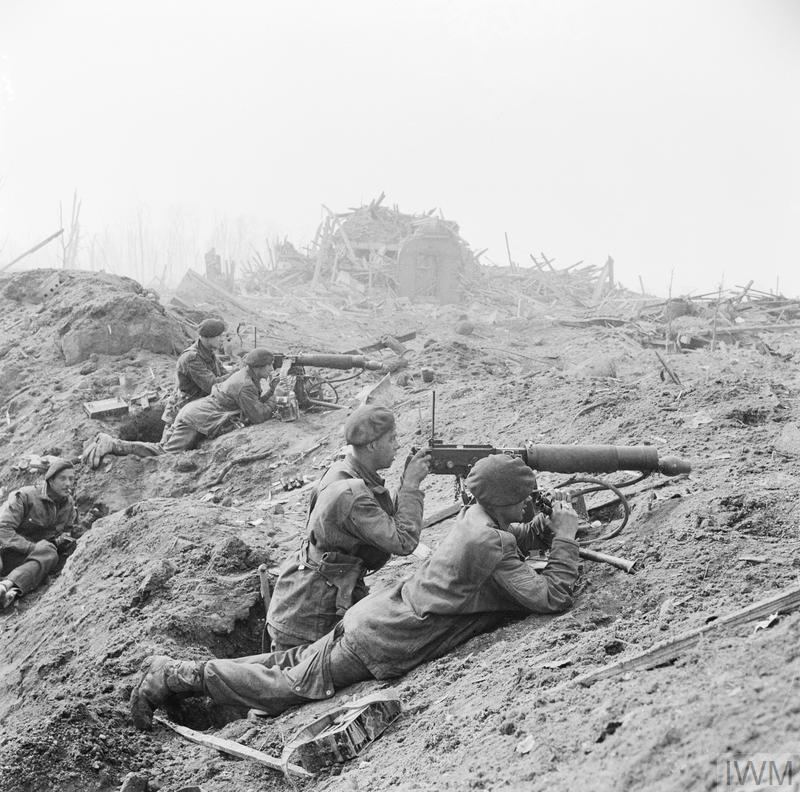
Two Vickers medium machine guns in action in Wesel, 1945 (IWM)

A number of large budget programmes were launched while small arms projects were also undertaken. These included the Infantry Personal Weapon programme which sought to develop a new intermediate calibre infantry rifle – the IPW programme later yielded Stefan Janson’s EM-2, a bullpup chambered in .280, which was briefly adopted as the Rifle No.9. The FN FAL was later adopted due to changes in political circumstances – a long, fascinating story for another article. The companion to the IPW programme was the development of a Sustained Fire Machine Gun also chambered in .280.  The TADEN, a belt-fed derivative of the Bren firing the new .280 round, was designed by Harold Turpin (‘T’), the Armament Design Establishment (‘AD’) and Enfield (‘EN’). With the abandonment of the IPW the TADEN was also abandoned but its design greatly influenced the later X11 developments.

Centrefire automatic machine gun - Experimental SFMG
.280 TADEN SFMG mounted on a tripod (Royal Armouries)

Another major small arms programme at the time was the search for a new machine carbine (or submachine gun). This saw the testing of designs from Sterling, BSA and Madsen – with the Sterling finally adopted as the L2.

The other major small arms project was the programme to find a new section level machine gun. The German MG34 and MG42 had impressed the Allies during the war, so much so the US went as far as to clone it with the T24. After the abandonment of the EM-2 and TADEN machine gun the British issued a new specification for a lightweight sustained fire machine gun, chambered in the 7.62x51mm round recently adopted by NATO, in the mid-1950s.

t24mg5-794x1024
US T24, MG42 clone, complete with US-pattern bipod (Springfield Armory)

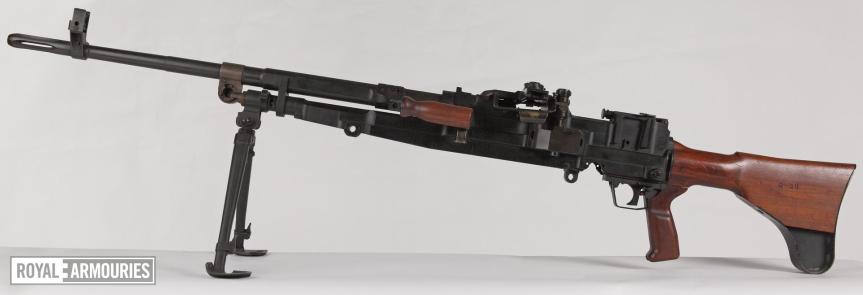
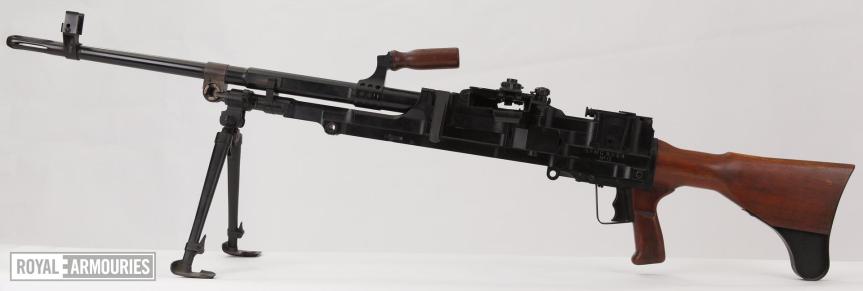
The design team at the Royal Small Arms Factory at Enfield developed a belt-fed derivative of the Bren light machine gun. The X11 series of prototypes sought to convert the Bren’s proven design into a weapon capable of sustained fire. The X11 made a number of changes to the Bren included the addition of a detachable butt/grip/trigger assembly which could be swapped for a pair of spade grips and a paddle trigger for static sustained fire from a tripod. This resulted in the pistol grip being located much further back than the traditional Bren’s.

Centrefire automatic machine gun - Experimental SFMG (about 1956)
The X11E2 set up for the sustained fire role on a tripod with the spade grips and an optical sight similar to the UNIT sight. (Royal Armouries)

It appears that during the mid-1950s British military parlance described the General Purpose Machine Gun as a Sustained Fire Machine Gun (SFMG). From the available photographs it appears that the L4 and X11 use the same barrel with its distinct flash hider. The receivers of all the prototypes appear to be milled to attach the optical long range sight seen above.

The main drawback with the X11 was its feed mechanism. The feed slide was indexed by a rotating vertical feed shaft which was driven by the gas piston’s recoil. This created a considerable amount of friction within the action. It had the effect of causing failures to feed during adverse conditions testing and elevated firing tests. A series of four X11 prototypes were developed with Harold Turpin (co-designer of the STEN gun and later TADEN) working on the new gun. Each prototype appears to have a sightly different trigger configuration. The most interesting of these is a two-finger double-crescent trigger reminiscent of the MG-34’s – from the photographs it appears that the conventional selector lever, used in the X11E2, was replaced with a fire-selector system similar to the MG-34’s (upper crescent – semi-auto, lower crescent – full-auto). However, the trigger of the example of the X11E4 examined by Vic (serial number #11) was fully automatic only, despite its crescent shape.

Below are photographs of examples of the three types held at the Royal Armouries:

1
X11E2, note the large cutout in the receiver in front of the trigger group (Royal Armouries)
Belt fed Bren 1
X11E3 (Bren Gun Saga, Dugelby)
Centrefire automatic machine gun - SFMG Experimental Turpin X11E4
X11E4, note double-crescent trigger (Royal Armouries)

The X11 was tested against the M60, French AA-52, Swiss MG51, Danish Madsen-Saetter, German MG-3, and the Belgian FN MAG. The FN MAG, designated the X15E1 by the British, fared best in the trials with the X11 coming second due to its feeding issues. In January 1958, the British abandoned the X11 and moved to adopt the X15E1 general purpose machine gun, negotiating a license for its manufacture. The weapon was finally adopted as the L7A1 in 1961, with production at Enfield beginning in 1963. It seems that the Birmingham Small Arms Company were a latecomer to the competition having developed the another belt-fed Bren gun derivative known as the X16.

The Bren did continue in service after the switch to 7.62x51mm. In 1954, before beginning work on the X11, Enfield had developed the X10E1. Taking a Canadian manufactured 7.92x57mm Bren breech block and converting it to cycle the new round. The X10E1 was formally adopted as the L4. The L4 remained in service, alongside the L7, into the early 1990s. The L7 GPMG continues to be used by the British Army.

If you enjoyed the video and this article please consider supporting our work here.


Bibliography:

The Bren Gun Saga, T. B. Dugelby (1999)

Photographs: Durs Egg Breech-Loading Carbine

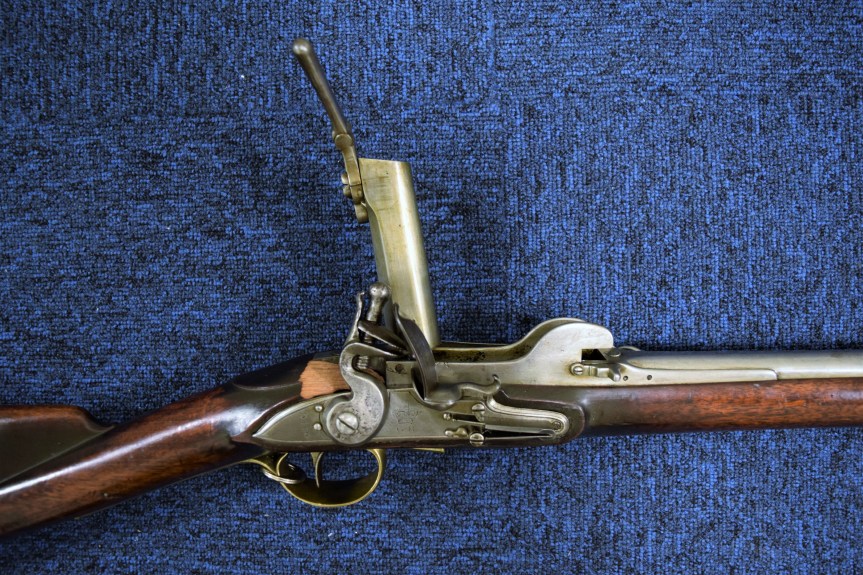
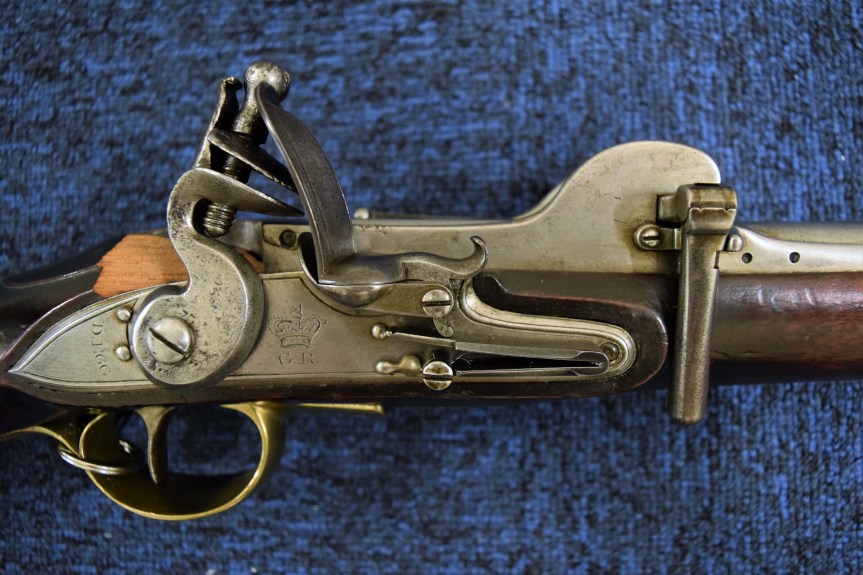
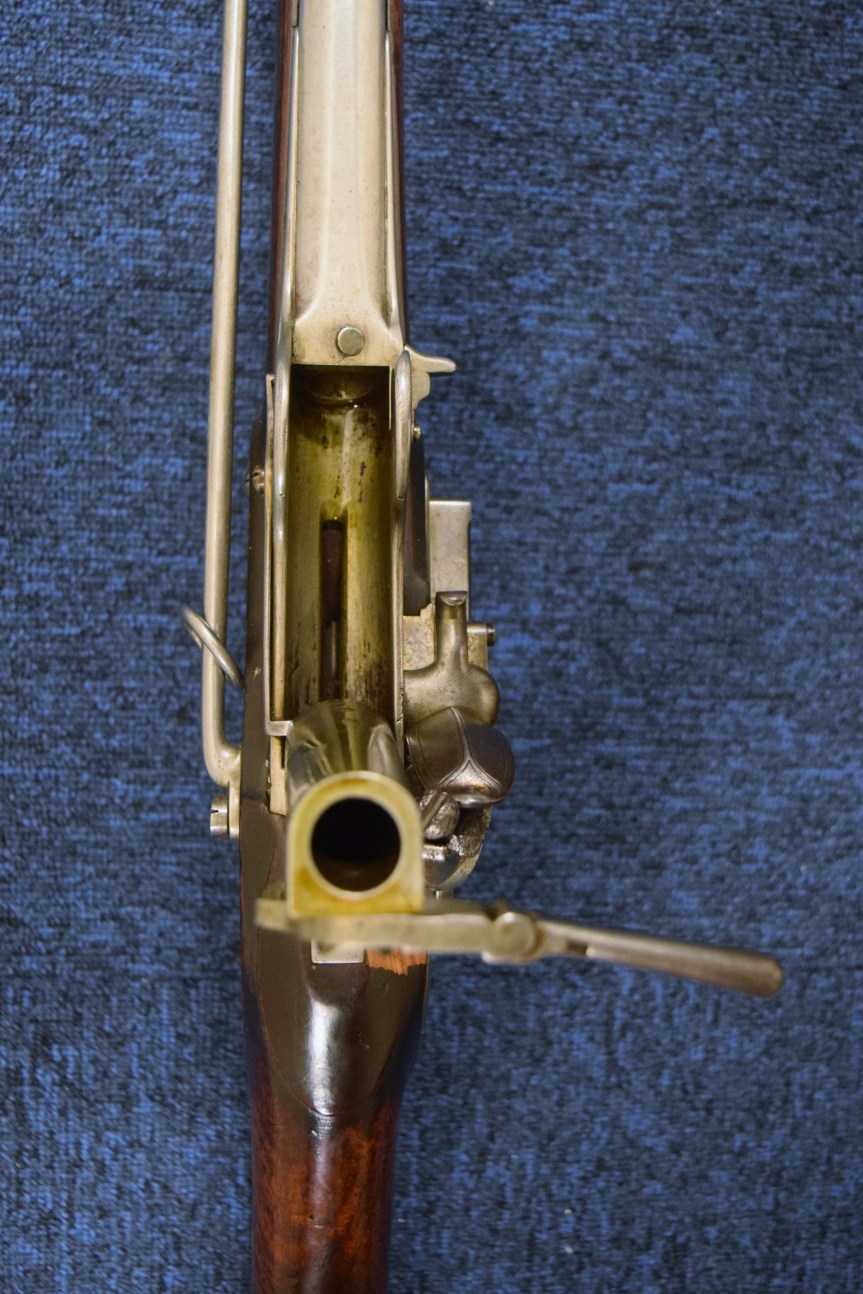
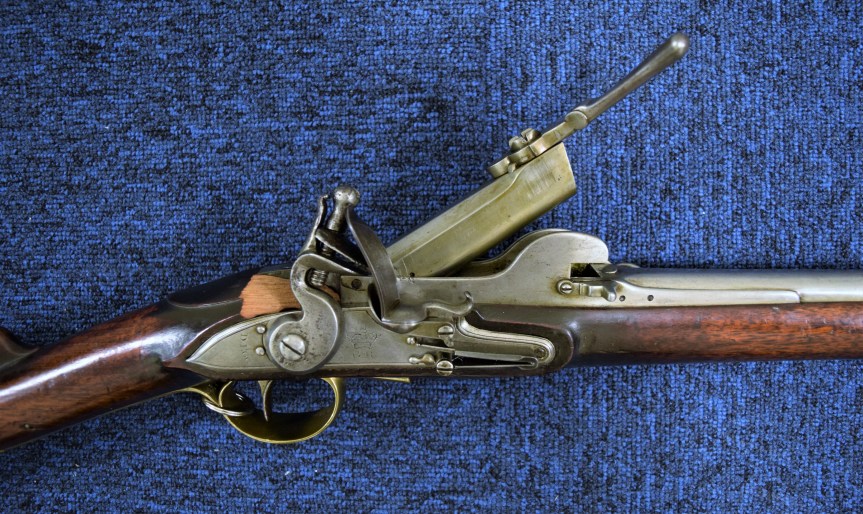
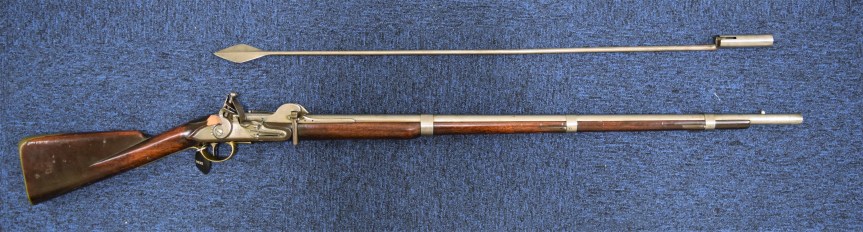
Matt was recently lucky enough to examine a 1785 Pattern Durs Egg Breech-loading cavalry carbine. Based upon Giuseppe Crespi’s breech-loading system, the Egg carbines were tested by British cavalry regiments in the late 1780s. You can check out our full-length article on the weapon here and our video here.

Below are a some photographs I took of the carbine showing some of the details of its design:

DSC_0844
A right-side view of the length of the carbine
DSC_0857
The carbine with its breech fully open from the right-hand, lock side
DSC_0853
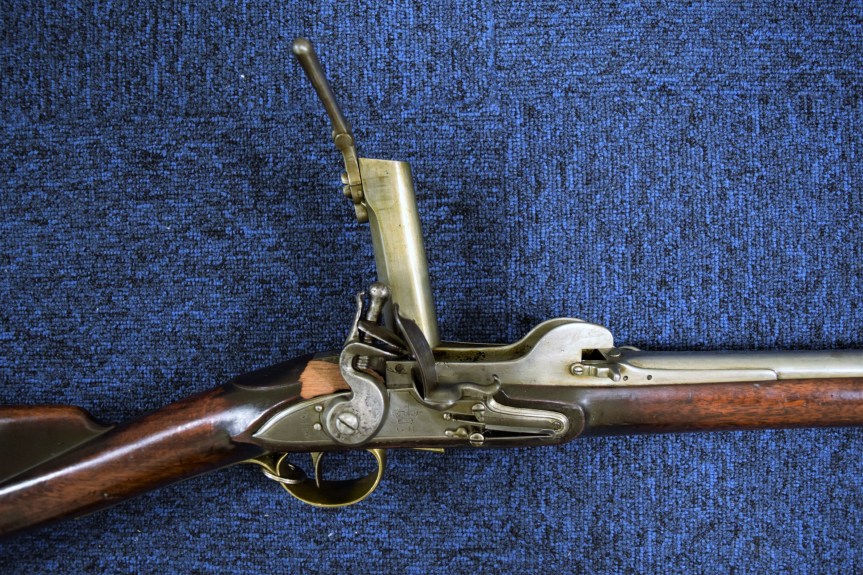
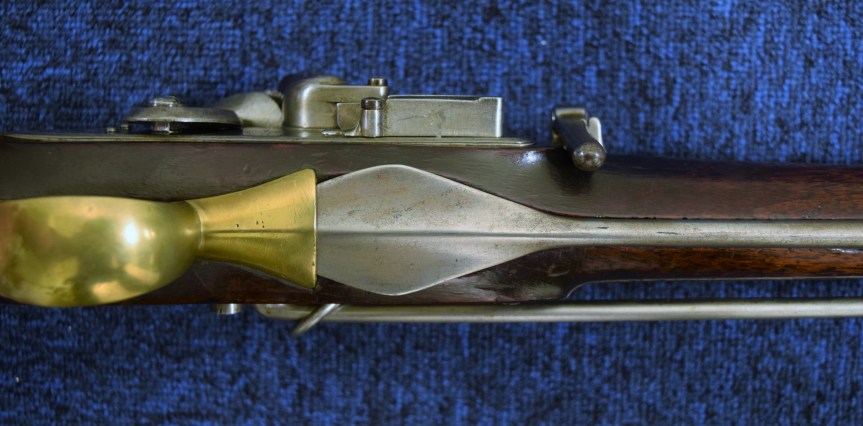
Detail photo of the carbine’s lock and breech handle
DSC_0848
An overhead view of the Egg Carbine’s open breech showing the chamber into which powder and ball were placed
DSC_0849
A closer overhead view of the carbine’s breech
DSC_0850
A close up of the carbine’s spear point bayonet showing the extension of the brass trigger guard into which the bayonet point sits
DSC_0856
With the carbine’s breech partially open its possible to see the small touch hole into the breech block, just above the frizzen and pan, which allows the flash from the fan to ignite the powder charge
DSC_0851
The carbine and its bayonet

Our thanks to the collection that holds this example of the Durs Egg Carbine, whom wish to remain anonymous, which was kind enough to allow us access to their impressive array of small arms.

If you enjoyed the video and this article please consider supporting our work here.


All photographs taken by Matthew Moss. Please do not reproduce these images without permission or credit. © The Armourer’s Bench 2018.

Crespi Breech-loading Carbine

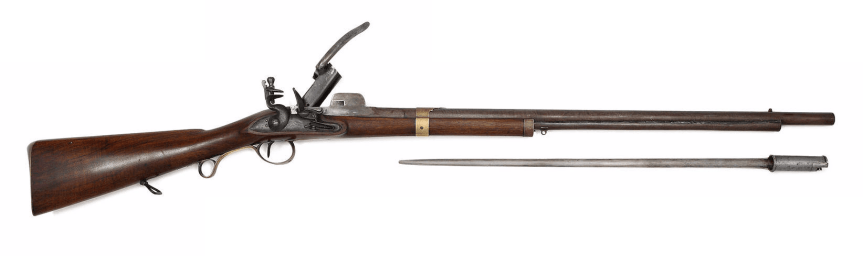
In the late 1760s a Milanese machinist/clockmaker Giuseppe Crespi developed a breech-loading system for the Austrian Empire. Working with Ambroglia Gorla Crespi built a practical breech loader which was eventually adopted and fielded by the Austrian army during the 1770s. Crespi’s system is a lesser known contemporary of the Girandoni air rifle.

Crespi and Gorla’s system was designed to be a conversion of standard Austria’s muzzle-loading carbines. It used a hinged breech which tipped up to allow powder and then a ball to be loaded into the chamber. The breech was then closed and the handle locked into a pair of lugs mounted to the barrel. Austrian Emperor Josef II ordered testing of the design and over 350 were initially ordered and delivered by June 1771.

download
A later Crespi System Breech-Loading Flintlock Volunteer Carbine dating from 1810 – note the different orientation of the locking handle (source)

Despite some wrangling over payment a further order for 2,000 guns using Crespi’s system was made in 1772. These were to be made by the Ferlach gunmakers association in southern Austria and Crespi was paid a lump sum settlement for his design. Gorla’s role in the development of the system is unclear and he did not receive a settlement from the government. In 1771, he sued Crespi for his share but the courts threw out his claim in 1778.
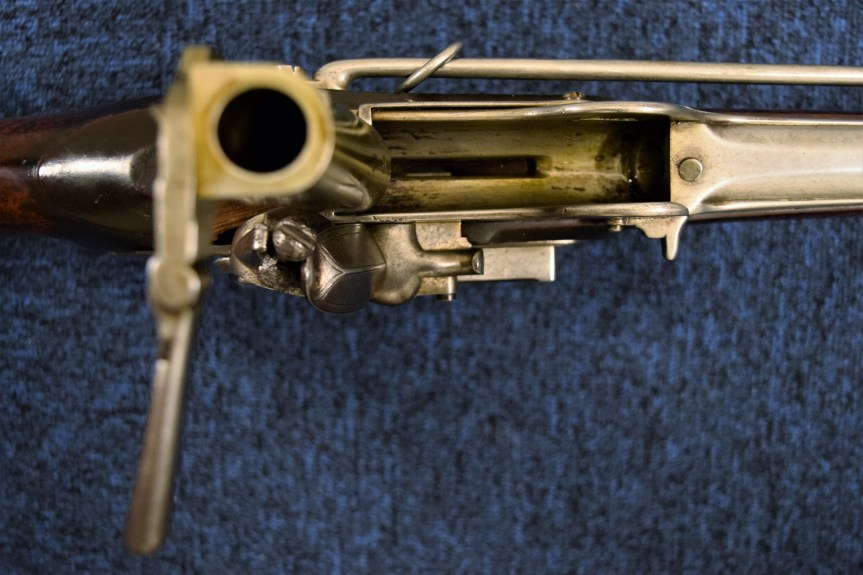
Flintlock breech-loading military carbine - Model 1770 (1775)
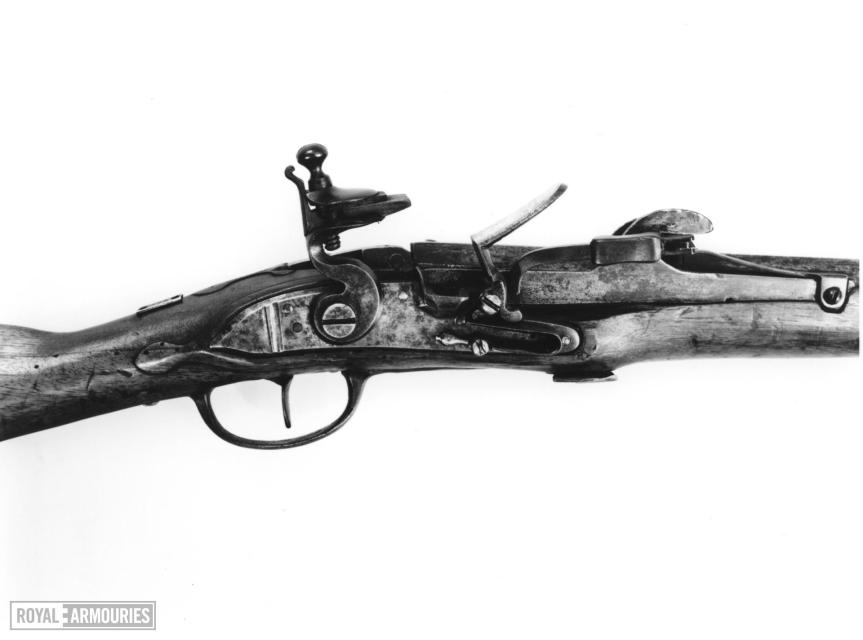
A 1770 Austrian Crespi breech-loading carbine with a hooked breech arm, held by the Royal Armouries (Courtesy of the Royal Armouries)

The principle problem with Crespi’s system was that it was not gas tight, a problem which plagued many early breech-loading systems. As can be seen in the images above the breech block is flat where it meets the breech. This allowed gas to escape and troops complained the chamber was susceptible to wear. The Crespi carbines were issued to Austrian cavalry with a long bayonet, some sources also suggest a spear point bayonet. The bayonet was carried reversed suspended in the carbine stock.  The Austrian carbines were removed from service in 1779, following numerous reports of men being badly burned by escaping gases and opening breeches during the War of Bavarian Succession.
In 1768, Crespi was also allegedly hired by the Portuguese crown to establish a factory at Coimbra to manufacture guns using his system. By 1776, Crespi no longer had any interests in the factory and it was taken over by Companhia de Armamento who continued to manufacture conventional muzzleloading muskets.

image
An Egg breechloading Carbine which borrowed heavily from Crespi’s design (source)

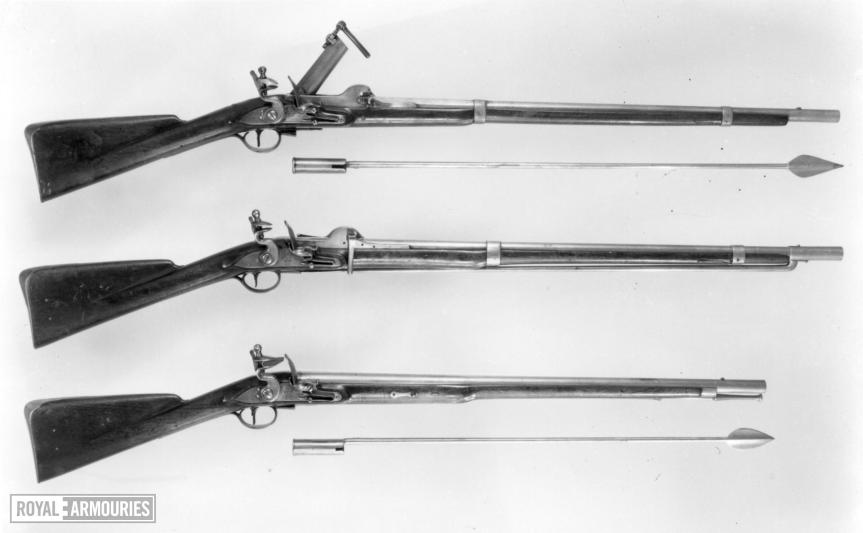
In the early 1780s, the Duke of Richmond became the Master General of Ordnance and ordered a selection of breech loaders for trials. Two of these came from Swiss-born London Gunmaker Durs Egg. Egg’s carbine was a copy of Crespi’s system. The carbines were tested by a board of general officers in July 1784 and it was recommended that the carbine be issued to the Light Dragoon regiments. Egg was paid £31 10s for two carbines with one being presented to King George III and the other retained by the Ordnance office. Sources suggest a further 36 breech-loading carbines were ordered from Egg. In 1786, these were issued to the 7th, 10th, 11th, 15, and 16th Light Dragoons for field trials. These are often reffered to as the Pattern 1785 Egg/Crespi carbines, some of these trials guns were rifled for testing.

DSC_0856
The carbine with its breech partially open. Egg’s carbine was loaded by placing either loose power and ball or a paper cartridge containing power and ball into the breech block (Author’s photograph) 

The Egg carbines were almost as long as a standard issue Short Land Pattern (Brown Bess) musket which was 58 inches or 150cm in overall length. Based on surviving examples it seems the smoothbore Egg carbine was 48.1 inches or 122cm overall while the rifled version was slightly longer at 53 inches or 135cm in length. This combined with the long reach of the spear bayonet, an estimated 35 inches (88cm) long, made for an extremely long weapon – certainly capable of reaching any mounted assailant a dragoon might face while dismounted. Unlike the Brown Bess’ the rifle fired a .60 calibre ball while the smoothbore fired a .68 calibre ball.

A standard dedicated carbine was not introduced for Britain’s light dragoon regiments until 1796. Until then the Short Land Pattern musket had been issued to dragoon regiments. The trials report was returned in 1788, recommending that more experimentation with the rifled carbines should be carried out and that a folding bayonet may be better suited to cavalry use.

Flintlock breech-loading military carbine - Pattern 1785 Egg-Crespi (1785)
Pattern 1785 Crespi-system Egg breechloaders, the second has Hennem’s screwless lock. The carbine at the bottom is a muzzle-loader, all three have the unusual spear bayonet (Courtesy of the Royal Armouries)

The lack of a gas seal at the breech was also criticised and the Duke of Richmond began to explore other designs including those by Henry Nock. Tatham & Egg (Egg’s nephew) continued to manufacture weapons using the Crespi system until at least 1810, when some were made for volunteer yeoman cavalry (with serial numbers ranging up to at least #134). Crespi’s system would be improved by Urbanus Sartoris in 1817, with the addition of an interrupted screw and a moving barrel. Giuseppe Crespi reportedly died in poverty and his breech-loading system became another footnote in the early history of breech loading firearms.

If you enjoyed the video and this article please consider supporting our work here.


Bibliography:

John H. Hall and the Origin of the Breechloader, D.B. Demeritt Jr., (source)

British Military Firearms 1650-1850, H.L. Blackmore, (1961)

The Austrian Army 1740-80: Cavalry, P.J. Haythornthwaite, (1994)