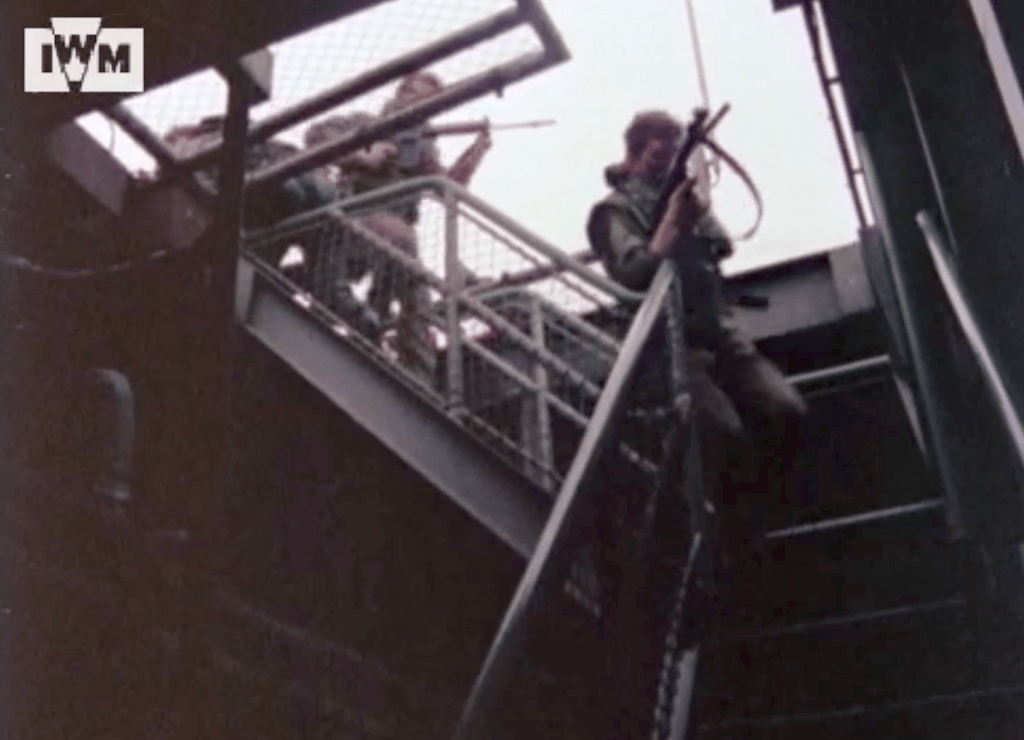
In this video/article we’re going to take a look at a short internal British Ministry of Defence film about the SBS called ‘Oil Safe’. Produced in 1980 by the SSVC, the Services Sound & Vision Corporation, the 11 minute film provides an introduction to the Special Boat Service’s capabilities and procedures for retaking off-shore oil and gas rigs seized in a potential terrorist operation.
‘Oil Safe’ is not to be confused with another oil rig hijack film made the same year – ‘North Sea Hijack’ with Roger Moore.
It gives some insight into how the SBS would go about recapturing a rig seized by terrorists, showing in some detail the procedures used in operations associated with offshore gas and oil installations. The film takes us step by step through the operation from the moment the SBS are notified to the moment they exfiltrate after the operation to retake the rig is successful.
It’s definitely worth watching the whole thing, its available up on the. In this video we’ll take a look at some of the weapons featured in the film.
The first weapons we see are those of the SBS assault team as they are preparing their weapons and kit for the journey out to the oil rig. On the table we see no less than eight MAC-10s, which appear to be the 9x19mm variant. While the MAC-10 would later be surpassed by the HK MP5 it was in service with UK special forces throughout the 1970s. Here it appears to be the assault team’s primary weapon.
The MAC-10, designed by Gordon Ingram, could be paired with a sound suppressor – but these do not appear in the film. The MAC-10’s small size and considerable firepower seem well suited to the team’s task.
Also on the table are numerous L9A1 Browning Hi-Powers, a Remington 870 shotgun, a pair of AR-15s, an L1A1 self-loading rifle and an anti-riot Grenade Discharger – for CS gas. The Colt AR-15 was favoured for its firepower and light weight. The SAS and the Royal Marines’ Mountain & Artic Warfare Cadre favoured the AR-15 for the same reasons. Colt Model 602, 603 and 604s were the most prevalent models. In the film the rifle is seen with both 20 and 30 round magazines.
During the operation to retake the rig we see the team armed with the MAC-10s, AR-15s and Hi-Powers. The terrorist seen guarding the rig’s landing pad is shot by a member of the SBS armed with the Remington 870, another terrorist is shot by two SBS members with Hi-Powers who raid the rig’s cafeteria.
The terrorists are portrayed as being armed with a magazine-less M1 Carbine and a Luger P08 pistol. After the terrorists are neutralised the film explains that their weapons are taken by UK Police as part of an investigation into the seizure of the rig. Royal Marine Commandos who arrive by helicopter following the SBS’ initial assault are armed with L1A1 SLRs and L2A3 Sterling submachine guns.
Check out our earlier article/video analysing a 1984 British Army video on the SAS here.
I highly recommend watching the full film over on the Imperial War Museum’s online archive.
Support Us: If you enjoyed this video and article please consider supporting our work here. We have some great perks available for Patreon Supporters – including early access to custom stickers and early access to videos! Thank you for your support!
Bibliography
SBS Procedure: Part 3 – Oil Safe, SSVC/UK MoD via IWM, (source)
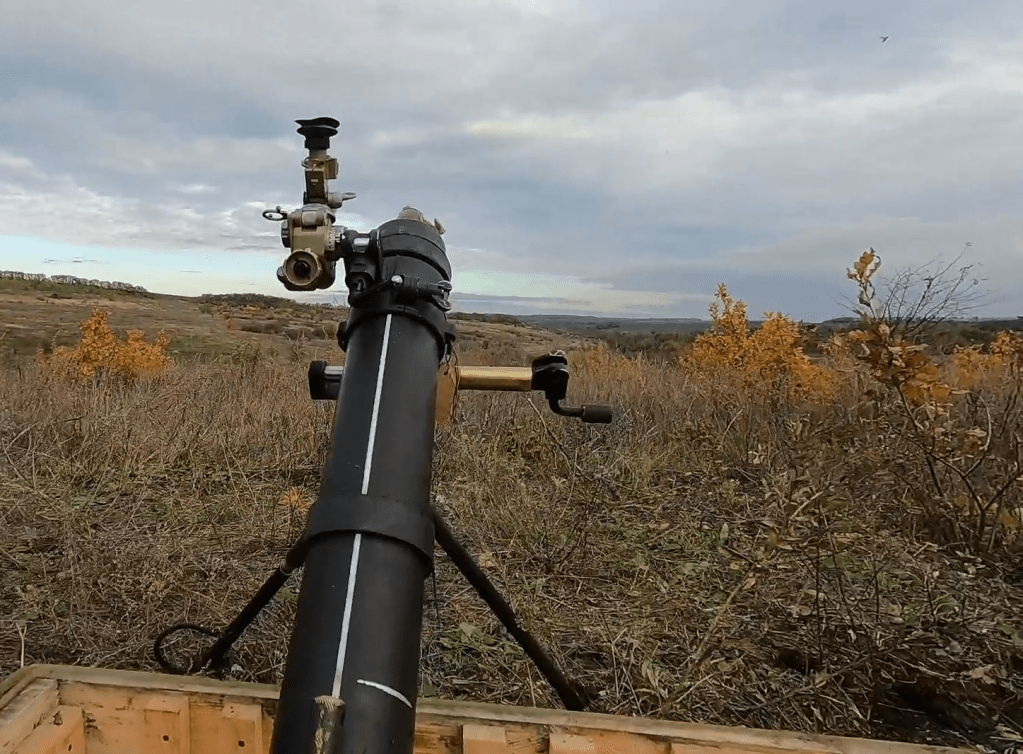
Recent video and photos from Ukraine show Russian troops getting to grips with the 2B25 82mm mortar. About 10 months ago, before Russia’s invasion of Ukraine, The Armourer’s Bench examined the 2B25 in an article/video and how it combines a spigot mortar with ammunition which uses a self-contained captive piston. For a full run down on operation and the mortar’s development history check out that article/video. In this article we will take a look at the mortar’s appearance in Ukraine.
The first mention of the 2B25 being in use with Russian forces in Ukraine dates to early July, when RIA News, a Russian state-owned domestic news agency, published an article with scant detail other than to suggest that “these mortars are used to carry out sudden fire raids, in particular in the fight against saboteurs of the Armed Forces of Ukraine.” Despite this report we haven’t seen any imagery showing the weapon in theatre until recently.
In late October imagery showing the 2B25 began to be shared by a member of what appears to be a Russian special operations unit which has been in action in the Donetsk Oblast. One of the members of the unit runs a telegram channel. The soldier who runs the channel describes himself as a “regular soldier of the Armed Forces of the Russian Federation, for more than 10 years.”
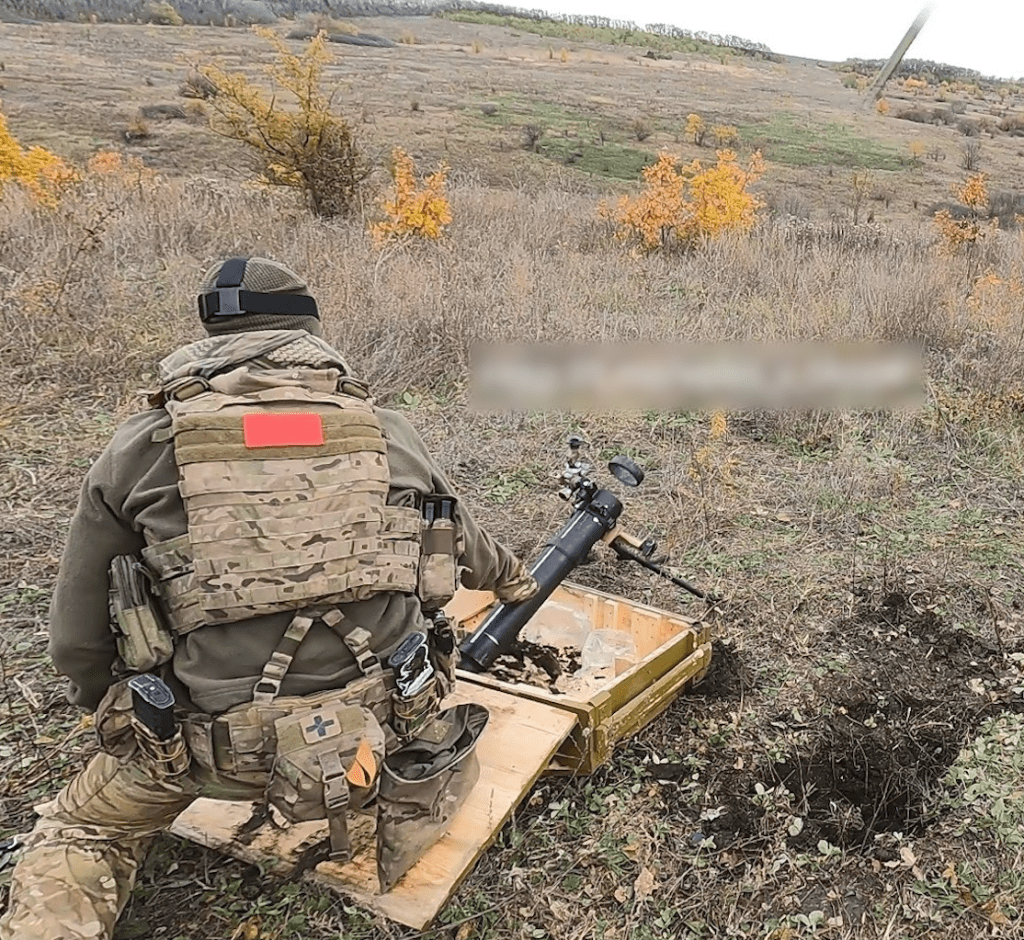
On 27 October, a POV video was shared from behind a 2B25, with the caption (machine translated): “We got acquainted with a silent mortar, mastered it ourselves and showed the mobilized guys. A minimum of recoil, a minimum of powder gases and the sound of a round being fired.”
The 8 November saw the unit share a photo of the mortar being fired without its base plate, instead using a wooden box as an ad-hoc base. In the comments section of the image the soldier running the channel says the use of the wooden ammunition box was ‘by design’, perhaps indicating intentional experimentation with using the mortar without its base plate. In another comment he explained: “No…they checked… whether it was possible to shoot without sinking into the ground, as a result, the box fell apart.” In another response he notes that they were trying to avoid placing the base plate in the wet ground. When asked how loud the mortar is the Russian soldier describes it as: “It is silent, the exit of a mine is not louder than a clap of hands”
A photo posted on 26 November showed the Russian soldier with perhaps 10 of the 2B25’s 3VO35 mortar bomb laid out on the ground. On 30 November a clip showing the mortar be prepared alongside a commercial drone was posted, suggesting training to correct fall of shot with drones.
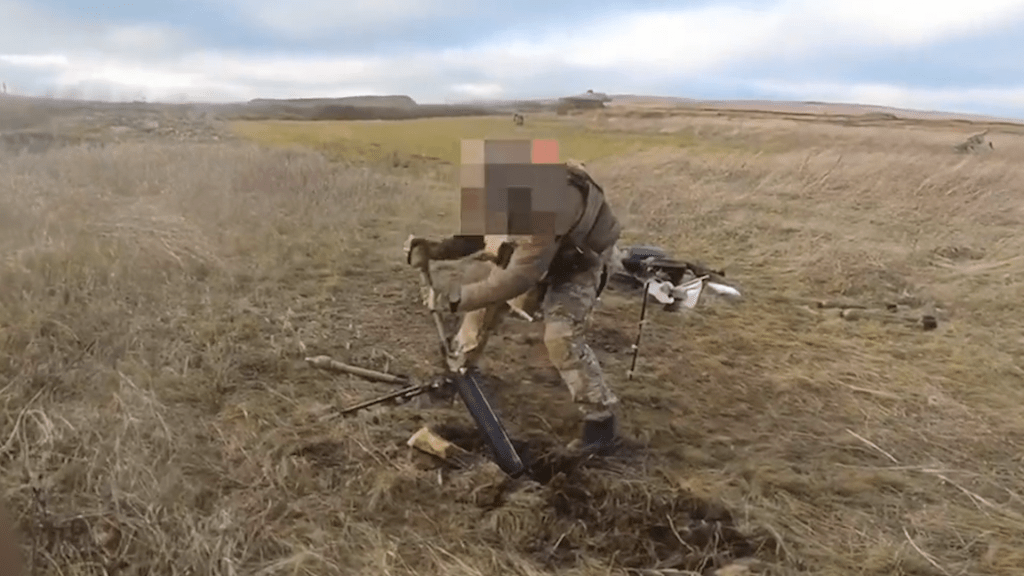
The longest video posted so far shows the mortar in action. Shared on 2 December the video shows the mortar dug into the ground with the operator firing three bombs in quick succession. Several seconds later we can hear them detonate down range. Again the video appears to show training and not operations. The machine translated caption describes a test with the 2B25 with the operators showing they could correct their fire with a drone, noting: “the accuracy and density of fire on the intended target increased significantly, the bombs hit the target one by one” Most recently, on the 3 December, a short clip with the caption “Another short video from our training” was shared showing the mortar being laid.
Update – 27/03/23: on 25 March a Russian telegram channel ‘Epoddubny’ shared a video featuring scouts operating around Bakhmut with a 2B25 82mm mortar. Below is a compilation of shots showing the mortar in action.
This is a compilation of shots from a recent Russian video showing the 2B25 82mm 'silent' mortar in action around #Bakhmut with a Russian recce unit. They note they have to be pretty close to the target due to the limited range. More on the 2B25 – https://t.co/ukrtdUK679#Ukrainepic.twitter.com/Bz4JhiSo1T
— Historical Firearms | Matthew Moss (@historicfirearm) March 27, 2023
Update – 26/10/23: Additional footage, without location or date of filming, shared on Russian social media. Briefly showing the 2B25 in action with an additional 3VO35 mortar bomb near by.
A very rare sighting of a Russian 2B25 'silent' 82mm mortar in use.
— Historical Firearms | Matthew Moss (@historicfirearm) October 26, 2023
Support Us: If you enjoyed this video and article please consider supporting our work here. We have some great perks available for Patreon Supporters – including early access to custom stickers and early access to videos! Thank you for your support!
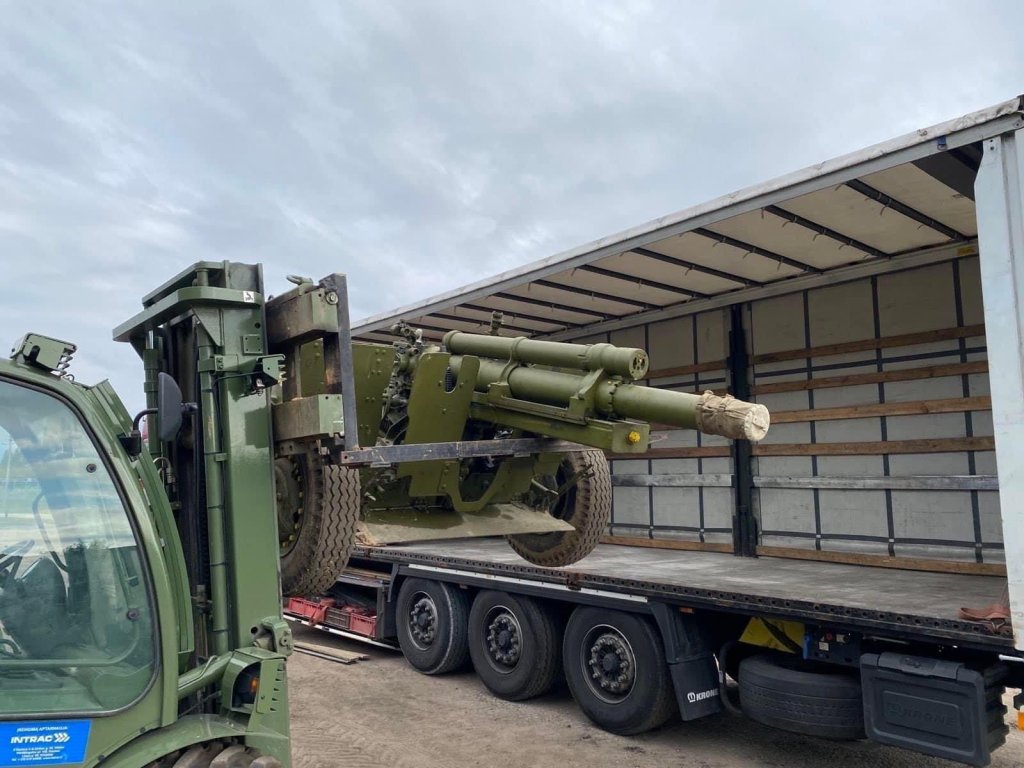
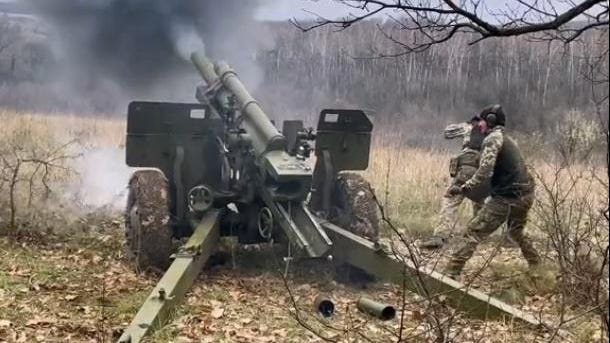
Plenty of old weapon systems are in use in Ukraine and artillery is no exception. This week the first footage of a batch of 105mm howitzers from Lithuania in action was shared online.
Lithuania has transferred an undisclosed number of M101 towed howitzers. While the 105mm gun lacks the range and punch of the 155mm M777s, Caesars, AHS Krabs and PzH 2000s which have made headlines in recent months, the venerable M101 is a proven weapon.
Introduced in 1941 as the M2A1, the gun has seen service around the world. First during the Second World War and later in Korea, Vietnam and in dozens of regional conflicts around the world. Now it finds itself equipping Ukrainian Army batteries.
The M101 weighs in at 2.5 tons or 2,260 kg and firing conventional M1 high explosive shells has a maximum range of 11,500 metres or just over 7 miles. The M1 round is made up of the the M1 High Explosive projectile, the M14 Cartridge Case, the M67 Propelling Charges and the M28 Percussion Primer.
The Baltic nation of Lithuania, has been a staunch supporter of Ukraine throughout the conflict providing equipment, arms and training. Lithuania originally received 54 of the guns from Denmark in 2002. Now, as Lithuania upgrades to 155mm systems the old guns have found a new home. While it is unconfirmed whether Ukrainian troops trained to use the guns in Lithuania, Ukrainian troops have been training in the Baltic nation.
The first guns were shipped in September, with the Lithuanian Minister of Defence announcing the transfer on his social media, but the first footage of them in action in Ukraine didn’t surface until late November.
While the M101 may be old it has the major advantage in that if fires the readily available family of 105mm NATO ammunition. This 105mm ammunition is used by a number of light artillery systems including the more modern US M119A3 and L119 towed 105mm howitzers. As of November 2022, the US has provided 180,000 rounds of 105mm.
While the M101 may seem like a step down from the 155mm systems in use it has a number of factors which mean the guns are still effective. Firstly, they are used in conjunction with drones which help adjust fire in real time to produce improve effect on target. Secondly, they can use M927 rocket-assisted projectiles which increase the gun’s range by 40%, around 17km. M927’s were first seen in late August being used in conjunction with L119 light guns.
The M101 is certainly an improvement over the 85mm D-44 guns that some Ukrainian Territorial Defense Force units have been seen using and the venerable 100mm MT-12 which has a range of just over 5 miles. While the M101 can’t hope to go toe to toe with Russian 152mm artillery, if used in its original role as an infantry support gun the venerable M101s will prove useful.
Update 07/12/22: Another short clip of an M101 in action was shared on the 7 December, showing the more closely than previous footage.
Here's the latest video of the M101's in action. Shared on telegram yesterday. Two guns are visible in the clip, location, date of filming unclear. Looks like it was filmed during training.
— Historical Firearms | Matthew Moss (@historicfirearm) June 11, 2023
Update – 11/11/23: Another siting of an M101 in action.
⚡️The 🇺🇸American 105-mm M101 howitzer in service with the Armed Forces of 🇺🇦Ukraine strikes 🇷🇺Russian positions. These howitzers were donated by friendly 🇱🇹Lithuania pic.twitter.com/xC4NqQETsk
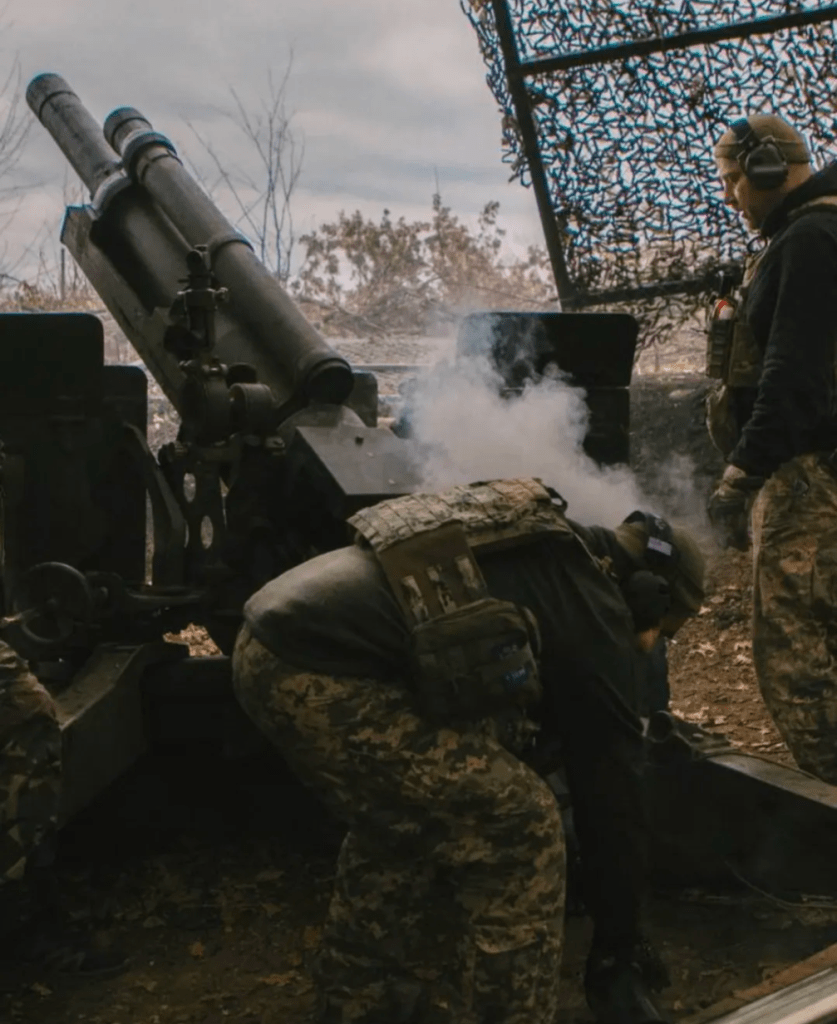
Update – 13/12/24: An M101 was seen in service with the 28th OMBR in a series of photos recently shared by the Ukrainian army.
Support Us: If you enjoyed this video and article please consider supporting our work here. We have some great perks available for Patreon Supporters – including early access to custom stickers and early access to videos! Thank you for your support!
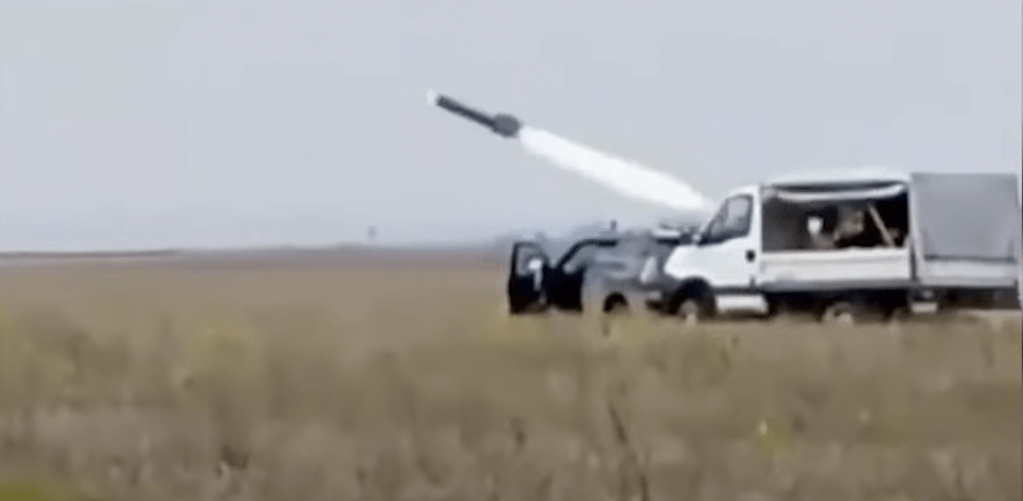
Footage of Brimstone anti-armour missiles being launched in Ukraine surfaced for the first time on 12 May but recent footage points to Ukraine now potentially deploying the Dual Mode Brimstone 2. In this updated video we look at what the missile is capable of, how they came to be in Ukraine and how they have been deployed.
A still from footage of a launch from the ‘Brimstone technical’ with the missile potentially being a Brimstone 2 with a translucent seeker head, shared online in early November (via Social Media)
In our earlier video on Brimstone use in Ukraine we examined the system’s capabilities, history and the new ad-hoc ground launch platforms in use. In this updated video we look at evidence of Brimstone use over the summer and autumn of 2022 and discuss the transfer of Brimstone 2 and its capabilities.
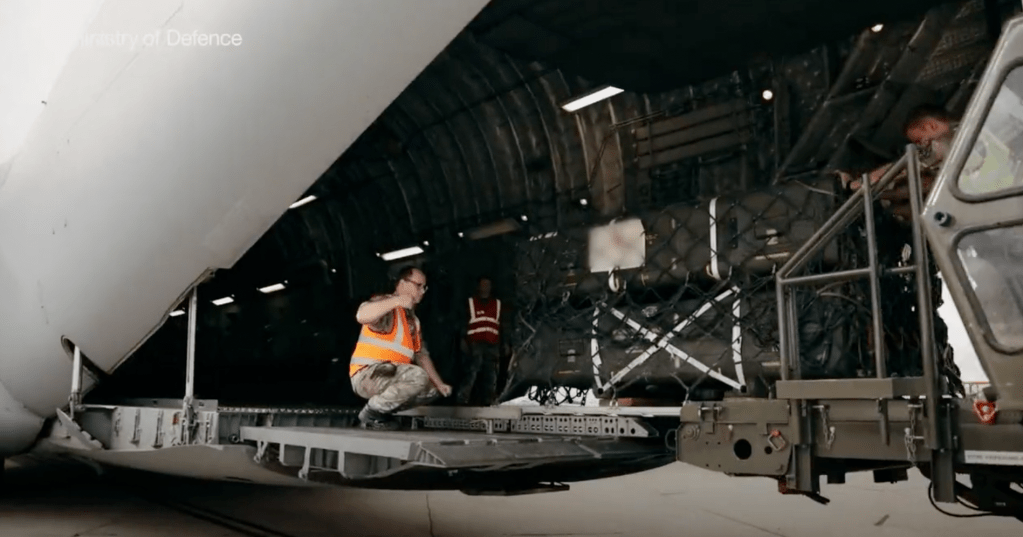
Brimstone 2 missiles being loaded aboard an RAF transport aircraft at RAF Brize Norton – perhaps around 48 missiles appear to be on board. (UK MoD)
The UK Ministry of Defence publicly confirmed the transfer of ‘Brimstone 2 Operational Missile Dual Mode’ to Ukraine on the 27 November with a short video. Dual Mode refers to a variant of the missile which can be used both as a ‘fire and forget’ system but also have a ‘man-in-the-loop’ capability which was originally developed as part of an Urgent Operational Requirement for a low-collateral damage weapon. According to MBDA Brimstone 2 has “an overall increase in performance with improvements in range and engagement footprint”, this is enabled by improved seeker, improvements to the missiles airframe with a more modular design and software updates.
Support Us: If you enjoyed this video and article please consider supporting our work here. We have some great perks available for Patreon Supporters – including early access to custom stickers and early access to videos! Thank you for your support!
We’ve seen a large number of different small arms being transferred to Ukraine. The large number of different 5.56x45mm chambered rifles is especially interesting. This is the first of a series of videos examining the variety of different 5.56x45mm rifles which have been seen in the field. These range from US M4A1s to FN F2000s and everything in between.
We’re starting the series examining the use of Colt Canada produced rifles and carbines. We first began to see Colt Canada C7 rifles appearing in the hands of Ukrainian personnel in May. They have continued to be seen in use with units including the Belarusian Kalinouski Regiment, International Legion Units and most recently one was seen in the hands of Ukrainian special operations forces landing on the Kinburn Spit.
International Volunteers with C7A1s fitted with ELCAN C79 optics (via Social Media)
Diemaco, renamed Colt Canada in 2005, began producing the C7 in 1982. These were derived from the US M16A1E1 programme which led to the development and adoption of the M16A2. The C7 differs from the M16A2 in a number of ways but principally in that it retains the M16A1’s rear sight set up and its semi- and full-automatic fire modes, rather than the A2’s 3-round burst. The versions seen in use in Ukraine are C7A1s, which replace the fixed carrying handle with a modified Weaver rail for mounting optics.
The primary users of the C7A1 are Canada (who have since moved to the C7A2 and C8A3), Denmark who issue the C7A1 as the M/95 and the Netherlands who adopted the C7A1 in the early 1990s. All of the countries also use the C8 carbine with the improved Integrated Upper Receiver. The Netherlands field the C8 as the C8NLD and the Danish Army uses it as the M/10. the United Kingdom currently fields the C8 SFW as the L119, and may have other earlier variants of the carbine in inventory.
Combatant from the Kalinouski Regiment with a C7A1 rifle fitted with a Hi-Mag optic (via Social Media)
I reached out to the Dutch, Canadian and Danish defence ministries and while the Dutch and Danish ministries declined to comment the Canadian Ministry of National Defence responded to confirm that Canada has not, to-date, provided any C7 pattern rifles. Instead, the Canadian spokesperson confirmed that Canada has provided an unspecified number of C8 carbines.
Another indicator of this is that some of the photographs show the original Diemaco stylised ‘D’ roll mark on the magazine housing. Canadian C7A1s have the ‘D’ roll mark above the trigger, with a Canadian maple leaf engraving on the magazine housing. Sources state that Colt Canada refitted most of Canada’s C7A1s into the C7A2 configuration, with a collapsing buttstock, in the 2010s. The available imagery isn’t clear enough to make out smaller national markings to differentiate where they originated from.
Ukrainian combatants with C7A1 rifles fitted with Hi-Mag optics (via Social Media)
This means that the C7A1 rifles seen in Ukraine were likely provided by either the Netherlands or Denmark. The Netherlands adopted the C7A1 and fielded it with ELCAN SpecterOS3.4x (C79). Interestingly, there has also been at least two sightings of a 6x ELCAN Hi-Mag on a C7A1 in early October. The Hi-Mag was adopted by the Dutch military as a machine gun optic which may point to at least some of the rifles coming from a transfer from the Netherlands. I have not been able to find any mention of the Danish armed forces using the Hi-Mag. [Update: on further research and discussion with Dutch sources the C7 pattern rifles have now been confirmed to be of Dutch origins. The key identifying characteristic being the small QR code tags seen on the right side of the magazine housing. We will have a more detailed article on this in the future.]
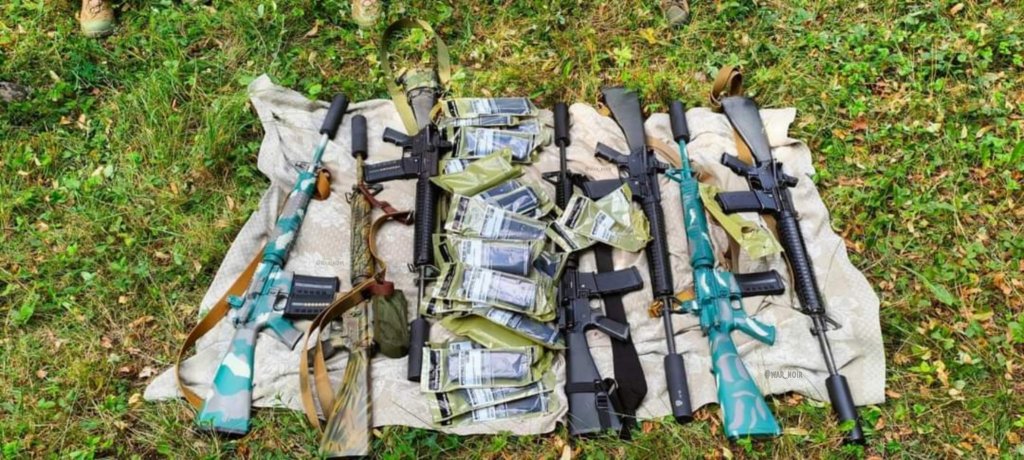
The C7A1s have been seen fitted with a mix of ELCAN C79s, Aimpoint Comps, various reflex sights and some with original Diemaco/Colt Canada rear iron sights. Some have already been adapted with some pretty interesting paint schemes and fitted with suppressors.
Various C7A1 rifles with suppressors, iron sights and paint jobs (via Social Media)
It is also unclesr where the C8 carnines seen in Ukraine originated from. While the Canadian Ministry of National Defence confirmed C8s had been sent to Ukraine, an anonymous source close to the programme to transfer the weapons noted that the carbines sent were in the C8 SFW configurations with a railed forend. The C8s seen in the field, with the earlier non-railed handguards, may be from Denmark or the Netherlands.
The first appearances of C8s in videos shared to social media that I could find date to September, but they’ve likely been in use prior to this. This piece of combat footage which was shared on social media around the 19 September is especially interesting as we see C8 carbines with ELCAN Specters but at least one has a red dot and magnifier set up. We can also see TRIAD rail mounts which are attached around the front sight base. This may indicate the carbines are C8A3s but its difficult to make out the other defining features of the A3. The TRIAD was developed to allow attachment of accessories without changing out the hangdguards, in this case most of the guys appear to have fitted vertical front grips.
Ukrainian combatant with a C8 carbine, note the Triad rail attachment (via Social Media)
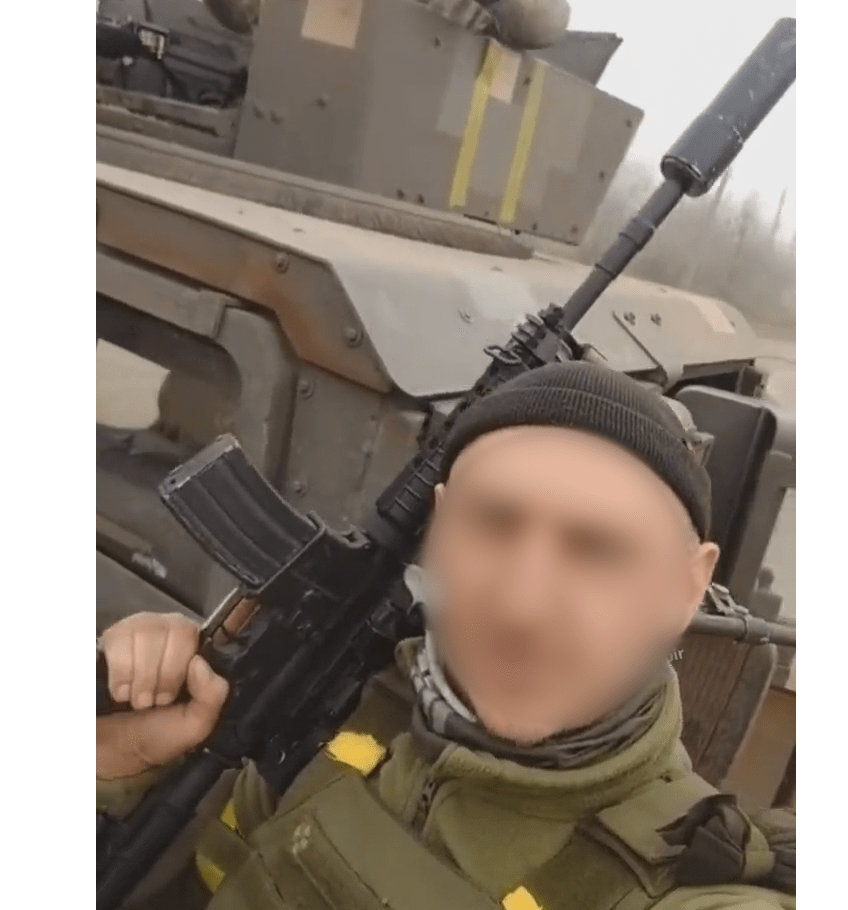
An individual on the Kherson front has also shared numerous images and videos featuring his personal weapon – a C8 with a suppressor and what appears to be a more modern ELCAN Specter. The individual also shared some footage of himself and others running a contact drills.
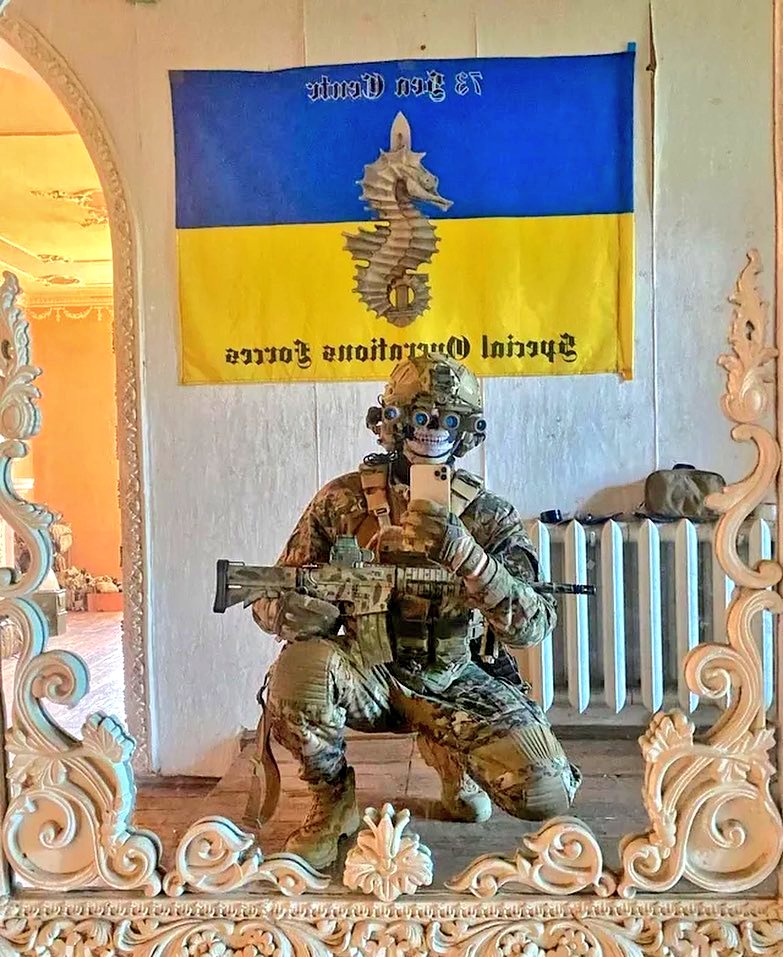
Member of the Ukrainian 73rd Naval Special Purpose Center with C8 (via Social Media)
The 73rd Naval Special Purpose Center, part of Ukraine’s SSO (special operations force), with a Colt Canada/Diemaco C8 carbine. The C8 is easily identifiable by its thicker buttstock. It also appears to have a vertical front grip just visible, attached to a Triad rail mount under the front sight post.
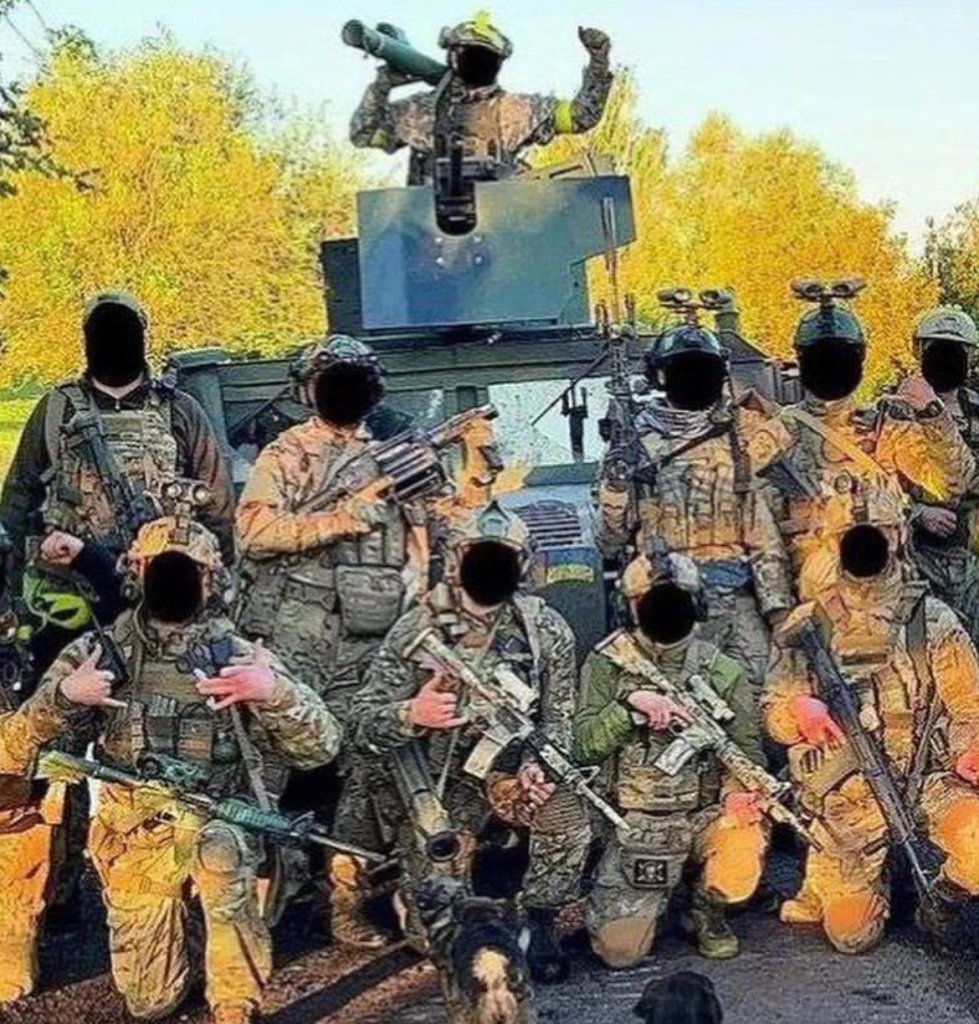
Another photo of the operators from the 73rd Naval Special Purpose Center may be the first image of a C8 SFW – the carbine appears to have a railed forend with a laser/light module fitted along with a vertical front grip.
73rd Naval Special Purpose Center operators with what may be a C8 SFW, along with earlier unrailed C8 carbines (via Social Media)
In future articles/videos we will explore the plethora a 5.56×45mm chambered rifles, carbines and light machine guns transferred to Ukraine.
Thank you to War_noir on twitter and StreakingDelilah on Instagram for sharing several additional photos of C8s.
Update – 01/12/22: Ukrainian SSO have shared a video with an operator discussing recent operations which gives a good look at his C8 carbine.
Ukrainian SSO have shared a video featuring an operator with a Colt Canada/Diemaco C8 carbine.
— Matthew Moss | The Armourer's Bench (@historicfirearm) December 1, 2022
Update – 30/01/23: The Belarusian Kalinouski Regiment, serving with the Ukrainian Armed Forces, has shared a photo of a Dutch Diemaco C7A1. Note the C79 ELCAN and original Thermold magazine which were shipped with the guns. The armory QR code tag can be seen on the magazine housing – identifying this rifle as of Dutch origins.
Another Dutch (ID'd from the armory QR tag on the mag well) Diemaco C7A1 rifle with ELCAN optic, seen in a photo posted by the Belarusian Kalinouski Regiment of the Ukrainian Armed Forces.
— Matthew Moss | The Armourer's Bench (@historicfirearm) January 31, 2023
Update – 15/02/23: Another recent photograph showing a Dutch C7A1 rifle with an ELCAN Hi-Mag optic, originally used on Dutch light machine guns.
Great photo, one of the ELCAN Hi-Mags. The Dutch armourers essentially fitted every available surplus optic. https://t.co/PnGcCQ204b
— Matthew Moss | The Armourer's Bench (@historicfirearm) February 15, 2023
Update – 26/02/23: Elements of the Azov Brigade have been equipped with Dutch C7A1 rifles (and ELCANs). Azov released these training photos a couple of days ago, on 21 February.
Element of the Azov Brigade have been equipped with Dutch C7A1 rifles (and ELCANs). Azov released these training photos a couple of days ago.
— Matthew Moss | The Armourer's Bench (@historicfirearm) May 12, 2023
Update – 17/05/23: Some recent examples of stock C7A1s being adapted with aftermarket furniture to increase the rifle’s modularity.
Ukrainian's issued with Colt Canada (Diemaco) C7A1 rifles largely like the weapon but some have complained about its lack of modularity. Here's some of the latest examples of them being upgraded with aftermarket parts.
— Matthew Moss | The Armourer's Bench (@historicfirearm) June 13, 2025
Support Us: If you enjoyed this video and article please consider supporting our work here. We have some great perks available for Patreon Supporters – including early access to custom stickers and early access to videos! Thank you for your support!
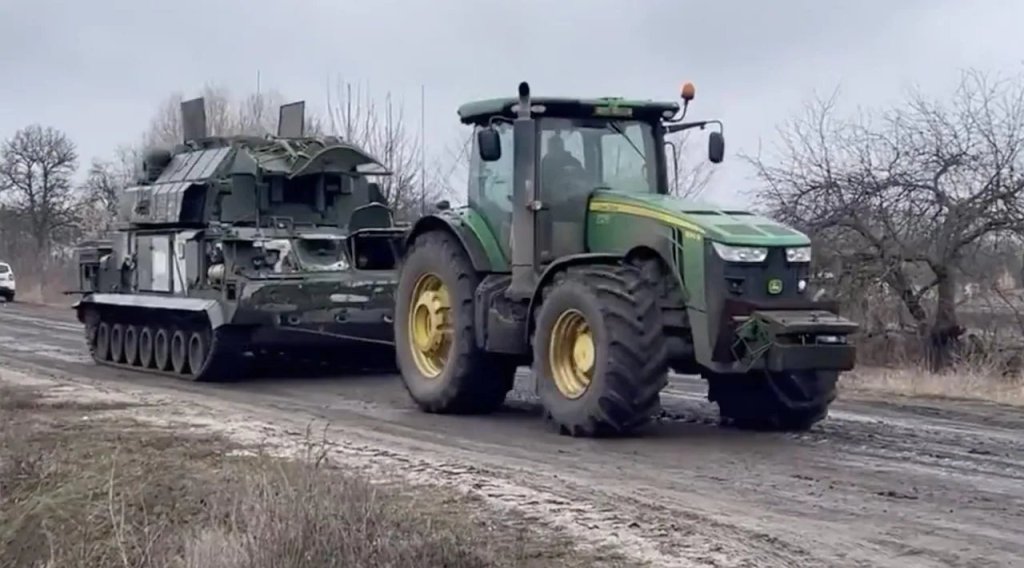
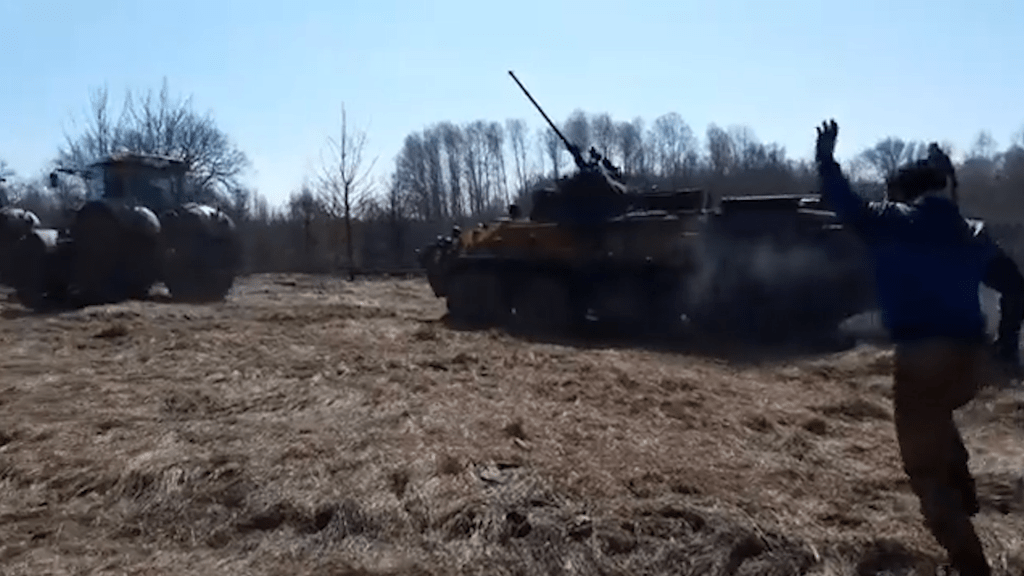
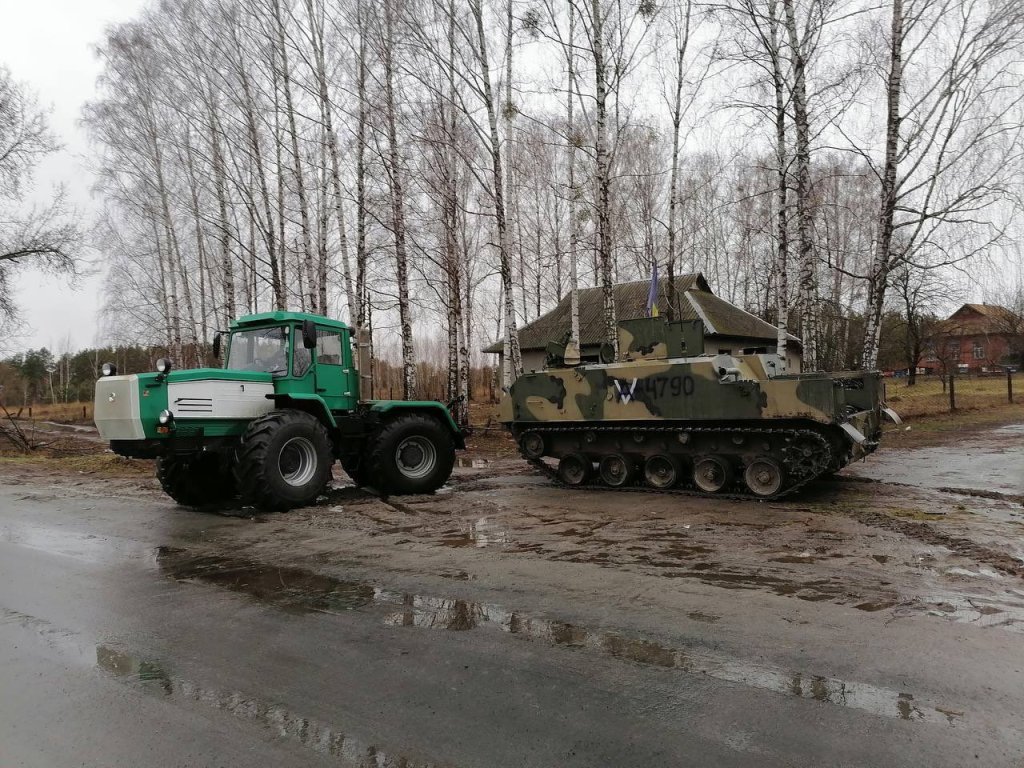
Since Russia’s invasion of Ukraine in late February large quantities of vehicles and equipment have been captured or destroyed on both sides. Fighting a war in the social media age means we have an unprecedented amount of first hand footage and of course from this memes are going to evolve. Almost as soon as the war began videos of Ukrainian farmers towing Russian vehicles began to be shared on telegram, tiktok and instagram. Often salvaging abandoned equipment the videos soon made unlikely heroes of Ukraine’s farmers. So much so they’ve been commemorated not just by Saint Javelin merchandise but also an official stamp from the Ukrainian post office.
I’ve collected quite a few videos of the farmers in action over the last few months and Rob Lee over on twitter has been keeping a running thread too. So here’s a supercut of videos showing Ukrainian farmers towing away everything from trucks to Grad launchers to T-80 tanks!
Support Us: If you enjoyed this video and article please consider supporting our work here. We have some great perks available for Patreon Supporters – including early access to custom stickers and early access to videos! Thank you for your support!
Bibliography:
Famous for towing captured Russian tanks, Ukrainian farmers step up for war effort, CBC News, (source)
Winning design in Ukraine’s second design contest features tractor and tank, Linn’s Stamp News, (source)
Ukraine Celebrates Its Tank-Towing Farmers, VOA, (source)
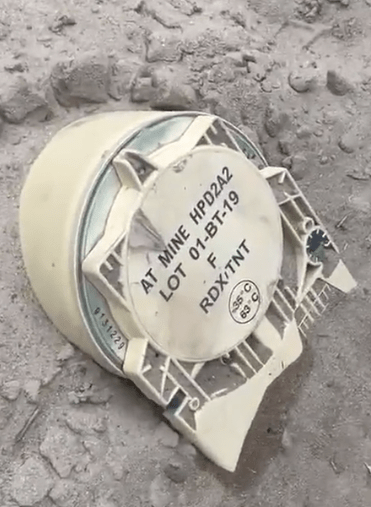
Earlier this week (7 November) Alexander Borodai, the former leader of the self-proclaimed Donetsk People’s Republic now a member of the Russian Duma for the separatist region, was seen in a video showing a near miss with a French HPD 2A2 anti-vehicle mine. The video, believed to have been filmed south of Kherson, showed the lead vehicle of Borodai’s convoy damaged by a mine, while another mine was seen next to his vehicle. The lead vehicle appears to be badly damaged with the front of the vehicle seemingly taking the brunt. If the vehicles was damaged by a HPD 2A2 it is interesting that the 4×4 vehicle was able to set off the mine which is designed to be triggered by heavier armoured vehicles, though some sources state movement of even smaller metal objects near by can trigger the mine. Similary Borodai is lucky not to have triggered the mine’s anti-tamper system.
The mine is clearly identifiable as a French HPD-2A2 with the lot number 01-BT-19. Various sources suggest around 400,000 of the HPD series of mines have been produced and they’re in service with the French, Norwegian, Belgian and Swiss armed forces. From Borodai’s video we can see the mine has a serial number of ‘9131229‘. Another example photographed in early October has the partial serial number ‘91296..’ visible. Both mines are from the same lot and the end digits seem to denote year of manufacture – 2019.
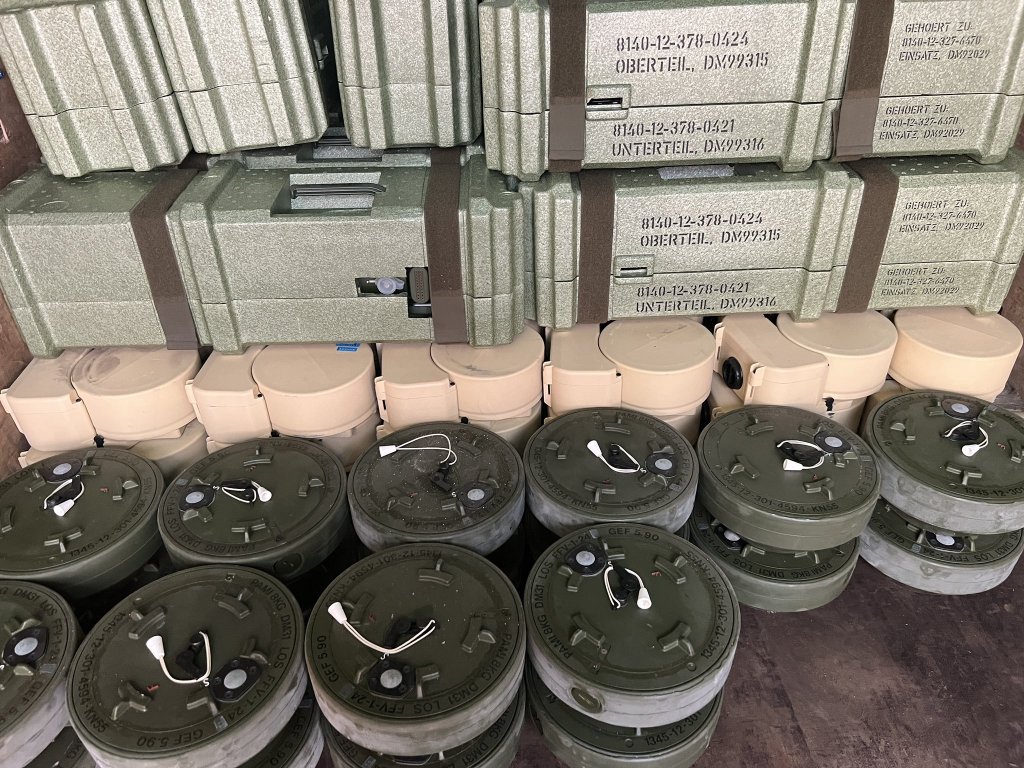
Russian sources suggest the mines have been in theatre since August but the first images of the mines were shared in early July, pictured in the back of a Ukrainian van with German DM-22 off-route mines and DM-31s. Some video was released by a Ukrainian explosive ordnance disposal (EOD) officer in July which is claimed to show a Russian vehicle destroyed by one of the HPD-2A2 mines.
Russian tank (probably carrying ammo) blew up on our mine and then was finished with grenade launcher.
The HPD family of mines (which includes the HPD 1, 2 and 3) began to be developed in the early 1980s by Thomson-CSF and Daimler-Chrysler Aerospac. The HPD2 (or MI AC HPD F2 in French service) was introduced in 1988. The mines use a 3.3kg charge made up of an RDX/TNT mix to create an explosively formed penetrator using the Misznay–Schardin effect. The mines are said to be able to penetrate armour between 100 to 150mm thick. The mines have a 10 minute arming delay once set and can be active for up to 30 day before they deactivate themselves. Because the mine can be triggered by the electromagnetic field of a metal detector it has been said that this contravenes the Geneva Convention’s Protocol II (May 3, 1996).
The HPD-2 is made up of two sections: a fuze assembly with a magnetic influence sensor and a two battery power supply, the self-neutralising system and the arming mechanism and the mine’s explosive charge. It reportedly has an anti-handling device sensitive to motion and the signals produced by metal detectors. The mine is detonated when the seismic sensor reacts to vibrations made by passing vehicles and a magnetic sensor is activated. The magnetic sensor uses variation in the earth’s magnetic field caused by the proximity of a vehicle’s large metal mass. Sources suggest the magnetic sensors is triggered by vehicles over 8 tons.
While there has been no official confirmation the mines are believed to have been provided by France as part of their military aid to Ukraine which has also included VAB armoured vehicles, Mistral short range air defence systems and anti-tank guided missile systems including MILAN and Javelin.
Support Us: If you enjoyed this video and article please consider supporting our work here. We have some great perks available for Patreon Supporters – including custom stickers and early access to videos! Thank you for your support!
Since the Russian invasion of Ukraine in February we’ve seen a number of FN MAG variants appear in use with Ukrainian forces. By far the most common appears to be the US M240 series. However, in recent months we’ve also seen a number of Swedish KSP-58s appear in imagery from the field.
Sweden has long supported the Ukrainian war effort providing a shipment of 5,000 Pansarskott m/86 anti-armour weapons (perhaps better known as the AT4) back in late February. The transfer of an additional batch of 5,000 m/86s was announced on 2 June. Most recently on 30 June it was reported that Sweden would provide a fresh batch of light anti-armour weapons and also machine guns as part of a transfer worth $49 million. When delivery of this aid was made is unconfirmed but the KSP-58s are reported to have been in theatre possibly as early as July – August.
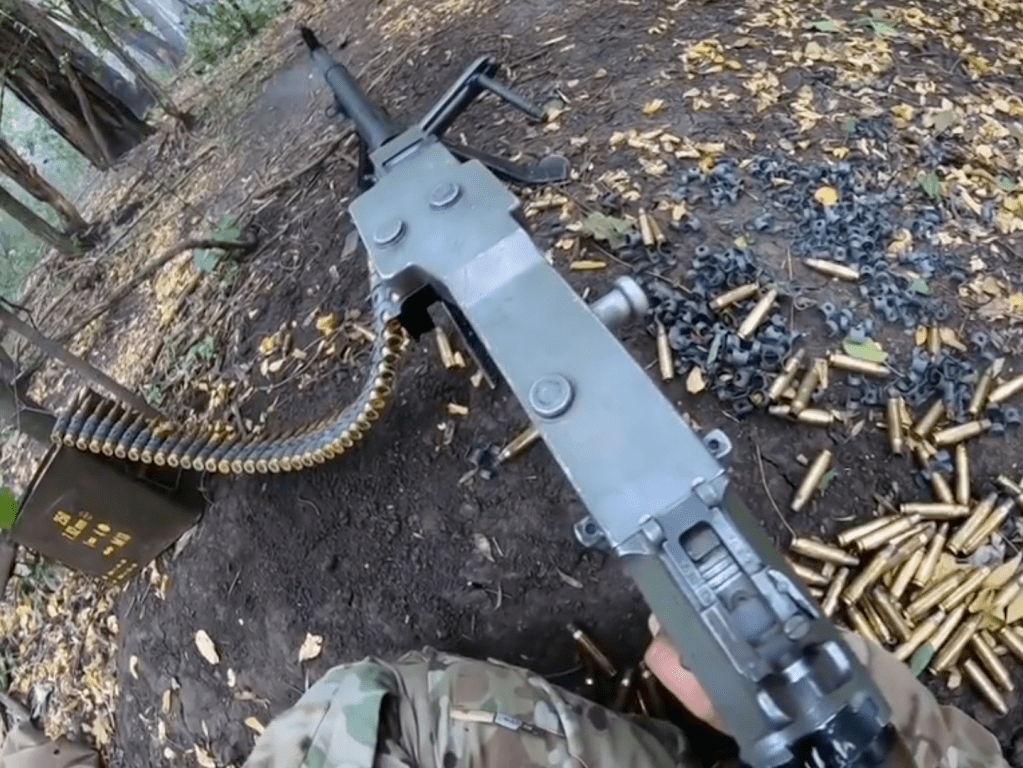
While the type of machine gun was not confirmed, since the beginning of September we’ve seen imagery of a number of KSP-58 GPMGs appear in theatre. Easily identified by their wooden stocks, grey-green-coloured receiver finish and enclosed front sight. Sweden was one of the earliest adopters of the FN MAG and the Kulspruta 58 or KSP-58 entered service with the Swedish armed forces in the late 1950s and was originally chambered in the 6.5×55mm Swedish round. The KSP-58B was introduced following the adoption of 7.62x51mm. The guns were made under license from FN at the Carl Gustav Stads rifle factory in Eskilstuna.
A KSP-58B in use with Ukrainian troops c. September 2022 (via social media)
These have been seen in the hands of International Legion units and also regular Ukrainian Army units centred around Mykolaiv and Kherson. All the the examples of the weapon sighted appear to be KSP-58Bs, none of the guns seen have the Picatinny rails seen in the KSP-58F.
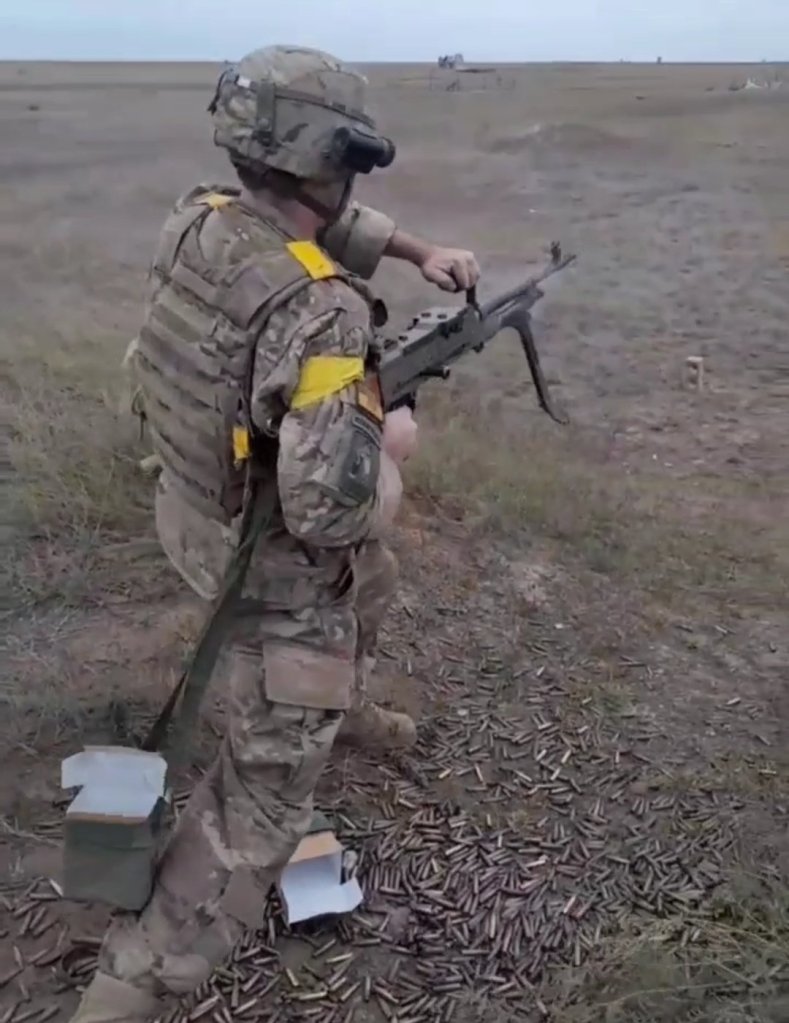
Speaking to Kaiser [frontline_view_kaiser] a German volunteer with the Ukrainian Army, he said his unit encountered a “a brand-new, never used KSP with original factory delivered Box and all accessories untouched”. His colleague Yuri [nucking_futs_yuri] has shared some videos filmed in late-August, during a training session he ran on FN MAG variants for various Ukrainian units. Yuri said their were about 20 guns on the range during the training session, with the majority being KSP-58s. Yuri shared a video in mid-September firing a through a KSP-58B, from the hip, filmed after the training session had been completed.
While we can’t confirm that the KSP-58s came directly from Sweden it seems likely. Another potential origin for the weapons may be the Baltic States (Estonia, Latvia and Lithuania). Sweden gifted an unconfirmed number of KSP-58s to the Baltic States in the 1990s. Today, the guns remain in service with the Latvian Army and National Guard, the Estonian Army and Estonian Defence League and the Lithuanian Army and National Defence Volunteer Force. Both Estonia and Lithuania began searching for a replacement for the KSP-58 in mid-2021. Given the Baltic states’ support for Ukraine the guns may potentially have originated from there, rather than Sweden itself. We have already seen the Baltic States have transferred former Swedish equipment including the PV-1110 recoilless anti-tank gun which were given to the Baltic states in the early 1990s.
It remains to be seen if we’ll see more of the KSP-58s in the field but in future articles/videos we’ll look at other FN MAG variants are in use in Ukraine.
Update 16/1/24: A maritime element of Ukraine’s Border Guards shared photos of them familiarising with what appears to be a KSP-58.
Some good photos of what appears to be a Swedish FN-MAG (KSP-58) in use with the Ukrainian Border Guards' maritime element.
— Matthew Moss | Historical Firearms (@historicfirearm) June 5, 2024
Update – 15/10/24: A video of a KSP-58 in action somewhere in Ukraine, date unknown, recently shared online.
If you enjoyed this video and article please consider supporting our work here. We have some great perks available for Patreon Supporters – including custom stickers and early access to videos! Thank you for your support!
Bibliography:
Thank you to Kaiser and Yuri for their input – definitely check them out on their social media!
Join me for a laid back video taking a look at some recent editions to the TAB reference collection. I’d been setting these aside for a few weeks and had largely forgotten what to expect! We have everything from the last Vickers Gun manuals printed by the British Army to a manual for the MAT-49 to a gritty guide to nuclear war from 1963!
If you enjoyed this video and article please consider supporting our work here. We have some great perks available for Patreon Supporters – including custom stickers and early access to videos! Thank you for your support!
The RPG-30 is one of Russia’s more advanced disposable anti-armour weapons. Developed in the early 2000s by Bazalt it is designed to overcome reactive armour and active protection systems. It entered service in 2012 and has seen extensive use during the fighting in Ukraine.
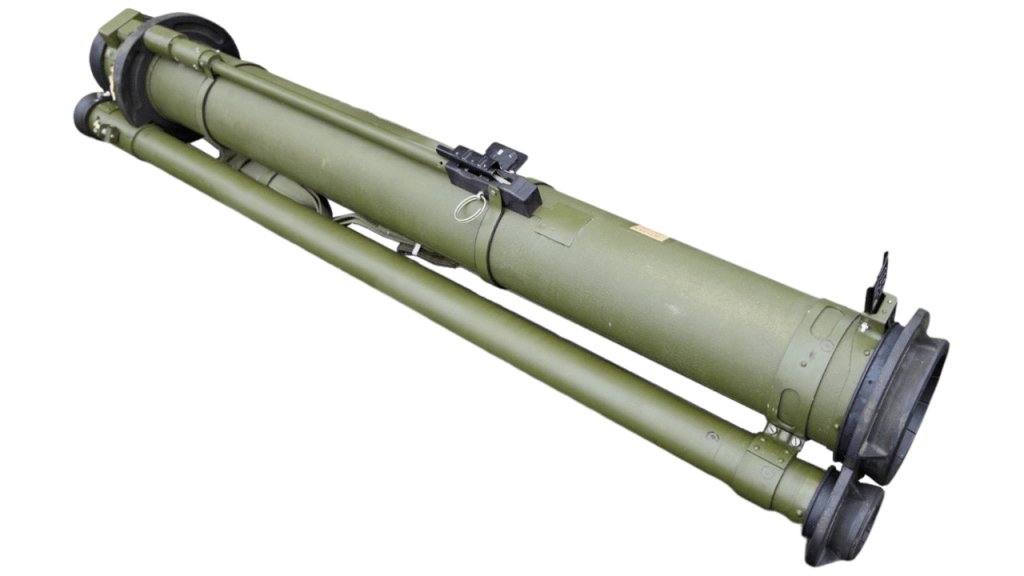
The 7P53 RPG-30 “Kryuk” or ‘Hook’ is a 105mm fin and spin stabilised rocket propelled munition with a tandem HEAT shaped charge warhead. The RPG-30 overcomes ERA and APS by using a 42mm IG-30 decoy projectile, which is believed to be inert, coupled with the main rocket’s tandem warhead. This can be seen in a secondary, thinner tube running along the side of the weapon. The precursor decoy causes premature activation of the APS and allows the main warhead to exploit the gap in the tank’s protection. The theory being that the target’s APS takes some time, perhaps half a second, before it can engage again. The gap between the firing of the two rockets is measured in milliseconds and the lag, while noticeable, does not appear to be significant enough to effect the user’s aim or accuracy on target.
RPG-30 (Vitaly Kuzmin CC BY-SA 4.0)
The RPG-30 uses the PG-30 tandem HEAT warhead, similar to the PG-27 used by the RPG-27. It can reportedly penetrate 750mm of rolled homogeneous armour and up to 650mm of rolled homogeneous armour after ERA. Effective range estimates vary with the average suggesting 200m.
The weapon’s sights are simple and consist of a folding ladder front sight and rear sight – there does not appear to be provision for mounting optics. Flipping up the rear sight also cocks the weapon. The disposable tube(s) is made of aluminium with a fibreglass outer layer. Sources suggest it weighs around 10.3kg (22.7lbs) and has an overall length of just over 1m (1,135mm/44.7in).
A pair of RPG-30s captured in April 2022 (via Social Media)
Unlike other Russian weapon systems few videos of its use have been shared by Russian state media or Russia’s defence exports corporation Rosoboronexport. The ongoing war in Ukraine, however, has provided our first real look at the weapon in action. As soon as the Russian invasion was launched on 24 February, RPG-30s began to be seen in use with Russian forces. By late February and early March imagery of captured examples was shared on social media.
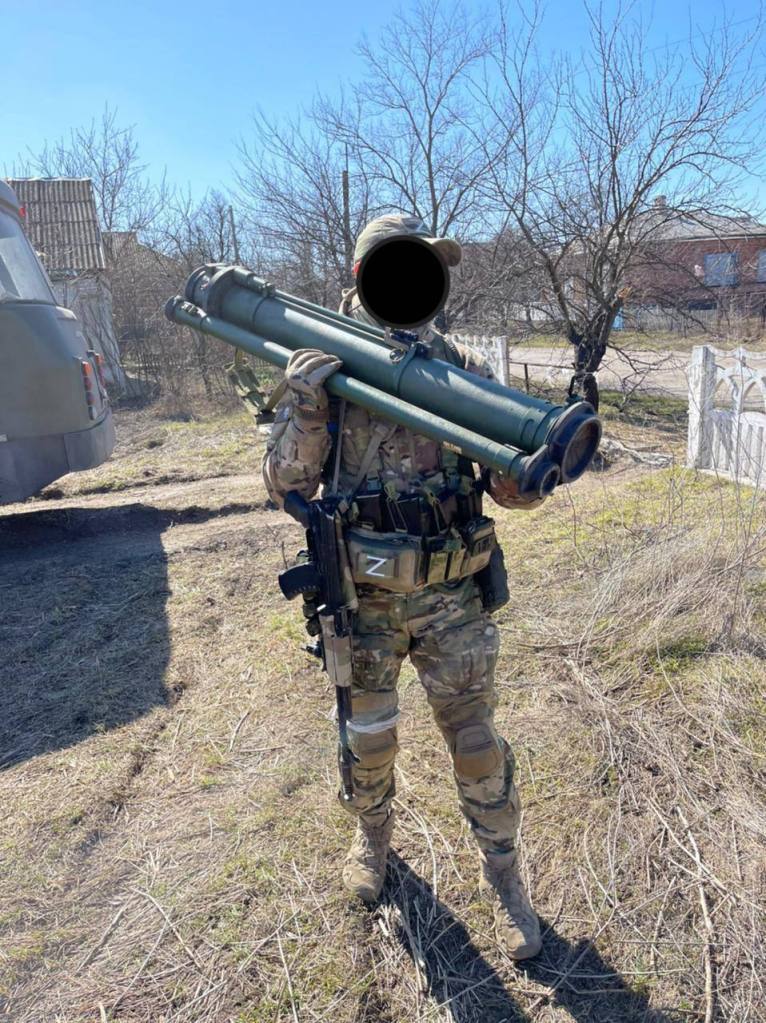
Russian soldier posing with RPG-30, March 2022 (via Social Media)
The first images of the weapon came from Russian sources in late February, just after the invasion. This was quickly followed by imagery of captured examples, most notably from the column of Tigr-M armoured infantry mobility vehicles in Kharkiv. A photograph of a further two captured RPG-30s appeared in April, while another example was photographed in Donbas in early May. Later in May a photo of a Russian soldier posing with one was shared on social media and in September significant caches of weapons were captured in Kherson and Balakliya.
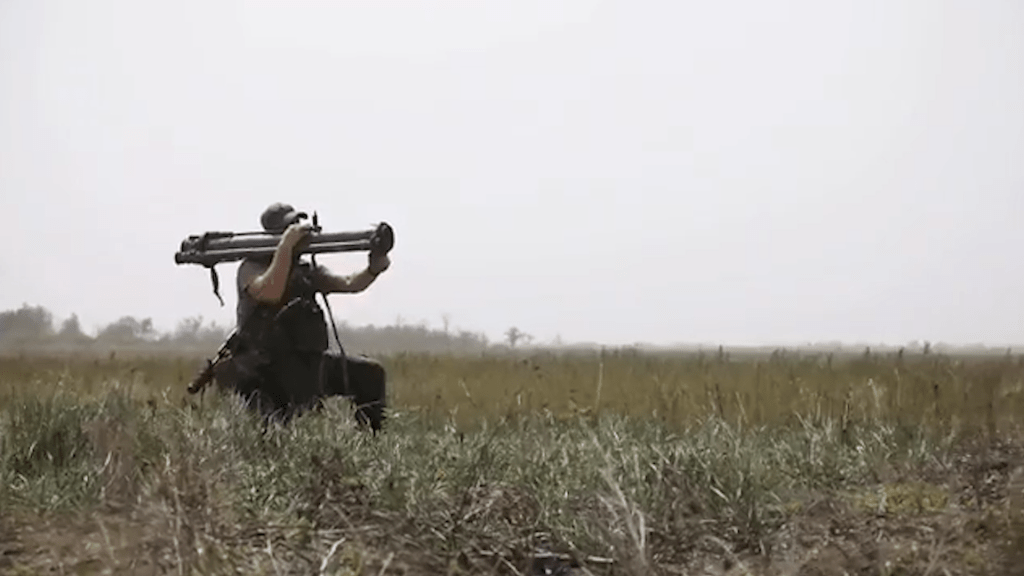
Still of a Russian soldier firing an RPG-30, August 2022 (via Social Media)
In late August we got our first brief look at the RPG-30 being fired in a montage video of VDV weapon systems (see image above). Earlier in mid-August a sort of ‘unboxing video’ was shared giving us a good close up look at some of the packaging the RPG-30s are shipped in and the markings on the side the weapon. Most recently in some further video of the RPG-30 being fired on a Russian Western Military District range also surfaced giving us a good look at the weapon in action.
RPG-30s captured in April (via Social Media)
Of course the weapon is designed to be simple to use, anyone with training on a similar shoulder-fired disposable anti-armour weapon can operate it. While it has been said that its widespread use in Ukraine is somewhat ironic given that Ukraine does operate any APS equipped tanks, the weapon is still useful against less sophisticated tanks. While the precursor might potentially deliver some limited kinetic damage to the ERA block, the RPG-30’s tandem warhead is capable of defeating the ERA fitted to most Ukrainian tanks, though of course, the same can be said of Russia’s other anti-armour weapons which use tandem warheads.
Update 27/10/22:
The Georgian Legion recently shared a short video looking at a captured RPG-30. The video also includes firing footage of the weapon.
Extract from a recent Georgian Legion video examining a captured RPG-30.
— Matthew Moss | Historical Firearms (@historicfirearm) August 20, 2024
If you enjoyed this video and article please consider supporting our work here. We have some great perks available for Patreon Supporters – including custom stickers and early access to videos! Thank you for your support!








 The Armourers Bench