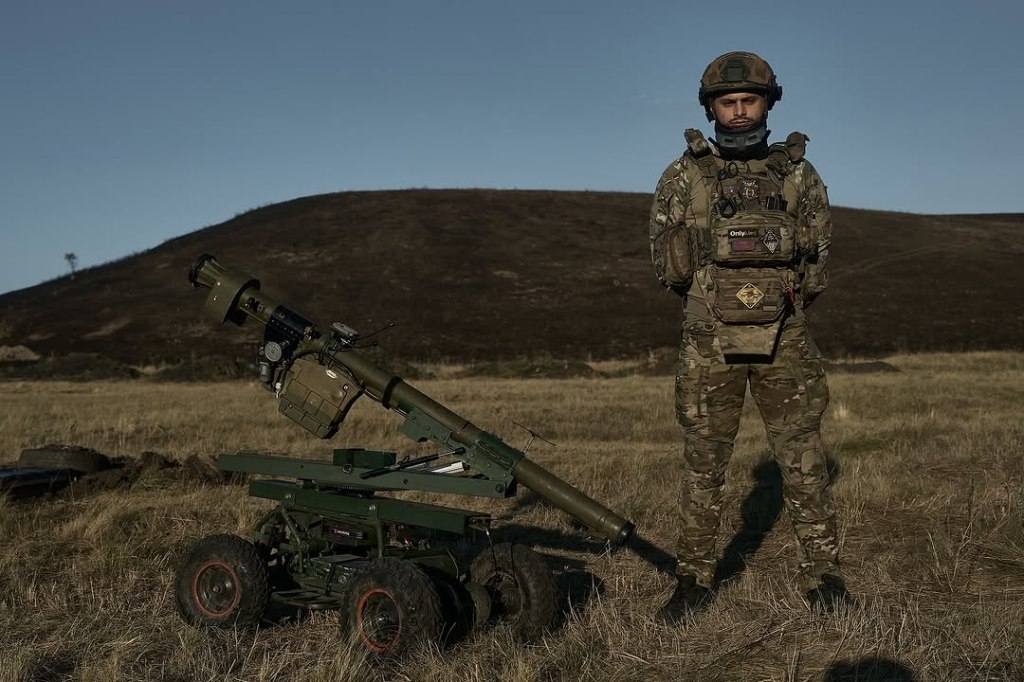
Following on from our recent examination of RPG-UGVs a new armed unmanned ground vehicle variant has appeared – the MANPADS-UGV. MANPADS or Man-Portable Air Defence Systems have been a key weapon during the war in Ukraine. They enable troops to engage drones and UAVs of various sizes as well as helicopters.
(LIBKOS/28th Mechanized Brigade)
On 4 August, photographers Libkos, shared a video showcasing an Igla-1 MANPADS mounted on a four-wheeled UGV operated by Ukraine’s 28th Mechanized Brigade. In an Instagram post, Libkos explained the idea behind the MANPADS-UGV:
“If before they were quite easy to shoot down with MANPADS, now Russian UAVs control every movement of our infantrymen and often do not even allow them to leave the trench. That is why the guys from @28ombr created this robotic platform. It independently guides and hits any large air target. The guys have already tested it in action and it already has one enemy helicopter on its account. So we are collecting 10 more such platforms. This is an effective and innovative weapon that is independently manufactured by the military from 28 Ombr.”
— Matthew Moss | The Armourer's Bench (@historicfirearm) August 4, 2025
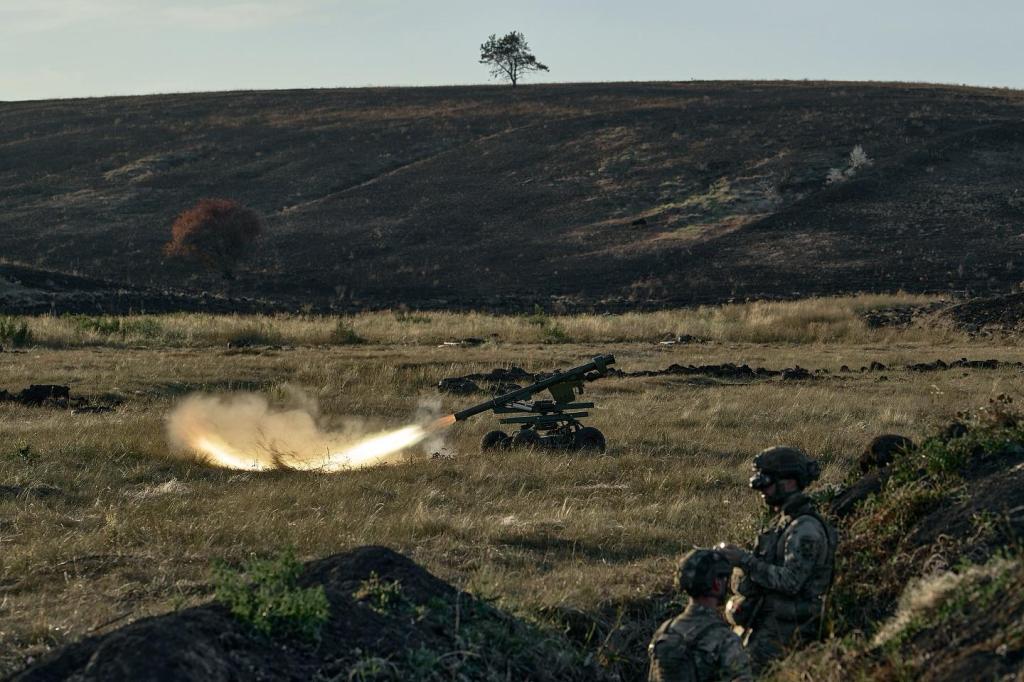
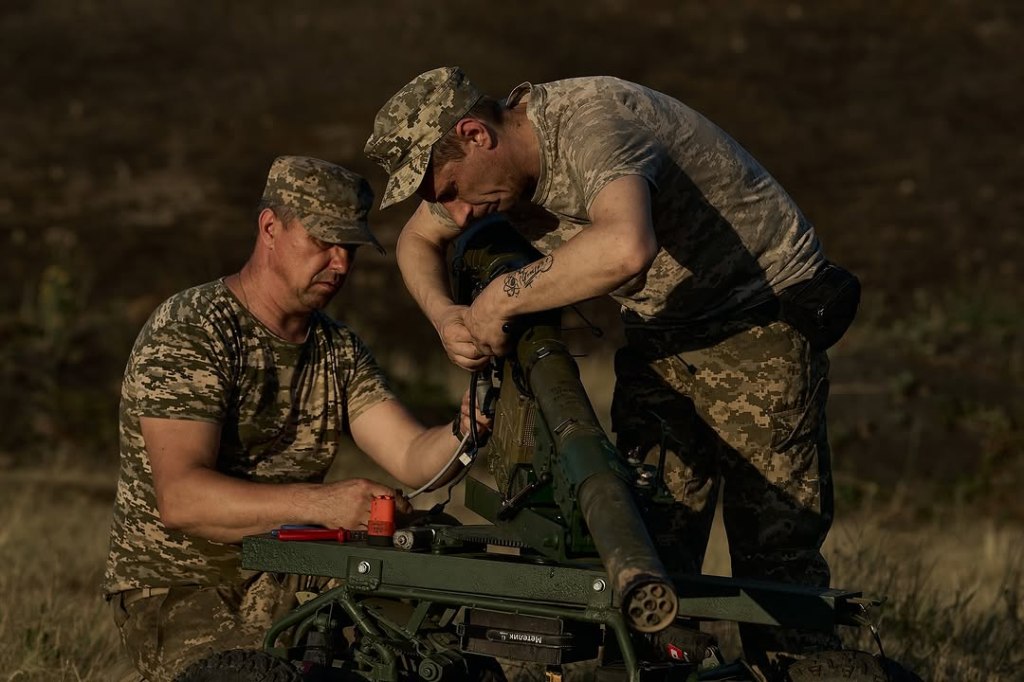
The available imagery, shared by Libkos and the brigade, shows the UGV being test-fired. The Igla is mounted on an angled mount, which seems to have a degree of elevation and traverse. There appears to be a motor and servo system attached to the front of the weapon to act on its trigger. Behind this is what may be a camera and transmitter/receiver. In part of the promo video a pair of operators are seen in a nearby trench, one wearing a headset for the UGV’s camera feed.
Ukrainian media outlet Defenderreports that the MANPADS-UGV has been named “Alycha”.
(LIBKOS/28th Mechanized Brigade)
It’s difficult to tell how the system would be used in practice or how effective it would be. MANPADS such as Igla-1 use infrared homing and require the operator to track the target before launching. The operator has to visually detect the target, activate the power supply unit, aim at the target via the fore and rear sights and pull the trigger. While the operator doesn’t have to track the target once the missile is fired they must track it immediately prior to launch. How capable the UGV is of doing this is currently unclear. For the best image clarity and response time for identifying and tracking a target it would make sense for the UGV to utilise a fibre-optic control cable but there is no evidence of this in the available imagery.
It is unclear if the system can be equipped with different types of MANPADS. In theory the UGV could be mounted with Igla, Strela, Piorun or even Stinger, as such one variable to consider is the system’s engagement range. The Igla-1’s operational engagement range is 6km (3.5 miles) with an 11,000 feet engagement ceiling. Given Ukraine’s focus on defensive strong-points the gap between positions able to engage aerial threats with a MANPADS may be relatively wide. If small Ukrainian units are defending strong-points along a stretch of front they may have a limited embedded anti-air capability. A MANPADS team would have to expose itself to reach various points along the unit’s sector of the front so having a UGV which can be rapidly deployed makes sense.
(LIBKOS/28th Mechanized Brigade)
Nevertheless the concept is an interesting one. the 28th Mechanised Brigade claims that the system has already been used operationally and the UGV has successfully engaged an enemy helicopter. Verifiable proof of this kill has not yet been provided. There are no doubt useful applications for the system, such as patrolling an area, as a quick reaction asset and in removing the need for troops to leave cover to engage aerial threats.
There are a lot of different types of general purpose machine guns in use in Ukraine and one of the most surprising to appear so far is the M60. The first appearance of an M60 in Ukraine came in September 2024, when the 23rd Mechanised Brigade shared an album of training photos which included an individual firing an M60D.
A month later the same brigade shared another photograph of the M60D. The M60D is usually mounted on helicopters as a door gun and as such it has been adapted with no stock or traditional rear sight, instead it has a pair of rear spade grips and a large ring sight. It’s unclear how many M60Ds are in Ukraine or where the guns originated from as a number of potential donor countries operate M60Ds as door guns. It may be the case that a donor nation provided the gun aboard a donated helicopter, we have previously seen French AANF-1 GPMGs appear in Ukraine – likely supplied with VAB APCs. Alternatively, the gun(s) may simply have been provided by a donor for whom it was surplus to requirements and ready for disposal.
Another sighting of an M60D came in May 2025, when the 65th Mechanized Brigade shared a series of photographs of a machine gun team training with one of the guns. Sadly, no markings are visible to confirm if this might be the same gun as previously seen with the 23rd Mechanised Brigade.
The M60D is not the easiest variant to utilise in a ground role with the absence of a stock to shoulder the weapon making it somewhat difficult to aim and keep on target while firing. It does have a folding carry handle but it also had an exposed trigger linkage which is far from ideal for ground use. The best use for this variant would probably be as a pintle-mounted an anti-air gun.
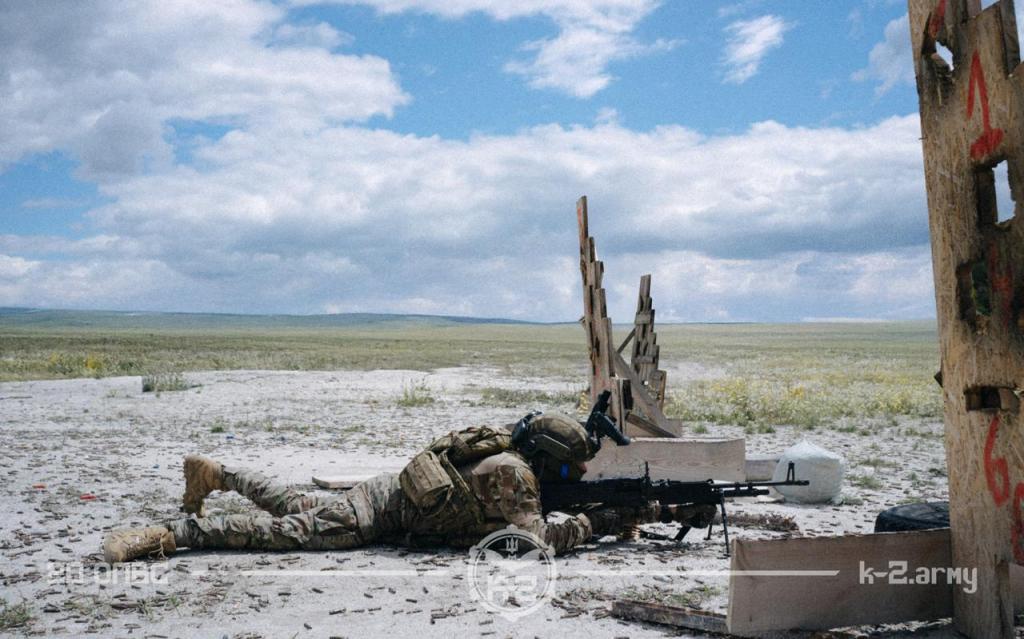
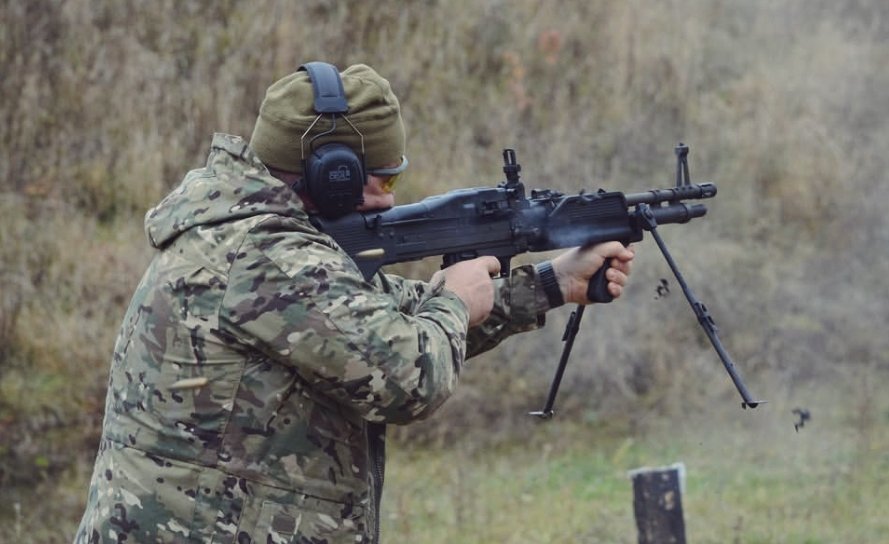
Most recently a new variant of the M60 was seen in a photo posted, on 18 July, by the 20th Separate Regiment of Unmanned Systems “K-2”. The gun appears to be either an M60E3 or an M60E4, with what appears to be a 22 inch barrel, the first ground role variant to be seen in-country. As with the M60Ds it is unclear where this M60 may have originated from, there are only a small number of nations which operate the weapons which may have donated it. Elements of the Czech Republic’s special operations forces operate E4s in small numbers but its unclear if this is the source of the gun seen in the recent photo.
It remains unclear just how many of the various variants of M60 are on the ground in Ukraine and where they came from but it is one of the weapons that I’ll continue to track, if you spot any let me know!
Update 12/10/25:
Serhii Filimonov, a member of the 1st Assault Regiment (Da Vinci Wolves), has shared several photos that appear to include an M60E4.
There is also a short video of him firing the weapon. Below is a still from the video.
Update – 17/11/25:
On 14 November, Raven Group, affiliated with the Ukrainian Directorate of Intelligence, shared a serious of range photos featuring an M60E4 (in what appears to be the Mk43 Mod 0 configuration). [H/t to Praise the Steph].
Support Us: If you enjoyed this video and article please consider supporting our work here. We have some great perks available for Patreon Supporters – including early access to custom stickers and early access to videos! Thank you for your support!
A few of weeks ago I published an article/video detailing the appearance of Swedish Carl Gustaf m/45 9x19mm submachine guns in Ukraine. One notable feature of the guns was that their configuration appeared to sit somewhere between the m/45A and the m/45B.
In the absence of clearer information I referred to these as m/45Bs, the most common variant and one which has the defining fixed magazine housing rather than the earlier removable magazine well seen on the m/45A. The fixed magazine well is an upgrade which was made before the later m/45B refit. It seems that there was some fluidity to how the upgrades were carried out which has led to guns with a mix of features.
An upgraded m/45A with the 41st Mechanized Brigade (Daily Mail)
From Swedish sourcesI’ve spoken to many of the m/45s seen in the imagery from Ukraine are early spec guns (m/45As) which may have been in storage and were not refit to the m/45B pattern. The m/45B refit was partially necessitated by the need to add an additional retention method to hold the receiver end-cap in place. Some sources suggest this was due to a type of training ammunition then in use, others point to it being simply extra security.
An m/45B (top) and an m/45A (bottom) with the fixed-magazine well upgrade (Henrik Jansson)
Working theories explaining the configuration of the guns seen in Ukraine include: that they are m/45A configuration guns which had been in storage and were retrofitted after the training ammunition left service and the additional end cap retention was no longer needed, so this change to the guns was omitted. As mentioned earlier, another reason may be that these are m/45As which had the magazine well upgrade but were placed in store or transferred before the broader m/45B upgrade was carried out.
As discussed in the initial video, it is thought that Estonia is a likely source for these guns as they received some of these guns in the 1990s and these m/45s have then subsequently been sent to Ukraine. Regardless of origin country the result is guns which do not have the additional end cap retention catch nor the green finish of the Swedish Army’s m/45B. They all feature the fixed magazine housing but there is also a mix of larger and smaller perforations in the barrel shrouds. [Note: Thanks to Jonathan Ferguson who noted that there is some variation in the size of shroud perforations within examples of both A & B model guns.]
A combatant in Ukraine with an m/45 c.early 2024 (via social media)
Since the last video a couple of other sources showing the m/45 in Ukraine were shared with me. Including this image of a Ukrainian combatant with a Swedish K which has the smaller barrel shroud holes. On 10 February a Daily Mailreport, featured Thunder Company, an element with the 41st Mechanised Brigade. Members of the company show journalist Richard Pendlebury an m/45 that is in their inventory. The company’s deputy commander describes it as a ‘museum piece’. Both guns appear to be of the same configuration generally seen in Ukraine. On 4 March, another short video of a Ukrainian combatant firing an m/45 at what appears to be a range was shared. It’s unclear when or where the video was filmed.
My very special thanks to Henrik Jansson for his time, insights and imagery and to numerous others for their knowledgeable input. Thank you to Weapons_Illustrated for their help sourcing imagery, check them out on twitter.
Update – 24/5/24:
On 11 April, a soldier of the 2nd Battery of the 2nd Self-Propelled Artillery Battalion of the Field Artillery Regiment of the 3rd Assault Brigade shared a photograph holding an m/45. [h/t Cloud for sharing].
Update – 18/6/24:
Some nice range footage of a Carl Gustaf m/45 in Ukrainian service. For more on these in Ukraine check out my video/article here:https://t.co/Hb9PcN8SR8
— Matthew Moss | Historical Firearms (@historicfirearm) June 19, 2024
Update 4/9/24: A new image of the Swedish m/45 submachine gun recently surfaced. (H/T AbraxasSpa)
Update 3/10/24: A photograph of what may be a member of the Ukrainian 129th Territorial Defence Brigade or potentially a member of the International Legion. He’s equipped with an m/45, note the three magazines in his chest rig and Ukrainian digicam pattern sling.
Support Us: If you enjoyed this video and article please consider supporting our work here. We have some great perks available for Patreon Supporters – including early access to custom stickers and early access to videos! Thank you for your support!
The war in Ukraine has seen a plethora of vintage weaponry being used by both sides. Everything from M1910 Maxims to TT pistols. One of the more surprising vintage weapons to turn up is the classic ‘Sweden K’. The Kulsprutepistol m/45 (Kpist m/45) perhaps better known as the Carl Gustaf M/45 has appeared in imagery from Ukraine numerous times over the past two years.
The most likely origin of the venerable submachine guns is either Sweden itself, whose home guard ceased using it in 2007, or Estonia, which received a number of the weapons from Sweden in the 1990s and for a time issued them to elements of thier Defence League.
Manufactured by Carl Gustafs stads gevärsfaktori from 1945 through to the mid-1960s the m/45 is a standard blowback submachine gun chambered in 9x19mm. The initial version had a detachable magazine well that enabled the weapon to feed from either a 36-round magazine or from Suomi KP/-31 (m/37-39 in Swedish service) magazines. The later m/45B variant permanently attached the magazine well limiting the weapon to feeding from the standard 36 round box magazines. The m/45B also incorporated a reinforced receiver end cap.
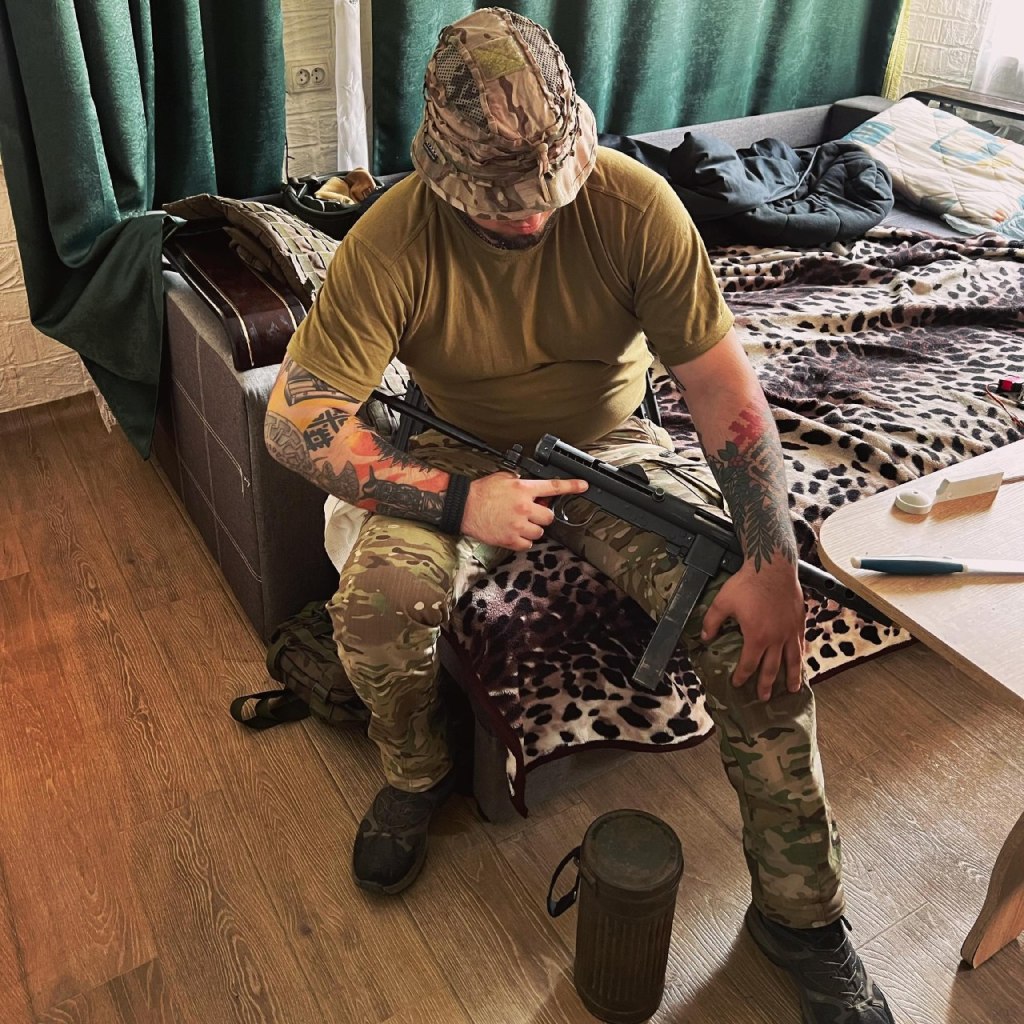
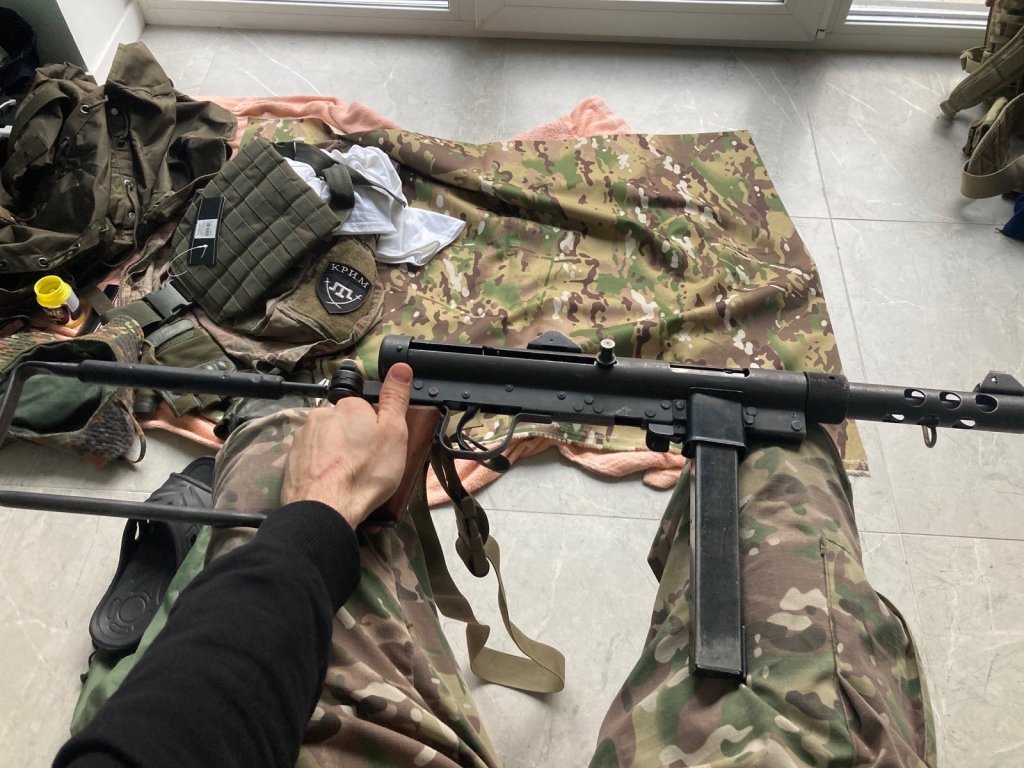
The earliest sighting of a ‘Swedish K’ in Ukraine I’ve found dates to early March 2022 when a member of the Krym Battalion posted a photograph of some of the weapons available to him; an AK-74, a Walther P99, an M7 bayonet and a Carl Gustaf M/45B.
Another image of a Ukrainian serviceman with an M/45 surfaced around the 23 March, but I’ve been unable to find the original source for the image so have little context for it.
In early May an photograph of an older member of the Ukrainian Armed Forces was shared on a number of sites, he’s seen sat in a vehicle holding up an M/45 with a sling attatched.
In mid-May 2022 another M/45 surfaced in a photograph from a member of Krym Battalion, which is a part of the International Legion. It’s unclear if this photograph was posted by the same member who shared a photograph of his weapons in March, but the wear marks on the gun appear quite similar.
On 10 November, a daily update post from the Ukrainian General Staff included a photograph of an individual holding an M/45 with a sling, while the unit the individual belongs to isn’t stated given the contents of the post he may have been assigned to a unit on the border with Belarus.
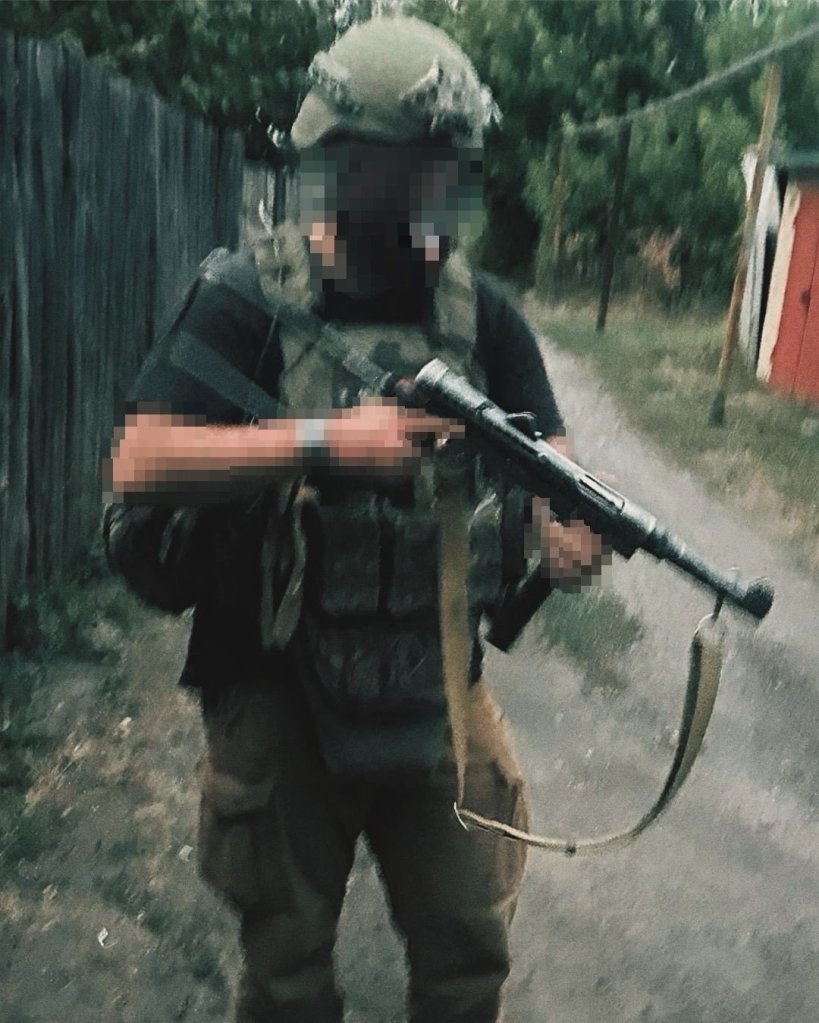
Throughout most of 2023 sightings of M/45s were rare but in mid-June a member of the National Guard posted a short video featuring himself holding a Swedish K as other members of his unit walk behind him, two of the passing men also carry slung M/45s.
On the 28 September, a Swedish volunteer posted a photograph of himself holding an M/45 he came across on the frontline, he captioned the post: “Photo of when I found a mint condition Swedish K with 39B ammo out close to the front. Just an awesome rare Swedish Gun to see in use by a Medic.” The unit where the M/45 was encountered was the 131st Separate Recon battalion. This suggests the photograph may have been taken earlier in the summer of 2023 and also that M/45s may be used by medics. The mention of the Swedish 39B 9mm ammunition which was specifically issued with the M/45 is also interesting. Most notably, however, is the presence of the attachment assembly for an original Swedish spent cartridge case catcher bag.
October saw the first video of a Swedish K being fired. A short clip was shared on Instagram showing an M/45B being fired at the range with what appears to be a red dot optic mounted forward on the perforated barrel shroud.
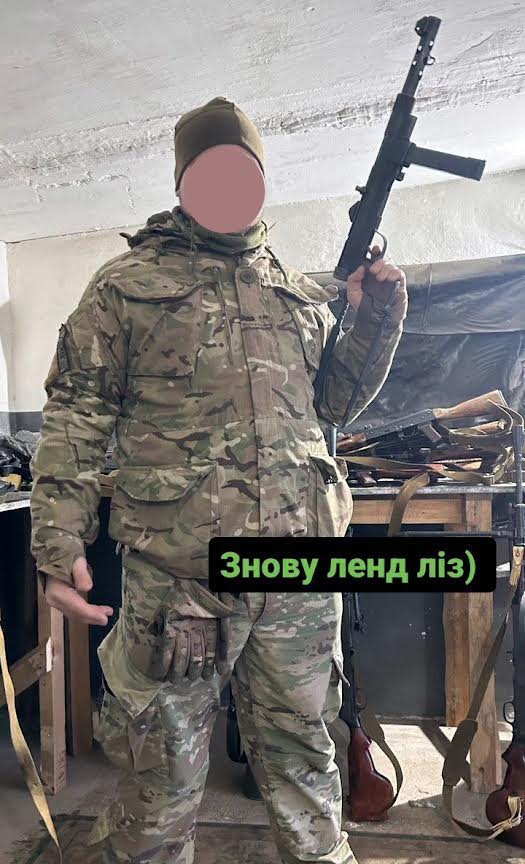
Several months later, on 11 December, a medic with the 12th Ukrainian National Guard Brigade “Azov” shared a photograph of himself holding an M/45. Later in December a member of the 78th Separate Assault Regiment ‘Herts’ shared a photo, on 21 December 2023, with the caption ‘lend lease again’, he’s holding up a behind him can be seen several DP-27 light machine guns and some AK-pattern rifles.
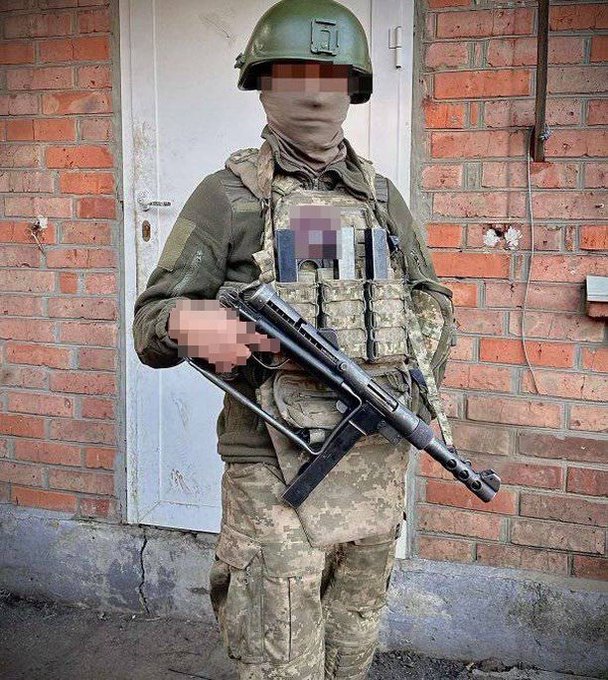
Interestingly, none of the M/45s have the green paint finish which was used on some of the Swedish Armed Forces’ guns but have clearly shipped with original slings and in one case a brass catcher attachment. Also none of the guns in the imagery from Ukraine appear to have the end cap reinforcement typically see on the Swedish Army’s M/45Bs. While the guns have the M/45B’s fixed magazine well they don’t seem to have the characteristic pair of rivets and hooked end cap. It’s difficult to positively identify the variant as the guns’ markings aren’t visible in any of the imagery. With little context for some of the imagery and relatively few sightings of the guns in Ukraine its difficult to pinpoint the types of unit which are receiving them but it is conceivable that the guns have been decimated amongst a number of different types of unit including frontline elements of the Ukrainian National Guard, International Legion and Army.
Update – 21/01/24: From Swedish sources I’ve spoken to these M/45s are early spec guns which may have been in storage and were refit later. Retrofitted with fixed magazine wells but not the reinforced end cap as the ammunition that necessitated this was no longer in use.
Update – 22/01/24: Another photograph posted November 2023.
— Matthew Moss | Historical Firearms (@historicfirearm) January 22, 2024
Support Us: If you enjoyed this video and article please consider supporting our work here. We have some great perks available for Patreon Supporters – including early access to custom stickers and early access to videos! Thank you for your support!
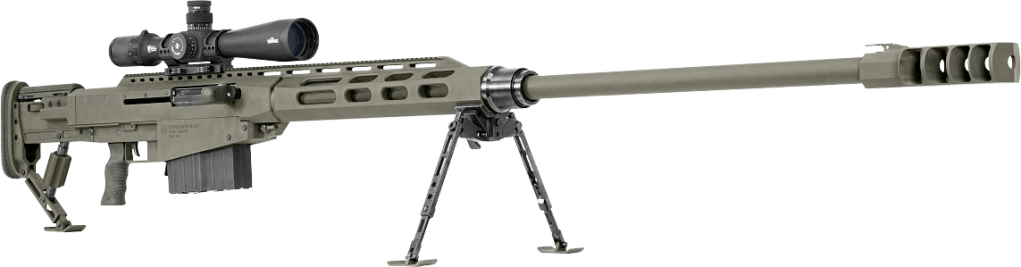
There are a significant number of different large calibre anti-materiel rifles in use in Ukraine. One of the largest is the Monomakh, a 14.5×114mm semi-automatic, box magazine-fed anti-materiel rifle from the Ukrainian company Snipex. Snipex is a subsidiary of the XADO Chemical Group.
Snipex are well known for their series of precision anti-materiel rifles which includes the M100, T-Rex and Alligator. The Monomakh, introduced in 2021, is the company’s first semi-automatic rifle. It is recoil operated and feeds from a 5-round box magazine. It has a barrel 1,200mm [47.2in] long and an overall length of 2,050mm [6.7 feet], Snipex list its weight without a magazine as 25kg [55lbs]. The rifle has a listed muzzle velocity of 950 to 980 m/s and an effective range of just under 2,000 metres [1.2 miles]. The weapon is fired from a bipod with a monopod supporting the butt of the rifle. It’s key feature is its reciprocating barrel which helps soak up the recoil from the 14.5mm cartridge.
A scopeless Monomakh at the range (via social media)
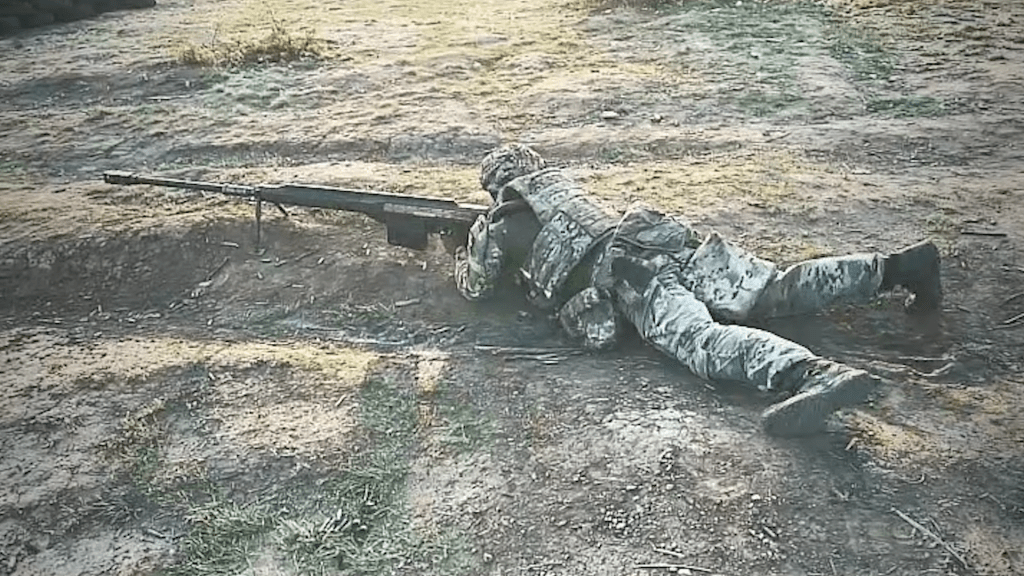
The Monomakh appears in imagery from Ukraine fairly infrequently, the earliest sighting of one of the rifles I could find was a photograph posted by a GUR member in late April 2022. Subsequently a number of videos of the weapon being fired at ranges by Ukrainian combatants was published in the Summer of 2022. The first posted on 7 August, shows a magazine being loaded into the rifle and the weapon chambering a round. Later that month a short video of a Monomakh firing at a range was published.
Snipex Monomakh (Snipex)
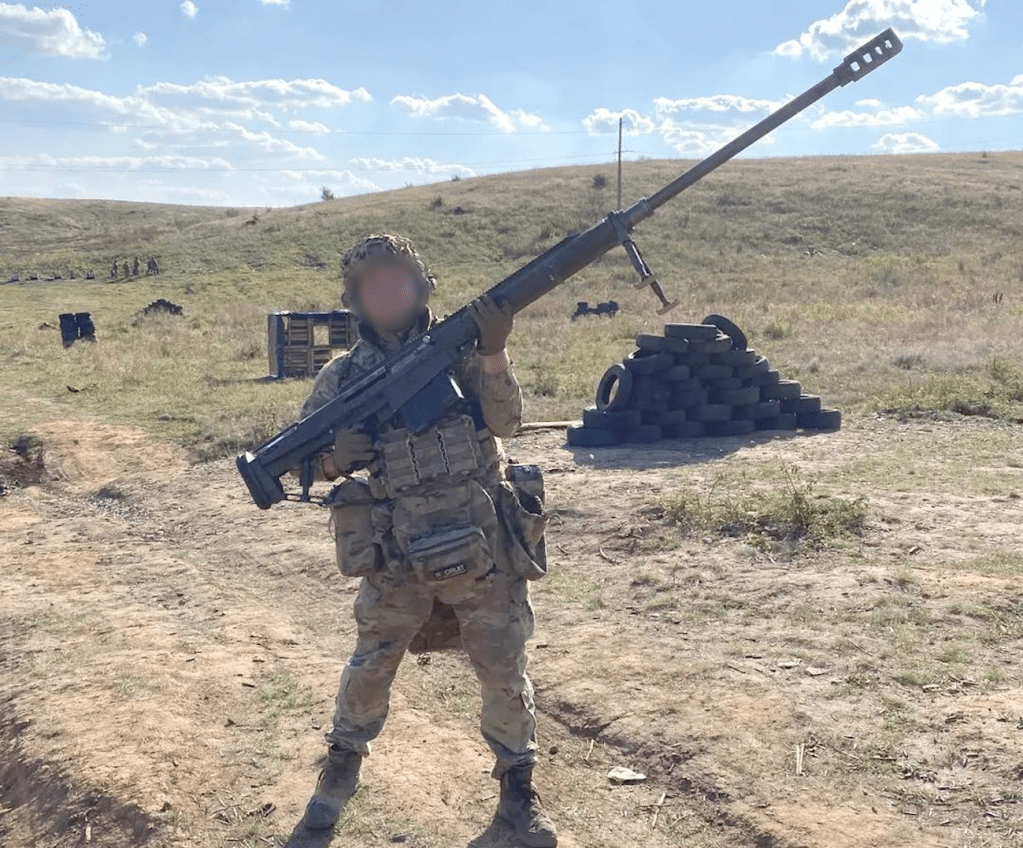
The earliest photograph of one of the guns I could find in 2023 was shared by a Ukrainian combatant in mid-July. Several months later, in September 2023, another Ukrainian combatant shared a photograph of himself holding up a Monomakh at a range. The same combatant also shared a short clip of himself firing the rifle, again at the range. In the clip he appears to be firing the rifle without sights or an optic. He is also seen helping the bolt into battery after each shot, the bushing which guides the barrel as it recoils into the receiver appears to have come loose. The rifles are typically paired with substantial optics, Snipex offer two of their own 6–24×56 scopes, the Jove 50 and the Galaxy G50. In late October, a female sniper with the 3rd Shock Brigade, posted several photographs and a video of herself firing a Monomakh from a position inside a building.
A Ukrainian combatant holds up a Monomakh (via social media)
The large size and hefty weight of the Monomakh limits it applications somewhat but the 14.5mm round is useful against light armoured vehicles, buildings and field fortifications – the main limitation is getting it in, and out, of position to engage targets. There are videos of it taking two men to move the similarly heavy T-Rex and Alligator rifles. From the limited sample of imagery of the Monomakh in theatre it is difficult to gauge how widespread its use actually is. The simpler to manufacture bolt action Snipex rifles are seen more frequently.
My thanks to Cloooud and AbraxasSpa for help sourcing some of the imagery used in this article/video.
Support Us: If you enjoyed this video and article please consider supporting our work here. We have some great perks available for Patreon Supporters – including early access to custom stickers and early access to videos! Thank you for your support!
We’ve examined a number of artillery systems in use in Ukraine, including the venerable M101 howitzers and the MT-100s mounted on MT-LBs, one of the smallest and most interesting howitzers in use is the OTO Melara Mod 56.
The Mod 56 is a small 105mm pack howitzer. It weighs in at 1.29 metric tons and it can be towed by light vehicles. It has a split trail gun carriage and a hydro-pneumatic recuperator assembly. Developed by Italy’s OTO Melara the gun entered service in the mid-1950s and has seen service with countries around the world including Italy, the UK, Australia, Spain, Pakistan and the Philippines.
An OTO Melara Mod 56 (Ukraine National Guard)
Much like the heavier M101 howitzers, transferred to Ukraine by Lithuania, the Mod 56 can use any M1 105mm ammunition. With its short 1.47 metre-long barrel, the Mod 56 has a maximum effective range of around 10,000 metres (10km/6 miles). While this puts it at a severe disadvantage compared to the larger 155mm howitzers used by Ukraine and the 152mm guns used by Russia the small Mod 56 has the advantage of being lightweight and can be deployed forward under cover. The most useful role it could likely fulfil is as an infantry support gun.
In November 2022, Spain’s Defence Minister Margarita Robles confirmed that Spain would send a battery of six light howitzers and also provide training for Ukrainian gun crews. Subsequently, a brief clip of Ukrainian gunners training on the Mod 56 was shared in late November.
A Mod 56 in action (via social media)
The guns were seen in Ukraine for the first time in early January, with a short clip of one of the guns firing being shared on 11 January. It appears the gunner is wearing a National Guard patch but its unclear which unit the gun belongs to. On 12 January, the 1st Mechanized Battalion of Ukraine’s 3rd Assault Brigade posted an info-graphic giving some basic detail on the Mod 56.
On 20 February, a brief clip of a Mod 56 was shared, the footage was believed to have been taken in the vicinity of Bakhmut. However, photographs taken by an AP photographer, Libkos, of the same gun showed that the gun was actually in action in Avdiivka, Donetsk. The series of photographs also showed that the gun was being operated by a National Guard unit and the crew was using drone footage to select their targets. One photograph was also shared by President Zelensky on 5 March. Interestingly, the gun is seen without its shield.
Another video of one of the guns in action was shared on 16 April. It was several months before more imagery of the Mod 56s in use appeared but on 1 June, the Ukrainian National Guard shared a photograph of one of the guns and several days later, on 3 June, a short video of a gun in action was shared.
A Mod 56 in action (via social media)
Most recently on 19 July, a Ukrainian National Guard unit shared a brief clip of a Mod 56 firing. It also nicely illustrates the gun’s breech mechanism.
From the available imagery, it appears that the guns are operated by Ukraine’s National Guard, though which artillery unit is unclear. While it has been confirmed that Spain has provided at least 6 Mod 56 howitzers, it remains unknown if any other countries, such as Italy, have provided the small guns.
Update – 29/12/23:
An undated sighting of a Mod 56 in operation in Ukraine. Notably half of the gun shield appears to be missing.
⚡️The 105-mm howitzer OTO Melara Mod 56 handed over by 🇪🇸Spain is in service with the Armed Forces of 🇺🇦Ukraine. pic.twitter.com/HyvMr6MWdE
— Matthew Moss | Historical Firearms (@historicfirearm) July 23, 2024
Support Us: If you enjoyed this video and article please consider supporting our work here. We have some great perks available for Patreon Supporters – including early access to custom stickers and early access to videos! Thank you for your support!
All sorts of munitions have been dropped from drones ranging from hand grenades to Molotov balloons to mortar rounds and even blocks of explosive. In this article/video, we’ll look at a couple of interesting examples of improvised munitions.
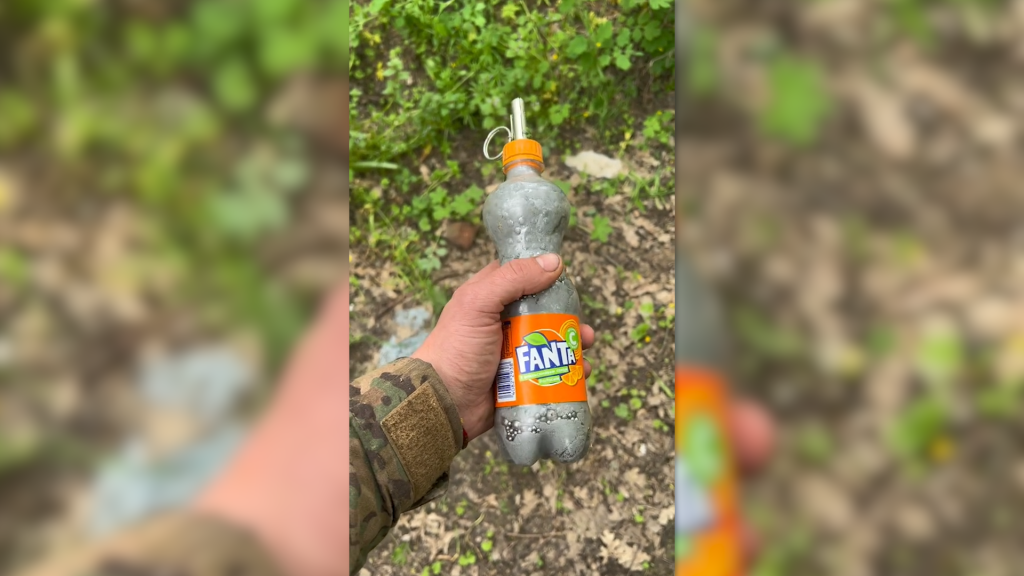
In early May an interesting short video was shared by a Ukrainian combatant showing a Fanta soft drink bottle filled with explosives and what appear to be ball bearings of different sizes. It’s hard to tell what sort of explosive has been used but the bottle is topped with a UZRGM grenade fuze.
The Fanta Bomb (via social media)
Ordnance Lab made an interesting video a couple of weeks ago testing an approximate version of the Fanta bomb and found it to be fairly effective in terms of blast and fragmentation. Though their version looked to contain more ball bearings and they noted it weighed around 3kg.
The only other similar munition to surface was seen in a photograph that showed a box of Polish Kropla Beskidu water bottles which also appear to be filled with explosive materials and fuzed with standard UZRGM fuzes.
Improvised can-based warhead for FPV drone (via social media)
It’s unclear whether the grenades are designed for ground use or perhaps for dropping from drones. If the fill of the grenade is purely explosive then it would have a significant blast effect but minimal fragmentation – likely why the Fanta bottle example has been augmented with ball bearings.
There is also evidence of the simple use of directly using TNT blocks with UZRGM fuzes, with the Georgian Legion evidently dropping them from drones.
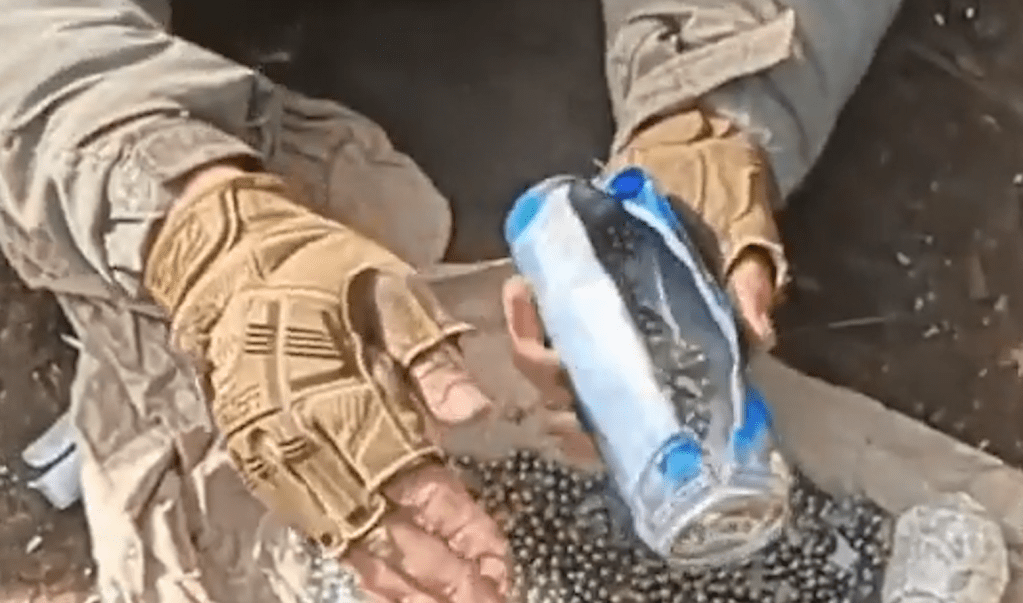
Old drinks cans have also been used to make improvised explosive devices. In early May a video showing a ‘Non Stop’ energy drink can being split open and filled with plastic explosives and ball bearings was shared. The can was then attached to a First Person View (FPV) drone and used against personnel in a Russian trench.
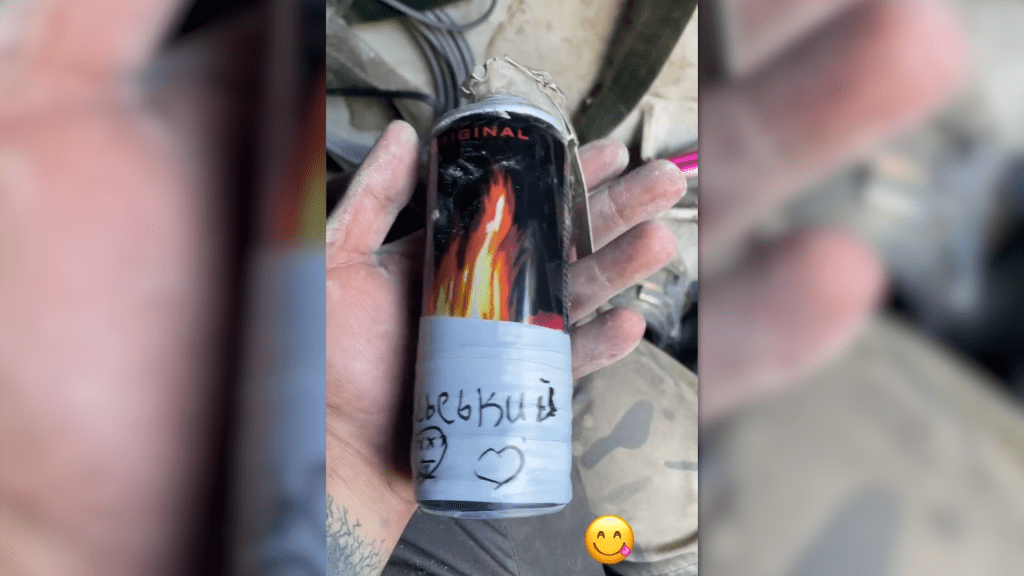
In June several short clips were shared featuring drinks cans with grenade fuzes. Two with UZRGM fuzes and one can with what appears to be a DVM fuze. The can could be augmenting a Bulgarian fragmentation grenade such as an AR-ROG or GHD/RGD series.
Improvised can-based grenade (via social media)
In July, Ryan O’Leary, a US volunteer in Ukraine, shared a photograph of 5 craft-made grenades constructed from plastic drinks bottles slipped into the base of Red Bull and Non Stop energy drink cans. O’Leary suggests that there is approximately 1-2 kg of RDX explosive inside. They are again topped with UZRGM fuzes and secured with tape.
Improvised grenades made from bottles and drinks cans (via social media)
So why are these munitions being made? Often when I cover improvised munitions people ask are the Ukrainians not receiving billions in aid? The answer to this is – they are. However, aid doesn’t always include all the types of munition you might want. Similarly, the combatants improvising these munitions may not receive the types of munitions they need – wartime logistics can be challenging. Additionally, the combatants producing these munitions may be looking for bombs with improved blast and fragmentation over what is available.
Update – 25/07/23:
💥Some more can grenades.
Packed with explosive and fuzed with a UZRGM. Enhanced blast grenades, useful for trench clearing.
— Matthew Moss | The Armourer's Bench (@historicfirearm) July 25, 2023
Update – 27/09/23: A BBC Newsnightreport featured a drone company attached to the 24th Brigade. A can-based improvised exposive device, designed to be dropped from a drone was featured.
Update 15/5/24: On 3 May a Ukrainian telegram channel shared a clip of a drone dropped munition attack on Russian infantry. The munition appears to be enclosed in a Pepsi can. The unit involved is claimed to be a drone unit of the National Guard’s 4th Rapid Reaction Brigade.
Update – 15/7/24:
In addition to bottles and cans packed with explosives, both sides have utilised bottles filled with incendiary mixtures. These have seen being dropped from drones on positions and vehicles.
What vile concoctions are in these Russian improvised incendiary munitions, with UZRG-M hand grenade fuzes. pic.twitter.com/2NZjNjr36y
A member of the 6th Special Purpose Battalion of the 12th Special Purpose Brigade “Azov” used an DIY bottle bomb, as an enhanded blast grenade to demolish the front of a single story building during fighting near Toretsk.
— Matthew Moss | The Armourer's Bench (@historicfirearm) May 28, 2025
Support Us: If you enjoyed this video and article please consider supporting our work here. We have some great perks available for Patreon Supporters – including early access to custom stickers and early access to videos! Thank you for your support!
The MT-LB tracked artillery tractor has become one of the most recognisable armoured vehicles of the war in Ukraine. These versatile vehicles are used by both sides in huge numbers and while first introduced in the 1970s they continue to be used as both armoured personnel carriers and also as the platform for a plethora of weapon systems ranging from rocket pods to auto-cannons to MT-12 anti-tank guns.
In this article/video we’ll look at two specific MT-LB adaptations; one Russian, one Ukrainian.
Russian MT-LB adaptation with a 2M-3 turret which was first seen in March 2023 (via Social Media)
Russia’s Turreted MT-LB
In March 2023, a number of photographs and videos emerged of Russian MT-LBs which had been fitted with a large turret complex over the rear portion of the vehicle. The turrets are naval 2M-3s which mount a pair of 25mm 110-PM autocannons. The first images surfaced at the beginning of March. The strikingly ugly turret quickly led to ridicule on social media and numerous memes mocking the vehicle. Between the 8 and 10 March a series of short videos showing the turret-adapted MT-LBs on the move. One video showed several vehicles in a yard with a large crane, perhaps suggesting they had been off-loaded. The person filming the video notes that the unusual turrets and were apparently ‘sent for defence’. The footage features at least five turreted-MT-LBs, one appearing to also have an adapted front commander’s turret.
Another clip, shared around 10 March, shows a transport train with numerous vehicles loaded, including some Russian Military Police vans. Two (possibly four) of the adapted MT-LBs can be seen. Similarly, another clip showing the vehicles in transit through an urban area features one perhaps two adapted-MT-LBs.
Other examples of Russian MT-LB adaptations with 2M-3 turrets (via Social Media)
Since the early spring there have been no sightings of the vehicles but in late May a video and several photos were shared featuring a Russian combatant riding in the turret of one of the adapted MT-LBs, the anti-aircraft style style sight can be seen in the video and one of the photographs.
Russia is likely making use of turrets that have been in storage since the vessels they were mounted on were decommissioned. Their is probably still an ample supply of ammunition for the 25mm autocannons. The mount has -12° to +85° elevation and 360° rotation giving it a good field of fire for use against ground targets.
Just what role Russia envisioned for the turreted MT-LBs is still unclear. They could be used in direct fire roles perhaps as support guns which can help plug gaps in defensive lines with suppressive fire. Or perhaps as mobile anti-aircraft vehicles for taking on drones but their limited manual targeting would mean they would struggle to be a match for even slow moving drones. Other potential uses might be as assault guns or as a more heavily armed vehicle for internal security duties protecting supply lines from Ukrainian partisans.
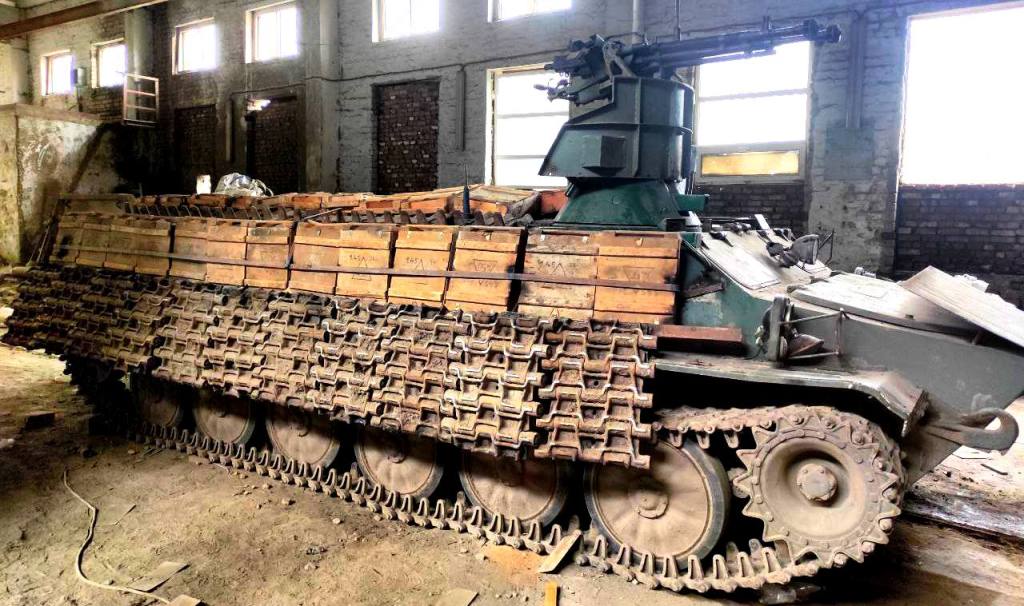
Ukrainian MT-LBu adaptation with a KPV heavy machine gun remote weapon system (via Social Media)
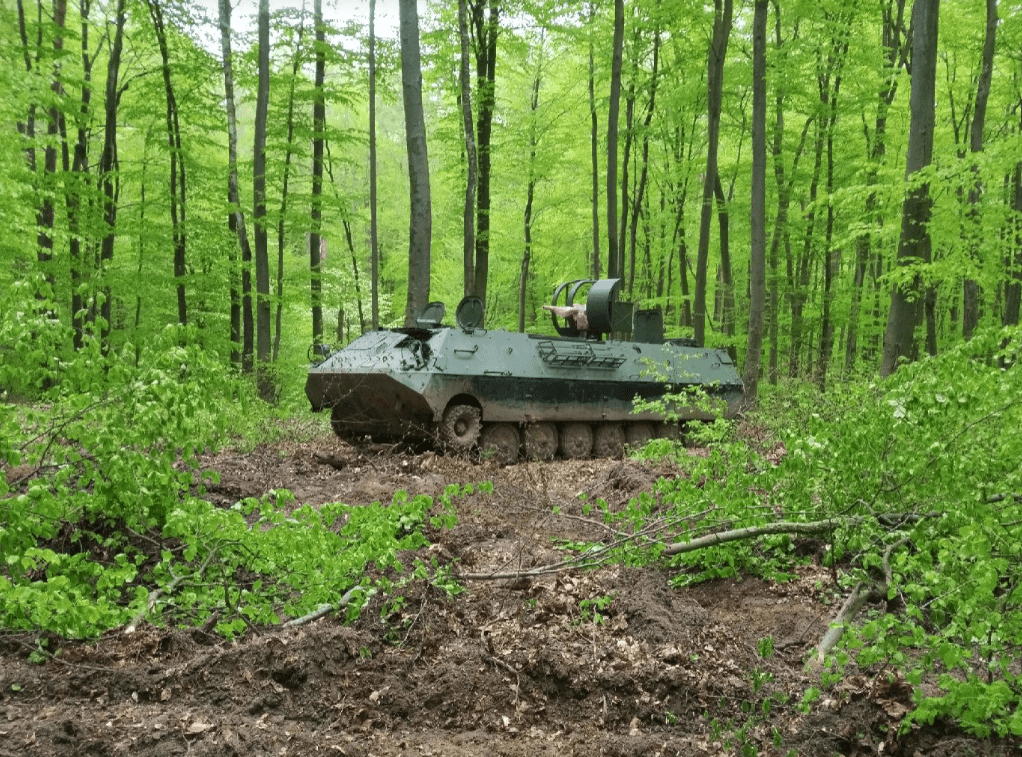
Ukraine’s MT-LB Refits
While many of both sides’ MT-LB adaptations have focused on simply mounting a weapon system to the rear deck or where the commander’s original PKT mount was, a recent Ukrainian refit has gone much further. A video was shared by a Ukrainian MT-LB crewmember which showed six vehicles all refit to a similar configuration. It appears that additional armour has been added to the sides and rear of the vehicle in an effort to provide additional protection to the lightly armoured MT-LB. [Correction: the vehicle has 7 road-wheels indicating the adaptation is likely based on an MT-LBu variant. These have been described as BMP-1LBs.] The vehicles also have new storage baskets, smoke-grenade launchers and a new remote weapon mount controlled from inside the MT-LB. A photograph of the front of the mount shows that it mounts a single 14.5x114mm KPVT machine gun, remotely fired and aimed using an electro-optics module positioned to the left side of the gun. The weapon and optics are protected by a curved gun shield, the cuts in the shield suggest that the weapon’s range of elevation is considerable.
Russian MT-LB adaptation with twin DShk mount on the original PKT turret (via Social Media)
These vehicles are are just two examples of MT-LBs in Ukraine adapted with ad-hoc weapon mounts. There are dozens of other examples of up-gunned MT-LBs deployed by both sides. Other commonly seen adaptations include fitting ZU-23-2 anti-aircaft mounts to MT-LBs
In February 2023, Ukrainian troops shared a video of a Russian MT-LB captured near Vuhledar, which had been fitted with a 2M-7 naval turret mounting a pair of 14.5mm KPV heavy machine guns. Similar vehicles appeared in photographs showing several MT-LBs with ad-hoc adaptations which included one vehicle with the same, as well as other vehicles with other dual and single gun mounts. One can be seen mounted with a single DShK on a tall, exposed pintle mount.
In May, an MT-LB was sighted with a twin DShK mount. Similarly, another MT-LB fitted with a twin DShK mount on top of the existing PKT turret was shared on 10 June, it had also been adapted by adding track and boxes as appliqué armour. Also in June, a photograph of a pair of MT-LBs equipped with A-22 140mm multiple rocket launch systems was shared on Telegram.
With Ukraine forming new brigades and both sides suffering considerable armoured vehicle losses the ubiquitous MT-LB, while lightly armoured, offers one of the best available platforms for mounting additional or role-specific weapons.
Support Us: If you enjoyed this video and article please consider supporting our work here. We have some great perks available for Patreon Supporters – including early access to custom stickers and early access to videos! Thank you for your support!
We’ve examined a number of 5.56x45mm rifles in use with Ukrainian forces, notably the Colt Canada C7 and C8 and the M16A4 with many others to be covered in future articles/videos. In this article/video we’re going to examine HK416 use by Ukrainian personnel.
HK416s are far from a common weapon in Ukraine but recently there has been an increase in the frequency with which they have been seen. Since the beginning of 2023, there have been various configurations seen in the field with most being earlier variants of the HK416, likely with either 14.5 inch or 10.4 inch barrels paired with quad rail forends. There also seems to have been a small number of MR223, the civilian-market semi-automatic only version of the rifle, appear in imagery from the conflict.
One of the first HK416-pattern rifles seen in imagery from the conflict was shared in mid-May 2022 by a female Ukrainian combatant. An MR223 with a 16.5 inch barrel is seen leaning against a wall in the background of a photograph. What is believed to be the same rifle has been seen in another photograph mounted with a bipod and fitted with a long, over-barrel suppressor.
In January 2023, a photograph of a pair of SBU members wearing Saint Javelin shirts also featured an MR223A1. Another interesting photograph that appeared in January, features Ukrainian SOF members, one has an accessorised HK416 A5, identified by its adjustable gas block and less flat magazine well angle, with a Surfire SOCOM 556 [Correction: B&T Rotex] suppressor, a Sig Sauer Romeo4T or potentially a Holding 515 and a Stiener DBAL A3N laser module.
A Ukrainian combatant fires a HK GLM-pattern UBGL attached to an HK416 (via social media)
In March, a member of a Ukrainian special operations unit shared a photograph of himself with an HK416 with an 10.4 inch barrel and what appears to be an Aimpoint Comp. The same individual shared another photograph with the same rifle in early May, this time the carbine was fitted with what appears to be a Vortex Crossfire.
A note on nomenclature: the majority of the HK416s seen in Ukraine appear to be HK416 A2s, potentially of Dutch origin. Some sources describe these rifles using the ‘DxxRS’ designations such as D10RS for a 10.4 inch barrel carbines and D14.5RS for a 14.5 inch barrel rifles. This designation, however, doesn’t represent the various iterative changes in the rifles.
Another photograph believed to have been taken in early Spring features another unpainted HK416 A2 with a 10.4 inch barrel, note the folded front sight on the gas block which, fitted with an EOTech 5-series H WS. Another interesting photo, shared by a Japanese volunteer with the International Legion also features an HK416 fitted with a weapon light, a vertical foregrip and a Holosun HS510c reflex sight.
In April, a Taiwanese volunteer with the International Legion, shared several photos of his HK416 A2 with a 14.5 inch barrel fitted with an Aimpoint CompM5. In one photograph it has been paired with a GLM, 40mm underbarrel grenade launcher.
A Dutch HK416 A2 with a Swedish Aimpoint Comp M5 used by a member of the International Legion (via social media)
In response to questions he said he preferred the rifle to the FN SCAR-L as it is more durable but also noted that the HK416 was much heavier than the M4A1 he also used in Ukraine. He also shared a photograph of the rifle equipped with a EOTech 5 series holographic weapon sight. In one of the photographs he shared the rifle has an armoury ID tag on the left side of the magazine housing. This tag is similar to those used by the Dutch military, as seen on the C7A1 rifles which have been provided to Ukraine in large numbers. On many of the images of the rifles there are no clear markings to definitively indicate their country of origin. So the armoury ID tags with QR codes are potential indicators of Dutch origin.
On the 15 April the GUR shared an image with the International Legion, the GUR and the 10th Special Detachment to publicise a TV news piece about the Shaman Battalion. The context and date when photograph was taken remains unclear but the combatant featured in the image appears to have an HK416 with a 14.5 inch barrel. This photo may be a stock image and not one of Ukrainian origin.
In late April photographs of members of the 92nd Mechanised Brigade featured several combatants holding HK416 A2 w ith 14.5 inch barrels. The rifles are seen equipped with EOTech holographic weapons sights. Another photo, also believed to have been taken by a member of 92 OMBR, shows an HK416 A2, with a 14.5 inch barrel, a camouflage paint job, a Knights Armament Company-style vertical foregrip and an EOTech sight and EOTech G33 magnifier.
A suppressed HK416 A2, with 14.5 inch barrel, used by Elite Global Response (via social media)
In early May, Elite Global Response, a group which describes itself as a ‘private security company’, operating in Ukraine shared a number of posts on their Instagram page featuring several HK416 A2s. The rifles are seen fitted with a variety of suppressors (including Ukrainian Tihon suppressors) and optics including an TA11 ACOG and a Holosun AEMS. When asked about the rifles Elite Global Response said they’re “a lot lighter than previous weapons we’ve run [AK-74s and MSBS GROTs], less stoppages and easy to maintain.”
In mid May another photograph of an HK416 A2 was shared online equipped with a small optic. A member of a Ukrainian special operations unit shared a photograph on 18 May, showing a group of combatants, two of which have what appear to be HK416s, one unpainted and another painted with an ACOG mounted, both appear to have 10.4 inch barrels.
In late May photos of another 10.4 inch HK416 A2 were shared by a member of the 1st Assault Battalion of the 3rd Assault Brigade. The combatant’s rifle has a Surefire or possibly a Dead Air muzzle device and is mounted with a Leupold LCO optic and a magnifier. In one photograph the carbine is seen loaded with a 60-round D-60 drum magazine. Earlier footage shared in early May on TikTok suggests he’s been using the rifle since early 2023 and originally received it unpainted. When asked what he thought of the rifle he described it as “the best assault rifle there could be”. A short clip of the same combatant also shows him firing an HK GLM-pattern 40mm underbarrel grenade launcher. This older video also shows the rifle with a different muzzle device.
A Ukrainian combatant with an HK416 with a 10.3 inch barrel, Leupold LCO and D-60 drum magazine (via social media)
On the 5 June, a short clip of members of the Polish Volunteer Corps was shared showing a member of the unit clearing Russian positions with an HK416-pattern rifle – when the video was filmed is unclear. While the resolution is low the camouflage painted rifle appears to have a magnified optic, possibly an Aimpoint Comp and a CQB red dot sight. A few days later a body camera video of combatants from the International Legion showed another HK416-pattern rifle clearly with an armoury tag. While undated the video is said to have been filmed during fighting near Bakhmut. Most recently, on 12 June, another member of Ukraine’s special operations forces was seen with an HK416 A2 outfitted with an EOTech optic and magnifier.
While a number of countries that use the HK416 have provided military aid to Ukraine it seems that a significant proportion of the rifles seen in theatre originate from the Netherlands, with the rifles configurations, HK416 A2s with ambidextrous selectors and the presence of armoury QR tags, matching those used by the Dutch military. The Dutch Ministrie Van Defensie initially procured HK416s for their special forces in 2010 and have since procured further HK416 A5s. Regardless of origin how many of the Heckler & Koch rifles have been transferred to Ukraine is currently unclear.
HK417
Ukrainian marksman with an HK417 (via social media)
There have also been a smaller number of 7.62x51mm chambered HK417s seen in use with various Ukrainian units. These rifles are believed to also have been transferred by the Dutch military with the configuration of the rifles matching those used by the Dutch. With few so far seen in theatre research is still ongoing. These will be the topic of a future video/article when more information is available.
Update – 19/6/23: Footage of a 10.3in HK416 A2 in use near Bakhmut, date unknown.
A short engagement featuring a suppressed HK416, likely an A2 with a 10.3 inch barrel. Said to be from recent fighting on the edges of Bakhmut.
— Historical Firearms | Matthew Moss (@historicfirearm) June 19, 2023
Support Us: If you enjoyed this video and article please consider supporting our work here. We have some great perks available for Patreon Supporters – including early access to custom stickers and early access to videos! Thank you for your support!
Bibliography:
Thank you to the guys at Streaking Delilah for sharing images they sourced and providing technical detail. Check out their instagram page here. Thanks also to Jonathan Ferguson for additional technical information.
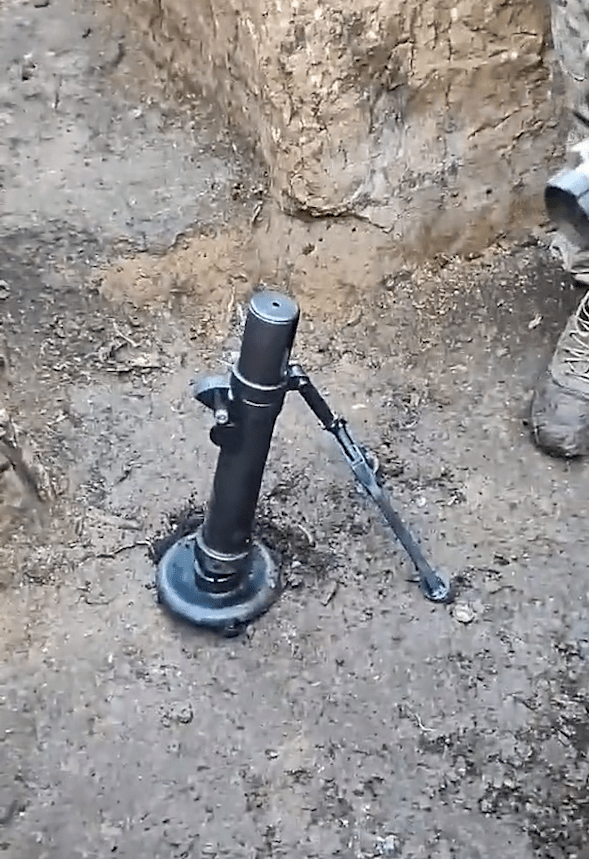
Since April, a Ukrainian unit has shared a number of short videos showing a small mortar capable of firing 40mm grenades.
From their patches and TikTok username, 16batzsu, the men’s unit appears to be the 16th Separate Rifle Battalion. They appear to be part of the battalion’s embedded mortar battery and are seen operating other larger mortars and automatic grenade launchers in numerous videos.
A close up of the small mortar (via 16batzsu)
On the 11 February, 16batzsushared a video showing a small mortar with a stainless steel insert seen dropped into a small hand-held mortar. The same video was shared on their YouTube account under the title ‘New Toy’. While the resolution of the video is low it clearly uses the same barrel sleeve principal seen in later videos. In replies to comments 16batzsu explain that the small mortar has a range of 2km and is 30mm in calibre. This suggests that the weapon may launch 30×29mm VOG grenades normally fired by AGS automatic grenade launchers. Unlike the later 40mm mortars it does not appear to have a bipod. No further videos featuring the 30mm mortar have been shared.
A still from a video showing a 30mm handheld mortar (via 16batzsu)
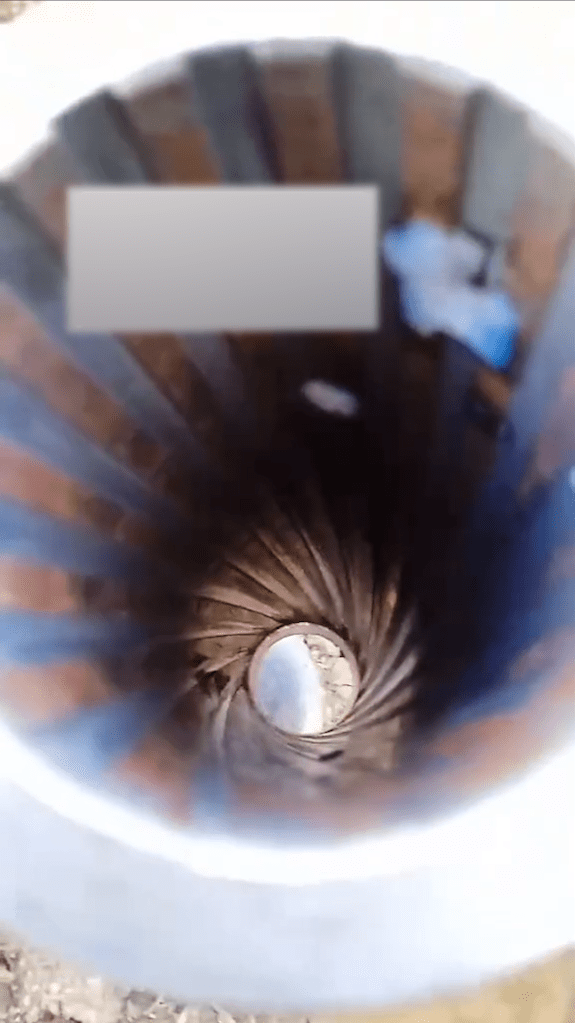
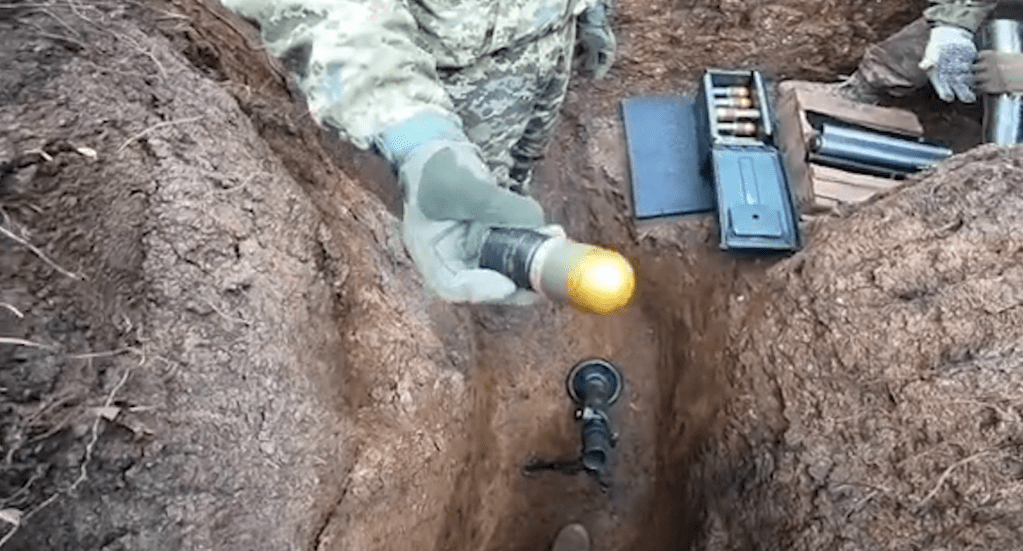
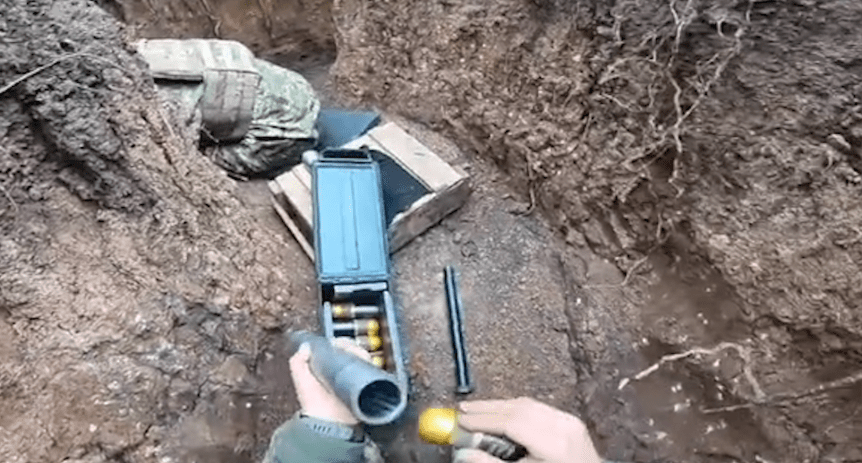
The first video providing a close up look at the 40mm mortar was shared on the 26 April, with the small mortar in a pit next to an 82mm mortar. The mortar uses 40mm high velocity grenades which are slid into the base of a rifled steel barrel sleeve. The rifling is needed to both maximise the grenade’s range but also impart spin which arms grenade. The loaded sleeve is then dropped into the mortar tube, the grenade’s primer presumably strikes the mortar’ firing pin and the grenade is ignited firing it out of the mortar. The sleeve remains in the tube.
A closeup of the inside of the barrel sleeve, note the rifling (via 16batzsu)
In terms of size the small mortar looks similar to the Ukrainian 60mm KBA-118, however, the base plate, bipod and tube differ. Despite similarities I haven’t been able to find an exact match to a mass-produced mortar. The weapon appears to be well made and the examples seen in the videos appear to be near identical suggesting they may be a locally developed and produced weapon.
In a pair of videos posted on 3 May, we get a closer look at the weapon and a member of the unit explains the principal behind how it works. The tube has a pair of parallel cuts which allow the steel barrel sleeve to be removed. The video shows a pair of the small mortars and also shows the rifling inside the sleeve. The sleeve appears to have approximately 16 rifling grooves and on its exterior are three rings cut into the top end of the sleeves outer surface to aid removing it from the mortar tube.
A 40mm high velocity round about to be loaded into a rifled barrel sleeve (via 16batzsu)
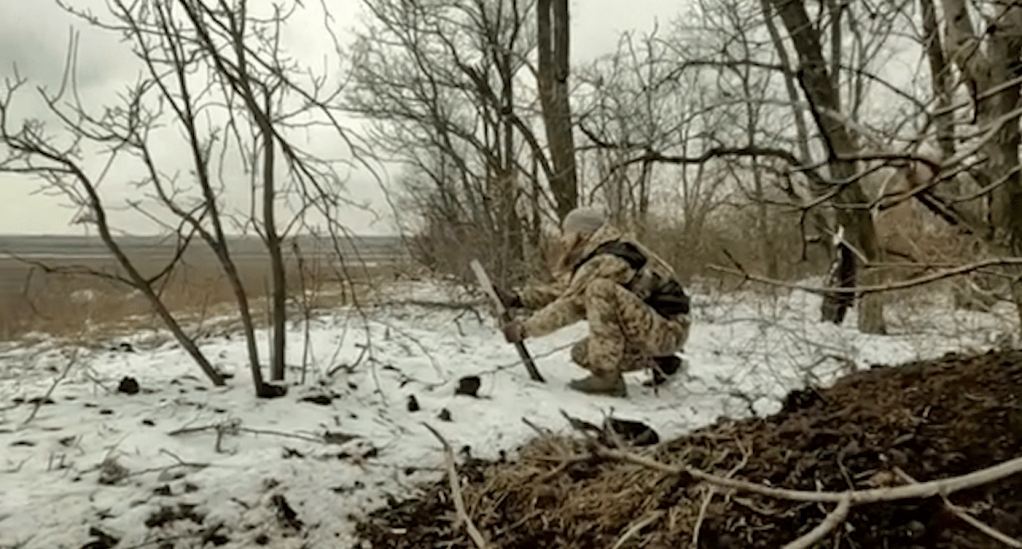
Finally, in a video posted on 9 May, we can clearly see the mortar fired a number of times. The operators can also be seen loading the 40mm grenades into the rifled barrel sleeves. One man loads the three tubes while another fires the mortar. The spent grenade cases are removed with the aid of a metal ramrod. The 40mm grenades which appear in the video are high velocity high-explosive dual-purpose (HEDP) grenades of the type used with Mk19 automatic grenade launchers. The reason the sleeve is rifling is to arm the grenade’s fuze when the round is fired. These include grenades like the US M383, M384, M430 and M677 as well as German DM111 and DM 112.
A still of a 40mm grenade being loaded into a barrel sleeve (via 16batzsu)
So what is the small mortar for? Why not just use the unit’s Mk19 automatic grenade launcher? My initial theory was that the barrel sleeve might provide an increase in range over the Mk19 though the 2,000 metre range mentioned in one of the videos suggests the mortar has a range on parr with the Mk19. Another theory is that the unit’s Mk19 may be inoperable and they still have a supply of 40mm grenades to use. The grenades are also perhaps more readily available and cost-effective than small mortar rounds. It could also potentially have the effect of mimicking drone-dropped 40mm munitions, keeping enemy combatants on the look out for drones. As a harassment weapon the small mortar seems to have potential, allowing its operator to fire from cover while being relatively lightweight allowing it to shift firing positions quickly. The accuracy of the weapon is difficult to gauge but with the aid of an observation drone rounds could be walked into the vicinity of a target. The mortar is a very interesting piece of innovative engineering.
Thank you to Ukraine Weapons Warfare for bringing the original footage of the mortar to my attention.
Update – 06/06/23: Some additional footage from another member of the 16th Separate Rifle Battalion showing the 40mm grenade mortar in action.
Some additional footage of the interesting Ukrainian 40mm Grenade Mortar. The small mortar that fires 40mm high velocity grenades.
— Matthew Moss | Historical Firearms (@historicfirearm) June 6, 2023
Update – 22/10/23 – Some new footage showcasing the mortar. One of the Ukrainian combatants appears to have a National Guard 4th Rapid Reaction Rubizh Brigade, 3rd Battalion Svoboda patch. The video gives us a good close look at the tub, tangent sight, barrel sleeve and the bipod and base plate which appear to have slightly different designs.
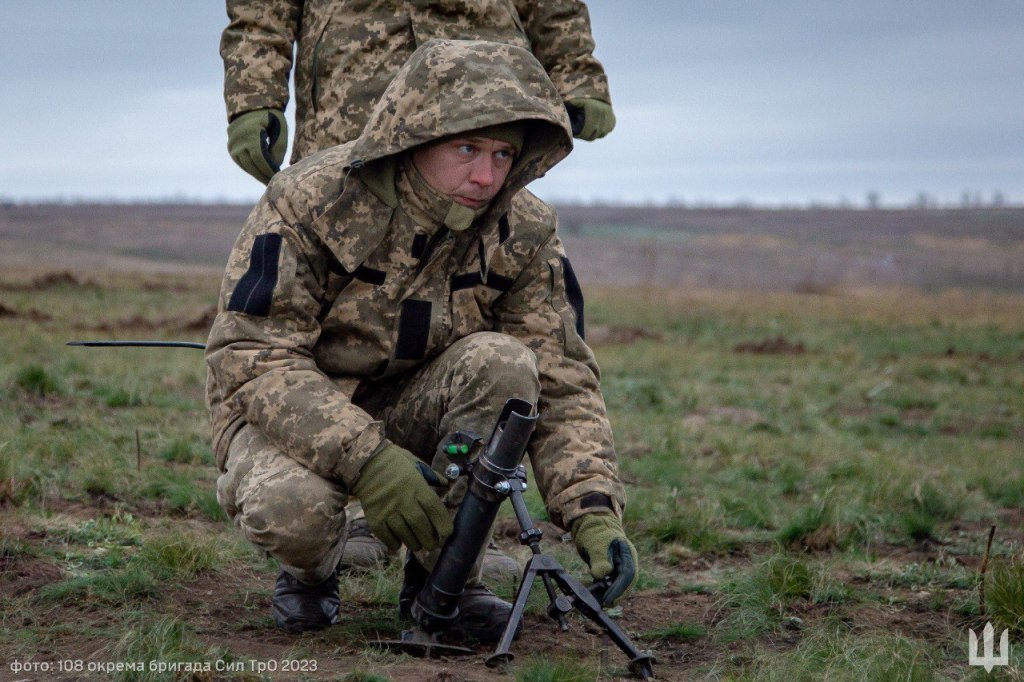
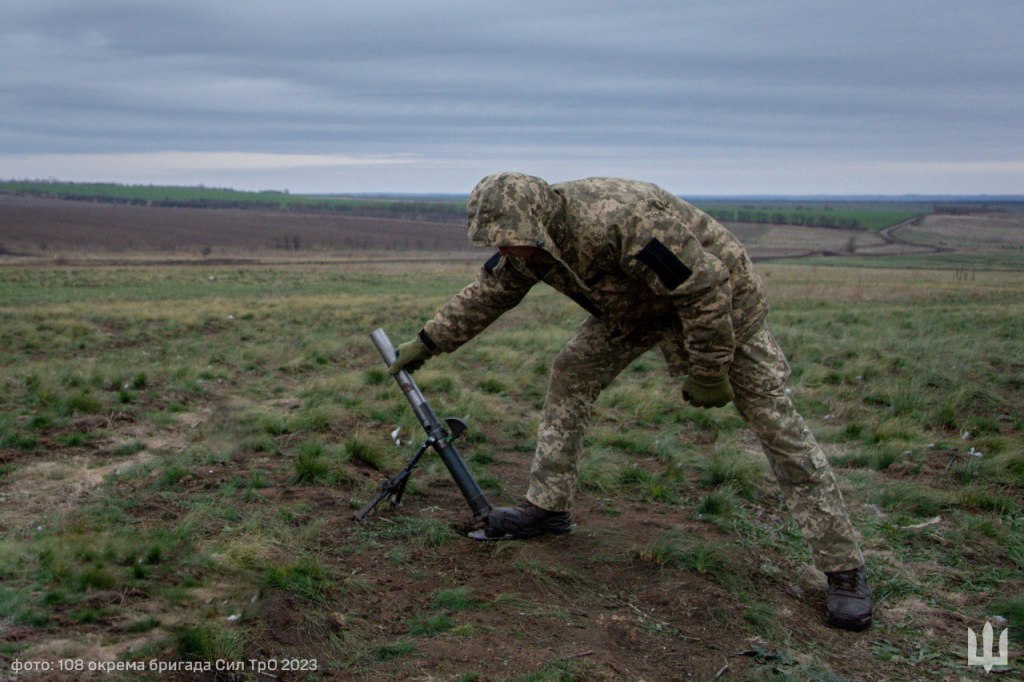
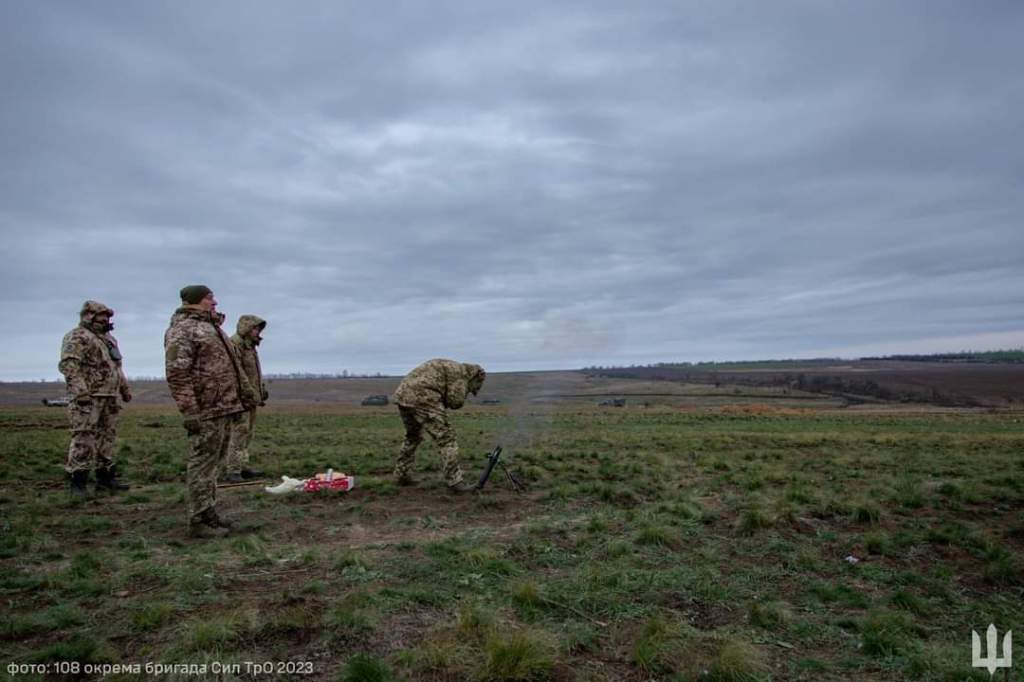
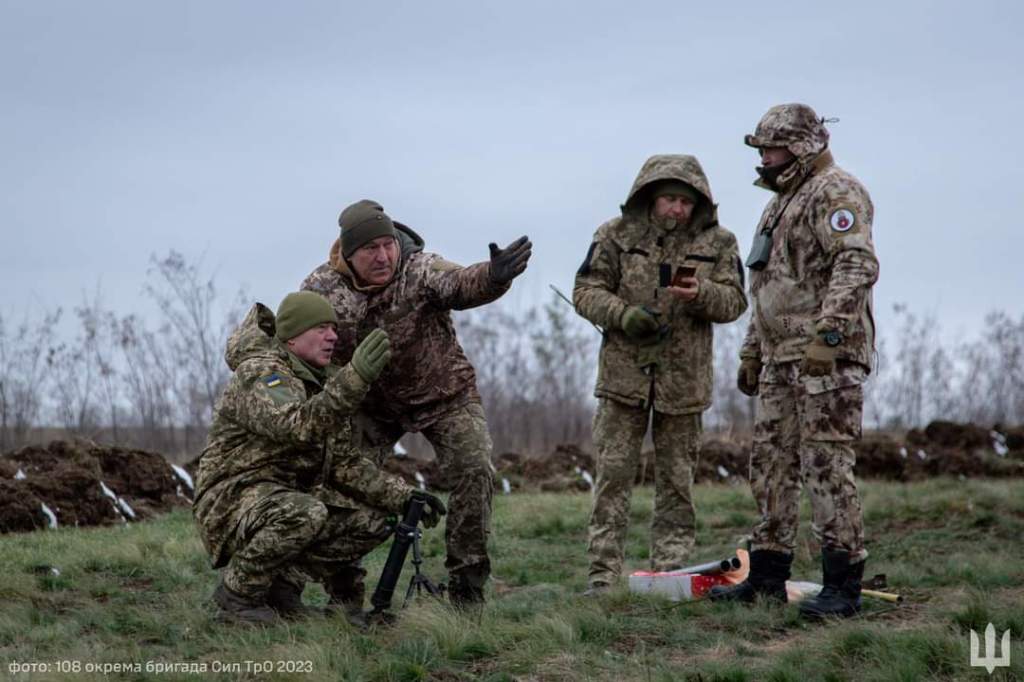
Update – 28/11/23: Another sighting of the 40mm grenade mortar. This time in official photos shared by the 108th Territorial Defense Brigade on 25 November. The post suggests the mortar can also fire 30mm VOG rounds.
Update – 17/8/24: A new sighting of the 40mm grenade mortar showing some of the loading and firing steps.
Support Us: If you enjoyed this video and article please consider supporting our work here. We have some great perks available for Patreon Supporters – including early access to custom stickers and early access to videos! Thank you for your support!















 The Armourers Bench