Rare Mk14 Anti-Structure Grenades & Scalable Offensive Hand Grenade In Ukraine

One of the rarer hand grenades to surface in Ukraine is the US Mk14 Anti-Structure grenade. These were developed by the Naval Surface Warfare Center’s Indian Head Explosive Ordnance Disposal Technology Division, back in the 2000s.

The Mk 14 Mod 0 Anti-Structural Munition Hand Grenade has been primarily used by USSOCOM. It is reportedly a Thermobaric Fuel-Air-Explosive Blast (FAE-Blast), hand grenade with a longer duration HE-Blast pressure curve.

The ASM has a thin-walled aluminium body with a main charge filler of PBXN-109 and a PBXN-114 booster. The grenade body is black with three knurled bands with a yellow band at the top and two sticker labels which read: “HE Overpressure Grenade, NEW 0.88 lbs. Fuze 4.5 sec”.
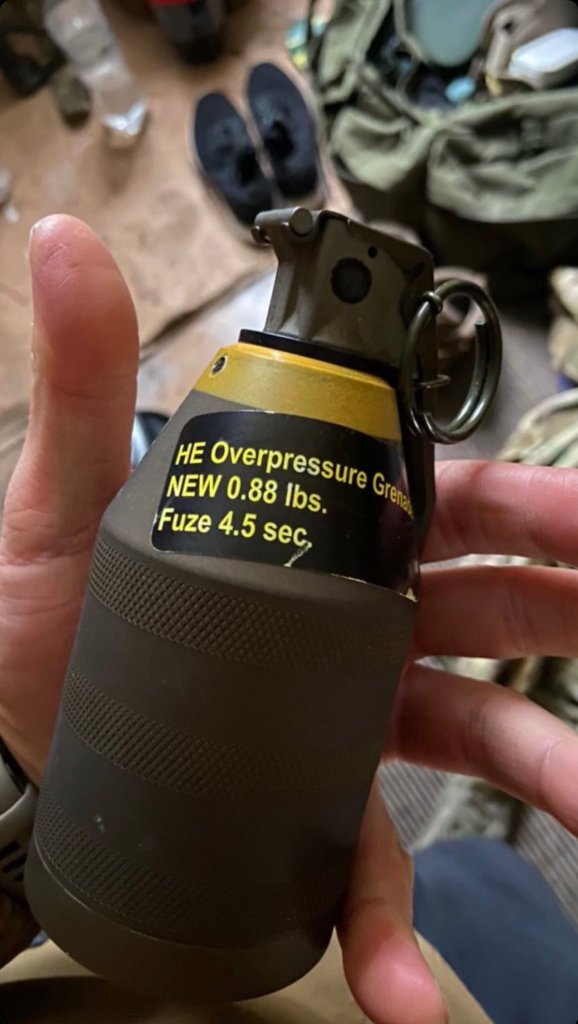
Mk 14 Mod 0 Anti-Structural Munition Hand Grenade (via Social Media)

Using the principle of overpressure the ASM, much like the US Army’s new M111 grenade, reduces the risk of friendly casualties due to fragmentation during close combat. In enclosed areas the grenade creates concussion effects and can be used for for blast or demolition tasks. It has a M213-type fuze with a 3-5 second delay, though the stickers seen on the grenades state 4.5 seconds

The available evidence of Mk14 ASM presence in Ukraine is extremely slim. To date, I have only come across a handful of images of the grenades, which were reportedly taken in Ukraine. The individuals who have shared imagery of the grenades have predominantly been associated with Ukrainian special operations units.

Another extremely rare offensive hand grenade seen in Ukraine is the Nammo Scalable Offensive Hand Grenade (SOHG – HGO115M-3.5). The SOHG is a modular grenade with a plastic body packed with either Comp B filling (115g) or PBXN-11 filling (130g). It has a male-female screw interface moulded into the body that allows up to three modules (which can all be used individually) to be screwed together. This allows the system to be scaled to the target its engaging or the space its being used in – Nammo say one equals a concussion grenade, two creates enough overpressure to kill anyone in a average space and the cumulative effect of three modules provides a small scale anti-structure capability. According to Nammo the SOHG modules with a fuze weigh 230g while the modules without fuze weight 190g.
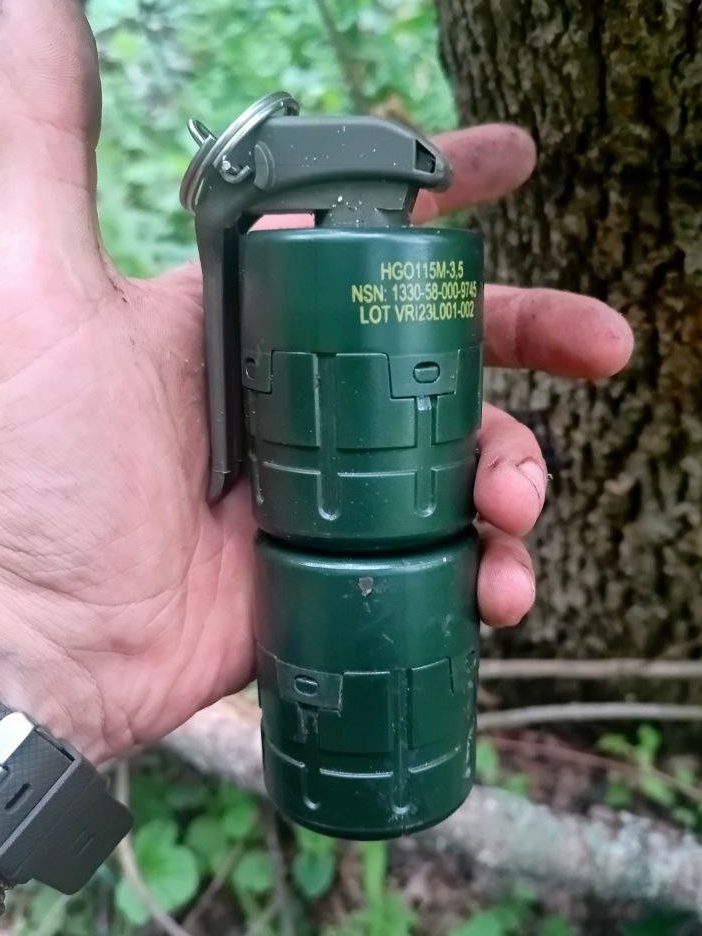
Nammo Scalable Offensive Hand Grenade (via Social Media)

Designated the MK21 Mod 0 in US service, SOCOM have been using them since 2010 and the US Marine Corps purchased some in 2024. Unlike the Mk 14 Mod 0 it is not a thermobaric grenade. The first sighting of them in Ukraine came in July 2024, when a Russian telegram channel posted a short video showing some of the weapons captured from Ukrainian units by a reconnaissance unit with Russia’s Tsentr (Center) battlegroup.

In November 2024, when a Russian telegram channel focused on Sapper and EOD activities shared photos of a base unit and an additional module. It’s unclear if these are captured examples or they are images pulled from the internet to illustrate the post.

Most recently, in May 2025, a pair of SOHGs were captured by Russian forces, each was captured with its own fuze, configured for individual use. All of the grenades seen in the imagery have the lot number VR123L001-002 and an NSN which denotes they are filled with Composition B. Given the presence of the Finnish National Codification Bureau number, ’58’, in the NSN, the grenades were likely provided by Finland.

Thanks to AbraxasSpa and Helvegen29 for thier help collecting imagery.


Support Us: If you enjoyed this video and article please consider supporting our work here. We have some great perks available for Patreon Supporters – including exclusive videos, custom stickers and early access to videos! Thank you for your support!
The Fanta Bomb & Improvised Munitions in Ukraine

All sorts of munitions have been dropped from drones ranging from hand grenades to Molotov balloons to mortar rounds and even blocks of explosive. In this article/video, we’ll look at a couple of interesting examples of improvised munitions.

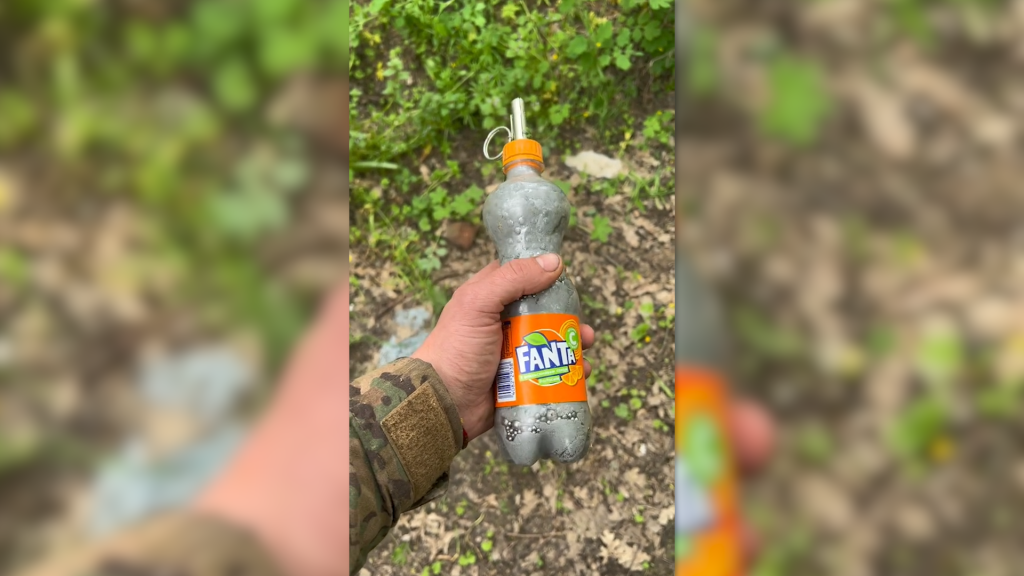
In early May an interesting short video was shared by a Ukrainian combatant showing a Fanta soft drink bottle filled with explosives and what appear to be ball bearings of different sizes. It’s hard to tell what sort of explosive has been used but the bottle is topped with a UZRGM grenade fuze.

The Fanta Bomb (via social media)

Ordnance Lab made an interesting video a couple of weeks ago testing an approximate version of the Fanta bomb and found it to be fairly effective in terms of blast and fragmentation. Though their version looked to contain more ball bearings and they noted it weighed around 3kg.

The only other similar munition to surface was seen in a photograph that showed a box of Polish Kropla Beskidu water bottles which also appear to be filled with explosive materials and fuzed with standard UZRGM fuzes. 

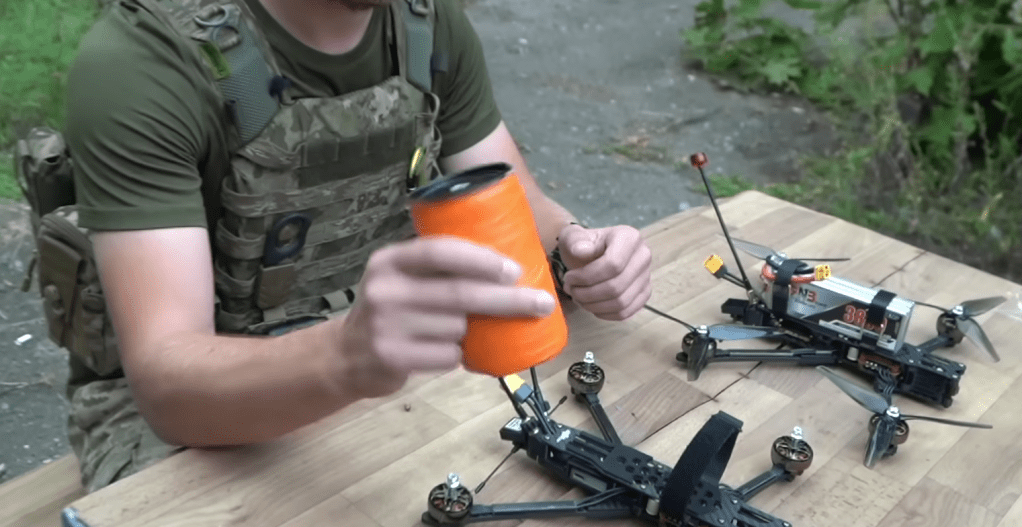
Improvised can-based warhead for FPV drone (via social media)

It’s unclear whether the grenades are designed for ground use or perhaps for dropping from drones. If the fill of the grenade is purely explosive then it would have a significant blast effect but minimal fragmentation – likely why the Fanta bottle example has been augmented with ball bearings. 

There is also evidence of the simple use of directly using TNT blocks with UZRGM fuzes, with the Georgian Legion evidently dropping them from drones. 

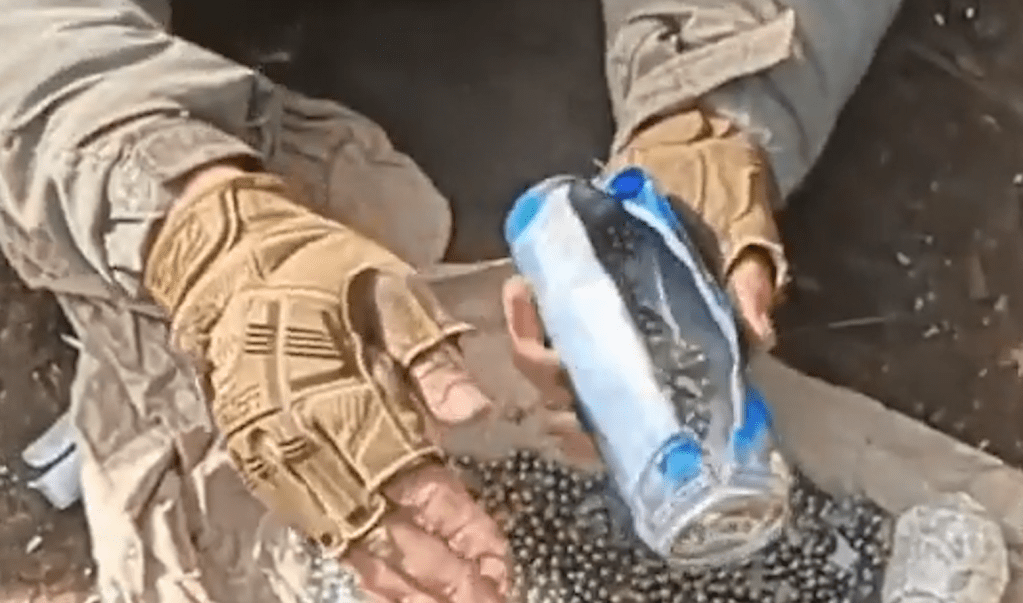
Old drinks cans have also been used to make improvised explosive devices. In early May a video showing a ‘Non Stop’ energy drink can being split open and filled with plastic explosives and ball bearings was shared. The can was then attached to a First Person View (FPV) drone and used against personnel in a Russian trench. 

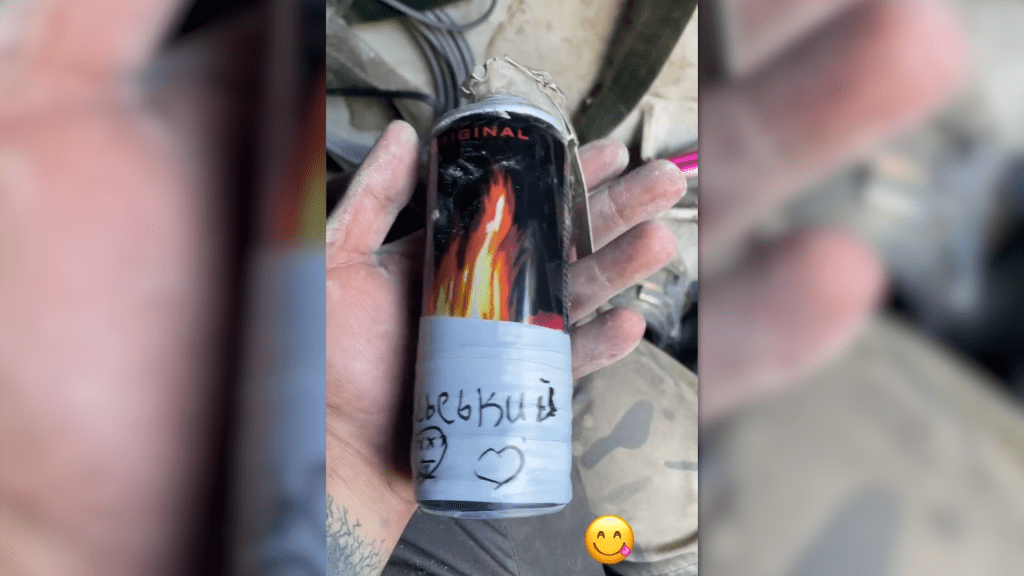
In June several short clips were shared featuring drinks cans with grenade fuzes. Two with UZRGM fuzes and one can with what appears to be a DVM fuze. The can could be augmenting a Bulgarian fragmentation grenade such as an AR-ROG or GHD/RGD series.    

Improvised can-based grenade (via social media)

In July, Ryan O’Leary, a US volunteer in Ukraine, shared a photograph of 5 craft-made grenades constructed from plastic drinks bottles slipped into the base of Red Bull and Non Stop energy drink cans. O’Leary suggests that there is approximately 1-2 kg of RDX explosive inside. They are again topped with UZRGM fuzes and secured with tape.

Improvised grenades made from bottles and drinks cans (via social media)

So why are these munitions being made? Often when I cover improvised munitions people ask are the Ukrainians not receiving billions in aid? The answer to this is – they are. However, aid doesn’t always include all the types of munition you might want. Similarly, the combatants improvising these munitions may not receive the types of munitions they need –  wartime logistics can be challenging. Additionally, the combatants producing these munitions may be looking for bombs with improved blast and fragmentation over what is available.

Update – 25/07/23:

Update – 27/09/23: A BBC Newsnight report featured a drone company attached to the 24th Brigade. A can-based improvised exposive device, designed to be dropped from a drone was featured.

Update 15/5/24: On 3 May a Ukrainian telegram channel shared a clip of a drone dropped munition attack on Russian infantry. The munition appears to be enclosed in a Pepsi can. The unit involved is claimed to be a drone unit of the National Guard’s 4th Rapid Reaction Brigade.

Update – 15/7/24:

In addition to bottles and cans packed with explosives, both sides have utilised bottles filled with incendiary mixtures. These have seen being dropped from drones on positions and vehicles.

Update – 28/5/25:

A member of the 6th Special Purpose Battalion of the 12th Special Purpose Brigade “Azov” used an DIY bottle bomb, as an enhanded blast grenade to demolish the front of a single story building during fighting near Toretsk.


Support Us: If you enjoyed this video and article please consider supporting our work here. We have some great perks available for Patreon Supporters – including early access to custom stickers and early access to videos! Thank you for your support!

Bibliography:

UZRG-M Fuze, CAT-UXO, (source)

DVM Fuze, CAT-UXO, (source)

US & Canadian M67 Grenades In Ukraine

A range of Western, Eastern European and Russian hand grenades have been seen in use in Ukraine over the last eight months. One of these is the M67 Fragmentation Grenade which are believed to have been provided by the US and Canada.

The M67 evolved from the earlier M33, it began to be fielded in 1968. They are produced by Day & Zimmermann, who state they have produced over 43 million of the grenades. It is a spherical anti-personnel fragmentation grenade which has a Composition B filling. Composition B is made up for a RDX and TNT mix. The M67 explosive filling weighs in at 6.5oz (180g). It uses the M213 fuze which provides a 4 to 5 second delay after deployment.

There is a spring clip which interacts with the spoon and safety pin. On detonation the grenade’s steel outer body fragments to create an injury radius of around 15 metres (50 feet). The fragmentation is caused by scoring on the inside of of the grenade’s outer body.

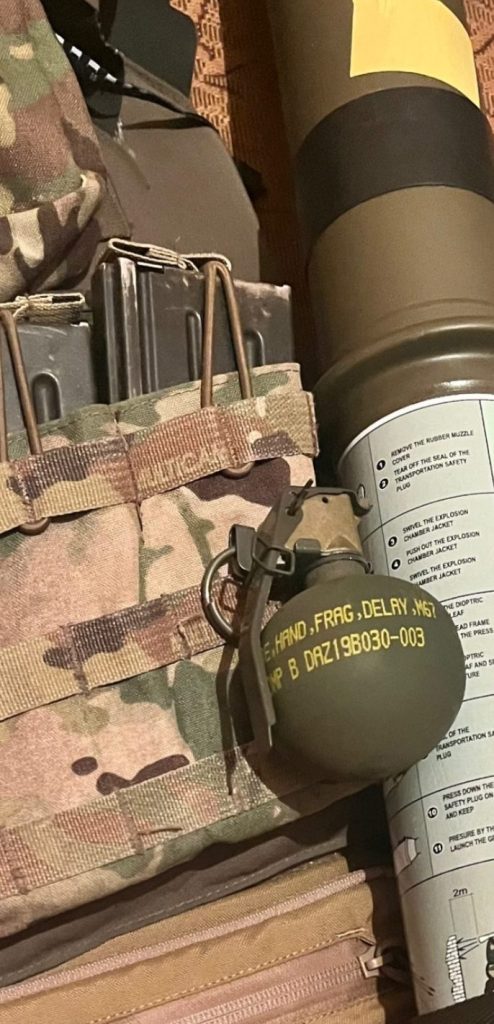
A captured M67 Grenade (via Social Media)

The US government has confirmed that hand grenades have been provided to Ukraine but specific mentions of them in the regular fact sheets breaking down aid have not been common since the spring when it was said that ‘over 1 million grenade, mortar and artillery rounds’ had been provided. Canada has previously, on 3 March, confirmed the supply of 7500 hand grenades of an unspecified type.

M67 shared 29 April 2023 (via social media)

Imagery of the grenades first began to be circulated online in May with the Azov-Dnipro 98th Territorial Defence Battalion sharing several videos featuring them. In their first video they showed a couple of transit chests, each containing 30 individually packed grenades. They then showed the individual packaging of the grenades. In another video posted a few days later the show an M67 alongside a French OF37.

On the 15 June, Russia’s Zvezda News shared a short interview with a soldier from the separatist Luhansk People’s Republic showing off captured weapons including an 66mm M72 LAW and an M67 grenade. Describing the grenade he said: “We are already walking around with American [grenades]. The grenade is convenient, it flies far.”

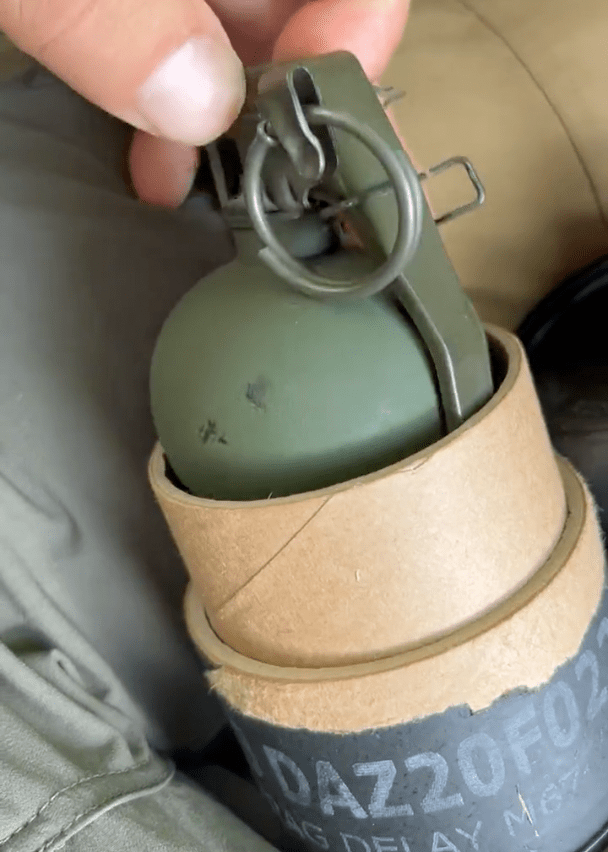
M67 Grenade in its cardboard transit tube (via Social Media)

A short video of one of the grenades was shared in late June and in late July the 98th Territorial Defence Battalion shared a clip showing soldiers training with live grenades. On the 18 August, Valgear shared a short video showing an M67 he believed has been provided by Canada. An M67 and its individual packaging was shown in another video posted by a Ukrainian soldier on 23 August.

In August several videos featuring M67s were also shared by Russian forces. The first video showing off a captured example of the M67 was posted on 3 August, featuring a DPR officer examining a grenade. On the 28 August another brief clip of a captured grenade was also shared.

M67 in a 73rd Mechanised Brigade trench (source)

In September the Russian YouTube channel ‘Big Calibre Trouble’ published a video testing the blast effect of several grenades including an M67. Similarly, Ukrainian YouTube Channel ‘Boys from the Forest’ also demonstrated the M67 and German DM51. Most recently several photos of M67s have been shared. Ukrainian serviceman Valgear notes that the M67 is highly prised amongst Ukrainian personnel including with drone teams.

M67 Grenade (via Social Media)

From the sources available it appears that Canadian-made grenades are marked with a ‘CA’ prefix. So far the grenades we’ve identified in the photos and footage from the field all of the grenades appear to have US markings. Exactly how many M67s have been provided to Ukraine, and by whom, remains unclear but the number seems likely to be in the tens of thousands.  

Research Note: several lots of M67 grenades have been visually confirmed from available imagery:

DAZ13C002-003 – 1 confirmed example

DAZ14D002-011 – 2 confirmed example

DAZ20F022-006 – 7 confirmed examples

DAZ21C022-014 – 7 confirmed examples

DAZ21J022-017 – 1 confirmed example

DAZ19B030-002 – 2 confirmed example

DAZ19B030-003 – 1 confirmed example

DAZ12J001-003 – 1 confirmed example

DAZ14F002-012 – 2 confirmed example

DAZ21D022-015 – 1 confirmed example

DAZ20M022-012 – 3 confirmed examples

DAZ22F023-002 – 1 confirmed example

Update 30/01/23:


Support Us: If you enjoyed this video and article please consider supporting our work here. We have some great perks available for Patreon Supporters – including early access to custom stickers and early access to videos! Thank you for your support!

Bibliography:

M67 Hand Grenade, Day & Zimmerman, (source)

M33, M59, M67 & M68, Lexpev.nl, (source)

C13 Fragmentation, Lexpev.nl, (source)

M67 Hand Grenade, CAT-UXO, (source)