There are a significant number of different large calibre anti-materiel rifles in use in Ukraine. One of the largest is the Monomakh, a 14.5×114mm semi-automatic, box magazine-fed anti-materiel rifle from the Ukrainian company Snipex. Snipex is a subsidiary of the XADO Chemical Group.
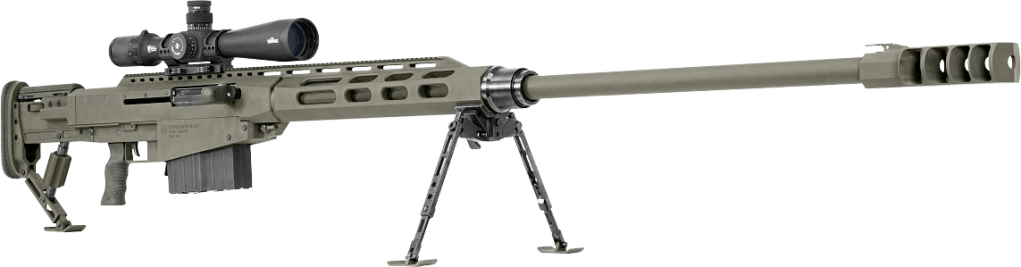
Snipex are well known for their series of precision anti-materiel rifles which includes the M100, T-Rex and Alligator. The Monomakh, introduced in 2021, is the company’s first semi-automatic rifle. It is recoil operated and feeds from a 5-round box magazine. It has a barrel 1,200mm [47.2in] long and an overall length of 2,050mm [6.7 feet], Snipex list its weight without a magazine as 25kg [55lbs]. The rifle has a listed muzzle velocity of 950 to 980 m/s and an effective range of just under 2,000 metres [1.2 miles]. The weapon is fired from a bipod with a monopod supporting the butt of the rifle. It’s key feature is its reciprocating barrel which helps soak up the recoil from the 14.5mm cartridge.
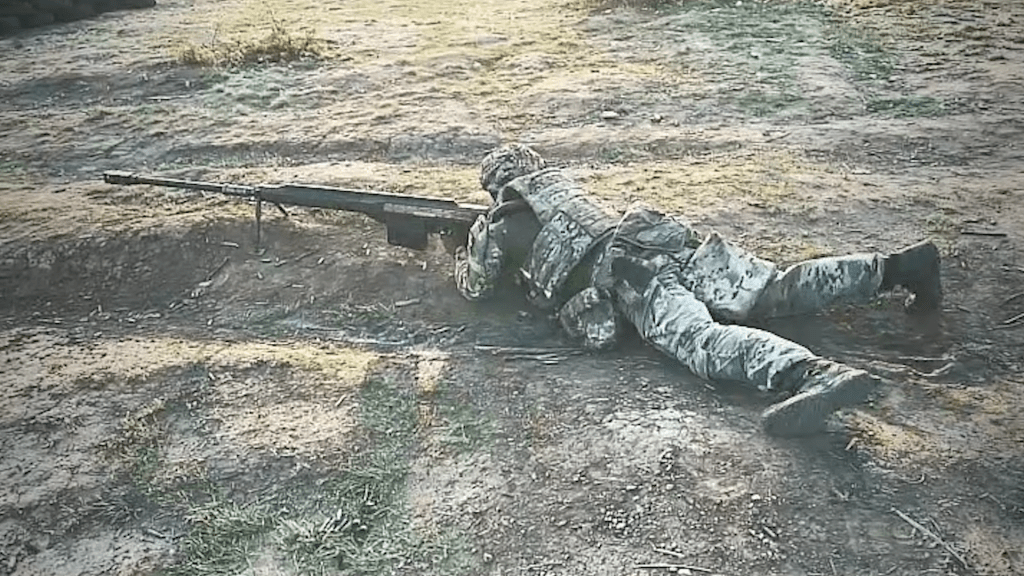
A scopeless Monomakh at the range (via social media)
The Monomakh appears in imagery from Ukraine fairly infrequently, the earliest sighting of one of the rifles I could find was a photograph posted by a GUR member in late April 2022. Subsequently a number of videos of the weapon being fired at ranges by Ukrainian combatants was published in the Summer of 2022. The first posted on 7 August, shows a magazine being loaded into the rifle and the weapon chambering a round. Later that month a short video of a Monomakh firing at a range was published.
Snipex Monomakh (Snipex)
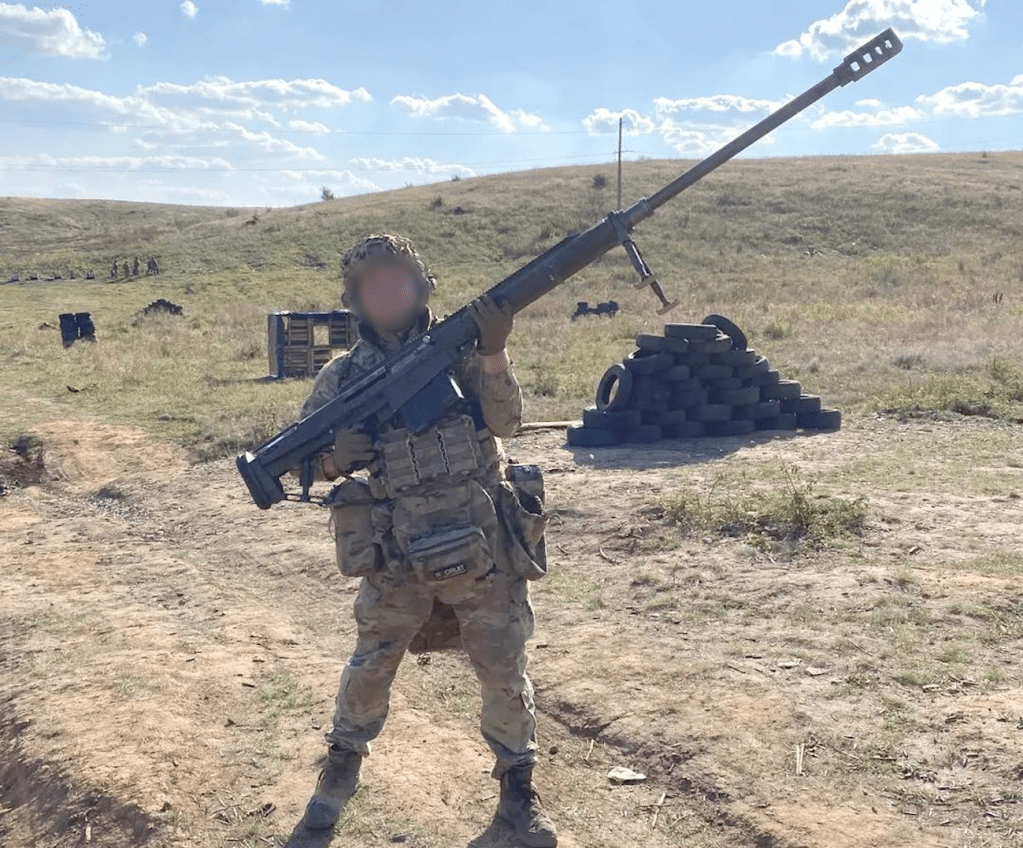
The earliest photograph of one of the guns I could find in 2023 was shared by a Ukrainian combatant in mid-July. Several months later, in September 2023, another Ukrainian combatant shared a photograph of himself holding up a Monomakh at a range. The same combatant also shared a short clip of himself firing the rifle, again at the range. In the clip he appears to be firing the rifle without sights or an optic. He is also seen helping the bolt into battery after each shot, the bushing which guides the barrel as it recoils into the receiver appears to have come loose. The rifles are typically paired with substantial optics, Snipex offer two of their own 6–24×56 scopes, the Jove 50 and the Galaxy G50. In late October, a female sniper with the 3rd Shock Brigade, posted several photographs and a video of herself firing a Monomakh from a position inside a building.
A Ukrainian combatant holds up a Monomakh (via social media)
The large size and hefty weight of the Monomakh limits it applications somewhat but the 14.5mm round is useful against light armoured vehicles, buildings and field fortifications – the main limitation is getting it in, and out, of position to engage targets. There are videos of it taking two men to move the similarly heavy T-Rex and Alligator rifles. From the limited sample of imagery of the Monomakh in theatre it is difficult to gauge how widespread its use actually is. The simpler to manufacture bolt action Snipex rifles are seen more frequently.
My thanks to Cloooud and AbraxasSpa for help sourcing some of the imagery used in this article/video.
Support Us: If you enjoyed this video and article please consider supporting our work here. We have some great perks available for Patreon Supporters – including early access to custom stickers and early access to videos! Thank you for your support!
A dozen different types of light and general purpose machine guns are in use in Ukraine, one of the newest is the Heckler & Koch MG5.
In May 2023, the German government announced a package of aid which would include 100 HK MG5 7.62x51mm general purpose machine guns. In September, evidence of their arrival in theatre began to surface with Ukrainian combatants sharing imagery of the brand new weapons.
The transfer of MG5s by the German government is interesting as the Bundeswehr themselves have only recently begun to receive the guns. The MG5 officially entered German service in 2015 but procurement has only recently ramped up with around 10,000 currently estimated to be in inventory. The MG5 is a gas-operated 7.62x51mm general purpose machine gun with a variable rate of fire and is intended to replace the MG3. It fires from an open bolt and it’s action is locked by a rotating bolt head. The guns themselves are listed on the German government’s aid-tracking page as “being deliveries from industry stocks financed by German funds for security capacity building.” This indicates that the transfer was probably not made direct from Bundeswehr stores.
Jurado posted the first photo of an MG5 in Ukraine (via Social Media)
On 20 September, Jurado – a Spanish member of the International Legion, shared the first photograph of an MG5 in Ukraine. Several days later on 22 September, omega_team_gurshared another photograph of the MG5 at the range. According to Jurado his unit received three of the guns.
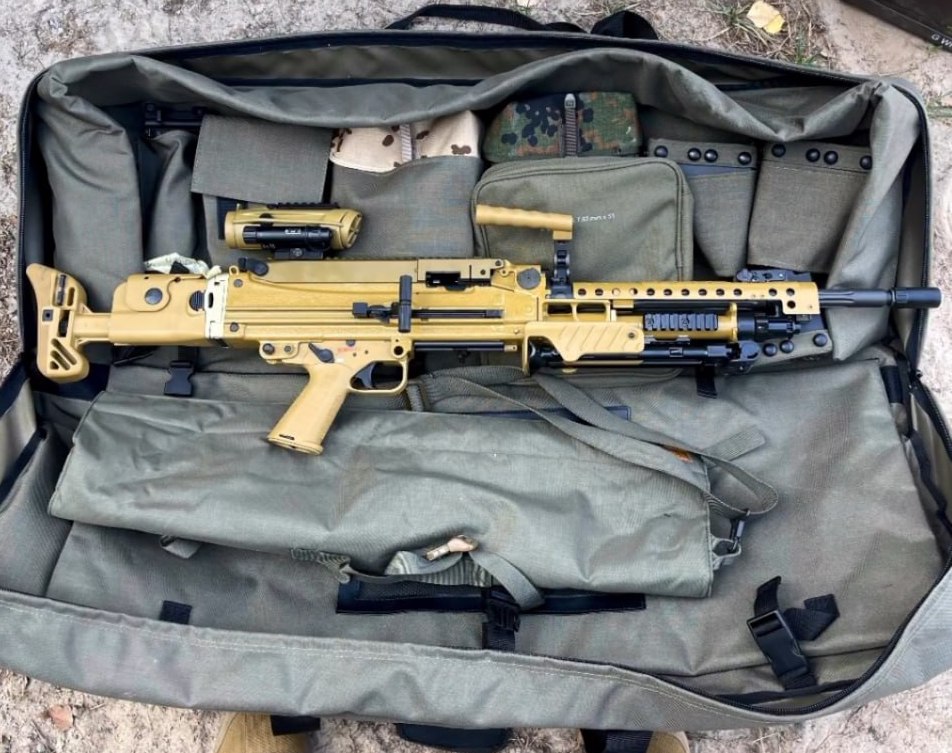
A week later Greek International Legion members shared the first video of one of the guns mounted on a Lafette tripod. Through discussions with some of the combatants whose units have received the MG5s not all the guns came with tripods. A member of a Ukrainian Military Intelligence Directorate, the GUR, team told us that the guns came in bags with accessories including an optic, bipod, cleaning kit, manual and spare barrel.
An MG5 in its transport bag (via Social Media)
A member of the GUR, callsign Shock, shared a photo with an MG5 on 28 September, and several more the next day. Shock told TAB that his unit had received two of the MG5s and that while they’re cool pieces of kit the are heavy “13+ kg without ammunition” [HK lists the MG5A2’s weight as 11.5kg or 25lbs]. Shock’s team appears to be one of the few GUR teams not made up of international volunteers to receive the guns. He also shared a photograph of two MG5s sat in their transport bags.
On the 30th September Omega Team shared another group photograph featuring an MG5 and several days later on 2 October, a member of the GUR’s Shaman battalion, shared a photograph of himself holding a new MG5. Another member of the Shaman battalion also shared a photograph of an MG5 in its transit case/bag. It can seen fitted with a Hensoldt 4x30i optic and a cleaning kit and a number of belt pouches can be seen in the case. Knights, another GUR team, shared a photograph featuring an MG5 on 6 October. This was followed on the 10 October by a unit photograph with an MG5 seen at the back of the group. During the same week, another SOF group made up of international volunteers, Black Maple, also shared a photograph featuring an MG5.
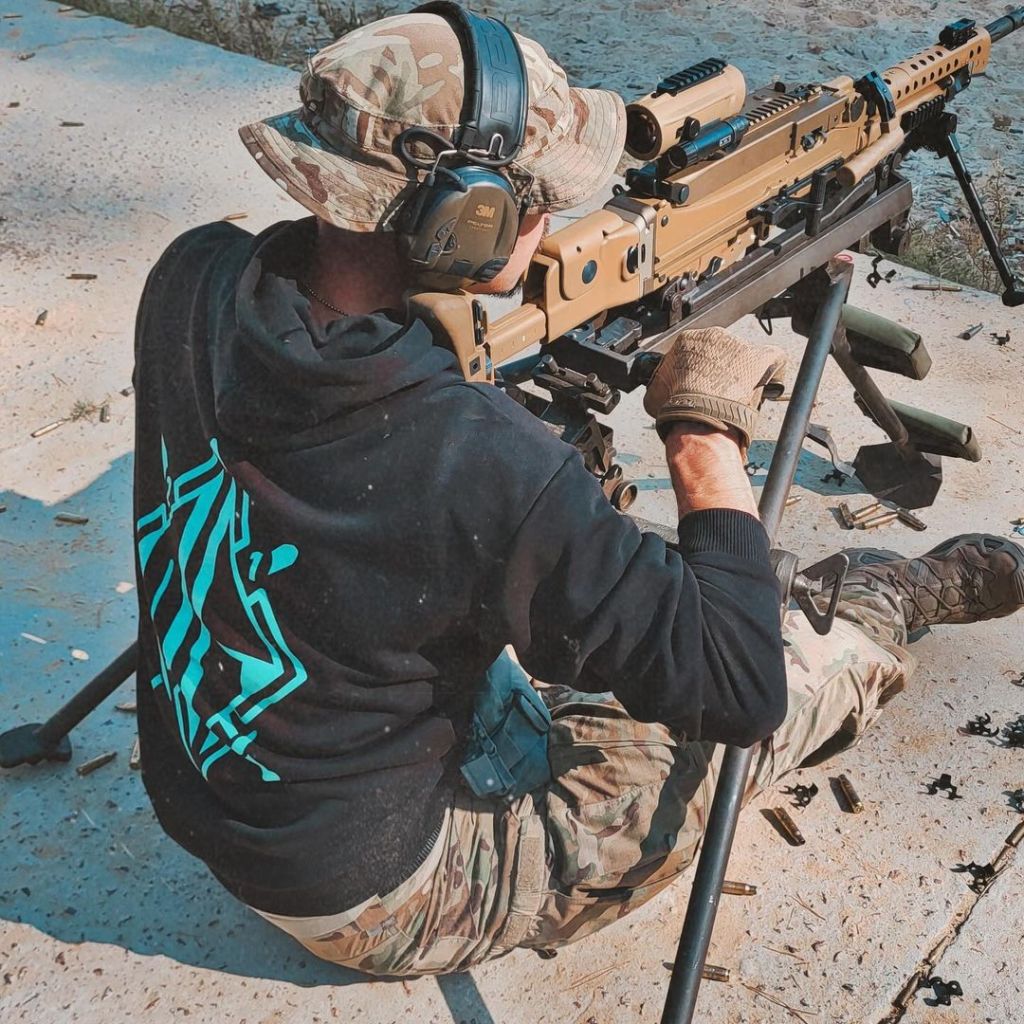
An MG5 mounted in a Lafette tripod at the range (via Social Media)
Another team, Operation 21 Group, posted a photograph on 16 October of an MG5 mounted on a Lafette tripod at the range. The gun is again paired with the Hensoldt optic. On around the 17 October, a member of the Kraken Regiment, also part of the GUR, posted a photograph holding one of the MG5s. Several days later the first glimpse of an MG5 being used in combat was shared by a GUR team, the MG5 can be heard firing and is just visible though the foliage.
On the 22 October the GUR’s Stugna Battalion also shared a promotional video featuring one of the MG5s. On 24 October imagery from a number of photographers showed members of the International Legion’s new Siberian Battalion training. Amongst an interesting array of small arms the battalion’s trainees also appeared to have a single MG5.
The team at GRaft, a Ukrainian company which fabricates ammunition boxes for machine guns, shared some video of testing of one of their boxes with an MG5 in late October. At the beginning of November Tactical Group Athena, another GUR team, shared a team photograph featuring not one but two MG5s.
Later in November, the Knights shared a series of photographs and clips featuring the MG5. The first was posted on 4 November, showing the gun in a fighting position. This was followed on the 13 November, by a short video of an MG5 firing from its bipod in a frontline position in the trenches feeding from a British 7.62x51mm ammunition box. I spoke to one of the members of Knights about the MG5 and they described it as ‘a fantastic weapon’ and while “a bit on the heavy side [it’s] still a good weapon system and we love to use it!”
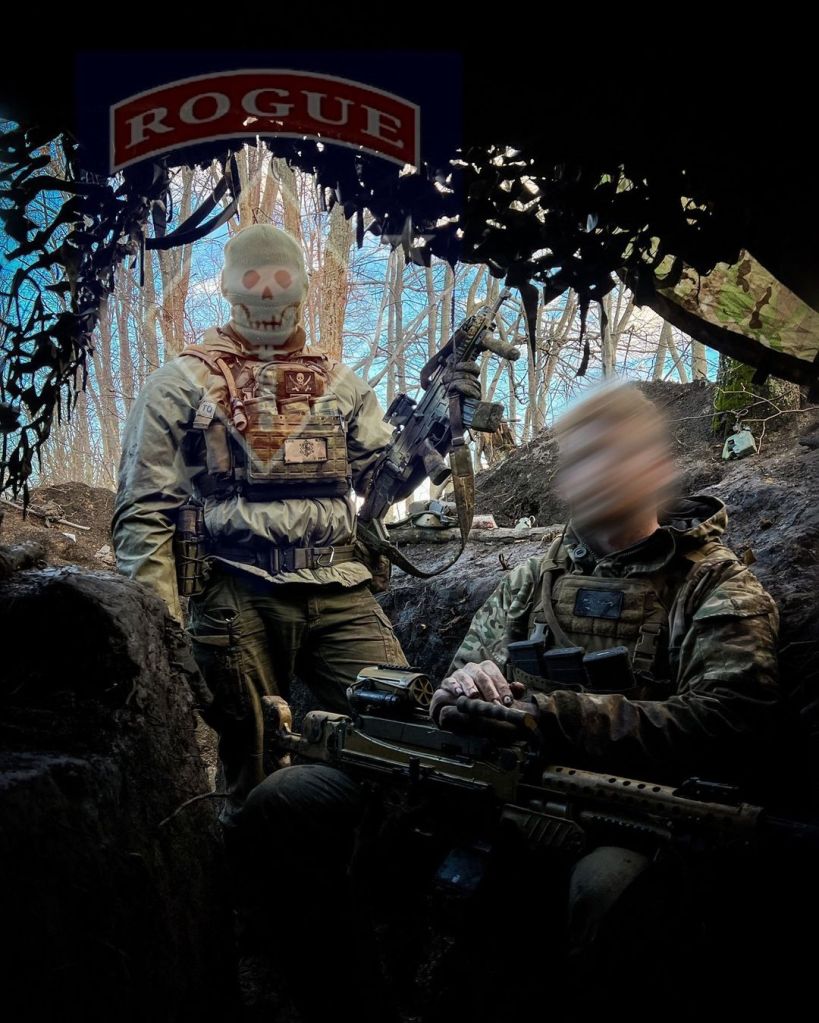
A member of Rogue Team holds an MG5 in a frontline trench (via Social Media)
Omega team shared another group photo featuring an MG5 on 12 November. Later that week Rogue Team posted a photograph of two combatants in a frontline trench, one is seated holding an MG5. A week later the GUR shared a video on their YouTube channel about their amphibious operations in Crimea, on 16 November, with an MG5 briefly appearing in part of the sequence. Towards the end of November a video from the Knights team thanking people for kit donations also featured an MG5. On the 14 November, an element of the Kraken Regiment, Special Assault Company, shared a promotional video featuring a drive by with an MG5 being fired out the window of a vehicle at a range. On the 19 November Rogue Team shared a team photograph, with one combatant holding an MG5, a day later a member of the team shared a short clip from the range showing the MG5 in action with the caption ‘I love MG5’. Finally, on the 26 November another MG5 was seen in a photograph of members of Kraken.
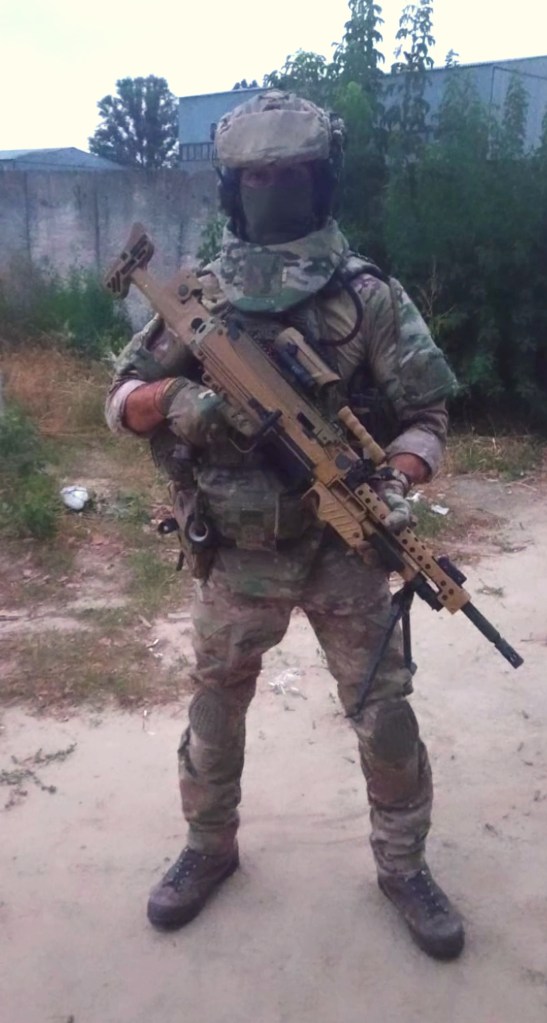
All of the guns appear to have HK’s RAL 8000 (FDE-ish) finish and are of the MG5 A2 configuration with the shorter 460mm (18in) barrel. The guns also appear to have been provided with Hensoldt 4x30i ‘intermediate range targeting optics’. From the imagery which has surfaced so far we can see that the MG5s have predominantly been issued to special operations forces including teams from the GUR and possibly the SSO. Despite the small number of guns officially confirmed to have been transferred they have been widely photographed in theatre and when asked by TAB comments from combatants using them have largely been positive. It is unknown what quantity of spares were provided with the guns or if more may be provided by Germany in the future.
Thank you to friends at Cloooud and at StreakingDelilah for their help gathering imagery for this video.
Update – 2/12/23:
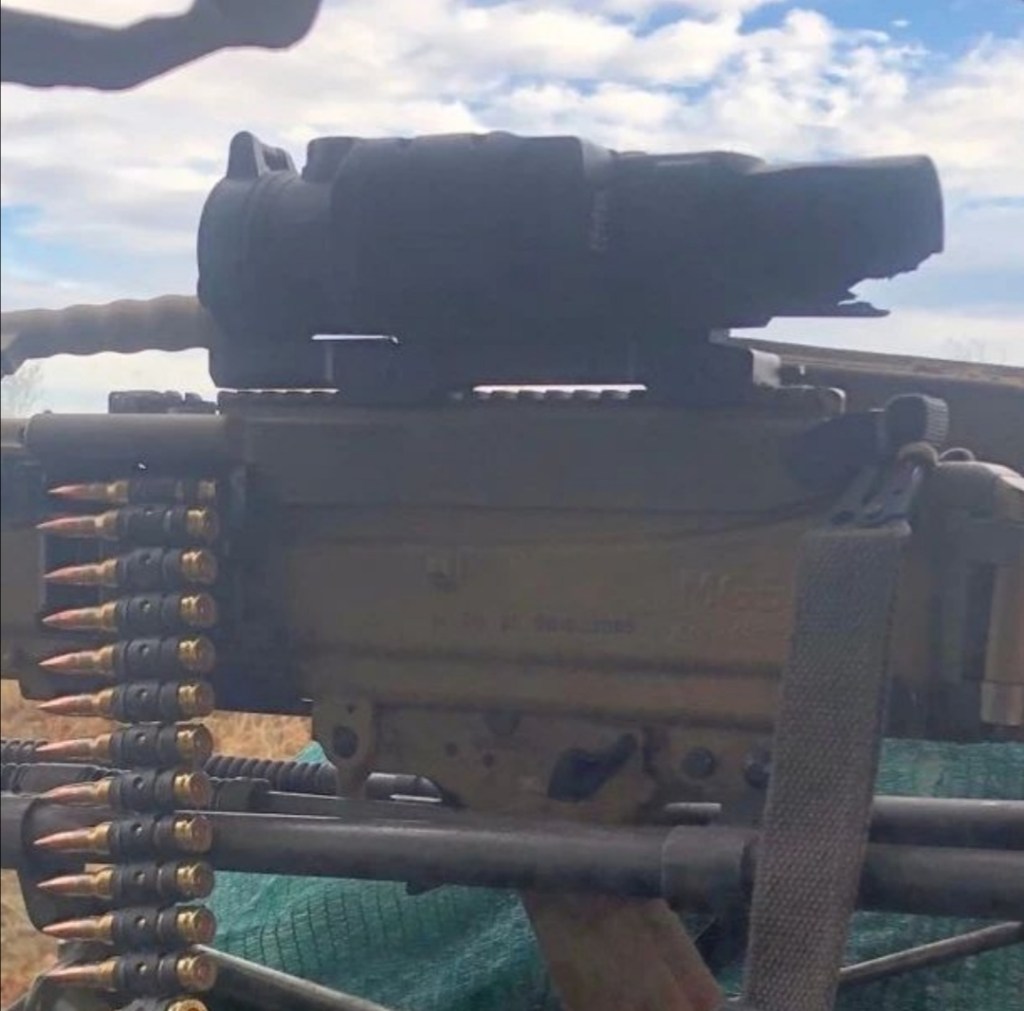
Ukrainian combatant, Valgear, shared a photo of an MG5 in a Lafette tripod fitted with a thermal optic. Both the gun and optic have apparently been damaged by shrapnel.
Update – 03/12/23:
Machine gun training (Bundeswehr/KSK)
The Bundeswehr issued a statement on training Ukrainians SOF members and shared a photograph of Ukrainians training on MG3 and MG5 machine guns. Unlike the guns seen in Ukraine the MG5s have 550mm (22in) barrels.
Update – 9/12/23:
Another GUR team, Stugna, have shared photos of an HK MG5 in recent weeks.
Stugna, another GUR team, have shared a few photos of their HK MG5. One in a group photo (h/T @war_noir) and a second from a range day when volunteer fundraiser group Peace For The Future visited the to present a vehicle.
— Matthew Moss | Historical Firearms (@historicfirearm) December 9, 2023
Update – 13/12/23: The recently formed Sibir Battalion were photographed again training with an MG5.
Very recent training with German-delivered MG5s by the Sibir Battalion, which consists only of Russian nationals, who want to fight against the Russian armed forces. pic.twitter.com/SQGI5os4HJ
— Matthew Moss | Historical Firearms (@historicfirearm) April 16, 2024
Update – 7/6/24: Rogue, a GUR direct action team, shared some video of their machine gun team in action near Kupyansk in November 2023. It gives a great look at the MG5 in action and also features a brief glimpse of the gun’s spare barrel and it’s reload drills.
Some stills from a video filmed by Rogue, a GUR direct action team, operating in Kupyansk in Nov. 2023. Great look at the HK MG5 in action, reloading and it's spare barrel.
— Matthew Moss | Historical Firearms (@historicfirearm) June 7, 2024
Support Us: If you enjoyed this video and article please consider supporting our work here. We have some great perks available for Patreon Supporters – including early access to custom stickers and early access to videos! Thank you for your support!
Bibliography:
Military Support for Ukraine, Bundesregierung, (source)
On 5 October, a combatant in Ukraine shared photograph of himself with a French FR F2 sniper rifle. The 7.62x51mm rifles have only been sighted in theatre once before in March 2022, when a single F2 was seen. The origins of that rifle are unclear as no further rifles were subsequently seen. The rifle may have been acquired as surplus or another potential origin for the rifle is as aid from either Estonia or Lithuania who previously issued the rifle.
Most recently, on 5 October, Ukrainian outlet Tysk shared three photographs, provided by one of their subscribers, featuring another FR F2. The photographs featured a rifle and a SAGEM Sword Sniper 3-in-1 optic (a telescopic sight, thermal weapon sight, and laser rangefinder) which is part of the FELIN System. The presence of the SAGEM Sword optics may suggest that France have provided a batch of the rifles and accompanying optics.
The rifle appears to be mounted with a SCROME J8 scope which the rifle is typically paired with in French service. The FR F2 is being replaced in French service by the FN SCAR-H PR which may mean that France can pass on its surplus F2s to Ukraine.
It remains to be seen if further examples of the FR F2s will be seen. If a substantial number have been transferred by France then further examples will likely be sighted in the future.
France has also transferred a considerable number of armoured vehicles and a unknown quantity of general purpose machine guns including AANF1s and FN MAGs. Most recently, on 13 September, a FAMAS with the Valorisé upgrade, which adds rails, was seen in a range video posted by a Ukrainian combatant. There has been no further sightings of FAMAS in theatre to date. Individual sightings can’t be considered representative of wider use or considerable transfers of weapons until further examples are seen in theatre.
Some very intriguing footage from #Ukraine featuring a French FAMAS with Valorisé upgrade (Picatinny rails added & position/style of the bipod altered). First such sighting of a FAMAS. France does have stocks to spare now the HK416F is entering service.#SALW#UkraineRussiaWar️pic.twitter.com/8ORtJNRO4W
— Matthew Moss | Historical Firearms (@historicfirearm) September 13, 2023
Update – 1/12/23: The French Assemblee Nationale has published a document which outlines the equipment, but not quantities, provided to Ukraine by France. It confirms the provision of both FAMAS, various calibres of machine gun and precision rifles.
Update – 14/12/23:
Interesting to see a French FAMAS F1 Valorise in #Ukraine, with 54 ORB. We've seen some evidence of FAMAS in Ukraine previously and the French govt also recently confirmed an undisclosed number had been transferred.#UkraineWar#SALWpic.twitter.com/3Pb7a7JjMR
— Matthew Moss | Historical Firearms (@historicfirearm) December 14, 2023
Update – 10/3/24: The French government has released an updated document listing the equipment and some of the quantities provided to Ukraine. The document states that 30 ‘Fusil de precision’ (precision rifles) have been provided between 1 March, 2022 and 1 May, 2024.
Support Us: If you enjoyed this video and article please consider supporting our work here. We have some great perks available for Patreon Supporters – including early access to custom stickers and early access to videos! Thank you for your support!
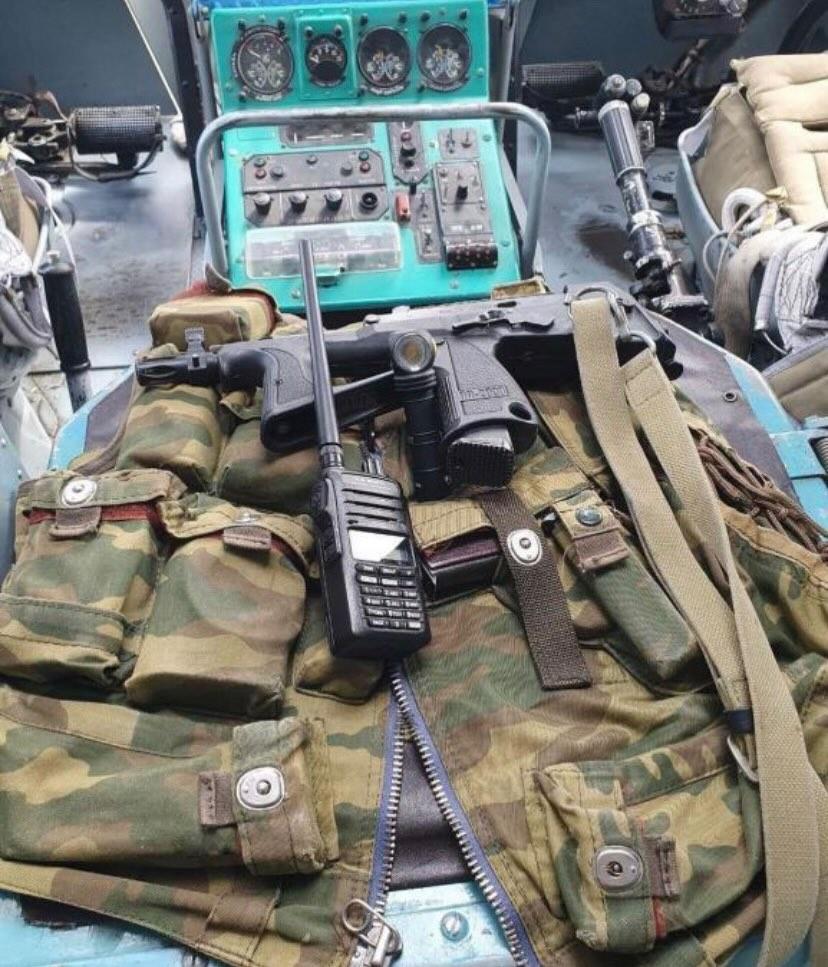
On 29 September delegations from the defence departments of member states of the Russian-led Commonwealth of Independent States were shown around the JSC Instrument Design Bureau in Tula. During the tour Russia’s defence minister Sergei Shoigu demonstrated a PP-2000 submachine gun. Also present was Deputy Commander-in-Chief of the Aerospace Forces Yuri Grekhov who explained that the PP-2000 is now part of the emergency kit stored under Russian aircrew seats.
Grekhov’s statement confirms what has been anticipated for a while. Back in June, TASSreported that during the International Naval Show (IMMS-2023) Rostec/High-Precision Complexes (the parent company which offers the PP-2000) had confirmed that the weapon was “currently undergoing trials in the Aerospace Forces (VKS) of the Russian Federation.” This was confirmed by a post on Rostec’s website on 19 June.
A PP-2000 and a new PLK pistol at the range for testing (via FighterBomber)
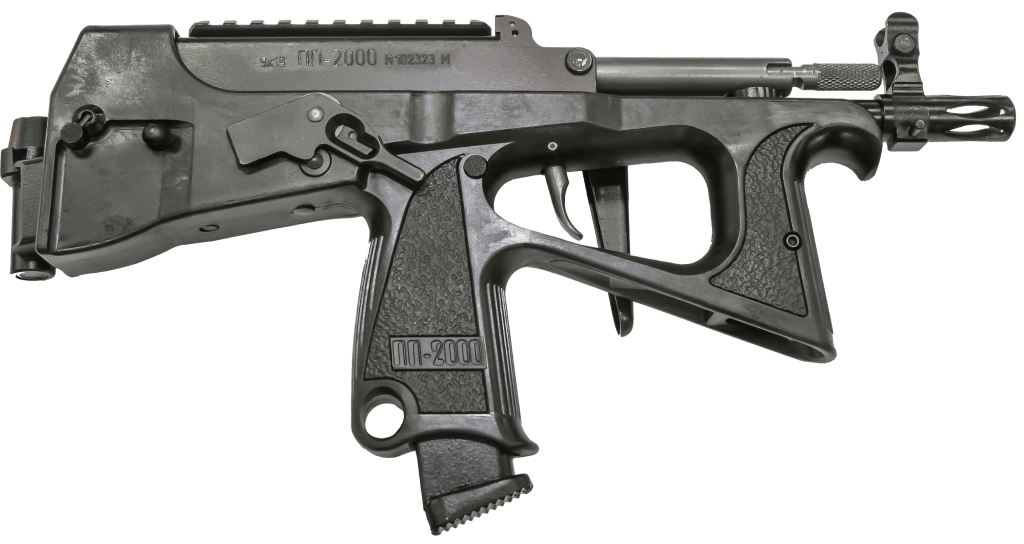
The PP-2000 is a compact submachine gun, designed at the Instrument Design Bureau in Tula in the 1990s. The weapon is a conventional blowback which feeds from 20 or extended 44 round magazines which are loaded into the pistol grip. It is chambered in 9x19mm and can fire Russia’s standard 9mm ammunition or the armour piercing 7N21 and 7N31 rounds. It has a reciprocating charging handle which runs parallel over the barrel. It is characterised by its front grip which connects to the pistol grip to act as a large trigger guard. It can be fitted with a suppressor and has a side folding stock and a small length of rail on the top of the receiver for mounting optics. Other accessories such as lights or lasers can be attached to the base of the front grip. According to Rosoboronexport the weapon weighs 1.4kg (or just over 3lbs) unloaded and with the stock folded is 35cm (13.7in) in length.
Typically, aircrew have carried Makarov or Stechkin pistols but better equipping Russian pilots has long been a consideration with not all aircraft able to fit larger weapons such as rifle or carbines. This has reportedly been driven by experiences in Syria and more recently in Ukraine. During the battle of Hostomel airport in March 2022, a damaged KA-52 attack helicopter was forced to make an emergency landing. It’s crew were able to dismount and take up positions and await retrieval. They were armed with AK-74Ms, however, the confines of other Russian aircraft do not allow rifles to be carried.
PP-2000 (Rosoboronexport)
In a December 2019 interview with Lt.Gen. Nikolai Gostev, commander of the 4th Air and Air Defence Forces Army, Interfax asked if PP-2000s will be fielded. Gostev replied [machine translated]: “Currently, several promising samples of portable emergency supplies for flight personnel are being tested, which also include promising samples of small arms. The tests are carried out by specialists from the Gromov Flight Research Institute, and after their completion it will be decided which portable emergency supplies will be put into service.”
In May 2021, it was reported that Shoigu had directed the process for a compact personal defence weapon to be added to aircrew’s survival kits to be expedited. At the same time the PPK-20, from Kalashnikov Concern was also suggested as an option. Russian news reports noted that personal defence weapons would be added to the emergency kits aboard Su-27, Su-30SM, Su-35, Su-57, MiG-29 and MiG-35 as well as Su-24 and Su-34s.
Russian pilot demonstrating a PP-2000 during a Zvezda news report (Zvezda)
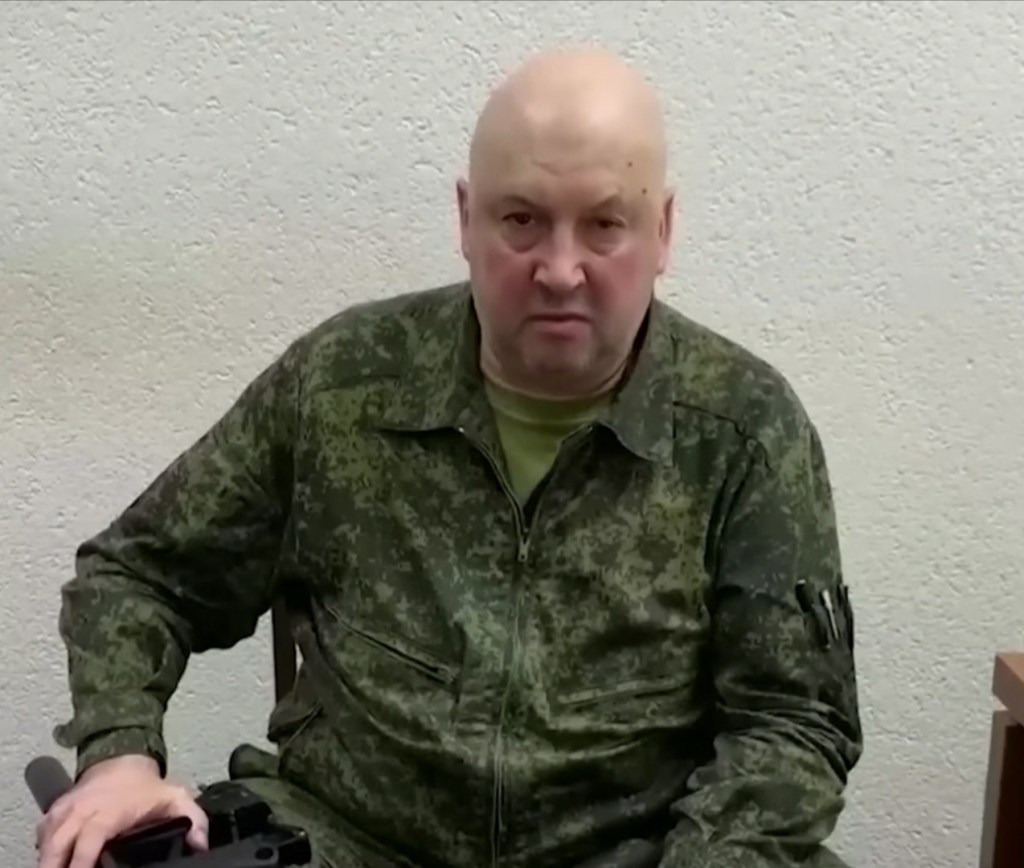
On 23 June 2023, during the failed Wagner advance on Moscow, General Sergey Surovikin, then Commander-in-Chief of the Russian Aerospace Forces, appeared in a video calling on Wagner to stand down. In his hand could be seen a PP-2000 outfitted with an optic, light and suppressor.
Surovikin with PP-2000 (Russian MoD)
In September 2022, the Fighterbomber telegram channel shared a post lobbying for the AM-17 rather than the PP-2000, rightly arguing a pistol calibre submachine gun is next to useless against combatants wearing body armour. Another major Russian telegram channel, Повёрнутые на Z войне, welcomed the wider issue of the PP-2000 in a post from late December 2022, sharing a photo of a PP-2000. The post also suggested that until then only Guards Aviation units had been issued them.
In January 2023, Fighterbomber began to report on the apparent testing of the PP-2000 and the PLK pistol, claiming that despite the order for three months testing positive reports from those involved had already been ordered.
A PP-2000 belonging to crew of a in an MI-8amtsh cargo helicopter, December 2022 (via @nrxnb)
In April 2023, Fighterbomberposted a review of the new PP-2000 and PLK. The post described the PLK as “a great gun. Powerful, comfortable and precise.” Praise for the PP-2000 was less forthcoming with the post noting: “PP-2000 is still jamming every now and then… still need 44-round magazines and a 7N31 cartridge for the PP.”
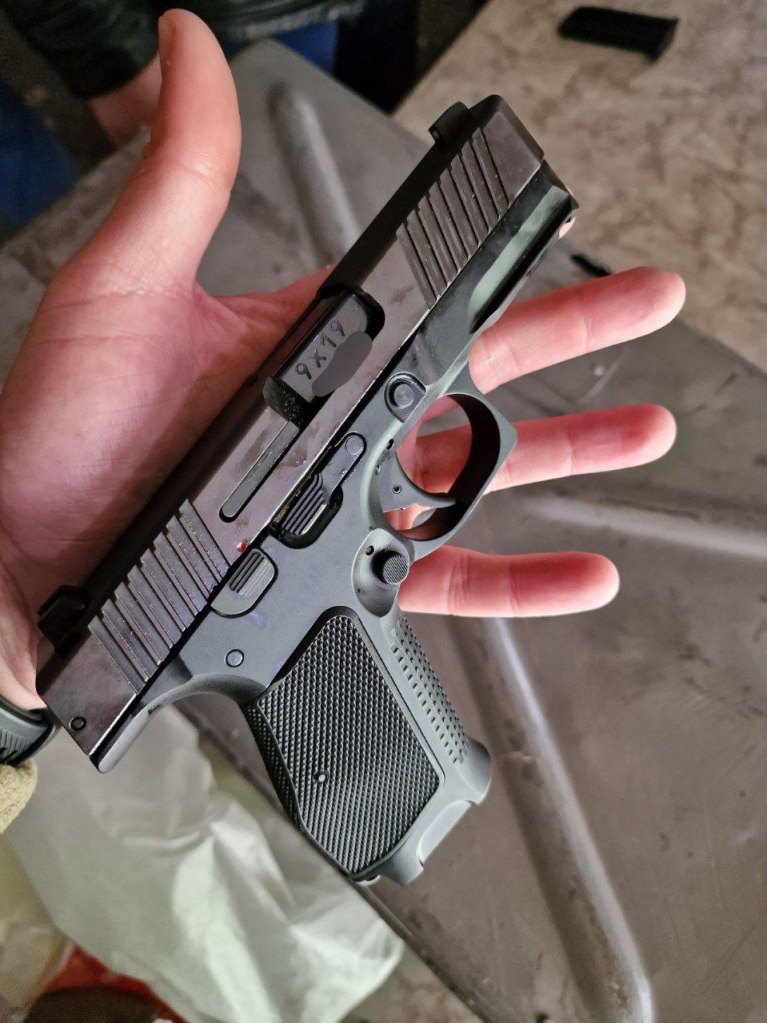
A new PLK pistol (via FighterBomber)
On 2 October, following Shoigu and Grekhov’s comments at Tula, Zvezdapublished a short report from a survival training centre. During the clip an Su-30SM pilot explains that “particular attention was paid to tactical shooting, survival in extreme conditions and tactical medicine.” The video shows pilots training in escape and evasion skills and sees them deploy their new PP-2000s. The video concludes with the two air crew firing both the PP-2000 and the PLK at the range.
The PLK pistols, from Kalashnikov Concern, are the latest iteration of the Lebedev pistol introduced in 2015 as the PL-14. The PLK was reportedly adopted by Russia’s Ministry of Internal Affairs in October 2021 but sightings with Russian pilots are the first sightings of regular Russian military use. If more of the PLKs appear in use they’ll be a topic for a future article/video.
Support Us: If you enjoyed this video and article please consider supporting our work here. We have some great perks available for Patreon Supporters – including early access to custom stickers and early access to videos! Thank you for your support!
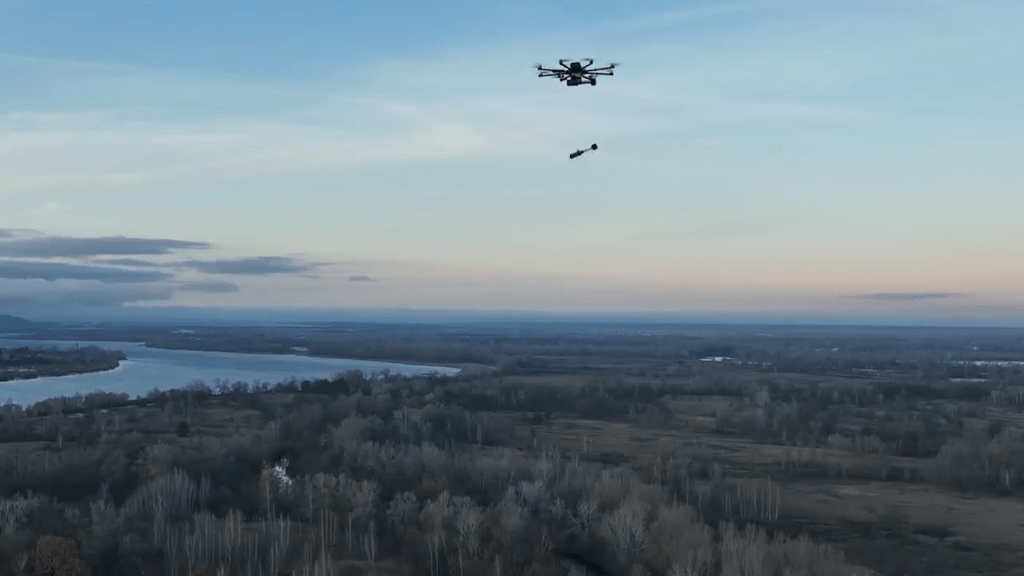
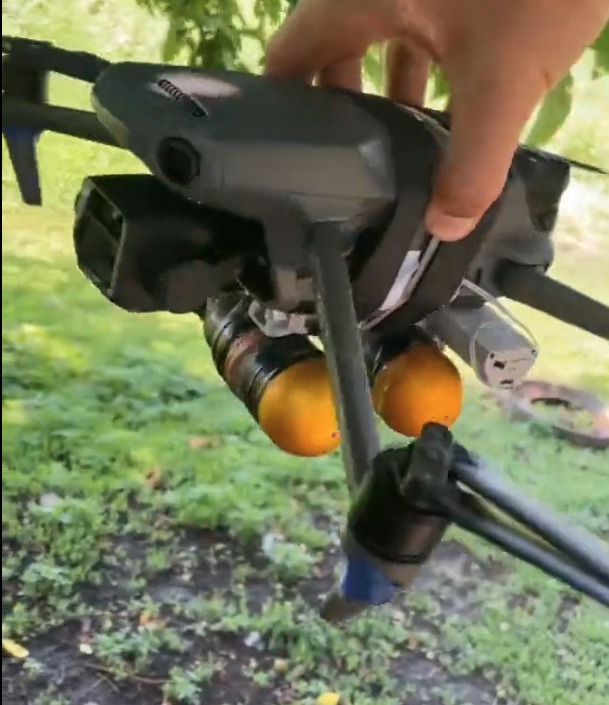
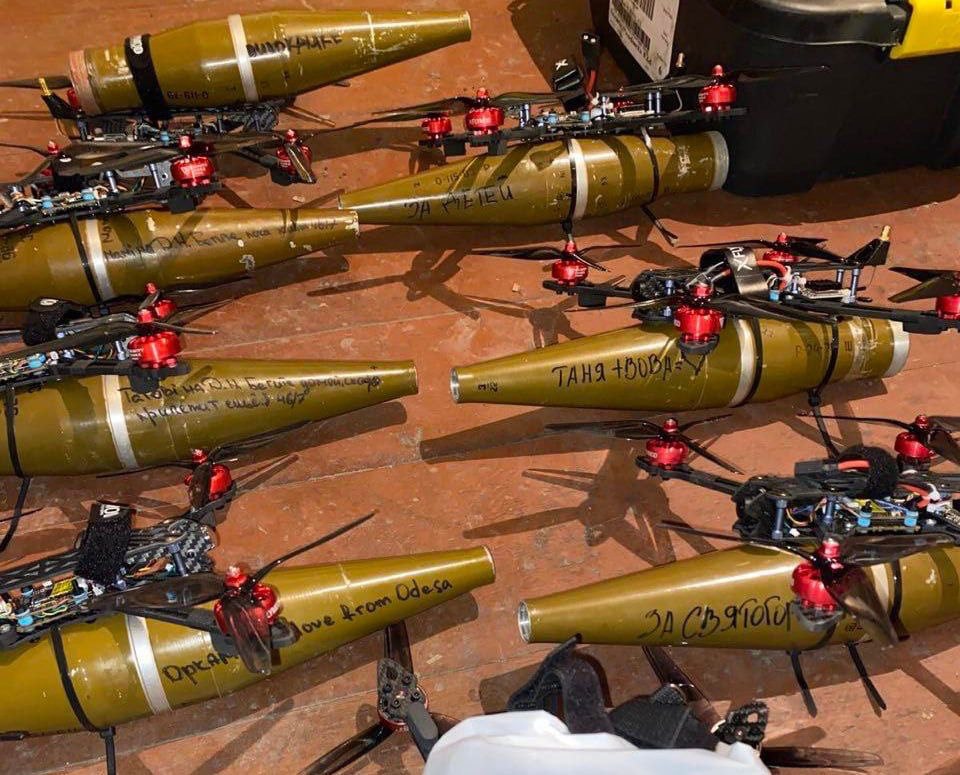
All sorts of munitions have been dropped from drones ranging from hand grenades to Molotov balloons to mortar rounds and even blocks of explosive. In this article/video, we’ll look at a couple of interesting examples of improvised munitions.
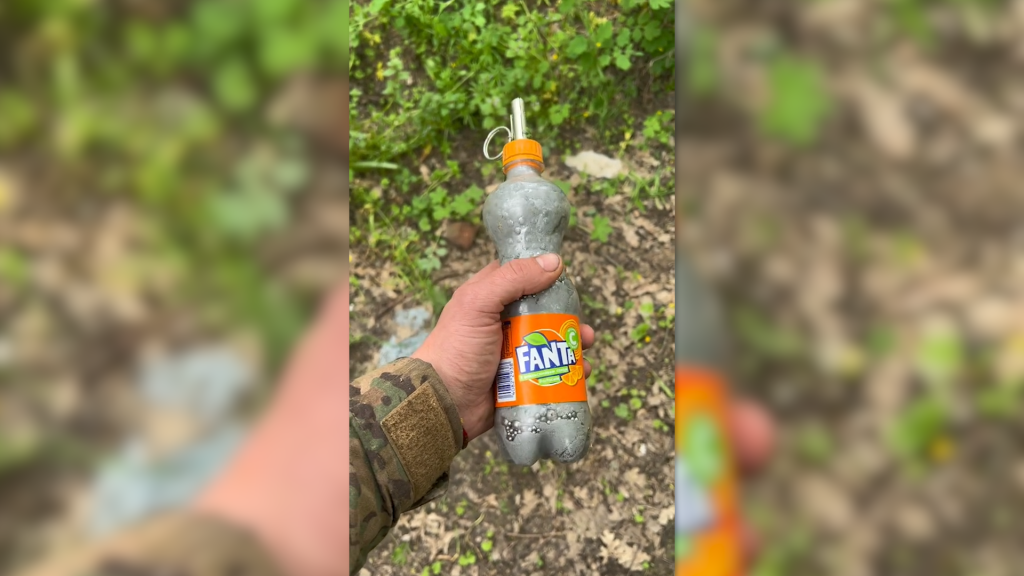
In early May an interesting short video was shared by a Ukrainian combatant showing a Fanta soft drink bottle filled with explosives and what appear to be ball bearings of different sizes. It’s hard to tell what sort of explosive has been used but the bottle is topped with a UZRGM grenade fuze.
The Fanta Bomb (via social media)
Ordnance Lab made an interesting video a couple of weeks ago testing an approximate version of the Fanta bomb and found it to be fairly effective in terms of blast and fragmentation. Though their version looked to contain more ball bearings and they noted it weighed around 3kg.
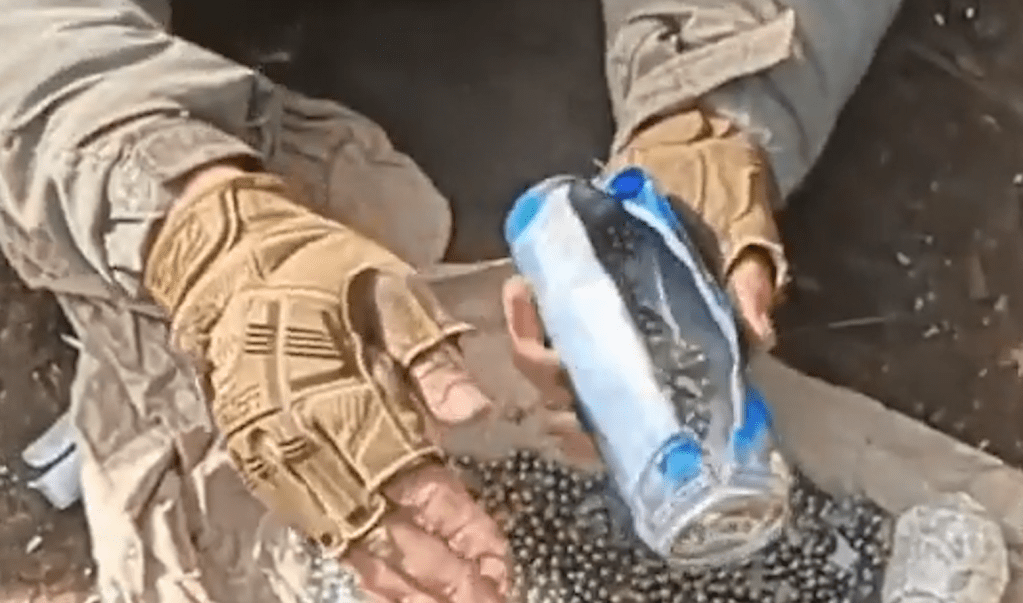
The only other similar munition to surface was seen in a photograph that showed a box of Polish Kropla Beskidu water bottles which also appear to be filled with explosive materials and fuzed with standard UZRGM fuzes.
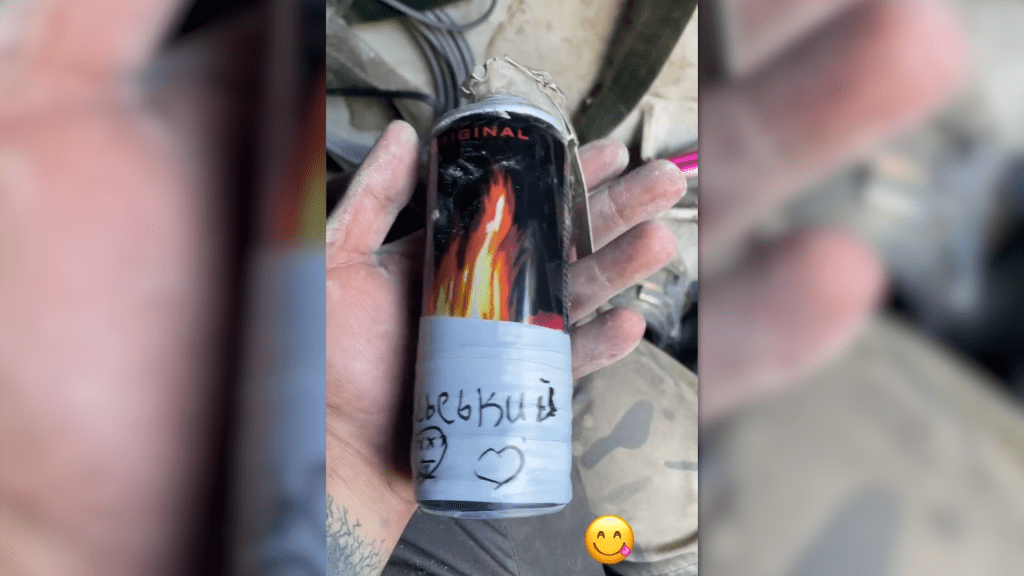
Improvised can-based warhead for FPV drone (via social media)
It’s unclear whether the grenades are designed for ground use or perhaps for dropping from drones. If the fill of the grenade is purely explosive then it would have a significant blast effect but minimal fragmentation – likely why the Fanta bottle example has been augmented with ball bearings.
There is also evidence of the simple use of directly using TNT blocks with UZRGM fuzes, with the Georgian Legion evidently dropping them from drones.
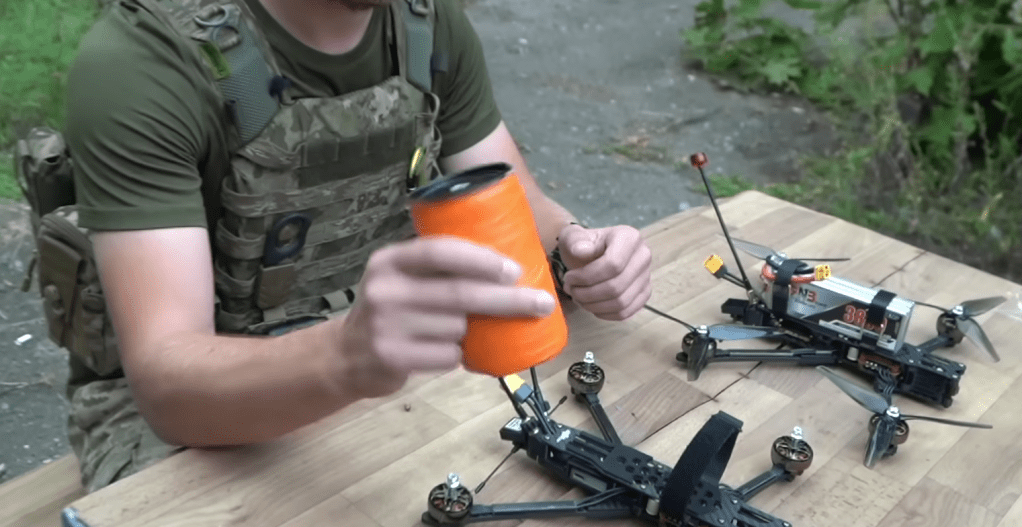
Old drinks cans have also been used to make improvised explosive devices. In early May a video showing a ‘Non Stop’ energy drink can being split open and filled with plastic explosives and ball bearings was shared. The can was then attached to a First Person View (FPV) drone and used against personnel in a Russian trench.
In June several short clips were shared featuring drinks cans with grenade fuzes. Two with UZRGM fuzes and one can with what appears to be a DVM fuze. The can could be augmenting a Bulgarian fragmentation grenade such as an AR-ROG or GHD/RGD series.
Improvised can-based grenade (via social media)
In July, Ryan O’Leary, a US volunteer in Ukraine, shared a photograph of 5 craft-made grenades constructed from plastic drinks bottles slipped into the base of Red Bull and Non Stop energy drink cans. O’Leary suggests that there is approximately 1-2 kg of RDX explosive inside. They are again topped with UZRGM fuzes and secured with tape.
Improvised grenades made from bottles and drinks cans (via social media)
So why are these munitions being made? Often when I cover improvised munitions people ask are the Ukrainians not receiving billions in aid? The answer to this is – they are. However, aid doesn’t always include all the types of munition you might want. Similarly, the combatants improvising these munitions may not receive the types of munitions they need – wartime logistics can be challenging. Additionally, the combatants producing these munitions may be looking for bombs with improved blast and fragmentation over what is available.
Update – 25/07/23:
💥Some more can grenades.
Packed with explosive and fuzed with a UZRGM. Enhanced blast grenades, useful for trench clearing.
— Matthew Moss | The Armourer's Bench (@historicfirearm) July 25, 2023
Update – 27/09/23: A BBC Newsnightreport featured a drone company attached to the 24th Brigade. A can-based improvised exposive device, designed to be dropped from a drone was featured.
Update 15/5/24: On 3 May a Ukrainian telegram channel shared a clip of a drone dropped munition attack on Russian infantry. The munition appears to be enclosed in a Pepsi can. The unit involved is claimed to be a drone unit of the National Guard’s 4th Rapid Reaction Brigade.
Update – 15/7/24:
In addition to bottles and cans packed with explosives, both sides have utilised bottles filled with incendiary mixtures. These have seen being dropped from drones on positions and vehicles.
What vile concoctions are in these Russian improvised incendiary munitions, with UZRG-M hand grenade fuzes. pic.twitter.com/2NZjNjr36y
A member of the 6th Special Purpose Battalion of the 12th Special Purpose Brigade “Azov” used an DIY bottle bomb, as an enhanded blast grenade to demolish the front of a single story building during fighting near Toretsk.
— Matthew Moss | The Armourer's Bench (@historicfirearm) May 28, 2025
Support Us: If you enjoyed this video and article please consider supporting our work here. We have some great perks available for Patreon Supporters – including early access to custom stickers and early access to videos! Thank you for your support!
Drone warfare is a complex and nuanced topic with drones used for information gathering, observation and direct attacks. The war in Ukraine has seen an explosion in drone use ranging from small commercial DJI Mavics to military grade drones like the Bayraktar TB-2. In this video I’m joined by author and journalist David Hambling who has been tracking and writing about drone use in Ukraine since the Russian invasion in February 2022.
We discuss the expanding role drones have played in the conflict, how they are deployed and the impact they have. We touch on countermeasures used by both sides, the psychological effect the drones can have and what the future holds for drone use.
Support Us: If you enjoyed this video and article please consider supporting our work here. We have some great perks available for Patreon Supporters – including early access to custom stickers and early access to videos! Thank you for your support!
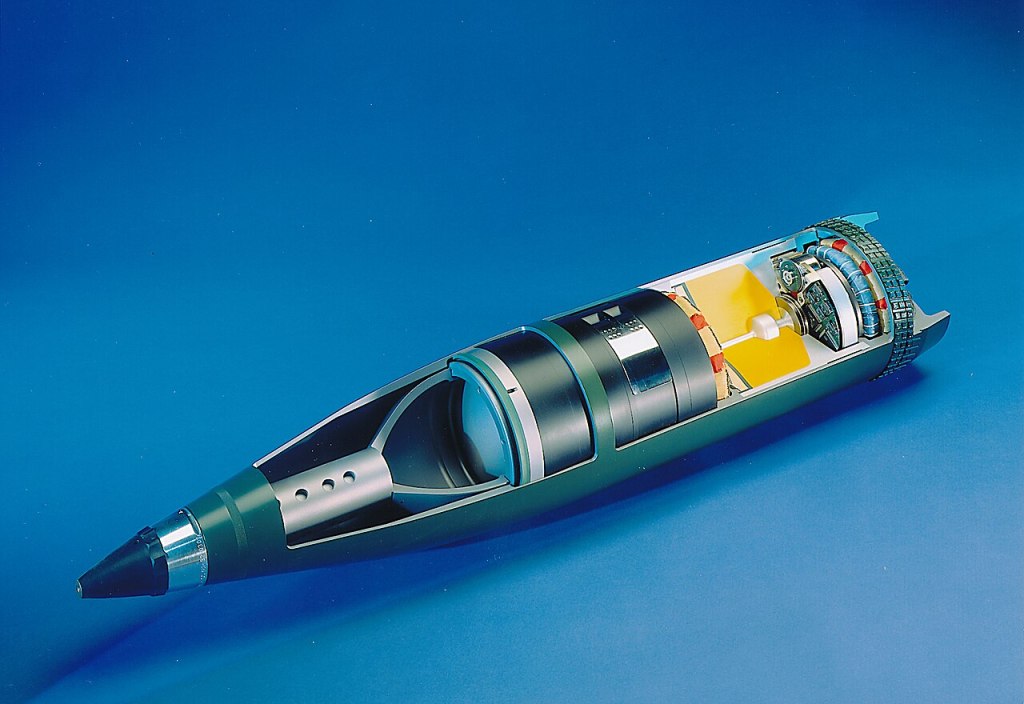
SMArt 155 is a Sensor Fuzed Munition (SFM), developed by Rheinmetall and Diehl BGT Defence in the late 1980s. It is a 155mm howitzer round which contains a pair of fire-and-forget top-attack submunitions. The submunitions use a ballute and parachute to slow their descent and allow the submunitions’ onboard infrared sensor and millimeter wave radar to locate its target and fire and explosively formed penetrator.
In a previous video/article we’ve looked at the 155 BONUS round which also carries two submunitions which are arrested by a pair of winglets which arrest the submunitions flight to enable their built-in sensors to detect targets within their search footprint before striking down on a target vehicle.
A cutaway of a SMArt 155 (Swiss Army)
The round is manufactured by GIWS, a joint venture between Diehl Defence and Rheinmetall, and entered service in the late 1990s. It is capable of being launched by NATO standard 155mm howitzers but in Ukraine appears to primarily be used in conjunction with Panzerhaubitze 2000 self-propelled howitzers. The round is also in British service as the Ballistic Sensor Fused Munition fired from AS-90s, the UK has recently provided Ukraine with a number of AS-90s but it is unclear if they will deploy SMArt155 rounds.
The manufacturer describes SMArt 155 projectile as consisting of: “a thin-walled shell body, a base plate, an ejection unit, time fuse, and two functionally identical submunitions.” The SMArt155 round allows a 155mm projectile to deliver two submunitions capable of penetrating any tank’s top armour with considerable accuracy. SMArt155 has a listed maximum range of 22km (13.6 miles) when fired from 155mm/39-calibre systems and 27.5km when fired from 155mm/52-calibre systems such as the PzH2000. Adding a base bleed unit would extend the round’s range further. The submunitions carry a shaped charge of 9.7lbs (4.2kg) of high explosive which create explosively formed penetrators (EFP). The manufacturer states that extensive German Army trials found that the round has a very low failure rate.
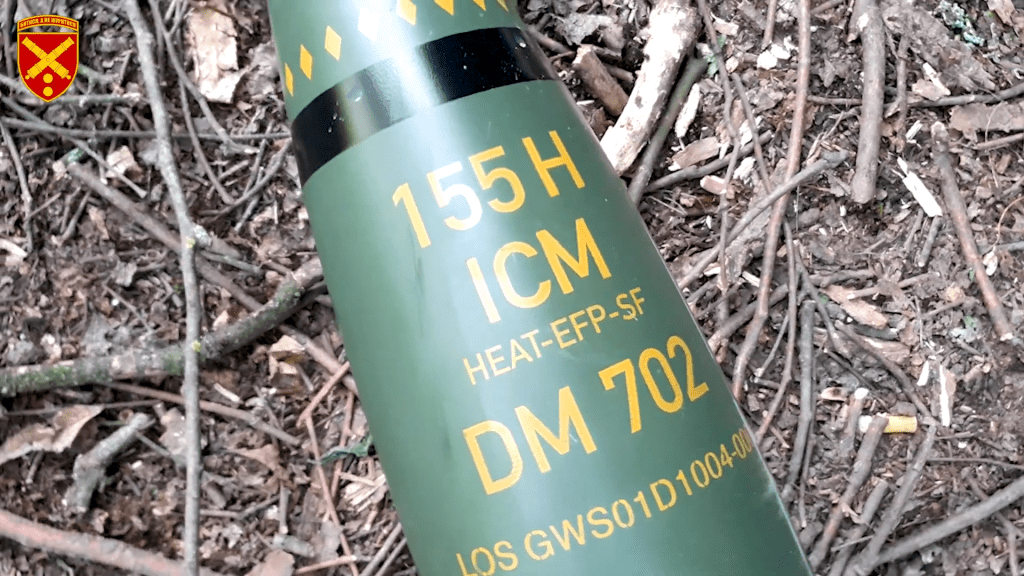
A DM702 shell seen briefly in a video posted by the 43 Separate Artillery Brigade, 16 May (via social media)
Once the round is fired an onboard timer fuze, set before firing, ignites an ejection charge in the shell’s nose which pulls the submunitions out of the shell body. Once clear the submunitions’ ballute and then parachute deploys they begin to spiral down over the target area using their onboard sensors to detect the target vehicle before detonating their payload.
Though there is controversy surrounding SMArt, and BONUS, the shells do not fall into the category of weapons banned under the 2008 Convention on Cluster Munitions as they comprise of just two submunitions and both have onboard self-destruction mechanisms.
The summer of 2022 saw a flurry of drone videos which showed strikes of Russian vehicles and equipment many of these were attributed to either BONUS or SMArt 155, but with most of the videos it is difficult to definitively identify which top attack munition was in use.
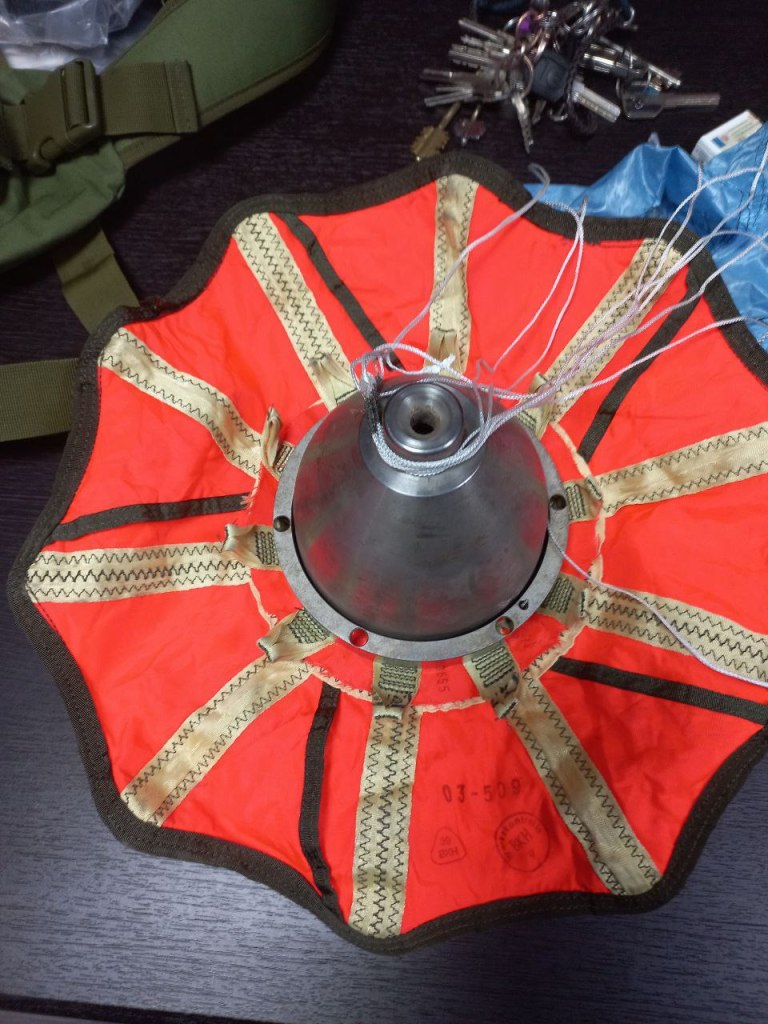
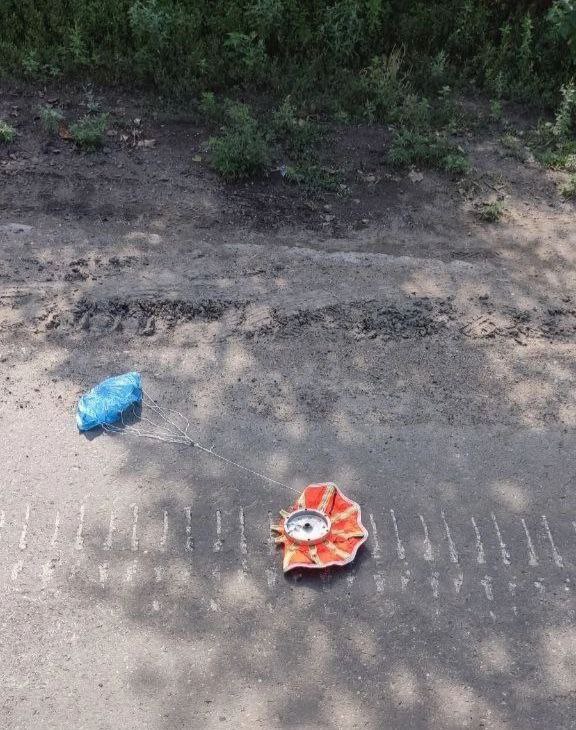
The ballute and parachute of a SMArt 155 (DM702A1) found near Kreminna in March 2023 (via social media)
On the 2 July, the first video believed to be a SMArt in action was shared online. In it a munition can be seen descening before detonating above. The framing and resolution of the video is too low to confirm if it is a parachute arrested submunition. Russian telegram channels shared a photograph of a ballute and parachute, said to have been seen near Kirovsky, in Donetsk in early August.
On the 13 September, another fairly low resolution video showed a top attack munition detonating above a Russian armoured vehicle. On 4 March 2023, photos of a ballute and parachute from a SMArt 155 were shared and said to have been found near Kreminna. Around the same time another video showing a potential SMArt 155 strike was shared. On 17 April, the 26th Artillery Brigade shared video showing what was claimed to be a SMArt munition striking two Russian vehicles. On 23 April, Ukrainian military journalist Andrii Tsaplienko shared a video from inside a PzH2000 showing some German DM702 SMArt 155 shells. The DM702 shells were again briefly seen in a video posted by the 43 Separate Artillery Brigade posted on the 16 May.
A ballute and parachute, said to have been seen near Kirovsky, August 2022 (via social media)
While the lack of easily verifiable videos of SMArt in use is frustrating it is impressive that we have any footage of top-attack munitions in use at all. Production of SMArt 155 paused in the late 2000s but even before the war in Ukraine began their had been plans to revive production. The war has, however, provided impetus for renewed production and in late 2022 the German government agreed to spend EUR 97.4 million to restart manufacture of the complex electronic components needed to manufacturer the round.
Update – 18/06/24:
Archive footage of the usage of SMArt 155 top-attack ammunition fired from a PzH 2000 of the 43rd Separate Artillery Brigade named after Hetman Taras Tryasyl. It's unclear how many of these DM 702 shells were delivered to Ukraine by Germany. pic.twitter.com/hVNeAuLBUJ
Support Us: If you enjoyed this video and article please consider supporting our work here. We have some great perks available for Patreon Supporters – including early access to custom stickers and early access to videos! Thank you for your support!
The iconic 9x19mm Uzi submachine gun has been intermittently seen in Ukraine since the early months of the conflict. The earliest images of the Uzi in theatre, which we could find, date to the beginning of May 2022. The origins of the Uzis are currently unclear with a number of possibilities including Israeli IMI-made guns, Croatian EROs, surplus German Bundeswehr MP2A1s or perhaps most likely Belgian manufactured Uzis made under license by FN Herstal.
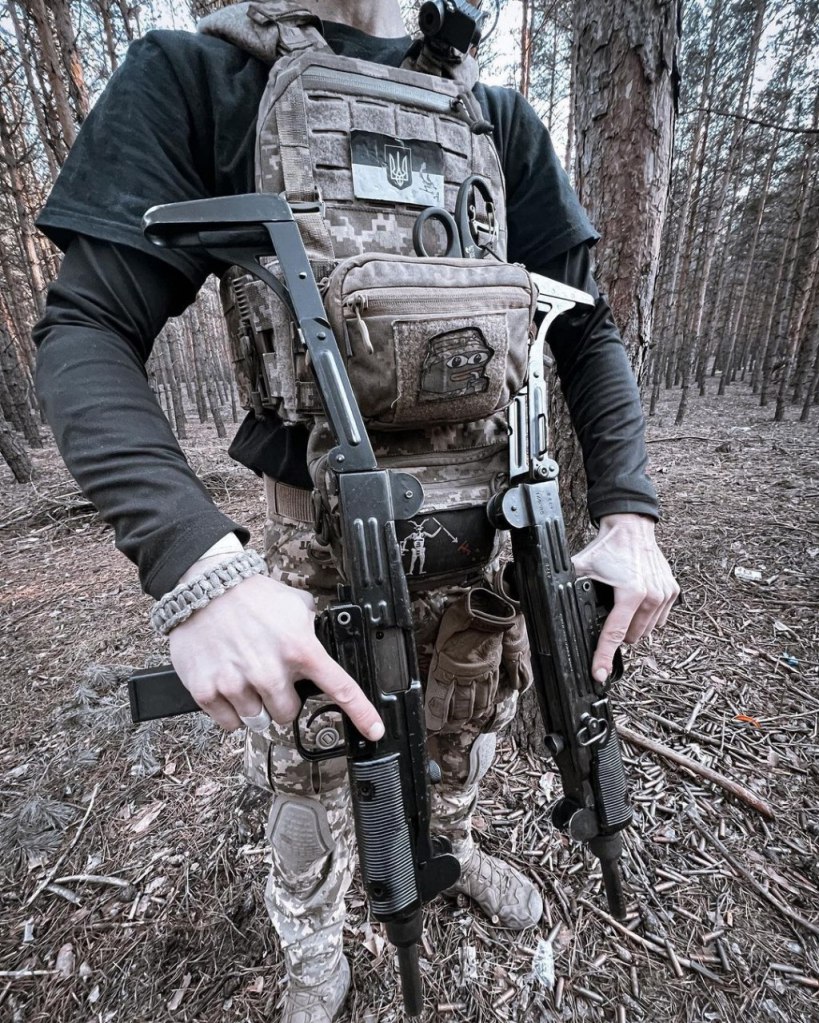
One of the earliest images of an Uzi in Ukraine appeared at the start of May 2022, with a Ukrainian combatant posing with an Uzi and a drone at what appears to be a range. 11 July, saw a group photo of International Legion members shared featuring one combatant holding an Uzi. Several days later on the 17 July a photo was shared of an international volunteer with an Uzi in the back of a vehicle. A month later a Ukrainian soldier was photographed holding a pair of Uzis.
A Ukrainian officer with the 93rd Mechanized Brigade holds a pair of Uzis (via social media)
On the 21 February 2023, a member of the Stugnabat unit, with the International Legion, shared a photo of a combatant with an Uzi. A Ukrainian infantry officer shared a video featuring himself firing two Uzis at one on 14 March. Subsequent photos shared online, seemingly taken at the same time, featuring the officer and the Uzis revealed he is with the 93rd Separate Mechanised Brigade. In early April another Ukrainian combatant shared a clip of himself on TikTok test firing an Uzi at an ad hoc range.
Research by OSINT researcher Ukraine Weapons Warfare has confirmed that at least three of the Uzis seen in Ukraine in early 2023 are of Belgian manufacture. Ukraine Weapons Warfare spoke to two Ukrainian combatants (those who had posted videos with Uzis) who confirmed that their guns had FN Herstal markings. FN Herstal acquired the license to manufacture the Uzi in 1958 with production of Belgian-made guns continuing into the early 1970s. As a result large numbers of Uzis purchased by European countries were made by FN, not IMI.
— 🇺🇦 Ukraine Weapons Warfare (@WeaponsWarfare) April 13, 2023
The Uzis haven’t appeared in any combat imagery and largely appear to be being used as personal defence weapons. They’re most often seen in photos from the range, away from the front line. Due to the iconic weapon’s notoriety they also appear to hold a novelty value for Ukrainian combatants.
Until we can get clear photos of markings or corroboration from users we can’t be certain if all of the Uzis in theatre were originally manufactured by FN Herstal. Similarly, it remains unclear which country or countries may have provided Uzis to Ukraine but we at least know that several of them were manufactured in Belgium.
Update – 13/12/23:
Members of #Ukraine's airborne forces with an Uzi submachine gun.
— Matthew Moss | Historical Firearms (@historicfirearm) November 21, 2024
Support Us: If you enjoyed this video and article please consider supporting our work here. We have some great perks available for Patreon Supporters – including early access to custom stickers and early access to videos! Thank you for your support!
Bibliography:
The UZI Submachine Gun, C. McNab (2011)
The UZI Submachine Gun Examined, D. Gaboury (2017)
The Russian A-545 is perhaps the rarest of assault rifles in use in Ukraine. Since Russia’s full-scale invasion last year there have only been a handful of sightings of the rifle which features an internal recoil mitigation system.
The A-545, also known as the 6P67 Kord, is the latest iteration of a long line of rifles which began development back in the late 1970s with the first iteration designated AEK-971, developed for Project Abakan.
The A-545 is a select-fire rifle with an ambidextrous selector with settings for safe, single shot, 2 round burst and fully-automatic. The rifle is gas-operated and uses a rotating bolt locking action coupled with the BARS recoil mitigation system. The rifle has a reported cyclic rate of 900 RPM.
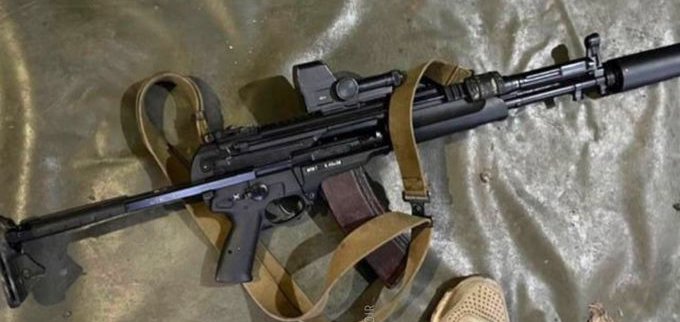
Russian troops with A-545 (via social media)
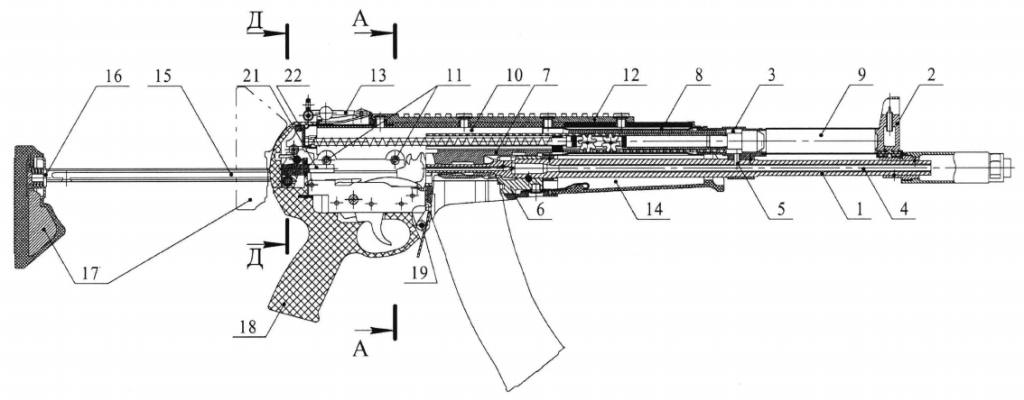
BARS (Balanced Automatic Recoil System) works by shifting mass towards the muzzle-end of the rifle to counter-balance the mass of the bolt and carrier moving towards the rear of the receiver. A pair of synchronised gears in a rack-and-pinion system move the counterweight forward during cycling, powered by the the movement of the bolt carrier as well as gas tapped from the barrel.
Designed by Stanislav Koksharov and developed at the ZiD/Degtyarev Plant in Kovrov. The A-545 development was completed in 2014, adding a new collapsing stock, new furniture and lengths of Picatinny rail. The rifle was tested during the Ratnik equipment trials in 2015 onwards which saw it tested against the AK-12 from Kalashnikov Concern.
The A-545 reportedly faired well in the trials but its more complicated action meant that the AK-12 was selected for wide scale issue while the A-545 was earmarked for elements of the Border Service, special forces, and the national guard (Rosgvardiya). Serial production of the rifles reportedly began in the summer 2020. There is also a 7.62x39mm chambered version, the A-762 or 6P68.
Patent drawing showing the internal layout of the A-545, note the pair of gears just ahead of the trunnion (Russian Patent)
Before the war the A-545 was also seen with the Rosgvardiya’s SOBR Rys, the VDV’s 45th Independent Guards Spetsnaz Brigade, the 810th Naval Infantry Brigade and elements of Russia’s Ministry of Internal Affairs (MVD),
Since Russia’s full-scale invasion of Ukraine last year it has been seen on just a handful of occasions.
Numerous photos have been posted by RAZVEDOS, a well-known Russian SOF veteran. On 9 April, RAZVEDOS posted a pair of photos featuring himself holding an A-545 along with a short ‘review’, reading:
“Reviews are positive, BUT! Firstly, “KORD” is much more complicated than AK, so it is hardly suitable for a simple soldier – and this applies not only to “conscripts”, because many “contract soldiers” left not far from them.Secondly, if we turn to the facts, i.e. to the test numbers, the combat characteristics of the “KORD”, although higher than those of the AK, are by no means head and shoulders above.“
Given the review is likely based on feedback from VDV Spetsnaz RAZVEDOS visited in April after the Battle of Hostomel the opinion could be based on battlefield experience.
The location these first photos were take is unclear. Several days later, on 13 April, RAZVEDOS shared several more photos featuring an A-545, which appears to be the same rifle, on top of a sleeping bag on a camp bed, in what appears to be a tent. This has frequently been cited as with VDV Spetsnaz at Hostomel (but the original post does not claim this). The rifle is fitted with a 1P87 red dot optic. A third photo, seemingly taken inside a tent, appears to be the same rifle fitted with the 1P87.
A-545 mounted with a 1P87 red-dot optic (via social media)
Late October saw the Russian Ministry of Defense share imagery of recently mobilised troops undergoing training led by an instructor with an A-545. In late December a photo seemingly taken on the back of a moving vehicle shows a A-545 fitted with a Holosun 403/503 red dot sight.
Most recently a photograph of an A-545 in a fighting position said to be in Ukraine was shared. The rifle is seen equipped with 45 round magazine, a suppressor and a Holosun 403/503. This is potentially the same rifle seen in December.
A-545 fitted with Holosun optic reportedly photographed in Ukraine (via social media)
Another question which is regularly asked is – have their been any sightings of the AN-94? The AN-94 was developed to meet the same requirements laid out by Project Abakan. It reportedly passed state trials and was adopted for service but its complex design means it is rarely seen. There haven’t yet been any confirmed sighting of the AN-94 in Ukraine or with troops training in Russia. If any of the rifles ever appear they’ll definitely be the subject of an article/video.
The A-545 is undoubtedly a more advanced weapon than the more common AK-12 but how many of the rifles are in service is unclear and the extent of their use in Ukraine remains unknown. In the past several months there have been a number of Russian news reports on the rifle including a feature length report from Zvezda and a shorter piece from HTB on production of the rifle. From the limited imagery available it would seem that they have seen some limited in theatre use while instructors back in Russia may also be using the rifles.
Update 17/04/23:
A pair of photos of A-545 in use with the VDV have been shared with TAB by nrxnb. The first photo was reportedly taken by a member of 175th Reconnaissance Battalion with the 76th Guards Air Assault Division (VDV). The 175th took part in the battle of Hostomel. The rifle has been fitted with an 1P87 red-dot optic and has a polymer magazine normally issued with AK-12s.
The second photo was said to have been taken in April, post Battle of Hostomel, by a member of the 45th Guards Spetsnaz Brigade (VDV). Again it appears to have been fitted with an 1P87 red-dot optic and a suppressor.
Update – 23/12/23: A Russian telegram channel shared a photograph of a 6P67 Kord which has been modified, with a rail cut into the handguard, to allow it to mount a grip and bipod.
The individual that modified the rifle provided the caption (machine translated):
“The body kit, of course, is not like that of those who posted it earlier, and there is literally no body kit for it on the market at all. Even the Picatinny rail had to be cut into the standard forend using a small drill, straight arms and such and such a mother. Alpha Arms can, Magpul belt, Magpul fire transfer handle, Atlas bipod, Vortex Viper pen and Vector Optics collimator. Overall, the machine is excellent, there are pros and cons.”
A new photo of an A-545, also known as the 6P67 Kord, which has been modded by adding a cut in 6 o'clock rail on the hand guard to mount a vertical front grip & a bipod.
— Matthew Moss | Historical Firearms (@historicfirearm) December 23, 2023
Update – 9/10/24: A recent image of an A-545 shared by Russian suppressor company Hexagon Tactical. Reportedly shared with them by the rifles user who has equipped the weapon with one of their 5.45mm suppressors. The optic appears to be a ThermTech VIDAR 2.0.
One I forgot to share, a recent sighting of a Russian A-545 fitted with Hexagon's 5.45 suppressor (20,000 of which have reportedly been shipped to the front).
A photo of a Russian serviceman armed with an A-545, claimed to have been taken somewhere in Donbass was recently shared online, but it’s unclear when the photo was taken.
Specifications (via Rosoboronexport)
Calibre
5.45x39mm
Weight (unloaded)
3.5kg (7.3lbs)
Stock Collapsed
720mm (28in)
Stock Extended
960mm (38in)
Maximum Range
800m
Feed
30 round magazine
Cyclic Rate
900 RPM
Support Us: If you enjoyed this video and article please consider supporting our work here. We have some great perks available for Patreon Supporters – including early access to custom stickers and early access to videos! Thank you for your support!
Bibliography:
Military Acceptance “Balanced Avtomat”, 12 Feb. 2023, Zvezda Live, (source)
6P67/6P67-1 KORD Assault Rifle, Rosoboronexport, (source)
Automatic Small Arms with Balanced Automatics, Russian Patent #2482417, (source)
BREAKING: Russian Army Accepts Both AK-12 And AEK-971, TFB, (source)
The Russian Balanced-Action A545 Rifle In Action, TFB, (source)
Meeting Government Orders: Unusually Designed Russian Rifles, M. Popenker, SADJ, (source)
6P68/6P68-1 KORD Assault Rifle, Rosoboronexport, (source)
Serial Production of An Assault Rifle, a Competitor to the AK-12, Has Started in Russia, 1 Jul. 2020, RIA, (source)
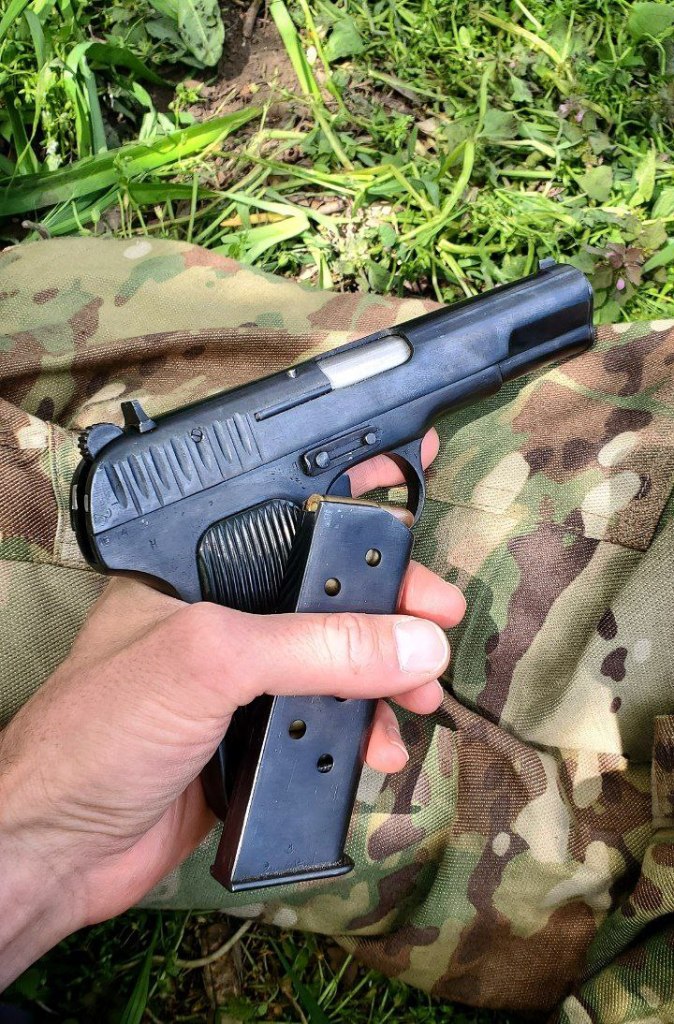
The fighting in Ukraine has seen a wide range of small arms in use ranging from the cutting edge to the antique. We’ve seen a number of older weapons like Mosin-Nagant rifles, M1910 Maxim machine guns and DP light machine guns in service with both sides. [We’ll take a look at those in future videso] The TT-33 pistol, a pistol which first entered service 90 years ago, is another older weapon which is again seeing action. The examples seen in theatre are likely a mix of privately owned firearms and pistols drawn from Ukrainian stores.
Introduced in the mid-1930s to replace the 1895 Nagant revolver, over a million TTs have been produced. Designed by Fedor Tokarev the pistol became the Soviet Union’s primary side arm, seeing service during the Second World War alongside the Nagant.
The TT-33 is a semi-automatic pistol, chambered in 7.62×25mm. It feeds from an 8 round single stack magazine and uses John Browning’s short recoil tilting-barrel action. The TT is an extremely robust pistol and remained in service well into the 1950s with the Red Army and continues in service around the world even today.
A photo of a TT-33 shared by the TDF’s 127th Kharkiv Brigade (via social media)
Pistol use in general in the current conflict doesn’t appear to be prolific but a considerable number of combatants are frequently seen carrying side arms. Everything from Makarovs and Stetchkins to more modern Glocks and Ukrainian Fort handguns. Pistols are often carried by soldiers working in roles which frequently see them separated from their service rifle and by those who prefer to carry a secondary weapon.
While we’ve seen TT-33s in the hands of Russian and Ukrainian separatist troops in this video we’ll largely focus on Ukrainian use. At the fall of the Soviet Union a considerable amount of surplus small arms fell under Ukraine’s control, including substantial numbers of TT pistols. While not general issue it has been in service with the Ukrainian Army, National Guard and the Border Guard Service. This video definitely isn’t an exhaustive survey of TT use in Ukraine but lets take a look at some examples:
At the start of April 2022 the training department of the command headquarters of the Ukrainian Territorial Defense Forces have published a number of high quality videos showing how to disassemble and clean the TT.
The Ukrainian YouTube channel, Boys from the Forest (ХЛОПЦІ З ЛІСУ) shared a video looking at the TT in May 2022. They concluded their video by shooting a block of explosive reactive armour with the pistol – to no effect. In June Alina Mykhailova, a medic with 1st separate mechanised battalion “Da Vinci Wolves” shared a photo of some firearms used by the unit, including amongst other things – a TT pistol.
A photo of a TT-33 shared by an International Legion volunteer (via social media)
In around August some members of a TDF unit posed with a Nestor Makhno banner and a DP light machine gun and a TT-33 pistol. A Russian news report from around Soledar, published on 5 August, featured an interview with a soldier carrying a TT in a front pouch of his load bearing equipment. On the 12 August a Ukrainian operator shared a couple of photos of his side arm, a 1945-dated, Izhevsk manufactured TT-33 with wooden grips. Date and location they were taken wasn’t shared.
In an interesting video posted around the 25 August, a TT-33 is used to test some captured Russian steel plate. Yurii Kochevenko, an officer of the 95th Air Assault Brigade, shoots a one of the plates point black with TT he carries in a webbing holster. The 7.62x25mm round doesn’t cleanly penetrate the plate but appears to impart enough force to crack the metal.
At the end of November the Military Institute at the National University in Kyiv shared photos of cadets taking part in a shooting championship using TT pistols.
On 30 December, the 247th Separate Battalion of the TDF’s 127th Kharkiv Brigade shared a photo of Vitaly, a member of the battalion, armed with an AK-74 and on his plate carrier he has a TT in a Cytac holster. These tactical holsters for the 90 year old pistol retail for around 780 Hryvnia. On the same day Ukrainian personnel shared an update video from their position in Bakhmut, one of them is carrying a TT on his plate carrier.
A TDF officer, call sign Witch, has been seen numerous times carrying a TT-33 as her sidearm. Videos posted to her TikTok on 24 December and 12 January show it in a holster on her plate carrier, with a coil lanyard fitted. A video shared by the TDF Public Relations Service on 19 February also gives us a good look at the TT carried by Witch.
Ukrainian marksman position with a rotary grenade launcher, a UAR-10 and a TT pistol (via social media)
On 26 February 2023, the TDF’s 127th Kharkiv Brigade shared a gallery of photographs featuring the TT on their instagram page. The caption notes that: “Despite the fact that this pistol was actively used even during the Second World War, it is simple in design, reliable in operation, small in size, comfortable to carry and always ready to defeat the Russian invaders.”
A Ukrainian special operations unit shared a photo of a member of the unit sat beside a Russian prisoner while holding two TT-33 pistols, one in its original finish and the other was a camouflage paint job. Most recently at the start of March a Ukrainian marksman active around Bakhmut shared a photo of his position with a rotary grenade launcher, a UAR-10 and a TT pistol.
In addition to the original TT-33s seen in theatre there are also a significant number of former-Yugoslavian M57s which while externally very similar have some improvements, including a slightly longer grip that allows the magazine to hold an extra round.
Update – 25/6/2024:
A member of the Ukrainian 117th Territorial Defense Brigade, May 2024, using a TT-pattern pistol at the range.
— Matthew Moss | Historical Firearms (@historicfirearm) June 25, 2024
Support Us: If you enjoyed this video and article please consider supporting our work here. We have some great perks available for Patreon Supporters – including early access to custom stickers and early access to videos! Thank you for your support!
Bibliography:
The Procedure for Partial Disassembly and Assembly of a TT pistol, TDF, (source)
Rules for cleaning and lubricating weapons on the example of a TT pistol, TDF, (source)











 The Armourers Bench