Hands On with Beretta’s New NARP

The NARP or ‘New Assault Rifle Platform’ project began back in 2018, seeking to meet the key requirements of Italy’s special forces. While their were several delays to development due to the COVID-19 pandemic the rifle has been tested and iterated over the last couple of years. In September 2023, Beretta unveiled their next generation combat rifle to the public. I had the pleasure of speaking with Andrea Candian, Beretta’s Defense and Law Enforcement Product Director. He explained the ethos behind the rifle’s development noting that the NARP project will create a family of combat rifles. Beretta were keen to stress that NARP isn’t actually the rifles’ name, but rather the overarching project to develop the new combat rifles. Mr Candian explained that the rifles themselves will likely have alpha-numeric designations once they’re introduced.

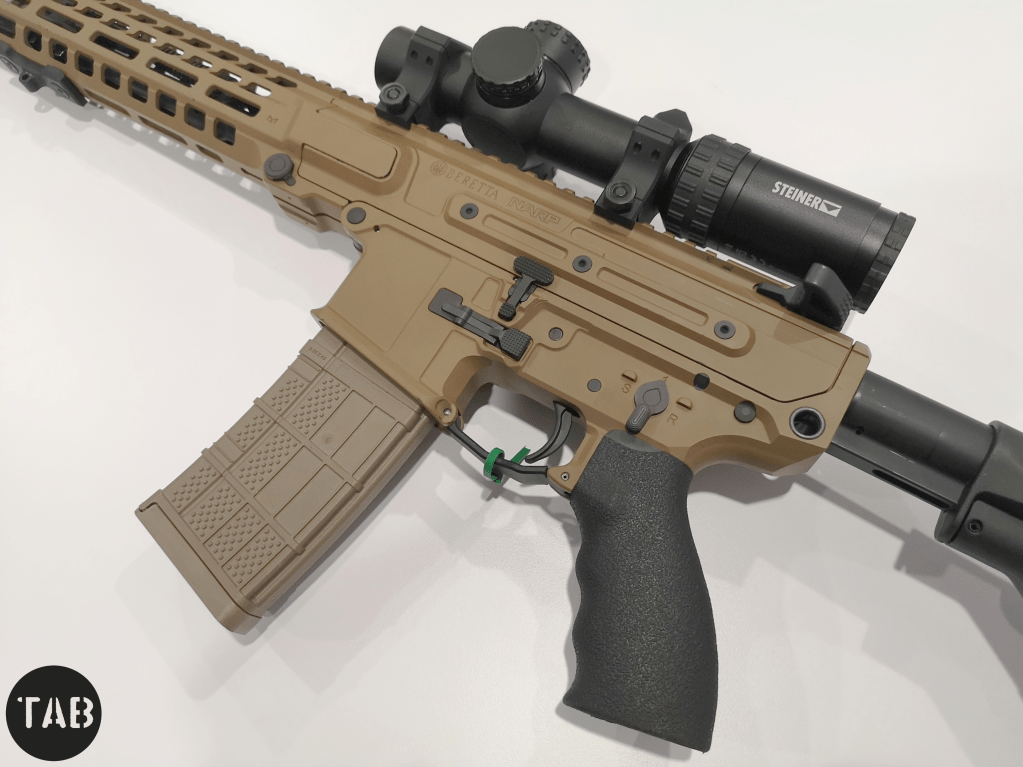
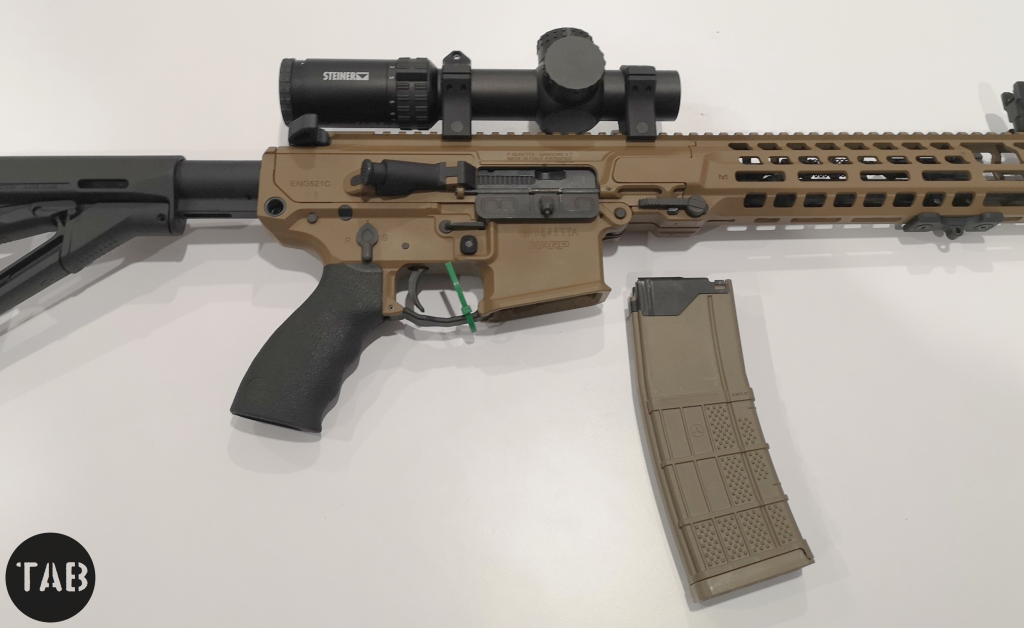
Beretta NARP (Matthew Moss)

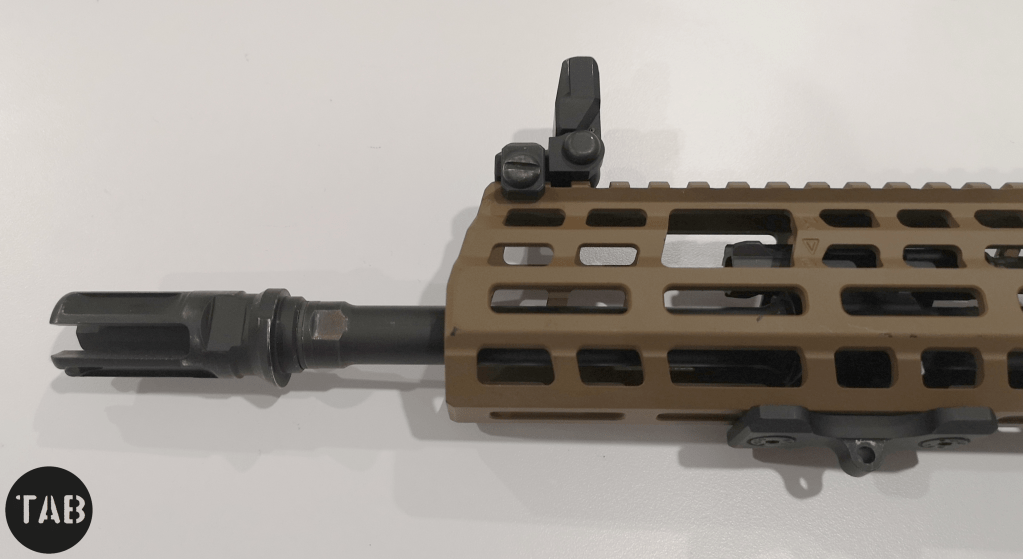
Working with Italian special forces and other members of the special forces community Beretta identified five key considerations: lethality, ergonomics, reliability, modularity and signature reduction. Mr Candian explained that Beretta systematically analysed and tested various options for each of the rifles features, selecting the ones which optimised one or more of the key considerations. One example of this is the development of a proprietary 3-prong muzzle device which reduces the weapon’s flash signature and similarly the incorporation of a Cerakote finish designed to reduce the IR signature of the weapon. Beretta also noted that they have developed their own 3D printed Inconel B-Silent suppressors which will pair with the NARP program rifles. The rifle also features either a single or a two-stage trigger – the trigger of the rifle on display at SHOT Show was impressive with a notably short take up and a crisp break.

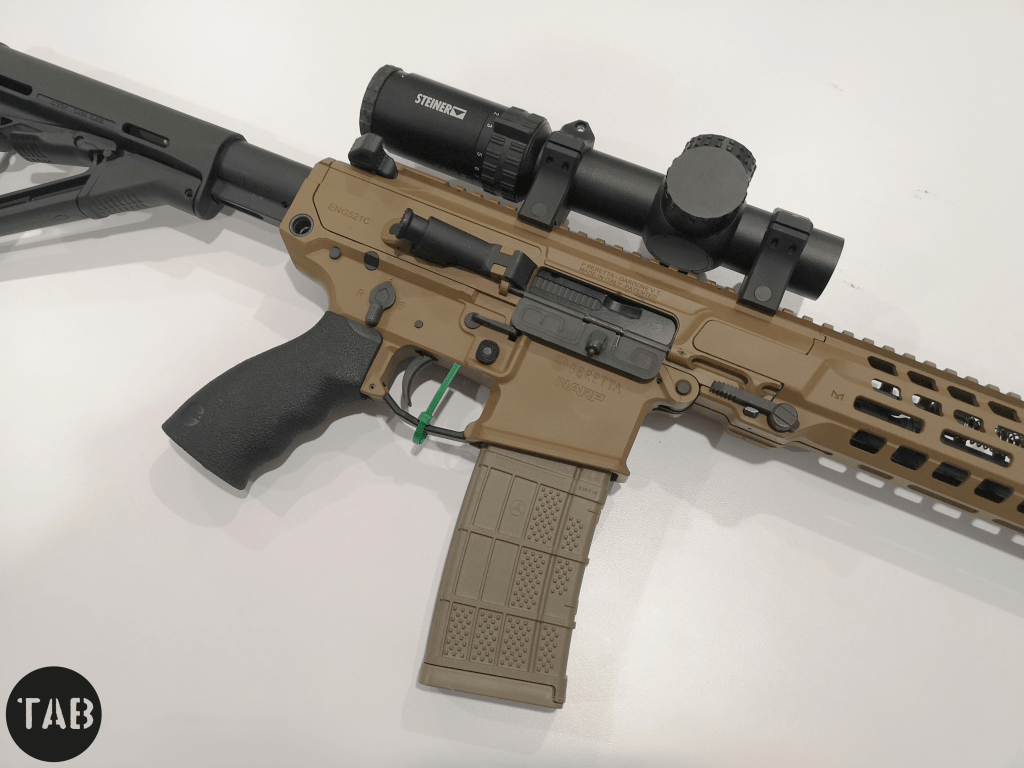
Beretta NARP (Matthew Moss)

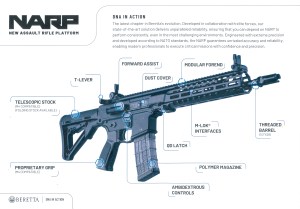
The rifle’s controls are full ambidextrous and also symmetrically positioned on both sides of the receiver. NARP’s 5.56mm incarnation will be available in 11,5″, 14,5″ (which was the configuration I examined at SHOT Show) and 16″ barrel configurations. In a departure from Beretta’s current ARX-160’s use of polymer both the upper and lower receivers are made from Aluminum. It weighs around 3.2-3.3kg (around 7lbs) and has a quick detachable forend, actuated by a single latch on the right-hand side, with a 12 o’clock rail and MLOK interfaces. Unlike the AR-15, the rifle’s recoil spring is in the upper receiver which allows a full range of buttstocks to be fitted, including an adjustable folding stock developed by Beretta themselves. Since its unveiling the rifle has been seen paired with both Lancer L5AWM translucent magazines and Magpul PMAGs.

The weapon uses a short-stroke gas system with a 2-position (normal and suppressed) adjustable gas port and has what Beretta described as a prismatic bolt carrier with a rotating bolt, this reportedly minimises vibration and reduces fouling issues. For ease of cleaning the handguard can be removed and the gas system stripped in a matter of seconds and the captive bolt group can be removed from the rear of the upper receiver without having to remove the T-lever charging handle.

Beretta NARP (Matthew Moss)

The initial configuration of the NARP program to be unveiled was unsurprisingly a 5.56x45mm-chambered rifle with various barrel length offerings but Mr Candian emphasised that it is not an AR-15 pattern rifle, though given the ubiquity of the AR-15, the new rifle does borrow features from the familiar platform. This, Beretta says, was a conscious decision to take advantage of widespread user familiarisation with an established and proven platform. In the future Beretta plan more chamberings including .300 Blackout and 6.5 Grendel and a larger calibre version chambering 6.5 Creedmoor, 7.62x51mm and the NGSW’s 6.8mm is in development.

Beretta NARP (Matthew Moss)

Development and testing was rigorously shaped to fulfil and exceed NATO’s D14 Handbook on Evaluation Procedures for Future NATO Small Arms Weapon Systems. Beretta say that with standard issue SS109 5.56x45mm ammunition they are achieving accuracy close to that of a designated marksman’s rifle. But as the rifle has been developed for military tenders they could not give any specific data on this.

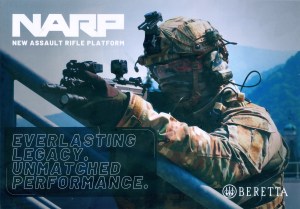
Beretta’s brochure for the NARP:

Mr Candian noted that tweaks are still being made to the rifle based on feedback from testing with special forces personnel and that the receiver’s profile will have some small changes made. There is also room for the possibility of customer-driven features such as a left-side charging handle, a selector with a burst function and different hand guard lengths, muzzle devices and barrel lengths.

Beretta NARP (Matthew Moss)

With a number of European nations expected to begin seeking replacements for their current service rifles in the near future Beretta are making a concerted effort to revamp their military offerings and are positioning themselves to compete with other major players within the small arms sector.

This article was adapted from a piece originally published at TFB. Be sure to check out my friend James’ TFBTV video for another look at Beretta’s NARP with some additional input from Beretta representatives.


Support Us: If you enjoyed this video and article please consider supporting our work here. We have some great perks available for Patreon Supporters – including early access to custom stickers and early access to videos! Thank you for your support!


Russia’s Rare RPG-16 in Ukraine

One of the rarer Russian anti-armour weapons to surface during the ongoing war in Ukraine is the RPG-16. The RPG-7’s big brother was developed in the late 1960s and entered service in the early 1970s. It was predominantly developed for Russia’s airborne forces, the VDV, but also saw issue to Spetsnaz units.

The RPG-16 is characterised by its larger diameter tube which can fire a 58mm (2.3 inch) PG-16 rocket-propelled grenade. Unlike the RPG-7s munitions the PG-16 slides flush inside the launcher, while this limits the volume and types of warhead the RPG-16’s ammunition can carry it provides improved accuracy and slightly increased range. The PG-16 is a fin-stabilised high explosive anti-tank (HEAT) round with a rocket booster which propels it at a maximum velocity of 350 metres per second. The rocket weighs around 2.1kgs and has a maximum range of 800 metres, though practical engagement range of vehicles is closer to 300 metres. It can penetrate up to 300mm (12 inch) of rolled homogenous armour.

An RPG-16 seen in a Russian news report, June 2023 (Russia 1)

The RPG-16 can only fire the PG-16 round and following its adoption in the early 1970s it has been surpassed by other anti-armour weapons which have entered Russian service and by the development of more capable PG-7 series warheads. The launcher weighs 12.4 kg (27 lbs) [compared to the 7 kg (15.4 lb) of the RPG-7] when loaded and is 110cm (43.5 in) long but can be broken down into two parts: the rear tube with venturi and the forward tube and fire control group. Unlike the smaller RPG-7 it has a bipod near the muzzle and a grip area on the fire control group, it does not have a second, rear pistol grip.

A reported 120,000 were produced with manufacture continuing into the late 1980s. It had been thought that the RPG-16 went out of Russian service in the early 2000s but evidently some have been drawn from stores and have been used in Ukraine. The RPG-16 was reportedly used against fixed positions during the Soviet war in Afghanistan and may now be pressed into the same role in Ukraine.

It appears from available imagery that the RPG-16 began to be issued in early 2023. Early March 2023 saw Russian state-news outlet RIA shared a report featuring combatants of the 76th Guards Air Assault Division firing small arms and RPGs in woodland. One of the RPGs fired was an RPG-16.

Russian combatant firing an RPG-16, December 2023 (via social media)

In late April, stills from a video of troops said to be with the 98th Guards Airborne Division featured an RPG-16 being fired near Dibrova were shared. I’ve been unable to find the original footage. In June, one of the launchers appeared in a Russia-1 news report featuring Russian forces near Avdiivka, Donetsk Oblast.

On 26 November, a Russian combatant shared a photograph of an RPG-7 and an RPG-16 next to one another, reportedly taken in a depot or armoury. Two days later on 28 November a short clip of marines from the Russian 40th Naval Infantry Brigade was shared showing an RPG-16 in action, location unknown, possibly near Pavlivka.

A week later, on 3 December a video featuring a pair of Russian combatants from the Otvazhnye (Brave) Group, firing an RPG-7 and an RPG-16 was posted on telegram. The footage was probably filmed in near Kreminna where the unit was reportedly active.

Russian combatant poses with an RPG-16 and AK-12, January 2024 (via social media)

On 13 December, a mobilized Russian combatant shared a post on Telegram describing his experiences at the front. He mentions that due to a lack of infantry anti-armour weapons with sufficient range to reach Ukrainian AFVs standing off and firing on their positions his unit began issuing RPG-16s. In late January, two photographs of Russian troops in a trench, location unknown, posed with an RPG-16, and some unrelated RPG-7 munitions.

From the limited imagery available it seems that the RPG-16s have been again issued to largely airborne units, however they have also been seen with Russia’s naval infantry. Exactly why the RPG-16 has returned to service is unclear, as by one Russian combatant suggested, it may be that the greater range offered by the RPG-16 enables engagement of distant targets, another potential reason might be Russia’s desire to use up existing reserve stocks of munitions.


Support Us: If you enjoyed this video and article please consider supporting our work here. We have some great perks available for Patreon Supporters – including early access to custom stickers and early access to videos! Thank you for your support!

Specifications:

Calibre: 58.3 mm
Length:
– Assembled: 1,104 mm
– Disassembled: 645 mm
Weight:
– Unloaded with optical sight: 10.3kg
– Loaded: 12.4kg
Velocity:
– Initial: 130 m/s
– Maximum: 350 m/s
Effective range: 800 m
Armour Penetration: +300 mm

Bibliography:

Jane’s Infantry Weapons 2014-15, R.D. Jones & L.S. Ness (2014)

58mm PG-16 Rocket, CAT-UXO, (source)

RPG-16 Udar Russian Rocket-Propelled Grenade Launcher, US Army, (source)

Airborne choice: Soviet RPG-16 in Afghanistan, Safar Publishing, (source)


Ukraine’s ASRAAM-Supacat Franken-SAM

Earlier this week a short video featuring an ASRAAM-Supacat ‘Franken-SAM’ surfaced online. Early on 8 February, Ukrainian Telegram channels began sharing a video pulled from TikTok, which is likely the first daylight footage of one of the UK-developed and supplied ad-hoc air defence systems.

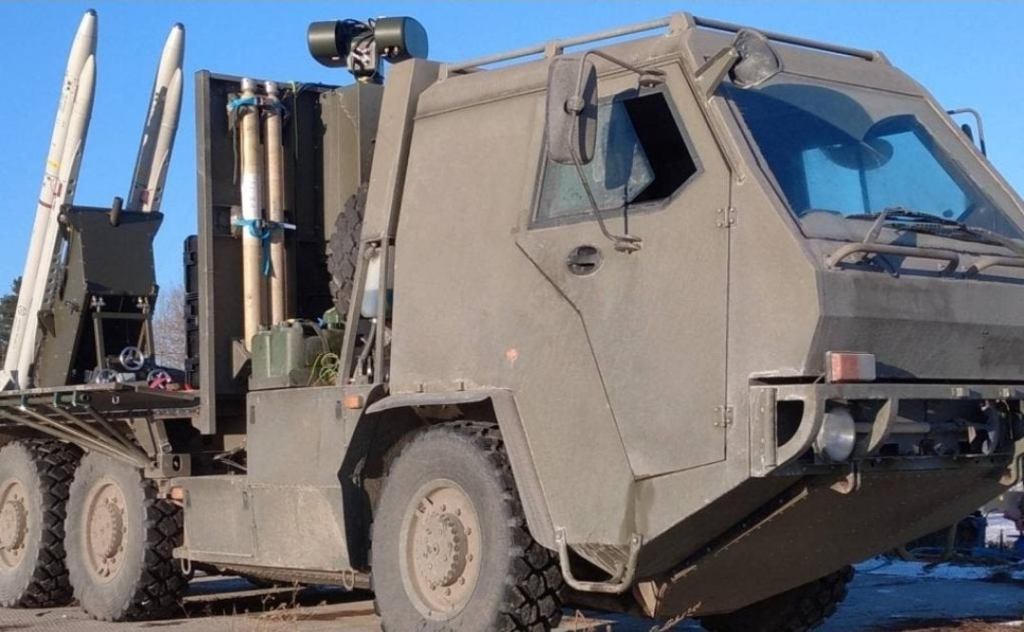
The system can be seen parked by the side of a road and was filmed (original source now private) from a passing vehicle. The date and location the video was filmed is unknown. The launcher appears to have two AIM-132 Advanced Short-Range Air-to-Air Missiles (ASRAAM) loaded with the launcher ramp raised in the ready position. It is difficult to make out but the cab has seemingly been fitted with a protective screen to guard against drone attack. Also visible is what appears to be a sensor turret mounted behind the cab, this is possibly an electro-optical/infrared sensor used for targeting.

Still from recently posted footage of an ASRAAM Franken-SAM in Ukraine, 8 Feb. 2024 (via social media)

The UK-developed system is one of several so-called Franken-SAMs produced by Ukraine’s allies. They are part of an effort to affordably and quickly bolster Ukraine’s air defences. In October 2023 a pair of videos shared by the Ukrainian air force gave a glimpse of the system in action. The both filmed at night shows a launch but the vehicle is not visible. The second, shared on 12 October, by Ukraine’s Air Command – South shows the successful engagement of a Russian long range loitering munition. As the darkness is lit up by the missile launch, the Supacat 6×6 High Mobility Transporter is briefly visible.

The AIM-132 missiles and the vehicles launching them were provided by the UK in the summer of 2023. ASRAAM uses infrared homing and can lock onto its target after launch. It has an air-launched range of more than 25km but this is likely shorter when used in a ground launched role. The system may be used in conjunction with radar systems which feeds target data to the missile. A key feature of the ASRAAM is its ability to lock-on after launch, theoretically allowing it to be vectored onto a target in the air before it begins IR homing.

A photo dating from August 2023 of a Supacat High Mobility Vehicle mounted with a pair of MBDA UK ASRAAMs (Ukrainian Ministry of Defence)

The system, however, isn’t ideal with limited ready-to-fire capacity on the launcher ramp, with just two rails, and no protection for the missiles themselves, from either the elements or from potential fragmentation or impact damage if attacked. The ad-hoc air defence system first saw action in Ukraine in August 2023, and represents an ingenious improvisation utilising a highly capable missile in an air defence role it was never envisaged in. In December 2023 UK Ministry of Defence summarised their development:

“In summer 2022, a joint MoD-MBDA team developed air defence systems to fire ASRAAM from the ground for the first time. Within four months of initiating the surface launched ASRAAM project, these air defence systems were developed, manufactured, trialled and Ukrainian crews trained on their usage, on UK soil, before being transferred into Ukrainian hands.”

It is unclear how many of the systems have been assembled but in late 2023, it was reported that the UK had supplied “a handful” of the missile-equipped Supacat trucks. They were believed to be in use in near the front and in the Kyiv region, defending key infrastructure, against Shahed-136/Geran-2 long-range loitering munition attacks.

In December 2023, the UK Ministry of Defence announced that a further 200 ASRAAMs would be provided to Ukraine and that the systems in-country had achieved a “successful hit rate reported as high as 90% against some Russian air targets.”

This article originally appeared at OvertDefense.com

Update 16/04/24:

Short video showing a close up and launch of what appears to be an ASRAAM missile. Posted on Telegram on 14 April.

Update 16/09/24:

A brief video showing a launch of a missile from the HMT-mounted ASRAAM air defence system.


Support Us: If you enjoyed this video and article please consider supporting our work here. We have some great perks available for Patreon Supporters – including early access to custom stickers and early access to videos! Thank you for your support!


Ohio Ordnance Works – REAPR

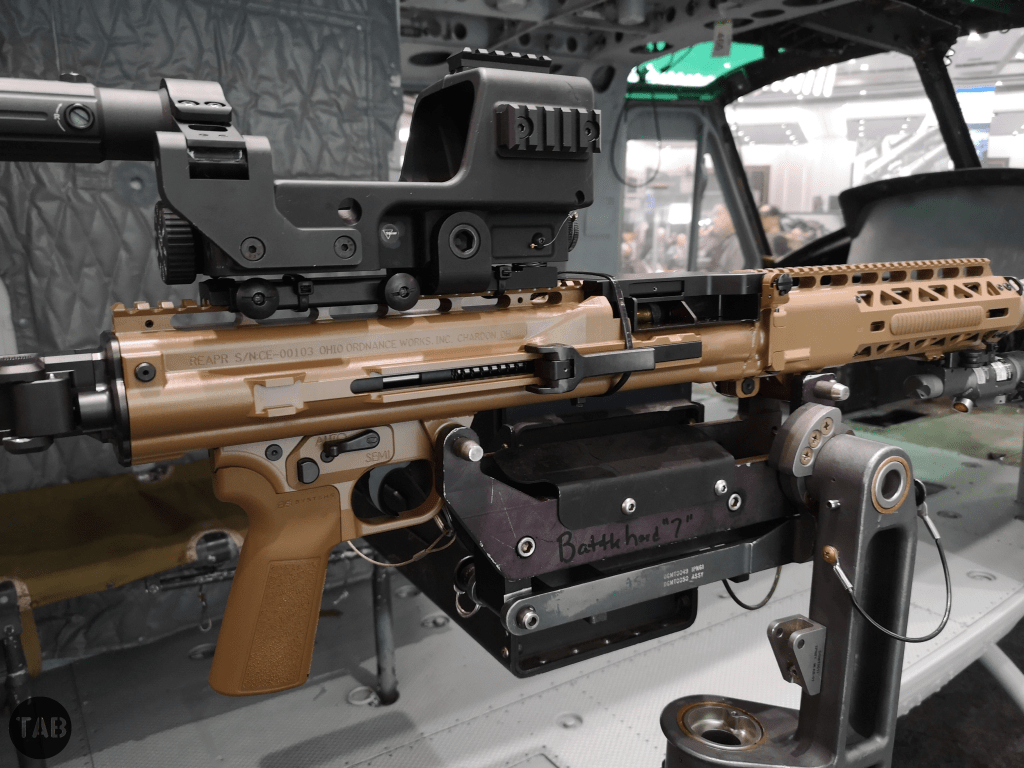
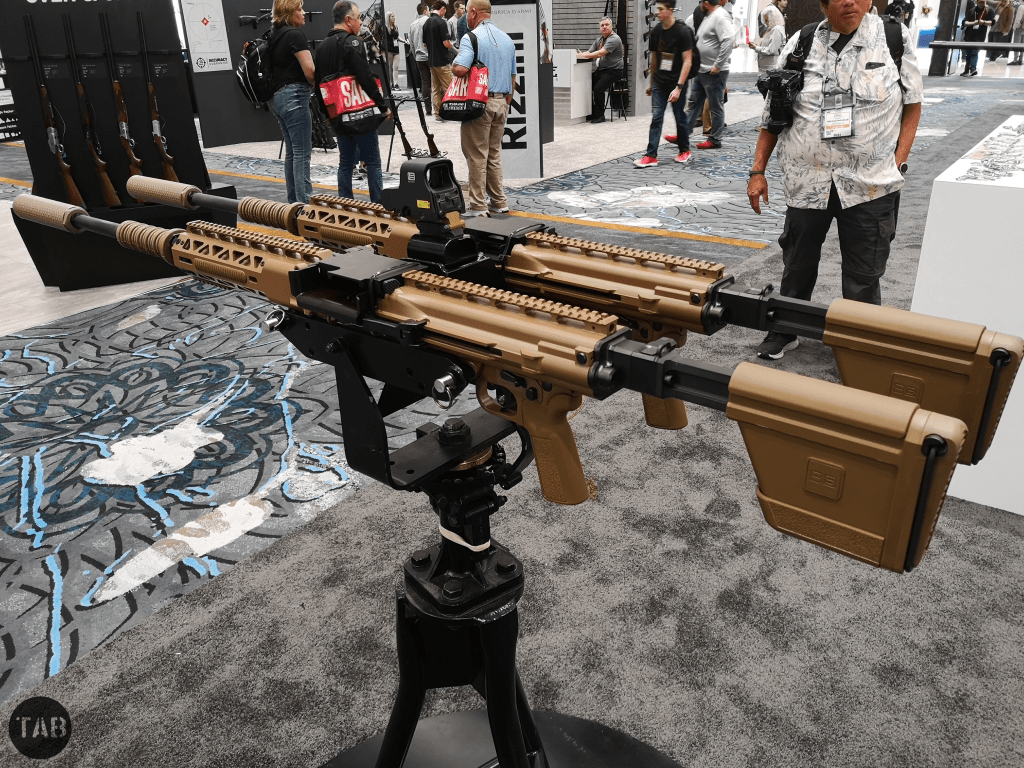
At SHOT Show in 2022, Ohio Ordnance Works teased their new .338 light weight medium machine gun, keeping the gun’s key features hidden under strategically placed scrim. This year the REAPR was unveiled for all to see. The REAPR or Recoil Enhanced Automatic Rifle is chambered in .338 Norma Magnum and can also be calibre converted to 7.62x51mm.

The gun was developed by Ohio Ordnance Works (OOW) in response to solicitations from the US SOCOM and US Marine Corps for a Lightweight Medium Machine Gun in .338NM. The niche requirement for a .338 gun dates back to at least 2012 with the first Sources Sought Solicitation being launched in May 2017. The solicitation requested:

The LWMMG should fire the belted .338NM round of ammunition with a polymer case. The LWMMG should weigh less than 24 pounds unloaded with a barrel length of 24in. The LWMMG should have a rate of fire of between 500-600 rounds per minute. Weapon shall be compatible with current rail mounted aiming systems with the ability to incorporate more advanced fire control technology. The system should include both a suppressed barrel and an unsuppressed barrel that can be rapidly changed. The LWMMG should include a tripod that is lightweight and provides the stability and accuracy required to engage targets at extreme ranges. The LWMMG should be able to mount in current machine gun mounts designed for the M240B/C. The weapon should have sufficient accuracy to engage area targets and vehicles at 2,000m.

General Dynamics led the field developing their .338 machine gun but this design was later divested to True Velocity and since then SIG Sauer have also developed their MG338/SL MAG. The 2017 solicitation is now inactive, however, in 2021 SOCOM (via PEO SOF Warrior, PM Lethality) began seeking an ‘LMG-M’. LMG-M project seeks a gun that can engage targets out to 2,500m and has a similar weight and form factor to an M240B. A contract had been hoped to be awarded by the end of 2022, however, this slipped back to 2025 and now likely 2026.

The aim of .338 machine guns is to fill the gap between the 7.62mm GPMG and the .50 HMG while providing a dismounted, lighter weight platform that can give the performance of a .50 calibre machine gun.

OOW began work on their gun in 2020 with numerous patents granted on its features. The REAPR is a select-fire weapon with ambidextrous controls on either side of the pistol grip assembly as well as a traditional cross-bolt safety. The pistol grip itself can be swapped out for any AR-15/M16 compatible grip. Robert W. Landies, OOW’s president and one of the designers of the gun, told me that with REAPR they addressed a lot of the pet peeves they had with legacy machine guns designs and that they “took a lot of features and amalgamated the best of them” when designing the weapon. Intriguingly, the gun uses a roller delayed operating system, similar to that of the MG45, this means the opening of the action is slowed by rollers but does not fully lock. Post-Second World War Two this system had some influence on a range of designs including the SIG MG 710-3 and a host of Heckler & Koch weapons. The gun uses a pair of springs on dual guide rods and has a 600 rpm rate of fire. The weapon can be field stripped without tools. To remove the action a pin at the rear is removed which allows the butt stock and rear of the receiver to be removed with the springs, guide rods and bolt sliding out of the receiver.

It has a side folding stock, designed in house with B5, with a shoulder rest and an adjustable cheek riser. B5 also provided the REAPR’s P23 Grip and MLOK rail covers. According to OOW the REAPR weighs in a 26.8lbs and has an overall length of 51.7in (131cm) when the stock is collapsed, 54.5in (138cm) when deployed and 44in (112cm) when folded (it can fold either to the left or right). For use when mounted on vehicles or aircraft the stock can be removed and a spade grip kit can be fitted. There is also a rail mounted removeable carrying handle.

A key feature is the gun’s barrel quick change system, this can be done with one hand by the operator. The change can also be done with the bolt either in the forward or rear position. The patented system uses 2 opposing groups of 5 interrupted threads, this allows the barrel to be released with just a 90-degree turn. To remove the barrel the operator grasps the barrel cover, pushes the barrel rearward, towards the receiver, and then turns the barrel 90-degrees to disengage it. The REAPR can be mounted with a suppressor, it has been seen paired with cans from a number of different manufacturers.

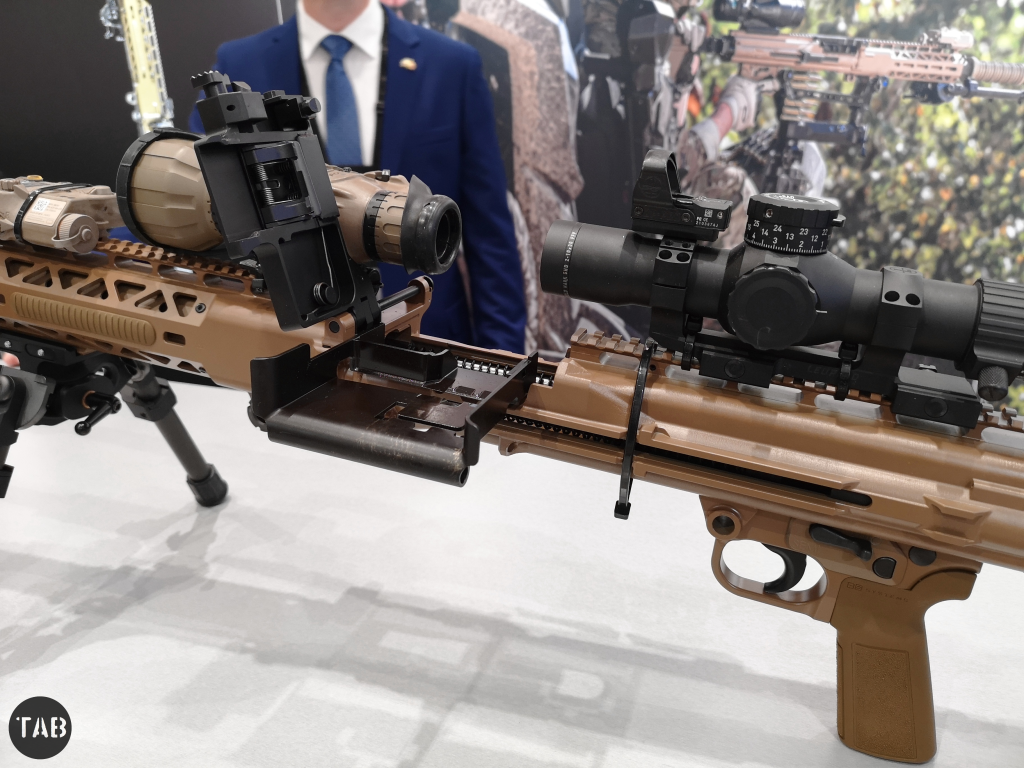
Another feature is that the entire system can be broken down into 3 pieces within 10-20 seconds. It can be packed away with the barrel at 24.5in (61cm) being the longest component. The REAPR has a one-piece steel receiver and an aluminium hand guard with MLOK slots, which can be removed via a pair of catches. The gun also has MIL-standard mounting points for either tripod or pintle mounting. Another key, patented, feature is the gun’s feed tray which can slide out to the side of the gun for loading and clearing, this allows the operator to use optics with a larger continuous footprint. SIG Sauer addressed this issue by having a cover which hinges to the side. The REAPR’s direction of feed can be flipped either left or right and ejection is through the bottom of the receiver. OOW note that the gun has a mounting interface for an ammunition pouch on the left side of the receiver but are considering adding one to the right side but are waiting on feedback from users.

OOW say that the REAPR is currently available for ordering in test quantities but full volume production is set to begin in April 2024. The REAPR seems to be a very competent, well thought out design with a lot of promise. It will be interesting to see how the LMG-M programme progresses.


Support Us: If you enjoyed this video and article please consider supporting our work here. We have some great perks available for Patreon Supporters – including early access to custom stickers and early access to videos! Thank you for your support!


Bibliography:

‘Firearm top cover with multiple degrees of freedom of motion’, US Patent #11268774B1, (source)

‘Quick-change barrel for a firearm’, US Patent #11598600B2, (source)

[FULL BREAKDOWN] Ohio Ordnance REAPR .338 NM Belt-Fed Machine Gun, OOW, (source)

Lightweight Medium Machinegun (LWMMG), SAM.gov, (source)

USSOCOM Small Arms Update 2021, SSD, (source)

SOFIC 22 – USSOCOM Weapons Update, SSD, (source)

SOF Week 23 – USSOCOM Weapons Update, SSD, (source)

Full Circle: A Treatise on Roller Locking, R. Blake Stevens (2006)

Vintage Weapons In a Modern War: Swedish K in Ukraine

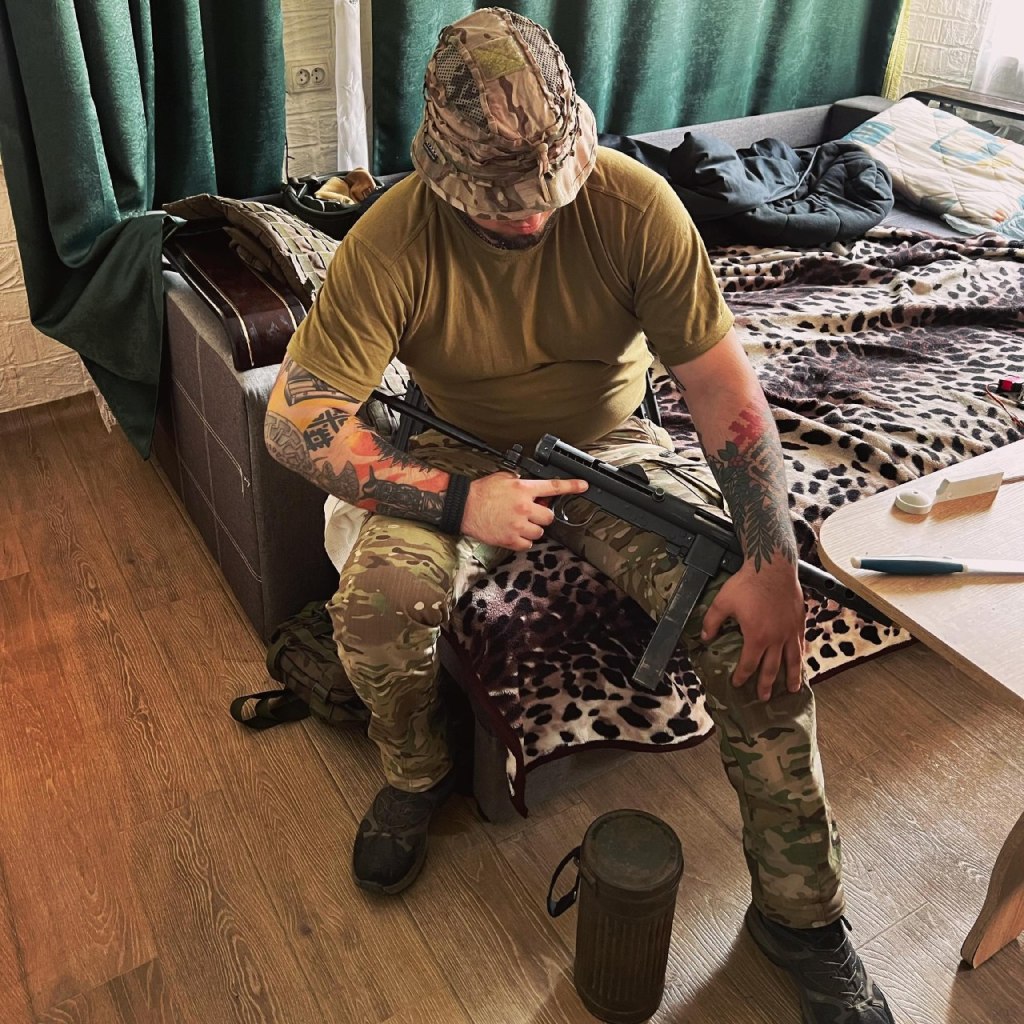
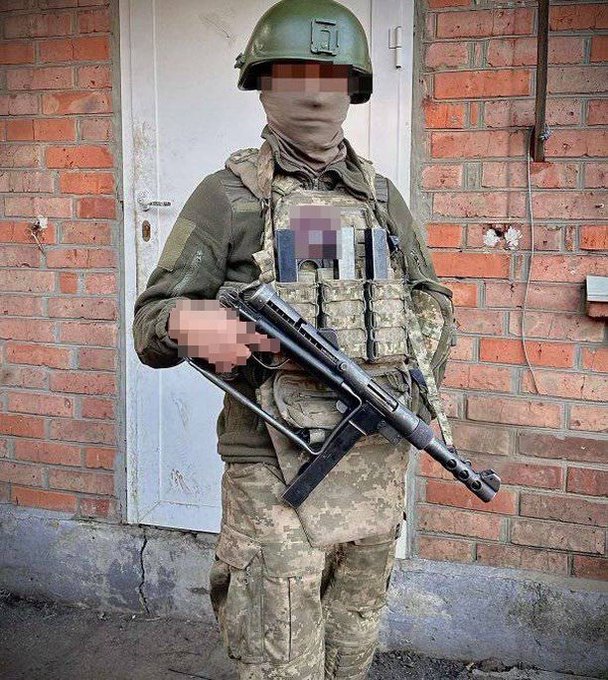
The war in Ukraine has seen a plethora of vintage weaponry being used by both sides. Everything from M1910 Maxims to TT pistols. One of the more surprising vintage weapons to turn up is the classic ‘Sweden K’. The Kulsprutepistol m/45 (Kpist m/45) perhaps better known as the Carl Gustaf M/45 has appeared in imagery from Ukraine numerous times over the past two years.

The most likely origin of the venerable submachine guns is either Sweden itself, whose home guard ceased using it in 2007, or Estonia, which received a number of the weapons from Sweden in the 1990s and for a time issued them to elements of thier Defence League.

Manufactured by Carl Gustafs stads gevärsfaktori from 1945 through to the mid-1960s the m/45 is a standard blowback submachine gun chambered in 9x19mm. The initial version had a detachable magazine well that enabled the weapon to feed from either a 36-round magazine or from Suomi KP/-31 (m/37-39 in Swedish service) magazines. The later m/45B variant permanently attached the magazine well limiting the weapon to feeding from the standard 36 round box magazines. The m/45B also incorporated a reinforced receiver end cap.

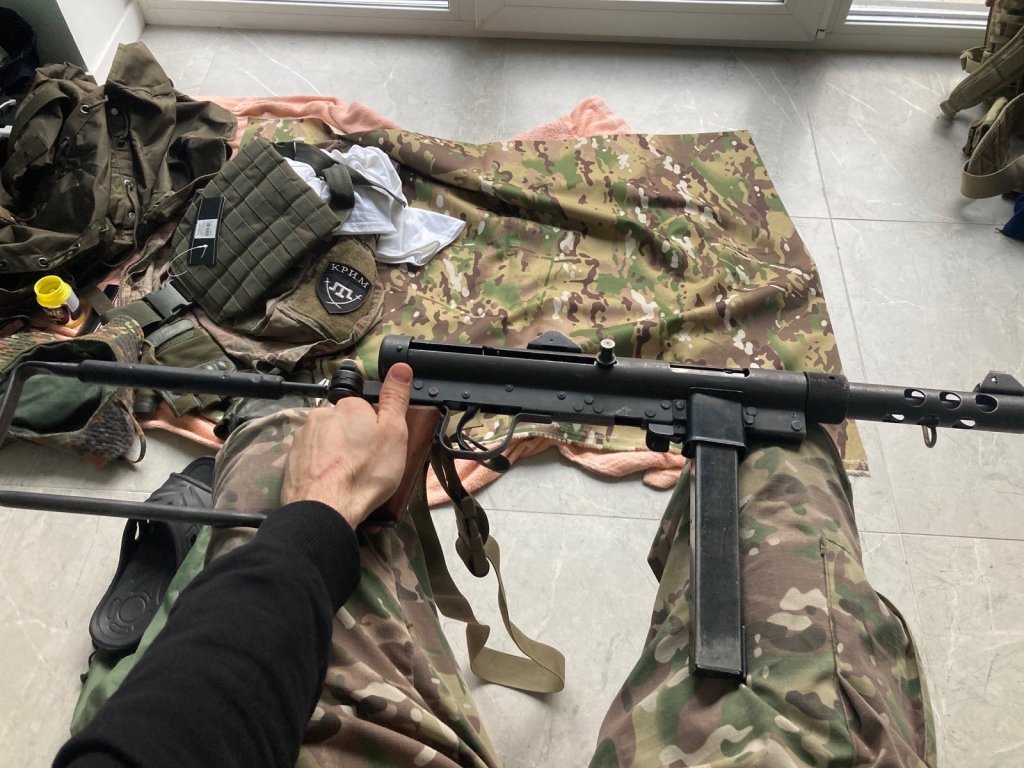
The earliest sighting of a ‘Swedish K’ in Ukraine I’ve found dates to early March 2022 when a member of the Krym Battalion posted a photograph of some of the weapons available to him; an AK-74, a Walther P99, an M7 bayonet and a Carl Gustaf M/45B.

Another image of a Ukrainian serviceman with an M/45 surfaced around the 23 March, but I’ve been unable to find the original source for the image so have little context for it.

In early May an photograph of an older member of the Ukrainian Armed Forces was shared on a number of sites, he’s seen sat in a vehicle holding up an M/45 with a sling attatched.

In mid-May 2022 another M/45 surfaced in a photograph from a member of Krym Battalion, which is a part of the International Legion. It’s unclear if this photograph was posted by the same member who shared a photograph of his weapons in March, but the wear marks on the gun appear quite similar.

On 10 November, a daily update post from the Ukrainian General Staff included a photograph of an individual holding an M/45 with a sling, while the unit the individual belongs to isn’t stated given the contents of the post he may have been assigned to a unit on the border with Belarus.

Throughout most of 2023 sightings of M/45s were rare but in mid-June a member of the National Guard posted a short video featuring himself holding a Swedish K as other members of his unit walk behind him, two of the passing men also carry slung M/45s.

On the 28 September, a Swedish volunteer posted a photograph of himself holding an M/45 he came across on the frontline, he captioned the post: “Photo of when I found a mint condition Swedish K with 39B ammo out close to the front. Just an awesome rare Swedish Gun to see in use by a Medic.” The unit where the M/45 was encountered was the 131st Separate Recon battalion. This suggests the photograph may have been taken earlier in the summer of 2023 and also that M/45s may be used by medics. The mention of the Swedish 39B 9mm ammunition which was specifically issued with the M/45 is also interesting. Most notably, however, is the presence of the attachment assembly for an original Swedish spent cartridge case catcher bag.

October saw the first video of a Swedish K being fired. A short clip was shared on Instagram showing an M/45B being fired at the range with what appears to be a red dot optic mounted forward on the perforated barrel shroud.

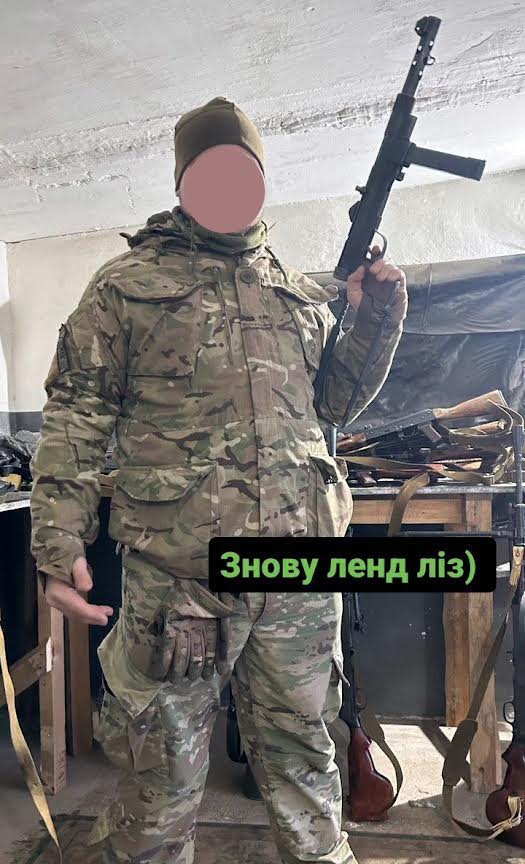
Several months later, on 11 December, a medic with the 12th Ukrainian National Guard Brigade “Azov” shared a photograph of himself holding an M/45. Later in December a member of the 78th Separate Assault Regiment ‘Herts’ shared a photo, on 21 December 2023, with the caption ‘lend lease again’, he’s holding up a behind him can be seen several DP-27 light machine guns and some AK-pattern rifles.

Interestingly, none of the M/45s have the green paint finish which was used on some of the Swedish Armed Forces’ guns but have clearly shipped with original slings and in one case a brass catcher attachment. Also none of the guns in the imagery from Ukraine appear to have the end cap reinforcement typically see on the Swedish Army’s M/45Bs. While the guns have the M/45B’s fixed magazine well they don’t seem to have the characteristic pair of rivets and hooked end cap. It’s difficult to positively identify the variant as the guns’ markings aren’t visible in any of the imagery. With little context for some of the imagery and relatively few sightings of the guns in Ukraine its difficult to pinpoint the types of unit which are receiving them but it is conceivable that the guns have been decimated amongst a number of different types of unit including frontline elements of the Ukrainian National Guard, International Legion and Army.

Update – 21/01/24: From Swedish sources I’ve spoken to these M/45s are early spec guns which may have been in storage and were refit later. Retrofitted with fixed magazine wells but not the reinforced end cap as the ammunition that necessitated this was no longer in use.

Update – 22/01/24: Another photograph posted November 2023.


Support Us: If you enjoyed this video and article please consider supporting our work here. We have some great perks available for Patreon Supporters – including early access to custom stickers and early access to videos! Thank you for your support!


Bibliography:

thank you to the researchers at Weapons Illustrated, Cloooud and Ukraine Weapons Warfare

https://www.gotavapen.se/gota/artiklar/kpist/swede_45.htm 

Swedish RBS-17 Missiles in Ukraine

In June 2022 Sweden announced it would provide Robot-17 (RBS-17) coastal defence missiles to Ukraine. These missiles are used by Sweden’s Amphibious Corps to interdict the movement of enemy vessels along Sweden’s coast.

RBS-17 is a Bofors Defense (now Saab Bofors Dyanmics) led development of the AGM-114 Hellfire. Work on the Swedish coastal defence missile began in the 1980s. It is man-portable with the missile weighing 48kg in addition to the launcher, firing system and laser targeting module. It is typically operated in the field by five man teams, with two operating the laser targeting system and three on the weapon itself.

RBS-17 launch October 2023 (via social media)

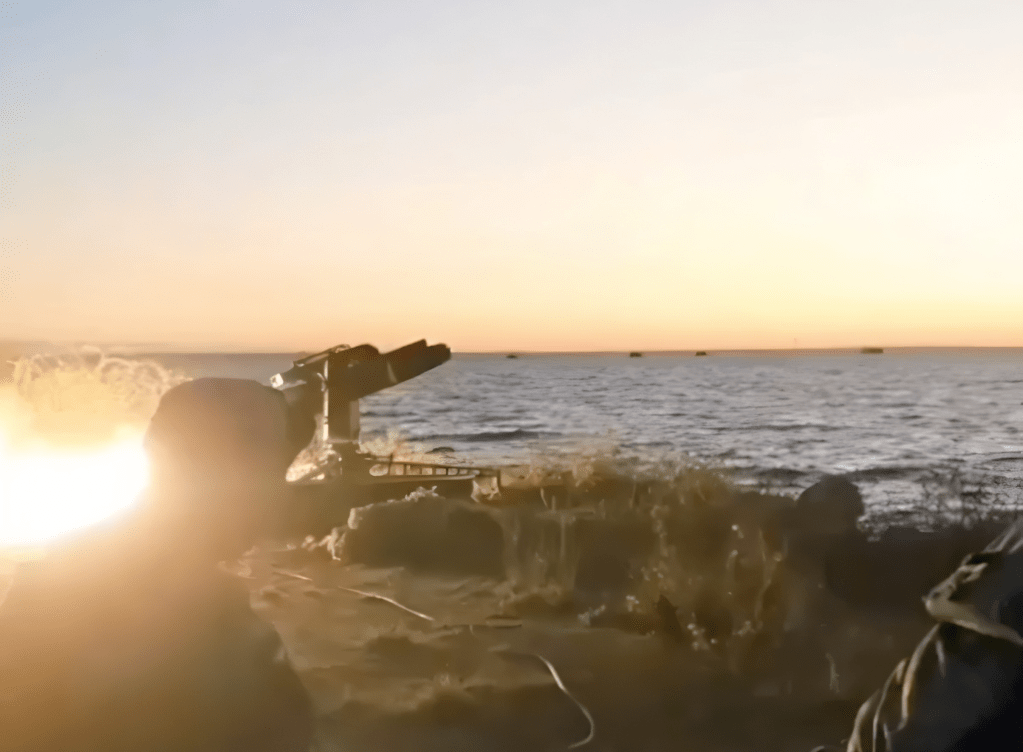
On launch the missile climbs to several hundred metres and seeks the laser-marked target. The system has a maximum range of around 8km and carries a 9kg high explosive warhead. While designed to engage vessels the RBS-17 can also be used against ground targets.

On 2 June 2022, the Swedish government announced the transfer of an undisclosed number of RBS-17s. They are believed to have been seen in theatre for the first time in a video published on 20 October, although it appears it may have been filmed earlier. The video was shared by a group called ‘Bigcats’, the lo-res clip shows the launch of a pair of missiles. ‘Bigcats’ haven’t shared any further imagery of the missiles since.

In September 2022 the Norwegian government also announced plans to provide Ukraine with their Hellfire-derived Norwegian Shore Defence Missile System. The transfer of 160 missiles and associated equipment was announced in response to a Ukrainian request. In late March 2023 photographs of several pieces of wreckage from one of the missiles was posted on Telegram. It was hypothesised that they were found in the area of ​​the Kinburn Spit and had been fired across the water by an element of the 73rd Naval Center of Ukraine’s Special Operations Forces.

An RBS-17 launch, c.September 2022 (via social media)

It was over 8 months before another video of a the weapons in action was shared. In mid-August 2023 a brief clip was published showing a Hellfire-patterned missile (which may be an RBS-17) being fired and apparently detonating downrange. Several months later at the end of October perhaps the best piece of footage of one of the missiles being launched was shared. In the video we can see the missile being launched and as the camera pans the laser targeting module can also be seen.

In August 2023, Army Inform, the news agency of Ministry of Defense of Ukraine, published an article outlining how the RBS-17 is used noting that it is most frequently used against Russian defensive positions, dugouts or lightly armoured vehicles. The article included a photograph of a display showing the RBS-17 set up. In the background a Ukrainian combatant can be seen sat on a missile case, he’s wearing the patch of the Zaporizhzhia-based 27th River Fleet Division (27 ODnRK).

An RBS-17 launch in Ukraine Nov/Dec 2023 (via Swedish MoD)

On the 18 December, the Swedish government published an article about Ukraine’s use of the RBS-17 and the training the Swedish armed forces provided on the system. The article explains that Ukrainian personnel were secretly trained on the system. The training appears to have been carried out during Summer 2022 and took place in time to coincide with the delivery of the RBS-17s. Swedish personnel have also continued to be on call for answering the technical and operational queries of the Ukrainian teams using the system.

The Swedish article also included a short video of one of the missile systems in operation in Ukraine. The team appears to be in cover behind a wall. The GoPro footage shows the missile near by and the control unit as well as transport cases near by. A Polish MSBS Grot rifle can also be seen leaning on the wall next to the operator.

Update – 22/05/24:


Support Us: If you enjoyed this video and article please consider supporting our work here. We have some great perks available for Patreon Supporters – including early access to custom stickers and early access to videos! Thank you for your support!

Ukraine’s Giant Rifle – the Snipex Monomakh

There are a significant number of different large calibre anti-materiel rifles in use in Ukraine. One of the largest is the Monomakh, a 14.5×114mm semi-automatic, box magazine-fed anti-materiel rifle from the Ukrainian company Snipex. Snipex is a subsidiary of the XADO Chemical Group.

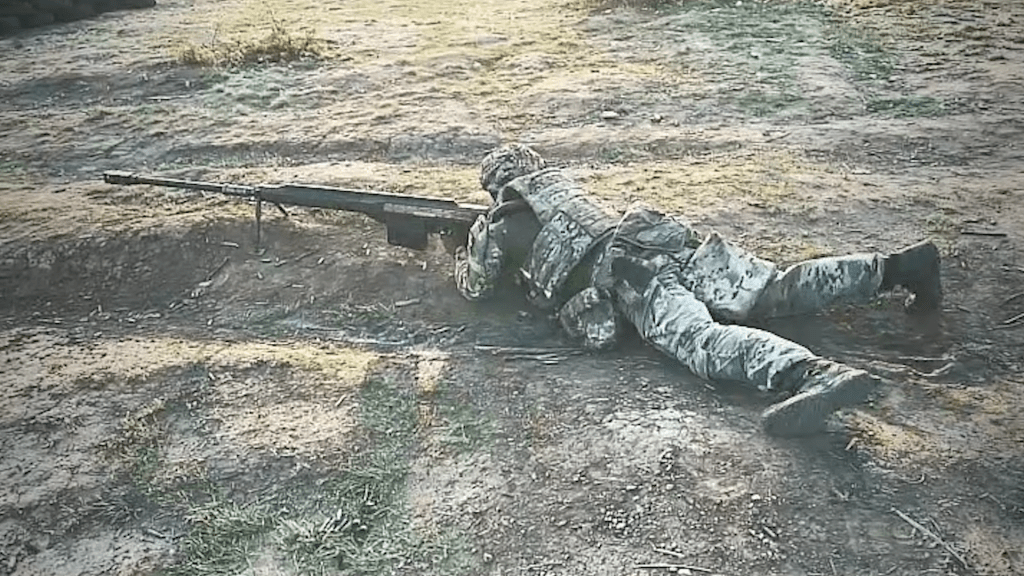
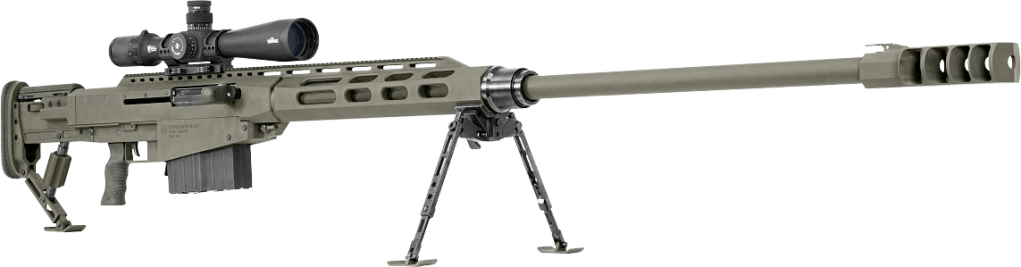
Snipex are well known for their series of precision anti-materiel rifles which includes the M100, T-Rex and Alligator. The Monomakh, introduced in 2021, is the company’s first semi-automatic rifle. It is recoil operated and feeds from a 5-round box magazine. It has a barrel 1,200mm [47.2in] long and an overall length of 2,050mm [6.7 feet], Snipex list its weight without a magazine as 25kg [55lbs]. The rifle has a listed muzzle velocity of 950 to 980 m/s and an effective range of just under 2,000 metres [1.2 miles]. The weapon is fired from a bipod with a monopod supporting the butt of the rifle. It’s key feature is its reciprocating barrel which helps soak up the recoil from the 14.5mm cartridge.

A scopeless Monomakh at the range (via social media)

The Monomakh appears in imagery from Ukraine fairly infrequently, the earliest sighting of one of the rifles I could find was a photograph posted by a GUR member in late April 2022. Subsequently a number of videos of the weapon being fired at ranges by Ukrainian combatants was published in the Summer of 2022. The first posted on 7 August, shows a magazine being loaded into the rifle and the weapon chambering a round. Later that month a short video of a Monomakh firing at a range was published.

Snipex Monomakh (Snipex)

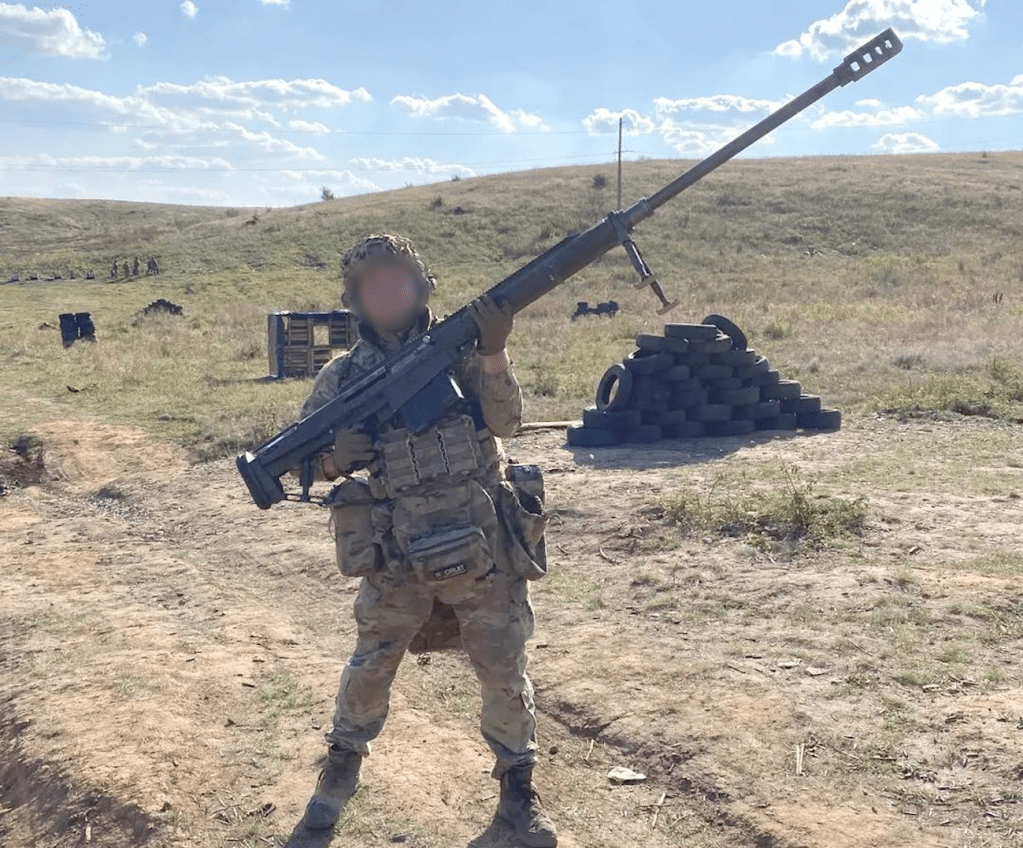
The earliest photograph of one of the guns I could find in 2023 was shared by a Ukrainian combatant in mid-July. Several months later, in September 2023, another Ukrainian combatant shared a photograph of himself holding up a Monomakh at a range. The same combatant also shared a short clip of himself firing the rifle, again at the range. In the clip he appears to be firing the rifle without sights or an optic. He is also seen helping the bolt into battery after each shot, the bushing which guides the barrel as it recoils into the receiver appears to have come loose. The rifles are typically paired with substantial optics, Snipex offer two of their own 6–24×56 scopes, the Jove 50 and the Galaxy G50. In late October, a female sniper with the 3rd Shock Brigade, posted several photographs and a video of herself firing a Monomakh from a position inside a building.

A Ukrainian combatant holds up a Monomakh (via social media)

The large size and hefty weight of the Monomakh limits it applications somewhat but the 14.5mm round is useful against light armoured vehicles, buildings and field fortifications – the main limitation is getting it in, and out, of position to engage targets. There are videos of it taking two men to move the similarly heavy T-Rex and Alligator rifles. From the limited sample of imagery of the Monomakh in theatre it is difficult to gauge how widespread its use actually is. The simpler to manufacture bolt action Snipex rifles are seen more frequently.

My thanks to Cloooud and AbraxasSpa for help sourcing some of the imagery used in this article/video.


Support Us: If you enjoyed this video and article please consider supporting our work here. We have some great perks available for Patreon Supporters – including early access to custom stickers and early access to videos! Thank you for your support!

HK MG5s in Ukraine

A dozen different types of light and general purpose machine guns are in use in Ukraine, one of the newest is the Heckler & Koch MG5.

In May 2023, the German government announced a package of aid which would include 100 HK MG5 7.62x51mm general purpose machine guns. In September, evidence of their arrival in theatre began to surface with Ukrainian combatants sharing imagery of the brand new weapons.

The transfer of MG5s by the German government is interesting as the Bundeswehr themselves have only recently begun to receive the guns. The MG5 officially entered German service in 2015 but procurement has only recently ramped up with around 10,000 currently estimated to be in inventory. The MG5 is a gas-operated 7.62x51mm general purpose machine gun with a variable rate of fire and is intended to replace the MG3. It fires from an open bolt and it’s action is locked by a rotating bolt head. The guns themselves are listed on the German government’s aid-tracking page as “being deliveries from industry stocks financed by German funds for security capacity building.” This indicates that the transfer was probably not made direct from Bundeswehr stores.

Jurado posted the first photo of an MG5 in Ukraine (via Social Media)

On 20 September, Jurado – a Spanish member of the International Legion, shared the first photograph of an MG5 in Ukraine. Several days later on 22 September, omega_team_gur shared another photograph of the MG5 at the range. According to Jurado his unit received three of the guns.

A week later Greek International Legion members shared the first video of one of the guns mounted on a Lafette tripod. Through discussions with some of the combatants whose units have received the MG5s not all the guns came with tripods. A member of a Ukrainian Military Intelligence Directorate, the GUR, team told us that the guns came in bags with accessories including an optic, bipod, cleaning kit, manual and spare barrel.

An MG5 in its transport bag (via Social Media)

A member of the GUR, callsign Shock, shared a photo with an MG5 on 28 September, and several more the next day. Shock told TAB that his unit had received two of the MG5s and that while they’re cool pieces of kit the are heavy “13+ kg without ammunition” [HK lists the MG5A2’s weight as 11.5kg or 25lbs]. Shock’s team appears to be one of the few GUR teams not made up of international volunteers to receive the guns. He also shared a photograph of two MG5s sat in their transport bags.

On the 30th September Omega Team shared another group photograph featuring an MG5 and several days later on 2 October, a member of the GUR’s Shaman battalion, shared a photograph of himself holding a new MG5. Another member of the Shaman battalion also shared a photograph of an MG5 in its transit case/bag. It can seen fitted with a Hensoldt 4x30i optic and a cleaning kit and a number of belt pouches can be seen in the case. Knights, another GUR team, shared a photograph featuring an MG5 on 6 October. This was followed on the 10 October by a unit photograph with an MG5 seen at the back of the group. During the same week, another SOF group made up of international volunteers, Black Maple, also shared a photograph featuring an MG5.

An MG5 mounted in a Lafette tripod at the range (via Social Media)

Another team, Operation 21 Group, posted a photograph on 16 October of an MG5 mounted on a Lafette tripod at the range. The gun is again paired with the Hensoldt optic. On around the 17 October, a member of the Kraken Regiment, also part of the GUR, posted a photograph holding one of the MG5s. Several days later the first glimpse of an MG5 being used in combat was shared by a GUR team, the MG5 can be heard firing and is just visible though the foliage.

On the 22 October the GUR’s Stugna Battalion also shared a promotional video featuring one of the MG5s. On 24 October imagery from a number of photographers showed members of the International Legion’s new Siberian Battalion training. Amongst an interesting array of small arms the battalion’s trainees also appeared to have a single MG5.

The team at GRaft, a Ukrainian company which fabricates ammunition boxes for machine guns, shared some video of testing of one of their boxes with an MG5 in late October. At the beginning of November Tactical Group Athena, another GUR team, shared a team photograph featuring not one but two MG5s.

Later in November, the Knights shared a series of photographs and clips featuring the MG5. The first was posted on 4 November, showing the gun in a fighting position. This was followed on the 13 November, by a short video of an MG5 firing from its bipod in a frontline position in the trenches feeding from a British 7.62x51mm ammunition box. I spoke to one of the members of Knights about the MG5 and they described it as ‘a fantastic weapon’ and while “a bit on the heavy side [it’s] still a good weapon system and we love to use it!”

A member of Rogue Team holds an MG5 in a frontline trench (via Social Media)

Omega team shared another group photo featuring an MG5 on 12 November. Later that week Rogue Team posted a photograph of two combatants in a frontline trench, one is seated holding an MG5. A week later the GUR shared a video on their YouTube channel about their amphibious operations in Crimea, on 16 November, with an MG5 briefly appearing in part of the sequence. Towards the end of November a video from the Knights team thanking people for kit donations also featured an MG5. On the 14 November, an element of the Kraken Regiment, Special Assault Company, shared a promotional video featuring a drive by with an MG5 being fired out the window of a vehicle at a range. On the 19 November Rogue Team shared a team photograph, with one combatant holding an MG5, a day later a member of the team shared a short clip from the range showing the MG5 in action with the caption ‘I love MG5’. Finally, on the 26 November another MG5 was seen in a photograph of members of Kraken.

All of the guns appear to have HK’s RAL 8000 (FDE-ish) finish and are of the MG5 A2 configuration with the shorter 460mm (18in) barrel. The guns also appear to have been provided with Hensoldt 4x30i ‘intermediate range targeting optics’. From the imagery which has surfaced so far we can see that the MG5s have predominantly been issued to special operations forces including teams from the GUR and possibly the SSO. Despite the small number of guns officially confirmed to have been transferred they have been widely photographed in theatre and when asked by TAB comments from combatants using them have largely been positive. It is unknown what quantity of spares were provided with the guns or if more may be provided by Germany in the future.

Thank you to friends at Cloooud and at StreakingDelilah for their help gathering imagery for this video.

Update – 2/12/23:

Ukrainian combatant, Valgear, shared a photo of an MG5 in a Lafette tripod fitted with a thermal optic. Both the gun and optic have apparently been damaged by shrapnel.

Update – 03/12/23:

Machine gun training (Bundeswehr/KSK)

The Bundeswehr issued a statement on training Ukrainians SOF members and shared a photograph of Ukrainians training on MG3 and MG5 machine guns. Unlike the guns seen in Ukraine the MG5s have 550mm (22in) barrels.

Update – 9/12/23:

Another GUR team, Stugna, have shared photos of an HK MG5 in recent weeks.

Update – 13/12/23: The recently formed Sibir Battalion were photographed again training with an MG5.

Update – 11/1/24: GoPro footage of an MG5 in action, reportedly from the GUR’s Rogue Team.

Update – 18/2/24: A platoon of the Sibir Battalion photographed with an MG5.

Update – 16/04/24: HK MG5 with optic.

Update – 7/6/24: Rogue, a GUR direct action team, shared some video of their machine gun team in action near Kupyansk in November 2023. It gives a great look at the MG5 in action and also features a brief glimpse of the gun’s spare barrel and it’s reload drills.


Support Us: If you enjoyed this video and article please consider supporting our work here. We have some great perks available for Patreon Supporters – including early access to custom stickers and early access to videos! Thank you for your support!

Bibliography:

Military Support for Ukraine, Bundesregierung, (source)

HK MG5, Heckler & Koch, (source)

MG5 – Bundeswehr Receives Additional Machine Guns, S&T, (source)

For more on Germany’s aid to Ukraine check out deaidua.org

SAS Browning Hi-Power Extended Magazines

On the 5th May 1980, the world was spectacularly introduced to the Special Air Service and their Browning Hi-Power’s with extended magazines.

22 SAS formed the Counter-Revolutionary Warfare Wing in the 1970s, after the 1972 Munich Massacre, and quickly took a lead in developing counter-terrorism tactics. They gained worldwide notoriety in 1980, during Operation Nimrod, the assault ended the Iranian Embassy Siege. It was during Nimrod that the SAS’ CRW squadron was seen in action for the first time.

I began to notice the extended Hi-Power magazines while examining photographs from the operation for another upcoming video. As I looked closely I began to notice more and more holstered Browning Hi-Powers with extended magazines. The Hi-Power’s standard double-stack, single-feed magazine holds 13 rounds, decent for the period, however, SAS troopers evidently saw the benefit of having more ammunition ready to go on their secondary weapon.

Members of B Squadron’s Red Team prepare to rappel and breach the rear of the embassy (via Woolley & Wallis)

The best photographs are of part of Red Team as they breach the rear balcony of the embassy. In the first photograph a four man team prepare to rappel/abseil down the rear of the embassy to enter via the balcony. You can see the trooper with his back to the camera about to rappel has a Hi-Power with an extended magazine. Subsequent photographs of the four man team on the rear balcony show that several of the troopers have extended magazines. In another photograph Rusty Firmin and a breech team with Blue Team enter the rear of the embassy at the ground floor. On his right leg Firmin is carrying a Browning Hi-Power with an extended magazine.

The last photograph shows members of the SAS in the garden behind the embassy securing the hostages so they can be safely identified. As one of the troopers is zip-tying a man he has laid his Hi-Power on the grass next to him.

SAS troopers secure hostages for IDing, note the pistol and extended magazine on the left (via Woolley & Wallis)

The British Army adopted the Hi-Power in 1954, it remained in service through to 2013. It was the SAS’ primary sidearm until the SIG Sauer P226 gained favour in the early 1990s. As seen in the photographs from the Iranian Embassy Siege the CRW squadron carrier their Hi-Powers in custom-made leather drop leg holsters which were made by Len Dixon and Paul Evers.

The extended magazines can be seen in photographs dating from throughout the 1980s. Theundated photograph below shows an SAS team during training to assault a train carriage, the trooper in the centre has a Hi-Power with an extended magazine. A photograph of Princess Diana during a visit to Hereford in 1983, features an SAS trooper with an extended magazine visible. This undated photograph, probably from the mid-1980s, of a trooper kicking in a door during training also features one of the magazines. A similar training photograph shows a 4-man team stacking up for an entry – the lead trooper has a Hi-Power loaded with an extended magazine.

SAS team during training to assault a train carriage, note the extended magazine in the central trooper’s Hi-Power and the DIY vertical front grip on the right

Initially, I was unsure who manufactured the extended magazines used by the SAS as very little has previously been written about them and the resolution of the available imagery makes identifying them difficult. A look through contemporary issues of Soldier of Fortune magazine shows a quite few variations were available. With manufacturers like Mec-Gar, SILE and Pachmayr all producing variations though they may also have been offered by FN themselves. However, according to a member of the SAS active in the 1970s and early 1980s the magazines were made in-house by the Regiment’s armourers. They apparently worked well. Judging from the imagery available the magazines probably held between 20 and 25 rounds, with the lower end of the scale more likely.

I spoke to Robert Lancaster, another member of the SAS who served in the 1980s, who explained:

“I nearly always used a 20 round mag unless I was doing door entry, when you had a slung Remington [870] and the 5 [MP5], in that case I used the standard mag in case the mag got caught on the shotty!”

A wrist magazine holder seen in a 1984 British Army film about the SAS (British Army/SSVC via IWM)

One other notable thing to point out are the wrist magazine holders used by some members of the assault teams. This is essentially a ready-to-go magazine attached to the operator’s pistol arm. This would in theory allow the operator to execute a faster reload, the idea being that taking the fresh magazine from the wrist, nearer to the pistol, rather than from the holster pouches on the thigh .

We get a good look at one of these in the British Army’s 1984 video about the SAS. We can see the magazine holder on the operator’s left wrist. Later in the film a trooper climbing through a window can also be clearly seen equipped with a Browning Hi-Power loaded with an extended magazine. The tradition continued with extended magazines also being regularly used with the later SIG P226s.

Special thanks to British SAS Photos on Instagram for their help and to Robert Lancaster for answering my questions. We’ll have more articles/videos looking at SAS weapon set ups from this period in the future so stay tuned.


Support Us: If you enjoyed this video and article please consider supporting our work here. We have some great perks available for Patreon Supporters – including early access to custom stickers and early access to videos! Thank you for your support!


Wheeled Mk19 Mount

A Ukrainian engineer and fabricator, Іван Савельєв/Ivan Saveliev, has designed and built an interesting wheeled mount for the Mk19 automatic grenade launcher. The mount was recently seen in a video posted to TikTok by a member of 4th Rapid Reaction Rubizh Brigade’s 3rd Battalion Svoboda. The video was posted on the 10 November and shows the mount being demonstrated in camp. There’s a long history of Russian machine guns like the Maxim PM1910, SG-43 and DShK having wheeled mounts or carriages. The new mount for the Mk19 could be seen as a descendent of these.

A Mk19 on the wheeled mount (via social media)

The first MK19 Mod IIIs arrived from the US in late January 2022, as it looked increasingly likely that Russia would invade. Since then they have proliferated and are widely used by the Ukrainian armed forces.

A Mk19 on the mount with wheels removed (via social media)

Saveliev has developed a range of mounts for various support weapons including machine guns, auto-cannons and mortars. He first shared imagery of the wheeled mount for the Mk19 in mid-June posting a photograph showing a Mk19 elevated on one of the mounts. Five months later, on 23 October, Saveliev shared a series of detailed photos of the mount. He noted that the mount could allow the Mk19 to be fired at ‘increased vertical angles’. This is very useful for long range, indirect fire. The M2 heavy machine gun could also be used with the wheeled mount as the mount mimics the mounting points of the M3 tripod, which both the Mk19 and M2 are used with.

Above & Below: Close-ups of the mount (via social media)

The mount has a pair of handles at the muzzle end to allow the weapon to be pulled by two men. The elevation of the Mk19 can be adjusted by an elevation wheel which uses a long threaded bar (or worm pinion/screw) to move the mounting arm forward and back, lowering and raising the weapon. In the video posted by members of the 3rd Battalion Svoboda it is suggested that elevations of 60 or more degrees is possible. Windage can be adjusted by a pair of wheels either side of the rear of the mount.

The mount has a pair of wheels with pneumatic tires which can be removed allowing the weapon to be grounded in the mount. However, this looks to be a fairly unstable firing platform due to the narrow base the mount offers compared to the Mk19’s standard tripod. Despite the Mk19’s relatively low recoil the mount would probably have to be well bedded in to achieve accurate fire and prevent it from potentially toppling. There is no mount for the weapon’s belt box.

According to various comments on Saveliev’s posts about the mount individuals from a number of Ukrainian brigades including the 47th Mechanised and 5th Assault brigades are reportedly interested in the mount.

I haven’t yet been able to find any imagery of the mount being used in the field or of a Mk19 being fired from one so its difficult to know how useful it is in battlefield conditions. The major benefit, however, is increasing the Mk19’s portability. Weighing in at 77.6 lbs (35.2 kg) the Mk19 (without the M3 tripod which adds 44 lbs (20 kg)) is heavier than its Russian counter-part, the AGS-17. This makes moving it across broken terrain a difficult task, the wheels might help

Special thanks to Weapons Illustrated who has been tracking this mount and assisted with this video/article.


Support Us: If you enjoyed this video and article please consider supporting our work here. We have some great perks available for Patreon Supporters – including early access to custom stickers and early access to videos! Thank you for your support!