This week we discuss 2016’s Siege of Jadotville, a film which portrays the valiant last stand of a UN contingent of Irish troops holding off an overwhelming force of mercenaries and rebels during Congo Crisis. With a veritable plethora of ally kit and guns the Siege of Jadotville is a well shot, competently made war film which tells a little known story. Starring Jamie Dornan as Commandant Pat Quinlan, alongside Mark Strong, Danny Sapani, Jason O’Mara and Guillaume Canet, the film is the first feature from director by Richie Smyth.
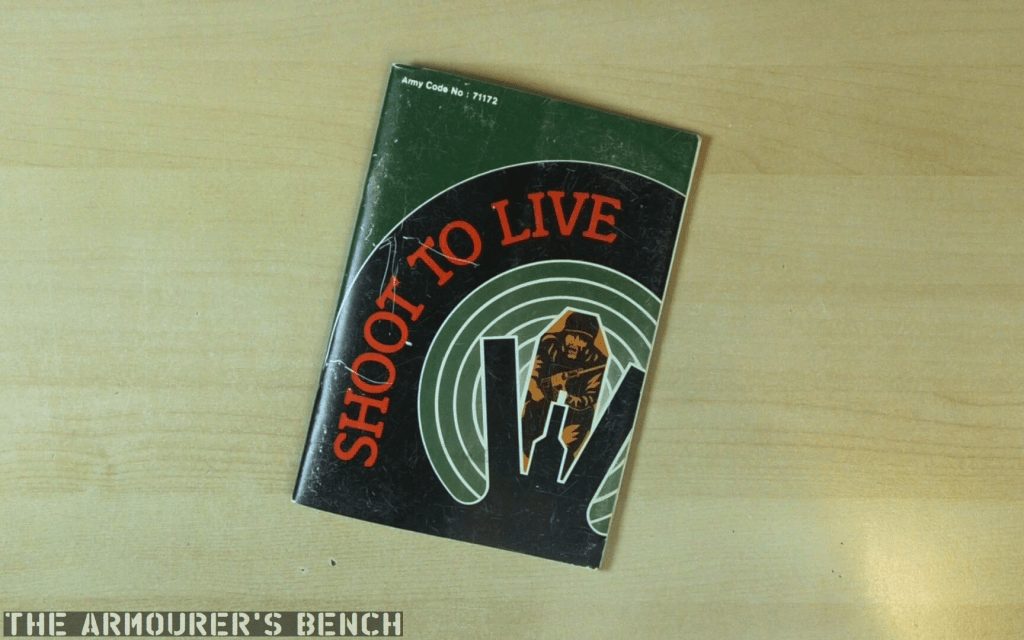
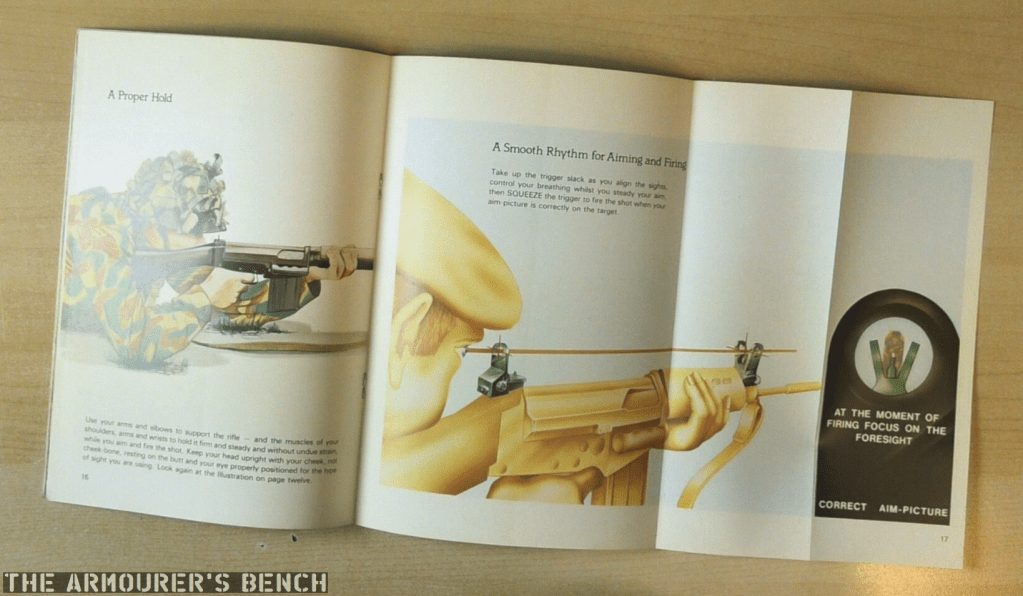
‘Shoot to Live’ is a British Army marksmanship training pamphlet published in the late 1970s and early 1980s
Shoot To Live cover (Matthew Moss)
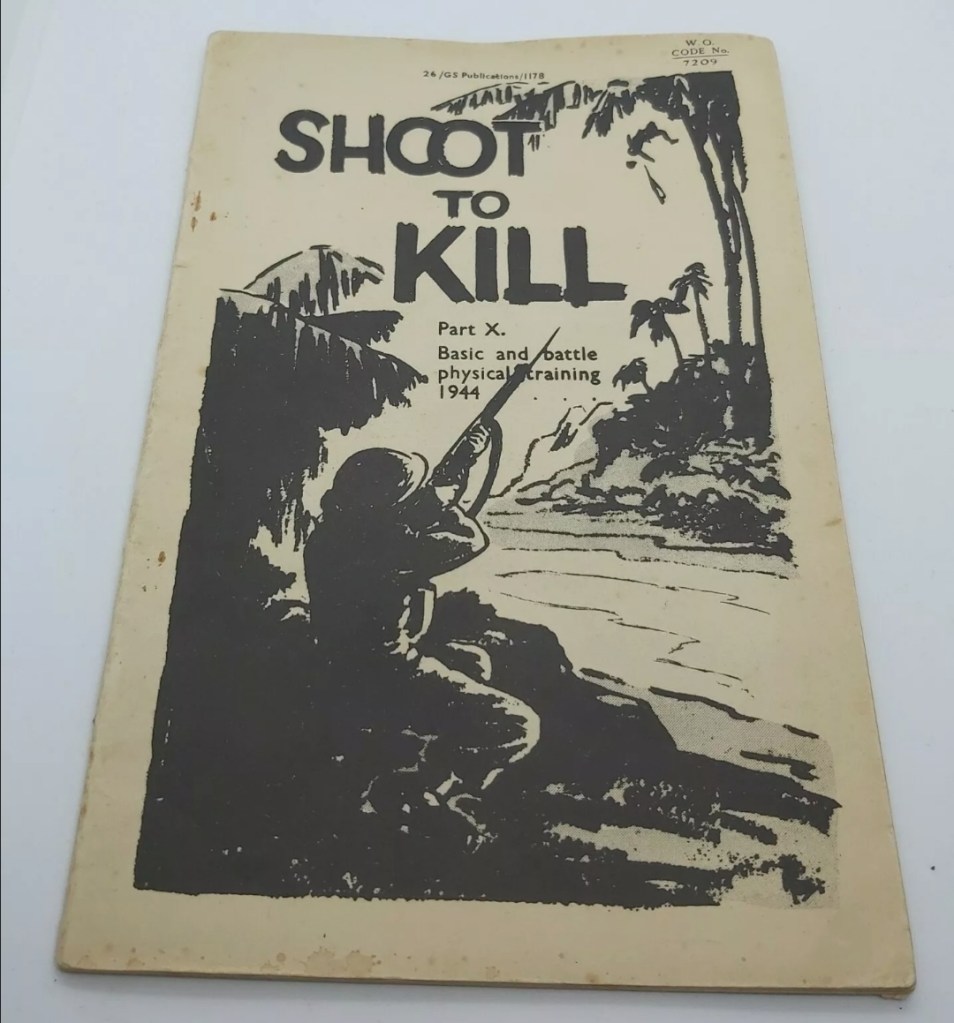
‘Shoot to kill’ had long been a British Army slogan, appearing in numerous training films and pamphlets. One training film from the 1970s, which features in our video, can be watched here.
A 1944 British Army manual – ‘Shoot to Kill’ (source)
But in the late 70s and early 80s a new introductory pamphlet on marksmanship filed the old slogan on its head. In the video above we take a look inside an original copy of ‘Shoot To Live’.
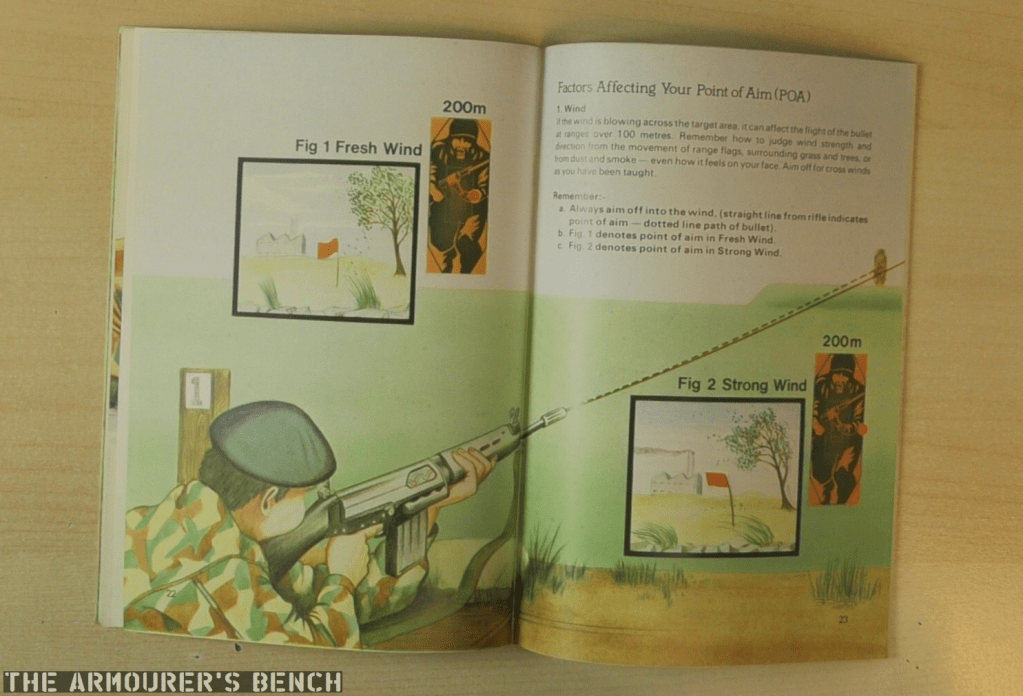
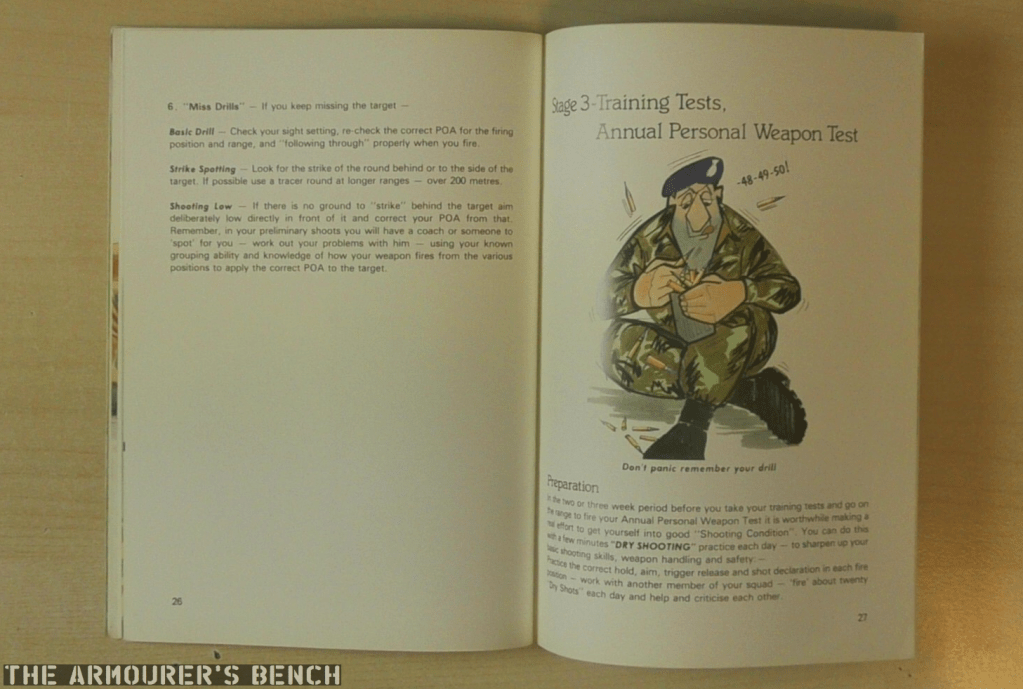
Below are some pages from the booklet:
Shoot To Live section on compensating for wind (Matthew Moss)One of the more humorous illustrations from Shoot To Live, showing the loading of a magazine (Matthew Moss)Shoot To Live’s section on proper sight alignment (Matthew Moss)
The ‘Shoot To Live’ manual is now part of our reference collection and we were able to bring this video/article thanks to the support of our Patrons. We have many more videos on important and interesting primary source materials in the works. If you enjoy our work please consider supporting us via Patreon for just a $1. Find out more here.
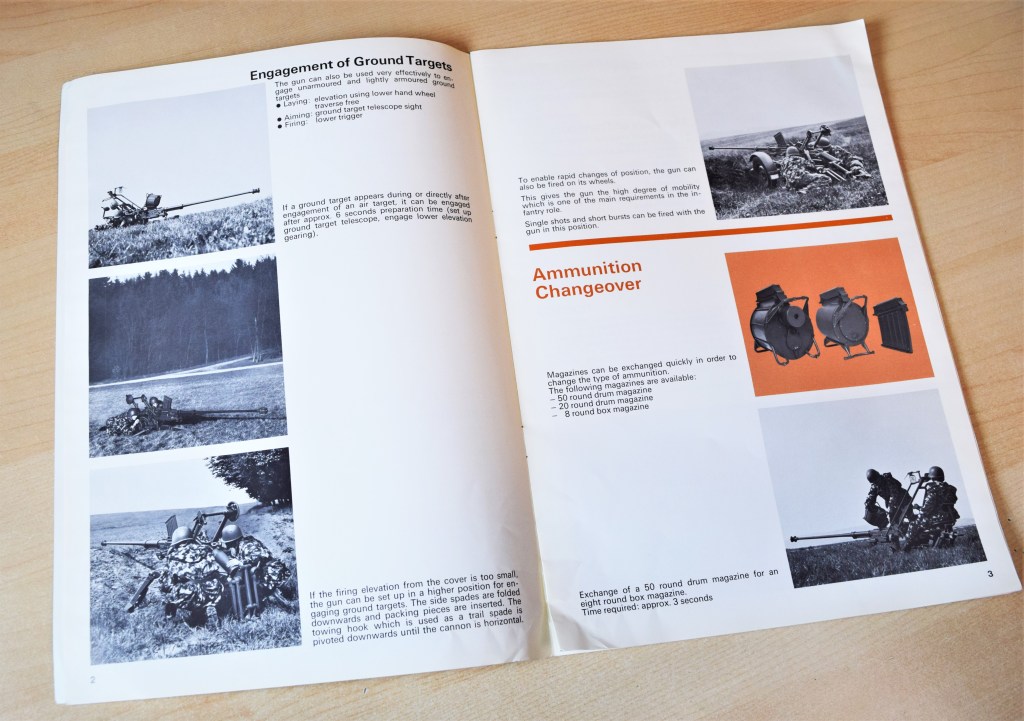
In this video we take a look at an original 1970s brochure for an Oerlikon 20mm Cannon. The booklet, printed in 1974, covers the Type GAI-BO1 – which had previously been designated the 10ILa/5TG. The Swiss Oerlikon had been introduced in the mid-1930s and seen widespread on both sides use during the Second World War.
Engagement of Ground Targets (Matthew Moss)
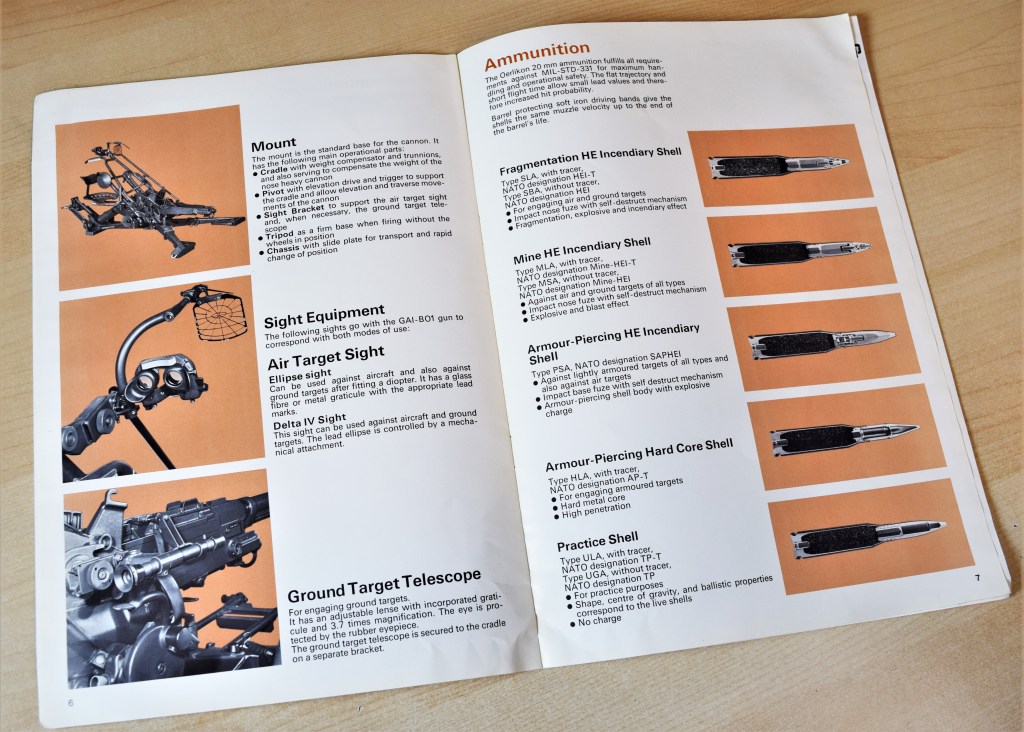
The brochure covers the anti-aircraft and ground roles the cannon was capable of fulfilling as well as explaining the major assemblies of the weapon and some of the accessories like sights and magazines. The brochure also lays out some of the ammunition available for the Oerlikon, ranging from practice shells to fragmentation HE incendiary and armour-piercing hard core shells. The Oerlikon cannon remains in production and in service with dozens of countries around the world.
Sights, mounts and ammunition (Matthew Moss)
The brochure is now part of our reference collection and we were able to bring this video to you due to the support of our Patrons. We have many more videos on important and interesting primary source material like this brochure in the works. If you enjoy our work please consider supporting us via Patreon. Find out more here.
With the UEFA European Football Championship (the Euros) starting this week we thought what better time to tackle a curious John Huston film staring no less than Michael Caine, Max Von Sydow, Sylvester Stallone, Pele and half of the Ipswich Town football club! It is of course ‘Escape To Victory’, a film which mixes football with a POW escape movie! We are joined by Ipswich Town fan and host of the excellent WW2TV, Paul Woodage, who brings his expert Ipswich Town knowledge to help us breakdown this unconventional war film!
A couple of weeks ago we looked at some photographs showing an interesting modification seen on a STEN MkII held by Deputy Prime Minister Clement Attlee. The STEN Attlee posed with had a front grip added, something the MkII didn’t typically come with.
A few people very kindly sent me some other contemporary photos showing other ad hoc STEN front grips so I thought a follow up video was needed. I also found a group of photographs taken in June 1943 at the Combined Training Centre at Kabrit, in Egypt. The photos show groups of Commandos and the Royal Navy’s Naval Beach Parties armed with Stens with a pretty standardised style of front grip.
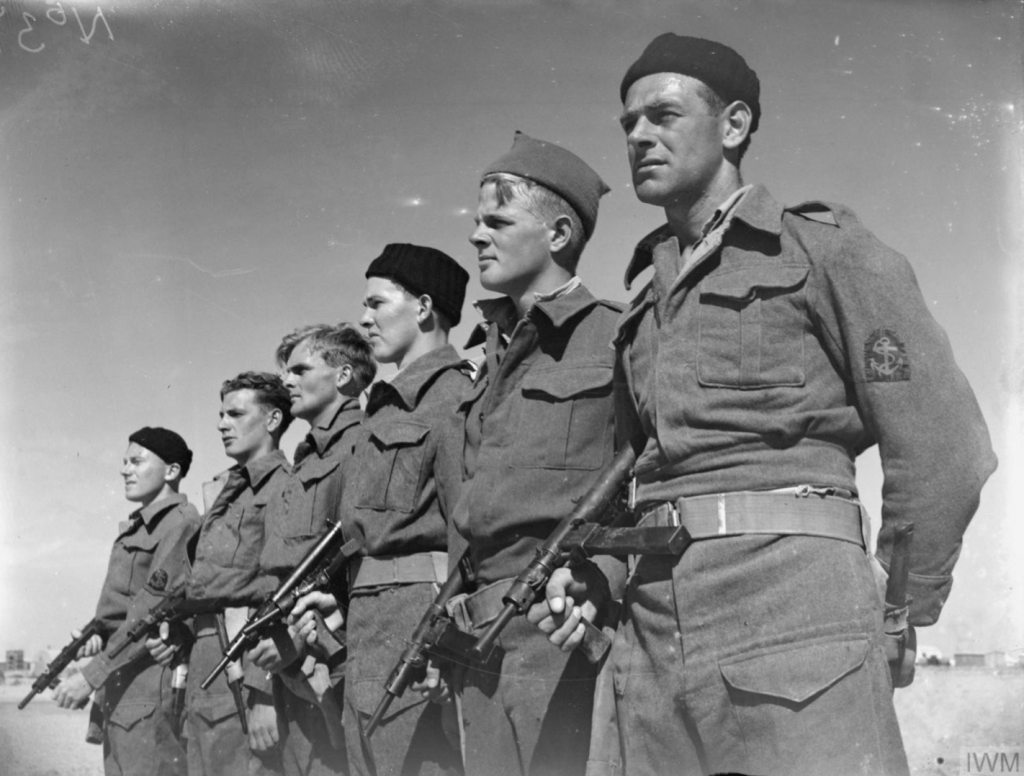
Commandos on parade with STEN MkIIs equipped with ad-hoc front grip, at Kabrit in June 1943 (IWM A17755)
In these photos we can see the men training with the STENs and the front grips are quite clear. It’s especially interesting in that it isn’t just the Commandos who have the front grips but also men of the Naval Shore Parties. It’s also relatively rare to see STENs in North Africa. You might have seen some of these photos, taken by Royal Navy photographer Lieutenant L.C. Priest, in our video looking at the unusual fighting knives the Commandos are equipped with.
The plethora of photos from Kabrit show a fairly standardised design for the grip. A metal ring, seemingly tightened by a wingnut on the left side and a generous wooden grip that was long enough to fit all four fingers on. The grip appears to have some finger grooves and a fairly standard shape. A photo (see above) of Naval Commandos on parade shows the men with the STENs tucked under their arms, holding the front grips. This is identical to how the STEN MkI with its front grip was paraded with. The photo also gives us a good look at the uniformity of the grips.
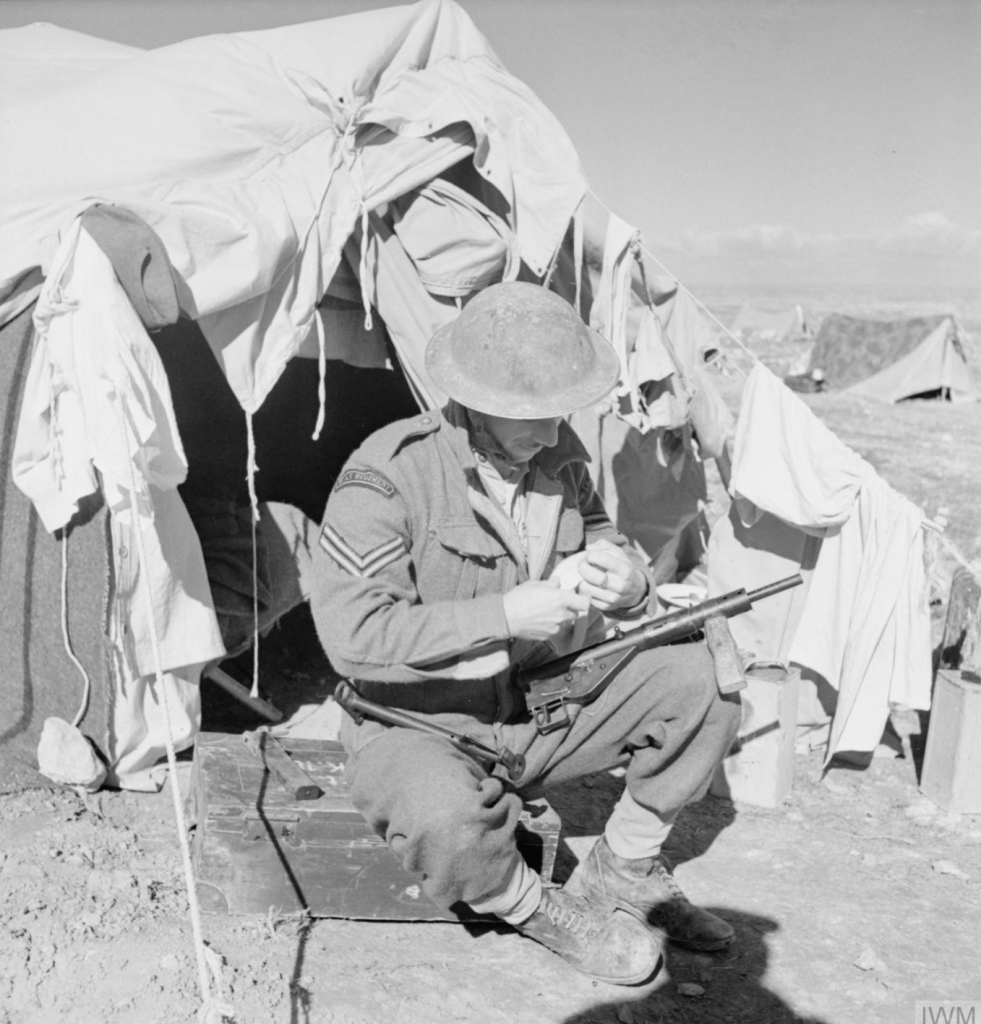
RAF Regiment Corporal cleans his STEN MkII, equipped with a makeshift front grip (IWM CM4296)
While the photos from the Combined Training Centre at Kabrit represent the largest number STEN front grips seen in one place and several units there are a few other photos which are really interesting. First up is this photograph of a Corporal from the RAF Regiment taken in Libya sometime in 1943. The Regiment had been formed just a year earlier. The corporal is sat cleaning his STEN MkII with the butt removed but the bolt still in the weapon. On the barrel nut of his weapon he has a wooden front grip. Again seemingly attached to a metal band around the barrel nut. The wooden grip appears to have some rudimentary finger grooves. Sadly, I couldn’t find any other photos of this Corporal and his STEN. But the design of his front grip is very similar to those seen in the Kabrit training photos and could well be of the same origin.
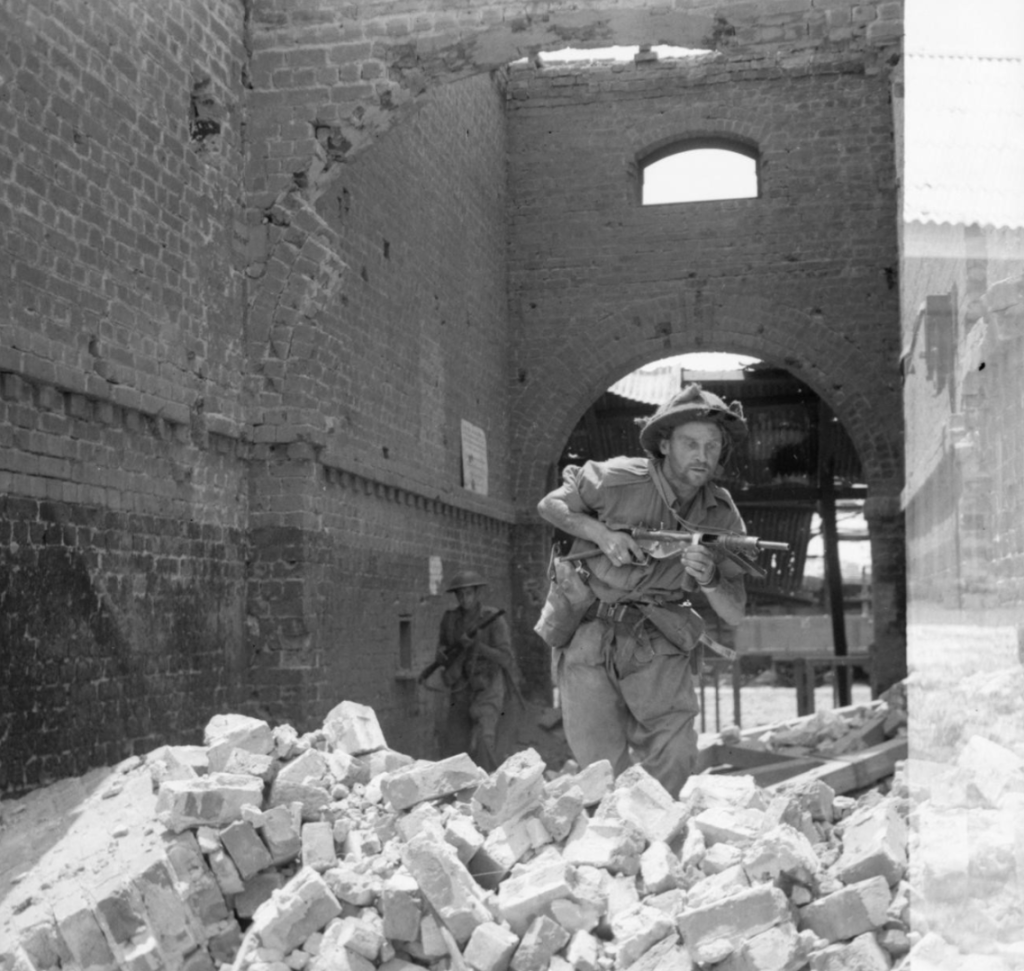
Finally, we have a photograph from a completely different theatre – Burma. The caption for this photograph reads: “Men of the 2nd York and Lancaster Regiment searching the ruins of a railway station for Japanese snipers, during the advance of 14th Army to Rangoon along the railway corridor, 13 April 1945.” This soldier’s STEN MkII has a grip just in front of the trigger mechanism cover and behind the magazine housing and ejection port. It’s actually in a position close to that of the original STEN MkI’s integral folding pistol grip.
Soldier of the 2nd York and Lancaster Regiment with a STEN MkII outfitted with a homemade front grip, Burma 1945 (IWM SE3804)
At the end of the day the adaptation is a good idea, a front grip provides a means of pulling the weapon into the shoulder and a more natural place to grasp other than the barrel nut, the trigger mechanism housing or the magazine – which was discouraged. It is interesting to note that I’ve yet to see any examples of a MkIII being fitted with a front grip like these.
This is certainly something I’m going to do more research into to see if there’s any documentary reference to the use of front grips like these. With the introduction of the MkV, with its front grip, it seems that the idea was sound enough. If you know of any other examples let me know in the comments!
If you enjoyed this video and article please consider supporting our work here. We have some great perks available for Patreon Supporters. You can also support us via one-time donations here.Thank you for your support!
This week marks the 81st anniversary of Operation Dynamo, the Dunkirk Evacuations, so we’re examining the very first onscreen depiction of the evacuation – Channel Incident (1940). Channel Incident is a 15 minute Ministry of Information film directed by Anthony Asquith and starring Peggy Ashcroft, Gordon Harker, Robert Newton and Kenneth Griffith.
You can watch the whole film on the IWM’s online archive here!
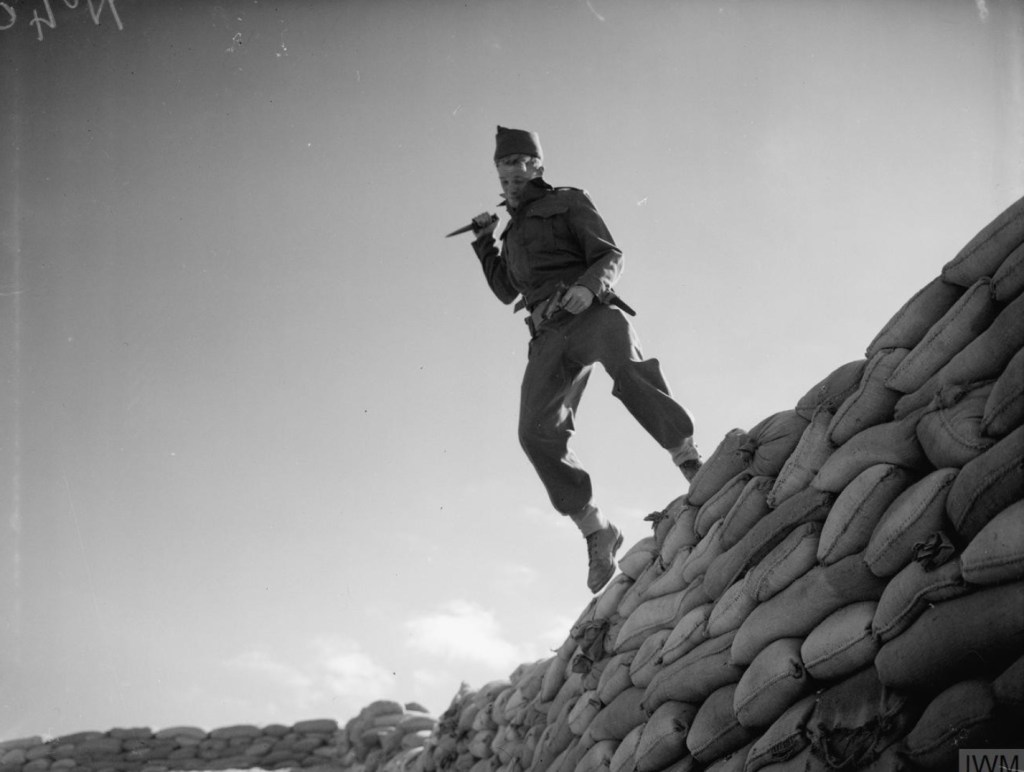
While doing some research for a couple of upcoming videos I came across some photographs of Commandos training, at the Combined Training Centre at Kabrit in Egypt, which showed men equipped with some interesting fighting knives.
Typically when we think of Commandos and fighting knives we think of the Fairbairn-Sykes fighting knife with its stiletto point and cast grip. So much so that it became the iconic symbol of the Commandos.
Well these Royal Navy Commandos appear to be armed with fighting knives crafted from earlier standard issue bayonets. The knives have the standard stiletto blade but quite clearly do not have the Fairbairn-Sykes’ instantly recognisable cast ringed grip.
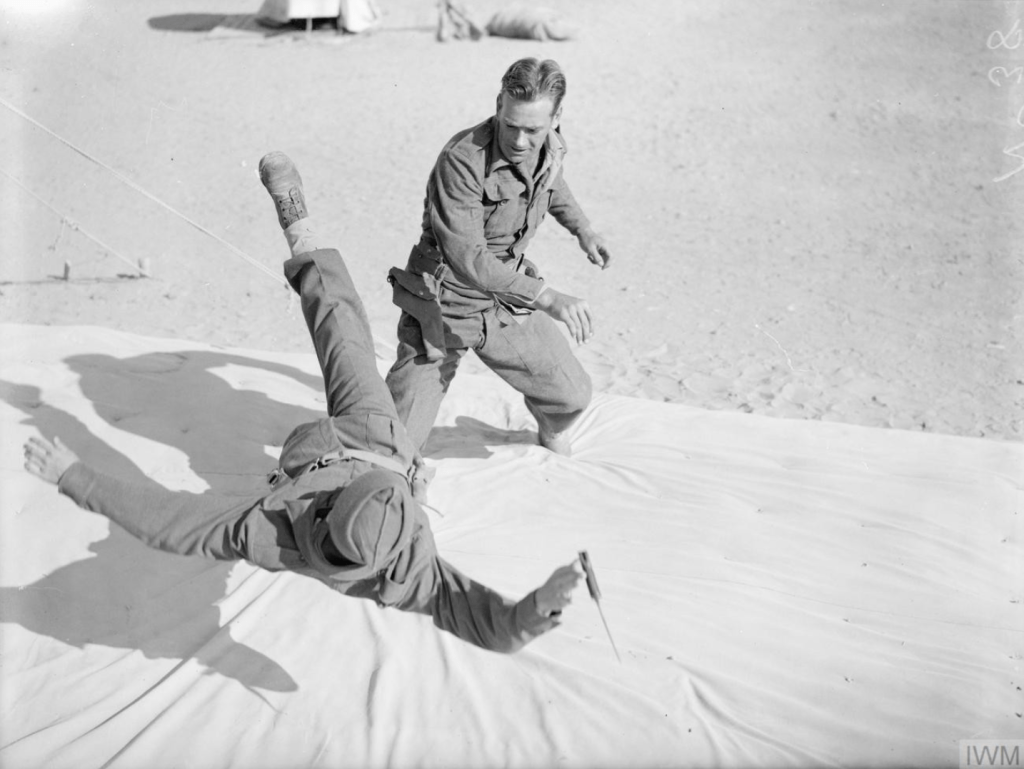
Commandos training in hand to hand combat at Kabrit in June 1943 (IWM)
In the series of photos taken during training at Kabrit, we can see numerous Commandos equipped with them and featuring in some quite dramatic photos from June 1943 – seemingly taken during training for Operation Husky. At first I thought the knives might have been made from the still-in-service 1907 Pattern sword bayonet used by the SMLE No.1 Mk.3. In some of the photos the scabbards appear to look like shortened 1907 bayonet scabbards with the same brass fittings and the knives appear to be retained by Pattern 1908 webbing bayonet frogs.
I also thought they might have been adapted from the even earlier 1888 Pattern bayonet for the Lee-Metford. But while they have a scroll to the front of their quillon/cross guard the shape of the pommel and the bayonet attachment point clearly differ.
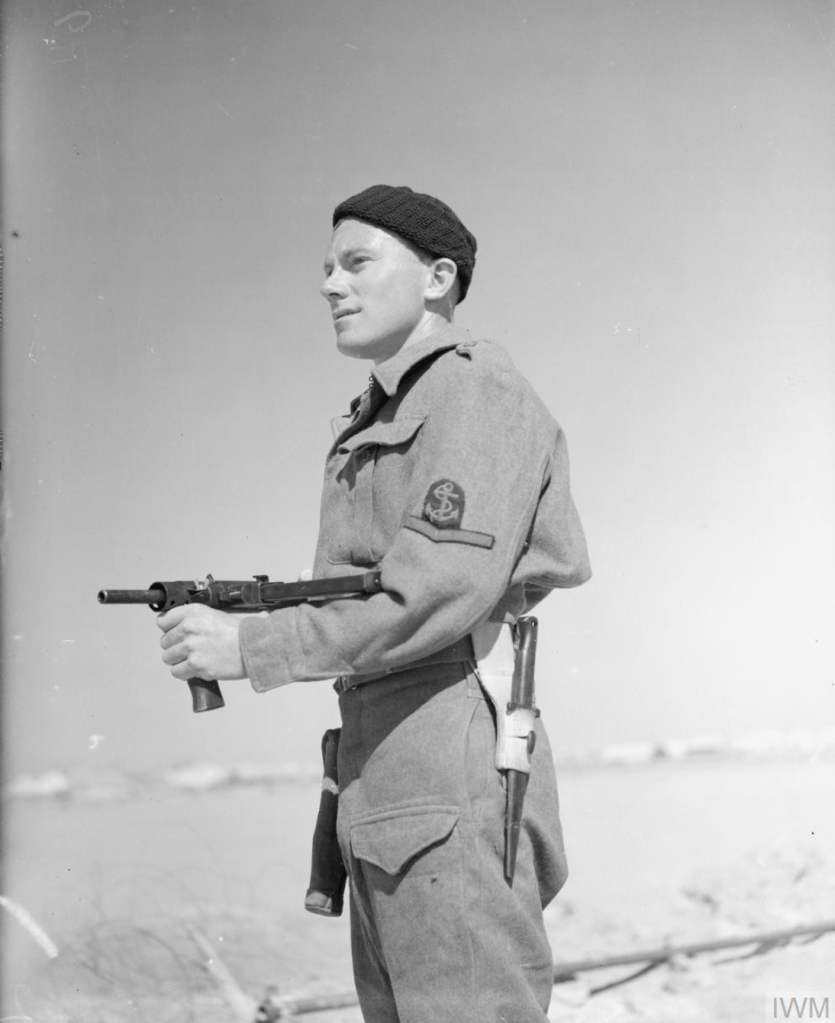
Naval commando with STEN MkII (with curious pistol grip) and a Commando knife made from a 1903 pattern bayonet (IWM)
Not being a bayonet expert I was a little stumped so posted about the photos on twitter and Kevin Dann was kind enough to mention that the knives are in Ron Flook’s book on British & Commonwealth Military Knives. Flook identified the knives as adapted 1903 Pattern Bayonets, originally introduced with the SMLE before the move to a longer bayonet.
Naval commando training June 1943 (IWM)
It seems that these knives were used by Commandos and they are also seen in some photos of SAS operating in the Aegean. I’m not sure who made these knives, some sources mention Wilkinson Sword making some F/S style knives from old 1888 and 1903 bayonet blades but state these had different grips. Perhaps these were put together by a unit armourer if proper issue knives weren’t available.
If you enjoyed this video and article please consider supporting our work here. We have some great perks available for Patreon Supporters. You can also support us via one-time donations here.Thank you for your support!
Bibliography:
British and Commonwealth Military Knives, R. Flook (1999)
Fairbairn-Sykes Commando Dagger, L. Thompson (2011)
On the 14th May 1940, the British Government announced the formation of the Local Defence Volunteers. By the summer of 1940 nearly 1.5 million men had volunteered to serve. The force was later renamed the Home Guard in July 1940 but remained under-equipped throughout the summer of 1940. Many of the newly raised militia units had just ‘LDV’ arm bands, some civilian firearms and improvised weapons, as uniforms and service weapons were in short supply.
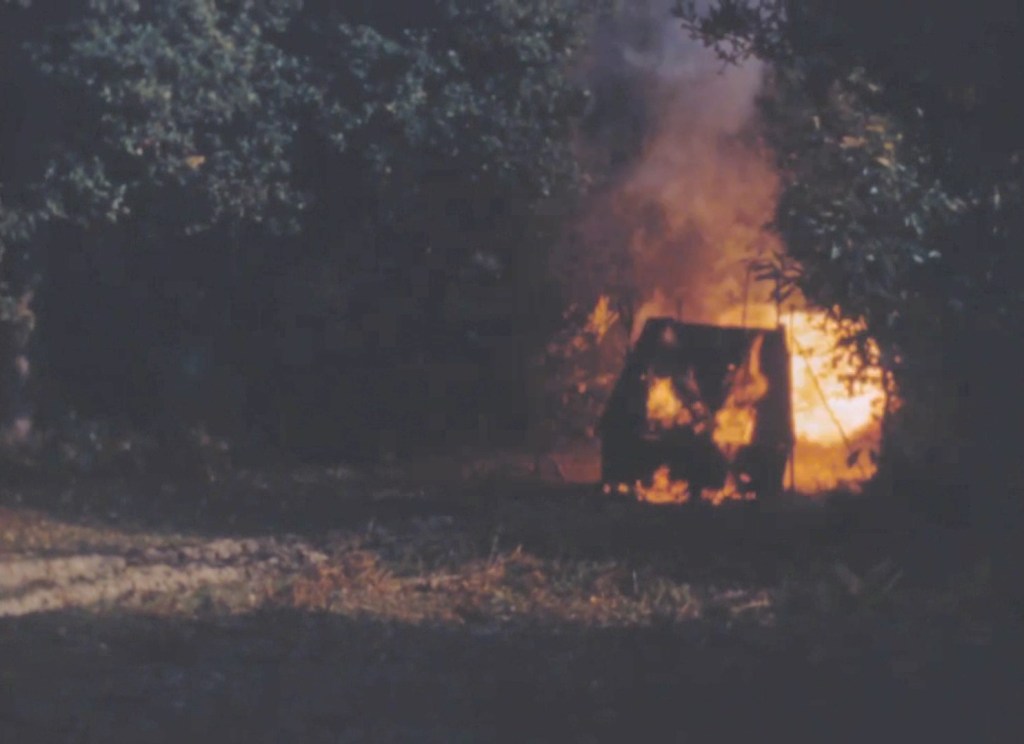
I recently came across a really interesting piece of footage showing a Hampshire Home Guard unit training with an ‘incendiary weapon’. With few heavy weapons available during 1940, some Home Guard units improvised. This remarkable original colour footage appears to show a reasonably effective incendiary weapon of some sort. But beyond what we can see we know very little about the weapon.
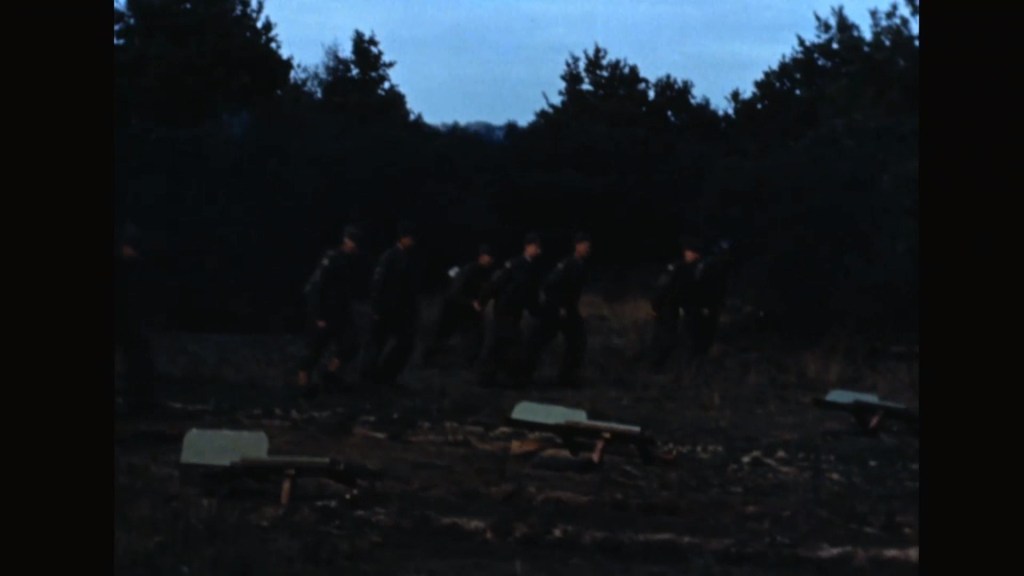
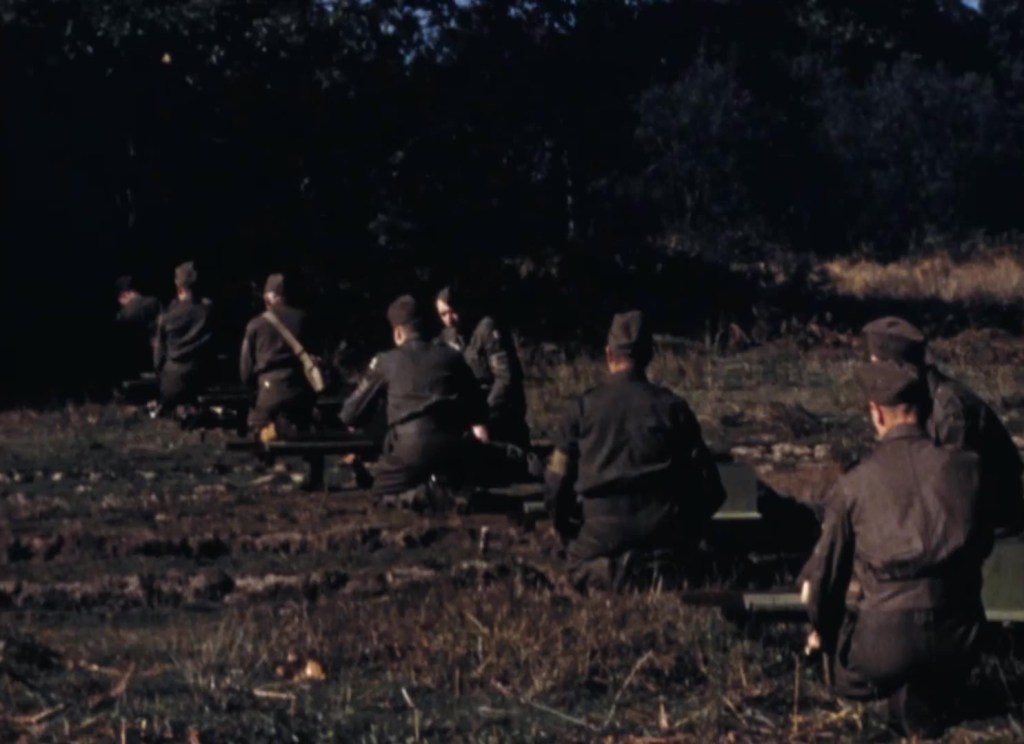
The footage shows a battery of five launchers, each seemingly with a 3 man crew. One man aiming, another loading and another firing. The footage is undated but from their arm bands we can see that the men are Home Guard so definitely post July 1940. The men also appear to be quite well equipped with caps, denim trousers and blouses and belts. No webbing is seen but we can potentially date the footage to between late 1940 and mid-1941.
Crews dash to their launchers. Note the rifle stock-shaped pieces to the side of the weapons which appear to have been used to aim the launcher
The incendiary weapon itself is extremely intriguing! I haven’t seen a similar weapon before and I couldn’t find any direct reference to it in the available original documents, newspapers or photos. The footage comes from the Wessex Film and Sound Archive, it is described as showing Home Guard men from Swanmore, a rural village in Hampshire, demonstrating the weapons. Before the incendiary weapon is demonstrated we see a company sized force of Home Guard parading, without rifles or other equipment, and then a single Home Guard member demonstrates loading an SMLE. From the footage we can get an idea of how the weapon would have worked.
Three-man crews sit by their weapons note the troughs projecting from the front of the launchers
The men run to the launchers, which appear to be made of wooden boards. Beneath them are rifle stock shaped pieces which the man at the rear seems to shoulder – probably to aim the weapon. The other two crew members kneel either side of the launcher. The footage then cuts away to another angle from the other side and shows one of the kneeling men hitting the rear of the projectile with a hammer. Then with a flash and puff of smoke the projectile launches forward. The man who aimed the weapon appears to have moved away, out of shot. Frustratingly the footage is a bit underexposed and quite dark so we can see too much more detail but we can see that the chap with the hammer is definitely hitting the rear of what looks like a length cylinder. The cylinder shoots to the rear while a projectile fires forward and the launcher’s crew look downrange.
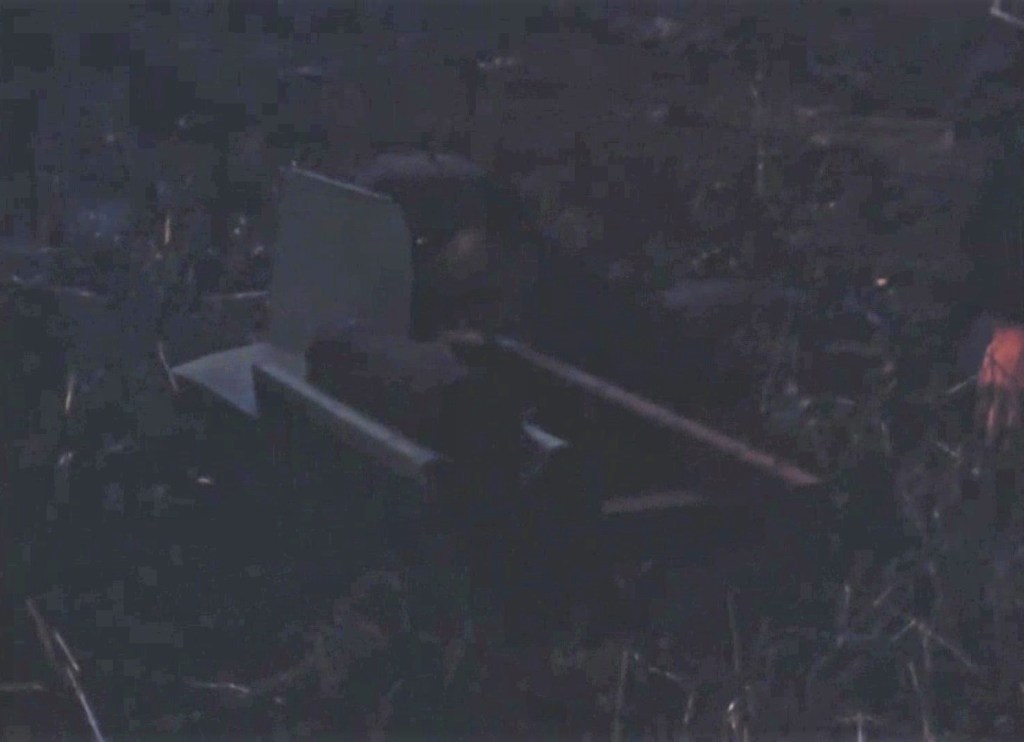
A somewhat low resolution close-up of the launcher. Note the crew member lying behind it aiming it along the wooden piece on the right. The projectile and launch cylinder sit in a trough while behind appears to be a shield to protect the crew member aiming
We then get footage showing what seem to be a series of impacts, likely from the projectile’s fired by the launchers. Then we get another clip of the men running to man the launchers and some more shots of the incendiary weapons exploding. From the available footage its pretty difficult to theorise how the launchers work. They appear to be using an almost proto-recoilless rifle-like principle with the launch cylinder shooting backwards and the projectile leaving the cylinder and firing towards the target. The crew member with a hammer may be hitting a percussion cap to detonate some black powder which projects the incendiary bomb. This system may have been developed to remove the need for a fixed, pressure bearing barrel. Making the weapon much simpler to manufacture.
The effect down range – the target well alight
The footage doesn’t give us too much indication of the range of the weapon but it’s distant enough that the men firing the weapon don’t appear to recoil when the projectile hits the target. The incendiary effect downrange is actually quite impressive and a battery of five of the launchers would have been an impressive sight and perhaps quite useful as a road ambush weapon which was something the Home Guard focused heavily on at the time. It wasn’t until later in 1941 that sub-artillery like the Smith Gun, Northover Projector and the Blacker Bombard began to enter service with the Home Guard. Until then some of the units took it upon themselves to create their own weapons, improvising contraptions like the one featured in this video.
Update 28/07/21:
The weapon somewhat fits the description of the ‘Jones-Wise Projector’ shared by David Lister in his book Forgotten Tanks and Guns. Thanks to BettongMI who brought this to my attention in the comment section of the video. The weapon was apparently developed by a pair of Home Guard officers and while turned down for regular service was used by some elements of the Home Guard in southern England, at least until official sub-artillery began to enter service.
If you enjoyed this video and article please consider supporting our work here. We have some great perks available for Patreon Supporters. You can also support us via one-time donations here.Thank you for your support!
Bibliography
Home Guard and home-movies in Swanmore, Wessex Film and Sound Archive via the BFI, (source)
Britain’s Final Defence: Arming the Home Guard, 1940-1944, D. Clarke (2016)
Forgotten Tanks and Guns of the 1920s, 1930s and 1940s, D. Lister (2018)
This week we tackle a truly harrowing film. Arguably director Peter Watkins’ finest work, 1966’s ‘The War Game’. An anti-nuclear war film that takes Watkins’ pseudo-documentary style to its pinnacle to tell the story of what a Britain during a nuclear war might look like. Suppressed by the BBC and government the film still won an Oscar. We are joined by author and host of the Atomic Hobo podcast, Julie McDowall to discuss this very important film.
We return to the Projector, Infantry, Anti-Tank’s long and storied on-screen career. This time we are examining a scene from ‘Paper Tiger’ (1975). It’s an interesting film, and certainly not one you’d expect a PIAT to pop up in! David Niven plays Mr Bradbury, a tutor to a young Japanese boy. Bradbury is a Walter Mitty-like character that regales the child with made up tales of his wartime escapades.
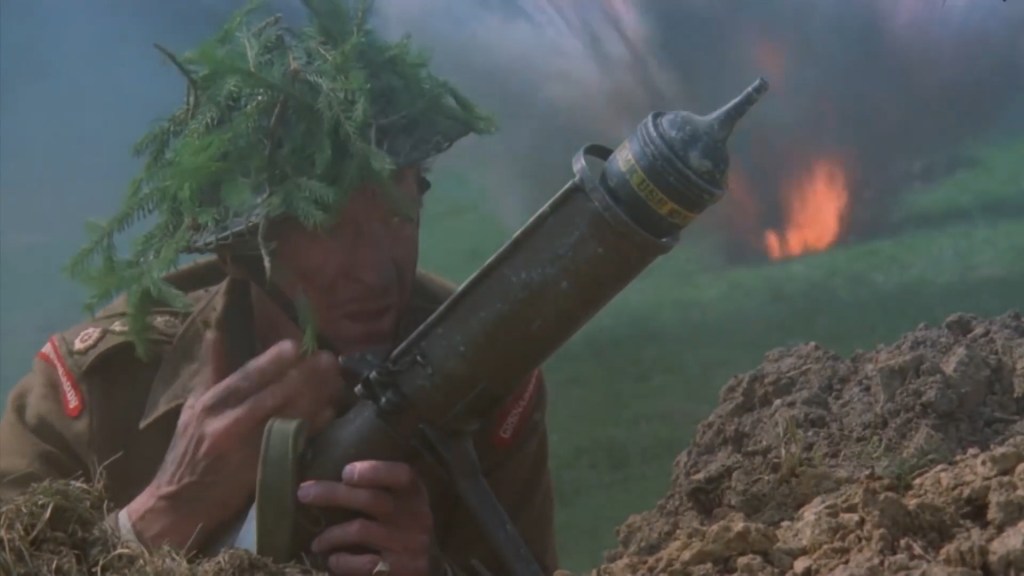
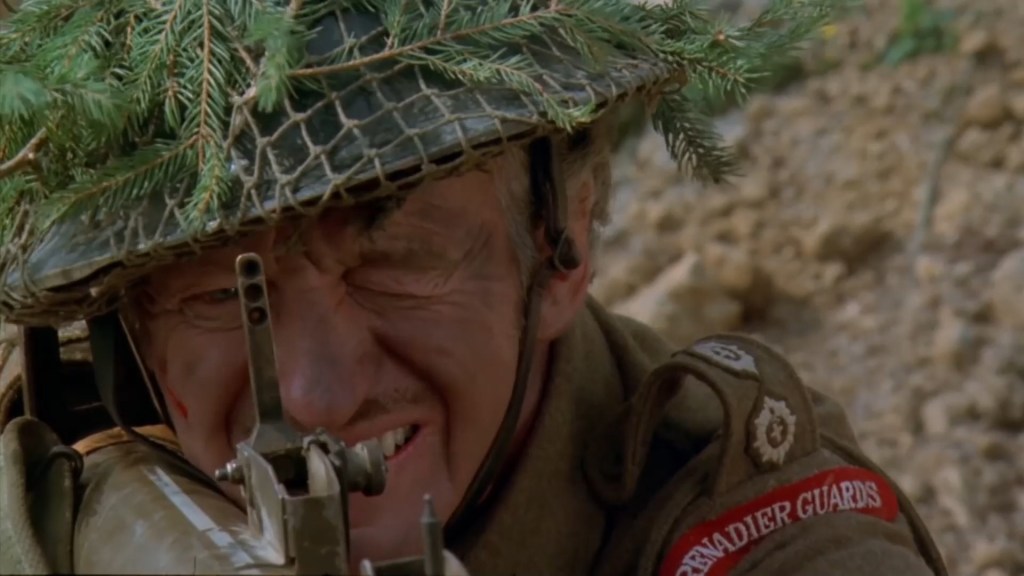
Early in the film Bradbury describes a battle in France in October 1944. Niven’s Character is shown to be a member of the Grenadier Guards and receivers orders to take an enemy pill box. Bradbury describes how he attacked the German position single handed. The sequence begins with what looks like a platoon making a frontal assault.
Niven receives a call from his commanding officer and then asks his Sgt to hand him ‘the bazooka’. But it’s not a Bazooka he’s handed but a PIAT! Now it’s quite the faux pa’s to call a PIAT a Bazooka but I imagine the script called for one and the film armourer brought along British weapons to fit the action involving the Grenadier Guards.
Niven’s character then charges across the ground in front of the pillbox. He takes cover in a shell crater and we can see that the bomb loaded into the tray is painted black with a yellow stripe – this denotes that its actually an inert drill round. – If we look closely inside the yellow stripe it also appears to have the words ‘drill use’ written on it. Note how far forward the bomb appears in the bomb support – this suggests that the weapon isn’t cocked and that the bomb has just been slid down onto the spigot to make it look loaded.
Before he can take on the pillbox a German armoured fighting vehicle (which is actually a disguised American M8 Greyhound) crests the ridge. Niven takes aim with the PIAT and knocks it out. As he aims, we can see the PIAT has the later pattern 3 aperture rear sight rather than the earlier 2 aperture. The apertures are for 50, 80 and 110 yards. The PIAT, however, is missing its webbing butt pad and gaiter cheek rest. But we can see the white indirect aiming line painted along the top of the PIAT for use in the light mortar role!
As the Greyhounds crew bails out Niven draws his revolver and shoots the crew with a style that pastiches many war films. Leaving his PIAT Niven runs forward and we see that the spigot is forward in the bomb tray – this means he would have had to manually re-cock the weapon before firing again! As he runs we can see he has another PIAT bomb handing from his belt. I’ve never seen any contemporary photos or documents referencing this method of carrying bombs – in reality they would have been carried in a 3-bomb bomb carrier.
He throws a No. 36 (Mills) grenade into the pillbox with perfect aim. Another funny nod to a common war movie trope! The bunker is knocked out and the enemy surrender en masse. It’s an interesting little scene, Niven as always is great and of course as a veteran of the war and an officer he would have been familiar with the PIAT.
Check out the rest of our videos looking at on screen PIAT portrayals here.
If you enjoyed this video and article please consider supporting our work here. We have some great perks available for Patreon Supporters. You can also support us via one-time donations here.Thank you for your support!