One of the more surprising pistols to appear in Ukraine is the French MAC Modele 1950. The MAC 1950 is a 9x19mm pistol which was adopted by the French armed forces in the early 1950s. It was supplanted by the PAMAS G1, a French-manufactured Beretta 92, in the early 90s, which is now in turn being replaced by the Glock 17. It would appear that France has provided the MAC pistols from their stores. It is unclear if any PAMAS G1s have been provided, as there are a number of Beretta 92 variants in use in Ukraine.
The MAC 1950 is a short recoil, locked breach pistol which feeds from a nine round single stack magazine. Compared to more modern pistols, and even some of its contemporaries, the MAC 1950 is somewhat obsolecent. As a sidearm, however, they are likely adequate for the roles they fulfil.
The first imagery of a MAC 1950 I have come across dates to in February 2025. I’ve been unable to find the original source of the images.
#Russia / #Ukraine 🇷🇺🇺🇦: A combatant of #Ukrainian Forces released photos of his recently-obtained pistol.
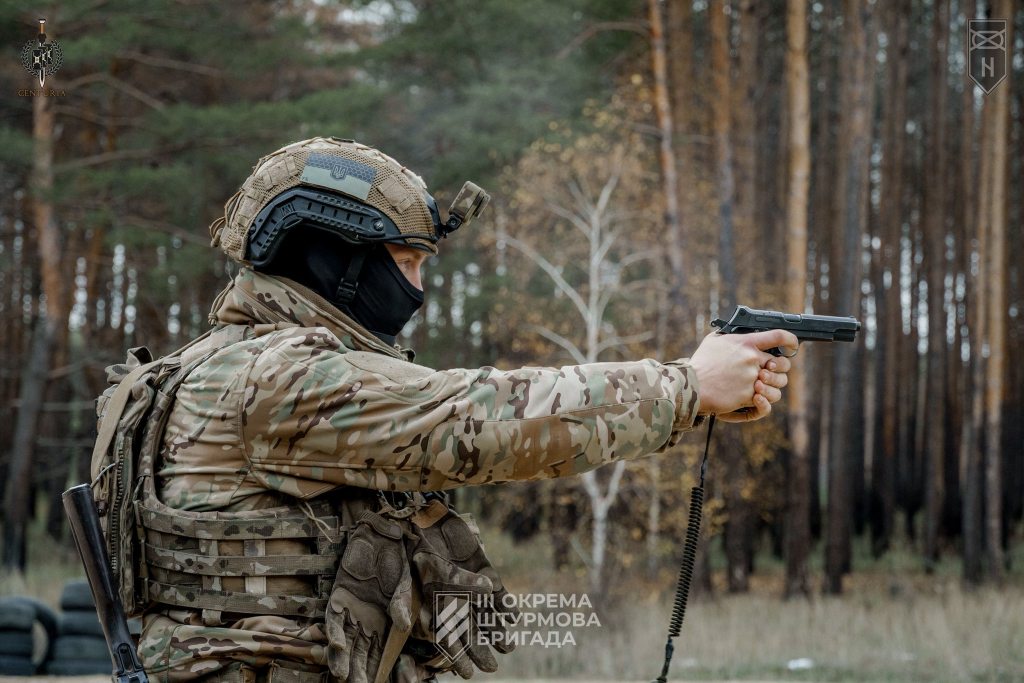
More recently, on 17 November, a second sighting came when the 2nd Mechanised Battalion of the 3rd Assault Brigade shared a photograph featuring a French MAC 1950 pistol being fired during a training session.
Іван Савельєв, an armourer affiliated with the 3rd Assault Brigade, has also noted that some units are short on pistols and have issued MAC 1950s.
The pistols do not appear in either of the equipment lists released by the French government in 2023 and 2024.
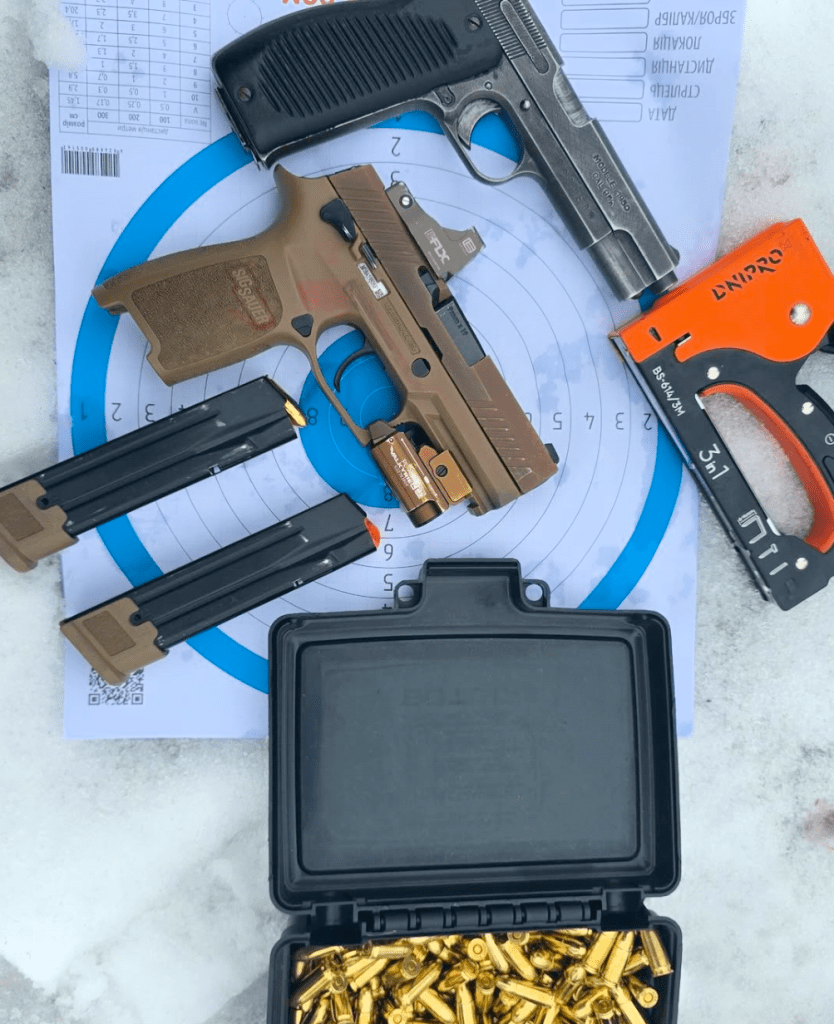
Most recently, I came across another photo shared by a Ukrainian serviceman featuring a MAC Modele 1950, shared on 30 January (alongside a SIG Sauer P320).
My thanks to Weapons Illustrated for assistance.
This is one of the ‘research note’ videos I share on the TAB Patreon. It highlights early research into a weapon spotted in use in Ukraine ahead of a fully fleshed out video! If you found this interesting and enjoyed a look at the process of doing the research and making these videos check out Patreon for more of them (3 more in the editing stage at the time of posting). Check out the TAB Patreon page here.
The APILAS or Armour-Piercing Infantry Light Arm System, developed by France’s GIAT Industries in the early 1980s, is perhaps one of the rarest shoulder-fired anti-armour weapon systems to appear in Ukraine. APILAS is a 112mm anti-armour weapon with a 1.5kg shaped charge warhead capable of penetrating more than 750mm or rolled homogeneous armour.
The APILAS seen in Ukraine are most likely to have originated from either France or Finland, with Finland being the more likely.
In late February 2022, with Russian forces massed on Ukraine’s borders, the Finnish government made a rare public declaration of military aid to Ukraine. This included figures for a number of different weapon systems. The announcement stated: “Finland will deliver 2,500 assault rifles, 150,000 cartridges for the assault rifles, 1,500 single-shot anti-tank weapons.” The announcement didn’t specify the type of anti-tank weapons to be sent; however, and from Finish inventory these may have included APILAS, M72 LAWs or even NLAWs.
An APILAS seen in a video dating from 2021, filmed during fighting on the Donbas line of contact (via social media)
APILAS have been seen in Ukraine before Russia’s invasion in 2022, one was seen in a video dating from November 2021. It is unclear when the first APILAS were first transferred to Ukraine, and the weapons seen subsequently may originate from an earlier, pre-2022 invasion transfer.
APILAS in a Ukrainian armoury, c.2023 (via social media)
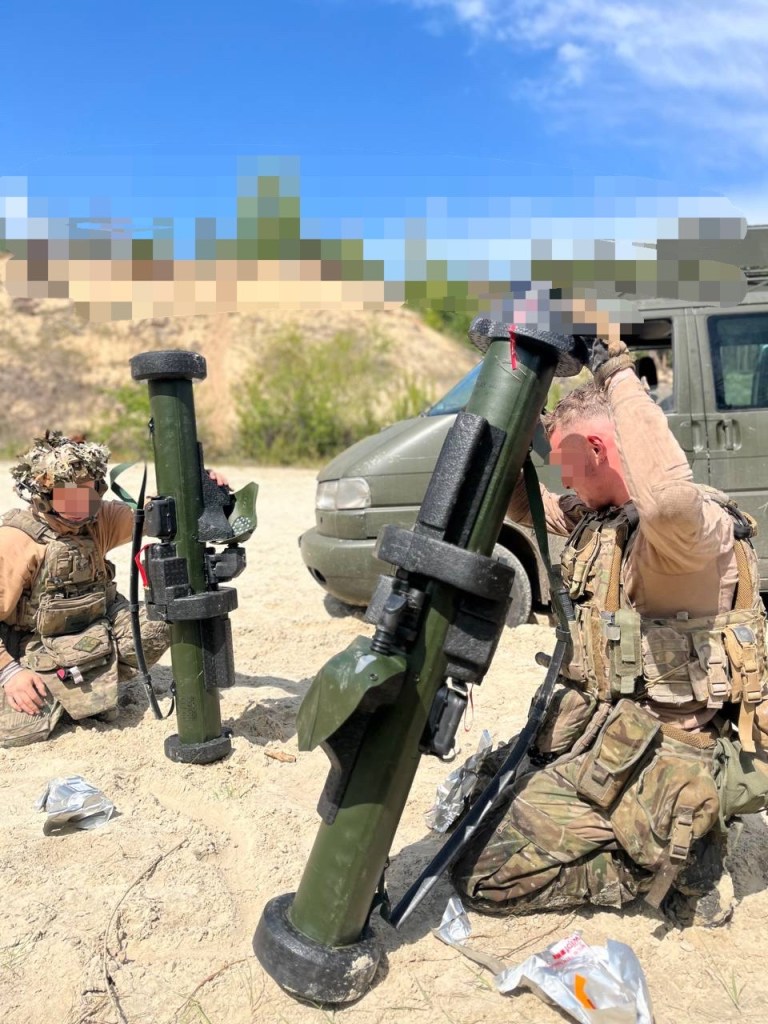
In April 2023 a photo of an APILAS in a Ukrainian armoury surfaced, sadly no markings are visible in the image. Several months later, on 19 and 20 June, Red Line Team, a unit affiliated with the Ukrainian security services special forces unit, SBU-Alpha, shared imagery from a range trip where a wide variety of anti-armour systems were fired. One of the weapons featured in the video was an APILAS.
(Red Line Team)
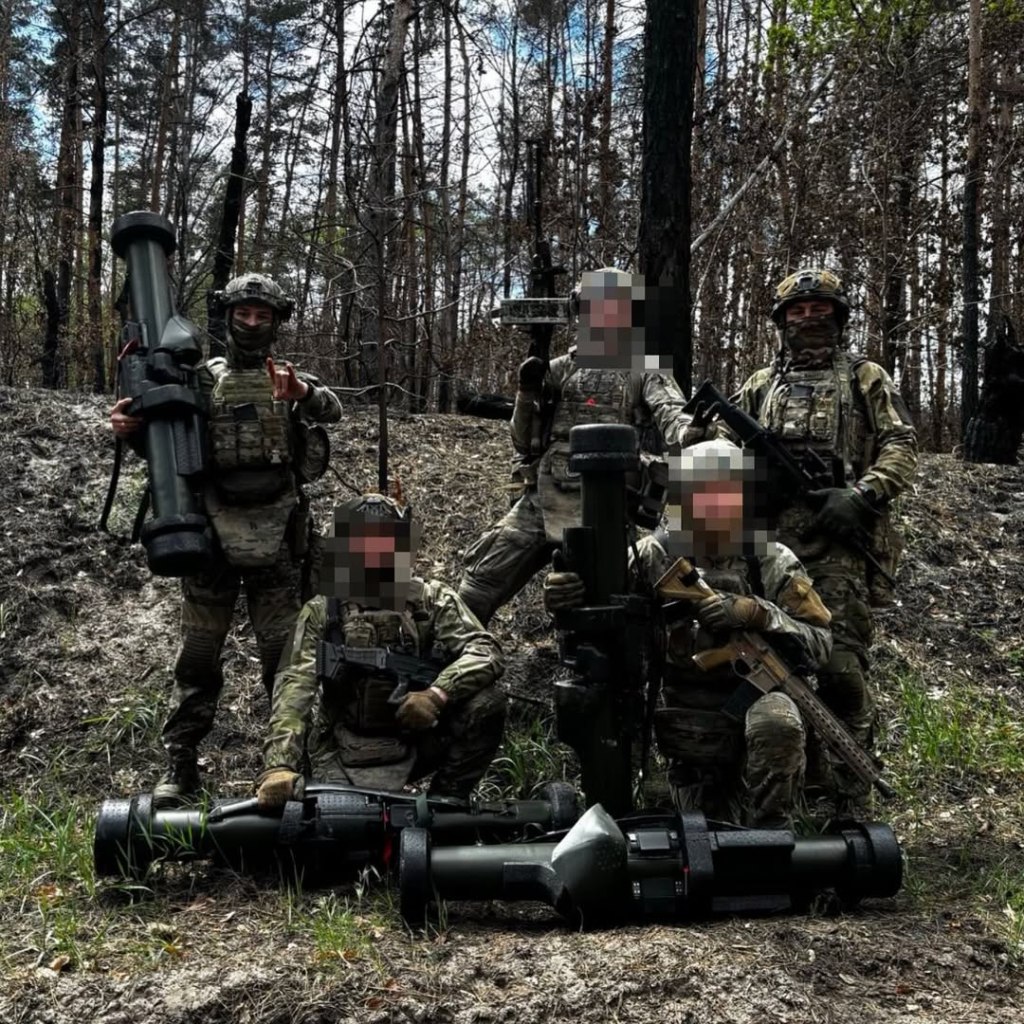
APILAS have also been seen with the Assault Bastards, a unit believed to be part of the Kraken Regiment’s 2nd Assault Company, which is part of the Department of Active Operations of Ukraine’s Intelligence Directorate (the GUR). On 13 May, the unit shared a group photo which also featured three APILAS.
(Assault Bastards)
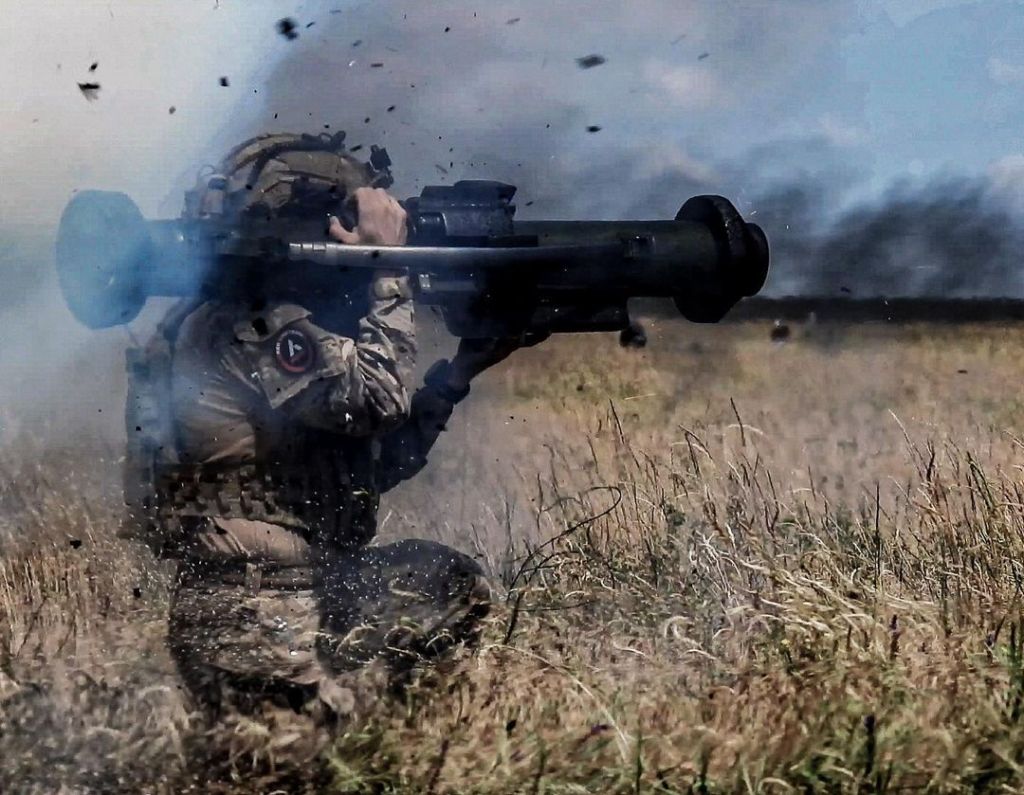
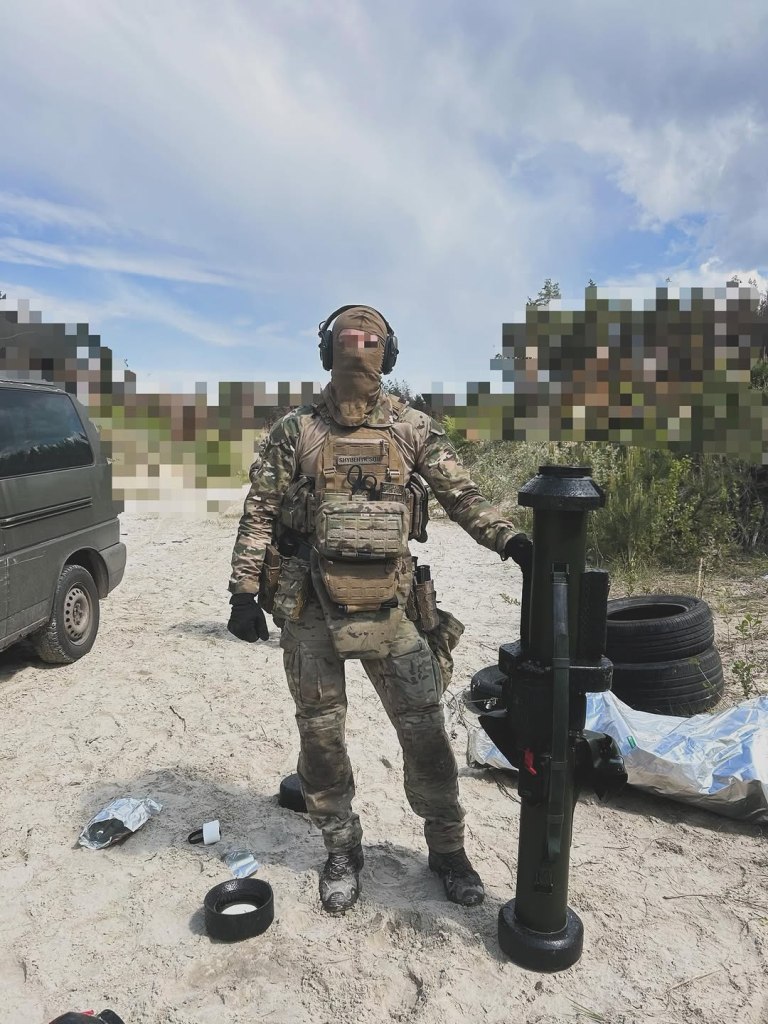
Most recently Shybenyk.Squad, another unit with Kraken’s 2nd Assault Company, shared a photo of an APILAS. This photo also appears to have possibly been taken at a range rather than in the field. Speaking to Shybenyk.Squad they explained that they have a decent number of APILAS in store and have used them operationally.
(Shybenyk.Squad)
APILAS has a reputation for having considerable concussive force when firing but Shybenyk.Squad noted that it’s blast isn’t that bad comparatively, describing it as ‘not critical’, during a recent trip to the training range the unit test fired 6 APILAS.
While APILAS are rarely seen in imagery from the conflict Shybenyk.Squad noted that they have a significant number of them in stores. They favour them for operations where more expensive complex systems, like NLAW or Javelin, may be lost. Shybenyk.Squad explained that “they can definitely be useful in certain situations… [systems such as] NLAW are much more expensive, high-tech, more effective, but losing it is much more problematic and in some risky tasks it is better to take a less expensive weapon.” In general they noted that they favour the AT4 and RGW-90 Matador “due to the weight to the corresponding firepower and ease of use.”
(Shybenyk.Squad)
Operationally they favour the APILAS’ for its penetration capabilities, with sources suggesting it can penetrate around 2 metres of concrete, making it is an excellent weapon for mouse-holing – breaching structures. Shybenyk.Squad explained that they “once used it to break through a small wall to storm a building from a blind side not protected by the enemy.”
APILAS is one of the most rarely seen anti-armour weapons currently being fielded in Ukraine so I’m pleased to be able to share some good first hand imagery and feedback on its capabilities.
Special thanks to Shybenyk.Squad for sharing additional imagery and sharing their thoughts on APILAS.
Support Us: If you enjoyed this video and article please consider supporting our work here. We have some great perks available for Patreon Supporters – including early access to custom stickers and early access to videos! Thank you for your support!
Following on from our recent examination of RPG-UGVs a new armed unmanned ground vehicle variant has appeared – the MANPADS-UGV. MANPADS or Man-Portable Air Defence Systems have been a key weapon during the war in Ukraine. They enable troops to engage drones and UAVs of various sizes as well as helicopters.
(LIBKOS/28th Mechanized Brigade)
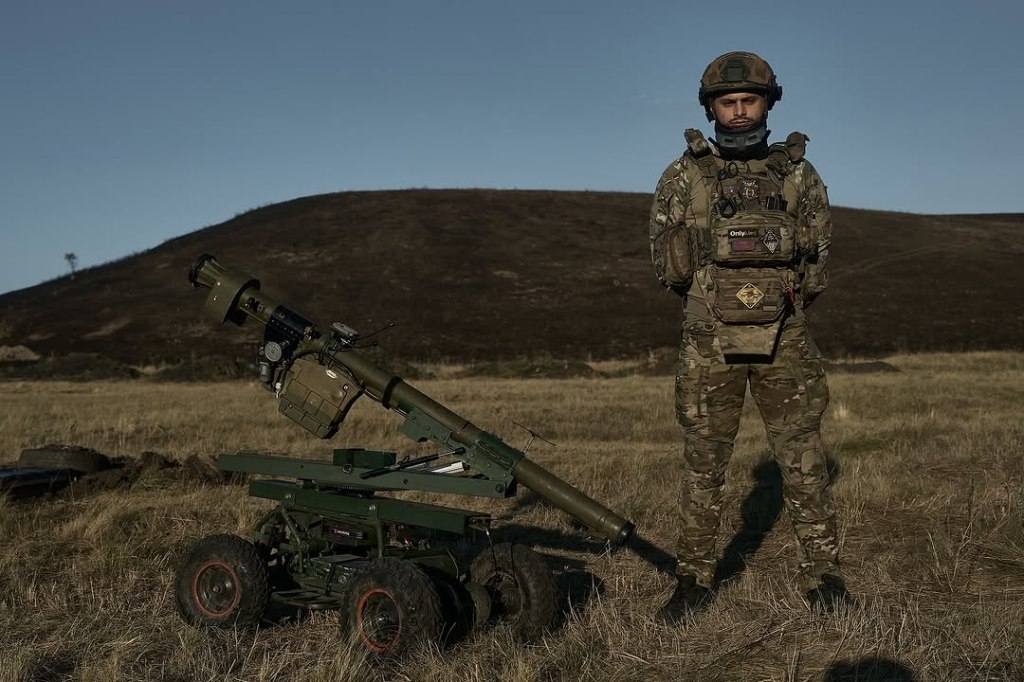
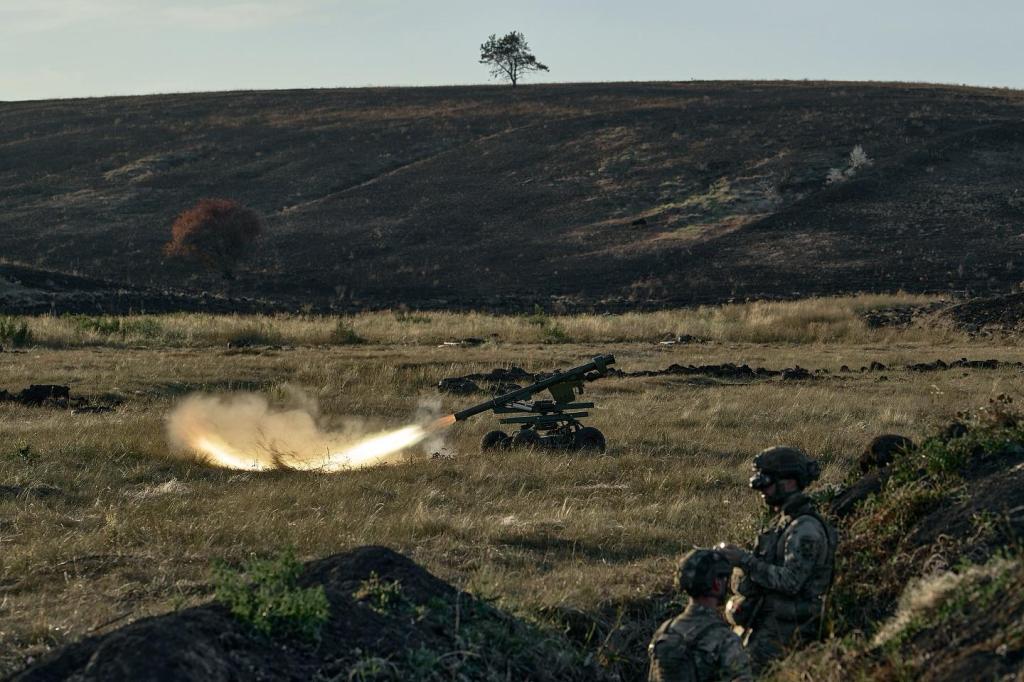
On 4 August, photographers Libkos, shared a video showcasing an Igla-1 MANPADS mounted on a four-wheeled UGV operated by Ukraine’s 28th Mechanized Brigade. In an Instagram post, Libkos explained the idea behind the MANPADS-UGV:
“If before they were quite easy to shoot down with MANPADS, now Russian UAVs control every movement of our infantrymen and often do not even allow them to leave the trench. That is why the guys from @28ombr created this robotic platform. It independently guides and hits any large air target. The guys have already tested it in action and it already has one enemy helicopter on its account. So we are collecting 10 more such platforms. This is an effective and innovative weapon that is independently manufactured by the military from 28 Ombr.”
— Matthew Moss | The Armourer's Bench (@historicfirearm) August 4, 2025
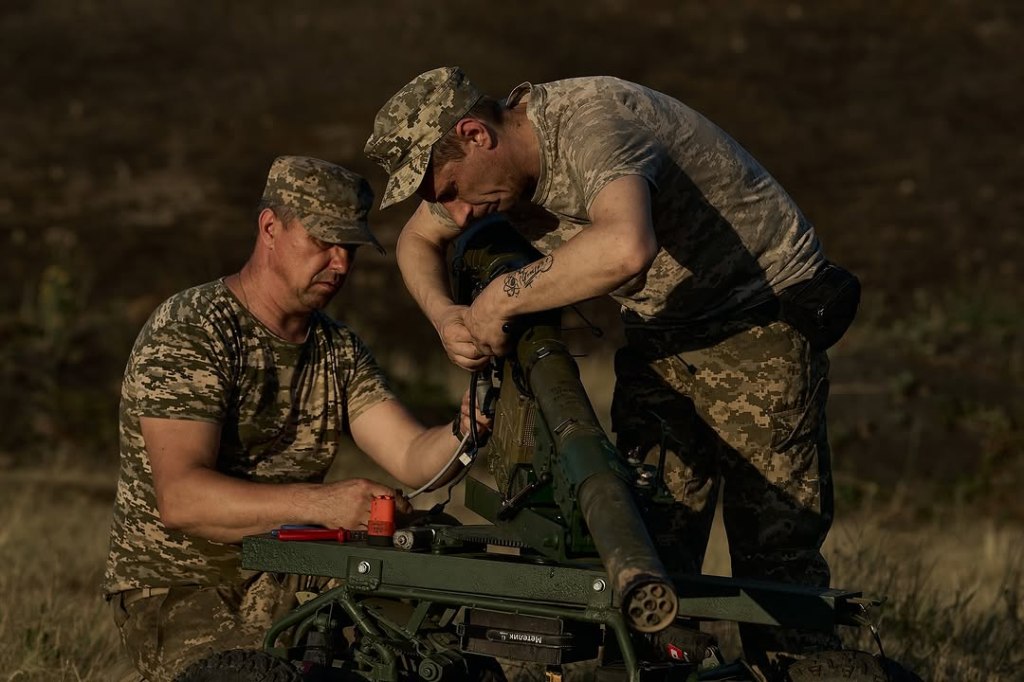
The available imagery, shared by Libkos and the brigade, shows the UGV being test-fired. The Igla is mounted on an angled mount, which seems to have a degree of elevation and traverse. There appears to be a motor and servo system attached to the front of the weapon to act on its trigger. Behind this is what may be a camera and transmitter/receiver. In part of the promo video a pair of operators are seen in a nearby trench, one wearing a headset for the UGV’s camera feed.
Ukrainian media outlet Defenderreports that the MANPADS-UGV has been named “Alycha”.
(LIBKOS/28th Mechanized Brigade)
It’s difficult to tell how the system would be used in practice or how effective it would be. MANPADS such as Igla-1 use infrared homing and require the operator to track the target before launching. The operator has to visually detect the target, activate the power supply unit, aim at the target via the fore and rear sights and pull the trigger. While the operator doesn’t have to track the target once the missile is fired they must track it immediately prior to launch. How capable the UGV is of doing this is currently unclear. For the best image clarity and response time for identifying and tracking a target it would make sense for the UGV to utilise a fibre-optic control cable but there is no evidence of this in the available imagery.
It is unclear if the system can be equipped with different types of MANPADS. In theory the UGV could be mounted with Igla, Strela, Piorun or even Stinger, as such one variable to consider is the system’s engagement range. The Igla-1’s operational engagement range is 6km (3.5 miles) with an 11,000 feet engagement ceiling. Given Ukraine’s focus on defensive strong-points the gap between positions able to engage aerial threats with a MANPADS may be relatively wide. If small Ukrainian units are defending strong-points along a stretch of front they may have a limited embedded anti-air capability. A MANPADS team would have to expose itself to reach various points along the unit’s sector of the front so having a UGV which can be rapidly deployed makes sense.
(LIBKOS/28th Mechanized Brigade)
Nevertheless the concept is an interesting one. the 28th Mechanised Brigade claims that the system has already been used operationally and the UGV has successfully engaged an enemy helicopter. Verifiable proof of this kill has not yet been provided. There are no doubt useful applications for the system, such as patrolling an area, as a quick reaction asset and in removing the need for troops to leave cover to engage aerial threats.
There are a lot of different types of general purpose machine guns in use in Ukraine and one of the most surprising to appear so far is the M60. The first appearance of an M60 in Ukraine came in September 2024, when the 23rd Mechanised Brigade shared an album of training photos which included an individual firing an M60D.
A month later the same brigade shared another photograph of the M60D. The M60D is usually mounted on helicopters as a door gun and as such it has been adapted with no stock or traditional rear sight, instead it has a pair of rear spade grips and a large ring sight. It’s unclear how many M60Ds are in Ukraine or where the guns originated from as a number of potential donor countries operate M60Ds as door guns. It may be the case that a donor nation provided the gun aboard a donated helicopter, we have previously seen French AANF-1 GPMGs appear in Ukraine – likely supplied with VAB APCs. Alternatively, the gun(s) may simply have been provided by a donor for whom it was surplus to requirements and ready for disposal.
Another sighting of an M60D came in May 2025, when the 65th Mechanized Brigade shared a series of photographs of a machine gun team training with one of the guns. Sadly, no markings are visible to confirm if this might be the same gun as previously seen with the 23rd Mechanised Brigade.
The M60D is not the easiest variant to utilise in a ground role with the absence of a stock to shoulder the weapon making it somewhat difficult to aim and keep on target while firing. It does have a folding carry handle but it also had an exposed trigger linkage which is far from ideal for ground use. The best use for this variant would probably be as a pintle-mounted an anti-air gun.
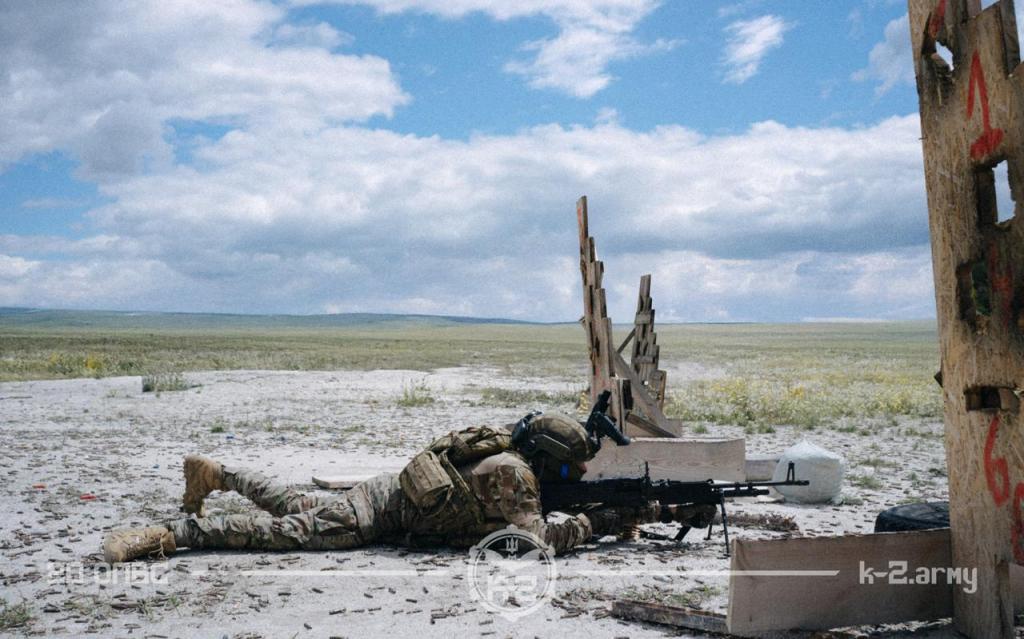
Most recently a new variant of the M60 was seen in a photo posted, on 18 July, by the 20th Separate Regiment of Unmanned Systems “K-2”. The gun appears to be either an M60E3 or an M60E4, with what appears to be a 22 inch barrel, the first ground role variant to be seen in-country. As with the M60Ds it is unclear where this M60 may have originated from, there are only a small number of nations which operate the weapons which may have donated it. Elements of the Czech Republic’s special operations forces operate E4s in small numbers but its unclear if this is the source of the gun seen in the recent photo.
It remains unclear just how many of the various variants of M60 are on the ground in Ukraine and where they came from but it is one of the weapons that I’ll continue to track, if you spot any let me know!
Update 12/10/25:
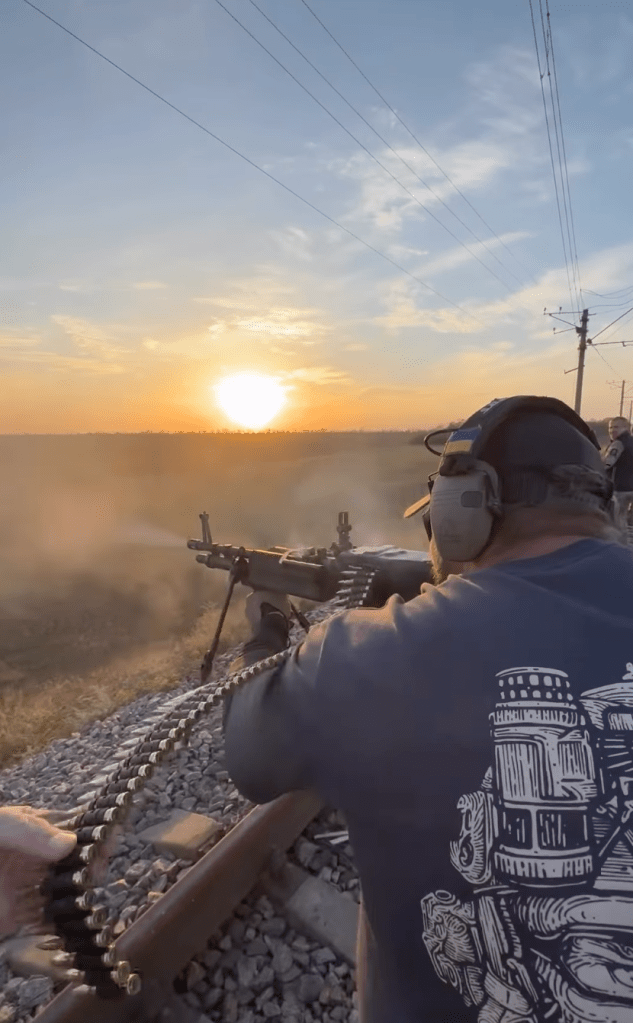
Serhii Filimonov, a member of the 1st Assault Regiment (Da Vinci Wolves), has shared several photos that appear to include an M60E4.
There is also a short video of him firing the weapon. Below is a still from the video.
Update – 17/11/25:
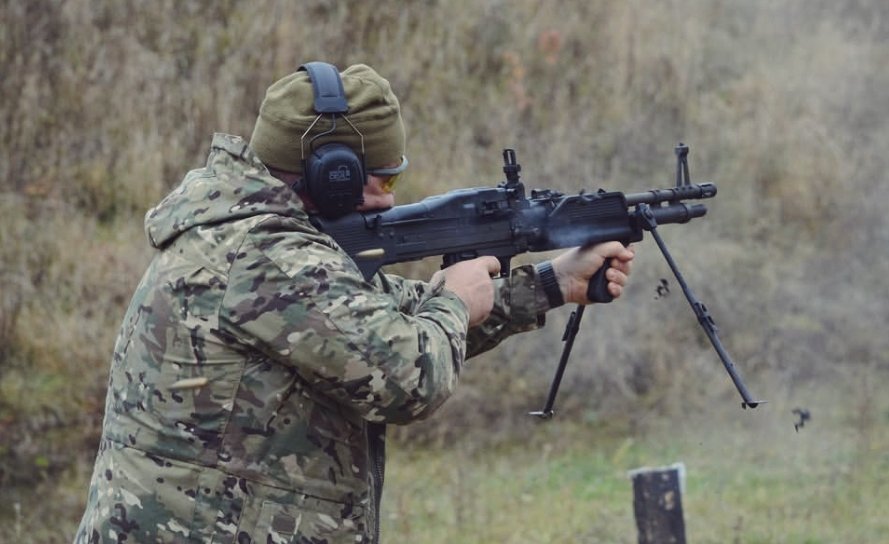
On 14 November, Raven Group, affiliated with the Ukrainian Directorate of Intelligence, shared a serious of range photos featuring an M60E4 (in what appears to be the Mk43 Mod 0 configuration). [H/t to Praise the Steph].
Support Us: If you enjoyed this video and article please consider supporting our work here. We have some great perks available for Patreon Supporters – including early access to custom stickers and early access to videos! Thank you for your support!
Since our last article/video on gun-armed drones in September 2024, both sides have continued to develop the technology. Numerous Ukrainian teams have developed recoilless ‘shotgun’ drones designed to hunt other drones as well as developing and fielding an AK-armed FPV. The Russians too have returned to the concept in recent months showcasing a number of gun-armed drone systems.
In December the first footage of a Ukrainian gun drone appeared, it utilised the recoilless gun concept. Several videos were shared of an FPV drone equipped with a pair of barrels which are likely electrically initiated and have counter-weight charges as the earlier Russian drone did. The videos showed a series of successful drone vs drone engagements.
On 7 February, Russian Telegram channel, FPV Covenant, shared footage of a gun-drone being tested, with the caption “Testing a shooting drone. The bird has two cameras, a night camera and a thermal imager.” The drone appears to have a single barrel and on firing is jarred considerably by recoil, this indicates the lack of a recoilless, recoil mitigation system.
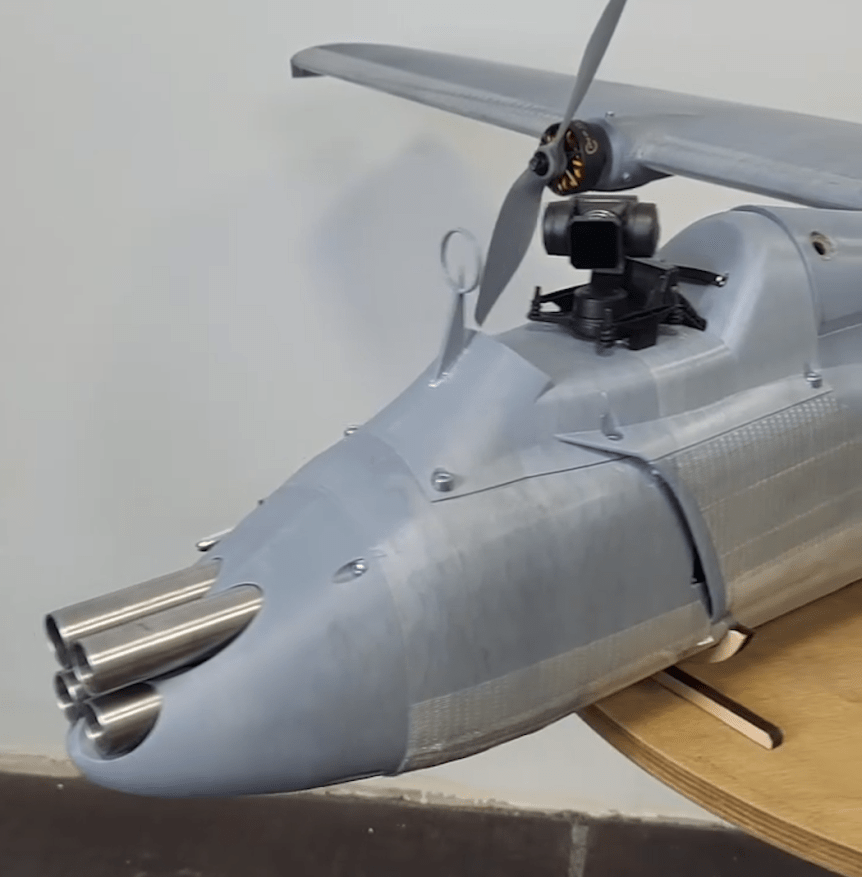
In the first indication of Russian state efforts to develop a gun-armed drone the Осоед-Д , developed by the Novgorod scientific and production center “Ushkuynik”, was unveiled to Russian media on 20 February. The Осоед-Д has four barrels and appears to incorporate a recoilless counterweight system. Very little imagery of the system is available but it’s developers claim it has a degree of autonomy and can find and attack targets within an area once ground detectors locate a target. One article states that the drone “has already been put into operation”.
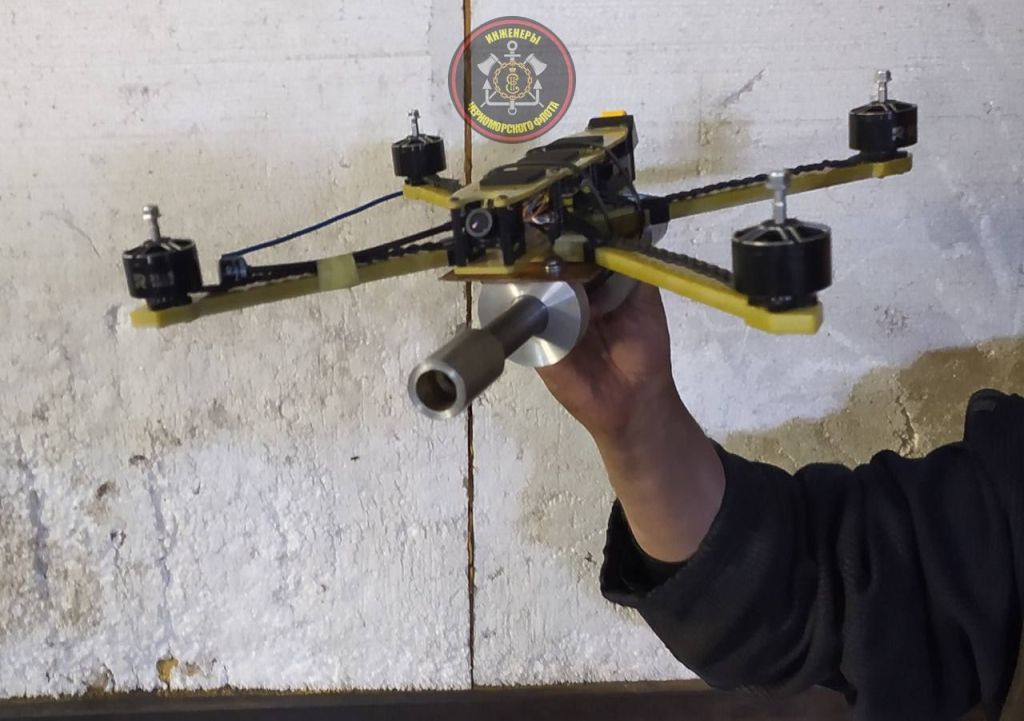
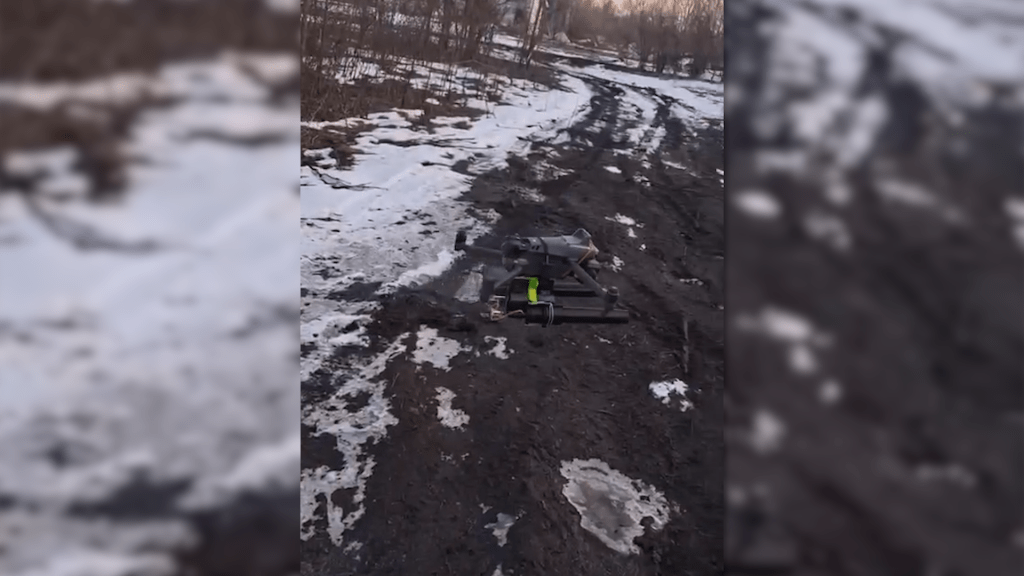
On 6 March a Russian Telegram channel, affiliated with the engineers of the Russian Black Sea Fleet, shared test footage and photographs of a new gun system which can be mounted on small drones. The Telegram post highlights that the system uses the recoilless principle to mitigate recoil and it reportedly utilises standard 12 and 16 gauge shotgun cartridges. It is claimed that it has an effective engagement out to 20 metres and that the aiming of the gun is done through the standard drone camera. The post also claims that operators can “you can hang from 2 to 4 barrels on the drone.” The size and power of the drone would likely have to be greater than a standard Mavic or Russian FPV to mount more than one or two barrels and greater payload reduces range. The post includes a photograph of the barrel assembly on a scale reading 700.9g. (1.5lbs) but a video caption notes when loaded the weight is closer to 780g.
The telegram post includes a pair of videos showing the gun system being tested at a range. The first video shows a 10in quadcopter drone equipped with a 16 gauge gun system. The drone takes off and fires down range, while the recoil is noticeable the drone continues to hover.
In the second longer video the drone appears to struggle to initially maintain a stable altitude/hover but this may be an operator error. The drone travels downrange and fires on a target from a distance of 3.5 metres. The video cuts to show the effect on target with several dozen shot holes. Incidentally, the box is for AI-Thinker RA-08 transceiver modules made in China.
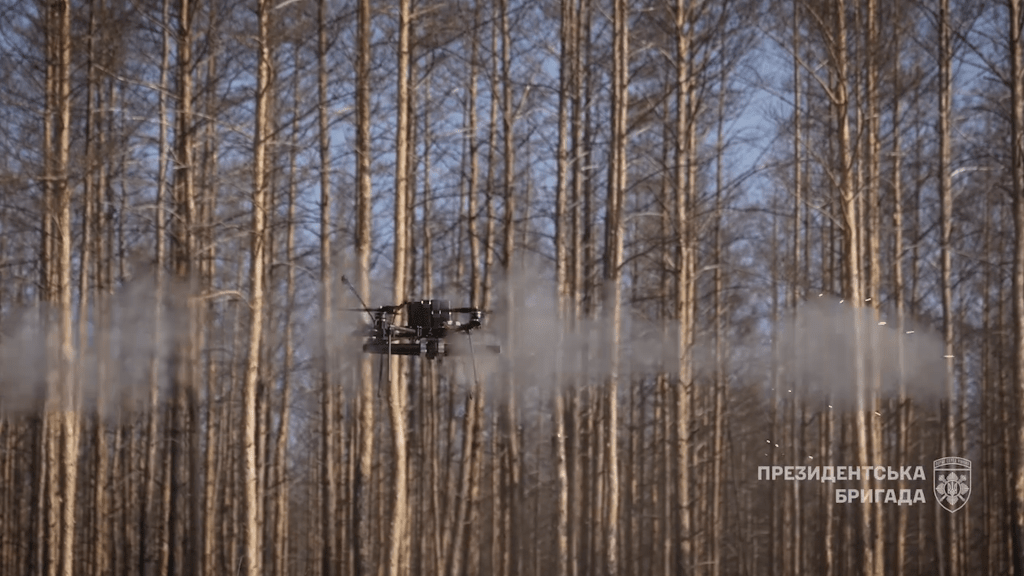
Meanwhile on 7 March, a drone unit with Ukraine’s Separate Presidential Brigade shared the best look at a Ukrainian gun-armed drone we’ve seen so far. We’ve previously seen the Bulava drone team, which part of the 3rd battalion of the Separate Presidential Brigade, deploying drones equipped with rifles and RPGs. These drones were developed with the help of Wild Hornets (a Ukrainian drone manufacturing organisation).
The gun-armed drone seen in the video is operated by the 4th Mechanized Battalion and is based on a Lucky Strike-manufactured quadcopter drone. It’s unclear if Lucky Strike has assisted in the development of the gun system.
In the video we see the drone operators drop in a 12 gauge cartridge into a barrel, notably the cartridge’s primer has been removed probably to enable electrical ignition. The video does not show the counter-weight system likely to avoid breaches of operational security on how the system works. The drone can be seen mounted with a pair of barrels and when firing is demonstrated its clear that the larger drone is able to compensate for any remaining recoil the counterweight system can’t mitigate. Its also possible that the Ukrainian counterweight charge has been more finely tuned to the charge of the firing barrel. The operator explains that even a small number of hits from relatively small shot can be effective on target and that one of their primary targets are DJI Mavics which the Russians use for Intelligence, Surveillance, and Reconnaissance (ISR). In terms of doctrine the video explains that they try and engage with one barrel but if they want to be sure of hitting a target they can fire a salvo of both at the same time to increase hit probability.
On 10 March, A small Russian Telegram channel, Bright Head, shared a short video of a small quadcopter drone armed with a pair of barrels. The video is simply titled ‘Drone killer “GORYNYCH (ГОРЫНЫЧ)’. It approaches a cardboard target and fires twice. Intriguingly, the Gorynych has an ingenious recoil-mitigation system with the barrels being ejected from the drone on firing, this reduces the recoil significantly with the first shot only briefly dipping the drone.
A close up of the ZigZag’s four-gun barrels and gimbal mounted camera (via Sky Defenders)
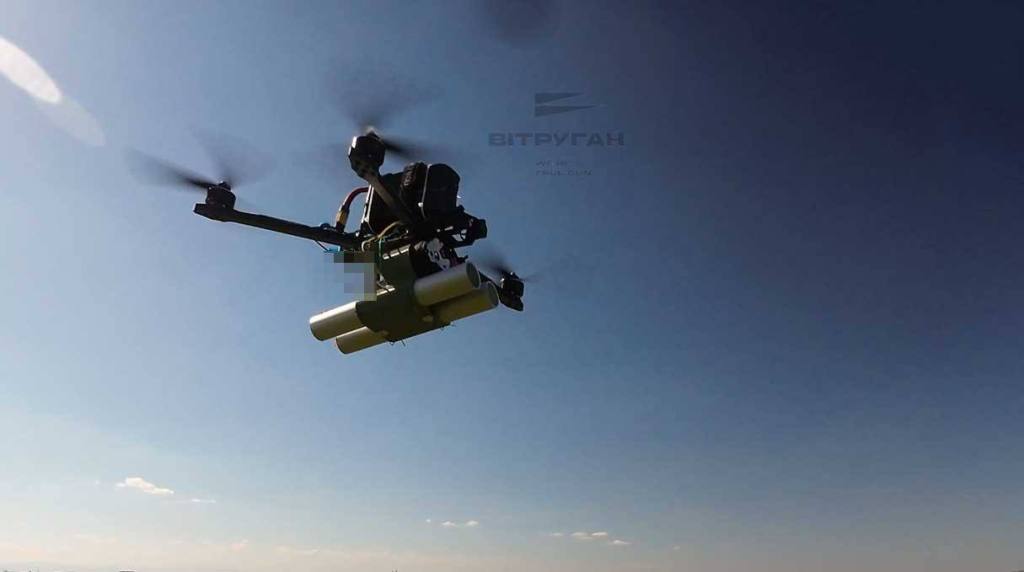
Ukrainian drone developers ВІТРУГАН introduced their ‘Ги́цель’ (Gitsel) gun-armed drone on 19 March. The Gitsel is equipped with a pair of 30mm barrels and the developers claim is has ‘automatic target acquisition and firing when the target is within the strike zone’ but it can also be operated manually. ВІТРУГАН have so far only shared photographs of the Gitsel and while there is no video of it in operation they say it can be used against both aerial and ground targets. The barrels in the photographs appear to be cut down metal piping wired for electrical ignition through the rear end of the barrel. They appear to be mounted on on a 3D printed assembly.
Most recently on the 29 March, the 2nd Mechanised Battalion of the 30th Separate Mechanised Brigade shared a minute long super-cut video of a gun-armed drone engaging more than 20 Russian quadcopter drones. Most fall to the ground after suffering damage to their rotors but one explodes upon being hit, with the shot likely hitting a piece of ordnance the drone was carrying. The video concludes with footage of one of the downed Russian drones being salvaged and lifted away by a Ukrainian drone.
The flurry of development by both sides illustrates how sorely gun-armed drones are needed to counter the ever pervasive drone threat. The development of the gun-drones is now being undertaken not only be individual developers and units but now also by larger companies and in Russia’s case a state-owned research and development entity. Both sides are also now claiming some limited autonomous targeting capability. While some of the gun-drones have entered operational use it’s unclear if significant numbers have been produced and fielded. Over the coming months we will likely see further fielding of the gun-drones and it will remain to be seen how effective they are and how they may change the dynamic of the conflict’s drone use.
On the 27 December, a Ukrainian fundraising charity posted a series of short videos featuring a drone with a pair of gun barrels. The Lesia UA Foundation provide Ukrainian units with vehicles, bikes, drones and personal equipment procured with the funds they raise. It appears that they have helped to fund the development or fielding of an unknown number of gun-armed drones.
The footage of the gun-drone in action was shared on 27 December with the telegram post stating [machine translated]:
“For the first time on video – drones and hard drives shot down other drones Defenders of Ukraine test #LesiaUAtechnology developments Stay tuned and we’ll show you even more exclusive shots! Together to victory!”
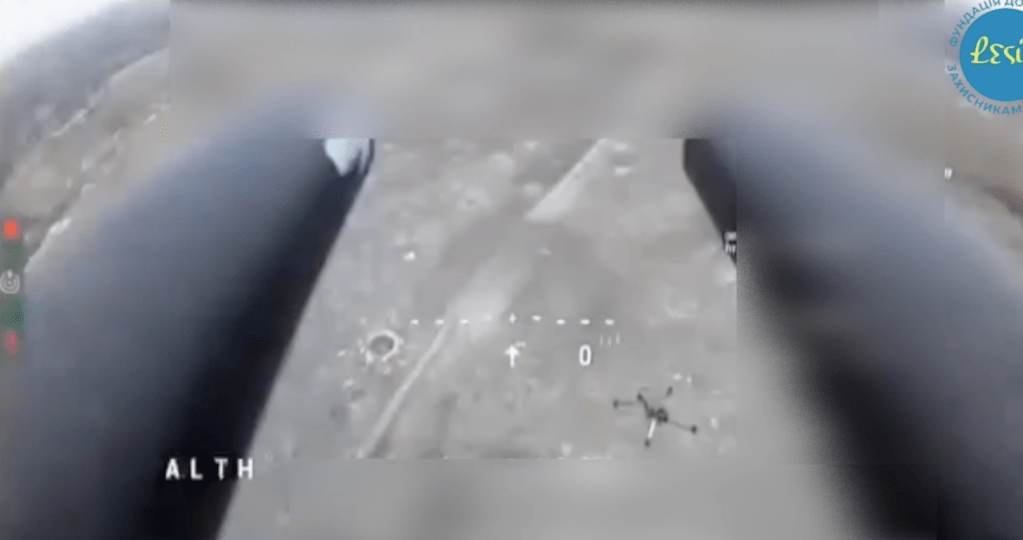
In the first video the gun-drone follows a quadcopter with the drone’s camera panning up and down several times between what appear to be a pair of barrels. The quadcopter is downed with damage to one of its rotors and appears to be trailing smoke as it spirals to the ground.
View between the barrels of a Ukrainian gun drone (via social media)
In the second short clip what appears to be a bomber drone, carrying an explosive hanging beneath it, is shot down as very close range as it hovers. Similarly, the third video shows a bomber drone which is shot down at close range as it hovered with damage to its rotor blades. At the time of writing the Lesia UA Foundation have not released any additional clips of the drone in action or any images of what the drone looks like.
While in recent months we have seen drones armed with both RPGs and AK-74s these have been used in the air-to-ground role. The shotgun-like blasts seen in these clips are more useful for close range air-to-air engagements. From the lack of recoil seen in the clips, the large bore diameter of the barrels and their positioning on the drone, either side of a camera gimbal, it would appear that the gun used by the drone follows a recoilless principal. The recoilless guns work along the premise of Newton’s Third Law of Motion, that all things have an equal and opposite reaction – as such two guns are connected back to back, with the backwards-facing gun firing a counter-weight – mitigating recoil which prevents the drone’s flight from being destabilised.
A Russian recoilless gun drone developed in 2024 (via social media)
Why a recoilless gun and not a conventional shotgun? Principal factors governing this are likely weight, effectiveness and recoil. The recoilless guns have a larger bore diameter meaning larger load and increased hit probability. Additionally they are simpler with no-working or recoiling parts (as they load is likely electrically ignited) and they are lighter allowing the drone to stay in the air for longer and/or travel further. The key downside to the use of a single shot recoilless gun is that it can fire only one round. The Ukrainian drones have sought to mitigate this by seemingly equipping their drone with two of the guns.
While we haven’t yet seen an image of the Ukrainian gun-armed drone, we have seen a Russian example which was developed in the summer of 2024, tested but reportedly not yet fielded. The Russian drone was developed by the BRT company who, in a recent telegram post, expressed their frustration at seeing a Ukrainian recoilless gun drone in use.
While successfully engaging an enemy drone with a gun is difficult it is the detection and tracking of enemy drones which is likely the most challenging part. This may lead to these recoilless gun-equipped drones being used in a sort of combat air patrol role, seeking out and hunting down enemy drones over an area where they have been reported. It remains to be seen if these recoilless gun-armed drones will proliferate as a method of countering the huge number of small drones used by both sides but from the limited footage of them in action that is available the concept seems proven.
Update – 10/1/24: Additional footage has surfaced showing the drone firing on Russian infantry.
In an unsurprising turn of events the Ukrainian recoilless gun drone has now been seen firing on infantry. Looks like an FPV also targeted the Russian.
— Matthew Moss | The Armourer's Bench (@historicfirearm) January 10, 2025
Update – 15/1/25: Additional footage of the Ukrainian drone in action, shared by a drone unit with the 2nd Mechanized Battalion of the 30th Mechanized Brigade.
A compilation of footage from the Ukrainian 'shotgun' drone which I covered in a video a few weeks ago. The footage was shared by a drone unit with the 2nd Mechanized Battalion of the 30th Mechanized Brigade.
On Friday, it was confirmed that the CZ Bren 2 will be assembled in Ukraine. This marks the first partnership since Russia’s Invasion in February 2022, that will see foreign small arms assembled in Ukraine. The Bren 2 is a 5.56x45mm select-fire gas-operated rifle which was first introduced as the CZ 805 BREN in 2011. While CZ Bren 805s have appeared in Ukraine the BREN 2 is much more common and favoured by troops on the ground.
We’ll take an in-depth look at their use in a future article/video but a considerable number of Ukrainian units ranging from special forces units to regular army have been seen equipped with the Czech rifles. Visually confirmed variants in Ukrainian service include the initial 5.56x45mm BREN 805 and later BREN 2 in various barrel lengths and configuration including the 8 inch barrel carbine with both side folding and telescoping stocks and the much more common rifles with side folding stocks and 11 and 14 inch barrels. There have also been a limited number of sightings of 7.62x39mm 8 inch barrel carbines and a number of 7.62x51mm BREN 2 BRs.
The first indications that production of the BREN 2 might be established in Ukraine came on 29 September 2023. During the first ever Ukrainian International Defence Industries Forum Deputy Minister of Defense Daniel Blažkovec stated that “the transfer of production of the Bren 2 “Sich” assault rifle” was a major, ‘flagship’ project.
Ukrainian Special Operations with CZ BREN 2s (via social media)
Sich (Січ) in Ukrainian refers to a historic form of fortified administrative and military camp used by Cossacks during the 16th century and later became associated with the Euromaidan in 2013. Since the name was used in September 2023, it has not appeared again.
In an announcement posted on 13 December, Ukraine’s state-owned defence corporation Ukroboronprom stated that the Ukrainian Defense Industry had begun licensed assembly of BREN 2s and that the agreement with CZ covers local assembly of rifles and will later include “full production of NATO-standard assault rifles in Ukraine”, the agreement was signed on 16 July 2024. Oleg Hulyak, Director General of Ukroboronprom, stated:
“Partnership with Czech colleagues will help to improve the provision of the needs of the Defense Forces of Ukraine in reliable and modern small arms produced in our country. In addition, another step has been taken towards the integration of our defense-industrial complex into the industrial chains of NATO countries,”
I reached out to Colt CZ Group for comment, Jan Zajíc, CEO of Česká zbrojovka, said in a statement:
“We are happy that together with our Ukroboronprom partners, we have successfully completed the assembly phase of the CZ BREN 2 assault rifle on the Ukrainian soil. Following the training of Ukroboronprom personnel at Česká zbrojovka, Ukraine is now able to deliver to its Armed Forces the CZ BREN 2 rifles assembled in Ukraine according to Česká zbrojovka‘s strict quality standards. We are ready to continue our cooperation in the future, all the way to full technology transfer.“
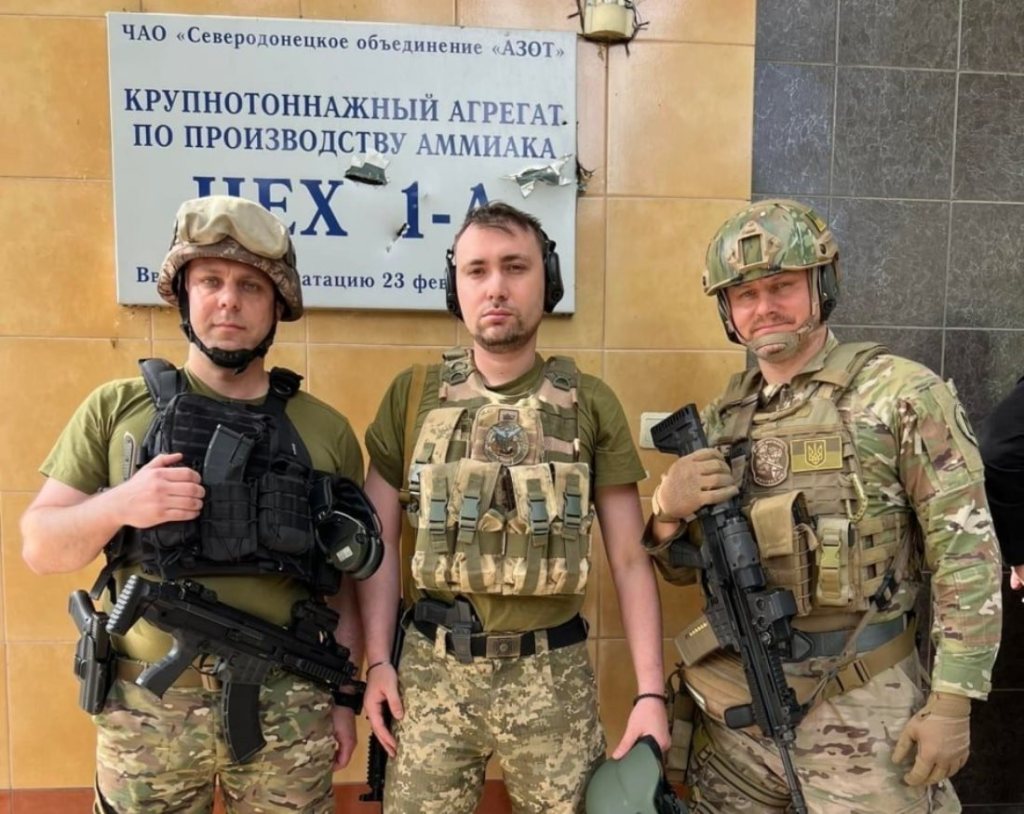
Ukrainian GUR chief, Kyrylo Budanov, and associates during a June 2022 visit to Sievierodonetsk. One individual has a 5.56x45mm CZ BREN 2 and the other a rare 7.62x39mm BREN 2 with an 8in barrel and telescoping stock (via social media)
Currently the only other country which has a similar arrangement with CZ is Hungary which has established Colt CZ Hungary to enable Hungary’s HM Arzenal to assemble/manufacture BREN 2s for the Hungarian armed forces. This isn’t the first time Ukraine has worked with external firearms manufacturers with an earlier partnership seeing Ukrainian small arms manufacturer Fort assemble Israeli IWI weapons under license in the 2000s. See our earlier look at the Ukrainian Fort Tavor bullpup rifles here.
The future significance of CZ’s establishment of an assembly line in Ukraine remains to be seen but as Ukraine seeks to further integrate with its Western allies and take up NATO standards the ability to produce a NATO calibre rifle, which is already in widespread Ukrainian service, will be extremely useful. From the statements released it appears that assembly of the rifles may be the first step towards localised production, it will be interesting to track CZ and Ukroboronprom’s partnership.
In an earlier video/article we examined the M14s which appeared in Ukraine back in March 2022, since then there have been a number of intriguing sightings of what, at a glance, appear to be Mk14 Enhanced Battle Rifles or M39 Enhanced Marksman Rifles. The EBR and EMR emerged during the Global War on Terror in the early 2000s as an improved variant of the 7.62x51mm M14.
The project to develop a more compact, improved M14 reportedly evolved from a request from US Navy SEALs in 2000 for a rifle for Arctic warfare. This eventually developed into what became the Mk14 EBR with development led by Naval Special Warfare Centre Crane and input from commercial specialists and manufacturers including Smith Enterprise, Inc. and Sage International. The result was a rifle with a 18 inch barrel and new flash hider, with changes to the operating rod guide, a new stock chassis and a raft of accessories. A number of different variants were built including the Mk14 Mod 0, Mod 1 and Mod 2, the M14 EBR-RI and the USMC’s M39 EMR. In total between 2003 and 2011 just over 9,000 of these upgraded variants were assembled.
Given the significant number assembled and the fact they have been replaced by rifles such as the M110 Semi Automatic Sniper System (which has already been seen in Ukraine) and the M110A1 CSASS it would not be unsurprising to see Mk14 EBR variants turn up in Ukraine.
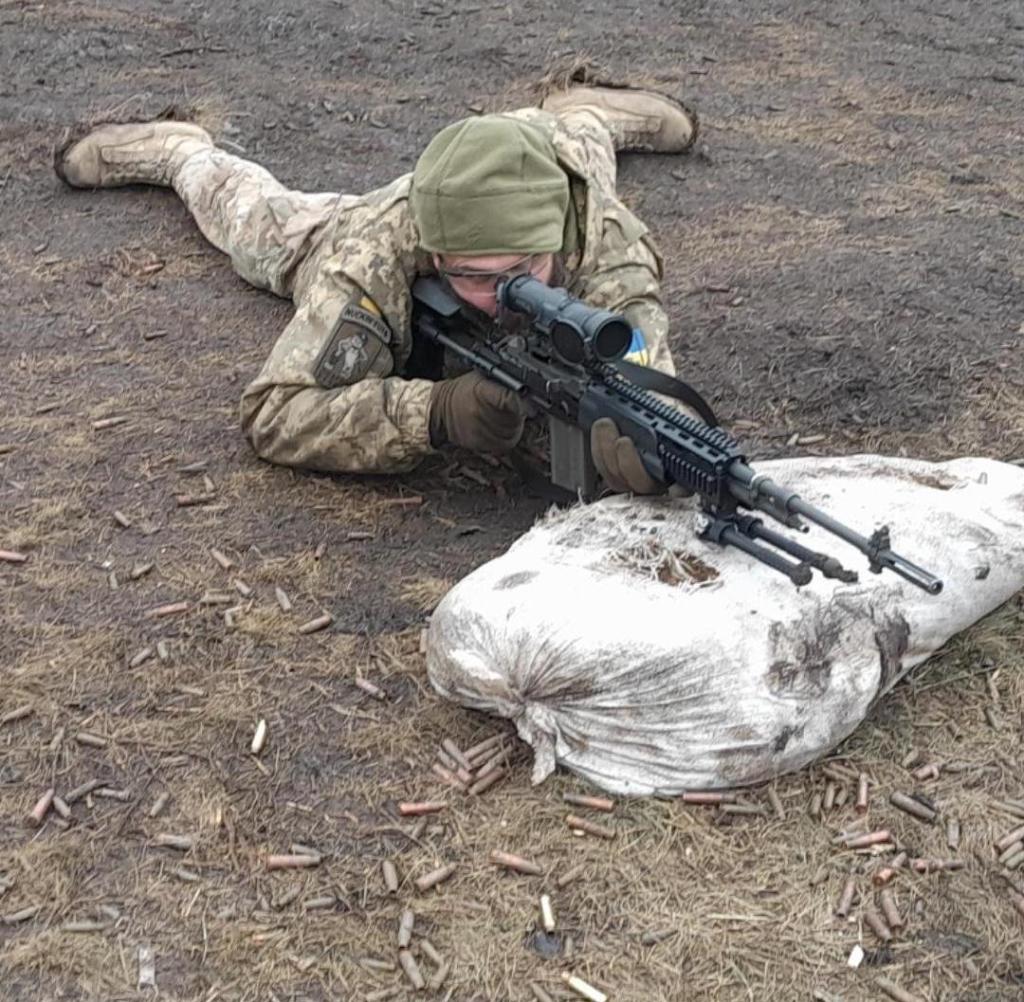
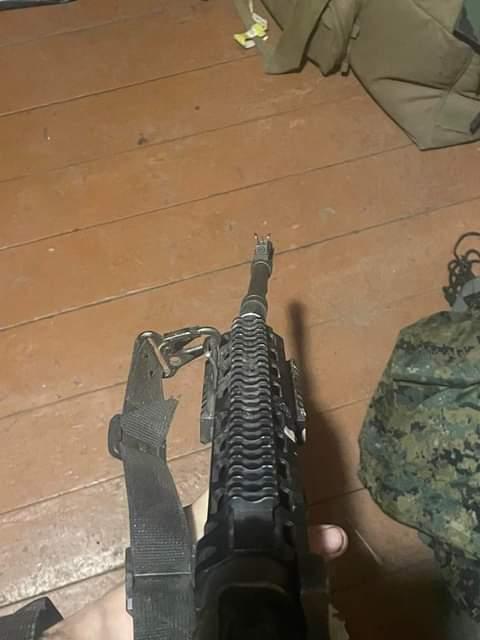
Over the past two years I’ve been tracking sightings of what appear to be Mk14 EBR variants but on closer examination some of them are not what they initially seemed to be, several were in fact kit builds using the standard configuration M14s which reached Ukraine in early 2022. Some, however, do appear to be surplus Mk14s.
Yuri’s Mk14 EBR clone at the range (Nucking_Futs_Yuri)
First, let’s examine some of the kit builds seen in theatre. The first appears to have been assembled by Nucking_Futs_Yuri, an American volunteer who enlisted in the Ukrainian Army in early 2022. Yuri explained to me that in late 2022, following combat experience where he wasn’t satisfied with how well 5.56x45mm suppressed a Russian position he decided to assemble an EBR clone using a donated chassis. Yuri noted that parts for the rifle began to arrive in December 2022 and by January the rifle had been assembled. Yuri was seen with the rifle in numerous photographs and in several configurations. It had a standard 22 inch barrel, a Sage International M14ALCS chassis and a M14DCSB (Detachable Cantilevered Sight Base). He mounted a 1.5-6x Elcan SpectreDR optic on the rifle, opting for more of a battle rifle-style set up. The rifle was damaged in February 2023 by a Kornet ATGM blast which bent both the barrel and the chassis.
Yuri’s damaged Mk14 EBR clone (Nucking_Futs_Yuri)
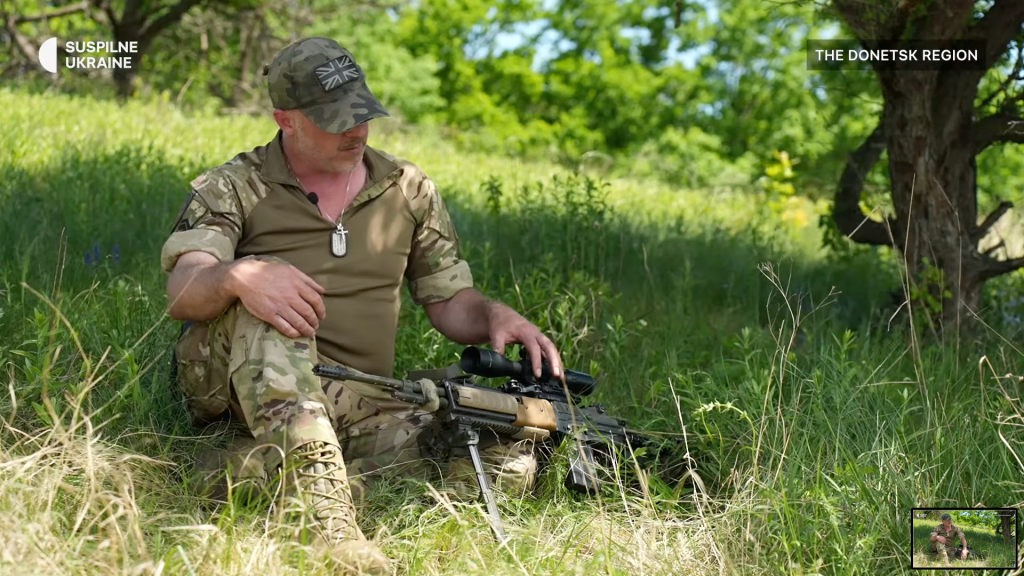
In early May 2023, another rifle which resembled an M14 EBR-RI, with a 22in barrel and a black Sage International M14ALCS chassis, appeared in use with a member an International Legion team. This individual and his rifle was seen again in May 2024 appearing in a number of interviews with Ukrainian media. His callsign was revealed to be ‘Solo’ and he was described as a marksman and a squad leader with a unit of the International Legion’s 3rd Special Purpose Battalion. In the interview he explained that the rifle has originally been a wooden stocked M14 converted with a SAGE chassis sent to him by a friend in the US. Interestingly, between May 2023 and May 2024, it appears the rifle’s set up has evolved with new FDE rail covers added and a short tan Kydex handguard replacing the initial black longer handguard. These parts were likely acquired in Ukraine.
‘Solo’ with his Mk14 clone built off a standard M14 (Суспільне Донбас)
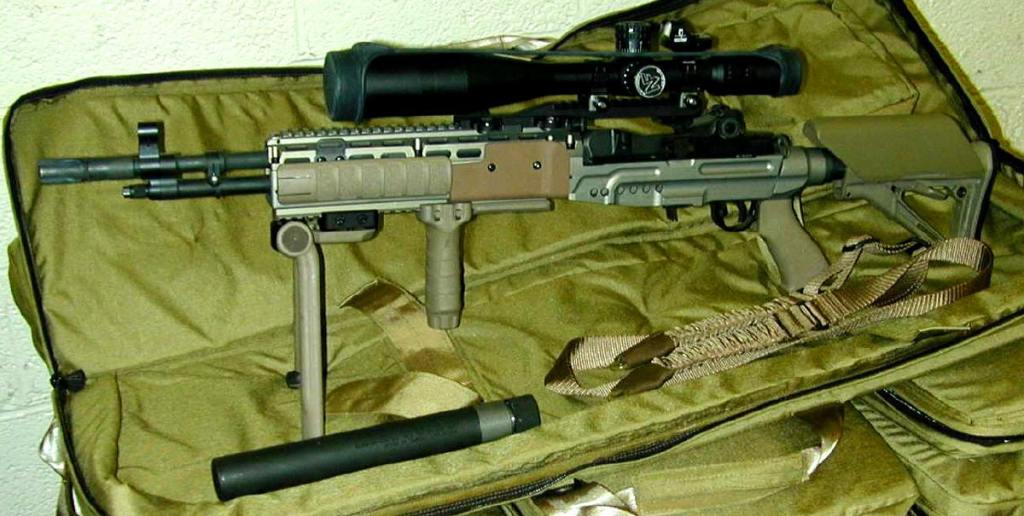
Most intriguingly, in November 2023, the first Mk14 Mod 1 appeared. Mod 1s are characterised by their shorter 18in barrels, a Sage M14ALCS/CV-BS with Magpul CTR FDE stock (with a cheek riser) mounted on a buffer tube extension rather than the earlier collapsing stock. The rifles also have LaRue LT-608 extended Picatinny risers and short tan handguards. The rifle is equipped with a Schmidt & Bender PMII 5-25×56 scope.
A Mk14 Mod 1 EBR with Schmidt & Bender PMII, Nov. 2023 (via social media)
The Mk14 Mod 1 was assembled at NSWC Crane in 2006, around 500 were assembled. The shorter barrel and the general configuration of parts and accessories suggest that this may be a surplus rifle transferred by the US.
A recent sighting of a Mk14 Mod 1 EBR (via Tysk)
Most recently, on 18 October, Ukrainian telegram channel Tyskshared a series of photos of a Ukrainian combatant at the range with another Mk14 Mod 1. This rifle’s parts and accessories closely match those assembled by Crane for the Mod 1, including: an 18in barrel with a SureFire FH762KM14 muzzle device, a TangoDown BG-16 FDE pistol grip, a Sage M14ALCS/CV-BS with a Magpul CTR FDE stock (this time without the cheek riser), a TangoDown BGV-MK46 FDE vertical foregrip, and a TangoDown ACB-4 FDE bipod. The rifle is also equipped with a NightForce NXS 2.5-10x24mm optic and a DOCTER MS01 3.5 MOA red dot sight which were selected to be paired with the Mod 1. [It has been noted that the Mod 1s may also be clones due to some small differences in the chassis profile and accessories used – for instance the model of VFG, scope rings, cheek riser, and the machining on the chassis. If this is the case someone has gone to an improbable amount of trouble to ‘clone’ a Mod 1, a considerable level of effort to expend in a war zone. Thanks to tanodized for input.]
From the very limited imagery available of Mk14 EBR-pattern rifles in Ukraine it appears that numerous clone builds have been assembled in-country and that the only EBRs which can be identified as potential US transfers are the two Mk14 Mod 1 variants seen so far.
A squad designated marksman with an Mk14 EBR-RI (the most common EBR variant), 5th Battalion, 20th Infantry Spin Boldak, Afghanistan, 2012 (US Army)
If the US was to transfer a significant number of Mk14-pattern rifles I would expect them to be the Mk14 EBR-RI, the most common variant, some 6,000 of which were assembled by Rock Island Armory – TACOM [Tank-automotive and Armaments Command]. It is unsurprising clone rifles have been assembled by combatants in Ukraine as Sage International and a number of other US manufacturers offer EBR-pattern chassis which do offer some improvements over the traditional M14 configuration.
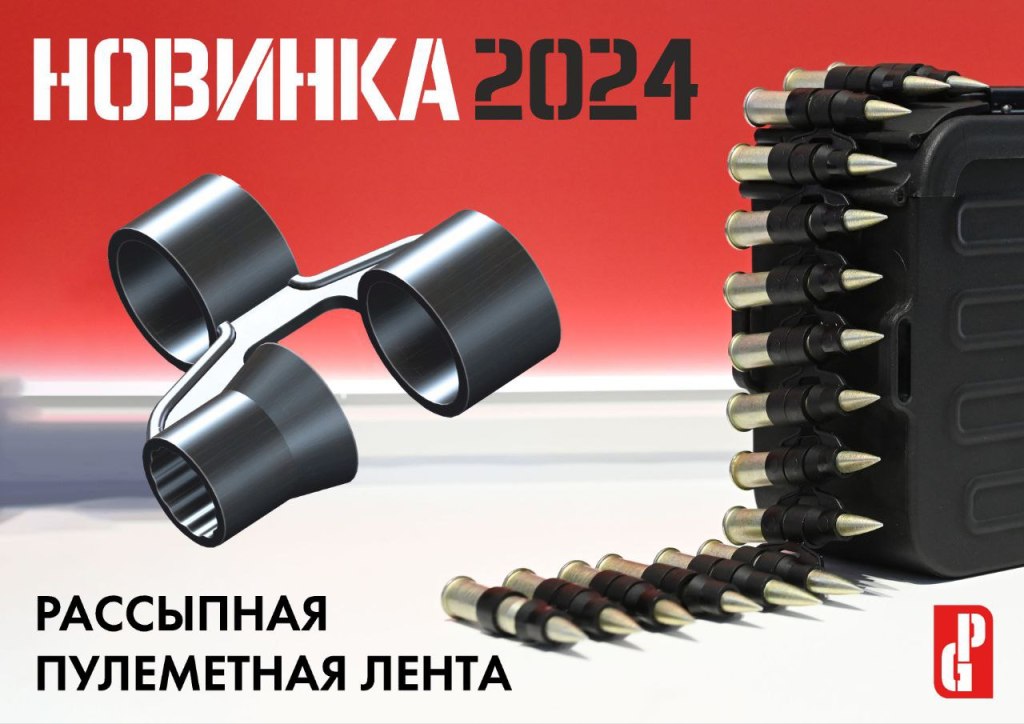
In previous videos we’ve looked at Ukrainian efforts to manufacture polymer belts for PK-pattern general purpose machine guns. These were developed by Ukrainian company RAROG who has been selling them since the summer of 2022. Now PUFGUN, a Russian company has also developed a polymer PK belt.
Traditionally, the 7.62x54mmR belts used by the PK series of guns have been made from metal and are non-disintegrating, meaning they remain linked together after they’ve been used, while NATO machine guns tend to use disintegrating belts that fall apart once the rounds held in them have been fired.
On 3 September, PUFGUN announced the introduction of the new disintegrating belts, explaining some of their features:
“The tape is made of high-strength polymer – a light and durable material. 3 times lighter than metal analogues. The total weight of the package for 100 links is 220g Due to the physical properties of the polymer, the loading of the PUFGUN loose belt is carried out faster than that of a metal belt. Maintains functionality in temperature conditions from -40C to +70C. Not subject to corrosion, does not require special conditions for long-term storage.”
Packs of 100 links are being sold for 548 Rubles or $5.75 on PUFGUN’s website.
PUFGUN shared a pair of photos, on 10 September, comparing the weight of a loaded traditional metal belt with one of their non-disintegrating belts, with the metal belt weighing 2.8kgs while the polymer belt weighed in at 2.37kgs. In the caption they claim that the photos were taken by Russian special forces unit Grom. OSN “Thunder”, who they state has been testing the belts since late August. The post claims Grom’s first impression was ‘quite good’. The post on PUFGUN’s telegram has since been deleted.
On 14 September a video showcasing the belts was posted by Mikha Mikhalych, a Russian gun content-creator, reviewing the belts. In the video two types of belt are featured; the disintegrating belt and a non-disintegrating one. The video also features a polymer belt box developed by PUFGUN, which is said to weigh around 150g. Combining the box with the polymer belts appears to be a meaningful push towards reducing the weight of the PK’s ammunition carriage system.
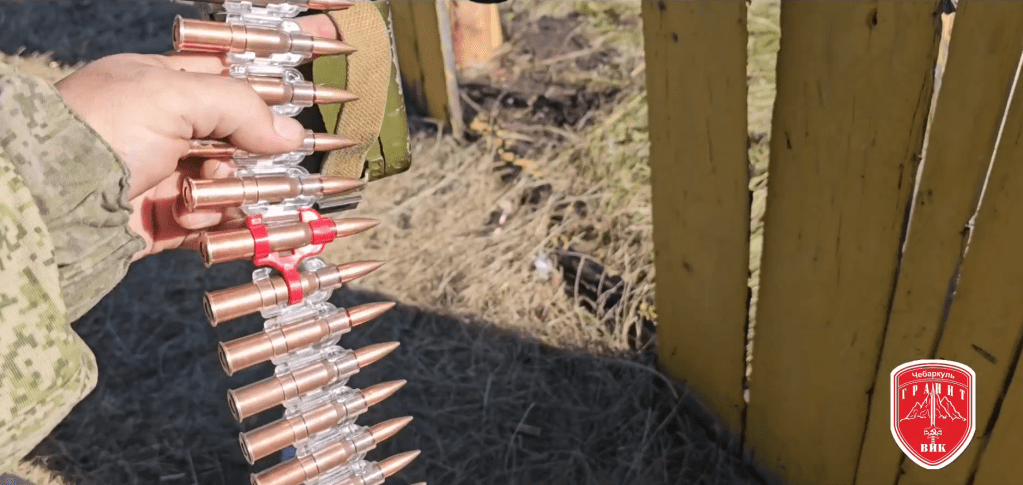
On 26 September, PUFGUN announced the non-disintegrating polymer belts on their social media. These belts share the same technical specifications as the disintegrating belts but notable are made from a clear plastic rather than a black plastic. While these have previously appeared in the earlier video they are not, at the time of publication, available for purchase on the company’s site. It appears that the links will be sold in packs of 100, with a starter tab and four disintegrating connector links which allows 25-round belts to be linked together.
On 9 October, PUFGUN shared a short clip showing their non-disintegrating belt being loaded by an Rakov belt-filling machine. This video was made in collaboration with ‘Granit’, a Russian living history group which appears to have links to the Russian military. Granit also shared their own longer video showing the belts being used in a variety of old and new Russian machine guns ranging from a vintage SG-43 to the latest PK variant the 6P41M.
Much like the Ukrainian KS-122 polymer belts from RAROG, the PUFGUN belts do significantly reduce the weight on the gun itself and more broadly for transporting ready ammunition. PUFGUN have sought to address the need for both disintegrating belts, useful for troops on the move that don’t want to be encumbered by trailing empty belts, while the non-disintegrating belts are more easily reloaded and better suited to use in vehicles or static positions. It’s interesting to see both sides commercially developing polymer belts to address a perceived need shared by both sides.
With the war in Ukraine’s current trench-bound stalemate often resembling the First World War it isn’t too surprising to see an early 20th century innovation making a comeback. Several variations on the concept of a periscope rifle have been seen in Ukraine since the summer of 2023.
A still from Heroes of Gallipoli (1915) showing a periscope rifle (via IWM)
The concept actually pre-dates the First World War, with sights like William Youlten’s Hyposcope dating to 1900, but really emerged during the war with many nations developing similar periscope-based systems that allowed service rifles to be mounted in frames and fired over the parapet removing the need for soldiers to expose themselves when sniping.
The first design featured in an article by Jeff Farrell in June 2023, Farrell interviewed a Czech veteran of the International Legion, Marian Simunek, who was wounded and has since developed a periscope which a rifle can be mounted in. In a pair of videos Simunek demonstrated fitting the rifle into the periscope mount and how it would be fired. Simunek manages to mount an AK-74 in the periscope mount within 30 seconds. The stock folds down from the body of the periscope and is secured with the pistol grip and trigger assembly being lined up, the stock of the rifle is secured by two straps and then the trigger cable is attached to the rifle’s trigger.
A second periscope design emerged in late January 2024, when a short video showing a tall tripod-mounted periscope was shared. The video shows the testing of a prototype gun mount which can be raised up to above parapet height and allows the gun to be aimed using the periscope the gun is show being tested in both semi-automatic and fully automatic. The trigger is attached to a command cable which runs down to a front grip with an exposed trigger in front of it. The tall monopod isn’t the most stable platform but the user demonstrating it supports the assembly using the integrated stock and pistol grip assembly and holds the stand with his off hand. While the ability to quickly raise and lower the rifle mounted on the stand is useful, especially for reloading, but it may lack stability in the field.
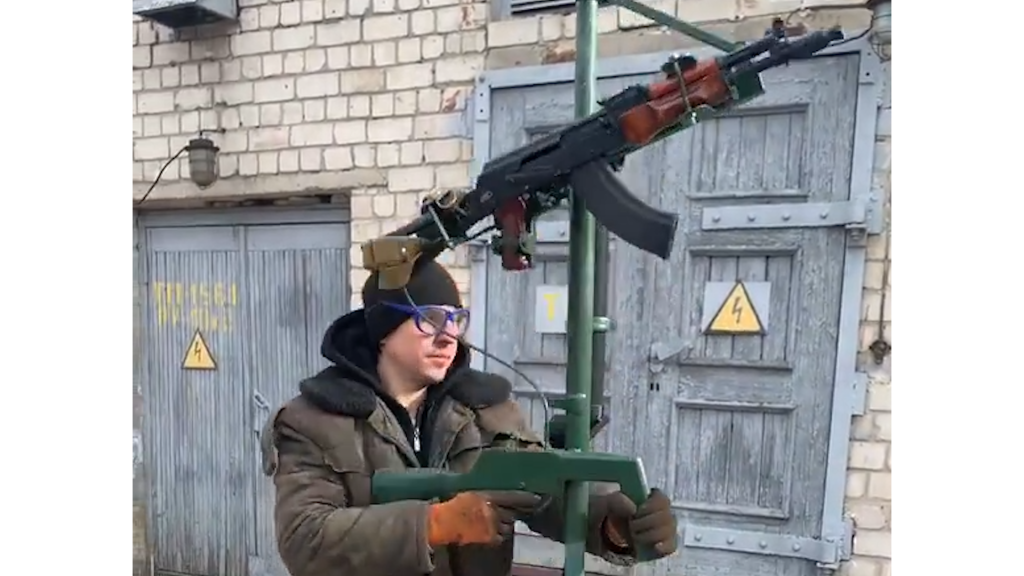
The third variation on the periscope rifle concept was shared on 18 March, with a short 22 second clip showing an AK-pattern rifle with its stock removed, mounted on a well fabricated pole with a periscope, an off hand support grip, a stock shaped like an AKS-74 folding stock and a pistol grip and trigger assembly which uses what appears to be a brake cable. In another video of the mount in the same position an individual demonstrates the articulation of the mount (albeit without a weapon installed). The mount has a wide tripod base and appears to be well made. The gun is set up in an urban environment behind a wall, likely for demonstration proposes. The this periscope rifle may be a more developed version of the previous design but I’ve been unable to find the original source for the video.
Interestingly, another video of as similar periscope rifle set up was shared, the design is clearly the same as that seen in the previous video. The shape of the stock has changed and the position and design of the stabilising forward hand grip differs.
While trench periscopes have been in use since the early weeks of the war, a more modern approach is the use of digital camera aimed remote weapons. These include the Shablya (sabre) remote weapon station developed by Roboneer, which has been in development since 2015 and has been tested with numerous different types of machine guns including PKs and M2 Brownings. Another similar system is the Tarantul, developed by engineers of the 118th Territorial Defence Brigade. This is a concept that Russian forces have also been experimenting with with a number of systems seen in test videos.
— Matthew Moss | Historical Firearms (@historicfirearm) April 24, 2023
The available imagery of periscope rifle systems originating from the war in Ukraine is relatively small so its difficult to gauge their utility fully, I’ve yet to see any evidence of their front line use. They are a specialist piece of kit which depending on the design is suited to some environments more than others. If you’ve seen other examples of periscope rifle systems or evidence of their use in combat please do let me know!
Support Us: If you enjoyed this video and article please consider supporting our work here. We have some great perks available for Patreon Supporters – including early access to custom stickers and early access to videos! Thank you for your support!










 The Armourers Bench