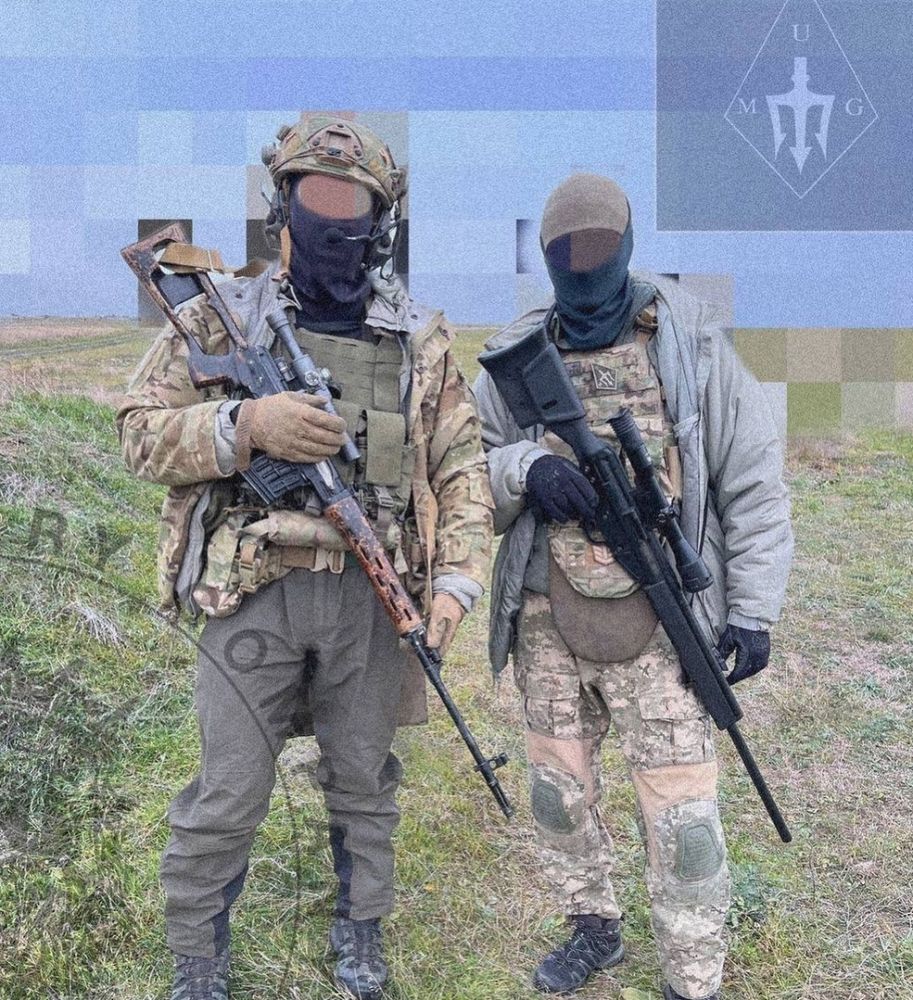
This week has seen photographs of two intriguing 7.62x51mm Heckler & Koch rifles appear, they feature what appears to be an iconic, and extremely rare, PSG1 and an HK G28E. The first photograph was shared by pmc_ua and universal_mobility_group on Instagram on 14 November. In the photograph a pair of two Ukrainian marksmen pose with an SVD and a PSG1, no further images of the rifle have been shared.
What appears to be a PGS1 at a Ukrainian range session (via social media)
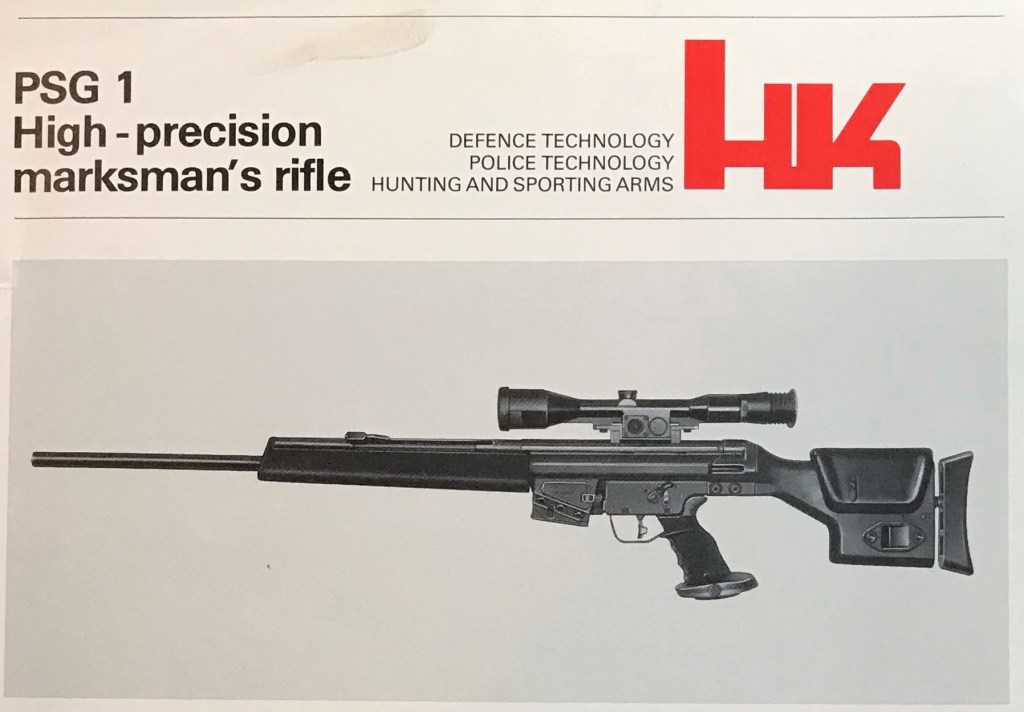
The PSG1 was introduced by HK in the early 1970s as a semi-automatic precision rifle. It is unclear where the PSG1 was acquired from but this is the first time I’ve seen one of the rifles appear in Ukraine. The PSG1 is based on the G3, and as such uses a roller-delayed blowback operating system. Its accuracy is reputed to be better than 1 MOA, the rifle appears to have an original Hensoldt ZF 6×42 PSG1 scope.
Illustration from an H&K catalogue page for the PSG1
PMC_ua, who shared the photograph, confirmed that the rifle is “used where there is an opportunity, fighting and training” but gave no further details. The PSG1 may have been acquired via civilian channels or may have been transferred to Ukraine as aid by one of the many countries who acquired the PSG1 in small numbers over the years. While the PSG1 is of Cold War vintage, the rifle continued to be offered into the 2010s by HK and it is still a very accurate, capable rifle.
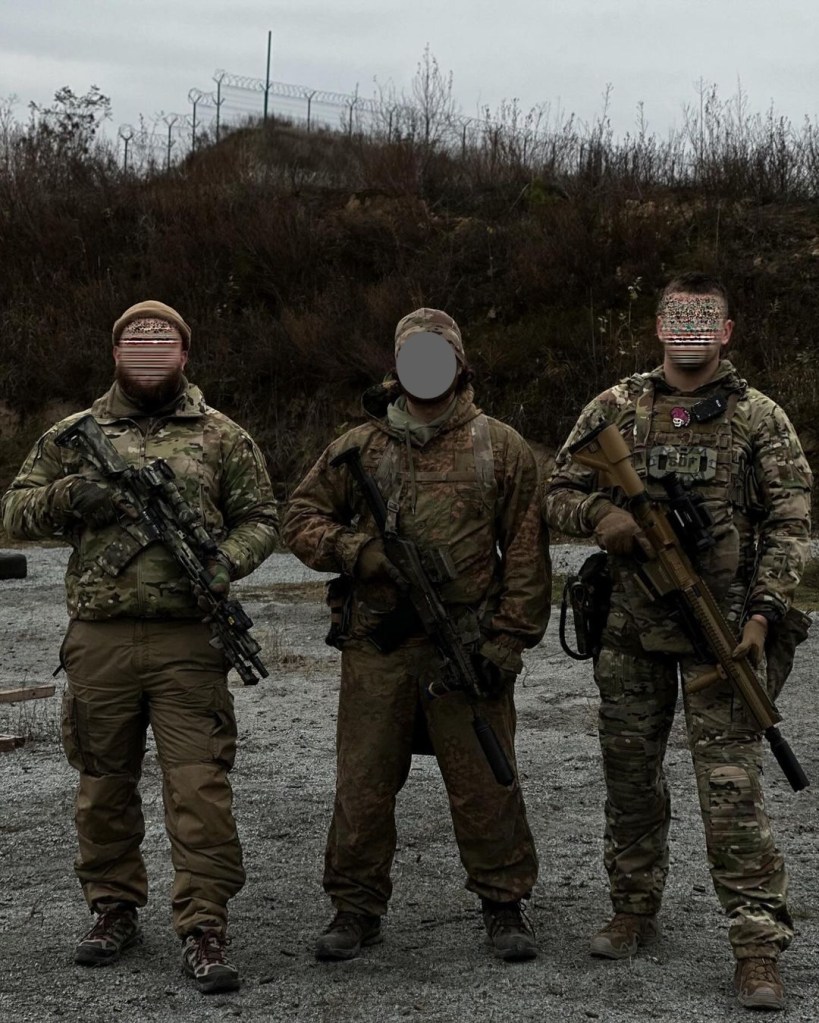
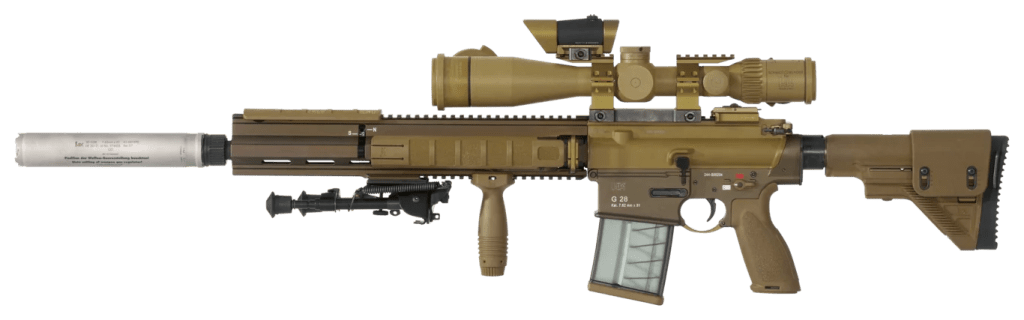
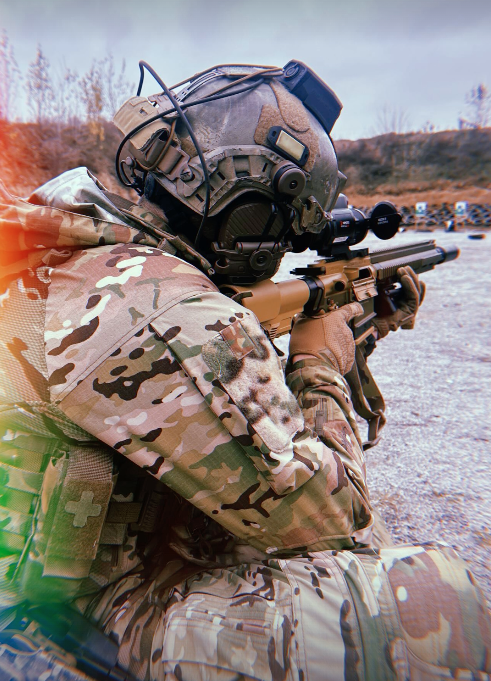
The second image was shared on Instagram, on the 17 November, and features what at first glance appeared to be an HK G28 but may also be the civilian-available HK G28Z. The rifle is held by a member of the 3rd Separate Assault Brigade and is equipped with a thermal weapon sight.
A probable HK MR308 A3-28 at a Ukrainian range (via social media)
The rifle has free-floated 16.5 inch barrel, a bi-pod and a vertical front grip mounted on its forend. It is loaded with a 10-round magazine and is fitted with what appears to be an Ase Utra DUAL762-S-BL suppressor. A small number of the RAL 8000-coloured MR308 A3-28s have recently appeared on the civilian market in Ukraine, with one private listing one of the rifles for 29,5000 UAH or $7,145.
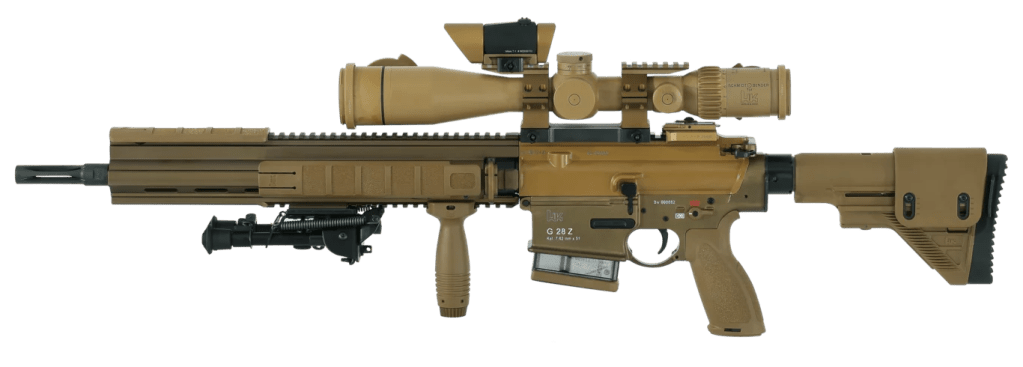
HK G28Z (Heckler & Koch)HK G28 (Heckler & Koch)
An additional photograph showing the rifle being fired was shared in an Instagram story by one of the individuals in the first photograph. This photograph gives us a better look at the receiver of the rifle and shows that the upper is painted/coated rather than treated. This indicates that the rifle is either a G28 or the civilian G28Z variant. [Thank you to CaliFlori for pointing out this detail].
It’s not uncommon to see civilian, semi-automatic, firearms used by Ukrainian personnel. This is more common in terms of precision platforms but various semi-automatic 5.56x45mm platforms are also regularly seen, including HK MR223s and patrol variants of the MR308.
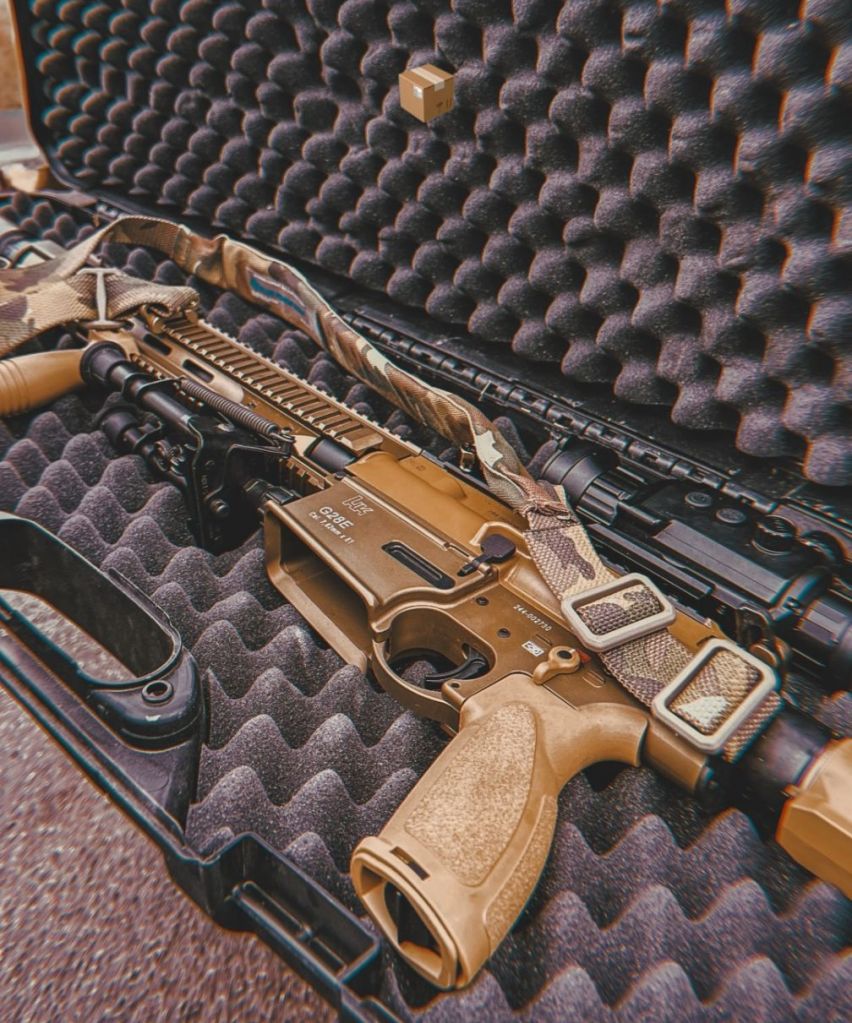
A second photograph of the MR308 A3-28 at the range (via social media)
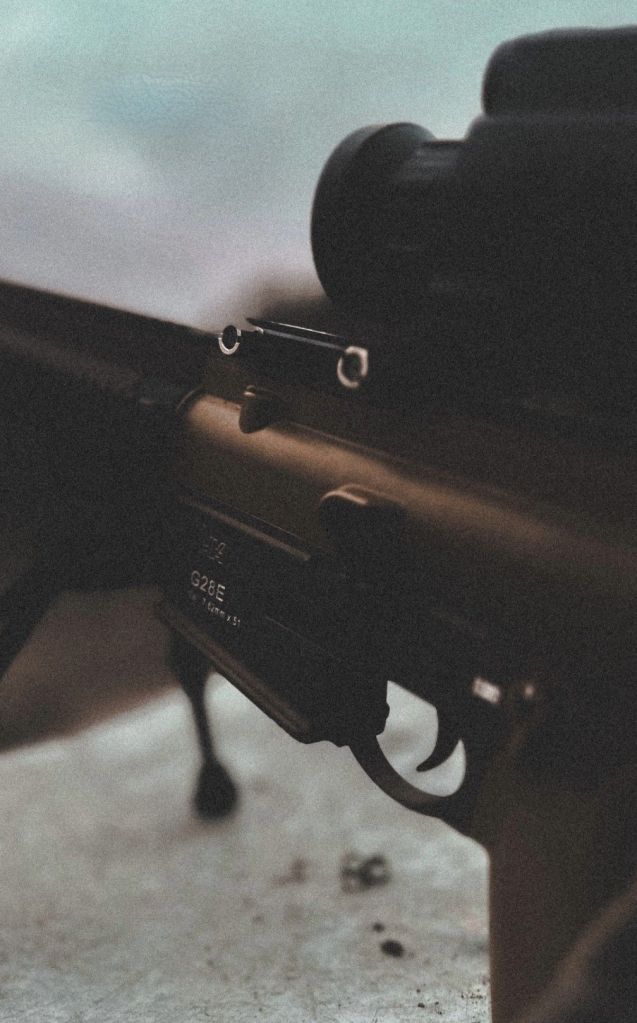
Two subsequent photographs shared by one of the individuals in the initial photograph clearly show the rifle’s lower receiver markings, confirming that the rifle is an HK G28E, not a commercial G28Z. The ‘E’ suffix indicates ‘export’.
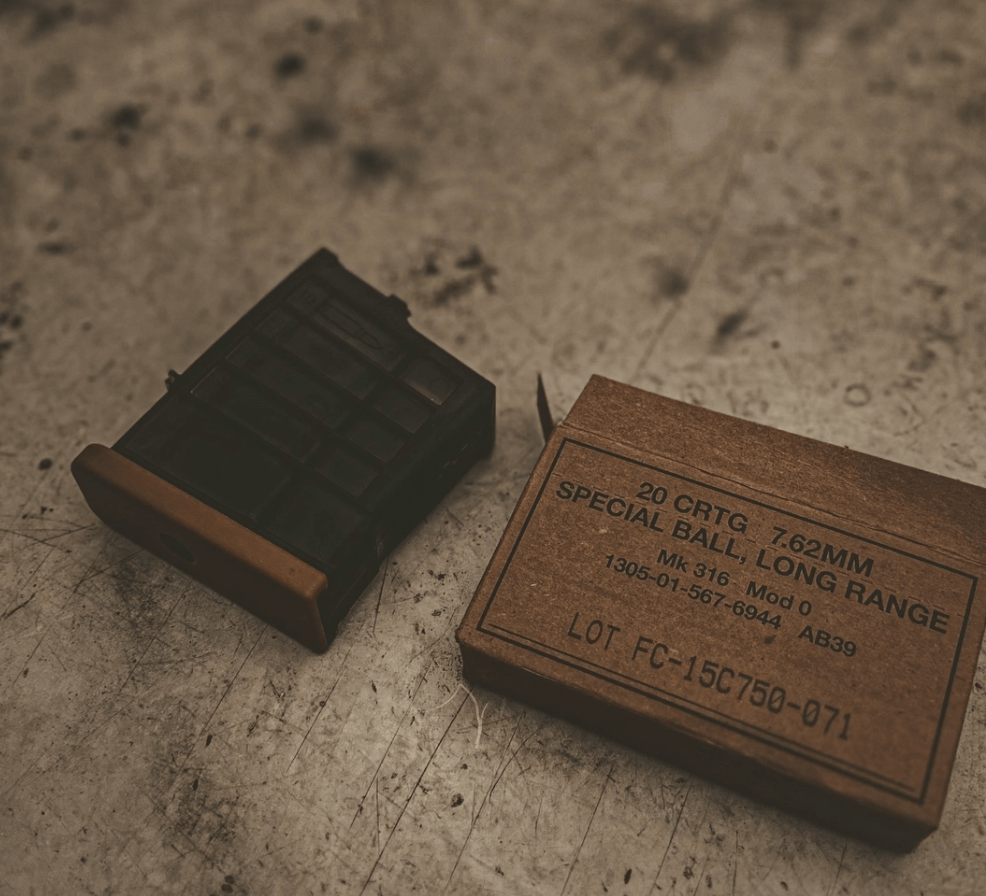
The same Ukrainian combatant, who appears to be a member of the GUR, also shared a photograph of ammunition he is using with the rifle. US-manufactured Mk316 Mod 0 is a match-grade cartridge which uses a 175gr projectile. While the ammunition was likely provided by the US, the origins of the rifle are unconfirmed.
It is intriguing to see two generations of Heckler & Koch’s semi-automatic precision rifles appear in Ukraine within days of each other.
The transfer of Western anti-armour weapons started before the war even began. The United States transferred significant shipments of Javelin anti-tank guided missiles along with M141 SMAW-D Bunker Defeat Munitions and Stinger MANPADS.
At the same time as an initiative from the Baltic states of Lithuania, Latvia and Estonia – Estonia also delivered Javelin missiles. For reasons of operational security we don’t know how many Javelins have been delivered to Ukraine by the US and Estonia at this time. However, Estonia is believed to have had several hundred in stock.
Ukrainian troops training with January in February 2022 (Ukrainian MoD)
What is Javelin?
Javelin is an infrared guided man-portable fire-and-forget anti-tank missile. It’s been been in service with over a dozen countries for over 20 years and is still produced by a joint venture between Raytheon Missiles & Defense and Lockheed Martin. It weighs about 22kg or 46 lbs ready to fire and had a detachable Command Launch Unit (or CLU) . Its effective range depends on the type of CLU but the improved Lightweight CLU introduced in 2020 can engage targets out to 4,000 metres (about 3 miles). As of 11 March, Lightweight CLU has not yet been seen in Ukraine. The earlier block 0 and 1 CLU can engage targets out to 2,500 meters (1.5 miles). The CLU enables this with a number of optics including a 4x day sight, a 4x night sight a 9.2x thermal sight. The CLU is also a useful tool for reconnaissance when other NVG and thermal imagers aren’t available. Once the gunner has their target and establishes a lock the missile can be launched.
Javelin’s CLU (US Army)
Javelin’s missile has a soft launch system which limits back blast and firing from relatively enclosed spaces. Once launched the main rocket motor kicks in at a safe distance. It uses automatic infrared self-guidance and has two modes of attack: direct for use against lightly armoured targets and structures and top-attack. In top-attack mode the missile climbs above the target and then plunges down on it to penetrate thinner top armour.
The missile has a tandem shaped charge high explosive anti-tank round. The initial charge can detonate any explosive reactive armour used by the enemy target vehicle while the second shaped charge will penetrate the target’s main armour. When the round detonates it super heats the metal of the armour and creates a high velocity stream of metal which enters the vehicle. More on the complex science behind shaped charges here. It can destroy vehicle’s drive systems or if it enters the fighting compartment it can kill or injure the crew and detonate munitions.
History
Javelin was developed by Texas Instruments in cooperation with Martin Marietta. In the mid-1980s it beat off competition from Ford Aerospace and Hughes Aircraft to win the US Army’s Advanced Anti-Tank Weapon System—Medium program.
A Ukrainian Depot, early March 2022 (Ukrainian MoD)
In June 1989 Texas Instruments and Martin Marietta were awarded a development contract and the Javelin was adopted as the FGM-148. Javelin continued development and testing throughout the 90s before entering service. Since then it’s been adopted by countries including the UK, Australia, France, Norway, Poland, Taiwan, and many others. According to Raytheon the system is scheduled to be in inventory until 2050.
Javelin In Ukraine
Ukraine adopted Javelin in April 2018, ordering 210 missiles and 37 CLUs with a further order for 150 missiles and 10 CLS in December 2019. Since the threat of invasion became increasingly likely the US provided a series of aid packages worth $260 million. Reports suggest that at least 300 Javelin missiles were delivered as part of these packages. Since then the US has agreed a further package worth $350 million. 70% of this package is said to have been delivered as of 9 March. It’s difficult to estimate how many missiles and CLUs have been delivered so far but the number of missiles is likely over 1,000.
Still from a Ukrainian training film on Javelin (Ukrainian MoD)
From the sparse evidence available we know that at least some of the Javelin transferred to Ukraine are confirmed to be from older Block 0 stocks, which includes FGM-148A/B/C and D. The vast majority of Javelins in Ukraine are likely to be Block 0 variants. Block I, the FGM-148E came into service with the US in 2008 and has an improved CLU and rocket motor. Javelin’s shelf life is around 20 years, so it makes sense for these older production but still fully capable missiles to be sent first.
In early February the Ukrainian Ministry of Defense shared a short video showing troops testing the newly-arrived Javelins against tank hulks which had been fitted with so-called ‘Javelin Cages’, a metal structure which Russian tanks have recently added to their turrets. It is believed the cage is intended to detonate the initial charge of a Javelin before it contacts with the tanks explosive reactive armour or the hull itself. However, it is also believed that it is intended to defeat drone-fired micro munitions like the Turkish MAM series. The cage detonating the micro munition before it reaches the tank. The footage shared by the Ukrainian MoD showed that Javelin easily defeated the cages.
Update 15/3/22: We have now seen evidence of Block 1 FGM-148Es in Ukraine. Amael Kotlarski, Janes Infantry Weapons Editor, speculates that these may have originated from the Baltic states’ stocks. At least one example of the Block 1 and a number of Block 0s have been captured by Russian forces so far.
Ukrainian Defence Minister announcing arrival of a shipment of Javelin in January 2022
While at the time of publishing this video there has been no confirmed footage of Javelin in action in Ukraine, no doubt due to good Ukrainian OPSEC, we have seen the system in theatre.
We got our first confirmation on 3 March, when Ukraine’s Operational Command “North” shared photos of troops being briefed on the use of NLAW and Javelin anti-tank weapons. In the photos we could see numerous Javelin transport cases stacked while troops were briefed on the Command Launch Unit (or CLU). On 6 March, the Ukrainian Armed forces shared a short instructional video on Javelin, showing how the battery is inserted and what the CLUs controls do.
How Capable is Javelin?
The penetration capabilities of Javelin are listed as classified with the USMC’s manual stating “The Javelin penetrates all known armor, “well” in excess of 30 inches [or 760mm] of rolled homogeneous steel.” This means Javelin is more than capable of knocking out any Russian armoured vehicle in Ukraine.
Javelin Missile (US Army)
In terms of performance in Ukraine, one report from 3 March, quoted an anonymous US Special Operations officer who is monitoring the conflict, suggested that of 300 Javelin fired, 280 knocked out vehicles. Time will tell.
If you enjoyed this video and article please consider supporting our work here. We have some great perks available for Patreon Supporters – including custom stickers and early access to videos! Thank you for your support!
Bibliography:
Javelin – Close Combat Missile System, Medium, FM3-22.37, US Army, 2008 (source) Rundown: Western Anti-Tank Weapons For Ukraine, Overt Defense, (source) Introduction to Crew Served Weapons, USMC, (source) NLAW In Ukraine, Armourer’s Bench, (source) As Russia Pounds Ukraine, NATO Countries Rush In Javelins and Stingers, New York Times, (source) $60 Million Worth of US Military Aid Arrives In Ukraine, Overt Defense, (source) First batch of Estonia-donated Javelin missiles arrive in Ukraine, EER, (source) New US Military Aid to Ukraine Includes 300 Javelin, nv.ua, (source) Shaped Charge, Global Security, (source)
A comment in my recent video about the Royal Bermuda Regiment’s use of the Mini-14 sparked my interest. It noted that Malta, another small island military, uses the AK. I wasn’t aware of this so I decided to do some research.
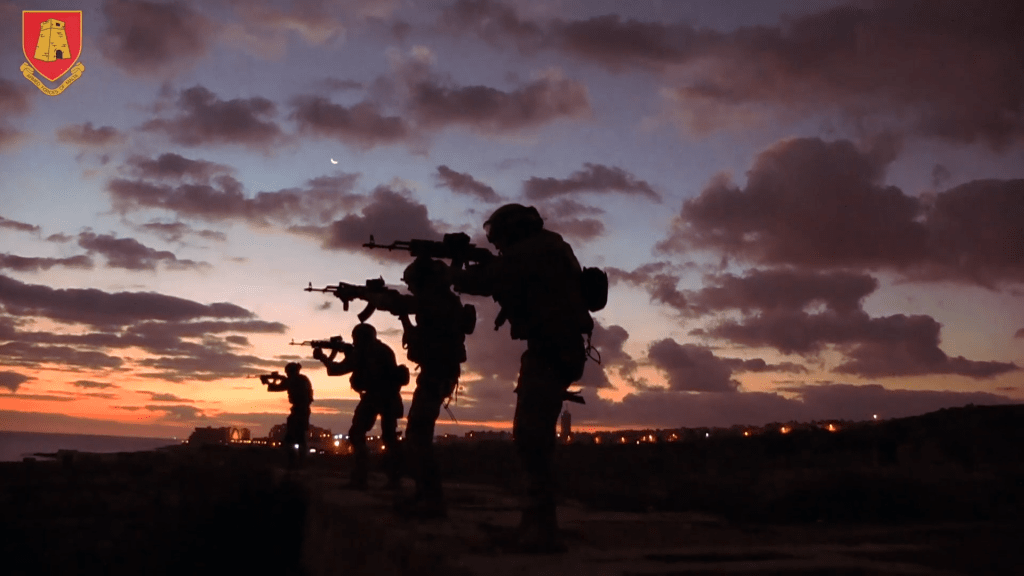
Malta’s military, known as the Armed Forces of Malta (AFM) is roughly the size of a brigade. In recent years the Armed Forces of Malta have had a strength of between 1,600 and 1,800 personnel. It has three battalions a maritime squadron and an air wing. Malta is a neutral nation and as such the AFM’s role is territorial defence, internal security and border control.
Malta gained independence from the UK in 1964 and became a republic in 1974, this is when the AFM was founded. With the former link to the UK much of the AFM’s initial equipment was of British origin and the 7.62×51mm L1A1 Self-Loading Rifle was used as the AFM’s service rifle for many years this appears to have changed in the late 1970s early 1980s. The FN FAL-derrived L1A1 is still used as the AFM’s standard drill and parade rifle.
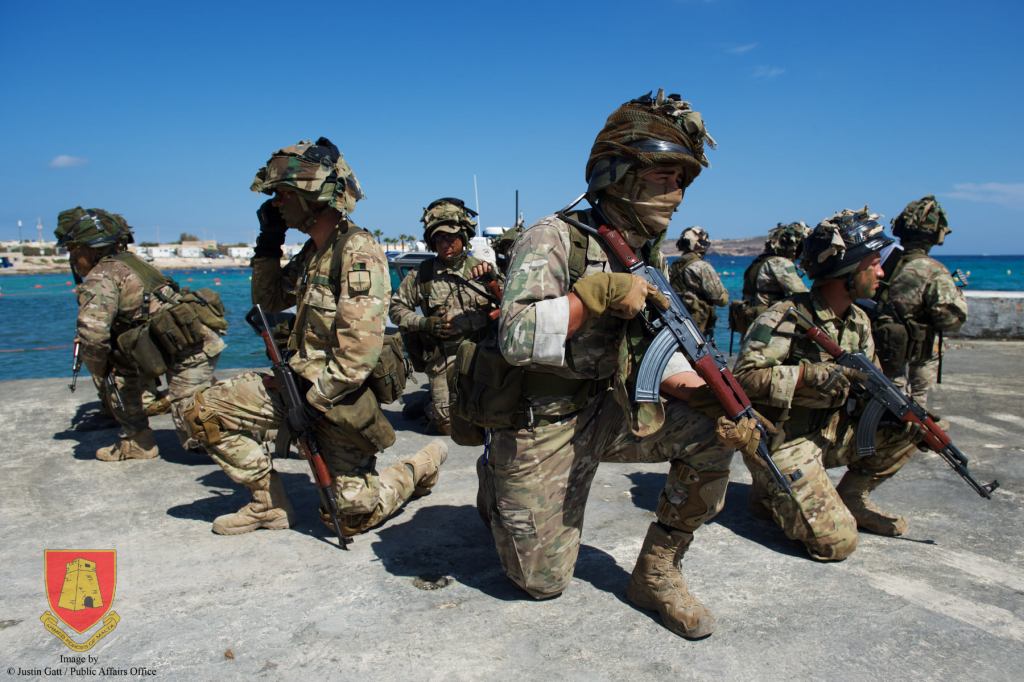
AFM personnel with Type 56/II AK-pattern rifles (AFM)
The AFM celebrated its 50th anniversary in 2020 and shared this time line of their uniform and equipment in their service magazine OnParade which gives us some idea of how their small arms changed over time. We can see that the AK-pattern rifles have been in service since at least the 1980s.
The AFM’s website lists their small arms with personnel being armed with Beretta 92s, a variety of HK MP5s, and what they describe as the ‘AK 47 Variant’. The site lists the rifles as being manufactured by Russia, Romania, China and East Germany. These rifles are all chambered in the 7.62×39mm cartridge.
Where the first AK-pattern rifles came from is unclear, although one source suggests the German and Romanian rifles were bought second hand in the 1990s. From a survey of images and video shared by the AFM in recent years it appears that East German MPiKMS, Romanian PM md.63, North Korean Type 68 and Chinese Type 56/II are in service.
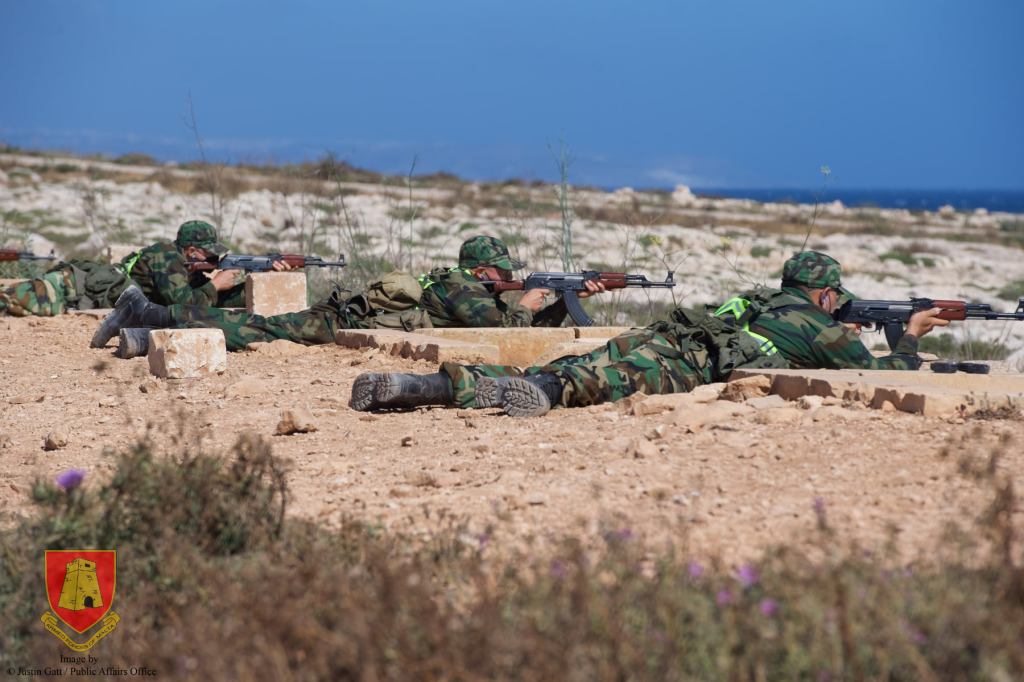
AFM recruits training with Chinese Type 56/II AKs (AFM)
The origins of the Chinese rifles is easy to trace back to a 2003 donation of small arms and light weapons made by the People’s Republic of China. An agreement was signed with China in June 2001 and as part of this a donation of 150,000 Maltese lira-worth of weapons. By 2003, however, it was reported by the Time of Malta that this had increased to 500,000 Maltese lira-worth of weapons. This included Type 56/II rifles, Type 80 general purpose machine guns and RPG-7 clones. The AFM’s acting commander Colonel Carmel Vassallo described the donation as a “dream come true” at the time. It reportedly allowed the entire AFM to be armed with a single type of service rifle.
The reasoning behind the adoption no doubt comes down to financing, Malta being a small island nation does not have an extensive defence budget, reported at 54 million Euros in 2020, and perhaps have chosen to prioritise personnel and procurement of naval and aviation assets over small arms. It is easy to see how the donation of service rifles and other small arms would be welcomed when balancing a modest budget.
AFM personnel with modified AKs (AFM)
Over the last 10 years there have been a number of photos and videos released showing AKs which have been upgraded with some aftermarket modifications. The mods appear to predominantly be sourced from FAB Defense – with their CAA Polymer buttstock and VFR-AK railed forend with a top rail which extends over the top of the receiver cover. This provides the bare bones AKs with some modularity. It’s unclear how widely issued the modified AKs are but from officially release imagery it seems that the basic AK-pattern rifles are more prevalent. In recent years Malta has stood up quick reaction forces and it appears from videos and images shared of the company that they have been equipped with SIG Sauer MCX rifles.
If you enjoyed this video and article please consider supporting our work here. We have some great perks available for Patreon Supporters – including custom stickers and early access to videos! Thank you for your support!
In this video we dive into another item from the TAB Reference Collection. An article taken from a 1955 edition of the Illustrated London News which looks at the British Army’s newest anti-tank weapon – The B.A.T Gun! The L2 B.A.T Gun was a recoilless rifle developed to replace the heavier 17pdr Anti-Tank guns then in service. The B.A.T and its successors remained in service throughout the Cold War.
Today we would consider the illustration an ‘infographic’, it was drawn up with the Ministry of Defence’s assistance by Illustrated London News‘ special artist George Horace Davis who had illustrated hundreds of similar articles including one for the PIAT.
The article, titled ‘Britain’s Latest and Most Powerful Anti-Tank Weapon’, explains not juse the operation of the new gun but also provides some data on weight and comparisons of the new 120mm HESH ammunition with that of previous conventional anti-tank weapons. Check out our video on the 2pdr anti-tank gun and the 6pdr anti-tank gun.
We have many more videos on important and interesting primary source materials in the works. If you enjoy our work please consider supporting us via Patreon for just a $1. Find out more here.
Check out videos on items from our reference collection here.
Join us as we look at ‘When Trumpets Fade‘, John Irvin’s HBO TV movie which follows a battle-weary squad leader torn between simply staying alive and leading his new recruits into action during the Battle of the Hürtgen Forest. Starring Ron Eldrad, Zak Orth, Frank Whaley, Timothy Olyphant and Bobby Cannavale the film shines a light on a largely forgotten battle and premiered just a few months before Saving Private Ryan.
Join us for the fourth edition of our Show & Tell series were we discus ‘Geronimo’ (1993) which tells the story of Geronimo’s last battles and the 1962 Steve McQueen-led classic ‘Hell Is For Heroes’ following a group of US soldiers as they battle to break through the Siegfried Line.
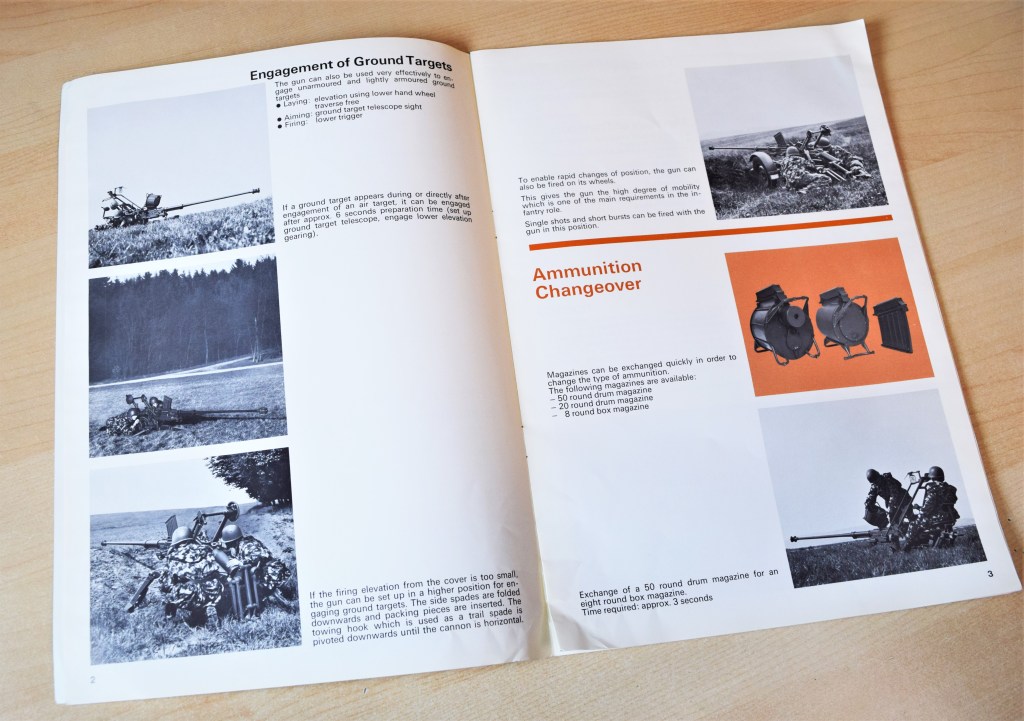
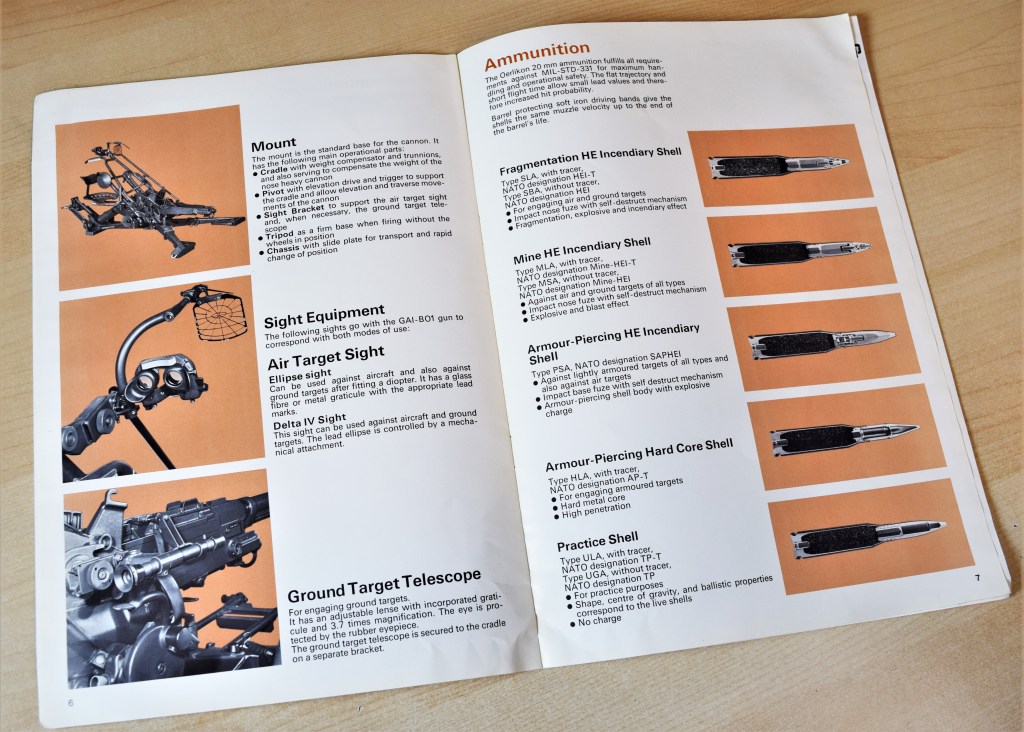
In this video we take a look at an original 1970s brochure for an Oerlikon 20mm Cannon. The booklet, printed in 1974, covers the Type GAI-BO1 – which had previously been designated the 10ILa/5TG. The Swiss Oerlikon had been introduced in the mid-1930s and seen widespread on both sides use during the Second World War.
Engagement of Ground Targets (Matthew Moss)
The brochure covers the anti-aircraft and ground roles the cannon was capable of fulfilling as well as explaining the major assemblies of the weapon and some of the accessories like sights and magazines. The brochure also lays out some of the ammunition available for the Oerlikon, ranging from practice shells to fragmentation HE incendiary and armour-piercing hard core shells. The Oerlikon cannon remains in production and in service with dozens of countries around the world.
Sights, mounts and ammunition (Matthew Moss)
The brochure is now part of our reference collection and we were able to bring this video to you due to the support of our Patrons. We have many more videos on important and interesting primary source material like this brochure in the works. If you enjoy our work please consider supporting us via Patreon. Find out more here.
This week we tackle a truly harrowing film. Arguably director Peter Watkins’ finest work, 1966’s ‘The War Game’. An anti-nuclear war film that takes Watkins’ pseudo-documentary style to its pinnacle to tell the story of what a Britain during a nuclear war might look like. Suppressed by the BBC and government the film still won an Oscar. We are joined by author and host of the Atomic Hobo podcast, Julie McDowall to discuss this very important film.
Join us for the second edition of our Show & Tell series were we look at the escape and evasion epic ‘The 12th Man’ (2017) and a modern last stand movie ‘The Outpost’ (2020)!
This week we return to Korea. Following on from our look at ‘A Hill In Korea‘ a couple of weeks ago, in this episode we discuss ‘Men in War‘ (1957). Based on Van Van Praag’s 1949 novel ‘Day Without End‘ and directed by Anthony Mann, ‘Men in War‘ follows a platoon of US soldiers which have been cut off by sudden North Korean advances. They must fight their way to their objective. Starring Robert Ryan and Aldo Ray, tension rises throughout the film climaxing with a hard fought infantry battle to take an enemy held hill.







 The Armourers Bench