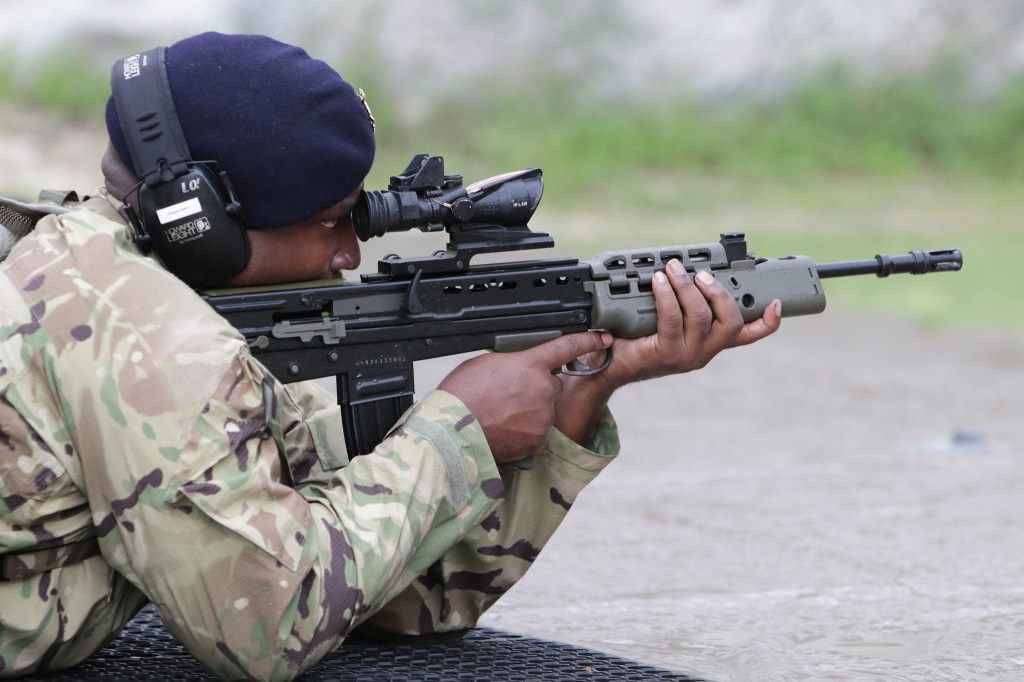
I can’t believe it 2 years since we released the The TAB Advanced Combat Rifle Colouring Book! Pleased to say its back in stock, you can pick up your copy now! Check them out here.


Pick a copy up now at www.armourersbench.com/shop
I can’t believe it 2 years since we released the The TAB Advanced Combat Rifle Colouring Book! Pleased to say its back in stock, you can pick up your copy now! Check them out here.


Pick a copy up now at www.armourersbench.com/shop
This month sees the relaunch of the ARMAX: The Journal of Contemporary Arms, the academic journal of the Cody Firearms Museum. The first edition of the new ARMAX covers everything from Dutch Uzis to the EM2 in Malaya, from East German AK-74s to a CIA assassination pistol.
I’m especially excited about the new journal as it contains one of my first published journal articles, it’s titled ‘The Winchester Repeating Arms Company’s Exports to Foreign Powers During the First World War’. The article leverages the research I undertook while a research fellow at the Cody Firearms Museum a couple of years ago. It examines the work of the Winchester Repeating Arms Company during the First World War. Specifically this article explore the breadth and variety of the work done for the Entente powers. I cover everything from the Russian contract Model 1895 lever-action rifles to the air-service self-loading rifles and of course the British Pattern 1914 rifle.
My advanced copy arrived just a day or two ago and I’m so pleased to see my research in print alongside some fantastically interesting work from friends and colleagues. Below are some photos of the journal and above is a first look video.


If you’re interested in up-to-the-minute small arms research then I highly recommend checking out the relaunched ARMAX journal, I’m very excited to see the next edition. Find out more about the journal and read the abstract for my article here.
If you enjoyed the video and this article please consider supporting our work here. We have some great perks available for Patreon Supporters. You can also support us via one-time donations here.
This week we embark on Dirty Dozen December with a special guest, Lee Marvin’s biographer Dwayne Epstein. Naturally we start this month long exploration of the four Dirty Dozen films with the first and best of them – 1967’s The Dirty Dozen, directed by Robert Aldrich. With Dwayne’s help we look at the making of what has become an iconic war film of the era with defining performances from a strong cast including Lee Marvin, Ernest Borgnine, Charles Bronson, Jim Brown, John Cassavetes, George Kennedy, Robert Ryan, Telly Savalas, Robert Webber and Donald Sutherland. Grab your Grease Guns we’re headed for the chateau!
The episode is also available on all other podcast platforms, you can find them here.
Here are some stills from the film:


If you enjoy the podcast then please check out our Patreon here. Be sure to follow Fighting On Film on Twitter @FightingOnFilm, on Facebook and don’t forget to check out www.fightingonfilm.com.
Thanks for listening!
In this final video of the Rhineland Campaign Weapons series we take a look at the little known role of the British and Commonwealth forces’ Vickers Guns. With the help of the Vickers MG Collection & Research Association we recreated a platoon line consisting of 4 Vickers Guns to recreate the Pepperpot tactics used during Operation Veritable – the western Allies’ invasion of Germany.
In this video we examine how Vickers Medium Machine Guns were used en masse to soften up enemy positions before Operation Veritable began and during the subsequent advance into the Rhineland. The Vickers was used alongside artillery, mortars and even anti-aircraft guns in what was known as a ‘pepperpot’ fire plan – where the focus was on weight of fire. The Vickers supported the advance through out the campaign and in this video we aimed to capture some of the feel of what those pepperpot bombardments might have been like – albeit on much, much smaller scale.
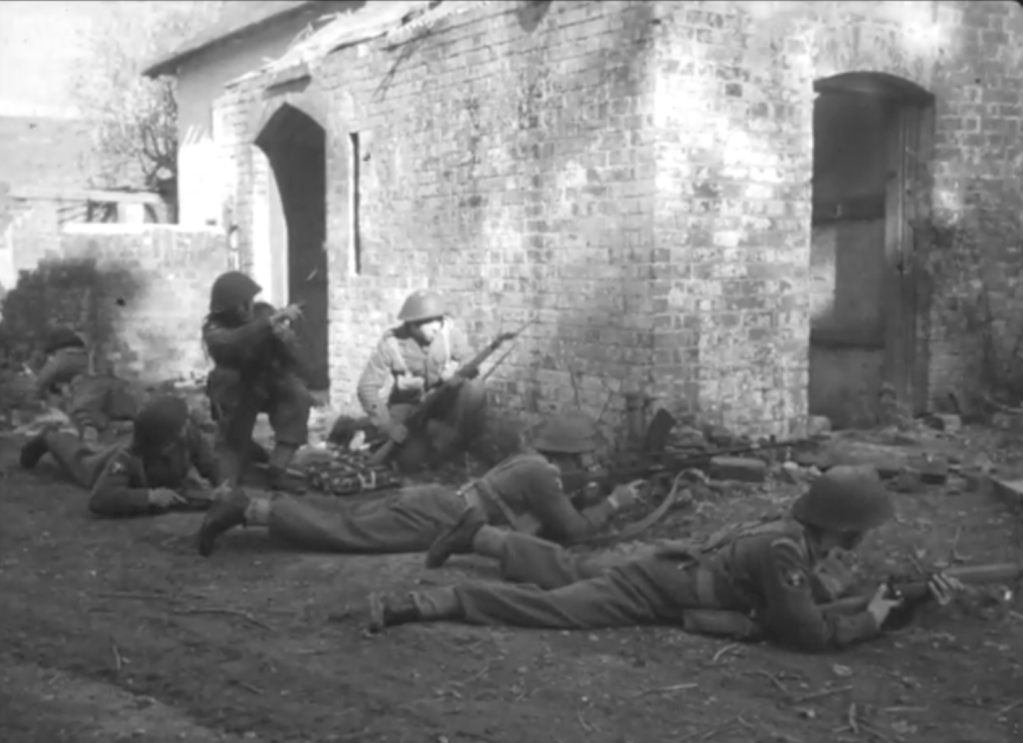
Using contemporary photographs and footage we recreated the gun pits, complete with overhead cover, pits dug to the original manuals and plenty of empty belts and belt boxes. Right down to the gun crews being badged up as Middlesex Regiment. Check out the comparison of our shoot and a contemporary photograph taken during the battle for Goch, 20 February 1945.


Below are some behind the scenes photos from the shoot taken by myself and Robbie McGuire:


A huge thank you to everyone who made the shoot possible, I’m very proud of what we were able to achieve with this shoot.
If you enjoyed this video and article please consider supporting our work here. We have some great perks available for Patreon Supporters. Thank you for your support!
I was recently lucky enough to pick up a pair of very cool anti-tank weapons. A brilliant cutaway/sectioned 66mm LAW and an intriguing 94mm LAW80 training model which requires more research! These were both standard infantry anti-tank weapons for the British Army (and many others) during the Cold War.


Really pleased to add these to the TAB reference collection. We’ll have proper videos on both of these in the near future!
If you enjoyed this video and article please consider supporting our work here. We have some great perks available for Patreon Supporters. Thank you for your support!
In 1940 Britain was overrun and became just another country occupied by Nazi Germany. At least that’s what happened in Kevin Brownlow and Andrew Mollo’s 1964 film ‘It Happened Here’. The film follows Pauline, a nurse as she is forced to choose between resistance and collaboration. Made over 8 years by two exceptionally young filmmakers ‘It Happened Here’ is an impressive and thought provoking film.
In this week’s episode we examine one of the most ambitious amateur films of its era and delve into the fascinating production, performances and story of ‘It Happened Here’.
Warning – this episode includes discussion of fascism, the Holocaust and euthanasia in relation to the plot of the film.
The episode is also available on all other podcast platforms, you can find them here.
Here are some stills from the film:


If you enjoy the podcast then please check out our Patreon here. Be sure to follow Fighting On Film on Twitter @FightingOnFilm, on Facebook and don’t forget to check out www.fightingonfilm.com.
Thanks for listening!
Hello!
I’m pleased to say we’re introducing a new perk this week, Armourer’s Bench Patreon supporters will now be able to watch new videos early!
Over the past couple of weeks I’ve been hard at work making videos which I’m looking forward to sharing with everyone. If you’d like to watch them early, ahead of their YouTube release, then head over to the TAB Patreon page and sign up for as little as $1. There are lots of other thank you perks too!
The first video, available now, is the conclusion to our weapons of the Rhineland Campaign series with a look at the use of the iconic Vickers Machine Gun!
Become a Patron today to get early access to future videos! You can find the Vickers Gun video here.
Thanks for your support!
Matt
This week we examine a Polish film 303 Squadron (Dywizjon 303) with Jennifer Grant, a postgraduate researcher focusing on the Polish Armed Forces in the West during the Second World War. With Jenny as our wingman we discussed the nuances and missed opportunities of this film which follows the exploits of the RAF’s first operation fighter squadron made up of Polish pilots. Immortalised first in 1969’s The Battle of Britain and also revisited in another 2018 film Hurricane, 303 Squadron has a fascinating history but we ask the question – does this film do them justice?
The episode is also available on all other podcast platforms, you can find them here.
Here are some stills from the film:


If you enjoy the podcast then please check out our Patreon here. Be sure to follow Fighting On Film on Twitter @FightingOnFilm, on Facebook and don’t forget to check out www.fightingonfilm.com.
Grab your SLR and LAW 80 and jump in the back of the FV432, the Soviet 3rd Shock Army is on the advance! This week we dive into a pair of British Army training films Fighting In Woods (1982) and Soviet Encounter (1983) with Dr. Kenton White – an expert on the Cold War British Army. These well-made films show a potential (and somewhat optimistic) scenario of how the British Army would have fought the Warsaw Pact if the Cold War had ever gone hot!
The episode is also available on all other podcast platforms, you can find them here.
Here are some stills from the film:


If you enjoy the podcast then please check out our Patreon here. Be sure to follow Fighting On Film on Twitter @FightingOnFilm, on Facebook and don’t forget to check out www.fightingonfilm.com.
During the Cold War the British Army on the Rhine was deployed in West German. In anticipation of a conflict with the Soviet Union detailed recognition guides were written for British troops to identify and familiarise themselves with enemy weapons and equipment. A substantial series of these were written covering everything from small arms to artillery to vehicles and aircraft.
In this video and article we will examine ‘Recognition Handbook Foreign Weapons and Equipment (USSR) Group III Infantry Weapons’ originally published in August 1966. It covers pistols, carbines, rifles, light, medium and heavy machine guns, grenades and some infantry anti-tank weapons like the RPG-2.

The Recognition Handbook is about 100 pages long while the wider series encompasses 12 booklets at approximately 1,200 pages. Each entry in the handbook includes general description of the weapon, its characteristics and recognition features to help identify it. The Handbooks are more detailed version of the smaller Threat Recognition Guide booklets which we have looked at previously.

The video includes clips from a 1979 British Army training film made by the School of Infantry.

Below is the two page entry covering the ‘7.62mm Assault Rifle Kalashnikov (AK-47)’ with a general description, characteristic and some recognition features.

‘Recognition Handbook Foreign Weapons and Equipment (USSR) Group III Infantry Weapons’, British Army, 1966
Warsaw Pact Small Arms’, British Army, 1986, (source)
If you enjoyed this video and article please consider supporting our work here. We have some great perks available for Patreon Supporters. Thank you for your support!