The iconic 9x19mm Uzi submachine gun has been intermittently seen in Ukraine since the early months of the conflict. The earliest images of the Uzi in theatre, which we could find, date to the beginning of May 2022. The origins of the Uzis are currently unclear with a number of possibilities including Israeli IMI-made guns, Croatian EROs, surplus German Bundeswehr MP2A1s or perhaps most likely Belgian manufactured Uzis made under license by FN Herstal.
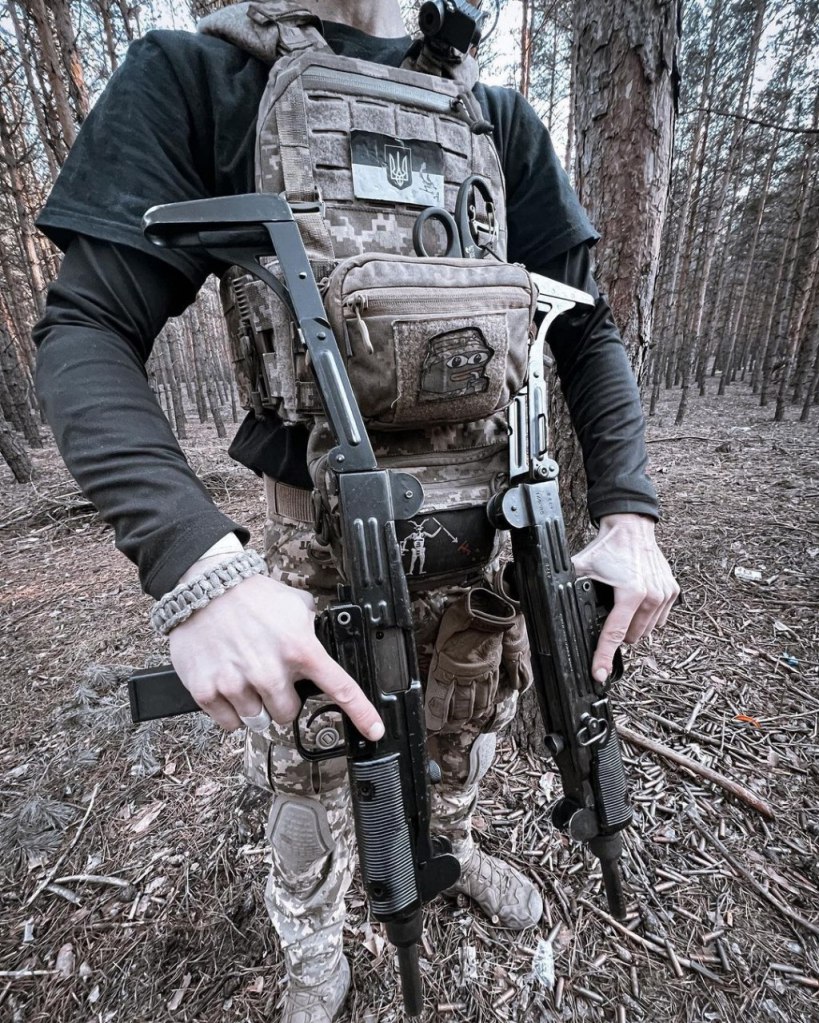
One of the earliest images of an Uzi in Ukraine appeared at the start of May 2022, with a Ukrainian combatant posing with an Uzi and a drone at what appears to be a range. 11 July, saw a group photo of International Legion members shared featuring one combatant holding an Uzi. Several days later on the 17 July a photo was shared of an international volunteer with an Uzi in the back of a vehicle. A month later a Ukrainian soldier was photographed holding a pair of Uzis.
A Ukrainian officer with the 93rd Mechanized Brigade holds a pair of Uzis (via social media)
On the 21 February 2023, a member of the Stugnabat unit, with the International Legion, shared a photo of a combatant with an Uzi. A Ukrainian infantry officer shared a video featuring himself firing two Uzis at one on 14 March. Subsequent photos shared online, seemingly taken at the same time, featuring the officer and the Uzis revealed he is with the 93rd Separate Mechanised Brigade. In early April another Ukrainian combatant shared a clip of himself on TikTok test firing an Uzi at an ad hoc range.
Research by OSINT researcher Ukraine Weapons Warfare has confirmed that at least three of the Uzis seen in Ukraine in early 2023 are of Belgian manufacture. Ukraine Weapons Warfare spoke to two Ukrainian combatants (those who had posted videos with Uzis) who confirmed that their guns had FN Herstal markings. FN Herstal acquired the license to manufacture the Uzi in 1958 with production of Belgian-made guns continuing into the early 1970s. As a result large numbers of Uzis purchased by European countries were made by FN, not IMI.
— 🇺🇦 Ukraine Weapons Warfare (@WeaponsWarfare) April 13, 2023
The Uzis haven’t appeared in any combat imagery and largely appear to be being used as personal defence weapons. They’re most often seen in photos from the range, away from the front line. Due to the iconic weapon’s notoriety they also appear to hold a novelty value for Ukrainian combatants.
Until we can get clear photos of markings or corroboration from users we can’t be certain if all of the Uzis in theatre were originally manufactured by FN Herstal. Similarly, it remains unclear which country or countries may have provided Uzis to Ukraine but we at least know that several of them were manufactured in Belgium.
Update – 13/12/23:
Members of #Ukraine's airborne forces with an Uzi submachine gun.
— Matthew Moss | Historical Firearms (@historicfirearm) November 21, 2024
Support Us: If you enjoyed this video and article please consider supporting our work here. We have some great perks available for Patreon Supporters – including early access to custom stickers and early access to videos! Thank you for your support!
Bibliography:
The UZI Submachine Gun, C. McNab (2011)
The UZI Submachine Gun Examined, D. Gaboury (2017)
On 11 April, Prime Minister, Justin Trudeau, announced that Canada would provided Ukraine with “21,000 5.56mm assault rifles” and 2.4 million rounds of ammunition. This latest round of security assistance brings the value of Canada’s aid to Ukraine to CAD 8 billion ($6 billion). The official announcement stated:
The new military assistance package includes 21,000 5.56mm assault rifles, 38 7.62mm machine guns, and over 2.4 million rounds of ammunition to support these weapons as well as small arms already in use by the Armed Forces of Ukraine.
The statement, which the Canadian Department of National Defense confirmed, noted that the small arms would be “sourced from Colt Canada”, meaning that the weapons would not be coming from the Canadian Armed Forces’ own stocks. The announcement also noted that the: “donation comes from the remaining funds across the Government of Canada’s various funding envelopes for military assistance to Ukraine.”
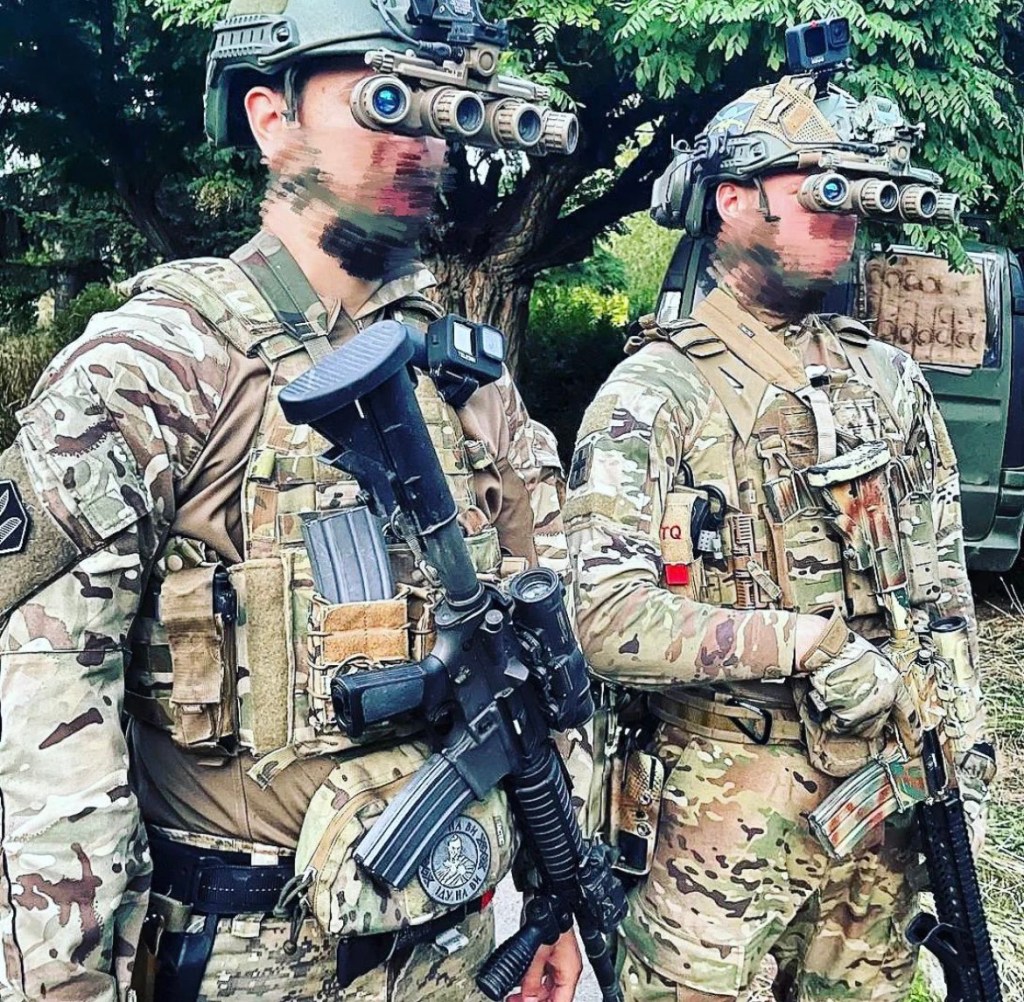
Ukrainian SOF with Colt Canada C8 carbines (via Social Media)
In terms of previous small arms donations, Canada has provided a range of weapons. These include 100 Carl Gustaf M2 Recoilless Rifles, 7,500 hand grenades and up to 4,500 M72 LAW anti-tank weapons. Canada has also transferred C9 (FN Minimi) light machine guns, C6 (FN MAG) general purpose machine guns and an undisclosed number of Colt Canada C8 carbines.
When the new aid package was announced, there was considerable speculation about what models might be – C7 or C8s or perhaps the newer Colt Canada MRR?
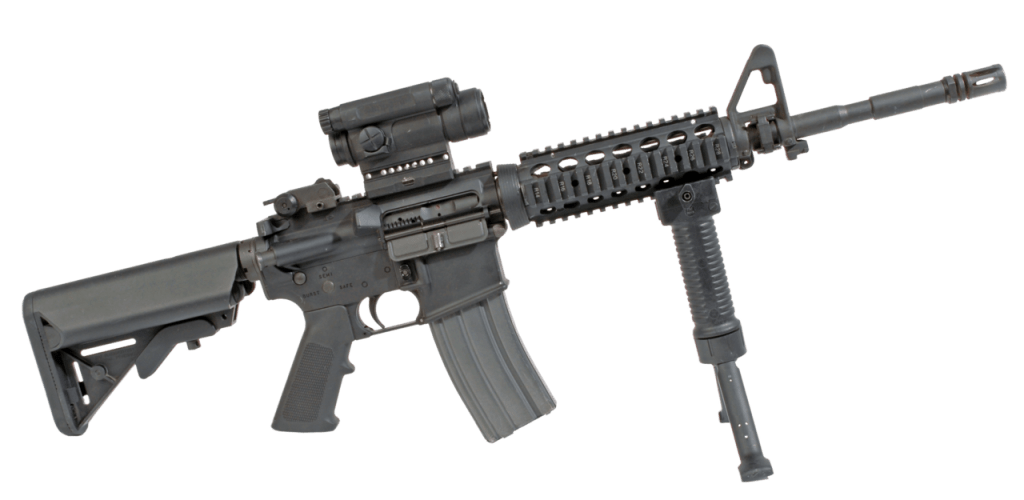
One of the surprising weapons on Canada’s list of rifles for Ukraine – M4A1 carbine (US Army)
I enquired about the types of ‘5.56mm assault rifles’ that Colt Canada would be providing. A Department of National Defense spokesperson stated that the donation would include: “M4 carbines; M4 Commandos; M16A4 rifles; M5 carbines; and C8A2 carbines.” This is a surprising list as the C8A2 is the only weapon on the list manufactured by Colt Canada. Of the other weapons, the M4 and M16A4 are US military weapons, and the M5 is a rifle aimed at the international law enforcement and military markets offered by US-based Colt only.
We asked the Department of National Defense about the unexpected models listed, and they responded that: “we expect that the majority of the rifles will be manufactured and assembled at the Kitchener plant [Colt Canada’s facility in Ontario], though it is likely that they will need to source certain parts from their subsidiaries.”
An unexpected entry on Canada’s list of rifles for Ukraine – Colt M5 carbine (Colt)
It appears that Colt Canada will act as the vendor but call upon Colt in the US to provide components and perhaps complete weapons – both companies are part of the Colt-CZ Group. We also reached out to Colt Canada, who responded to our request for comment, saying:
We are honored to be part of Canada’s military assistance to Ukraine. Colt Canada will play an important role in the deliveries of assault rifles, machine guns, and ammunition to the Government of Ukraine. We are proud to be a strong and reliable partner to the Canadian government, in helping Ukraine to defend its national sovereignty and territorial integrity.
Colt Canada declined to comment on the variety of weapons listed by the Department of National Defense and did not comment on the hypothesis that parts for the weapons would be drawn from across the Colt-CZ Group.
Ukrainian SOF with Colt Canada C8 carbines (via Social Media)
21,000 rifles is a considerable number of personal weapons. The average Ukrainian brigade size is around 4,000 personnel. We also have to factor in the considerable attrition rate experienced during heavy fighting but even so this supply of rifles could in theory perhaps arm three or four brigades. This is especially useful as Ukraine is currently raising new Army and National Guard brigades.
Another aspect to consider is spare parts for the weapons – as yet the Canadian government have not disclosed spares which might be provided. The Canadian Department of National Defense expects the delivery of the weapons “to be completed in the coming months”.
This article was based on an earlier article written by the author and published at TFB.
Support Us: If you enjoyed this video and article please consider supporting our work here. We have some great perks available for Patreon Supporters – including early access to custom stickers and early access to videos! Thank you for your support!
In a video a few months ago we looked at the use of Diemaco C7A1s in Ukraine. The C7s have been seen in use with various Ukrainian units including the International Legion, the Belarusian the Kalinouski Regiment and most recently elements of the Azov Brigade.
In that video I theorised about where the rifles may have been sent from – with several options. Since then after speaking with numerous sources the rifles have been confirmed to have come from the Netherlands. I’ve spoken with Dutch colleagues and members of the Netherlands Armed Forces about the rifles and have been able to interview a source familiar with the Dutch operation to supply the rifles.
Ukrainian SOF operator with a Dutch C7A1 mounted with an ELCAN optic originally used on a simulator range (via social media)
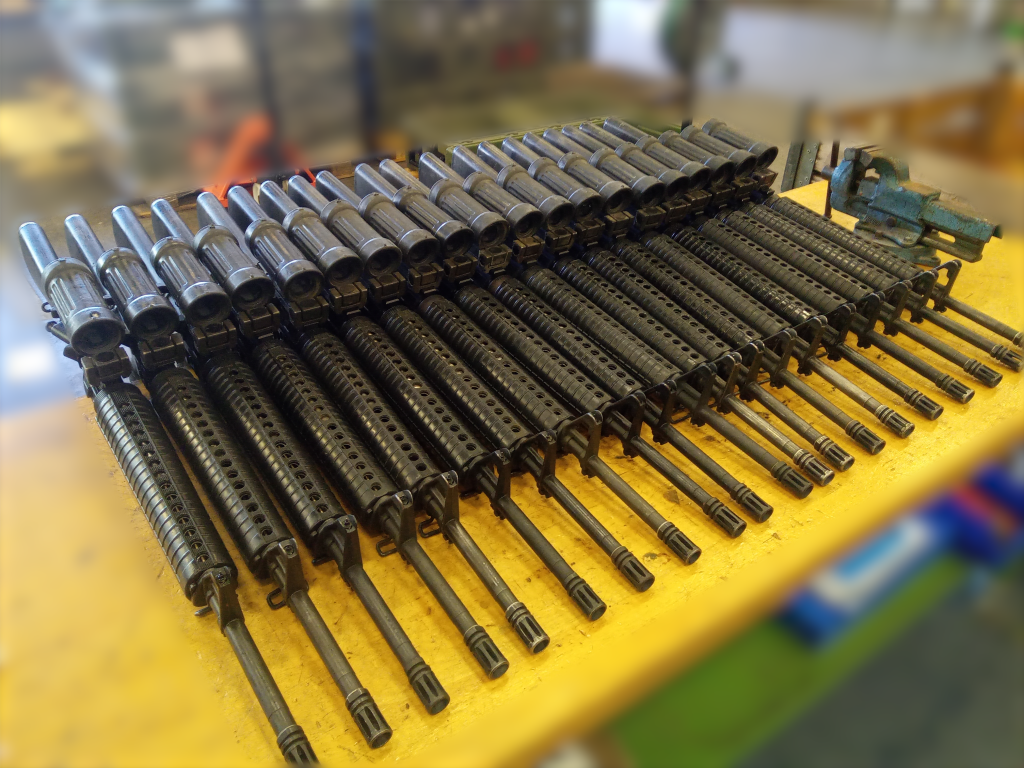
In the summer of 2022 a small team of Dutch Army armourers worked feverishly to check and prepare thousands of surplus rifles for shipment to Ukraine. Since then the rifles have regularly been seen in the hands of numerous Ukrainian military units.
The Netherlands has provided a wide range of military aid to Ukraine since the outbreak of war ranging from Stinger MANPADS to YPR-765 APCs, and from 155mm PzH 2000s self-propelled howitzers to Barrett and Accuracy International precision rifles.
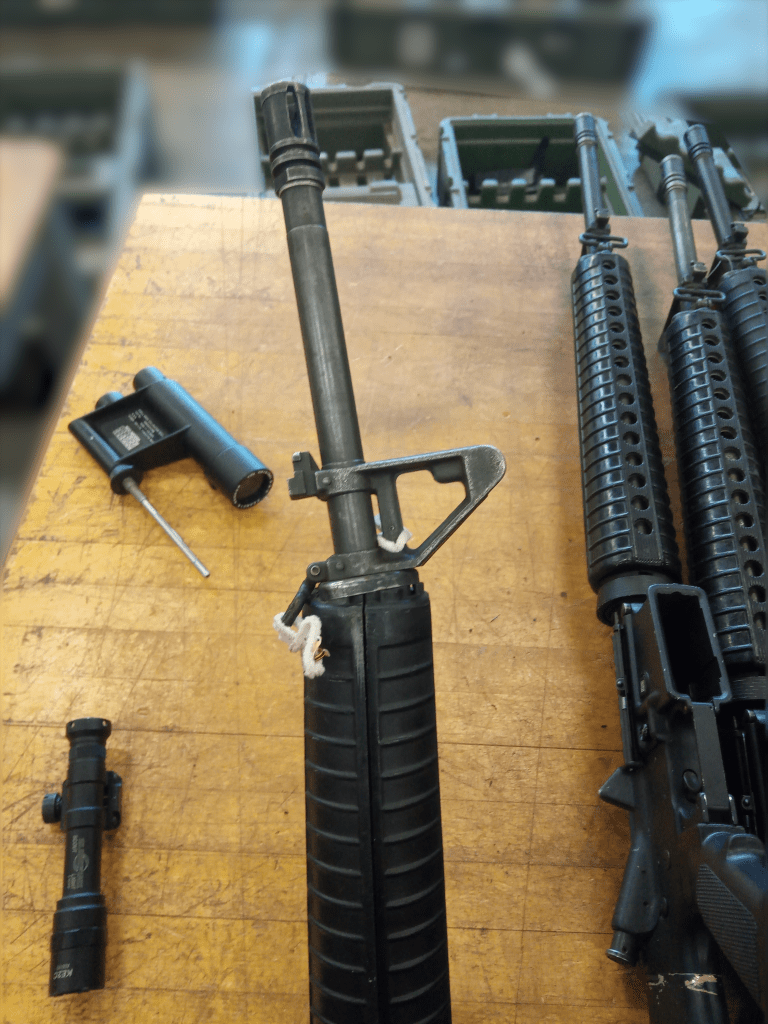
A workbench filled with C7A1 rifles, with ELCAN optics, after being checked by armourers from the Royal Netherlands Army (redacted by TAB, via source)
We spoke to a source familiar with the Dutch operation to supply the weapons who described the mammoth task of preparing rifles, pistols, optics and light machine guns for transfer to Ukraine.
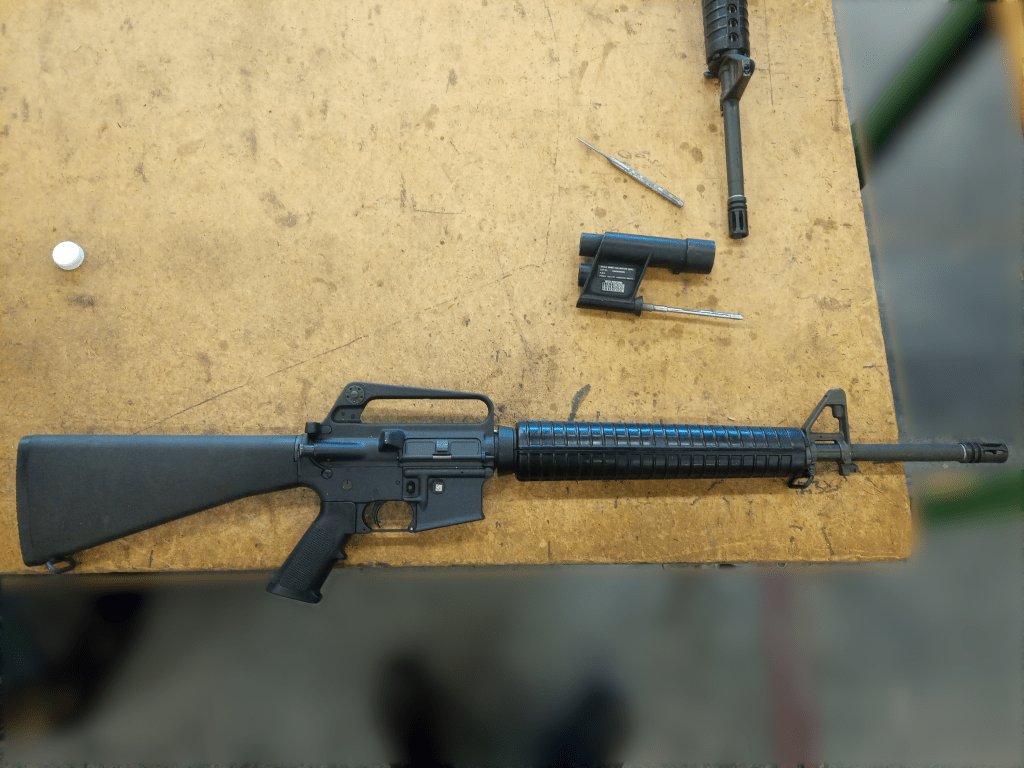
The primary weapon the team had to get ready for shipment were 5.56x45mm select-fire C7A1 rifles. Made by Diemaco, now Colt Canada, these rifles were made in Canada under license from Colt. The A1 variant is easily identified by its combination of a handguard similar to that of the US M16A2 and its upper receiver which has a length of STANAG Picatinny rail for mounting optics. Since the early 2010s the Netherland’s C7A1s have been progressively upgraded to the C7NLD standard with new adjustable stocks, railed forends and Integrated Upper Receiver (IUR)s. The remaining C7A1s were placed in storage – many still sporting old paint jobs.
Older C7s with integral carrying handle were also shipped. Note: Another identifying feature noted by numerous Dutch sources is the small QR code armoury tags seen on the right side of the magazine housing (redacted by TAB, via source)
Each rifle had its headspacing, barrel alignment and disconnector and sear checked as well as an overall check for damage or corrosion. On average, if the rifle had no significant defects, the inspection took around five minutes before it was set aside to be prepped for shipment.
So many C7A1s were checked and prepared that the team ran out of the standard C79 ELCAN optics to mount on them, with our source noting that “we used the ELCANs designated for the FN Minimi on the rifles… we also used the ones for the simulator [optics used on electronic indoor training ranges] eventually. We had to remove the front lenses [which allow them to be used on the simulator ranges].”
A Dutch C7A1, fitted with an Aimpoint Comp sight, in the hands of a Ukrainian combatant, c. June 2022 (via social media)
Once the weapons were checked they were mounted with optics. Collimating these involved setting a 300m zero. Which our source said “took the longest of all and really trained our arms. Holding the rifle in the air with one arm and adjusting the optics with the other.” After this they noted that the “tools for inspection and alignment for optics were completely worn out.”
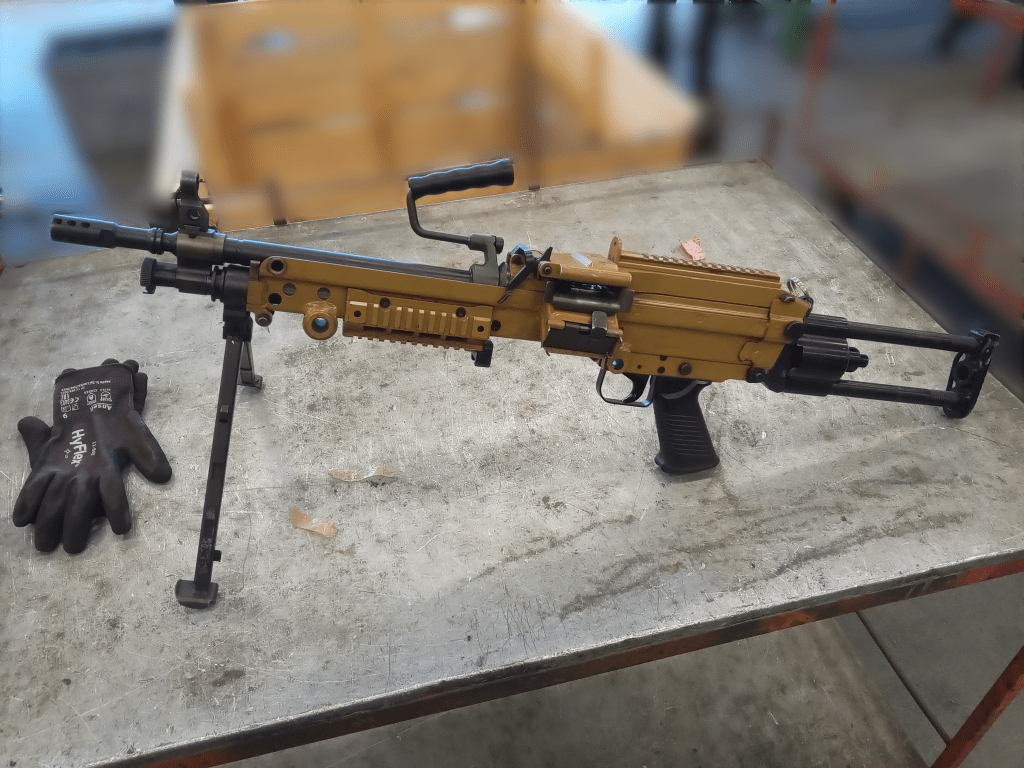
Our source also noted that the Netherlands also transferred a significant number of Gen 3 Glock 17 pistols and some FN Minimi 5.56x45mm light machine guns.
An FN Minimi Para light machine gun, with FDE finish, checked ready for transfer to Ukraine (redacted by TAB, via source)
Along with the more numerous C7A1 rifles, a number of the earlier C7 pattern rifles with a carrying handle and a selector with a 3-round burst option rather than fully automatic found on the C7A1s, were also shipped to Ukraine. These earlier C7s are rarely seen in imagery from Ukraine.
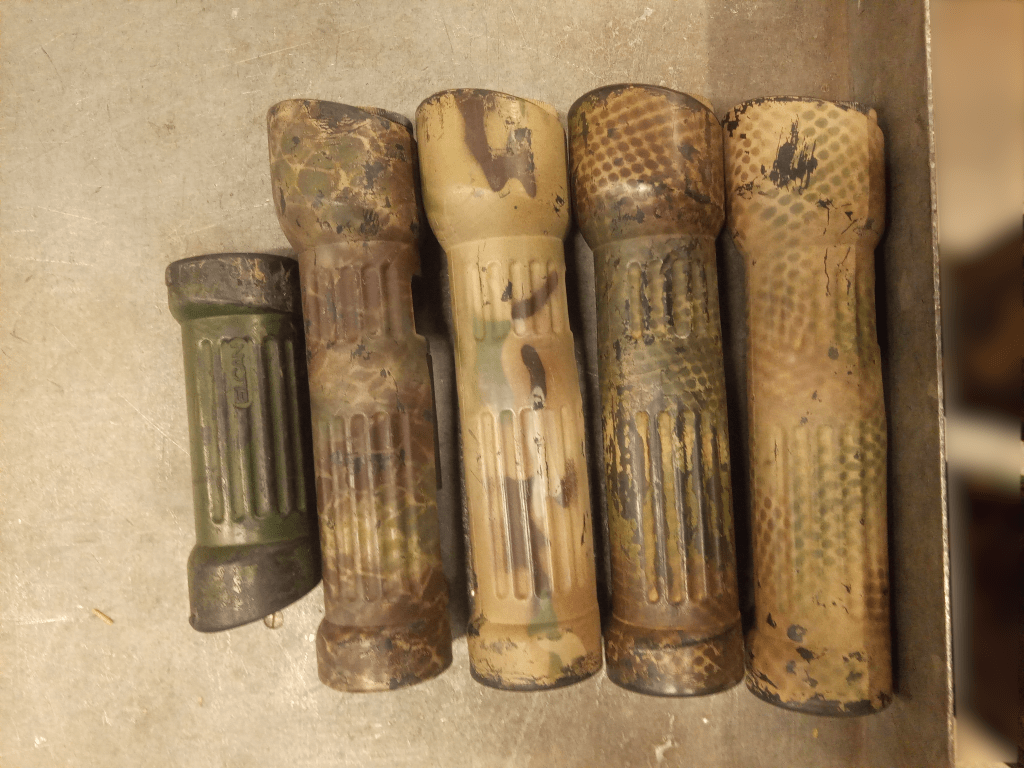
Our source explained that when the weapons arrived at the depot for preparation for shipment “every gun came with one magazine and no optic at first.” But it was decided that rifles needed optics, at first they mounted Aimpoint Comp M3s, then the older 3.4×28 ELCANs, Hi-Mag ELCANs which had originally been mounted on the Dutch Army’s FN Minimis and finally the simulator range ELCANs were used. All of these optics have since been seen in use in Ukraine.
A 3.4×28 ELCAN and Hi-Mag ELCANs originally fitted to machine guns – with their old operational camouflage paint jobs (redacted by TAB, via source)
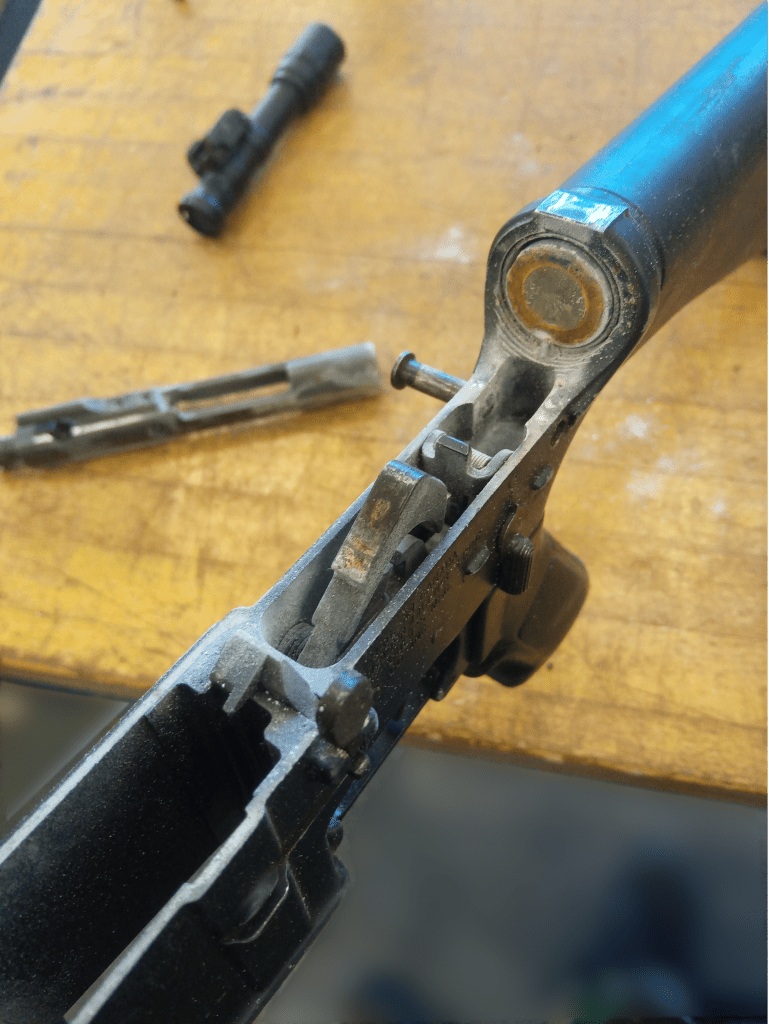
The team of armourers were only allowed to prepare surplus material for shipment so rifles which were damaged – some weapons had corrosion, bent barrels, damaged receivers or furniture – were rejected. Some rifles were cannibalised to repair as many defective weapons as possible but with time short only quick, basic repairs were undertaken.
A C7 lower receiver with some corrosion and a rifle with a badly bent barrel (redacted by TAB, via source)
The process took weeks of hard work and while our source couldn’t provide an exact number of rifles prepared for transfer he estimated that just under 10,000 were checked, repaired and prepared for shipment.
Since the team completed its work the weapons they prepared have been seen in numerous photographs and videos from the fighting in Ukraine. [As mentioned earlier] The C7A1 rifles have been seen in use with Ukrainian special operations forces, the Ukraine-aligned Belarusian Kalinouski Regiment and most recently with elements of the 47th Separate Mechanised and Azov brigades. The weapons are easily identifiable by their configuration, the characteristic range of ELCAN and Aimpoint optics and also by the small armory identification tags which can often be seen on the right side of the magazine housing.
Ukrainian SOF operator at the range with a Dutch C7A1 mounted with an ELCAN Hi-Mag optic (via social media)
When asked what he thought of the rifles being used in Ukraine our source said: “I’m glad to see they are being used there. Makes me proud of my work.” Special thanks to those who helped ID the rifles and to our sources who spoke to us for this article/video!
Support Us: If you enjoyed this video and article please consider supporting our work here. We have some great perks available for Patreon Supporters – including early access to custom stickers and early access to videos! Thank you for your support!
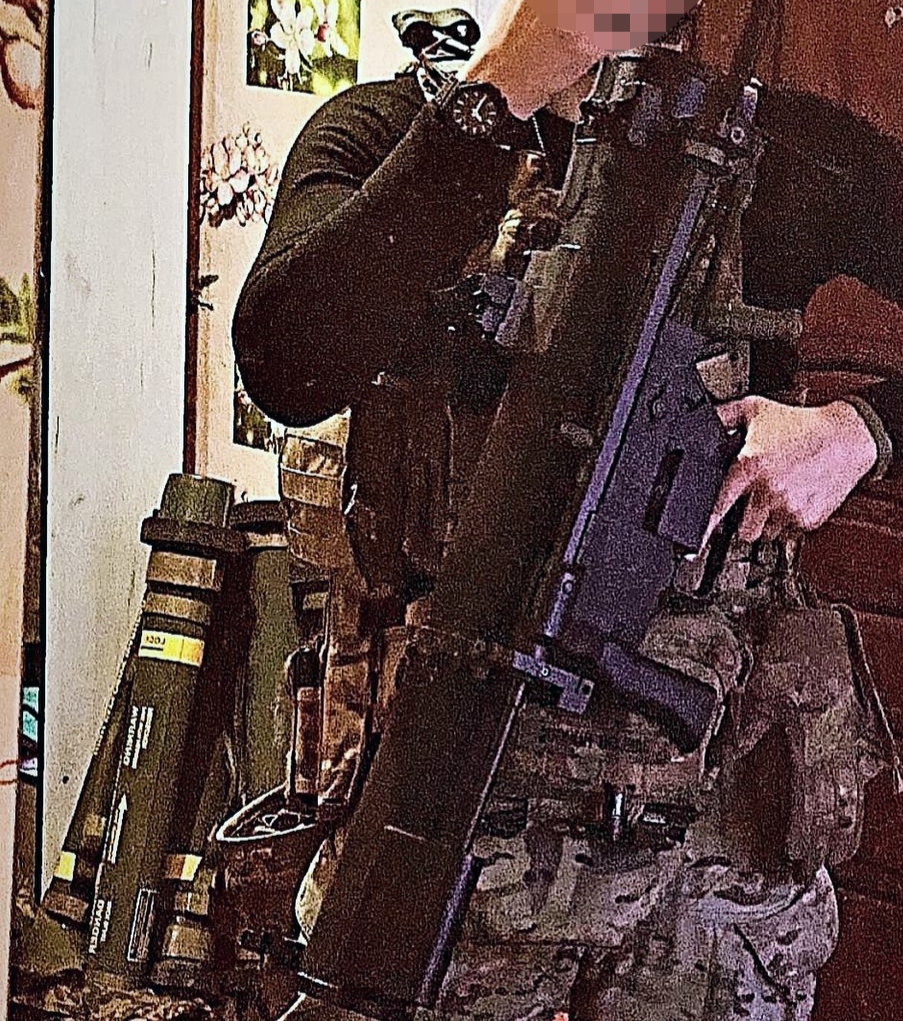
Recent imagery confirms the presence of the Mk153 SMAW in Ukraine. In the last couple of months there have been sightings of the Mk153 in use at the front and at a Ukrainian Armed Forces training ground. The Mk153 is a shoulder-fired rocket launcher capable of engaging structures and armoured vehicles.
The Mk153’s cousin munition – the one-shot, disposable M141 SMAW-D has been seen in theatre in fairly small numbers since February 2022. We have an earlier article/video looking at the SMAW-D, check that out if you haven’t already.
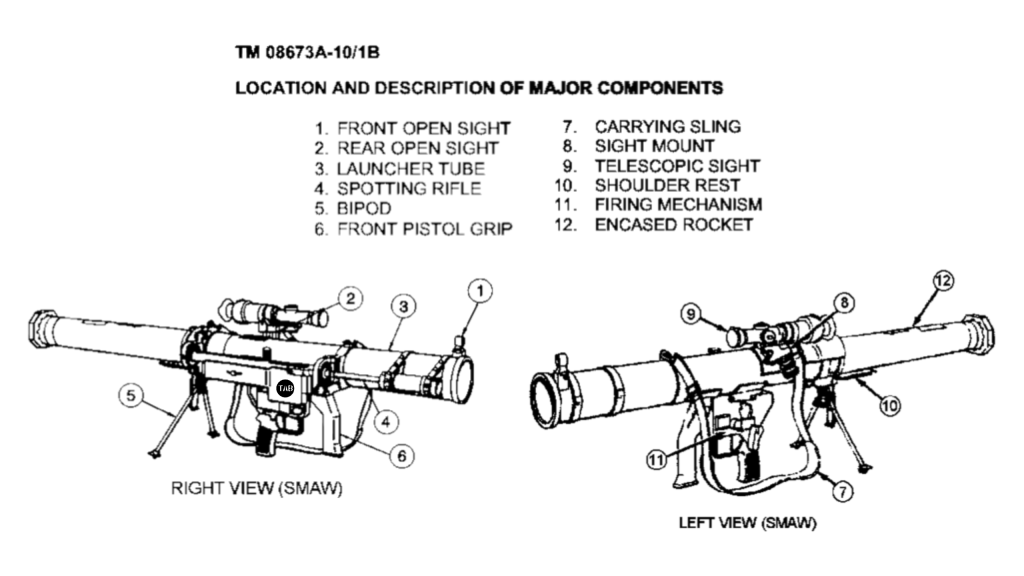
The Mk153 is primarily used by the USMC and was developed from the Israeli IMI B-300 and introduced in the mid-1980s. So what actually is a Mk153? The USMC describes the SMAW as:
“a one-man operable, 83 mm smooth bore, shoulder-fired, rocket launcher with a spotting rifle attached to the right side of the launcher tube. The encased rocket is fitted into the aft end of the launcher, and the fiberglass encasement is discarded after use. The spotting rifle, which improves firstround hit probability, is fed 9 mm tracers by a magazine, which holds six rounds. The 9 mm round is ballistically matched to the 83mm rocket.”
The SMAW (or Shoulder-Launched Multi-Purpose Assault Weapon-Disposable) can fire Encased High-Explosive, Dual Mode (HEDM) and Encased High-Explosive, Anti-Armor (HEAA) rockets. The HEDM is an anti-structure and anti-light armour munition with a warhead containing 2.4 pounds Aluminized Comp A-3 capable of penetrating 200mm (8 in) of concrete. The HEDM has a maximum effective range of 250m. The HEAA is a dedicated anti-armour round able to penetrate up to 600mm (23.6in) of rolled homogeneous steel, with a maximum effective range of 500m. It uses a shaped charge warhead with 1.89 lbs Octol explosive. The Novel Explosive (SMAW-NE) has a 4lbs enhanced-blast warhead, containing PBXN-113, designed for bunker busting which the USMC manual describes as “designed to provide enhanced-blast lethality to defeat personnel in reinforced structures and caves.”
Mk153 in Ukraine (via Social Media)
The Mk153 has iron sights and a Mk42 3.8× magnified optic and a 9mm spotting rifle on the side of the launch unit. This spotting rifle fires tracer rounds which match the rocket’s ballistics and can help range the target and aid the operator in applying the right hold for the target. The tracer cartridge that contains a 9mm jacketed bullet with an aft burning .22 calibre tracer element. Spotting rifle magazines for the rockets are supplied on the outside of the rocket carry tube end cap.
The first sighting of a Mk153 in the field came from some B roll footage of a UK Channel 4 News report published on 28 February. It showed men of the Ukrainian 68th Jager Brigade on the front-line near Vuhledar. Several soldiers are seen preparing a Mk153 to fire.
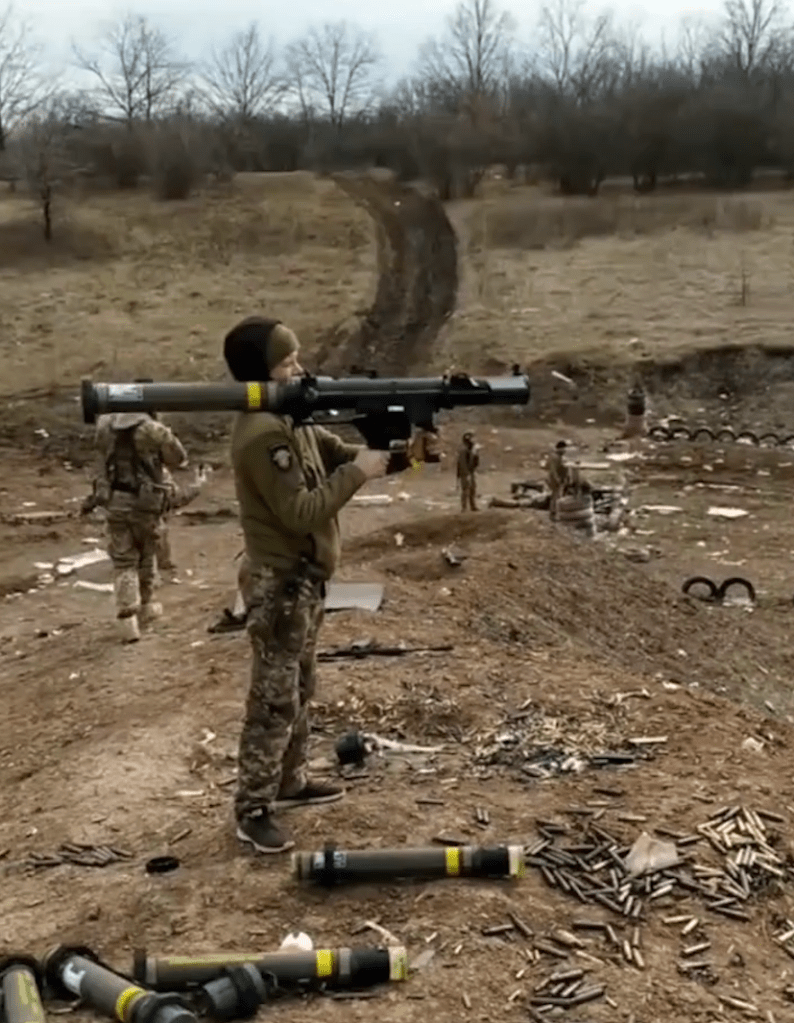
On 17 March a video featuring a Mk153 SMAW being fired at a range was shared on Telegram. It shows a SMAW being fired and a pile of spent tubes and unfired rockets on the ground. The fired and unfired rockets all appear to have yellow bands indicating high explosive munitions – the Mk153’s practice round has a brown band. Sadly, we can’t make out the other markings which would indicate the type of rounds being fired.
Mk153 in Ukraine (via Social Media)
At the end of March another video of Ukrainian soldiers preparing a Mk153 for firing was shared again at the range. The video gives us the best close up of the launcher in theatre so far and shows not one but two launch units. We get a good look at the tube and the launch unit’s spotting gun on the right hand side. This video shows the weapon being prepared to fire, the rocket is inserted into the launcher and rotated clockwise a quarter-turn to lock it in place before the Ukrainian soldier fires at a target down range.
Another interesting detail we can see is the white paper hang ing from the rocket. This is a humidity indicator which allows quick visual inspection to see if the rocket might have been compromised by moisture. The indicator on this rocket appears to have pink in all three of its indicators circles, meaning the munition might be compromised, in USMC service this would mean the rocket needs to be returned to the ammunition supply point. Despite this the rocket appears to fire normally and detonate down range. It’s worth noting that the launch unit isn’t fitted with an optic in any of the clips.
Update – 24/05/23: An additional clip of a SMAW being fired in an urban environment, perhaps during the defence of Bakhmut, date unknown.
A very rare sighting of a Mk153 SMAW in action in Ukraine. Telegram source simply captioned it Bakhmut, date unknown.
— Matthew Moss | Historical Firearms (@historicfirearm) August 8, 2023
Update – 3/9/23: An interesting video showing a phone mounted onto a SMAW MK153, this allows a clinometer app to be used to enable the SMAW to be used in the in-direct role, angling the weapon upwards.
Really interesting video showing a phone mounted onto a SMAW MK153, this allows a clinometer app to be used to allow the SMAW to be used as a in-direct weapon. Not sure if the MK153 rounds have a max range detonation feature.
— Matthew Moss | Historical Firearms (@historicfirearm) April 3, 2024
Update – 3/4/23: A combatant from Ukraine’s 3rd Assault Brigade shared video on 27 March of a firing of a SMAW Mk153 at a range, filming date unconfirmed.
A combatant from #Ukraine's 3rd Assault Brigade firing a SMAW Mk153 at a range, recently posted but filming date unconfirmed.
— Matthew Moss | Historical Firearms (@historicfirearm) April 3, 2024
Mk153 Specifications (per USMC):
Rocket Launcher
Length
29.9 inches
Weight
16.9 pounds
Encased rocket (as carried)
Length
27.3 inches
Weight
12.7 pounds
Caliber
83mm
Weapon Ready to Fire
Length
53.1 inches
Weight
29.0 pounds
Range
Maximum effective (HEDM)
250m
Maximum effective (HEAA)
500m
Time of flight to 250m
1.6 sec
Support Us: If you enjoyed this video and article please consider supporting our work here. We have some great perks available for Patreon Supporters – including early access to custom stickers and early access to videos! Thank you for your support!
Bibliography
Ukraine War: on the front lines with the 68th Brigade, C4 News, (source)
Introduction to Crew Served Weapons, USMC, (source)
Launcher, Assault Rocket, 83mm (SMAW) MK153 Mod 0, USMC, (source)
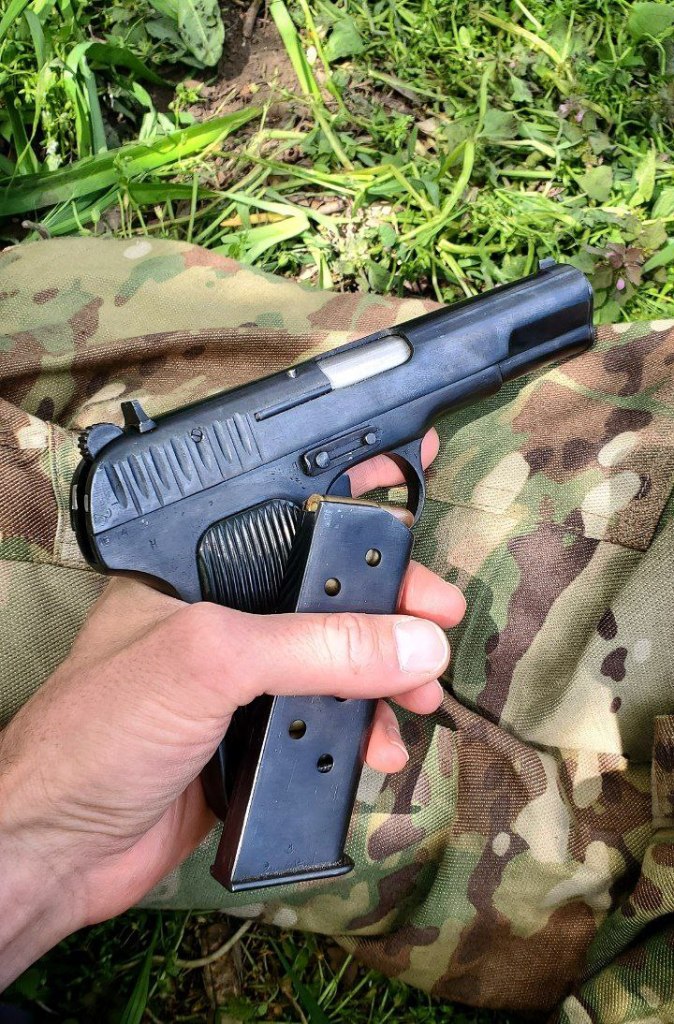
The fighting in Ukraine has seen a wide range of small arms in use ranging from the cutting edge to the antique. We’ve seen a number of older weapons like Mosin-Nagant rifles, M1910 Maxim machine guns and DP light machine guns in service with both sides. [We’ll take a look at those in future videso] The TT-33 pistol, a pistol which first entered service 90 years ago, is another older weapon which is again seeing action. The examples seen in theatre are likely a mix of privately owned firearms and pistols drawn from Ukrainian stores.
Introduced in the mid-1930s to replace the 1895 Nagant revolver, over a million TTs have been produced. Designed by Fedor Tokarev the pistol became the Soviet Union’s primary side arm, seeing service during the Second World War alongside the Nagant.
The TT-33 is a semi-automatic pistol, chambered in 7.62×25mm. It feeds from an 8 round single stack magazine and uses John Browning’s short recoil tilting-barrel action. The TT is an extremely robust pistol and remained in service well into the 1950s with the Red Army and continues in service around the world even today.
A photo of a TT-33 shared by the TDF’s 127th Kharkiv Brigade (via social media)
Pistol use in general in the current conflict doesn’t appear to be prolific but a considerable number of combatants are frequently seen carrying side arms. Everything from Makarovs and Stetchkins to more modern Glocks and Ukrainian Fort handguns. Pistols are often carried by soldiers working in roles which frequently see them separated from their service rifle and by those who prefer to carry a secondary weapon.
While we’ve seen TT-33s in the hands of Russian and Ukrainian separatist troops in this video we’ll largely focus on Ukrainian use. At the fall of the Soviet Union a considerable amount of surplus small arms fell under Ukraine’s control, including substantial numbers of TT pistols. While not general issue it has been in service with the Ukrainian Army, National Guard and the Border Guard Service. This video definitely isn’t an exhaustive survey of TT use in Ukraine but lets take a look at some examples:
At the start of April 2022 the training department of the command headquarters of the Ukrainian Territorial Defense Forces have published a number of high quality videos showing how to disassemble and clean the TT.
The Ukrainian YouTube channel, Boys from the Forest (ХЛОПЦІ З ЛІСУ) shared a video looking at the TT in May 2022. They concluded their video by shooting a block of explosive reactive armour with the pistol – to no effect. In June Alina Mykhailova, a medic with 1st separate mechanised battalion “Da Vinci Wolves” shared a photo of some firearms used by the unit, including amongst other things – a TT pistol.
A photo of a TT-33 shared by an International Legion volunteer (via social media)
In around August some members of a TDF unit posed with a Nestor Makhno banner and a DP light machine gun and a TT-33 pistol. A Russian news report from around Soledar, published on 5 August, featured an interview with a soldier carrying a TT in a front pouch of his load bearing equipment. On the 12 August a Ukrainian operator shared a couple of photos of his side arm, a 1945-dated, Izhevsk manufactured TT-33 with wooden grips. Date and location they were taken wasn’t shared.
In an interesting video posted around the 25 August, a TT-33 is used to test some captured Russian steel plate. Yurii Kochevenko, an officer of the 95th Air Assault Brigade, shoots a one of the plates point black with TT he carries in a webbing holster. The 7.62x25mm round doesn’t cleanly penetrate the plate but appears to impart enough force to crack the metal.
At the end of November the Military Institute at the National University in Kyiv shared photos of cadets taking part in a shooting championship using TT pistols.
On 30 December, the 247th Separate Battalion of the TDF’s 127th Kharkiv Brigade shared a photo of Vitaly, a member of the battalion, armed with an AK-74 and on his plate carrier he has a TT in a Cytac holster. These tactical holsters for the 90 year old pistol retail for around 780 Hryvnia. On the same day Ukrainian personnel shared an update video from their position in Bakhmut, one of them is carrying a TT on his plate carrier.
A TDF officer, call sign Witch, has been seen numerous times carrying a TT-33 as her sidearm. Videos posted to her TikTok on 24 December and 12 January show it in a holster on her plate carrier, with a coil lanyard fitted. A video shared by the TDF Public Relations Service on 19 February also gives us a good look at the TT carried by Witch.
Ukrainian marksman position with a rotary grenade launcher, a UAR-10 and a TT pistol (via social media)
On 26 February 2023, the TDF’s 127th Kharkiv Brigade shared a gallery of photographs featuring the TT on their instagram page. The caption notes that: “Despite the fact that this pistol was actively used even during the Second World War, it is simple in design, reliable in operation, small in size, comfortable to carry and always ready to defeat the Russian invaders.”
A Ukrainian special operations unit shared a photo of a member of the unit sat beside a Russian prisoner while holding two TT-33 pistols, one in its original finish and the other was a camouflage paint job. Most recently at the start of March a Ukrainian marksman active around Bakhmut shared a photo of his position with a rotary grenade launcher, a UAR-10 and a TT pistol.
In addition to the original TT-33s seen in theatre there are also a significant number of former-Yugoslavian M57s which while externally very similar have some improvements, including a slightly longer grip that allows the magazine to hold an extra round.
Update – 25/6/2024:
A member of the Ukrainian 117th Territorial Defense Brigade, May 2024, using a TT-pattern pistol at the range.
— Matthew Moss | Historical Firearms (@historicfirearm) June 25, 2024
Support Us: If you enjoyed this video and article please consider supporting our work here. We have some great perks available for Patreon Supporters – including early access to custom stickers and early access to videos! Thank you for your support!
Bibliography:
The Procedure for Partial Disassembly and Assembly of a TT pistol, TDF, (source)
Rules for cleaning and lubricating weapons on the example of a TT pistol, TDF, (source)
We’ve looked at a number of different bullpups currently in use with Ukrainian forces, ranging from Tavors to the locally developed Malyuk/Vulcan – check out those articles/videos if you haven’t already.
In this article/video we’re going to take a look at another Ukrainian development which converts a standard AK-74 into a bullpup. The Black Storm BS-series of kits has been around since the mid 2010s and in recent months more and more imagery of Ukrainian personnel with Black Storm bullpup AKs has been emerging.
The Black Storm kits are compatible with both AKM and AK-74 pattern rifle and the relatively simple designs allows the conversion of a conventional rifle into the bullpup with not alterations to the base rifle.
A suppressed AK-74 next a suppressed BS-3 illustrating the overall length difference (via Black Storm)
To convert the rifle the stock furniture is removed, the pistol grip, forend and butt. The trigger transfer bar is then put in place and the lower receiver of the chassis is then attached which holds it in place. The new lower receiver has the pistol grip already attached. The butt assembly is then slide into place – this also covers the original trigger but leaves the magazine release exposed. There is a hinged cheek piece attached to the butt assembly. This can be pivoted out the way for access into the receiver and to allow the gas piston and bolt assembly and receiver cover to be placed. Finally, a top cover is slotted into place and retained by a catch to the lower. This covers the gas tube and barrel.
The kit appears to be made from simple sheet metal stampings and is held together by slotting into pre-existing parts of the rifle’s original receiver and a couple of screws. While the chassis obviously adds weight to the weapon it does have the benefit of shortening the rifle and also shifting its centre of balance back.
The BS3 adds no additional controls to the rifle and the weapon is manipulated using it’s existing charging handle and safety-selector lever. The BS4 was developed in 2017 and introduced in 2018, adds a number of new ergonomic features with a left-side forward charging handle which makes the rifle much easier to cock and a new thumb actuated safety – which probably acts on the trigger transfer bar. A new extension to the magazine release lever has also been added to make magazine changes easier. Black Storm describe the BS4 as: “easy to put on and take off in the field, without intruding into the weapon. It is enough to remove the butt and stock, and you can install the Bullpup with one mounting bolt.” Both the BS-3 and BS-4 have a length of Picatinny rail under the lower receiver and require an optic riser rail for mounting an optic.
A BS-3 c.November 2022 (via Black Storm)
How well an optic mounted on a rifle in a Black Storm kit retains zero is unknown but the mount is fitted over the rifle’s rear sight block and held in place by a bracket under the barrel. This is then secured by four small bolts.
The company says that both the BS-3 and BS4 are made from 1mm stamped steel and polymer. Black Storm list the weight of an AK-74 with the BS-3 kit installed, but without a magazine, as 3.4kgs. The weight of the BS-3 kit’s components is 1.2kg. A 2018 video, however, suggests that the kit’s components weigh just over 1.6kg (not including the rifle’s receiver, barrel and bolt assembly).
Black Storm list the weight of an AK-74 with the BS-4 kit installed, but without a magazine, as 3.9kgs. The weight of the BS-4 kit’s components is 1.7kg. Once installed with either kit the rifle has an overall length of 70cm (27.5in) down from 94cm (37in) for a standard configuration AK-74.
A video review of the kit by one of the Ukrainian soldiers who has used it in the field
Black Storm list the BS-3 at 14,250 UAH ($387) and the BS-4 at 21,500 UAH ($585). From the information available it appears that the kits are purchased by servicemen privately, to adapt their issued service rifles.
A BS-5 has been developed, it’s unclear if this is in production but it is listed on Black Storm’s site and is said to be available. It has a length of rail along its top cover removing the need for an optic riser and also allowing the use of back up iron sights. It’s price is listed at 28,500 UAH ($775).
BS-3 with an EOTECH HWS XPS2, a laser/light module and a custom green camouflage paint job (via social media)
Photos of the BT-2 were shared in January 2015 and an early version of the kit was displayed at a Ukrainian military exhibition in 2015, the BT-3 and BS-3 variants were introduced in 2017 and 2018. The guns have seen combat use since at least 2017, with Black Storm sharing photos of a BS-3e used in Donbas in July 2017. Since Russia’s invasion in February 2022, a number of photos and videos have shown the conversion kits in use with personnel from a variety of units.
During the first week of April combatants from the Georgian Legion shared a photo featuring a BS-3. In July a member of Azov Dnipro was photographed with a BS-3 outfitted with a thermal optic, bipod and suppressor. Interestingly you can see the remains of a green paint on the AK-74 receiver while the Black Storm kit has not been painted.
In October 2022 a series of photo featuring rifles outfitted with the kits were shared. Two were shared by a member of ‘Cats Squad Special Company’ showing a BS-3 with an EOTECH HWS XPS2, a laser/light module and a custom green camouflage paint job.
A Black Storm BS-4 photographed at the front around Bakhmut, February 2023 (via Yuri)
The member of the Cats Squad shared another photo in November 2022, the rifle can now be seen fitted with a suppressor. On 7 January, photographer Viktor Fridshon took photos of Ukrainian soldiers in Krasna Hora, Donetsk. One of the soldiers had a BS-3 fitted with a micro red dot sight and painted in a green camouflage scheme. A the beginning of February a video of a Ukrainian combatant showing off his BS-3 was shared on line, in it he explains its features and demonstrated how handy it is. He has a vertical foregrip fitted and an Aimpoint red dot.
Most recently in early February, Yuri was kind enough to share some photos he took of a Ukrainian soldier’s BS-4, identifiable by the visible left-side charging handle and safety on the pistol grip. The rifle was kitted out with a vertical foregrip, suppressor, a thermal optic, laser/light module and a red dot sight on a 45-degree mount.
It’s unclear just how many of these Black Storm kits are being used by Ukrainian personnel and this brief look at examples from the field can’t be considered a representative survey. The kit itself, while heavy, does have the advantage of shortening the rifle’s overall length which is useful in some of the urban and close quarter fighting that’s ongoing. The fact the base rifle doesn’t have to be modified is also useful and means that users don’t have to physically modify issued service weapons.
Update – 8/1/24: Some additional photos of Blackstorm conversions in use.
More pictures of BlackStorm BS-4 bullpup conversion kits for AK-74 in Ukrainian service, 2022-23 period. pic.twitter.com/fKEkeKopYG
— Matthew Moss | Historical Firearms (@historicfirearm) April 21, 2024
Support Us: If you enjoyed this video and article please consider supporting our work here. We have some great perks available for Patreon Supporters – including early access to custom stickers and early access to videos! Thank you for your support!
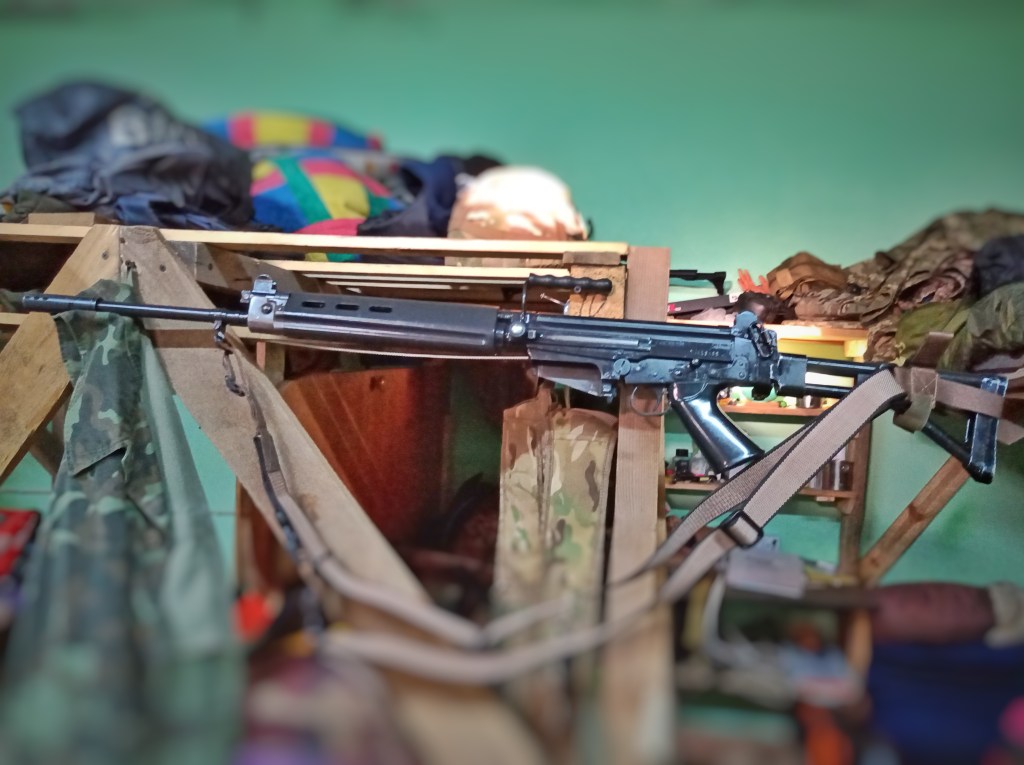
It’s a year since Russia’s full-scale invasion of Ukraine and since last February we have seen a massive influx of Western weapon systems into Ukraine. We’ve seen everything from artillery to infantry weapons and the breadth of small arms has ranged from brand new Polish MSBS Grots and M4A1s to M14s. In recent months another Cold War icon has begun to appear in imagery from the fighting – the FN FAL – the ‘Right Arm of the Free World’.
To date both standard fixed stock and folding stock FALs have been seen in use, though appearances are relatively rare. The first sightings of FALs came in June 2022 when two photos of fixed stock 50.00 metric pattern Type 3 FALs were shared. The first in the second week of June and a second at the end of the month. The second photograph was posted by Ukrainian combatants near Nikolaev, Mykolaiv region. It is possible that both of these rifles may have been a civilian-owned rifle pressed into service.
The most common variant seen in open source imagery is currently the 50.61 or PARA FAL with a side-folding stock and a full length 53cm (21.0 in) barrel. The rifles could also be the visually identical 50.64, which has an alloy receiver, though these rifles are less common. All of the rifles seen in the photographs have Type 3 receivers which date them to post 1973 production. Sadly, photographs showing the weapon’s serial number ranges aren’t available.
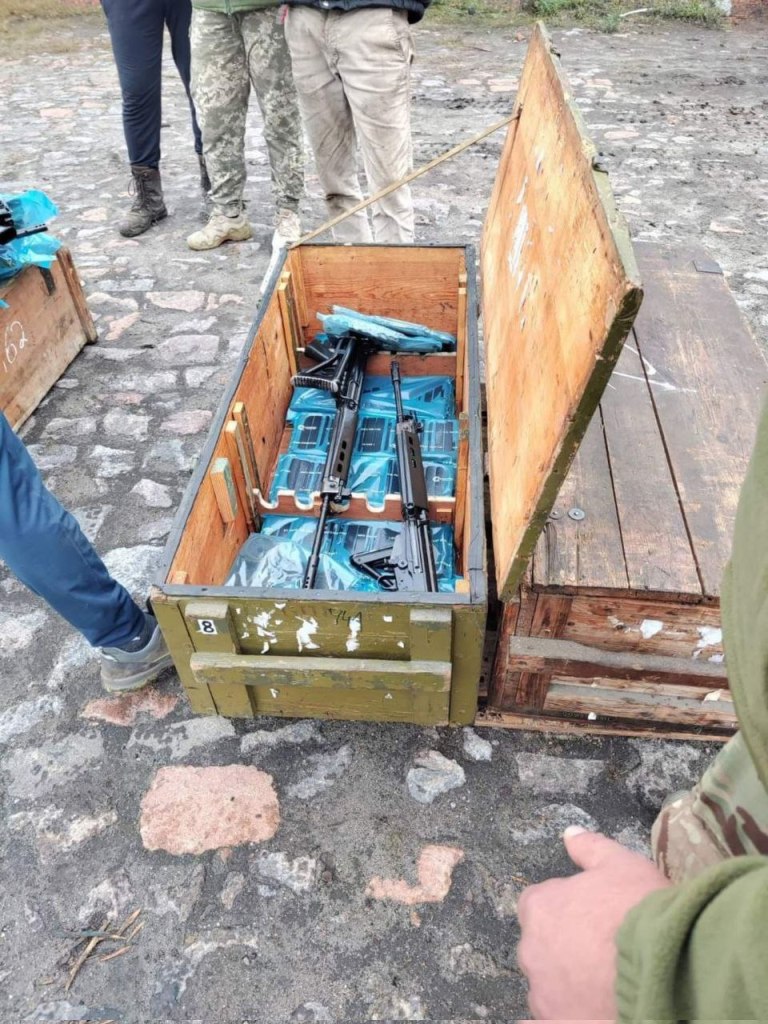
A photograph of several crates of these still in their plastic wrapping shared in early October 2022. This is potentially the first sighting of the folding stocked rifles in Ukraine.
In late November a photograph of five PARA FALs in the same sort of crate was shared and said to have been taken near Bakhmut.
On 10 December, Dmytro Mrachnyk, the commander of a mortar platoon with a Ukrainian Territorial Defence Force unit fighting around Bakhmut, shared his first photograph with his PARA FAL. I contacted Dmytro and he was kind enough to share his thoughts on the rifle. He explained that he liked the rifle and has only had one stoppage, he said: “it jammed a cartridge case once during an intense fight, but the problem was quickly resolved.” He also explained that he really likes the 7.62x51mm round and that he had 9 magazines for the rifle.
He confirmed that the rifles are select fire and when I asked him about ammunition availability for the 7.62x51mm FALs, Dmytro said that there is some available but it can’t be found everywhere.
He said that so far he’s only seen the FALs in use with elements of his unit. He opted for the FAL, to replace his AK-74 when he joined the unit.
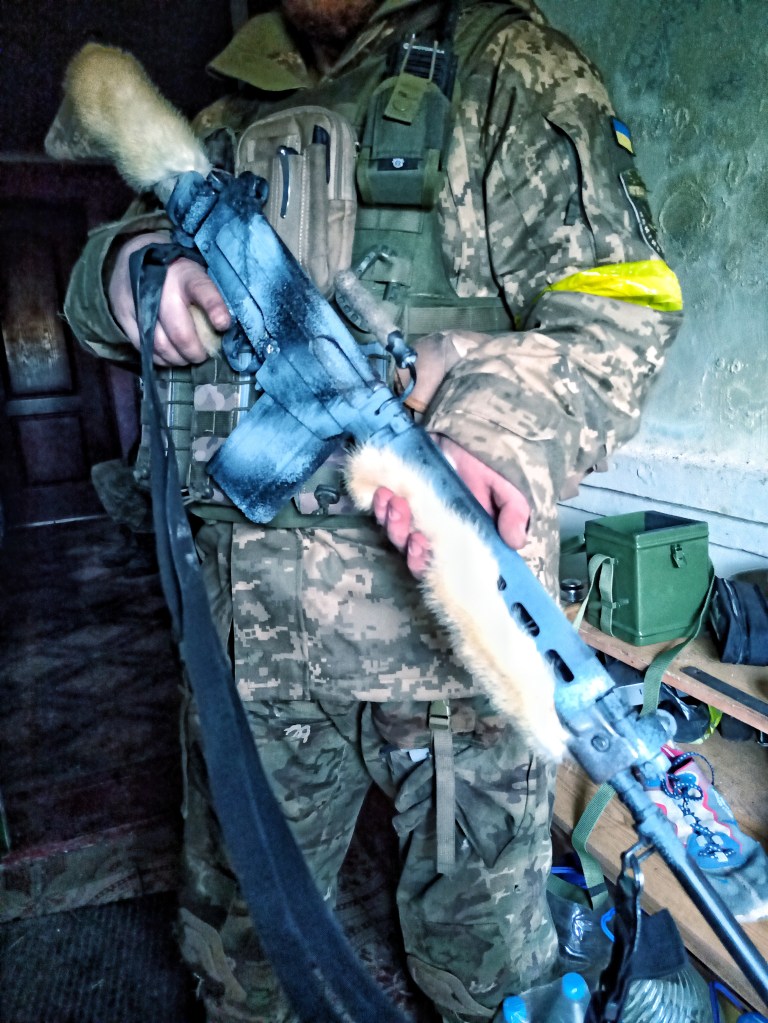
On the 22 December Dmytro shared a photograph of a PARA FAL which had its forend and stock covered in fur. I asked him about this and he explained that: “My sergeant decided to disguise the rifle for the winter – he partially painted it white and glued on a light fur found among the garbage in Bakhmut.”
On 30 December, Ukrainian personnel shared an update video from Bakhmut, one of the soldiers can be seen holding a PARA FAL. Several days later, in early January 2023, the same soldiers shared another short video filmed in a town square in Bakhmut, again the FAL can be seen.
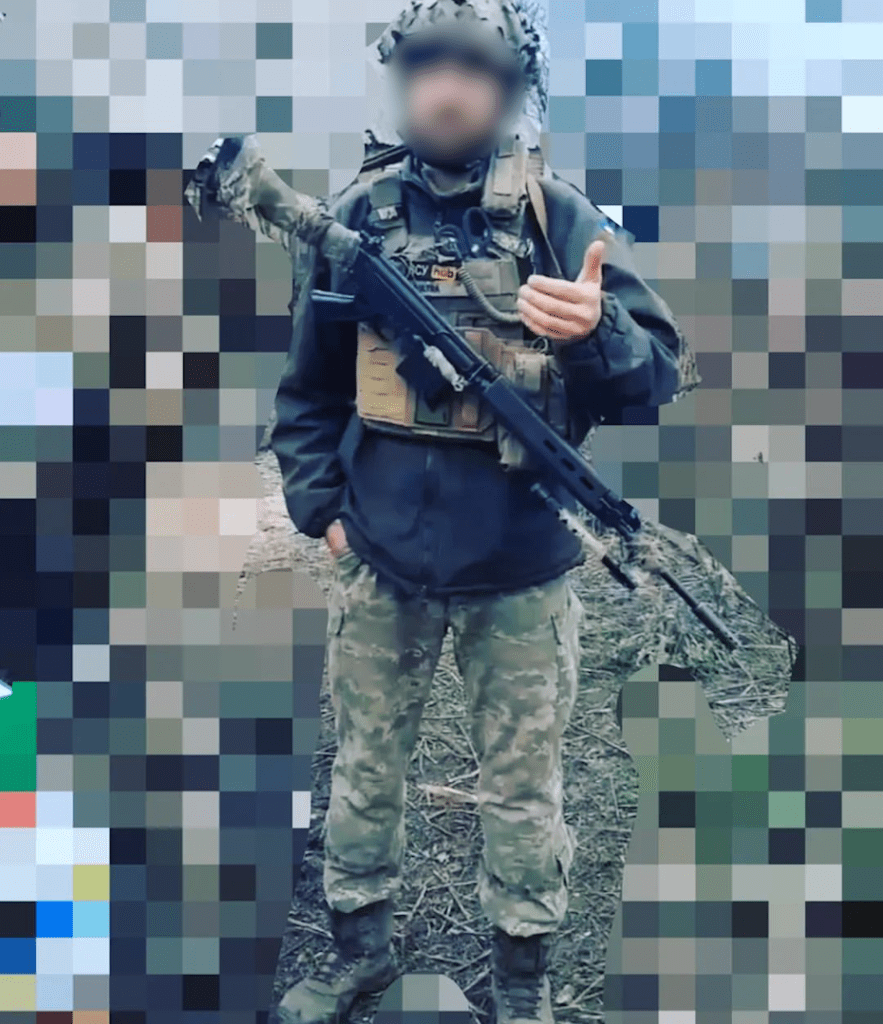
Our second sighting of a fixed stock FAL came on 31 December when another Ukrainian combatant shared a photograph holding a 50.00 FAL, with some scrim wrapped around the butt and carrying handle and a bipod attached. He wished to remain anonymous but was kind enough to share his thoughts on the FAL.
He explained that he was issued the FAL instead of a UR-10 (UAR-10/Z-10) DMR rifle and that he was the only one in his company to be issued one. An optic was issued with the rifle but no means of mounting it to the rifle. He was also only provided with two 10 round magazines. Even without an optic he said that: “As a marksman, you can work at a maximum of 500m” and it “hits quite accurately with single shots, automatic fire gives a very large spread, very loud.”
Commenting on the rifle itself he noted that he believed the rifle to date from 1976 and that while ‘cool and a little unusual’ it was “picky, she is afraid of dirt, she was in a swamp and the action almost did not work.” He also felt that it was ‘a little too heavy compared to the AK [AK74].”
He also pointed out that “it is very long and not convenient when storming buildings” he concluded: “In my opinion, it is already outdated and not practical and often very inconvenient.”
The most recent photograph of one I have seen dates from 15 January, when Dmytro posted a photo, holding his FAL aloft, with the caption ‘The unconquered Bakhmut stands’.
It’s unclear who provided the rifles to Ukraine as numerous nations around the world have fielded similar variants. In Europe these include Belgium, Greece, Luxembourg, Portugal and the Netherlands. Most of these, however, have long since replaced them in service. If Belgium, one of the most likely candidates, provided the rifles then they have been in store since the late 1990s.
Special thanks to Dmytro and the other anonymous Ukrainian combatant for answering my questions, Dmytro’s details are in the description box below. Thanks also to the guys at Shrieking Delilah on Instagram who have been doing great work on documenting some of the plethora of weapons turning up in Ukraine.
So far, of the three major call war battle rifles we’ve seen the M14, check out my video on that if you haven’t already, and the FN FAL but I’m yet to see any sign of HK G3s. If you spot any or anything else I should cover in a video drop me a comment below or an email.
Update 06/03/23:
The social media of the Command of the United Forces of the Armed Forces of Ukraine shared a photograph of a member of the 103rd Separate Brigade of the Ukrainian Territorial Defence Force with a tricked out 50.00 FN FAL mounted with bipod and an ATN THOR thermal optic. This configuration is in line with one mentioned by the anonymous Ukrainian combatant who shared his thoughts on the FAL. This FAL with the 103rd brigade, however, has an optic mounting rail and 20-round magazines.
A member of the 103rd Separate Brigade of the Ukrainian Territorial Defence Force with a tricked out 50.00 FN FAL. Mounted with bipod and an ATN THOR thermal optic. Good DMR kit.
— Historical Firearms | Matthew Moss (@historicfirearm) March 6, 2023
Support Us: If you enjoyed this video and article please consider supporting our work here. We have some great perks available for Patreon Supporters – including early access to custom stickers and early access to videos! Thank you for your support!
Bibliography:
Identifying & Tracing the FN Herstal FAL Rifle, ARES, (source)
Authors discussions with Ukrainian servicemen including Dmytro Mrachnyk [PayPal: dmrachnik@gmail.com]
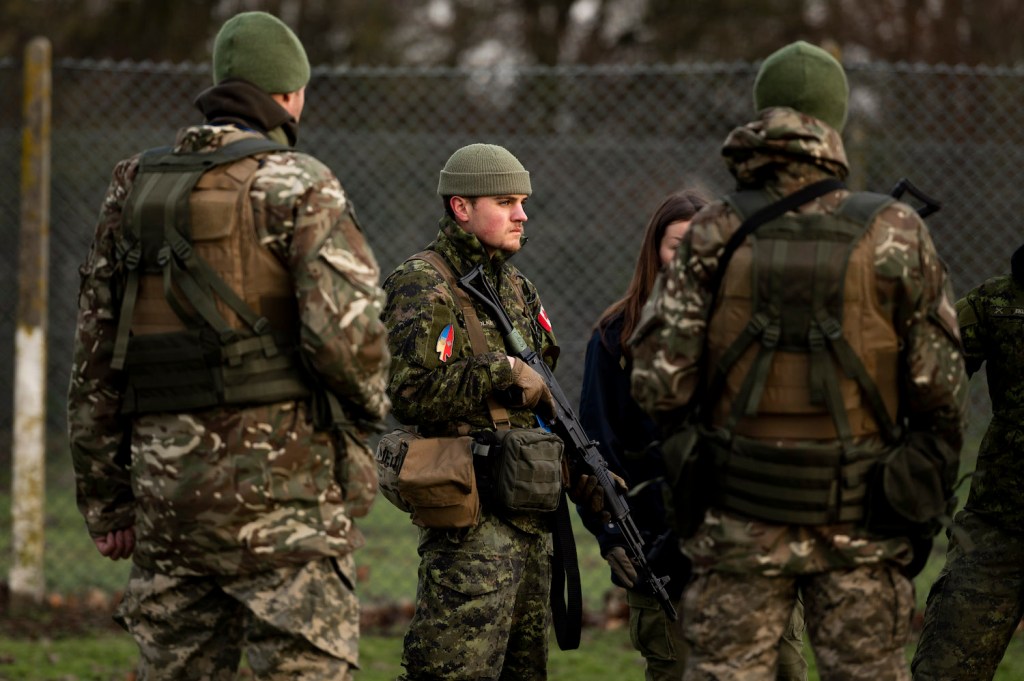
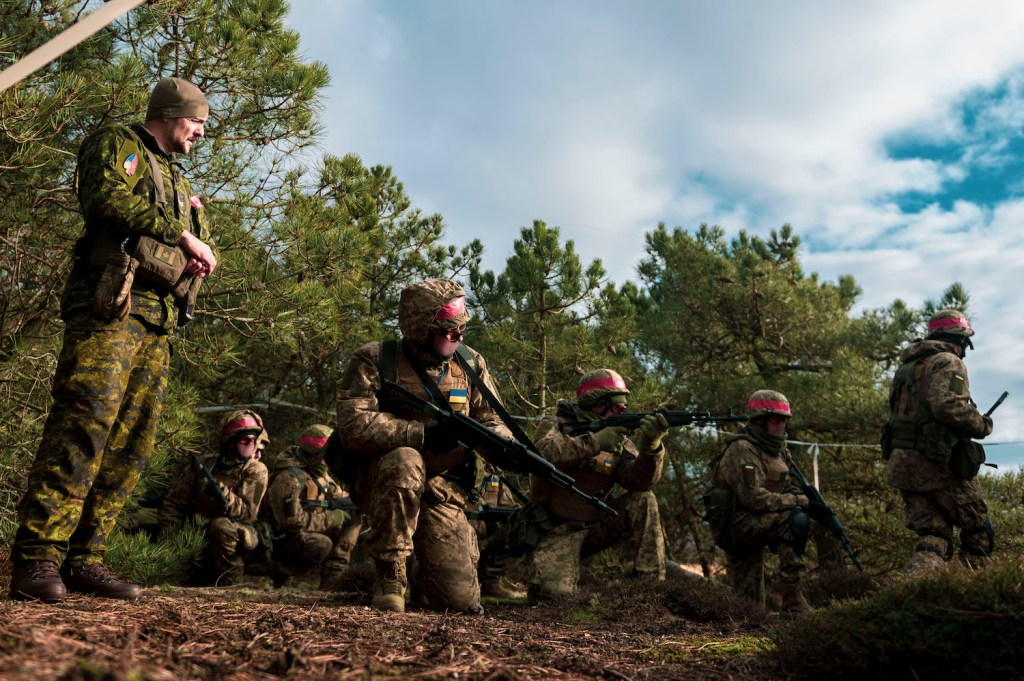
At the end of January a series of photographs taken by Canadian Army photographers showed Ukrainian troops being trained at sites in the UK as part of Operation Unifier. Unifier is a training mission carried out by the Canadian Armed Forces with training currently taking place in the UK alongside the multi-national training mission Operation Interflex.
What is interesting about the new imagery is that the Ukrainian troops in training are all armed with Bulgarian-made Arsenal AK-pattern rifles. This is the firs time this particular AK has been seen in use. If you saw our earlier videos looking at the other types of AK-pattern rifles procured by the UK for their training of Ukrainian personnel you’ll have seen Zastava M70s, Chinese Type 56s and East German MPi KMS-72s are in use.
The rifles were almost certainly procured by the UK Ministry of Defence and like the other AK-pattern rifles being used for training they will probably remain in the UK to be used in the training of future Ukrainian personnel.
A soldier with the 3rd Battalion, Princess Patricia’s Canadian Light Infantry, instructs Ukrainian recruits during a weapons class as part of Operation UNIFIER in the United Kingdom, on January 26, 2023. (Corporal Eric Greico/Canadian Armed Forces)
The Arsenal AKs were seen for the first time in photographs taken on the 23 January, during a lesson on field craft. The Ukrainian troops can be seen taking notes with the rifles slung at their sides.
The rifles appeared in photographs again on 25 January, when Canadian medics were instructing Ukrainian recruits on the application of tourniquets. One of the rifles was seen slung over the shoulder of a Ukrainian soldier rendering aid.
Subsequently on 26 January, soldiers from the 3rd Battalion, Princess Patricia’s Canadian Light Infantry were photographed instructing Ukrainian recruits during a weapons class. The class saw Ukrainian troops learning how to operate NLAWs, grounded on the floor next to them are their Arsenal AKs.
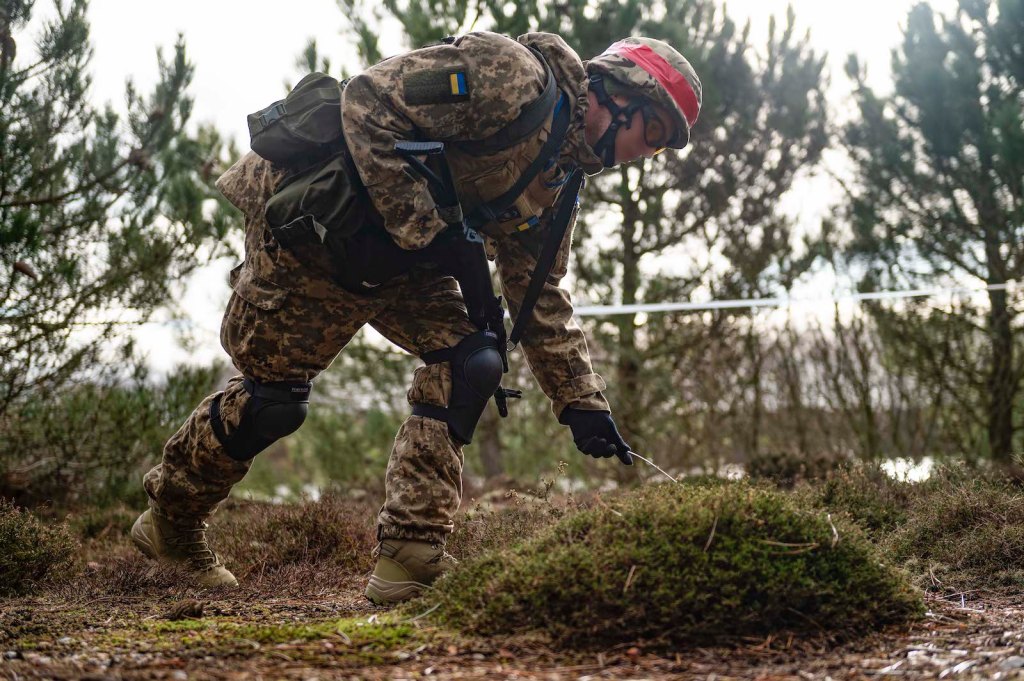
A series of images from a counter-explosive training session on searching and spotting mines and booby traps showed a platoon of Ukrainian trainees equipped with the Bulgarian AKs.
Ukrainian recruits under the supervision of Canadian soldiers from 1 Combat Engineer Regiment practice searching for and identifying booby traps, during Operation UNIFIER on 28 January 2023 in the United Kingdom. (Corporal Eric Greico/Canadian Armed Forces)
The rifles seen in all of the photographs appear to be basic model rifles, none of the weapons have railed handguards or Picatinny on the receiver cover for mounting optics. This suggests that they are either AR-M9Fs or AR-M14Fs (at least according to Arsenal’s website). The ‘F’ refers to the folding tube metal stock which helps identify the rifles as Arsenal-made AKs. The characteristic flash hider and furniture also identify them as Arsenal rifles. It is difficult to identify what calibre the rifles are chambered in as the Ukrainians are never seen with magazines loaded into their weapons (as they’re unnecessary for the training being carried out).
The AR-M9 and M14 are bother available chambered in 5.56x45mm and 7.62x39mm. Logical arguments could be made for either calibre: the UK MoD has confirmed that other AK-pattern rifles that have been procured are chambered in 7.62x39mm so this chambering would give them ammunition commonality with other AK-pattern rifles in use. Alternatively, the UK has ample stocks of 5.56x45mm and this would also more closely mimic the 5.45x39mm AK-74 rifles the Ukrainians are likely to be issued when they return home. Either way they are AK-pattern rifles which enable training on manual of arms, handling and firing with similar weapons the trainees will probably be equipped with.
Ukrainian recruits under the supervision of Canadian soldiers from 1 Combat Engineer Regiment practice searching for and identifying booby traps, during Operation UNIFIER on 28 January 2023 in the United Kingdom. (Corporal Eric Greico/Canadian Armed Forces)
The rifles have black polymer furniture and appear to be either new or in excellent condition with few visible scratches or scrapes to the finish or furniture. Notably each rifle has green tape around the base of the folding stock onto which a rack number has been written in black marker pen.
Addendum:
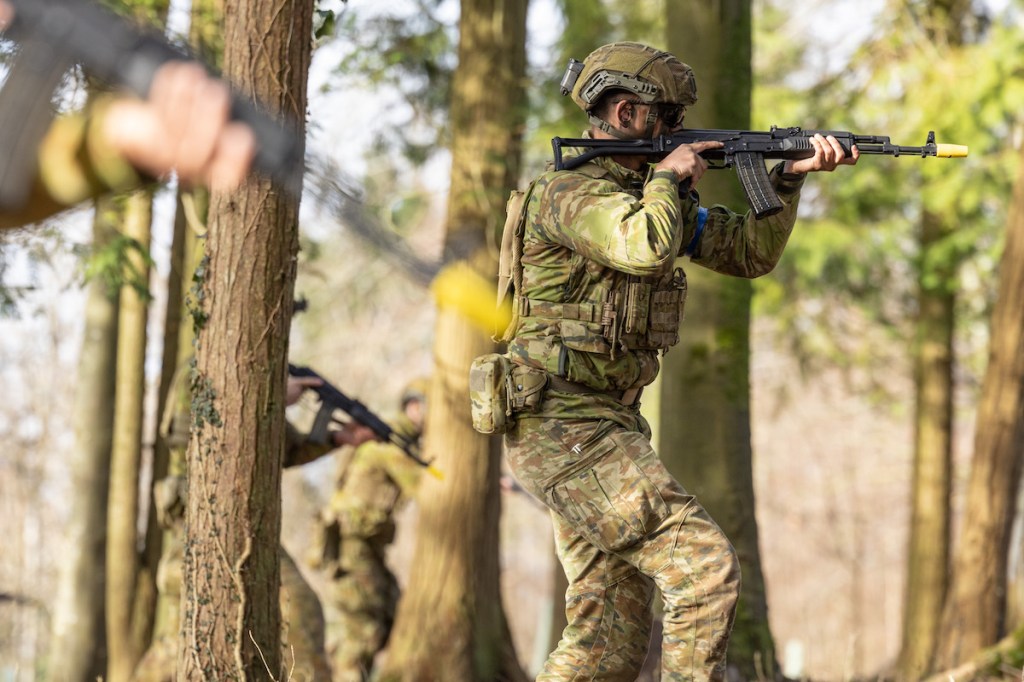
As is sometimes the case with writing these articles and videos while in the process of research and production new source material emerges. On 1 February, the UK MoD shared a series of new photographs from the training of Ukrainian troops. In these a number of the Arsenal AKs were seen fitted with blank firing adapters (BFAs). This is interesting for a number of reasons – previously we have seen Ukrainian trainees using British L85A2s with BFAs for the elements of their training which required blank fire. We have covered this in an earlier article/videos – it requires additional, and largely unnecessary training on the use of the British bullpup.
Australian soldiers demonstrate section level attacks and how to handle captured enemy personnel to Ukrainian recruits during the first rotation of Operation Kudu in the United Kingdom. (UK MoD/Crown Copyright)
BFAs for the 7.62x39mm AK pattern rifles procured earlier by the UK appear to have been deemed either unsafe for use in British training areas or BFAs and blank 7.62x39mm ammunition haven’t been readily available. The new photographs show that BFAs are in use with these Bulgarian AKs – likely because they were procured with the rifles direct from the manufacturer.
These UK MoD photographs also show the rifles with magazines – which indicate the rifles are chambered in 5.56x45mm. As I theorised earlier the UK has ample stocks of both blank and ball 5.56x45mm which would simplify the logistics of training the nearly 20,000 Ukrainian soldiers expected to be trained in the UK in 2023.
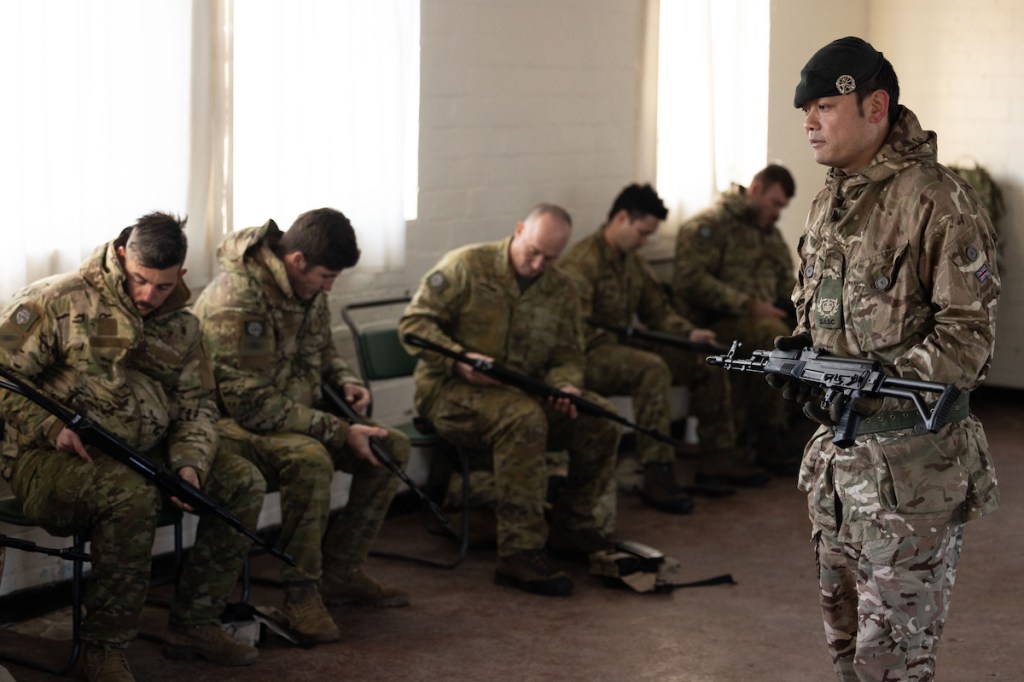
Australian Army soldiers from the 5th Battalion, Royal Australian Regiment, receive weapon handling lessons from the British Army’s Small Arms School Corps as part of the “train the trainer” portion of Operation KUDU in the United Kingdom (Australian Department of Defence/Commonwealth copyright)
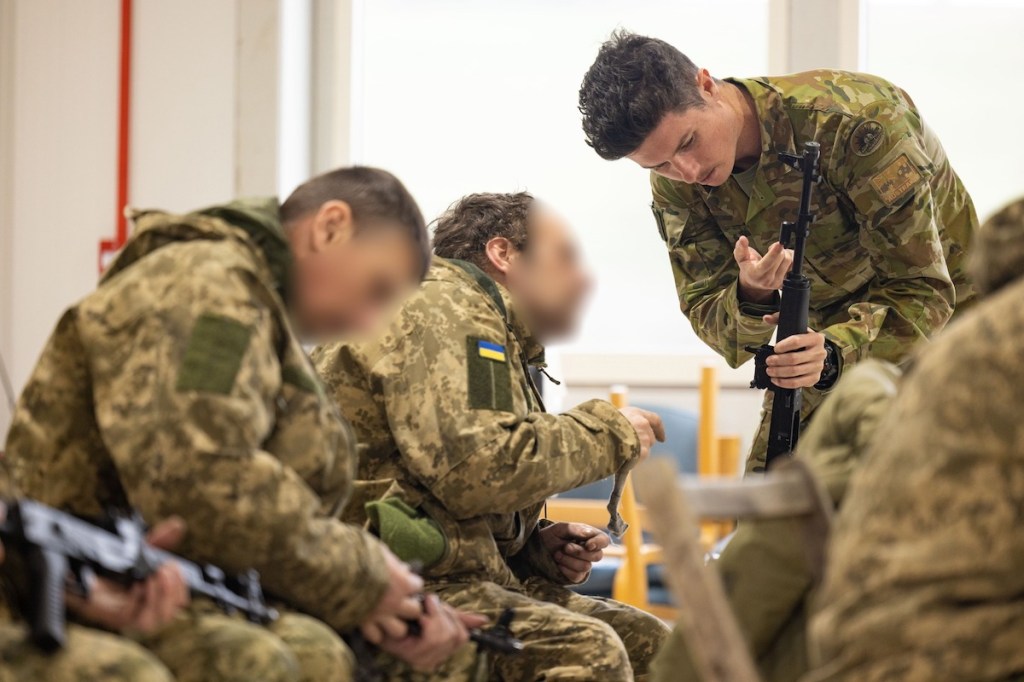
The Australian Army has also shared a large number of photographs from their involvement in the training of Ukrainian troops in the UK. The Australian military have dubbed their effort Operation Kudu. They describe Kudu as: “A contingent of up to 70 Australian Defence Force (ADF) personnel are deployed on Operation KUDU to assist with the UK-led and based training program.” The Australian photographs show the training and familiarisation of Ukrainian troops with the Arsenal AKs with both Australian and British instructors seen in the photographs.
An Australian Army soldier from the 5th Battalion, Royal Australian Regiment, assists Ukrainian recruits with cleaning their rifles during Operation KUDU (Australian Department of Defence/Commonwealth copyright)
The photographs feature members of the 5th Battalion, Royal Australian Regiment and senior instructors from the British Army’s Small Arms School Corps, instructing trainees in the classroom before undertaking some fire and movement drills with blanks.
Update 08/02/23:
The Canadian Ministry of National Defense has released a short video showing some of the training Canadian personnel in the UK are delivering to Ukrainian troops as part of Operation Unifier (the Canadian element of the international Operation Interflex.)
The video focuses on some of the field exercises and urban training being provided and heavily features Bulgarian Arsenal AR-M9F (5.56x45mm) AK-pattern rifles.
Canada's Ministry of National Defense has shared a short video showing Ukrainian troops training as part of Op Unifier (Canadian element of the UK-based international Op Interflex).
— Historical Firearms | Matthew Moss (@historicfirearm) February 8, 2023
Update – 14/02/23: A video shared by the Australian Department of Defence showed Australian troops training Ukrainians with Arsenal AKs during Operation Kudu.
Last week I looked at the use of Bulgarian Arsenal AKs to train Ukrainian troops in the UK. Australia is taking part in this trading (what they call OP Kudu) Here's a video the Aus Defence has released:https://t.co/tw1HA7r6YI
— Historical Firearms | Matthew Moss (@historicfirearm) February 14, 2023
Update 15/02/23: The Danish Army has also shared several photographs of Danish troops training Ukrainians in the UK, Arsenal AKs can again be seen in the photographs (fitted with BFAs).
Support Us: If you enjoyed this video and article please consider supporting our work here. We have some great perks available for Patreon Supporters – including early access to custom stickers and early access to videos! Thank you for your support!
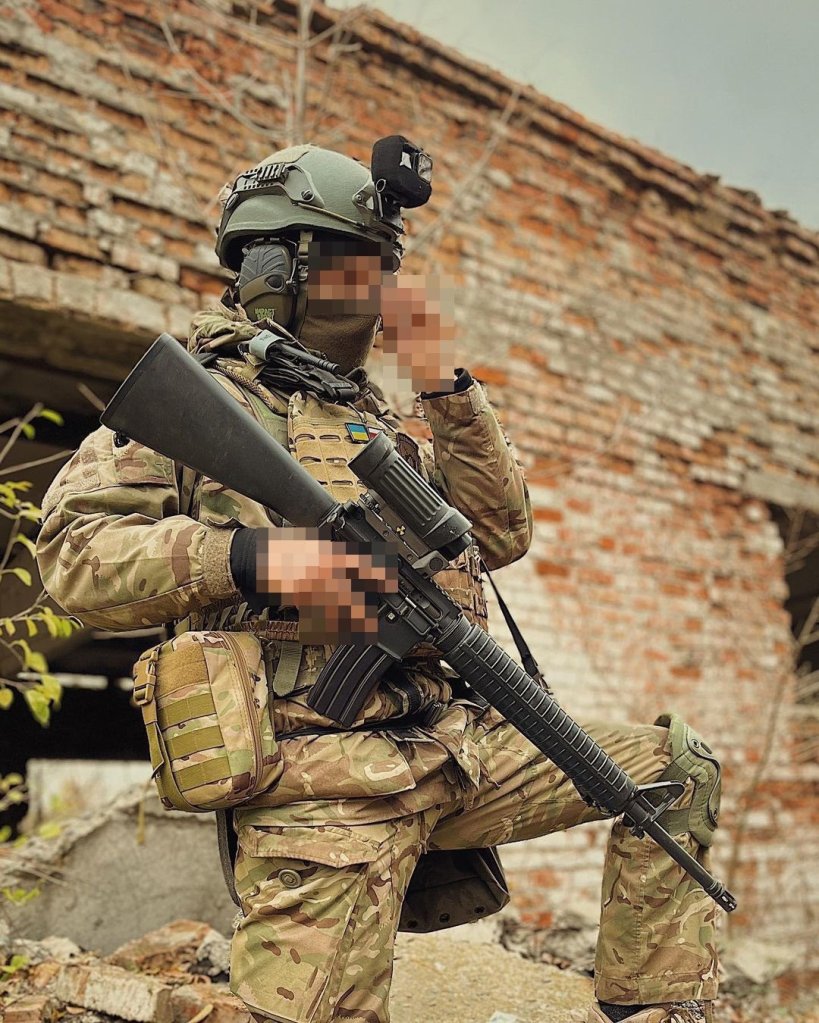
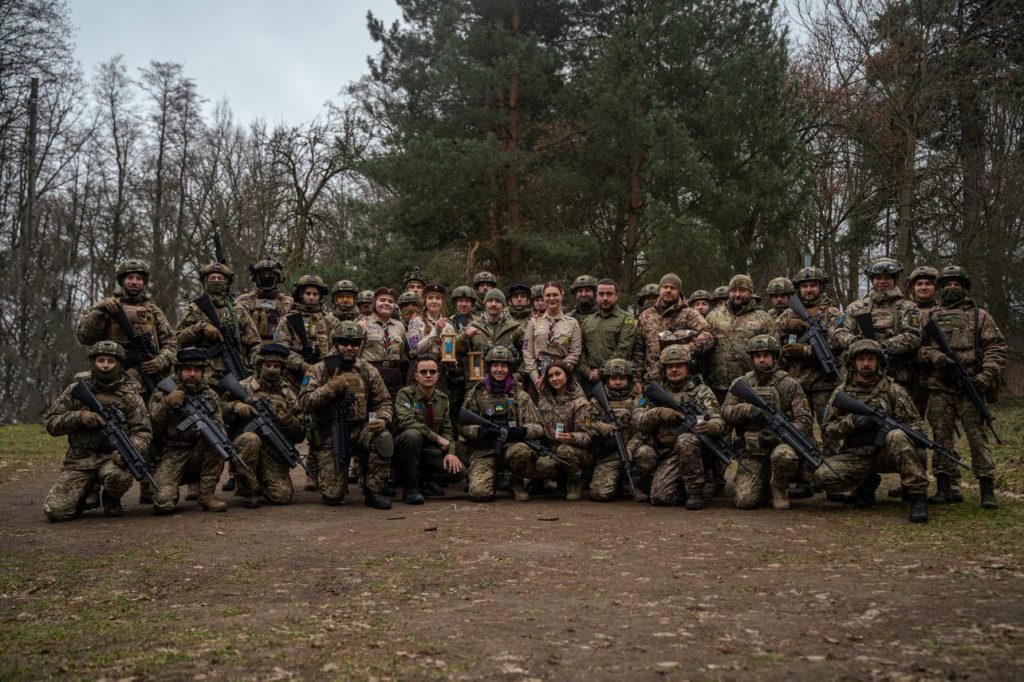
On 12 January, a unit of the Ukrainian Army’s 47th Separate Mechanised Brigade (47 OMBr) was seen equipped with US M16A4s for the first time. The rifles were seen equipped with Trijicon ACOG optics and some, a considerable percentage, were seen with M203 40mm under-barrel grenade launchers, and of course rail covers.
Photo released by 47 OMBr in early January showing M16A4s in Ukraine for the first time (47 OMBr)
Previously, we have seen a considerable number of M4A1 carbines, some equipped with M320 40mm grenade launchers. This, however, is the first time we’ve seen the M16A4. Other elements of the 47 OMBr have been seen equipped with FN FNCs in 5.56x45mm. The 47 OMBr appears to be a unit which has largely been allotted western small arms and equipment. The brigade was formed in November 2022 and, as with a number of other new Ukrainian brigades, has been built up from a battalion (which was raised in August 2022) to a regiment to a brigade level formation.
A close up of an M16A4 with an ACOG and M203 UBGL and rail covers in Ukrainian service (47 OMBr)
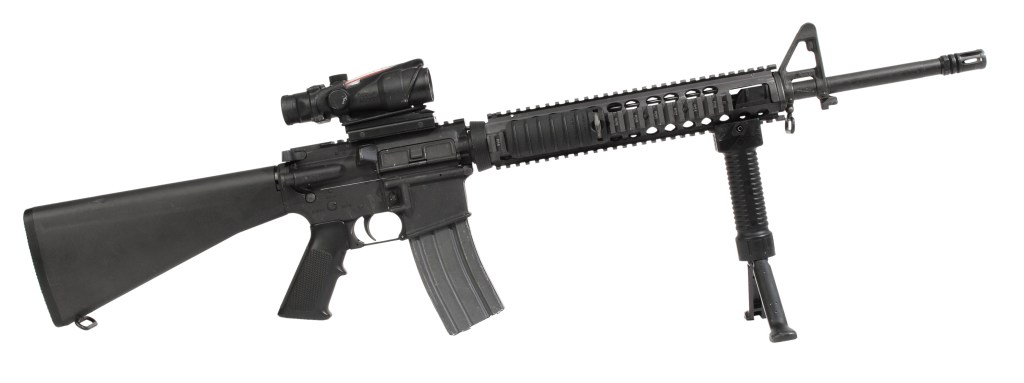
The M16A4 is a 5.56x45mm, select-fire rifle which uses a direct impingement gas system and a rotating bolt locking mechanism. The M16A4 was developed in the late 1990s and entered service in January 1999. It and has seen service with the US Army, USMC and US Navy. The US Army began to move away from the M16A4 in favour of the M4A1 in 2011 while the USMC favoured the rifle’s 20 inch (50.8cm) barrel length and began replacing its M16A2 with A4s in 2002, only in October 2015 did they begin to transition to the M4A1 Carbine and latterly the M27 for infantry Marines. Despite this the M16A4, however, remains in widespread service use.
The photographs and short video where the rifles were seen for the first time were posted to commemorate a visit from members of Plast, Ukraine’s scouts organisation, who brought a lamp of the Fire of Peace to be lit with members of the brigade.
Another photograph was shared on the brigade’s social media on 22 January, showing a close up of an M203-equipped M16A4, which was also mounted with an ACOG. How many of these rifles have been transferred is unknown, the most recent US Department of Defense fact sheet on aid to Ukraine, published on 25 January, lists 13,000 assorted small arms.
An as-issued M16A4 service rifle with quad rail forend, railed receiver, ACOG and grip pod (US Army)
The rifles appear to be straight from US Army or USMC inventory and look to be in good shape. The rifles have been predominantly made by Colt and FN. None of the imagery has been close enough yet to see which manufacturer the now-Ukrainian rifles were made by.
I expect we will be seeing a proliferation of the M16A4 rifles just as we have the M4A1 carbines since the early summer of 2022. The 47 OMBr probably won’t be the only unit to field them and we’ll probably be seeing many more of these in the future as the US military has considerable stocks of the rifles and production lines are still active. If and when we do, I’ll follow up with further videos/articles.
Update 20/03/23: Sergeant with Ukraine’s 47th Brigade seen armed with M16A4 equipped with M203 grenade launcher and an ACOG.
A Sergeant with the 47th Brigade armed with an M16A4, M203 grenade launcher and an ACOG. Next to him is a soldier a… twitter.com/i/web/status/1…— Historical Firearms | Matthew Moss (@historicfirearm) March 22, 2023
Support Us: If you enjoyed this video and article please consider supporting our work here. We have some great perks available for Patreon Supporters – including early access to custom stickers and early access to videos! Thank you for your support!
Bibliography:
Marine’s Switch from the M16 to the M4, Marine Corps Times, (source)
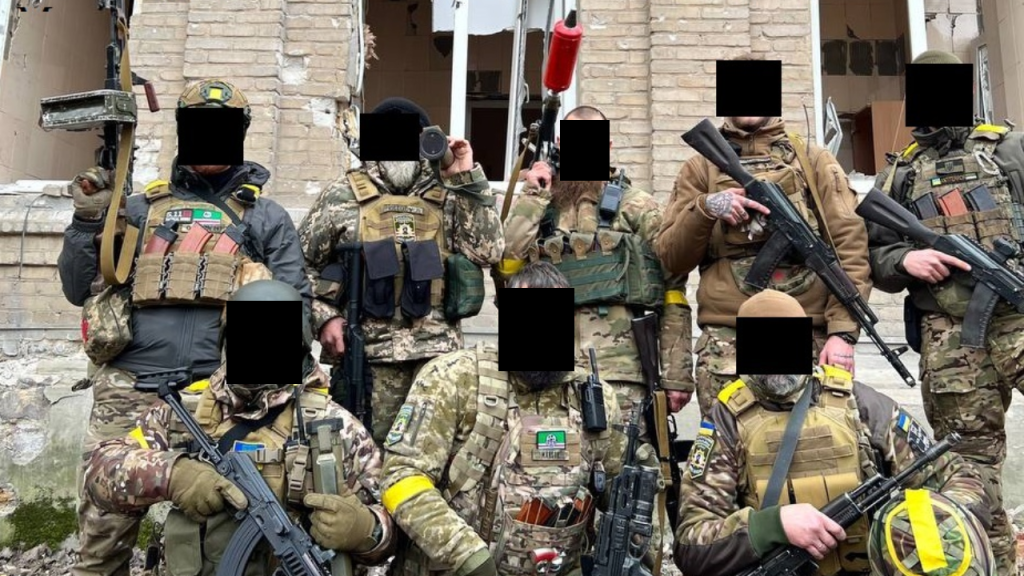
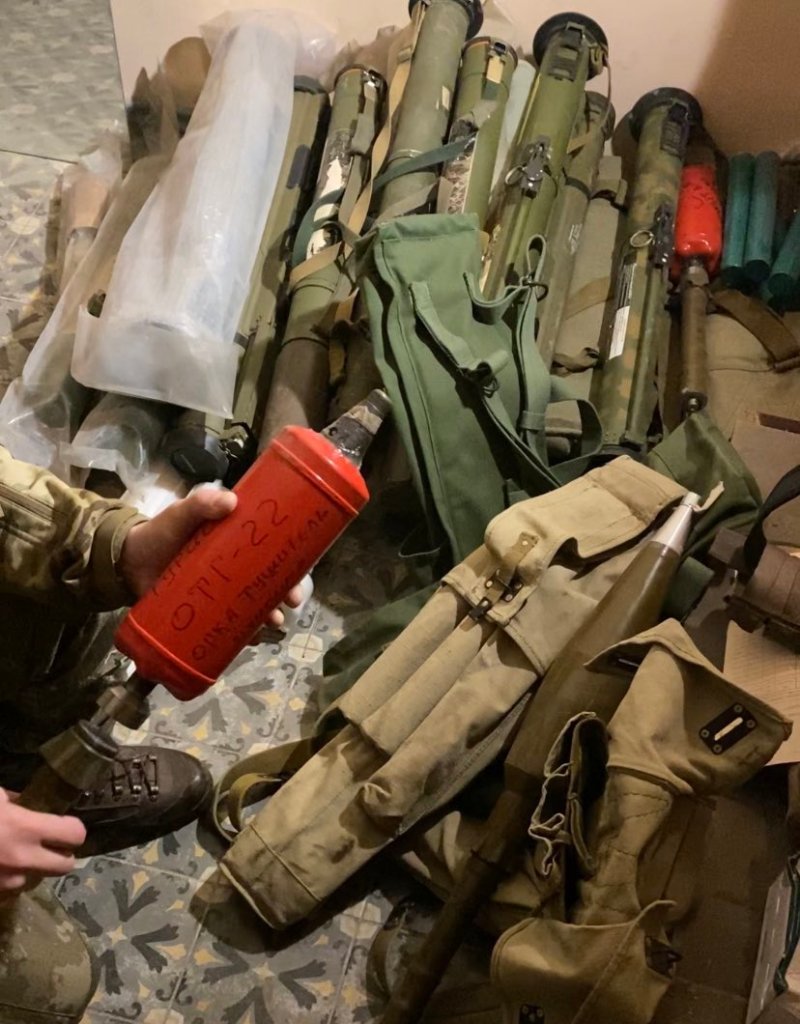
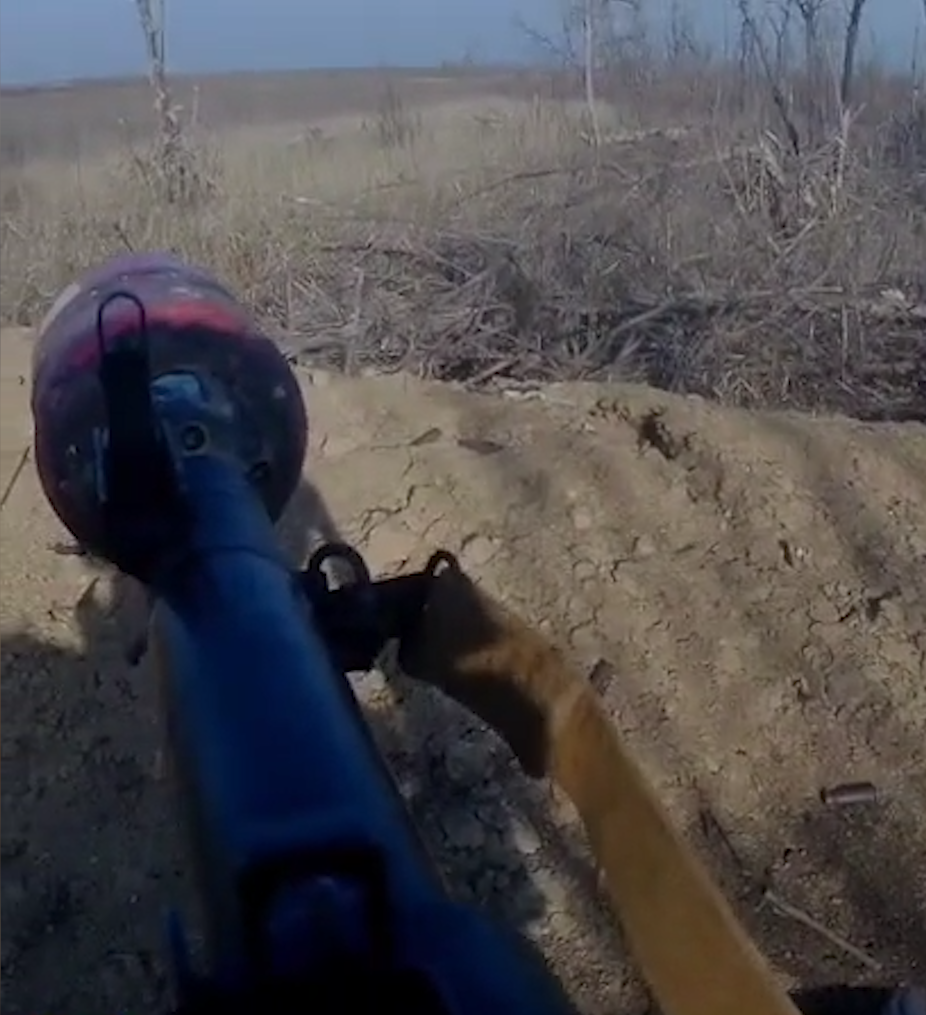
In December images of Chechen volunteers fighting with the Ukrainian Armed Forces began to feature an interesting craft-made weapon – an RPG munition made from the body of a small fire extinguisher.
These RPG-warheads improvised from fire extinguishers have appeared in numerous videos and photographs of the Sheikh Mansur Battalion. The battalion was formed back in 2014 and is made up of exiled Chechens who reject Russian control of their region. The battalion itself is named after an 18th century Chechen military leader Sheikh Mansur. The battalion had disbanded in 2019, but reformed in March 2022 following the invasion. Since then they have reportedly seen action during the Battle of Kyiv, in the Donbas, during the Battle of Sievierodonetsk and most recently in the fighting around Bakhmut.
There’s a long history of improvised warheads adapted for launch from the RPG-7 but I think this is the first time I’ve seen a fire extinguisher body used, at least in this phase of the fighting in Ukraine.
A section of the Sheikh Mansur Battalion, with a craft-made fire extinguisher munition, Bahkmut, December 2022 (via Sheikh Mansur Battalion)
It appears that the fire extinguisher body has been emptied and filled with whatever explosive and shrapnel material is readily available and then adapted to fit the sustainer motor and booster assemblies. They appear to use V-429 or V-429E point detonating fuzes. These fuzes were developed for use on high explosive (HE) projectiles used by various Combloc weapon systems including the T-12 and MT-12 100mm anti-tank guns and the 115mm main gun of the T-62 and 125mm main guns of the T-64, T-72, T-80 and T-90 series tanks. Some other fuzes appear to be used too but conceivably any impact fuze would work. The inertia armed fuzes normally arm within 5-15m of the muzzle once fired from a conventional barrel. It appears that the fuzes have been epoxied into place.
Close up of a craft-made fire extinguisher munition, Bahkmut, December 2022 (via social media)
How the mass and shape of the improvised round impacts the velocity of the warhead once it is fired is unclear. But Bild correspondent Bjorn Stritzel, who recently met with members of the Battalion while writing an article about them, told me that the range of the warheads is about 100m. He noted that the Chechen’s have found them to be ‘very effective in Bakhmut’ and that ‘apparently its firepower surprised RF entrenched in houses’ according to radio chatter picked up by the Battalion.
While we don’t have a perfect close up of them the extinguishers themselves appear to be small 2kg (or 5lbs) units which contain powder. From a quick survey of some Ukrainian websites which sell the extinguishers, the price of these ranges between 300 and 500 Hryvnias (or $8 & $14).
A member of the Sheik Mansur Battalion demonstrates a craft-made fire extinguisher munition, Bahkmut, December 2022 (via Sky News)
The fire extinguisher rounds are probably being used as anti-personnel weapons which would be fitting for the sort of fighting occurring around Bakhmut where the majority of the imagery is said to be coming from. The thin steel body of the extinguisher may provide suitable fragmentation or depending on the metallurgy it may just rupture. According to Stritzel the filling of the warheads is around 50% explosive and 50% shrapnel material. He also noted that the Chechen’s described the warhead as being “three times more powerful than a normal OG-7V [fragmentation RPG-7 round]”.
Two craft-made fire extinguisher munitions, Bahkmut, December 2022 (via Bjorn Stritzel)
The first video featuring the improvised warheads was published by the Sheikh Mansur Battalion on their social media in around mid December. In a Sky News report from the 22 December, a member of the Battalion demonstrates how one of the extinguisher warheads is loaded. A video posted to the Battalion’s social media on the 27 December showed a number, perhaps four, of the improvised rounds stacked ready for use with booster assemblies attached.
On the 31 December, the Battalion shared a photograph of a group of eight Battalion members, one of which can be seen holding an RPG-7 with one of the improvised extinguisher rounds loaded. During the second week of January, a short, undated, video of an individual in a fighting position firing one of the craft-made warheads was shared. We get some idea of the weight of the round in this clip.
The most recent video (see stills above), posted on TikTok, on the 12 January, shows two of the improvised munitions being fired. These warheads follow the same design but differ slightly in that the fire extinguisher body appears to have been cut open at the centre and then welded back together. Perhaps this is done to easier fill the munition or perhaps to shorten a longer extinguisher body. For the first time we also get to see the explosion of the rounds down range. This video again gives us a good indication of the weight of the round from the movement of the shooter. It also illustrates the distances the rounds can travel. Notably it appears to be used here against a Russian field work rather than against a building.
With fighting continuing in Bakhmut we are likely to see more of these improvised fire extinguisher rounds in use, especially if they are as effective as the Sheikh Mansur Battalion suggest.
Support Us: If you enjoyed this video and article please consider supporting our work here. We have some great perks available for Patreon Supporters – including early access to custom stickers and early access to videos! Thank you for your support!














 The Armourers Bench