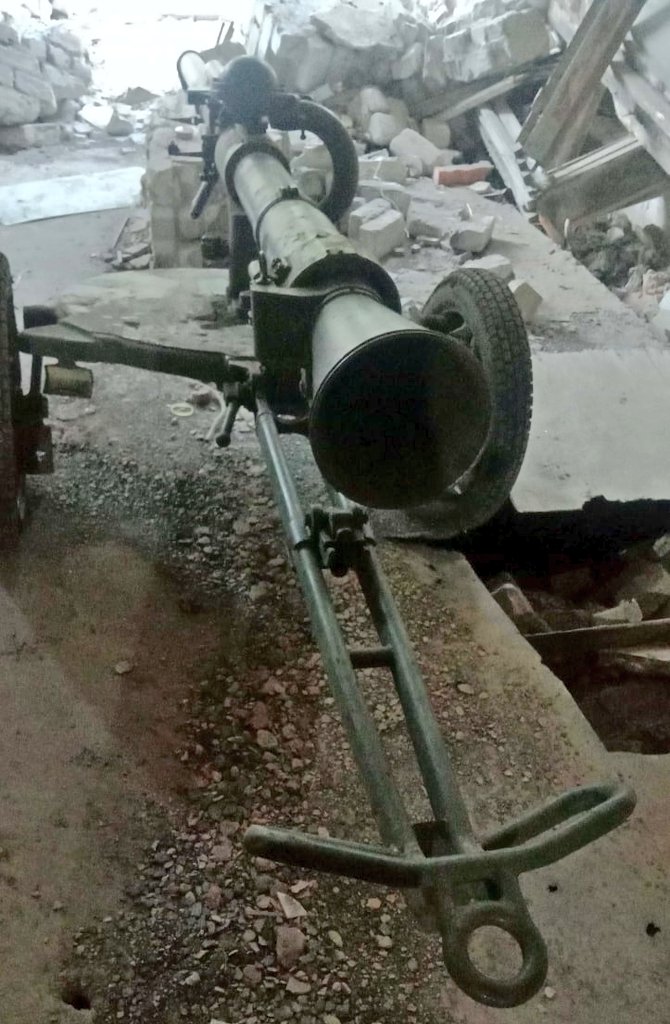
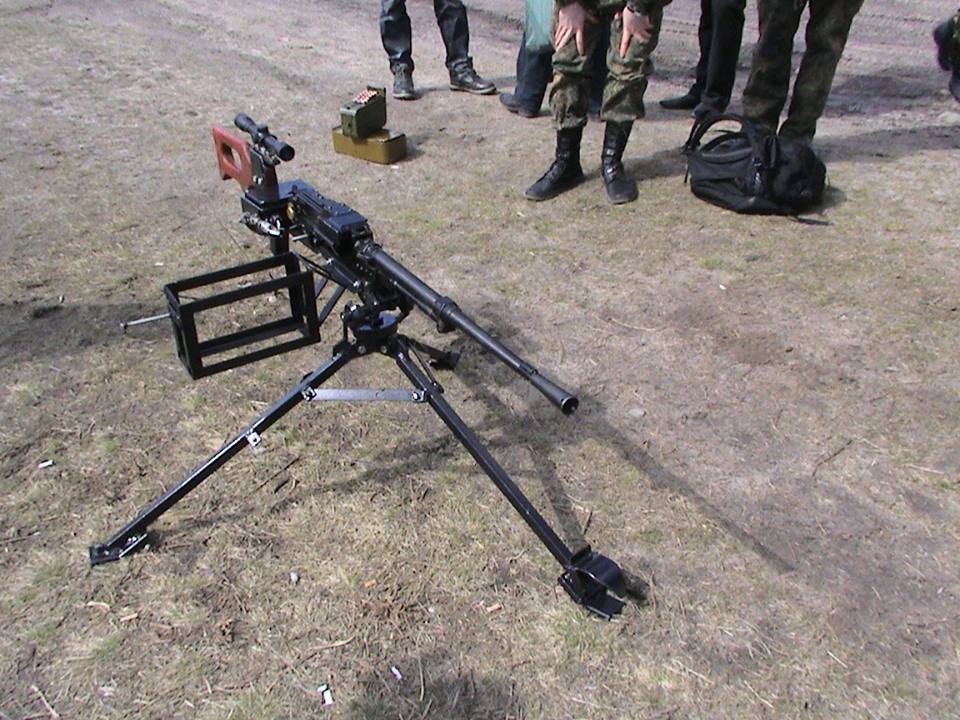
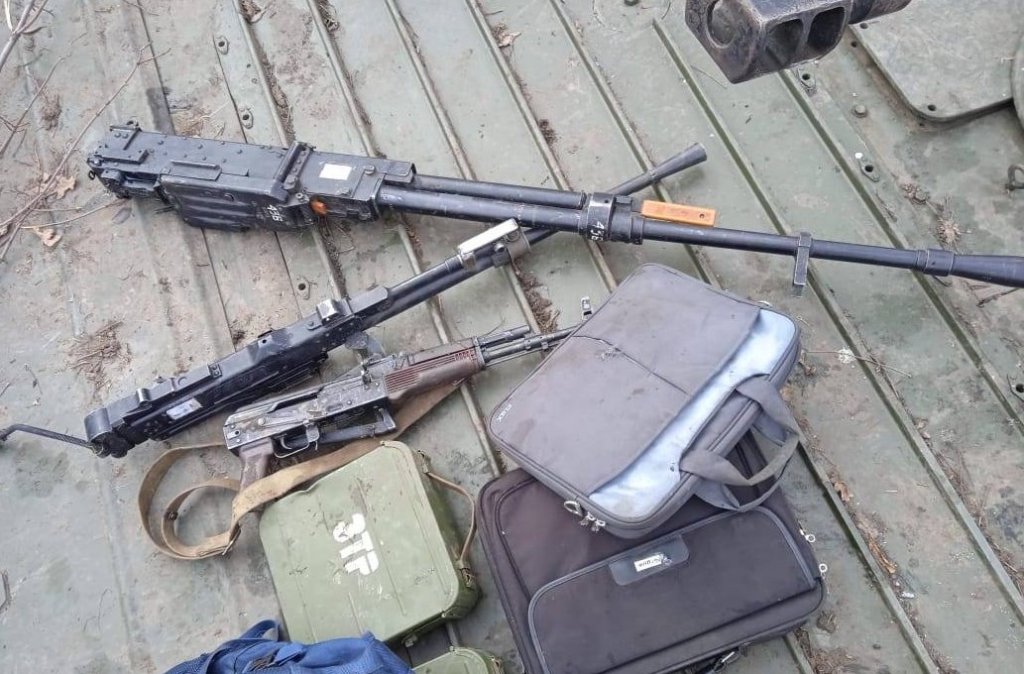
On 18 August Russian Telegram channels began sharing photographs of weapons claimed to be captured from Ukrainian forces, near Sloviansk, including a DShK, a damaged MG-42/59 and most interestingly a Swedish PV-1110.
The Pansarvärnspjäs 1110 or PV-1110 is a recoilless gun developed by Bofors which saw service with the Swedish military between 1959 and the late 1990s/early 2000s. While not the only recoilless rifle/gun in use in Ukraine, others include the Carl Gustav and SPG-9, the 90mm smoothbore PV-1110 is perhaps the rarest. With sources suggesting that fewer than 2,000 PV-1110s were manufactured this would make the PV-1110 one of the rarest anti-tank weapons in use in Ukraine.
A Swedish PV-1110 claimed to be captured from Ukrainian forces (via Russian telegram channels)
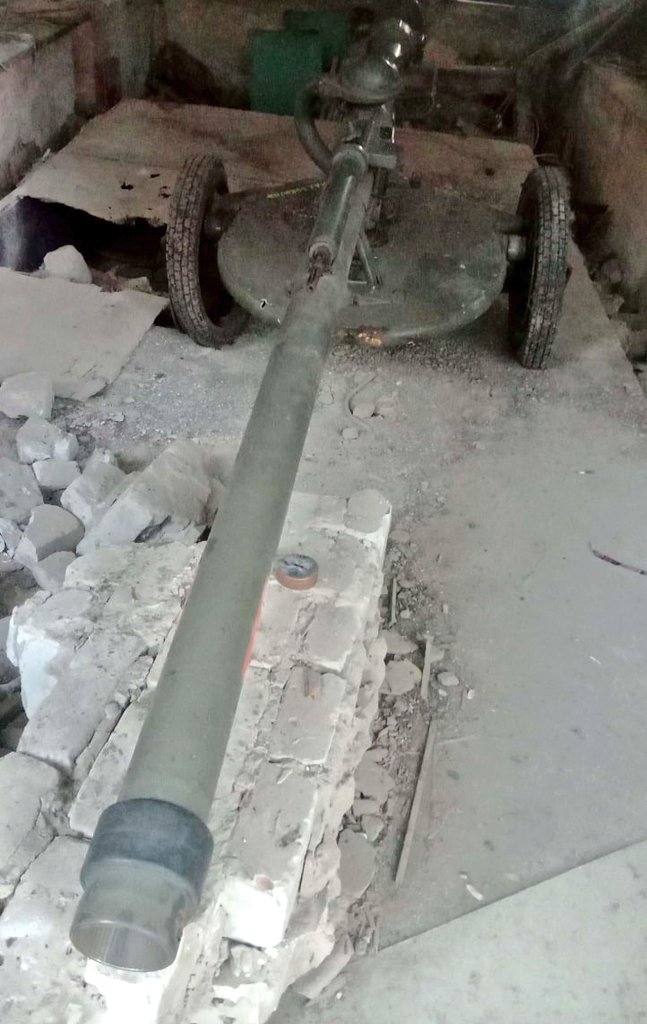
Developed in the early 1950s it was adopted by Sweden in 1959, the PV-1110 could be mounted on vehicles but also on a wheeled carriage with the barrel suspended from an ingenious ball joint mount. In the photographs of the captured example, showing its serial number #5936, we can see this two-wheeled carriage for the weapon.
The ball joint was intended to compensate for firing from an uneven position. The PV-1110 weighs in at around 260kg (just over 570lbs) and has an optical sight on the left side of the barrel as well as a spotting rifle, based on the Ag m/42 chambered in 7.62x51mm, mounted on top. The PV-1110 has an effective range of up to 1,000m but engagement of moving targets is limited to around 700m according to the Lithuanian Army. With a good crew it is capable of firing up to 6 rounds per minute. The older m/62 HEAT round could penetrate up to 380mm of rolled homogeneous armour (RHA), the m/77 can penetrate up to 500mm and the m/84, the most modern and capable round can penetrate up to 800mm of armour. It’s unknown what ammunition has been provided for the guns.
A Swedish PV-1110 claimed to be captured from Ukrainian forces (via Russian telegram channels)
While it could be suggested that recoilless guns and rifles like the PV-1110 are obsolescent the continued use of the SPG-9 shows they still have their uses. The PV-1110’s low-profile combined with its still quite effective penetration means its still a viable weapon against most armoured vehicles its likely to encounter.
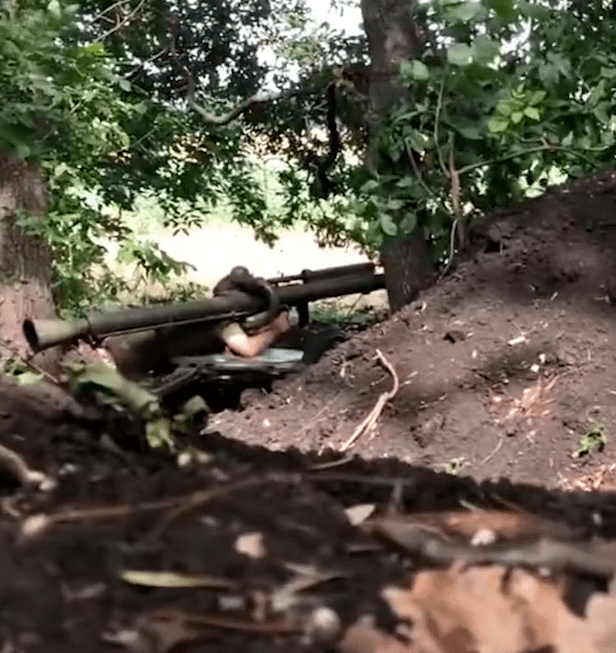
Following on from the first sighting in Ukraine on 22nd August footage of a PV-1110 firing from a defensive position surfaced and we can see the gun on its very recognisable mount.
Still from video of the PV-1110 in Ukraine, c.22 August 2022
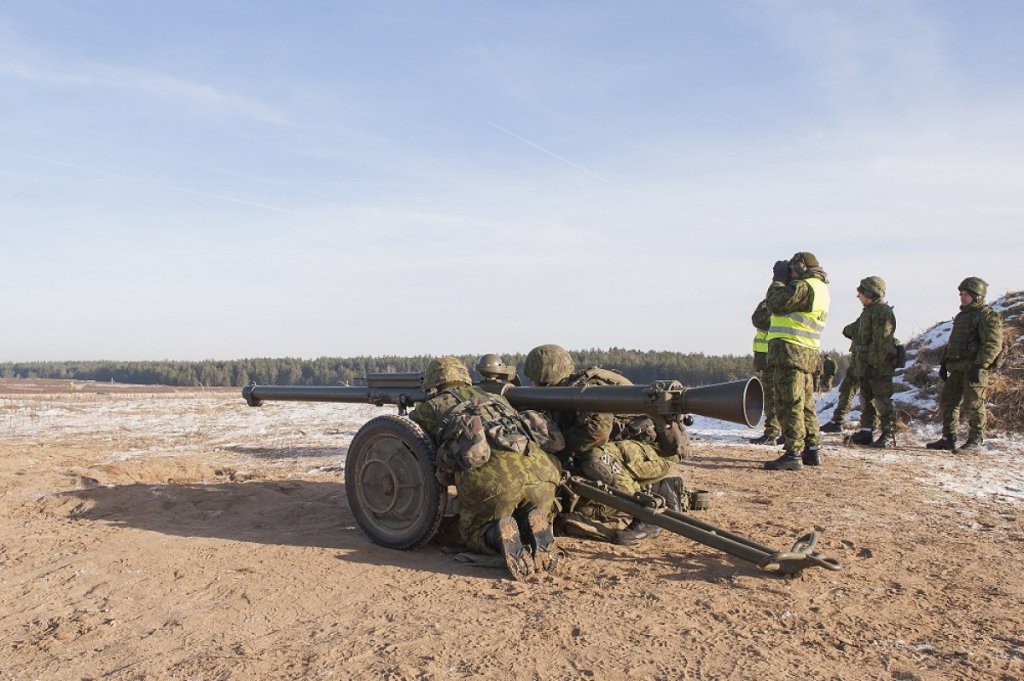
But how did Ukrainian forces come by their PV-1110? There were likely transferred from one of the Baltic nations which have supplied Ukraine with considerable military assistance. Latvia, Lithuania and Estonia all received a number of PV-1110s from Sweden when they were retired from service. It is unclear how many weapons each of the three countries originally received.
Troops of the Lithuanian National Defense Volunteer Force training with the PV-1110 c.2014 (Lithuanian Army)
The Estonian Defence League reportedly had over 100 in inventory as of 2018 while the Latvian National Guard have a similar number. Lithuania’s Army and National Defense Volunteer Force have previously been seen to be equipped with the PV-1110 in recent years but they have reportedly since been placed in wartime reserve storage. No country has publicly confirmed the transfer of the PV-1110s, so with the Baltic nations slowly removing the guns from service it’s likely that the PV-1110s either came from the remaining guns held by the Swedish Army or from the stores of Lithuania, Latvia or Estonia. Regardless of their origin they represent one of the rarest recoilless guns in service in Ukraine.
Updates
Update – 18/10/22:
Some recent footage of the PV-1110 in use in Ukraine. It is unclear where or when this footage was filmed but it surfaced on social media around 15 October. I suspect it was filmed during training rather than when in action. Regardless, it represents one of the few pieces of footage we have of the Swedish recoilless guns in action in Ukraine.
Some recent footage of the Pansarvärnspjäs 1110 in #Ukraine.
— Historical Firearms | Matthew Moss (@historicfirearm) October 18, 2022
Update – 25/01/23:
The recently raised 47th Separate Assault Brigade have shared several photographs of a PV-1110 on their social media pages, between 10 and 15 January. The photographs were likely taken during training. The first is a point-of-view shot down the weapon’s barrel while the second is a side profile shot – both taken during firing.
Update – 2/05/23:
Recent video of a Pv-1110 shared by Ukraine Weapons Warfare.
— Matthew Moss | The Armourer's Bench (@historicfirearm) May 15, 2025
If you enjoyed this video and article please consider supporting our work here. We have some great perks available for Patreon Supporters – including custom stickers and early access to videos! Thank you for your support!
In a recent video/article we looked at the AK-pattern rifles that the UK Ministry of Defense has procured to train Ukrainian troops with in the UK. In that video I touched on the use of British SA80/L85 pattern bullpup rifles used during the training of the Ukrainian troops. With fresh imagery it seems that the British rifles are playing a significant role in training the Ukrainian personnel at several training centres across the UK.
Ukrainian soldier seen with an SA80A2 with SUSAT during training, when visited by the Prime Minister in late-July (UK MoD/Crown Copyright)
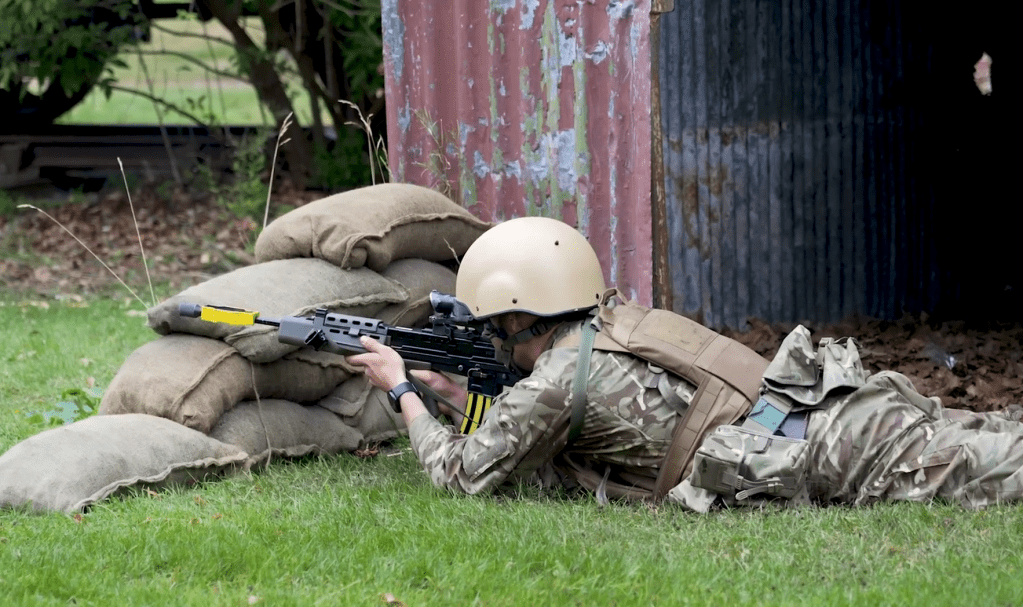
The SA80 rifles were first seen in the initial imagery released around the announcement of the training scheme but have appeared again since. They featured in photographs of Defence Minister Ben Wallace’s visit in early July and again a couple of weeks later during another visit by General Sir Patrick Sanders’, Chief of the General Staff. The rifles were seen with iron sights and fitted with blank firing adaptors. Interestingly, at least some of the Ukrainian personnel have been shown how to field strip the British rifles.
Deputy Defence Minister of Ukraine Volodymyr Havrylov with visits Ukrainian troops training in the UK, 19 July (UK MoD/Crown Copyright)
On 19th July, imagery from a visit by the Deputy Defence Minister of Ukraine, Volodymyr Havrylov, also showed Ukrainian troops equipped with SA80A2s fitted with blank firing adaptors. As before the rifles were not fitted with optics.
The Ministry of Defence has confirmed that while AK-pattern blank firing adaptors have been procured, SA80’s with blank firing adaptors have also been used to ‘maintain strict safety conditions for both British and Ukrainian soldiers during training and to meet the urgency of the training requirement.’
Ukrainian troops field stripping and cleaning SA80A2s in early July (UK MoD/Crown Copyright)
Because the rifles don’t have railed forends some thought they might be the earlier SA80A1s. We can tell that these rifles are SA80A2s from the up-turned scalloped tear drop charging handle which also doubles as a brass deflector. The rifles have the non-railed green polymer handguards fitted. While the Daniel Defense produced railed forends have come to characterise what many thing is the A2 configuration, these were actually developed in response to an urgent operational requirement for troops deploying in Afghanistan. Many of the rifles overhauled by HK to the A2 standard retained the classic green handguards. Some, like those recently provided to the Royal Bermuda Regiment, actually have a green handguard designed by HK.
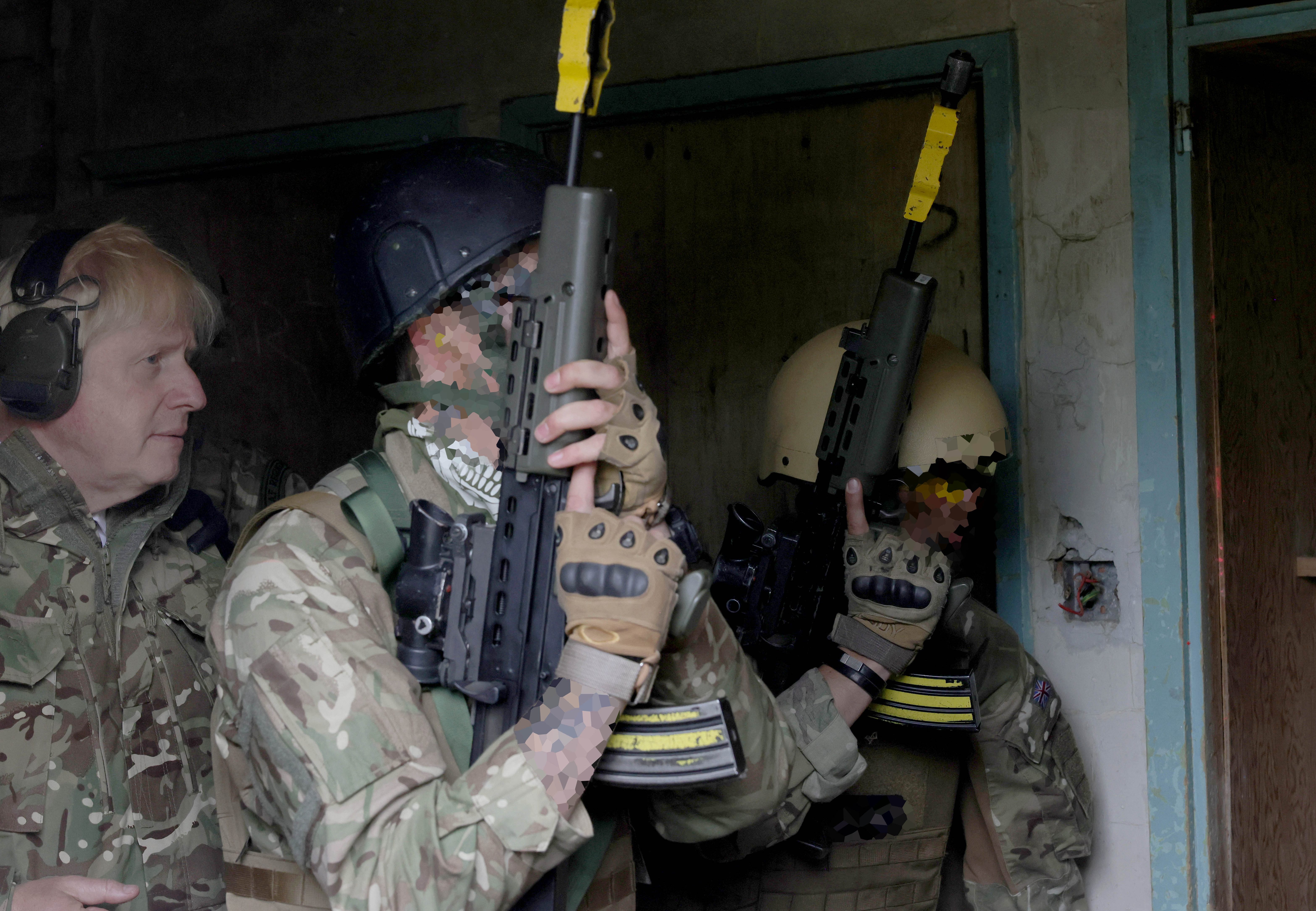
Prime Minister Boris Johnson visits Ukrainian troops (Andrew Parsons/No.10 Downing Street)
We can easily identify British troops involved in the training, as we can see that they are equipped with the new SA80A3 with the characteristic new MLOK forends and Cerakote finish.
On the 21st July, the UK Prime Minister’s office released photos and video of Prime Minister Boris Johnson’s visit to Ukrainian troops training in the North East of England. The imagery showed Ukrainian troops training in urban combat, known by the British Army as Fighting In Built Up Areas or FIBUA. This supports the theory that they are being issued for FIBUA and field exercises that require blank firing. Unlike in the earlier imagery the Ukrainians were armed with SA80A2s largely equipped with SUSAT sights.
If you enjoyed this video and article please consider supporting our work here. We have some great perks available for Patreon Supporters – including custom stickers and early access to videos! Thank you for your support!
Bibliography:
‘Defence Secretary Ben Wallace visits Armed Forces of Ukraine as training programme starts across the UK’, UK MoD, 9 July, 2022, (source)
Prime Minister Boris Johnson visits the North East, UK Govt., (source)
Deputy Defence Minister of Ukraine Volodymyr Havrylov meets with Ukrainian trainees in UK, UK MoD, (source)
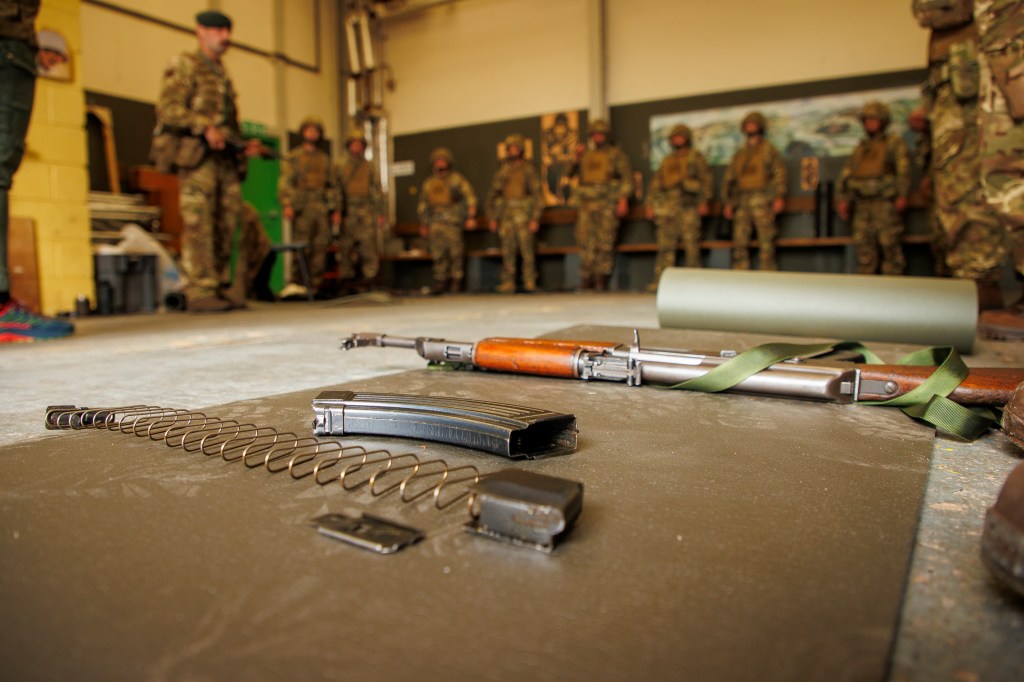
On the 9th July, the UK’s Ministry of Defence announced that as part of its agreement to train 10,000 Ukrainian soldiers it had acquired a significant number of AK-pattern rifles. Initially sharing only one, fairly low res, photograph the official announcement stated that:
“The Government has rapidly procured AK variant assault rifles for the training programme, meaning Ukrainian soldiers can train on the weapons they will be using on the front line. This effort was supported by the Welsh Guards, who tested more than 2,400 such rifles in 17 days to ensure they were ready for the Ukrainians to commence their training.”
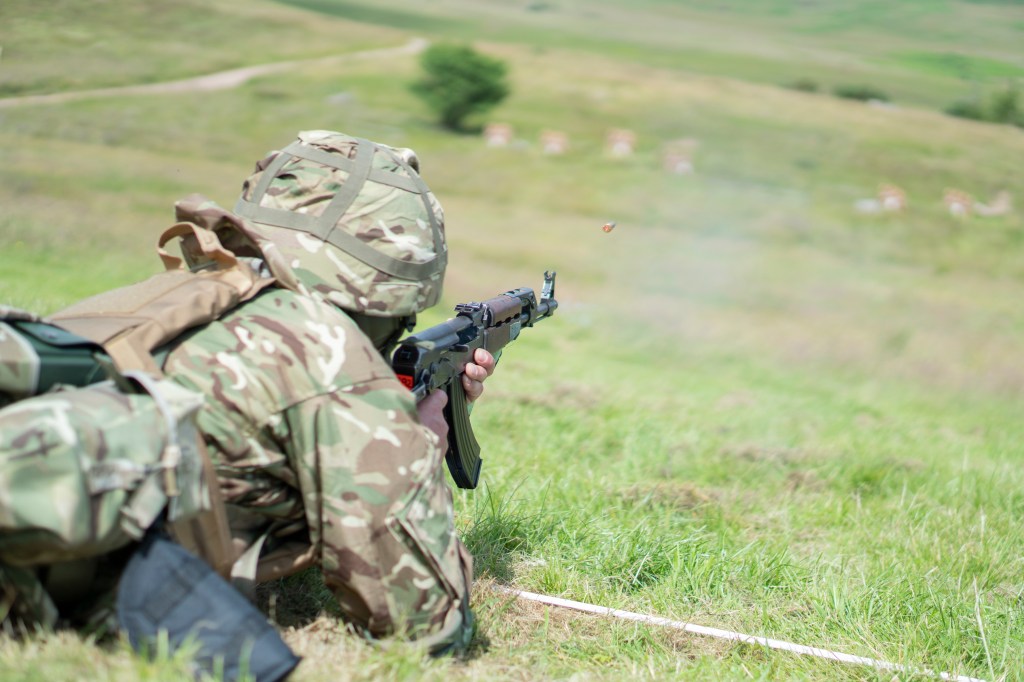
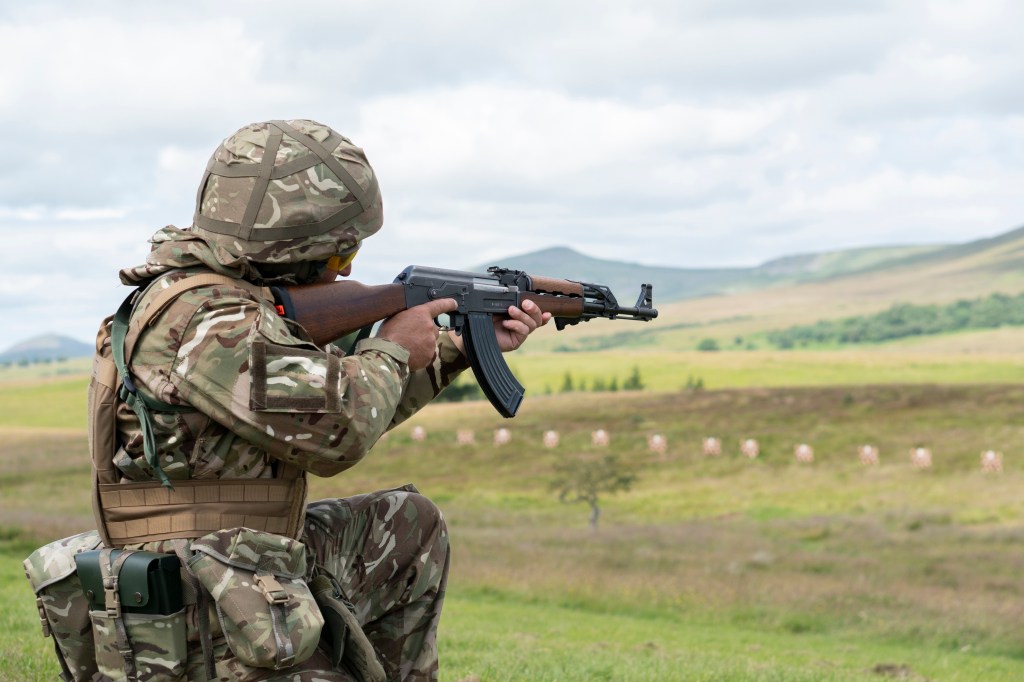
Ukrainian soldier at the range July 2022 (UK MoD / Crown Copyright)
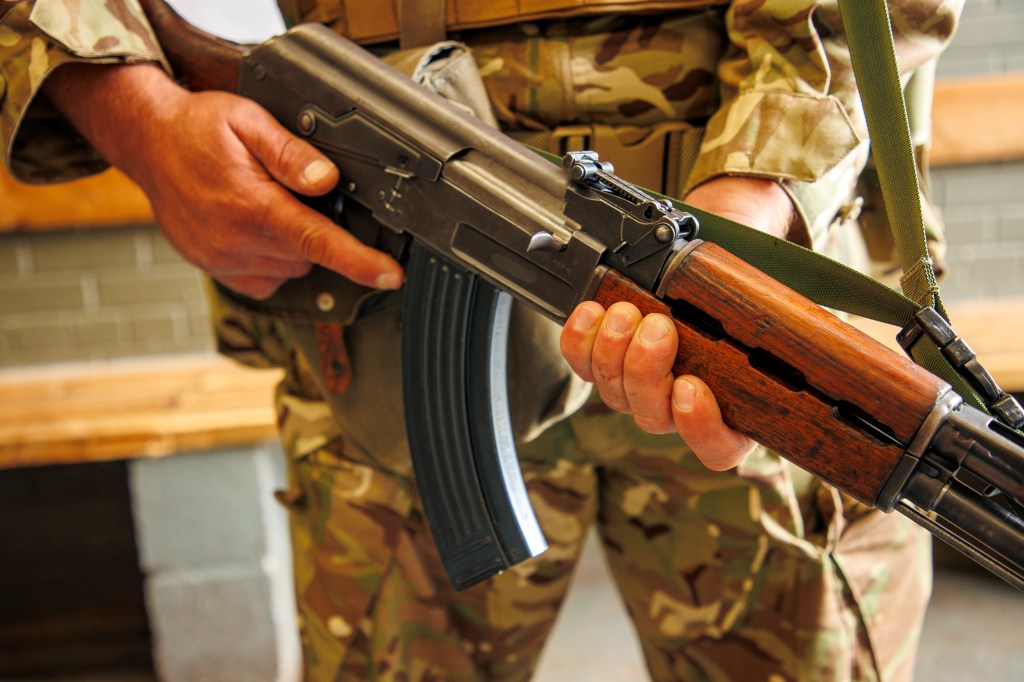
The types of AK-pattern rifles procured was not announced but from the initial photograph released it was clear that at least one of the rifles was a Serbian-produced Zastava M70AB2, chambered in 7.62x39mm.
The programme is the latest phase of Operation ORBITAL, the British Army’s name for the long term support and training programme undertaken since 2015. To-date ORBITAL has reportedly trained some 22,000 Ukrainian personnel, with the initial phase being run in Ukraine until early 2022 when the threat of imminent invasion saw the training personnel in Ukraine withdrawn. At the same time Canada and the US have run similar programmes in Ukraine. T he UK has agreed to train 10,000 Ukrainians within 120 days and in comments to the press the Uk’s Defence Secretary Ben Wallace saying that “if the Ukrainians ask for more, we’ll be open to more”.
Ukrainian soldiers seen here receiving training from 3 RIFLES, July 2022 (UK MoD / Crown Copyright)
The rifles procured will likely be retained in Britain to train successive cadres of Ukrainian personnel, however, the UK has gifted a substantial amount of uniform and kit with the Ministry of Defence’s 9th July statement saying that each soldier will be issued with:
Personal protective equipment including helmets, body armour, eye protectors, ear protectors, pelvic protection, and individual first aid kits
Field uniforms and boots
Cold and wet weather clothing
Bergens, day sacks and webbing
Additional equipment required for field conditions including ponchos, sleeping bags, and entrenching tools
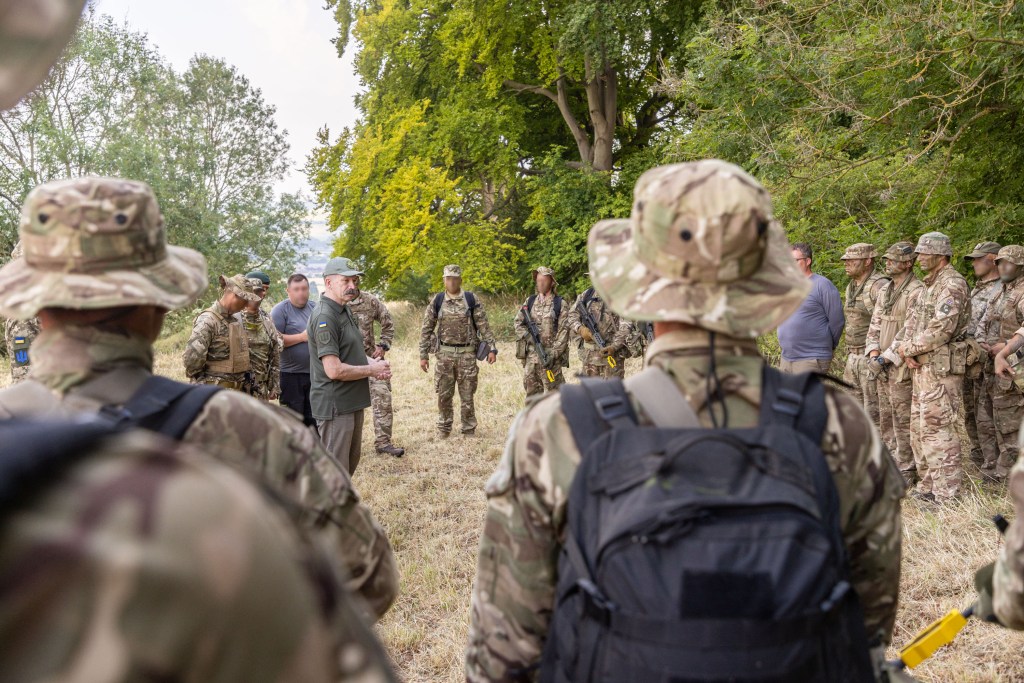
The training is being undertake by around 1,050 UK service personnel largely drawn from 11 Security Force Assistance Brigade. The brigade was formed in 2021 and is tasked with “building the capacity of allied and partner nations”. Personnel from the 12th Armoured Brigade Combat Team and 1st Armoured Infantry Brigade as well as Ukrainian-speaking interpreters are involved.
The course the Ukrainian troops are undergoing is a condensed basic infantryman course which includes weapons handling and marksmanship fundamentals, battlefield first aid, fieldcraft, patrol tactics and the Law of Armed Conflict. From the file dates on the imagery released it appears that many of the photographs were taken in late June and early July.
British instructor with M70 rifle (UK MoD / Crown Copyright)
From examination of further imagery released it appears that the AK-pattern rifles procured for training the Ukrainian troops are all chambered in 7.62x39mm and the 2,400 rifles procured include: wooden-stocked Zastava M70 (or M70B)s, milled receiver M70As, folding stock M70AB2s, Hungarian FEG AK63Ds and East German MPi KMS-72s.
Interestingly, some photographs and video suggest that as part of the training at least some of the Ukrainian personnel have been shown how to field strip the British SA80/L85 rifles. These are believed to have been used with blank firing adaptors during training this theory was supported by Ukrainian troops being pictured with SA80/L85 pattern rifles, with the easily recognisable yellow blank firing adaptors fitted, during a visit by General Sir Patrick Sanders’, Chief of the General Staff, to meet Ukrainian troops doing Fighting In Built Up Areas (FIBUA) training. The Ministry of Defence has confirmed that while AK-pattern blank firing adaptors have been procured, SA80’s with blank firing adaptors have also been used to ‘maintain strict safety conditions for both British and Ukrainian soldiers during training and to meet the urgency of the training requirement.’
Ukrainian soldier at the range July 2022 (UK MoD / Crown Copyright)
The reasoning behind the procurement of rifles chambered in 7.62x39mm rather than the more regularly issued 5.45x39mm AK-74 pattern rifles is also unclear. Perhaps this was due to weapon availability and regardless of calibre the manuals of arms remains the same. There is no indication that training with support weapons such as general purpose machine guns or light anti-armour weapons is being provided.
When approached for comment on the sources and types of AK rifles procured, the Ministry of Defence told The Armourer’s Bench:
“The Government has rapidly procured AK variant assault rifles through a combination of international donations and private purchase, meaning Ukrainian soldiers can train on the type of weapons they will be using on the front line. All weapons were tested in accordance with UK legislative and safe working practices.”
While this doesn’t offer much detail it does suggest that the rifles were procured via donations and private purchase – the scale of the donations and private purchases remains unclear.
Ukrainian Army recruits have arrived in the UK this month where they are being given the skills needed to be effective and lethal on the frontline and defend their homeland. 🇺🇦 #StandWithUkraine 🇺🇦 pic.twitter.com/fngYb2XRoo
It has also been confirmed that elsewhere British personnel are training Ukrainian mechanised troops on various vehicles including Spartan, Husky and Mastiff at Bovington as part of ‘Project Spring Generation’. It was confirmed by the Defence Secretary Ben Wallace, on 18th July, that the first cadre has now completed its training in the UK. Wallace also noted that Dutch personnel will be joining the British effort to train Ukrainian troops in the future.
If you enjoyed this video and article please consider supporting our work here. We have some great perks available for Patreon Supporters – including custom stickers and early access to videos! Thank you for your support!
Bibliography:
‘Defence Secretary Ben Wallace visits Armed Forces of Ukraine as training programme starts across the UK’, UK MoD, 9 July, 2022, (source)
‘First Ukrainian Volunteer Recruits Arrive In UK For Training’, Overt Defense, (source)
So far during the fighting we’ve seen everything from M14s to Brimstone missiles transferred to Ukraine. One weapon which was hailed as a game changer when it was announced was the Switchblade loitering munition. While not game changers we have begun to see evidence of their use in the field and they are definitely an interesting new weapon.
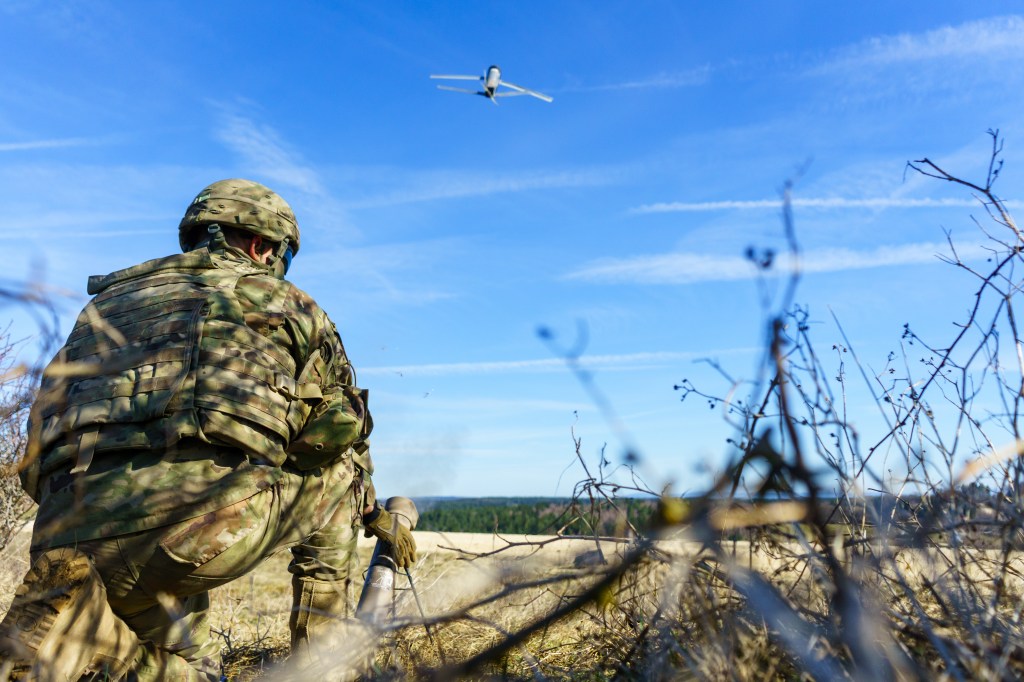
Switchblades are a loitering munition capable of being launched and then remaining on station to be tasked to destroy a ground target once the target has been identified. Back in March it was announced that as part of the US’ military aid to Ukraine Switchblades made by AeroVironment.
Pvt. 1st Class Brandon Norton launches a Lethal Miniature Aerial Missile System (LMAMS) for aerial support during a Robotic Complex Breach Concept assessment and demonstration, at Grafenwoehr, Germany, April 6, 2018. (U.S. Army photo by Sgt. Gregory T. Summers)
The system was originally developed for use in Afghanistan with the first US Department of Defense contract awarded in 2011. These have been designated the Lethal Miniature Aerial Missile System (LMAMS). AeroVironment currently offers two models, the Switchblade 300 and the larger Switchblade 600.
On the 16th March the US announced it would provide Ukraine with “100 Tactical Unmanned Aerial Systems”.[1] It was widely theorised that these would in fact be Switchblade loitering munitions.
So what is a Switchblade?
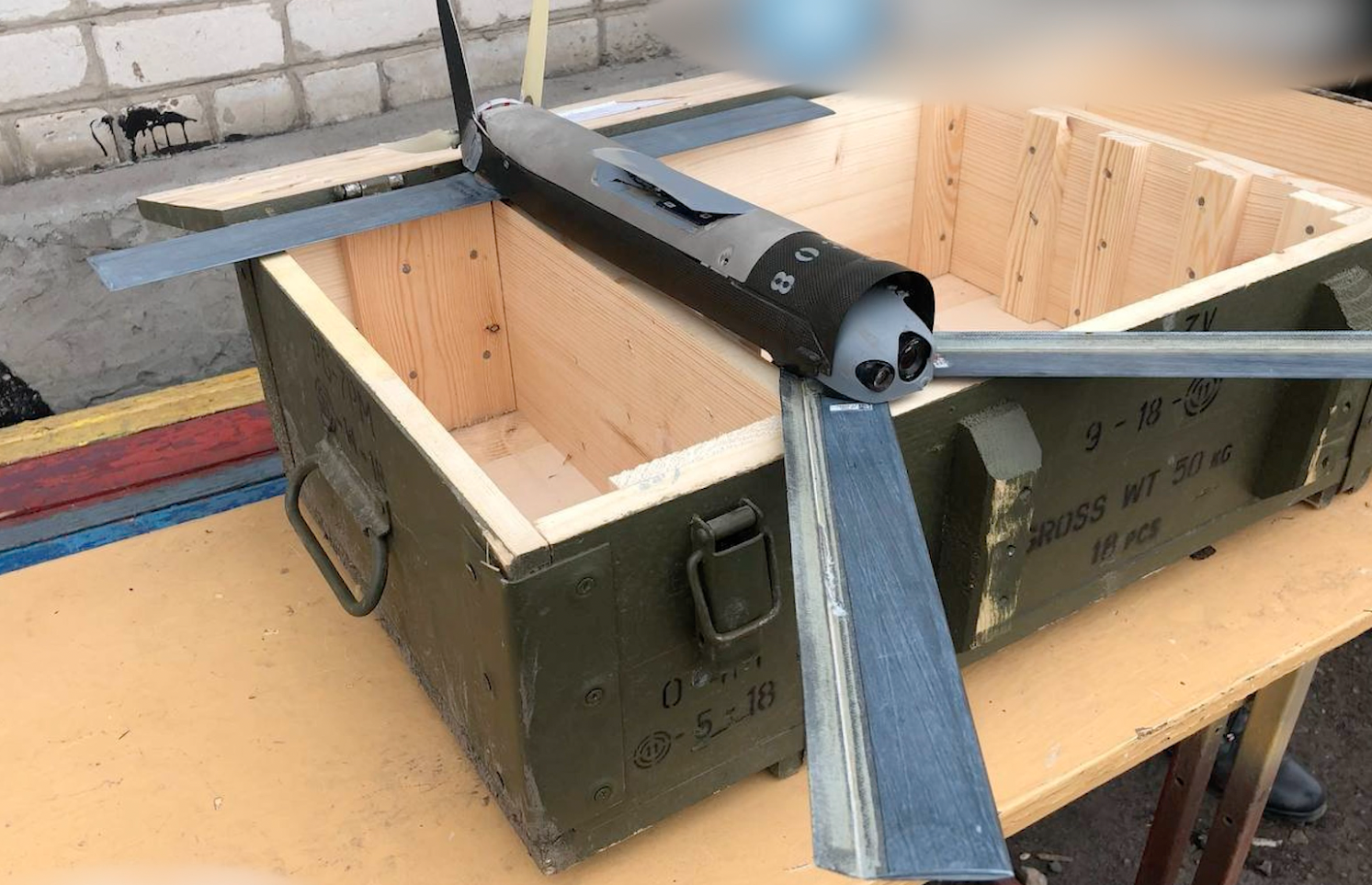
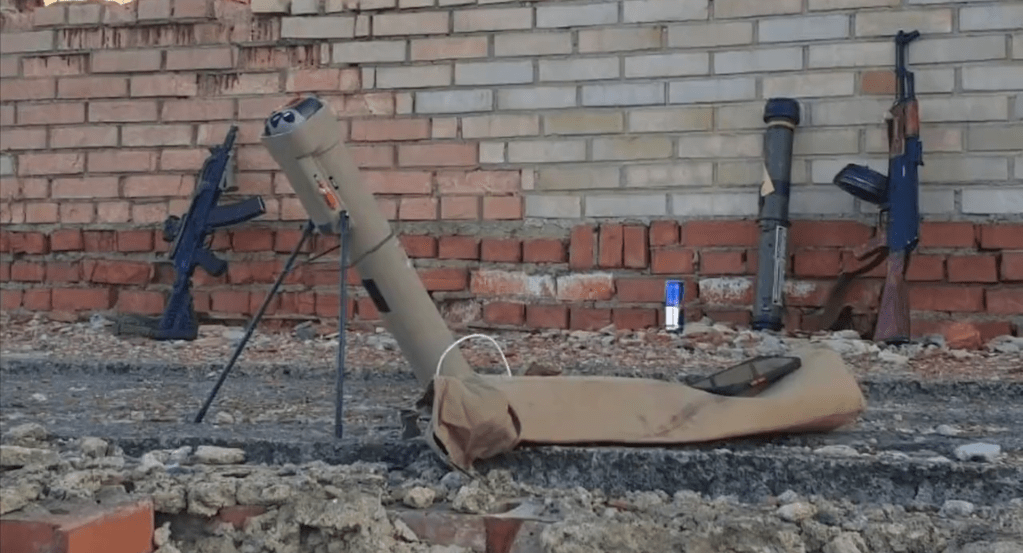
It is a tube-launched, rapidly deployable munition which can strike beyond-line-of-sight targets with precision at a range of up to 10km. The system is small enough to be man-packed weighing 5.5lbs (or 2.5kg).
It can also be launched from a multiple launch system which can be vehicle mounted. Once launched its wings deploy and its electrically-powered propeller spins up, it can remain in the air for 15 minutes. It has a maximum altitude of 5,000 feet and cruises at around 60 miles per hour (but can dash at speeds up to 100mph).[4] AeroVironment claim the system can be set up and launched in under 2 minutes.
Its payload is described as ‘modular’ by AeroVironment, who also mention it carries a ‘Northrop Grumman advanced munition’, which some sources suggest is roughly equivalent to a 40mm grenade – said to be capable of knocking out light armoured vehicles. The warhead has a highly directional fragmentation charge which is triggered by a sensor that detonates it as a specific distance from the target in mid-air.
Remains of a Switchblade 300 following detonation of its warhead (via social media)
The system is controlled manually or autonomously and uses a dedicated ruggedized laptop with a built-in mission planner (which is also pre-loaded with a simulator). The Switchblade is equipped with electro-optical and infra-red cameras which provide the operator with real-time video and can be directed by fly-by-radio frequency signal. Once launched Switchblade is not recoverable and does have a wave-off and redirection capability.
On 1 April, a fresh military assistance package was announced which expressly named ‘Switchblade Tactical Unmanned Aerial Systems’ but did not indicate a quantity.[2] These were believed to have been ordered direct from the manufacturer under the Ukraine Security Assistance Initiative (USAI) which allows procurement of systems and capabilities from industry rather than delivering equipment Department of Defense stocks.
On 7 April the US Department of Defense’s fact sheet on aid supplied to Ukraine referred to ‘hundreds of Switchblade Tactical Unmanned Aerial Systems’[11], a week later the wording had changed to a more specific ‘Over 700 Switchblade Tactical Unmanned Aerial Systems’.[12]
An intact, undetonated but damaged Switchblade 300 captured by Russian forces (via social media)
On the 6 May AeroVironment were awarded a contract modification worth nearly $18 million for “Switchblade hardware production” for a Foreign Military Sale to Ukraine. This contract is estimated to be completed by 4 May, 2023.[3] The US Department of Defense announced on 10 May that it would supply a total of 700 Switchblade systems, but did not state the split between 300s and the newer, more capable Switchblade 600s.[10]
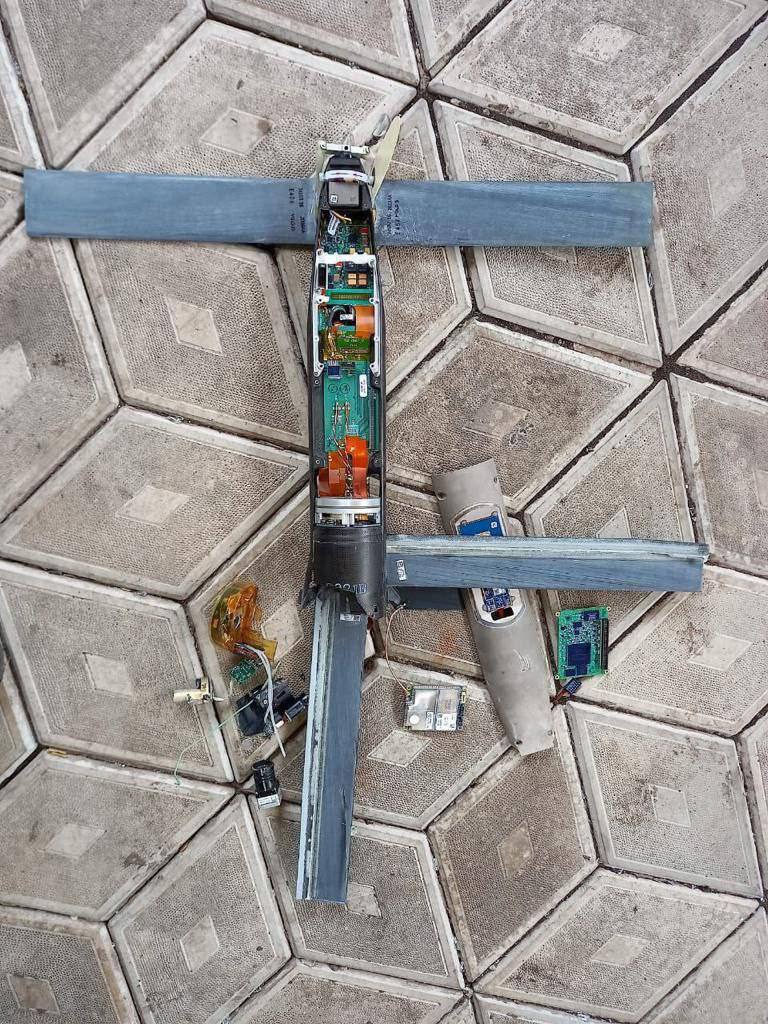
We’ve yet to see evidence of Switchblade 600 use in Ukraine, likely because the system has only been produced in pre-production runs and substantial orders for the munition have not been made yet. The 600s capabilities are regularly compared to those of an Anti-Tank Guided Missile. With a 40km (25 mile) range and a 20 minute loiter time they offer considerable capability and much longer range than ATGM like Javelin or Stugna P. For now only 300s have been visually confirmed in use in Ukraine. But the larger 600s have the potential to have significant impact on the battlefield.
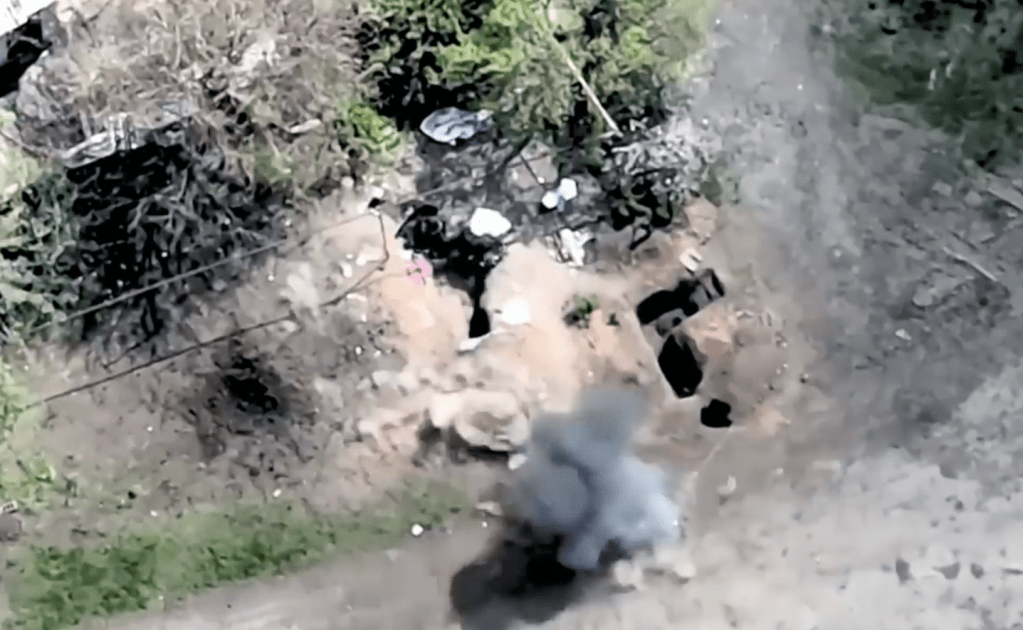
On the 6 May the Ukrainian 53rd Separate Mechanized Brigade shared a clip showing a Russian machine gun position being struck by a Switchblade, we can see the characteristic mid-air blast and fragmentation pattern.[5]
On the 24 May the SSO, a Ukrainian special forces unit, shared a video of a Switchblade 300 strike against a Russian tank crew which had dismounted and were sat on the vehicle’s hull. Memes are one thing the war in Ukraine isn’t short of and the video features the Star Wars theme and concludes with a Curb Your Enthusiasm credit reel meme.[9]
A Switchblade 300 in the field in Ukraine (via social media)
On the 25 May a pretty comprehensive video showing the launch and targeting of a Switchblade, said to be on the eastern front was shared.[6] The video shows the launch tube and control laptop. A largely intact Switchblade 300 was recovered by Russian troops on 26 May, with photos of the munition shared online.[8] This is potentially an example of the munition running out of loitering time or one which has potentially taken damage from ground fire.
On 1 June footage of another Switchblade 300 launch was released but no indication of if it struck its target. The video is said to have originated from the Kharkiv region.[7] On the 6 June a further photo of a Switchblade 300 appeared. The photo shows the remnant of the Munition – given the front portion of the Switchblade is missing it appears that it fired its payload. Around the 12 June further photos of an expended Switchblade 300 were shared online with very little of the fuselage remaining.
Footage released by the Ukrainian Armed Forces of a Switchblade 300 strike against a machine gun position
On 15 June, a short clip of another fired Switchblade gives us a close up look at the electronics inside the weapon and at the propeller at the rear which powers it. Again given the damage and the fact the front portion of the munition is missing it would indicate that the Switchblade detonated its payload.
On the same day more footage of what might be the same expended Switchblade 300 appeared in a Russian news report. The report allegedly shows the location where the Switchblade detonated, somewhere near Avdiivka in Donetsk. The nature of the Switchblade 300’s forward firing payload it is suited to softer targets like infantry in the open or in the case of at least one video claimed to be from a Switchblade attack against dismounted vehicle crews.
Some have criticised the Switchblade 300 for its apparent lack of punch but they were never designed to take on Russian armour, they were designed as a focused munition intended to take out soft targets with the minimum collateral damage. In Ukraine the use of commercial drones has rapidly proliferated, many of these are delivering grenade-based gravity bombs onto enemy positions and assets. It could be argued that these systems, rather than a sophisticated loitering munition like the Switchblade 300, are arguably more cost effective, efficient, more versatile and easier to use. The larger, more capable loitering munitions, such as the Switchblade 600s, will likely see the concept come into its own and have the potential to have a more significant impact on the battlefield.
If you enjoyed this video and article please consider supporting our work here. We have some great perks available for Patreon Supporters – including custom stickers and early access to videos! Thank you for your support!
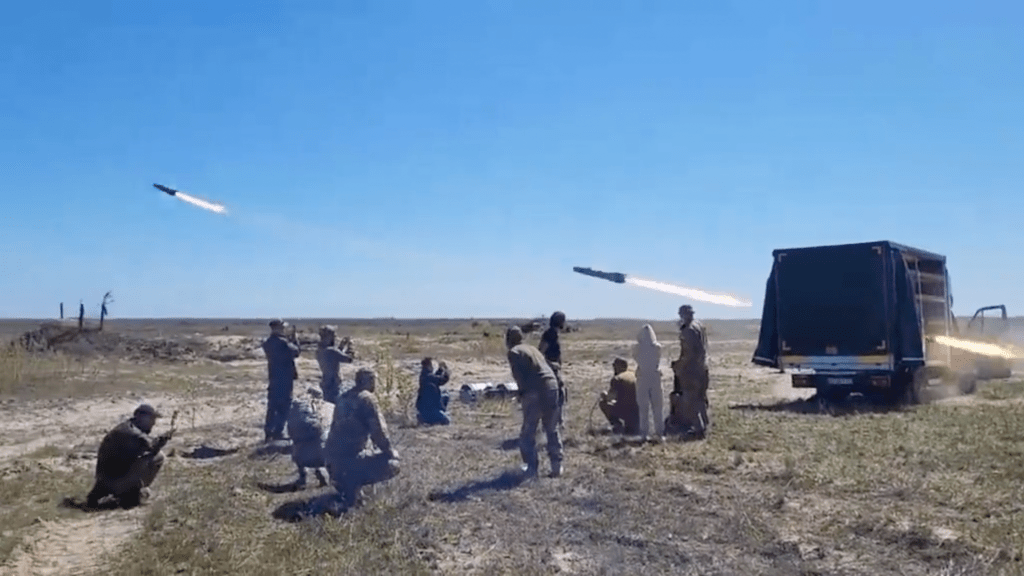
On 12 May video of what appears to be a test launch of Brimstone Missiles in Ukraine surfaced online. A containerised launch platform can be seen launching a salvo of three missiles. The footage shows what appears to be a repurposed commercial vehicle, such as an IVECO Daily or Mercedes-Benz Sprinter box van. The van appears to have a series of rails mounted inside the cargo area which may have something similar to a Cobham triple launch rail fixed to them. It could be described as a sort of very advanced technical. It is unclear when or where the footage was filmed.
Brimstone salvo being launched from a repurposed commercial vehicle (via Social Media)
In April, the UK Ministry of Defence confirmed the supply of Brimstone missiles to the Ukrainian Armed Forces. It was announced that these would be adapted for surface launch for use against ground targets. Before Russia’s invasion of Ukraine in February, the UK government had been in talks to provide the maritime variant of of the missile (Brimstone Sea Spear) to the Ukrainian Navy and there was speculation that this would be the variant sent to Ukraine. However, on 25 April, Defence Minister Ben Wallace told the UK Parliament that “if we do provide Brimstone, we will look to provide it for the land, using stock that we already hold, but not as yet for the sea.” A day later, on 26 April, the UK’s Armed Forces Minister James Heappey told Parliament that “such is the speed with which our technicians are now working and so effective is the partnership with industry that I am pleased to say that that has been moved forward. It is necessary to inform the House that we will be providing Brimstone in the next few weeks.”
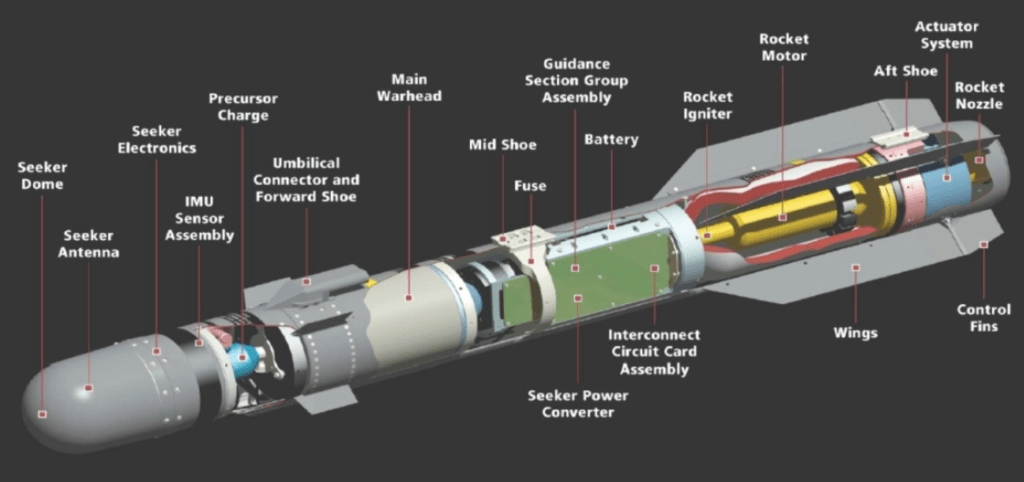
Brimstone is an advanced, rocket-powered, radar-guided weapon which can seek and destroy armoured targets at long ranges with high precision. Developed by in the late 1990s it was designed to be fired from aircraft and entered service with the Royal Air Force in 2005, seeing action in Iraq, Afghanistan Libya and Syria. The missile’s manufacturer MBDA has continued development of the weapon with ground-based and maritime variants designed and proposed. Brimstone uses a 94 Ghz millimetre wave (mmW) active radar homing seeker and a sophisticated guidance system which can differentiate and prioritise targets. The missile delivers a tandem shaped charge to destroy armoured targets at ranges varying from 12 to approximately 20km depending on launch platform and conditions and the variant of missile. Brimstone is capable of firing a salvo of missiles which will then fly in parallel before striking their targets in unison. This may be what is seen in the video. Brimstone is a fire and forget missile with the missile able to targeted at a designated killbox to then engage highest value targets it detects.
Diagram showing the layout of Brimstone (via Think Defence)
On 6 May the first evidence of Brimstone’s presence in Ukraine was provided by a series of photographs of the remnants of a Brimstone 1 missile. The recovered tail section of the missile bore a sticker denoting the surviving component as being manufactured in September 2001. Subsequent photographs of fragments from another missile, which perhaps self destructed, surfaced online on 11 May. These suggested that this Brimstone 1 was manufactured in around May 2001.
#Ukraine: Another UK-supplied Brimstone 1 missile was reportedly used against RU forces in #Zaporizhzhia Oblast – however this one failed to explode. This particular missile is relatively old and was made no earlier than June '04 – also utilizing many parts imported from the US. pic.twitter.com/uxShg7pwFJ
— 🇺🇦 Ukraine Weapons Tracker (@UAWeapons) May 8, 2022
On 8 May photographs of a further Brimstone 1, this time intact perhaps photographed before launch or after a failure of some sort, appeared online. If photographed following a failure it would indicate that this missile’s self destruct failsafe did not activate. Though the missile appears in good condition if it landed after a failure. From its markings seen in the photographs it is clear that the weapon’s components were produced in September 2001 and February and June 2004. We do not yet know how Ukrainian forces are employing Brimstone or how effective it has been.
#Ukraine: More footage of the covert ground launch system for UK-supplied Brimstone missiles, used by the Ukrainian Army- apparently a launch platform with 3 missiles loaded (Similar to an already known test rig) is placed on a truck chassis. pic.twitter.com/25N7SZlpvl
— 🇺🇦 Ukraine Weapons Tracker (@UAWeapons) May 15, 2022
Further footage from Ukrainian Brimstone launches emerged on 15 May, showing some close-ups from inside the launch vehicle. A Cobham triple rail can be seen mounted and several launches were shown as part of a compilation video shared by Ukrainian forces. In this video we only see two missiles being launched rather than a salvo of three although in one clip we can see three missiles mounted on the rail. The footage also shows us that the system appears to be mounted on a palletised frame work which could seemingly be easily mounted on more capable vehicles.
Brimstone offers greater range than the infantry-operated anti-tank guided missiles (ATGM) like the western Javelin or the Ukrainian Stugna-P. This greater range coupled with its ability to be fired in salvos offers a valuable capability to Ukrainian forces.
Update – 15 November 2022:
In October a video from BFBS Creative confirmed that the UK has provided Brimstone 2 missiles to Ukraine. BFBS do not state when the video was filmed but the footage shows a transit chest marked ‘Brimstone 2 Operational Missile Dual Mode’. Dual Mode refers to a variant of the missile which can be used both as a ‘fire and forget’ system but also have a ‘man-in-the-loop’ capability which was originally developed as part of an Urgent Operational Requirement for a low-collateral damage weapon. According to MBDA Brimstone 2 has “an overall increase in performance with improvements in range and engagement footprint”, this is enabled by improved seeker, improvements to the missiles airframe with a more modular design and software updates.
Some previously unseen footage of a Brimstone launch was circulated online on 15 November, which may show the launch of several Brimstone 2 missiles. It is unclear when the footage was filmed. Though the resolution of the footage is low there is a discernible glint on the seeker head/dome which might indicate they are a later type of missile to those seen earlier in Ukraine which have a translucent seeker dome.
Some newly circulating footage of a Brimstone technical in action.
We first saw Brimstone in action in May. A very short clip but there may be a glint from a different seeker head to the one previously seen in #Ukraine.
If you enjoyed this video and article please consider supporting our work here. We have some great perks available for Patreon Supporters – including custom stickers and early access to videos! Thank you for your support!
Bibliography:
Brimstone, MBDA, (source) Brimstone Guided Missile, Think Defence, (source) Footage: Brimstone Missiles Deployed in Ukraine, Overt Defense, (source) What is the Brimstone missile?, BBC, (source) Ukraine Update 25 Apr. 2022, UK Parliament Hansard, (source) Ukraine 26 Apr. 2022, UK Parliament Hansard, (source) Brimstone 2 Missiles in Use in Ukraine, Overt Defense, (source) How the UK’s Brimstone Missiles Reach Ukraine, BFBS Creative, (source) MBDA reveals Brimstone 2 missile work for UK, FlightGlobal, (source) Dual Mode Brimstone, MBDA, (source)
The ongoing war in Ukraine has seen all sorts of small arms pop up. Many from military stores, some old some new. But also large numbers of previously civilian-owned and commercially available rifles.
One manufacturer which continues to surface is Savage Arms. We’ve seen a range of Savage firearms in social media posts from Ukraine. In this short video we’ll take a look at some of the models of rifle which have been seen on the ground.
It is worth noting that Savage 110s have previously been seen in the hands of Ukrainian Special Operations snipers prior to the current conflict, as early as 2017. It was reported in September 2018 that 125 Savage 110 Stealths had been purchased for Ukrainian Airborne troops and it seems that along with Ukrainian Z-10 DMR and other Western bolt actions the Savage Arms rifles are one of the systems which replaced many of Ukraine’s SVDs.
Savage 110 Stealth & Fort 221 [Tavor] (via social media)
Before the war civilian firearms ownership in Ukraine was fairly buoyant, and this only increased as tensions before the Russian invasion rose. Savage Arms have dealers and stockists all around the world, including Ukraine. Savage’s site lists IBIS LLC / Europa Arms Sports Ltd as their Ukrainian stockists with an address in Kyiv but IBIS have a chain of stores across Ukraine.
IBIS’ site lists a large range of Savage Arms firearms and accessories with nearly 50 different models and variations listed. Everything from 110s in .338 Lapua Magnum to semi-automatic 7.62x51mm MSR-10s, and Savage Model 10s in various calibres to MSR-15 ARs.
Savage MSR-15 (via social media)
With the help of DixieMauser, on Instagram, I’ve been collecting images of Savage Arms rifles in the field. From the photos we can see that both Savage’s semi-automatic rifles and bolt actions are in use.
A comparatively small number of photographs feature Savage’s MSR series. In these photos we see MSR-15s, Savage’s AR-15 pattern rifle. In use with Ukrainian forces they all appear to be running variable power optics. Much more common, however, are Savage’s bolt action rifles. They are seen with a range of suppressors and optics being used and while most appear to have factory stocks and chassis some barrelled actions have been placed in after-market chassis.
It is worth noting that Savage previously offered 10 (short action) and 110 (long action) versions of their rifles but in recent years have consolidated to referring to all their bolt actions in the 10/110 series – 110. It is difficult to differentiate between 10/110s in many of the photographs with the magazine being the key indicator.
Savage 110 Carbon Tactical (via social media)
Due to the nature of sourcing the photos across several social media platforms its difficult to identify units or know where personnel are operating. But one thing we can tell is the kinds of rifle being used.
Savage 110 Precisions have been seen as well as a number of 110 BA Stealths. We know that one of these Stealths was also used in Irpin at the beginning of April as it was mentioned in a Daily Beast report and pictured on the ground.
A number of 110s have also been seen in MDT chassis. In terms of calibre 7.62x51mm and .338 Lapua Magnum appear to be the most commonly seen but 300 Win Mag is also believed to be in use.
Conventionally stocked Savages have also been seen including this rifle which appears to be a Model 10 or 110 Hunter. Even a Savage 110 Carbon Tactical, still with its Savage sticker has been pictured. At least one AXIS series rifle has been seen in use with one unit operating around Kyiv.
Savage Stealth (via social media)
It’s also worth noting there it’s not only Savages which have been see, there have also been a significant number of Remington 700s, Sakos and others seen in use. It is impossible to know how many of the Savage rifles were procured by the Ukrainian military and how many are formerly civilian owned or commercially sold firearms.
It is important to contextualise a sampling of photographs like this one as it is difficult to gauge how widespread the use of the rifles is and indeed in what areas of Ukraine they are being used in. They could be in fairly wide use or localised within a region or smattering of units. But we can say that rifles made by Savage Arms rifles are being used as precision rifles by marksmen and snipers of the Ukrainian armed forces.
If you enjoyed this video and article please consider supporting our work here. We have some great perks available for Patreon Supporters – including custom stickers and early access to videos! Thank you for your support!
Bibliography:
Ukrainian Special Forces Precision Rifle Competition, TFB, (source) Ukrainian President Poroshenko buys 430 sniper rifles for paratroopers, UAWire, (source) IBIS Savage Arms Listings, IBIS, (source) You Won’t Believe the Horror Left Behind, Daily Beast, (source) What Ukrainian snipers are fighting in Donbas, Rambler (source) First Sniper Tournament of the SSO of Ukraine, SSO, (source)
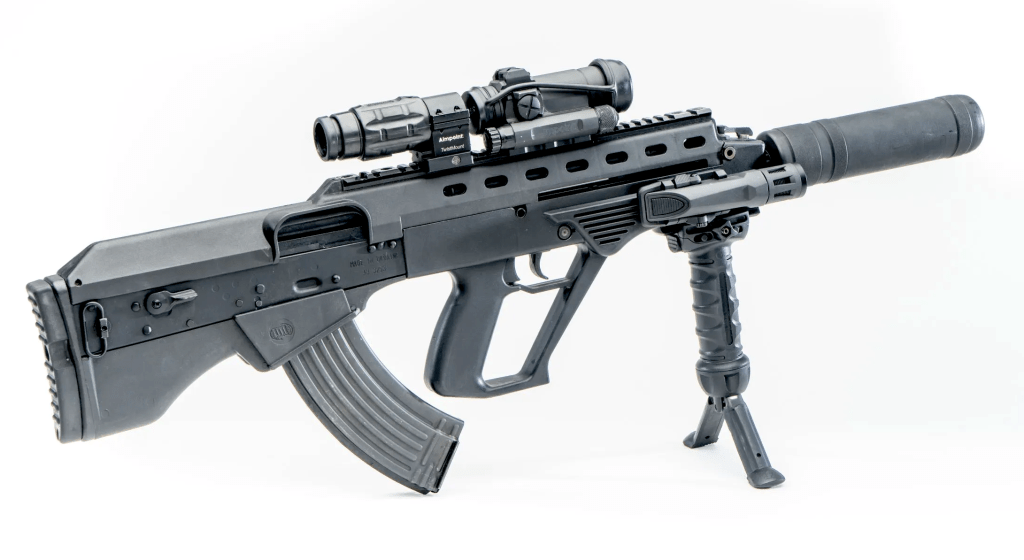
One of the most interesting small arms we’ve seen during the fighting in Ukraine is the Vulcan [Vulkan] or Malyuk bullpup. Available in 7.62x39mm and 5.45x39mm the weapon is built around the action of either an AKM or AK-74. Most frequently seen in the hand’s of Ukrainian special forces the weapon appears to be a well-designed adaptation of the proven AK platform.
Ukrainian troops with unsuppressed 5.45x39mm Vulcan bullpups (via social media)
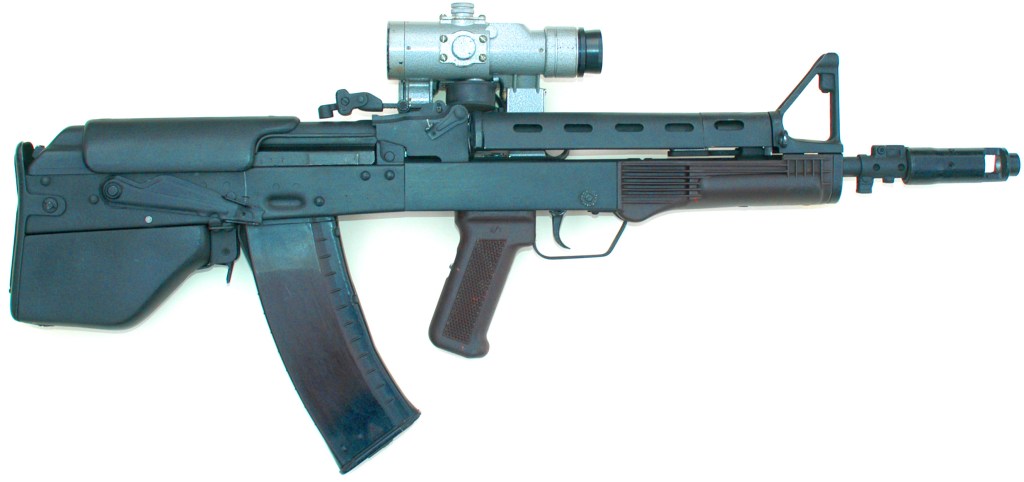
Development of the weapon reportedly began in 2005, following efforts by Ukraine’s State Space Agency to adapt an AK-74 into a bullpup. This project began in the early 2000s and was known as the Vepr, not to be confused with the Russian shotguns and rifles produced by Molot-Oruzhie , and resulted in a fairly basic, non-ambidextrous conversion, notable for its AR-15/M16 style front sight post.
Ukrainian Vepr prototype (60менге CC BY-SA 4.0)
The design and development of the Vulcan was undertaken by a company called InterProInvest (IPI). IPI market the weapon under the name Vulcan (Malyuk), as does Ukraine’s state export company SpetsTechnoExport. The weapon’s nickname ‘Malyuk’ translates into English as ‘baby’ or ‘little one’. Unlike conventional rifles bullpups place the breech and magazine behind the trigger and pistol grip. This has the advantage of creating a more compact package while maintaining a full-length barrel.
The weapons are manufactured at the ‘Krasyliv Aggregate Plant’ in Khmelnytskyi Oblast, western Ukraine. The Krasyliv Plant is part of Ukroboronprom, Ukraine’s state-owned defence industry enterprise. The plant produced a number of civilian and military products and also produces parts for the Stugna-P ATGM.
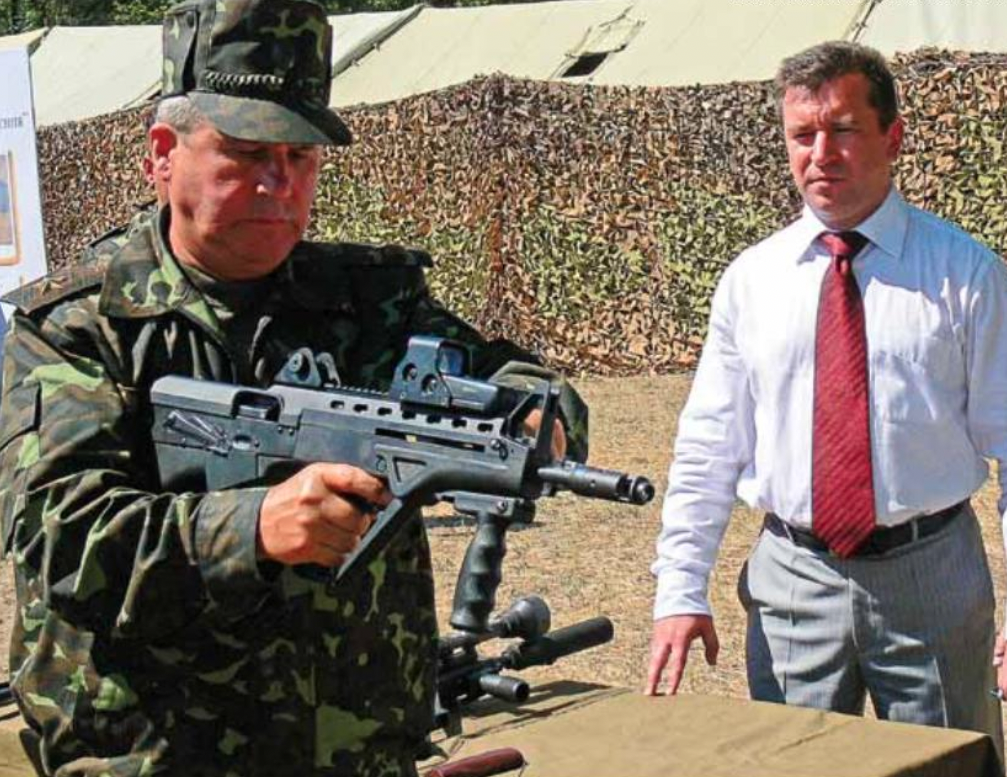
In an interview with Ukrainian Defence Review in 2015, IPI’s Vice CEO, Serhiy Luhovskoy, said that the prototype development of the weapon was “done under a contract that we got from Ukraine’s Security Service [SBU].” Following positive feedback from the SBU elements of the Ukrainian Ministry of Defence became interested in around 2008.
A demonstration to Ukrainian Armed forces c.2015 (via Ukrainian Defense Review)
The Malyuk was unveiled publicly in 2015 and was first evaluated by the Ukrainian Army in 2016. Ukroboronprom announced in late 2016 that the rifle had been accepted by the Ukrainian armed forces, stating it had successfully passed testing. It appears that a relatively small but significant number have been procured by Ukraine’s special forces.
The basic design of the weapon changed very little between 2015 and 2019, but refinements appear to have been made. The most significant external refinement is the removal of the AR-15/M16 type front sight (similar to that seen on the earlier Vepr) and fixed rear sight assembly in favour of a full length top rail and folding back up iron sights. With this change the latch for the upper assembly appears to have been moved from the side to over the top of the barrel.
A 7.62x39mm chambered Vulcan (IPI)
As the weapon went into production continued improvements were made, in 2017 the weapon still used an AK-style selector lever but by 2019 this had been replaced by smaller selectors on either side of the receiver. The latest version of the Vulcan has a number of new features including an adjustable gas block which may suggest that the barrel and block are now of new manufacture (rather than repurposed from old AKs). There is also a new five position adjustable stock.
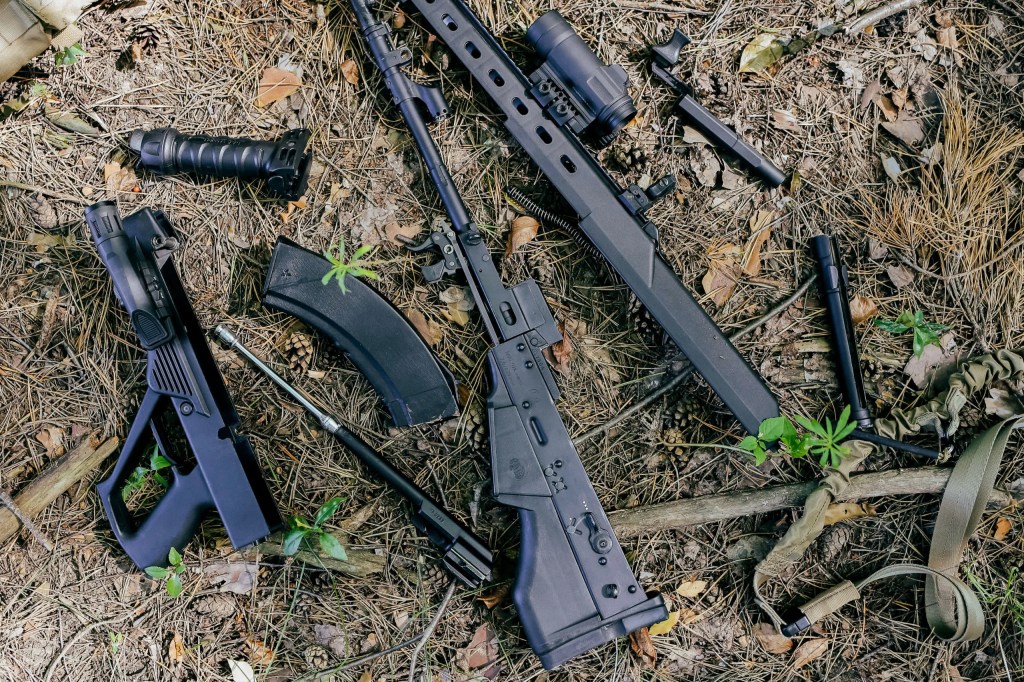
The 7.62x39mm and 5.45x39mm rifles appear to be made using a mixture of new and old parts. This has been confirmed by images of examples seen in the field. We know that the rifles are made using the barrels, trunnions, bolts and sections of the original AK-pattern rifle’s receiver. The receiver is cut down, the front sight assembly and rear sight block are removed and a new gas piston is installed in the bolt carrier. The recoil spring appears to be held captive in the upper receiver. When the upper is detached the spring and guide rod hang from the rear of the upper.
A 5.45x39mm chambered Vulcan (IPI)
The weapon can be fired from the left or right shoulder and has ambidextrous controls with selector levers on both sides at the rear of the receiver. The charging handle is non-reciprocating and can be swapped from left to right. The chassis has a large polymer brass deflector which protects the shooter when the weapon is being fired from the left shoulder. The magazine release is located directly behind the weapon’s trigger and can be operated when firing from either shoulder. The 7.62 and 5.45 rifles feed from standard pattern AK magazines. In addition to the magazine release behind the trigger there is a thumb release within the magazine housing at the rear of the magazine – the 5.56 version does not appear to have this feature. The 5.56 rifle appears to use an AK pattern magazine rather than a STANAG one. The housing is designed to allow the magazines to drop free under their own weight. The rifle has a push button safety located above the trigger which can be reached by the trigger finger.
The non-reciprocating charging handle is attached to a collar which sits around the gas piston system and acts on the bolt assembly without being attached to the piston or bolt itself. This allows it to be positioned ahead the trigger and pistol grip. An action bar projects back from the trigger, into the rifle’s receiver, to trip the sear.
Graphic showing disassembled Vulcan (IPI)
The rifle consists of three major assemblies: the upper which is a polymer assembly which retains the weapon’s mainspring and provides a platform for optics mounting. The barrel and receiver assembly which consists of the barrel, firing mechanism and magazine well. And the lower, which is a polymer pistol grip and forend which slides onto the receiver assembly. The upper and lower are held in place by a locking lever and cross pin.
A field stripped 5.45x39mm Vulcan (IPI)
The Malyuk has a convection system within the stock chassis which IPI says allows air to flow through the hollow pistol grip and out above the barrel. IPI says this allows the enclosed barrel to cool and is claimed to extend barrel life.
IPI state the weapon’s empty weight as 3.8kg (8.38lb), its overall length is 712mm or 28 inches and its barrel length is 415mm (or 16in). The rifle has a rate of fire of 660RPM in fully automatic and feeds from standard AK and AK-74 pattern magazines (or STANAG if a variant chambered in 5.56x45mm).
Commercial, semi-automatic Malyuk K-01 (IPI)
Along side a pair of semi-automatic variants of the rifle, the Malyuk K-01 in 7.62x39mm and the K-02 in 5.56x45mm in 2019, IPI introduced the ‘Shepit’ or Whisper, designed for operations that require quiet, precision work. It has a longer 520mm or 20.4 inch barrel, a longer forend for mounting a bipod on and a longer, alternate suppressor design. It also has an adjustable length of pull with a butt piece which is able to extend up to 3 inches. The Whisper is chambered in either 7.62x39mm or 5.56x45mm. IPI’s website does not have a great deal of information on the weapon but lists its weight as 4kg with an overall length of 850mm.
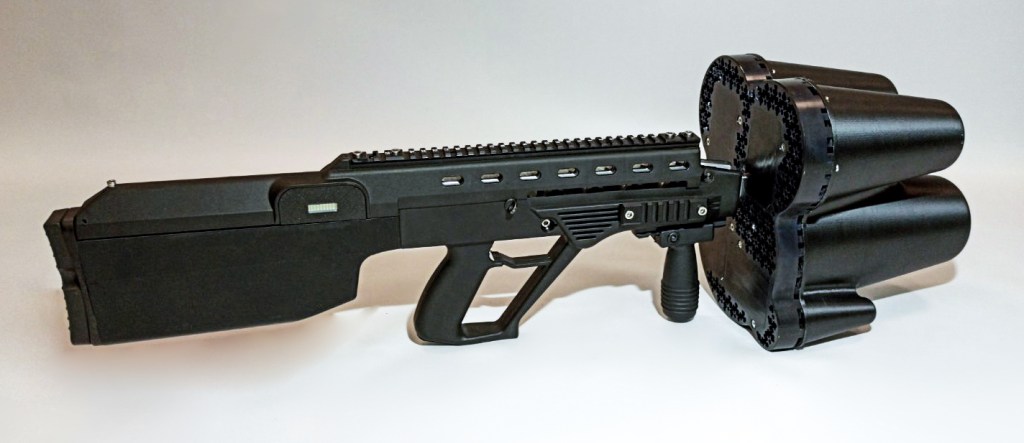
Perhaps the most interesting member of the Vulcan family is the RIFF-P, an electronic anti-drone system which uses the Vulan’s bullpup chassis. IPI states that the RIFF-P has a range of up to 1.5km and weighs around 5kg.
RIFF-P electronic anti-drone system (IPI)
Combat use of the Malyuk appears to have been widespread with not only members of Special Operations Forces units seen armed with them but also troops from Ukraine’s National Guard and even the Territorial Defence Force battalions. Ukrainian SSO (or Special Operations Forces) units which have been seen using the rifles include elements from the 73rd Maritime Special Operations Center, 3rd and 8th Special Purpose Regiments as well as the National Police’s Rapid Operational Response Unit (KORD). Elements of the Ukrainian National Guard including the 2nd Special Purpose Battalion and the Azov Special Operations Detachment in Mariupol have also been seen equipped with the rifles.
An unsuppressed 5.45x39mm Vulcan in the field (via Social Media)
The Malyuk is often seen with a sizeable IPI-made suppressor. The barrel is threaded and can also accept an AK-74-style muzzle brake. Photos from in theatre show that the top Picatinny top rail is made from metal and is not a polymer moulded part. In terms of accessories along with the top rail there is also a section of rail at 6 o’clock on the polymer forend which allows the mounting of a front grip and smaller rail sections at 3 and 9 o’clock for the mounting of accessories like lights and lasers. The rifles are frequently seen in the field with Aimpoint CompM4s, red dot and magnifier combinations and occasionally variable power optics.
Update – 7/7/24: A Malyuk was seen in a video said to be of Ukrainian air crews training in a light aircraft to shoot down long range Russian reconnaissance drones. The compact size of the Malyuk makes sense for the take.
It appears that Ukrainian light aircraft crews are training to shoot down Russian recce drones. Not sure what the drone in the video is, source says a mocked up Orlan. The rifle is a Malyuk.
— Matthew Moss | Historical Firearms (@historicfirearm) July 7, 2024
If you enjoyed this video and article please consider supporting our work here. We have some great perks available for Patreon Supporters – including custom stickers and early access to videos! Thank you for your support!
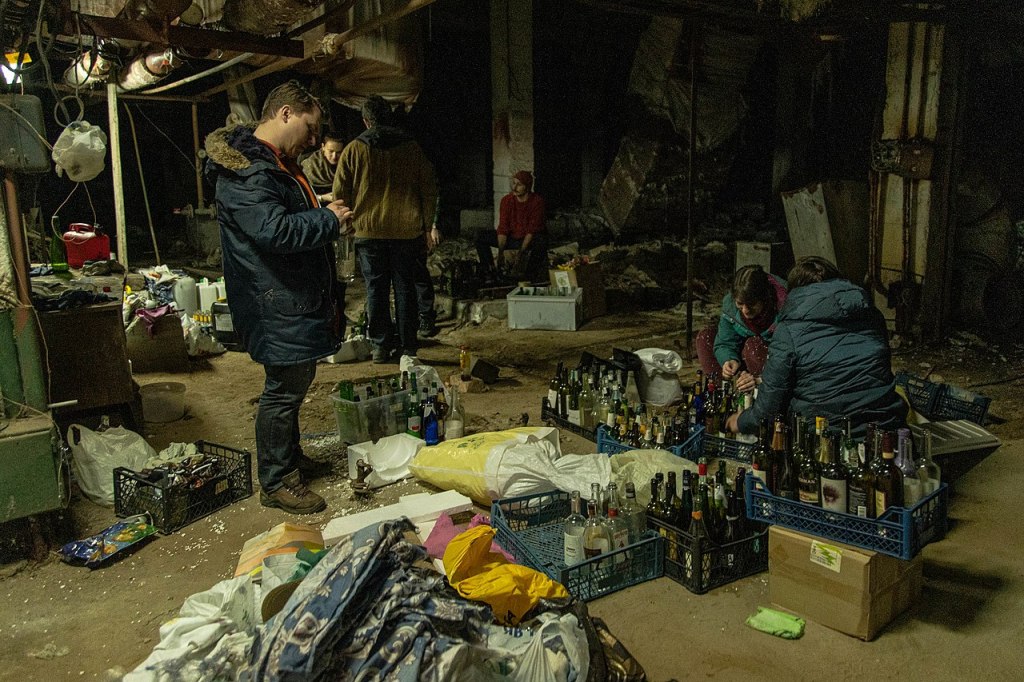
Almost as soon as the war began we started to see evidence of Molotov cocktail manufacture. The Ukrainian Ministry of Defense was keen to highlight and encourage it to show civilian resolve in the face of the Russian invasion and there’s been numerous news reports and tv news segments on Molotov production.
Footage of Molotov manufacture spread across social media and was quickly seized upon by the world’s media. Videos from across Ukraine showed children, students, the elderly and ordinary people working makeshift production lines.
Kyiv civilians gather in a basement downtown to make Molotov Cocktails (Yan Boechat/VOA)
On the 26 February, two days after the Russian invasion women of Dnipro were featured on TV news making Molotov, shaving polystyrene for use as a thickening agent. In Lviv reports from 28 February suggested that 1,500 Molotovs were being made a day at just one makeshift factory. The Pravda brewery in Lviv also garnered attention with its employees and bottles turned over to Molotov production. The brewery manager said that they had produced 2,000 as of 18 March and shipped some to Kyiv. The former Ukrainian Minister of Internal Affairs Arsen Avakov even posed with Molotov Cocktail he’d made using a bottle of 1998 Château Mouton Rothschild. On 7 March the mayor of Lutsk, Ihor Polishchuk, estimated the city had a stockpile of as many as 7,000 Molotovs.
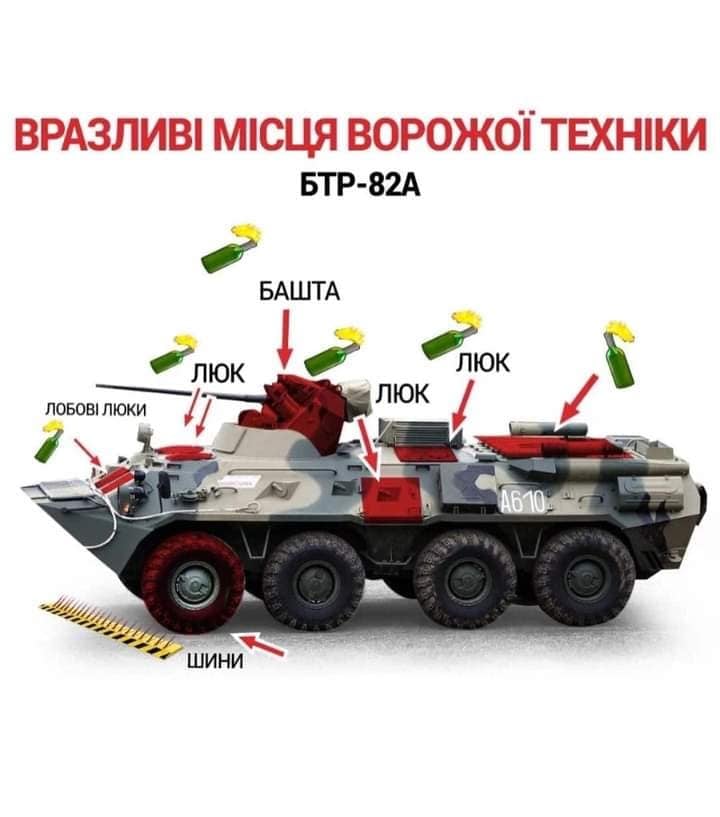
Ukrainian graphic showing where to throw Molotovs at a BTR-82A (Ukrainian MoD)
The morning after the invasion the Ukrainian National Guard posted a graphic showing how to make a Molotov and on the 28 February, the General Staff of the Ukrainian Armed Forces share some graphics suggesting the best places to hit Russian vehicles with Molotovs. And there have also been billboards posted with instructions on how to make a Molotov and another with a simplified graphic showing good spots to throw them.
We have also seen a number of interesting delivery systems developed ranging from a medieval-inspired catapults to a pneumatic mortar. On 28 February we got our first video of a Molotov being used. With a short video showing a Molotov drive-by, with a Ukrainian’s throwing a Molotov against the rear of a Russian vehicle before speeding away. Since then a handful of other videos have shown Ukrainian civilians or Territorial Defence Force members destroying abandoned Russian vehicles and equipment.
A Russian support vehicle struck by a Molotov Cocktail early in the conflict (via social media)
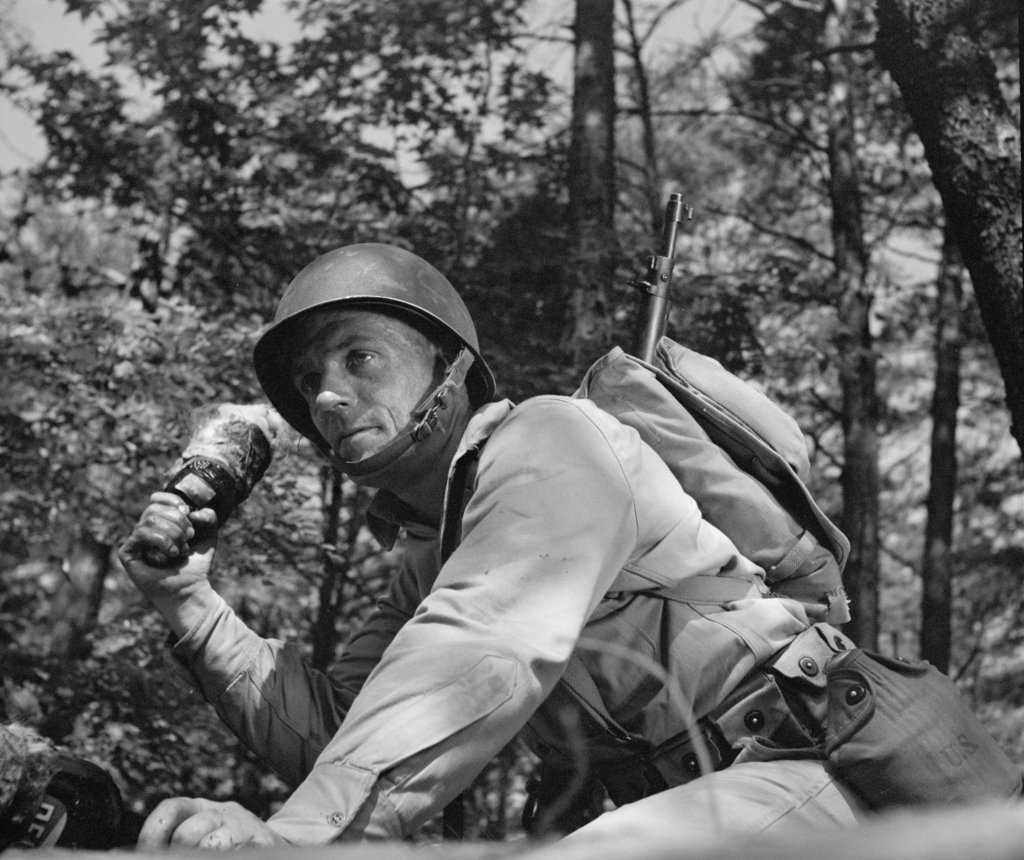
Historically speaking, petrol-based improvised incendiary bombs have been used since the 1930s. Perhaps the first prominent use came during the Spanish Civil War. The weapons gained their nickname during the Winter War after Soviet foreign minister Molotov – a cocktail for Molotov. During the Second World War Molotov cocktails were one of the first weapons made by the fledgling British Home Guard, with them remaining in their arsenal well into the war. Both the British and US regular army’s trained with Molotovs during the early years of the war and they were certainly used by Soviet forces. Since then they have been used in countless riots, uprisings, revolutions, insurgencies and conflicts around the world.
Soldier preparing to throw a Molotov cocktail at Ft. Belvoir, August, 1942 (US National Archives)
How widespread the use of Molotov cocktails has been is pretty much impossible to know at this point. Despite having a comparative wealth of footage and photos from the ground we still only have a tiny picture of what is going on. It does appear that some have been used by the Territorial Defence Force units to destroy abandoned Russian vehicles and some have even been thrown at Russian vehicles – either as part of individual acts of defiance or as part of more coordinated attacks on Russian forces.
While Molotovs may seem futile in the face of a 40+ tonne T-72, they remain a cheap and effective weapon and checkpoints across Ukraine have been seen to have ready supplies of them. For the urban fighting that was expected in cities across Ukraine they make perfect sense as a plentiful, simple weapon which can be used to pepper Russian vehicles.
If you enjoyed this video and article please consider supporting our work here. We have some great perks available for Patreon Supporters – including custom stickers and early access to videos! Thank you for your support!
Bibliography:
‘‘I haven’t told my granny’: Ukraine’s student molotov cocktail-makers’, The Guardian, (source) ‘Ukraine conflict: The women making Molotov cocktails to defend their city’, BBC, (source) ‘Ukrainians Prepare Molotov Cocktails in Kyiv’, NYT, (source) ‘Vulnerable areas of enemy machinery’, Ukraine General Staff, (source) ‘Stark photos show Ukrainians, and even a local brewery, making Molotov cocktails to defend their cities’, Insider, (source) How To Make a Molotov, Ukrainian National Guard, (source) ‘Catapult for throwing “Molotov cocktails” created in Lutsk’, Rubryka (source) ‘Ukrainian brewery switches from beer to Molotov cocktails’, France24, (source)
Since the war in Ukraine began on 24 February, the Ukrainian armed forces have been hastily putting together and sharing training films for various weapon systems. we’re sharing these so they’re saved for the historical record and so they can be easily found by those who might need them. We’ll try and give some context on the weapon’s origins and on who made the training video.
Demonstrating how to deploy the RPG-18, the tube isn’t fully extended as its a live weapon
In this well shot video a Ukrainian soldier demonstrates the features and handling of an RPG-18. The RPG-18 (‘Mukha’ or ‘fly’) was the first of the Soviet/Russian family of extendable tube launchers (very similar to the US M72 LAW). The RPG-18 was developed in the late-1960s and was introduced in the early 1970s. It has since largely been replaced by larger calibre and more capable launchers. The weapon is a simple, smoothbore, single-use launcher. It is constructed from an aluminium tube with an outer layer of fibreglass.
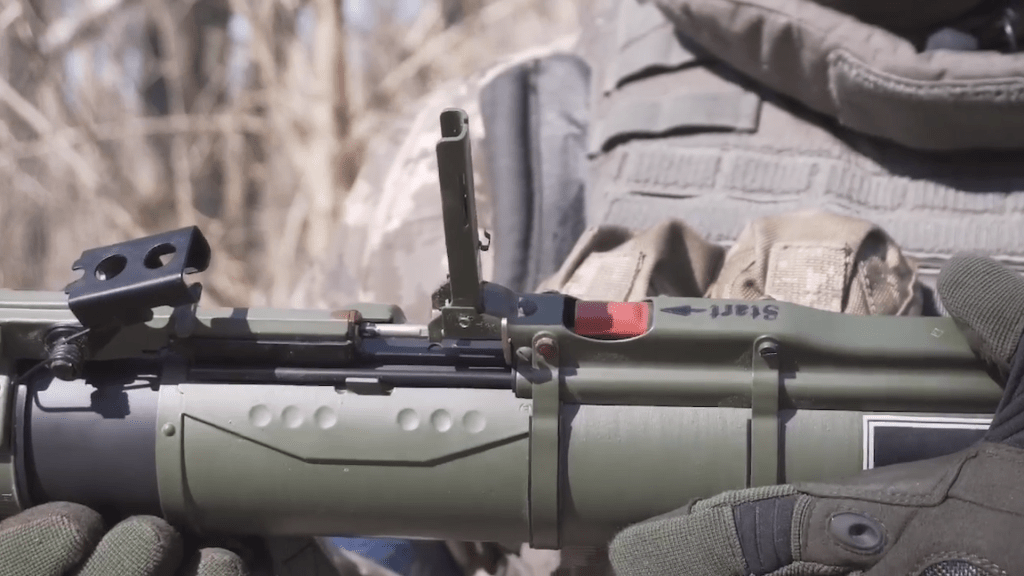
A close up of the RPG-18’s locking system, rear sight and trigger
It isn’t clear how many RPG-18 the Ukrainian Armed Forces’ may have had in inventory before the war began but it appears that the weapon seen in this video was made in East Germany and probably transferred by Germany as part of Germany’s military aid shipments to Ukraine. While Greece have also reportedly transferred a quantity of RPG-18s, we have seen other examples in the field with identical German instructions stickers.
#Ukraine: A rather interesting RPG-18 was captured by DNR forces; as can be seen, it was made by East Germany, and most likely recently transferred by Germany to UA forces. pic.twitter.com/B9WrWSRJvz
— 🇺🇦 Ukraine Weapons Tracker (@UAWeapons) March 16, 2022
The video first surfaced around the 21st March, posted by Vadim Kodachigov (the director of Kort, a military industrial company) on Facebook, though he may not be the original creator. Kodachigov appears to be part of a Territorial Defence Force unit. The video identifies the unit as part of the 112th Territorial Defense Brigade (Kyiv). The production value of the video is relatively high, with a title card, good editing, close ups and some interesting footage of the weapon being fired.
If you enjoyed this video and article please consider supporting our work here. We have some great perks available for Patreon Supporters – including custom stickers and early access to videos! Thank you for your support!
Bibliography:
Earliest video source found: Vadim Kodachigov via facebook (source)
The Kalashnikov designed PK machine gun is one of the most ubiquitous general purpose machine guns in the world. Designed by Mikhail Kalashnikov and his team in the late 1950s. We’ve seen a number of PKMs in Ukraine already but another variant, the PKT, has popped up in a couple of interesting pieces of press footage.
It appears that there is a car repair shop in Kyiv which is taking in captured and salvaged Russian machine guns and adapting them for ground use with an ad-hoc stock and pistol grip assembly. Fantastic ingenuity and the team is reported to be made up of welders, engineers and mechanics.
What may be an early version of the adaptation (via France24)
The first piece of footage of the workshop surfaced on the 9 March and a France24 report was published on the 16 March. We’ve yet to see any of the adapted PKTs in the field.
The PKT itself was developed in 1968 to replace the SG-43-derived SGMT. The PKT is primarily used as a coaxial gun on armoured vehicles including the MT-LB, BTR-4, BTR-60, BTR-80, BTR-90, the BMD and BMP series and Russia’s T-72, T-89 and T-90 series of tanks. One thing the Ukrainians have not been short of is captured and abandoned Russian armoured vehicles. The adapted PKTs will probably be used to help equip the Territorial Defence Force battalions which have been raised across Ukraine.
Offering up an aftermarket optics rail, this option appears to have been abandoned in favour if a side-mounted optics mount (via UAWeaponsTracker)
The PKT is solenoid fired, with the gunner pushing a button to fire the gun. This means that it obviously has no pistol grip or trigger assembly but it also lacks sights and a bipod. So when the Ukrainian’s are salvaging these gun they are essentially useless for immediate ground use. The footage from the workshops shows that they have developed a simple stock and pistol grip assembly. The stock slides into the trunnion at the rear of the receiver, where the solenoid firing unit normally fits. The pistol grip and trigger mechanism assembly is then pivoted up and secured by a cross pin. There appears to be a simple hook projecting up from the trigger mechanism assembly which trips the sear inside the PKT.
Diagram showing the PKT with its solenoid firing mechanism in placeIn this diagram we can see how the PKT is mounted in an armoured vehicle (PKT Manual)
The stock appears to be from a standard PK and the pistol grip is a widely available aftermarket AK-pattern grip which seems to be held in place by a large nut and bolt. To get around the PKT’s lack of sights the workshop have fitted a scope mount, welded to the left side of the stock assembly. The gun is seen here with what appears to be a thermal optic.
In the second piece of footage we see some adapted PKTs with classic AK pistol grips attached to stock assemblies. The pistol grip no longer hangs free but is attached to the stock. The trigger mechanism also appears to have been redesigned. Now when the trigger is pulled an arm protrudes from the stock, it pivots from the top – rather than from the bottom as in the example we saw in the first video. This might suggest that the gun featured in the 9 March footage is the workshop’s initial prototype. If so they have moved from a relatively crude design to a more sophisticated on in about a week. From the France24 report it seems the engineers and mechanics had the benefit of some military experience and some technical drawings.
Detaching the stock and firing mechanism assembly from a PKT (via France24)
In terms of historical precedent – there is plenty. As long as tanks have had machine guns infantry have been salvaging their guns for ground use. Seen during both world wars and in conflicts around the world. In terms of ad-hoc weapons for home defence forces like the Ukrainian Territorial Defense Force the British Home Guard during the Second World War were partially equipped with aerial Lewis Guns which were retrofitted with bipods and stocks.
Below are some examples of PKTs adapted in Ukraine since the conflict in Donbas began in 2014.
Photos shared by @V_V_Vavas
The adaptation of PKTs specifically was seen during the Chechen Wars and in 1992 the Nagorno-Karabakh War. Further adaptation have even been seen in Ukraine since 2014.
PKT (Rosobronexport)
A kit was reportedly designed by Tula which allowed a PK stock with rear sight and a pivoting pistol grip to slot into the rear trunnion of the gun. This provided a mechanism to fire the gun and a bipod with a front sight could be fitted. It is unclear if this has ever been fielded.
A captured Kord (Tank) heavy machine gun and a PKT
From the footage it appears the workshop are also working on adapting NSVTs, the vehicle mounted variant of the 12.7×109mm NSV heavy machine gun. The mechanic lifts an NSVT without its barrel to show a workshop-made pistol grip assembly with some box steel projecting out the rear, perhaps for a stock to be fixed to.
The PKT has a slightly longer barrel at 722mm or 28.4in (compared to the PKM’s 645mm or 25.3in), a slightly redesigned gas system and is also 1kg heavier at 10.5kg (23lbs). The PKT has a thicker barrel profile. The PKTM has a slightly reinforced receiver but few other differences compared to the PKT.
If you enjoyed this video and article please consider supporting our work here. We have some great perks available for Patreon Supporters – including custom stickers and early access to videos! Thank you for your support!
PKTM Specifications (from Rosoboronexport):
Caliber:7.62x54mmR Weight: 10.5kg / 23lbs Overall Length: 1098mm / 43in Barrel Length: 722mm / 28.4in Rate of fire: 700-800RPM Belt capacity: 250rds Muzzle velocity: 850m/s / 2788ft/s Sighting range of fire: 1500m / 1640yds
Bibliography:
Operator’s Manual PKM Machine Gun, US Army, (source) PKT Coaxial Machine Gun Modified for Infantry Use, Silah Report, (source) Differential Identification of NSV and Kord Heavy Machine Guns, ARES, (source) PKTM, Rosoboronexport, (source) PKT (PKMT) Machine Gun, Tankograd, (source)
Thank you to Amael Kotlarski for a copy of the PKM manual
















 The Armourers Bench