FN40 Grenade Launchers in Ukraine

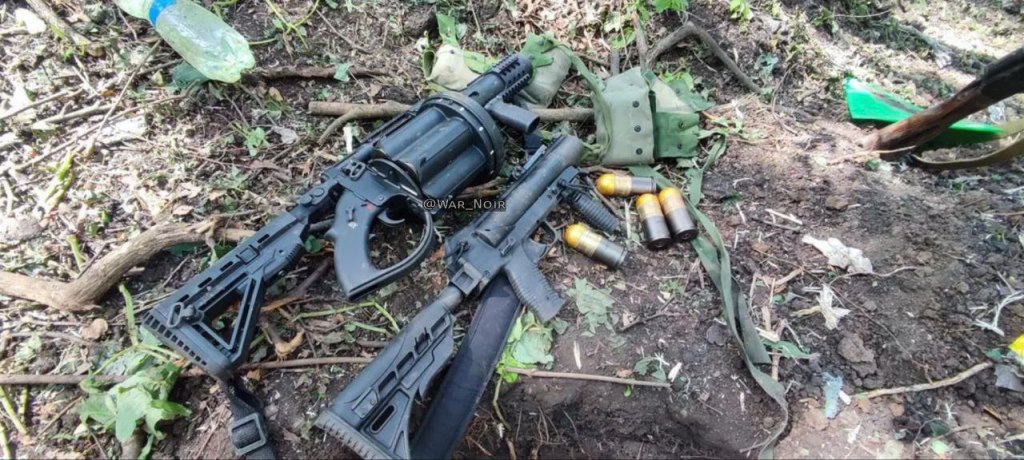
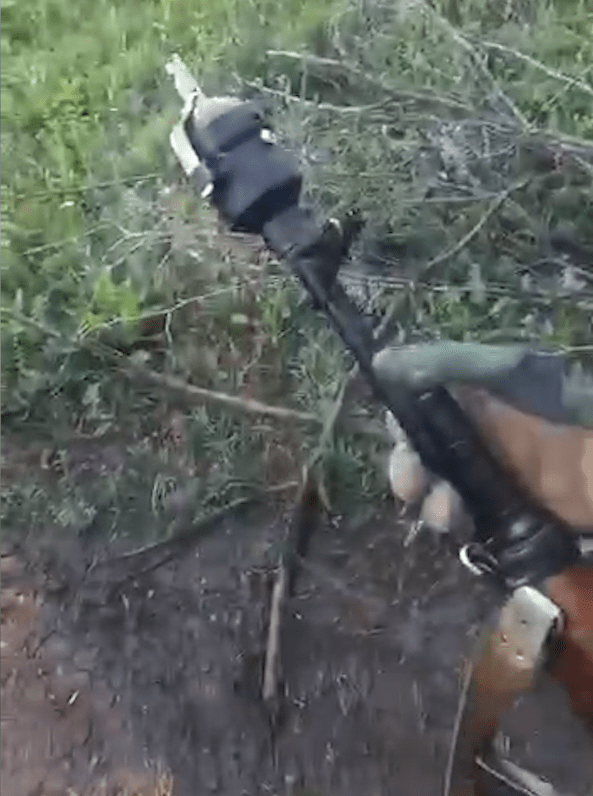
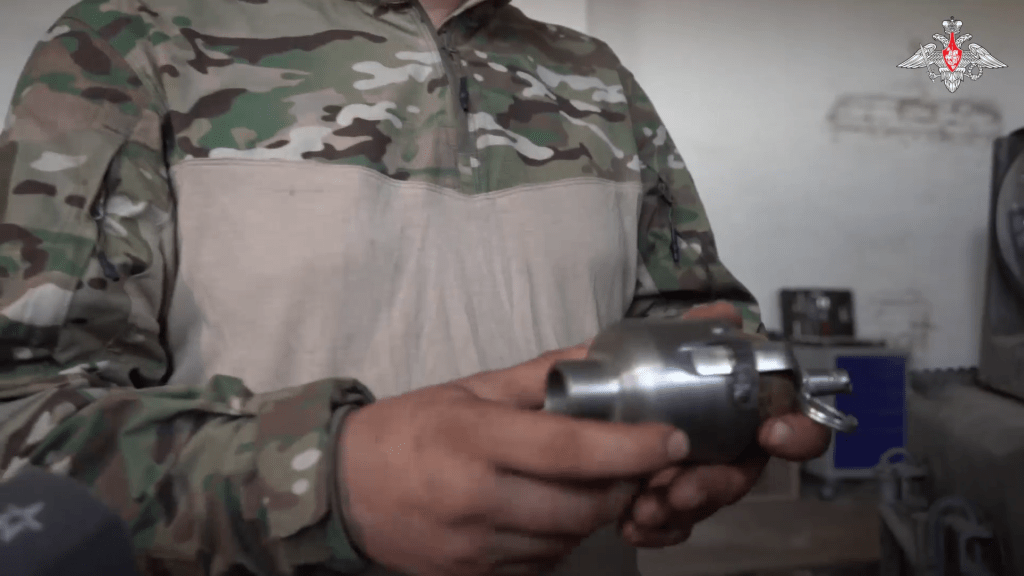
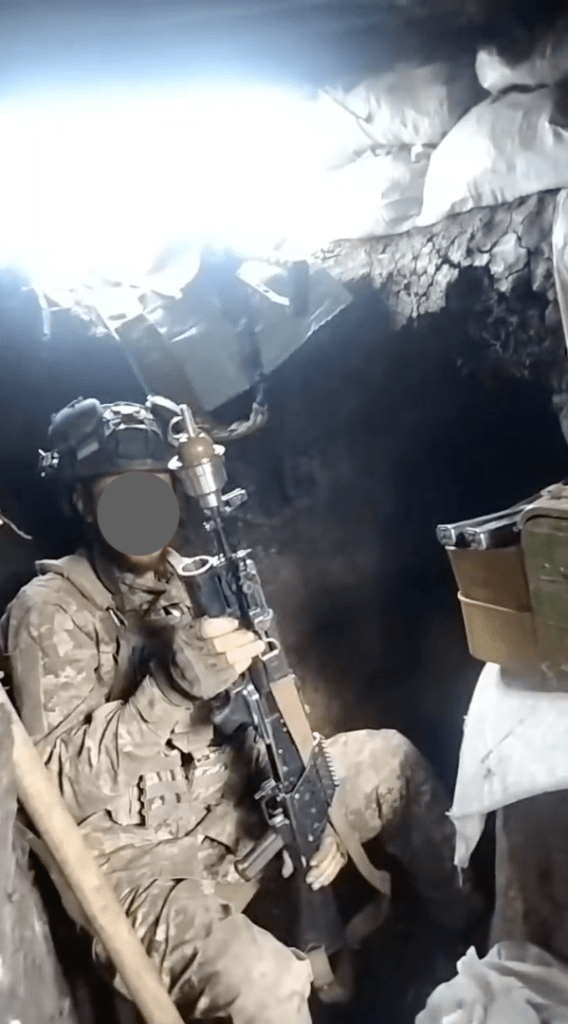
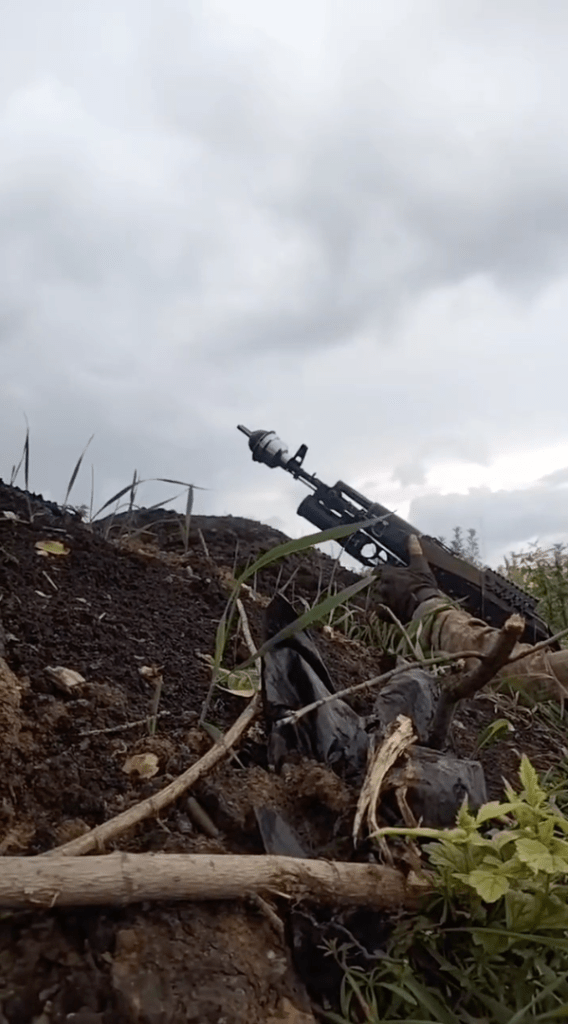
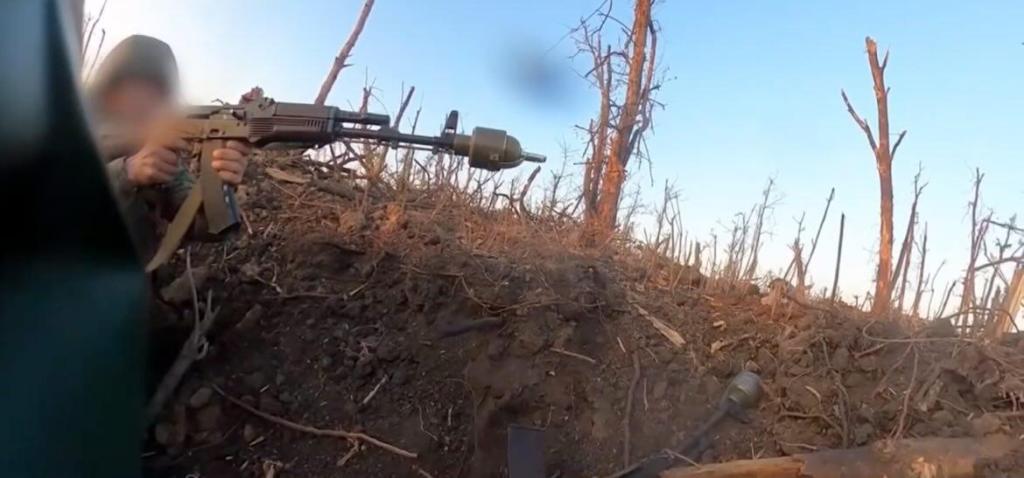
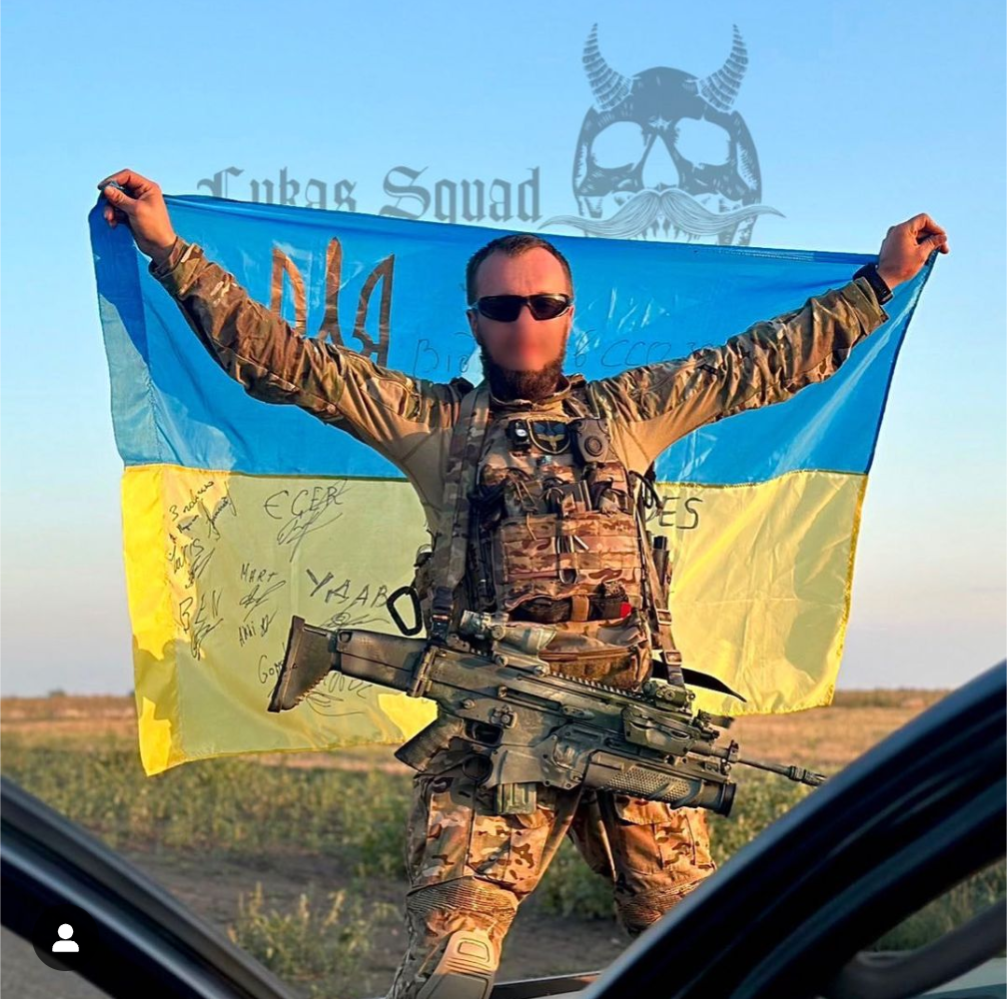
In recent weeks a yet another type of 40mm grenade launcher has begun to be seen in imagery from the conflict in Ukraine – standalone FN FN40GL grenade launchers. In early June, as Ukraine’s counter-offensive got underway, Ukrainian special operations units began to be seen equipped with FN40GLs in both the standalone (FN40GL-S) and under-barrel grenade launcher configurations.

The FN40GLs which have begun to seen in Ukraine appear to be original Mk1 versions with a slightly different pistol grip assembly profile with a large gap between the grip assembly and the actual barrel assembly. Alongside these launchers in the standalone configuration a number of FN40GLs in the under-barrel configuration have been seen mounted on rifles.

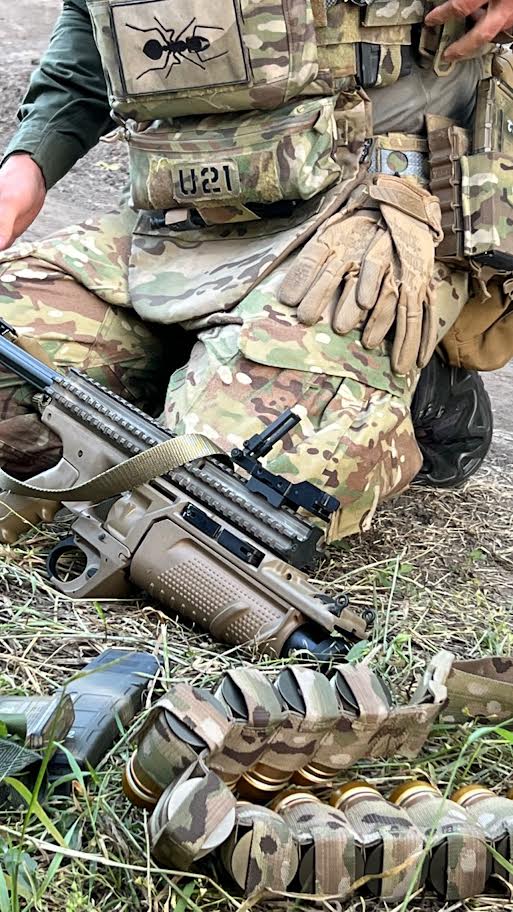
The Mk1 launcher was introduced by FN in the mid-2000s, the stand alone unit mounts the launcher on a frame with rail space and a collapsing stock. When in the under-barrel configuration a different trigger assembly is used which wraps around the rifle’s magazine housing. The FN40GL-S weighs in at 2.9kg while in the under-barrel configuration it weighs between 1.3-1.4kg. The launcher is fully ambidextrous with the barrel able to cant either left or right to facilitate loading.

An FN40GL-S with 40mm rounds (via social media)

It’s unclear which country has provided the grenade launchers as a number of countries adopted them, with many special forces units pairing them with FN’s SCAR series of rifles. It is also unclear how many of the launchers are in theatre though from conversations with combatants they are still relatively rare with M320s, M203s, Fort-600s and GP-25s being among the more common single-shot 40mm low velocity launchers. Given the increasing number of them sighted since July it seems the FN40GLs are proliferating through Ukraine’s various special operations units.

The first sighting of an FN40GL came on around 7 June, when a member of AZOV’s SOF unit shared a photograph of an FN40GL-S and a bandolier of 40mm rounds.

On the 8 June a photograph of a member of Ukraine’s SSO was shared online featuring a SCAR-L mounted with an FN40GL. The photograph is also notable for the presence of a SCAR MK20 (article/video on these coming).

On the 12 June, another Ukrainian combatant shared a photograph of an M4A1, an FN40GL and a Glock pistol.

Another standalone FN40GL-S seen by the side of a Ukrainian combatant during the early phases of the counter-offensive (via social media)

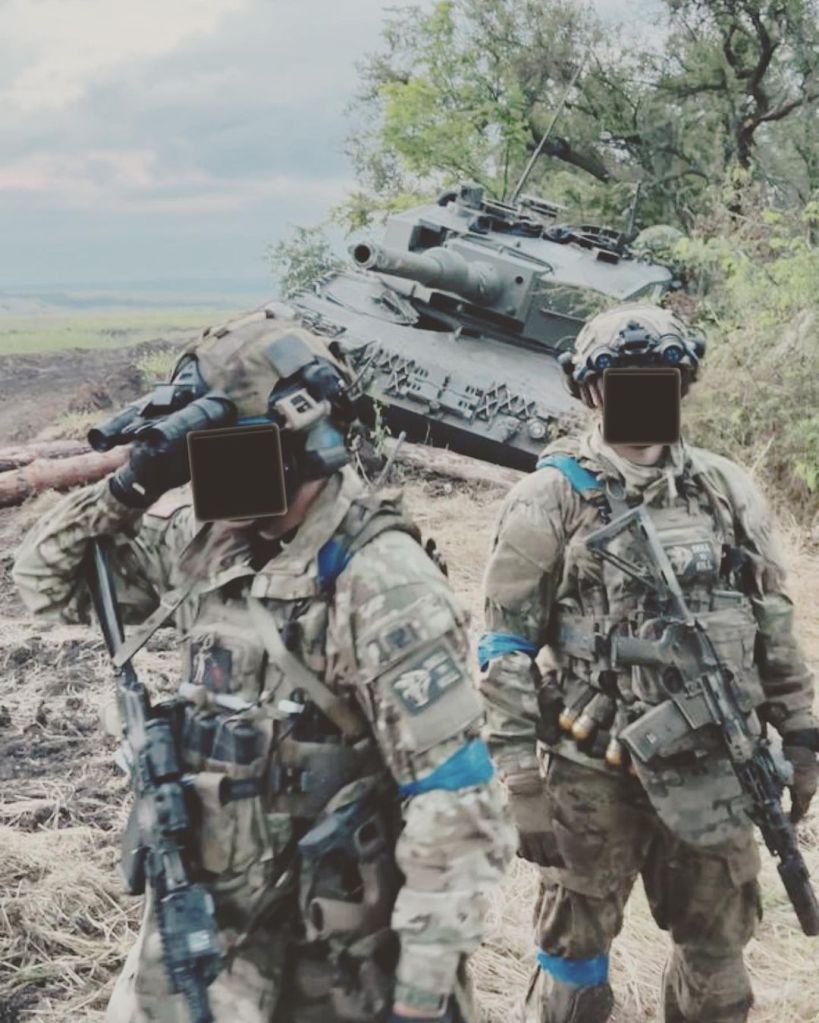
During the early phase of the counter-offensive a Ukrainian SOF team shared a photograph in front of an abandoned Leopard 2 on 15 June, strapped to the plate carrier of one of the operators can be seen an FN40GL-S.

Another photograph taken near the same Leopard 2 surfaced a week later showing another member of Ukrainian SOF with an FN40GL-2.

On the 24 June, a Ukrainian combatant posted a video on TikTok demonstrating the action of a FN40GL-s and how its barrel can pivot left and rifle.

In early July, a member of the AZOV brigade’s SOF teams shared a photograph of an FN40GL-S handing from a sling and retained in place by a cord.

On the 10 July, the second photograph of an FN40GL in the underbarrel configuration was shared showing the launcher mounted on a Springfield Armory SAINT AR-15 pattern rifle

On the 17 July, the same combatant affiliated with AZOV SOF shared a video of the FN40GL-S being fired and reloaded several times during a firefight across a road.

A week or so later, on 29 July, a member of the SSO shared a photograph of a SCAR fitted with a FN40GL.

In early August an Estonian volunteer shared a photo of a black SCAR-L fitted with an FN40GL. He shared his thoughts on the FN launcher and grenade launchers in general. He noted that there’s “not a lot of them around, only special units using these types of weapons… 40mm must be in each squad, they’re very effective.” He went on to explain that he prefers standalone launchers such as the M320.

Ukrainian combatant with an FN40GL in the underbarrel configuration (via social media)

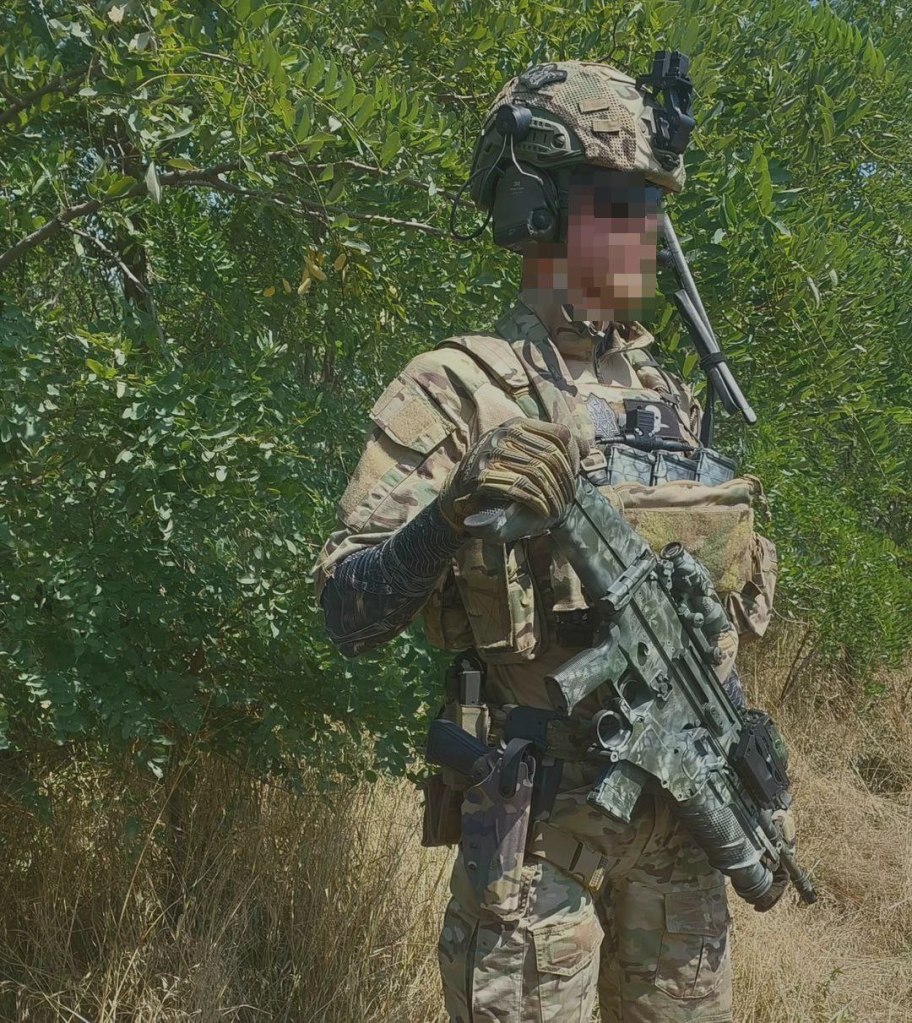
Most recently another phoptograh of a Ukrainian combatant with a SCAR-L fitted with a FN40GL was shared on Telegram. Both the rifle and launcher have been given a camouflage paint job.

The grenade launchers currently appear to be largely in use with a handful of Ukrainian special operations units which have also seen a recent proliferation of SCAR pattern rifles.

Very special thanks to every who helped collect and collate imagery for this video including, especially my friends at ShriekingDelilah on IG, as well as AbraxasSpa, UkraineWeaponsWarfare and Sergio for their help.

Update – 29/12/23: Another sighting of an FN40 GL, a reportedly Swedish volunteer wearing a Company Group Team shirt.

Update – 2/1/24: More imagery, shared in summer 2023, by Ukrainian SOF of an FN40 GL.

Update – 28/02/24: an FN40GL seen in a collection of weapons reportedly captured by Russian forces from a 73rd Naval Special Purpose Center team.

Update – 6/9/24: Recently shared photo of a member of a GUR team with an FN SCAR-L equipped with an FN40GL.

Update – 10/1/25:

A Ukrainian SSO member with an FN FN40GL in the standalone configuration along with the ubiquitous Daniel Defense rifle.More on the FN40GL here: armourersbench.com/2023/08/13/f…#UkraineRussiaWar #Ukraine️ #SALW

Matthew Moss – Armourer's Bench (@matthewmoss.bsky.social) 2025-01-11T12:06:06.473Z

Support Us: If you enjoyed this video and article please consider supporting our work here. We have some great perks available for Patreon Supporters – including early access to custom stickers and early access to videos! Thank you for your support!


OTO Melara Mod 56 In Ukraine

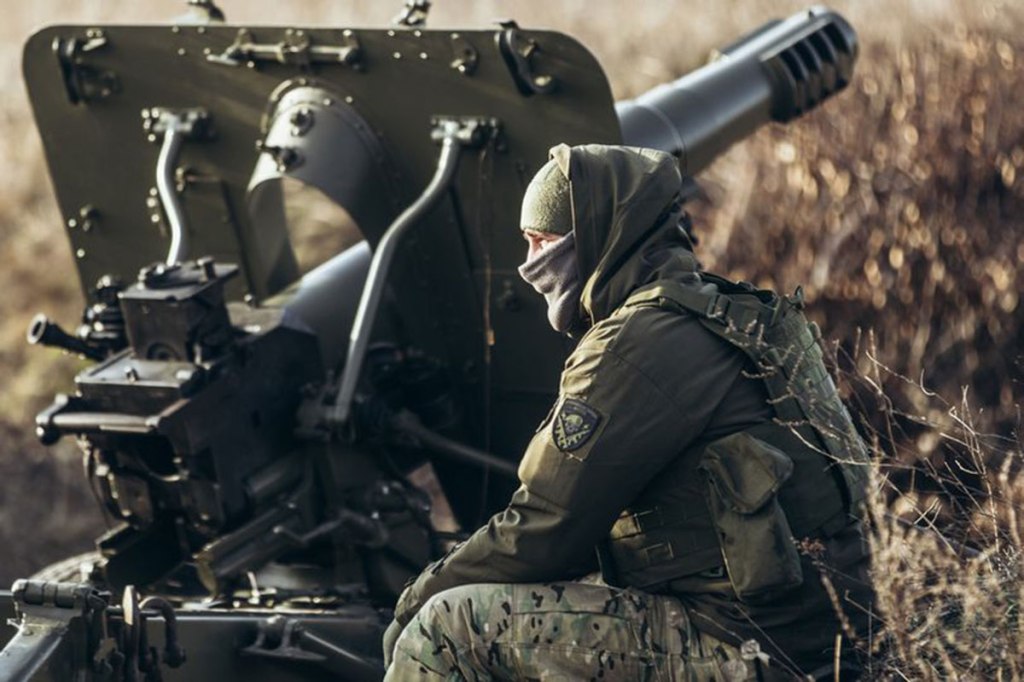
We’ve examined a number of artillery systems in use in Ukraine, including the venerable M101 howitzers and the MT-100s mounted on MT-LBs, one of the smallest and most interesting howitzers in use is the OTO Melara Mod 56.

The Mod 56 is a small 105mm pack howitzer. It weighs in at 1.29 metric tons and it can be towed by light vehicles. It has a split trail gun carriage and a hydro-pneumatic recuperator assembly. Developed by Italy’s OTO Melara the gun entered service in the mid-1950s and has seen service with countries around the world including Italy, the UK, Australia, Spain, Pakistan and the Philippines.

An OTO Melara Mod 56 (Ukraine National Guard)

Much like the heavier M101 howitzers, transferred to Ukraine by Lithuania, the Mod 56 can use any M1 105mm ammunition. With its short 1.47 metre-long barrel, the Mod 56 has a maximum effective range of around 10,000 metres (10km/6 miles). While this puts it at a severe disadvantage compared to the larger 155mm howitzers used by Ukraine and the 152mm guns used by Russia the small Mod 56 has the advantage of being lightweight and can be deployed forward under cover. The most useful role it could likely fulfil is as an infantry support gun.

In November 2022, Spain’s Defence Minister Margarita Robles confirmed that Spain would send a battery of six light howitzers and also provide training for Ukrainian gun crews. Subsequently, a brief clip of Ukrainian gunners training on the Mod 56 was shared in late November.

A Mod 56 in action (via social media)

The guns were seen in Ukraine for the first time in early January, with a short clip of one of the guns firing being shared on 11 January. It appears the gunner is wearing a National Guard patch but its unclear which unit the gun belongs to. On 12 January, the 1st Mechanized Battalion of Ukraine’s 3rd Assault Brigade posted an info-graphic giving some basic detail on the Mod 56.

On 20 February, a brief clip of a Mod 56 was shared, the footage was believed to have been taken in the vicinity of Bakhmut. However, photographs taken by an AP photographer, Libkos, of the same gun showed that the gun was actually in action in Avdiivka, Donetsk. The series of photographs also showed that the gun was being operated by a National Guard unit and the crew was using drone footage to select their targets. One photograph was also shared by President Zelensky on 5 March. Interestingly, the gun is seen without its shield.

Another video of one of the guns in action was shared on 16 April. It was several months before more imagery of the Mod 56s in use appeared but on 1 June, the Ukrainian National Guard shared a photograph of one of the guns and several days later, on 3 June, a short video of a gun in action was shared.

A Mod 56 in action (via social media)

Most recently on 19 July, a Ukrainian National Guard unit shared a brief clip of a Mod 56 firing. It also nicely illustrates the gun’s breech mechanism.

From the available imagery, it appears that the guns are operated by Ukraine’s National Guard, though which artillery unit is unclear. While it has been confirmed that Spain has provided at least 6 Mod 56 howitzers, it remains unknown if any other countries, such as Italy, have provided the small guns.

Update 29/12/23:

An undated sighting of a Mod 56 in operation in Ukraine. Notably half of the gun shield appears to be missing.

Update – 17/04/24: A clip posted on 7 April, date of recording unconfirmed, showing a Mod 56 in action. The howitzer’s gunshield has been removed.

Update – 29/5/24:

Update – 23/07/24:


Support Us: If you enjoyed this video and article please consider supporting our work here. We have some great perks available for Patreon Supporters – including early access to custom stickers and early access to videos! Thank you for your support!


Making Belt Boxes For Ukraine’s Machine Guns

Earlier this month Popular Mechanics published an article I wrote about GRaft, a Ukrainian company which has manufactured belt boxes for almost every type of machine gun being used by the Ukrainian armed forces.

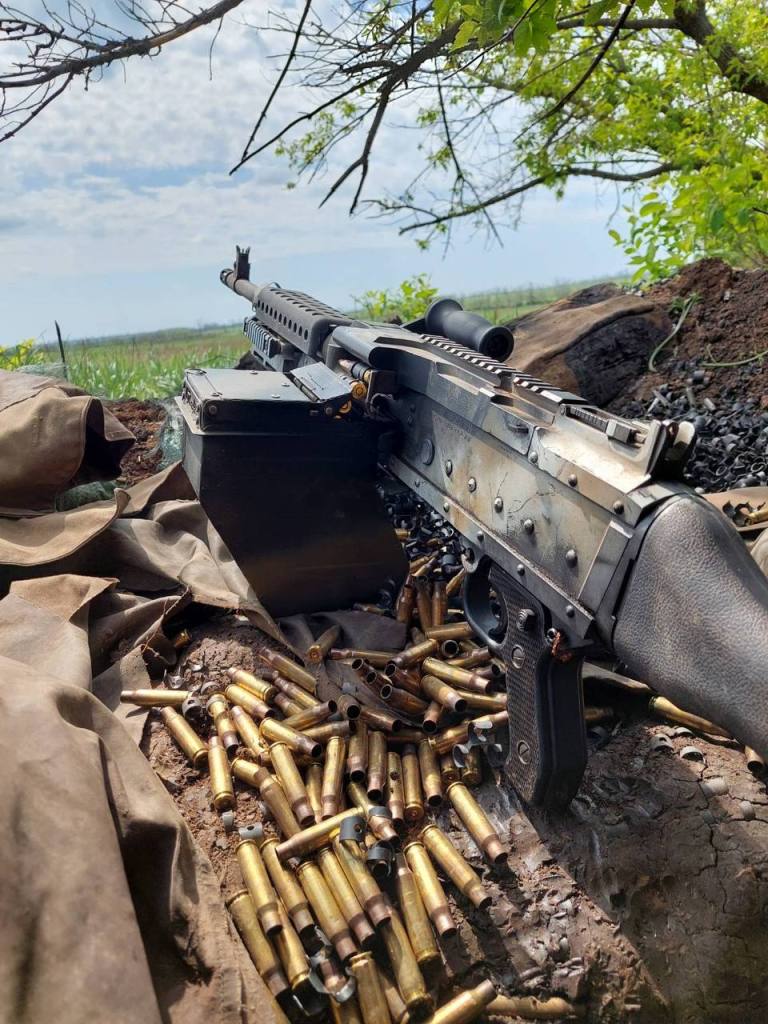
While belt boxes might not seem like the most exciting pieces of military equipment, they’re no less vital than the guns they’re paired with; the boxes are essential for storing and carrying ready-to-use belts of linked ammunition, and they allow machine gunners to move around unencumbered by hanging belts that can become tangled.

M240 GPMG with GRaft 100-round belt box (GRaft)

GRaft initially designed and manufactured furniture including benches and tables but with the full-scale Russian invasion in February 2022, they have since turned their attention and skills to belt boxes. With machine guns being transferred to Ukraine by a plethora of different countries this has led to a wide variety of machine guns entering service with the Ukrainian armed forces. In many cases the machine guns transferred to Ukraine are often without enough belt boxes.

I spoke to one of GRaft’s engineers who explained that their impetus to begin designing and manufacturing belt boxes came from friends’ experience with old boxes for PK-pattern machine guns. He explained that the old aluminium PK boxes had seen decades of service and there was a general shortage of them.

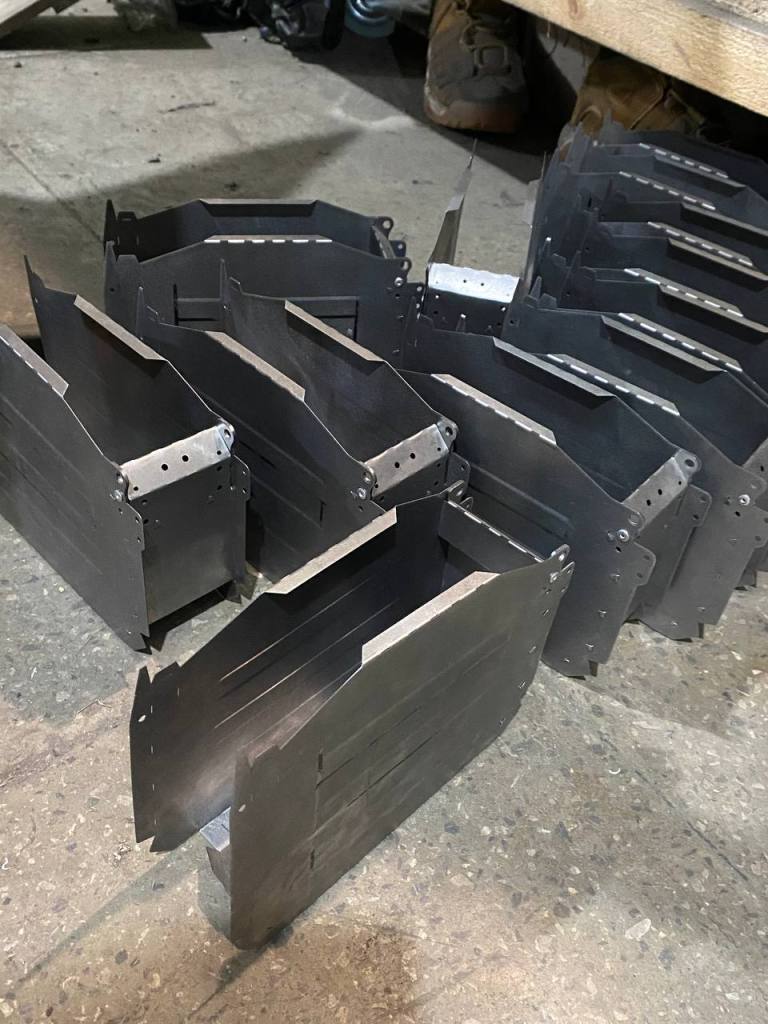
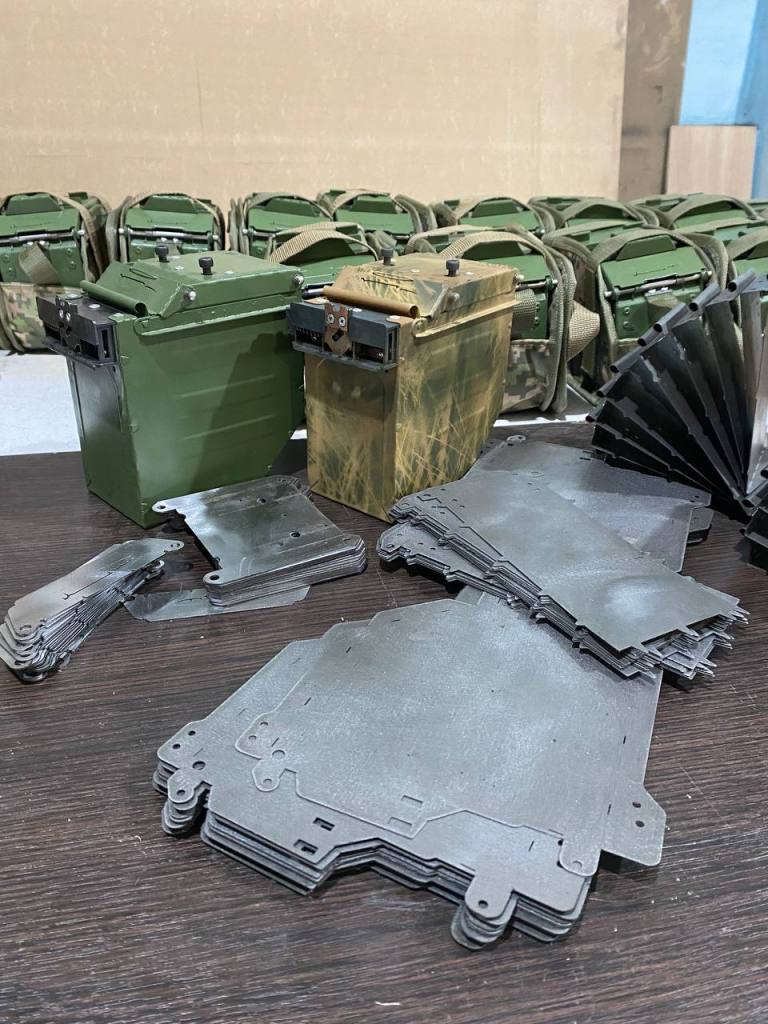
GRaft belt boxes at various stages of fabrication (GRaft)

GRaft began work on their PK box in April 2022 and within a month had a design ready for manufacture. GRaft refined its designs based on direct user feedback and soon began working on belt boxes for other weapons ranging from 14.5mm KPVs to 5.56x45mm and 7.62x51mm FN Minimis.

GRaft kindly shared some videos from their workshop showing how the belt boxes are fabricated. They use laser cutting to cut sheet metal into blanks which are then shaped and riveted and spot welded into their final form. They work with a small paint shop that then powder coat the boxes.

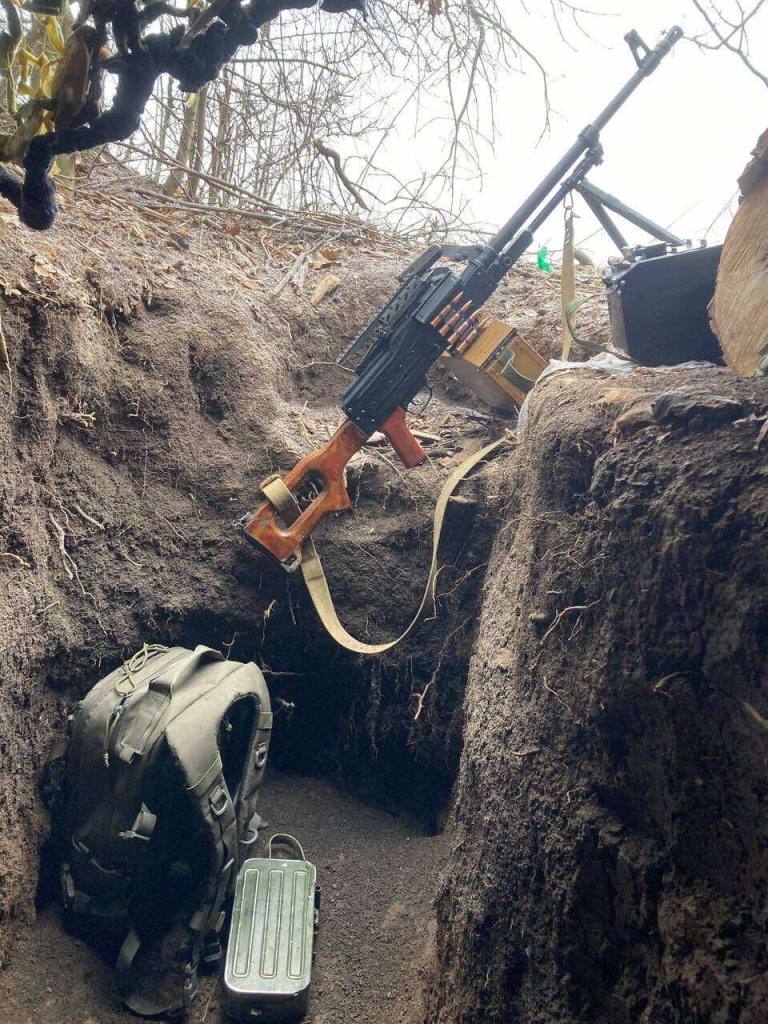
PK GPMG with GRaft belt box (GRaft)

The company also developed 75 and 100-round boxes for the FN MAG/M240, the 100 round box was designed with an angled wall so the mass of the belt sits closer to the weapon’s center of balance, improving the weapon’s handling. Similarly they have also begun producing boxes for 7.62x51mm MG42-pattern machine guns. Their goal, the engineer told me, is “satisfied machine gunners” but really they’d like to get back to producing furniture.

Check out my full article on GRaft’s work over at Popular Mechanics.


Support Us: If you enjoyed this video and article please consider supporting our work here. We have some great perks available for Patreon Supporters – including early access to custom stickers and early access to videos! Thank you for your support!


The Fanta Bomb & Improvised Munitions in Ukraine

All sorts of munitions have been dropped from drones ranging from hand grenades to Molotov balloons to mortar rounds and even blocks of explosive. In this article/video, we’ll look at a couple of interesting examples of improvised munitions.

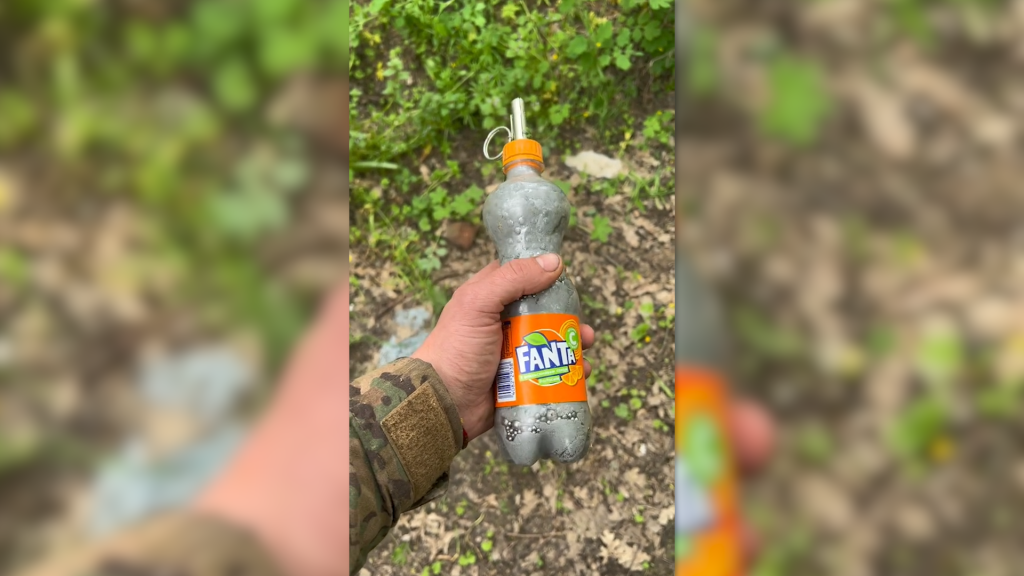
In early May an interesting short video was shared by a Ukrainian combatant showing a Fanta soft drink bottle filled with explosives and what appear to be ball bearings of different sizes. It’s hard to tell what sort of explosive has been used but the bottle is topped with a UZRGM grenade fuze.

The Fanta Bomb (via social media)

Ordnance Lab made an interesting video a couple of weeks ago testing an approximate version of the Fanta bomb and found it to be fairly effective in terms of blast and fragmentation. Though their version looked to contain more ball bearings and they noted it weighed around 3kg.

The only other similar munition to surface was seen in a photograph that showed a box of Polish Kropla Beskidu water bottles which also appear to be filled with explosive materials and fuzed with standard UZRGM fuzes. 

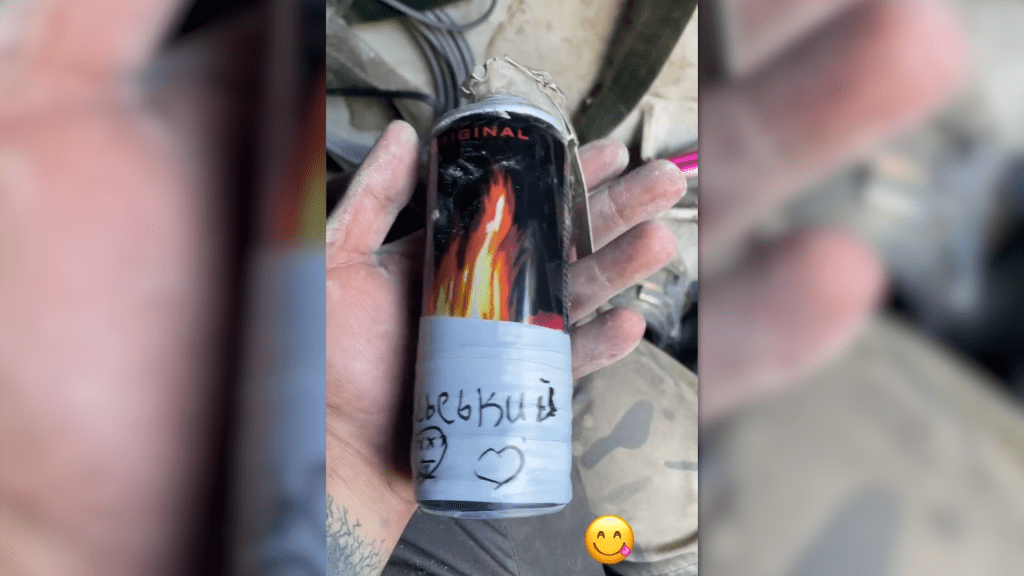
Improvised can-based warhead for FPV drone (via social media)

It’s unclear whether the grenades are designed for ground use or perhaps for dropping from drones. If the fill of the grenade is purely explosive then it would have a significant blast effect but minimal fragmentation – likely why the Fanta bottle example has been augmented with ball bearings. 

There is also evidence of the simple use of directly using TNT blocks with UZRGM fuzes, with the Georgian Legion evidently dropping them from drones. 

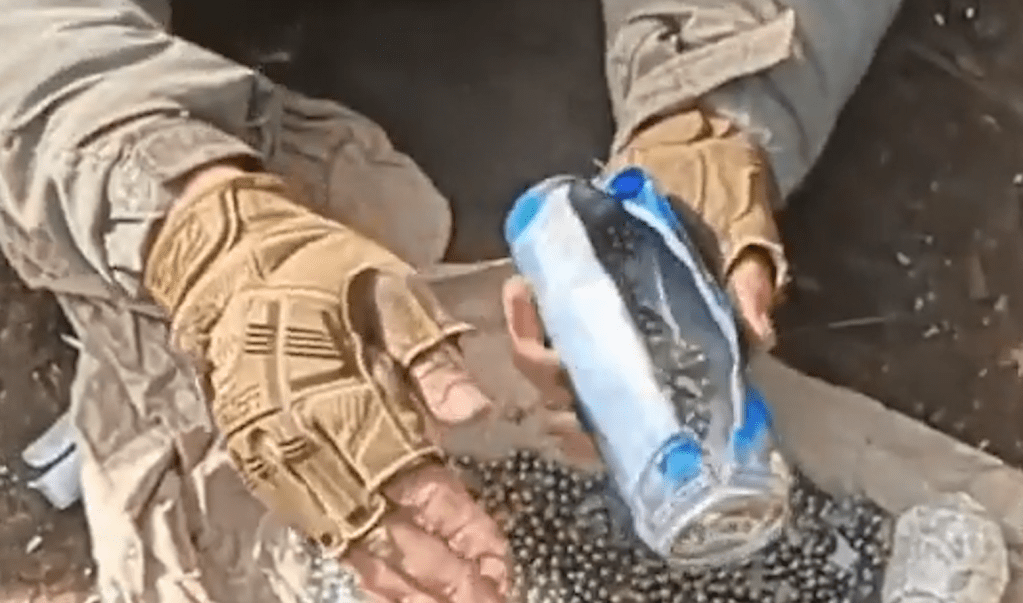
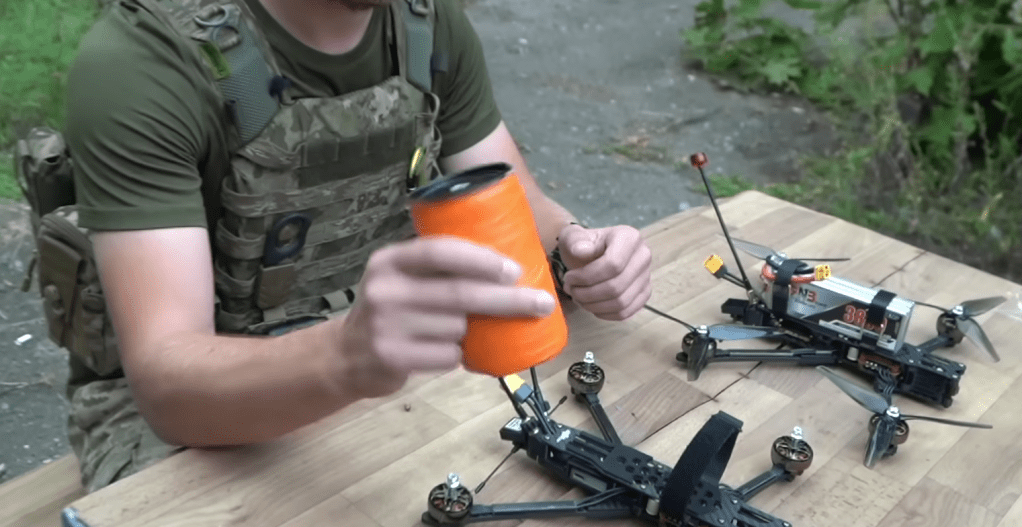
Old drinks cans have also been used to make improvised explosive devices. In early May a video showing a ‘Non Stop’ energy drink can being split open and filled with plastic explosives and ball bearings was shared. The can was then attached to a First Person View (FPV) drone and used against personnel in a Russian trench. 

In June several short clips were shared featuring drinks cans with grenade fuzes. Two with UZRGM fuzes and one can with what appears to be a DVM fuze. The can could be augmenting a Bulgarian fragmentation grenade such as an AR-ROG or GHD/RGD series.    

Improvised can-based grenade (via social media)

In July, Ryan O’Leary, a US volunteer in Ukraine, shared a photograph of 5 craft-made grenades constructed from plastic drinks bottles slipped into the base of Red Bull and Non Stop energy drink cans. O’Leary suggests that there is approximately 1-2 kg of RDX explosive inside. They are again topped with UZRGM fuzes and secured with tape.

Improvised grenades made from bottles and drinks cans (via social media)

So why are these munitions being made? Often when I cover improvised munitions people ask are the Ukrainians not receiving billions in aid? The answer to this is – they are. However, aid doesn’t always include all the types of munition you might want. Similarly, the combatants improvising these munitions may not receive the types of munitions they need –  wartime logistics can be challenging. Additionally, the combatants producing these munitions may be looking for bombs with improved blast and fragmentation over what is available.

Update – 25/07/23:

Update – 27/09/23: A BBC Newsnight report featured a drone company attached to the 24th Brigade. A can-based improvised exposive device, designed to be dropped from a drone was featured.

Update 15/5/24: On 3 May a Ukrainian telegram channel shared a clip of a drone dropped munition attack on Russian infantry. The munition appears to be enclosed in a Pepsi can. The unit involved is claimed to be a drone unit of the National Guard’s 4th Rapid Reaction Brigade.

Update – 15/7/24:

In addition to bottles and cans packed with explosives, both sides have utilised bottles filled with incendiary mixtures. These have seen being dropped from drones on positions and vehicles.

Update – 28/5/25:

A member of the 6th Special Purpose Battalion of the 12th Special Purpose Brigade “Azov” used an DIY bottle bomb, as an enhanded blast grenade to demolish the front of a single story building during fighting near Toretsk.


Support Us: If you enjoyed this video and article please consider supporting our work here. We have some great perks available for Patreon Supporters – including early access to custom stickers and early access to videos! Thank you for your support!


Bibliography:

UZRG-M Fuze, CAT-UXO, (source)

DVM Fuze, CAT-UXO, (source)

Dogfighting Drones in Ukraine

During my recent video with author and journalist David Hambling discussing drone warfare in Ukraine, we briefly touched on the phenomena of drone dogfighting. Drone use in Ukraine has been a prominent feature of the conflict and drones have been used in roles ranging from Intelligence, Surveillance, and Reconnaissance (ISR) to direct action against targets – either through one-way loitering/kamikaze drones or by drone-dropped munitions.

Naturally, the threat drones pose, either from information gathering, artillery forward observation or direct attacks, means that both sides have sought to interdict and destroy the other’s drones. In some cases, this has seen opposing drones attacking one another in dogfights. This raises some fascinating parallels with early military aviation, during the First World War, which saw initially unarmed observation aircraft begin to carry weapons and attack one another.

Some of the earliest instances of these drone dogfights were reported in October 2022, with an initial video featuring a pair of DJI Mavic quadcopters, with the Ukrainian drone destroying the Russian drone by breaking its rotors. Another video posted on 18 October, reportedly shows a Ukrainian drone dive down onto a Russian quadcopter damaging it. Several more similar videos were shared in November. One shared around 14 November again shows a drone attacking from above. Towards the end of the month, on 25 November, a DJI Mavic clearly marked with a ‘Z’ was rammed from above by a Ukrainian drone.

Check out our earlier video on drone warfare:

In early December, a different technique was demonstrated with a drone from the separatist 1st Donetsk Army Corps dropping a weighted net onto a Ukrainian drone below it. This has the benefit of not having to use a valuable asset to ram, and potentially lose while attempting to attack an enemy drone. It also has the advantage that it presumably uses the same munition release mechanism used to drop munitions on ground targets. The drawback to net dropping, however, is the increased chances of missing the target and a limit to how many attempts the operator has to attack a target. In mid-December another video was shared, this time by Ukraine’s 54th Mechanised Brigade, showing the ramming of another drone.

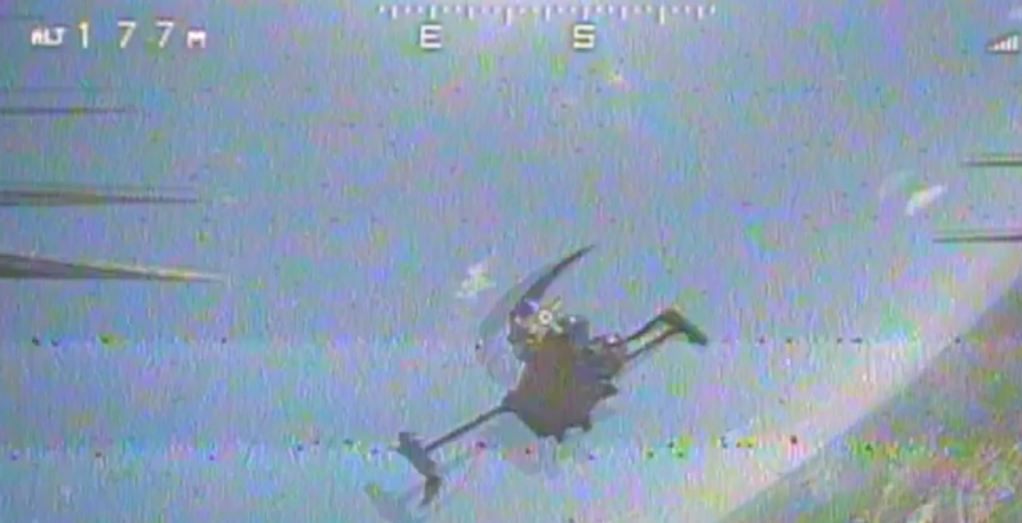
A Russian drone seen via the feed from an attacking Ukrainian drone (via social media)

February 2023 saw further videos of drone dogfights, in another piece of footage shared on 24 February, we can see the attacking Russian drone taking its time to line up on its target before attacking, it is possible to the attacked Ukrainian drone fall to the ground.

As can be seen in videos like this one from mid-February, aiming a drone for a ramming run at an opposing drone below can be difficult. In our earlier video, David explained the favoured tactic of attacking from above has a number of advantages in that it allows the attacking drone to maintain visual contact with the drone’s camera and also avoid being seen by the target drone’s camera which is also unable to look upwards. The more robust body of the drone is what makes contact with the target drone’s rotors – increasing the attacking drone’s survivability. In some of the videos, the target drone appears unaware it’s about to be attacked.

DJI Mavic struck by another drone damaging its rotor blades (via social media)

This was again demonstrated in a video posted by the Ukrainian 10th Mountain Division in March, which showed a drone making numerous ramming runs on a Russian quadcopter. In early May, a video of a Russian DJI Matrice 30 series drone being hunted by a Ukrainian DJI Mavic was shared. While the Ukrainian drone was destroyed too, the loss of a $2,000 Mavic to destroy a Matrice worth approximately $12,000 makes tactical sense. On 25 March, Russian telegram channels shared a video from a team called Project Krechet featuring a test showing a fast-moving First Person View (FPV) drone ramming a larger quadcopter. The telegram posts noted that the ‘Small anti-drone fighter aircraft’ are much cheaper and better suited to the role than DJI Mavics.

In late April, footage of another drone dogfight was shared showing a Russian Mavic being downed by a Ukrainian drone. In early May, the Russian news agency RIA shared footage of a clash between a Russian drone and a Ukrainian DJI Mavic, reportedly in the Donetsk, Adviivka region. On 24 May, Escadrone, a Ukrainian manufacturer and supplier of FPV kamikaze drones shared what is believed to be the first video of a Ukrainian FPV drone attacking a Russian reconnaissance quadcopter.

An FPV drone attacks a Russian quadcopter (Escadrone)

While not a drone vs drone dogfight on 30 June, a video of a Ukrainian drone dropping a munition on a Russian Zala 421-16E2 which was on the ground, shows another nuance to drone vs drone engagements. This video is similar to the popular tactic of ‘drone demolition’, the dropping of munitions into enemy vehicles that have been mobility killed. In both the case of the Zala and ground vehicles the demolition missions deny the enemy the asset’s recovery and future use.

With drones playing a fundamentally important role for both sides instances of drone vs drone combat are only likely to increase. We may also see the emergence of more complex onboard methods of drones attacking other drones.


Support Us: If you enjoyed this video and article please consider supporting our work here. We have some great perks available for Patreon Supporters – including early access to custom stickers and early access to videos! Thank you for your support!


Russia & Ukraine’s Adapted MT-LBs

The MT-LB tracked artillery tractor has become one of the most recognisable armoured vehicles of the war in Ukraine. These versatile vehicles are used by both sides in huge numbers and while first introduced in the 1970s they continue to be used as both armoured personnel carriers and also as the platform for a plethora of weapon systems ranging from rocket pods to auto-cannons to MT-12 anti-tank guns.

In this article/video we’ll look at two specific MT-LB adaptations; one Russian, one Ukrainian.

Russian MT-LB adaptation with a 2M-3 turret which was first seen in March 2023 (via Social Media)

Russia’s Turreted MT-LB

In March 2023, a number of photographs and videos emerged of Russian MT-LBs which had been fitted with a large turret complex over the rear portion of the vehicle. The turrets are naval 2M-3s which mount a pair of 25mm 110-PM autocannons. The first images surfaced at the beginning of March. The strikingly ugly turret quickly led to ridicule on social media and numerous memes mocking the vehicle. Between the 8 and 10 March a series of short videos showing the turret-adapted MT-LBs on the move. One video showed several vehicles in a yard with a large crane, perhaps suggesting they had been off-loaded. The person filming the video notes that the unusual turrets and were apparently ‘sent for defence’. The footage features at least five turreted-MT-LBs, one appearing to also have an adapted front commander’s turret.

Another clip, shared around 10 March, shows a transport train with numerous vehicles loaded, including some Russian Military Police vans. Two (possibly four) of the adapted MT-LBs can be seen. Similarly, another clip showing the vehicles in transit through an urban area features one perhaps two adapted-MT-LBs.

Other examples of Russian MT-LB adaptations with 2M-3 turrets (via Social Media)

Since the early spring there have been no sightings of the vehicles but in late May a video and several photos were shared featuring a Russian combatant riding in the turret of one of the adapted MT-LBs, the anti-aircraft style style sight can be seen in the video and one of the photographs.

Russia is likely making use of turrets that have been in storage since the vessels they were mounted on were decommissioned. Their is probably still an ample supply of ammunition for the 25mm autocannons. The mount has -12° to +85° elevation and 360° rotation giving it a good field of fire for use against ground targets.

Just what role Russia envisioned for the turreted MT-LBs is still unclear. They could be used in direct fire roles perhaps as support guns which can help plug gaps in defensive lines with suppressive fire. Or perhaps as mobile anti-aircraft vehicles for taking on drones but their limited manual targeting would mean they would struggle to be a match for even slow moving drones. Other potential uses might be as assault guns or as a more heavily armed vehicle for internal security duties protecting supply lines from Ukrainian partisans.

Ukrainian MT-LBu adaptation with a KPV heavy machine gun remote weapon system (via Social Media)

Ukraine’s MT-LB Refits

While many of both sides’ MT-LB adaptations have focused on simply mounting a weapon system to the rear deck or where the commander’s original PKT mount was, a recent Ukrainian refit has gone much further. A video was shared by a Ukrainian MT-LB crewmember which showed six vehicles all refit to a similar configuration. It appears that additional armour has been added to the sides and rear of the vehicle in an effort to provide additional protection to the lightly armoured MT-LB. [Correction: the vehicle has 7 road-wheels indicating the adaptation is likely based on an MT-LBu variant. These have been described as BMP-1LBs.] The vehicles also have new storage baskets, smoke-grenade launchers and a new remote weapon mount controlled from inside the MT-LB. A photograph of the front of the mount shows that it mounts a single 14.5x114mm KPVT machine gun, remotely fired and aimed using an electro-optics module positioned to the left side of the gun. The weapon and optics are protected by a curved gun shield, the cuts in the shield suggest that the weapon’s range of elevation is considerable.

Russian MT-LB adaptation with twin DShk mount on the original PKT turret (via Social Media)

These vehicles are are just two examples of MT-LBs in Ukraine adapted with ad-hoc weapon mounts. There are dozens of other examples of up-gunned MT-LBs deployed by both sides. Other commonly seen adaptations include fitting ZU-23-2 anti-aircaft mounts to MT-LBs

In February 2023, Ukrainian troops shared a video of a Russian MT-LB captured near Vuhledar, which had been fitted with a 2M-7 naval turret mounting a pair of 14.5mm KPV heavy machine guns. Similar vehicles appeared in photographs showing several MT-LBs with ad-hoc adaptations which included one vehicle with the same, as well as other vehicles with other dual and single gun mounts. One can be seen mounted with a single DShK on a tall, exposed pintle mount.

In May, an MT-LB was sighted with a twin DShK mount. Similarly, another MT-LB fitted with a twin DShK mount on top of the existing PKT turret was shared on 10 June, it had also been adapted by adding track and boxes as appliqué armour. Also in June, a photograph of a pair of MT-LBs equipped with A-22 140mm multiple rocket launch systems was shared on Telegram.

With Ukraine forming new brigades and both sides suffering considerable armoured vehicle losses the ubiquitous MT-LB, while lightly armoured, offers one of the best available platforms for mounting additional or role-specific weapons.


Support Us: If you enjoyed this video and article please consider supporting our work here. We have some great perks available for Patreon Supporters – including early access to custom stickers and early access to videos! Thank you for your support!


Evidence of Ukraine’s First Use of Storm Shadow Cruise Missiles

Last week, on 11 May, the UK became the first country to provide Ukraine with medium range cruise missiles. Less than a week later the first evidence of their use has emerged.

Storm Shadow is an air-launched subsonic cruise missile with a reported range of 250-300km (155-185 miles). It can reportedly reach speeds of Mach 0.8 or around 620 miles per hour. This will enable Ukraine to strike targets within territory occupied by Russia including Crimea. Theoretically, Storm Shadow could also strike targets inside Russia, but the UK has provided them on the understanding they will not be used outside Ukraine’s borders.

Storm Shadow is characterised by its accuracy and also has a sophisticated warhead: the Bomb, Royal Ordnance, Augmenting CHarge (BROACH). The 450 kg (990 lb) BROACH warhead uses a precursor penetrator charge followed by a follow-through main charge to penetrate hardened shelters and structures. 

RAF technicians arm a Typhoon with Storm Shadow, 2021 (Cpl Steve Buckley/UK MOD Crown copyright)

Storm Shadow is said to be extremely accurate.  Once the missile is released from the aircraft its wings deploy and it uses a GPS/INS and Terrain Profile Matching navigation system to guide the missile to the target area. The missile typically flies at a low level and on its the final approach it jettisons its nose cone and the on-board infrared sensor guides the missile to the impact point. With a reported price tag of around £790,000 per missile, they are typically used against high value targets.

Development of the missile requirement began in the mid-1980s becoming part of the multi-nation NATO Modular Stand-Off Weapon (MSOW) programme. While the US pulled out of the programme in the late 1980s Matra BAe Dynamics continued development of a missile based on the Matra Apache. The missile became known as Storm Shadow and was procured by the UK in 1997, it entered service in 2002. 

The missile also entered service with the French in 1998 as SCALP-EG (Sistème de Croisière Autonome à Longue Portée – Emploi Général, or Long Range Autonomous Cruise Missile System – General Purpose). Since then Storm Shadow and SCALP have been used in the Gulf, Iraq, and in Libya by the UK’s Royal Air Force and the French Air Force.

A Tornado GR4 aircraft with 617 Squadron fitted with Storm Shadow, 2004 (UK MOD Crown copyright)

Ben Wallace, UK Defense Secretary, addressed the UK’s Parliament on 11 May saying:

Today I can confirm that the UK is donating Storm Shadow missiles to Ukraine… the use of Storm Shadow will allow Ukraine to push back Russian forces based within Ukrainian sovereign territory. …Russia must recognise their actions alone have led to such systems being provided to Ukraine. It is my judgement as Defence Secretary that this is a calibrated, proportionate response to Russia’s escalations.”

Wallace added that it hadn’t been easy to incorporate the missile on a former Soviet aircraft. He said “that has been one of the reasons for the time… working out if it is technically feasible, and I would like to pay tribute to our scientists & technicians.” It is believed that Ukraine’s Su-24 Fencers have been adapted to launch the missiles. 

Storm Shadow is key for Ukraine as it provides a much needed long range, deep strike capability, well beyond that of HIMARS rockets and other artillery. Ahead of Ukraine’s anticipated offensive the cruise missiles will allow Ukraine to strike high value targets including infrastructure and logistics nodes and command and control centres – most of which have been repositioned outside of HIMARS/GMLRS munitions range. 

A building in Luhansk claimed to have been struck by a Storm Shadow missile (via social media)

13 May saw the first evidence of Ukraine’s use of the missiles emerge with Russian media outlets and telegram channels sharing fragments collected in Luhansk. Russian media shared photographs of an industrial building destroyed. Subsequent photos and videos showing further fragments with serial numbers and other markings were also shown. Russian state media reports that LPR Separatist authorities claim Luhansk has been targeted with at least three Storm Shadow missiles. This claim is yet to be independently verified.

A tail fin fragment believed to be from the Storm Shadow strike on Luhansk (via social media)

The strike on the target in Luhansk is the first with physical evidence of Storm Shadow’s use, now that the missile is known to be in service it will inevitably be one of the weapons discussed when considering future strikes but given the missile’s cost and the relatively small number available, the Ukrainians will likely be picking their targets carefully.

On 16 May, France signalled its intention to also provide Ukraine with longer range missiles, while not confirmed by name this potentially means its SCALP-EG missiles. In late May some German politicians made calls for Germany’s similar Taurus missile to be provided to Ukraine.

Update – 24/5/23: During a visit to Ukraine UK secretary of Defence signed a photograph of a Ukrainian SU-24MR carrying a Storm Shadow. Inscribing: “To all the brave ‘few’ who risk all for the glory of Ukraine” in reference to Churchill’s remarks referring to the RAF as the ‘few’ during the Second World War.

Update – 3/6/23: A photo of a Ukrainian air force SU-24M was shared online showing it carrying a pair of what appear to be Storm Shadow missiles.

Update – 8/6/23: Russian authorities in Luhansk have shared photographs of a retrieved Storm Shadow nose cone. The missile jettisons the nose cone, which covers onboard sensors, on its final approach to the target. The nose cone has a production date of November 2004.


Support Us: If you enjoyed this video and article please consider supporting our work here. We have some great perks available for Patreon Supporters – including early access to custom stickers and early access to videos! Thank you for your support!


Bibliography:

Defence Secretary oral statement on war in Ukraine, UK Government, (source)

House of Commons Proceedings 11 May 2023, UK Parliament, (source)

UK Provides Storm Shadow Cruise Missiles to Ukraine, OVD, (source)

Russia says Ukraine used Storm Shadow missiles from Britain to attack Luhansk, Reuters, (source)

Interview with President Emmanuel Macron on TF1, Elysee/TF1, (source)

Storm Shadow, ThinkDefence, (source)

Putting Russia’s Army in the Shadow of the Storm, RUSI, (source)

DP-64: Russia’s Anti-Saboteur Grenade Launcher In Ukraine

On 20 March, Russia’s State news agency RIA shared a short report from Ukraine. In it an RIA reporter looked at an interesting double-barrel grenade launcher – a DP-64.

The DP-64 was developed in the late 1980s to combat Frogmen/demolition divers. It’s described as an anti-sabotage grenade launcher to protect maritime assets. Designed at NPO “Basalt” the DP-64 is manufactured by ZiD/Degtaryev in Kovrov. 

Factory photo of DP-64 (ZiD)

In the past 18 months ZiD appear to have removed the military products from their website but using archive.org we can look at earlier caches of the site. This version of ZiD’s website from April 2021 shows the DP-64 and gives a short description of the weapon (machine translated below):

“Designed to protect surface ships, submarines (in the surface position), as well as oil and gas production offshore platforms and the coastline by mobile patrols from attack by detected combat divers and saboteurs.

The grenade launcher operates according to the scheme of a dynamo rocket-propelled grenade launcher and provides single firing of FG 45 and SG 45 grenades. It is included in the ammunition load of combat surface submarines and boats.

High-explosive grenade FG-45, which is designed to destroy combat swimmers and signal grenade SG-45, which is designed to indicate the location of combat swimmers.

The grenade launcher is mobile and lightweight. Works in any climatic conditions, easy to operate and maintain.”

In the short report gives very few details and doesn’t even mention the weapon’s name. The video’s caption, however, notes that the DP-64 is being used by a VDV unit stationed at the Kakhovka Reservoir – possibly guarding the reservoir’s hydroelectric plant. A Russian combatant interviewed mentions that it has been used against ‘DRGshnikovs’ or sabotage and reconnaissance groups.

Still from RIA’s report giving a look at the DP-64 (RIA)

An b older Russian news report from around 2015, shows how the weapon is loaded and fired. It has a quadrant sight on its left side and its superposed barrels are loaded from the rear. It fires either fragmentation or indicator 45mm grenades. It has a range of up to 400m according to ZiD and is designed primarily for use against underwater targets.

The RIA news report is the first time I’ve seen a DP-64 in imagery from Ukraine. It is certainly one of the more niche weapons to appear. 

Specifications (from ZiD):

Calibre45mm
Number of barrels2
Weight of grenade launcher10kg
Maximum firing range400m
Overall length820mm

Update – 17/10/23:

Another sighting of a DP-64, posted on a Russian telegram channel. Date and location of photograph unknown.

Update – 2/8/24: A rare sighting of a DP-64 during Russian naval drills, location known.


Support Us: If you enjoyed this video and article please consider supporting our work here. We have some great perks available for Patreon Supporters – including early access to custom stickers and early access to videos! Thank you for your support!


Bibliography:

DP-64 In Kakhovka, RIA, (source)

DP-64, ZiD site c. Apr. 2021, (source)

DP-64 Grenade Launcher, Arms-Expo, (source

‘Gift For Pirates’, Russian News Report, 2015 (source)

Mk153 SMAW In Ukraine

Recent imagery confirms the presence of the Mk153 SMAW in Ukraine. In the last couple of months there have been sightings of the Mk153 in use at the front and at a Ukrainian Armed Forces training ground. The Mk153 is a shoulder-fired rocket launcher capable of engaging structures and armoured vehicles.

The Mk153’s cousin munition – the one-shot, disposable M141 SMAW-D has been seen in theatre in fairly small numbers since February 2022. We have an earlier article/video looking at the SMAW-D, check that out if you haven’t already.

The Mk153 is primarily used by the USMC and was developed from the Israeli IMI B-300 and introduced in the mid-1980s. So what actually is a Mk153? The USMC describes the SMAW as: 

“a one-man operable, 83 mm smooth bore, shoulder-fired, rocket launcher with a spotting rifle attached to the right side of the launcher tube. The encased rocket is fitted into the aft end of the launcher, and the fiberglass encasement is discarded after use. The spotting rifle, which improves firstround hit probability, is fed 9 mm tracers by a magazine, which holds six rounds. The 9 mm round is ballistically matched to the 83mm rocket.”

The SMAW (or Shoulder-Launched Multi-Purpose Assault Weapon-Disposable) can fire Encased High-Explosive, Dual Mode (HEDM) and Encased High-Explosive, Anti-Armor (HEAA) rockets. The HEDM is an anti-structure and anti-light armour munition with a warhead containing 2.4 pounds Aluminized Comp A-3 capable of penetrating 200mm (8 in) of concrete. The HEDM has a maximum effective range of 250m. The HEAA is a dedicated anti-armour round able to penetrate up to 600mm (23.6in) of rolled homogeneous steel, with a maximum effective range of 500m. It uses a shaped charge warhead with 1.89 lbs Octol explosive. The Novel Explosive (SMAW-NE) has a 4lbs enhanced-blast warhead, containing PBXN-113, designed for bunker busting which the USMC manual describes as “designed to provide enhanced-blast lethality to defeat personnel in reinforced structures and caves.”

Mk153 in Ukraine (via Social Media)

The Mk153 has iron sights and a Mk42 3.8× magnified optic and a 9mm spotting rifle on the side of the launch unit. This spotting rifle fires tracer rounds which match the rocket’s ballistics and can help range the target and aid the operator in applying the right hold for the target. The tracer cartridge that contains a 9mm jacketed bullet with an aft burning .22 calibre tracer element. Spotting rifle magazines for the rockets are supplied on the outside of the rocket carry tube end cap.

The first sighting of a Mk153 in the field came from some B roll footage of a UK Channel 4 News report published on 28 February. It showed men of the Ukrainian 68th Jager Brigade on the front-line near Vuhledar. Several soldiers are seen preparing a Mk153 to fire.

On 17 March a video featuring a Mk153 SMAW being fired at a range was shared on Telegram. It shows a SMAW being fired and a pile of spent tubes and unfired rockets on the ground. The fired and unfired rockets all appear to have yellow bands indicating high explosive munitions – the Mk153’s practice round has a brown band. Sadly, we can’t  make out the other markings which would indicate the type of rounds being fired.

Mk153 in Ukraine (via Social Media)

At the end of March another video of Ukrainian soldiers preparing a Mk153 for firing was shared again at the range. The video gives us the best close up of the launcher in theatre so far and shows not one but two launch units. We get a good look at the tube and the launch unit’s spotting gun on the right hand side. This video shows the weapon being prepared to fire, the rocket is inserted into the launcher and rotated clockwise a quarter-turn to lock it in place before the Ukrainian soldier fires at a target down range.  

Another interesting detail we can see is the white paper hang ing from the rocket. This is a humidity indicator which allows quick visual inspection to see if the rocket might have been compromised by moisture. The indicator on this rocket appears to have pink in all three of its indicators circles, meaning the munition might be compromised, in USMC service this would mean the rocket needs to be returned to the ammunition supply point. Despite this the rocket appears to fire normally and detonate down range. It’s worth noting that the launch unit isn’t fitted with an optic in any of the clips.

Update – 24/05/23: An additional clip of a SMAW being fired in an urban environment, perhaps during the defence of Bakhmut, date unknown.

Update – 25/06/23: A photograph of a Ukrainian combatant with a SMAW share online, June 2023

Update – 25/07/23: A photograph originally posted in December 2022 showing a SMAW launcher with rockets in the background.

Update08/08/23: Short video of a Ukrainian combatant firing a Mk153 at a distant (judging by elevation) target.

Update – 3/9/23: An interesting video showing a phone mounted onto a SMAW MK153, this allows a clinometer app to be used to enable the SMAW to be used in the in-direct role, angling the weapon upwards.

Update – 24/09/23: Bravo Rapid Reaction Group training with SMAW Mk153 at the range.

Update – 3/4/23: A combatant from Ukraine’s 3rd Assault Brigade shared video on 27 March of a firing of a SMAW Mk153 at a range, filming date unconfirmed.

Mk153 Specifications (per USMC):

Rocket Launcher
Length29.9 inches
Weight16.9 pounds
Encased rocket (as carried)
Length27.3 inches
Weight12.7 pounds
Caliber83mm
Weapon Ready to Fire
Length53.1 inches
Weight29.0 pounds
Range
Maximum effective (HEDM)250m
Maximum effective (HEAA)500m
Time of flight to 250m 1.6 sec

Support Us: If you enjoyed this video and article please consider supporting our work here. We have some great perks available for Patreon Supporters – including early access to custom stickers and early access to videos! Thank you for your support!


Bibliography

Ukraine War: on the front lines with the 68th Brigade, C4 News, (source)

Introduction to Crew Served Weapons, USMC, (source)

Launcher, Assault Rocket, 83mm (SMAW) MK153 Mod 0, USMC, (source)

RARGOG Polymer Belts

Back in July we looked at polymer belt links developed for PK series machine guns made by a Ukrainian company, the Kharkiv Plant of Personal Protective Equipment – who trade under the name RAROG. Development of the links began back in 2015, and since the Russian invasion in February production of the links has increased.

Unlike the classic metal 7.62×54mmR belts, the new polymer belts are disintegrating – meaning once the round held in the belt link is fired and the next round is loaded it falls out of the gun just as with NATO standard disintegrating belts. This has the advantage of there are no longer being a long empty section of belt trailing from the gun.

A PK with RAROG’s polymer belt links at the range (RAROG)

One question that was regularly asked in the comments of the first video was – can the links not be made from a biodegradable material?  

Speaking RAROG they made it clear that there is currently no possibility of using biodegradable materials to make the belt links as they would not be strong enough for them to work properly. Unsurprisingly, the reality of the situation means a reliable, durable product that won’t fail, with dire consequences, during a firefight is a much more important consideration.

Polymer belt links and fabric belt box (RAROG)

The company relocated from Kharkiv to Lviv following the invasion but quickly re-established manufacturing and tell me that on average 100,000 links are shipping per month, although they have the capacity to produce far more. They are often shipping with their fabric belt bags. The bags and links are largely privately purchased by Ukrainian combatants.

7/2/24 – Update: An 3 OSHBr PK was seen in the field with RAROG links.


Support Us: If you enjoyed this video and article please consider supporting our work here. We have some great perks available for Patreon Supporters – including early access to custom stickers and early access to videos! Thank you for your support!


Bibliography

Thanks to Anton at RAROG for sharing some information and these videos with us. 

RAROG’s Polymer Belt Links, RAROG, (source)

RAROG’s Fabric Belt Bad, RAROG, (source)