In this article/video we’ll examine an an interesting and very simple 3D printed anti-personnel mine developed by the Ukrainians. The mines are similar in purpose and size to the Russian PFM-1, the so-called ‘Butterfly’ mines. However, their shape and form factor is similar to that of the larger PMN-4, but they are significantly simpler.
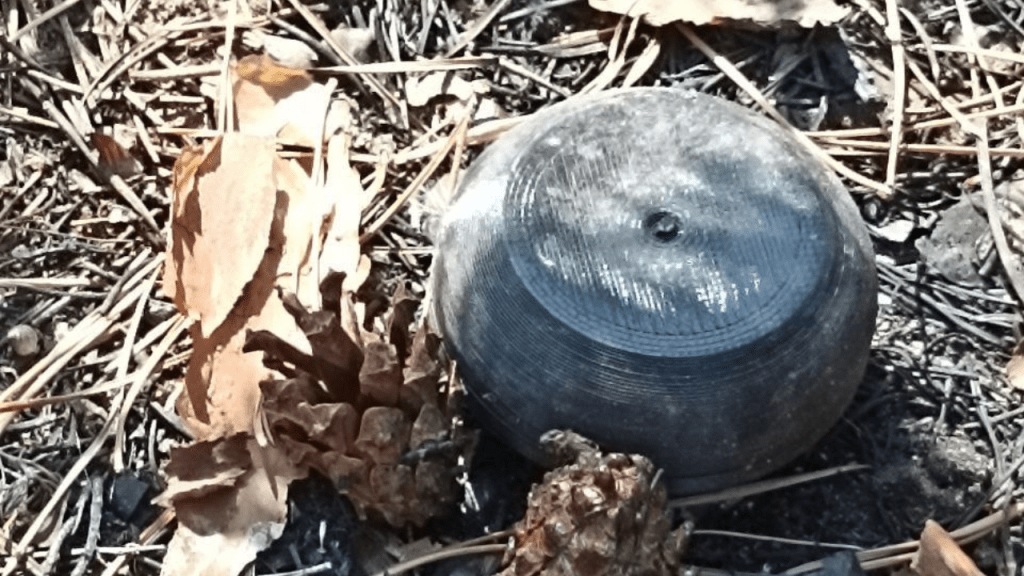
3D printed mine found in the field (via social media)
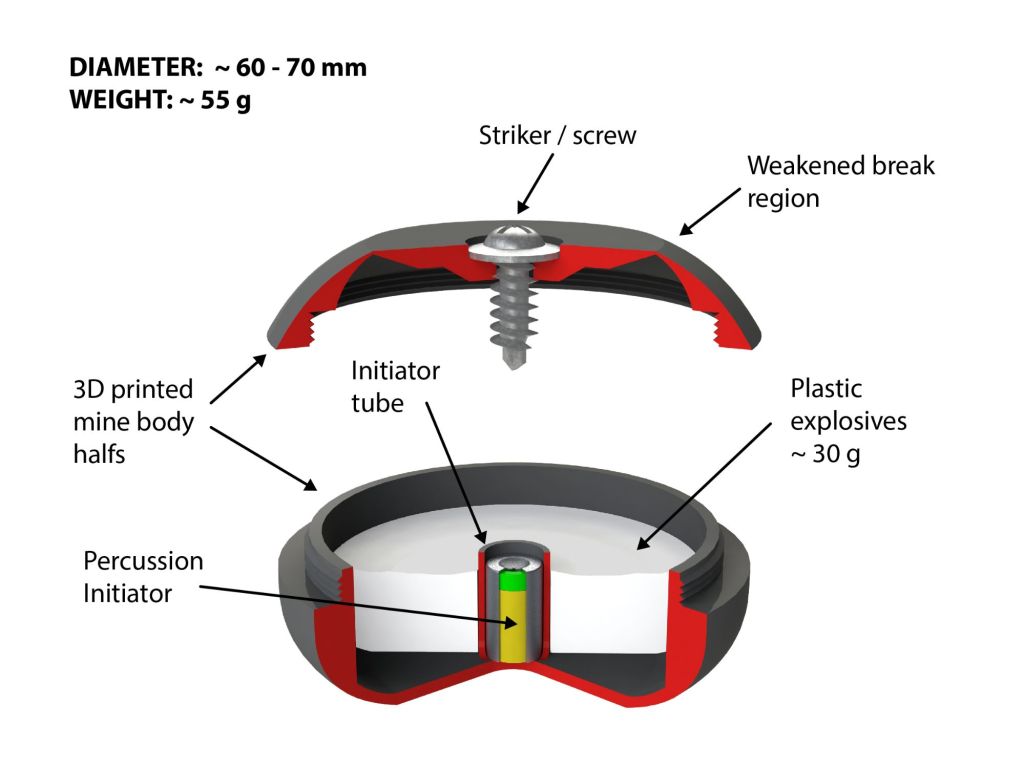
The 3D printed mine’s explosive filling is said to be around 30g, with an overall weight of 55g. The mine is made up of a two-part outer shell printed in PLA, or another similar plastic. The two pieces screw together and a layer of plastic explosive is in the bottom half of the shell along with a percussion initiator of some sort. The top half of the mine has a small metal Philips-head screw protruding down through the top, this acts as a striker for the initiator. There is a tube protruding up from the lower half of the mine, printed as part of the body, which likely guides the screw and holds the initiator.
The mine appears to work along the principle of when stepped on the outer shell breaks and compacts allowing the screw to strike the initiator, detonating the mine.
The design is extremely simple and cost effective to produce, requiring only the simplest 3D printer, a screw and an initiator and explosive.
The first sighting of the mines I’ve been able to find was in a telegram post by a Russian sapper. In the post, on 6 October, he shared several photos of the mines found in the field and warned that Ukrainian drones are dropping them in the Kursk and Belgorod regions. Another photo of one of the mines was shared by another Russian combatant on 8 October.
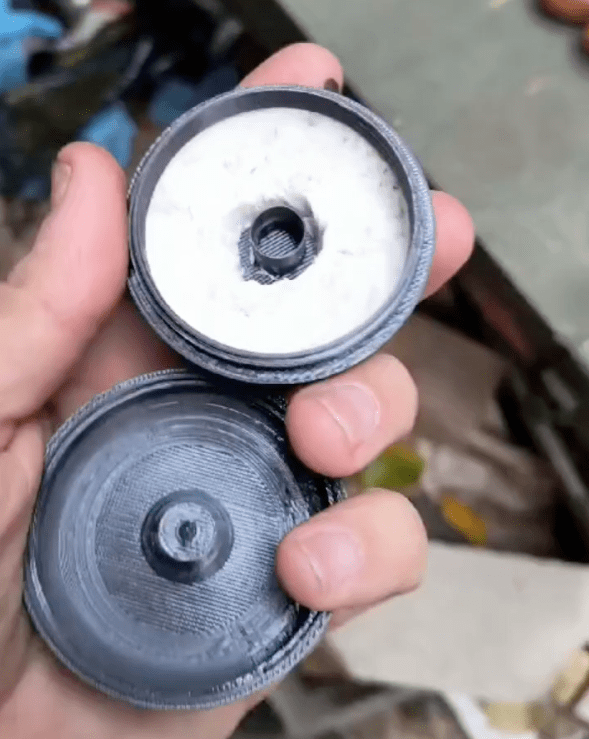
A Russian telegram channel, enginner25, shared post showing multiple images of the mines and a video showing the internals.
3D printed mine opened to show explosive filling (via social media)
In another photo we can see that the mines are apparently dropped from plastic tubes suspended below drones. The photo only shows the top of the tube but it’s clear that a number of tubes are carrying a significant number of mines. The release mechanism for the lids of the carrier tubes appears to use something like 3mm Visco fuze, commonly used with fireworks, or igniter cord. Once initiated the fuze/cord burns away and releases the mines with the drone scattering them as it flies over an area.
The design of the mine is extremely simple but appears to be potentially quite effective, relying on the brittleness of the 3D printed shell to work. The mines seem to have been engineered to be quickly produced at scale rather than to make them undetectable to Russian sappers. However, if a non-metallic striker replaced the screw the mines would be even more difficult to detect.
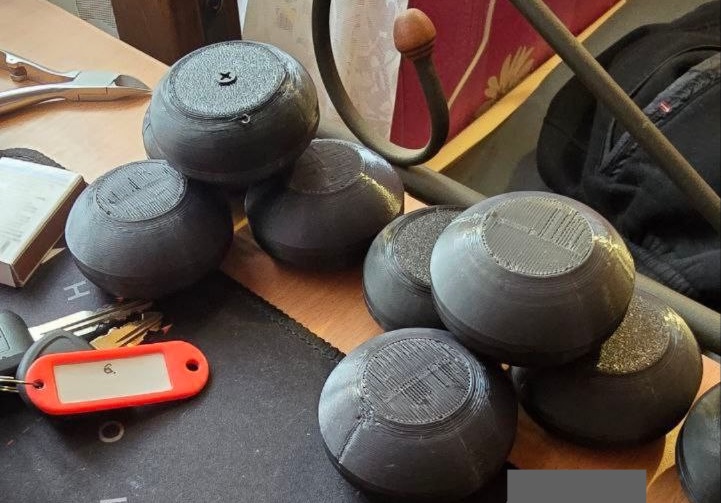
Assorted 3D printed mines (via social media)
While not the first 3D printed explosive device to emerge from the fighting in Ukraine, this mine is certainly one of the smallest and simplest. How widespread their deployment is, is still unclear but they seem they would be a useful part of Ukraine’s drone-deployed mine interdiction efforts behind Russian lines.
Thank you to Roy for drawing my attention to these mines.
Update 22/12/24: A new Russian video showing the internals of the mine and giving a better look at the percussion initiator (source).
Update 5/7/25: A Ukrainian video showing the testing of a 3D printed mine.
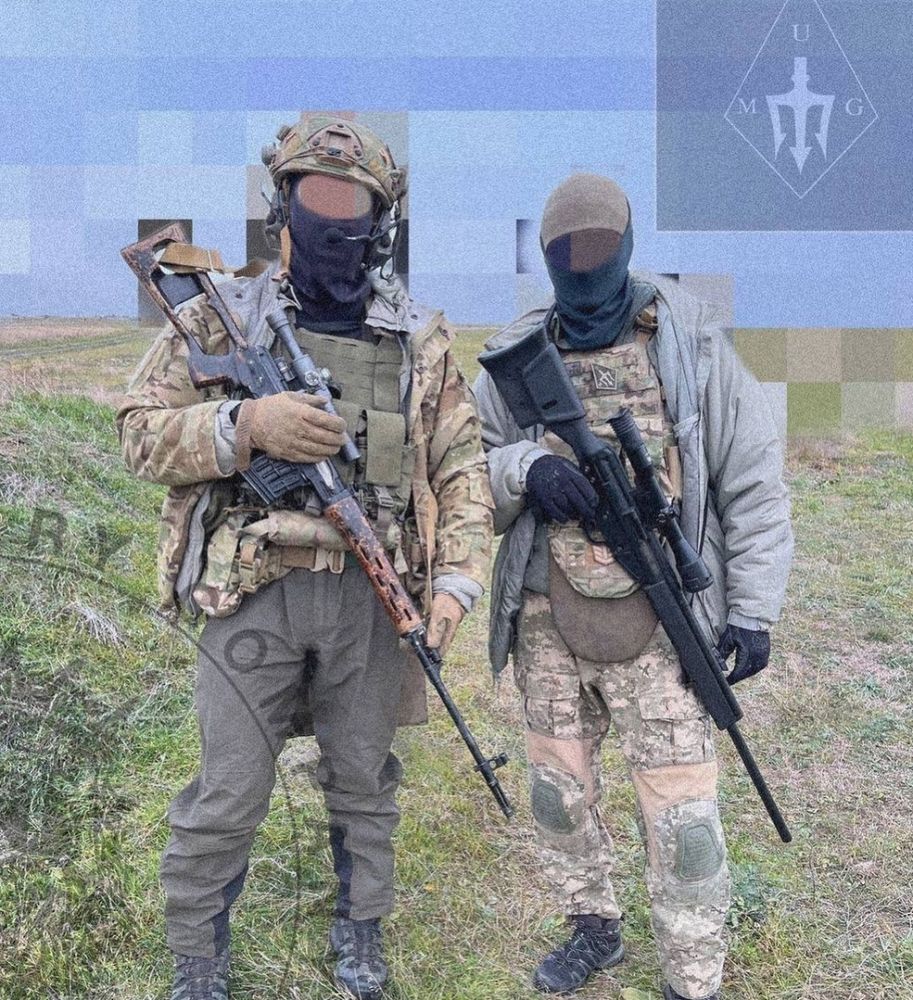
This week has seen photographs of two intriguing 7.62x51mm Heckler & Koch rifles appear, they feature what appears to be an iconic, and extremely rare, PSG1 and an HK G28E. The first photograph was shared by pmc_ua and universal_mobility_group on Instagram on 14 November. In the photograph a pair of two Ukrainian marksmen pose with an SVD and a PSG1, no further images of the rifle have been shared.
What appears to be a PGS1 at a Ukrainian range session (via social media)
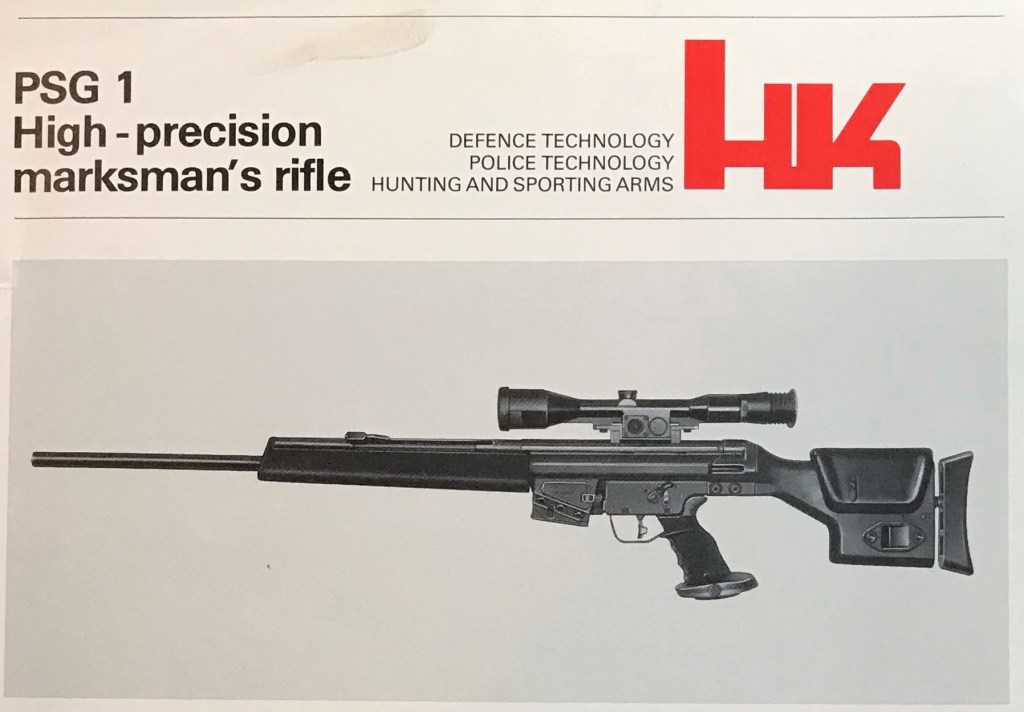
The PSG1 was introduced by HK in the early 1970s as a semi-automatic precision rifle. It is unclear where the PSG1 was acquired from but this is the first time I’ve seen one of the rifles appear in Ukraine. The PSG1 is based on the G3, and as such uses a roller-delayed blowback operating system. Its accuracy is reputed to be better than 1 MOA, the rifle appears to have an original Hensoldt ZF 6×42 PSG1 scope.
Illustration from an H&K catalogue page for the PSG1
PMC_ua, who shared the photograph, confirmed that the rifle is “used where there is an opportunity, fighting and training” but gave no further details. The PSG1 may have been acquired via civilian channels or may have been transferred to Ukraine as aid by one of the many countries who acquired the PSG1 in small numbers over the years. While the PSG1 is of Cold War vintage, the rifle continued to be offered into the 2010s by HK and it is still a very accurate, capable rifle.
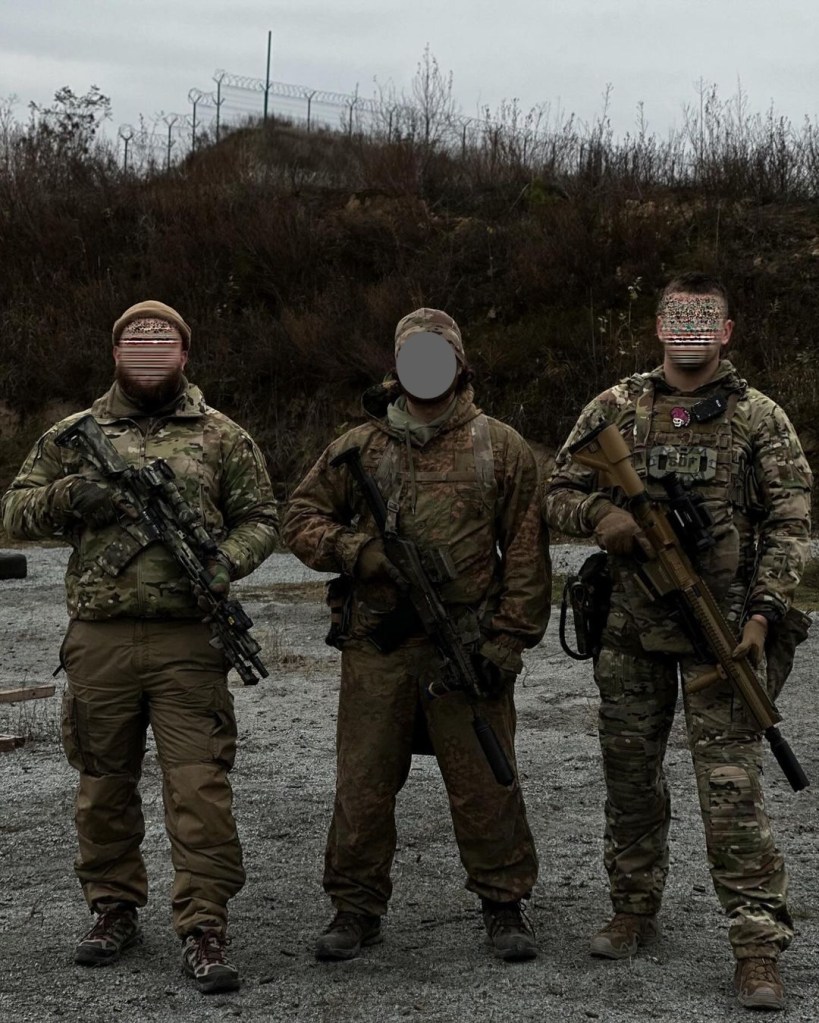
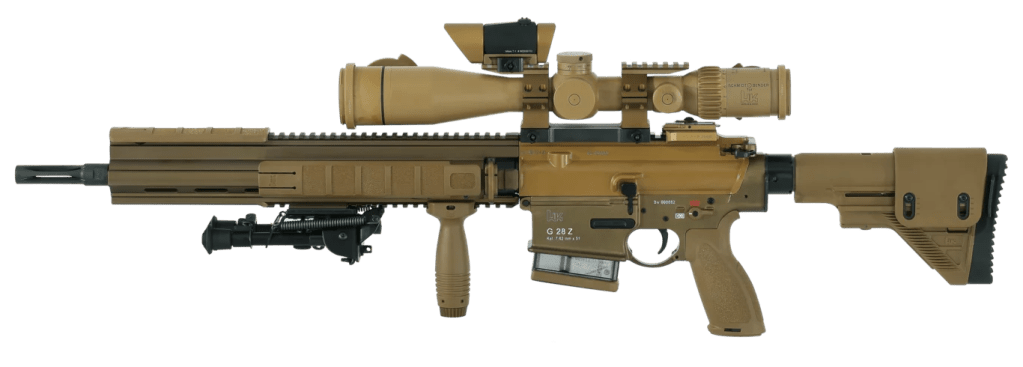
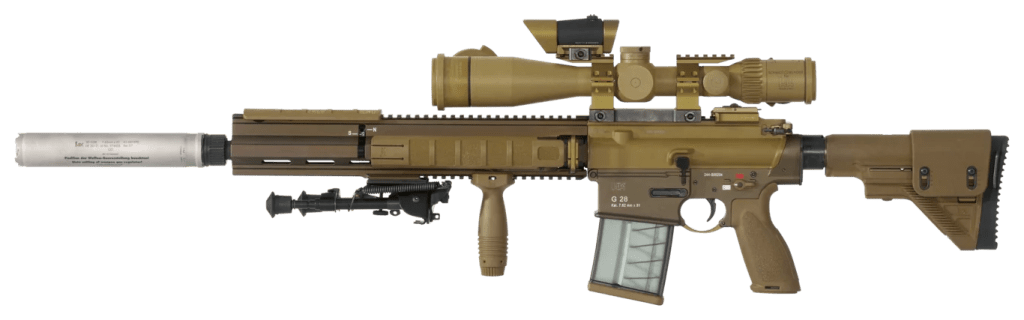
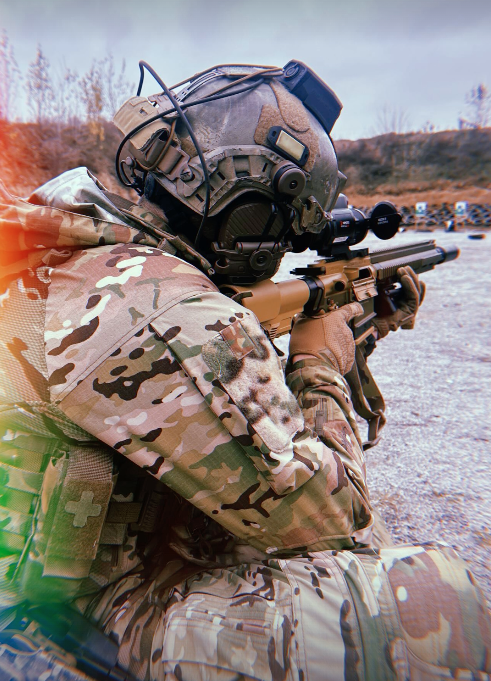
The second image was shared on Instagram, on the 17 November, and features what at first glance appeared to be an HK G28 but may also be the civilian-available HK G28Z. The rifle is held by a member of the 3rd Separate Assault Brigade and is equipped with a thermal weapon sight.
A probable HK MR308 A3-28 at a Ukrainian range (via social media)
The rifle has free-floated 16.5 inch barrel, a bi-pod and a vertical front grip mounted on its forend. It is loaded with a 10-round magazine and is fitted with what appears to be an Ase Utra DUAL762-S-BL suppressor. A small number of the RAL 8000-coloured MR308 A3-28s have recently appeared on the civilian market in Ukraine, with one private listing one of the rifles for 29,5000 UAH or $7,145.
HK G28Z (Heckler & Koch)HK G28 (Heckler & Koch)
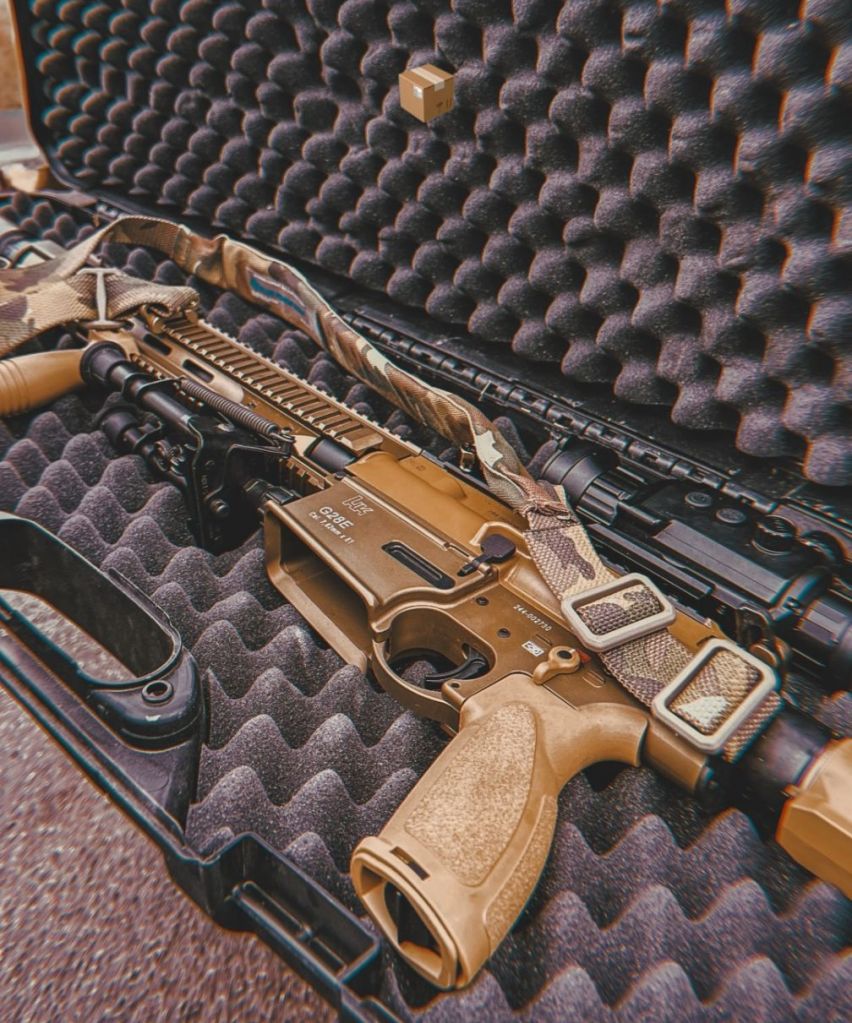
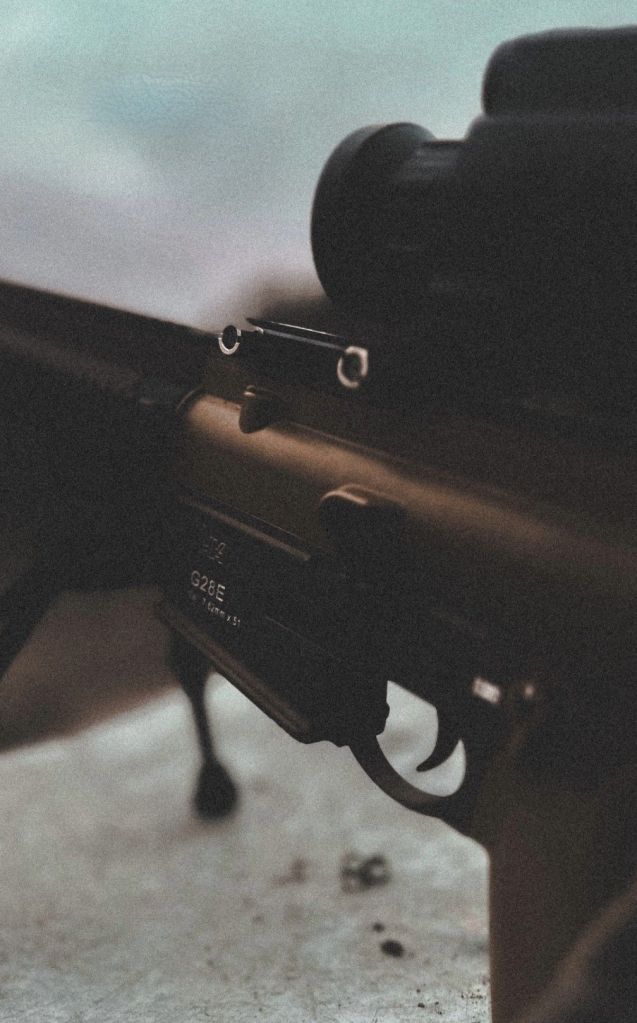
An additional photograph showing the rifle being fired was shared in an Instagram story by one of the individuals in the first photograph. This photograph gives us a better look at the receiver of the rifle and shows that the upper is painted/coated rather than treated. This indicates that the rifle is either a G28 or the civilian G28Z variant. [Thank you to CaliFlori for pointing out this detail].
It’s not uncommon to see civilian, semi-automatic, firearms used by Ukrainian personnel. This is more common in terms of precision platforms but various semi-automatic 5.56x45mm platforms are also regularly seen, including HK MR223s and patrol variants of the MR308.
A second photograph of the MR308 A3-28 at the range (via social media)
Two subsequent photographs shared by one of the individuals in the initial photograph clearly show the rifle’s lower receiver markings, confirming that the rifle is an HK G28E, not a commercial G28Z. The ‘E’ suffix indicates ‘export’.
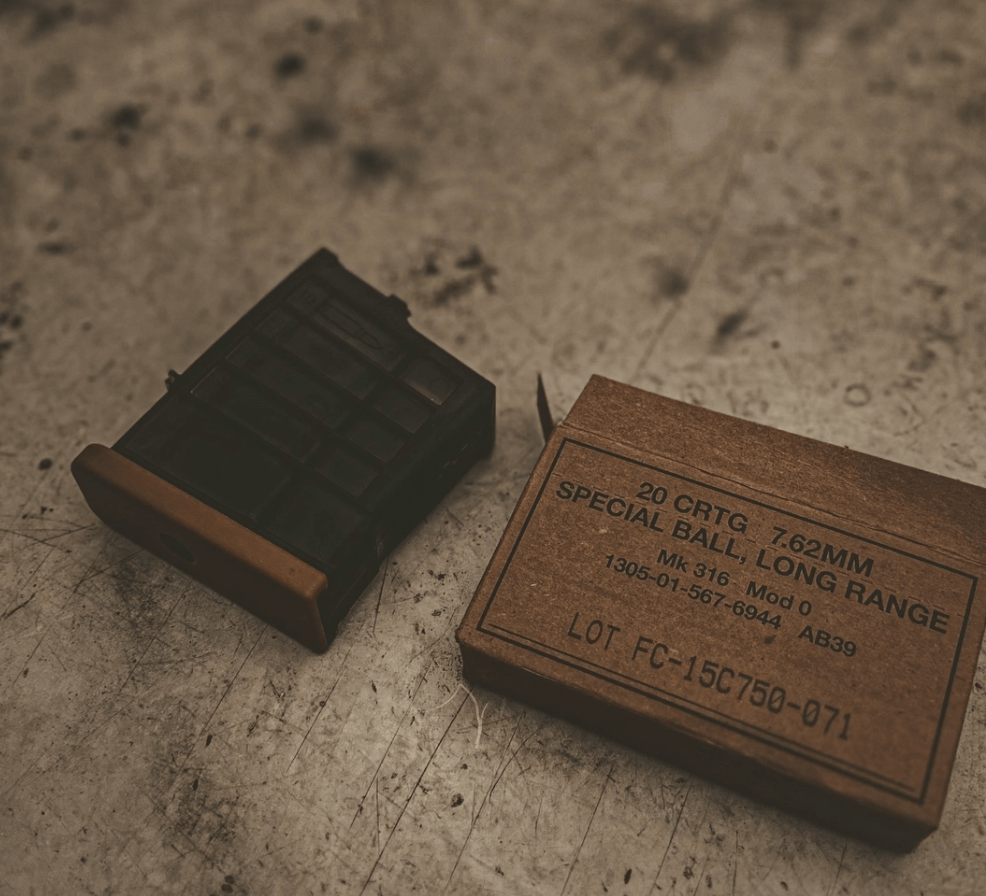
The same Ukrainian combatant, who appears to be a member of the GUR, also shared a photograph of ammunition he is using with the rifle. US-manufactured Mk316 Mod 0 is a match-grade cartridge which uses a 175gr projectile. While the ammunition was likely provided by the US, the origins of the rifle are unconfirmed.
It is intriguing to see two generations of Heckler & Koch’s semi-automatic precision rifles appear in Ukraine within days of each other.
On 7 November, photographs began circulating on Russian telegram channels of North Korean Type 73 general purpose machine guns said to be in Russia. The appearance of the photographs led to suggestions the weapons are now in Russia service. This claim is somewhat supported by the appearance of Russian E.M.R. camouflage in the top right corner of one of the photographs.
A North Korean Type 73 complete with magazine (via Russian social media)
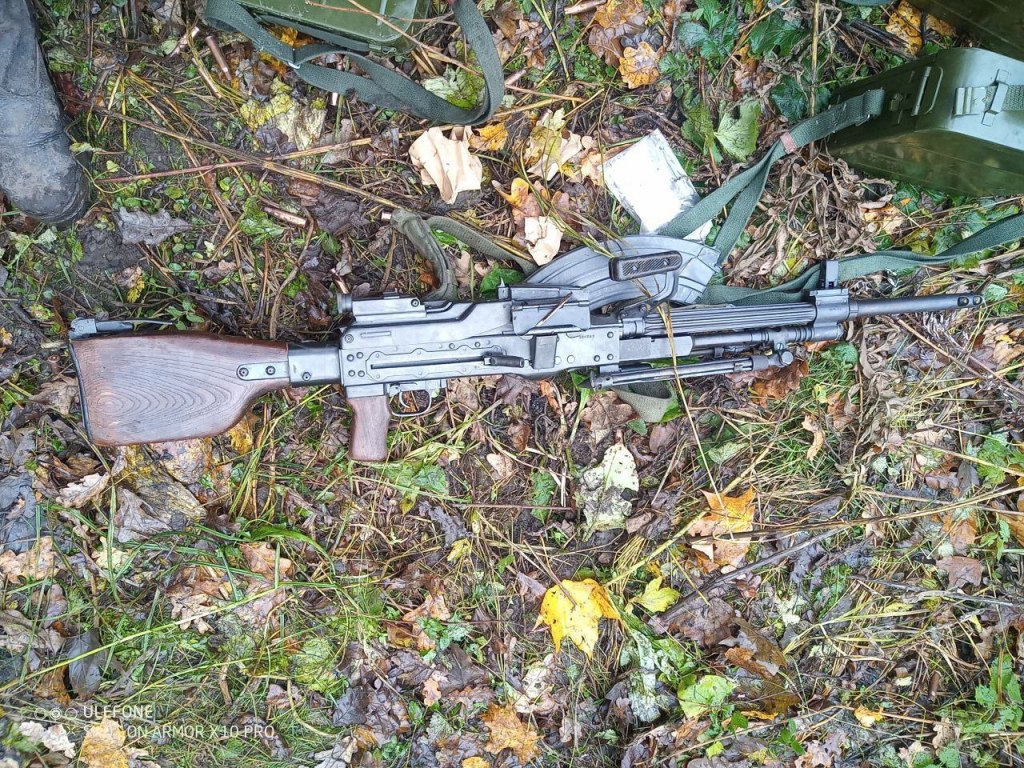
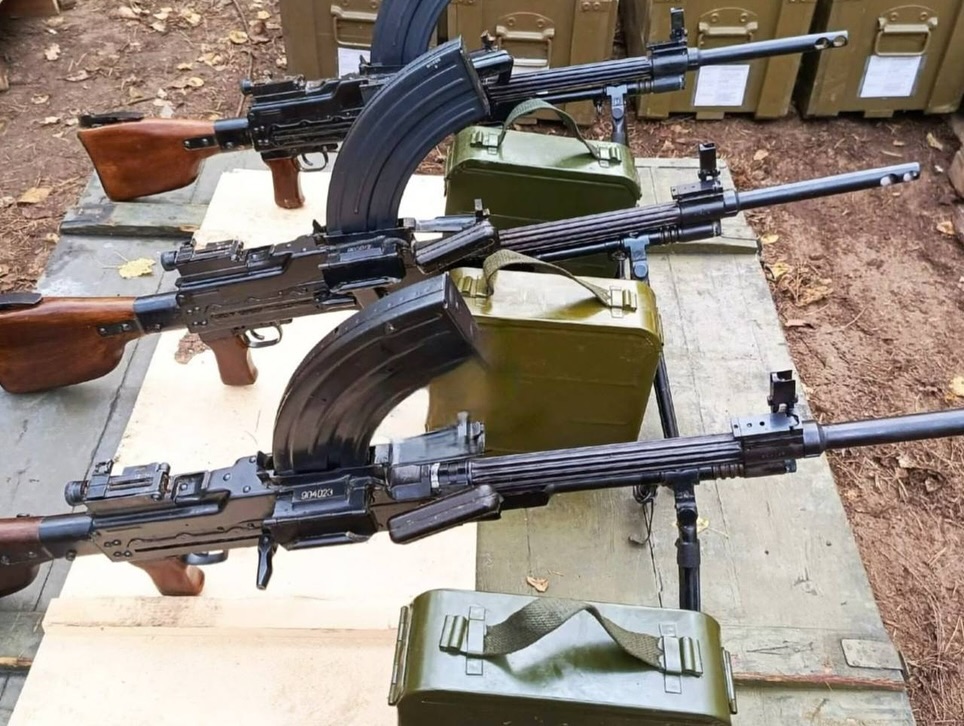
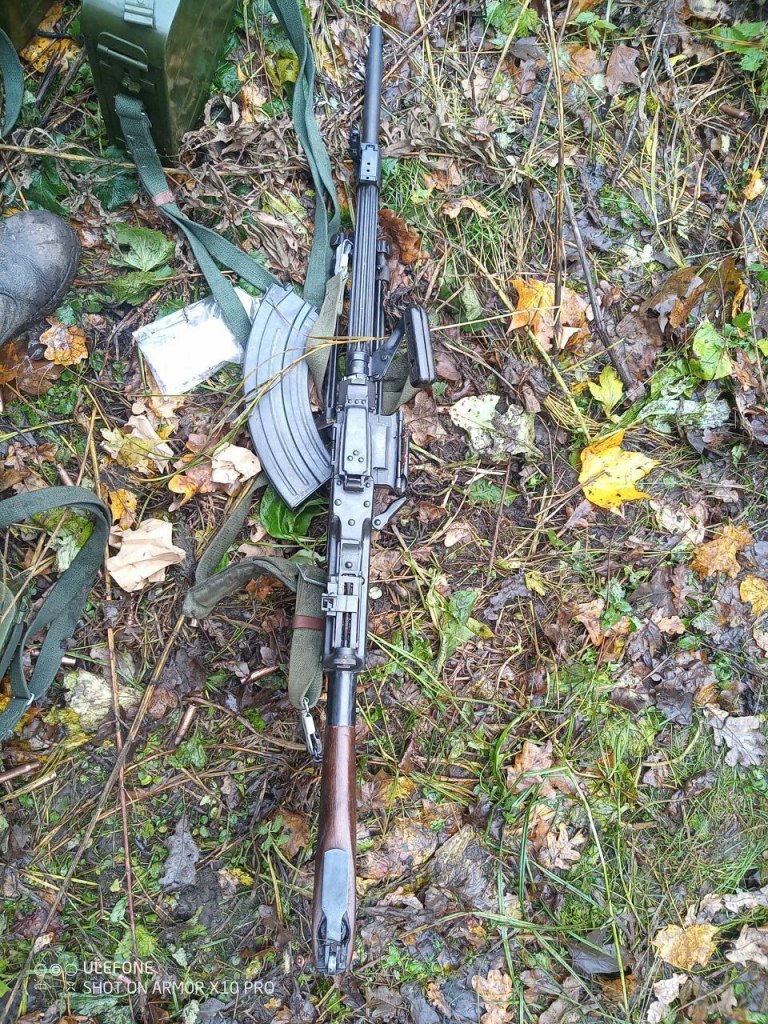
The Type 73 is a fairly rare weapon though it has surfaced in conflicts areas such as Yemen, Iraq, Syria and Lebanon over the years. Thought to have entered service in the early 1970s, it is a somewhat unusual machine gun, it is gas-operated, using a long-stroke gas system, it fires from an open-bolt and is chambered in the long serving 7.62x54mmR cartridge. It is derived from the PK-pattern machine gun and as such feeds from standard Russian metal non-disintegrating belts but also is able to feed from proprietary box-magazines (which look a little like over-sized AK magazines). The magazine is dual stack, single feed which is designed to allow the Type 73’s bolt to pull cartridges out of its rear. Check out Forgotten Weapons’ video on the weapon for a better look at the action. The dual-feed design appears to have been influenced by the Czech vz.52/57. The Type 73 has a longitudinal fluted barrel with its front portion, ahead of the gas block, machined as a spigot to enable it to fire rifle grenades, it comes with a removable barrel shroud which acts as a muzzle device. Also visible in the photographs are the segments of cleaning rod which sit in channels in the weapons’ bipod.
Three North Korean Type 73s complete with magazines and belt boxes (via Russian social media)
The dates and locations of when the photographs were taken is unclear and various Russian telegram channels are claiming a range of explanations varying from – the weapons were brought along with the North Korean troops who have reportedly arrived in Russia in recent weeks, to – they were provided to Russia as part of the military aid being provided by the DPRK. However, the photographs may also have been taken during a past exercise involving Russian and North Korean troops. The environmental conditions in the photographs do, however, correlate with the photographs being taken recently.
The photographs of the Type 73 emerged as a series of, as yet unverified, videos and photographs of North Korean troops in Russia have surfaced in recent days. Intriguingly, it was reported that the Ukrainian GUR had claimed that North Korean troops in Russia would be equipped with Russian small arms and light weapons including: AK-12s, RPK and PKM pattern machine guns, and RPG-7 shoulder-launched anti-tank rocket launchers.
Top view of a Type 73 (via Russian social media)
The available imagery shows three Type 73s together in one photograph and then three detail photographs of another weapon on its own. The visible serial numbers on the guns include ‘904023’, ‘905012’ and a partially visible serial number which appears to read ’904032′ is seen in another photograph. Which places these three weapons relatively close to each other in the serial number range. Intriguingly, the typical star and model number aren’t visible in the above photograph.
If these images are verified and we see more evidence of their use it is extremely intriguing to see these weapons appear in Russia. It raises questions as to why Russia needs North Korean GPMGs – is Russia suffering from a shortage? The presence of some RPD light machine guns appearing in imagery of Russian forces training may also support this.
Left-side view of a Type 73 (via Russian social media)
The origins of the guns is also unclear, while the obvious source would be North Korea themselves, if so it is interesting that they would choose to supply Type 73s rather than their own straight copy of the PKM, the Type 82. If these guns are to be used for training purposes, or indeed in the field, then it would make more logistical and operational sense to acquire Type 82s so troops have commonality and familiarity with Russian PK-pattern machine guns. An another alternative potential origin for the guns is Russia’s other ally -Iran. Iran is reported to have acquired large numbers of Type 73s during the Iran-Iraq War (1980-88) and has since provided them to their proxies and allies. It may be that Iran has provided a shipment of these machine guns as part of their aid to Russia.
It remains to be seen if the Type 73 will enter service with Russian troops or indeed if we will see evidence of any other North Korean small arms.
Update 22/12/24: A short video appeared Russian telegrams of a Russian combatant examining a North Korean Type 73.
Update – 15/1/25:
A North Korean Type 73 GPMG mounted on a Russian motorbike & sidecar. No North Korean's in view. Interesting.More on the Type 73 in #Ukraine here: armourersbench.com/2024/11/17/i…#UkraineRussiaWar #SALW
In an earlier video/article we examined the M14s which appeared in Ukraine back in March 2022, since then there have been a number of intriguing sightings of what, at a glance, appear to be Mk14 Enhanced Battle Rifles or M39 Enhanced Marksman Rifles. The EBR and EMR emerged during the Global War on Terror in the early 2000s as an improved variant of the 7.62x51mm M14.
The project to develop a more compact, improved M14 reportedly evolved from a request from US Navy SEALs in 2000 for a rifle for Arctic warfare. This eventually developed into what became the Mk14 EBR with development led by Naval Special Warfare Centre Crane and input from commercial specialists and manufacturers including Smith Enterprise, Inc. and Sage International. The result was a rifle with a 18 inch barrel and new flash hider, with changes to the operating rod guide, a new stock chassis and a raft of accessories. A number of different variants were built including the Mk14 Mod 0, Mod 1 and Mod 2, the M14 EBR-RI and the USMC’s M39 EMR. In total between 2003 and 2011 just over 9,000 of these upgraded variants were assembled.
Given the significant number assembled and the fact they have been replaced by rifles such as the M110 Semi Automatic Sniper System (which has already been seen in Ukraine) and the M110A1 CSASS it would not be unsurprising to see Mk14 EBR variants turn up in Ukraine.
Over the past two years I’ve been tracking sightings of what appear to be Mk14 EBR variants but on closer examination some of them are not what they initially seemed to be, several were in fact kit builds using the standard configuration M14s which reached Ukraine in early 2022. Some, however, do appear to be surplus Mk14s.
Yuri’s Mk14 EBR clone at the range (Nucking_Futs_Yuri)
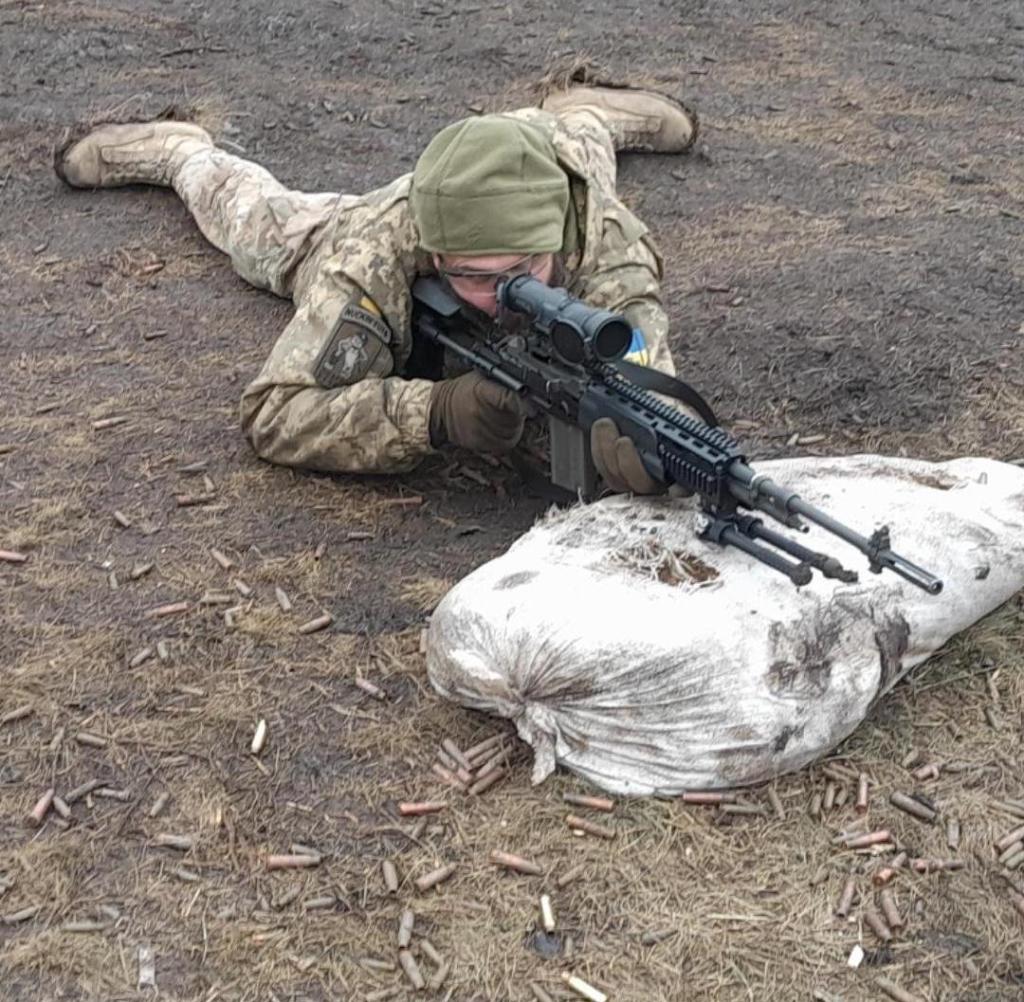
First, let’s examine some of the kit builds seen in theatre. The first appears to have been assembled by Nucking_Futs_Yuri, an American volunteer who enlisted in the Ukrainian Army in early 2022. Yuri explained to me that in late 2022, following combat experience where he wasn’t satisfied with how well 5.56x45mm suppressed a Russian position he decided to assemble an EBR clone using a donated chassis. Yuri noted that parts for the rifle began to arrive in December 2022 and by January the rifle had been assembled. Yuri was seen with the rifle in numerous photographs and in several configurations. It had a standard 22 inch barrel, a Sage International M14ALCS chassis and a M14DCSB (Detachable Cantilevered Sight Base). He mounted a 1.5-6x Elcan SpectreDR optic on the rifle, opting for more of a battle rifle-style set up. The rifle was damaged in February 2023 by a Kornet ATGM blast which bent both the barrel and the chassis.
Yuri’s damaged Mk14 EBR clone (Nucking_Futs_Yuri)
In early May 2023, another rifle which resembled an M14 EBR-RI, with a 22in barrel and a black Sage International M14ALCS chassis, appeared in use with a member an International Legion team. This individual and his rifle was seen again in May 2024 appearing in a number of interviews with Ukrainian media. His callsign was revealed to be ‘Solo’ and he was described as a marksman and a squad leader with a unit of the International Legion’s 3rd Special Purpose Battalion. In the interview he explained that the rifle has originally been a wooden stocked M14 converted with a SAGE chassis sent to him by a friend in the US. Interestingly, between May 2023 and May 2024, it appears the rifle’s set up has evolved with new FDE rail covers added and a short tan Kydex handguard replacing the initial black longer handguard. These parts were likely acquired in Ukraine.
‘Solo’ with his Mk14 clone built off a standard M14 (Суспільне Донбас)
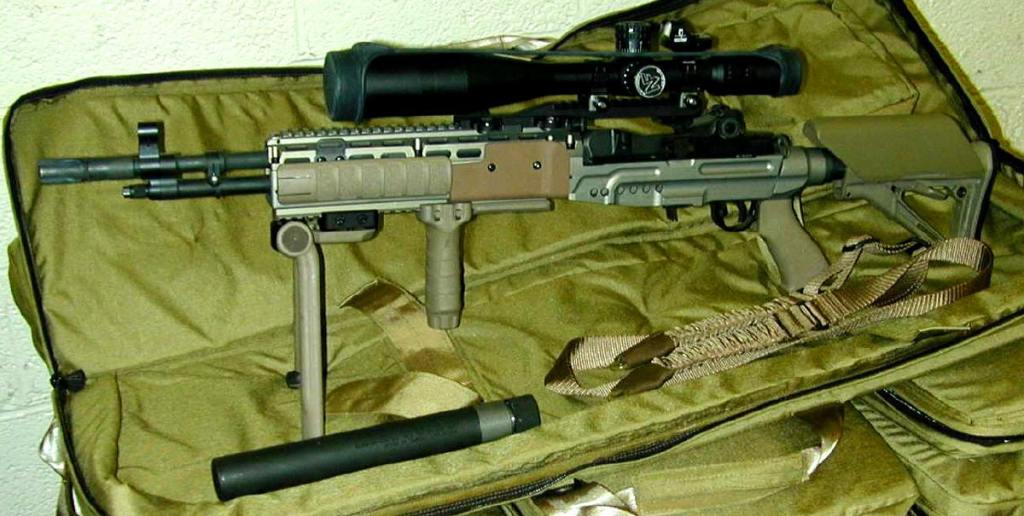
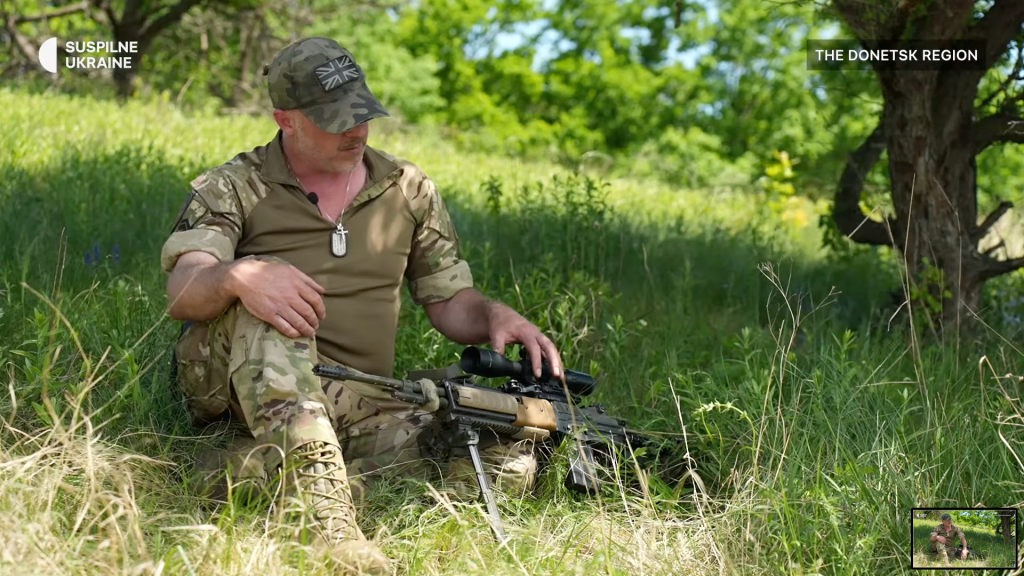
Most intriguingly, in November 2023, the first Mk14 Mod 1 appeared. Mod 1s are characterised by their shorter 18in barrels, a Sage M14ALCS/CV-BS with Magpul CTR FDE stock (with a cheek riser) mounted on a buffer tube extension rather than the earlier collapsing stock. The rifles also have LaRue LT-608 extended Picatinny risers and short tan handguards. The rifle is equipped with a Schmidt & Bender PMII 5-25×56 scope.
A Mk14 Mod 1 EBR with Schmidt & Bender PMII, Nov. 2023 (via social media)
The Mk14 Mod 1 was assembled at NSWC Crane in 2006, around 500 were assembled. The shorter barrel and the general configuration of parts and accessories suggest that this may be a surplus rifle transferred by the US.
A recent sighting of a Mk14 Mod 1 EBR (via Tysk)
Most recently, on 18 October, Ukrainian telegram channel Tyskshared a series of photos of a Ukrainian combatant at the range with another Mk14 Mod 1. This rifle’s parts and accessories closely match those assembled by Crane for the Mod 1, including: an 18in barrel with a SureFire FH762KM14 muzzle device, a TangoDown BG-16 FDE pistol grip, a Sage M14ALCS/CV-BS with a Magpul CTR FDE stock (this time without the cheek riser), a TangoDown BGV-MK46 FDE vertical foregrip, and a TangoDown ACB-4 FDE bipod. The rifle is also equipped with a NightForce NXS 2.5-10x24mm optic and a DOCTER MS01 3.5 MOA red dot sight which were selected to be paired with the Mod 1. [It has been noted that the Mod 1s may also be clones due to some small differences in the chassis profile and accessories used – for instance the model of VFG, scope rings, cheek riser, and the machining on the chassis. If this is the case someone has gone to an improbable amount of trouble to ‘clone’ a Mod 1, a considerable level of effort to expend in a war zone. Thanks to tanodized for input.]
From the very limited imagery available of Mk14 EBR-pattern rifles in Ukraine it appears that numerous clone builds have been assembled in-country and that the only EBRs which can be identified as potential US transfers are the two Mk14 Mod 1 variants seen so far.
A squad designated marksman with an Mk14 EBR-RI (the most common EBR variant), 5th Battalion, 20th Infantry Spin Boldak, Afghanistan, 2012 (US Army)
If the US was to transfer a significant number of Mk14-pattern rifles I would expect them to be the Mk14 EBR-RI, the most common variant, some 6,000 of which were assembled by Rock Island Armory – TACOM [Tank-automotive and Armaments Command]. It is unsurprising clone rifles have been assembled by combatants in Ukraine as Sage International and a number of other US manufacturers offer EBR-pattern chassis which do offer some improvements over the traditional M14 configuration.
A couple of months ago we took a look at Kalashnikov Concern’s new belt-fed machine gun, the RPL-20. That video was made in collaboration with firearms researcher Deni Almaskhanov, of Just Guns. Deni has also kindly shared some video of Kalashnikov’s new GP-46 grenade launcher.
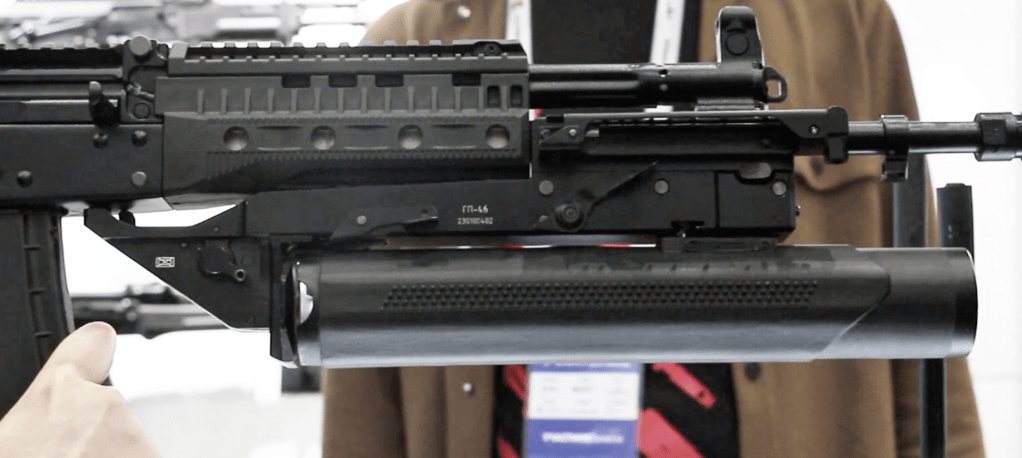
The GP-46 was unveiled by Kalasknikov Concern at the ‘Army-2024’ exposition in August. Unlike other Russian underbarrel grenade launchers the GP-46 is chambered in the Western 40x46mm, the low velocity grenades used in launchers like the M203, and M320. Despite its first public appearance in 2024, the visible serial number indicates that the launcher on display was actually made in 2023. It was reportedly developed in 2023-24 by a design team led by Kalashnikov’s chief small arms designer Sergei Vladimirovich Urzhumtsev.
The GP-46 features ambidextrous controls with mechanical safety selectors, locking mechanism catches and triggers found on both sides of the launcher. The launcher can be mounted on all previous AK-pattern rifles which are able to mount UBGLs.
It’s currently unclear what range of 40x46mm grenades are available for the GP-46 but Kalashnikov’s promotional video on the launcher featured a grenade tipped with what appears to be a VGM fuze used on VOG-pattern grenades.
GP-46 UBGL (Deni Almaskhanov)
Interestingly, Deni noted that the unconventional trigger placement is not entirely new for Kalashnikov. In 2018, Kalashnikov patented another grenade launcher, seemingly one designed around VOG-pattern grenades. That UBGL’s the trigger mechanism was located on the outer cover of the barrel itself. Deni explains that “the latch was to be pressed, unlocking the movement of the cover, the cover was to be pulled backwards. Such design was implemented in order to allow for a double-action trigger action while not requiring lots of strength from the trigger finger”. Deni believes that the GP-46 seems to be following the same philosophy while avoiding overtly complicated design elements.
The GP-46 is aimed using iron sights located on the right side of the launcher. The rear sight allows for shooting at ranges starting at 50 meters, out to 400 meters. The sights also feature a built-in mechanical rangefinder, calibrated for 170 cm (5’7) tall target. Interestingly, the 5.56×45mm AK-19 Type 3 that was used to showcase the grenade launcher at ARMY-2024, also featured what seems to be a new ACOG-style prismatic scope by Dedal-NV, one of Russia’s premium optics manufacturers. Deni notes that the scope featured both rifle and grenade launcher reticles.
GP-46 UBGL sights (Kalashnikov Concern)
It is unlikely the Russian armed forces will be moving away from their in-service 40mm grenade launchers any time soon and it is worth noting that both the GP-46 and the AK-19 it was mounted on are primarily export models. One potential interesting international customer may be India, which has already contracted with Kalashnikov previously. India recently adopted the AK-203, with plans to produce the rifles under license in India.
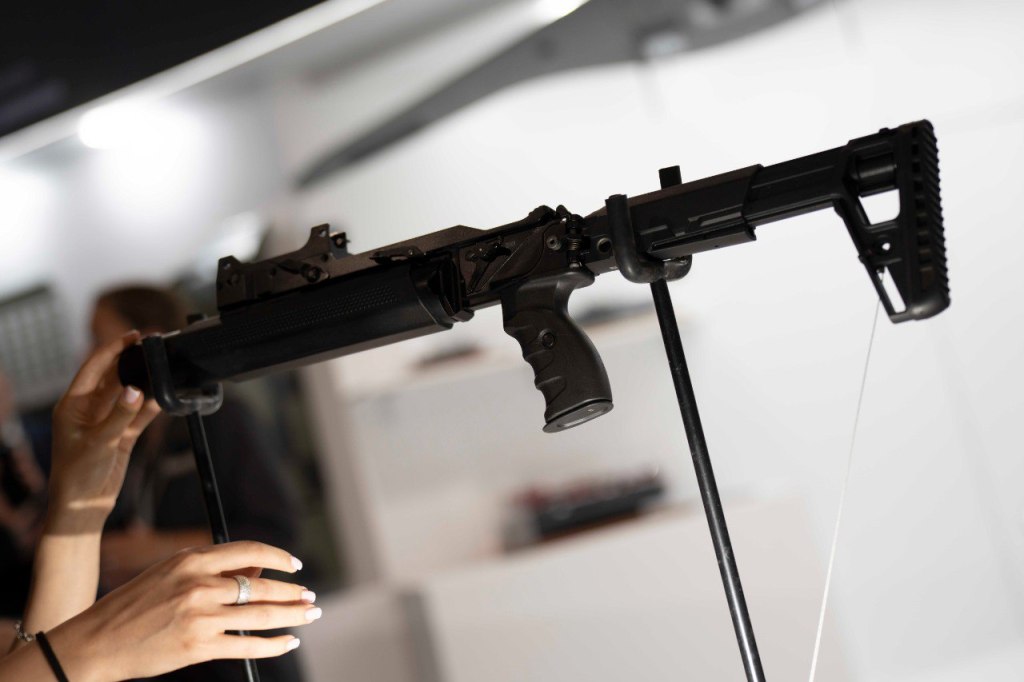
GP-46 in stand alone chassis (Kalashnikov Concern)
Intriguingly, what sets this this grenade launcher apart from the majority of previous Russian UBGLs is the special module that allows it to be used as a stand-alone launcher. The GP-46 mounts onto a stock chassis which consists of a full-size AK-12 Type 1 pistol grip and an adjustable AK-12 Type 3 buttstock. Given the large number of stand alone stock systems for launchers like the GP-25 which have emerged as a result of the war in Ukraine this development isn’t surprising.
Special thanks to Deni for sharing this footage and information with me so I can bring you guys this video. Please do check out Deni’s pages – Telegram, Instagram, Youtube.
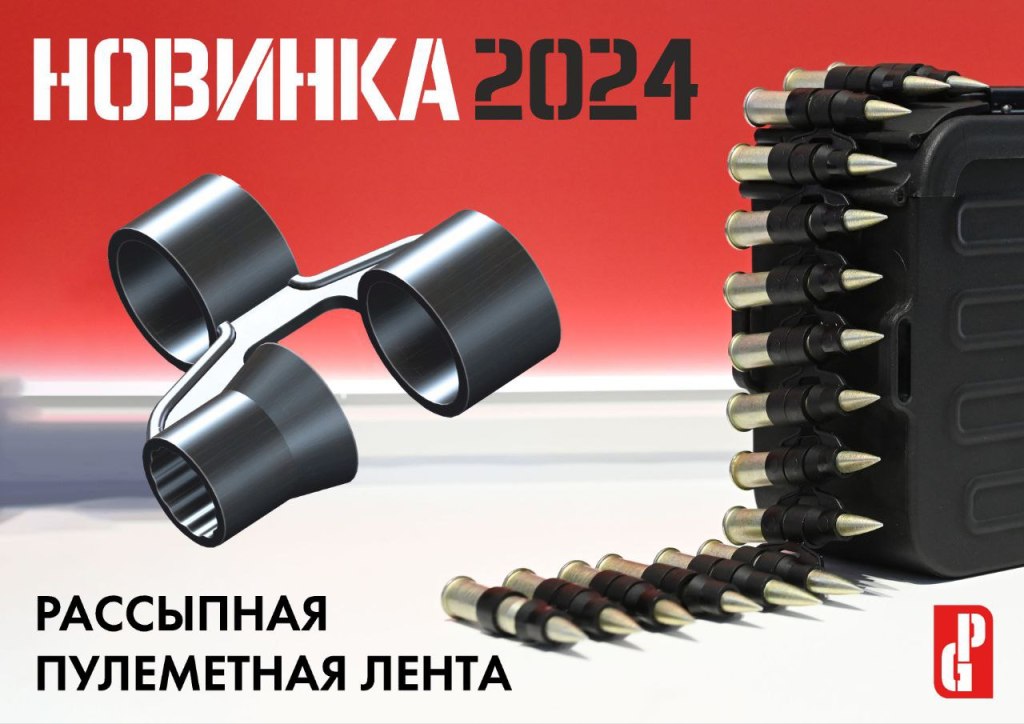
In previous videos we’ve looked at Ukrainian efforts to manufacture polymer belts for PK-pattern general purpose machine guns. These were developed by Ukrainian company RAROG who has been selling them since the summer of 2022. Now PUFGUN, a Russian company has also developed a polymer PK belt.
Traditionally, the 7.62x54mmR belts used by the PK series of guns have been made from metal and are non-disintegrating, meaning they remain linked together after they’ve been used, while NATO machine guns tend to use disintegrating belts that fall apart once the rounds held in them have been fired.
On 3 September, PUFGUN announced the introduction of the new disintegrating belts, explaining some of their features:
“The tape is made of high-strength polymer – a light and durable material. 3 times lighter than metal analogues. The total weight of the package for 100 links is 220g Due to the physical properties of the polymer, the loading of the PUFGUN loose belt is carried out faster than that of a metal belt. Maintains functionality in temperature conditions from -40C to +70C. Not subject to corrosion, does not require special conditions for long-term storage.”
Packs of 100 links are being sold for 548 Rubles or $5.75 on PUFGUN’s website.
PUFGUN shared a pair of photos, on 10 September, comparing the weight of a loaded traditional metal belt with one of their non-disintegrating belts, with the metal belt weighing 2.8kgs while the polymer belt weighed in at 2.37kgs. In the caption they claim that the photos were taken by Russian special forces unit Grom. OSN “Thunder”, who they state has been testing the belts since late August. The post claims Grom’s first impression was ‘quite good’. The post on PUFGUN’s telegram has since been deleted.
On 14 September a video showcasing the belts was posted by Mikha Mikhalych, a Russian gun content-creator, reviewing the belts. In the video two types of belt are featured; the disintegrating belt and a non-disintegrating one. The video also features a polymer belt box developed by PUFGUN, which is said to weigh around 150g. Combining the box with the polymer belts appears to be a meaningful push towards reducing the weight of the PK’s ammunition carriage system.
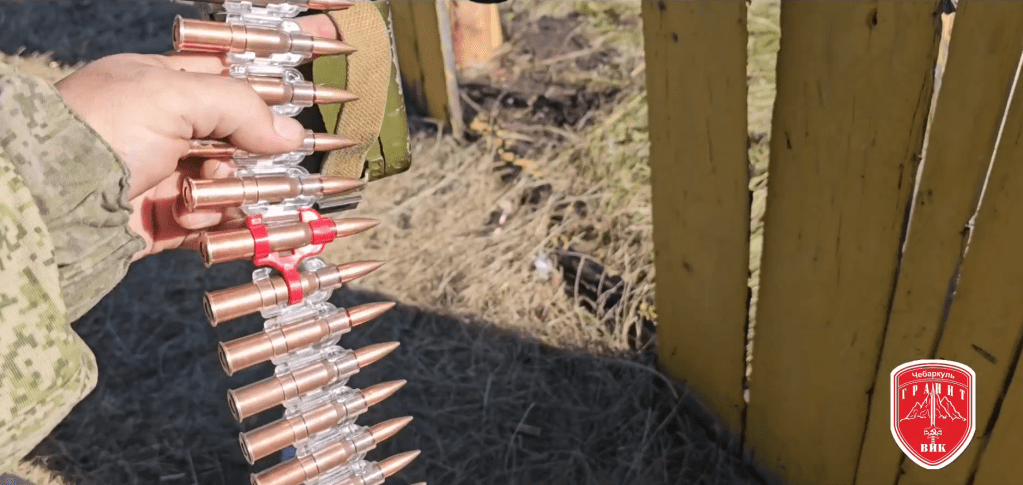
On 26 September, PUFGUN announced the non-disintegrating polymer belts on their social media. These belts share the same technical specifications as the disintegrating belts but notable are made from a clear plastic rather than a black plastic. While these have previously appeared in the earlier video they are not, at the time of publication, available for purchase on the company’s site. It appears that the links will be sold in packs of 100, with a starter tab and four disintegrating connector links which allows 25-round belts to be linked together.
On 9 October, PUFGUN shared a short clip showing their non-disintegrating belt being loaded by an Rakov belt-filling machine. This video was made in collaboration with ‘Granit’, a Russian living history group which appears to have links to the Russian military. Granit also shared their own longer video showing the belts being used in a variety of old and new Russian machine guns ranging from a vintage SG-43 to the latest PK variant the 6P41M.
Much like the Ukrainian KS-122 polymer belts from RAROG, the PUFGUN belts do significantly reduce the weight on the gun itself and more broadly for transporting ready ammunition. PUFGUN have sought to address the need for both disintegrating belts, useful for troops on the move that don’t want to be encumbered by trailing empty belts, while the non-disintegrating belts are more easily reloaded and better suited to use in vehicles or static positions. It’s interesting to see both sides commercially developing polymer belts to address a perceived need shared by both sides.
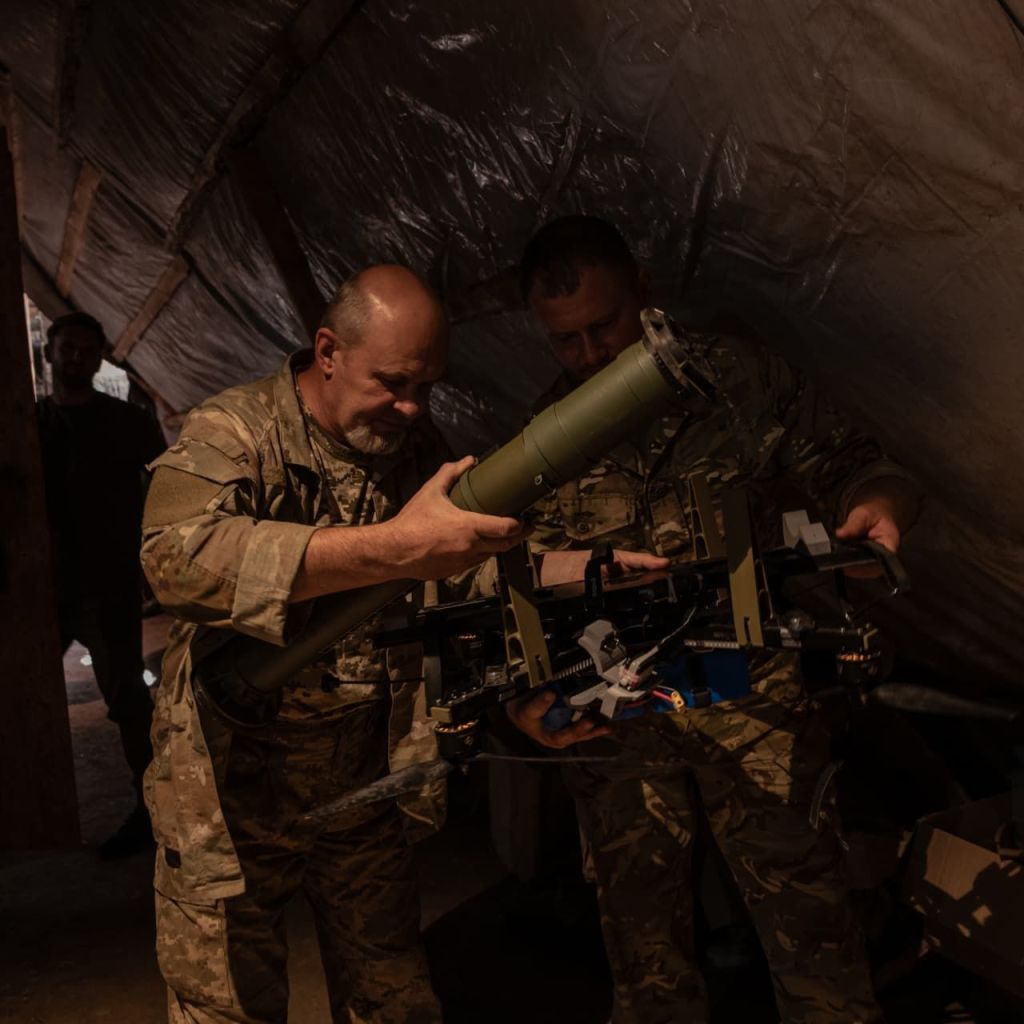
In a recent video/article I mentioned that the Ukraine-aligned Georgian Legion had mounted an RPG-7 on an drone and successfully tested it. Several days later video of another drone equipped with disposable RPG was shared. Posted on 10 September it shows a Queen Hornet FPV equipped with an RPG-18 anti-armour weapon. The drone is seen taking off at a range and hovering. The short clip does not show the RPG-18 being fired.
Claimed as testing footage of a Ukrainian FPV drone equipped with an RPG-18 rocket propelled grenade launcher. pic.twitter.com/syv4qt69Bt
This isn’t the first time a drone with a disposable RPG mounted on it has been seen in Ukraine. In January 2023, a photograph surfaced of a heavy-lift DJI Agras T-30 armed with a gimbal mounted PK-pattern machine gun and a Bulgarian Bullspike anti-armour weapon. The photo has since been shared regularly but with no further context. One post claimed it was associated with a GUR unit (Solnyshko DRB).
Still showing Bulava’s RPG-FPV (via Wild Hornets)
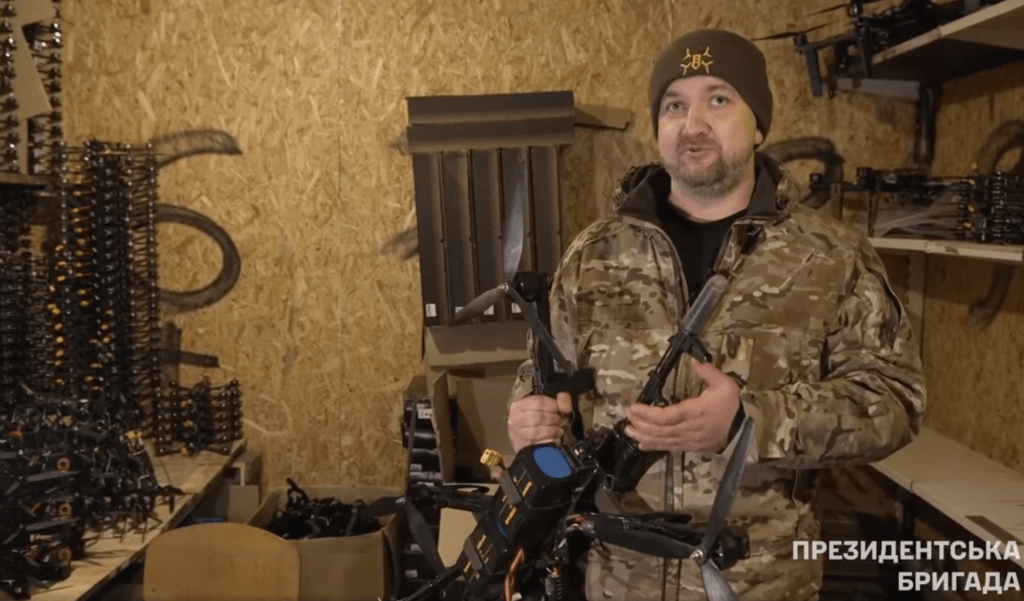
On 13 September, the Wild Hornets (a Ukrainian drone manufacturing organisation) shared a video of another RPG-FPV. The 56 second video, soundtracked by music from Terminator 2, showed a Queen Hornet drone equipped with what appears to be a Bulgarian Bullspike-AT. The efforts to develop an RPG-FPV based on the Queen Hornet appear to be lead by the Bulava drone team, part of the 3rd battalion of the Separate Presidential Brigade. The Bullspike-AT is produced by VMZ and fired a PG-22 pattern warhead, it has an effective range of 500m and can penetrate up to 400mm of armour. It weighs in at around 3.4kg, which is well within the Queen Hornet’s 9.5kg (21lbs) payload. The video shows the RPG-FPV take off and fire at a target down range. The drone can be seen pitching down to aim and then returning level before landing. This appears to have been a test of the assembly of the system to confirm the concept. In the photographs at the beginning of the video it appears that the weapon is fired by a servo arm which depresses the weapon’s trigger.
💥 Successful test of the world's first rocket launcher drone
The Bulava drone unit of the Separate Presidential Brigade named after Bohdan Khmelnytsky installed a rocket launcher on the Queen Hornet FPV drone and conducted a successful test.
The Bulava RPG-FPV was again briefly seen in a fundraising video shared by the unit on 15 September. A close-up of the drone shows an RPG being attached to the drone with a zip-tie and the servo arm trigger mechanism is again visible.
On the 17 September, Wild Hornets shared another short video from the Bulava team, claiming that the team had been working on ‘calibrating the drone grenade launcher’ leading to the ‘shots [becoming] more accurate.’
The unit Bulava is calibrating the drone grenade launcher 🐝☄️
The shots have become more accurate 👊
Please support our drone production so that we can conduct more experiments and achieve even better results:
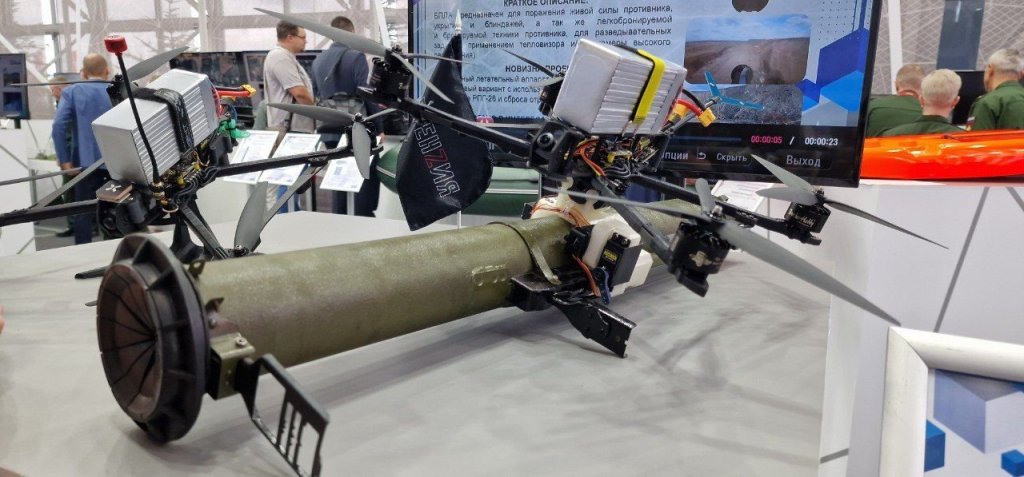
RPG-FPVs are something that Russia has also begun developing with one showcased at the recent ARMY 2024 defence exposition. The drone appears to consist of a ‘Gortensia’ quadcopter armed with an RPG-26 anti-armour weapon. The drones was developed by Гортензия (Gortensia) and has a range of 10km and a payload of up to 6kg. On an info sheet shared at ARMY 2024 the company claims they are developing a system that allows the drone to jettison the empty RPG tube once it has fired. Images from ARMY 2024 show a dovetail-type attachment with a cradle attached to the RPG’s tube. On 18 August, the company shared two videos of test launches of the RPG-armed Gortensia drone. The videos show the drone take off and then the drone pitches down to aim and then fires. On firing the RPG’s tube detaches from the drone, seemingly using the weapon’s recoil to jettison it. In the second video, the drone travels further down range and fires on the target at a flatter trajectory, again the tube detaches from the drone.
‘Gortensia’ quadcopter with an RPG-26 (via social media)
In mid-September Russian government organisation People’s Frontshared a short video showing a octocopter armed with an RPG-22 being tested at the range. The RPG-22 is mounted on its side The long body of the extended RPG-22 body, at 850mm long, seems to somewhat impact the balance of the drone. Despite this the test fire appears to be successful, it’s unclear if this is a development by a drone company or a Russian unit.
While the RPG-FPV has more firepower than the gun-armed drones which have begun to emerge they are still a concept in development. The major positive of the RPG-FPV is the use of an anti-armour weapon which means that the drones aren’t a part of the munition, as in the case of the kamikaze/one-way FPVs, and can be reused. Similarly, the firing of the RPG’s warhead means the drone does not have to be directly over its target as with a bomber drone. This means the RPG-FPV can engage at stand-off distance and has increased survivability. The difficulty, as we’ve seen with the gun-armed drones, is aiming the launcher accurately. It’s still unclear if the drone operators are using the FPV’s primary camera to aim the weapon, this would mean the aiming process might be impacted by latency, the lack of a reticle and poor feed quality. One way to increase hit probability might be to mount the RPG vertically as Nammo did in their tests of an M72-armed drone back in late 2021. The technology and doctrine for RPG-FPVs is still developing so it will be interesting to see how these drones evolve and are employed tactically.
Update 22/9/24:
A video of an RPG-FPV, developed by an unspecified manufacturer, was shared by MASH with the caption (machine translated):
“Meet the new product in the SVO zone – the flying RPG-26. The drone has already passed tests and will soon delight the military on the front lines.
According to our information, the request for the device came from the Ugledar direction, since ours went on the offensive. The first batch of fighters is preparing for flights.
Features: stabilization mode, which does not throw the drone back after firing. On the contrary, the drone returns to the base to replace the grenade launcher. It is equipped with an RPG-26 with armor penetration of 440 mm (and the prospect of installing a “Shmel” flamethrower). It carries up to 12 kg, rises to 800 meters, flies 30 km at a speed of up to 60 km / h. The miracle costs about 600 thousand rubles, the footage shows winter tests.”
Another Russian RPG-FPV!
This footage was shared today showing a Russian drone firing an RPG-26, notably the launcher is mounted at an angle rather than perpendicular!
— Matthew Moss | The Armourer's Bench (@historicfirearm) September 22, 2024
Update – 14/1024: A Wall Street Journalarticle (by Isabel Coles) featured photographs of one of the Ukrainian RPG-FPVs pictured during assembly and range testing.
Update – 8/11/24: An ArmyInform video looking at the Bulava RPG-FPV. It appears to show the same test launch featured in earlier videos.
Update – 29/12/24: A Russia RPG-FPV fires on a building.
A Russian FPV hits a building with a rocket launcher, possibly an RPG-18.The rocket motor burns out completely in the launch tube, so the FPV isn’t hit by backblast.
What is old is new. On 12 September, Russian journalist Alexander Kots shared a photograph of a recoilless gun mounted on a drone on his Kotsnews telegram channel channel. The idea certainly isn’t a new one. The use of a recoilless gun on aerial platforms dates back to the 1910s with the development of a series of recoilless guns by Commander Cleland Davis (US Navy) which were experimentally mounted on a variety of early military aircraft.
While the Davis Gun was abandoned shortly after the end of World War One, it was influential and its principle of operation was utilised in later recoilless guns. Essentially it worked along the premise of Newton’s Third Law of Motion, that all things have an equal and opposite reaction – as such Davis connected two guns back to back, with the backwards-facing gun firing a counter-weight.
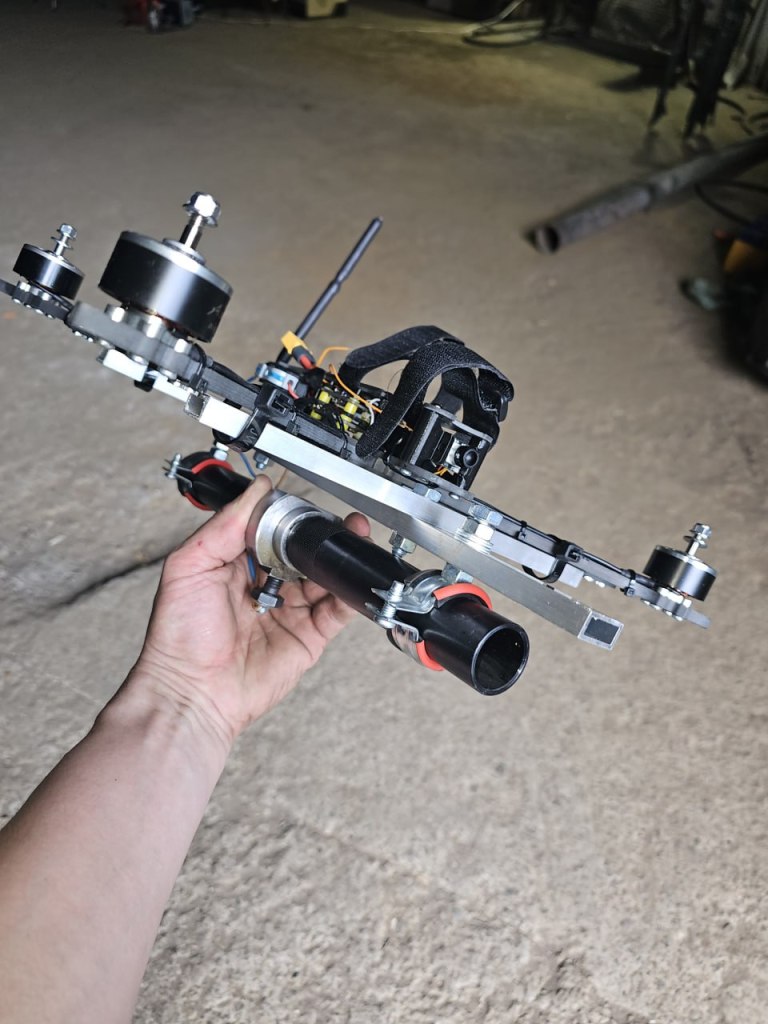
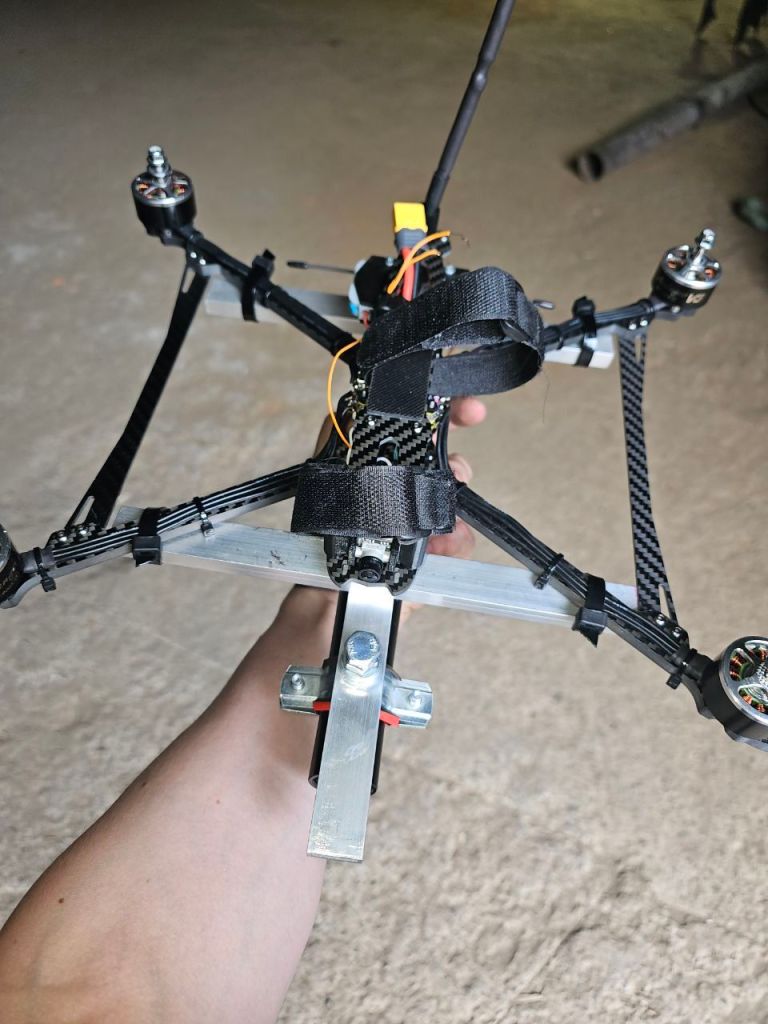
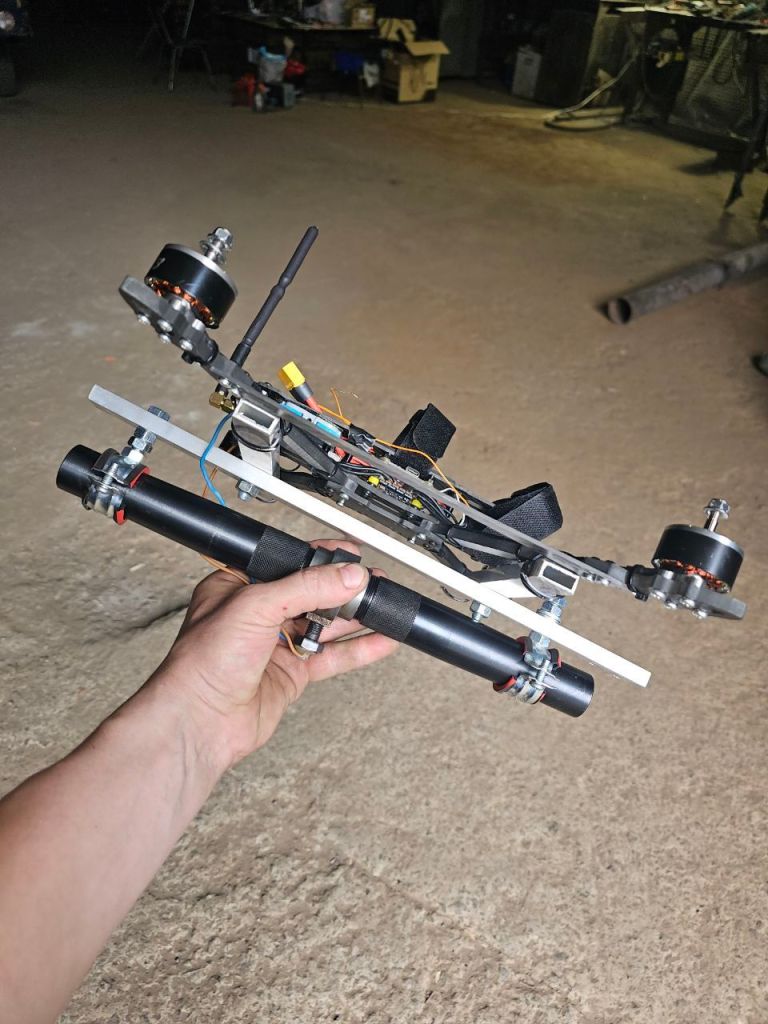
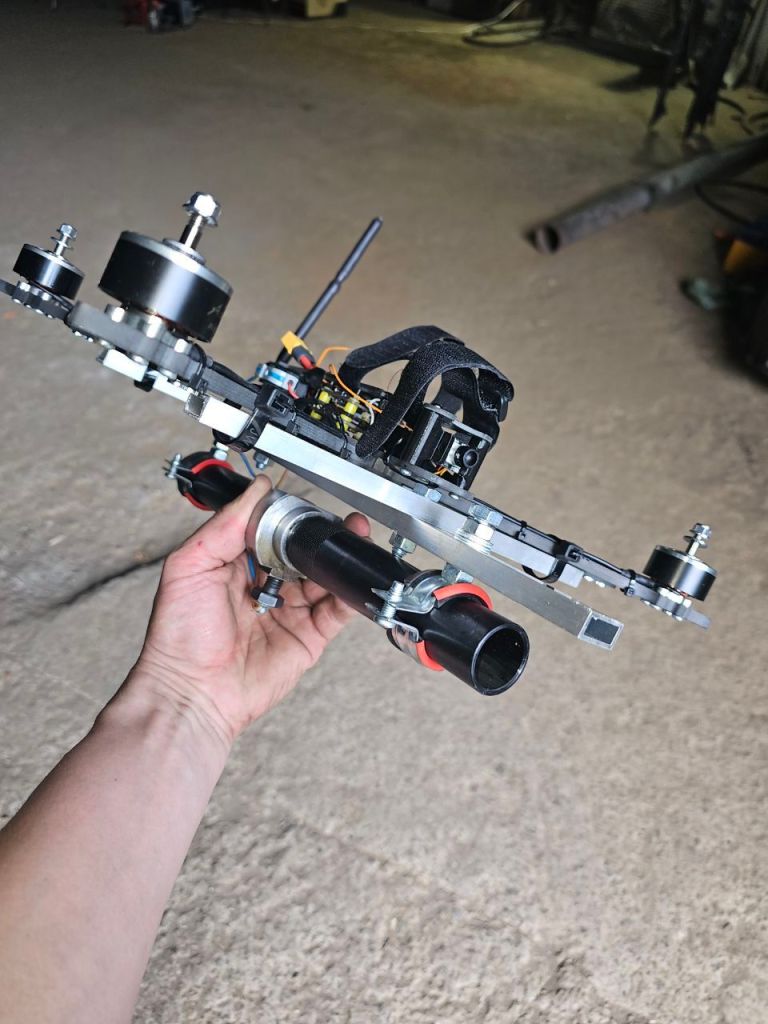
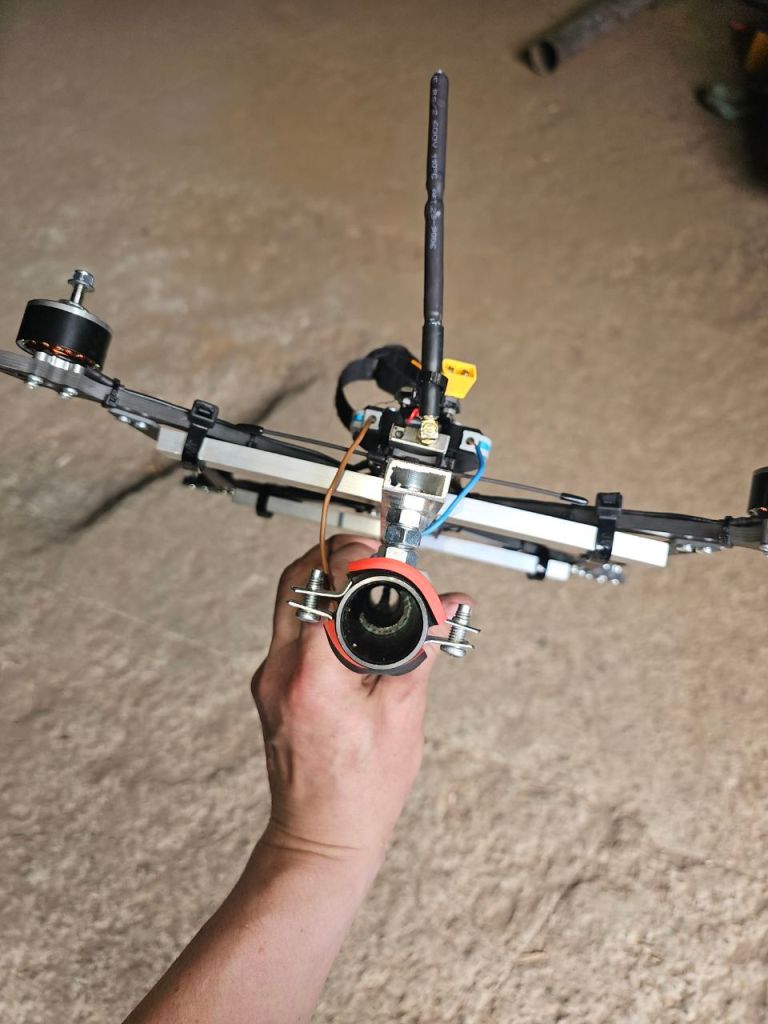
Fast-forward over a century and the concepts is again revisited in miniature and mounted on a quadcopter drone. Kots described the recoilless gun in his post [machine translated]: “Large pellets are loaded in the front, and an equal counterweight is loaded in the back. Thus, a lightweight drone becomes capable of hitting small air targets without the risk of falling into a tailspin from the recoil.” The image shared appears to show a smoothbore weapon attached to the drone with plumbing clamps with several electrical wires running to it, likely for ignition of the charge.
The developer of the drone, the chief engineer of Russian company BRT, shared Kots’ post commenting [machine translated]: “Our BUBUKA hit the news. I made it, taught it to shoot, and gave it to our FPV players… – I don’t fly myself, it’s not my thing,” lamenting that “since then – no response, no greetings. I’m not even sure they tried to test it.”
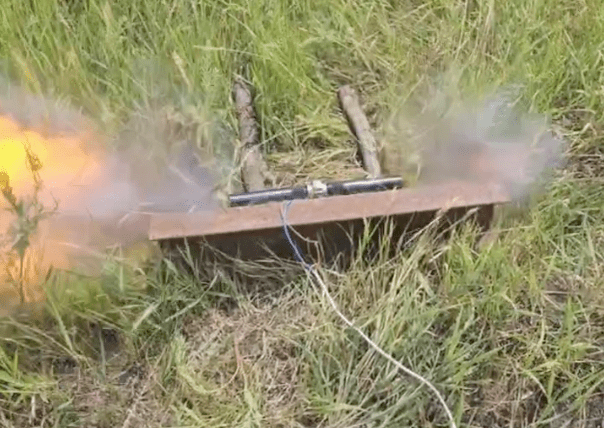
The engineer followed this up by posting footage of a test of the recoilless gun, explaining [machine translated]:
“The principle is fully functional. And it was used more than 100 years ago, on plywood planes. On the FPV, as I see it, for its use, you need to solve 2 main problems: – – aiming at the target. – correct ballistics of shot ammunition (dispersion, mass of shot charge, etc.).”
In the video the engineer exclaims that ‘both ways [fired] just fine’ with the grass in front of both barrels clearly impacted by the test. It’s unclear what kind of shot the recoilless gun is designed to use likely a buckshot-style round able to spread on leaving the barrel and sufficiently damage a drone to down it.
It appears that the ‘Bubuka’ may not yet have been tested or used in the field but it is an interesting design mitigating one of the major factors of firing a weapon from a drone – recoil. However, the recoilless gun has a number of drawbacks too. While the gun allows the drone to engage another drone kinetically without having to fly into it, the gun only has one shot which magnifies the difficulty of scoring a hit when aiming is difficult. It’s clear, however, that the evolution of drone warfare in Ukraine is continuing at pace with recent efforts by both sides to mount AK-pattern rifles to drones and the increasing number of drone vs drone engagements occurring.
Update 28/12/24: It appears that a Ukrainian team has also developed a recoilless gun-armed drone. Several videos were shared of an FPV drone equipped with a pair of barrels which are likely electrically initiated and have counter-weight charges as the earlier Russian drone did. The videos show a series of successful drone vs drone engagements.
This Ukrainian footage of an drone armed with a pair of "shotgun" barrels is intriguing. We'll know more if a photo of the drone appears but it may be using a recoilless system, with a counterweight charge. 1/ pic.twitter.com/GLOypaojNG
— Matthew Moss | Historical Firearms (@historicfirearm) December 28, 2024
Update – 3/1/25: A telegram associated with BRT has posted additional photos of their recoilless gun drone developed in early 2024 and expressed Thier frustration that a similar Ukrainian drone has had operational success.
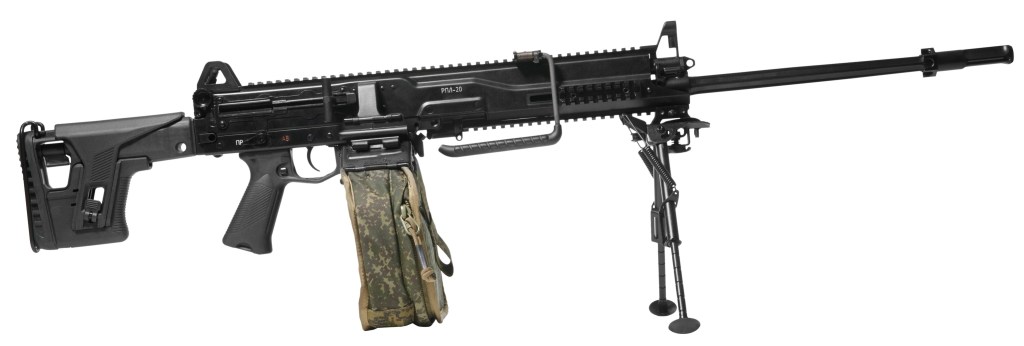
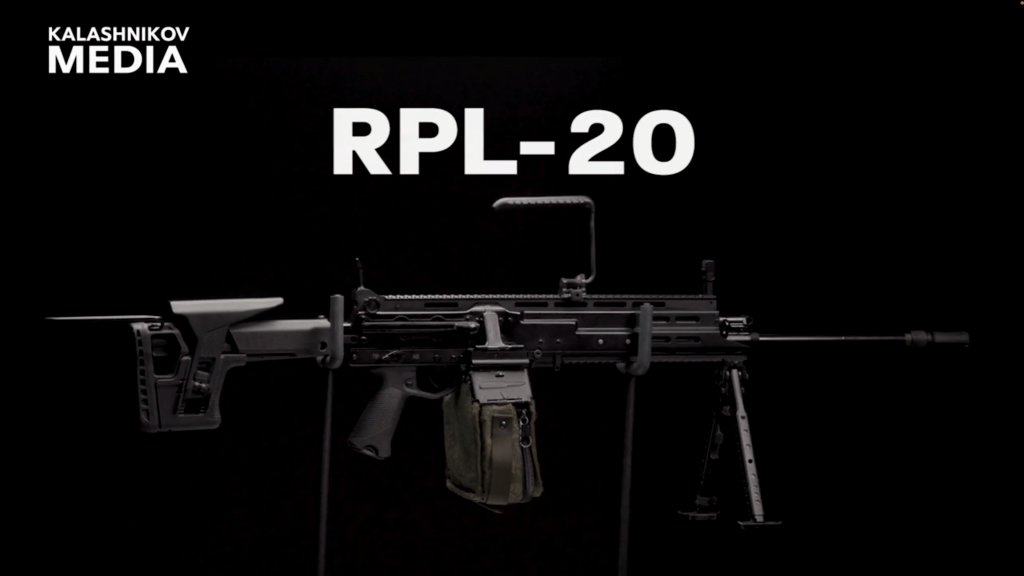
I’m excited to share this collaboration with firearms researcher Deni Almaskhanov, of Just Guns. Deni had the chance to attend the Army 2024 exposition in Moscow earlier this month. He has very kindly shared some great video and information about the latest version of Kalashnikov Concern’s RPL-20 light machine gun.
The RPL-20 at ARMY 2024 (Deni Almaskhanov)
The Russian armed forces haven’t used belt-fed LMGs since 1959 when the RPD was replaced by the RPK. The RPK-74M has been considered obsolescent since 2011. Kalashnikov Concern began exploring an RPK replacement in the 2010s with the RPK-16. The RPK-16 failed to satisfy the military due to issues with overheating and the reliability of its 96-rounds drum magazines. The RPL is a direct follow-up to the ‘Kipchak’ program during which the now extremely rare RPK-16 was trialed.
The RPL-20 was initially unveiled four years ago during the Army 2020 exposition but was stated to still be in development.
RPL-20 in its 2023 iteration (Kalashnikov Concern)
The RPL is a belt-fed light machine gun, chambered in 5.45×39mm, it feeds from metal non-disintegrating belts, carried in 100- or 200-rounds textile boxes, with a quick attach/detach mechanism. It fires from an open bolt but does not have a quick change barrel, although it is possible to replace the barrel during the disassembly of the weapon. This aligns the RPL with the simultaneously emerging Western concept of the light assault machine guns like the FN EVOLYS and the Knight’s Armament LAMG amongst others.
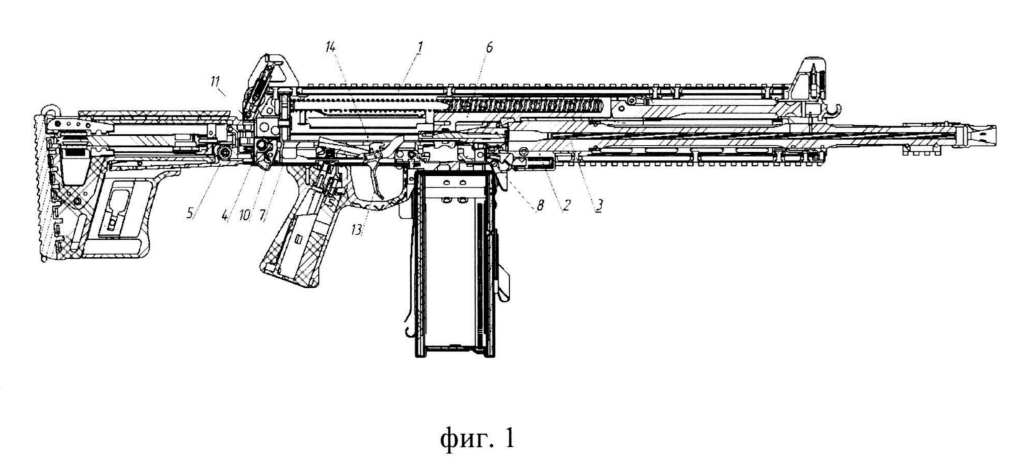
Russian patent diagram for the RPL-20 (Russian Patent Office)
Deni explains that the lower receiver is “fixed with a pin in the front end and a latch in the rear end… the latch is pressed, unlocking the pivoting movement of the lower receiver. Such a design was chosen to address the common requirement for all the modern firearms – a continuous top Picatinny rail that would allow for reliable mounting of accessories and aiming devices.” The receiver can be opened this way to reload, however, a faster and more expedient method of reloading the RPL-20 is to simply push a new belt through the firearm’s feed block and pulling the starter tab until the first round seats.
The RPL-20’s pistol grip and selector (Deni Almaskhanov)
The RPL-20 has a 2-position adjustable gas block mounted onto the barrel. Kalsashnikov Concern’s chief-designer Sergey Urzhumtsev describes the action of the machine gun as ‘an upside-down PKM’, but there are some important mechanical differences, such as the fact that the RPL-20 uses a push-through belt, unlike the PKM which pulls each cartridge backwards from the belt before chambering it.
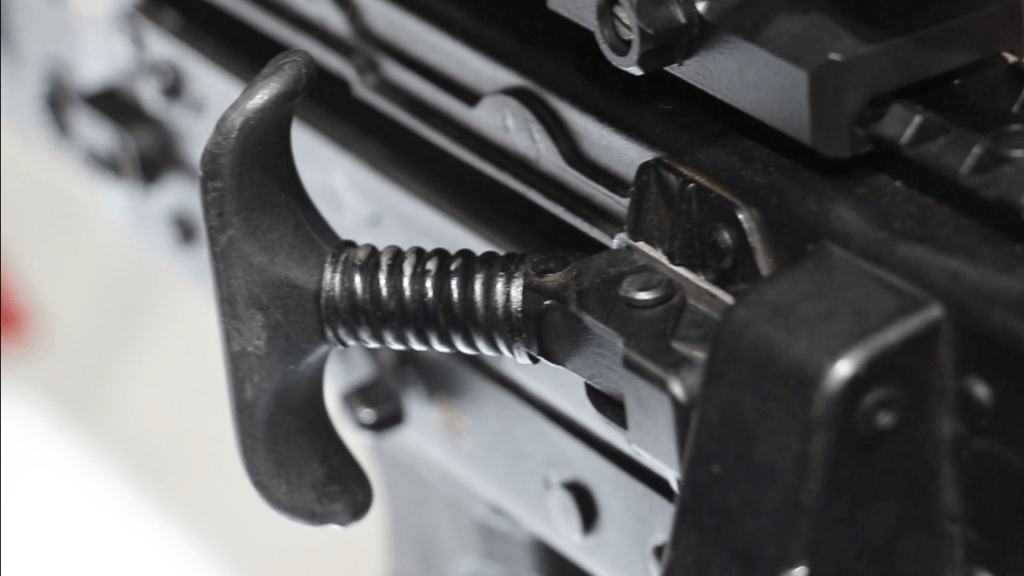
On the right side of the receiver, the RPL has a non-reciprocating T-shaped charging handle mounted onto a strong coil spring that is intended to prevent the charging handle from bending the weapon’s receiver or breaking the handle in the event of a heavy strike against it.
There are selector switches on both the left and right sides of the receiver only and the weapon fires in fully automatic fire only. The pistol grip and the buttstock are the same as those being also used on the 2nd and 3rd generations of the AK-12. The buttstock differs slightly in that it has an adjustable cheek rest and a foldable shoulder rest that can be flipped up over the shoulder. The gun on display was also seen with a cant-adjustable vertical front grip attached to the 6 o’clock rail.
The RPL-20’s charging handle (Deni Almaskhanov)
There is a small Picatinny rail at the muzzle end of the barrel intended for attaching the bipod in the forward position. With an alternate position on the handguard giving the user some tactical flexibility. The handguard is not a separate piece but a continuation of the upper receiver and it is connected to the barrel via the gas block. The weapon has a threaded muzzle device to allow the fitting of suppressors.
There are some notable external changes from the earlier iteration of the RPL. The weapon now has fixed front and rear sight protectors rather than folding iron sights. It also has some changes to the receiver geometry with the receiver no longer having a step but a slope ahead of the breech and more, angled, ventilation holes in the receiver.
RPL-20 as introduced in 2020 (Kalashnikov Concern)
The RPL-20 is reportedly undergoing state trials this year, so its remains to be seen if the light assault machine gun concept is one which the Russian MoD wishes to pursue. The nature of the war in Ukraine means that urban fighting and trench clearing have become increasingly important, perhaps this is a niche into which the RPL would fit.
My special thanks again to Deni for sharing this brilliant footage and information with me so I can bring you guys this video. Please do check out Deni’s pages – Telegram, Instagram, Youtube.
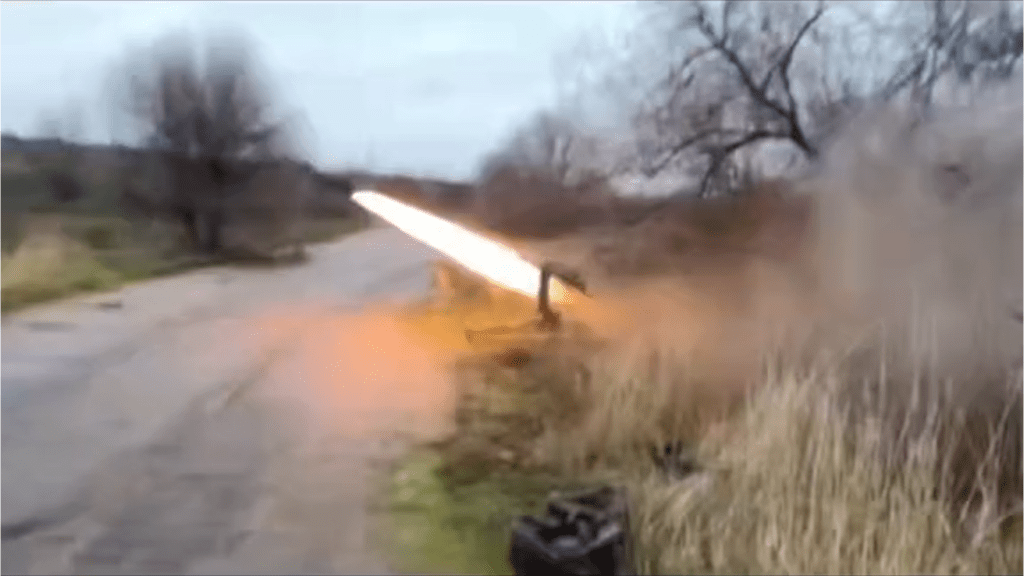
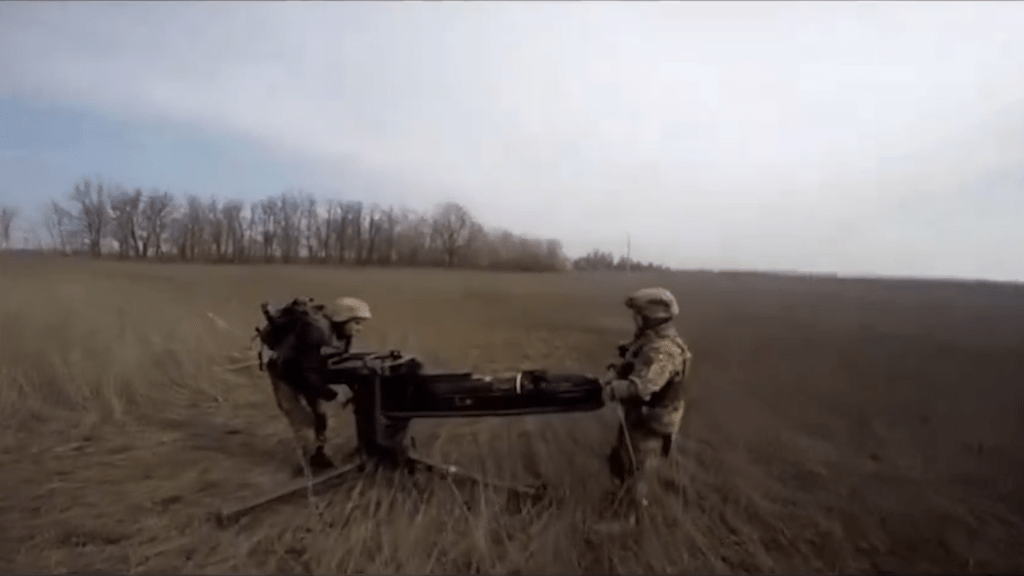
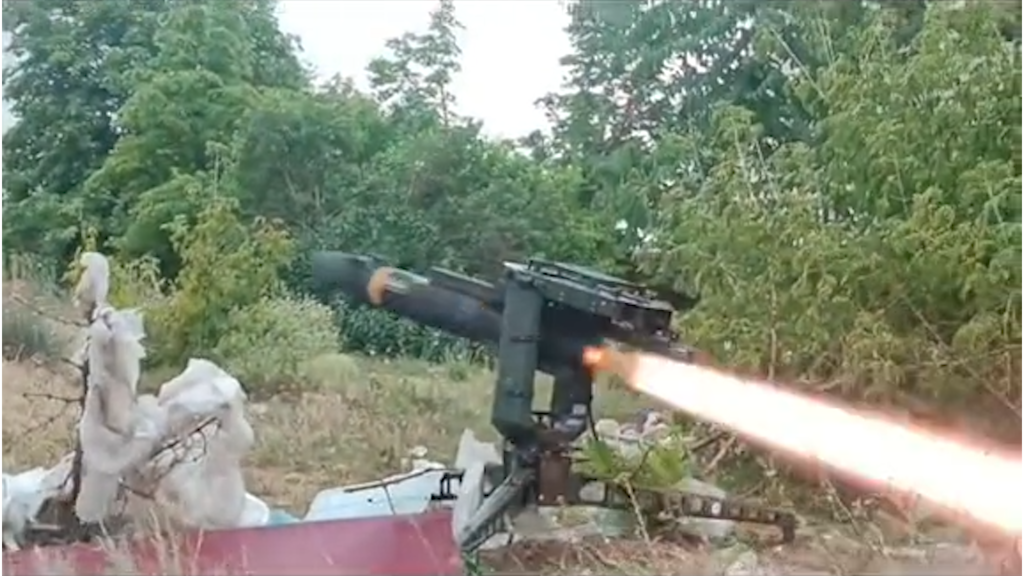
The RBS-17 has been in Ukrainian service for quite some time with Sweden announcing in June 2022, that they would provide the missiles. The RBS-17 was a development of the AGM-114 Hellfire, entering service in the the early 1990s. It is a man-portable missile which weighs 48kg in addition to the launcher, firing system and laser targeting module. It is typically operated in the field by a five man team – two operating the laser targeting system and three on the weapon itself.
We first saw the RBS-17 in use in the field in a video posted in October 2022, by a page called ‘Bigcats’, the lo-res clip shows the launch of a pair of missiles. In December 2023, the Swedish government published an article and video about Ukraine’s use of the RBS-17 and the training the Swedish armed forces provided on the system. Most recently in May 2024, a clip of an Armenian volunteer unit, NEMESIS, showed a team operating an RBS-17. The video shows NEMESIS team members carrying a missile to the launcher, this gives an indication of just how ‘man portable’ they are. They load the missile and then take cover in the nearby tree-line. We can then see one man manning the control unit and the missile is launched.
It is worth noting that Norway has also provided it’s Hellfire Shore Defense System, which is externally very similar in appearance to the RBS-17. Some of the missiles in use are likely Norwegian HSDS.
Since then we have had a series of excellent clips which are amongst the most detailed so far. The clips were posted to various TikTok accounts and show a team, which appears to be attached to one of the Ukrainian Marine brigades, operating the missile system.
My colleague Weapons_Illustrated shared a series of videos he found on a Ukrainian serviceman’s Tiktok channel which were posted in summer 2024 but have since largely been removed. One simply shows a launch of a missile filmed relatively close to the launcher. Another pans along a missile body showing a message scrawled on the casing and also the missile’s lot number ‘98001’. While slightly blurred one Bofors sticker appears to read ‘Norwegian Hellfire Shore Defense Missile ‘ The video concludes showing a night launch across a body of water before cutting to a thermal camera showing an impact downrange. Another video shows the missile control system before cutting to showing a missile launch and then a clip of a strike on a large building which has its roof blown off. A video posted by the same channel on 20 July included a new launch video showing a missile being fired before cutting to a screen showing the destruction of a building near a large body of water. The landscape visible may suggest the footage was filmed along the Dnieper River, possibly near Krynky.
With further research I came across another affiliated account which had a number of videos showing the launch of RBS-17s dating back to January 2023. The first video posted on 3 January shows a launch of an RBS-17 with a picture-in-picture video of the operator at the launch control terminal. On the 5 March another video was posted from the same position, when the videos were actually filmed is difficult to confirm, this time the video also concluded with a clip of the impact of the missile on a target, a large building, downrange. On 13 May, a short video of the RBS-17s control terminal lit up was shared. A video posted by the account on 23 October, includes a slowed down clip of a launch and a clip showing a missile hit a target building.
The most recent video, posted on 11 December, features the launch of an RBS-17 filmed with multiple camera angles. One shows the video from the launch control station with a picture-in-picture view of the operator at the controls as well as a show showing the missile leaving the launcher, which has been positioned on a road. The video concludes with some overwatch drone feed footage of an impact on a building.
Update – 15/08/24:
One of the accounts which previously shared launch videos also recently shared a new video of a missile being launched from the edge of a field. Given earlier videos posted by the same individual showed HSDS markings this missile may also be a Norwegian HSDS.
#Ukraine: New video of the use of the #Norwegian 🇳🇴 Hellfire Shore Defense System (HSDS) by 🇺🇦 #Ukrainian forces somewhere on the front line.










 The Armourers Bench