Kalashnikov Concerns Folding Single-shot Anti-Drone Shotgun

Kalashnikov Concern’s press office announced that specialists from the Central Research Institute of Precision Engineering (JSC TsNIITochMash) Research Center for Small Arms Systems and Combat Equipment were awarded gold medals at the 2026 N. G. Slavyanov International Exhibition of Inventions and Innovations for a number of counter-drone designs. JSC TsNIITochMash is a part of Russia’s Rostec State Corporation, and which is managed by JSC Kalashnikov Concern.

One of the designs was described as a “compact, single-shot shotgun chambered for 12x70mm [12 gauge] cartridges is designed to engage small, low-flying UAVs. The weapon’s main advantage is its compact size and light weight, weighing only 1.8 kg.” The weapon essentially appears to be a linear tube capable of being folding in two for transport. The ergonomics are limited and the barrel is relatively short.
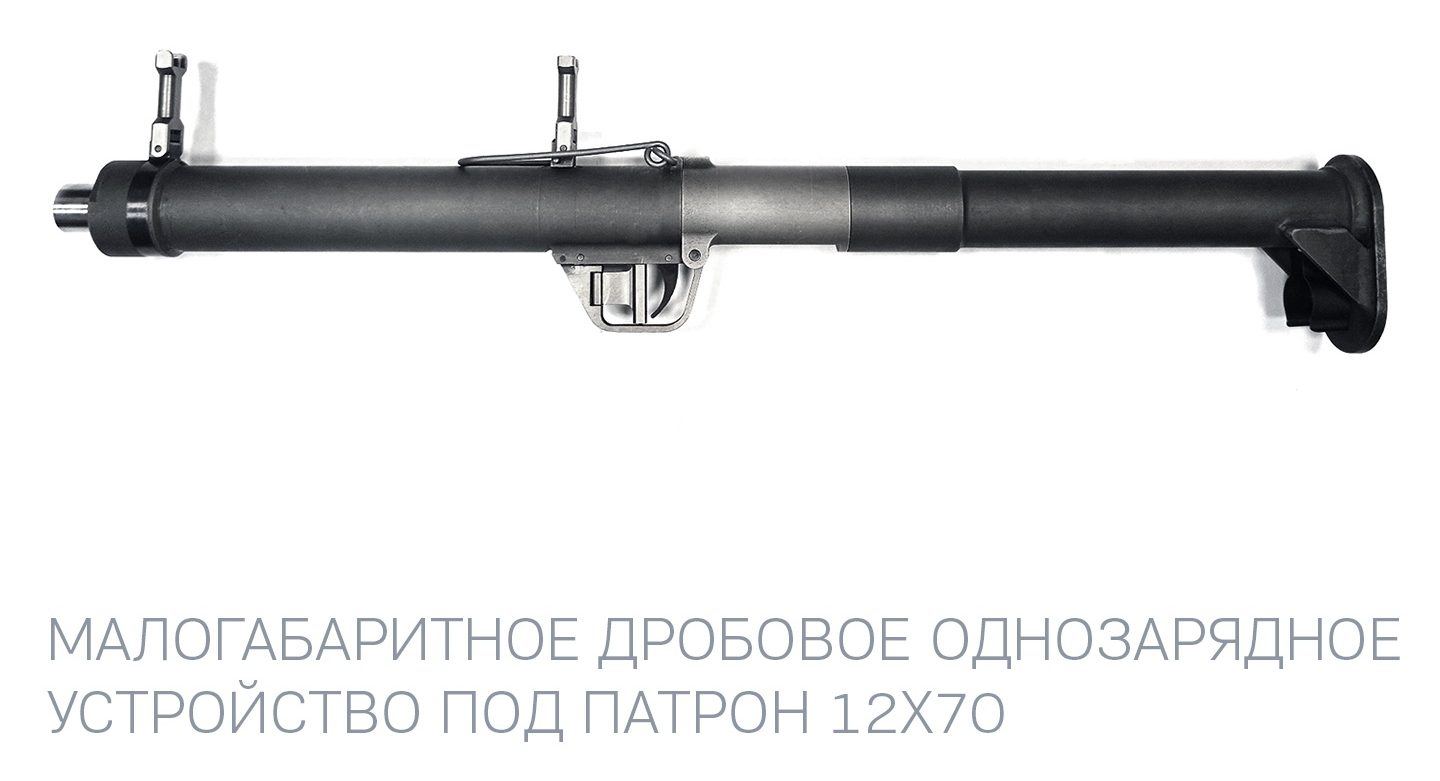
Folding 12ga C-UAS shotgun (Kalashnikov Concern)

From the limited information available and the single image which has been shared of the shotguns it appears that the weapon may break just behind the trigger guard and hinges back so the two halves run perpendicular. The muzzle appears to clip into the buttstock. The trigger guard incorporates a trigger block safety but the hypothesised folding design would mean the trigger and trigger guard would have to recess into the body of the weapon or to the side of the tube. The shotgun has a pair of folding iron sights.

The weapon perhaps loads when the two halves are broken but this would mean there is either a method of retaining the cartridge in the weapon or it has to be carried unloaded which would defeat the purpose of a compact anti-drone personal defence shotgun. Until additional imagery of the weapon appears these characteristics remain hypothetical and largely unconfirmed.
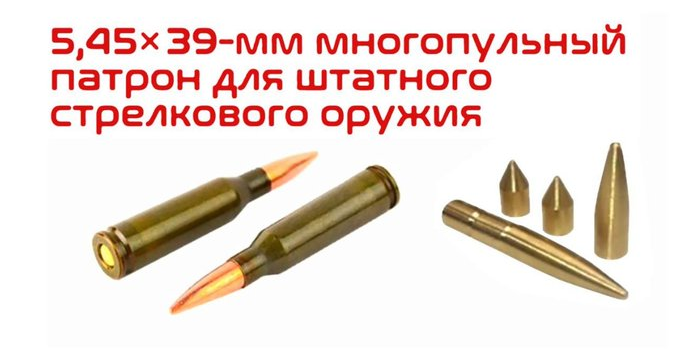
Duplex C-UAS ammunition (Kalashnikov Concern)

Also said to have won the award is a triplex-style rifle round with a three projectiles. These have been developed to match the form factors of conventional 5.45x39mm and 7.62x54mmR ammunition. The press release stated that the “multi-bullet cartridges are designed for individual small arms and contain a multi-element projectile that significantly increases the probability of engaging UAVs. This design solution ensures that the cartridge’s components separate orderly upon exiting the barrel, improving the stability of external ballistic characteristics while maintaining the weapon’s reliable operation.” This ammunition development revisits a concept which has been explored in the past. Through industrial manufacture, with proper quality control and materials, it may offer some benefits over the ad-hoc AK-buckshot rounds which have evolved.

It’s unclear if Kalashnikov have plans to put the new shotgun into production or if it simply represents the latest experimental efforts to provide individual soldiers with a weapon which can provide some counter to the pervasive threat of FPV drones. Full details on the design are not yet available and its utility remains debatable as while the shotgun is said to be relatively light it still represents 1.8 kg or 4lbs of extra kit a soldier would have to carry. The weapon has to be deployed and only offers one chance to engage the drone threat before having to be reloaded.


Support Us: If you enjoyed this video and article please consider supporting our work here. We have some great perks available for Patreon Supporters – including early access to custom stickers and early access to videos! Thank you for your support!

New Russian Grenade Launcher – GP-46

A couple of months ago we took a look at Kalashnikov Concern’s new belt-fed machine gun, the RPL-20. That video was made in collaboration with firearms researcher Deni Almaskhanov, of Just Guns. Deni has also kindly shared some video of Kalashnikov’s new GP-46 grenade launcher.

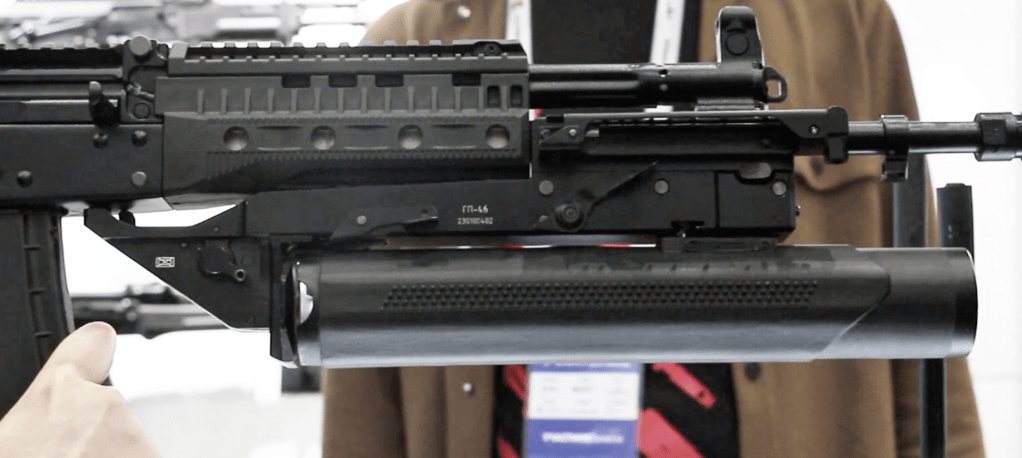
The GP-46 was unveiled by Kalasknikov Concern at the ‘Army-2024’ exposition in August. Unlike other Russian underbarrel grenade launchers the GP-46 is chambered in the Western 40x46mm, the low velocity grenades used in launchers like the M203, and M320. Despite its first public appearance in 2024, the visible serial number indicates that the launcher on display was actually made in 2023. It was reportedly developed in 2023-24 by a design team led by Kalashnikov’s chief small arms designer Sergei Vladimirovich Urzhumtsev.

GP-46 UBGL & 40x46mm grenades (Kalashnikov Concern)

The GP-46 features ambidextrous controls with mechanical safety selectors, locking mechanism catches and triggers found on both sides of the launcher. The launcher can be mounted on all previous AK-pattern rifles which are able to mount UBGLs.

Kalashnikov Concern list its specs as:

  • Length: 380mm
  • Caliber: 40mm
  • Weight: 1.6kg
  • Rate of Fire: 5-6 rounds per minute

It’s currently unclear what range of 40x46mm grenades are available for the GP-46 but Kalashnikov’s promotional video on the launcher featured a grenade tipped with what appears to be a VGM fuze used on VOG-pattern grenades.

GP-46 UBGL (Deni Almaskhanov)

Interestingly, Deni noted that the unconventional trigger placement is not entirely new for Kalashnikov. In 2018, Kalashnikov patented another grenade launcher, seemingly one designed around VOG-pattern grenades. That UBGL’s the trigger mechanism was located on the outer cover of the barrel itself. Deni explains that “the latch was to be pressed, unlocking the movement of the cover, the cover was to be pulled backwards. Such design was implemented in order to allow for a double-action trigger action while not requiring lots of strength from the trigger finger”. Deni believes that the GP-46 seems to be following the same philosophy while avoiding overtly complicated design elements.

Kalashnikov Concern 2018 UBGL design for 40mm VOG-pattern grenades (Russian Patent #2694383)

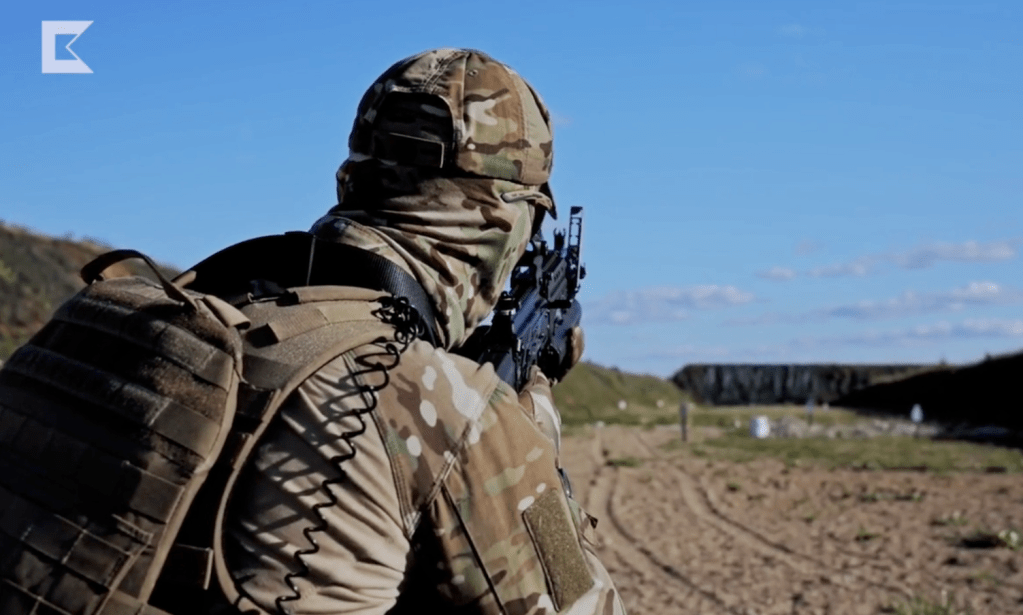
The GP-46 is aimed using iron sights located on the right side of the launcher. The rear sight allows for shooting at ranges starting at 50 meters, out to 400 meters. The sights also feature a built-in mechanical rangefinder, calibrated for 170 cm (5’7) tall target. Interestingly, the 5.56×45mm AK-19 Type 3 that was used to showcase the grenade launcher at ARMY-2024, also featured what seems to be a new ACOG-style prismatic scope by Dedal-NV, one of Russia’s premium optics manufacturers. Deni notes that the scope featured both rifle and grenade launcher reticles.

GP-46 UBGL sights (Kalashnikov Concern)

It is unlikely the Russian armed forces will be moving away from their in-service 40mm grenade launchers any time soon and it is worth noting that both the GP-46 and the AK-19 it was mounted on are primarily export models. One potential interesting international customer may be India, which has already contracted with Kalashnikov previously. India recently adopted the AK-203, with plans to produce the rifles under license in India.

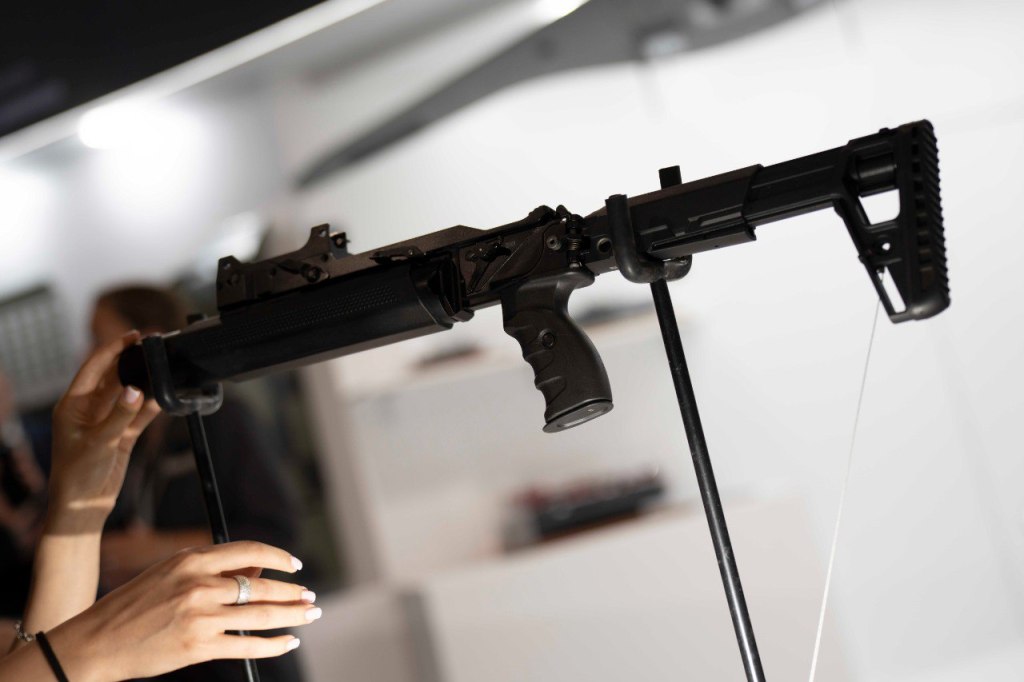
GP-46 in stand alone chassis (Kalashnikov Concern)

Intriguingly, what sets this this grenade launcher apart from the majority of previous Russian UBGLs is the special module that allows it to be used as a stand-alone launcher. The GP-46 mounts onto a stock chassis which consists of a full-size AK-12 Type 1 pistol grip and an adjustable AK-12 Type 3 buttstock. Given the large number of stand alone stock systems for launchers like the GP-25 which have emerged as a result of the war in Ukraine this development isn’t surprising.

Special thanks to Deni for sharing this footage and information with me so I can bring you guys this video. Please do check out Deni’s pages – Telegram, Instagram, Youtube.


Support Us: If you enjoyed this video and article please consider supporting our work here. We have some great perks available for Patreon Supporters – including early access to custom stickers and early access to videos! You can also find us on the History of Weapons & War app. Thank you for your support!

RPL-20 – Russia’s New Light Machine Gun

I’m excited to share this collaboration with firearms researcher Deni Almaskhanov, of Just Guns. Deni had the chance to attend the Army 2024 exposition in Moscow earlier this month. He has very kindly shared some great video and information about the latest version of Kalashnikov Concern’s RPL-20 light machine gun. 

The RPL-20 at ARMY 2024 (Deni Almaskhanov)

The Russian armed forces haven’t used belt-fed LMGs since 1959 when the RPD was replaced by the RPK. The RPK-74M has been considered obsolescent since 2011. Kalashnikov Concern began exploring an RPK replacement in the 2010s with the RPK-16. The RPK-16 failed to satisfy the military due to issues with overheating and the reliability of its 96-rounds drum magazines. The RPL is a direct follow-up to the ‘Kipchak’ program during which the now extremely rare RPK-16 was trialed. 

The RPL-20 was initially unveiled four years ago during the Army 2020 exposition but was stated to still be in development. 

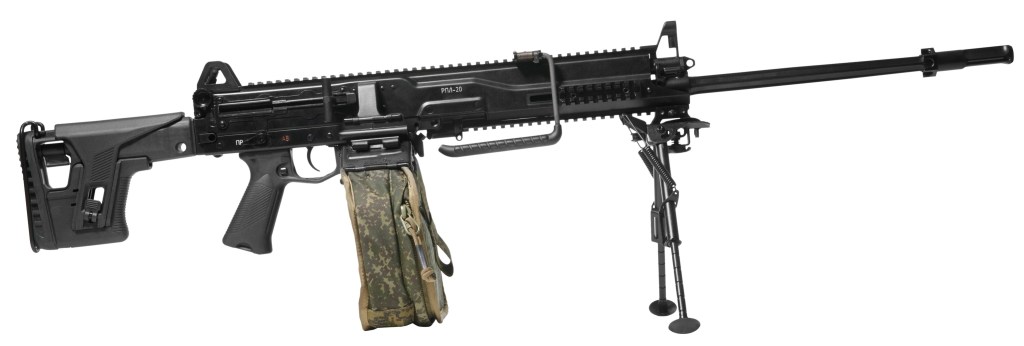
RPL-20 in its 2023 iteration (Kalashnikov Concern)

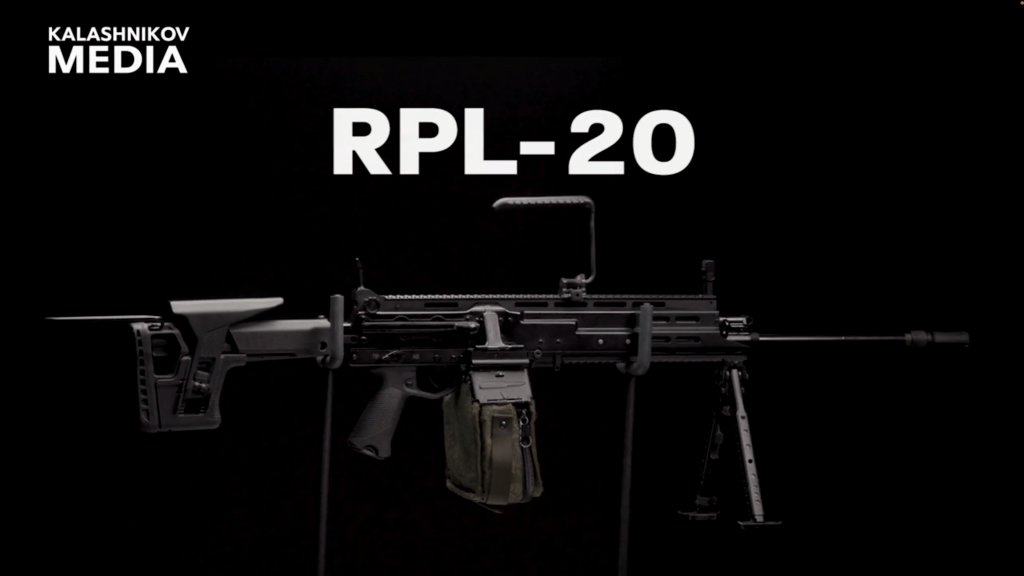
The RPL is a belt-fed light machine gun, chambered in 5.45×39mm, it feeds from metal non-disintegrating belts, carried in 100- or 200-rounds textile boxes, with a quick attach/detach mechanism. It fires from an open bolt but does not have a quick change barrel, although it is possible to replace the barrel during the disassembly of the weapon. This aligns the RPL with the simultaneously emerging Western concept of the light assault machine guns like the FN EVOLYS and the Knight’s Armament LAMG amongst others.

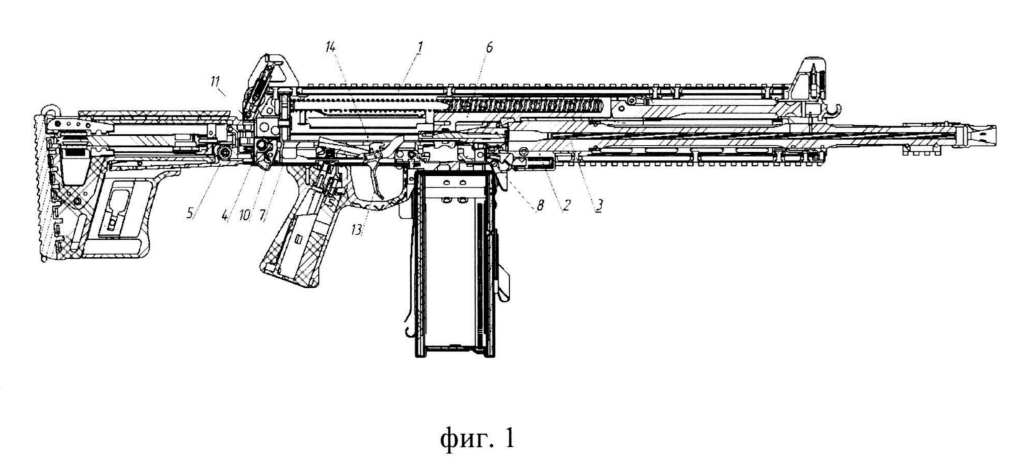
Russian patent diagram for the RPL-20 (Russian Patent Office)

Deni explains that the lower receiver is “fixed with a pin in the front end and a latch in the rear end… the latch is pressed, unlocking the pivoting movement of the lower receiver. Such a design was chosen to address the common requirement for all the modern firearms – a continuous top Picatinny rail that would allow for reliable mounting of accessories and aiming devices.” The receiver can be opened this way to reload, however, a faster and more expedient method of reloading the RPL-20 is to simply push a new belt through the firearm’s feed block and pulling the starter tab until the first round seats. 

The RPL-20’s pistol grip and selector (Deni Almaskhanov)

The RPL-20 has a 2-position adjustable gas block mounted onto the barrel. Kalsashnikov Concern’s chief-designer Sergey Urzhumtsev describes the action of the machine gun as ‘an upside-down PKM’, but there are some important mechanical differences, such as the fact that the RPL-20 uses a push-through belt, unlike the PKM which pulls each cartridge backwards from the belt before chambering it. 

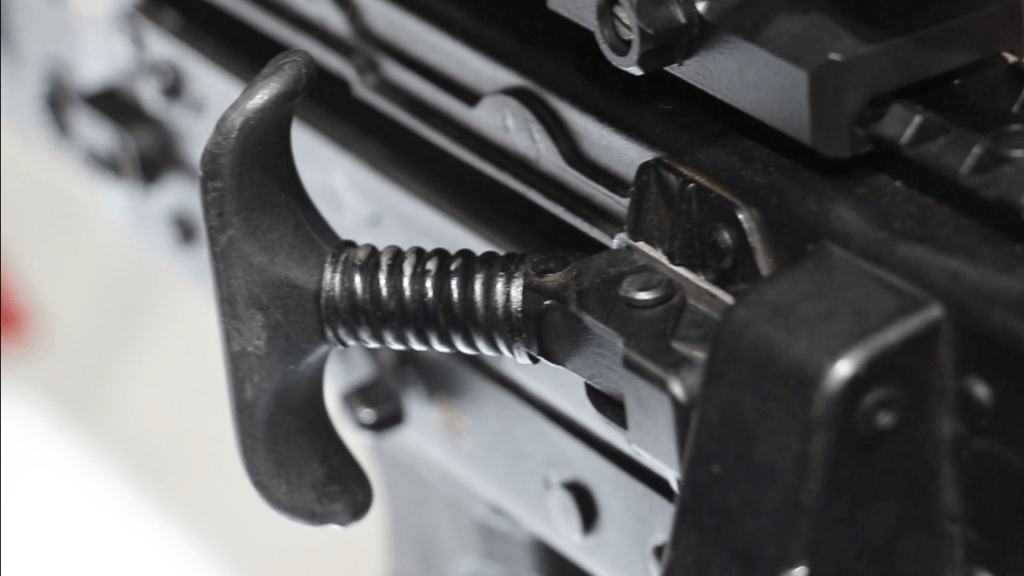
On the right side of the receiver, the RPL has a non-reciprocating T-shaped charging handle mounted onto a strong coil spring that is intended to prevent the charging handle from bending the weapon’s receiver or breaking the handle in the event of a heavy strike against it.

There are selector switches on both the left and right sides of the receiver only and the weapon fires in fully automatic fire only. The pistol grip and the buttstock are the same as those being also used on the 2nd and 3rd generations of the AK-12. The buttstock differs slightly in that it has an adjustable cheek rest and a foldable shoulder rest that can be flipped up over the shoulder. The gun on display was also seen with a cant-adjustable vertical front grip attached to the 6 o’clock rail.

The RPL-20’s charging handle (Deni Almaskhanov)

There is a small Picatinny rail at the muzzle end of the barrel intended for attaching the bipod in the forward position. With an alternate position on the handguard giving the user some tactical flexibility.
The handguard is not a separate piece but a continuation of the upper receiver and it is connected to the barrel via the gas block. The weapon has a threaded muzzle device to allow the fitting of suppressors.

There are some notable external changes from the earlier iteration of the RPL. The weapon now has fixed front and rear sight protectors rather than folding iron sights. It also has some changes to the receiver geometry with the receiver no longer having a step but a slope ahead of the breech and more, angled, ventilation holes in the receiver.  

RPL-20 as introduced in 2020 (Kalashnikov Concern)

The RPL-20 is reportedly undergoing state trials this year, so its remains to be seen if the light assault machine gun concept is one which the Russian MoD wishes to pursue. The nature of the war in Ukraine means that urban fighting and trench clearing have become increasingly important, perhaps this is a niche into which the RPL would fit.

My special thanks again to Deni for sharing this brilliant footage and information with me so I can bring you guys this video. Please do check out Deni’s pages – Telegram, Instagram, Youtube.


Support Us: If you enjoyed this video and article please consider supporting our work here. We have some great perks available for Patreon Supporters – including early access to custom stickers and early access to videos! You can also find us on the History of Weapons & War app. Thank you for your support!