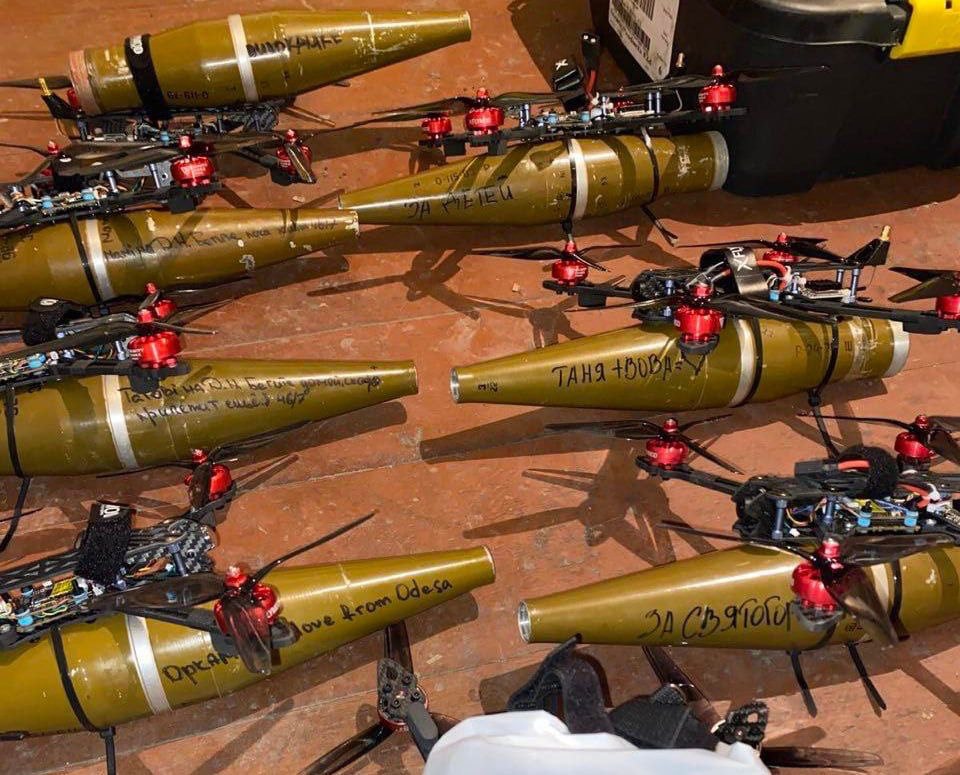
Heavy Drone Bombers Dropping Anti-Tank Mines

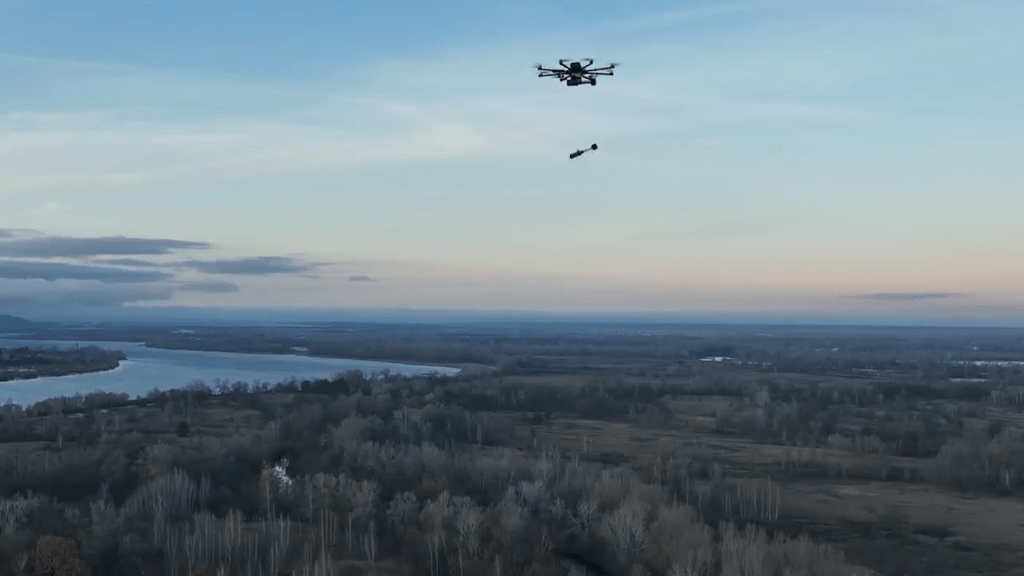
Drone warfare in Ukraine is one of the war’s most rapidly evolving elements with considerable innovation and improvisation. In recent weeks several videos have been shared showing large drones dropping TM-62 anti-tank mines.

The first video shared on 3 September showed how a mine could be carried and released by a large six-rotor drone. The TM-62M is seen loaded into a cradle tray which is then remotely triggered causing the floor plate to hinge and release the mine. The video also shows how the TM-62 is fuzed with a UZRG-pattern hand grenade fuze, pushed directly into the mine’s explosive through a hole cut in the side of its casing.
The TM-62M is a high-explosive blast landmine designed to immobilise or destroy vehicles. The mine is packed with 7.5kg (17lbs) of explosive and is normally centrally fuzed by a pressure fuze. The TM-62M is a significant payload for a bomber drone and when dropped they have significant blast effect.

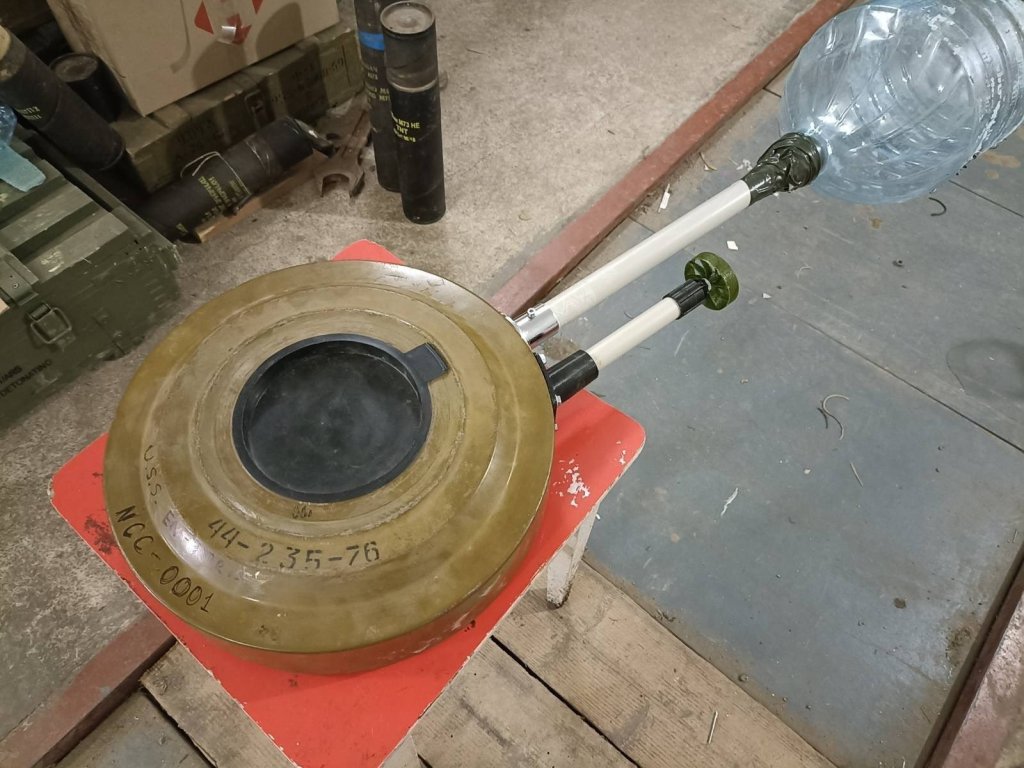
A subsequent video, shared on 6 September, shows a series of clips filmed by the bomber drone’s camera showing the TM-62 being dropped on numerous targets. The mines in this video have been significantly adapted with a stabilising tail added. The tail appears to be made up of a length of PVC pipe and a large water battle with its base cut off. The tail appears to be quite effective especially given the mine’s considerable weight and poor aerodynamics. It is also notable that the fuzing system appears to be different in the second video. Rather than a hand grenade fuze it appears that a larger fuze has been used, positioned next to the stabilising tail.

With the tail and its cut down water bottle its unlikely the release system for this munition is the same as that seen in the first video. A system which would allow for a smooth release and not snag the tail assembly would be needed. In several of the clips in the second video a strap swings past the drone’s camera perhaps suggesting there is a sling system in use.

A subsequent photograph shared on social media shows one of the mines in much better resolution. The tail is indeed made from PVC piping and a water bottle and the fuze appears to be vane-armed. The makers also have a sense of humour likening the odd-looking munition to the ‘USS Enterprise’ from Star Trek, they’ve written ‘USS Enterprise NCC-0001’ on the forward section of the mine.

At the same time as the photograph a number of additional videos showing the TM-62 based bombs being dropped were shared. These videos were originally shared towards the end of August and show a series of successful munition drops.

We are seeing a trend towards more sophisticated and more capable drone bombers which can carry either greater numbers of smaller bombs or larger singular bombs like the TM-62 munition.

Update – 1/10/23

The K-2 drone team with the 54th Brigade has shared footage of one of their drones dropping TM-62s mines on a Russian checkpoint and storage position. The drone appears to drop several unadapted TM-62s, though the lag time between landing and detonation would indicate they are not equipped with an impact fuze but perhaps a grenade fuze as seen in the initial videos featuring TM-62s. The resolution of the thermal cameras does not make it possible to identify the method of fuzing.
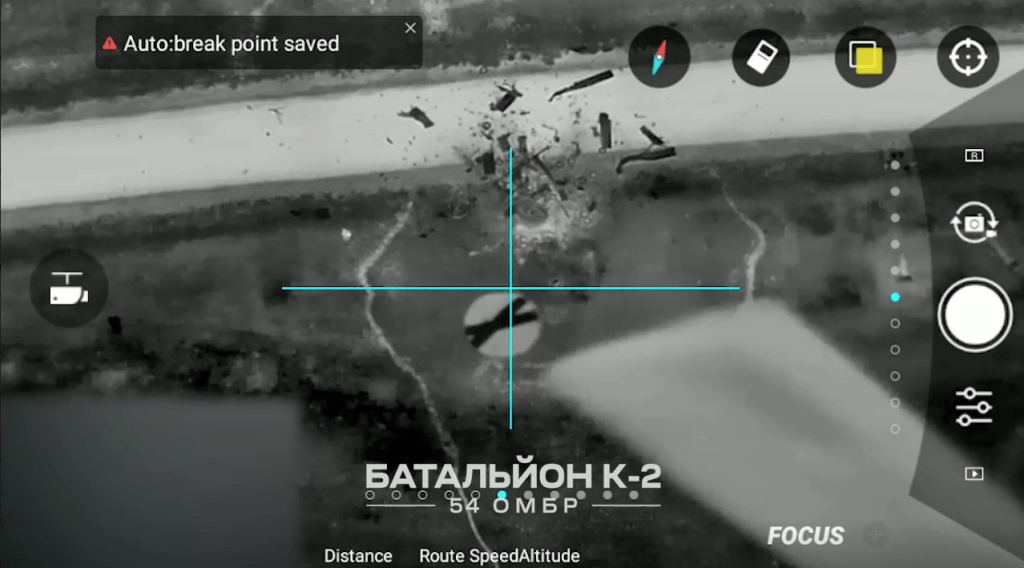
Note the falling TM-62 (with tape) and the swinging drop tray (K-2)

The release system appears to consist of a tray which holds the mine which is suspended by straps which are released to drop the munition. The tray can be seen swinging beneath the drone after one of the drops. The munitions appear to have tape around them, the reason for this is unclear, perhaps protecting the fuze system.

Update – 5/1/24: A video compilation showing numerous drops of TM-62s was shared on 5 January 2024. It begins with a demonstration of a light weight drop tray being released. The tray appears to be made from a metal grill (perhaps from an oven or an animal cage). The compilation shows mines being dropped without tail assemblies like those seen in earlier videos. Their are also visible puffs of gases/smoke from the mine’s fuze being triggered as it descends.

Update – 11/1/24:

Update -17/1/24: Further footage of TM-62 pattern mines being dropped from drones. Note a tail stabiliser is not used.


Support Us: If you enjoyed this video and article please consider supporting our work here. We have some great perks available for Patreon Supporters – including early access to custom stickers and early access to videos! Thank you for your support!


Bibliography:

TM-62M Landmine, CAT-UXO, (source)

Fuzes, CAT-UXO, (source)
BAS-80: Russia’s Switchblade Loitering Munition

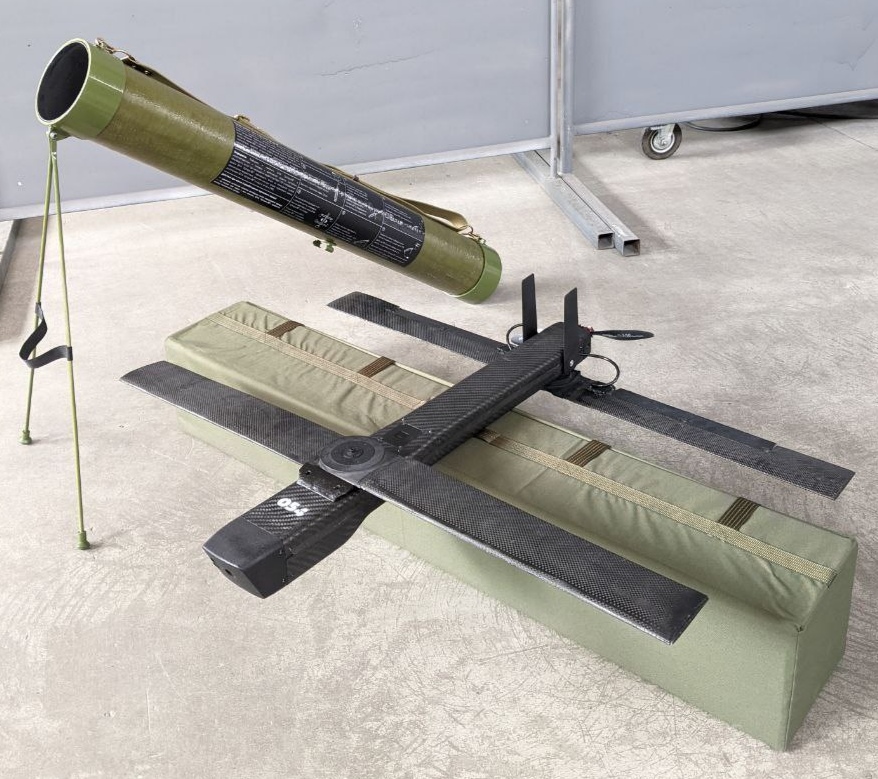
Reports from Russian media outlets announced on 18 September, that Android Technics/Technology, a Russian technology company, had developed an analogue of AeroVironment’s Switchblade 300 loitering munition. Imagery and footage of the BAS-80 was shared by Russian state news outlet RIA.

Android Technology’s Managing Director, Evgeny Dudorov, told RIA that they had provided a ‘couple’ of the loitering munitions to a volunteer unit, the Tsar’s Wolves, which reportedly provides military-technical assistance to Separatist units. Dudorov hopes that the unit will “find the best ways” to use the new kamikaze drone. Back in April, the development of the BAS-80 was first reported when Android Technology stated that the munitions would be mounted on the Marker armed unmanned ground vehicle.

BAS-80 (via RIA)

Russia has had considerable success in the field with its larger, heavier Lancet loitering munitions developed by ZALA Aero Group which is a part of Kalashnikov Concern. The most advanced variants of Lancet boast a 11lb/5kg payload. The Ukrainian’s, however, have demonstrated an edge when utilising smaller FPV kamikaze drones. These FPV drones appear to be favoured over the Switchblade 300.

The BAS-80 bares more than a passing resemblance to the US-manufactured Switchblade which the US has provided to Ukraine in moderate numbers since March 2022. Utilising the same folding wing configuration and man-portable tube-launch system.

Dudorov stated that the BAS-80 is made from carbon fiber, weighs in at 3.7lb/1.7kg and has a maximum flight speed of up to 80mph/130kph. He also claimed that it can travel up to 18.6 miles/30km and carries a 1.1lb/500g payload – which may suggest that its intended for anti-personnel and anti-materiel use, like the Switchblade. This would made the BAS-80 0.6lb/300g lighter than the Switchblade 300 and have 12.5 miles/20km more range. Photographs of the munition show that it uses a pusher propeller configuration and has three forward-facing optical lens for guidance.

A Switchblade 300 in the field in Ukraine, 2022 (via social media)

It remains unclear if the Russian munition was developed using technology found in captured Switchblade 300s. Other analogues of the Switchblade have been developed by both China and Iran. China unveiled the FH-901 loitering munition in September 2022 and Iran introduced the Meraj-521 in October 2022. Both systems appear to be externally different in size and shape to that of the BAS-80, with the Chinese munition larger (more analogous with the Switchblade 600) and the Iranian drones launching from a rectangular box. The BAS-80 launches from a cylindrical tube more akin to the Switchblade.

The BAS-80’s guidance systems, software and internals remain unknown and from Russian reports it is still some way from mass production with development to be finalised following trials in the field.

This article was adapted from one originally published at OvertDefense.com


Support Us: If you enjoyed this video and article please consider supporting our work here. We have some great perks available for Patreon Supporters – including early access to custom stickers and early access to videos! Thank you for your support!


Bibliography:

BAS-80, RIA, (source)

China unveils its version of Switchblade suicide drone, Global Times, (source)

US Switchblade Drone ‘Knock Off’ Meraj-521 Unveiled By Iran, Eurasian Times, (source)

Armourer’s Bench on the New History of Weapons & War App!

We are excited to announce that TAB will be joining the new video app History of Weapons & War, launched by our friend Ian of Forgotten Weapons. We were flattered to be amongst the first group of channels to be asked to join the app.

We’re really pleased to be joining our friends at Bloke on the Range, British Muzzleloaders, the Royal Armouries, Cap & Ball EU, Legacy Collectibles, Nine Hole Reviews and of course Forgotten Weapons!

All of these channels approach military and gun history in their own fantastic, unique ways so there is a vast plethora of cool and interesting content on the app from the beginning. There are currently around 5,000 videos on the app and counting.

The app is available on various platforms including tvOS (aka Apple TV), iOS (aka Apple App Store), Android TV, Android App Store, Roku, and Amazon Fire TV. The best place to sign up is directly at weaponsandwar.tv and sign up there, then download the app on your platform of choice!

Here’s Ian’s video explaining everything!

A History of Weapons & War subscription is $9.99 a month, or around $99.99 a year.

So head to weaponsandwar.tv, check out the site/app and sign up!

Gulf War Homemade SA80 / L85A1 Front Grip

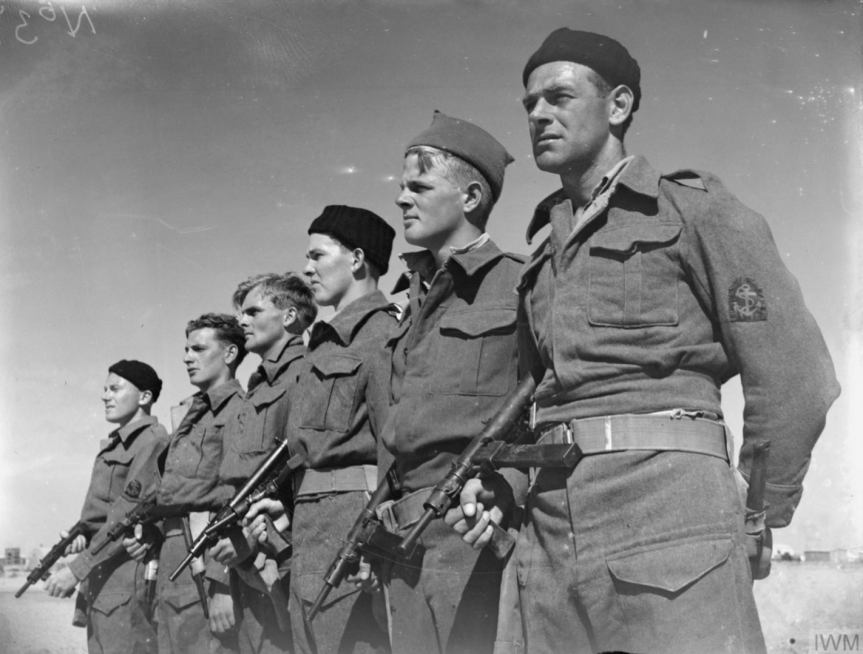
There is a rich history of attaching home-made, ad-hoc forward grips to weapons within the British military. In the 1940s troops fashioned home-made forward grips for Sten machine carbines while in the 1960s at least one member of the SAS operating in Borneo during the Indonesian Confrontation attached a carved wooden foregrip to his M16. In the 1980s the operators with the SAS’ counter-terrorism teams attached L1A1 SLR pistols grips to their MP5s.

British troops in Northern Ireland with L1A1s fitted with makeshift front grips made using a spare pistol grip attached with a jubilee clip

The intermittent tradition appears to have continued into the early 1990s with one member of the Staffordshire Regiment seen to have mounted a pistol grip to the forend of his L85A1. The soldier and his adapted rifle appeared in a number of photographs and some footage taken during a field exercises in Saudi Arabia.

Commandos on parade with STEN MkIIs equipped with ad-hoc front grip, at Kabrit in June 1943 (IWM A17755)

The battalion deployed to Saudi Arabia as part of 7th Armoured Brigade in October 1990, as part of Operation Granby. During the phase of operations in the Gulf which the US designated Operation Desert Shield allied forces prepared to liberate Kuwait and took part in a number of field exercises.

On 10 November, 1990 Sgt. Dave Miles, a British Army photographer filmed up-close footage of C Company, 1st Battalion during a live fire exercise. During one brief section of the footage the L85A1 with foregrip can be seen firing. On 6 January 1991, C Company took part in another live fire exercise which again saw them filmed and the same rifle features in several brief sections. It also appears in photographs taken by AP photographers Patrick Baz and Sadayuki Mikami, an unnamed British Army photographer and US Army photographer PFC John F. Freund.

Company C, 1st Battalion, The Staffordshire Regiment, during a live fire training exercise assaulting a mock village and trench complex, 6 January 1991. (XVIII Airborne Corps History Office photograph by PFC John F. Freund)

Unlike some of the earlier examples of wooden ad-hoc foregrips this one appears to be fashioned from a spare SA80 pistol grip attached to the rifle’s plastic forend by a bolt. While mods like this one weren’t that uncommon they are rarely so well documented in photographs and videos. It’s also interesting to see just how common painting weapons was.

Royal Marines Commandos in Afghanistan c.2006. An LSW rear grip fitted as an ad-hoc foregrip (Commando: On the Front Line)

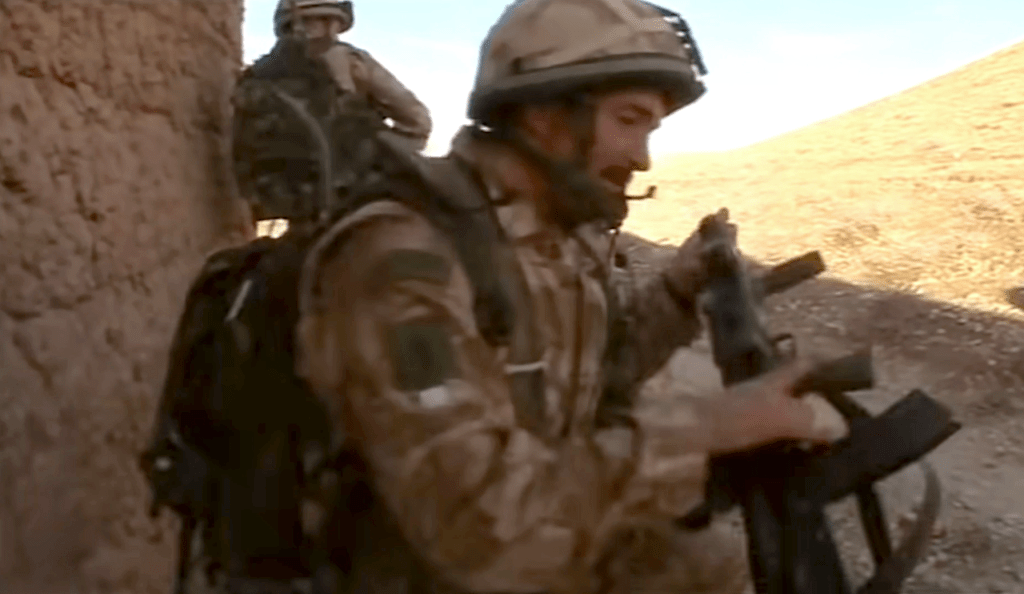
Similar modifications were made using the rear grip from the L86A1 Light Support Weapon. These were again bolted through the vents in the underside of the rifle’s plastic handguard. One of these modifications was seen a number of times in the hand of a member of the Royal Marines Commandos during the 2007 documentary Commando: On the Front Line.

Generally the addition of foregrips make for handier, more pointable weapons. Arguably, the soldier from C company was ahead of his time as later, following the L85A2 refits and the Afghanistan urgent operational requirements, Grip Pod vertical front grips were paired with the rifles.


If you enjoyed this video and article please consider supporting our work here. We have some great perks available for Patreon Supporters. You can also support us via one-time donations here. Thank you for your support!


Project Hunter: The UK’s New Assault Rifle

The United Kingdom has announced the selection of the Knight’s Armament Company KS-1 as the new individual weapon for the new Ranger battalions and the Royal Marines Commandos. The requirement for the new rifle was released back in August 2021, and called for the “procurement and support of an Armalite Rifle (AR) platform Alternative Individual Weapon (AIW) System.”

The requirement called for a ‘Rifle System’ which comprises the weapon and a ‘Signature Reduction System’ [suppressor] and an ‘Optic System’. The rifle itself had to be ‘gas operated with a rotating, locking bolt’ and was to specifically have “a standard configuration, not bullpup, with the magwell in-front of the trigger housing.”

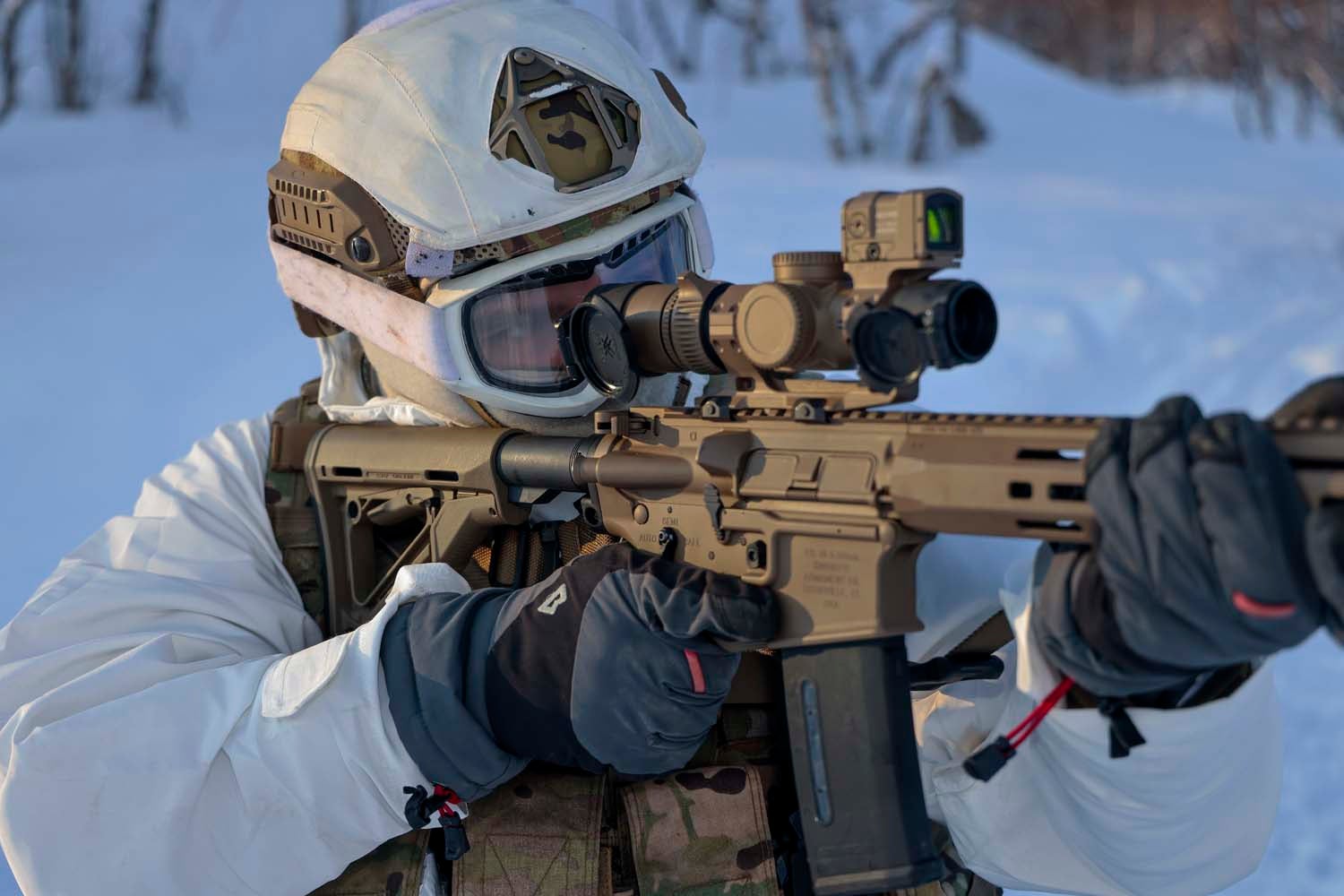
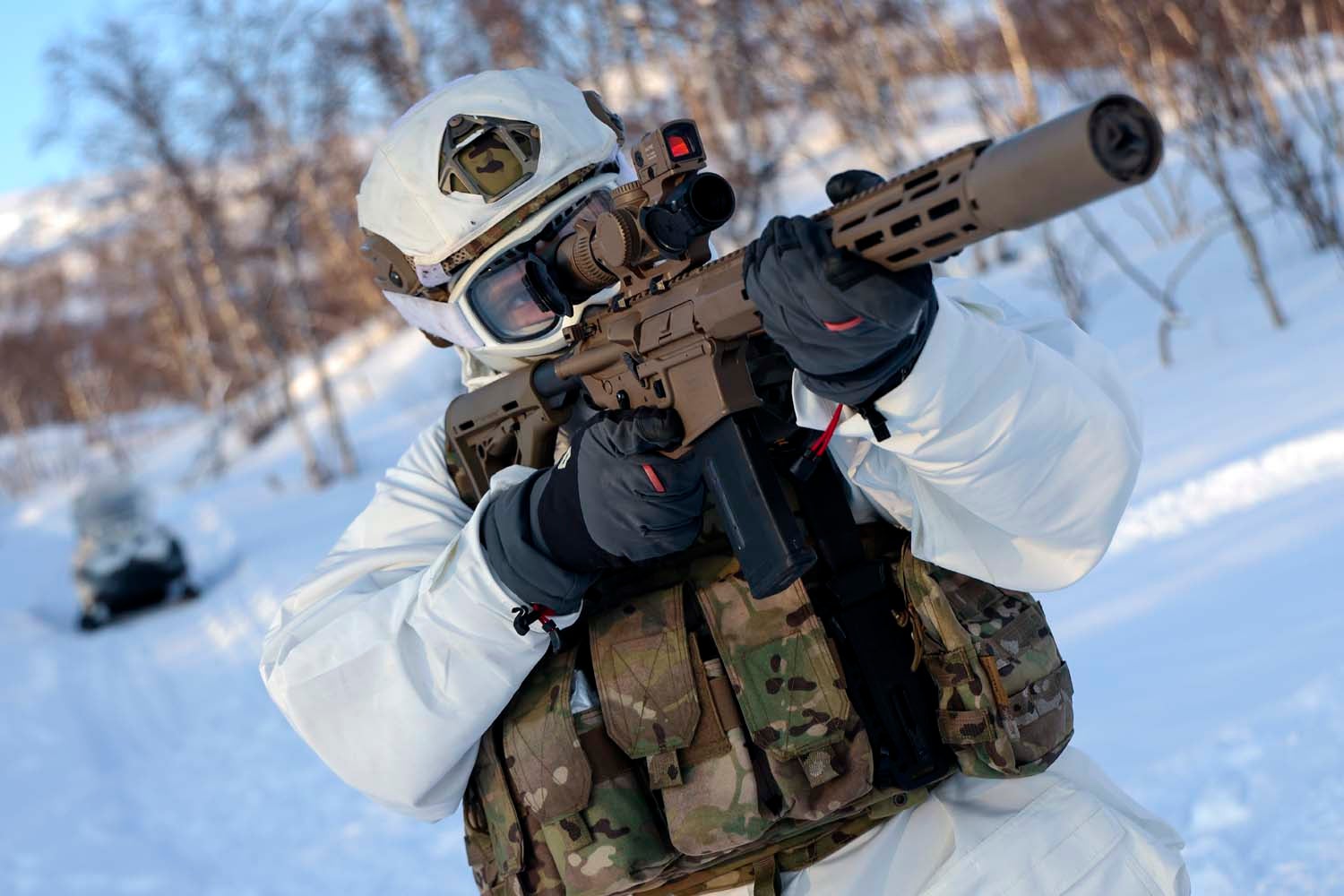
Royal Marines Commando with L403A1 (Royal Marines/Royal Navy)

The UK launched Project Hunter to select a new Alternative Individual Weapon (AIW) to replace the SA80/L85 series of rifles and Colt Canada L119s in service with the Rangers and elements of the Royal Marines Commandos. After two years of competition the UK MoD has announced that Knight’s KS-1 has been selected as the L403A1, beating off reported competition from Heckler & Koch, SIG Sauer, Daniel Defense and Glock.

Other weapons believed to have been evaluated include the HK416A5, the SIG Sauer SPEAR-LT, the Daniel Defense M4 and Glock’s GR-115F. Other companies believed to have submitted rifles include Colt Canada, Lantac, Haenel and Steyr amongst others.

The new rifles will supplement the L85A2 and L85A3 which currently equip the majority of the UK armed forces. The rifles will be procured via UK-based company Edgar Brothers and the £90 million ($110 million) contract will see up to 10,000 new rifles delivered over the next decade. An initial £15 million order for 1,620 AIW systems has been placed with the British Army fielding them with the Army Special Operations Brigade, with the brigade expected to receive the first rifles by the end of 2023. The Royal Marines’ ‘strike companies’ and Surveillance and Reconnaissance Squadron will also be among the first to receive the L403A1. The ‘Alternative Individual Weapon’ essentially fulfils the same role every AR-pattern rifle in UK service has since the 1960s.

New Alternative Individual Weapon – L403A1 (UK MoD)

The UK’s Minister for Defence Procurement, James Cartlidge said:

“This is another example of how we are committed to investing in the most advanced battlefield equipment to back our troops on the battlefield. This advanced rifle’s ability to help soldiers maintain the stealth edge not only protects them but delivers war-fighting advantage over our adversaries.”

Interestingly, the UK Ministry of Defence’s press release emphasises that as an AR-pattern rifle the L403A1 “shares much in common with the rifle systems used by many of the UK’s allies. Given their specialist role, and the critical task of working with and alongside many of the UK’s allies, the platform will enable ASOB to share skills and drills in an efficient manner.”

Close up of the Vortex and Aimpoint optics which make up part of the AIW package (Royal Marines/Royal Navy)

So what does the Alternative Individual Weapon (AIW) system include?

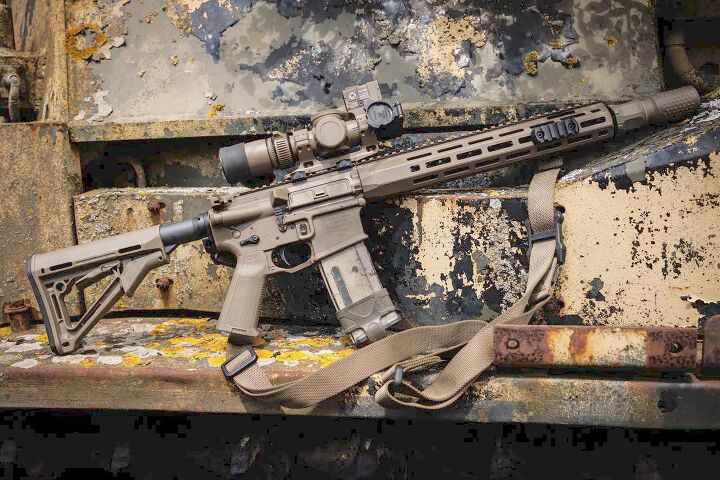
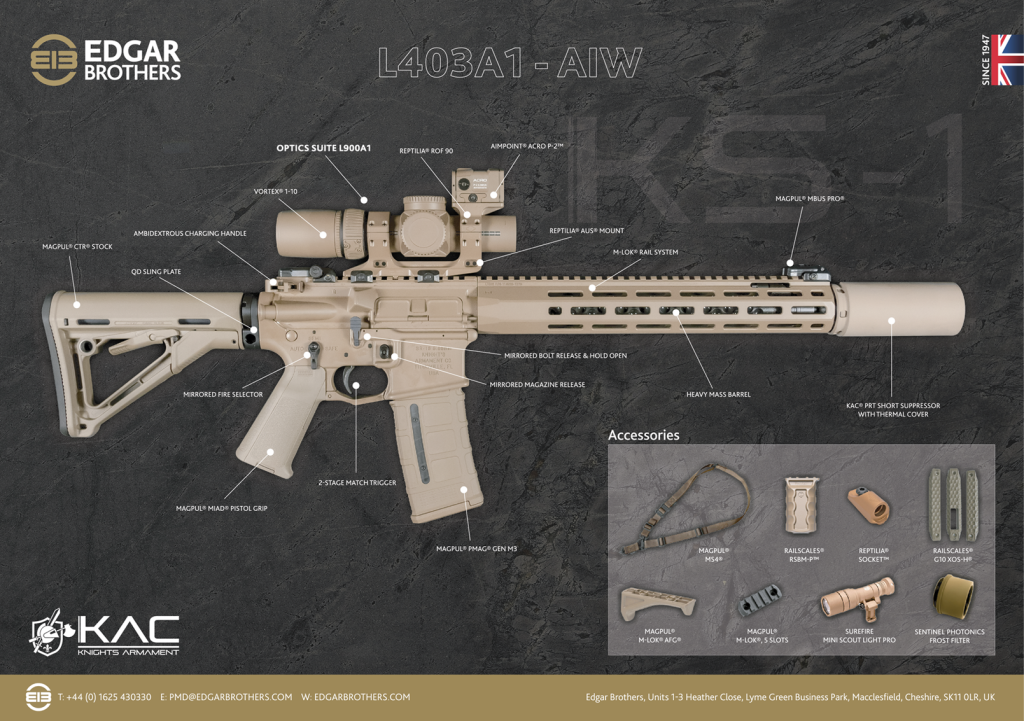
The system builds around the Knight’s KS-1 but also includes a magnified 1-10 LPVO optic from Vortex, an Aimpoint ACRO P-2 red dot and the Knight’s QDC/MCQ-PRT suppressor.  The prime contractor for the project, Edgar Brothers, are responsible for the sourcing and assembly of the AIW’s accessories. Accessories for the rifle will include a MAGPUL M54 sling, a Surefire Mini Scout Light Pro, G10 rail scales and a MAGPUL M-LOK AFG.

Anatomy of the L403A1 (Edgar Brothers)

The KS-1 is the latest iteration of the SR-16 series, it has a 13.7in (35cm) barrel and weighs 6.88lbs (3.1kg) unloaded, its overall length is 32.2in (82cm) with the stock collapsed and 34.2in (87cm) extended. The QDC/MCQ-PRT weighs an additional 13.9oz and adds just over 2 inches to the weapon’s length. The rifle uses a direct gas impingement system (or more correctly described as Stoner’s internal piston system).

The selection of the new rifle forms part of the Royal Marines’ larger modernization push under the Commando Force Programme alongside a new helmet from Gentex and Fused Binocular Night Vision devices from L3Harris.

Surveillance and Reconnaissance Squadron member with L403A1 in Norway (Royal Marines/Royal Navy)

We got our first indication of the KS-1’s selection in June, when the Royal Marines published a new recruitment advert featuring the rifle. It was also subsequently seen during a demonstration at Lulworth Ranges in July.

While the British military have used AR-pattern rifles since the 1960s in various roles, Project Hunter and the Alternative Individual Weapon represents a major procurement and it remains to be seen how it will influence Project Grayburn – the effort to select a replacement for more than 150,000 SA80s.


Support Us: If you enjoyed this video and article please consider supporting our work here. We have some great perks available for Patreon Supporters – including early access to custom stickers and early access to videos! Thank you for your support!


Bibliography:

Alternative Individual Weapon (AIW) System Tender Aug. 2021, UK Govt. (source)

£90 million contract equips Armed Forces with advanced new rifle, UK MoD (source)

Britain’s Commandos to get new assault rifles, Royal Navy (source)

Knight’s KS-1, Knight’s Armament Company, (source)

UK Selects New Assault Rifle, Overt Defense, (source) [This article is adapted from this original article]

OTO Melara Mod 56 In Ukraine

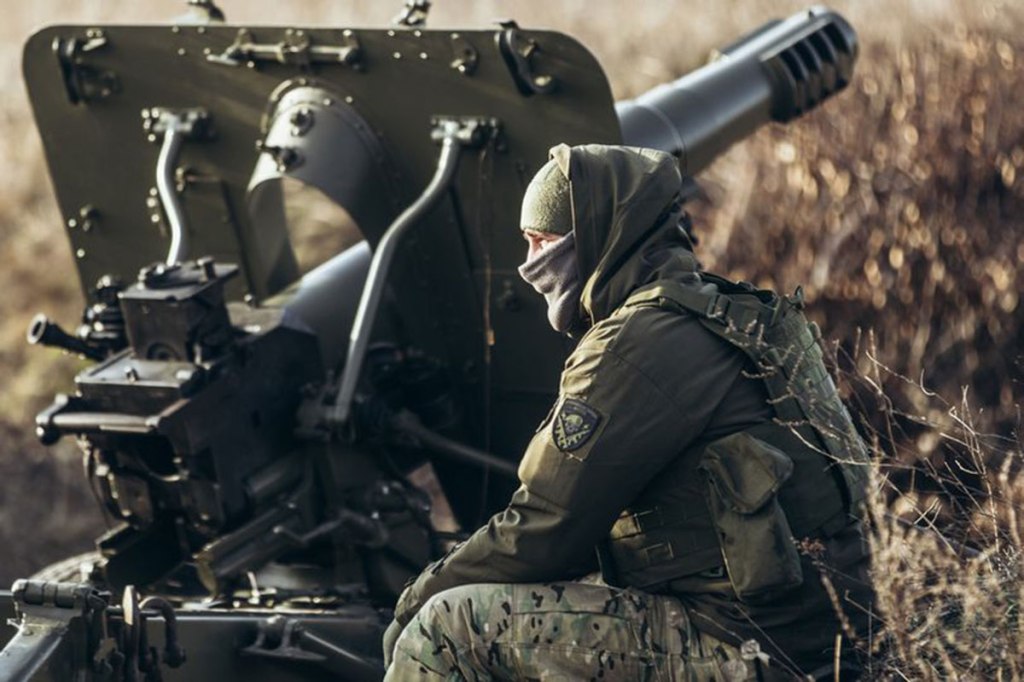
We’ve examined a number of artillery systems in use in Ukraine, including the venerable M101 howitzers and the MT-100s mounted on MT-LBs, one of the smallest and most interesting howitzers in use is the OTO Melara Mod 56.

The Mod 56 is a small 105mm pack howitzer. It weighs in at 1.29 metric tons and it can be towed by light vehicles. It has a split trail gun carriage and a hydro-pneumatic recuperator assembly. Developed by Italy’s OTO Melara the gun entered service in the mid-1950s and has seen service with countries around the world including Italy, the UK, Australia, Spain, Pakistan and the Philippines.

An OTO Melara Mod 56 (Ukraine National Guard)

Much like the heavier M101 howitzers, transferred to Ukraine by Lithuania, the Mod 56 can use any M1 105mm ammunition. With its short 1.47 metre-long barrel, the Mod 56 has a maximum effective range of around 10,000 metres (10km/6 miles). While this puts it at a severe disadvantage compared to the larger 155mm howitzers used by Ukraine and the 152mm guns used by Russia the small Mod 56 has the advantage of being lightweight and can be deployed forward under cover. The most useful role it could likely fulfil is as an infantry support gun.

In November 2022, Spain’s Defence Minister Margarita Robles confirmed that Spain would send a battery of six light howitzers and also provide training for Ukrainian gun crews. Subsequently, a brief clip of Ukrainian gunners training on the Mod 56 was shared in late November.

A Mod 56 in action (via social media)

The guns were seen in Ukraine for the first time in early January, with a short clip of one of the guns firing being shared on 11 January. It appears the gunner is wearing a National Guard patch but its unclear which unit the gun belongs to. On 12 January, the 1st Mechanized Battalion of Ukraine’s 3rd Assault Brigade posted an info-graphic giving some basic detail on the Mod 56.

On 20 February, a brief clip of a Mod 56 was shared, the footage was believed to have been taken in the vicinity of Bakhmut. However, photographs taken by an AP photographer, Libkos, of the same gun showed that the gun was actually in action in Avdiivka, Donetsk. The series of photographs also showed that the gun was being operated by a National Guard unit and the crew was using drone footage to select their targets. One photograph was also shared by President Zelensky on 5 March. Interestingly, the gun is seen without its shield.

Another video of one of the guns in action was shared on 16 April. It was several months before more imagery of the Mod 56s in use appeared but on 1 June, the Ukrainian National Guard shared a photograph of one of the guns and several days later, on 3 June, a short video of a gun in action was shared.

A Mod 56 in action (via social media)

Most recently on 19 July, a Ukrainian National Guard unit shared a brief clip of a Mod 56 firing. It also nicely illustrates the gun’s breech mechanism.

From the available imagery, it appears that the guns are operated by Ukraine’s National Guard, though which artillery unit is unclear. While it has been confirmed that Spain has provided at least 6 Mod 56 howitzers, it remains unknown if any other countries, such as Italy, have provided the small guns.

Update 29/12/23:

An undated sighting of a Mod 56 in operation in Ukraine. Notably half of the gun shield appears to be missing.

Update – 17/04/24: A clip posted on 7 April, date of recording unconfirmed, showing a Mod 56 in action. The howitzer’s gunshield has been removed.

Update – 29/5/24:

Update – 23/07/24:


Support Us: If you enjoyed this video and article please consider supporting our work here. We have some great perks available for Patreon Supporters – including early access to custom stickers and early access to videos! Thank you for your support!


The Hammerless 1911

Ever since I picked up a copy of John Browning and Curt Gentry’s 1964 biography of John M. Browning I’ve been fascinated by this hammerless .45 calibre pistol, one of Browning’s prototypes for the US Army’s semi-automatic pistol trials.

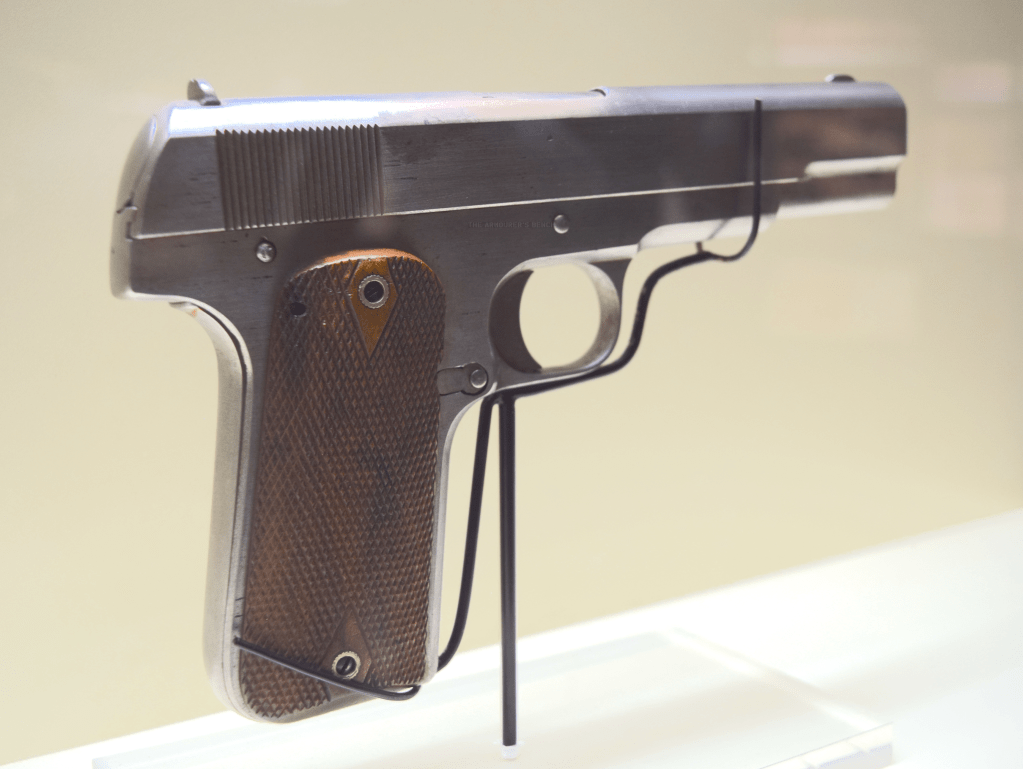
The Browning .45 calibre pistol prototype with a shrouded hammer (Matthew Moss)

Last year I had the opportunity to visit the John M. Browning Museum in Ogden, Utah and I was thrilled to see the ‘hammerless’ prototype on display. Very little has been written about the development of this particular pistol with Browning and Gentry explaining that during the US Army’s long process to select a new service pistol John Browning decided to provide two versions of his .45 ACP pistol – one with an exposed hammer and the other with a shrouded hammer similar to that seen on his Colt 1903 and 1908 Pocket Hammerless commercial pistols. 

The ‘hammerless’ pistol is identical in operation to the exposed hammer prototype which was eventually selected as the M1911. It uses the same improved tilting barrel action which is covered by the patent filed in February 1910, US #984,519. The slide and frame profiles of the ‘hammerless’ pistol have been reshaped with the slide extending back further shrouding the hammer while the rear of the frame projects back, lining up with the rear of the slide rather than forming a beavertail. The pistol grip angle, at near 90-degree, is more akin to the Colt Pocket Hammerless and earlier Colt-Browning semi-automatic pistols.

The Browning-Gentry book lists the pistol as 8 inches in length overall with a 3.75-inch barrel and a weight of 2lbs 4oz. The pistol has a grip safety and a frame-mounted safety and a push-button magazine release on the left side of the frame. Sadly the pistol was behind glass and with time short we couldn’t get a better look at the gun. 

The Browning .45 calibre pistol prototype with shrouded hammer on display at the Browning Museum (Matthew Moss)

The chronology of the various prototypes’ development is sometimes difficult to track as Browning’s hands-on style left few written descriptions of the designs as they evolved. The museum dates the pistol to 1905 but displays it alongside the pattern of pistol often referred to as the Model 1910. Interestingly, the ‘hammerless’ pistol also has the frame-mounted safety which was reportedly added late in the refinement of the 1910 pistols. The ‘hammerless 1911’ was never commercially marketed by Colt and the exposed hammer .45 ACP pistol went on to win the US military pistol trials and became an iconic design. 

Huge thanks to the Browning Museum in Ogden for allowing us to film in their collection – we have some really exciting videos from the museum coming up. 


Support Us: If you enjoyed this video and article please consider supporting our work here. We have some great perks available for Patreon Supporters – including early access to custom stickers and early access to videos! Thank you for your support!


Bibliography

John M. Browning: American Gunmaker, J. Browning C. Gentry (1987)

The Guns of John Browning, N. Gorenstein, (2021)

Handguns of the World, E.C. Ezell (1981)

‘Rarest of the rare: Browning 1910 & Hammerless .45’, American Handgunner, (source)

The Fanta Bomb & Improvised Munitions in Ukraine

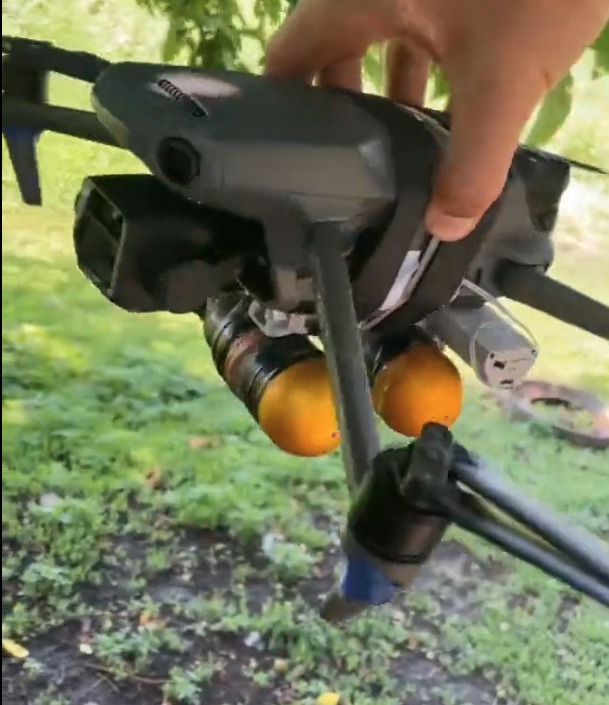
All sorts of munitions have been dropped from drones ranging from hand grenades to Molotov balloons to mortar rounds and even blocks of explosive. In this article/video, we’ll look at a couple of interesting examples of improvised munitions.

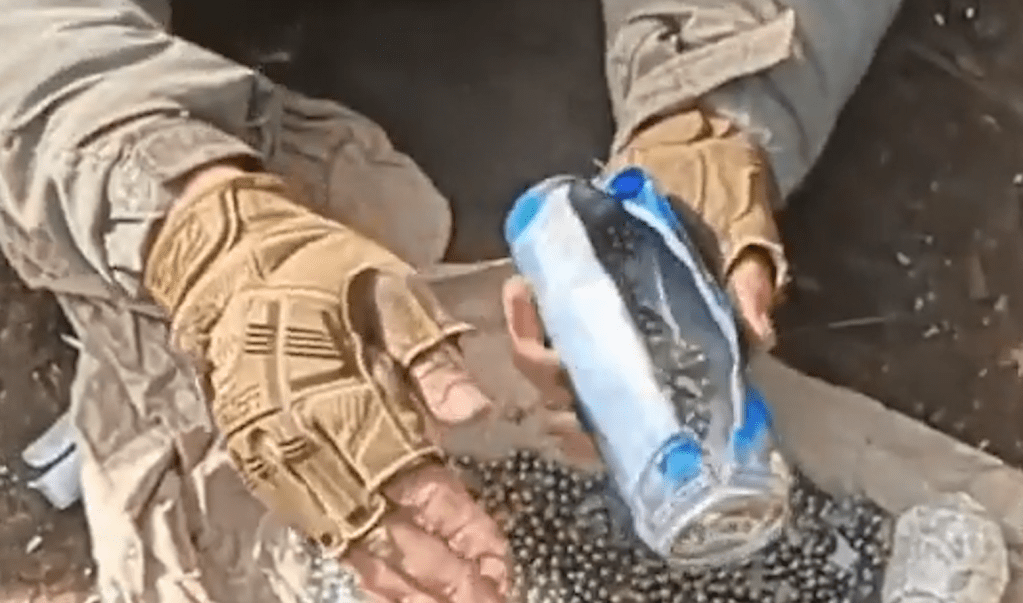
In early May an interesting short video was shared by a Ukrainian combatant showing a Fanta soft drink bottle filled with explosives and what appear to be ball bearings of different sizes. It’s hard to tell what sort of explosive has been used but the bottle is topped with a UZRGM grenade fuze.

The Fanta Bomb (via social media)

Ordnance Lab made an interesting video a couple of weeks ago testing an approximate version of the Fanta bomb and found it to be fairly effective in terms of blast and fragmentation. Though their version looked to contain more ball bearings and they noted it weighed around 3kg.

The only other similar munition to surface was seen in a photograph that showed a box of Polish Kropla Beskidu water bottles which also appear to be filled with explosive materials and fuzed with standard UZRGM fuzes. 

Improvised can-based warhead for FPV drone (via social media)

It’s unclear whether the grenades are designed for ground use or perhaps for dropping from drones. If the fill of the grenade is purely explosive then it would have a significant blast effect but minimal fragmentation – likely why the Fanta bottle example has been augmented with ball bearings. 

There is also evidence of the simple use of directly using TNT blocks with UZRGM fuzes, with the Georgian Legion evidently dropping them from drones. 

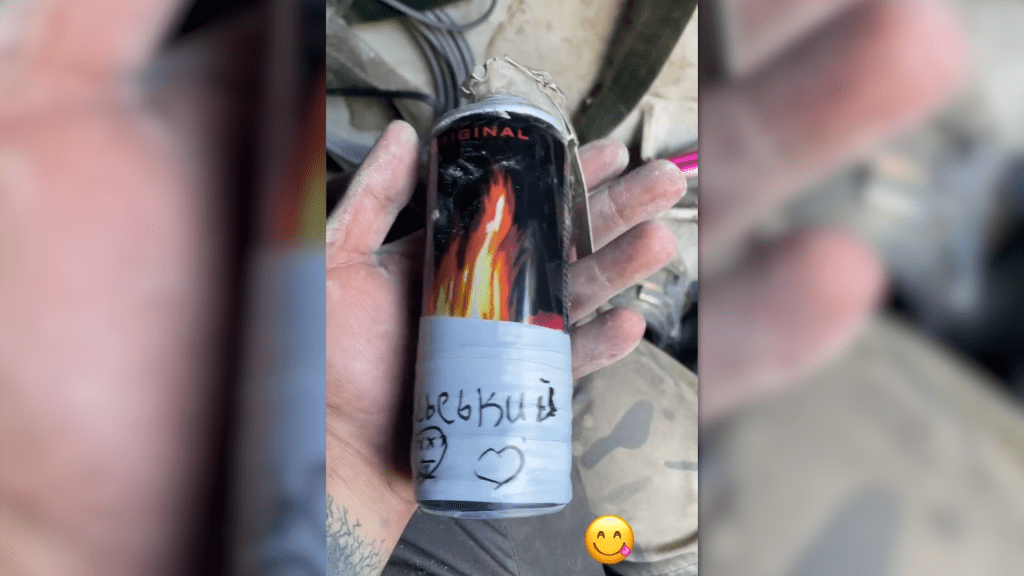
Old drinks cans have also been used to make improvised explosive devices. In early May a video showing a ‘Non Stop’ energy drink can being split open and filled with plastic explosives and ball bearings was shared. The can was then attached to a First Person View (FPV) drone and used against personnel in a Russian trench. 

In June several short clips were shared featuring drinks cans with grenade fuzes. Two with UZRGM fuzes and one can with what appears to be a DVM fuze. The can could be augmenting a Bulgarian fragmentation grenade such as an AR-ROG or GHD/RGD series.    

Improvised can-based grenade (via social media)

In July, Ryan O’Leary, a US volunteer in Ukraine, shared a photograph of 5 craft-made grenades constructed from plastic drinks bottles slipped into the base of Red Bull and Non Stop energy drink cans. O’Leary suggests that there is approximately 1-2 kg of RDX explosive inside. They are again topped with UZRGM fuzes and secured with tape.

Improvised grenades made from bottles and drinks cans (via social media)

So why are these munitions being made? Often when I cover improvised munitions people ask are the Ukrainians not receiving billions in aid? The answer to this is – they are. However, aid doesn’t always include all the types of munition you might want. Similarly, the combatants improvising these munitions may not receive the types of munitions they need –  wartime logistics can be challenging. Additionally, the combatants producing these munitions may be looking for bombs with improved blast and fragmentation over what is available.

Update – 25/07/23:

Update – 27/09/23: A BBC Newsnight report featured a drone company attached to the 24th Brigade. A can-based improvised exposive device, designed to be dropped from a drone was featured.

Update 15/5/24: On 3 May a Ukrainian telegram channel shared a clip of a drone dropped munition attack on Russian infantry. The munition appears to be enclosed in a Pepsi can. The unit involved is claimed to be a drone unit of the National Guard’s 4th Rapid Reaction Brigade.

Update – 15/7/24:

In addition to bottles and cans packed with explosives, both sides have utilised bottles filled with incendiary mixtures. These have seen being dropped from drones on positions and vehicles.

Update – 28/5/25:

A member of the 6th Special Purpose Battalion of the 12th Special Purpose Brigade “Azov” used an DIY bottle bomb, as an enhanded blast grenade to demolish the front of a single story building during fighting near Toretsk.


Support Us: If you enjoyed this video and article please consider supporting our work here. We have some great perks available for Patreon Supporters – including early access to custom stickers and early access to videos! Thank you for your support!


Bibliography:

UZRG-M Fuze, CAT-UXO, (source)

DVM Fuze, CAT-UXO, (source)
Dogfighting Drones in Ukraine

During my recent video with author and journalist David Hambling discussing drone warfare in Ukraine, we briefly touched on the phenomena of drone dogfighting. Drone use in Ukraine has been a prominent feature of the conflict and drones have been used in roles ranging from Intelligence, Surveillance, and Reconnaissance (ISR) to direct action against targets – either through one-way loitering/kamikaze drones or by drone-dropped munitions.

Naturally, the threat drones pose, either from information gathering, artillery forward observation or direct attacks, means that both sides have sought to interdict and destroy the other’s drones. In some cases, this has seen opposing drones attacking one another in dogfights. This raises some fascinating parallels with early military aviation, during the First World War, which saw initially unarmed observation aircraft begin to carry weapons and attack one another.

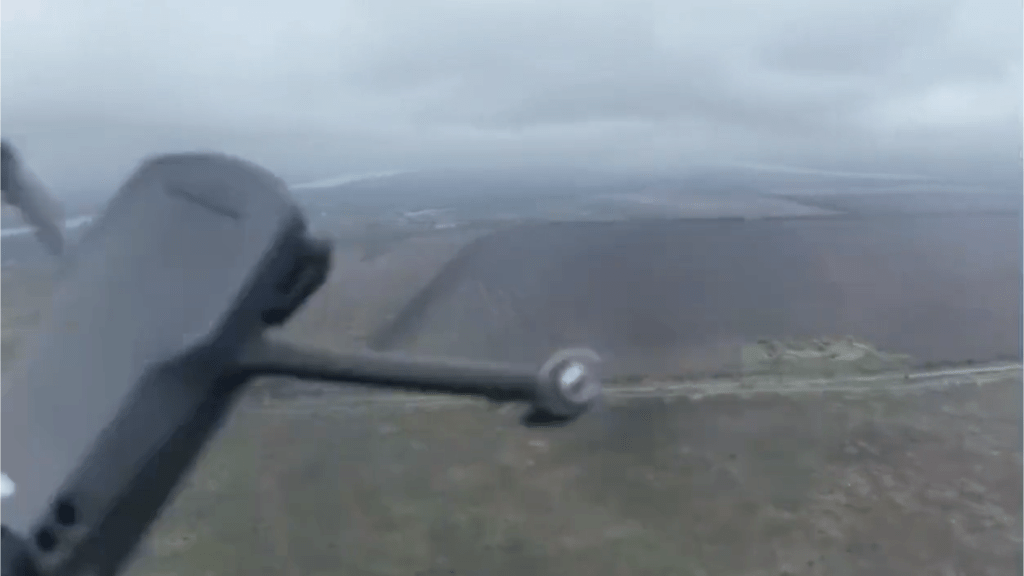
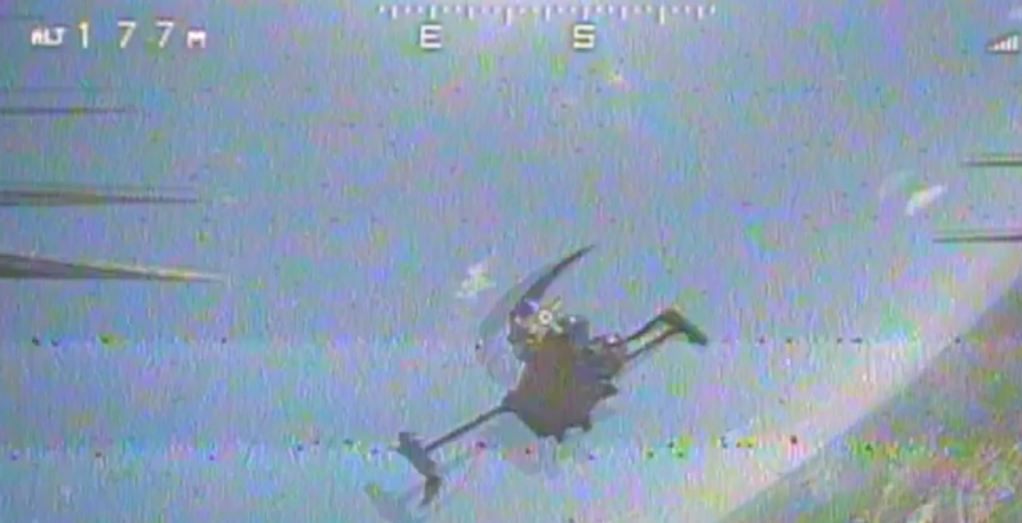
Some of the earliest instances of these drone dogfights were reported in October 2022, with an initial video featuring a pair of DJI Mavic quadcopters, with the Ukrainian drone destroying the Russian drone by breaking its rotors. Another video posted on 18 October, reportedly shows a Ukrainian drone dive down onto a Russian quadcopter damaging it. Several more similar videos were shared in November. One shared around 14 November again shows a drone attacking from above. Towards the end of the month, on 25 November, a DJI Mavic clearly marked with a ‘Z’ was rammed from above by a Ukrainian drone.

Check out our earlier video on drone warfare:

In early December, a different technique was demonstrated with a drone from the separatist 1st Donetsk Army Corps dropping a weighted net onto a Ukrainian drone below it. This has the benefit of not having to use a valuable asset to ram, and potentially lose while attempting to attack an enemy drone. It also has the advantage that it presumably uses the same munition release mechanism used to drop munitions on ground targets. The drawback to net dropping, however, is the increased chances of missing the target and a limit to how many attempts the operator has to attack a target. In mid-December another video was shared, this time by Ukraine’s 54th Mechanised Brigade, showing the ramming of another drone.

A Russian drone seen via the feed from an attacking Ukrainian drone (via social media)

February 2023 saw further videos of drone dogfights, in another piece of footage shared on 24 February, we can see the attacking Russian drone taking its time to line up on its target before attacking, it is possible to the attacked Ukrainian drone fall to the ground.

As can be seen in videos like this one from mid-February, aiming a drone for a ramming run at an opposing drone below can be difficult. In our earlier video, David explained the favoured tactic of attacking from above has a number of advantages in that it allows the attacking drone to maintain visual contact with the drone’s camera and also avoid being seen by the target drone’s camera which is also unable to look upwards. The more robust body of the drone is what makes contact with the target drone’s rotors – increasing the attacking drone’s survivability. In some of the videos, the target drone appears unaware it’s about to be attacked.

DJI Mavic struck by another drone damaging its rotor blades (via social media)

This was again demonstrated in a video posted by the Ukrainian 10th Mountain Division in March, which showed a drone making numerous ramming runs on a Russian quadcopter. In early May, a video of a Russian DJI Matrice 30 series drone being hunted by a Ukrainian DJI Mavic was shared. While the Ukrainian drone was destroyed too, the loss of a $2,000 Mavic to destroy a Matrice worth approximately $12,000 makes tactical sense. On 25 March, Russian telegram channels shared a video from a team called Project Krechet featuring a test showing a fast-moving First Person View (FPV) drone ramming a larger quadcopter. The telegram posts noted that the ‘Small anti-drone fighter aircraft’ are much cheaper and better suited to the role than DJI Mavics.

In late April, footage of another drone dogfight was shared showing a Russian Mavic being downed by a Ukrainian drone. In early May, the Russian news agency RIA shared footage of a clash between a Russian drone and a Ukrainian DJI Mavic, reportedly in the Donetsk, Adviivka region. On 24 May, Escadrone, a Ukrainian manufacturer and supplier of FPV kamikaze drones shared what is believed to be the first video of a Ukrainian FPV drone attacking a Russian reconnaissance quadcopter.

An FPV drone attacks a Russian quadcopter (Escadrone)

While not a drone vs drone dogfight on 30 June, a video of a Ukrainian drone dropping a munition on a Russian Zala 421-16E2 which was on the ground, shows another nuance to drone vs drone engagements. This video is similar to the popular tactic of ‘drone demolition’, the dropping of munitions into enemy vehicles that have been mobility killed. In both the case of the Zala and ground vehicles the demolition missions deny the enemy the asset’s recovery and future use.

With drones playing a fundamentally important role for both sides instances of drone vs drone combat are only likely to increase. We may also see the emergence of more complex onboard methods of drones attacking other drones.


Support Us: If you enjoyed this video and article please consider supporting our work here. We have some great perks available for Patreon Supporters – including early access to custom stickers and early access to videos! Thank you for your support!


Understanding Drone Warfare in Ukraine

Drone warfare is a complex and nuanced topic with drones used for information gathering, observation and direct attacks. The war in Ukraine has seen an explosion in drone use ranging from small commercial DJI Mavics to military grade drones like the Bayraktar TB-2. In this video I’m joined by author and journalist David Hambling who has been tracking and writing about drone use in Ukraine since the Russian invasion in February 2022.

We discuss the expanding role drones have played in the conflict, how they are deployed and the impact they have. We touch on countermeasures used by both sides, the psychological effect the drones can have and what the future holds for drone use.

Check out David’s book on drones, ‘Swarm Troopers‘.


Support Us: If you enjoyed this video and article please consider supporting our work here. We have some great perks available for Patreon Supporters – including early access to custom stickers and early access to videos! Thank you for your support!