Vintage Weapons In a Modern War: The TT-33 Pistol In Ukraine

The fighting in Ukraine has seen a wide range of small arms in use ranging from the cutting edge to the antique. We’ve seen a number of older weapons like Mosin-Nagant rifles, M1910 Maxim machine guns and DP light machine guns in service with both sides. [We’ll take a look at those in future videso] The TT-33 pistol, a pistol which first entered service 90 years ago, is another older weapon which is again seeing action. The examples seen in theatre are likely a mix of privately owned firearms and pistols drawn from Ukrainian stores. 

Introduced in the mid-1930s to replace the 1895 Nagant revolver, over a million TTs have been produced. Designed by Fedor Tokarev the pistol became the Soviet Union’s primary side arm, seeing service during the Second World War alongside the Nagant. 

The TT-33 is a semi-automatic pistol, chambered in 7.62×25mm. It feeds from an 8 round single stack magazine and uses John Browning’s short recoil tilting-barrel action. The TT is an extremely robust pistol and remained in service well into the 1950s with the Red Army and continues in service around the world even today.  

A photo of a TT-33 shared by the TDF’s 127th Kharkiv Brigade (via social media)

Pistol use in general in the current conflict doesn’t appear to be prolific but a considerable number of combatants are frequently seen carrying side arms. Everything from Makarovs and Stetchkins to more modern Glocks and Ukrainian Fort handguns. Pistols are often carried by soldiers working in roles which frequently see them separated from their service rifle and by those who prefer to carry a secondary weapon.

While we’ve seen TT-33s in the hands of Russian and Ukrainian separatist troops in this video we’ll largely focus on Ukrainian use. At the fall of the Soviet Union a considerable amount of surplus small arms fell under Ukraine’s control, including substantial numbers of TT pistols. While not general issue it has been in service with the Ukrainian Army, National Guard and the Border Guard Service. This video definitely isn’t an exhaustive survey of TT use in Ukraine but lets take a look at some examples:

At the start of April 2022 the training department of the command headquarters of the Ukrainian Territorial Defense Forces have published a number of high quality videos showing how to disassemble and clean the TT.

The Ukrainian YouTube channel, Boys from the Forest (ХЛОПЦІ З ЛІСУ) shared a video looking at the TT in May 2022. They concluded their video by shooting a block of explosive reactive armour with the pistol – to no effect. In June Alina Mykhailova, a medic with 1st separate mechanised battalion “Da Vinci Wolves” shared a photo of some firearms used by the unit, including amongst other things – a TT pistol.
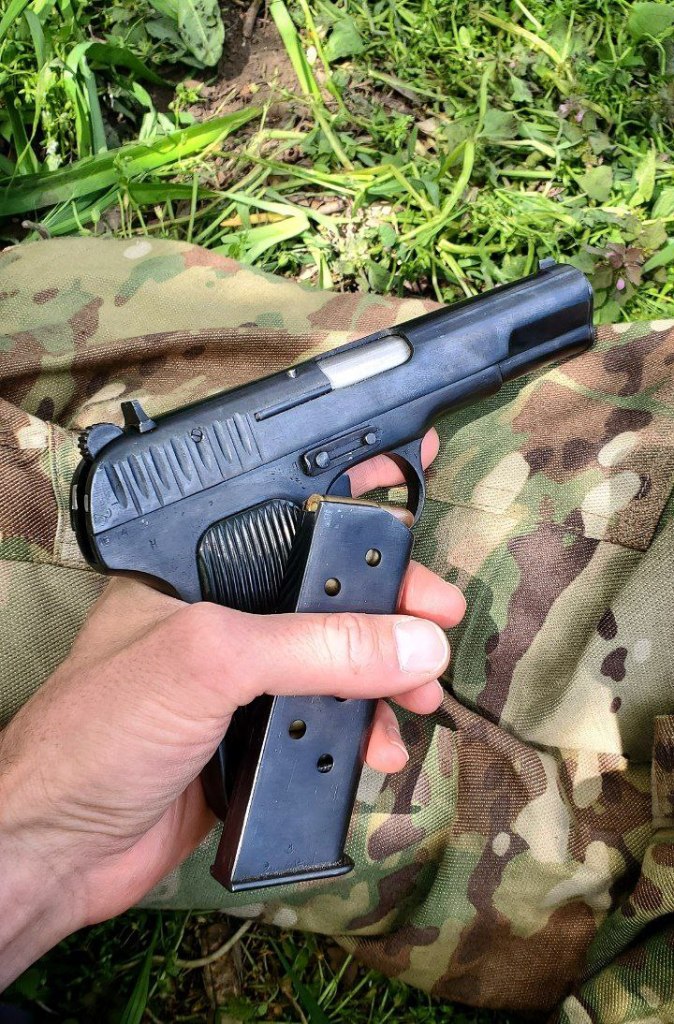
A photo of a TT-33 shared by an International Legion volunteer (via social media)

In around August some members of a TDF unit posed with a Nestor Makhno banner and a DP light machine gun and a TT-33 pistol. A Russian news report from around Soledar, published on 5 August, featured an interview with a soldier carrying a TT in a front pouch of his load bearing equipment. On the 12 August a Ukrainian operator shared a couple of photos of his side arm, a 1945-dated, Izhevsk manufactured TT-33 with wooden grips. Date and location they were taken wasn’t shared.  

In an interesting video posted around the 25 August, a TT-33 is used to test some captured Russian steel plate. Yurii Kochevenko, an officer of the 95th Air Assault Brigade, shoots a one of the plates point black with TT he carries in a webbing holster. The 7.62x25mm round doesn’t cleanly penetrate the plate but appears to impart enough force to crack the metal.

At the end of November the Military Institute at the National University in Kyiv shared photos of cadets taking part in a shooting championship using TT pistols.

On 30 December, the 247th Separate Battalion of the TDF’s 127th Kharkiv Brigade shared a photo of Vitaly, a member of the battalion, armed with an AK-74 and on his plate carrier he has a TT in a Cytac holster. These tactical holsters for the 90 year old pistol retail for around 780 Hryvnia. On the same day Ukrainian personnel shared an update video from their position in Bakhmut, one of them is carrying a TT on his plate carrier.

A TDF officer, call sign Witch, has been seen numerous times carrying a TT-33 as her sidearm. Videos posted to her TikTok on 24 December and 12 January show it in a holster on her plate carrier, with a coil lanyard fitted. A video shared by the TDF Public Relations Service on 19 February also gives us a good look at the TT carried by Witch.

Ukrainian marksman position with a rotary grenade launcher, a UAR-10 and a TT pistol (via social media)

On 26 February 2023, the TDF’s 127th Kharkiv Brigade shared a gallery of photographs featuring the TT on their instagram page. The caption notes that: “Despite the fact that this pistol was actively used even during the Second World War, it is simple in design, reliable in operation, small in size, comfortable to carry and always ready to defeat the Russian invaders.”

A Ukrainian special operations unit shared a photo of a member of the unit sat beside a Russian prisoner while holding two TT-33 pistols, one in its original finish and the other was a camouflage paint job. Most recently at the start of March a Ukrainian marksman active around Bakhmut shared a photo of his position with a rotary grenade launcher, a UAR-10 and a TT pistol.

In addition to the original TT-33s seen in theatre there are also a significant number of former-Yugoslavian M57s which while externally very similar have some improvements, including a slightly longer grip that allows the magazine to hold an extra round.

Update – 25/6/2024:


Support Us: If you enjoyed this video and article please consider supporting our work here. We have some great perks available for Patreon Supporters – including early access to custom stickers and early access to videos! Thank you for your support!


Bibliography:

The Procedure for Partial Disassembly and Assembly of a TT pistol, TDF, (source)  

Rules for cleaning and lubricating weapons on the example of a TT pistol, TDF, (source)  
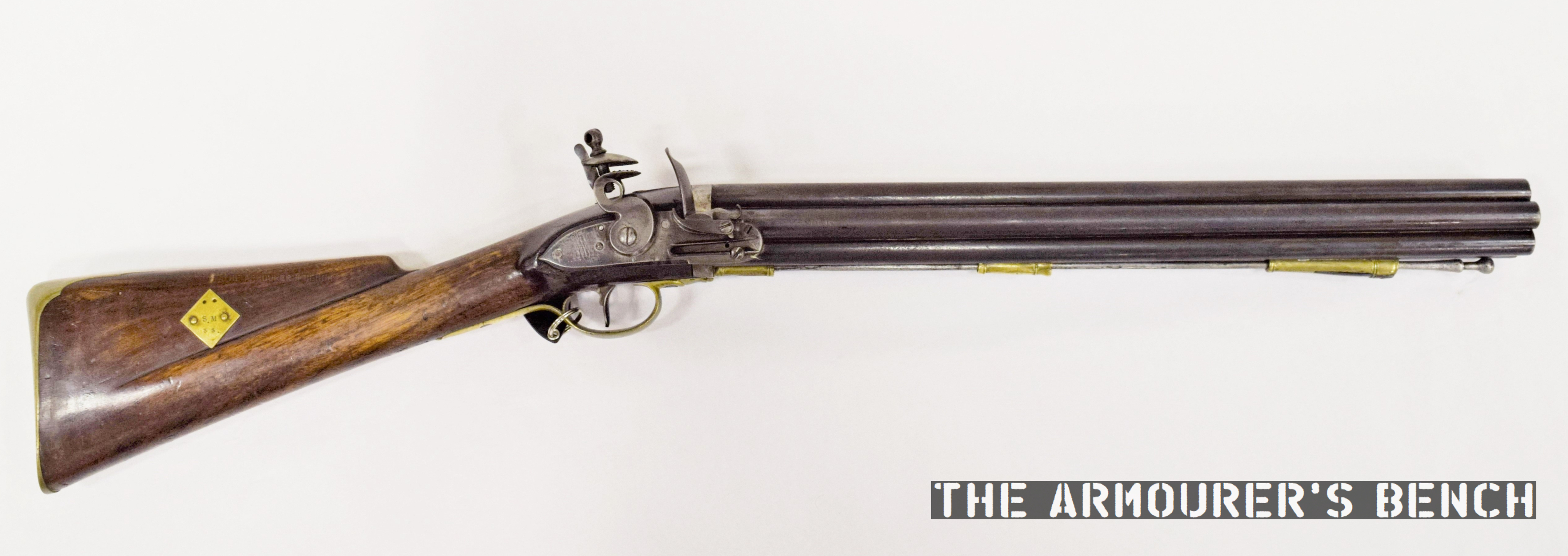
Nock Volley Gun

Commonly referred to as Nock Guns, the seven barrel volley guns were actually designed by James Wilson. Wilson presented his design to the Board of Ordnance for testing in July 1779. Following testing at Woolwich Arsenal the Board of Ordnance decided that the guns, while of no use to the Army, might be useful aboard the Royal Navy’s ships. The volley gun’s impressive firepower could be devastating at the relatively short ranges aboard ships. The Navy had historically used blunderbusses/musketoons and the Board of Ordnance probably viewed Wilson’s gun as an advancement of this concept. London gunmaker Henry Nock was given an order for two ‘seven barrelled rifle guns’ for Admiralty testing but these proved slow to load in action and subsequent guns had smoothbore barrels.

DSC_0262a
Right-side profile of the volley gun (Matthew Moss)

The Admiralty envisioned equipping first rate ships of the line (vessels with 75 guns or more) with 20 volley guns, while second and third rates would have 16 and 12 volley guns respectively, and frigates would carry 10 Nock guns. This represented a sizeable order. The Admiralty eventually purchased 500 guns, paying £13 per gun, to equip Royal Marines and sailors manning the fighting tops (at the top of ship’s masts). The Navy felt that the volley guns’ firepower would be useful when boarding enemy vessels or in repelling boarders by pouring down fire on enemy boarding parties.

DSC_0266 (1)
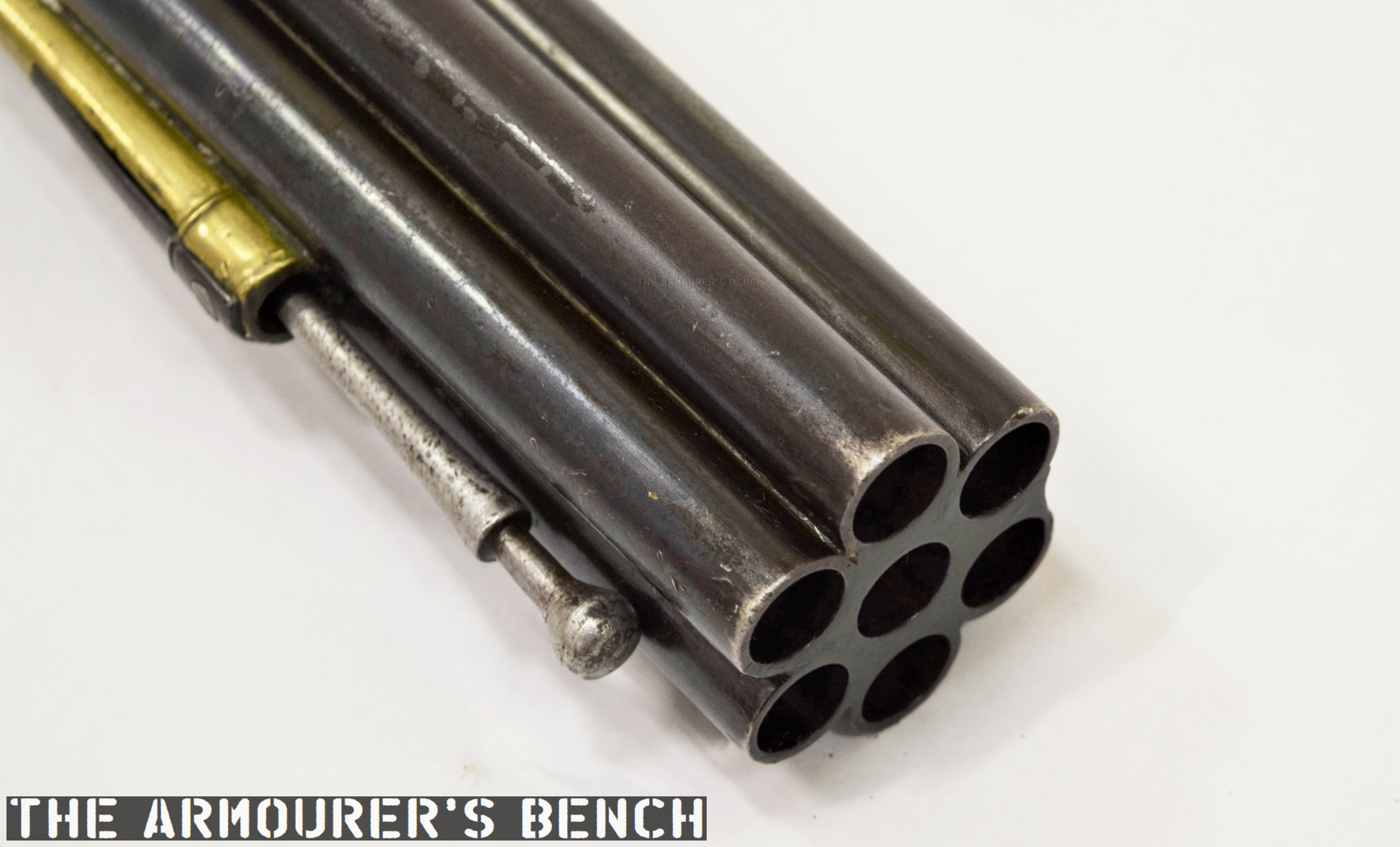
A close up of the gun’s muzzel-end, not also the ramrod which appears to have been lengthened at some point in its life  (Matthew Moss)

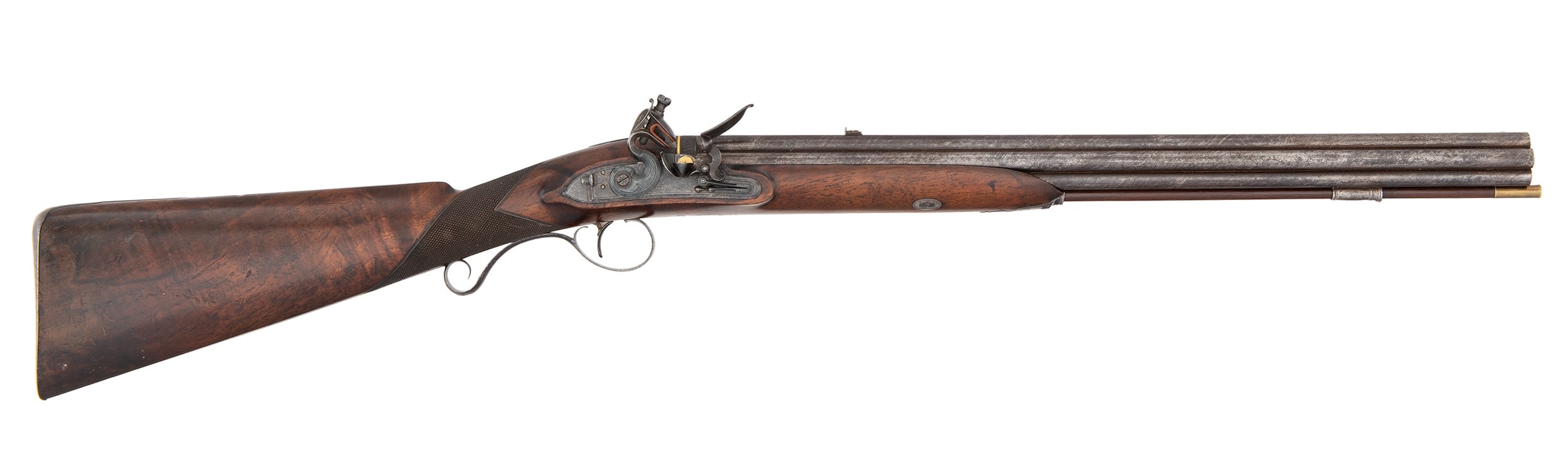
Henry Nock, better known for producing high quality duelling pistols and sporting guns, became the sole supplier of Wilson’s volley guns to the Royal Navy. The weapon’s 0.46 inch calibre outer barrels were arranged around the seventh centre barrel. The 51cm or 20in barrels were brazed together and screwed to an iron plate set into a walnut stock. The outer barrels had vents drilled through them to the central barrel while the central barrel had a vent leading from the lock. Once the flintlock ignited the powder charge in the central barrel, the surrounding barrels were ignited through the vents. As the vents had to be drilled with the barrels already brazed into position, the outer barrels all have plugged drill holes on their outer surfaces.

DSC_0264
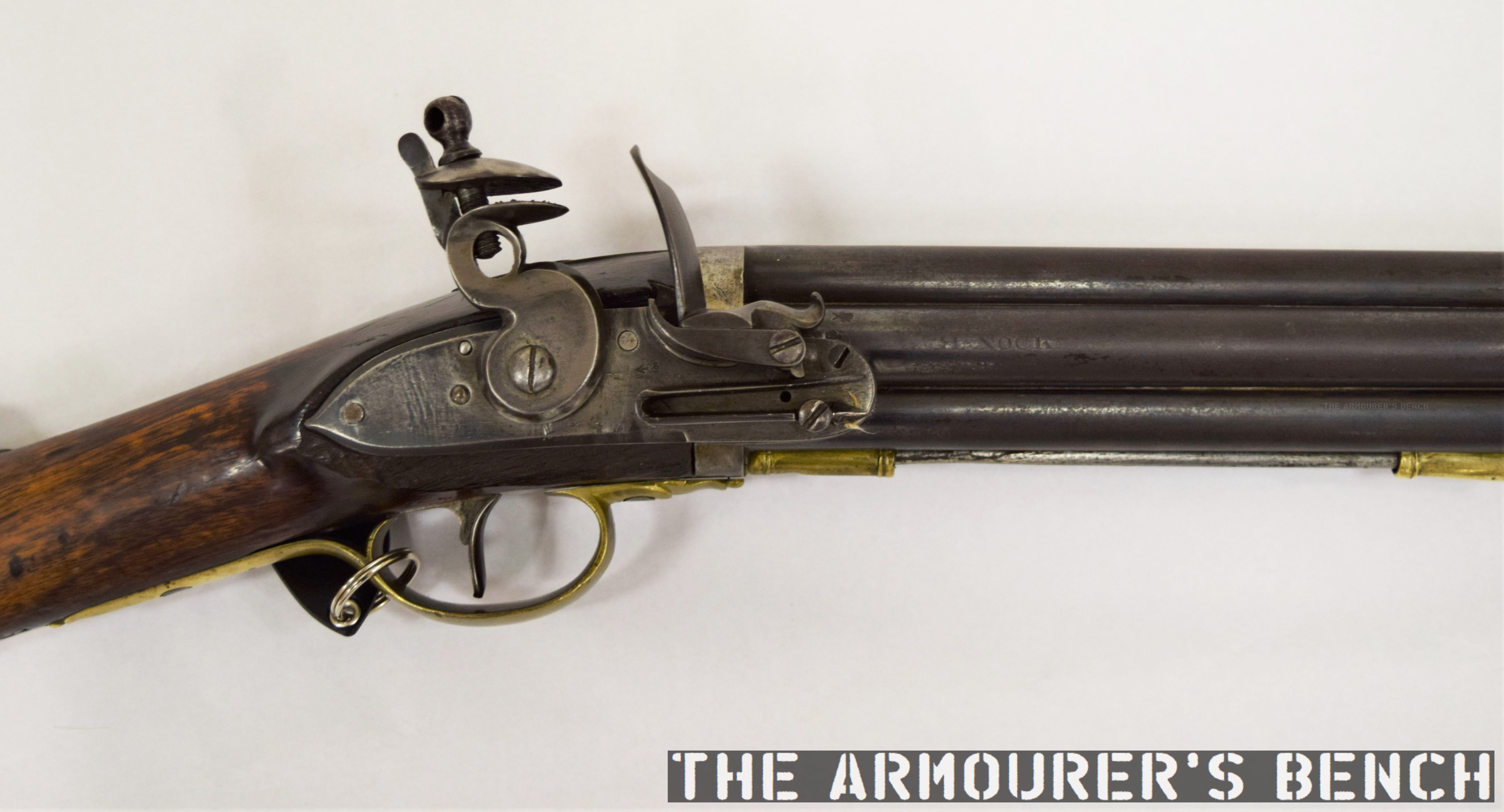
A close up of the lock and the ‘H. NOCK’ makers mark (Matthew Moss)

All seven barrels fired almost at once producing significant recoil, reputedly able to dislocate shoulders. The service load was originally 2.5 drams of finer rifle powder (which I believe equals 68gr) for each barrel – totalling 476gr. Despite the gun weighing 12lbs, this did little to mitigate the weapon’s recoil and a reduced charge or 1.5 drams of standard musket powder was ordered.

The Board of Ordnance and the Admiralty granted Wilson an awarded of £400 (equal to £48,000 or $63,000 today) in May 1780. He played no further role in the testing and development of the volley gun. In 1787 the Navy ordered a further 100 guns from Nock.

DSC_0267a
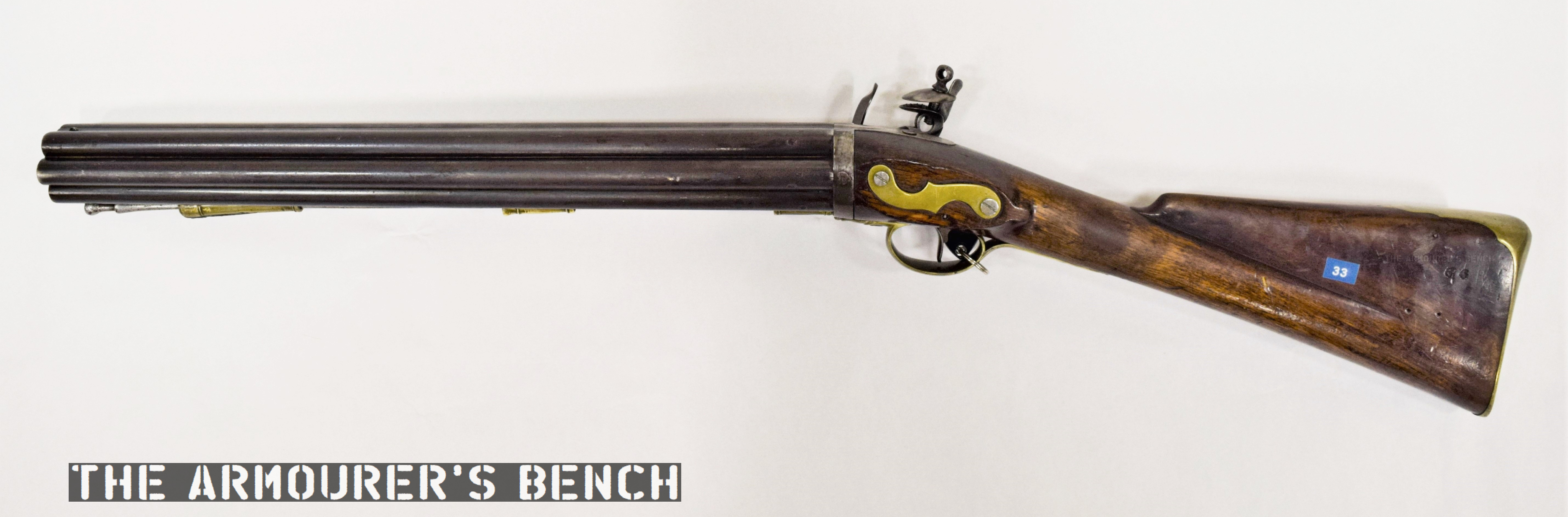
Left-side profile of the Nock Gun (Matthew Moss)

Entering service just too late for service during the American War of Independence the first reported use of the guns came with Admiral Howe’s fleet at the siege of Gibraltar in 1782. They continued to be carried aboard other vessels during the 1790s, but few accounts refer to them and little is known about their service.

Howard Blackmore suggests that naval officers, including Admiral Nelson who disliked placing marksmen in his tops, disliked the guns. There were some fears that the volley guns’ wads could set the ships sails and rigging on fire. Reputedly it was also not uncommon for some of the volley gun’s barrels to fail to ignite. As a result the guns were seldom used on board ships and removed from Royal Navy service in 1804. In 1805, Wilson, then a captain of the Marines suggested the Navy reissue the guns to the Sea Fencibles, a naval militia which helped defend the British coast, however, his recommendation was not followed up.

large_A3018_8
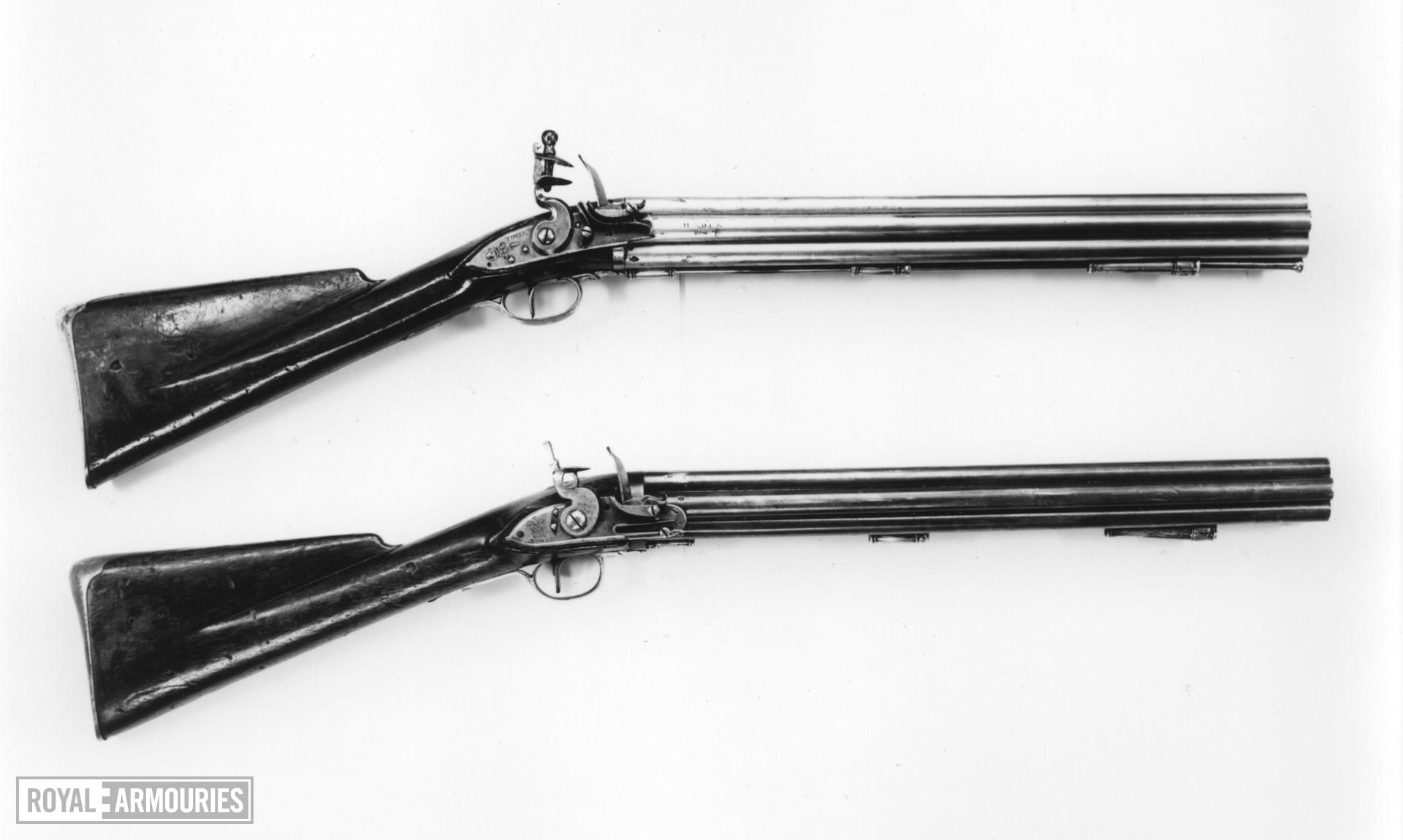
The early (top) and later (bottom) patterns of Nock volley gun (Royal Armouries)

This particular example has the second pattern of lock used on the Nock guns with a smaller lock positioned a little lower on the gun. The earlier pattern was a back action lock, fitted high on the gun with the front of the lock plate in line with the side of the barrel.

The gun has a maker’s mark of ‘H. NOCK’ on the second barrel on the left and various barrel proof marks. Unlike other examples the lock itself isn’t Tower and ‘GR’/Crown cypher marked but does have the Ordnance Broad Arrow just behind the pan. Interestingly, the steel ramrod appears to have an extension brazed onto the end of it, this might indicate that the shorter rod used with the initial charge had to be extended when less powder was used for the lighter 1.5 dram load.

Why did the Nock Volley Guns fall out of favour?

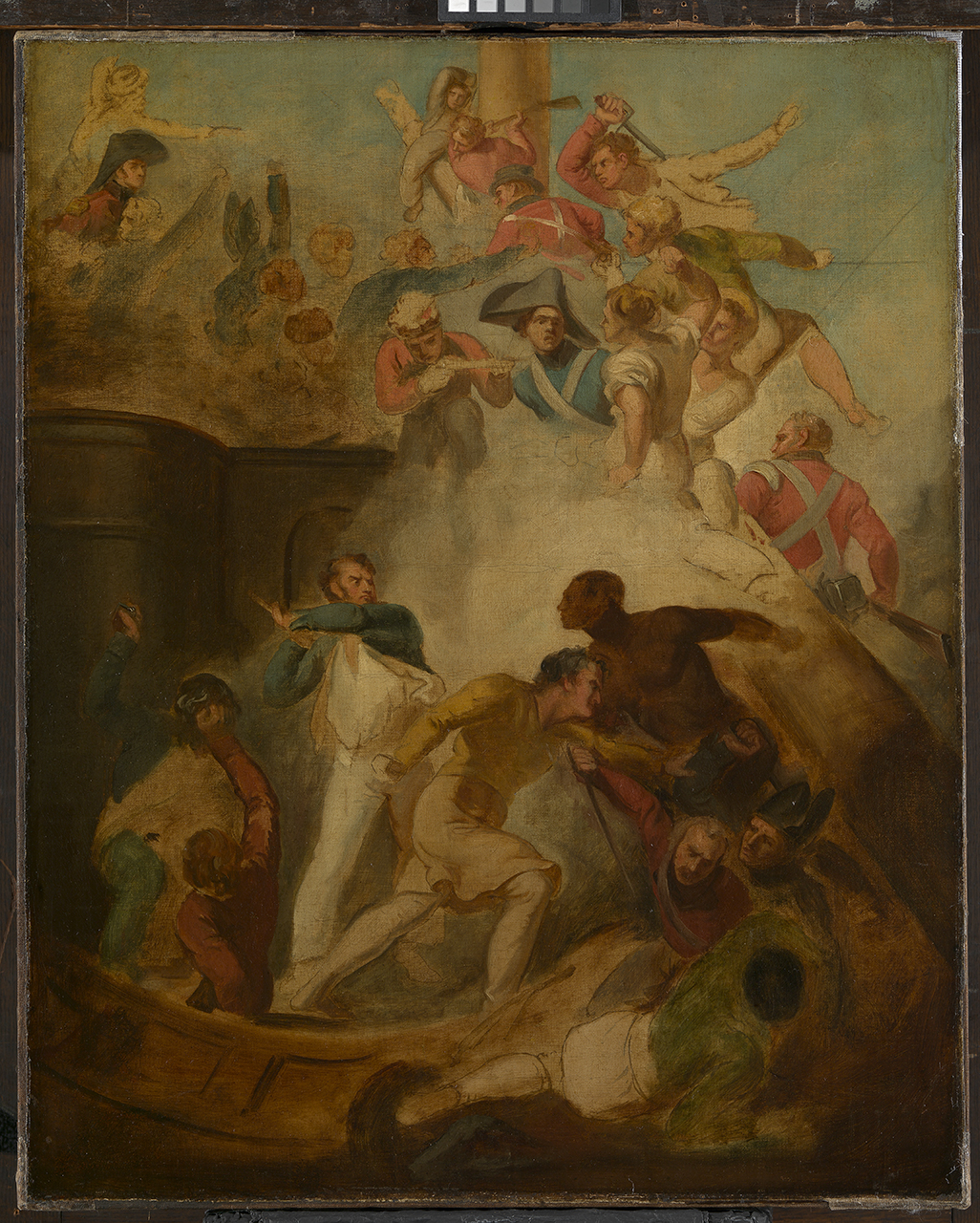
As I mentioned earlier the recoil of the initial service load was significant, Howard Blackmore hypothesised that there may have also been some weakness to the lock springs leading to misfires. One key factor is that close quarters fighting aboard ships often relied on edged weapons like cutlasses, boarding axes and pikes. These paintings give us some feel for what fighting aboard a Napoleonic Man-of-War might have been like – a close, chaotic, terrifying affair.

Drummond, Boarding Party BHC1155
Boarding Party by D. Drummond, (National Maritime Museum)

While pistols were commonly used they were disposable and may not have been reloaded during a fight – more likely they were dropped or used as a club. The Nock Gun would have offered a devastating first volley, and while its 20 inch barrels would have given it better accuracy and range than a musketoon, how much of an impact a single volley of seven .32 bore projectiles would have had especially once the fighting became hand to hand is a matter for debate. At close quarters the Nock Gun quickly becomes a short, ill-balanced, 12lb club.

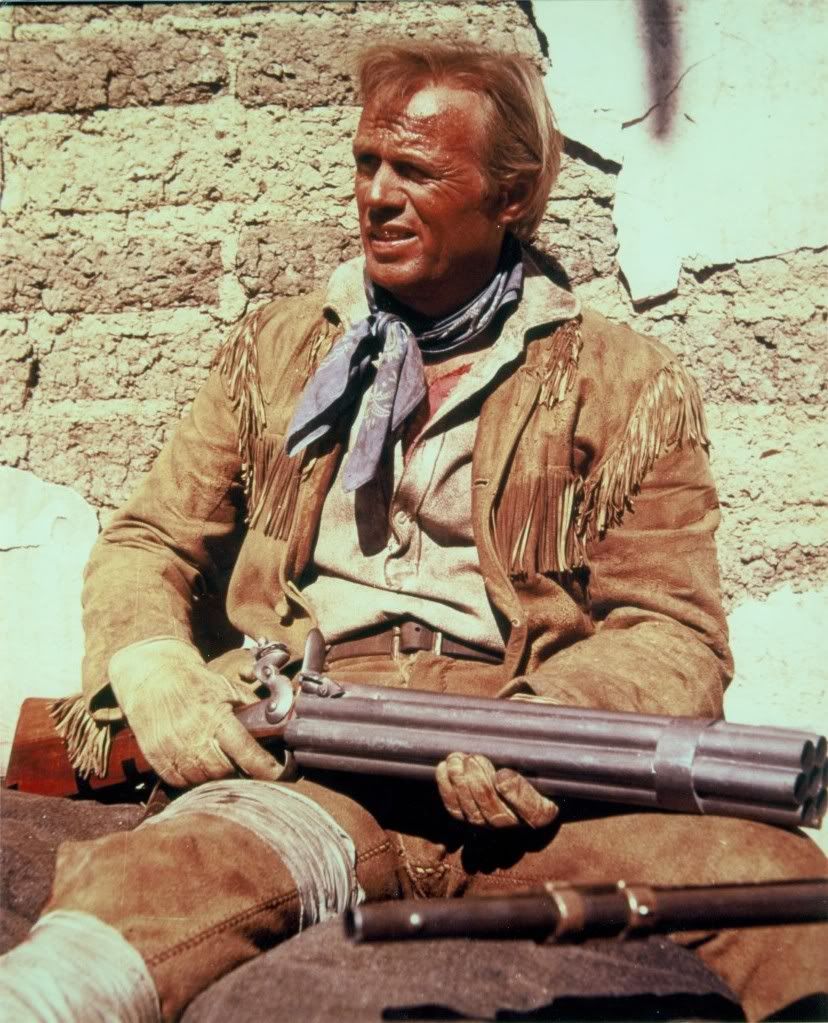
The Nock Volley Gun is perhaps best known for appearing in the Sharpe series of books and films as Sergeant Harper’s weapon of choice but it first appears on screen in the 1960 classic The Alamo with Richard Widmark’s Jim Bowie carrying one and more recently a fleeting, anachronistic, appearance in Master & Commander: Far Side of the World.

576c6f52614f00151316aec60b5a4b30
Richard Widmark as Jim Bowie in The Alamo (1960) with his pretty rough mocked-up Nock Gun

Despite a relatively short and undistinguished service life the Nock Volley Guns also saw some civilian sales with a number of ornate hunting guns with wooden forends, engraving, rifling and rear leaf sights.

3222585_1
A civilian Nock Volley Gun, note the rear sights, wooden forend and fine craftsmanship   (Cowan’s Auctions)

Later in 1818, Nock’s workshop manufactured a design by Artemus Wheeler, an American gun designer with a fondness for revolving guns.

Revolving Nock Carbine
A Nock-made rotating barrel carbine designed by Artemus Wheeler (Rock Island Auction Company)

Wheeler’s carbine resembles the earlier volley gun externally but is in fact a manually rotated, self-priming flintlock ‘pepperbox gun’ with six barrels arranged around a central axis. Unlike the earlier volley gun the pepperbox carbine was never trailed or purchased by the Admiralty. Henry Nock’s workshops produced approximately 655 volley guns between 1780 and 1788. The Nock Gun is a weapon that would greatly benefit from some in-depth contemporary research as the current best source is over 50 years old and relatively little is known about the gun’s service history.


If you enjoyed the video and this article please consider supporting our work here. We have some great perks available for Patreon Supporters.


Specifications:

Calibre: .32 bore
Action: Muzzle-loading 7-barrel flintlock
Barrel  Length: 51.3cm/20in
Overall Length: 92.7cm/36.5in


Bibliography:

British Military Firearms 1650-1850, H. Blackmore (1961)