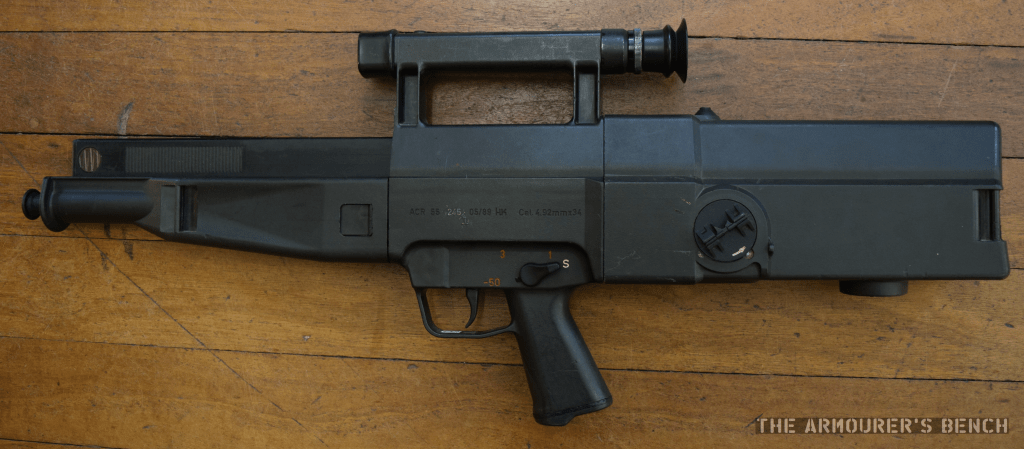
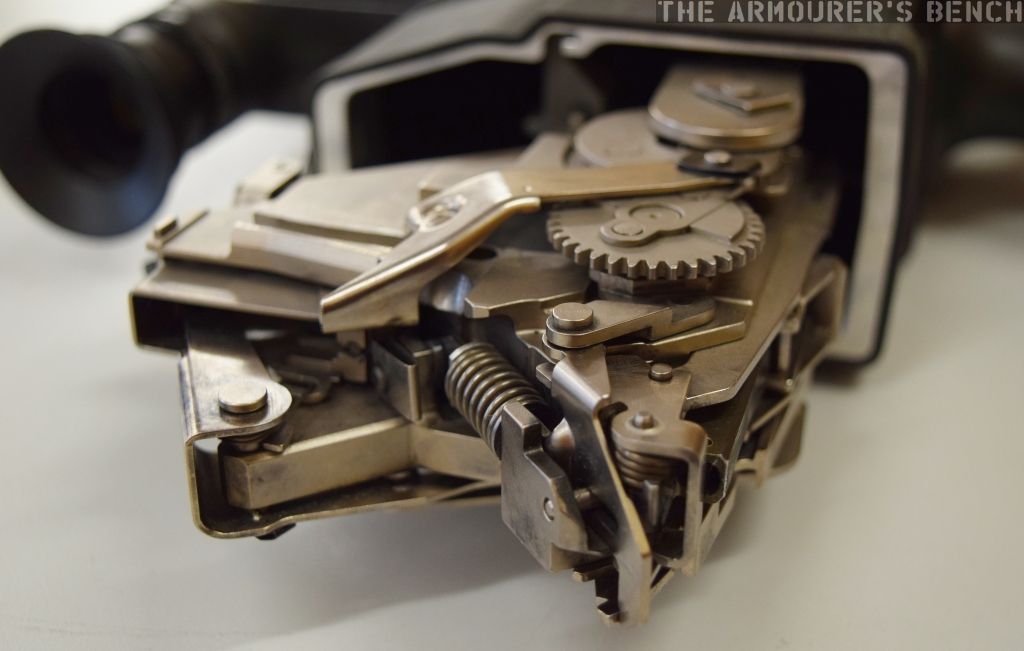
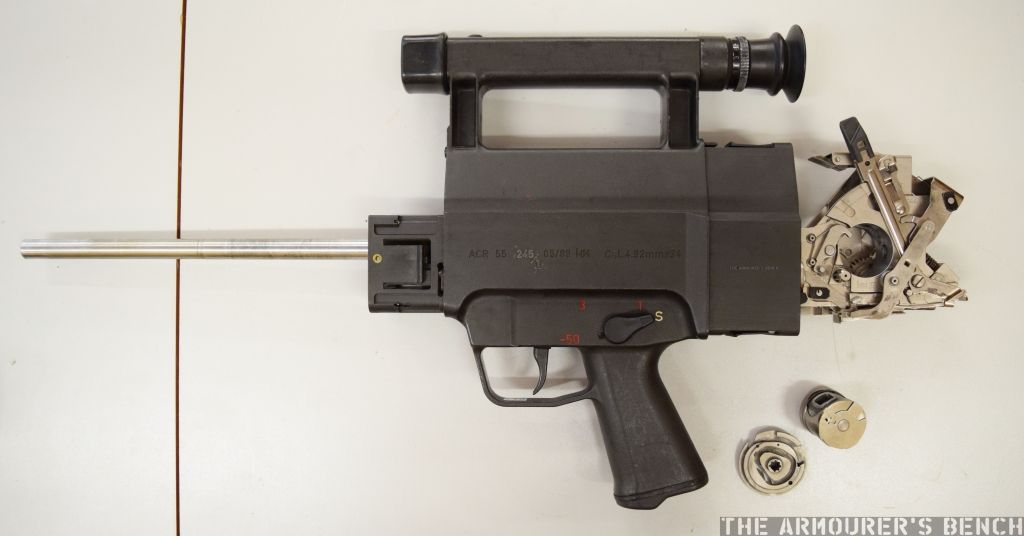
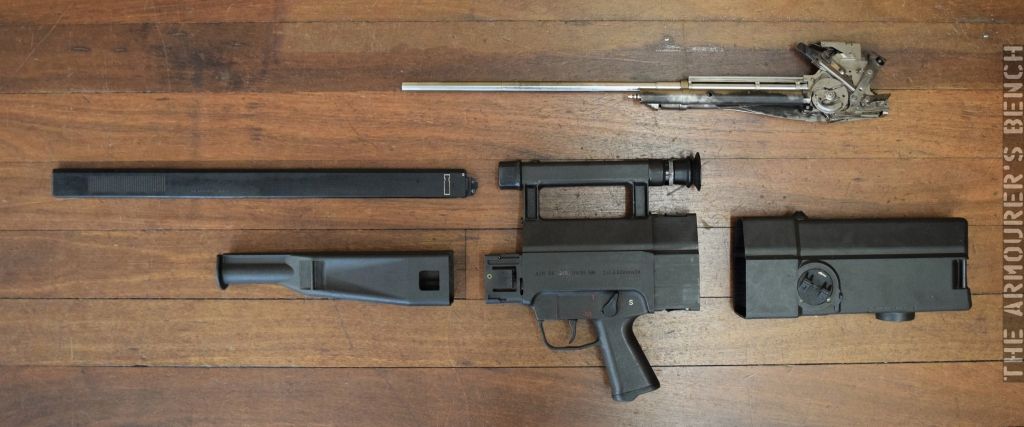
In this special video I had the privilege of field stripping a Heckler & Koch G11. We strip the rifle down into its major assemblies and then explain how the ‘space magic’ works!
I explain how the recoil management system, which compensated for the recoil of firing a 3-round burst at ~2,000rpm, worked and how rifle’s ingenious rotating breech operated. This video demonstrates just how complex and ambitious the HK G11 was!
For more information and more photographs of the G11 disassembled check out the original article – here.
This is a remaster of an earlier video with a new fun intro and the full 1990 Aberdeen Proving Ground video filmed by HK, it is the best available look at the G11 in action. I’ve been meaning to remaster this video and make some additions for a while. Hope you enjoy it.
In mid-August there began to be sightings of small numbers of interesting Heckler & Koch rifles with Ukrainian special operations units. We’ve previously seen HK416s in use with a variety of units, check out our earlier article/video on those. However, it now appears that alongside H416s there are now a limited number of G36s and HK433s in use in Ukraine.
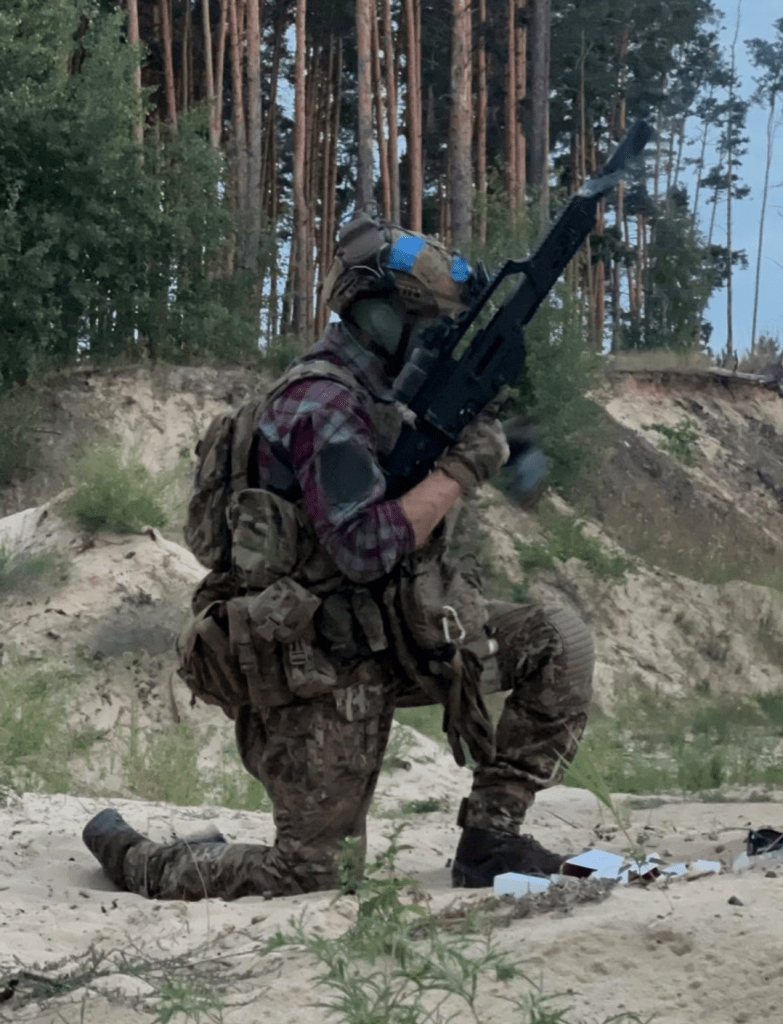
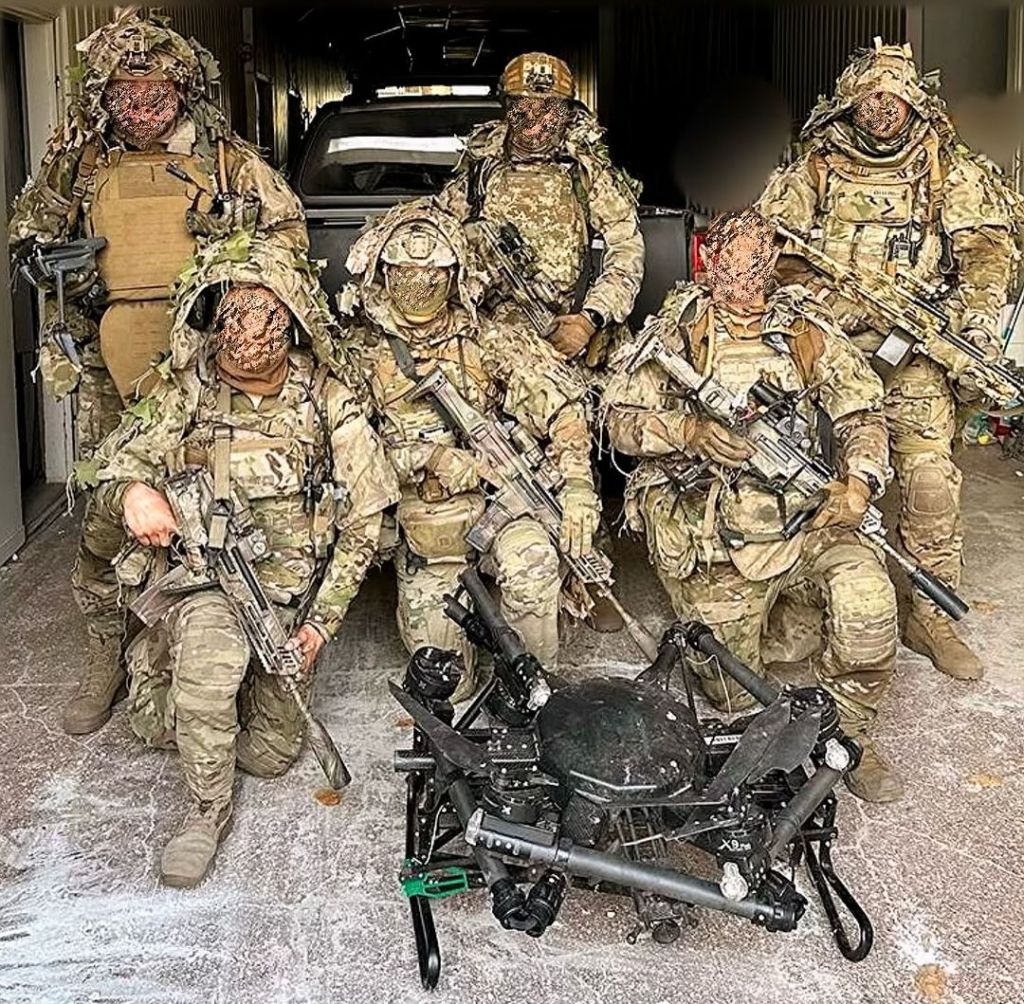
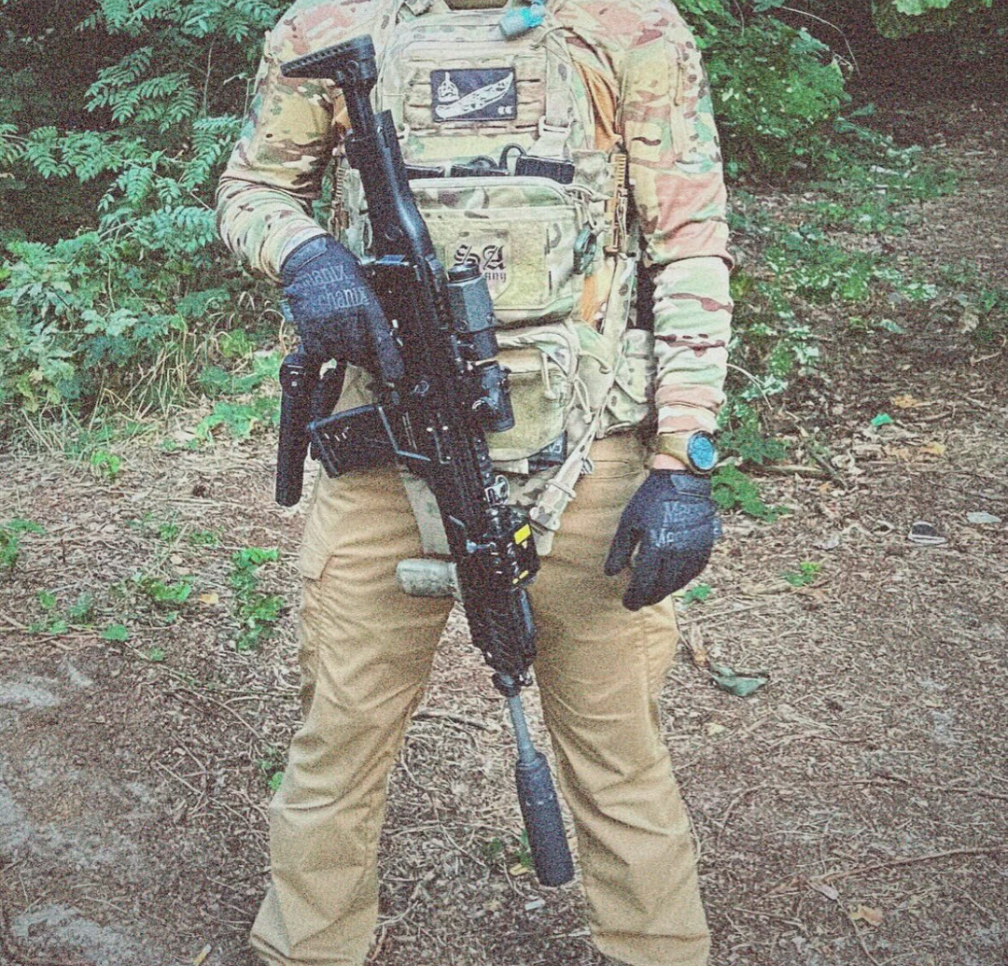
The first image of these appeared on 12 August, when Assault Bastards, a team affiliated with Ukraine’s Intelligence Directorate’s (the GUR) Kraken regiment, shared a photograph of a combatant with a suppressed G36KA4 at the range. On the 18 August, shybenyk.squad, a team associated with the Kraken Operations Unit, posted a team photo with the caption “GUR MOrning. Kill & travel”, with one combatant on the far right seen holding an HK G36KA4. The rifle has an HKey forend, HK’s proprietary mounting system, and is equipped with an Aimpoint RDS and a 3X-C magnifier and an Ase Utra DUAL556-S-BL suppressor.
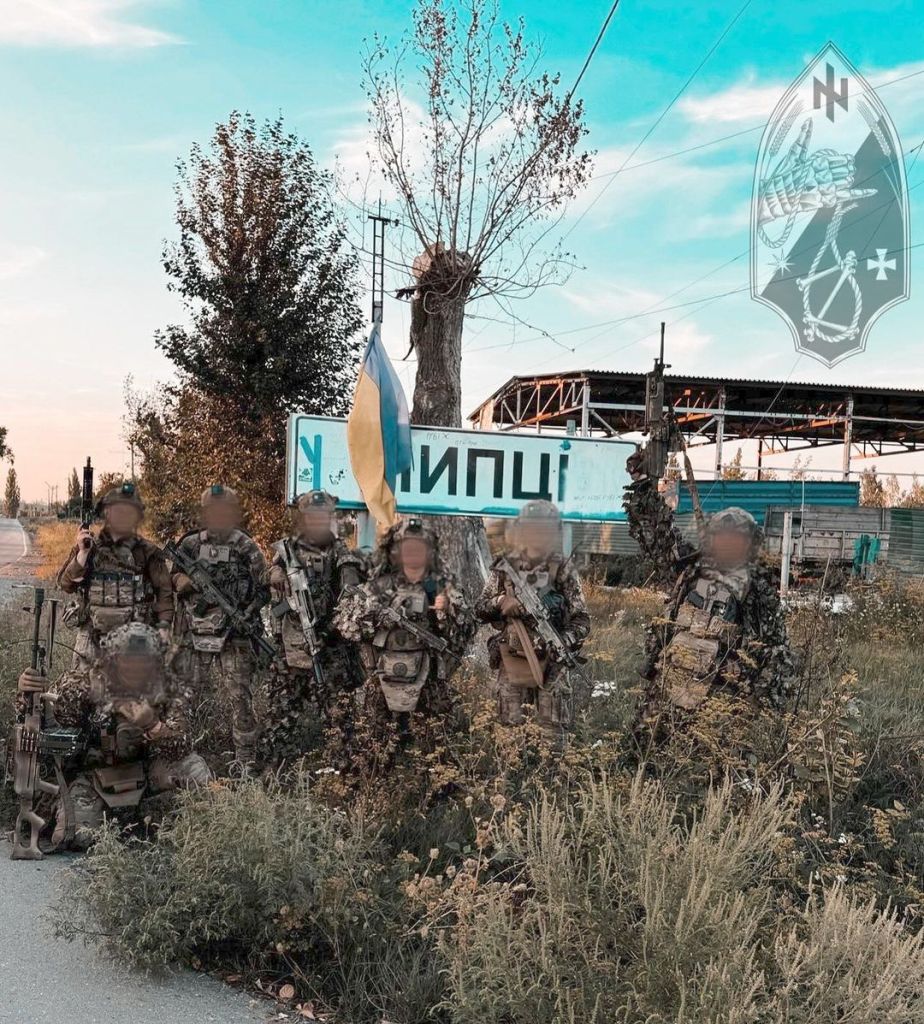
On 23 August, shybenyk.squad shared a group photo posing in front of a signpost for the village of Lyptsi in the Kharkiv oblast. In the photo we can make out a pair of G36KA4s. Intriguingly both appear to be loaded with STANAG pattern polymer magazines rather than HK’s translucent magazines. This would indicate that either some of the rifles were shipped with magazine well adapters or were shipped with them.
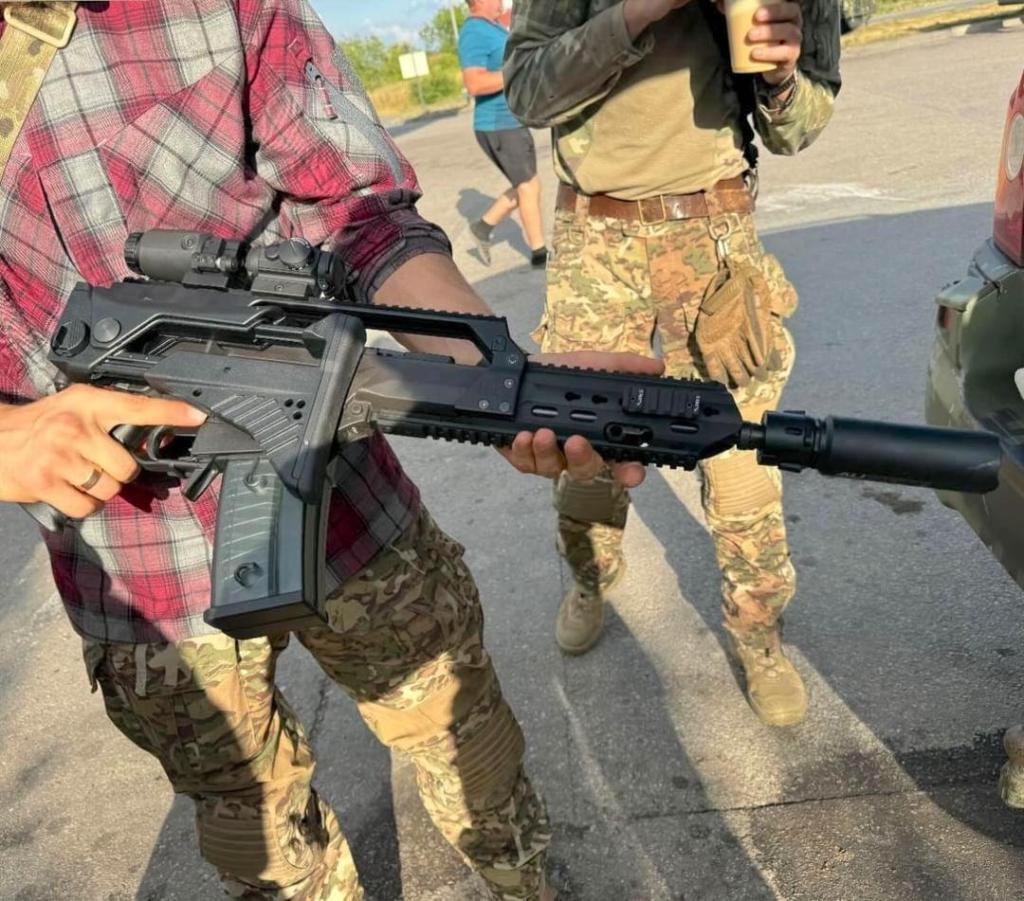
Shortly after these photos emerged a member of the Kraken regiment shared a close up photo of one of the G36KA4s with my colleagues at StreakingDelilah. It has an HK translucent magazine and is fitted with an Aimpoint T2 RDS and Aimpoint 3X-C magnifier and an Ase Utra DUAL556-S-BL [Correction: DUAL QM-2] suppressor. This appears to be the common setup and likely how the rifles were shipped. On the HKey forend we can see a short rail segment has been attached for mounting a light or laser aiming device. The rifle looks in great condition, appearing as if new out the box.
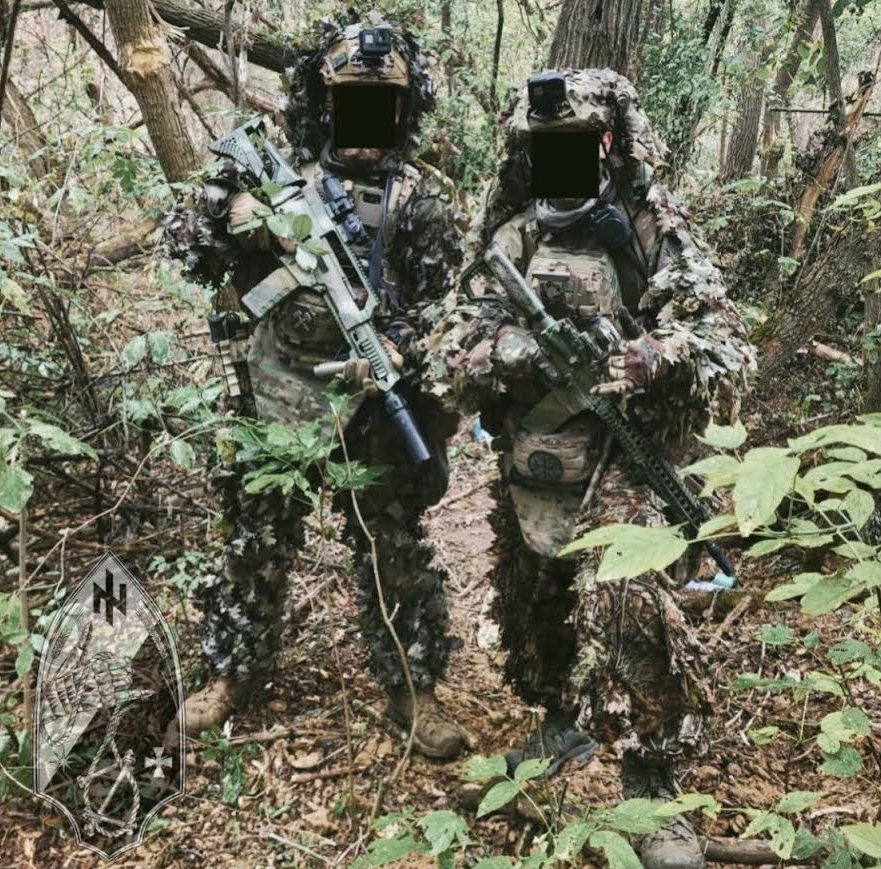
shybenyk.squad shared another group photo alongside the Assault Bastards group on the 24 August. The photo again features two previously seen G36KA4s. Speaking to Shybenyk.squad they noted that they only received a couple of the rifles.
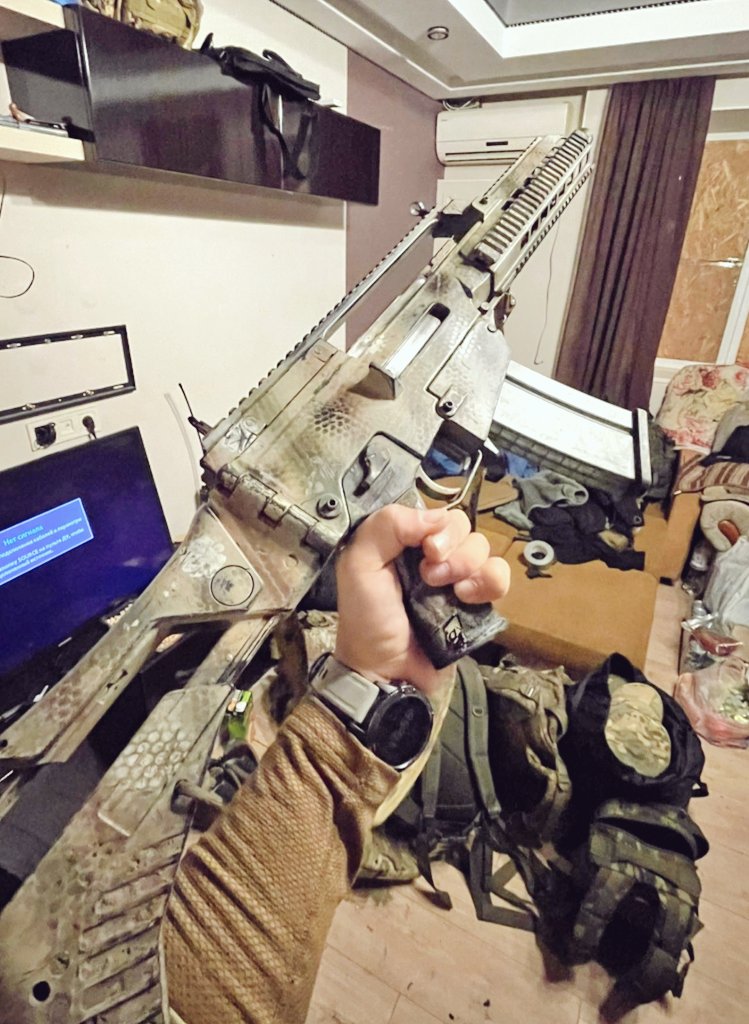
On the 26 August another member of Kraken shared photographs of himself firing a G36KA4 at a range. The rifle has the usual accessories and is loaded with an HK translucet 30-round magazine. On 30 August, shybenyk.squad shared another image of a combatant with an G36KA4 again fitted with Aimpoint optics and an Ase Utra suppressor. The rifle has been painted up and is seen loaded with a polymer MAG (what appears to be a Mission First Tactical Extreme Duty Magazine). Again indicating magazine well adaptors are in use.
But there may have been some earlier sightings dating back to 2023. In mid-June 2023, Tyskshared a series of three photos of a Ukrainian serviceman with a G36K with a railed forend. The rifle doesn’t have any optics mounted and the folding back-up iron sights are deployed. Tysk noted that they had been sent the photos by a serving subscriber but there was no further detail on where the photos were taken – be it in Ukraine or during training abroad.
Several months later in October, a member of the 12th Assault Brigade (Azov) shared a photograph of another G36K series rifle, again with no optics and a paint job similar to the earlier rifle. The combatant who shared the photograph noted that it wasn’t his rifle but claimed that a number of them were in his unit’s armoury for a time. In early November, a German colleague DEAidUA, contacted the BMVg (German MoD) who stated to him that they had “no knowledge of the transfer of these weapons to Ukraine.” Additionally, there has been no mention of the rifles on the German government’s extensive list of aid to Ukraine. The only small arms mentioned include a number of pistols, some MG3s and the HK MG5s we’ve examined in a previous article/video.
HK433
In addition to the G36s yet another Heckler & Koch rifle has appeared in Ukraine recently – the HK433. The first sighting of an HK433 in Ukraine actually predates the recent sightings of G36s. At the very end of July a member of Kraken posted a photograph featuring an HK433 equipped with a Aimpoint T2 RDS, an Aimpoint 3X-C magnifier, a Magpul RGV front grip, a Steiner DBAL A2 laser aiming module and a Norwegian A-TEC ‘A-Flow’ suppressor. The combatant who shared the photo stated that his platoon had received 10 of these rifles for testing and evaluation purposes, though he did not state if they had been provided directly by HK. On speaking to the combatant about the rifles he noted that they had performed well but that they had not yet been used in combat but they had been taken out on operations.
It was over a month before another image of the HK433s surfaced, on 18 September four HK433s, three with Aimpoint Micro T2s and magnifiers and one with an EOTECH XPS and a magnifier, they all appear to have the A-TEC suppressors. The photo appears to be of a recce squad and was shared by Kraken’s 3rd assault company.
The most recent photo of an HK433 to surface was shared on Telegram with a caption noting the combatant that submitted the photo was part of the Ministry of Internal Affairs of Ukraine and operating in the Kharkiv oblast. The combatant is possibly part of the National Guard’s 12th Assault Brigade.
It would seem that Ukraine has received small numbers of G36s and HK433s and that these have been issued to teams associated with. the Kraken regiment and the 12th Assault Brigade. The source of these rifles is unclear, while the G36KA4s may have come from one of the Baltic nations the HK433s are newer, less common rifles and have not yet been adopted by any militaries in the 5.56x45mm configuration. This may indicate that the rifles were provided by Heckler & Koch themselves, its unclear if the G36s may have been included in the same batch.
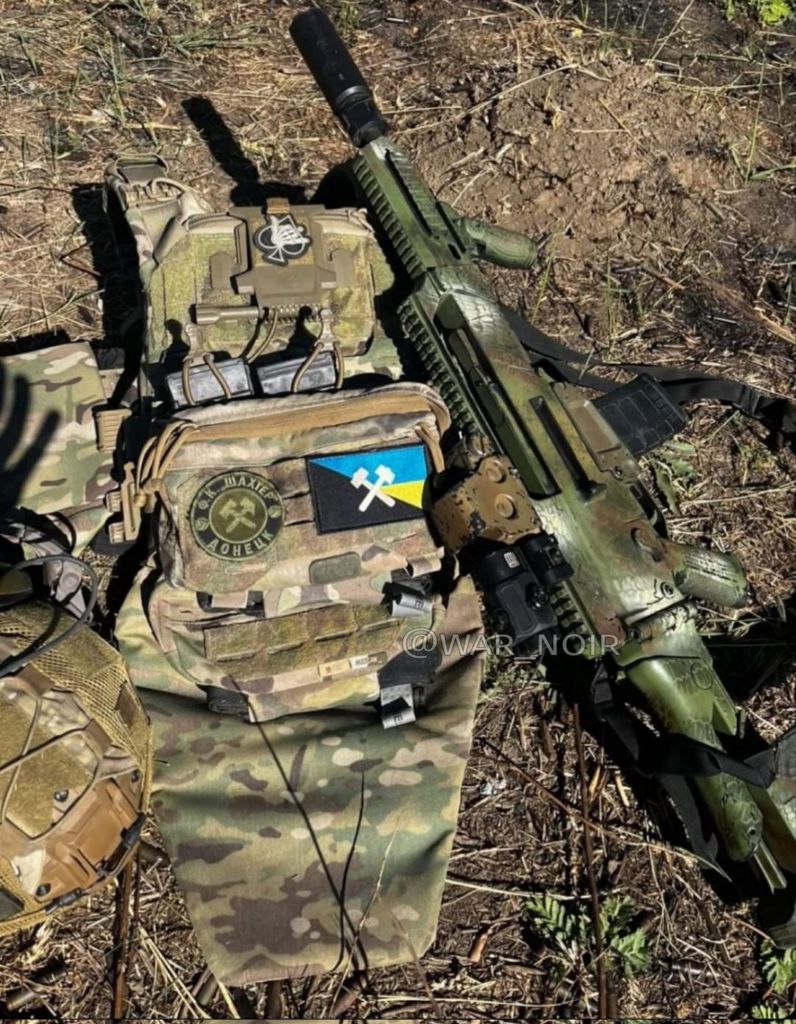
Update – 5/10/24: Another G36 with magazine adapter and PMAG. (Source)
Update – 6/10/24: The hammer insignia would suggest the combatant is from the same unit as the rifle pictured above.
Another sighting of a G36 in #Ukraine. Notably this one is using standard G36 mags, unlike some of the others that have been seen with STANAG mag adapters.
— Matthew Moss | Historical Firearms (@historicfirearm) October 6, 2024
Update – 7/10/24:
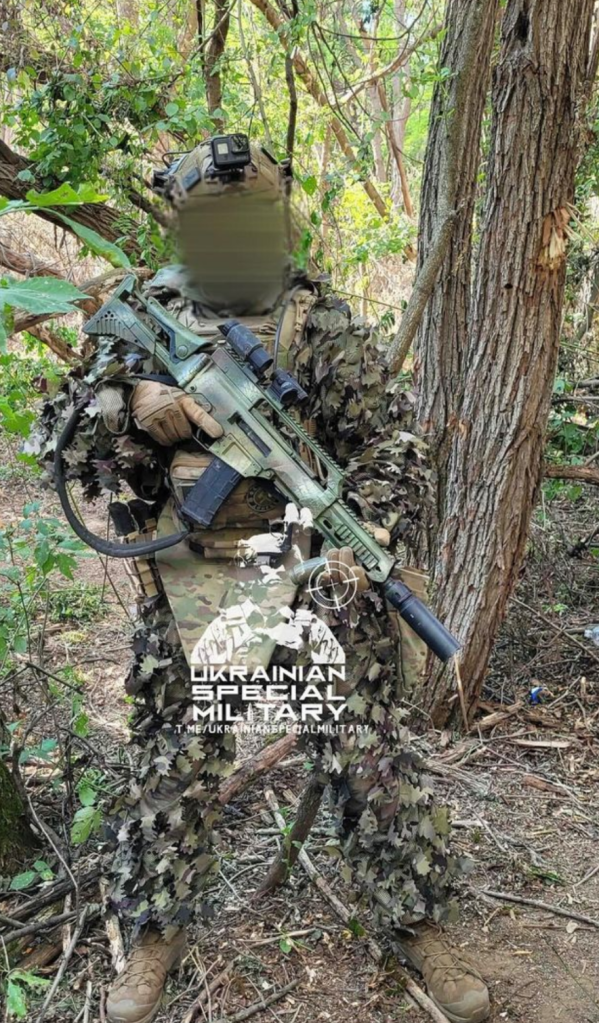
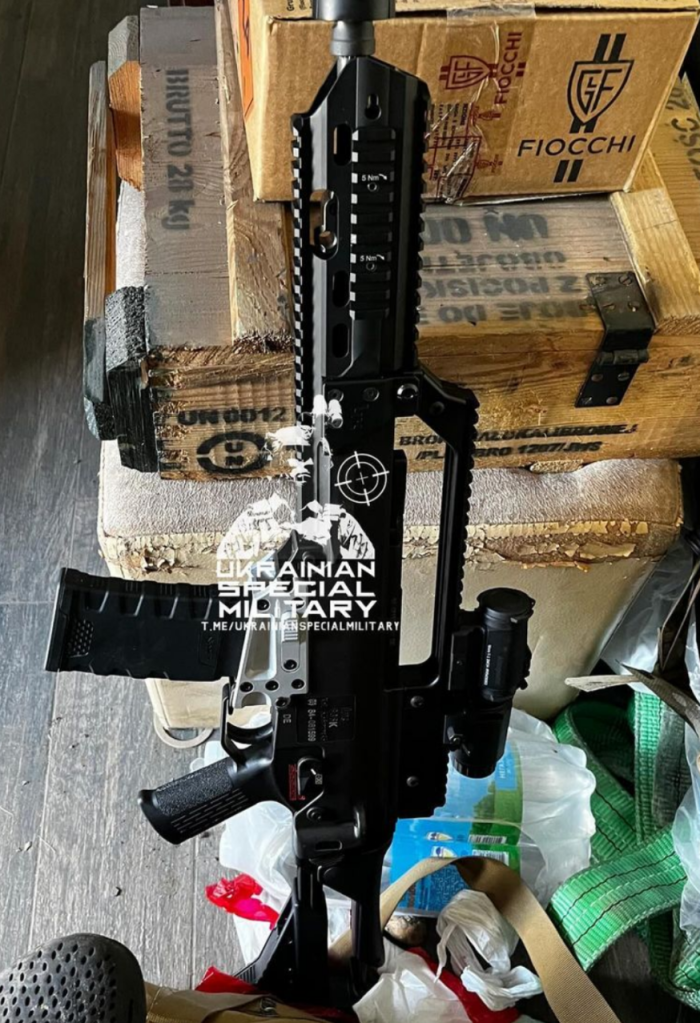
A couple of additional images of HK G636s in Ukrainian service shared by Ukrainian Special Military on IG. Again the rifles are seen evidently using magazine adapters. The rifle on the right has an unusual magazine adapter, which I’ve so far been unable to ID. It seems to be either in-the-white or, perhaps more likely, 3D printed.
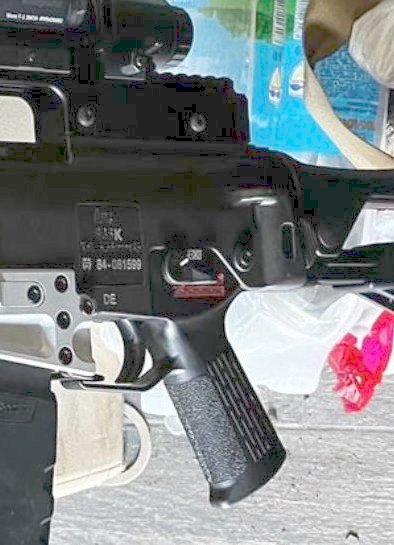
Intriguingly, in photograph on the right the rifle’s serial number and markings are visible. With an ’84’ serial number prefix and a ‘DE’ marking visible. It’s pictograph selector markings (rather than S-E-F) are also visible.
In 1981, Heckler & Koch introduced what would be their last infantry rifle that used their tried and tested roller-delayed blowback action, the HK G41. In October 1980, following NATO’s smalls arms and ammunition testing during the late 1970s, a meeting of NATO Armament Directors, agreed to standardise to the 5.56x45mm round favoured by the United States since the mid-1960s. Standardisation Agreement (STANAG) 4172 saw NATO standardise on the Belgian/FN SS109 ball round. At the same time Draft STANAG 4179 proposed adopting US 30-round M16 magazines as the standard 5.56 magazine pattern, while this proposal wasn’t ratified the M16’s magazine became the de facto standard.
At this time Heckler & Koch were engaged in a major engineering project to develop the G11 caseless ammunition-firing individual weapon. Their main offering for the 5.56x45mm rifle market at the time was the HK33, a rechambered version of the 7.62x51mm G3 developed by Tilo Moller, which was introduced in 1965. The HK33, however, used a proprietary HK magazine and was not compatible with the M16’s magazines. In 1977, as the NATO trials began and it became clear that 5.56x45mm would be adopted, HK began to develop what would become the G41. In 1979 with initial development completed HK submitted 18 G41s for testing with the West German Army. It wasn’t until 1981 that HK introduced the G41 onto the market.
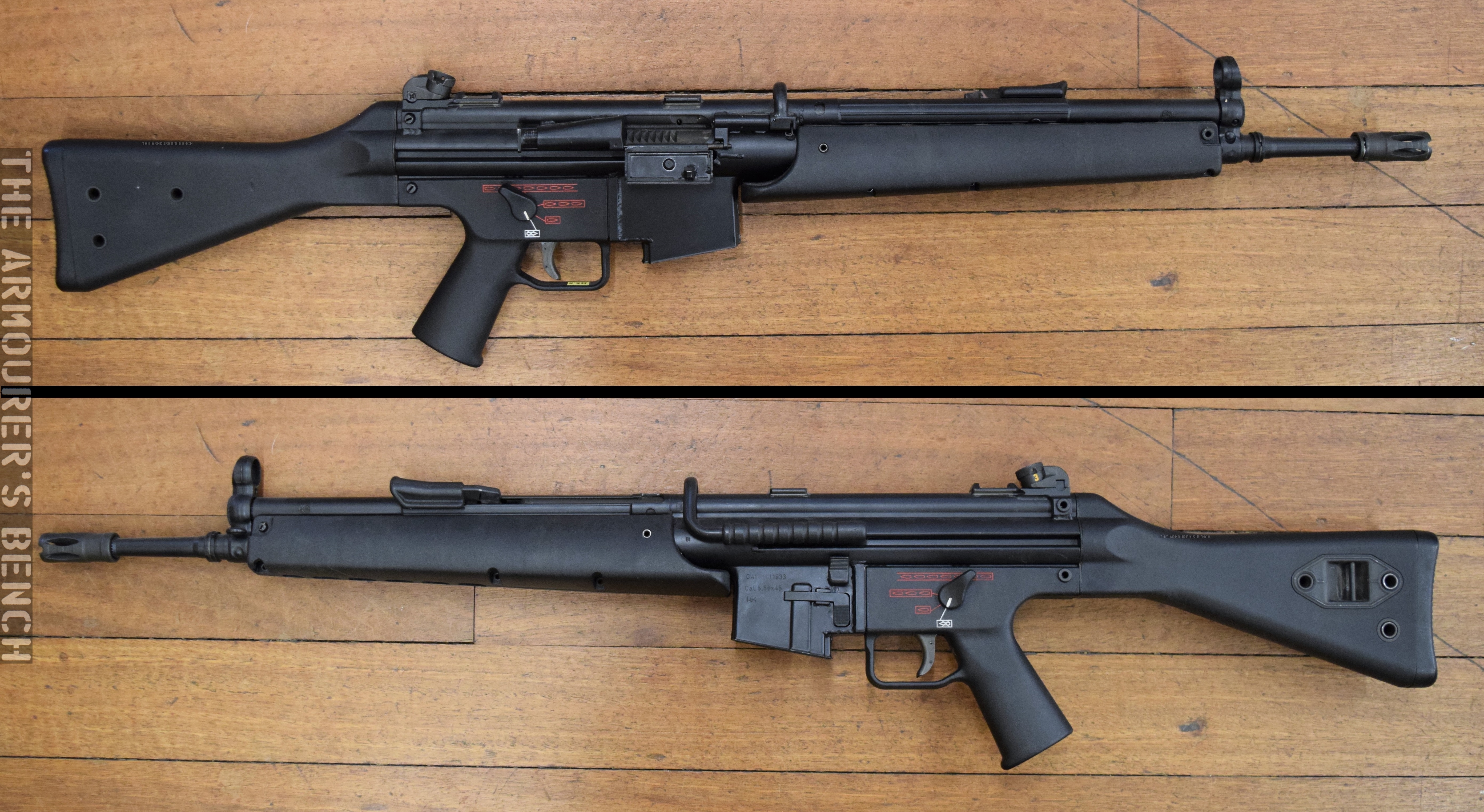
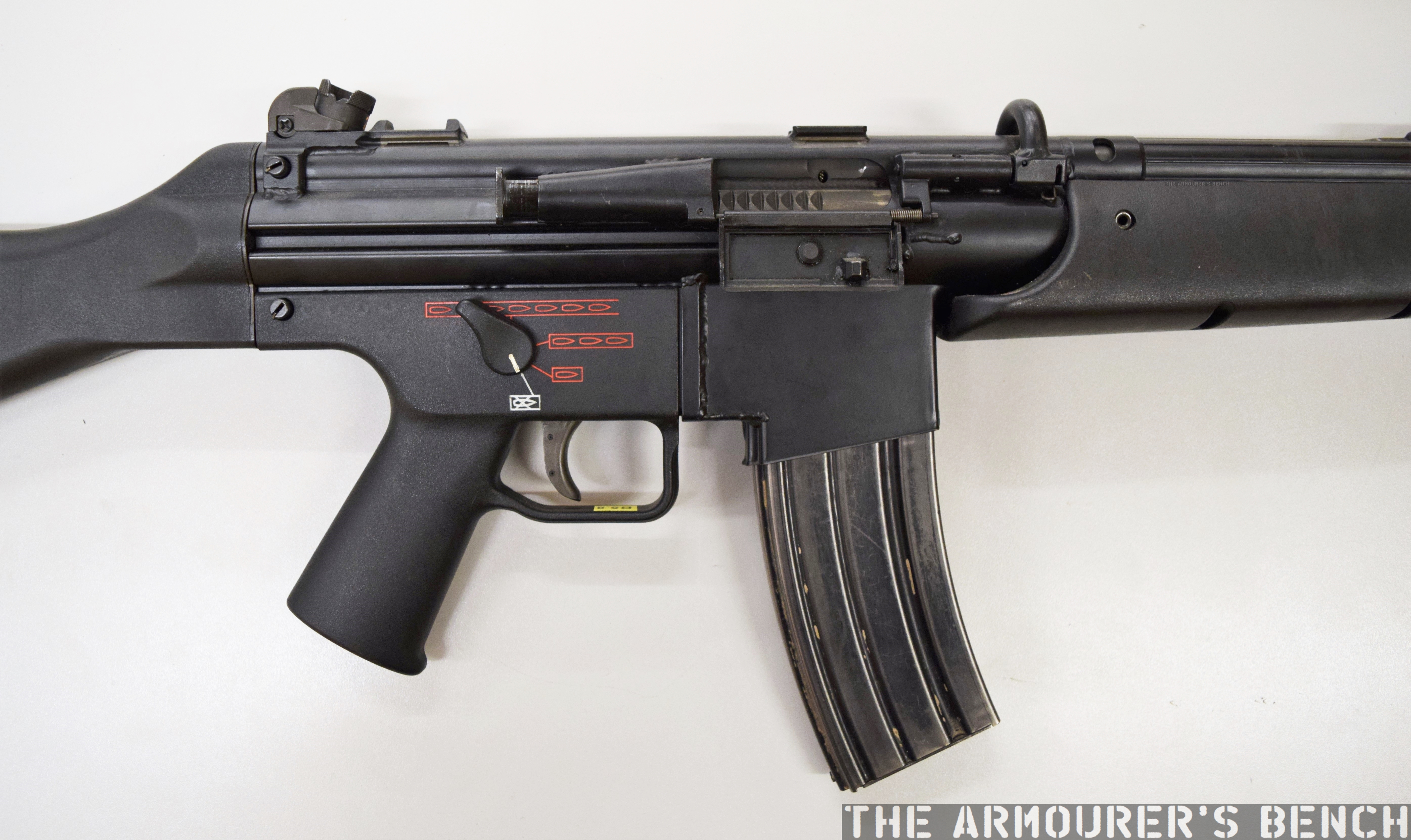
Left and right profile views of the G41 (Matthew Moss)
While continuing to use the same roller delayed blowback operating system as the G3, HK33 and MP5, the G41 embodied a number of improvements. While still using a stamped metal receiver it utilised 1mm thick high tensile steel rather than the 1.2mm thick steel used by the HK33. This helped to lighten the receiver. The new rifle also used a lighter bolt assembly, paired with a new recoil spring which comprised of five wound strands around a central coil, rather than a single coil, which had a longer stroke. This acted to lower the felt recoil. The G41, however, had a higher rate of fire at around 850 rounds per minute compared to the 750 rounds per minute of the HK33. Some of the G41’s bolt geometries were reworked and a new extractor was added.
The G41’s lower receiver was redesigned to allow the rifle to feed from STANAG magazines rather than HK’s earlier proprietary magazines. The cocking lever and forward assist were taken from the HK21A1 (XM262) general purpose machine gun, developed for the US SAW trials.
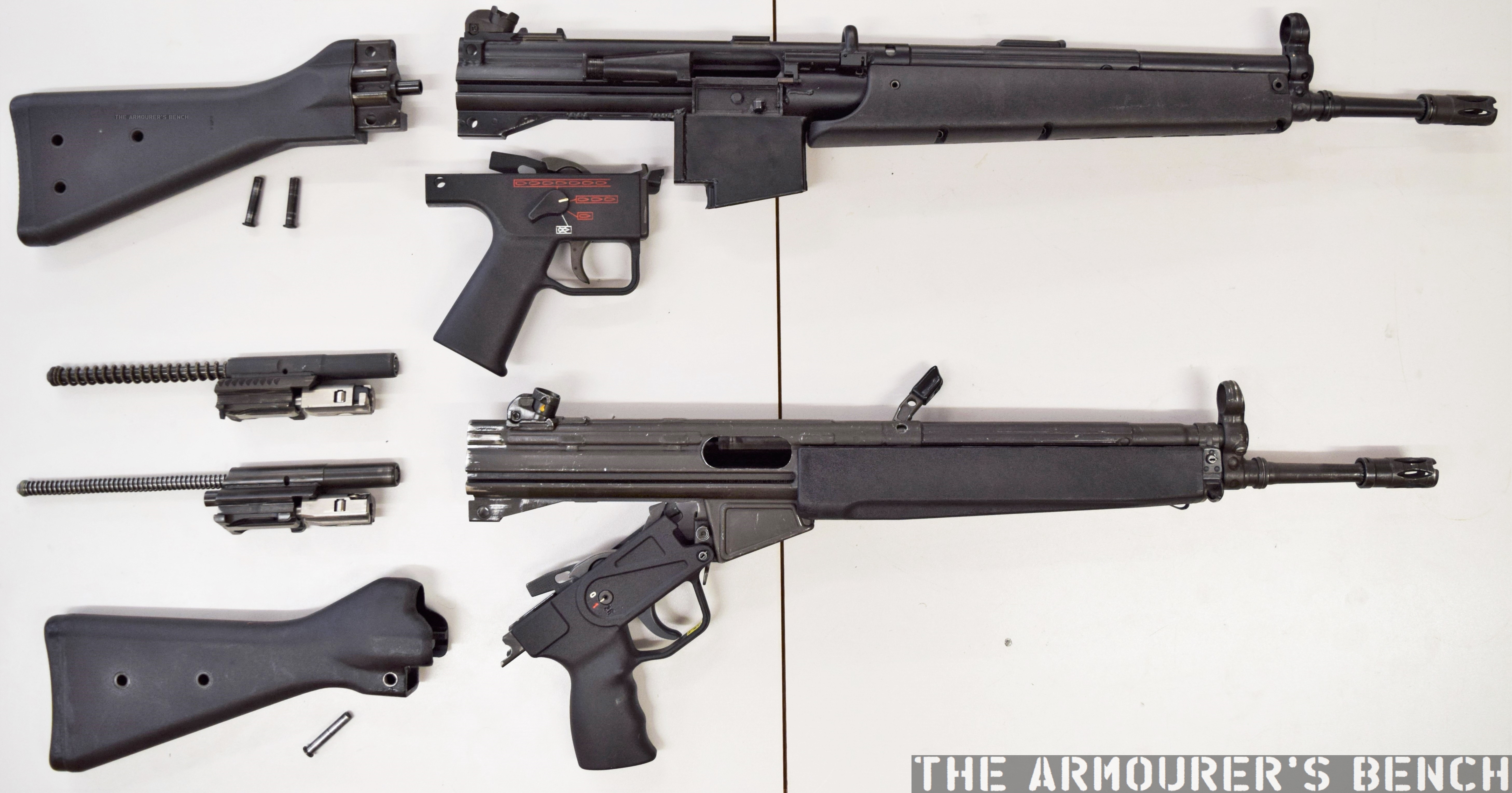
HK G41 (top) and HK33 (bottom) field stripped (Matthew Moss)
It also had a new more triangular polymer foregrip and added a plastic dust cover to the ejection port, a NATO pattern optics mount (meeting STANAG 2324) replaced HK’s claw-mount system, and a spring-loaded folding carrying handle near the centre of balance was added. Importantly it also added a last round hold open device and a bolt release catch, on the left side of the lower receiver.
The usual thumb serrations on the side of the bolt, for pushing the bolt home, were replaced by a prominent forward assist, similar to that found on the M16A1 and other HK weapons such as the HK21 light machine gun and the PSG-1 sniper rifle. HK sales literature described it as a ‘low noise’ forward assist and the manual describes the “quiet cocking of the weapon” – essentially riding the cocking handle back into battery and then pushing the forward assist to lock the action, the system is not as ‘low noise’ as advertised.
Right side of the G41, note the addition of a forward assist and dust cover (Matthew Moss)
Another important feature of the rifle was the inclusion of a three-round burst setting alongside semi and fully automatic. The G41 could mount a standard G3 bayonet, fit an M16 bipod and had a flash hider designed to enable it to fire NATO standard rifle grenades. The 40mm HK79 under barrel grenade launcher could also be mounted to all variants of the G41, simply swapping it out for the polymer forend. HK referred to this set up as the G41-TGS or ‘Tactical Group Support system’.
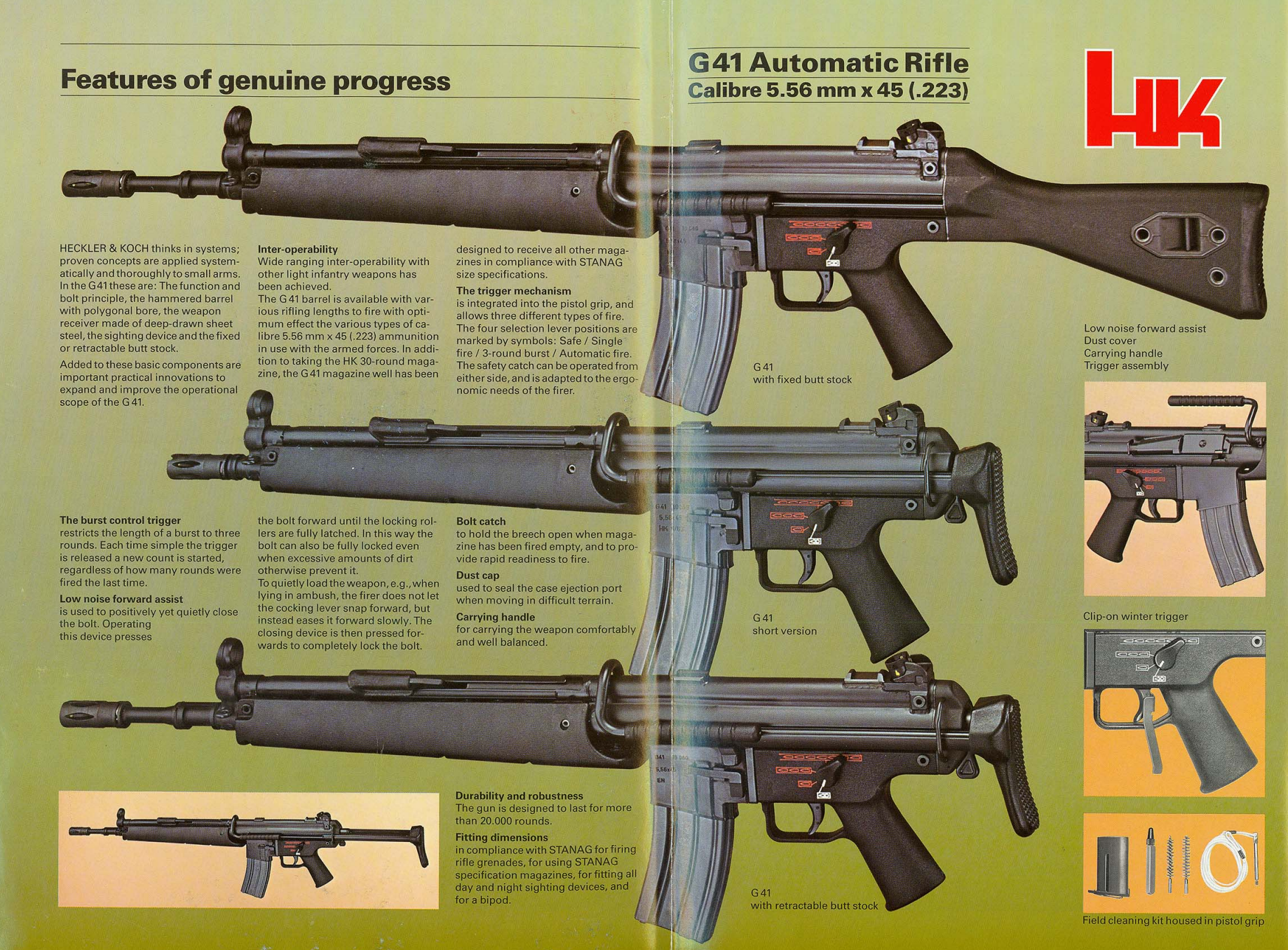
Spread from a 1985 HK promotional product brochure showing the various G41 configurations (HK)
The G41 came in a number of variants with designations A1 to A3. The base rifle had a fixed buttstock and its rifling had 1 turn in 7 inches with a right-hand twist, in a 18.9 inch barrel. The A1 had a 1 in 12” twist barrel and fixed buttstock. The A2 had a collapsing, single position stock and 1 in 7” inch twist rifling, while the A3 had 1 in 12” inch twist rifling. The 1 in 7” rifling was optimised for the new SS109, while the 1 in 12” optimised for the US M193 round. There was also a shortened G41K model which had a collapsing stock and a 15 inch barrel available with both rifling types.
One of the main issues with the G41 was its weight. Despite efforts to lighten the sheet metal receiver, it weighed more than its predecessor the HK33. According to measurement data compiled by researcher Nathaniel F, unloaded the G41 weighs in at 4.31kgs or 9.5 lbs, this is a full pound heavier than the HK33. A contemporary M16A2 weighed 3.39kg or 7.5 lbs while the Spanish CETME L, a similar stamped receiver rifle chambered in 5.56×45, weighed 3.72kg or 8.2 lbs. The rifle eventually adopted by the Bundeswehr, the HK G36, weighed 3.13kg or 7.3 lbs. The G41K with its collapsing steel stock wasn’t much lighter, weighing 4.3kg or 9.5 lbs, according to HK sales literature. Another potential issue may have been reliability with the move to the STANAG magazine rather than the optimised proprietary HK magazines may have introduced some issues.
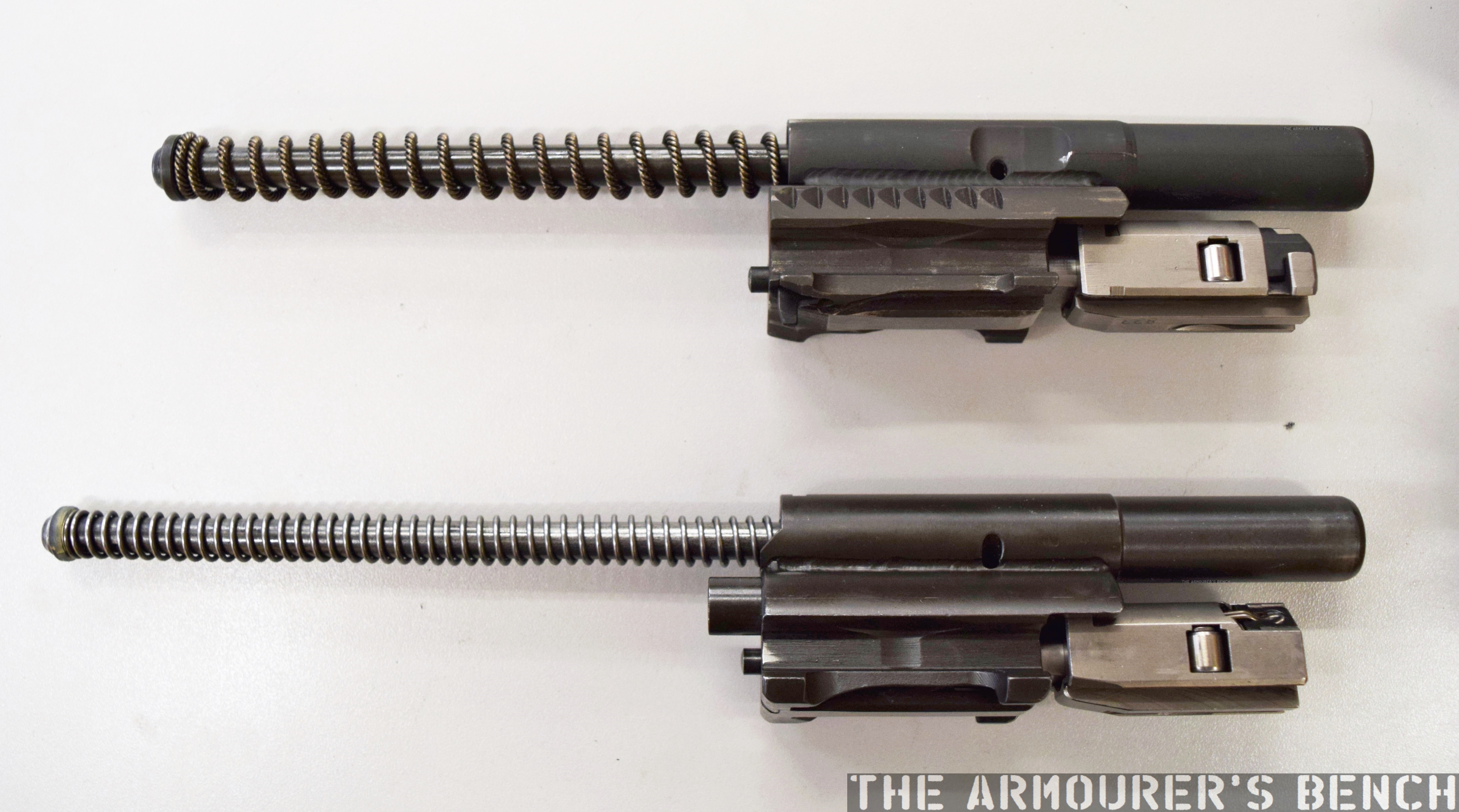
The bolts of the HK G41 (top) and HK33 (bottom), note the redesigned extractor, forward assist serrations on the bolt carrier and the G41’s thicker but shorter recoil spring (Matthew Moss)
Following NATO’s decision the early 1980s saw a large number of countries looking to replace their ageing 7.62x51mm battle rifles. Sweden began to look for a 5.56x45mm rifle to replace its licensed version of the G3, the Ak4, in the late 1970s. HK could initially only offer the HK33 but the G41, tested later, was also rejected by the Swedes in favour of FN’s FNC. Italy sought to replace the BM59 with a more modern rifle and HK entered into an agreement with Luigi Franchi which saw them offer both the original HK configuration and the develop their own, slightly modified version, the Franchi mod. 641, but the Beretta AR70/90 was selected. Similarly, in 1984 Spain decided to adopt the indigenously developed CETME L. In 1986 the HK G41 was also submitted to the Irish Army’s trials to replace the FN FAL, it was beaten by the Steyr AUG. Initially West Germany had hoped to procure up to 20,000 HK G11 rifles per year, with a total of 224,000 in service by 2003.
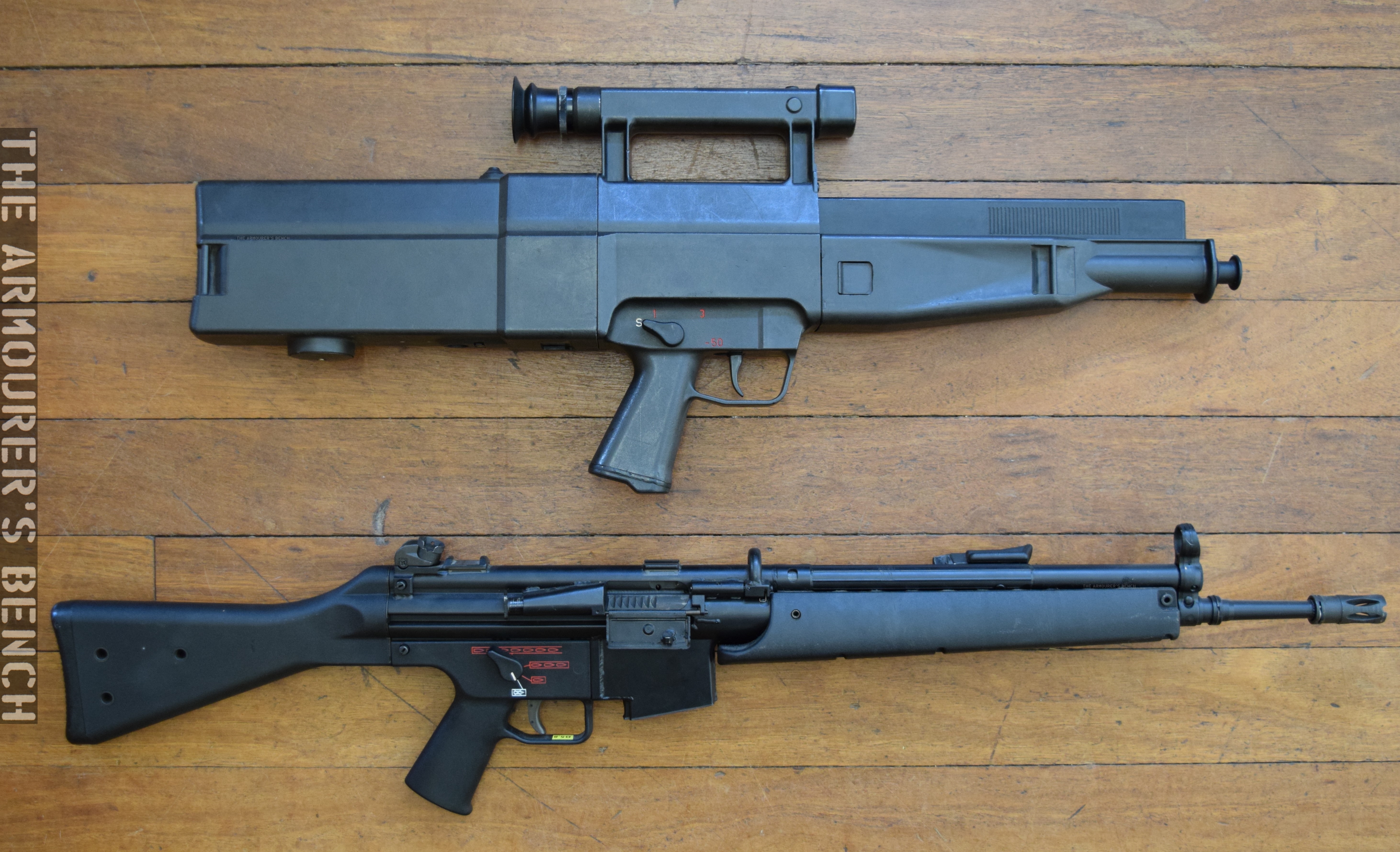
HK’s G11 and G41 (Matthew Moss)
The collapse of the Soviet Union and the subsequent reunification of Germany saw Federal budgets stretched and the G11 programme was subsequently abandoned entirely. The Bundeswehr still needed a suitable rifle to replace the G3 and in the 1990s sought a lighter weight rifle. HK felt their HK50 project, in development since the mid-1970s was a better bet than the heavier G41, and following Bundeswehr trials the G36 was subsequently adopted in 1997. Sadly, I have not been able to get a hold of any of the trials reports from the nations that tested the G41, so can not say with certainty why the countries mentioned above rejected HK’s rifle.
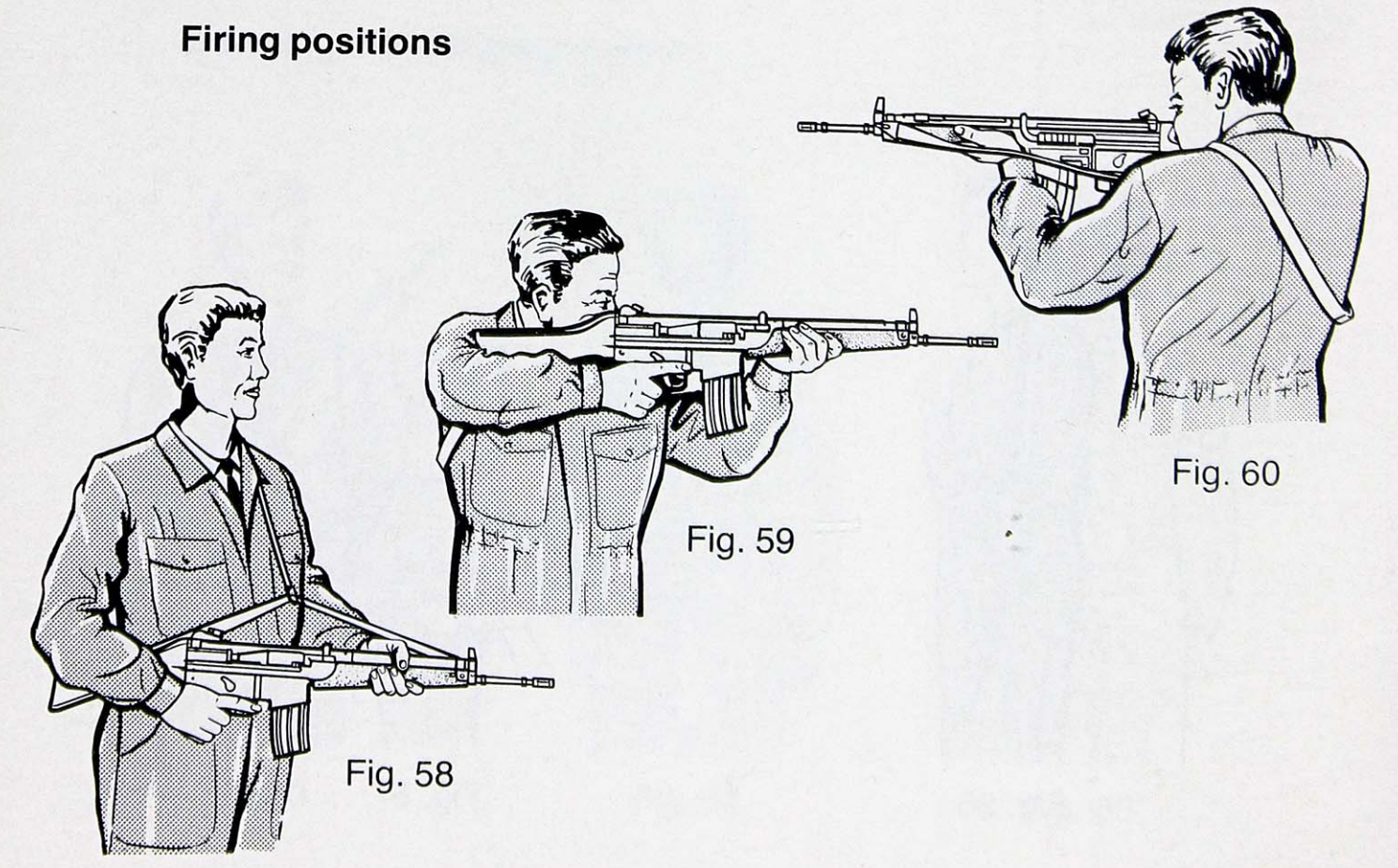
Graphic from HK’s manual for the G41 (HK)
From photographs of members of the Turkish Gendarmerie special operations group training at the Foça Commando School, dating from the early 2010s, it appears that Turkey either purchased a number of G41s or Turkey’s state-owned defence manufacturer, MKEK, produced an unknown number under license.At some point in the 1980s the British Army also tested a small number G41s with serial numbers #11131, #11832 and #11833 remaining in UK collections.
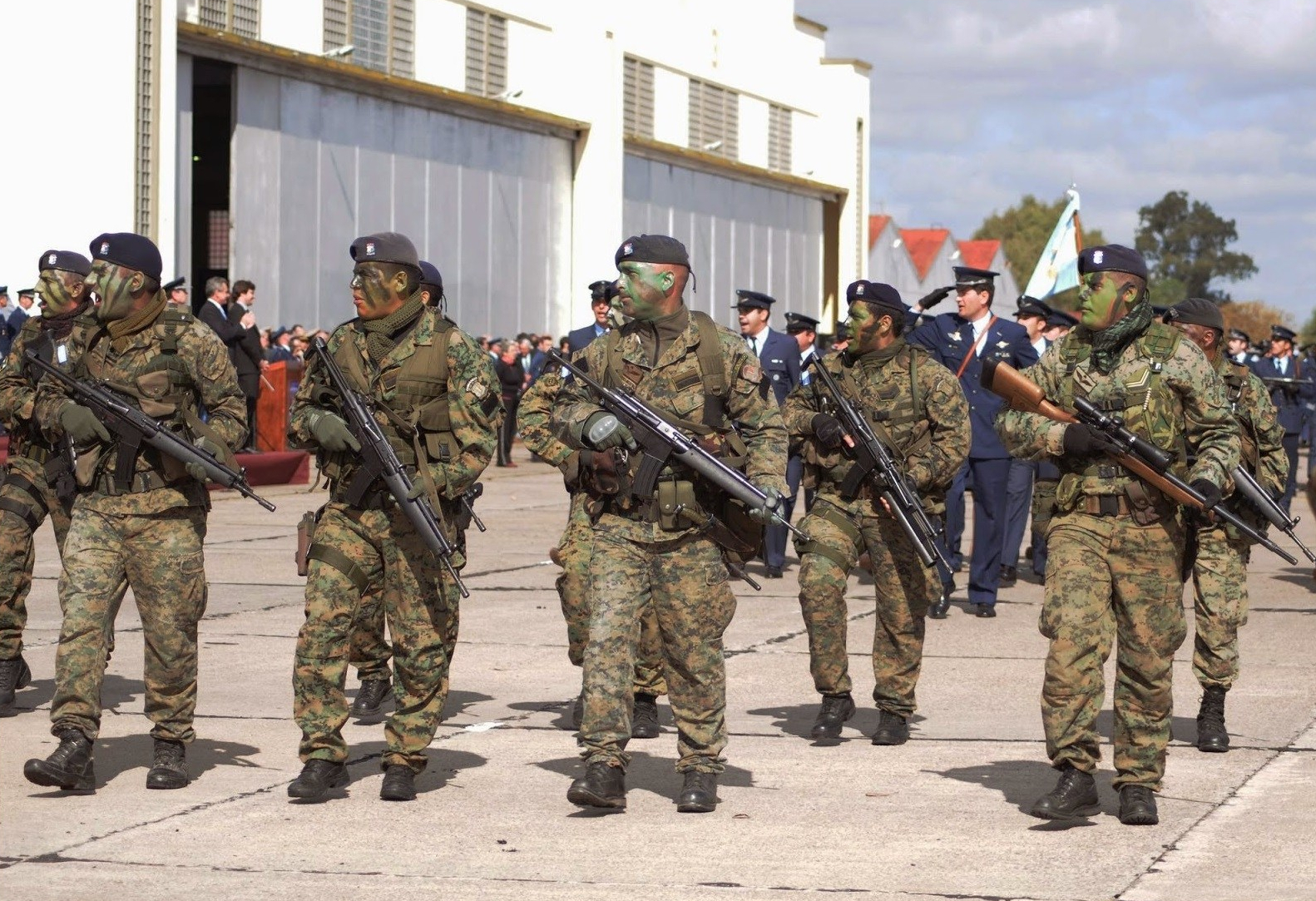
Denmark’s elite Jaegerkorpset and Froemandskorpset used the G41 for a time and Argentina’s special forces, including the Grupo de Operaciones Especiales, have also been photographed with both HK G41s and G41A2(collapsing stock) fitted with the TGS package comprising of the HK79 under barrel grenade launcher.
Argentina’s Grupo de Operaciones Especiales on parade with G41s and the G41-TGS, grenade launcher package (source)
The G41 represents the last evolution of HK’s infantry rifles using the roller delayed blowback action. It comes from a period when HK were developing what they hoped would be the next generation of small arms technology and with the collapse of the G11 programme and the lack of interest in the G41 the company faced financial uncertainty throughout the early 1990s. HK’s move away from the roller delayed blowback action to a more conventional gas operated rotating bolt system, combined with lightweight polymers, in the G36 proved to be more successful than the ill-fated G41.
If you enjoyed the video and this article please consider supporting our work here.


 The Armourers Bench
