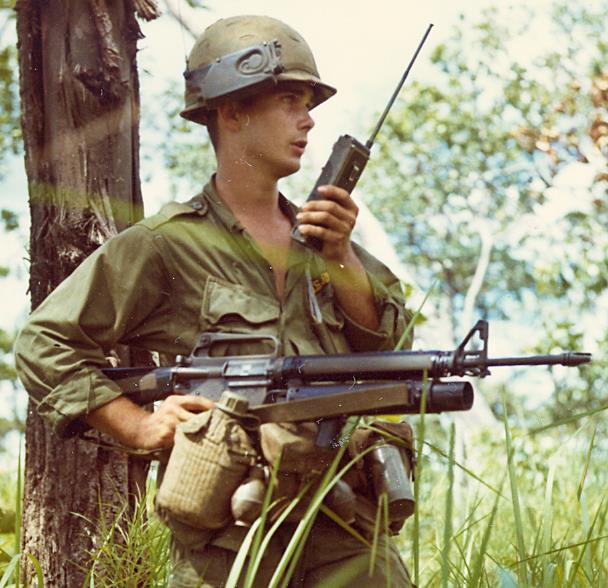
New Russian Grenade Launcher – GP-46

A couple of months ago we took a look at Kalashnikov Concern’s new belt-fed machine gun, the RPL-20. That video was made in collaboration with firearms researcher Deni Almaskhanov, of Just Guns. Deni has also kindly shared some video of Kalashnikov’s new GP-46 grenade launcher.

The GP-46 was unveiled by Kalasknikov Concern at the ‘Army-2024’ exposition in August. Unlike other Russian underbarrel grenade launchers the GP-46 is chambered in the Western 40x46mm, the low velocity grenades used in launchers like the M203, and M320. Despite its first public appearance in 2024, the visible serial number indicates that the launcher on display was actually made in 2023. It was reportedly developed in 2023-24 by a design team led by Kalashnikov’s chief small arms designer Sergei Vladimirovich Urzhumtsev.

GP-46 UBGL & 40x46mm grenades (Kalashnikov Concern)

The GP-46 features ambidextrous controls with mechanical safety selectors, locking mechanism catches and triggers found on both sides of the launcher. The launcher can be mounted on all previous AK-pattern rifles which are able to mount UBGLs.

Kalashnikov Concern list its specs as:

  • Length: 380mm
  • Caliber: 40mm
  • Weight: 1.6kg
  • Rate of Fire: 5-6 rounds per minute

It’s currently unclear what range of 40x46mm grenades are available for the GP-46 but Kalashnikov’s promotional video on the launcher featured a grenade tipped with what appears to be a VGM fuze used on VOG-pattern grenades.
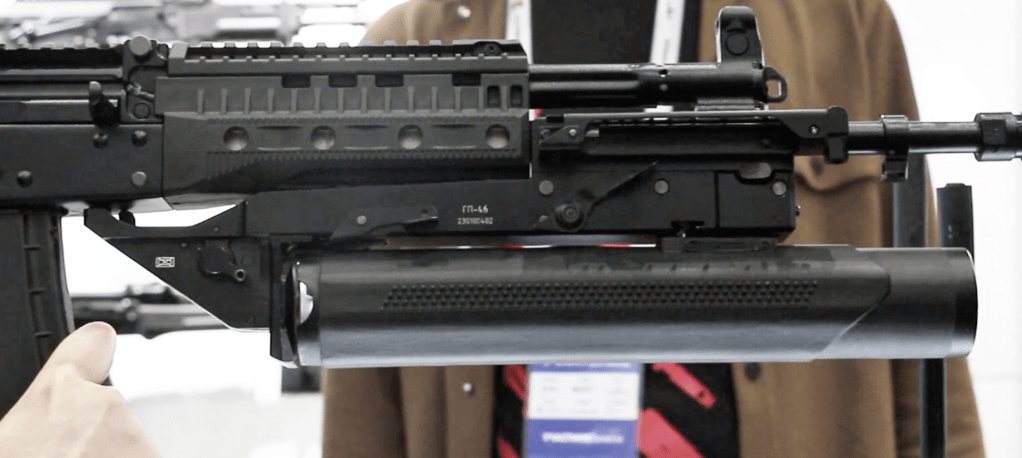
GP-46 UBGL (Deni Almaskhanov)

Interestingly, Deni noted that the unconventional trigger placement is not entirely new for Kalashnikov. In 2018, Kalashnikov patented another grenade launcher, seemingly one designed around VOG-pattern grenades. That UBGL’s the trigger mechanism was located on the outer cover of the barrel itself. Deni explains that “the latch was to be pressed, unlocking the movement of the cover, the cover was to be pulled backwards. Such design was implemented in order to allow for a double-action trigger action while not requiring lots of strength from the trigger finger”. Deni believes that the GP-46 seems to be following the same philosophy while avoiding overtly complicated design elements.

Kalashnikov Concern 2018 UBGL design for 40mm VOG-pattern grenades (Russian Patent #2694383)

The GP-46 is aimed using iron sights located on the right side of the launcher. The rear sight allows for shooting at ranges starting at 50 meters, out to 400 meters. The sights also feature a built-in mechanical rangefinder, calibrated for 170 cm (5’7) tall target. Interestingly, the 5.56×45mm AK-19 Type 3 that was used to showcase the grenade launcher at ARMY-2024, also featured what seems to be a new ACOG-style prismatic scope by Dedal-NV, one of Russia’s premium optics manufacturers. Deni notes that the scope featured both rifle and grenade launcher reticles.
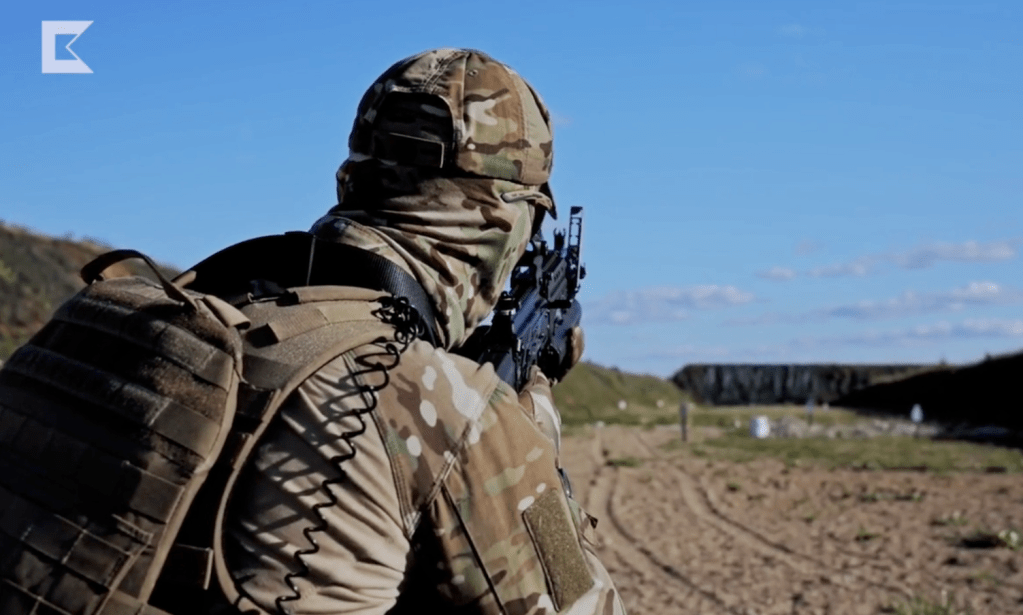
GP-46 UBGL sights (Kalashnikov Concern)

It is unlikely the Russian armed forces will be moving away from their in-service 40mm grenade launchers any time soon and it is worth noting that both the GP-46 and the AK-19 it was mounted on are primarily export models. One potential interesting international customer may be India, which has already contracted with Kalashnikov previously. India recently adopted the AK-203, with plans to produce the rifles under license in India.
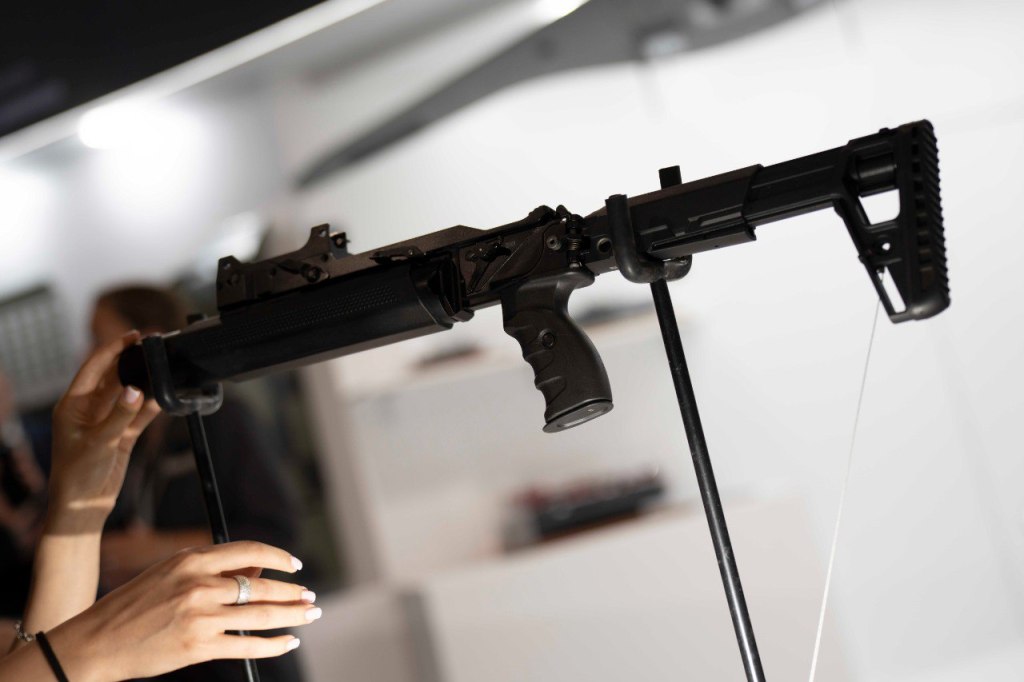
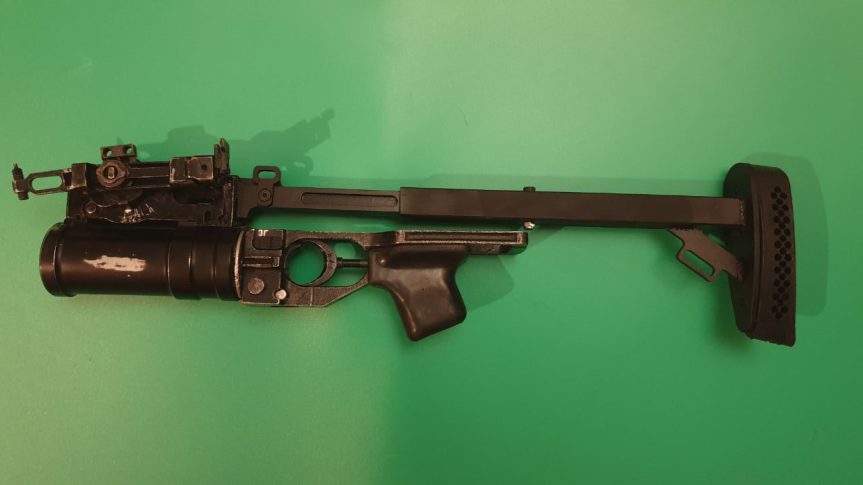
GP-46 in stand alone chassis (Kalashnikov Concern)

Intriguingly, what sets this this grenade launcher apart from the majority of previous Russian UBGLs is the special module that allows it to be used as a stand-alone launcher. The GP-46 mounts onto a stock chassis which consists of a full-size AK-12 Type 1 pistol grip and an adjustable AK-12 Type 3 buttstock. Given the large number of stand alone stock systems for launchers like the GP-25 which have emerged as a result of the war in Ukraine this development isn’t surprising.

Special thanks to Deni for sharing this footage and information with me so I can bring you guys this video. Please do check out Deni’s pages – Telegram, Instagram, Youtube.


Support Us: If you enjoyed this video and article please consider supporting our work here. We have some great perks available for Patreon Supporters – including early access to custom stickers and early access to videos! You can also find us on the History of Weapons & War app. Thank you for your support!
Ukraine’s Newest Grenade Launcher – UKROP UGL-40

We have looked at a range of grenade launchers being used in Ukraine including standalone adaptations of GP-25s, the Ukrainian RG-1, the Russian DP-64, and a whole range of launchers that use the NATO standard 40x46mmSR rounds like the LMT M203 and the FN40GL.

In mid-August a new Ukrainian-produced 40mm launcher appeared, the UKROP UGL-40. This isn’t the first Ukrainian manufactured 40mm launcher, the Fort 600 has been in service for over a year and will be the topic for a future article/video of its own.

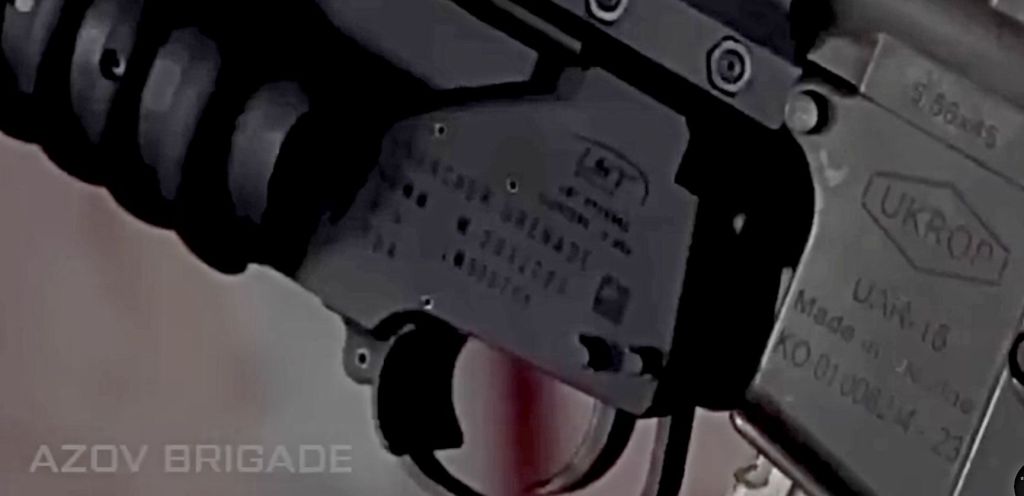
The UGL-40 is manufactured by UKROP, which is associated with Zbroyar. Intriguingly, in some of the available imagery of the UGL-40, LMT markings are clearly visible on the left side of the weapons receiver. It’s unclear if the launchers are imported from LMT, if they’re simply licensed on the LMT design or if a portion of the parts are manufactured by LMT and assembled by UKROP. While the barrel length and receiver design are very similar to that of the LMT M203 the stand-alone stock design differs. [H/T  – CaliFlori for spotting the markings.]

Update – February 2025: Having spoken to LMT representatives at SHOT 2025, it appears that after buying a significant number of LMT’s M203s Ukraine also bought all available components to assemble further launchers in-country. This included tubes, receivers and assorted components. These parts were combined with a chassis developed by UKROP, creating that UGL40.

LMT markings on a left side of the UGL-40’s receiver (via 12th Special Operations Brigade)

UKROP are best known for producing the UAR-10 and UAR-15 rifles used by elements of the Ukrainian armed forces. Sources suggest that the UGL-40 has a barrel length of 224mm, shorter than that of the M203 it’s based on, and in the under-barrel configuration it probably weighs around 3lbs (1.36 kg). The launcher is typically seen with a tangent sight attached to the left side of the weapon.

In retrospect and after some digging the earliest possible sighting of a UGL-40 I’ve seen dates from 20 March, in a photograph of a pair of members of Foxtrot Group with carbines equipped with under-barrel grenade launchers. Foxtrot Group, who are believed to be part of Ukraine’s SSO, posted two more photos of a team member equipped with an M4 carbine mounted with a UGL-40.

UGL-40 in standalone configuration (Western Savages)

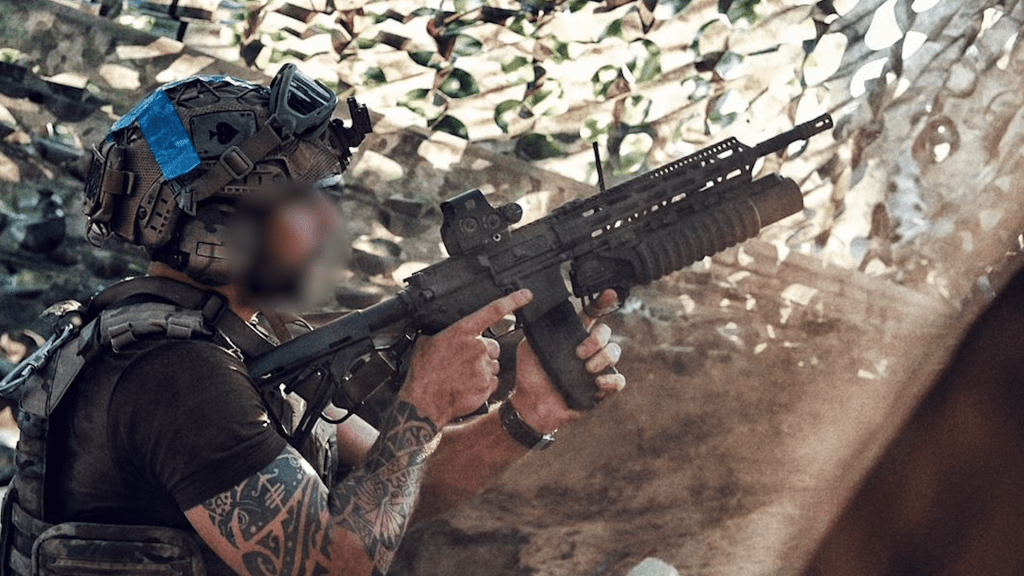
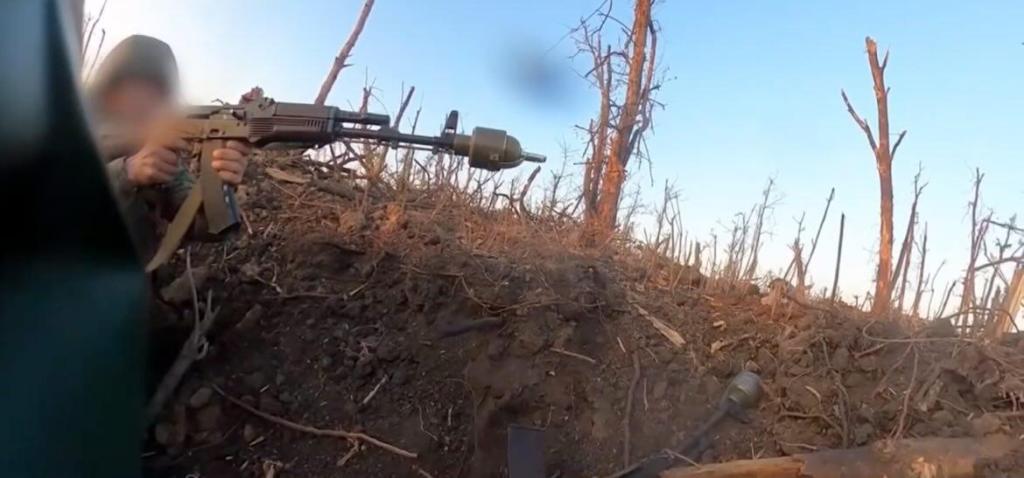
The grenade launchers were next seen in an Instagram post on 5 July, by crab_zol, a member of the 3rd Assault Brigade, which showed him firing a UGL-40 from a trench. The launcher is seen attached to a UAR-15 rifle as an under-barrel grenade launcher.

On the 12 August, a photograph of the UGL-40 in its standalone configuration was shared online. Some sources suggest the image originated with personnel from the Ukrainian 36th Marine Brigade. The UGL-40 and UKROP markings can be clearly seen. The launcher appears to slot onto a rail of a stand-alone adaptor. The adaptor has a collapsing stock and a full length Picatinny top rail. A UGL-40 in the stand-alone configuration also appears in a kit photograph, the source of which I haven’t been able to confirm. It has been painted up and matches the UAR-15 seen below it.

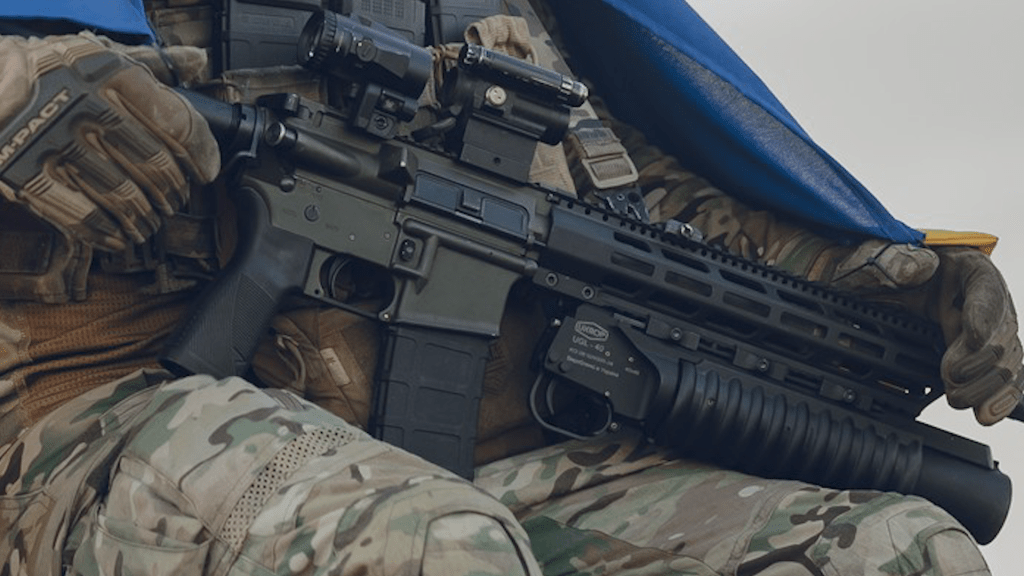
UGL-40 mounted on a UAR-15 (Rubizh Brigade)

A week later on 19 August, Western Savages, a Separate Special Purpose Unit with “OMEGA” West, part of the Ukrainian National Guard’s special forces wing, shared a montage video on their new instagram page which included footage of the UGL-40 being fired during training. Speaking to Western Savages they noted that they’d received the UGL-40 a couple of months ago and had previously used the Fort-600. They noted the differences between the two launchers are negligible but the Fort-600 is a little heavier. This may suggest that the UGL-40 with its stock is slightly lighter than the Fort-600’s 2.20kg (4.85lbs). They described the UGL-40 as ‘accurate and reliable’ but have not yet used it on operations.

The 12th Special Operations Brigade “Azov” shared a video on 21 August, which featured a member of the brigade’s reconnaissance detachment discussing his kit. He shows a UAR-15 equipped with a UGL-40 along with a bandolier for carrying 40mm grenades.

UGL-40 mounted on a UAR-15 (3rd SABr)

Most recently, on the 23 August, photographs of members of the Neptune reconnaissance group were shared with one of the operators pictured holding a rifle equipped with a UGL-40. On the same day the Rubizh Brigade also posted photographs showing personnel equipped with the new grenade launchers attached to UAR-15 rifles. One of the photographs of a soldier, wearing what appears to be a reconnaissance platoon patch, also gives a good look at the launcher’s markings.

It seems that the UGL-40s have so far been issued to a mixture of units including those from both the Ukrainian Army and the National Guard. Unsurprisingly they have only been seen paired with AR-15/M16 pattern rifles and are most typically seen in the under-barrel configuration rather than as a standalone. From confirmed sightings it appears that the UGL-40 has been in service since at least Spring 2024.

Update – 2/10/24:

A photo submitted to Ukrainian military page, Ukrainian_Special_Military of Members of 12th Special Operations Brigade “Azov” of the National Guard operating in the forests of Luhansk region. One individual has a UAR-15 with what is likely a UBL40.

Update – 29/10/25:

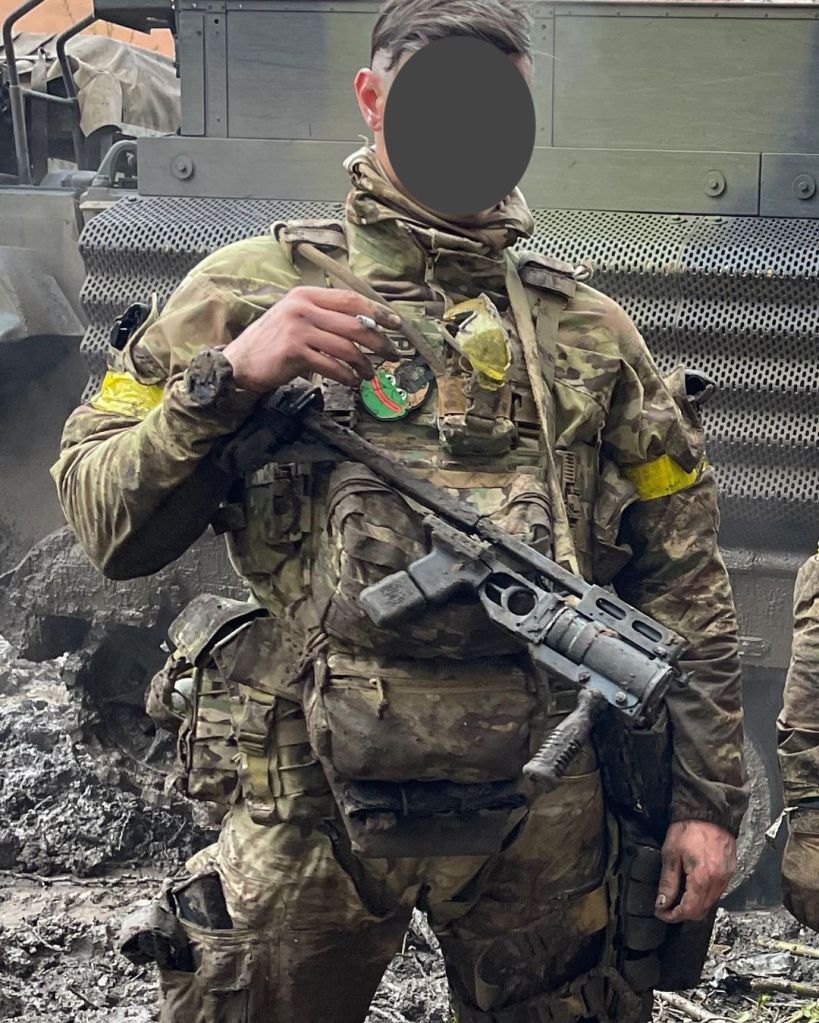
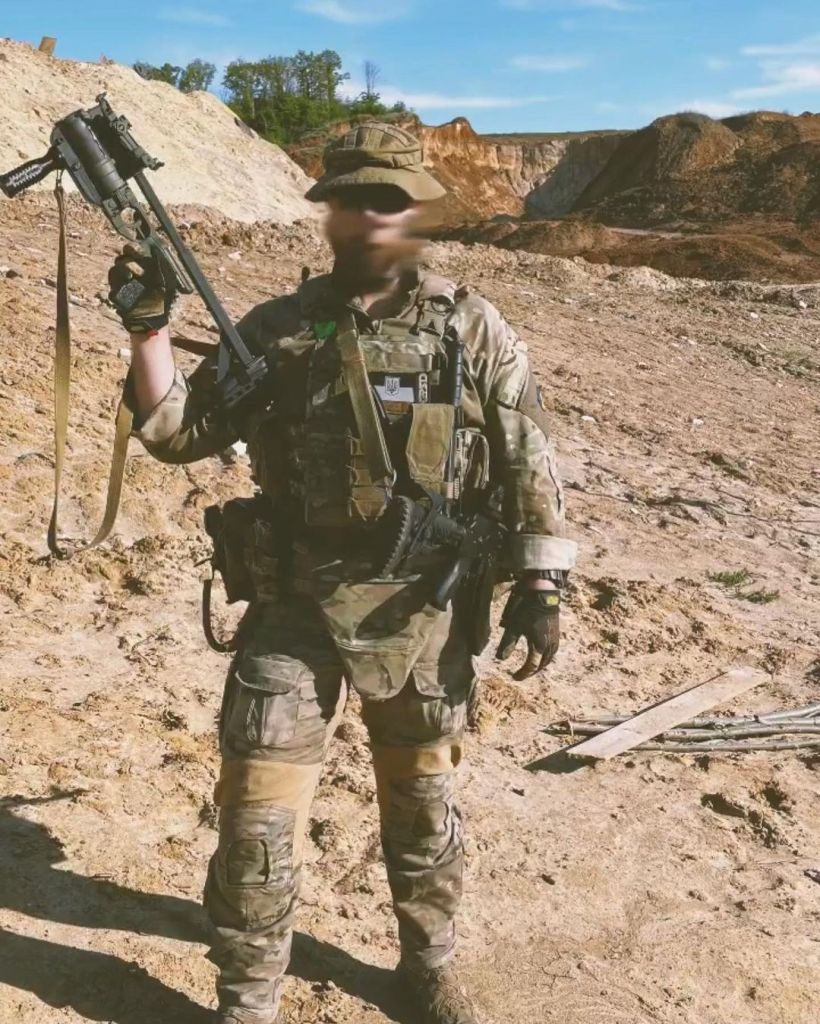
A photo of a member of 1st combat group of the special purpose intelligence squad of the 12th Brigade NGU with a nicely painted up standalone UGL-40 and a UAR-15.


Support Us: If you enjoyed this video and article please consider supporting our work here. We have some great perks available for Patreon Supporters – including early access to custom stickers and early access to videos! You can also find us on the History of Weapons & War app. Thank you for your support!
Ukraine’s Rare RG-1 Grenade Launcher

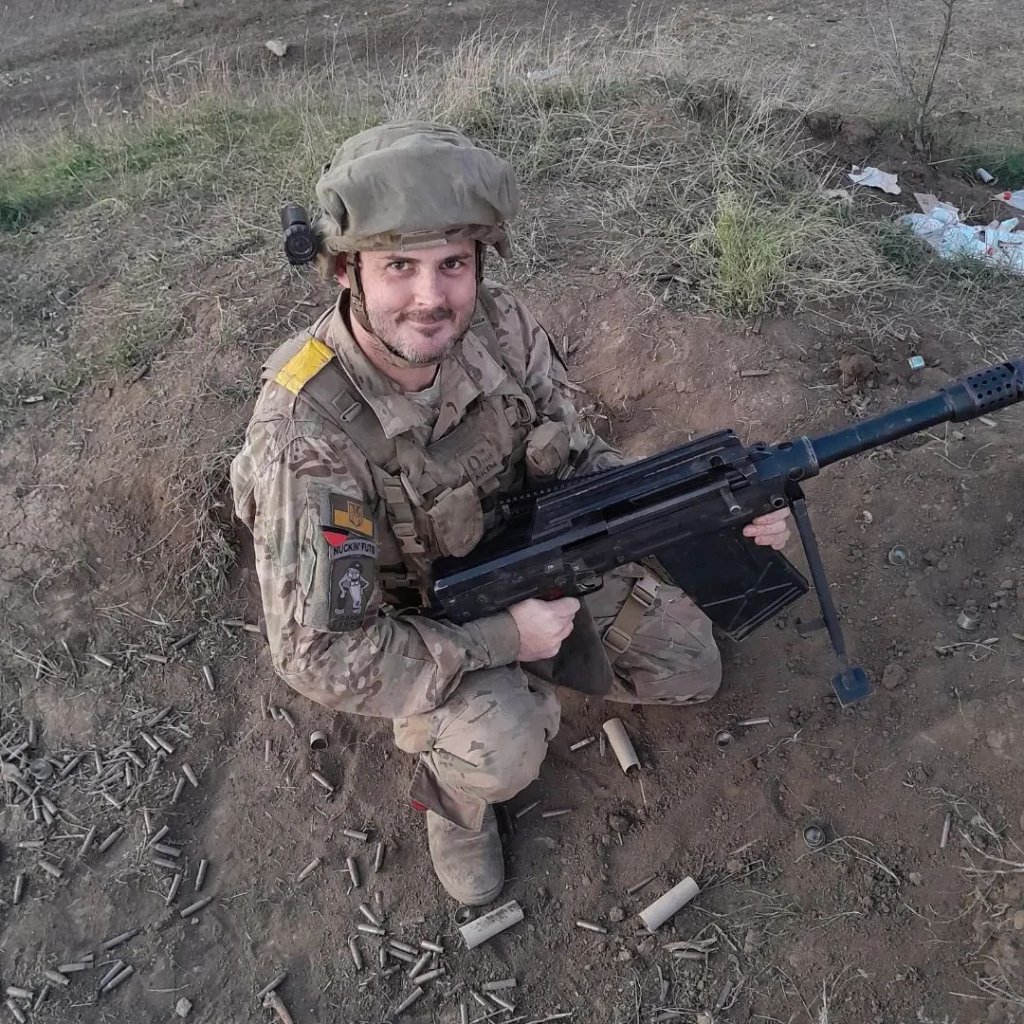
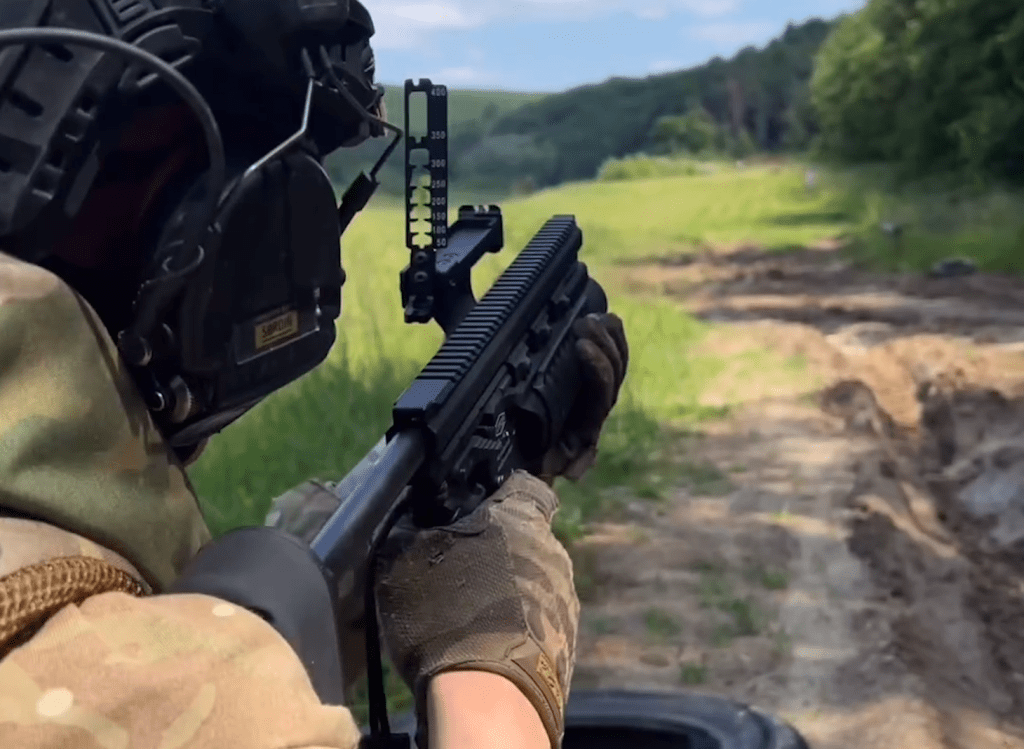
Way back in October 2022 video of the extremely rare Ukrainian RG-1 circulated online thanks to Yuri, an American member of the Ukrainian armed forces (known as Nucking_Futs_Yuri, best known as for his combat footage of him manning an M2 Browning and firing numerous AT-4s from a HMMWV). Yuri and his colleague Kaiser, a German volunteer, very kindly shared their videos of the RG-1 filmed when they had the chance to fire the weapon during some range time. As far as I can tell those videos remain one of the few occasions that the weapons have been seen during the ongoing fighting following Russia’s invasion. Since October 2022, I’ve been holding off on making a video about the RG-1 in the hopes more imagery might appear – there have only been two more sightings.

Yuri with an RG-1 at the range, October 2022 (via Yuri)

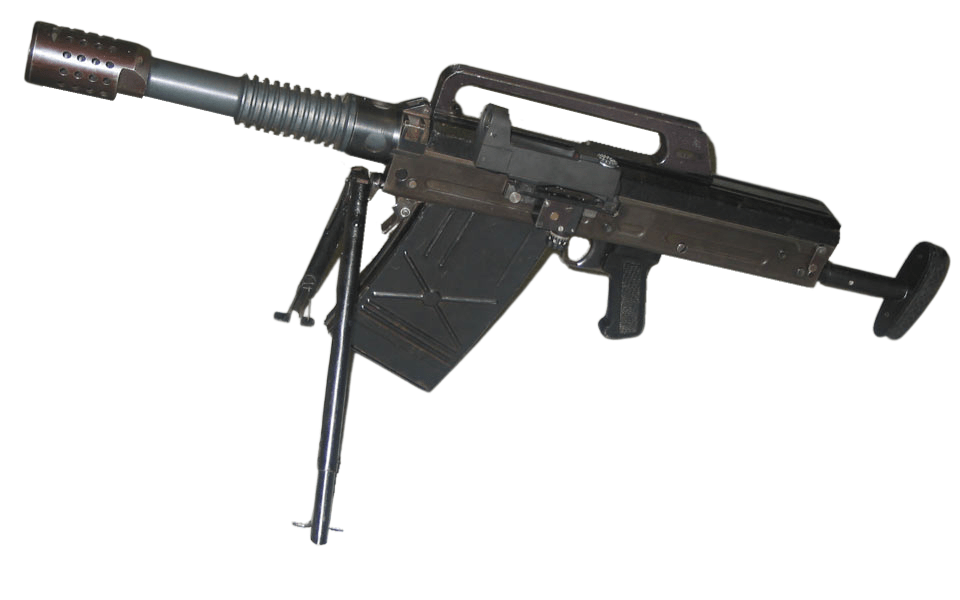
The RG-1 “Piston” (РГ-1 “Поршень”) was developed as a cost effective force multiplier, to provide the firepower of an AGS-17 in a man portable package. Information on the weapon is scarce and I’ve had to dig through a number archived Ukrainian news articles and other sources to pull together some of the story of the RG-1.

A 2014 article from UkraineIndustrial.info suggests the project to develop the RG-1 was launched in 1999 and continued until 2007.  It was reportedly developed by the Yuzhny Machine-Building Plant. A.M. Makarov with the design team including Alekseev Yury Sergeevich, Serbin Vladimir Viktorovich, Zagreba Alexander Ivanovich, and Mezhuev Nikolay Nikolaevich

RG-1 grenade launcher with red dot sight mounted on quadrant sight bar (Yuzhmash)

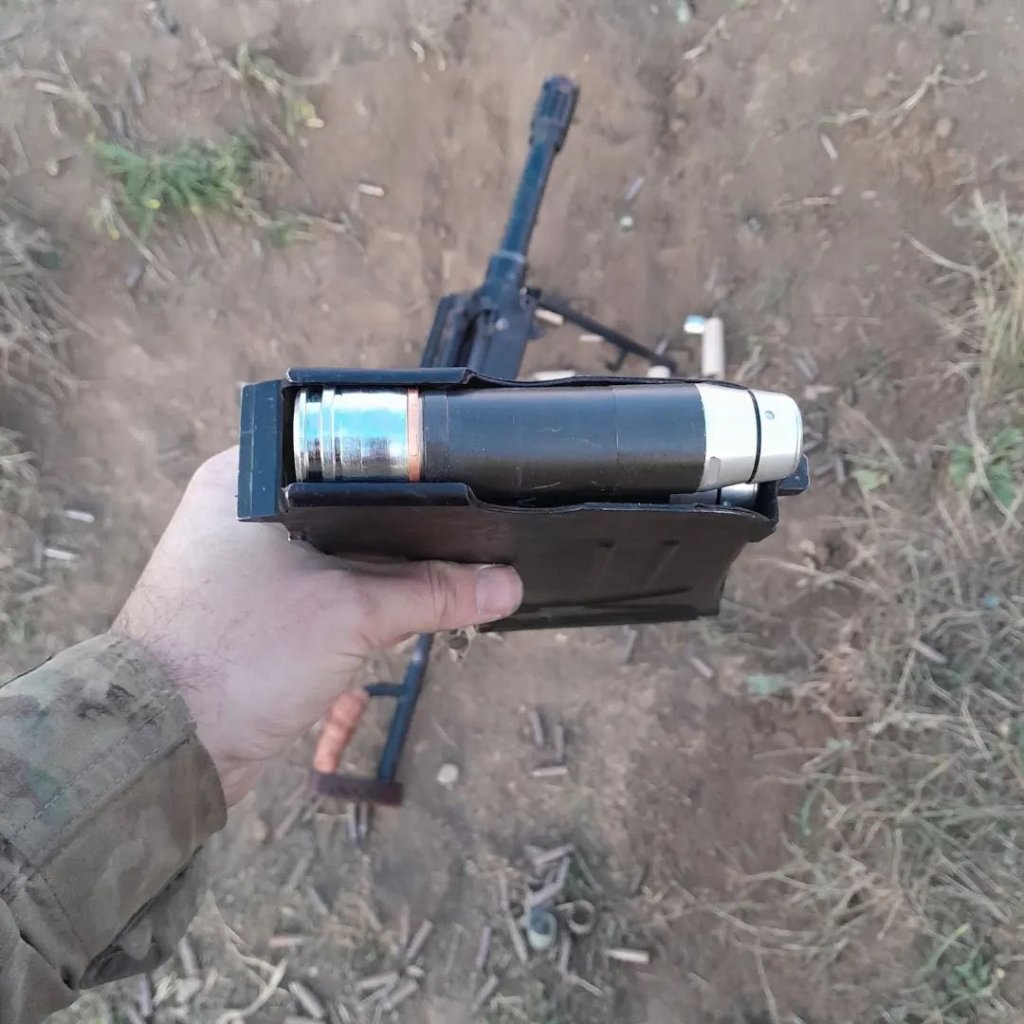
The RG-1 is a self-loading grenade launcher which fires 30×29mm VOG-17-pattern grenades. Some sources refer to specially made, lighter grenades made for the RG-1. Numerous sources also refer to a training round and a round designed for use against light armoured vehicles. The ammunition was reportedly developed by the Pavlograd Mechanical Plant, which is run by Yuzhmash. The RG-1’s relatively long barrel allows it to engage targets at ranges out to around 800m. The weapon does not appear to have a gas piston and it’s barrel is fixed suggesting it isn’t recoil operated. It may be gas blowback operated, though it’s unclear if it has any sort of bolt delaying system in place. The weapon has a large main spring soaking up the recoil as well as a large top-ported muzzle brake.   

The weapon’s weight is reportedly around 12kg (26.45lbs) loaded and 10.8kg unloaded. It has a 30cm (11.8in) barrel, has an integral bipod and feeds from a five round box magazine. The box magazine rocks forward to lock into the receiver, with the paddle magazine release located forward of the magazine (the reverse of the standard AK position). To load the weapon the bolt has to be pulled to the rear, but with no bolt hold open device it has to be held to the rear manually. There is a quadrant sight on the left side of the weapon’s receiver with a Picatinny rail for mounting optics. The buttstock has a rubber pad and from the available imagery there appears to be two designs of stock. 

Uprom.info reported in 2018, that as of Spring 2017, the RG-1 was not in full-scale production but prototypes had been undergoing field trials with the 79th Airmobile Brigade during fighting in Donbas, as early as 2016.

30×29mm VOG-17-pattern grenades in RG-1 magazine (via Yuri)

Speaking to Yuri in 2022, he noted that his unit didn’t bother using the RG-1 as they had plenty of 40mm grenade launchers in inventory, including then-newly arrived M320s. Yuri explained that “the RG-1 was a stop-gap weapon to give the average man the capability to fire VOGs without having to get an AGS into position.” The low velocity 40mm grenade launchers are smaller, lighter, easier to carry and, according to Yuri, have better range an accuracy than the RG-1.  

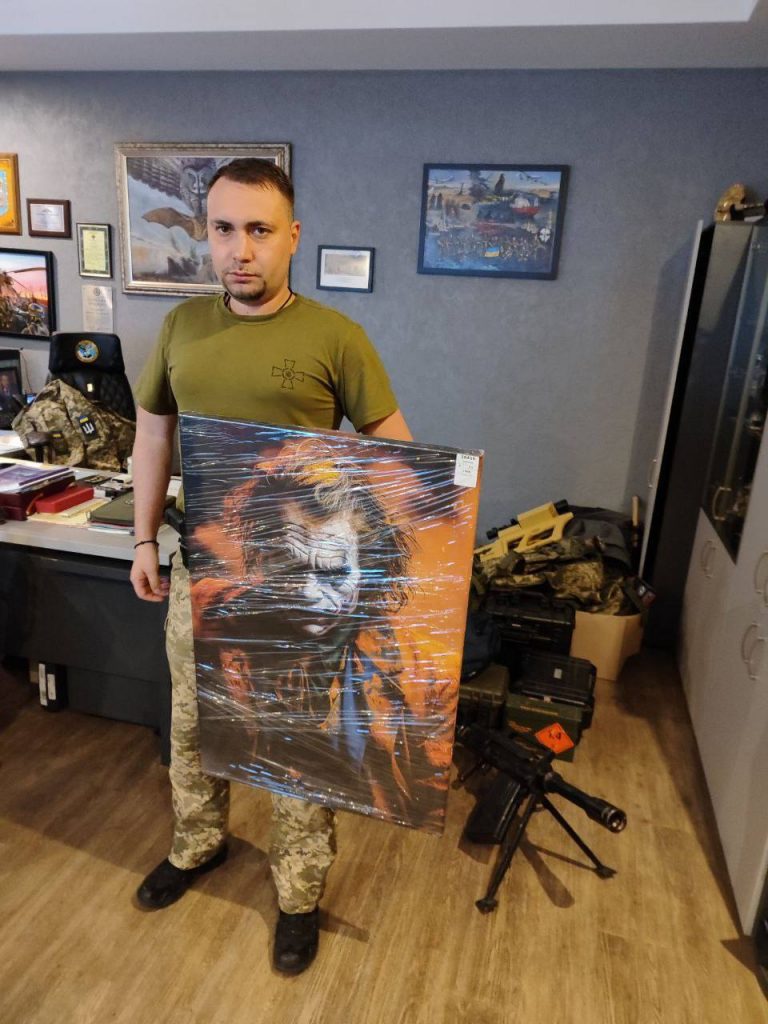
A second sighting of an RG-1 came in mid August 2023, when another video of the weapon being fired on a range was shared. The most recent sighting came in October 2023 when a curious photograph of General Kyrylo Budanov, chief of Ukraine’s Main Directorate of Intelligence, was published showing an RG-1 in the corner of his office. 

Gen. Budanov poses with Joker paining next to an RG-1 (via social media)

The RG-1 is an extremely interesting weapon. Designed to fulfil a tactical niche between the common GP-25 single-shot under-barrel grenade launcher and the heavy AGS-17 automatic grenade launcher. Essentially the RG-1 was intended to be light enough for the operator to manoeuvre and act as an integral support element within the squad. However, in the current phase of the war the proliferation of low velocity 40mm grenades has largely rendered the RG-1 unnecessary. If you’ve seen other imagery of RG-1s in use please do let me know.

Specifications for the RG-1 [assorted sources]:

Calibre – 30×29mm
Rate of fire – 30 RPM
Effective firing range – 800 meters
Weight (unloaded) – 10.8kg
Length – 905mm
Barrel length – 300mm
Initial grenade speed – 185m/s

Update – 20/11/24: Tysk shared a photo of a 3rd Assault Brigade member posing wth an RG-1, date unknown.


Support Us: If you enjoyed this video and article please consider supporting our work here. We have some great perks available for Patreon Supporters – including early access to custom stickers and early access to videos! You can also find us on the History of Weapons & War app. Thank you for your support!
Grenade Discharger Cups in Ukraine

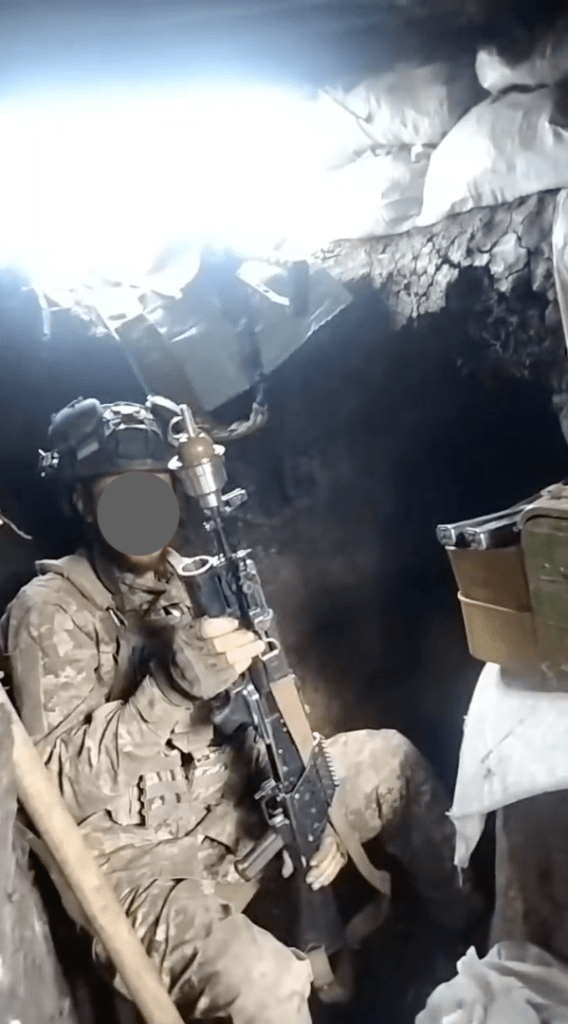
One of the intriguing, if rarely seen, weapons seen in Ukraine are rifle grenade launchers that are able to launch standard RDG-5 hand grenades. Historically, this is an idea that has been around for a long time. Emerging during the First World War and continuing to be used during the Second World War, a detachable metal cup could be fitted to the muzzle of a rifle which would hold the grenade and allow expanding gases from the firing of a blank round to throw the grenade downrange. In British military parlance, they were described as cup dischargers and could be used to launch No.36 Mills Bombs. British Army also issued the No.68 anti-tank grenade which could be fired from a cup discharger. During more recent conflicts after the collapse of the USSR and later in the middle east, designs capable of being fitted to AK-pattern rifles have been used.

During my research I’ve come across just a handful of videos of these cup dischargers in use in Ukraine, there may be more, and they are essentially demonstrations of the device rather than evidence of combat use. The first was shared by Ukraine’s Office of Strategic Communications on 14 November 2022. The caption notes that the discharger has a range of around 150m

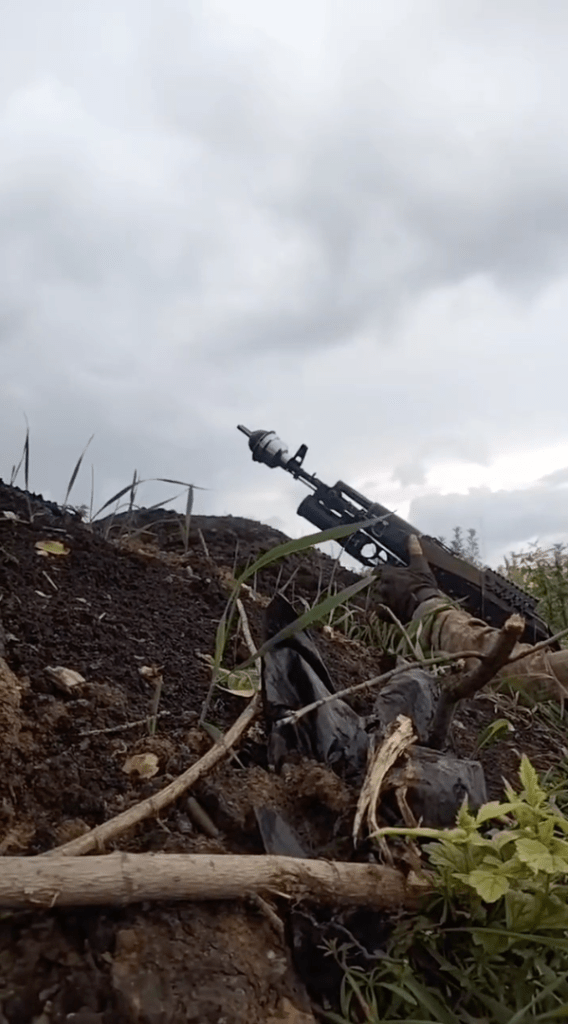
An AK-74 mounted with a cup discharger firing an RDG-5 (via social media)

The second video surfaced around 30 March 2023. The body of the cup is in the white, unpainted. Both of the videos show small cups made of machined metal which threaded directly onto the rifle’s barrel (once the standard muzzle device has been detached). They have differing external dimensions and profiles but they both feature a metal band into which the grenade’s safety lever can be slid. This holds the arm in place and prevents the grenade’s UZRGM fuze from arming before it’s fired and airborne. It appears that the cups are locally manufactured perhaps by different workshops and manufacturers.

The grenades appear to have a press-fit gas seal in the cup. The grenades are launched using blank cartridges, rather than ball ammunition. The blank creates enough pressure in the barrel, behind the base of the grenade, to launch it out of the cup.

Combatant prepares to fire an RDG-5 grenade from a cup discharger (via social media)

A video shared in 2021, long before the Russian invasion in February 2022, shows a very similar design and suggests that the idea has been around for a while in the region.

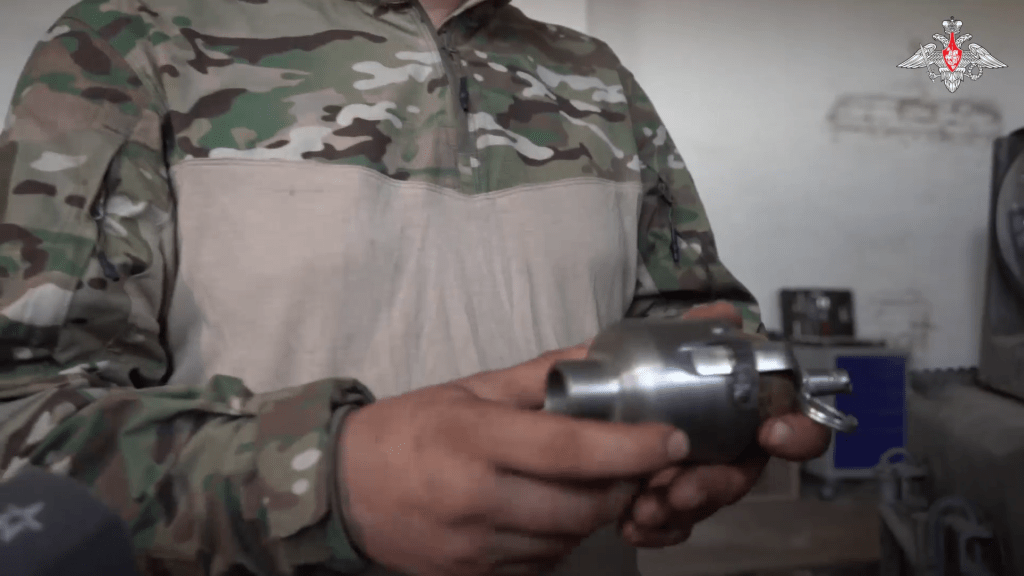
Most recently, on 11 August, the Russian Ministry of Defence shared a short video featuring a Russian Army engineers who are manufacturing 82mm Mortar round conversions for launching from RPG-7s and also cup dischargers for AK-74 pattern rifles. The design is identical to those seen previously. The engineer explains they are made on a lathe and the grenades are launched by a blank cartridge. In the clip we can clearly see that again there is a metal band which the grenade’s safety lever is slid.

A still from a Russian Ministry of Defence video sowing a recently manufactured cup discharger (Russian Ministry of Defence)

Gauging the angle at which to aim the rifle for the grenade to reach its target appears to be largely intuitive. In both videos, the grenade detonates in the air. Theoretically, the user should be able to deliver grenades both onto targets and above them in air bursts.

While the cup discharger would certainly be useful in a trench or urban fighting situation, allowing supplies of grenades to be used up one reason the cup dischargers are rarely seen is that under-barrel grenade launchers are in ample supply. These likely offer greater range, accuracy, and flexibility.


Update 2/7/23: A short video showing a Ukrainian combatant preparing a grenade for launch from a discharger cup was shared on telegram.

Update 4/9/23: Russia’s Channel One news shared a report featuring a cup dischargers in use on the frontline.

Video reportedly features a Russian Spetsnaz unit from the Southern military district and was filmed on 31 August in the Artemovsky/Bakhmut region. A pair of cup dischargers can be seen.

A pair of cup dischargers seen in the clip

Update – 30/10/23: A short video showing a failed launch of an RDG-5 grenade.

Update 23/4/24: A video showing how a Russian improvised rifle grenade discharger cup for VOG-pattern grenades is loaded and operated.

Update 6/9/24: New imagery features personnel of the Russian 40th Brigade demonstrating a cup discharger designed to launch RGD-5 grenades from AK-pattern rifles using blank cartridges. This example was reportedly manufactured in Kazan, interestingly it appears to have a spring clip on the side of the cup to provide additional retention on the grenade.


Support Us: If you enjoyed this video and article please consider supporting our work here. We have some great perks available for Patreon Supporters – including early access to custom stickers and early access to videos! Thank you for your support!

FN40 Grenade Launchers in Ukraine

In recent weeks a yet another type of 40mm grenade launcher has begun to be seen in imagery from the conflict in Ukraine – standalone FN FN40GL grenade launchers. In early June, as Ukraine’s counter-offensive got underway, Ukrainian special operations units began to be seen equipped with FN40GLs in both the standalone (FN40GL-S) and under-barrel grenade launcher configurations.

The FN40GLs which have begun to seen in Ukraine appear to be original Mk1 versions with a slightly different pistol grip assembly profile with a large gap between the grip assembly and the actual barrel assembly. Alongside these launchers in the standalone configuration a number of FN40GLs in the under-barrel configuration have been seen mounted on rifles.

The Mk1 launcher was introduced by FN in the mid-2000s, the stand alone unit mounts the launcher on a frame with rail space and a collapsing stock. When in the under-barrel configuration a different trigger assembly is used which wraps around the rifle’s magazine housing. The FN40GL-S weighs in at 2.9kg while in the under-barrel configuration it weighs between 1.3-1.4kg. The launcher is fully ambidextrous with the barrel able to cant either left or right to facilitate loading.

An FN40GL-S with 40mm rounds (via social media)

It’s unclear which country has provided the grenade launchers as a number of countries adopted them, with many special forces units pairing them with FN’s SCAR series of rifles. It is also unclear how many of the launchers are in theatre though from conversations with combatants they are still relatively rare with M320s, M203s, Fort-600s and GP-25s being among the more common single-shot 40mm low velocity launchers. Given the increasing number of them sighted since July it seems the FN40GLs are proliferating through Ukraine’s various special operations units.

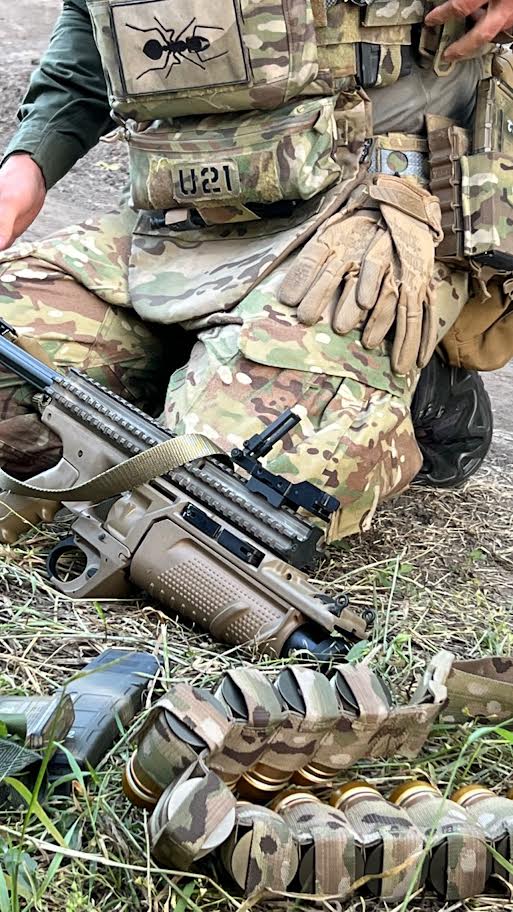
The first sighting of an FN40GL came on around 7 June, when a member of AZOV’s SOF unit shared a photograph of an FN40GL-S and a bandolier of 40mm rounds.

On the 8 June a photograph of a member of Ukraine’s SSO was shared online featuring a SCAR-L mounted with an FN40GL. The photograph is also notable for the presence of a SCAR MK20 (article/video on these coming).

On the 12 June, another Ukrainian combatant shared a photograph of an M4A1, an FN40GL and a Glock pistol.

Another standalone FN40GL-S seen by the side of a Ukrainian combatant during the early phases of the counter-offensive (via social media)

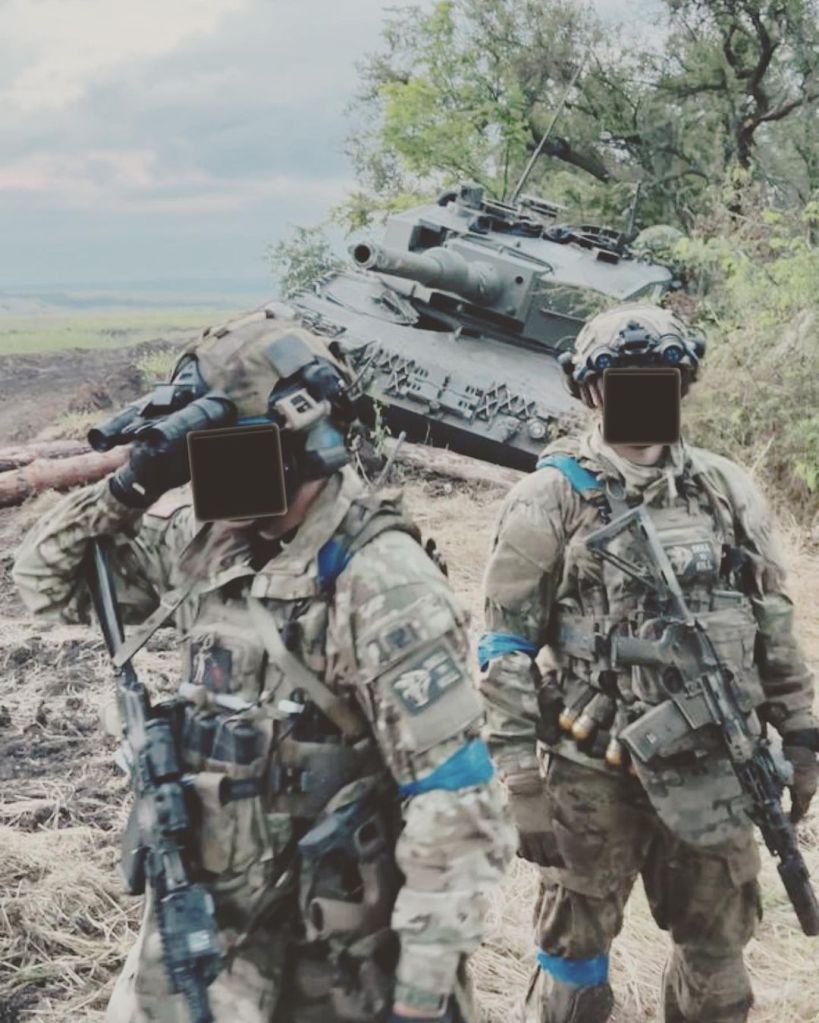
During the early phase of the counter-offensive a Ukrainian SOF team shared a photograph in front of an abandoned Leopard 2 on 15 June, strapped to the plate carrier of one of the operators can be seen an FN40GL-S.

Another photograph taken near the same Leopard 2 surfaced a week later showing another member of Ukrainian SOF with an FN40GL-2.

On the 24 June, a Ukrainian combatant posted a video on TikTok demonstrating the action of a FN40GL-s and how its barrel can pivot left and rifle.

In early July, a member of the AZOV brigade’s SOF teams shared a photograph of an FN40GL-S handing from a sling and retained in place by a cord.

On the 10 July, the second photograph of an FN40GL in the underbarrel configuration was shared showing the launcher mounted on a Springfield Armory SAINT AR-15 pattern rifle

On the 17 July, the same combatant affiliated with AZOV SOF shared a video of the FN40GL-S being fired and reloaded several times during a firefight across a road.

A week or so later, on 29 July, a member of the SSO shared a photograph of a SCAR fitted with a FN40GL.

In early August an Estonian volunteer shared a photo of a black SCAR-L fitted with an FN40GL. He shared his thoughts on the FN launcher and grenade launchers in general. He noted that there’s “not a lot of them around, only special units using these types of weapons… 40mm must be in each squad, they’re very effective.” He went on to explain that he prefers standalone launchers such as the M320.

Ukrainian combatant with an FN40GL in the underbarrel configuration (via social media)

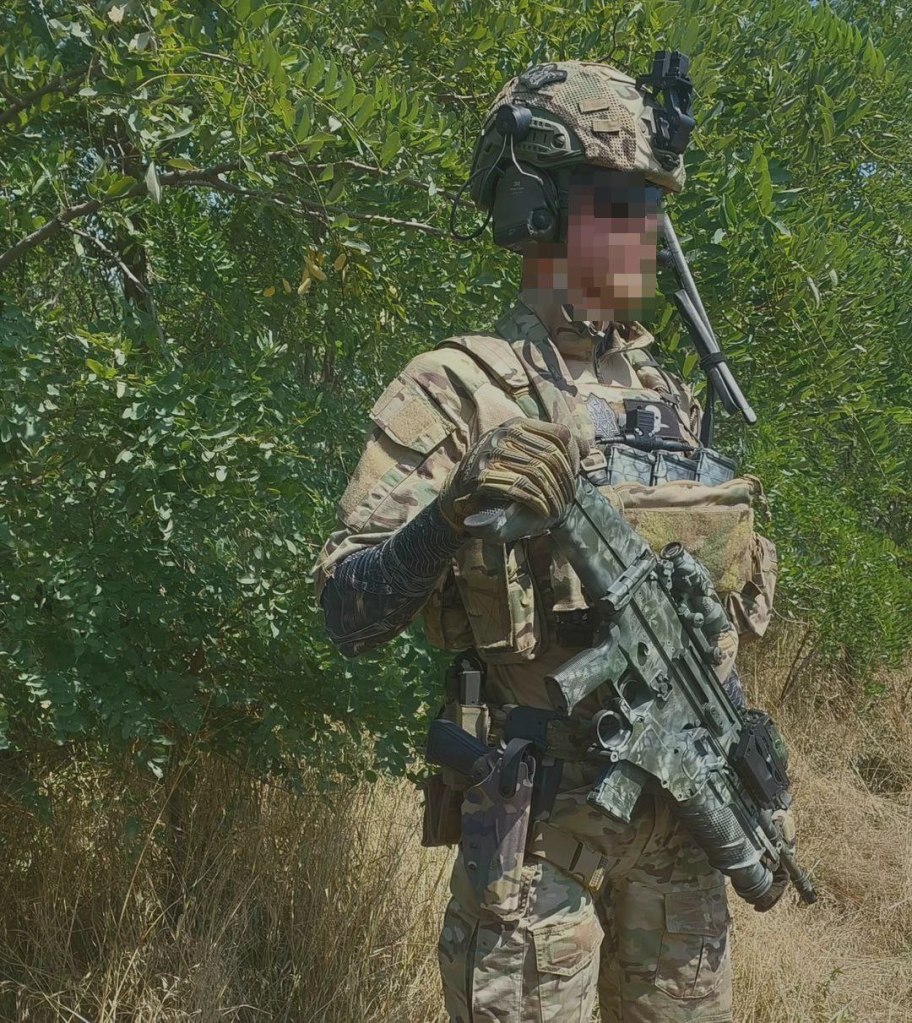
Most recently another phoptograh of a Ukrainian combatant with a SCAR-L fitted with a FN40GL was shared on Telegram. Both the rifle and launcher have been given a camouflage paint job.

The grenade launchers currently appear to be largely in use with a handful of Ukrainian special operations units which have also seen a recent proliferation of SCAR pattern rifles.

Very special thanks to every who helped collect and collate imagery for this video including, especially my friends at ShriekingDelilah on IG, as well as AbraxasSpa, UkraineWeaponsWarfare and Sergio for their help.

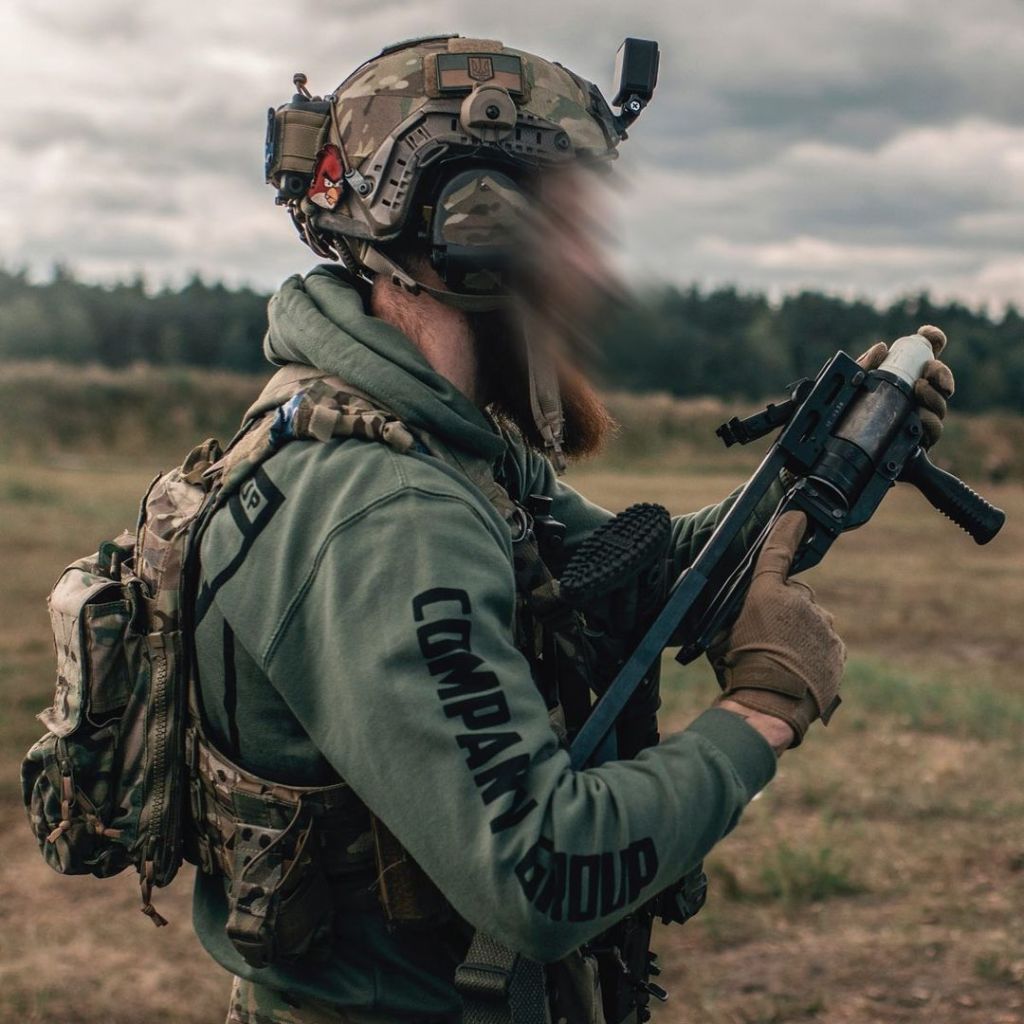
Update – 29/12/23: Another sighting of an FN40 GL, a reportedly Swedish volunteer wearing a Company Group Team shirt.

Update – 2/1/24: More imagery, shared in summer 2023, by Ukrainian SOF of an FN40 GL.

Update – 28/02/24: an FN40GL seen in a collection of weapons reportedly captured by Russian forces from a 73rd Naval Special Purpose Center team.

Update – 6/9/24: Recently shared photo of a member of a GUR team with an FN SCAR-L equipped with an FN40GL.

Update – 10/1/25:

A Ukrainian SSO member with an FN FN40GL in the standalone configuration along with the ubiquitous Daniel Defense rifle.More on the FN40GL here: armourersbench.com/2023/08/13/f…#UkraineRussiaWar #Ukraine️ #SALW

Matthew Moss – Armourer's Bench (@matthewmoss.bsky.social) 2025-01-11T12:06:06.473Z

Support Us: If you enjoyed this video and article please consider supporting our work here. We have some great perks available for Patreon Supporters – including early access to custom stickers and early access to videos! Thank you for your support!


Russia’s RGL Север 1

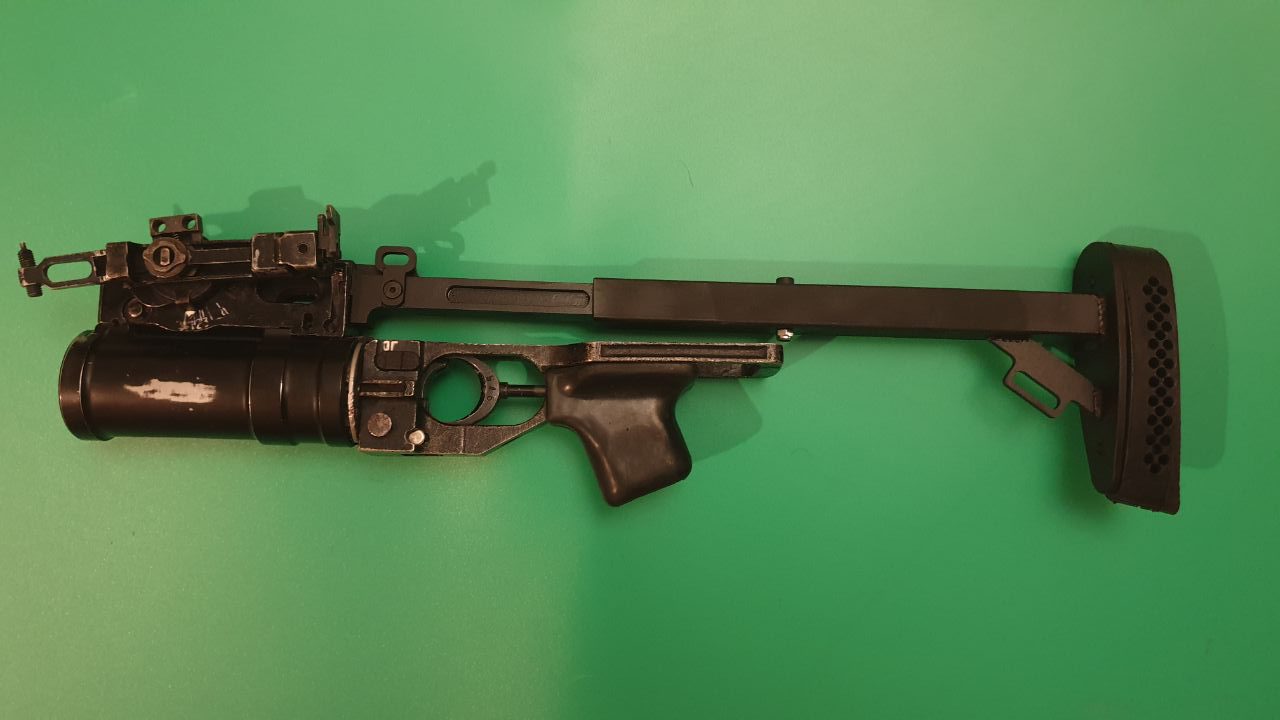
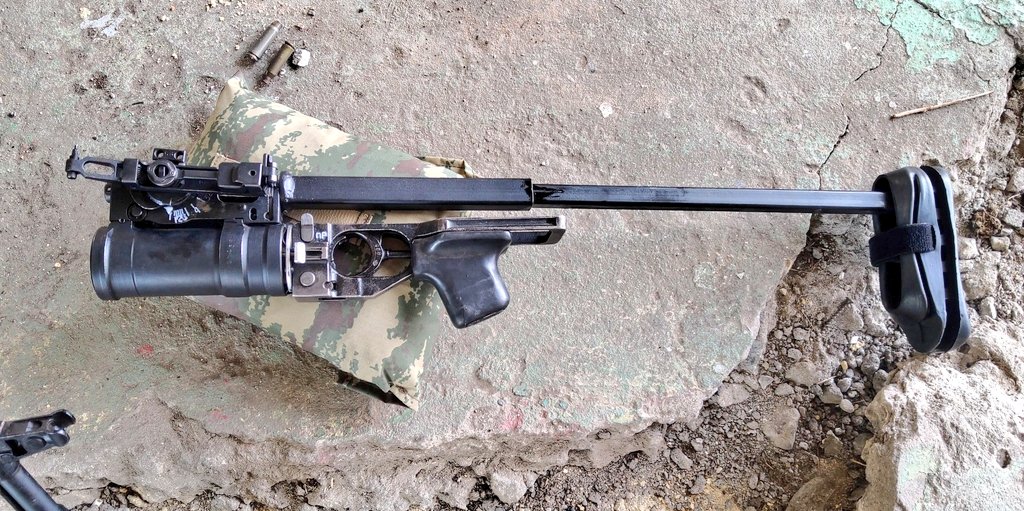
In early March we looked at the Black Storm Defender, a Ukrainian conversion kit, which turned GP-25 under-barrel grenade launchers into standalone weapons. Since then further research has discovered a very similar conversion design originating from Russia. Developed by a company called RGL (redgreenlight.ru). RGL have developed a number of products including a sight mount for RPG/RPO pattern shoulder-fired launchers and a small light which can illuminate turrets on optics for use in lowlight conditions. They developed their stock for the GP25 and GP34 in 2019, with refinements in 2022. It was reportedly developed independently of the Black Storm Defender – with both companies developing very similar products.

Comparison between Север 1 (top) & Blackstorm Defender (bottom)

RGL’s website has some specs on their system – the Север 1, noting its length is 480mm and its weight is ‘no more 1100g’. The stock adapter is priced at 17,000 Russian Ruble (or around $220). 

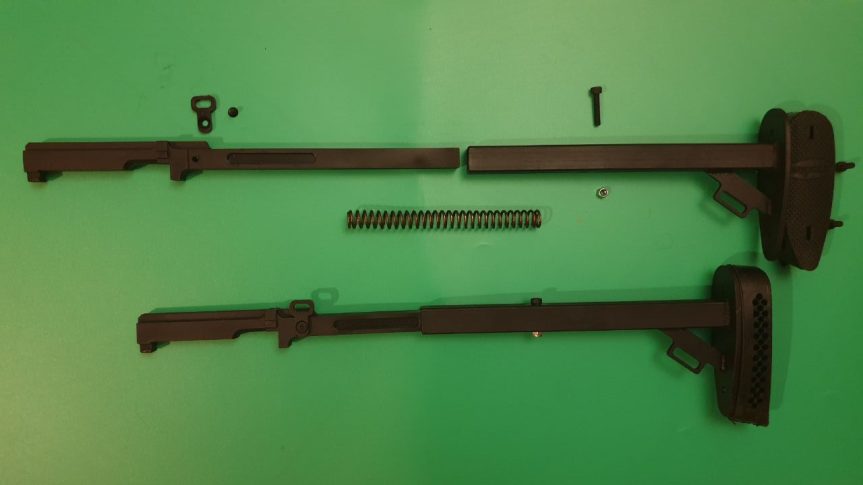
Photos of the Север 1 with GP-25 fitted and disassembled (via RGL)

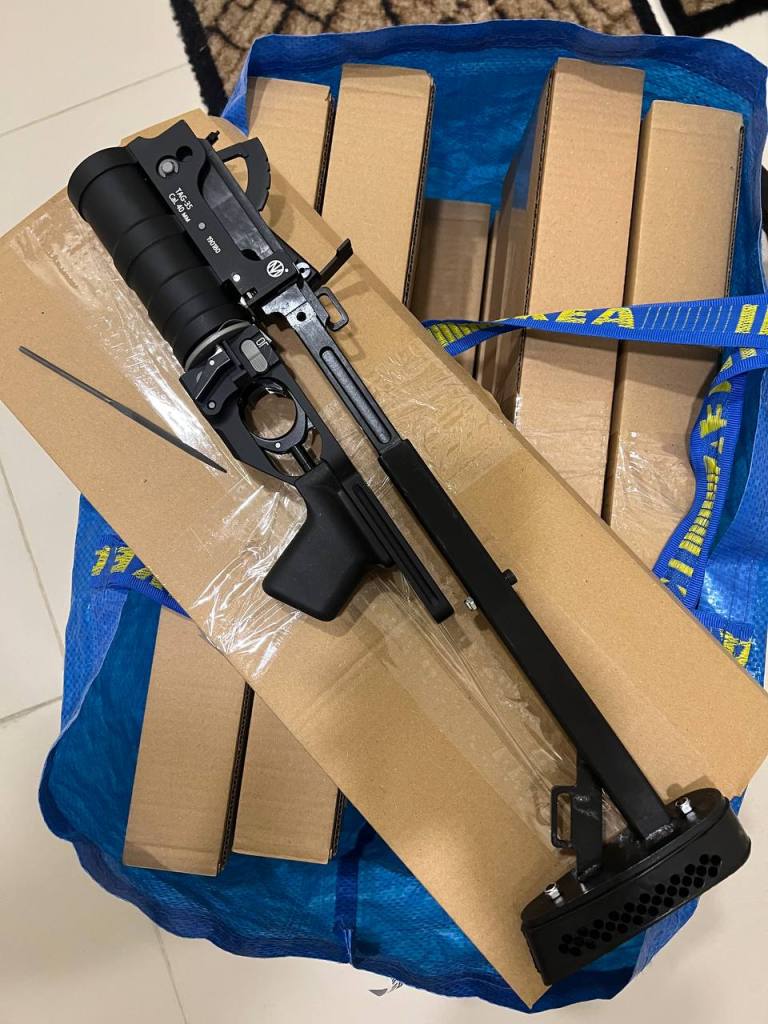
So similar are the two designs that images at 5:21 and a clip at 6:55 actually show Север 1s rather than Defenders. A Wagner-affiliated Telegram channel posted the photo below, with the caption: “For those who want to order – mid-May production time, place an order in advance.”

An RGL Север 1 fitted with a TAG-35, an airsoft clone of the GP-34 grenade launcher (via social media)

The key differences between the two appear to be a different kind of butt pad, the positioning of the sling loops, some machining on the extension which attaches to the launcher and most fundamentally a reversal of which parts of the stock telescope. On the Defender the rear section telescopes inside the front while on the Север the front portion appears to telescope inside the rear section. The Север 1 does not appear to come with a frontgrip or a grip extension. The Север 1 has been seen in use in Ukraine with Russian combatants.

Update – 14/07/23: Russian military ‘influencer’ Razvedos shared several photos of the RGL Север 1 standalone stock for GP series underbarrel grenade launchers. Razvedos recommended it saying: “I recommend the best solution in this niche today from RGL.”


Support Us: If you enjoyed this video and article please consider supporting our work here. We have some great perks available for Patreon Supporters – including early access to custom stickers and early access to videos! Thank you for your support!

Bibliography:

Black Storm Defender, Black Storm, (source)

RGL Север 1, RGL, (source)

Thanks to Abraxas Spa for their help with this video.

Black Storm Defender – Standalone GP-25 Grenade Launcher Stock

In an earlier video we looked at the Black Storm series of bullpup conversion kits for AK pattern rifles. Black Storm have also developed an interesting standalone stock for the GP-25 under barrel grenade launcher called ‘Defender’. The impetus for this is s aid to be that the Black Storm rifle kits aren’t able to support the grenade launchers so a standalone stock into which they can be mounted was developed.

The GP-25 is a 40mm grenade launcher designed in the late 1970s by the small arms design bureau based at Tula. It is an under-barrel grenade launcher designed to slide onto standard issued AK-74 pattern rifles. Its ammunition uses a high–low pressure system and has a range of up to 400m.

The most interesting feature of the GP-25 stock is that it has a recoil mitigation system. This appears to be a strong spring in the telescoping stock tube which acts as a buffer. The stock kit is made up of a telescoping stock with butt pad, onto which the grenade launcher is mounted – just as you would onto a rifle, a forward vertical grip can be attached by a clamshell pair of metal stampings with allow the grip piece to be centered and held in place by two cross nuts. There is also a press-fit pistol grip extension for the GP-25’s short grip to help improve ergonomics.

Black Storm list the stock kit without launcher as weighing 200g while the Defender with GP-25 is listed as weighing 500g (1.1lbs). Black Storm sell the V2.0 of the stock for 5,950 UAH ($162). 

A GP-25 in a Black Storm Defender stock (via War_Noir)

With some units also transitioning to NATO calibre rifles like the M4A1, MSBS GROT, FN FNC and F2000 amongst others, the ability to use the GP-25 as a stand alone weapon has proven valuable as the GP-25 can’t be mounted on Western rifles but with ammunition for the grenade launchers still plentiful they can continue to be used.

The earliest imagery I could find of the Defender in the field dates to 22 April, when  Russian reporter War Gonzo posted a short video showing a Defender captured by Separatist DPR troops in Mariupol. The DPR soldier examining it notes that the weapon doesn’t seem to work and also compared it to the GP-25 fitted to his own AKS-74.

In May a good, clear photograph of a GP-25 in a Defender stock was shared, shown fitted with a sling. In mid-May Ukrainian operators shared a video of the Defender being fired at the range.

Also in May a short video of a Defender kit being fitted to a launcher was shared – this particular example apparently requiring some hand fitting to the sheet-metal pieces that attach the forward grip.

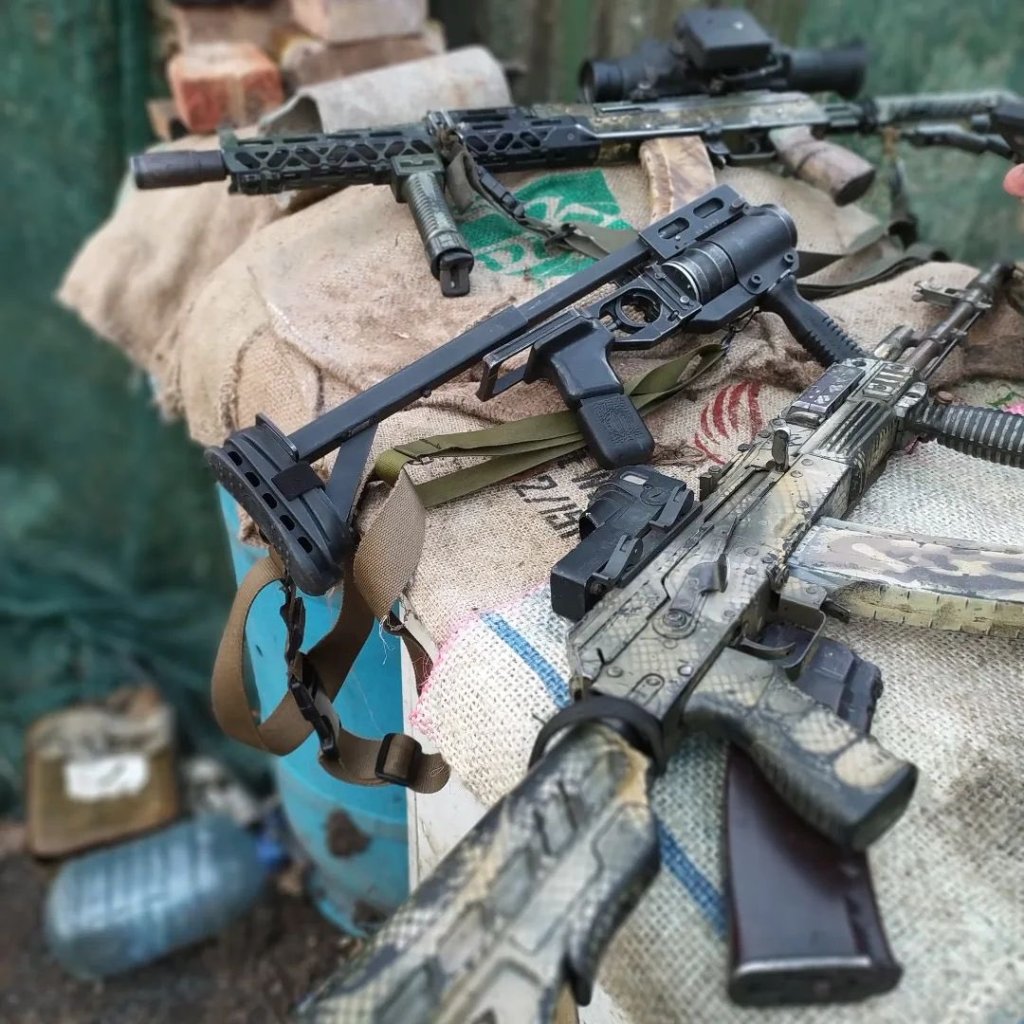
A number of other stand alone adapters for GP-25s have also been seen in the field, In late May 2022, this example of a simpler adapter was shared online featuring a rigid stock onto which the grande launcher can be fitted. Simple adapters like this may be craft made in the field or manufactured by commercial companies.

A GP-25 in a Defender stock (via social media)

In June a short video was shared of a Ukrainian soldier firing several high-angle rounds from a GP-25 mounted in a Defender stock, we can see that the sight has been set to its highest elevation.

Ukrainian operators shared another photograph of a GP-25 in a Defender stock in September. The North Side Group shared a photograph of a GP-25 in a Defender at what appears to be a range in mid-September.

Russian operator shared photo of two standalone stocks for the GP-25 – the first is the rigid stock type seen in the photo from May. I haven’t been able to ascertain who produces this stock yet. In these photos, however, it is clear that the butt is wider than the Ukrainian design. The second stock appears to be a Black Storm Defender [Update: since identified as a RGL Север 1].

On 30 November the Belarusian volunteer unit, the Kalinouski Regiment, shared a video demonstrating the Defender, showing how its loaded, fired and carried noting that it is “designed to destroy enemy manpower located in trenches, and open terrain.”

In early January, Assistance Group – a German group active in Ukraine, shared some photographs of load out for operating in urban and woodland environments and a GP-25 in a Defender feature in both photographs.

At the beginning of February 2023 a video was shared featuring an operator with Russia’s SOBR “Granit”, he fires a couple of rounds from a GP-25 in a stand alone stock [Update: since identified as a RGL Север 1].

The ‘Lubart’ Ukrainian special operations forces unit recently shared a number of montage video of operations around Bakhmut. In it one operator loads and fires a Defender several times. The Defender in the clip lacks the pistol grip extension that comes as part of the kit.

A GP-25 Defender and a pair of customised AKs (via social media)

On 2 March a member of the Forward Observations Group shared a photo of is various weapons including a Black Storm Defender. 

Finally, most recently, a short video from a Russian anti-Putin group – the Russian Volunteer Corps, filmed during an apparent raid into Bryansk. The video featured one of the group’s leaders with a Defender slung at his side.  

It’s unclear just how many of these Black Storm Defender stock kits are being used by Ukrainian personnel but they do continue to appear regularly in imagery from the field. While unsurprisingly they appear to be favoured by units armed with Western rifles they are also being used by combatants armed with weapons which could mount a GP-25, perhaps indicating a preference for using the launcher as a stand alone weapon. 


Update 30/04/22 – Russia’s RGL Север 1

Since writing the article further research has discovered a very similar stock design originating from Russia. Developed by a company called RGL (redgreenlight.ru). RGL have developed a number of products including a sight mount for RPG/RPO pattern shoulder-fired launchers and a small light which can illuminate turrets on optics for use in lowlight conditions. They developed their stock for the GP25 and GP34 in 2019, with refinements in 2022. It was reportedly developed independently of the Black Storm Defender – with both companies developing very similar products.

RGL’s website has some specs on their system – the Север 1, noting its length is 480mm and its weight is ‘no more 1100g’. The stock adapter is priced at 17,000 Russian Ruble (or around $220). 

Photos of the Север 1 with GP-25 fitted and disassembled (via RGL)

So similar are the two designs that images at 5:21 and a clip at 6:55 actually show Север 1s rather than Defenders. A Wagner-affiliated Telegram channel posted the photo below, with the caption: “For those who want to order – mid-May production time, place an order in advance.”

An RGL Север 1 fitted with a TAG-35, an airsoft clone of the GP-34 grenade launcher (via social media)

The key differences between the two appear to be a different kind of butt pad, the positioning of the sling loops, some machining on the extension which attaches to the launcher and most fundamentally a reversal of which parts of the stock telescope. On the Defender the rear section telescopes inside the front while on the Север the front portion appears to telescope inside the rear section. The Север 1 does not appear to come with a frontgrip or a grip extension. The Север 1 has been seen in use in Ukraine with Russian combatants.

Full article and video on the GL Север 1 here.


Update – 16 /06/23: Additional images of the Black Storm Defender in use in the field.


Support Us: If you enjoyed this video and article please consider supporting our work here. We have some great perks available for Patreon Supporters – including early access to custom stickers and early access to videos! Thank you for your support!

Bibliography:

Black Storm Defender, Black Storm, (source)

Video demonstrating assembly of Defender, Black Storm, (source)

Thanks to the guys at Streaking Delilah, War_Noir and to Abraxas Spa for their help with imagery for this video.

Diemaco/Colt Canada M203A1

The Diemaco M203A1 is a development of the M203 40x46mm low velocity grenade launcher. The M203 was initially developed by AAI to replace the Colt XM148 which proved overly complex when tested in Vietnam.

The Diemaco M203A1 improves on the earlier launcher by incorporating its sight into the mount rather than being atached to the top of the barrel. The Diemaco M203A1 should not be confused with the Colt-manufactured M203A1 in US service. The Diemaco launcher is offered alongside the C7 and C8 rifles made by Diemaco (now Colt Canada).

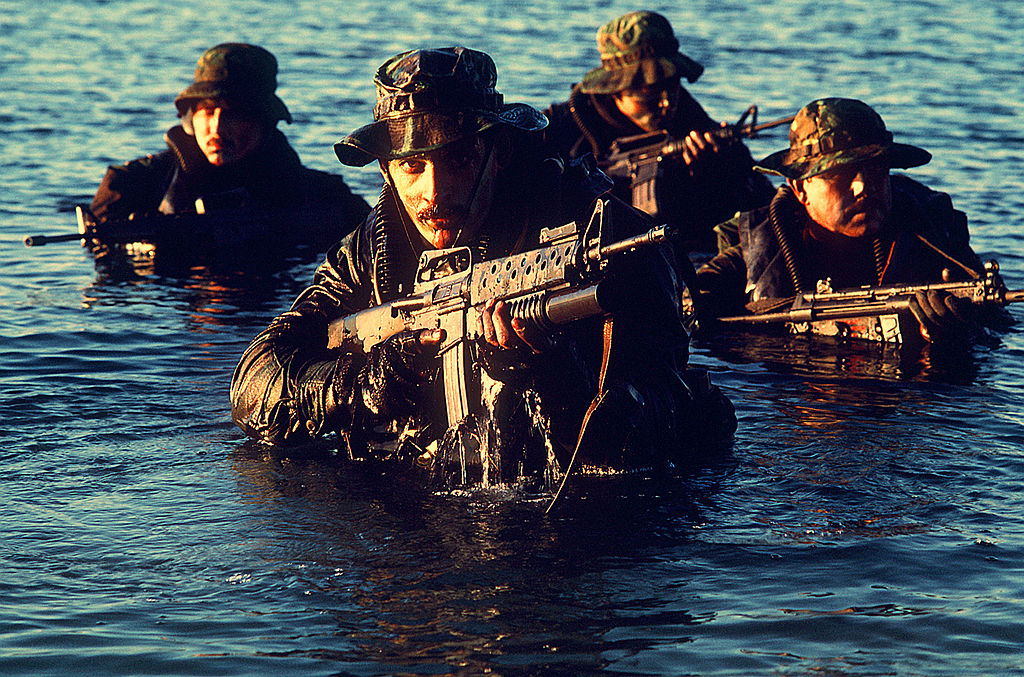
Navy_SEALs_coming_out_of_water.JPEG
SEAL members emerge from the water during tactical warfare training c.1986. The SEAL member in the foreground is armed with an M-16A1 rifle equipped with an M203 grenade launcher (US National Archive)

Diemaco developed the M203A1 so it has a longer action, with the breech opening further to allow the firing of all 40×46 mm LV grenades including less than lethal baton rounds. It can also be mounted on all AR-patterned rifles as well as the Steyr AUG.

Like the original M203 the launcher can be operated by either a left or right handed users. The original model had an iron sight assembly has dual azimuth adjustment knobs and an elevation dial, this model, however, has a simplified tangent sight. Diemaco stated that the M203A1 has a maximum effective range of 400m (440 yd) with a muzzle velocity of 78 m/s (260 ft/s).

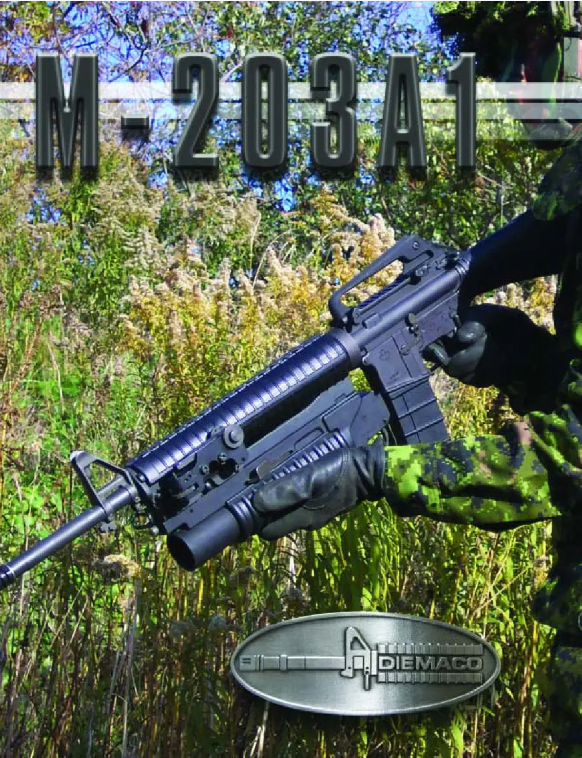
diemaco M203a1 brochure
Diemaco brochure cover showing M203A1 on a C7 rifle (Colt Canada)

The M203A1 was tested by the UK’s special forces in the late 1990s, when they evaluated the Diemaco SFW carbine, which was subsequently adopted as the L119A1. The Heckler & Koch M320 GLM (HK AG36) has since been adopted by the British Army.


If you enjoyed the video and this article please consider supporting our work here. We have some great perks available for Patreon Supporters. You can also support us via one-time donations here.


Specifications (From Diemaco Brochure):

Calibre: 40 mm
Loaded Weight: 2.15 kg (4.74 lb)
Empty Weight: 1.85 kg (4.08 lb)
Overall Length: 318 mm (12.52 in.)
Barrel Length: 228.6 mm (9 in.)
Overall Height: 140 mm (5.51 in.)
Rifling: Right Hand Twist – 6 Lands
Rate of Twist: 1 turn in 48 in. (121.9 cm)


Bibliography:

Diemaco M203A1 Product Brochure, Diemaco/Colt Canada, c.2000

Diemaco M203A1 for SFW carbine, Royal Armouries, (source)

Colt CGL-4 (XM148) 40mm Grenade Launcher

Here’s Vic’s video on the XM148, check out Matt’s article below:

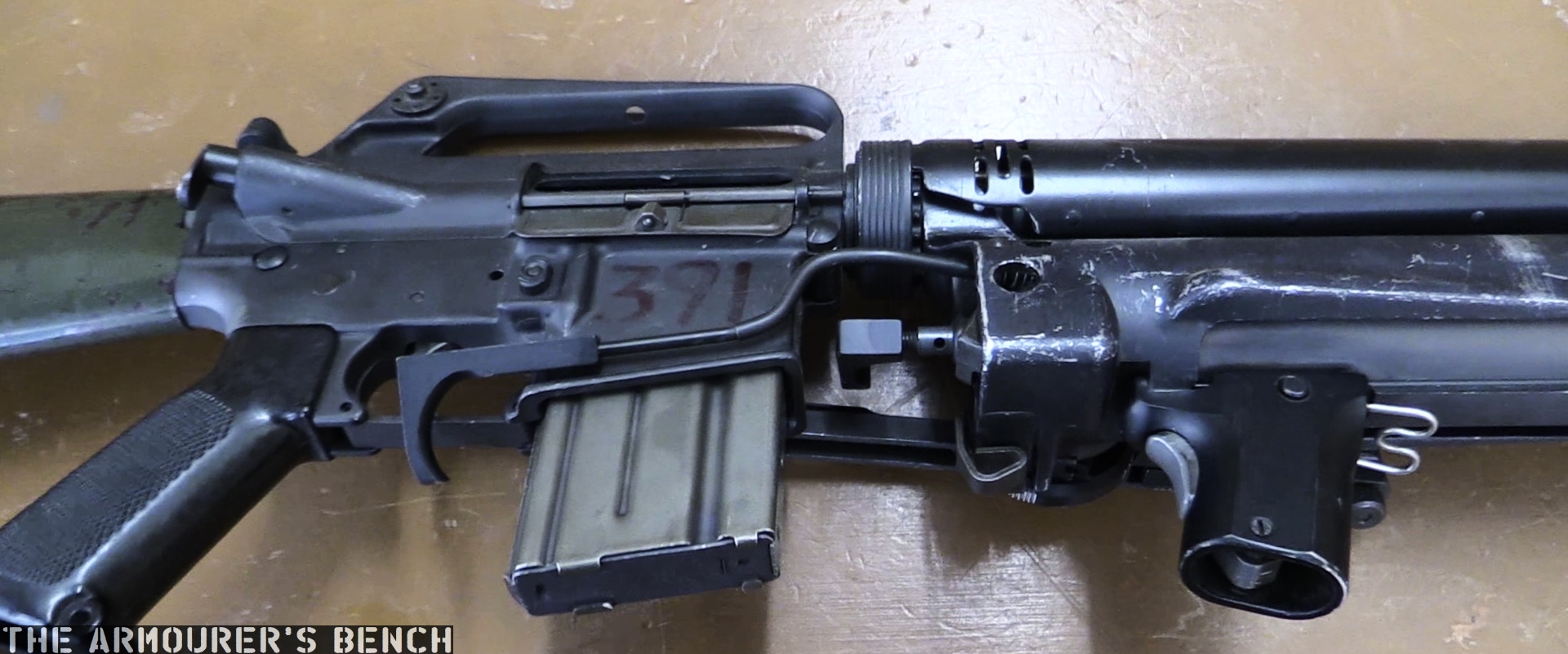
There have been attempts to fire grenades from the infantryman’s weapon since the 17th century. Up until the 1960s these almost entirely involved muzzle attachments or grenades which could be fired off the end of a rifle’s barrel. In May 1963, the US military called for a new ‘underslung’ grenade launcher to complement the AR-15/M16, then in early testing. The grenade launcher program had its roots in the ultimately unsuccessful Special Purpose Individual Weapon (SPIW) program which had begun in 1952.

While a series of designs were developed by various manufacturers and designers, May 1964 saw Colt unveil the CGL-4. The Colt was tested against designs from Springfield Armory and Ford, a design from AAI was promising but it was not able to chamber the 40x46mm rounds used by the M79 and was rejected. The US military sought munitions commonality between the M79, already in service, and the new rifle-mounted grenade launcher.

DCC CGL-4 NO SOUND_Moment2
Left side view of the XM148’s bulky tangent sight (Vic Tuff)

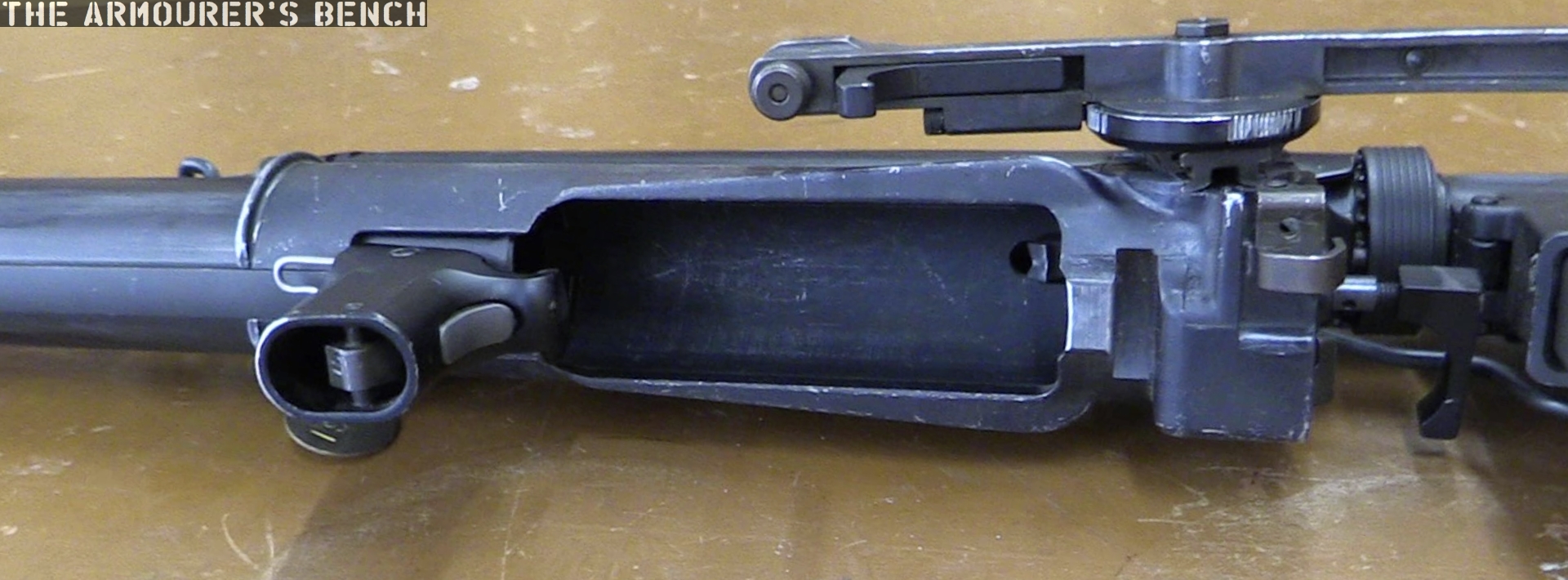
In March 1965, the CGL-4 was chosen for further testing and a contract for 30 launchers was signed. The CGL-4 was reportedly developed by Karl Lewis and Robert E. Roy in just 48 days. However, the design was complex. To load the barrel housing slid forward allowing a grenade to be placed in the breech, the weapon was then cocked and a long trigger, which projected back towards the rifle’s trigger guard, could be pulled to fire the weapon.

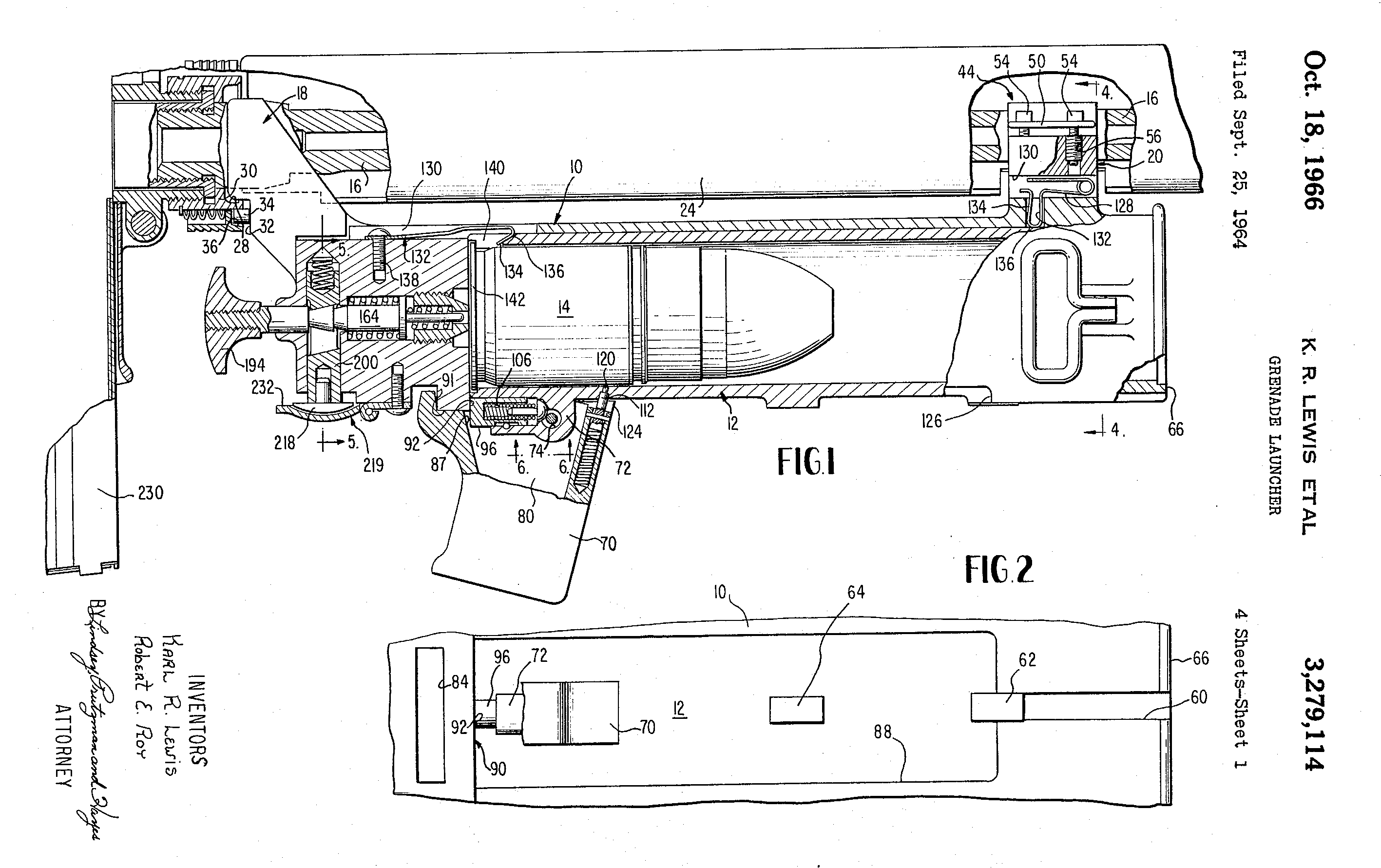
CGL4 Patent
Karl Lewis & Robert E. Roy’s patent for the Colt CGL-4 (US Patent Office)

Despite some problems with barrel housings cracking an order for 10,500 of the new launchers, now designated the XM148, was placed in January 1966. Production capacity issues and problems with the launcher’s sight lead to production delays and it wasn’t until December 1966, that the first shipment of 1,764 launchers arrived in Vietnam for field testing.

DCC CGL-4 NO SOUND_Moment6
Right side view of the XM148’s trigger, cocking mechanism and pistol grip (Vic Tuff)

Initial reports from the field were promising with troops praising the “tactical advantage of both the point fire and area fire system” concept. The XM148 was well received by the SEALs and the Australian SAS. The armourers of the Australian SAS, deployed to Vietnam with the 1st Australian Task Force, were also hard at work attaching XM148s to L1A1 rifles. Removing the L1A1′s handguard and attaching the XM148 to the rifle’s barrel.

Field testing was carried out by 12 units from six different divisions which were operating in various parts of Vietnam. This gave a wide variety of terrains and yielded some interesting results. In general it was found that the XM148 decreased rate and quantity of the grenadier’s fire, it slowed his reaction times when firing at a target, it hampered his movement in dense vegetation and also meant the grenadier had to spend longer caring for his weapon.

DCC CGL-4 NO SOUND_Moment4
XM148 with breech open (Vic Tuff)

It was noted that the sight mount which was overly complex and prone to snagging on brush and kit, it was also felt that too much force was needed to cock the XM148 (around 30 lbs) and the trigger mechanism was felt to be overly complex and difficult to repair and disassemble. One safety concern was the XM148′s long trigger bar, which could snag and launch a round – not ideal for special forces patrols infiltrating through thick bush. Problems with the launcher’s quadrant sights also continued causing deflection errors out at longer ranges. The bulkiness of the sights exasperated these problems as when they were knocked the XM148′s zero could be effected. The XM148 also precluded the use of a bayonet as when fired it would blow the bayonet off the muzzle. Overall, troops felt the XM148 was too fragile and complex for use in the field.

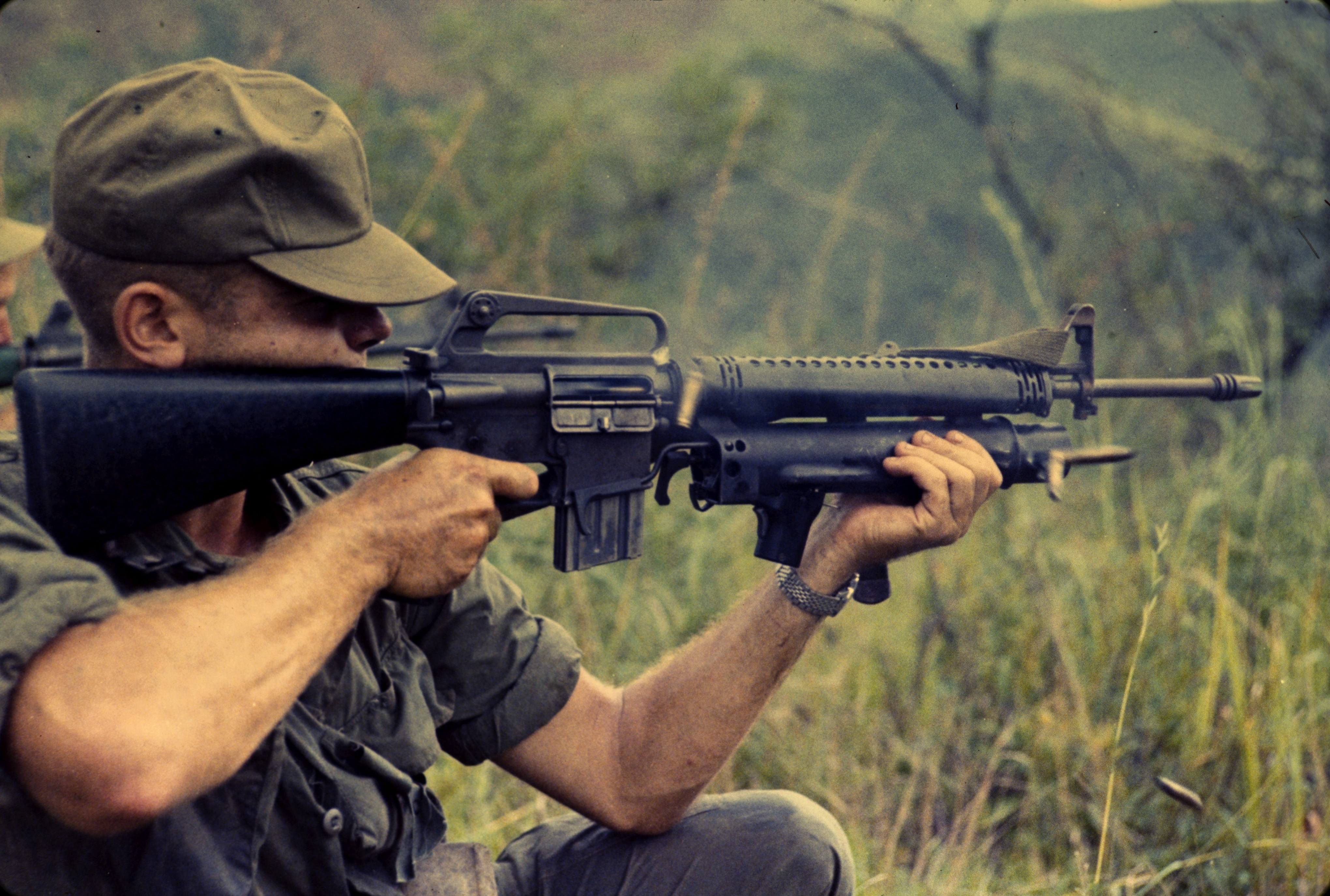
XM148 in vietnam
SP4 Willey firing an M16A1 mounted with a Colt XM148 c. 1967 (US National Archives)

At least one unit found use for the launchers, the 1st Cavalry Division (Airmobile)’s Operational Report for Quarterly Period Ending 31 October 1967, noted that the XM148

“proved unsatisfactory in infantry units due to its lack of durability; consequently, USARV directed that they be turned in. However, 1/9 Cav has devised a method of mounting the launcher coaxially on the M60C machine gun used by scout observers on OH-13 scout helicopters. Durability in this environment is
not a problem since the weapon deos not receive the rough handling it did in the hands of ground troops. Firepower on scout helicopters is significantly increased. Fifty-two XM148s have been retained for use by 1/9 CAV.”

Finally, despite Colt’s efforts to rectify the growing list of problems the Army Concept Team In Vietnam deemed the XM148 unsatisfactory for deployment in Vietnam and recommended they be removed from service and a new improved launcher be developed. This was a massive blow to Colt who had already manufactured 27,400 XM148s. Many of these were already in Vietnam.

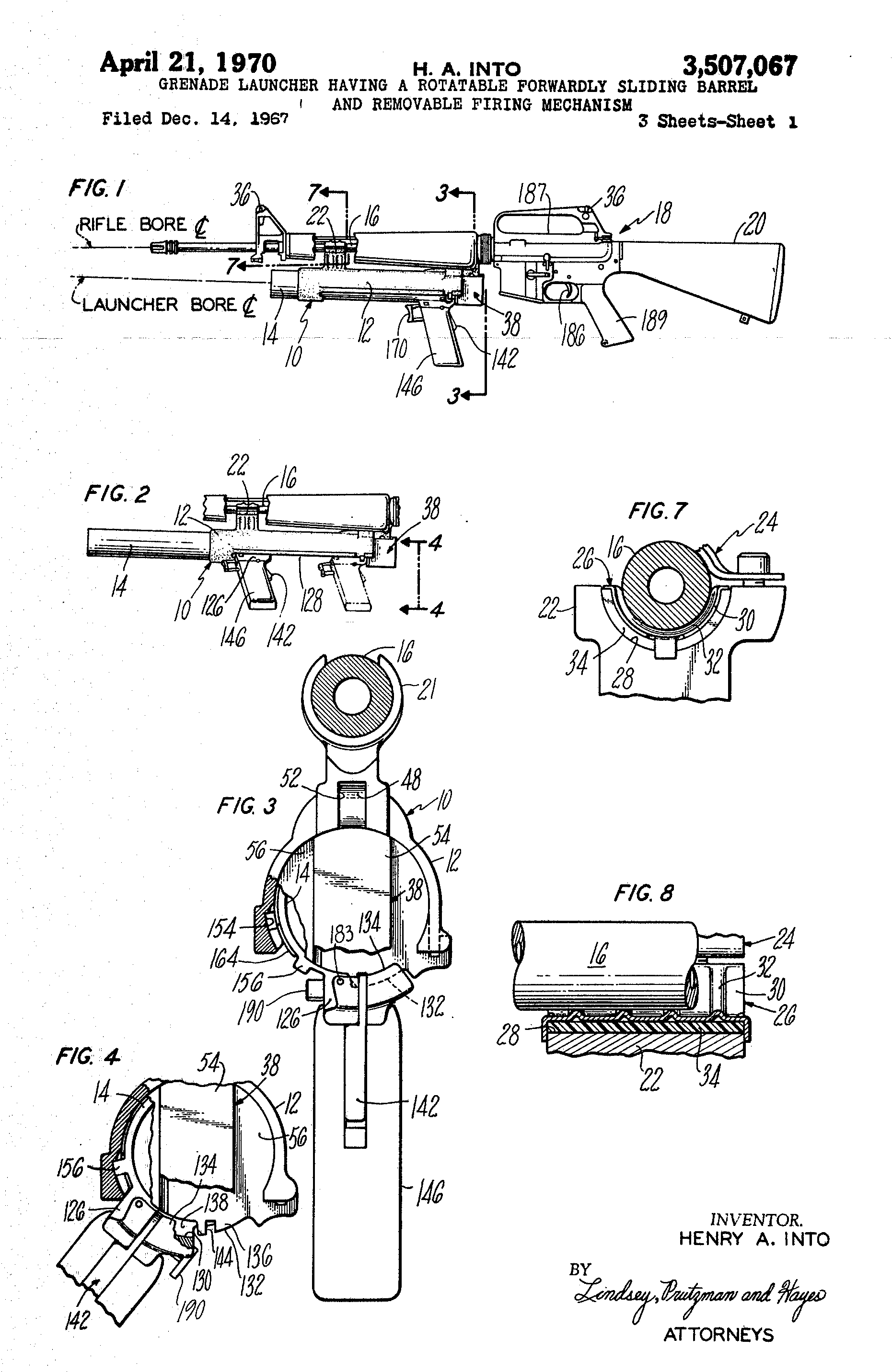
The US Army launched the Grenade Launcher Attachment Development (GLAD) program in the summer of 1967. A large number of manufacturers submitted designs including Colt, who offered the improved Henry Into-designed CGL-5. The Army turned down Colt’s offer of 20 free improved launchers and rejected the CGL-5 outright. The GLAD program saw the resurgence of the earlier AAI design, designated the XM203, this simple design, now chambering the 40x46mm shell, was eventually selected in August 1968. Ironically, as AAI was predominantly a research and development company and after an initial run of 10,000 made by AAI, Colt was subsequently awarded the contract to manufacture the M203 from 1971 onwards.

CGL-5
Harold Into’s patent for the product improved CGL-5 (US Patent Office)

While the XM148 proved to be a failure it played an important role in proving the operational viability of the rifle mounted grenade launcher system. The muzzle-launched rifle grenade is all but obsolete, superseded by the under-slung grenade launcher.

If you enjoyed the video and this article please consider supporting our work here.


Specifications:

Length: 16.5 inches
Weight: ~3lbs
Calibre: 40x46mm
Action: single shot, striker-fired single action
Capacity: 1
Rate of Fire: ~4 rpm


Bibliography

Images: 1 2 3 4 5 6

Black Rifle, E.C. Ezell & R. Blake Stevens, (1987)

Colt Industries Newsletter, Vol.2 no.3, May 1967, (source)

‘Grenade launcher having a rotatable forwardly sliding barrel and removable firing mechanism’, US Patent #3507067, H.A. Into, 14/12/67 (source)

Operational Report for Quarterly Period Ending 31 October 1967, 1st Cavalry Division (Airmobile), (source)

‘Grenade launcher’, US Patent #3279114, K. Lewis & R. Roy, 25/09/64 (source)

Springfield Armory Database entries: 1 2 3

40mm Shoulder-Fired Grenade Launchers & the SEALS, Small Arms Review, K. Dockery, (source)

The XM148: Birth of the Mounted 40mm Grenade Launcher, Small Arms Review, J. Wong, (source)

My thanks to Daniel Watters for information on AAI & Colt M203 production contracts.