We continue Mercenary Month with a classic, ‘Dark of the Sun’. Jack Cardiff’s 1968 action movie that follows a band of Congolese commandos attempting to retrieve a huge diamond haul before the Simbas arrive. An artistic but visceral film staring Rod Taylor, Yvette Mimieux, Jim Brown, Peter Carsten and Kenneth More. Skilfully shot, lots of impressive action and some good performances combine to create a compelling film.
Join us as we kick off Mercenary Month with ‘Code Name: Wild Geese’. A 1984 action movie directed by Antonio Margheriti following a group of mercs in tasked with destroying opium farms in the Golden Triangle. The film stars Lewis Collins, Lee Van Cleef, Klaus Kinski and Ernest Borgnine.
Join us as we discuss a modern adaptation of R.C. Sherriff’s classic First World War play ‘Journey’s End’. The 2018 adaptation stars Asa Butterfield, Sam Claflin, Paul Bettany, Stephen Graham, Tom Sturridge and Toby Jones.
We’re lucky enough to be joined by a very special guest, Taff Gillingham historical advisor and co-director of Khaki Devil, who was instrumental in giving the film its impressive authenticity. The film follows a group of British officers in the days before German Spring 1918 Offensive!
Join us for as we examine the Carol Reed-directed 1944 British classic ‘The Way Ahead’ starring David Niven, Stanley Holloway, William Hartnell, Peter Ustinov and John Laurie. We’re joined by special guest Richard Fisher, of the Vickers MG Collection and Research Association, who picked the film partly due to it’s iconic scene featuring a Vickers Gun! The film follows a platoon of men through their call up, training and up to their first experience of battle!
You can watch ‘The New Lot’ (1943) on the IWM’s site here.
We have examined several on screen appearances of the PIAT previously, in this article we will look at a scene from the 2014 Polish movie, MIASTO 44 or City 44/Warsaw 44. The film follows a group of young members of the Home Army during the Warsaw Uprising.
In the scene we’re going to analyse today a Home Army squad are in a defensive position on the first story of an apartment building when a German Goliath remote controlled mine approaches their position. They immediately open fire on the Goliath with small arms, some rifles, a couple of submachine guns including a Sten, a PPSh-41 and an MP40 as well as a captured MG-42. While they’re pretty well armed, they’re low on ammo.
With the small arms fire ineffectual the squad leader calls for the PIAT. The Home Army had an estimated 70 PIATs at the start of the uprising. The British Projector, Infantry, Anti-Tank was the Pole’s primary infantry anti-tank weapon. By the 12th September the allies had managed to drop more PIATs bringing the number available to around 250.
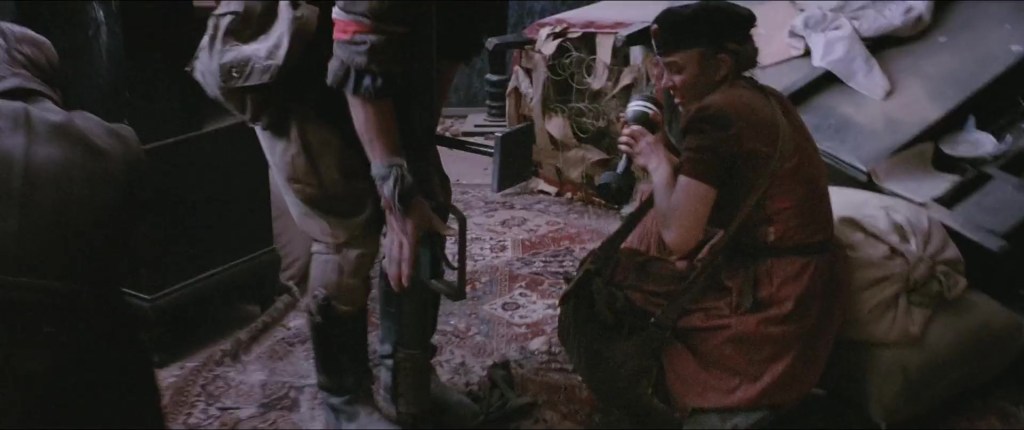
What’s so special about this scene is that it depicts the cocking of the PIAT! As the others open fire the PIAT number one can be seen rotating the outer casing to unlock it and then pulling it up until the spring inside is cocked. He then lowers the casing and locks it ready to fire. We don’t see it but the No.2 has loaded a bomb into the bomb support tray and the No.1 places the monopod on the sandbags and takes aim.
A member of the Home Army Cocking the PIAT
So not only do we have photographs of the PIAT in use at Warsaw we also have some good accounts of its use, one from Zbigniew ‘Deivir’ Czajkowski, a corporal and patrol leader with the Home Army’s ‘Parasol’ scout battalion describes using a PIAT against a German tank during street fighting. Czajkowski describes how the man about to fire the PIAT had forgotten to prime the bomb, he then describes firing on the tank below their position:
“I press the heavy weapon into my shoulder. The tank is in front of me, as if on a plate. I can see the enormous armour plating and the smoke coming from its muzzle. I set my sights. Slowly… carefully… The tank fires, below us again. I aim just behind the turret. There! I squeeze the trigger. The PIAT recoils, the round flies through the air… nearly there… It misses the tank and explodes to the rear of it. “Fuck!” Now my colleague tears the PIAT out of my hands. I don’t stop him. I load a new round. Two more shots from the tank. Presumably they haven’t noticed us. Suddenly it dawns on me – we’re on the second floor! “Aim lower, much lower, under the tracks. We’re too high up here.” The barrel of the PIAT tilts down. I’m oblivious to everything glued to the gap in the wall. The weapon barks. There’s a flash of light against the side of the tank. Got him! The tank is momentarily covered in smoke.”
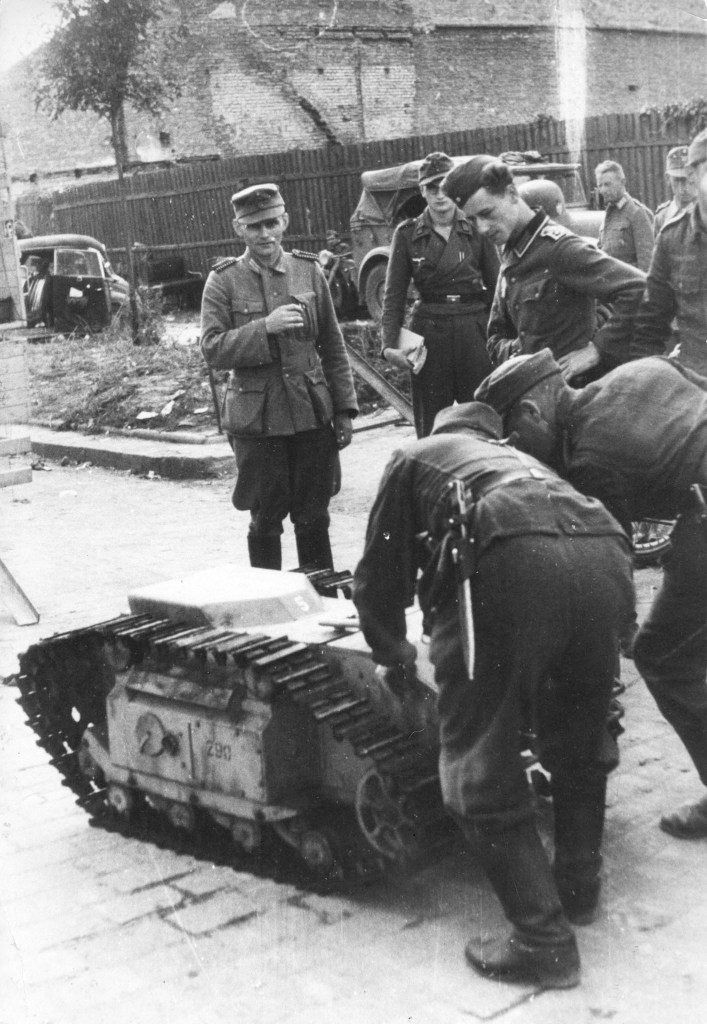
While not a tank, the Goliath seen in the film, were used during the fighting in Warsaw. The Goliaths were armoured, remote controlled bombs could be steered from cover. These tracked mines could deliver a 60 to 100kg payload of high explosive. Enough to destroy positions and heavily damage buildings. A pair of Goliaths are also seen in the earlier Polish film on the uprising – 1957’s Kanal – which also features a PIAT, albeit a wooden mock-up, which takes on a German tank.
A Goliath Remote Controlled Mine in Warsaw (Bundesarchiv)
In Warsaw 44 the PIAT No.1 manages to land his bomb just in front of the approaching Goliath, the blast apparently is enough to break one of the mine’s tracks – perhaps shrapnel or debris struck it. The victory is short-lived, however, and the Polish position is raked by machine gun fire – killing the PIAT No.1 – and a full German assault follows.
The film’s depiction of the PIAT is quite good, although the PIAT appears to be cocked very easily. The weapon’s recoil seems a little light but is represented with the No.1 being sharply pushed back. There is a short flash as the remains of the bomb’s propellent cartridge are seen as the bomb leaves the spigot. We can also see that the spigot is still visible in the bomb tray, meaning the weapon has not re-cocked itself.
The PIAT gave the besieged soldiers of the Home Army a much-needed weapon capable of taking on enemy armoured vehicles. But a few dozen PIATs weren’t enough to turn the tide and the valiant Poles were forces to surrender after two months hard fighting. The film, Warsaw 44, gives a pretty immersive idea of what the fighting in the city might have been like and is worth checking out.
Bibliography:
Miasto 44 (2014) Warsaw 1944: An Insurgent’s Journal of the Uprising, Z. Czajkowski, (2013)
If you enjoyed these videos and this article please consider supporting our work here. We have some great perks available for Patreon Supporters. You can also support us via one-time donations here.Thank you for your support!
Join us as we take a special look at not one but two films – both looking at the ill-fated SAS mission – Bravo Two Zero. Gulf War films are rare and with the 30th Anniversary of the war upon us we thought it was a good time to take a look at ‘The One That Got Away’ (1996) and ‘Bravo Two Zero’ (1999).
Join us, on the 53rd anniversary of the week the Tet Offensive began, as we take a look at 1989’s ‘The Siege of Firebase Gloria’ starring R. Lee Ermey, Wings Hauser & Albert Popwell. Directed Brian Trenchard-Smith its a Vietnam last stand movie that riffs on its predecessors.
Join us as we look at 1943’s ‘Bataan’ starring Robert Taylor, Robert Walker, Lloyd Nolan, Kenneth Spencer and Desi Arnaz. Directed by Tay Garnett, it’s one of the few films to look at the brutal Battle of Bataan. It’s a classic last stand movie and incorporates elements from the battle which saw some of its hardest fighting 79 years ago this month.
In this episode of Fighting On Film we examine 1951’s ‘Go For Broke!‘, written & directed by Robert Pirosh and starring Van Johnson – who had worked together on ‘Battleground‘ (FoF Episode 6). The film tells the unique story of the 442nd Infantry Regiment, a US Army unit made up of Japanese-Americans who became the most decorated unit of its size of World War Two!
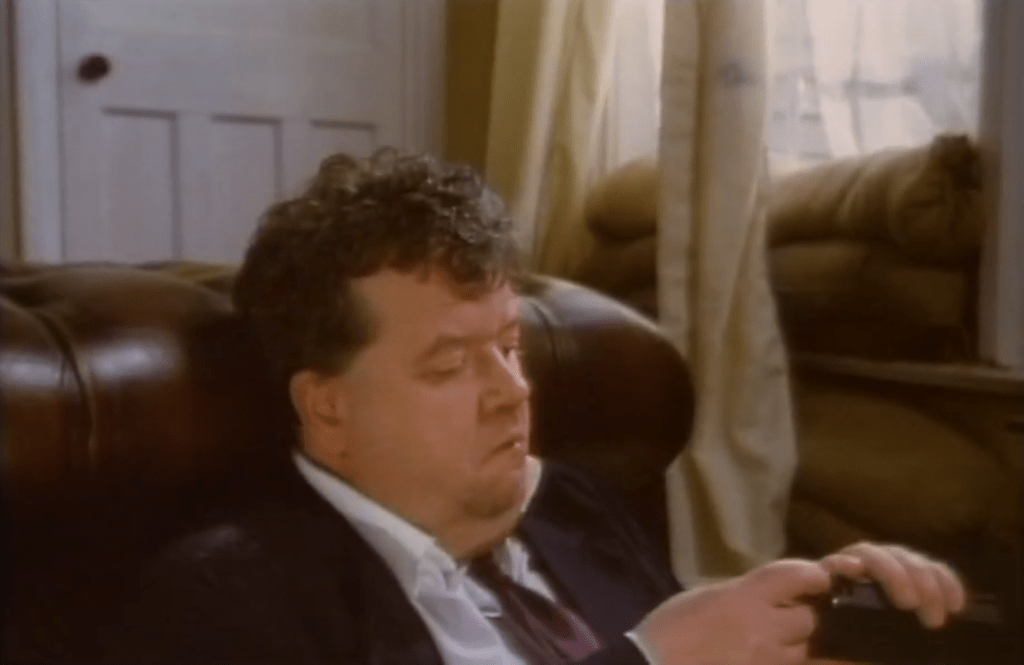
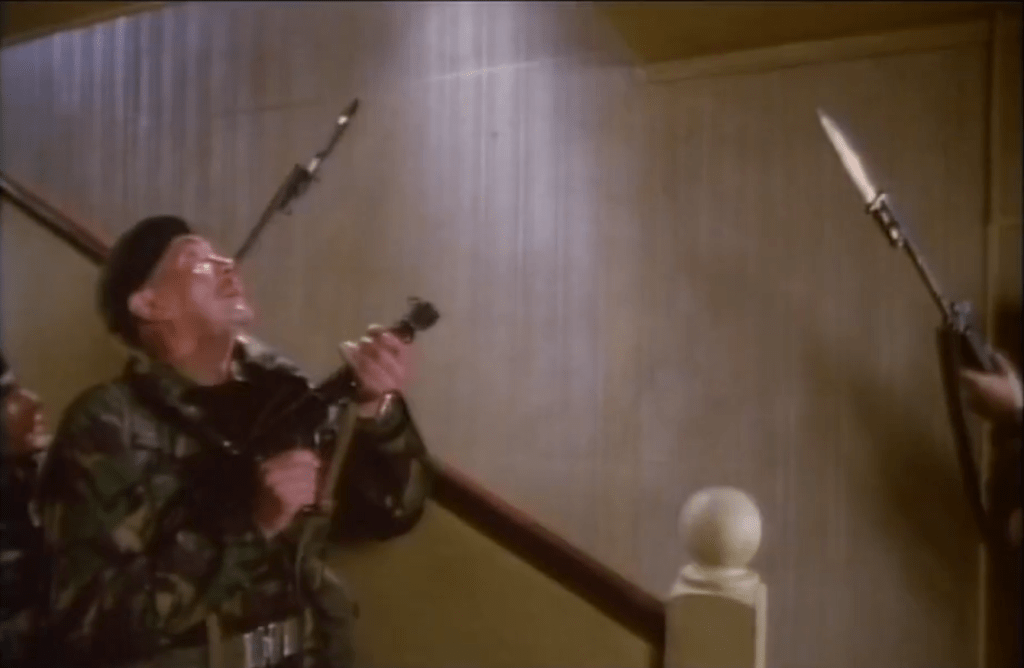
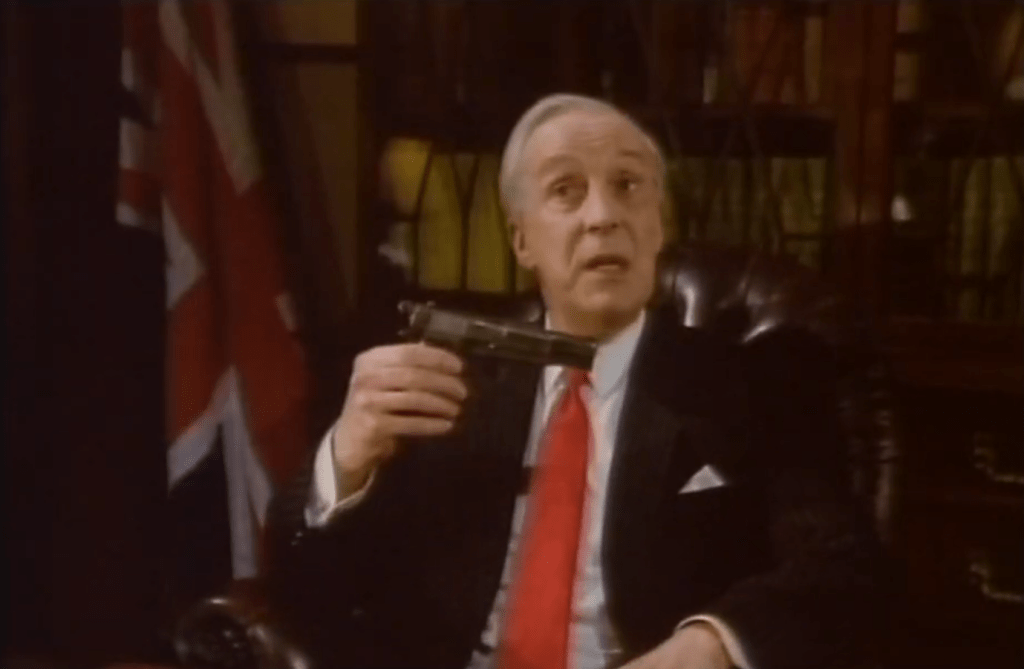
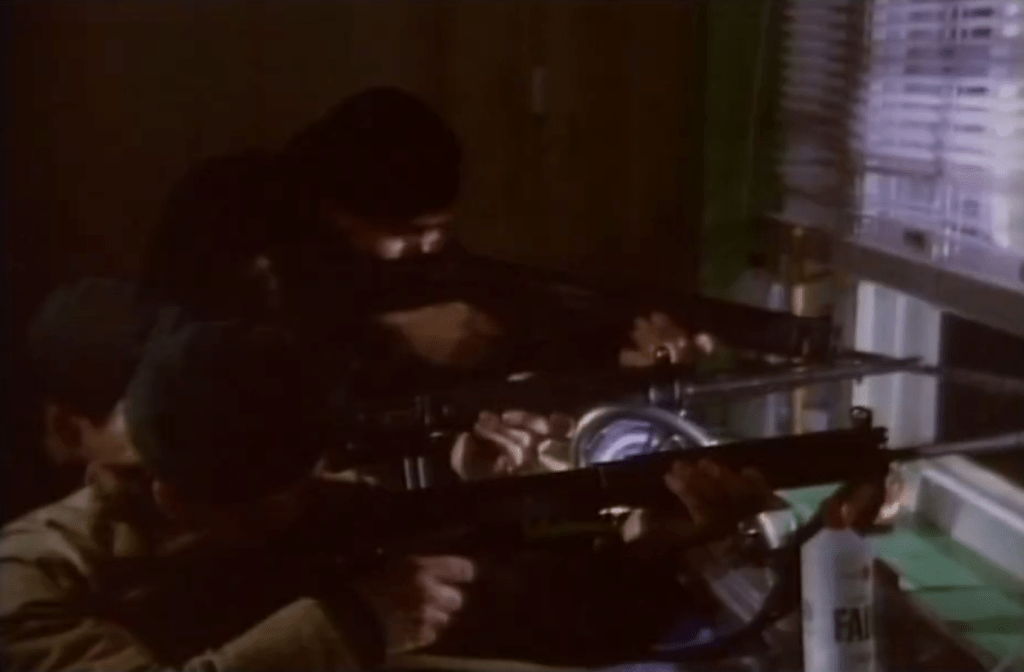
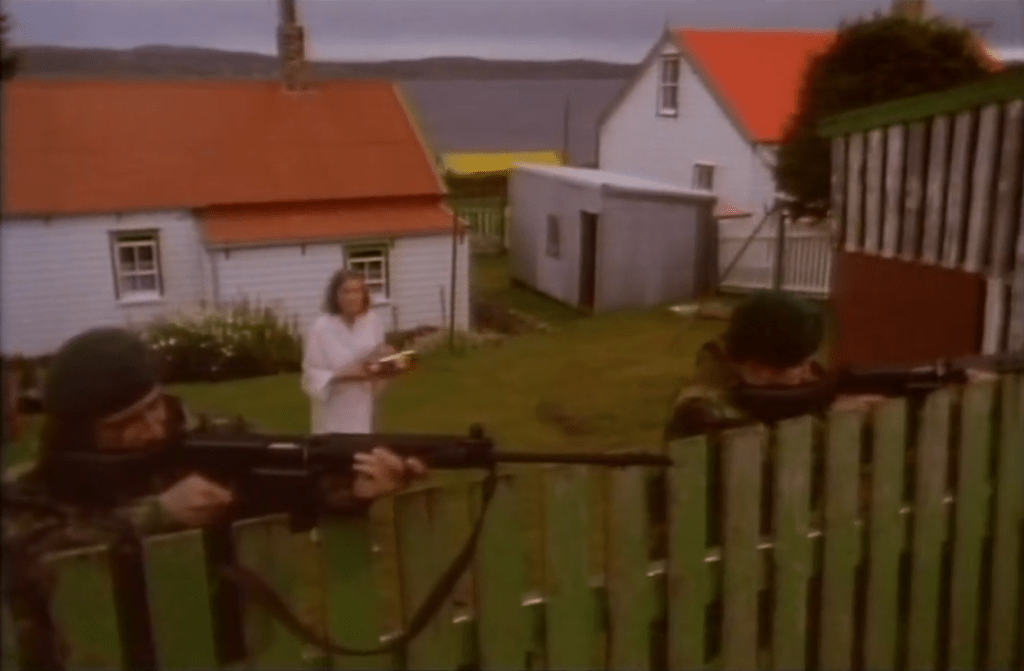
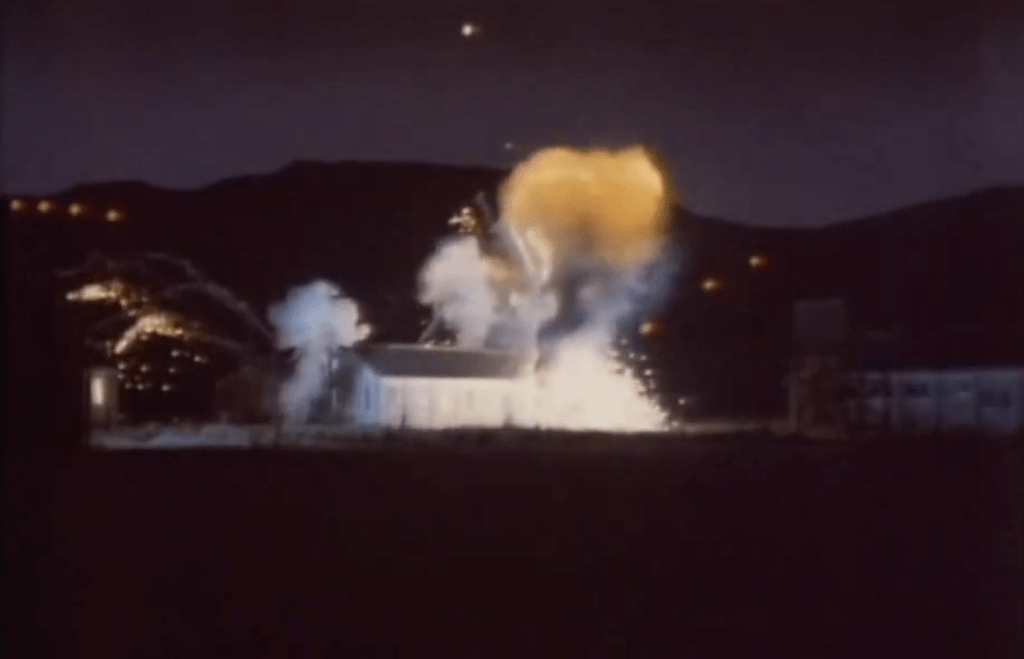
In another special episode of Fighting On Film we chat with director Stuart Urban and some of the cast (Hugh Ross & Ian McNeice) of the 1992 BAFTA-winning film ‘An Ungentlemanly Act‘. A unique war movie which looks at the first 36 hours of the Falklands War and the battle to defend the island from Argentine invasion.
With so few war movies made about the Falklands War by both sides this film is especially interesting. It was fascinating to hear about the writer/director’s first hand research and about what it was like to film on location in the Falklands just a decade after the war.








 The Armourers Bench