In recent weeks Russia has begun deploying North Korean-manufactured 107mm multiple rocket launch systems. These small rocket launchers are the latest of the North Korean weapon systems to enter Russian service.
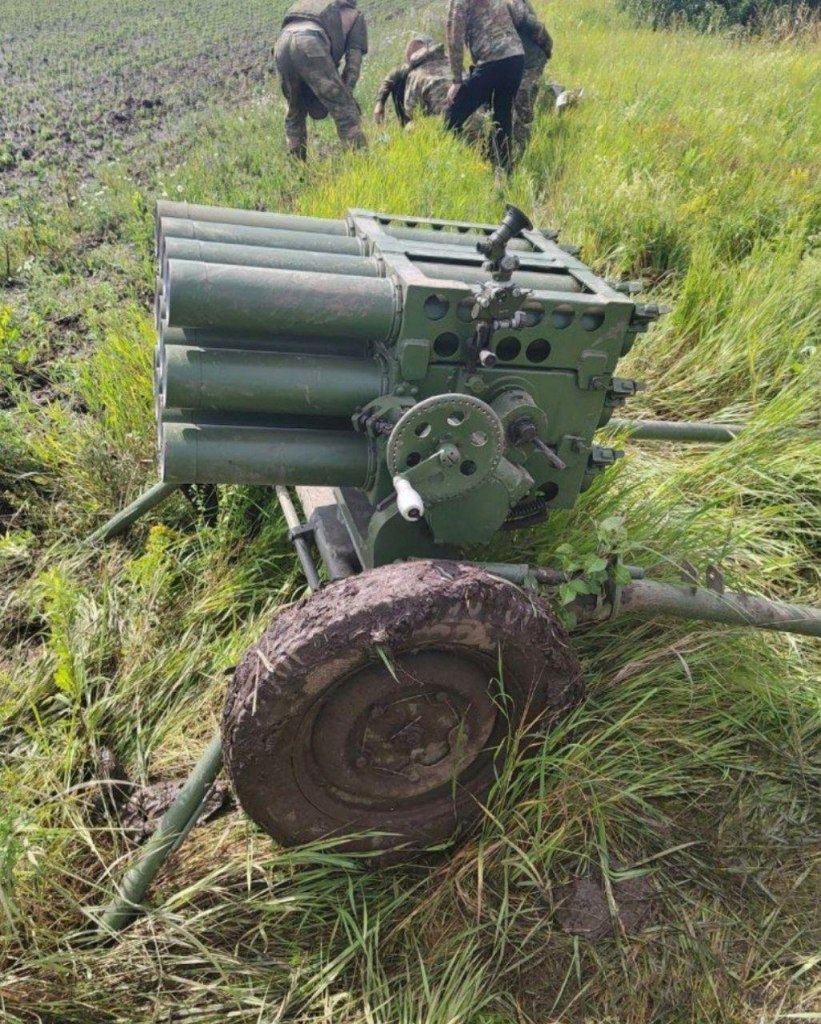
The Type 75 is a copy of China’s Type 63 multiple rocket launcher, is a small towed, 12-tube system which an fire a variety of 107mm ammunition. The system was first sighted in Ukraine in early June, though its likely been in use since Spring 2025.
A Type 75 in Russian service (via social media)
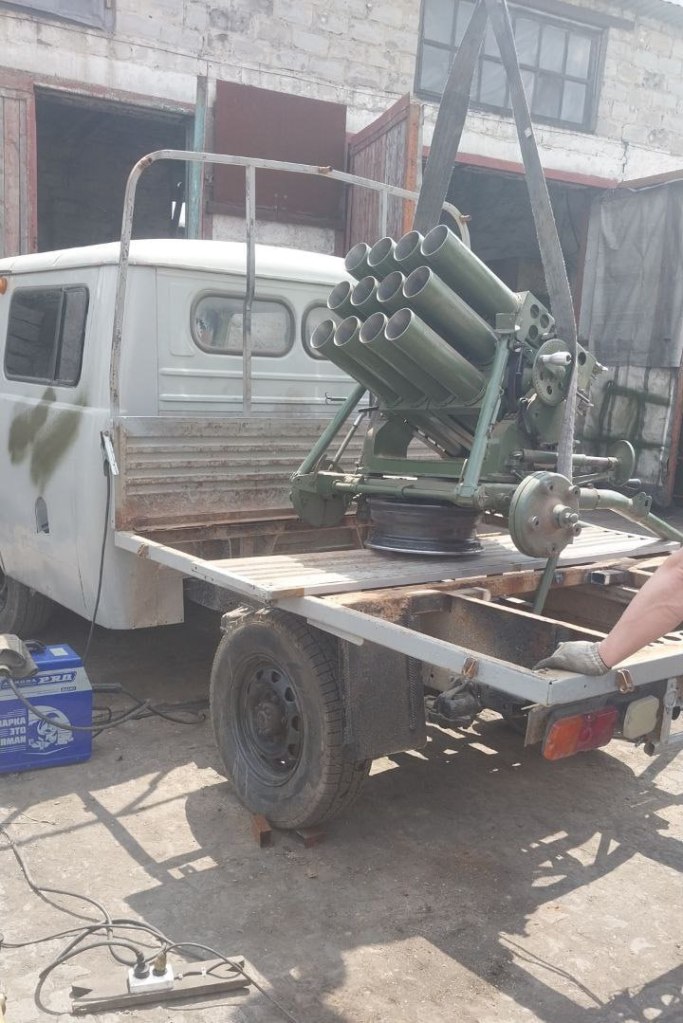
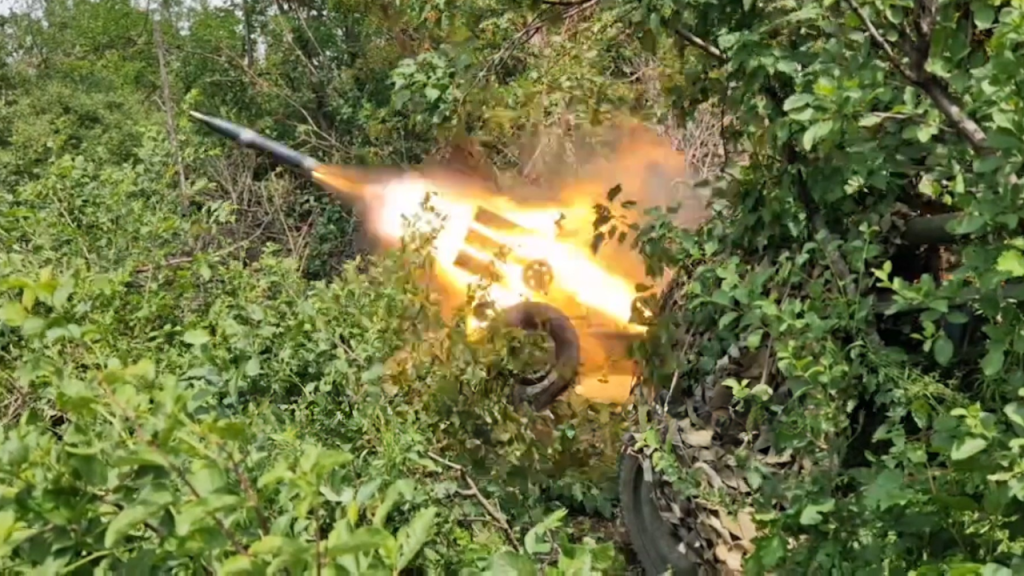
The first footage reportedly shows a crew training with the Type 75 while the second shows the Type 75 being fired from concealment within a tree line. Several days later on 15 June, photographs of a Type 75 being mounted on the bed of a UAZ utility van were posted.
Russian Channel One correspondent Dmitry Kulko shared footage of a Type 75 in action on the 25 June. In his post Kulko notes that the weapon system has a range of 8.5km and is being used with high explosive fragmentation rockets.
Russian mechanics mounting a Type 75 on a UAZ truck (via social media)
On 27 June, a close up photograph of the system was shared on telegram. A week later on 5 July, a Russian Type 75 team shared video of them deploying and operating the system in the field. The video shows the heavily camouflaged MLRS being towed by an unmanned ground vehicle and then being loaded and fired. Deployment with a UGV is sensible as the system unloaded weighs over 600kg and would otherwise require a larger, more noticeable vehicle to move it. The video concludes with some ISR drone footage which is implied to be the impacts on target.
A Type 75 in Russian service firing from a tree line, July 2025 (via social media)
On 12 July, Ukraine’s 1st Separate Presidential Brigade shared footage claiming the first destruction of a Type 75 by drone-dropped ordnance. The videos caption notes that the system was spotted and engaged in the Kup’yansk region.
The Type 75 is just one of the latest in a series of weapon systems North Korea have provided to Russia, other aid includes ammunition for various artillery systems and more complex rocket artillery systems like the M1991 240mm MLRS.
Update – 18/7/25:
Ukraine’s 429th Separate Regiment of Unmanned Systems shared footage of a strike on a North Korean-supplied Type 75 multiple launch rocket system.
Ukraine's 429th Separate Regiment of Unmanned Systems shared footage of a strike on a North Korean-supplied Type 75 multiple launch rocket system.
The 2A28 Grom is the main armament of the BMP-1 and BMD-1 infantry fighting vehicles, it is essentially a 73mm low-pressure gun which fires a variety rounds ranging from HEAT to HE-Frag. Developed in the early 1960s it has been in Russian service ever since.
While it is the same calibre as its tripod-mounted cousin the SPG-9 it is designed to fire rounds with less propellant charge. In the last six months there have been a series of sightings of Russian troops testing 2A28s which have been dismounted from vehicles and mounted on craft-made or repurposed carriages for use as infantry support guns.
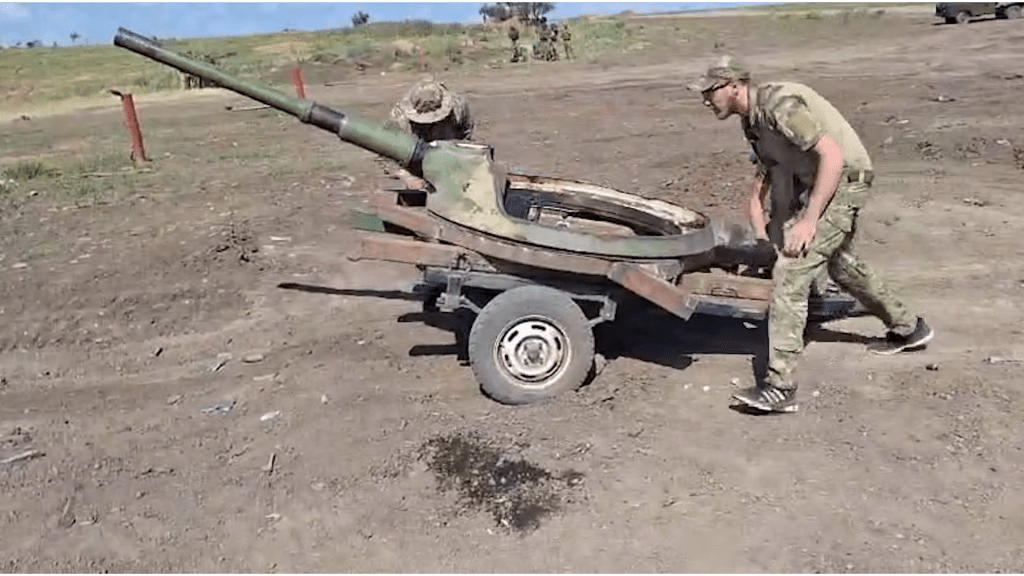
A 2A28 on what appears to be a 2B9 carriage (via social media)
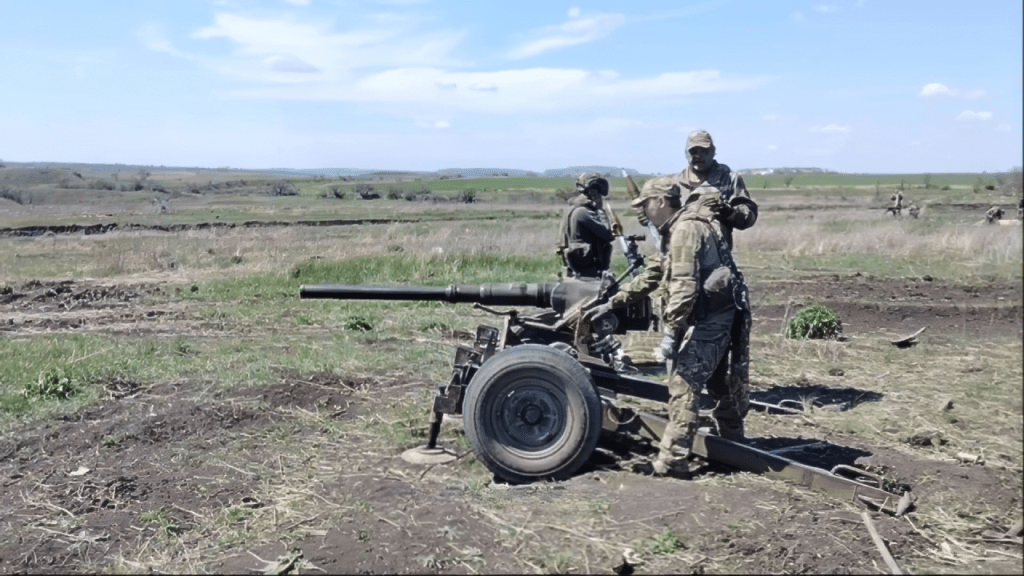
The first of these I’ve been able to find appeared on 27 May, this example was seen in a short video being test fired. The gun itself appears to have been mounted on a carriage similar to that used by the 2B9 Vasilek automatic mortar, though there are some differences in the trails. The crew of a gunner and loader are able to get of 10 rounds in 40 seconds with the gunner adjusting his aim several times. In the background there appears to be a team training with a conventional SPG-9. It could be argued that the wheeled carriage offers and advantage over the SPG-9 which has to be deployed on foot by its crew. The dismounted 2A28s could be seen as DIY analogues of the old Swedish PV-1110s which have seen limited service with the Ukrainians.
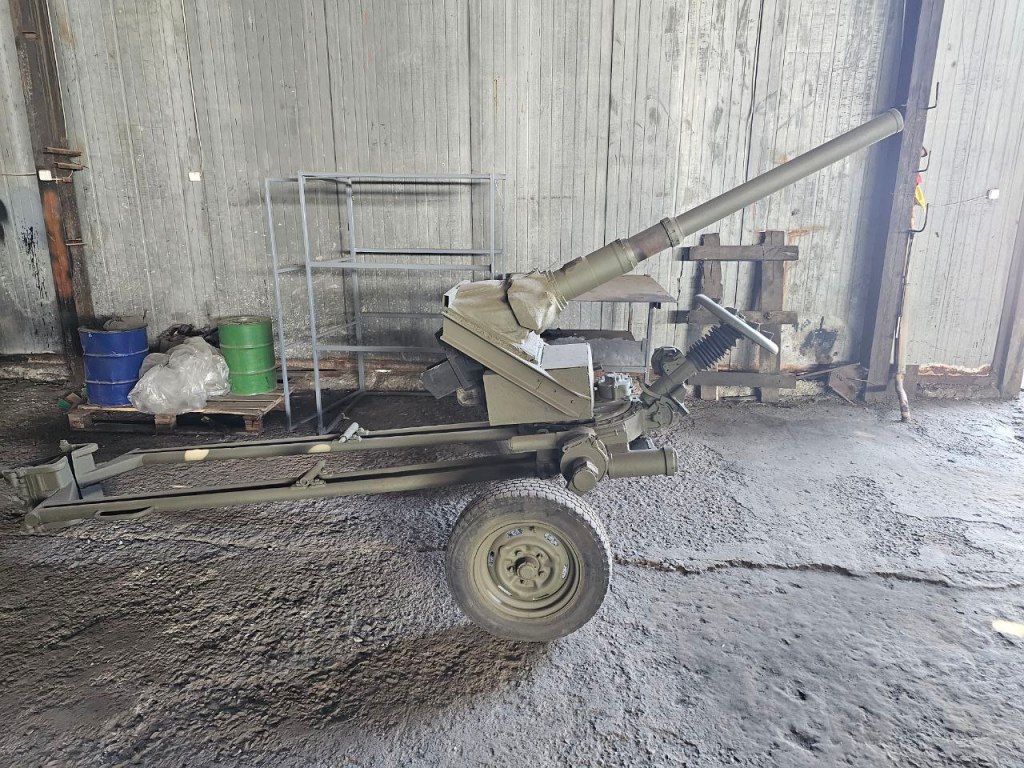
A 2A28 mounted on a commercial trailer which is removed when setting up to fire (via social media)
Several months later on the 1 July, another dismounted 2A28 appeared. The first of two videos showed the gun being towed into position by a tractor. The 2.37 minute-long video shows the crew bringing the gun into action: uncoupling it from the tractor, fitting the trails and front support. The carriage itself has been fabricated using a commercial trailer which is removed from a frame once the trials and supports have been fitted. The frame is built around a ring for the BMP-1’s original turret ring to sit on. This appears to allow rotation using the turret ring. The BMP-1’s turret has been cutaway to enable the gunner to access the breech. A couple of photographs of the salvaged turret being adapted were also shared with the videos. It takes the crew approximately 1 minute 40 seconds to bring the gun into action, the design is quite ingenious if unwieldy. The video concludes with the gunner refusing a lanyard and firing the gun personally.
The second shorter video shows a gunner operating the gun alone loading and firing another four rounds in 17 seconds. The gun jumps and moves back significantly despite the carriage’s trails having spades to reduce recoil movement. Some sources claim the unit is part of the 25th Combined Arms Army, the Russian combatant filming the video mentions the ‘3rd Battalion’ but does not mention a regiment or brigade.
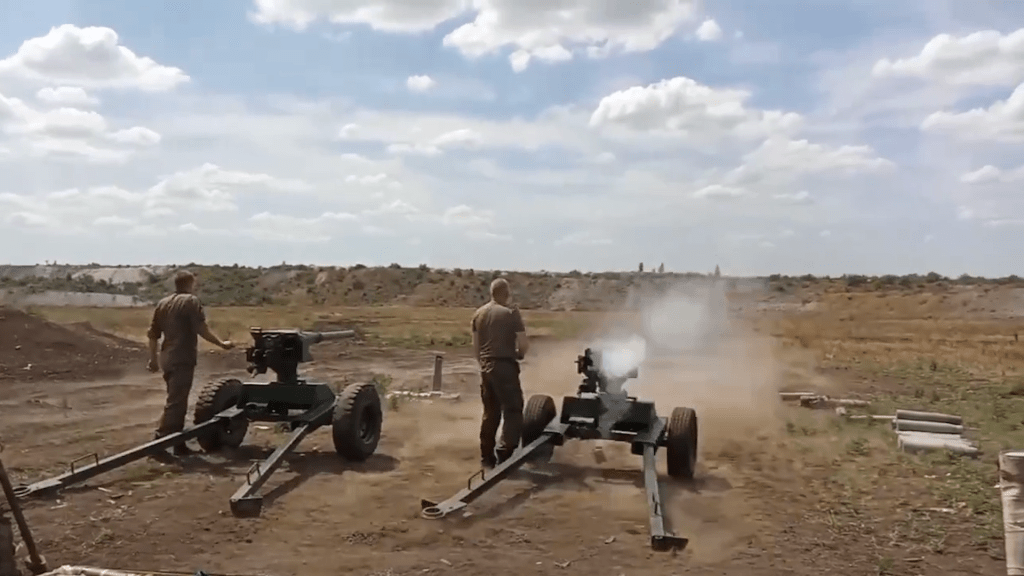
On the 26 July, a short video of a pair of 2A28s mounted on well built craft-made carriages, which appear to share a common design, was shared. While the design of the carriage appears to be the same they have different sized tyres.
Another well made dismounted gun based on a 2B9 carriage (via social media)
Most recently, on 6 September, a Russian engineer shared a couple of photos of a carriage-mounted 2A28 he came across at a unit near the front. The carriage again appears to be from a 2B9 Vasilek mortar. The 2A28’s trunion appears to be mounted directly on to the carriage.
The idea of re-purposing the 2A28 isn’t a new one with the guns seen dismounted around the world with examples from past and current conflicts in Libya, Syria and Africa. According to open source figures from Oryx an estimated 824 Russian BMP-1s had been damaged or destroyed. These knocked out BMP-1s and others which have broken down in the field are likely the source of the 2A28s in use in the craft-made support guns.
The rarity with which these DIY support guns have appeared on social media suggests that they may not be an entirely practical weapon system though their existence points to a perceived need for infantry support guns in the field. The 2A28’s effective battlefield range is likely around 500 yards, but given the guns are now unstably mounted on ad-hoc carriages, rather than a 13 tonne BMP-1 they suffer from greater recoil which may be a detriment to their effectiveness.
A pair of dismounted 2A28s testing at a range (via social media)
If the guns are to be used to harass, suppress or saturate a target at medium ranges they may be more effective but the Ukrainian battlefield is not an ideal space for an exposed crew to be manning a 2A28. With large stretches of open ground dominated by artillery and drones the dismounted 2A28s are likely to be of little value, even if crews attempted to tow them into optimal range. The dismounted 2A28, however, might prove more effective in the urban battlespace where support guns are valuable for dislodging enemy defenders from positions. Given I’ve not been able to find any verified footage of the guns in use in combat so far it is difficult to objectively gauge their effectiveness without speculation.
Update – 17/2/25:
Latest version of the dismounted AFV gun as a support gun.
— Matthew Moss | The Armourer's Bench (@historicfirearm) February 17, 2025
Update – 7/10/25:
A Russian ad hoc technical with a 73mm 2A28 cannon mounted on what appears to be a chopped Moskvich 412. Date and location of the video is unconfirmed.
A Russian ad hoc technical with a 73mm 2A28 cannon mounted on what appears to be a chopped Moskvich 412.
Since my last article/video on Russia’s ‘turtle tanks’ the adapted vehicles have continued to be used on several fronts but on Monday, 17 June Ukrainian forces captured their first turtle tank intact.
Known by numerous names by both sides including ‘Blyatmobiles’ (Блятьмобиль) and ‘assault garages’ (штурмовые гаражи), ‘Tsar Mangals’ (Царь мангал) or simply ‘sheds’ (сарай) the tanks are characterised by them being equipped with large counter-FPV shells made from readily available sheet metal (and other non-standard materials) and are sometimes equipped with electronic warfare jammers to provide additional protection against drones and sometimes with mine clearing devices such a mine rollers or ploughs. They appear to have been developed to provide improvised breaching vehicles capable of penetrating Ukrainian minefields, withstand drone attacks and in some cases deliver troops to an objective.
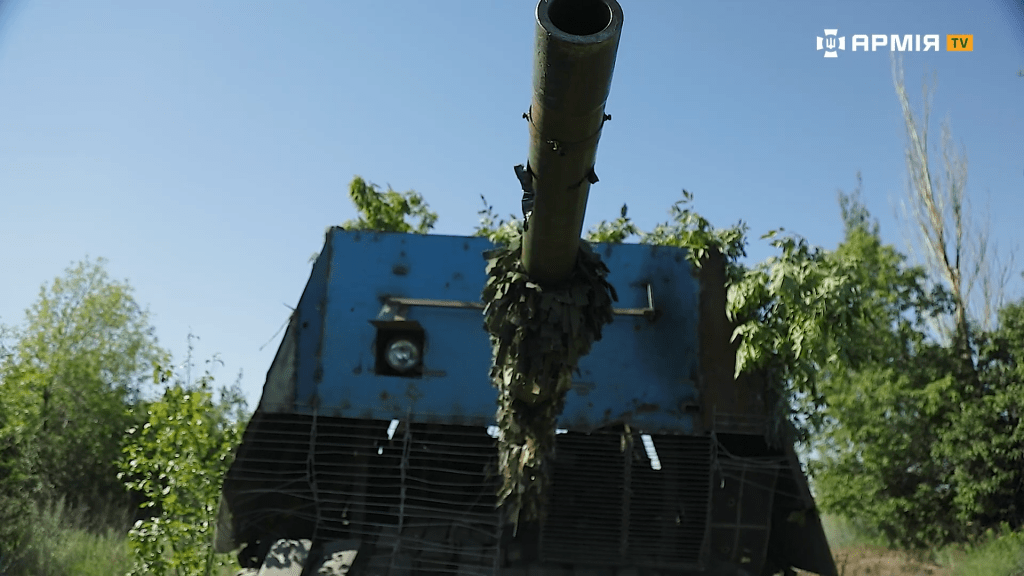
Front of the Turtle Tank captured in the field (via ArmyInform)
From posts on Ukrainian social media the tank was reportedly captured by troops from the 22nd Separate Mechanised Brigade but the vehicle was first encountered near Klishchiivka by soldiers of the 244th battalion of the 112th Territorial Defense Brigade that had been seconded to the 5th Assault Brigade.
The turtle tank allegedly became lost in the Klishchiivka area and saw an M113 APC belonging to the 2nd Battalion of the 5th Assault Brigade and began following it. When the M113 crew spotted the enemy tank it attempted to hide. The tank, however, continued to follow and on reaching the M113 a member of the turtle tank’s crew said to be the driver got out to ask for directions. He was captured by medics of the 244th Battalion. From the footage available it appears that the following morning troops of the 22nd Separate Mechanised Brigade approached the tank and captured an undisclosed number of Russian troops who were travelling in the rear of the turtle tank’s counter-FPV shell. Despite numerous sources and accounts the timeline of the tank’s capture remains somewhat unclear.
The immobilised Turtle Tank captured in the field (via 22nd Separate Mechanised Brigade)
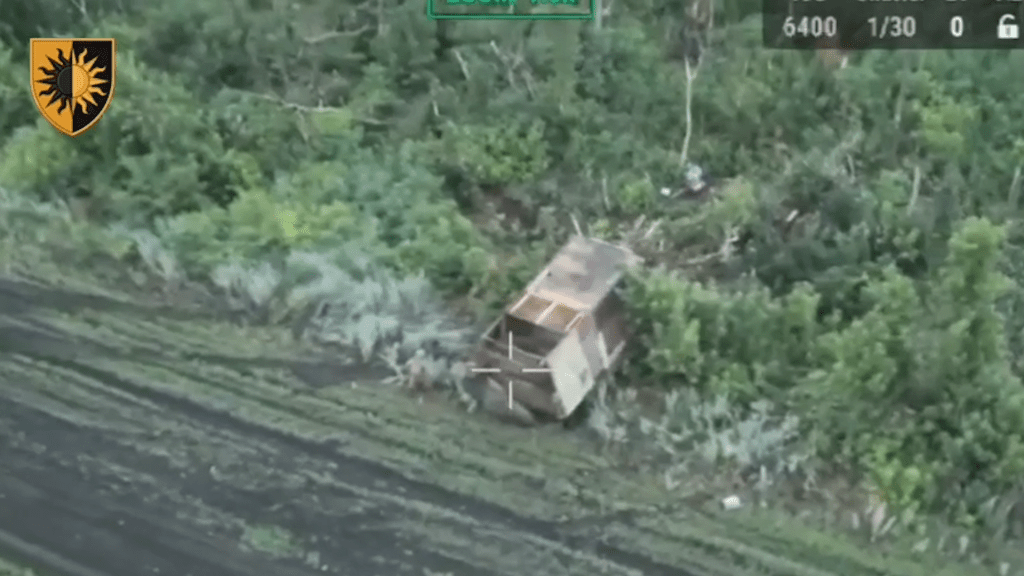
Subsequently released footage from a 22nd Mechanised Brigade drone appears to show the Turtle Tank being damaged by a drone dropped munition before it was captured. The post with the video claimed that the turtle tank’s crew became disorientated after the drone attack and mistakenly drove towards Ukrainian lines. Lt. Colonel Serhiy Misyura, of ArmyInform, also noted that the vehicle was struck by an FPV. Lt.Col. Misyura claims that the drone dropped munition detonated next to one of the tank’s road wheels and immobilised it. After it was captured Ukrainian troops were able to get the tank moving again and drive it to the rear.
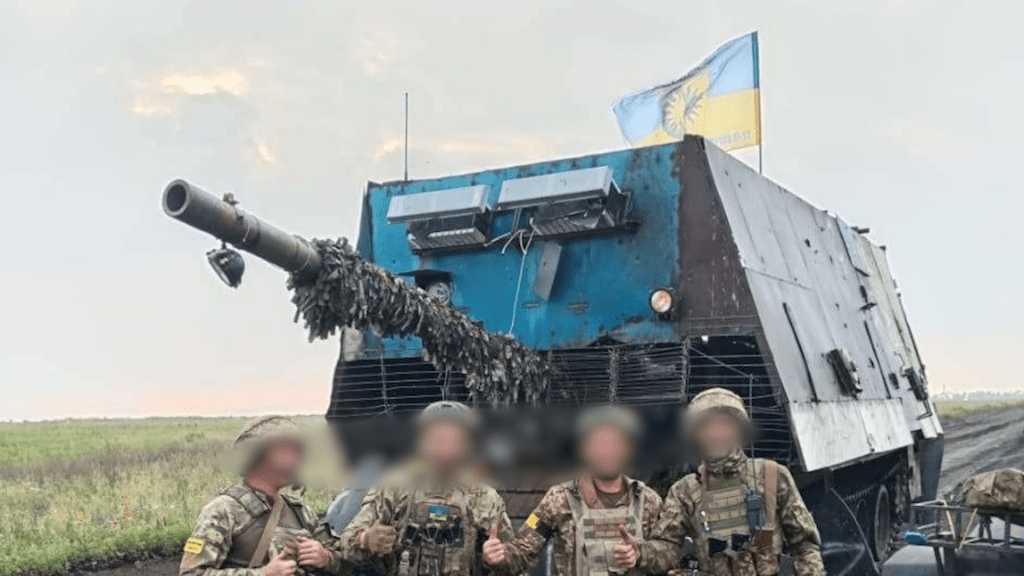
Drone footage then shows the capture of the tank’s crew and the vehicle moving off towards the Ukrainian rear. Teoyaomiquu shared a short clip filmed by a member of the 93rd Mechanized Brigade which showed the captured tank passing by, the 22nd Mechanised Brigade’s flag can be seen flying from the top of the tank. In a photograph of the tank and some of the men who captured it the same flag can be seen. Another piece of footage showing the tank close up also appeared online on the 18th June. The video shows the front, rear and left side of the tank’s counter-FPV shell.
Right side of the captured Turtle Tank (via ArmyInform)
On the 19th June, the 112th Territorial Defense Brigade shared a short video showing the confused captured tank driver sat in the rear of an M113. On the 20th June, ArmyInform, the Ukrainian Armed Forces’ news outlet published a video on their YouTube channel giving us an up close look at the captured tank in detail during which Lt. Colonel Misyura describes it as a ‘marvel of modern Russian engineering’.
The Ukrainian Army were quick to capitalise on the propaganda value of finally capturing one of the Tsar Mangal (Tsar’s Barbaque) / assault sheds in tact, at the time of publication the video has over 650,000 views on YouTube alone.
Examining The Turtle
Since late April we have seen many variations on the ‘turtle tank’ theme, this example is certainly one of the least refined. Firstly, the tank does not appear to have been equipped with mine clearing kit as some of the other tanks have. However, it has been outfitted with what appear to be some sort of EW jammer to counter drones. Additionally, we can clearly see several UDSh smoke generators, held in a pair of brackets on either side of the shell. These have sometimes been misidentified as standard TM-62 anti-tank mines but the UDSh is a smoke generator which mimics the mine’s shape for training purposes. In this case they have been repurposed to enable the tank to create a mobile smoke screen. According to CAT-UXO the UDSh can be initiated electronically or manually and once ignited discharges smoke for 8-10 minutes. In the ArmyInform video it is also noted that the Kontakt ERA blocks seen on the tank’s glacis are empty.
Ukrainian troops pose in fron of the captured Turtle Tank (via social media)
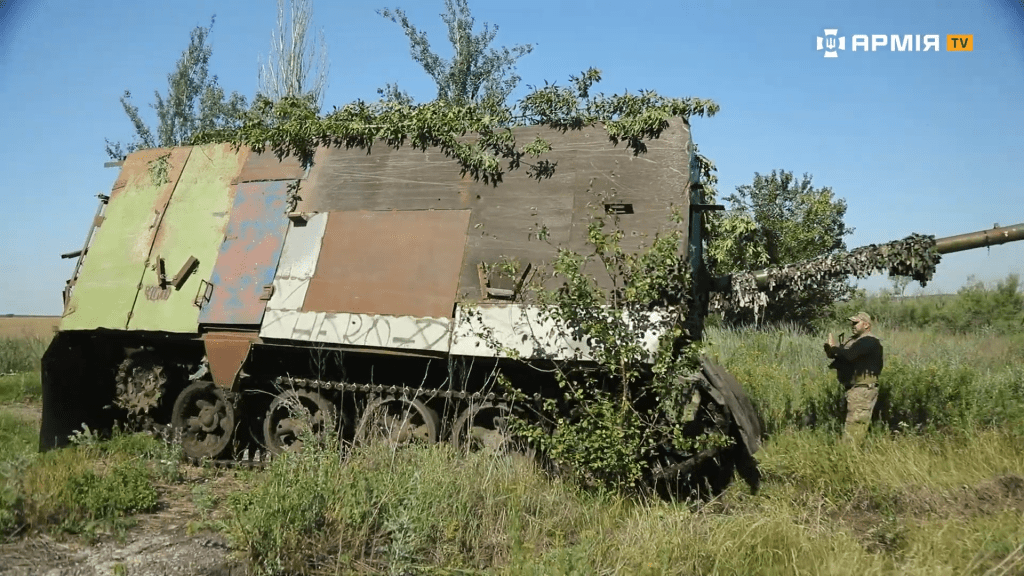
The tank itself is a T-62M and according to Ukrainian sources the turret is fixed in place and the tank carried no ammunition for its main gun, making it largely defenceless in isolation from supporting elements. The counter-FPV shell is crudely assembled made up of a mish-mash of materials including metal sheeting which ranges from rusted bare metal to various worn paint colours, wire fencing and metal caging. There also appears to be rubber matting attached front and rear to help keep dust down. The top of the shell over the tank’s engine deck appears incomplete and may have been damaged. In the ArmyInform video which shows the area in-detail it is clear that the counter-FPV shell’s support struts were welded directly to the top of the hull and a number of large and small shrapnel holes in the shell are visible.
Top of the captured Turtle Tank (via ArmyInform)
It appears that between when the vehicle was captured and when the ArmyInform video was filmed the Ukrainian have removed the assemblies, which may have been EW jammers, on the front of the tank. Its unclear how long the adapted tank has been in service but their is evidence of past repairs and there are numerous spray painted slogans on its panels including ‘god is with us’, ‘Hero-Z’ and ‘154 RUS’ (a possible joke reference to Russian vehicle registration plates). If this is the case it might hint at the origins of the Russian crew. ‘154’ is a registration code for the Novosibirsk Oblast which is the home of the 41st Combined Arms Army. In one clip of the tank it also has what appears to be a stolen ‘1941’ sign (possibly from a Great Patriotic War memorial) attached to the rear of its shell.
Support Us: If you enjoyed this video and article please consider supporting our work here. We have some great perks available for Patreon Supporters – including early access to custom stickers and early access to videos! Thank you for your support!
One of the rarer Russian anti-armour weapons to surface during the ongoing war in Ukraine is the RPG-16. The RPG-7’s big brother was developed in the late 1960s and entered service in the early 1970s. It was predominantly developed for Russia’s airborne forces, the VDV, but also saw issue to Spetsnaz units.
The RPG-16 is characterised by its larger diameter tube which can fire a 58mm (2.3 inch) PG-16 rocket-propelled grenade. Unlike the RPG-7s munitions the PG-16 slides flush inside the launcher, while this limits the volume and types of warhead the RPG-16’s ammunition can carry it provides improved accuracy and slightly increased range. The PG-16 is a fin-stabilised high explosive anti-tank (HEAT) round with a rocket booster which propels it at a maximum velocity of 350 metres per second. The rocket weighs around 2.1kgs and has a maximum range of 800 metres, though practical engagement range of vehicles is closer to 300 metres. It can penetrate up to 300mm (12 inch) of rolled homogenous armour.
An RPG-16 seen in a Russian news report, June 2023 (Russia 1)
The RPG-16 can only fire the PG-16 round and following its adoption in the early 1970s it has been surpassed by other anti-armour weapons which have entered Russian service and by the development of more capable PG-7 series warheads. The launcher weighs 12.4 kg (27 lbs) [compared to the 7 kg (15.4 lb) of the RPG-7] when loaded and is 110cm (43.5 in) long but can be broken down into two parts: the rear tube with venturi and the forward tube and fire control group. Unlike the smaller RPG-7 it has a bipod near the muzzle and a grip area on the fire control group, it does not have a second, rear pistol grip.
A reported 120,000 were produced with manufacture continuing into the late 1980s. It had been thought that the RPG-16 went out of Russian service in the early 2000s but evidently some have been drawn from stores and have been used in Ukraine. The RPG-16 was reportedly used against fixed positions during the Soviet war in Afghanistan and may now be pressed into the same role in Ukraine.
It appears from available imagery that the RPG-16 began to be issued in early 2023. Early March 2023 saw Russian state-news outlet RIAshared a report featuring combatants of the 76th Guards Air Assault Division firing small arms and RPGs in woodland. One of the RPGs fired was an RPG-16.
Russian combatant firing an RPG-16, December 2023 (via social media)
In late April, stills from a video of troops said to be with the 98th Guards Airborne Division featured an RPG-16 being fired near Dibrova were shared. I’ve been unable to find the original footage. In June, one of the launchers appeared in a Russia-1 news report featuring Russian forces near Avdiivka, Donetsk Oblast.
On 26 November, a Russian combatant shared a photograph of an RPG-7 and an RPG-16 next to one another, reportedly taken in a depot or armoury. Two days later on 28 November a short clip of marines from the Russian 40th Naval Infantry Brigade was shared showing an RPG-16 in action, location unknown, possibly near Pavlivka.
A week later, on 3 December a video featuring a pair of Russian combatants from the Otvazhnye (Brave) Group, firing an RPG-7 and an RPG-16 was posted on telegram. The footage was probably filmed in near Kreminna where the unit was reportedly active.
Russian combatant poses with an RPG-16 and AK-12, January 2024 (via social media)
On 13 December, a mobilized Russian combatant shared a post on Telegram describing his experiences at the front. He mentions that due to a lack of infantry anti-armour weapons with sufficient range to reach Ukrainian AFVs standing off and firing on their positions his unit began issuing RPG-16s. In late January, two photographs of Russian troops in a trench, location unknown, posed with an RPG-16, and some unrelated RPG-7 munitions.
From the limited imagery available it seems that the RPG-16s have been again issued to largely airborne units, however they have also been seen with Russia’s naval infantry. Exactly why the RPG-16 has returned to service is unclear, as by one Russian combatant suggested, it may be that the greater range offered by the RPG-16 enables engagement of distant targets, another potential reason might be Russia’s desire to use up existing reserve stocks of munitions.
Support Us: If you enjoyed this video and article please consider supporting our work here. We have some great perks available for Patreon Supporters – including early access to custom stickers and early access to videos! Thank you for your support!
Specifications:
Calibre: 58.3 mm Length: – Assembled: 1,104 mm – Disassembled: 645 mm Weight: – Unloaded with optical sight: 10.3kg – Loaded: 12.4kg Velocity: – Initial: 130 m/s – Maximum: 350 m/s Effective range: 800 m Armour Penetration: +300 mm
Bibliography:
Jane’s Infantry Weapons 2014-15, R.D. Jones & L.S. Ness (2014)
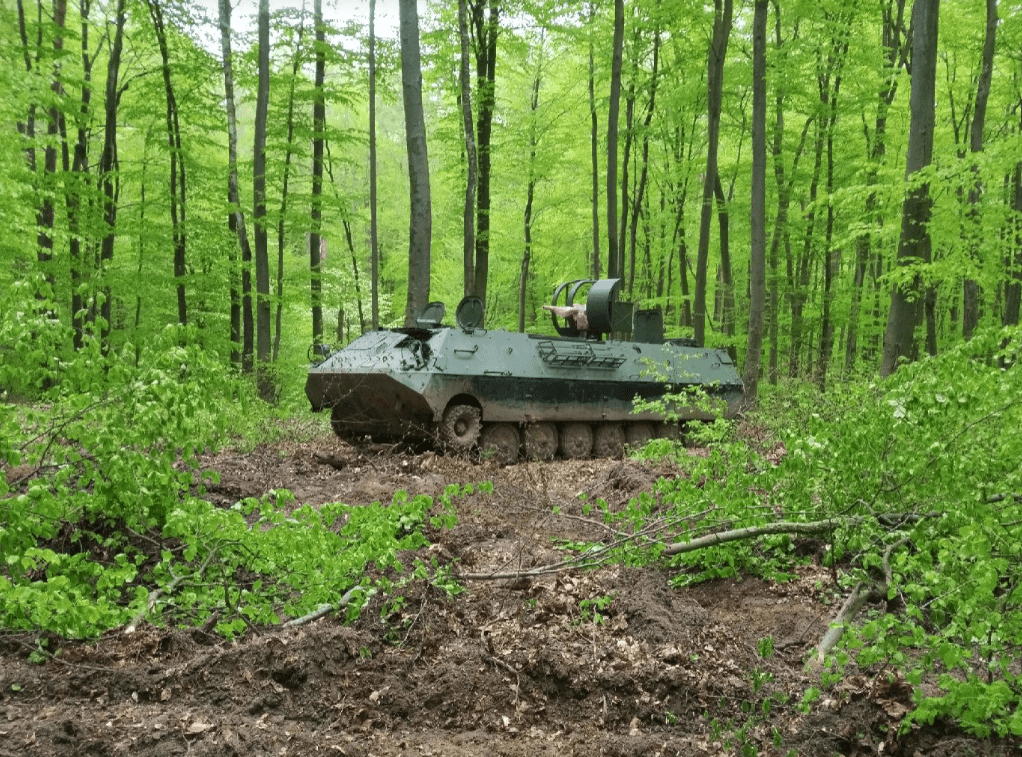
The MT-LB tracked artillery tractor has become one of the most recognisable armoured vehicles of the war in Ukraine. These versatile vehicles are used by both sides in huge numbers and while first introduced in the 1970s they continue to be used as both armoured personnel carriers and also as the platform for a plethora of weapon systems ranging from rocket pods to auto-cannons to MT-12 anti-tank guns.
In this article/video we’ll look at two specific MT-LB adaptations; one Russian, one Ukrainian.
Russian MT-LB adaptation with a 2M-3 turret which was first seen in March 2023 (via Social Media)
Russia’s Turreted MT-LB
In March 2023, a number of photographs and videos emerged of Russian MT-LBs which had been fitted with a large turret complex over the rear portion of the vehicle. The turrets are naval 2M-3s which mount a pair of 25mm 110-PM autocannons. The first images surfaced at the beginning of March. The strikingly ugly turret quickly led to ridicule on social media and numerous memes mocking the vehicle. Between the 8 and 10 March a series of short videos showing the turret-adapted MT-LBs on the move. One video showed several vehicles in a yard with a large crane, perhaps suggesting they had been off-loaded. The person filming the video notes that the unusual turrets and were apparently ‘sent for defence’. The footage features at least five turreted-MT-LBs, one appearing to also have an adapted front commander’s turret.
Another clip, shared around 10 March, shows a transport train with numerous vehicles loaded, including some Russian Military Police vans. Two (possibly four) of the adapted MT-LBs can be seen. Similarly, another clip showing the vehicles in transit through an urban area features one perhaps two adapted-MT-LBs.
Other examples of Russian MT-LB adaptations with 2M-3 turrets (via Social Media)
Since the early spring there have been no sightings of the vehicles but in late May a video and several photos were shared featuring a Russian combatant riding in the turret of one of the adapted MT-LBs, the anti-aircraft style style sight can be seen in the video and one of the photographs.
Russia is likely making use of turrets that have been in storage since the vessels they were mounted on were decommissioned. Their is probably still an ample supply of ammunition for the 25mm autocannons. The mount has -12° to +85° elevation and 360° rotation giving it a good field of fire for use against ground targets.
Just what role Russia envisioned for the turreted MT-LBs is still unclear. They could be used in direct fire roles perhaps as support guns which can help plug gaps in defensive lines with suppressive fire. Or perhaps as mobile anti-aircraft vehicles for taking on drones but their limited manual targeting would mean they would struggle to be a match for even slow moving drones. Other potential uses might be as assault guns or as a more heavily armed vehicle for internal security duties protecting supply lines from Ukrainian partisans.
Ukrainian MT-LBu adaptation with a KPV heavy machine gun remote weapon system (via Social Media)
Ukraine’s MT-LB Refits
While many of both sides’ MT-LB adaptations have focused on simply mounting a weapon system to the rear deck or where the commander’s original PKT mount was, a recent Ukrainian refit has gone much further. A video was shared by a Ukrainian MT-LB crewmember which showed six vehicles all refit to a similar configuration. It appears that additional armour has been added to the sides and rear of the vehicle in an effort to provide additional protection to the lightly armoured MT-LB. [Correction: the vehicle has 7 road-wheels indicating the adaptation is likely based on an MT-LBu variant. These have been described as BMP-1LBs.] The vehicles also have new storage baskets, smoke-grenade launchers and a new remote weapon mount controlled from inside the MT-LB. A photograph of the front of the mount shows that it mounts a single 14.5x114mm KPVT machine gun, remotely fired and aimed using an electro-optics module positioned to the left side of the gun. The weapon and optics are protected by a curved gun shield, the cuts in the shield suggest that the weapon’s range of elevation is considerable.
Russian MT-LB adaptation with twin DShk mount on the original PKT turret (via Social Media)
These vehicles are are just two examples of MT-LBs in Ukraine adapted with ad-hoc weapon mounts. There are dozens of other examples of up-gunned MT-LBs deployed by both sides. Other commonly seen adaptations include fitting ZU-23-2 anti-aircaft mounts to MT-LBs
In February 2023, Ukrainian troops shared a video of a Russian MT-LB captured near Vuhledar, which had been fitted with a 2M-7 naval turret mounting a pair of 14.5mm KPV heavy machine guns. Similar vehicles appeared in photographs showing several MT-LBs with ad-hoc adaptations which included one vehicle with the same, as well as other vehicles with other dual and single gun mounts. One can be seen mounted with a single DShK on a tall, exposed pintle mount.
In May, an MT-LB was sighted with a twin DShK mount. Similarly, another MT-LB fitted with a twin DShK mount on top of the existing PKT turret was shared on 10 June, it had also been adapted by adding track and boxes as appliqué armour. Also in June, a photograph of a pair of MT-LBs equipped with A-22 140mm multiple rocket launch systems was shared on Telegram.
With Ukraine forming new brigades and both sides suffering considerable armoured vehicle losses the ubiquitous MT-LB, while lightly armoured, offers one of the best available platforms for mounting additional or role-specific weapons.
Support Us: If you enjoyed this video and article please consider supporting our work here. We have some great perks available for Patreon Supporters – including early access to custom stickers and early access to videos! Thank you for your support!
Recent video and photos from Ukraine show Russian troops getting to grips with the 2B25 82mm mortar. About 10 months ago, before Russia’s invasion of Ukraine, The Armourer’s Bench examined the 2B25 in an article/video and how it combines a spigot mortar with ammunition which uses a self-contained captive piston. For a full run down on operation and the mortar’s development history check out that article/video. In this article we will take a look at the mortar’s appearance in Ukraine.
The first mention of the 2B25 being in use with Russian forces in Ukraine dates to early July, when RIA News, a Russian state-owned domestic news agency, published an article with scant detail other than to suggest that “these mortars are used to carry out sudden fire raids, in particular in the fight against saboteurs of the Armed Forces of Ukraine.” Despite this report we haven’t seen any imagery showing the weapon in theatre until recently.
In late October imagery showing the 2B25 began to be shared by a member of what appears to be a Russian special operations unit which has been in action in the Donetsk Oblast. One of the members of the unit runs a telegram channel. The soldier who runs the channel describes himself as a “regular soldier of the Armed Forces of the Russian Federation, for more than 10 years.”
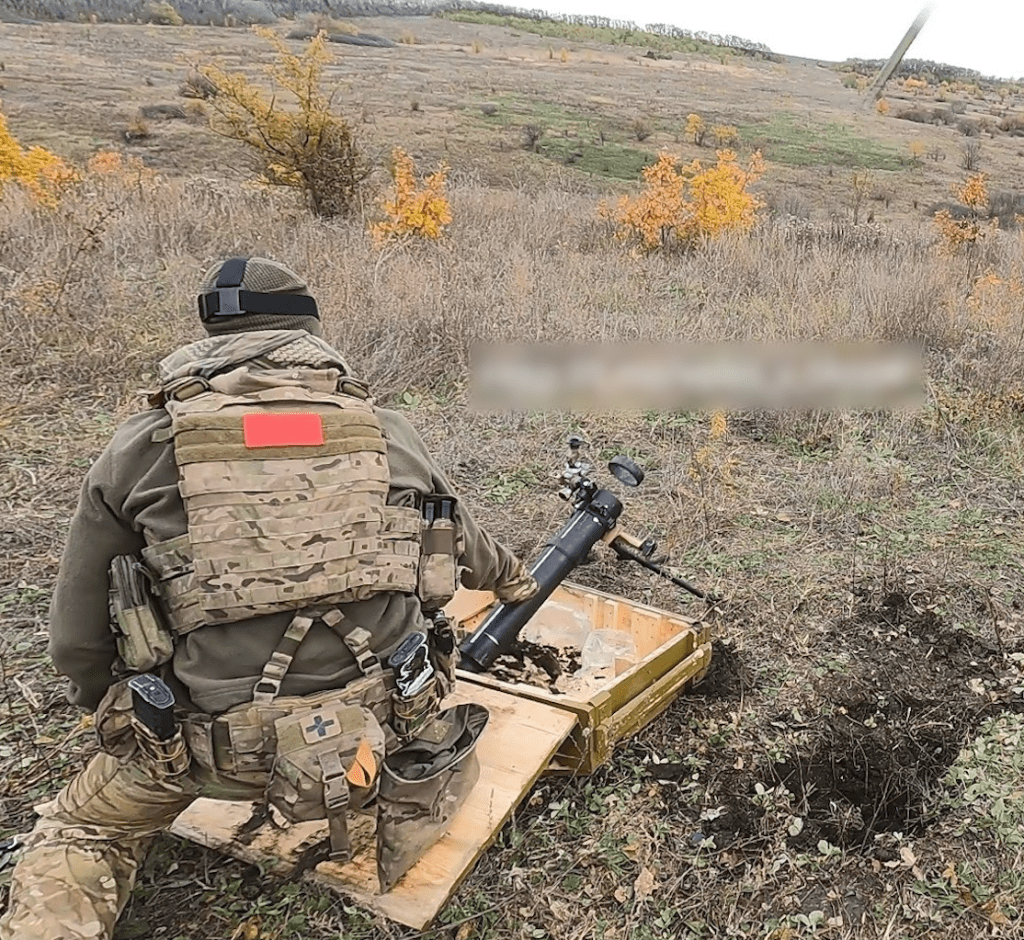
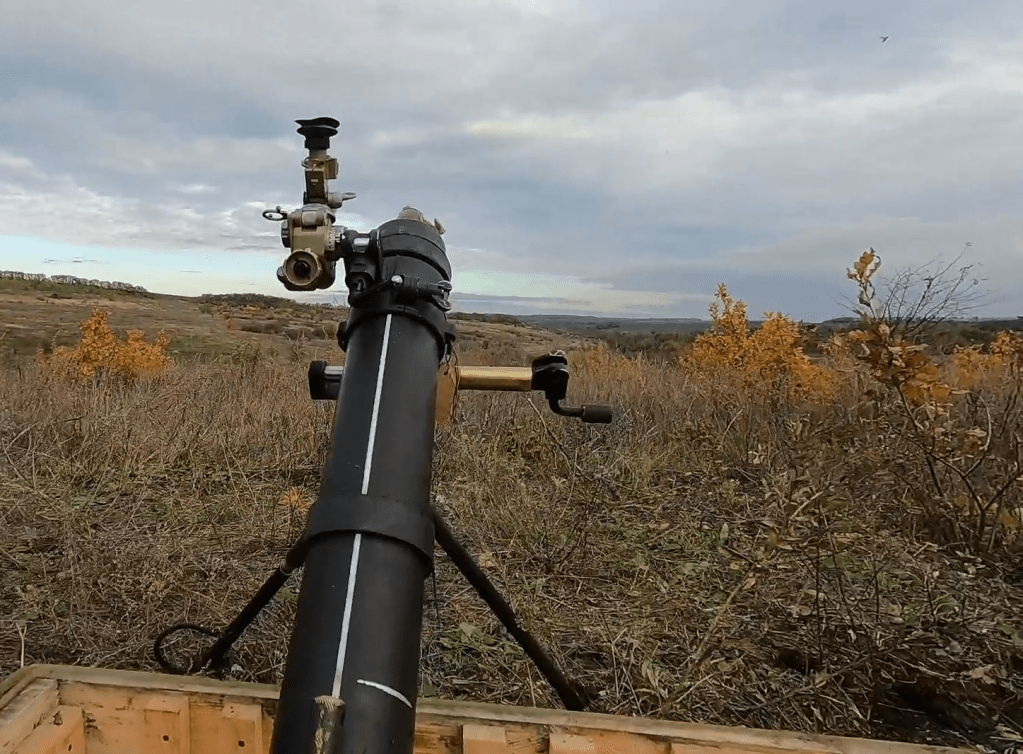
On 27 October, a POV video was shared from behind a 2B25, with the caption (machine translated): “We got acquainted with a silent mortar, mastered it ourselves and showed the mobilized guys. A minimum of recoil, a minimum of powder gases and the sound of a round being fired.”
The 8 November saw the unit share a photo of the mortar being fired without its base plate, instead using a wooden box as an ad-hoc base. In the comments section of the image the soldier running the channel says the use of the wooden ammunition box was ‘by design’, perhaps indicating intentional experimentation with using the mortar without its base plate. In another comment he explained: “No…they checked… whether it was possible to shoot without sinking into the ground, as a result, the box fell apart.” In another response he notes that they were trying to avoid placing the base plate in the wet ground. When asked how loud the mortar is the Russian soldier describes it as: “It is silent, the exit of a mine is not louder than a clap of hands”
A photo posted on 26 November showed the Russian soldier with perhaps 10 of the 2B25’s 3VO35 mortar bomb laid out on the ground. On 30 November a clip showing the mortar be prepared alongside a commercial drone was posted, suggesting training to correct fall of shot with drones.
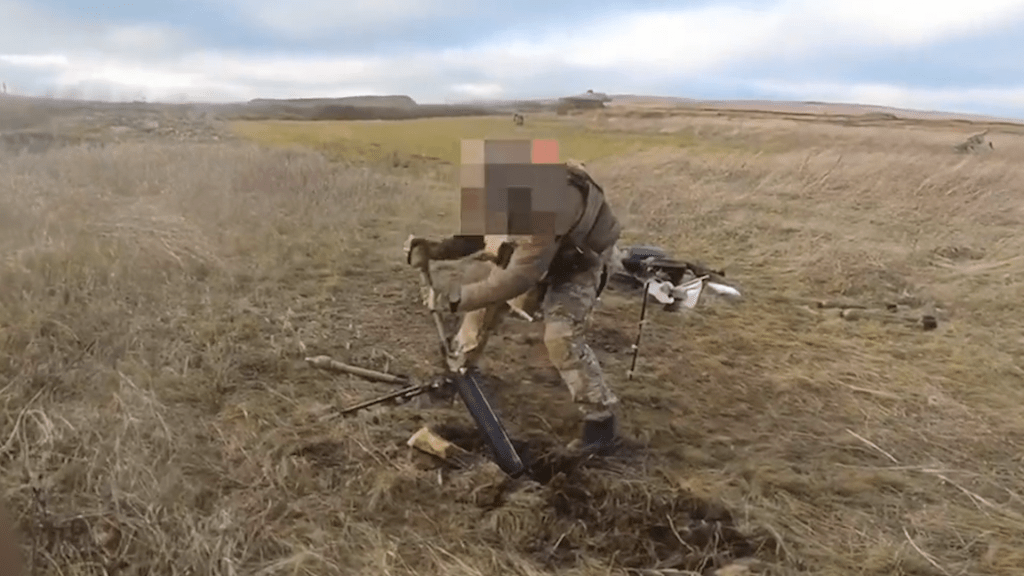
The longest video posted so far shows the mortar in action. Shared on 2 December the video shows the mortar dug into the ground with the operator firing three bombs in quick succession. Several seconds later we can hear them detonate down range. Again the video appears to show training and not operations. The machine translated caption describes a test with the 2B25 with the operators showing they could correct their fire with a drone, noting: “the accuracy and density of fire on the intended target increased significantly, the bombs hit the target one by one” Most recently, on the 3 December, a short clip with the caption “Another short video from our training” was shared showing the mortar being laid.
Update – 27/03/23: on 25 March a Russian telegram channel ‘Epoddubny’ shared a video featuring scouts operating around Bakhmut with a 2B25 82mm mortar. Below is a compilation of shots showing the mortar in action.
This is a compilation of shots from a recent Russian video showing the 2B25 82mm 'silent' mortar in action around #Bakhmut with a Russian recce unit. They note they have to be pretty close to the target due to the limited range. More on the 2B25 – https://t.co/ukrtdUK679#Ukrainepic.twitter.com/Bz4JhiSo1T
— Historical Firearms | Matthew Moss (@historicfirearm) March 27, 2023
Update – 26/10/23: Additional footage, without location or date of filming, shared on Russian social media. Briefly showing the 2B25 in action with an additional 3VO35 mortar bomb near by.
A very rare sighting of a Russian 2B25 'silent' 82mm mortar in use.
— Historical Firearms | Matthew Moss (@historicfirearm) October 26, 2023
Support Us: If you enjoyed this video and article please consider supporting our work here. We have some great perks available for Patreon Supporters – including early access to custom stickers and early access to videos! Thank you for your support!
The RPG-30 is one of Russia’s more advanced disposable anti-armour weapons. Developed in the early 2000s by Bazalt it is designed to overcome reactive armour and active protection systems. It entered service in 2012 and has seen extensive use during the fighting in Ukraine.
The 7P53 RPG-30 “Kryuk” or ‘Hook’ is a 105mm fin and spin stabilised rocket propelled munition with a tandem HEAT shaped charge warhead. The RPG-30 overcomes ERA and APS by using a 42mm IG-30 decoy projectile, which is believed to be inert, coupled with the main rocket’s tandem warhead. This can be seen in a secondary, thinner tube running along the side of the weapon. The precursor decoy causes premature activation of the APS and allows the main warhead to exploit the gap in the tank’s protection. The theory being that the target’s APS takes some time, perhaps half a second, before it can engage again. The gap between the firing of the two rockets is measured in milliseconds and the lag, while noticeable, does not appear to be significant enough to effect the user’s aim or accuracy on target.
RPG-30 (Vitaly Kuzmin CC BY-SA 4.0)
The RPG-30 uses the PG-30 tandem HEAT warhead, similar to the PG-27 used by the RPG-27. It can reportedly penetrate 750mm of rolled homogeneous armour and up to 650mm of rolled homogeneous armour after ERA. Effective range estimates vary with the average suggesting 200m.
The weapon’s sights are simple and consist of a folding ladder front sight and rear sight – there does not appear to be provision for mounting optics. Flipping up the rear sight also cocks the weapon. The disposable tube(s) is made of aluminium with a fibreglass outer layer. Sources suggest it weighs around 10.3kg (22.7lbs) and has an overall length of just over 1m (1,135mm/44.7in).
A pair of RPG-30s captured in April 2022 (via Social Media)
Unlike other Russian weapon systems few videos of its use have been shared by Russian state media or Russia’s defence exports corporation Rosoboronexport. The ongoing war in Ukraine, however, has provided our first real look at the weapon in action. As soon as the Russian invasion was launched on 24 February, RPG-30s began to be seen in use with Russian forces. By late February and early March imagery of captured examples was shared on social media.
Russian soldier posing with RPG-30, March 2022 (via Social Media)
The first images of the weapon came from Russian sources in late February, just after the invasion. This was quickly followed by imagery of captured examples, most notably from the column of Tigr-M armoured infantry mobility vehicles in Kharkiv. A photograph of a further two captured RPG-30s appeared in April, while another example was photographed in Donbas in early May. Later in May a photo of a Russian soldier posing with one was shared on social media and in September significant caches of weapons were captured in Kherson and Balakliya.
Still of a Russian soldier firing an RPG-30, August 2022 (via Social Media)
In late August we got our first brief look at the RPG-30 being fired in a montage video of VDV weapon systems (see image above). Earlier in mid-August a sort of ‘unboxing video’ was shared giving us a good close up look at some of the packaging the RPG-30s are shipped in and the markings on the side the weapon. Most recently in some further video of the RPG-30 being fired on a Russian Western Military District range also surfaced giving us a good look at the weapon in action.
RPG-30s captured in April (via Social Media)
Of course the weapon is designed to be simple to use, anyone with training on a similar shoulder-fired disposable anti-armour weapon can operate it. While it has been said that its widespread use in Ukraine is somewhat ironic given that Ukraine does operate any APS equipped tanks, the weapon is still useful against less sophisticated tanks. While the precursor might potentially deliver some limited kinetic damage to the ERA block, the RPG-30’s tandem warhead is capable of defeating the ERA fitted to most Ukrainian tanks, though of course, the same can be said of Russia’s other anti-armour weapons which use tandem warheads.
Update 27/10/22:
The Georgian Legion recently shared a short video looking at a captured RPG-30. The video also includes firing footage of the weapon.
Extract from a recent Georgian Legion video examining a captured RPG-30.
— Matthew Moss | Historical Firearms (@historicfirearm) August 20, 2024
If you enjoyed this video and article please consider supporting our work here. We have some great perks available for Patreon Supporters – including custom stickers and early access to videos! Thank you for your support!
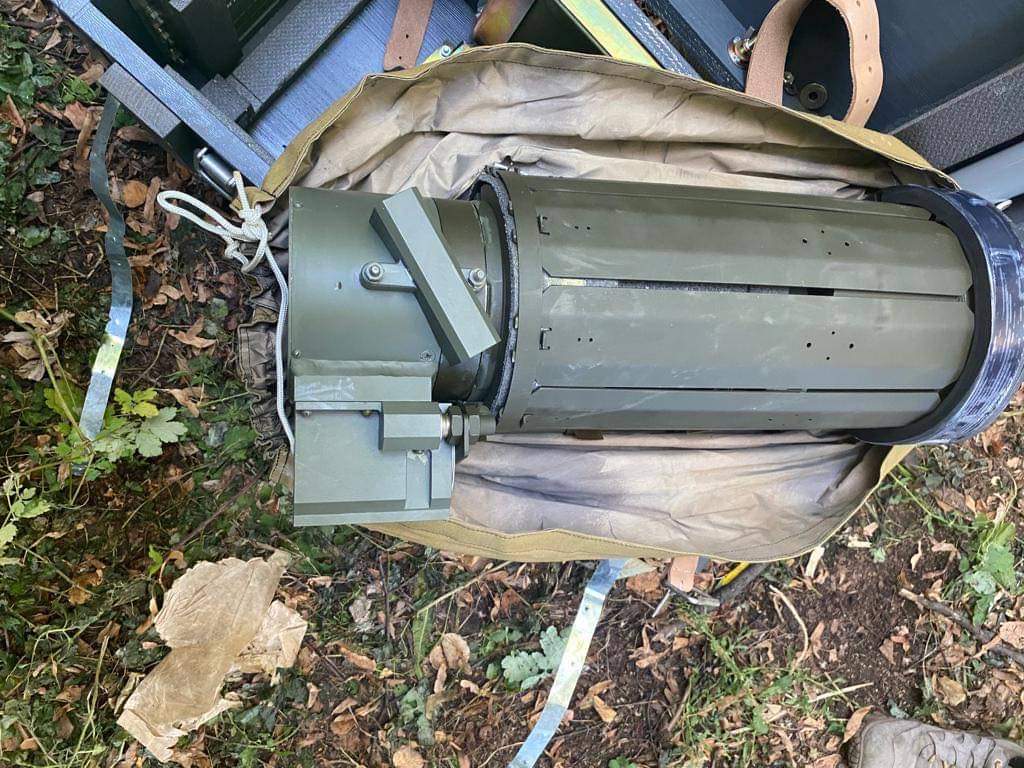
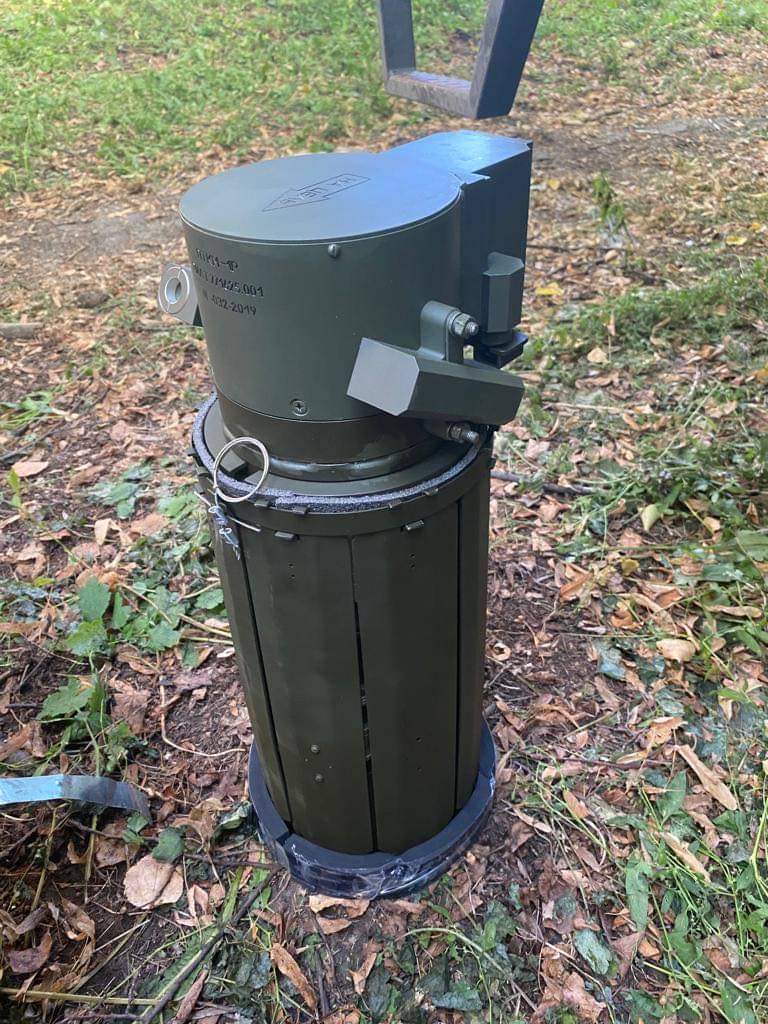
In recent weeks Ukrainian forces have shared photographs of captured PTKM-1R mines. These are without doubt Russia’s most advanced anti-tank mine design. The PTKM-1R’s main feature is that it is a top attack munition, much like a Javelin or NLAW. It can strike down from above at a tank’s least protected point – its roof and engine deck.
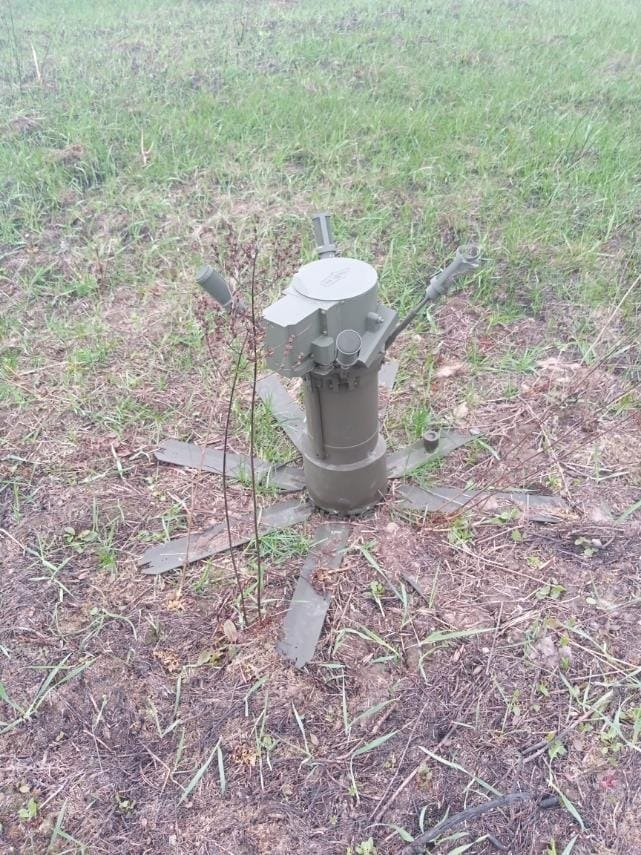
PTKM-1R photographed in Ukraine in April 2022 (via social media)
The mines essentially brand new and were only publicly unveiled by Rosoboronexport in November 2021 at the Army 2021 exposition and later at EDEX 2021. They have been adopted by the Russian armed forces on a limited basis. The PTKM-1R was first seen in Ukraine back in late April, appearing to show it deployed. Russia have released no footage of the mines in action.
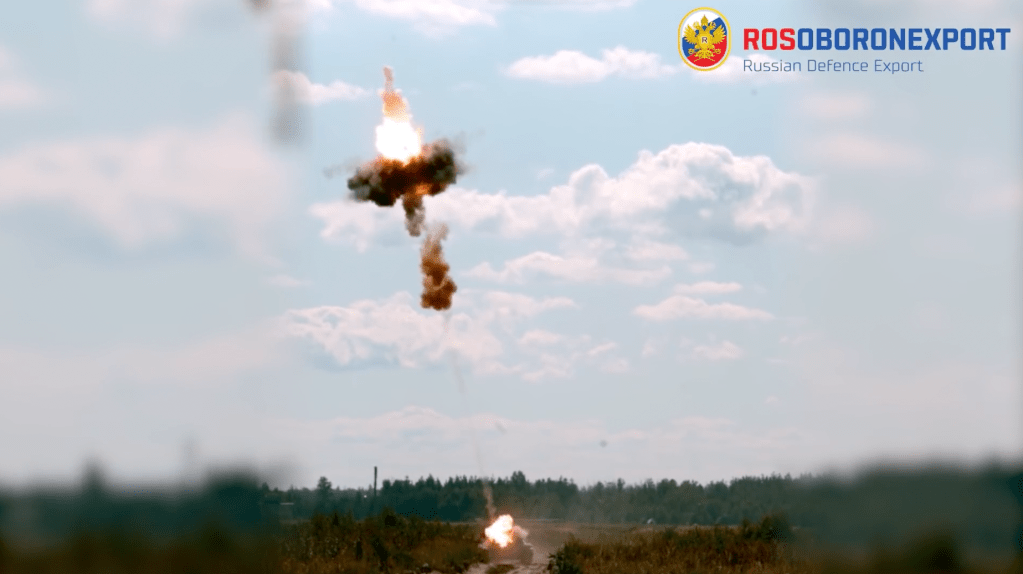
PTKM-1R submunition detonating and projecting its EPR down on a target during a 2021 demonstration (Rosoboronexport)
The PTKM-1R is a top-attack anti-tank/anti-vehicle mine which is designed to detect the passage of target vehicles using acoustic and seismic sensors. The launching charge then detonates and projects a submunition up into the air toward the target. As the sensor-fuzed submunition flies over the target and detects movement below it detonates firing an explosively formed penetrator (EFP) down onto the vehicle – attacking it where its armour is weakest.
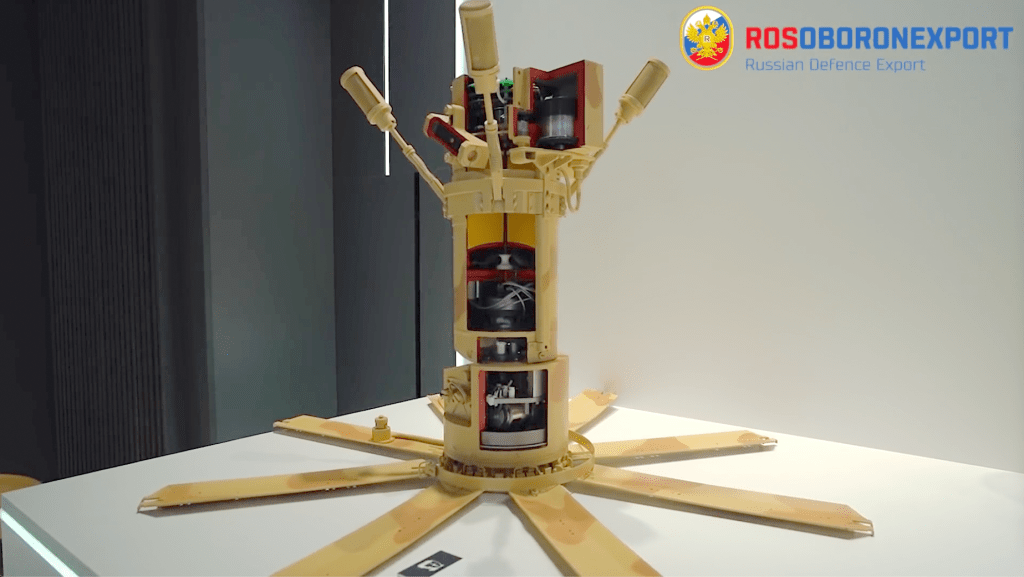
Sectioned PTKM-1R (Rosoboronexport)
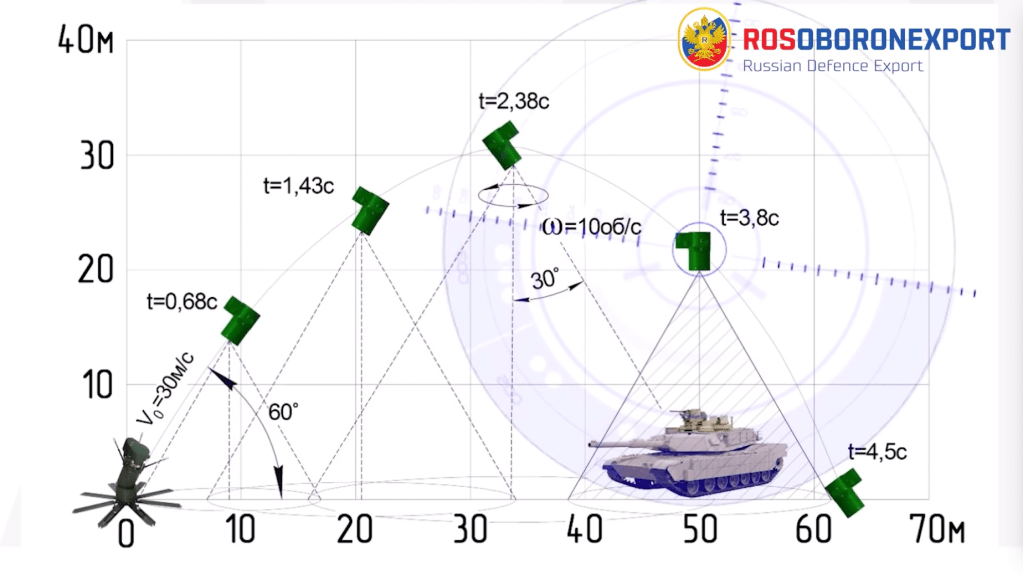
The mine can engage targets at between 5 and 50m but can detect a target out to 100m. Targets are initially identified by the mine by comparing the detected signature with acoustic and seismic signatures in its internal database. Once a target is detected the mine calculates a flight path and the launch unit tilts 30-degrees toward the target to create a parabolic ballistic trajectory over the target. While the mine can detect targets in a 360-degree arc the mine itself has a limited arc, limited by the need to tilt before firing, the mine has a an arrow with ‘towards target’ for orientating the mine in the direction of expected engagement but in an Army 2021 presentation Rosoboronexport suggest that the mine can turn itself to face its target, and track it if needed.
Rosoboronexport graphic showing the trajectory of the PTKM-1R (Rosoboronexport)
The submunition is launched into the air at a speed of 30m/s to a height of approximately 30 metres. It then uses infrared sensors and radar to pinpoint its target before detonating its shaped charged to create an explosively formed penetrator. Rosoboronexport claim the mine can penetrate ‘at least 70mm’ of armour.
The PTKM-1R can be considered an off-route mine like the German DM-22 and Estonian PK14s which are known to be in use with Ukrainian forces but its ability to strike from above sets it apart. The nearest similar system is the short-lived US M93 Hornet developed by Textron in the 1980s.
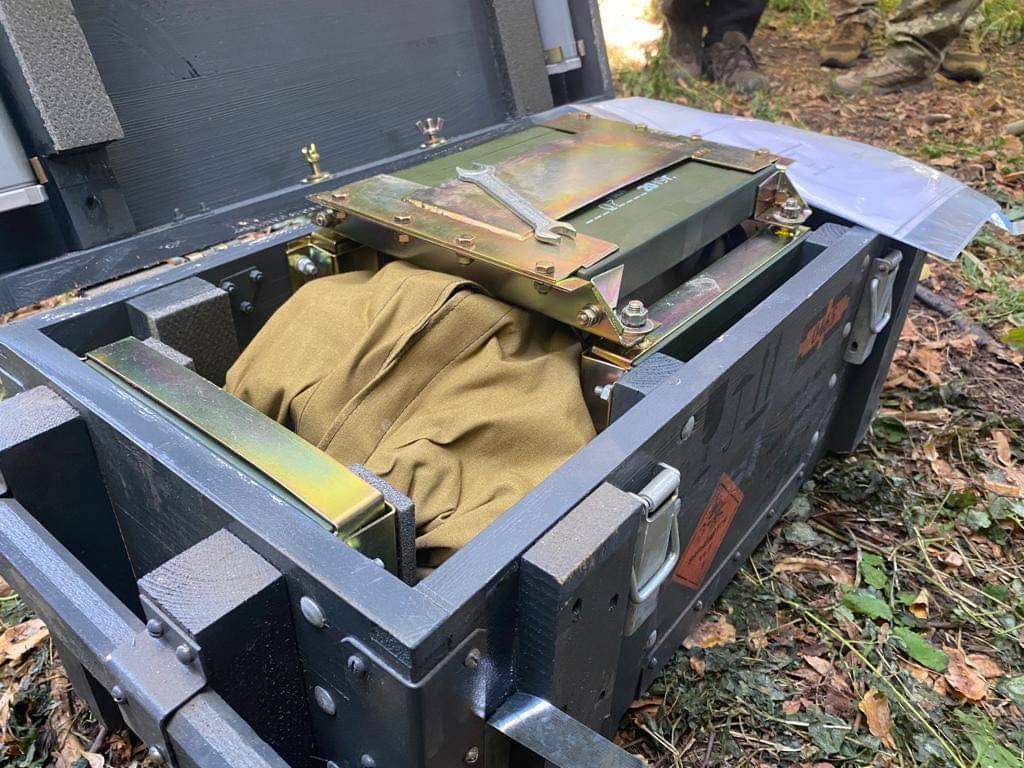
PTKM-1R captured in its transit chest, 10 September (via social media)
The launch unit (or transporter-launcher) incorporates eight feet that are lowered when the mine is deployed these provide a stable platform. According to Rosoboronexport the PTKM-1R weighs 19.9kg while its payload is said to be around 2.8kg of explosive. Two seismic sensors, which sense the vibrations caused by approaching vehicles, are deployed and there are also four cardiod microphones at the top of the unit which listen for the sounds of heavy armoured vehicles.
PTKM-1R captured by Ukrainian forces during Kharkiv offensive, 10 September (via social media)
On around the 10th September a second mine was photographed showing an undeployed PTKM-1R still in its transit chest. The mine was captured, reportedly by SSO, in the Kharkiv region on the eastern front where fighting has been significant and Russian forces appear to be rapidly falling back.
Update 17/10/22: On the 17th October, Ukrainian Telegram channels began sharing a short video of a PTKM-1R which appears to have launched its top-attack munition. The Telegram posts did not state where the footage was filmed. In the video we can see that the mine’s base unit has angled (supposedly towards its target) and has launched its munition.
Some great video of another Russian PTKM-1R, a quite advanced top-attack anti-armour mine. Interestingly, this one has launched its munition – note also how the base unit of the mine is angled towards its target.
— Historical Firearms | Matthew Moss (@historicfirearm) October 17, 2022
Update: 23/11/22: A video from the DPR/DNR People’s Militia Press Office featuring a Russian sapper (possibly from the 56th Guards Air Assault Regiment operating in the Zaporizhzhia Oblast) explaining the deployment of the advanced Russian PTKM-1R top-attack mine. [Machine translation in video captions] H/t – Patrick Senft.
Update 26/11/22: Photographs of a deployed and detonated PTKM-1R have surfaced online.
⚠️🇺🇦Ukraine💥🇷🇺Russie : 🚧 Photos très intéressantes ❗️ Voilà ce qui reste du conteneur de transport et de lancement de la mine antichar d’attaque par le dessus PTKM-1R après dépotage de l’élément de combat sur la cible. pic.twitter.com/egBh2KYRWl
— Historical Firearms | Matthew Moss (@historicfirearm) December 4, 2022
Update – 2/02/2023: A short clip was shared on Telegram showing an intact and unfired PTKM-1R said to be in the Kherson region.
A short video shared on Telegram showing a deployed Russian PTKM-1R. Original post claims it was filmed in Kherson Oblast. Appears to be intact and unfired.
— Historical Firearms | Matthew Moss (@historicfirearm) February 2, 2023
Update – 07/06/23: A recent sighting on a PTKM-1R from drone footage.
🇷🇺⚡🇺🇦
Interesting picture of a #Russian PTKM-1R top-attack mine in #Ukraine!
The picture was reportedly taken by a #drone and shows that the mine can be effectively hidden in high vegetation – despite the it's significant height.
If you enjoyed this video and article please consider supporting our work here. We have some great perks available for Patreon Supporters – including custom stickers and early access to videos! Thank you for your support!
Bibliography
Russian PTKM-1R Top-attack Anti-vehicle Mine Documented in Ukraine, ARES, (source)
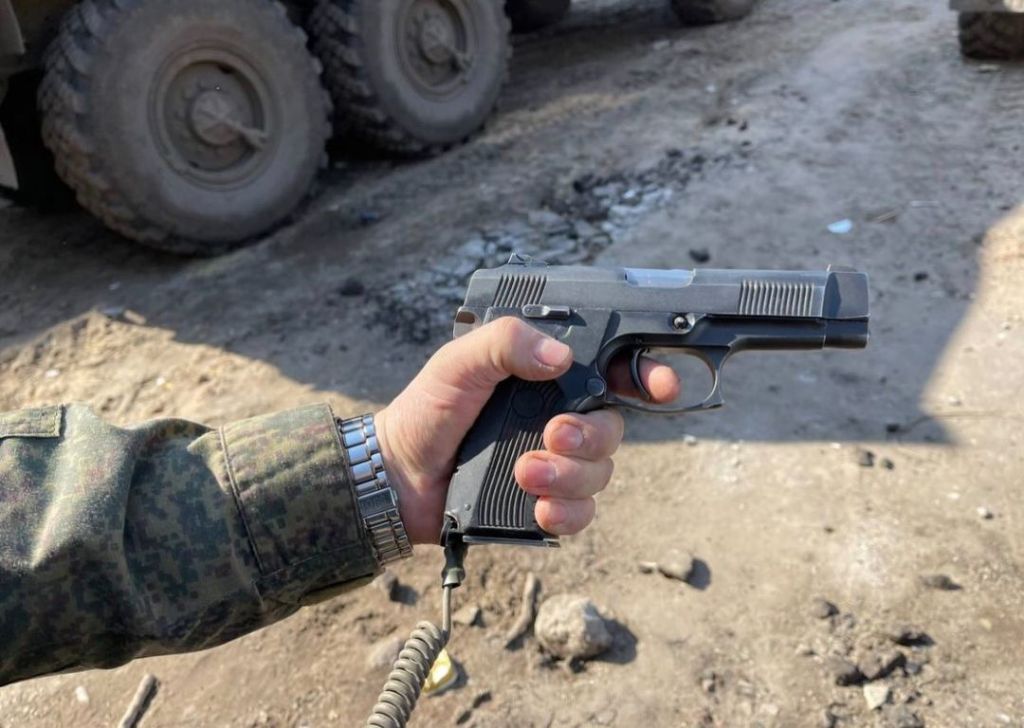
There have been a considerable number of sightings of the MP-443 pistols in Ukraine over the past two months. Unsurprising as it is the Russian armed forces issue side arm. Introduced in 2012, large scale issue of the pistol reportedly began in 2016. The pistol has been seen in holsters and chest rigs of Russian troops in Ukraine alongside substantial numbers of the classic Makarov PMs and even a few Stechkin APS.
The MP443 was developed at the Izhevsk Mechanical Plant by the Vladimir Yarygin. Izhevsk now falls under the Kalashnikov Concern banner. Commonly known as the Yarygin Pistol or PYa, it was codenamed ‘Gratch’ or rook during the Russian Army’s pistol trials, with the Russian military index number of 6P35. Work on the pistol began in the early 90s, initially to fulfil a Soviet Army requirement for a new pistol the pistol was finally selected in early 2003.
MP-443 (via Social Media)
The MP443 service pistol has a steel slide and frame, it uses the Browning short-recoil-operated tilting barrel action and has a double action/single action trigger. It has a pair of ambidextrous, frame mounted safety levers either side of the frame. The pistol does not have a decocking mechanism and has a semi-shrouded hammer.
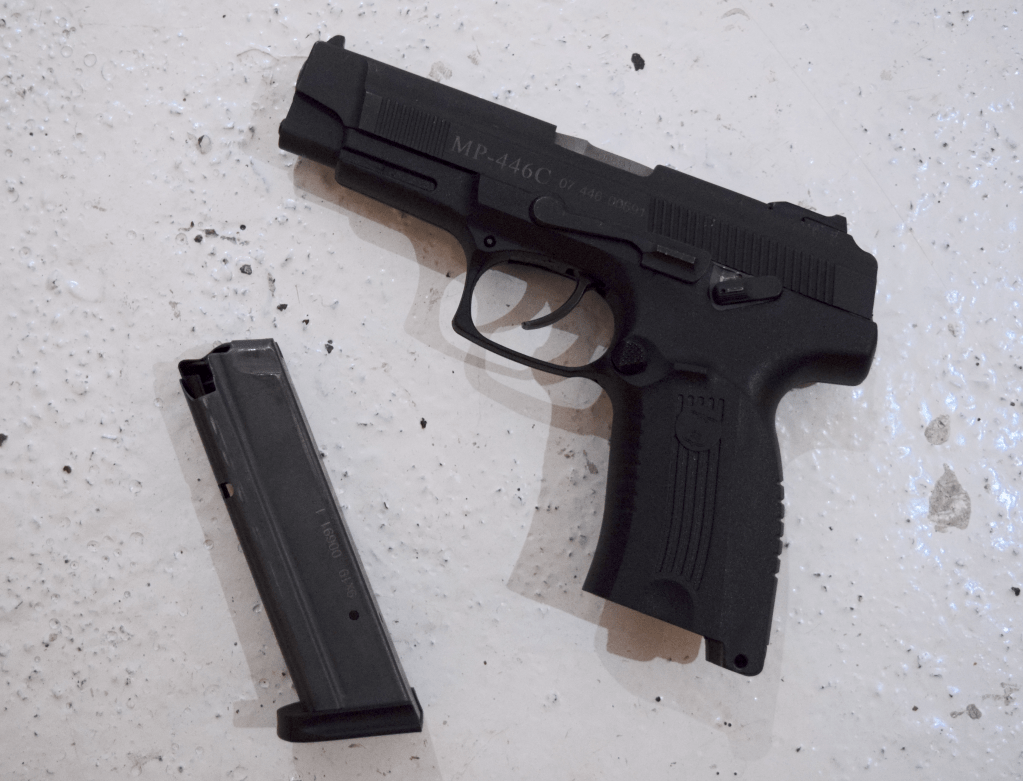
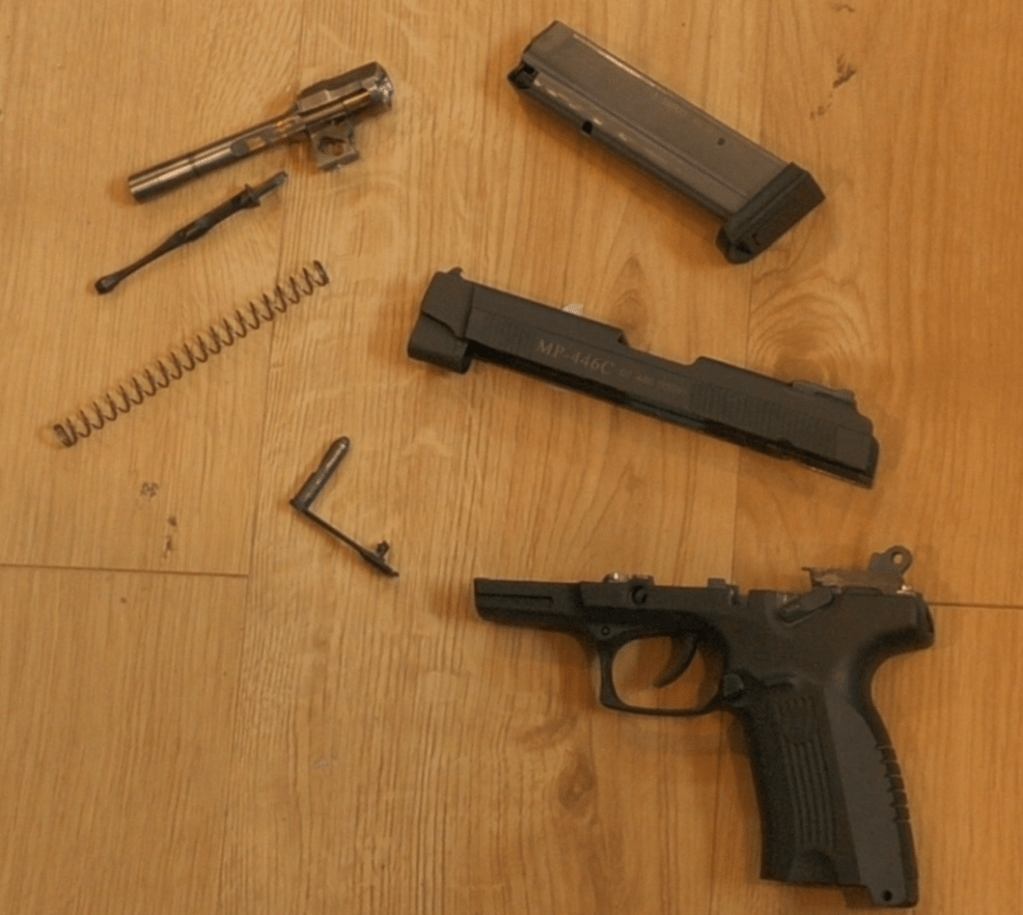
The pistol we have to examine, courtesy of Cold War Collectables, is an MP-446 Viking, a commercial variant of the MP443. This pistol is non-firing and deactivated to UK specification when imported in 2011, but perfectly illustrates the working and disassembly of the pistol.
MP-446 and double stack, double feed magazine (Matthew Moss)
The pistol strips in much the same way as other Browning-pistol derivatives. The take-down pin is removed, the slide slid forward and the barrel, recoil spring and guide rod can be removed. The frame of the MP-446 differs from the MP443 in that it is made of polymer rather than all-metal as in the service pistol.
The MP446 also has a different barrel profile, with more material machined from the barrel of the civilian pistol to prevent it firing the Russian 7N21 +P+ 9x19mm service rounds, which are said to be armour piercing with hardened steel cores.
MP-446 disassembled (Matthew Moss)
One notable feature of the pistols magazine is that it is double stack – double feed, rather than a conventional single feed. The purpose of this is to increase feed reliability, but more recent versions of the pistol appear to have gone to a single feed magazine.
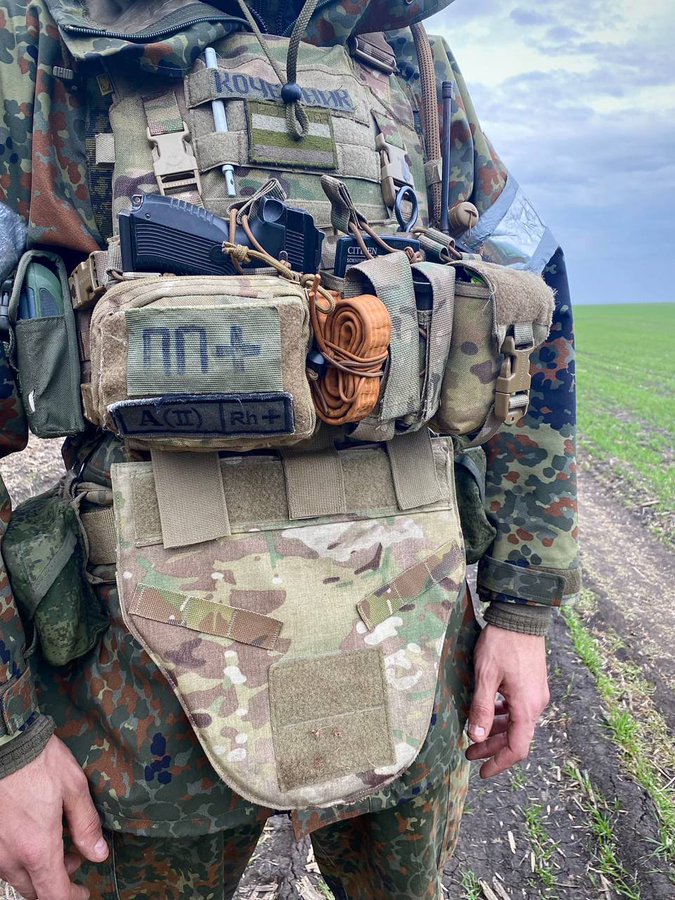
The MP-443 is predominantly issued to senior enlisted personnel, NCOs and various special forces units. In Ukraine we have seen it in the hands of Russian regular army, VDV and Chechen units, including Chechen SOBR – a spetsnaz unit of the National Guard of Russia, operating in the south. We have a number of very good photos of a Russian operator who is believed to be operating in the East, though often said to be VDV Spetsnaz, and he has been seen to be carrying an MP-443 in his load bearing equipment. In other imagery they are occasionally seen with lanyards and often in thermoplastic moulded holsters. A number of captured examples have also been seen in Ukrainian hands.
Russian marksman with MP-443 on his chest rig (via Social Media)
One thing to bear in mind with a visual survey like this one is that, as with our earlier video on Savage Arms rifles in use in Ukraine, it is often difficult to identify specific units and locations for these photographs because they are shared and re-shared on various social media platforms and in many cases the original creator of the imagery has chosen not to state locations for operational security reasons. But photos and videos do give us some idea of the types of units and personnel who are carrying the pistols in Ukraine.
Thank you to my colleague Abdullah of Khyber Armoury and friend of the channel Paul for their help filming, thanks to DixieMauser for help collecting photos of the pistol’s use in Ukraine, to Vlad and Lynndon for their input and special thanks to Jip of Cold War Collectables for letting us film items from his collection.
If you enjoyed this video and article please consider supporting our work here. We have some great perks available for Patreon Supporters – including custom stickers and early access to videos! Thank you for your support!
Recently there have been a number of defence media articles about Russia’s new ‘silent’ mortar. It’s often described as cutting edge technology but in reality it’s based on technology over 100 years old.
The Russian 2B25 82mm mortar is in fact a spigot mortar. What is a spigot mortar? Unlike a conventional mortar which uses gravity acting on the bomb dropped into the tube striking the anvil or striker at the base of the tube detonating the propellant cartridge in the bomb and launching the mortar bomb. A spigot mortar alters this principle, instead using a spigot or metal rod onto which a bomb with a hollow tail is placed. The bomb’s tail then becomes the element which contains the pressure from the detonated propellant charge rather than the tube as in a conventional mortar. The 2B25’s bomb has a plug at at the base of the propellant cartridge which when fired is pushed down the bomb’s tail tube by the expanding propellant gases – essentially acting as a piston. The plug is prevented from leaving the tube by a constriction at the tube’s end. This captures the gases and reduces the report of the mortar.
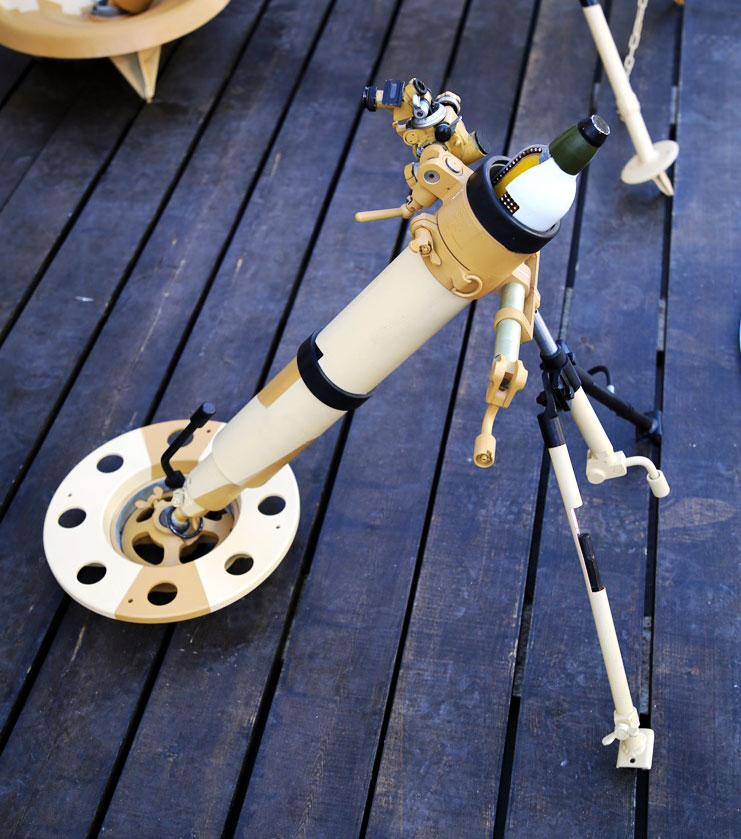
The 2B25 82mm Mortar (CRI Burevestnik/Russian Army)
Perhaps the most famous spigot mortars are the Blacker Bombard and PIAT (Projector, Infantry, Anti-Tank) of world war two. I wrote a book about the PIAT a couple of years ago so the 2B25 really interests me as a niche application of the same technology!
Spigot mortars have a number of benefits and drawbacks which set them apart from conventional mortars, including a shorter range and slower rate of fire than conventional mortars, but the advantages primarily seized upon is their reduced sound signature and lighter weight. The ignition of the propellant cartridge against the spigot, inside the bomb’s tail tube removes visible flash and is much quieter than a conventional mortar which. The 2B25 optimises this by enclosing the bomb inside a light weight tube to further reduce the visual and audio signatures of the weapon firing even further.
Why is this important and why are ‘silent’ mortars useful? With a reduced signature on the battlefield the chances of effective counter-battery fire are reduced enabling the mortar fire to be more effective and sustained. The developers claim that the 2B25 is about as loud as AK fitted with a PBS-1 suppressor, about 135db, substantially quieter than a standard mortar.
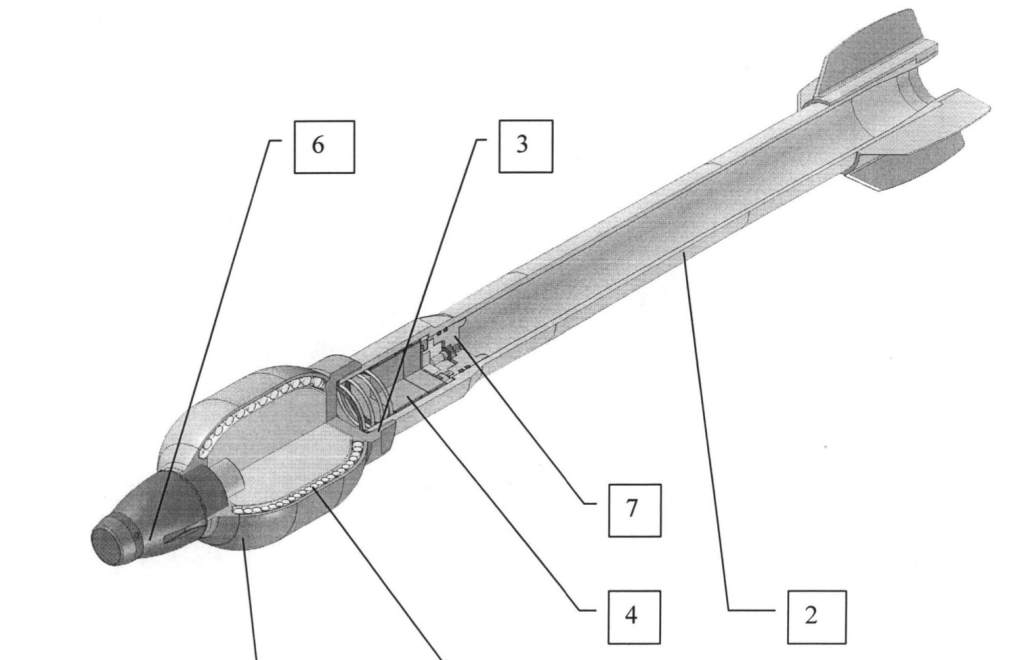
The patent for the 2B25’s bomb, filed in August 2011 and published in February 2013, states:
“proposed shell comprises main part and tail. Tail case accommodates propellant charge and combination piston with initiator. Shell is composed of detachable sealed screw assembly of tail and main part. Tail is furnished with fin. Tail charge chamber accommodates multi-section propellant to be implemented in various versions.”
Patent diagram of the 2B25’s self-contained piston bomb (Russian Patent #2494337)
The 2B25 first began to appear in western media back in 2018 but the design dates back to at least the early 2010s. Developed by the central research institute Burevestnik, it is manned by a two man team and can be transported in a backpack. Officially released data for the mortar suggests it has a maximum range of 1,200 metres with a rate of fire of perhaps 15 rounds per minute. It is reportedly equipped with a standard MPM-44M optical mortar sight.
The mortar appears to be of a fixed spigot design with a firing pin running inside the spigot. This means that unlike the PIAT the 2B25’s spigot does not move. Once the bomb is slid into the mortar tube, down onto the spigot, the operator pulls a handle at the base of the weapon downwards to cock the weapon and then pushing it up to fire it.
The 2B25 82mm Mortar (CRI Burevestnik)
The mortar’s baseplate is said to be made of an aluminium alloy with the whole weapon weighing 13kg or 28.6lbs. The mortar’s 3VO35 bomb itself weights 3.3kg and has a 1.9kg warhead.
Both Russian and western media reports have stated that the weapon has been delivered to the Russian armed forces with some suggesting it was in use by “special-purpose units”, possibly Spetsnaz
The 2B25 certainly isn’t the only modern spigot mortar in service, others include the Fly-K from Rheinmetall. Personally, I find it fascinating that spigot-based weapons still have a place on the battlefield, albeit a niche one.
If you enjoyed this video and article please consider supporting our work here. We have some great perks available for Patreon Supporters – including custom stickers and early access to videos! Thank you for your support!







 The Armourers Bench