Ukraine War: Both Sides Continue Development of Gun Drones

Since our last article/video on gun-armed drones in September 2024, both sides have continued to develop the technology. Numerous Ukrainian teams have developed recoilless ‘shotgun’ drones designed to hunt other drones as well as developing and fielding an AK-armed FPV. The Russians too have returned to the concept in recent months showcasing a number of gun-armed drone systems.

In December the first footage of a Ukrainian gun drone appeared, it utilised the recoilless gun concept. Several videos were shared of an FPV drone equipped with a pair of barrels which are likely electrically initiated and have counter-weight charges as the earlier Russian drone did. The videos showed a series of successful drone vs drone engagements.

On 7 February, Russian Telegram channel, FPV Covenant, shared footage of a gun-drone being tested, with the caption “Testing a shooting drone. The bird has two cameras, a night camera and a thermal imager.” The drone appears to have a single barrel and on firing is jarred considerably by recoil, this indicates the lack of a recoilless, recoil mitigation system.

In the first indication of Russian state efforts to develop a gun-armed drone the Осоед-Д , developed by the Novgorod scientific and production center “Ushkuynik”, was unveiled to Russian media on 20 February. The Осоед-Д has four barrels and appears to incorporate a recoilless counterweight system. Very little imagery of the system is available but it’s developers claim it has a degree of autonomy and can find and attack targets within an area once ground detectors locate a target. One article states that the drone “has already been put into operation”.

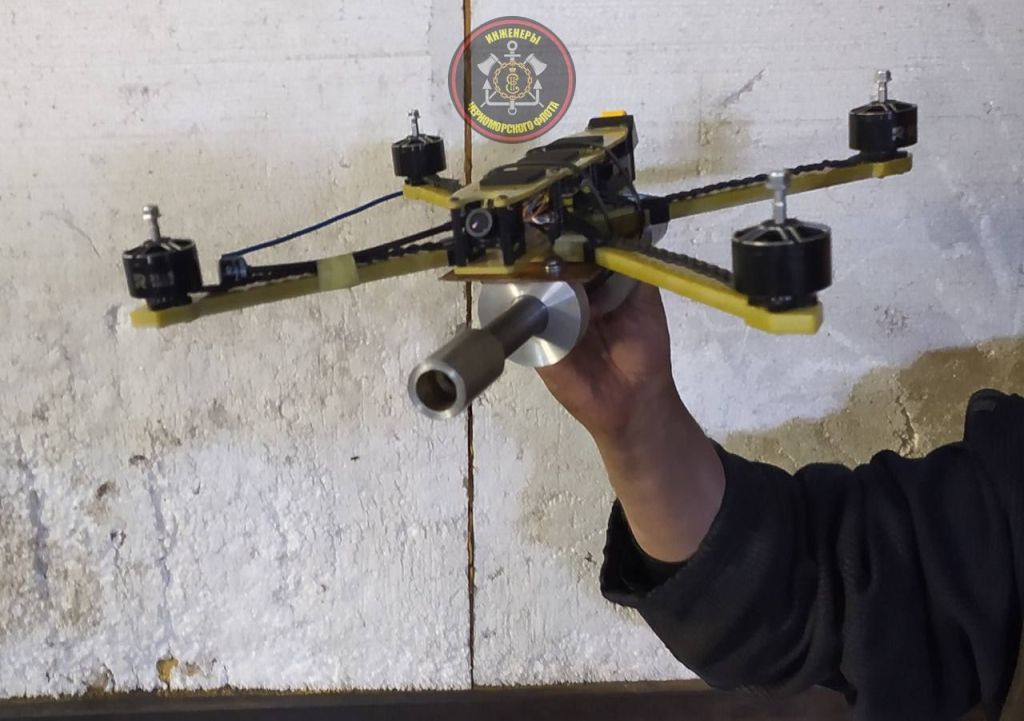
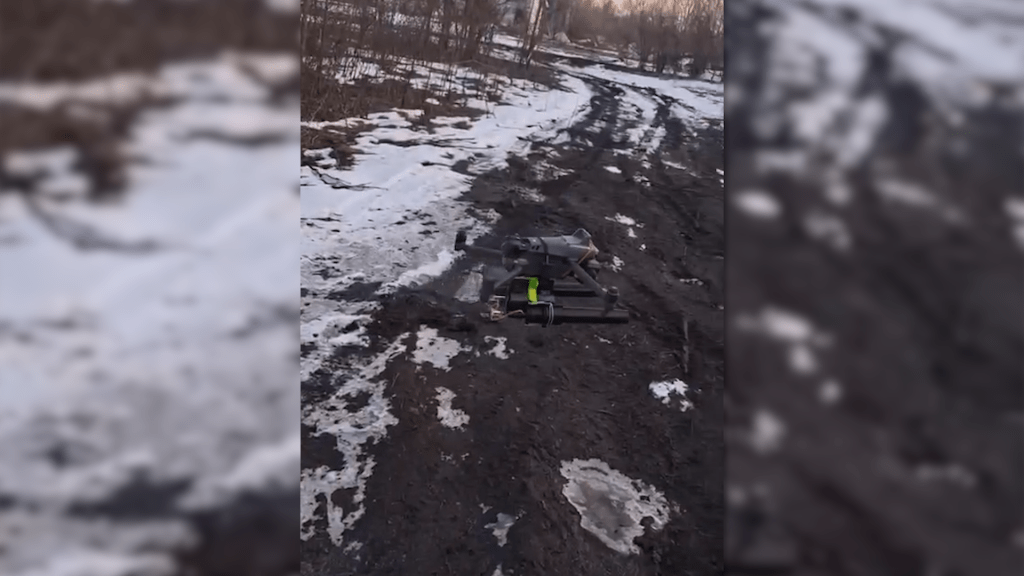
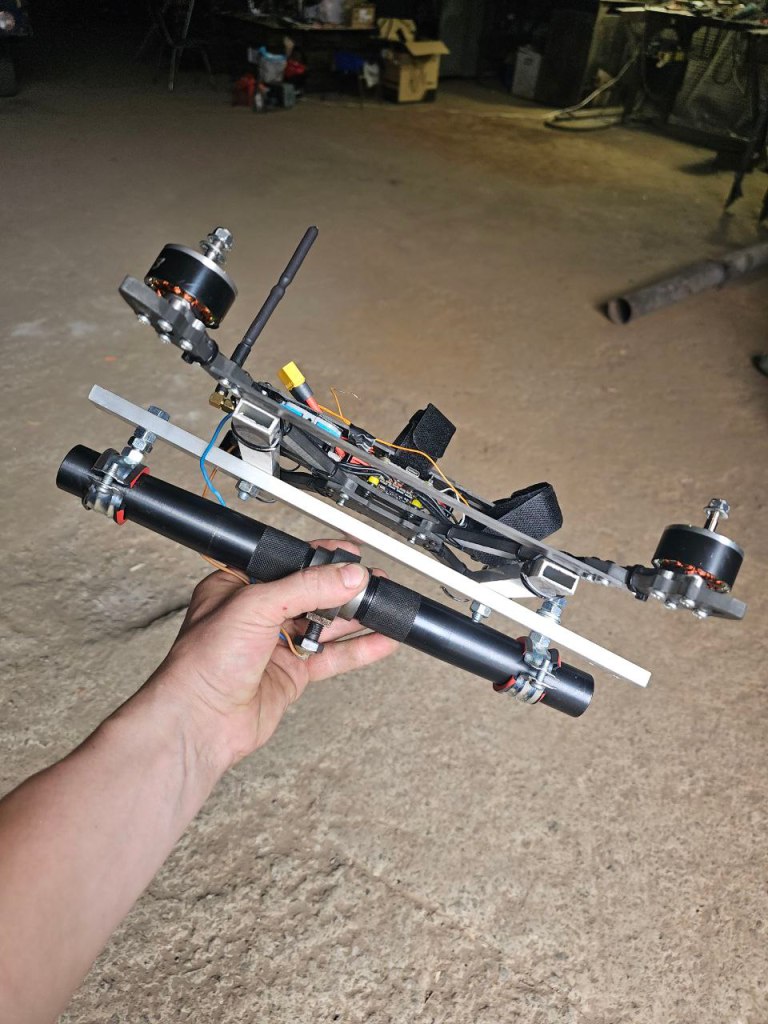
On 6 March a Russian Telegram channel, affiliated with the engineers of the Russian Black Sea Fleet, shared test footage and photographs of a new gun system which can be mounted on small drones. The Telegram post highlights that the system uses the recoilless principle to mitigate recoil and it reportedly utilises standard 12 and 16 gauge shotgun cartridges. It is claimed that it has an effective engagement out to 20 metres and that the aiming of the gun is done through the standard drone camera. The post also claims that operators can “you can hang from 2 to 4 barrels on the drone.” The size and power of the drone would likely have to be greater than a standard Mavic or Russian FPV to mount more than one or two barrels and greater payload reduces range. The post includes a photograph of the barrel assembly on a scale reading 700.9g. (1.5lbs) but a video caption notes when loaded the weight is closer to 780g.

The telegram post includes a pair of videos showing the gun system being tested at a range. The first video shows a 10in quadcopter drone equipped with a 16 gauge gun system. The drone takes off and fires down range, while the recoil is noticeable the drone continues to hover.

In the second longer video the drone appears to struggle to initially maintain a stable altitude/hover but this may be an operator error. The drone travels downrange and fires on a target from a distance of 3.5 metres. The video cuts to show the effect on target with several dozen shot holes. Incidentally, the box is for AI-Thinker RA-08 transceiver modules made in China.

Meanwhile on 7 March, a drone unit with Ukraine’s Separate Presidential Brigade shared the best look at a Ukrainian gun-armed drone we’ve seen so far. We’ve previously seen the Bulava drone team, which part of the 3rd battalion of the Separate Presidential Brigade, deploying drones equipped with rifles and RPGs. These drones were developed with the help of Wild Hornets (a Ukrainian drone manufacturing organisation).

The gun-armed drone seen in the video is operated by the 4th Mechanized Battalion and is based on a Lucky Strike-manufactured quadcopter drone. It’s unclear if Lucky Strike has assisted in the development of the gun system.

In the video we see the drone operators drop in a 12 gauge cartridge into a barrel, notably the cartridge’s primer has been removed probably to enable electrical ignition. The video does not show the counter-weight system likely to avoid breaches of operational security on how the system works. The drone can be seen mounted with a pair of barrels and when firing is demonstrated its clear that the larger drone is able to compensate for any remaining recoil the counterweight system can’t mitigate. Its also possible that the Ukrainian counterweight charge has been more finely tuned to the charge of the firing barrel. The operator explains that even a small number of hits from relatively small shot can be effective on target and that one of their primary targets are DJI Mavics which the Russians use for  Intelligence, Surveillance, and Reconnaissance (ISR). In terms of doctrine the video explains that they try and engage with one barrel but if they want to be sure of hitting a target they can fire a salvo of both at the same time to increase hit probability.

On 10 March, A small Russian Telegram channel, Bright Head, shared a short video of a small quadcopter drone armed with a pair of barrels. The video is simply titled ‘Drone killer “GORYNYCH (ГОРЫНЫЧ)’. It approaches a cardboard target and fires twice. Intriguingly, the Gorynych has an ingenious recoil-mitigation system with the barrels being ejected from the drone on firing, this reduces the recoil significantly with the first shot only briefly dipping the drone.

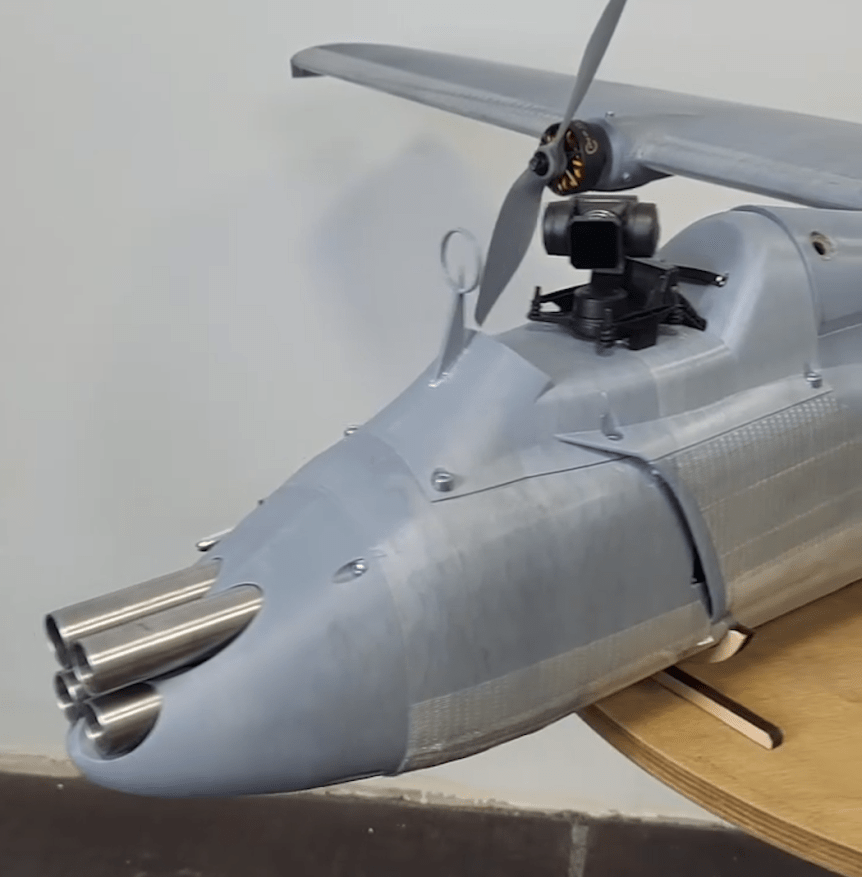
On 15 March, Ukrainian drone developers Sky Defenders shared video of their fixed wing UAV equipped with four forward-firing gun barrels. Check out our earlier article/video examining the Sky Defenders ZigZag.

A close up of the ZigZag’s four-gun barrels and gimbal mounted camera (via Sky Defenders)

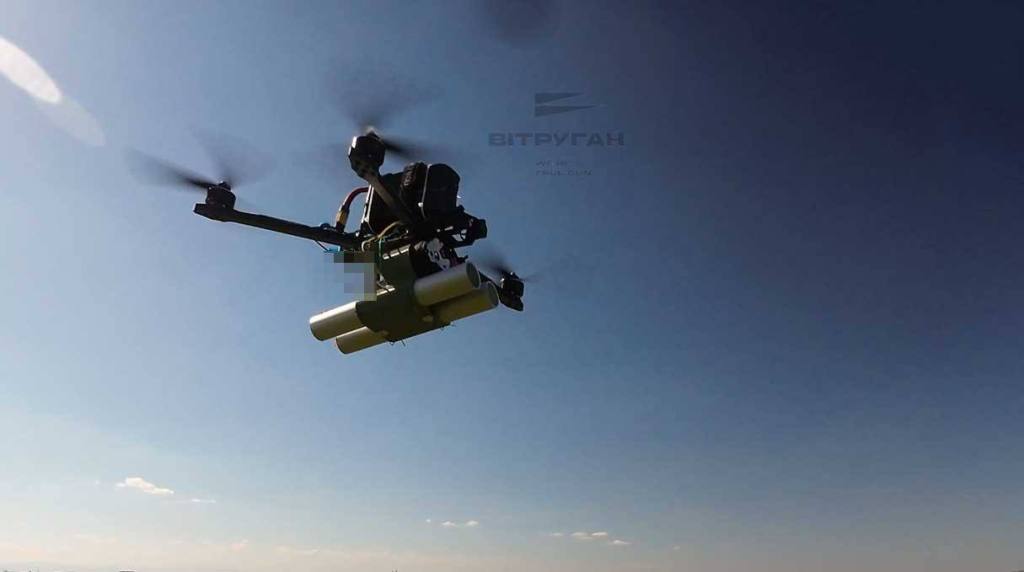
Ukrainian drone developers ВІТРУГАН introduced their ‘Ги́цель’ (Gitsel) gun-armed drone on 19 March. The Gitsel is equipped with a pair of 30mm barrels and the developers claim is has ‘automatic target acquisition and firing when the target is within the strike zone’ but it can also be operated manually. ВІТРУГАН have so far only shared photographs of the Gitsel and while there is no video of it in operation they say it can be used against both aerial and ground targets. The barrels in the photographs appear to be cut down metal piping wired for electrical ignition through the rear end of the barrel. They appear to be mounted on on a 3D printed assembly.

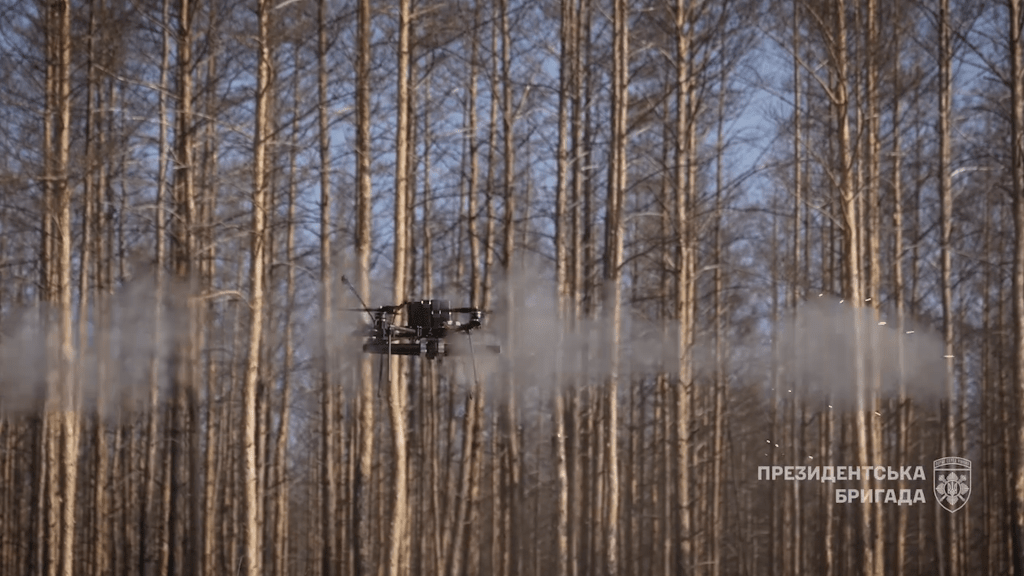
Most recently on the 29 March, the 2nd Mechanised Battalion of the 30th Separate Mechanised Brigade shared a minute long super-cut video of a gun-armed drone engaging more than 20 Russian quadcopter drones. Most fall to the ground after suffering damage to their rotors but one explodes upon being hit, with the shot likely hitting a piece of ordnance the drone was carrying. The video concludes with footage of one of the downed Russian drones being salvaged and lifted away by a Ukrainian drone.

The flurry of development by both sides illustrates how sorely gun-armed drones are needed to counter the ever pervasive drone threat. The development of the gun-drones is now being undertaken not only be individual developers and units but now also by larger companies and in Russia’s case a state-owned research and development entity. Both sides are also now claiming some limited autonomous targeting capability. While some of the gun-drones have entered operational use it’s unclear if significant numbers have been produced and fielded. Over the coming months we will likely see further fielding of the gun-drones and it will remain to be seen how effective they are and how they may change the dynamic of the conflict’s drone use.


Support Us: If you enjoyed this video and article please consider supporting our work here. We have some great perks available for Patreon Supporters – including early access to custom stickers and early access to videos! You can also find us on the History of Weapons & War app. Thank you for your support!

3D Printed AK ‘Buckshot’ Anti-Drone Rounds

Back in December I published an article/video examining the Russian practice of creating a rudimentary anti-drone round from a 5.45x39mm cartridge case and a handful of ball bearings (BBs). The BBs are encapsulated in shrink-wrap tub ing and then loaded in the cartridge case like a conventional bullet. This was seen to be relatively effective with evidence of multiple workshops independently producing the ammunition.

The ad-hoc production of the ammunition has been seen in locations ranging from kitchen tables to well-laid out large workshops. The rounds have also been tested by Ukrainian forces and there has been some interest in replicating the buckshot cartridges but its unclear if this has come to fruition as yet, shotguns appear to be more prevalent for Ukrainian forces.

3D printing has become a key element in so many aspects of the ongoing war so it was inevitable that it would be leveraged in making this ad-hoc anti-drone ammunition. It appears that several Russian workshops have now developed 3D-printed sabots to replace the shrink-wrap tubing. It appears that this move towards 3D printed sabots is an effort to prevent the barrel being fouled by plastic from the tubing. This is an issue which has been highlighted in a number of posts including a bore scope video published by Ukrainians who tested the home-made rounds. The shrink-wrap likely disintegrates in the barrel leaving behind polymer residues whereas the 3D printed sabots seem to remain intact until they leave the barrel.

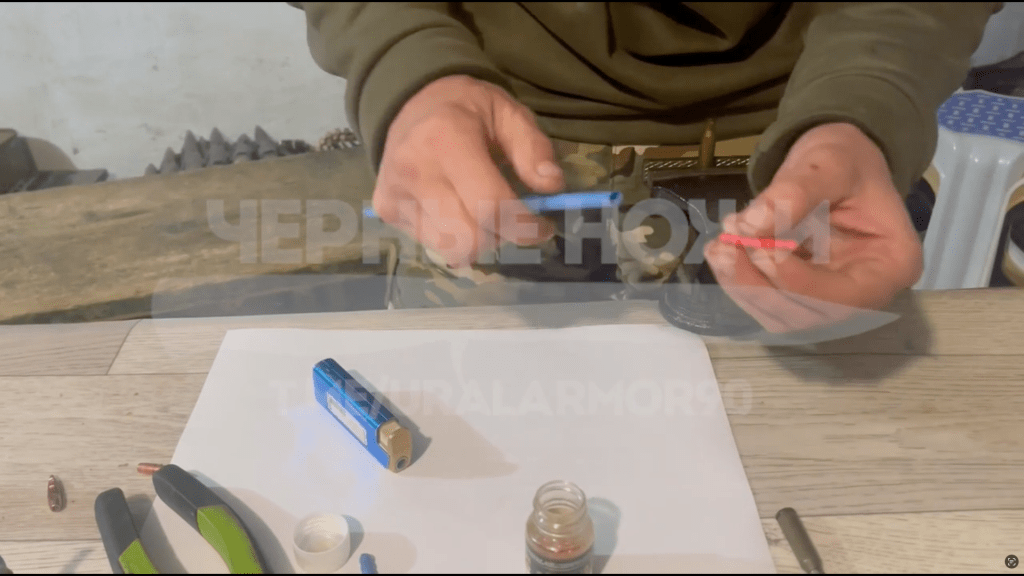
The first sighting of the 3D printed sabots came on 23 February, when a Russian telegram channel shared a video showing the printing and assembly of the anti-drone ammunition with 3D printers printing a bullet-shaped sabot. The design and production was attributed to the assault detachment of the 33rd regiment of the 20th Guards Motor Rifle Division. The design consists of a two-piece clam shell-like design which encapsulates the BBs and can be loaded into a 5.45 cartridge case like a conventional projectile. The video shows three 3D printers printing the sabots which hold 4-rounds each. It then shows how the standard cartridge’s projectile is pulled from the case, the sabots are loaded with BBs and then the sabot is tapped down into the case.

The video then shows an individual firing full auto at a target, said to be 75m away away – thought the distance is difficult to verify. It then cuts to a shot of the rifle disassembled and the individual filming states that after four magazines there is no plastic residue in the gas system, barrel or action.

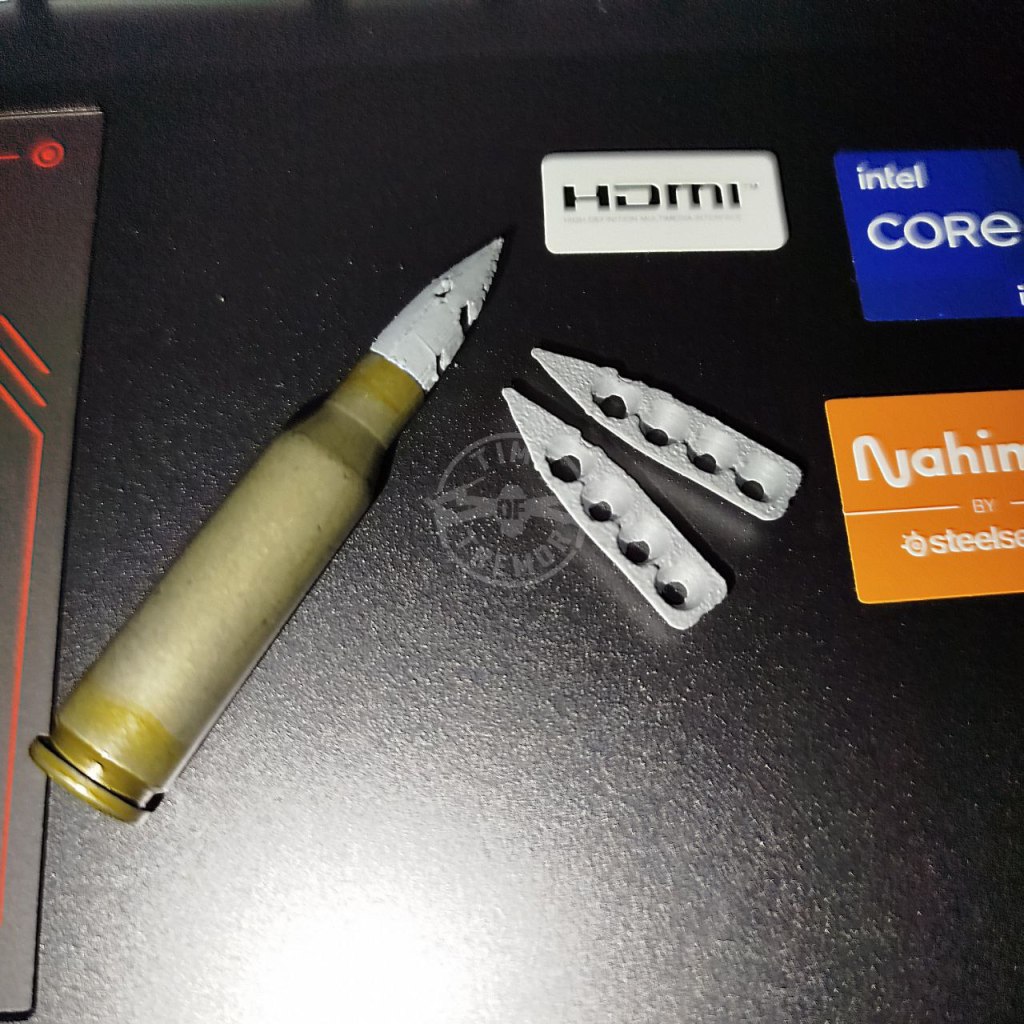
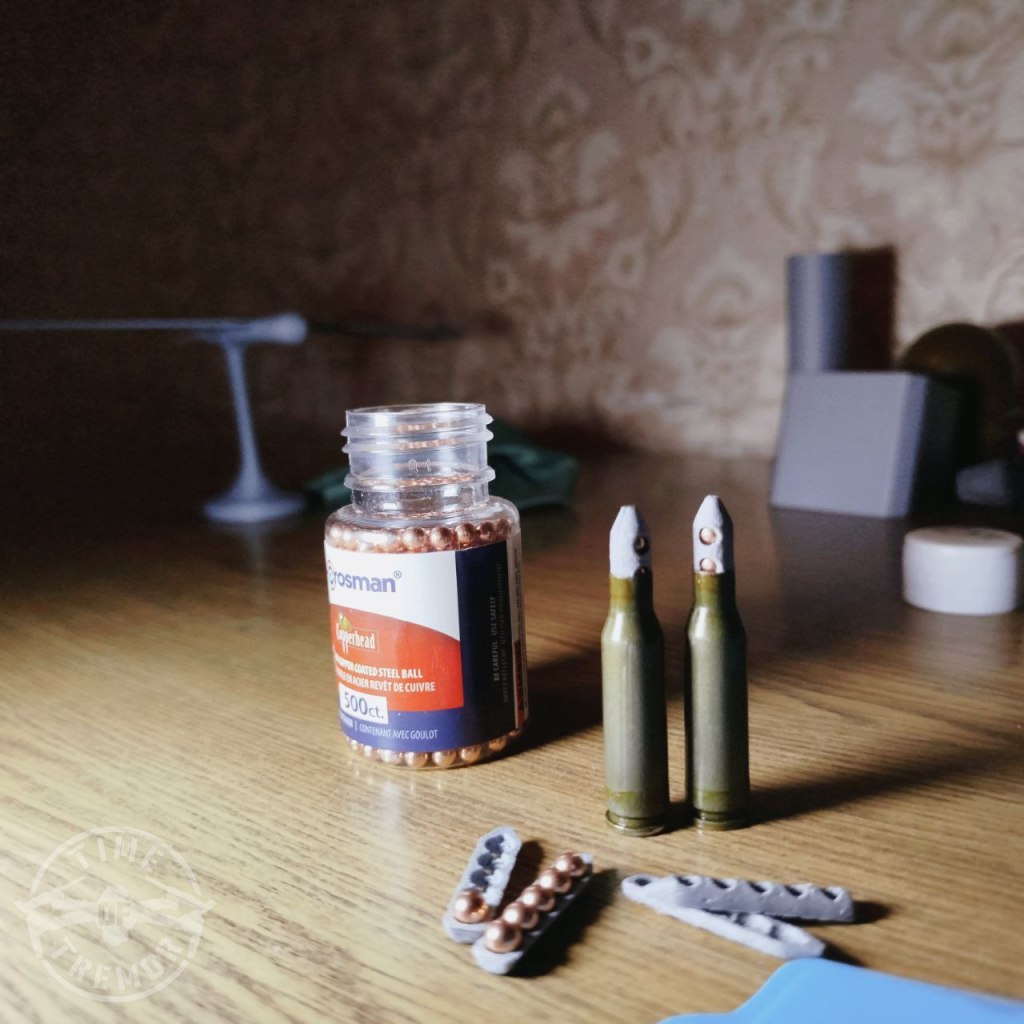
On 26 February, another Russian Telegram channel, Time of Terror, which describes itself as run by a special forces drone group, shared a photograph of a cartridge loaded with sabot with the two halves of an empty sabot next to it, stating that they had been asked to develop the sabot by a subscriber and that tests were ongoing. The nose of sabot has a notably less pronounced point compared to the first example. A day later the same Telegram channel shared another photograph of the ammunition this time with a five-BB sabot, next to a bottle of Crosman copperhead BBs.

Several days later, on 2 March, a short video showing a version of the sabot without the pointed nose was shared. It appears that the point of the sabot’s nose has been filed down. The video’s captions reads [machine translated]: “Based on the feedback, certain modifications were made. After checking them and collecting feedback from other units, we will stop at the most working version.” The video shows a few bursts being fired and several hits on a target down range. The video appears to have been filmed somewhat close to the frontline.

Later the same day another photo of some of the ammunition was shared, notably with the sabots seated at different depths. The caption mentioned the changes that have been made based on feedback [machine translated]: “In the new version, the diameter of the bullet base was reduced by 0.2mm and a chamfer was added instead of rounding, the diameter of the first solid cut-ring was reduced, which ensures easier pressing.”

On 4 March, the same Telegram channel shared a video demonstrating the assembly of one of the rounds. The video shows the pulling of a bullet and then the filling of the sabot with five BBs before the two halves of the sabot are pressed together and placed in the cartridge and tapped home with a hammer. The video’s caption reads [machine translated]: “At present, we observe significant potential in the application of the proposed modernization. Tests are ongoing, collecting data, which is necessary for forming a final conclusion on this issue. It is proposed to begin developing a prototype of equipment for an accelerated pressing procedure.” This would suggest the use of a conventional bullet press rather than a pair of pliers and hammer.

The video also includes footage of testing showing the ammunition being fired at a small rectangle of cardboard. The first two strings have a horizontal spread but with most of the BBs appearing to hit the target. A series of bursts shows the more hits on the target. The engagement range appears to be around 20-25 metres.

On the same day they also shared a short clip of a PKM machine gun being loaded with a belt holding three rounds of anti-drone 7.62x54mmR ammunition. Not much can be seen in the video but its likely that the 7.62 sabots can hold six or seven BBs. The caption notes [machine translated]: “In parallel, tests are being conducted for the modernized rifle bullet 7.62… Three rounds were fired in single mode. Results will be added later, looking ahead I will say that there is potential.”

The usefulness of having a machine gun with a belt of the anti-drone buckshot ammunition is somewhat debatable, while perhaps not ideal for a patrol or an assault having a belt of anti-drone ammunition while defending a position may be useful. A post from 8 March, shows the development of a loading punch and the use of nail varnish on the nose of the round as a means of adhering the nose of the sabot together preventing it parting. The most recent post from Time of Terror features couple of photos of a large batch of five-BB sabots. The caption states: “made a batch of 10,000. The test variants showed a very satisfactory result. I am waiting for further feedback and hope to put an end to this process as soon as possible.”

The evolution of these makeshift anti-drone rounds has moved rapidly, with the shift to 3D printing in some areas leading to the potential production of thousands of rounds. While printing may expedite one element of production the loading of the sabots and the seating of them in cartridge cases remains a bottle neck in the manufacturing of the rounds.

Update – 3/4/25

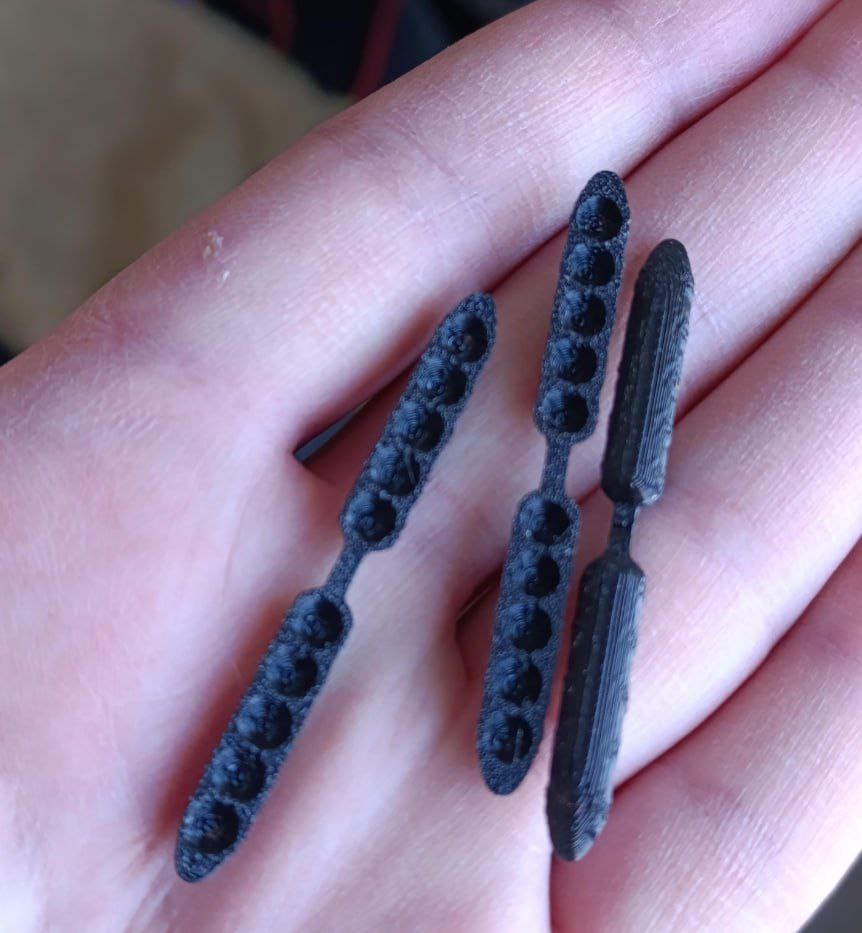
Another version of the 3D printed sabots has appeared on line in a video showing a Ukrainian combatant from the . Printed as once piece the sabot has five recesses for BBs. A video shows the firing of three rounds from an AK-74 pattern rifle. A target is shown approximately 5 metres away with a pattern of impacts from the anti-drone rounds.


Support Us: If you enjoyed this video and article please consider supporting our work here. We have some great perks available for Patreon Supporters – including early access to custom stickers and early access to videos! You can also find us on the History of Weapons & War app. Thank you for your support!

Improvised Shoulder-Fired S8 Rocket

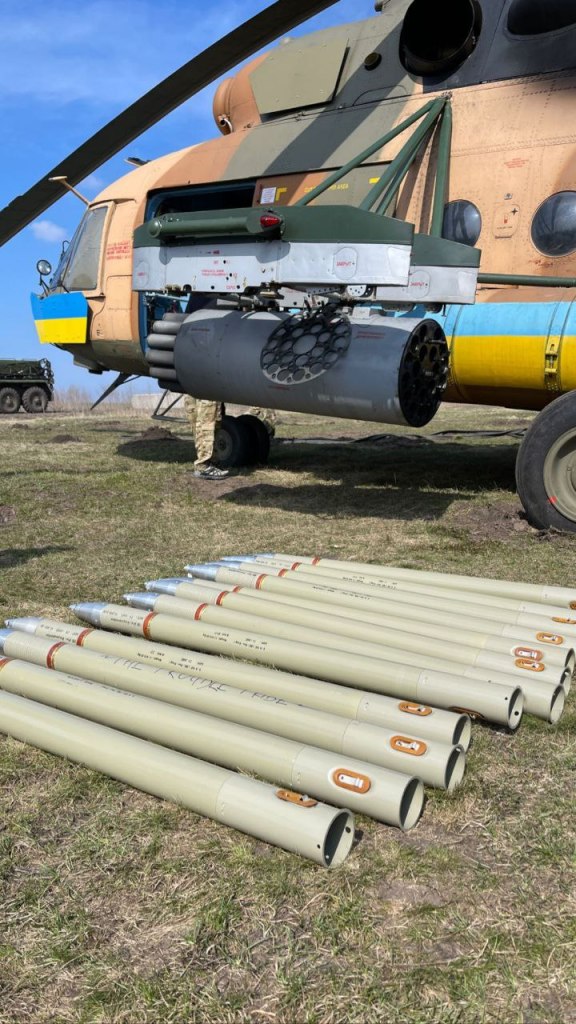
The S8 is an 80mm family of unguided rockets developed by the Soviet Union and still in service today. Developed in the 1970s there is a whole range of different types of warheads for the rockets and the S8s are most commonly seen being fired from both Russian and Ukrainian helicopters or Su-25s. We typically see both sides firing salvos of the rockets by pitching up the aircraft and launching, while this no doubt more inaccurate than firing them directly onto a ground target, as originally intended, the practice does keep the valuable aircraft somewhat out of the range of opposing air defences and must have some effect downrange as the practice has continued since the first weeks of the war.

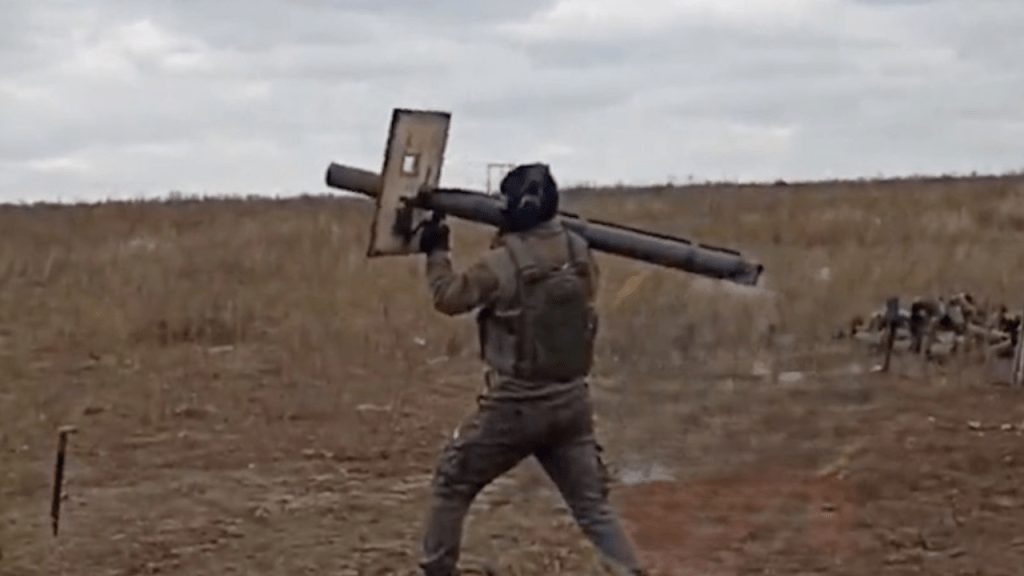
Firing an improvised S8 launcher (via social media)

This week, however, a video of an improvised launcher developed to be fired from the shoulder emerged, seemingly developed by Russian personnel. We can see that the launcher has a pair of pistol grips, a shield made from four planks of wood with a small hole and a plastic screen tacked in place. An electrical box is also mounted on the shield, possibly containing a battery, with a cable tube running to the rear of the launch tube, ostensibly to ignite the rocket motor. It appears that there may be a trigger on the front grip. An individual in the video providing commentary states that the connection is ‘absolutely safe’. The launch tube appears to have at least one bracket welded to it for securing the shield. How the launcher is aimed is unclear, but the individual filming states that they are testing the principle and still need to make some refinements.

S8 rockets ready to be loaded onto a Ukrainian helicopter, 2023 (via social media)

The S8’s rocket burns for approximately 0.7 seconds, generating around 5,800 Newtons of thrust. Depending on the variant of rocket used the rocket has a velocity of around 450 m/s, some variants are faster, this is around 4x faster than a conventional shoulder-fired rocket system, an RPG-22 for example has a muzzle velocity of approximately 130 m/s.

Shield and pistols grips of the improvised S8 launcher (via social media)

The clip shows the firer shoulder the weapon and fire, the launch is successful with the launcher operating as expected but the recoil from the extremely fast moving rocket was considerable. The exhaust gases also appear to have acted on the shield pushing it back against the operator. The launcher flies completely out of the operators hands just after launching, with the shield – designed to protect against rocket’s exhaust gases, apparently striking him in the face. The individual filming continues to track the flight of the rocket and the firer is not shown again.

Preparing to fire an improvised S8 launcher (via social media)

The idea of shoulder launching an S8 has been explored before in Chechnya and elsewhere but unless the force of the launch can be mitigated then the results are the same. Ground improvisation with S8 rockets isn’t uncommon with lots of improvised multiple-launch rocket systems (DIY MLRS) being used by both sides, these typically use pre-existing rocket pods mounted on vehicles. This is a topic for a future article/video. A single S8 launch tube on a mount or tripod, where the danger to the operator is minimised, might have useful applications, similar mounts have already been developed to fire Grad rockets with some degree of accuracy.


Support Us: If you enjoyed this video and article please consider supporting our work here. We have some great perks available for Patreon Supporters – including early access to custom stickers and early access to videos! You can also find us on the History of Weapons & War app. Thank you for your support!
HK MG4 In Ukraine

On 23 December 2024 the German government confirmed that 200 Heckler & Koch MG4 5.56x45mm machine guns had been delivered as aid to Ukraine. The MG4s join the 7.62x51mm MG5s which have already been provided, along with a plethora of other HK small arms and light weapons including HK GMGs and a significant number of SFP9 pistols.

The MG4 was developed in the mid-1990s and adopted by the Germany Army in 2005. It is a gas operated light machine gun with an effective range of 600m. It weighs 8.7 kg (19.8lbs) unloaded, has an overall length of 1085mm (42.7in) and feeds from NATO standard disintegrating metal belts.

MG4 with Thales Xtraim and magnifier (shybenyk.squad)

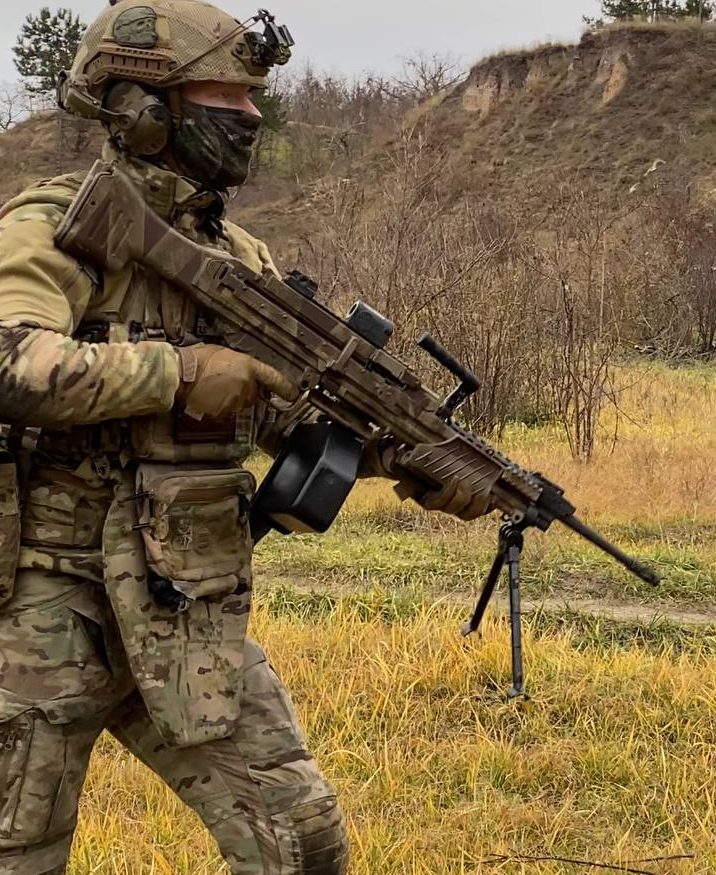
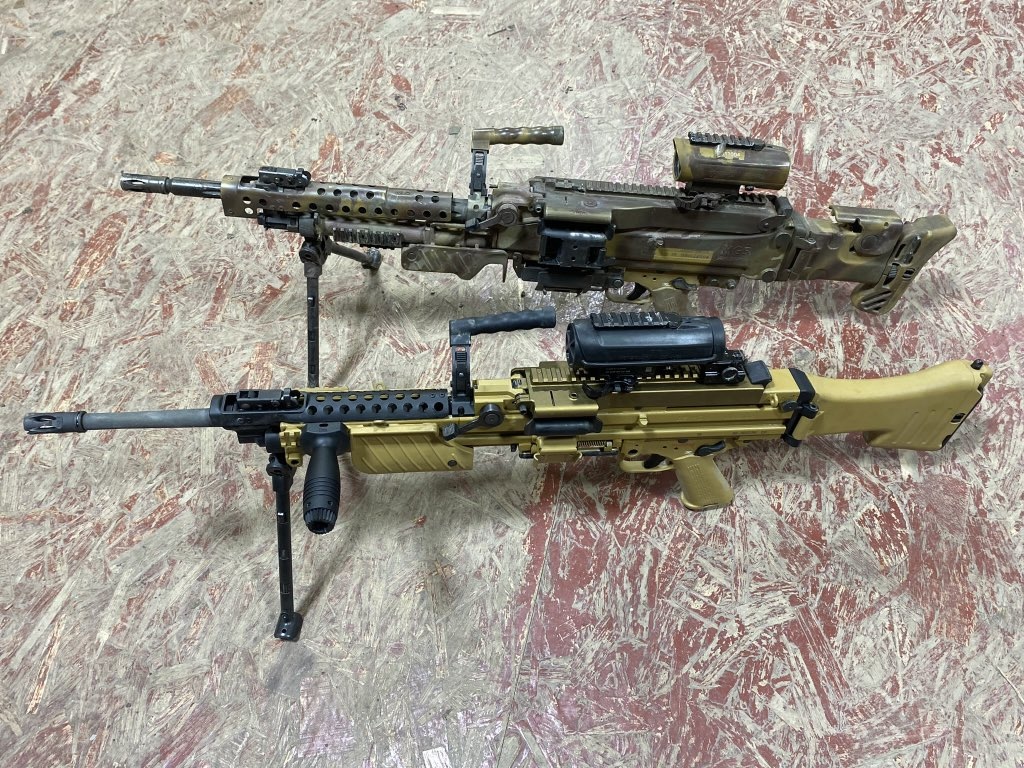
While the delivery of MG4s was only confirmed in late December the guns appear to have arrived in country earlier with the first sighting of one coming on 3 December 2024. The initial sighting of the weapon was posted on Instagram by a Ukrainian combatant, likely a member of the GUR’s special operations teams. The initial photograph appears to have been taken indoors at a range and the flat dark earth colour across all parts of the weapon – rather than black or RAL8000, appears to indicate a base coat for a custom paint job. The weapon also has an FN Minimi belt box, while an adapter isn’t needed to use a Minimi box or bag, HK offers an adapter which enables more ergonomic mounting on the MG4.

A day later the same combatant posted a video showing him firing the MG4 on the move. From both the video and earlier photograph we can see that the weapon has the Gen 1 pattern fixed length, folding stock and a 17.7″ (450 mm) barrel. The gun is mounted with a Hensoldt RSA-S Reflex Sight on top of a Hensoldt 4x30i magnified optic.

On the 8 December the combatant shared another video, the MG4 is seen with the camouflage paint job completed and equipped with just the Hensoldt RSA-S, conducting training drills at a range. 

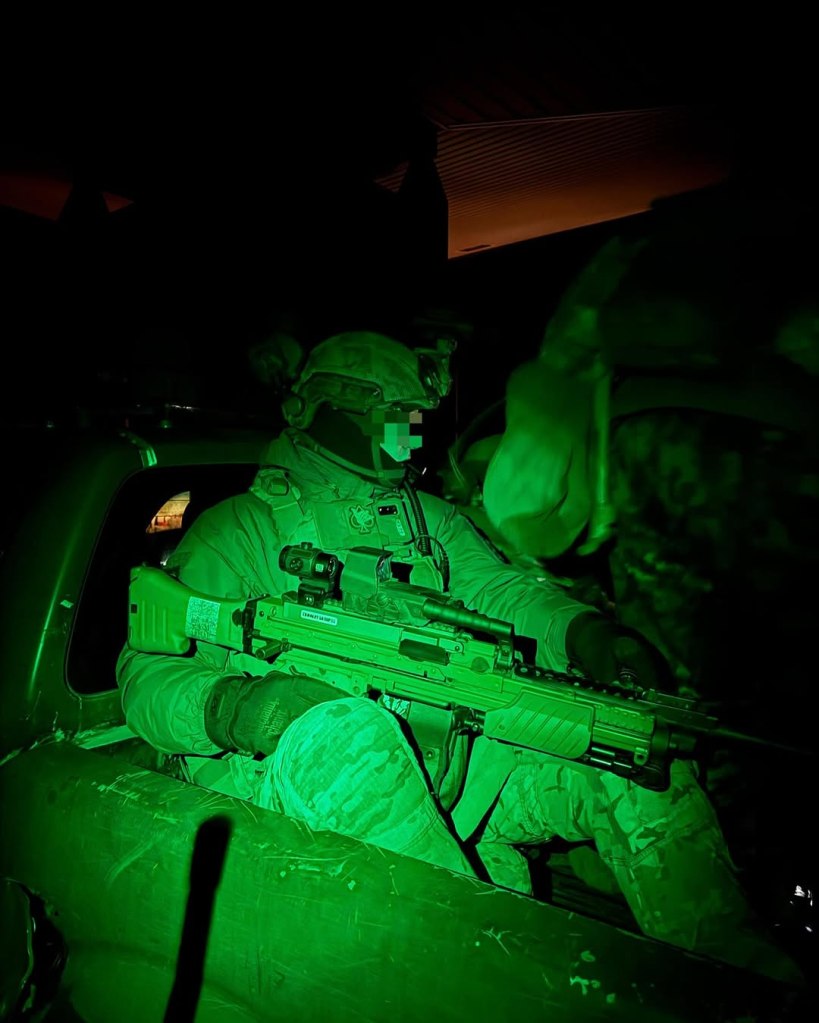
On the 14 December, Shybenyk.Squad, another GUR team – associated with the Kraken Regiment, shared a photograph of a combatant with an MG4 notably fitted with a rare Thales Xtraim thermal fusion holographic sight and a magnifier. The MG4 is loaded with HK’s proprietary fabric soft ammo pouch. Several days later on 19 December, they shared a group photo taken in Orikhiv in Zaporizhzhia. Speaking to a member of Shybenyk.Squad they shared some thoughts on the MG4 stating:

“the weapon is very reliable and highly accurate, it can withstand the heavy load of endless enemy assaults, requiring only periodic lubrication. The disadvantages include insufficient ergonomics and weight, with which it is difficult to control during assault actions.”

They went on to explain that they received spare barrels and spare parts for the weapon.

A painted MG4 (via social media)

On the 20 December, MTAC, a Ukrainian military clothing and gear manufacturer, shared a photograph of the combatant with the MG4 – showcasing some MTAC products. The Hensoldt RSA-S reflex sight can again be seen.

On the 22 December, a member of the Delta Knights, an element of the GUR’s International Legion, posted a series of photos featuring an MG4. In the first he poses with a recently donated axe and in the second he showed his unit’s MG5 alongside the new MG4. In these photographs the gun is clearly unpainted and has a factory RAL8000 finish but has a black heat shield – this is seen on other examples too. It also has the same Gen 1 pattern fixed length, folding stock as seen on the earlier seen MG4. When asked what they thought of it Delta Knights simply replied “we love it so far”.

A 7.62x51mm HK MG5 and 5.56x45mm HK MG4 (Kevin Vinje/Delta Knights)

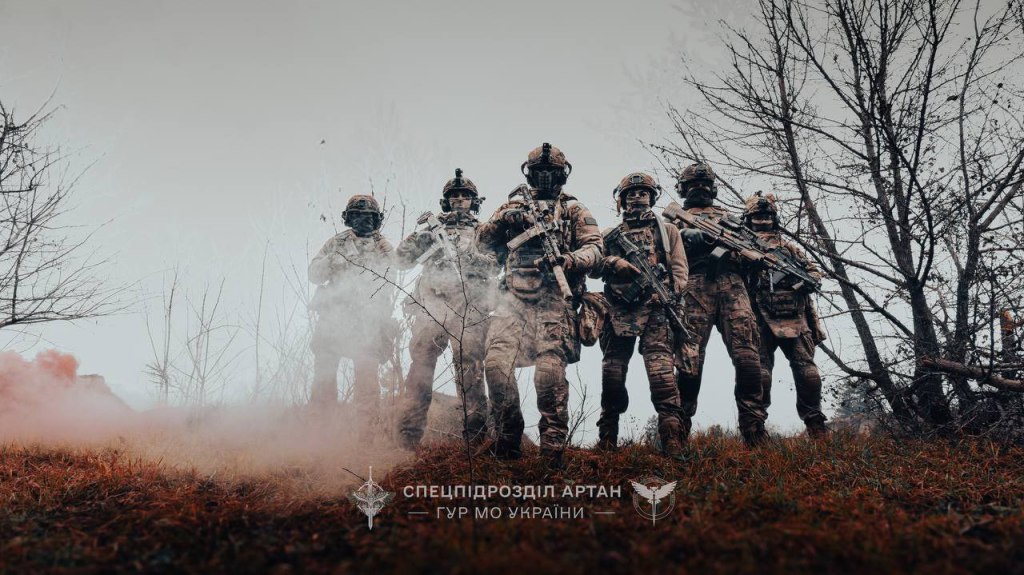
The most recent MG4 sightings, at the time of writing , appeared on 10 January 2025, when the Artan Special Unit, also affiliated with the GUR, shared a photograph of a combatant holding one of the machine guns, again with a RAL8000 finnish and mounted with a 4x30i Hensoldt optic with which it is likely the guns shipped with.

From the limited number of sightings of the weapons so far it appears that the MG4s have been predominantly issued to GUR teams including Delta Knights and Artan. With 200 guns delivered we will likely see MG4s appearing in imagery more often over the coming months.

Thank you to Matthias and DEaidUA for their invaluable help with this article/video. Thank you also to shybenyk.squad for sharing their thoughts on the MG4.


Update – 11/2/25: The GUR’s Artan Unit shared a team photo featuring an MG4 on 6 February.


Support Us: If you enjoyed this video and article please consider supporting our work here. We have some great perks available for Patreon Supporters – including early access to custom stickers and early access to videos! You can also find us on the History of Weapons & War app. Thank you for your support!
Ukrainian ‘Shotgun’ Drones Shoot Down Russian Drones

On the 27 December, a Ukrainian fundraising charity posted a series of short videos featuring a drone with a pair of gun barrels. The Lesia UA Foundation provide Ukrainian units with vehicles, bikes, drones and personal equipment procured with the funds they raise. It appears that they have helped to fund the development or fielding of an unknown number of gun-armed drones.

The footage of the gun-drone in action was shared on 27 December with the telegram post stating [machine translated]:

“For the first time on video – drones and hard drives shot down other drones
Defenders of Ukraine test #LesiaUAtechnology developments
Stay tuned and we’ll show you even more exclusive shots! Together to victory!”

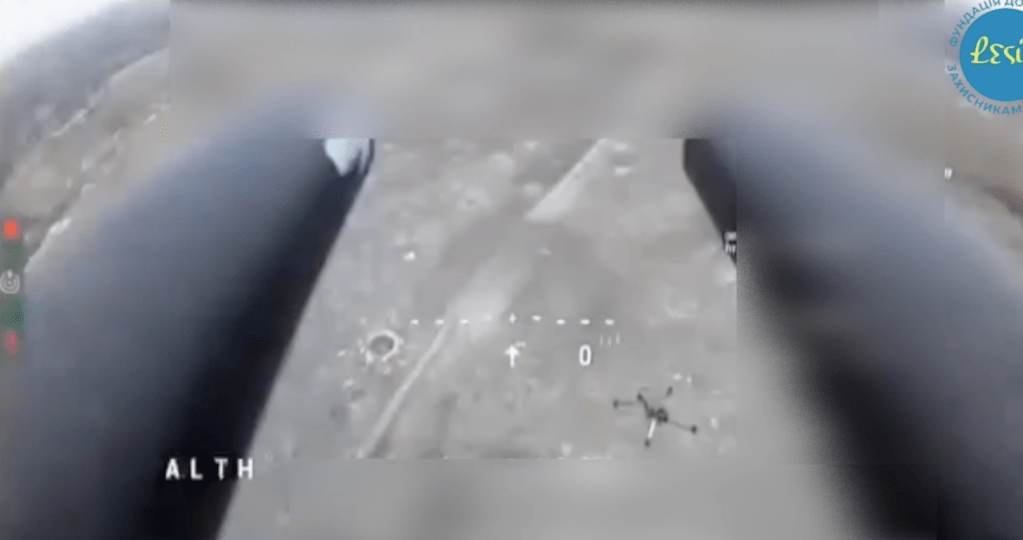
In the first video the gun-drone follows a quadcopter with the drone’s camera panning up and down several times between what appear to be a pair of barrels. The quadcopter is downed with damage to one of its rotors and appears to be trailing smoke as it spirals to the ground.

View between the barrels of a Ukrainian gun drone (via social media)

In the second short clip what appears to be a bomber drone, carrying an explosive hanging beneath it, is shot down as very close range as it hovers. Similarly, the third video shows a bomber drone which is shot down at close range as it hovered with damage to its rotor blades.
At the time of writing the Lesia UA Foundation have not released any additional clips of the drone in action or any images of what the drone looks like.

While in recent months we have seen drones armed with both RPGs and AK-74s these have been used in the air-to-ground role. The shotgun-like blasts seen in these clips are more useful for close range air-to-air engagements. From the lack of recoil seen in the clips, the large bore diameter of the barrels and their positioning on the drone, either side of a camera gimbal, it would appear that the gun used by the drone follows a recoilless principal. The recoilless guns work along the premise of Newton’s Third Law of Motion, that all things have an equal and opposite reaction – as such two guns are connected back to back, with the backwards-facing gun firing a counter-weight – mitigating recoil which prevents the drone’s flight from being destabilised.

A Russian recoilless gun drone developed in 2024 (via social media)

Why a recoilless gun and not a conventional shotgun? Principal factors governing this are likely weight, effectiveness and recoil. The recoilless guns have a larger bore diameter meaning larger load and increased hit probability. Additionally they are simpler with no-working or recoiling parts (as they load is likely electrically ignited) and they are lighter allowing the drone to stay in the air for longer and/or travel further. The key downside to the use of a single shot recoilless gun is that it can fire only one round. The Ukrainian drones have sought to mitigate this by seemingly equipping their drone with two of the guns.

While we haven’t yet seen an image of the Ukrainian gun-armed drone, we have seen a Russian example which was developed in the summer of 2024, tested but reportedly not yet fielded. The Russian drone was developed by the BRT company who, in a recent telegram post, expressed their frustration at seeing a Ukrainian recoilless gun drone in use.

While successfully engaging an enemy drone with a gun is difficult it is the detection and tracking of enemy drones which is likely the most challenging part. This may lead to these recoilless gun-equipped drones being used in a sort of combat air patrol role, seeking out and hunting down enemy drones over an area where they have been reported. It remains to be seen if these recoilless gun-armed drones will proliferate as a method of countering the huge number of small drones used by both sides but from the limited footage of them in action that is available the concept seems proven.

Update – 10/1/24: Additional footage has surfaced showing the drone firing on Russian infantry.

Update – 15/1/25: Additional footage of the Ukrainian drone in action, shared by a drone unit with the 2nd Mechanized Battalion of the 30th Mechanized Brigade.

Update – 4/2/25:

A drone team with the 43rd Mechanised Brigade shared a clip of a shotgun drone engaging a Russian drone.

Update – 17/2/25:


Support Us: If you enjoyed this video and article please consider supporting our work here. We have some great perks available for Patreon Supporters – including early access to custom stickers and early access to videos! You can also find us on the History of Weapons & War app. Thank you for your support!

M26 MASS In Ukraine

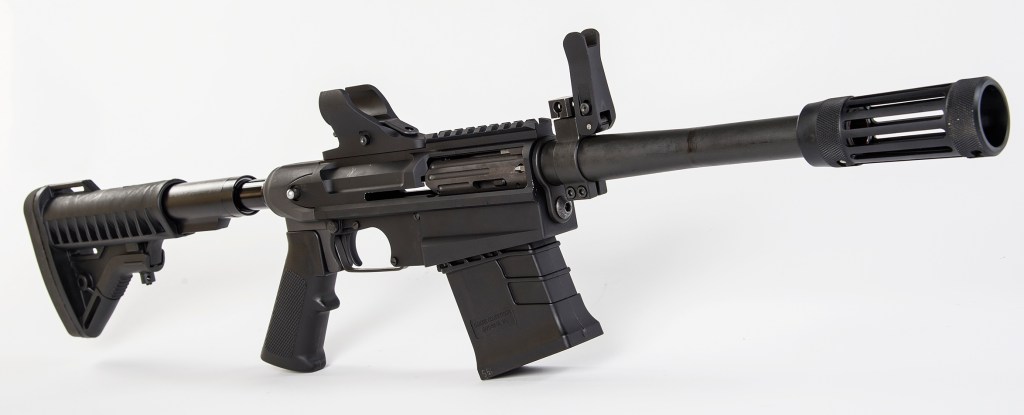
This week another image of a very rarely seen shotgun in Ukraine appeared, an M26 Modular Accessory Shotgun System. These are magazine-fed, bolt-action shotguns which can be mounted on rifles.

The M26 is essentially the US military’s bolt-action Masterkey at home. Developed in the early 2000s by C-More Systems it was selected by the US Army in 2008 and began fielding in 2011 seeing operational service in Iraq and Afghanistan. It is still in service today.

M26 Modular Accessory Shotgun System in its standalone configuration (US DoD)

The shotgun has a 3 inch chamber and uses a straight-pull bolt-action. It’s box magazine-fed with 3 or 5 round capacities available. It can also be used as a standalone once a stock and pistol grip assembly is attached, it has folding back-up iron sights but uses the rifle’s sights when mounted. The MASS’ safety and bolt-handle are reversible to allow ambidextrous operation. The M26 was designed to be employed as a breaching shotgun for shooting hinges and locks, the barrel is tipped with a breaching stand-off adapter muzzle-device. In its rifle-mounted configuration the M26 weighs around 3lbs (1.4kg) and has an overall length of 16.5 inches (42cm). It has an improved cylinder bore profile (sometimes referred to as a 1/4 choke), meaning it has an integral choke with a slight constriction that allows the shot to spread quickly after leaving the muzzle, the practical range for this type of choke is around 15-30 yards.

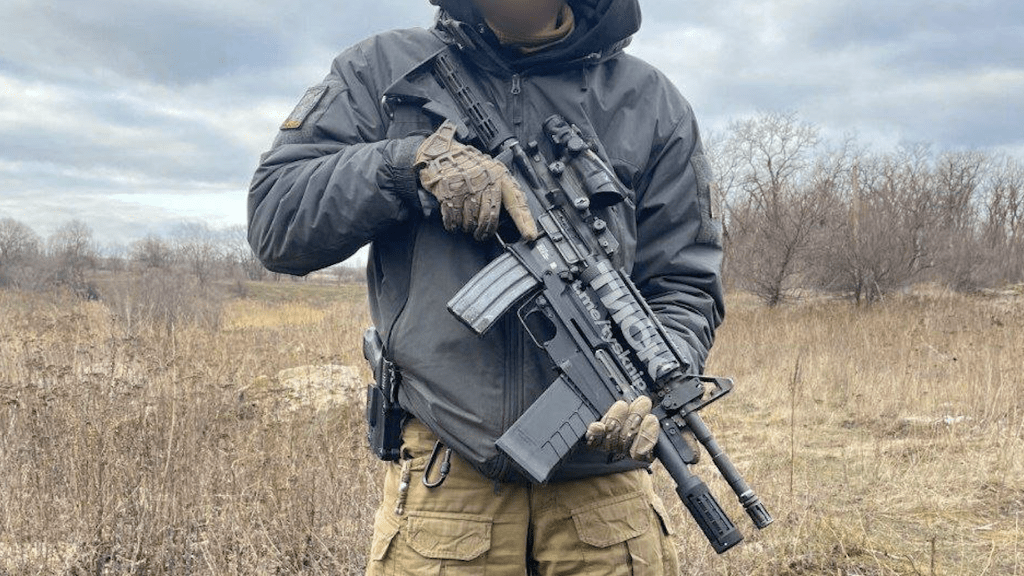
The most recent sighting of one of the shotguns came on 19 December. Ukrainian outlet Tysk shared a photograph of a Ukrainian operator armed with an M4A1 carbine topped with an ACOG and equipped with a M26 MASS In Ukraine. The M26 in the photograph appears to be loaded with a five-round magazine.

Sightings of the M26 in Ukraine are extremely rare, with the only other example appearing in a ХЛОПЦІ З ЛІСУ (Boys from the Forrest) video which showcased weapons used by the UA Reg is the 1st Special Operations Detachment of the 8th Regiment, SSO (UA SOF). The M26 seen in that video was in the standalone configuration with pistol grip and stock attached. Sadly, the shotgun itself wasn’t discussed in the video.

M4A1 mounted with an M26 (via Tysk)

While Russia has not officially fielded anything similar we have seen efforts to adapt GP-25 under-barrel grenade launchers with shotgun adaptors and there has been at least one sighting, back in May, of an improvised slam-fire tube-shotgun mounted under-barrel on an AK-12. The shotguns even appeared on the Russia 1 state TV channel.

Since the latest photograph appeared there has been significant speculation as to whether it might be being used to defend against First-Person View (FPV) drones. This may be unlikely given the weapon’s short 7.75 (197mm) barrel, this length would limit its effectiveness in engaging more distant drones but might be useful in engaging approaching FPV drones- as a last ditch defence. This is something we’ve seen Russian combatants improvising weapons to deal with. The speed with which FPV drones close on their targets, however, would make multiple shots from the M26 unlikely due to its manual action. This would reduce the chances of successfully engaging an on-coming drone.

Standalone M26 (via ХЛОПЦІ З ЛІСУ)

While any shotgun is better than no shotgun the units that the M26 has been seen with definitely have access to shotguns better suited to engaging drones. Where the M26 is more likely to be useful in Ukraine, is in its original role – as a breaching shotgun. Ukrainian units regularly find themselves operating in urban areas where quick access into rooms is key. Provided they have breaching rounds then the M26 might be most useful in this role.

M26 MASS Specs (from C-More Systems):

  • Caliber: 12 gauge
  • Chamber: 2-3/4″ or 3″
  • Operation: Straight-Pull Bolt-Action 
  • Capacity: 3 or 5 Round Detachable Magazine
  • Weight: 3 lbs (1.36 kg)
  • Barrel Length: 7-3/4 in (19.7 cm)
  • Overall Length: 16.5 in (41.9 cm)
  • Cylinder Bore: Improved Cylinder

Update – 4/1/24: Tysk have shared some redacted footage of the M26 at the range along with the operator’s thoughts (machine translated):

Experience shows the rifle’s effective range does not exceed 30 meters, and that already requires above average level of training.
Adding so much weight to the rifle increases the weight of the barrel too. I would argue one has to be quite a tough guy to stay in a ready position for long. Especially considering people nowadays cannot do the same even with an AK.
In my humble opinion, this weapon system has its niche and can even be useful as an independent piece but becomes too impractical when coupled with an M4.”

Update – 3/2/25: Mjolnir Group shared a photograph featuring an M26 in the standalone configuration.

Update – 2/3/25:

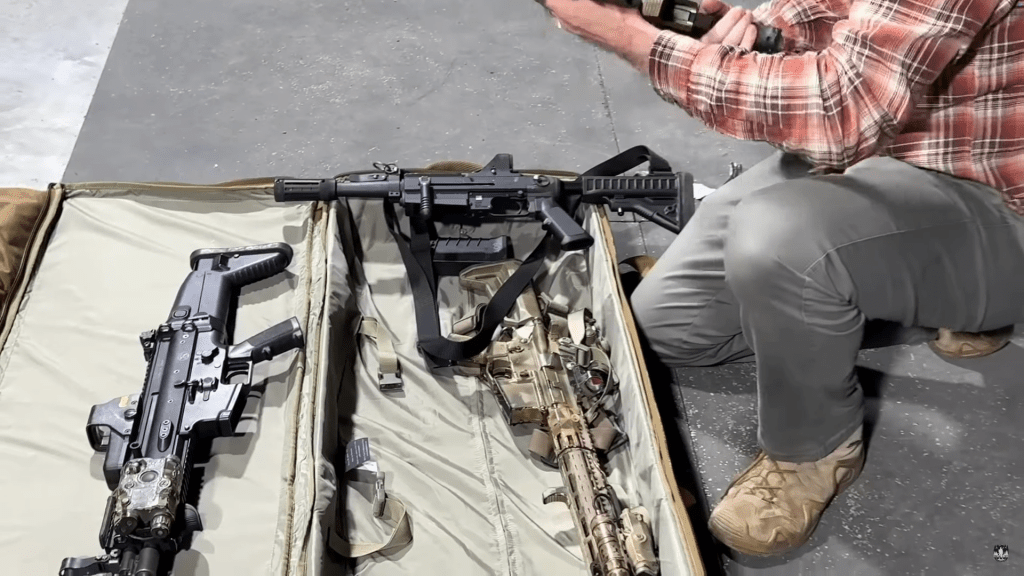
A recently shared video of a Ukrainian serviceman training with a US M26 MASS shotgun in the standalone configuration.


Support Us: If you enjoyed this video and article please consider supporting our work here. We have some great perks available for Patreon Supporters – including early access to custom stickers and early access to videos! You can also find us on the History of Weapons & War app. Thank you for your support!

Ukraine Begins Assembly of CZ BREN 2s

On Friday, it was confirmed that the CZ Bren 2 will be assembled in Ukraine. This marks the first partnership since Russia’s Invasion in February 2022, that will see foreign small arms assembled in Ukraine. The Bren 2 is a 5.56x45mm select-fire gas-operated rifle which was first introduced as the CZ 805 BREN in 2011. While CZ Bren 805s have appeared in Ukraine the BREN 2 is much more common and favoured by troops on the ground.

We’ll take an in-depth look at their use in a future article/video but a considerable number of Ukrainian units ranging from special forces units to regular army have been seen equipped with the Czech rifles. Visually confirmed variants in Ukrainian service include the initial 5.56x45mm BREN 805 and later BREN 2 in various barrel lengths and configuration including the 8 inch barrel carbine with both side folding and telescoping stocks and the much more common rifles with side folding stocks and 11 and 14 inch barrels. There have also been a limited number of sightings of 7.62x39mm 8 inch barrel carbines and a number of 7.62x51mm BREN 2 BRs.

The first indications that production of the BREN 2 might be established in Ukraine came on 29 September 2023. During the first ever Ukrainian International Defence Industries Forum Deputy Minister of Defense Daniel Blažkovec stated that “the transfer of production of the Bren 2 “Sich” assault rifle” was a major, ‘flagship’ project.

Ukrainian Special Operations with CZ BREN 2s (via social media)

Sich (Січ) in Ukrainian refers to a historic form of fortified administrative and military camp used by Cossacks during the 16th century and later became associated with the Euromaidan in 2013. Since the name was used in September 2023, it has not appeared again.

In an announcement posted on 13 December, Ukraine’s state-owned defence corporation Ukroboronprom stated that the Ukrainian Defense Industry had begun licensed assembly of BREN 2s and that the agreement with CZ covers local assembly of rifles and will later include “full production of NATO-standard assault rifles in Ukraine”, the agreement was signed on 16 July 2024. Oleg Hulyak, Director General of Ukroboronprom, stated:

“Partnership with Czech colleagues will help to improve the provision of the needs of the Defense Forces of Ukraine in reliable and modern small arms produced in our country. In addition, another step has been taken towards the integration of our defense-industrial complex into the industrial chains of NATO countries,”

I reached out to Colt CZ Group for comment, Jan Zajíc, CEO of Česká zbrojovka, said in a statement:

“We are happy that together with our Ukroboronprom partners, we have successfully completed the assembly phase of the CZ BREN 2 assault rifle on the Ukrainian soil. Following the training of Ukroboronprom personnel at Česká zbrojovka, Ukraine is now able to deliver to its Armed Forces the CZ BREN 2 rifles assembled in Ukraine according to Česká zbrojovka‘s strict quality standards. We are ready to continue our cooperation in the future, all the way to full technology transfer.“

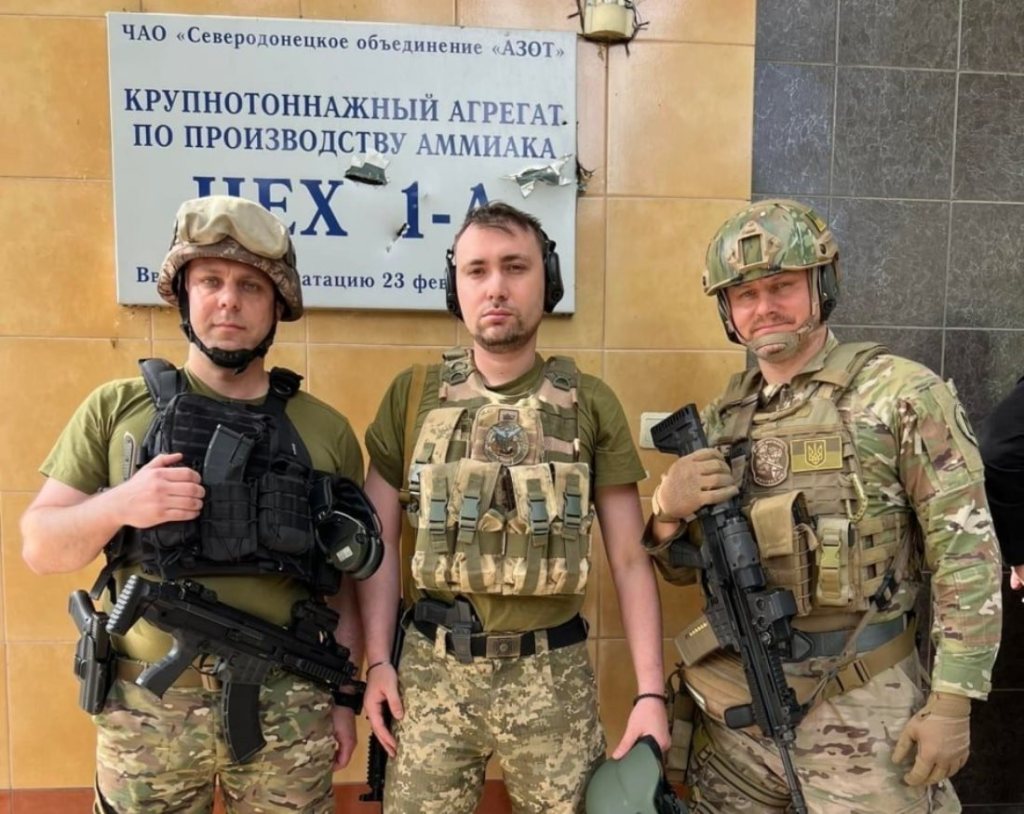
Ukrainian GUR chief, Kyrylo Budanov, and associates during a June 2022 visit to Sievierodonetsk. One individual has a 5.56x45mm CZ BREN 2 and the other a rare 7.62x39mm BREN 2 with an 8in barrel and telescoping stock (via social media)

Currently the only other country which has a similar arrangement with CZ is Hungary which has established Colt CZ Hungary to enable Hungary’s HM Arzenal to assemble/manufacture BREN 2s for the Hungarian armed forces. This isn’t the first time Ukraine has worked with external firearms manufacturers with an earlier partnership seeing Ukrainian small arms manufacturer Fort assemble Israeli IWI weapons under license in the 2000s. See our earlier look at the Ukrainian Fort Tavor bullpup rifles here.

The future significance of CZ’s establishment of an assembly line in Ukraine remains to be seen but as Ukraine seeks to further integrate with its Western allies and take up NATO standards the ability to produce a NATO calibre rifle, which is already in widespread Ukrainian service, will be extremely useful. From the statements released it appears that assembly of the rifles may be the first step towards localised production, it will be interesting to track CZ and Ukroboronprom’s partnership.


Support Us: If you enjoyed this video and article please consider supporting our work here. We have some great perks available for Patreon Supporters – including early access to custom stickers and early access to videos! You can also find us on the History of Weapons & War app. Thank you for your support!
Russian Anti-Drone AK-Buckshot Rounds

We have previously examined a couple of Russian efforts to develop small arms-based anti-drone weapons including the single-shot shotgun insert for GP-25 under-barrel grenade launchers and in the future we’ll examine the efforts to develop an anti-drone shotgun muzzle device which is now in production at several Russian companies. All of these efforts have one thing in common – they are seeking to turn the individual soldier’s rifle into a weapon capable of countering the enormous drone threat they are facing.

In this article/video we’ll examine perhaps the simplest attempt at creating counter-drone ammunition I’ve come across so far. While a number of Russian companies have developed specialist shotgun ammunition for increasing the probability of shooting down drones with 12 gauge shotguns there has been no official or commercial efforts to develop an anti-drone 5.45x39mm rifle round. The efforts examined here all appear to be localised with the concept disseminated via social media.

In early July, a video showing a Russian combatant making home-made buckshot cartridges for their AK-74 pattern rifles was shared. The quoted caption read: “To combat annoying drones, our soldiers are remaking AK cartridges by inserting buckshot charges in them in a dielectric heat shrink.” In the video the Russian combatant demonstrates filling a length of electrical wire insulation sleeving with ball bearings, pushing them in with what appears to be a tent peg. He then uses a candle to heat shrink the sleeve around the ball bearings and then takes a 5.45x39mm cartridge, with the projectile pre-extracted, and places the ball bearings into the cartridge case, down on top of the propellant. He then heat shrinks the exposed ball bearings and hand crimps the case neck around them.

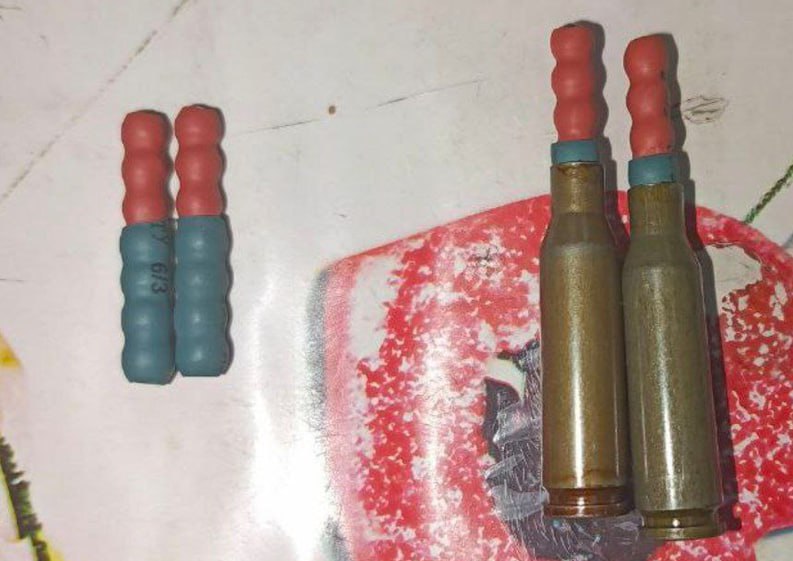
Since the July video I didn’t come across any imagery showing the buckshot until November, when interest in the concept seems to have increased with a flurry of posts on Russian telegram channels discussing the manufacture of the rounds and their pros and cons. The first of the second wave of posts came on 12 November, with a telegram channel sharing a photograph of two buckshot 5.45x39mm cartridges alongside two sleeves of seven ball bearings. The post makes some interesting observations; suggesting alternating the loading the magazine with the buckshot and tracer rounds. The post also mentions that the 4.5mm diameter of the shot is smaller than the diameter of the barrel and that this will likely impact ‘accuracy’ – though I suspect this is just one of numerous factors which will impact on effectiveness of the rounds. The post also notes that the plastic sleeving is likely to gum up the barrel’s rifling which will in turn impact the accuracy of the rifle and could lead to catastrophic fouling. The post concludes by suggesting while the idea is flawed if you don’t have a shotgun available the improvised buckshot is better than nothing.

Two days later on the 14 November, a video showing the assembly of a buckshot round identical to those seen in the previous photograph was shared. A Russian combatant fills a cable sleeve with seven Crossman 4.5mm (.177) ball bearings, he heat shrinks it with a lighter and then puts the shot into another slightly wider piece of sleeve which he also heat shrinks. Then he hand seats the shot in a standard 7N6 cartridge case and uses a pair of pliers to crimp the case neck.

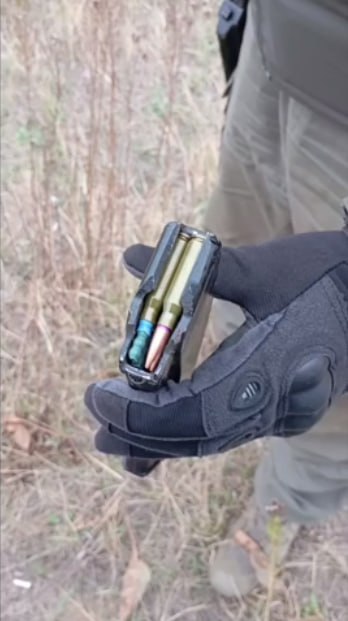
On 16 November, the first video claiming to show the buckshot in action was posted. The clip begins with a drone feed video showing a lone Russian combatant in a trench system before cutting to helmet camera footage showing the combatant firing up at a passing FPV drone, he appears to successfully clip one of the drone’s rotors. The footage may have been filmed at a training range. Alongside the video they posted a photograph of a magazine loaded with the buckshot. The post’s caption again recommends alternately loading the magazine, this time with a sequence of ball ammunition and buckshot, claiming that “this sequence allows you to fight air targets as effectively as possible”.

On the 18 November, the same channel shared a short post explaining how the buckshot cartridges are assembled and what is needed. The post shows the same photograph that was shared on 12 November. This post suggests using the buckshot with a mix of tracer when firing from vehicles and standard ball ammunition when on foot.

Another Russian channel uploaded a pair of videos on the 29 November, one showing the assembly of a buckshot cartridge and a demonstration video. The first video shows several individuals in a workshop assembling the buckshot cartridges. Several individuals are working on different states of assembly with one feeding the shot into the plastic sleeving, another using a heat gun to shrink form the sleeving, another pulling projectiles from 5.45x39mm cartridges and another cutting the sleeve of shot to length, about six ball bearings, before seating it in a cartridge. This process shows production at a more significant scale.

The second video shows a demonstration of the rounds being fired from an AK-74. In the video the combatant recommends not using the rifles standard muzzle-brake to in feat of the shot striking it. The combatant then empties a magazine of buckshot, though its difficult to make out if the entire magazine is buckshot or if there is a mix. The video then shows the target downrange, a sheet of metal, perforated with a significant dispersal pattern.

A post on another Russian telegram channel shared on 3 December, included the earlier videos along with a couple of photographs of a pair of jungle-taped magazines alternately loaded with the buckshot and a mix of ball and what appears to be black-tip armour piercing 7N22. Interestingly, the post suggests that the alternated non-buckshot rounds ‘clean’ the bore of any residue from the plastic sleeving.

The most recent sighting of the buckshot, at the time of writing, were published on 5 December. They include a range video which demonstrates the buckshot, with the caption claiming that from 14 rounds fired there were “41 punctures in the target”, the target appears to be about 25 feet (8 metres) away. It is worth noting that the rifle’s muzzle-brake has been removed. In the replies to the post a photo of some buckshot rounds was shared showing them alongside a length of sleeving filled with shot and a bottle of Crosman ball bearings.

The final video shared on 5 December again shows the typical production of the home-made buckshot rounds. This time lead shotgun pellets are used rather than ball bearings. The caption of the video notes that it is essential to clean the rifle after using the buckshot ammunition. It also notes that the main strength of the home-made ammunition is that its simple and instantly on hand if a soldier carries a magazine loaded with it, then he can quickly load and engage a drone.

The development of the home-made 5.45x39mm buckshot is certainly intriguing and at short ranges, from the available imagery, appears to have some merit. It enable an combatant armed with an AK-74 to theoretically engage a drone with a potentially slightly improved hit probability – though they may have to operate with their muzzle-brake permanently removed. Drones remain one of the key battlefield threats for combatants in Ukraine but it is unlikely this ad hoc solution is effective against drones at ranges of more than 20 yards. The dispersion of the five to seven shot is extremely unpredictable given it is being fired from a rifled barrel and there is not choke.

Many Russian posts discuss the potential for damage to the rifle and while this is certainly possible, especially when using the steel BBs rather than lead shot, the user however, is unlikely to be firing hundreds of rounds of the buckshot – especially given how time consuming production appears to be. Fouling from the plastic cable sleeves used may also have detrimental effects and cause barrel obstructions. It’s also unclear how reliably the round will feed given the varied projectile length and lack of rigidity when feeding. Additionally, once in field conditions significant temperature changes could impact the integrity of the plastic sleeves. Never the less the idea is ingenious but it illustrates how urgently defences against FPVs and other drones are needed by troops in the field.

Update – 22/12/24: A clip of a Ukrainian testing a version of the ammunition with 6 ball bearings. He feels the concept has enough merit for it to be of some use. (Source)

Update – 24/12/24: Additional video of scaled production of the 5.45x39mm ‘buckshot’ rounds shared via telegram.

Update – 9/1/25: Another clip of Ukrainian’s testing the ‘AK buckshot’ concept.


Support Us: If you enjoyed this video and article please consider supporting our work here. We have some great perks available for Patreon Supporters – including early access to custom stickers and early access to videos! You can also find us on the History of Weapons & War app. Thank you for your support!
3D Printed Anti-Personnel Mines

In this article/video we’ll examine an an interesting and very simple 3D printed anti-personnel mine developed by the Ukrainians. The mines are similar in purpose and size to the Russian PFM-1, the so-called ‘Butterfly’ mines. However, their shape and form factor is similar to that of the larger PMN-4, but they are significantly simpler.

3D printed mine found in the field (via social media)

The 3D printed mine’s explosive filling is said to be around 30g, with an overall weight of 55g. The mine is made up of a two-part outer shell printed in PLA, or another similar plastic. The two pieces screw together and a layer of plastic explosive is in the bottom half of the shell along with a percussion initiator of some sort. The top half of the mine has a small  metal Philips-head screw protruding down through the top, this acts as a striker for the initiator. There is a tube protruding up from the lower half of the mine, printed as part of the body, which likely guides the screw and holds the initiator.

The mine appears to work along the principle of when stepped on the outer shell breaks and compacts allowing the screw to strike the initiator, detonating the mine.

An illustration of the mine’s layout and components (Alexis Midy/Midy Infographie)

The design is extremely simple and cost effective to produce, requiring only the simplest 3D printer, a screw and an initiator and explosive.

The first sighting of the mines I’ve been able to find was in a telegram post by a Russian sapper. In the post, on 6 October, he shared several photos of the mines found in the field and warned that Ukrainian drones are dropping them in the Kursk and Belgorod regions. Another photo of one of the mines was shared by another Russian combatant on 8 October.

A Russian telegram channel, enginner25, shared post showing multiple images of the mines and a video showing the internals.

3D printed mine opened to show explosive filling (via social media)

In another photo we can see that the mines are apparently dropped from plastic tubes suspended below drones. The photo only shows the top of the tube but it’s clear that a number of tubes are carrying a significant number of mines. The release mechanism for the lids of the carrier tubes appears to use something like 3mm Visco fuze, commonly used with fireworks, or igniter cord. Once initiated the fuze/cord burns away and releases the mines with the drone scattering them as it flies over an area.

The design of the mine is extremely simple but appears to be potentially quite effective, relying on the brittleness of the 3D printed shell to work. The mines seem to have been engineered to be quickly produced at scale rather than to make them undetectable to Russian sappers. However, if a non-metallic striker replaced the screw the mines would be even more difficult to detect.

Assorted 3D printed mines (via social media)

While not the first 3D printed explosive device to emerge from the fighting in Ukraine, this mine is certainly one of the smallest and simplest. How widespread their deployment is, is still unclear but they seem they would be a useful part of Ukraine’s drone-deployed mine interdiction efforts behind Russian lines.

Thank you to Roy for drawing my attention to these mines.

Update 22/12/24: A new Russian video showing the internals of the mine and giving a better look at the percussion initiator (source).

Update 5/7/25: A Ukrainian video showing the testing of a 3D printed mine.


Support Us: If you enjoyed this video and article please consider supporting our work here. We have some great perks available for Patreon Supporters – including early access to custom stickers and early access to videos! You can also find us on the History of Weapons & War app. Thank you for your support!
A Pair of Interesting Heckler & Koch Marksman Rifles Appear in Ukraine

This week has seen photographs of two intriguing 7.62x51mm Heckler & Koch rifles appear, they feature what appears to be an iconic, and extremely rare, PSG1 and an HK G28E. The first photograph was shared by pmc_ua and universal_mobility_group on Instagram on 14 November. In the photograph a pair of two Ukrainian marksmen pose with an SVD and a PSG1, no further images of the rifle have been shared.

What appears to be a PGS1 at a Ukrainian range session (via social media)

The PSG1 was introduced by HK in the early 1970s as a semi-automatic precision rifle. It is unclear where the PSG1 was acquired from but this is the first time I’ve seen one of the rifles appear in Ukraine. The PSG1 is based on the G3, and as such uses a roller-delayed blowback operating system. Its accuracy is reputed to be better than 1 MOA, the rifle appears to have an original  Hensoldt ZF 6×42 PSG1 scope.

Illustration from an H&K catalogue page for the PSG1

PMC_ua, who shared the photograph, confirmed that the rifle is “used where there is an opportunity, fighting and training” but gave no further details. The PSG1 may have been acquired via civilian channels or may have been transferred to Ukraine as aid by one of the many countries who acquired the PSG1 in small numbers over the years. While the PSG1 is of Cold War vintage, the rifle continued to be offered into the 2010s by HK and it is still a very accurate, capable rifle.

The second image was shared on Instagram, on the 17 November, and features what at first glance appeared to be an HK G28 but may also be the civilian-available HK G28Z. The rifle is held by a member of the 3rd Separate Assault Brigade and is equipped with a thermal weapon sight.

A probable HK MR308 A3-28 at a Ukrainian range (via social media)

The rifle has free-floated 16.5 inch barrel, a bi-pod and a vertical front grip mounted on its forend. It is loaded with a 10-round magazine and is fitted with what appears to be an Ase Utra DUAL762-S-BL suppressor. A small number of the RAL 8000-coloured MR308 A3-28s have recently appeared on the civilian market in Ukraine, with one private listing one of the rifles for 29,5000 UAH or $7,145.

HK G28Z (Heckler & Koch)
HK G28 (Heckler & Koch)

An additional photograph showing the rifle being fired was shared in an Instagram story by one of the individuals in the first photograph. This photograph gives us a better look at the receiver of the rifle and shows that the upper is painted/coated rather than treated. This indicates that the rifle is either a G28 or the civilian G28Z variant. [Thank you to CaliFlori for pointing out this detail].

It’s not uncommon to see civilian, semi-automatic, firearms used by Ukrainian personnel. This is more common in terms of precision platforms but various semi-automatic 5.56x45mm platforms are also regularly seen, including HK MR223s and patrol variants of the MR308.

A second photograph of the MR308 A3-28 at the range (via social media)

Two subsequent photographs shared by one of the individuals in the initial photograph clearly show the rifle’s lower receiver markings, confirming that the rifle is an HK G28E, not a commercial G28Z. The ‘E’ suffix indicates ‘export’.

The same Ukrainian combatant, who appears to be a member of the GUR, also shared a photograph of ammunition he is using with the rifle. US-manufactured Mk316 Mod 0 is a match-grade cartridge which uses a 175gr projectile. While the ammunition was likely provided by the US, the origins of the rifle are unconfirmed.

It is intriguing to see two generations of Heckler & Koch’s semi-automatic precision rifles appear in Ukraine within days of each other.


Support Us: If you enjoyed this video and article please consider supporting our work here. We have some great perks available for Patreon Supporters – including early access to custom stickers and early access to videos! You can also find us on the History of Weapons & War app. Thank you for your support!