This week we take a look at ‘The Outpost‘, a film that brings the story of Camp Keating and the desperate Battle of Kamdesh to the screen. With the decades long war in Afghanistan seemingly drawing to an end we thought now was as good a time as any to begin examining how the war has been portrayed on screen. Directed by Rod Lurie and staring Scott Eastwood, Orlando Bloom, Caleb Landry Jones ‘The Outpost‘ is a very well-made war film – perhaps even a modern classic of the genre.
In this video we’re taking a look at something very rare, a pre-1911 catalogue produced by Colt. But it isn’t a catalogue to order guns from. Instead, it’s a catalogue to order gun advertisements from! Old firearms ad from this period are fascinating and give us an insight into who markets company’s were aiming their products at.
The catalogue includes illustrations of pistols and entire print ads which could be printed locally. It covers most of the commercial Colt line ranging from Colt Model 1908 Vest Pocket pistols, to Colt Police Positive revolvers and Colt’s military automatic pistols.
New fangled Colt automatics (Matthew Moss)
The catalogue’s introduction explains Colt’s advertising strategy, saying:
“we advertise in the big national mediums to CREATE A DEMAND ON YOU for our arms; these advertisements are read by thousands of perspective customers IN YOUR LOCALITY, therefore YOU can obtain the benefit of SALE by local advertising.” It’s a sound enough strategy.
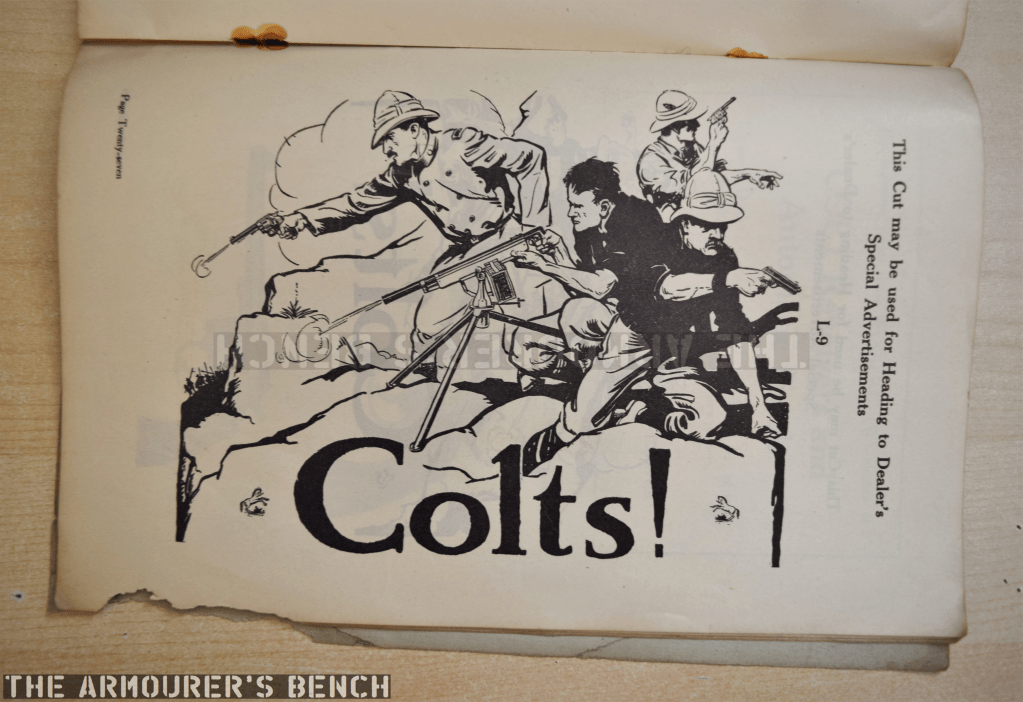
Only one ad includes a Colt product that isn’t a pistol. The ad above features an illustration which includes John Browning’s first machine gun, the Colt-produced Model 1895. It’s an evocative advert including revolvers, a semi-automatic pistol and the 1895.
Colt Model 1907 Military pistols, the predecessor of the 1911 (Matthew Moss)
One of my favourite parts of the catalogue covers Colt’s burgeoning automatic pistol line. This section actually helps us date the catalogue as there are no 1911s. It includes the Colt 1907 Military, the Colt 1902 Military, the Colt 1903 Pocket Hammer and the Colt 1903/1908 Pocket Hammerless automatic pistols.
Some of the illustrations of Colt’s revolvers available for printing (Matthew Moss)
The catalogue includes printable illustrations of the Colt ‘New Service’, the Colt ‘Army Special’, the Officers Model Target, the Police Positive Special, Police Positive and Police Positive Target. As well as some classics, with a full page of Colt Single Action Army revolvers.
Some cutaway diagrams of the Colt Pocket Hammerless (Matthew Moss)
The Colt advertisement catalogue is now part of our reference collection and we were able to bring this video/article thanks to the support of our Patrons. We have many more videos on important and interesting primary source materials in the works. If you enjoy our work please consider supporting us via Patreon for just a $1. Find out more here.
Check out videos on items from our reference collection here.
Don your flight suits and climb into the cockpit with us this wee as we discuss Strategic Air Command (1955). A film that blends beautiful aerial cinematography, awe inspiring aviation engineering and blatant Cold War propaganda. We’re joined by David Schroeder the host of the Cold War Channel to discuss this early Cold War classic which gives us a window into the objectives and operations of the USAF’s nuclear bomber arm – the Strategic Air Command.
This week we make our way through the atmospheric forests of North America to take on the latest screen adaptation of ‘Last of the Mohicans’. We’re joined by special guest Jonathan Ferguson, Keeper of Firearms & Artillery at the UK’s Royal Armouries, to explore Michael Mann’s 1992 epic. The film stars Daniel Day-Lewis, Madeleine Stowe, Russell Means, Wes Studi, Eric Schweig, and Steven Waddington and is set during the tumultuous French & Indian War. The film offers a more historically authentic telling of James Fenimore Cooper’s most famous novel and takes us on a trek through the North American frontier of the 1750s and gives us a love story amongst desperate sieges and viscous battles.
In this video/article we will examine some rare footage of the Covenanter Bridgelayer in action. The footage is available to watch on the BFIs website and originally comes from the Wessex Film and Sound Archive. The 16mm film was filmed at some time in August 1942 but little else is said about locations in the BFI archive entry for the footage.
The Covenanter Bridgelayer being demonstrated (IWM MH 3674)
The tank’s hull number is visible as T.18434 which I think would make it one of the earliest English Electric-built Covenanters. The covenanter was developed in the late 30s as a cheaper cruiser tank. It entered service in 1940, but saw limited active service – instead being largely used in training roles. The bridge element of the vehicle was a Scissors Bridge 30ft, No. 1. – it was deployed and recovered by a clutch and 2 to 1 reduction gear, it was powered directly from the tank’s engine.
Cruiser Mk V Covenanter III (A13 Mk III) (IWM KID 778)
A US report on the Covenanter Bridgelayer explains how it worked:
“The opening of the bridge begins after the launching mechanism has begun to pivot on the rollers of the launching frame. Since the cables are of fixed length, they act to open the bridge as it is pivoted about the rollers. Having been laid across the obstacle, the bridge is disengaged from the prime-mover [the tank itself]. The bridge is then ready for the passage of other vehicles. To retrieve the bridge, the prime-mover crosses the bridge to the far side of the obstacle, hooks up to the bridge, pulls it back to the traveling position, and is then ready to proceed to the next obstacle.”
Illustrations of the Covenanter Bridgelayer from a US Military Intelligence Service Tactical and Technical Trends report, 1942
The bridge had a span of 34 feet and vehicles up to 30 tons could cross it. It could be deployed in under 3 minutes and in total the bridge and the system which launched it was 3.5 tons. The vehicle had a two man crew, with a driver and a commander.
Above is a British Pathe newsreel that gives us a closer look at some of the Bridgelayer’s mechanism at work.
The US report also noted that “In one case 1,200 successful launchings and recoveries were made by one vehicle without undue maintenance.” The system was only mounted on a small number of Covenanters. One source suggests 20 Covenanter I and 60 Covenanter IV tanks were converted into Bridgelayers. Far more Valentines were equipped with them and subsequently the Churchill AVRE became the British Army’s primary bridging tank.
A later Valentine Bridgelayer in action in Burma, 1945 (IWM)
No location is given for the footage but the presence of a number of barrage balloons to the rear is intriguing! It may have been filmed at the Royal Engineers Establishment at Christchurch or at another demonstration elsewhere. Scissor Bridges, with similar basic designs remain in service with numerous militaries around the world today.
If you enjoyed this video and article please consider supporting our work here. We have some great perks available for Patreon Supporters. You can also support us via one-time donations here.Thank you for your support!
Bibliography:
‘Covenanter: Reservist Tank’, Tank Archives, (source)
‘A Home Guard parade and an inspection by the Duke of Kent’, BFI, (source)
Tactical and Technical Trends, No.15, Dec. 1942, Military Intelligence Service, War Department, (source)
This week we discuss 2016’s Siege of Jadotville, a film which portrays the valiant last stand of a UN contingent of Irish troops holding off an overwhelming force of mercenaries and rebels during Congo Crisis. With a veritable plethora of ally kit and guns the Siege of Jadotville is a well shot, competently made war film which tells a little known story. Starring Jamie Dornan as Commandant Pat Quinlan, alongside Mark Strong, Danny Sapani, Jason O’Mara and Guillaume Canet, the film is the first feature from director by Richie Smyth.
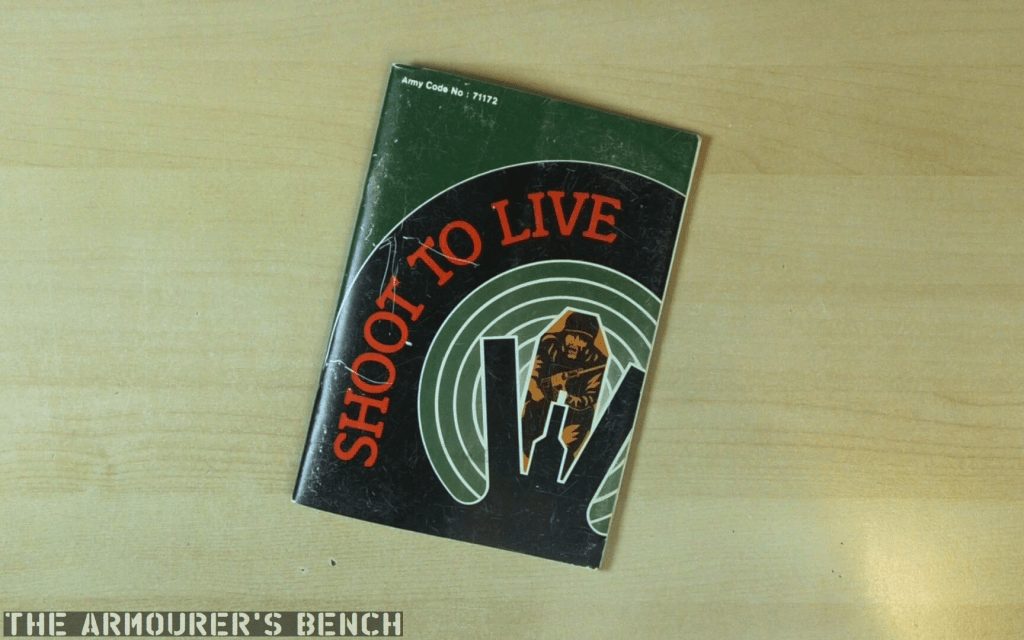
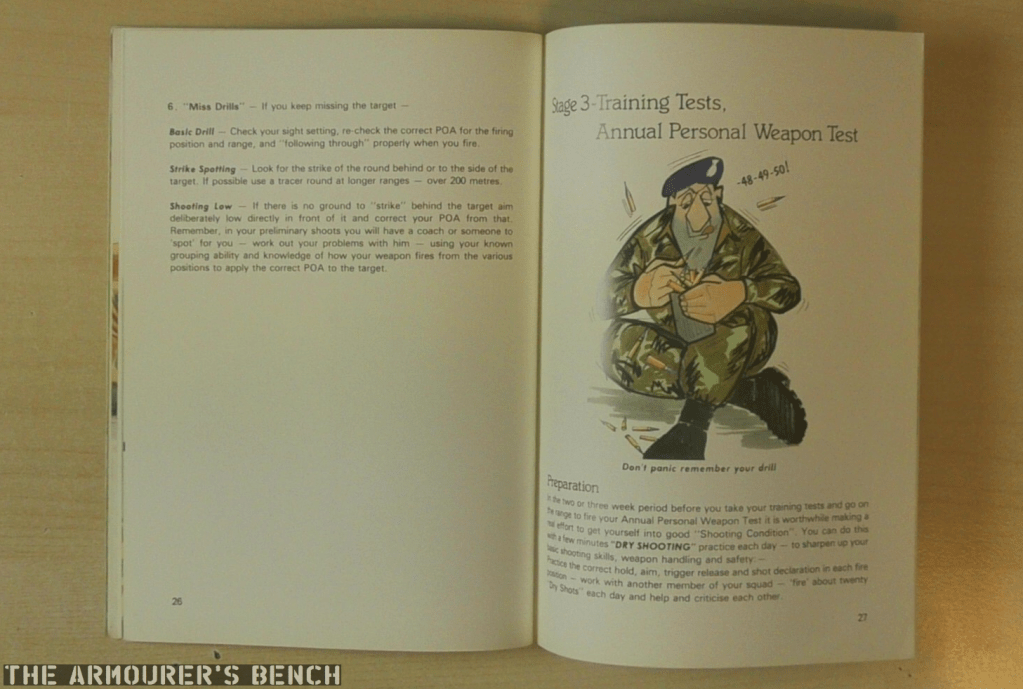
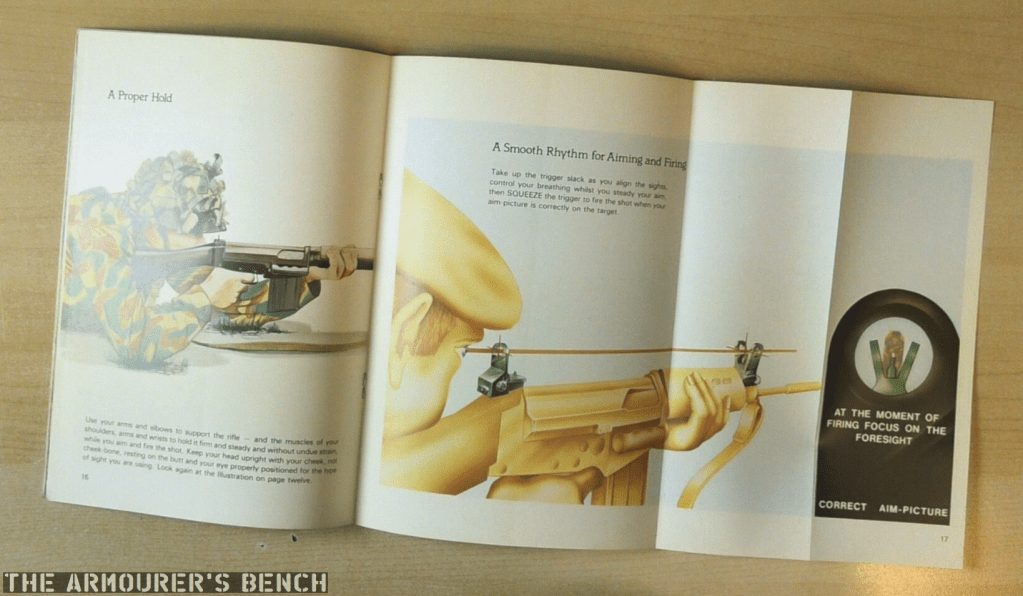
‘Shoot to Live’ is a British Army marksmanship training pamphlet published in the late 1970s and early 1980s
Shoot To Live cover (Matthew Moss)
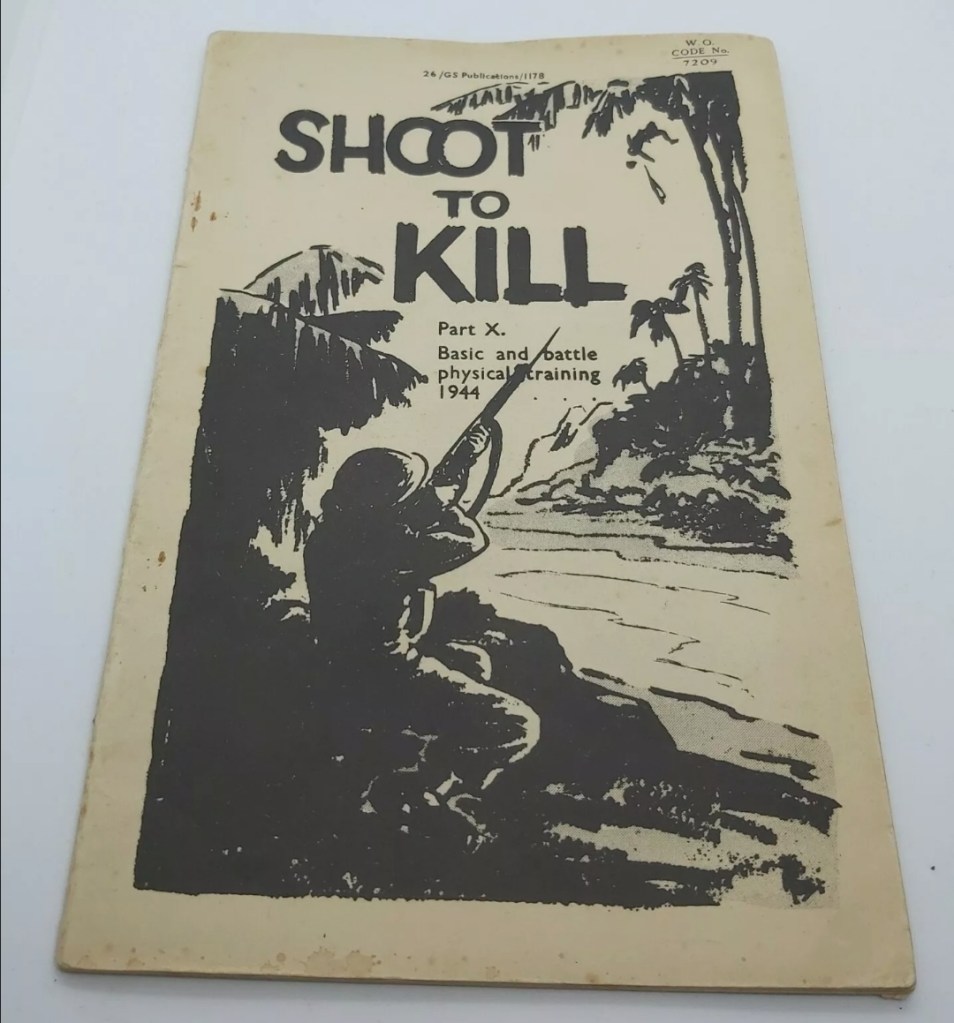
‘Shoot to kill’ had long been a British Army slogan, appearing in numerous training films and pamphlets. One training film from the 1970s, which features in our video, can be watched here.
A 1944 British Army manual – ‘Shoot to Kill’ (source)
But in the late 70s and early 80s a new introductory pamphlet on marksmanship filed the old slogan on its head. In the video above we take a look inside an original copy of ‘Shoot To Live’.
Below are some pages from the booklet:
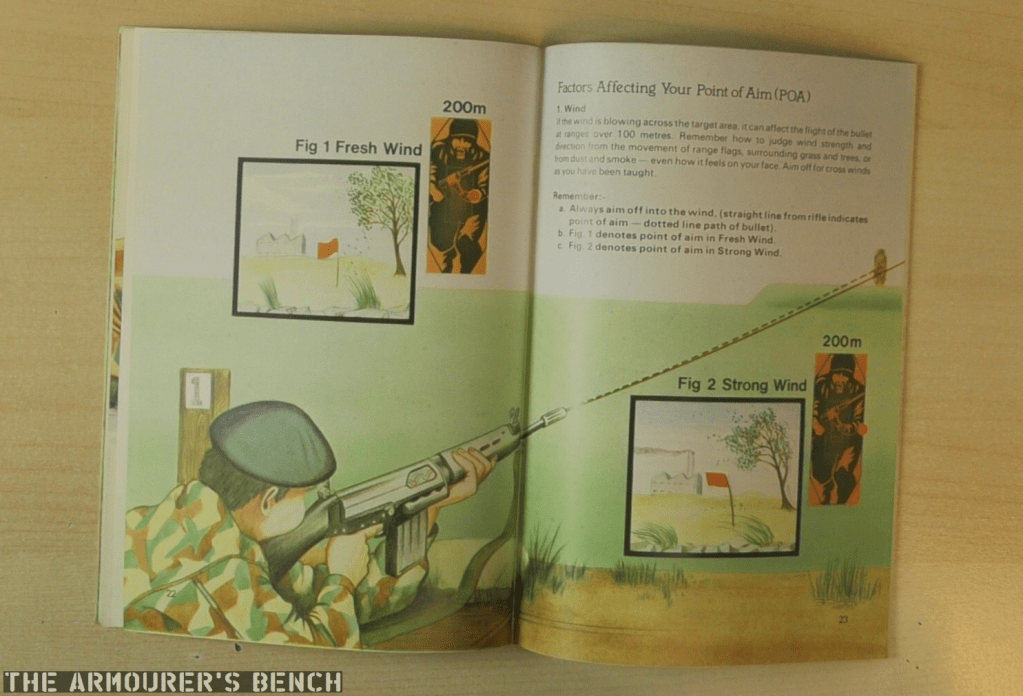
Shoot To Live section on compensating for wind (Matthew Moss)One of the more humorous illustrations from Shoot To Live, showing the loading of a magazine (Matthew Moss)Shoot To Live’s section on proper sight alignment (Matthew Moss)
The ‘Shoot To Live’ manual is now part of our reference collection and we were able to bring this video/article thanks to the support of our Patrons. We have many more videos on important and interesting primary source materials in the works. If you enjoy our work please consider supporting us via Patreon for just a $1. Find out more here.
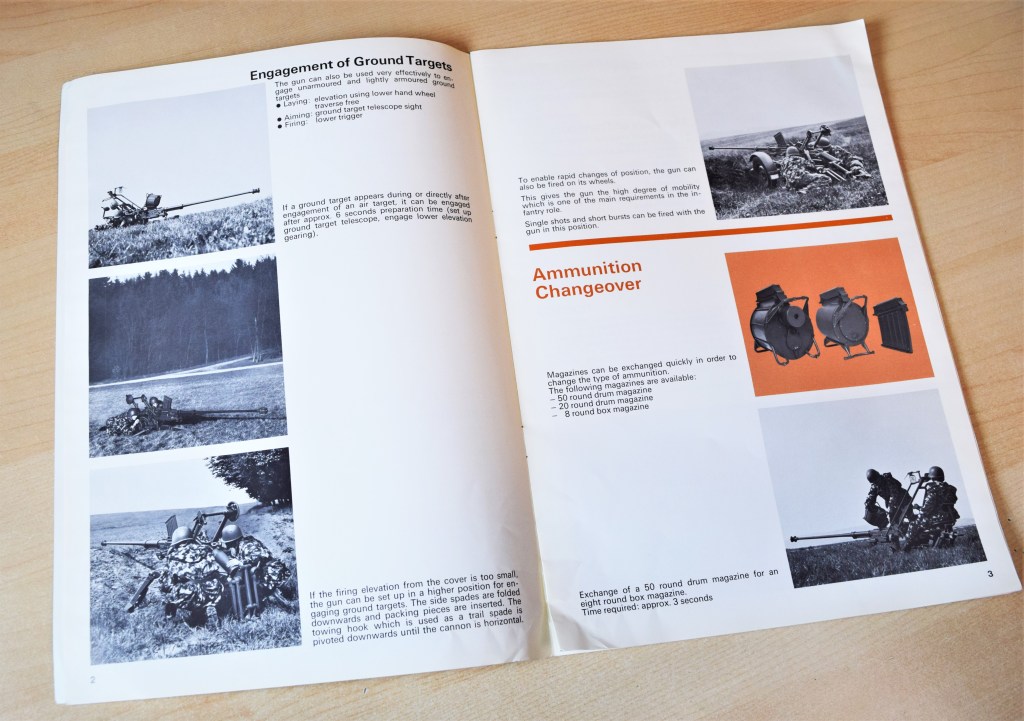
In this video we take a look at an original 1970s brochure for an Oerlikon 20mm Cannon. The booklet, printed in 1974, covers the Type GAI-BO1 – which had previously been designated the 10ILa/5TG. The Swiss Oerlikon had been introduced in the mid-1930s and seen widespread on both sides use during the Second World War.
Engagement of Ground Targets (Matthew Moss)
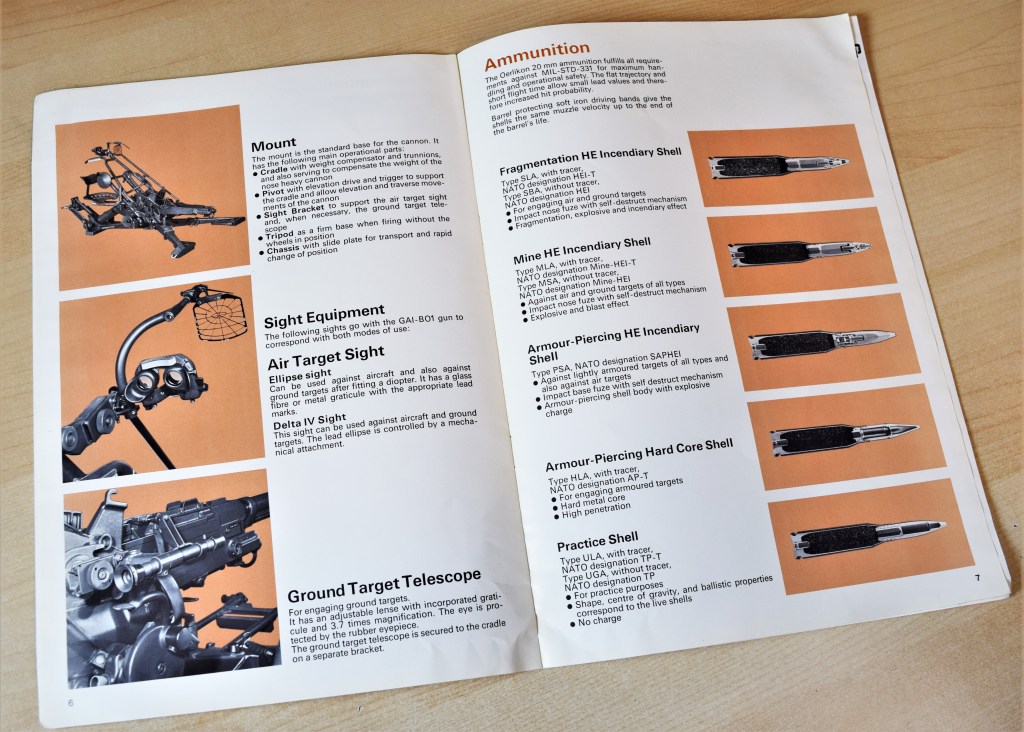
The brochure covers the anti-aircraft and ground roles the cannon was capable of fulfilling as well as explaining the major assemblies of the weapon and some of the accessories like sights and magazines. The brochure also lays out some of the ammunition available for the Oerlikon, ranging from practice shells to fragmentation HE incendiary and armour-piercing hard core shells. The Oerlikon cannon remains in production and in service with dozens of countries around the world.
Sights, mounts and ammunition (Matthew Moss)
The brochure is now part of our reference collection and we were able to bring this video to you due to the support of our Patrons. We have many more videos on important and interesting primary source material like this brochure in the works. If you enjoy our work please consider supporting us via Patreon. Find out more here.
With the UEFA European Football Championship (the Euros) starting this week we thought what better time to tackle a curious John Huston film staring no less than Michael Caine, Max Von Sydow, Sylvester Stallone, Pele and half of the Ipswich Town football club! It is of course ‘Escape To Victory’, a film which mixes football with a POW escape movie! We are joined by Ipswich Town fan and host of the excellent WW2TV, Paul Woodage, who brings his expert Ipswich Town knowledge to help us breakdown this unconventional war film!
A couple of weeks ago we looked at some photographs showing an interesting modification seen on a STEN MkII held by Deputy Prime Minister Clement Attlee. The STEN Attlee posed with had a front grip added, something the MkII didn’t typically come with.
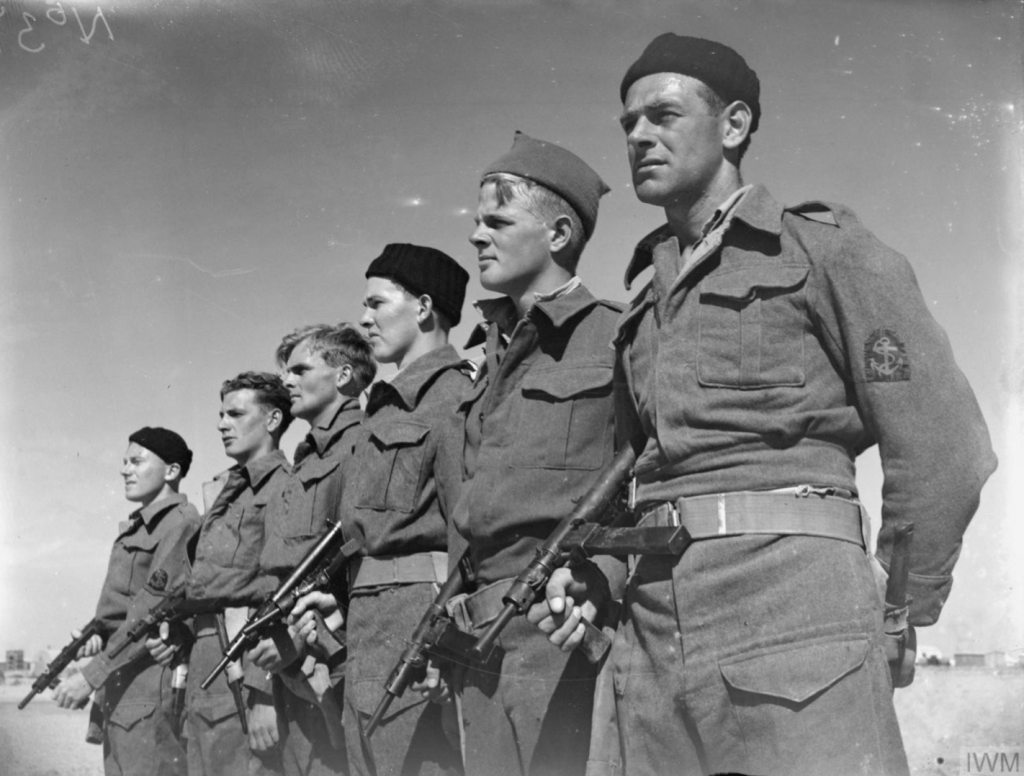
A few people very kindly sent me some other contemporary photos showing other ad hoc STEN front grips so I thought a follow up video was needed. I also found a group of photographs taken in June 1943 at the Combined Training Centre at Kabrit, in Egypt. The photos show groups of Commandos and the Royal Navy’s Naval Beach Parties armed with Stens with a pretty standardised style of front grip.
Commandos on parade with STEN MkIIs equipped with ad-hoc front grip, at Kabrit in June 1943 (IWM A17755)
In these photos we can see the men training with the STENs and the front grips are quite clear. It’s especially interesting in that it isn’t just the Commandos who have the front grips but also men of the Naval Shore Parties. It’s also relatively rare to see STENs in North Africa. You might have seen some of these photos, taken by Royal Navy photographer Lieutenant L.C. Priest, in our video looking at the unusual fighting knives the Commandos are equipped with.
The plethora of photos from Kabrit show a fairly standardised design for the grip. A metal ring, seemingly tightened by a wingnut on the left side and a generous wooden grip that was long enough to fit all four fingers on. The grip appears to have some finger grooves and a fairly standard shape. A photo (see above) of Naval Commandos on parade shows the men with the STENs tucked under their arms, holding the front grips. This is identical to how the STEN MkI with its front grip was paraded with. The photo also gives us a good look at the uniformity of the grips.
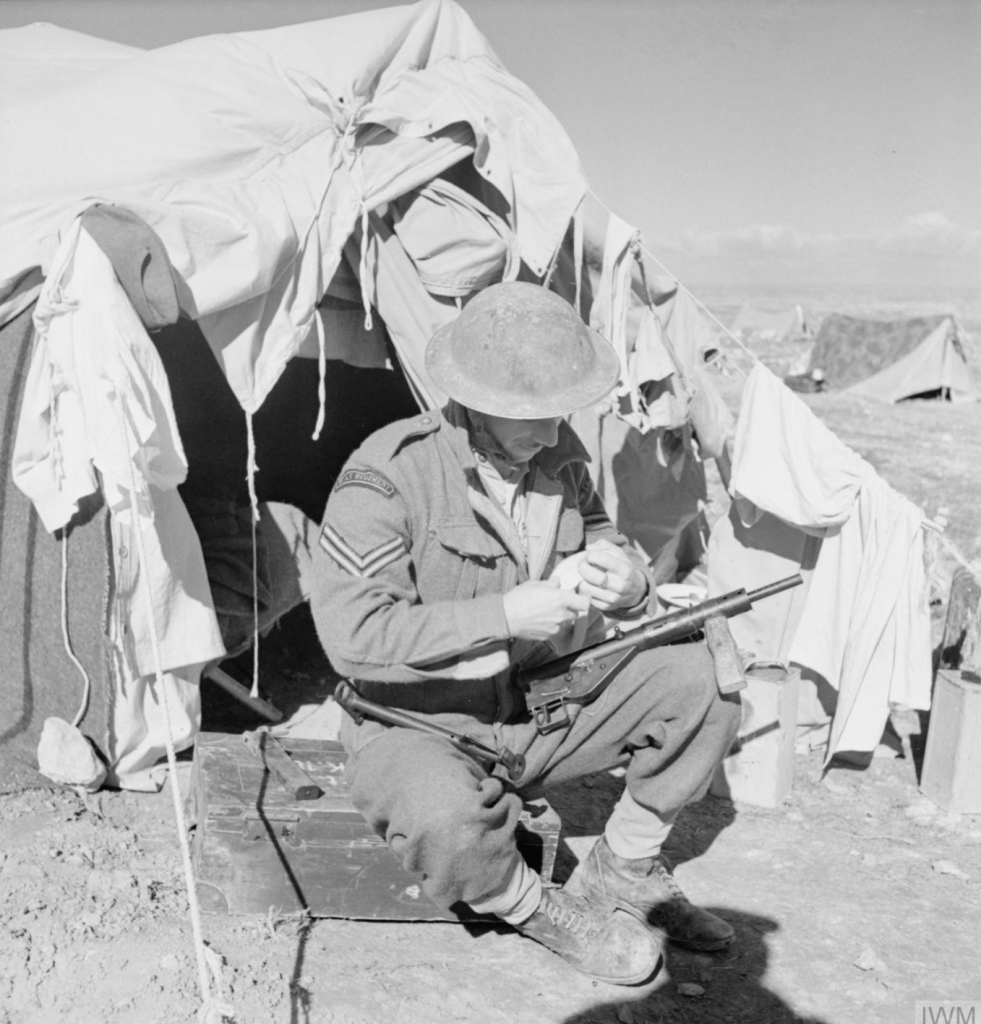
RAF Regiment Corporal cleans his STEN MkII, equipped with a makeshift front grip (IWM CM4296)
While the photos from the Combined Training Centre at Kabrit represent the largest number STEN front grips seen in one place and several units there are a few other photos which are really interesting. First up is this photograph of a Corporal from the RAF Regiment taken in Libya sometime in 1943. The Regiment had been formed just a year earlier. The corporal is sat cleaning his STEN MkII with the butt removed but the bolt still in the weapon. On the barrel nut of his weapon he has a wooden front grip. Again seemingly attached to a metal band around the barrel nut. The wooden grip appears to have some rudimentary finger grooves. Sadly, I couldn’t find any other photos of this Corporal and his STEN. But the design of his front grip is very similar to those seen in the Kabrit training photos and could well be of the same origin.
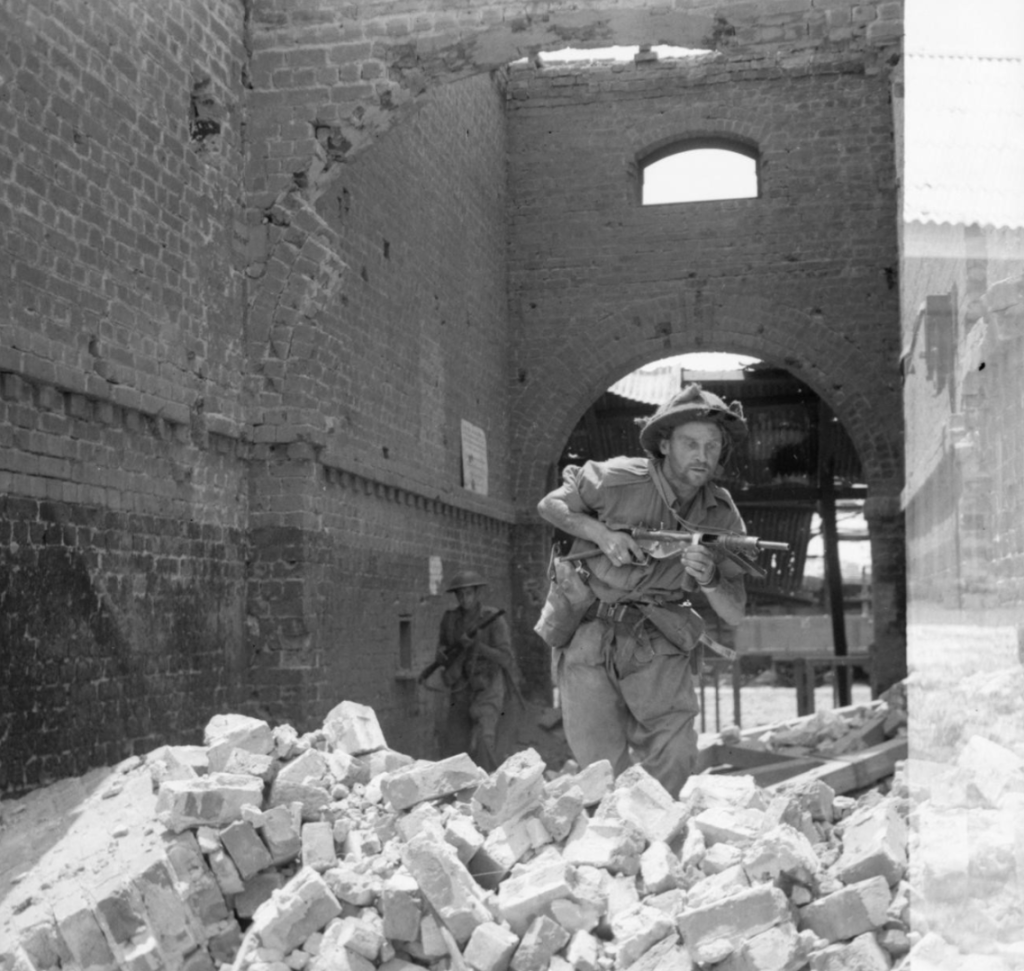
Finally, we have a photograph from a completely different theatre – Burma. The caption for this photograph reads: “Men of the 2nd York and Lancaster Regiment searching the ruins of a railway station for Japanese snipers, during the advance of 14th Army to Rangoon along the railway corridor, 13 April 1945.” This soldier’s STEN MkII has a grip just in front of the trigger mechanism cover and behind the magazine housing and ejection port. It’s actually in a position close to that of the original STEN MkI’s integral folding pistol grip.
Soldier of the 2nd York and Lancaster Regiment with a STEN MkII outfitted with a homemade front grip, Burma 1945 (IWM SE3804)
At the end of the day the adaptation is a good idea, a front grip provides a means of pulling the weapon into the shoulder and a more natural place to grasp other than the barrel nut, the trigger mechanism housing or the magazine – which was discouraged. It is interesting to note that I’ve yet to see any examples of a MkIII being fitted with a front grip like these.
This is certainly something I’m going to do more research into to see if there’s any documentary reference to the use of front grips like these. With the introduction of the MkV, with its front grip, it seems that the idea was sound enough. If you know of any other examples let me know in the comments!
If you enjoyed this video and article please consider supporting our work here. We have some great perks available for Patreon Supporters. You can also support us via one-time donations here.Thank you for your support!






 The Armourers Bench