Special Episode: The ArmaLite AR-10 (Pt.2)


If you missed the first part of our special episode on the AR-10 you can find it here!

Vic brings us the second part of his special episode looking at the story of the AR-10, with a very unique run down of various variants of Eugene Stoner’s weapon. Vic runs us through every production model made by Artillerie Inrichtingen as well as several special prototypes and transitional models.

After a recap look at an example of a Hollywood-made rifle Vic shows us how the AR-10 worked using an instructional cutaway model. Throughout the video Vic examines all of the major production guns, beginning with an early A.I. production gun that incorporates the same ‘beer can’ muzzle device as the original American-made rifles. Vic then takes us through a series of rifles that represent the evolution of the design.
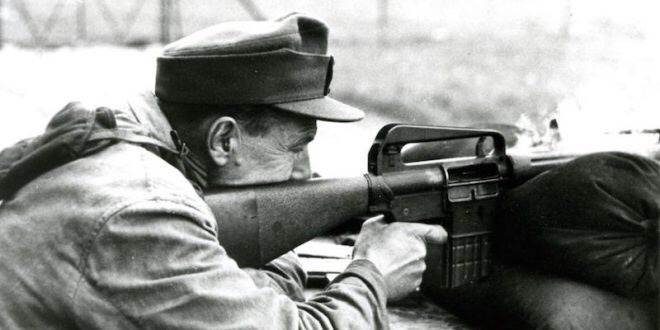
Photograph from the Bundeswehr rifle trials of a German soldier firing an AR-10B in 1957, the German’s classified the AR-10 as the G4 during the trials (source)

Beginning with the Cuban model, with its pencil profile barrel and top mounted gas tube. This model was also trailed by both the Dutch Army and the German Bundeswehr. Later in the video Vic gives us a quick look at the various German trials rifles the FAL (G1), the SIG 510-1 (G2), the H&K/CETME (G3) and the AR-10 (G4).
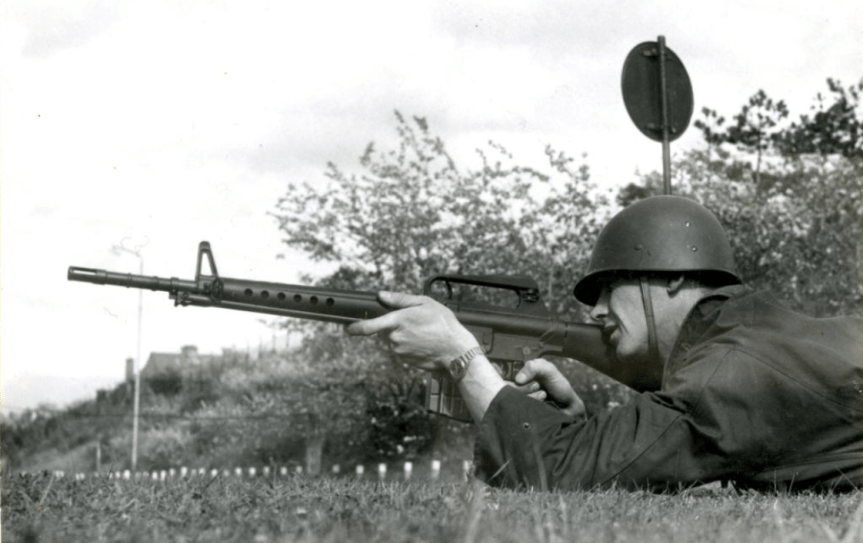
22222222
Soldier firing an AR-10 during the Dutch Army trials (source)

Vic follows the Cuban model with a look at the Sudanese Model, with its bayonet lug sleeve, and the Guatemalan variant which swaps out the bayonet lug for rifle grenade launching capability. The Sudanese military ordered 2,508 rifles from A.I.

tumblr_nqmmbtj7FT1s57vgxo5_1280
Caçadores Paraquedista with an AR-10 (source)

In addition to these Vic also gives us a look at an extremely rare prototype carbine, a sporter model (the AR-102) and a prototype squad automatic weapon with a heavier profile barrel.  Vic then takes us through the features of the final A.I.-made variant, the Portuguese or NATO model. The rifle was officially adopted by the Portuguese army’s Caçadores Páraquedistas (paratroops) and saw action in Angola, Portuguese Guinea and Mozambique.

Vic then takes a look at a series of rare variants and one-offs, including a rifle with green furniture made for Prince Bernhard, the Royal consort to Queen Juliana of the Netherlands, and a heavy barrelled magazine-fed squad automatic rifle with a rubber butt-pad and additional folding carrying handle.
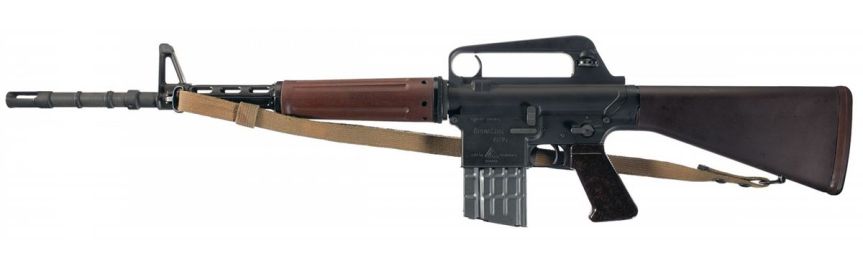
14554764_3
‘Transitional’ model AR-10 (source)

To round out the story of Artillerie Inrichtingen’s involvement with the AR-10, Vic is lucky enough to take a close look at an M1 Garand adapted to feed from surplus AR-10 aluminium waffle magazines. This concept was developed to equip the NATRES, the Dutch Army Reserve, and was based somewhat on the Italian Beretta BM-59. Vic shows us both a very early prototype BM-59 and one of only two A.I. Garand adaptation prototypes.

In the next part of the series Vic will examine several examples of the belt-fed AR-10. If you missed the first part of the series, which featured the early history of the ArmaLite AR-10 and a very rare original promotional film featuring Eugene Stoner himself, you can find that here!

If you enjoyed the video and this article please consider supporting our work here.


Bibliography:

The Armalite AR-10: World’s Finest Battle Rifle, J. Putnam Evans (2016)
Hybrid Sten

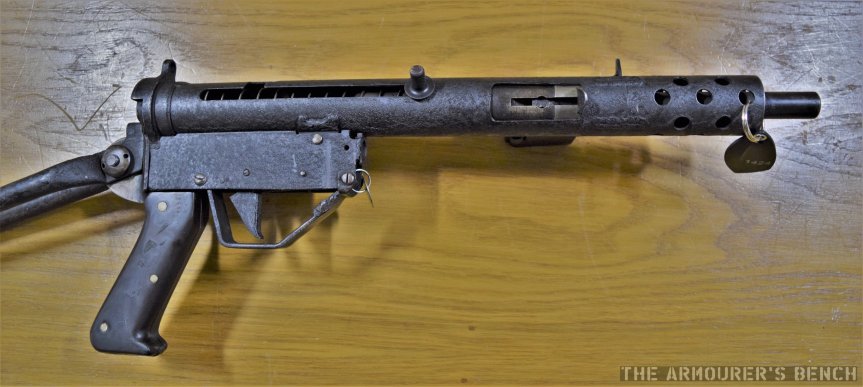
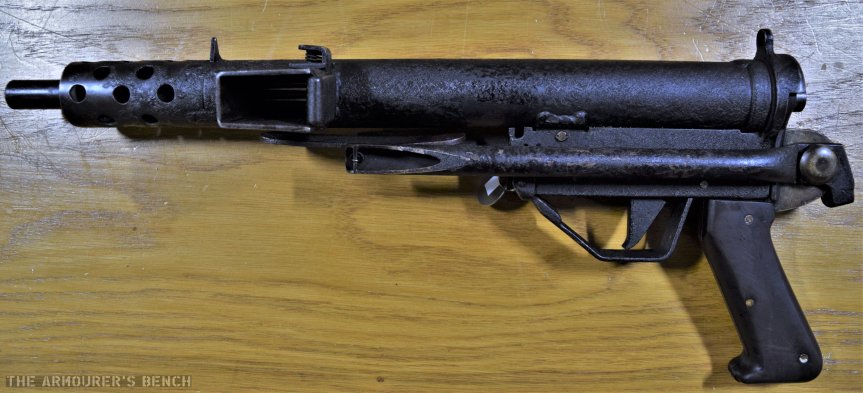
During our first research trip last spring I had the opportunity to examine an unusual ‘hybrid’ Sten submachine gun. The weapon combined a MkII Sten’s receiver with a MkIII’s magazine housing. Added to this was a proprietary folding stock and a new fire control group and pistol grip.

Very little is known about the hybrid Sten with Peter Laidler’s book The Sten Machine Carbine mentioning it and the later Osprey book by Leroy Thompson sharing a photograph and brief caption which calls it an “experimental version of the Mk III.” It is also unclear exactly when it was built.

Below are some photographs I took of the Sten, lets look at some of the interesting features of the Hybrid Sten.

DSC_0807
left side of the Sten with the stock folded flush under the receiver (Matthew Moss)

No production Variant of the Sten was fitted with an under-folding stock, the Australian Austen, however, directly copied the MP38/40. The entire weapon is covered by a layer of textured, crackle paint finish, this was commonly used on commercial Sterling Mk4 submachine guns. The weapon has a short, 3.5 inch, perforated fore-end welded onto the front of the tube receiver that appears to be from a Lanchester.

DSC_0803
Rear right of the weapon close up of its pistol grip, stock and trigger housing (Matthew Moss)

The under folding stock is rudimentary but effective, the butt plate swivels free but the lock up is quite secure. It uses the receiver main spring-loaded return-spring cap. The folding stock attaches to the pistol grip assembly (which can be seen detached below).

The proprietary rectangular trigger group housing brazed onto the tub receiver is unlike any other Sten and lacks a fire-selector.

DSC_0811
Left side of the Sten with its pistol grip and stock assembly detached (Matthew Moss)

The pistol grip itself is made from paxoline, a form of early resin plastic. The shape shape of the pistol grip does not resemble any production or prototype Sten grip. A simple hand-stop, made from a bent piece of sheet metal, has also been added in front of the weapon’s ejection port to prevent the user’s hand moving back and fingers being caught if gripped by the forend.

DSC_0802
Right side of the Sten with its stock unfolded (Matthew Moss)

While the origins of the hybrid Sten remain unclear I don’t believe it was an officially made prototype. While impressive it is relatively crudely assembled and does not match the Sten prototypes made by Enfield, such as the VI. Intriguingly, the magazine housing of the weapon has been stamped ‘PILOT’ below the usual ‘STEN MkIII’ stamp. I suspect that the weapon may have been put together by a unit armourer, perhaps authorised by a superior officer to suggest improvements or as an unofficial project gun.

UPDATE:  Their is some evidence emerging that this Hybrid Sten may be related to the T42 Sten prototype, part of the Sten MkIV development program. Where this hybrid fits into the story is not yet clear but the similarities are striking, when we have more information we will revisit this weapon.

If you enjoyed the video and this article please consider supporting our work here.


Technical Specifications:

Length (with stock folded): approx. 40cm (30in)
Weight: approx. 3kg (7lb)
Barrel Length: 16cm (6.5in)
Action: Blowback
Calibre: 9x19mm
Feed: 32 round box magazine
Cyclic Rate: approx. 500 rpm


Bibliography:

The Sten Machine Carbine, P. Laidler (2000)

The Sten Gun, L. Thompson (2012)


Please do not reproduce photographs taken by Matthew Moss without permission or credit. ©The Armourer’s Bench 2018.