On 6 November, the French arms manufacturer Verney-Carron, through its defence brand Lebel, announced the signing of a framework contract with Ukrspecexport, a Ukrainian state-owned arms trading company which is part of Ukroboronprom. The contract covers the production of a substantial number of small arms including carbines, precision rifles and 40mm grenade launchers.
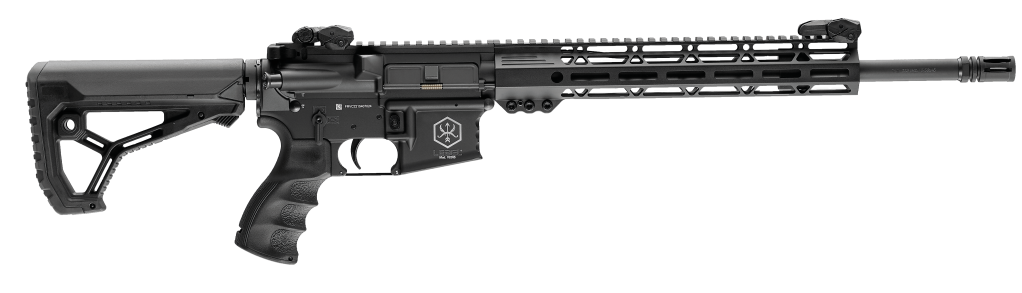
VDC15 (Lebel)
The contract is worth 36 million Euros ($38.5 million) and includes 10,000 assault rifles, 2,000 precision rifles and 400 grenade launchers. The contract will need to be funded from Ukrainian and French sources with initial delivery scheduled for early 2024, with delivery to be spread over the next 10 months. The announcement makes no mention of spare parts or support as part of the contract.
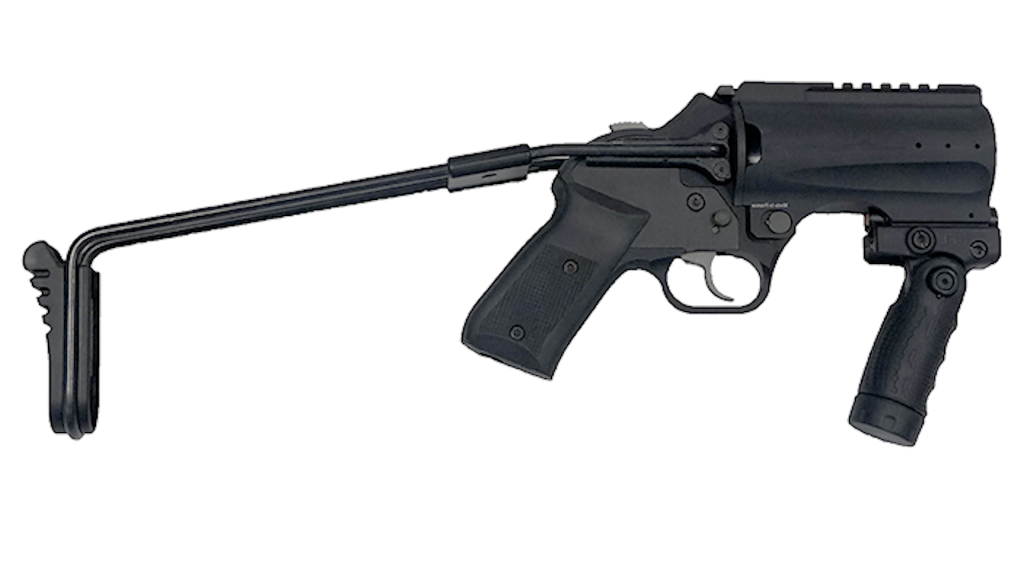
The contract will likely see the delivery of Verney-Carron’s VCD15, an AR-15 pattern rifle available in various configurations but chambered in 5.56x45mm or .300 BLK and based on Stoner’s internal gas system. The 2,000 precision rifles are probably Lebel’s VCD10, which was introduced in 2018 and is a precision AR-10 pattern rifle chambered in 7.62x51mm or .260 Remington. The 400 grenade launchers will likely be the compact LP40, a 40x46mm standalone launcher, which weighs 1.3kg, has a removable stock and a folding front pistol grip.
LP40 (Lebel)
It’s unclear which branch of the Ukrainian Armed forces the small arms will be destined for but they represent a substantial number, enough to equip a brigade or two. In terms of aid France has already provided a wide range of weapon systems and military equipment including self-propelled artillery, armoured personnel carriers, mines, anti-tank guided missiles, small arms, hand grenades and air defence systems.
Support Us: If you enjoyed this video and article please consider supporting our work here. We have some great perks available for Patreon Supporters – including early access to custom stickers and early access to videos! Thank you for your support!
The MT-LB tracked artillery tractor has become one of the most recognisable armoured vehicles of the war in Ukraine. These versatile vehicles are used by both sides in huge numbers and while first introduced in the 1970s they continue to be used as both armoured personnel carriers and also as the platform for a plethora of weapon systems ranging from rocket pods to auto-cannons to MT-12 anti-tank guns.
In this article/video we’ll look at two specific MT-LB adaptations; one Russian, one Ukrainian.
Russian MT-LB adaptation with a 2M-3 turret which was first seen in March 2023 (via Social Media)
Russia’s Turreted MT-LB
In March 2023, a number of photographs and videos emerged of Russian MT-LBs which had been fitted with a large turret complex over the rear portion of the vehicle. The turrets are naval 2M-3s which mount a pair of 25mm 110-PM autocannons. The first images surfaced at the beginning of March. The strikingly ugly turret quickly led to ridicule on social media and numerous memes mocking the vehicle. Between the 8 and 10 March a series of short videos showing the turret-adapted MT-LBs on the move. One video showed several vehicles in a yard with a large crane, perhaps suggesting they had been off-loaded. The person filming the video notes that the unusual turrets and were apparently ‘sent for defence’. The footage features at least five turreted-MT-LBs, one appearing to also have an adapted front commander’s turret.
Another clip, shared around 10 March, shows a transport train with numerous vehicles loaded, including some Russian Military Police vans. Two (possibly four) of the adapted MT-LBs can be seen. Similarly, another clip showing the vehicles in transit through an urban area features one perhaps two adapted-MT-LBs.
Other examples of Russian MT-LB adaptations with 2M-3 turrets (via Social Media)
Since the early spring there have been no sightings of the vehicles but in late May a video and several photos were shared featuring a Russian combatant riding in the turret of one of the adapted MT-LBs, the anti-aircraft style style sight can be seen in the video and one of the photographs.
Russia is likely making use of turrets that have been in storage since the vessels they were mounted on were decommissioned. Their is probably still an ample supply of ammunition for the 25mm autocannons. The mount has -12° to +85° elevation and 360° rotation giving it a good field of fire for use against ground targets.
Just what role Russia envisioned for the turreted MT-LBs is still unclear. They could be used in direct fire roles perhaps as support guns which can help plug gaps in defensive lines with suppressive fire. Or perhaps as mobile anti-aircraft vehicles for taking on drones but their limited manual targeting would mean they would struggle to be a match for even slow moving drones. Other potential uses might be as assault guns or as a more heavily armed vehicle for internal security duties protecting supply lines from Ukrainian partisans.
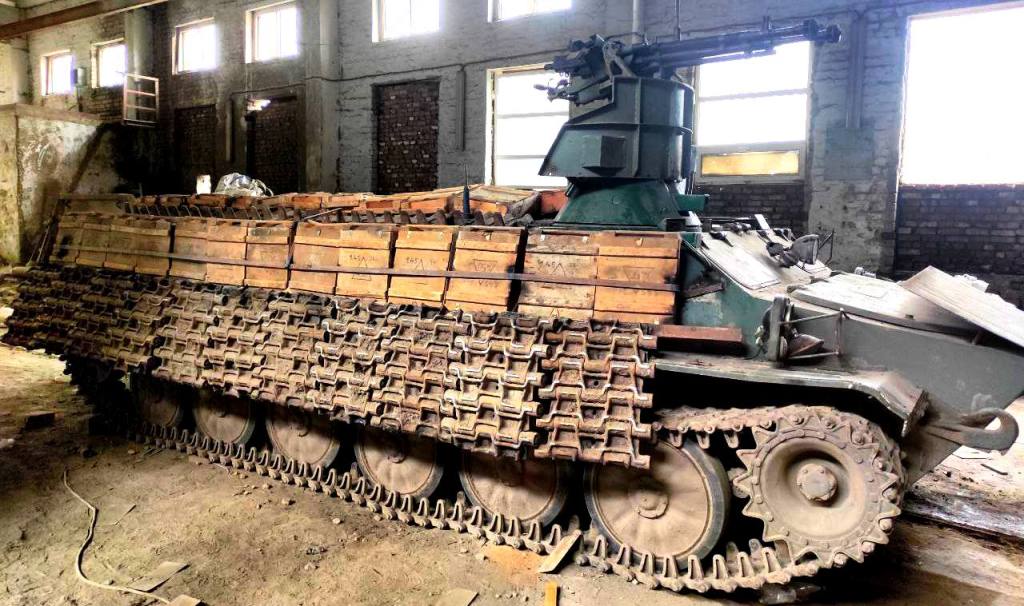
Ukrainian MT-LBu adaptation with a KPV heavy machine gun remote weapon system (via Social Media)
Ukraine’s MT-LB Refits
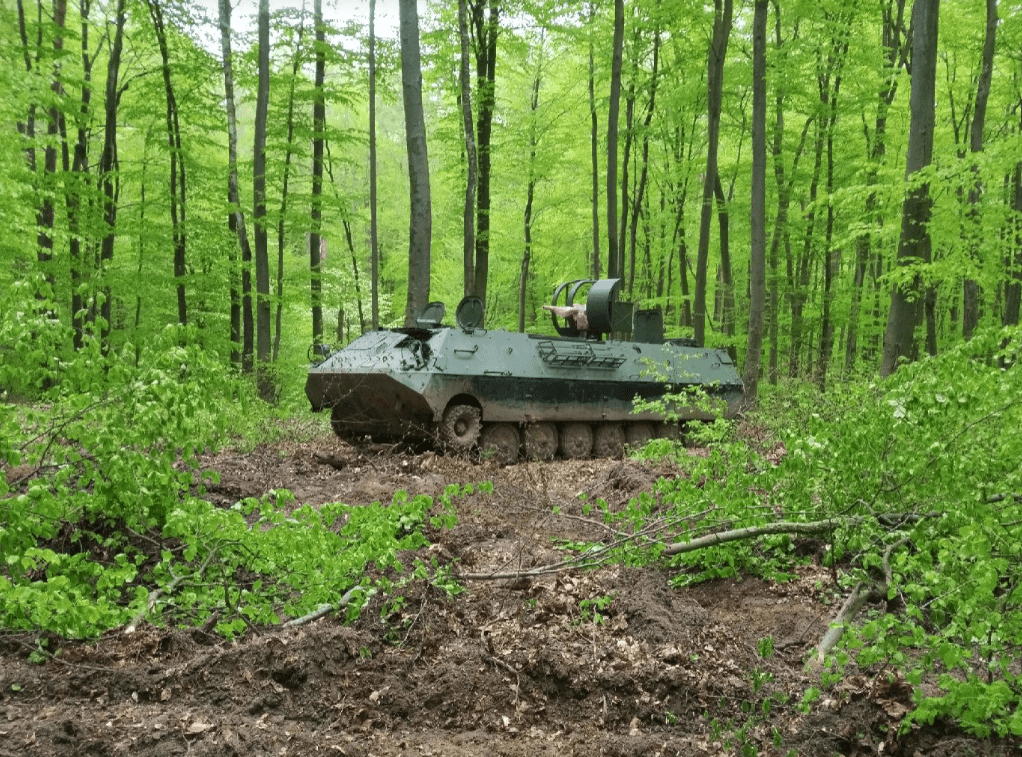
While many of both sides’ MT-LB adaptations have focused on simply mounting a weapon system to the rear deck or where the commander’s original PKT mount was, a recent Ukrainian refit has gone much further. A video was shared by a Ukrainian MT-LB crewmember which showed six vehicles all refit to a similar configuration. It appears that additional armour has been added to the sides and rear of the vehicle in an effort to provide additional protection to the lightly armoured MT-LB. [Correction: the vehicle has 7 road-wheels indicating the adaptation is likely based on an MT-LBu variant. These have been described as BMP-1LBs.] The vehicles also have new storage baskets, smoke-grenade launchers and a new remote weapon mount controlled from inside the MT-LB. A photograph of the front of the mount shows that it mounts a single 14.5x114mm KPVT machine gun, remotely fired and aimed using an electro-optics module positioned to the left side of the gun. The weapon and optics are protected by a curved gun shield, the cuts in the shield suggest that the weapon’s range of elevation is considerable.
Russian MT-LB adaptation with twin DShk mount on the original PKT turret (via Social Media)
These vehicles are are just two examples of MT-LBs in Ukraine adapted with ad-hoc weapon mounts. There are dozens of other examples of up-gunned MT-LBs deployed by both sides. Other commonly seen adaptations include fitting ZU-23-2 anti-aircaft mounts to MT-LBs
In February 2023, Ukrainian troops shared a video of a Russian MT-LB captured near Vuhledar, which had been fitted with a 2M-7 naval turret mounting a pair of 14.5mm KPV heavy machine guns. Similar vehicles appeared in photographs showing several MT-LBs with ad-hoc adaptations which included one vehicle with the same, as well as other vehicles with other dual and single gun mounts. One can be seen mounted with a single DShK on a tall, exposed pintle mount.
In May, an MT-LB was sighted with a twin DShK mount. Similarly, another MT-LB fitted with a twin DShK mount on top of the existing PKT turret was shared on 10 June, it had also been adapted by adding track and boxes as appliqué armour. Also in June, a photograph of a pair of MT-LBs equipped with A-22 140mm multiple rocket launch systems was shared on Telegram.
With Ukraine forming new brigades and both sides suffering considerable armoured vehicle losses the ubiquitous MT-LB, while lightly armoured, offers one of the best available platforms for mounting additional or role-specific weapons.
Support Us: If you enjoyed this video and article please consider supporting our work here. We have some great perks available for Patreon Supporters – including early access to custom stickers and early access to videos! Thank you for your support!
Since the Russian invasion of Ukraine in February we’ve seen a number of FN MAG variants appear in use with Ukrainian forces. By far the most common appears to be the US M240 series. However, in recent months we’ve also seen a number of Swedish KSP-58s appear in imagery from the field.
Sweden has long supported the Ukrainian war effort providing a shipment of 5,000 Pansarskott m/86 anti-armour weapons (perhaps better known as the AT4) back in late February. The transfer of an additional batch of 5,000 m/86s was announced on 2 June. Most recently on 30 June it was reported that Sweden would provide a fresh batch of light anti-armour weapons and also machine guns as part of a transfer worth $49 million. When delivery of this aid was made is unconfirmed but the KSP-58s are reported to have been in theatre possibly as early as July – August.
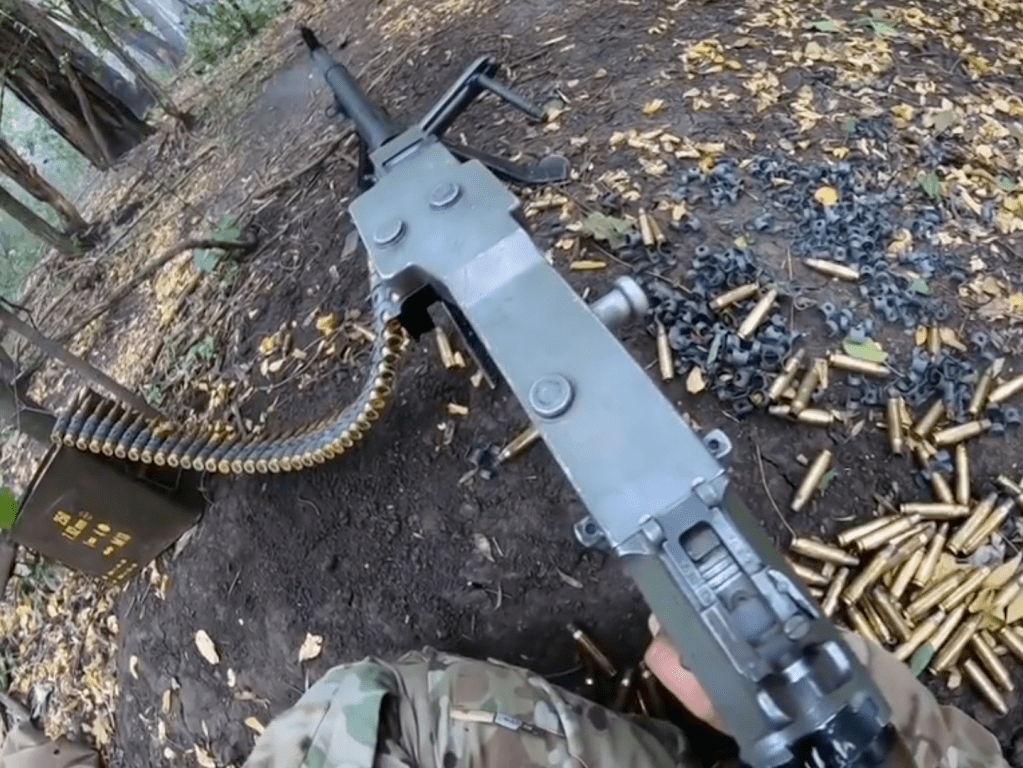
While the type of machine gun was not confirmed, since the beginning of September we’ve seen imagery of a number of KSP-58 GPMGs appear in theatre. Easily identified by their wooden stocks, grey-green-coloured receiver finish and enclosed front sight. Sweden was one of the earliest adopters of the FN MAG and the Kulspruta 58 or KSP-58 entered service with the Swedish armed forces in the late 1950s and was originally chambered in the 6.5×55mm Swedish round. The KSP-58B was introduced following the adoption of 7.62x51mm. The guns were made under license from FN at the Carl Gustav Stads rifle factory in Eskilstuna.
A KSP-58B in use with Ukrainian troops c. September 2022 (via social media)
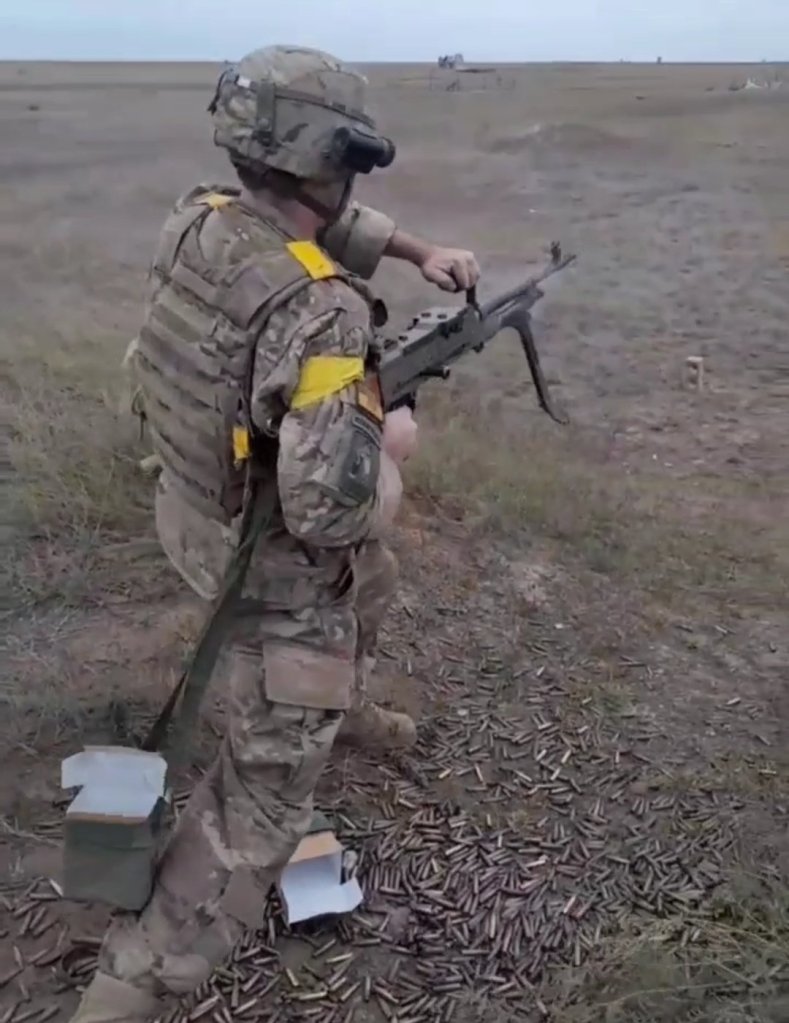
These have been seen in the hands of International Legion units and also regular Ukrainian Army units centred around Mykolaiv and Kherson. All the the examples of the weapon sighted appear to be KSP-58Bs, none of the guns seen have the Picatinny rails seen in the KSP-58F.
Speaking to Kaiser [frontline_view_kaiser] a German volunteer with the Ukrainian Army, he said his unit encountered a “a brand-new, never used KSP with original factory delivered Box and all accessories untouched”. His colleague Yuri [nucking_futs_yuri] has shared some videos filmed in late-August, during a training session he ran on FN MAG variants for various Ukrainian units. Yuri said their were about 20 guns on the range during the training session, with the majority being KSP-58s. Yuri shared a video in mid-September firing a through a KSP-58B, from the hip, filmed after the training session had been completed.
While we can’t confirm that the KSP-58s came directly from Sweden it seems likely. Another potential origin for the weapons may be the Baltic States (Estonia, Latvia and Lithuania). Sweden gifted an unconfirmed number of KSP-58s to the Baltic States in the 1990s. Today, the guns remain in service with the Latvian Army and National Guard, the Estonian Army and Estonian Defence League and the Lithuanian Army and National Defence Volunteer Force. Both Estonia and Lithuania began searching for a replacement for the KSP-58 in mid-2021. Given the Baltic states’ support for Ukraine the guns may potentially have originated from there, rather than Sweden itself. We have already seen the Baltic States have transferred former Swedish equipment including the PV-1110 recoilless anti-tank gun which were given to the Baltic states in the early 1990s.
It remains to be seen if we’ll see more of the KSP-58s in the field but in future articles/videos we’ll look at other FN MAG variants are in use in Ukraine.
Update 16/1/24: A maritime element of Ukraine’s Border Guards shared photos of them familiarising with what appears to be a KSP-58.
Some good photos of what appears to be a Swedish FN-MAG (KSP-58) in use with the Ukrainian Border Guards' maritime element.
— Matthew Moss | Historical Firearms (@historicfirearm) June 5, 2024
Update – 15/10/24: A video of a KSP-58 in action somewhere in Ukraine, date unknown, recently shared online.
If you enjoyed this video and article please consider supporting our work here. We have some great perks available for Patreon Supporters – including custom stickers and early access to videos! Thank you for your support!
Bibliography:
Thank you to Kaiser and Yuri for their input – definitely check them out on their social media!