M16A4s in Ukraine

On 12 January, a unit of the Ukrainian Army’s 47th Separate Mechanised Brigade (47 OMBr) was seen equipped with US M16A4s for the first time. The rifles were seen equipped with Trijicon ACOG optics and some, a considerable percentage, were seen with M203 40mm under-barrel grenade launchers, and of course rail covers.
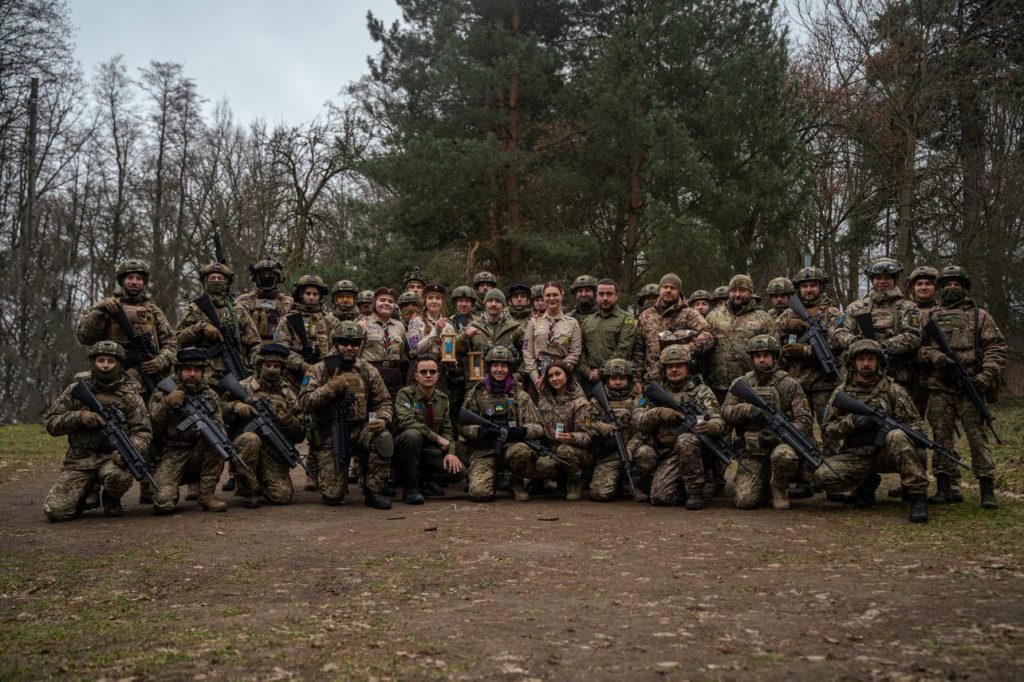
Photo released by 47 OMBr in early January showing M16A4s in Ukraine for the first time (47 OMBr)

Previously, we have seen a considerable number of M4A1 carbines, some equipped with M320 40mm grenade launchers. This, however, is the first time we’ve seen the M16A4. Other elements of the 47 OMBr have been seen equipped with FN FNCs in 5.56x45mm. The 47 OMBr appears to be a unit which has largely been allotted western small arms and equipment. The brigade was formed in November 2022 and, as with a number of other new Ukrainian brigades, has been built up from a battalion (which was raised in August 2022) to a regiment to a brigade level formation.

A close up of an M16A4 with an ACOG and M203 UBGL and rail covers in Ukrainian service (47 OMBr)

The M16A4 is a 5.56x45mm, select-fire rifle which uses a direct impingement gas system and a rotating bolt locking mechanism. The M16A4 was developed in the late 1990s and entered service in January 1999. It and has seen service with the US Army, USMC and US Navy. The US Army began to move away from the M16A4 in favour of the M4A1 in 2011 while the USMC favoured the rifle’s 20 inch (50.8cm) barrel length and began replacing its M16A2 with A4s in 2002, only in October 2015 did they begin to transition to the M4A1 Carbine and latterly the M27 for infantry Marines. Despite this the M16A4, however, remains in widespread service use.

The photographs and short video where the rifles were seen for the first time were posted to commemorate a visit from members of Plast, Ukraine’s scouts organisation, who brought a lamp of the Fire of Peace to be lit with members of the brigade.

Another photograph was shared on the brigade’s social media on 22 January, showing a close up of an M203-equipped M16A4, which was also mounted with an ACOG. How many of these rifles have been transferred is unknown, the most recent US Department of Defense fact sheet on aid to Ukraine, published on 25 January, lists 13,000 assorted small arms.
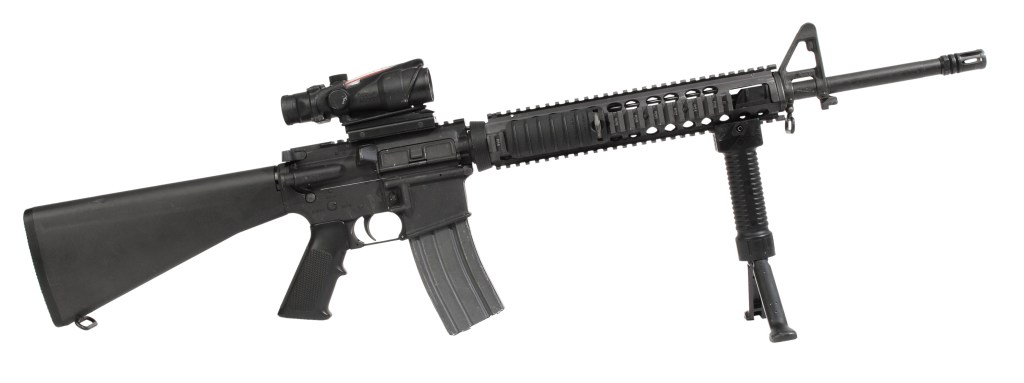
An as-issued M16A4 service rifle with quad rail forend, railed receiver, ACOG and grip pod (US Army)

The rifles appear to be straight from US Army or USMC inventory and look to be in good shape. The rifles have been predominantly made by Colt and FN. None of the imagery has been close enough yet to see which manufacturer the now-Ukrainian rifles were made by.

I expect we will be seeing a proliferation of the M16A4 rifles just as we have the M4A1 carbines since the early summer of 2022. The 47 OMBr probably won’t be the only unit to field them and we’ll probably be seeing many more of these in the future as the US military has considerable stocks of the rifles and production lines are still active. If and when we do, I’ll follow up with further videos/articles.


Update 20/03/23: Sergeant with Ukraine’s 47th Brigade seen armed with M16A4 equipped with M203 grenade launcher and an ACOG.


Support Us: If you enjoyed this video and article please consider supporting our work here. We have some great perks available for Patreon Supporters – including early access to custom stickers and early access to videos! Thank you for your support!


Bibliography:

Marine’s Switch from the M16 to the M4, Marine Corps Times, (source)

Weapon Systems 2011, US Army, (source)

5.56 Chronology, D. Watters/LooseRounds, (source)

FN & Colt Will Compete for M16A4 Foreign Military Sales Contracts Worth $380 Million, TFB, (source)

Aid to Ukraine Factsheet, 25 Jan., US Department of Defense, (source)

47 Brigade, Markus Foundation, (source)
French HPD2A2 Mines in Ukraine

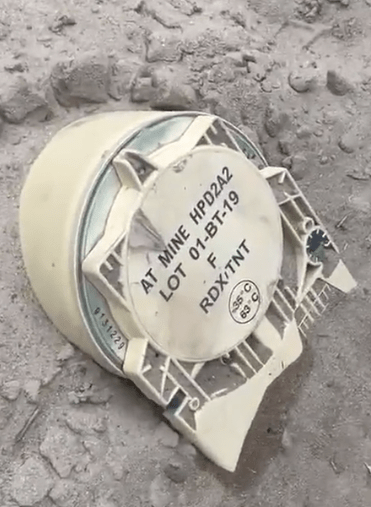
Earlier this week (7 November) Alexander Borodai, the former leader of the self-proclaimed Donetsk People’s Republic now a member of the Russian Duma for the separatist region, was seen in a video showing a near miss with a French HPD 2A2 anti-vehicle mine. The video, believed to have been filmed south of Kherson, showed the lead vehicle of Borodai’s convoy damaged by a mine, while another mine was seen next to his vehicle. The lead vehicle appears to be badly damaged with the front of the vehicle seemingly taking the brunt. If the vehicles was damaged by a HPD 2A2 it is interesting that the 4×4 vehicle was able to set off the mine which is designed to be triggered by heavier armoured vehicles, though some sources state movement of even smaller metal objects near by can trigger the mine. Similary Borodai is lucky not to have triggered the mine’s anti-tamper system.

The mine is clearly identifiable as a French HPD-2A2 with the lot number 01-BT-19. Various sources suggest around 400,000 of the HPD series of mines have been produced and they’re in service with the French, Norwegian, Belgian and Swiss armed forces. From Borodai’s video we can see the mine has a serial number of ‘9131229‘. Another example photographed in early October has the partial serial number ‘91296..’ visible. Both mines are from the same lot and the end digits seem to denote year of manufacture – 2019.

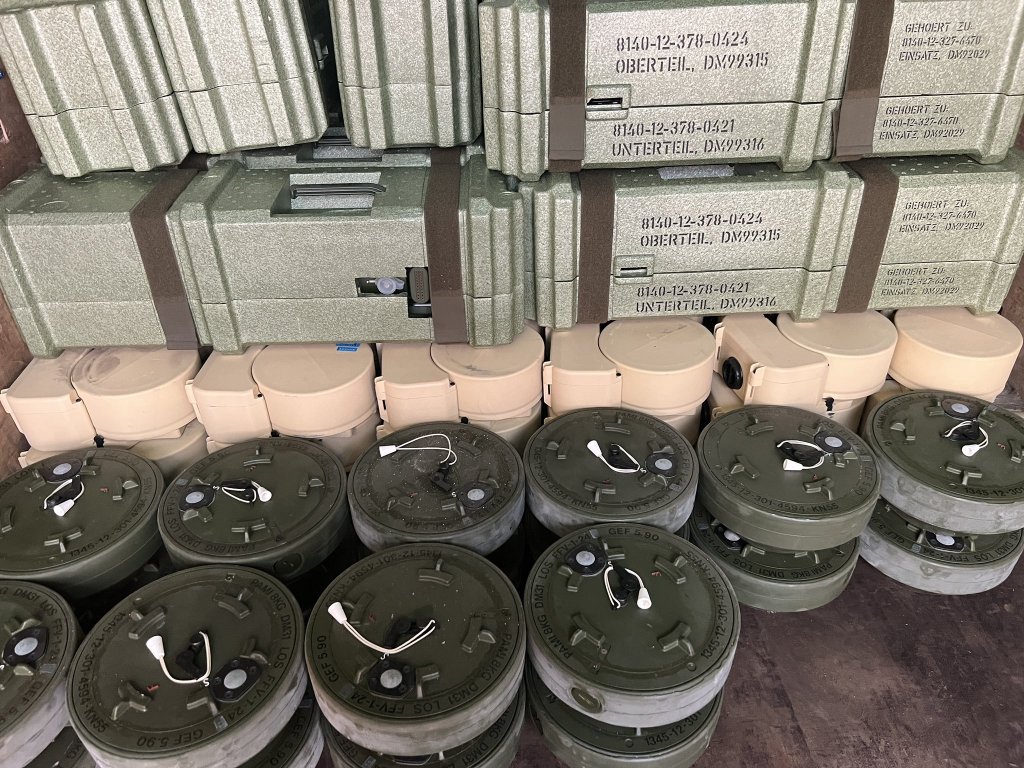
Russian sources suggest the mines have been in theatre since August but the first images of the mines were shared in early July, pictured in the back of a Ukrainian van with German DM-22 off-route mines and DM-31s. Some video was released by a Ukrainian explosive ordnance disposal (EOD) officer in July which is claimed to show a Russian vehicle destroyed by one of the HPD-2A2 mines.

The HPD family of mines (which includes the HPD 1, 2 and 3) began to be developed in the early 1980s by Thomson-CSF and Daimler-Chrysler Aerospac. The HPD2 (or MI AC HPD F2 in French service) was introduced in 1988. The mines use a 3.3kg charge made up of an RDX/TNT mix to create an explosively formed penetrator using the Misznay–Schardin effect. The mines are said to be able to penetrate armour between 100 to 150mm thick. The mines have a 10 minute arming delay once set and can be active for up to 30 day before they deactivate themselves. Because the mine can be triggered by the electromagnetic field of a metal detector it has been said that this contravenes the Geneva Convention’s Protocol II (May 3, 1996).

The HPD-2 is made up of two sections: a fuze assembly with a magnetic influence sensor and a two battery power supply, the self-neutralising system and the arming mechanism and the mine’s explosive charge. It reportedly has an anti-handling device sensitive to motion and the signals produced by metal detectors. The mine is detonated when the seismic sensor reacts to vibrations made by passing vehicles and a magnetic sensor is activated. The magnetic sensor uses variation in the earth’s magnetic field caused by the proximity of a vehicle’s large metal mass. Sources suggest the magnetic sensors is triggered by vehicles over 8 tons.

While there has been no official confirmation the mines are believed to have been provided by France as part of their military aid to Ukraine which has also included VAB armoured vehicles, Mistral short range air defence systems and anti-tank guided missile systems including MILAN and Javelin.

We’ve previously examined the German DM22, Estonian PK-14 and Russian PTKM-1R mines in use in Ukraine.


Support Us: If you enjoyed this video and article please consider supporting our work here. We have some great perks available for Patreon Supporters – including custom stickers and early access to videos! Thank you for your support!


Bibliography:

HPD-2 Landmine, CAT-UXO, (source)

MI AC HPD F2 Landmine, Fenix Insight, (source)

HPD Mine, Lexpev.nl, (source)

HPD Mines, Rufor.org, (source)

MI ACH 88, RMS, (source)

State Duma deputy’s security car blows up on French HPD anti-tank mine in Ukraine’s Kherson region, EuroWeekly, (source)

Arms For Ukraine: French Weapons Deliveries To Kyiv, Oryx, (source)