On Friday, it was confirmed that the CZ Bren 2 will be assembled in Ukraine. This marks the first partnership since Russia’s Invasion in February 2022, that will see foreign small arms assembled in Ukraine. The Bren 2 is a 5.56x45mm select-fire gas-operated rifle which was first introduced as the CZ 805 BREN in 2011. While CZ Bren 805s have appeared in Ukraine the BREN 2 is much more common and favoured by troops on the ground.
We’ll take an in-depth look at their use in a future article/video but a considerable number of Ukrainian units ranging from special forces units to regular army have been seen equipped with the Czech rifles. Visually confirmed variants in Ukrainian service include the initial 5.56x45mm BREN 805 and later BREN 2 in various barrel lengths and configuration including the 8 inch barrel carbine with both side folding and telescoping stocks and the much more common rifles with side folding stocks and 11 and 14 inch barrels. There have also been a limited number of sightings of 7.62x39mm 8 inch barrel carbines and a number of 7.62x51mm BREN 2 BRs.
The first indications that production of the BREN 2 might be established in Ukraine came on 29 September 2023. During the first ever Ukrainian International Defence Industries Forum Deputy Minister of Defense Daniel Blažkovec stated that “the transfer of production of the Bren 2 “Sich” assault rifle” was a major, ‘flagship’ project.
Ukrainian Special Operations with CZ BREN 2s (via social media)
Sich (Січ) in Ukrainian refers to a historic form of fortified administrative and military camp used by Cossacks during the 16th century and later became associated with the Euromaidan in 2013. Since the name was used in September 2023, it has not appeared again.
In an announcement posted on 13 December, Ukraine’s state-owned defence corporation Ukroboronprom stated that the Ukrainian Defense Industry had begun licensed assembly of BREN 2s and that the agreement with CZ covers local assembly of rifles and will later include “full production of NATO-standard assault rifles in Ukraine”, the agreement was signed on 16 July 2024. Oleg Hulyak, Director General of Ukroboronprom, stated:
“Partnership with Czech colleagues will help to improve the provision of the needs of the Defense Forces of Ukraine in reliable and modern small arms produced in our country. In addition, another step has been taken towards the integration of our defense-industrial complex into the industrial chains of NATO countries,”
I reached out to Colt CZ Group for comment, Jan Zajíc, CEO of Česká zbrojovka, said in a statement:
“We are happy that together with our Ukroboronprom partners, we have successfully completed the assembly phase of the CZ BREN 2 assault rifle on the Ukrainian soil. Following the training of Ukroboronprom personnel at Česká zbrojovka, Ukraine is now able to deliver to its Armed Forces the CZ BREN 2 rifles assembled in Ukraine according to Česká zbrojovka‘s strict quality standards. We are ready to continue our cooperation in the future, all the way to full technology transfer.“
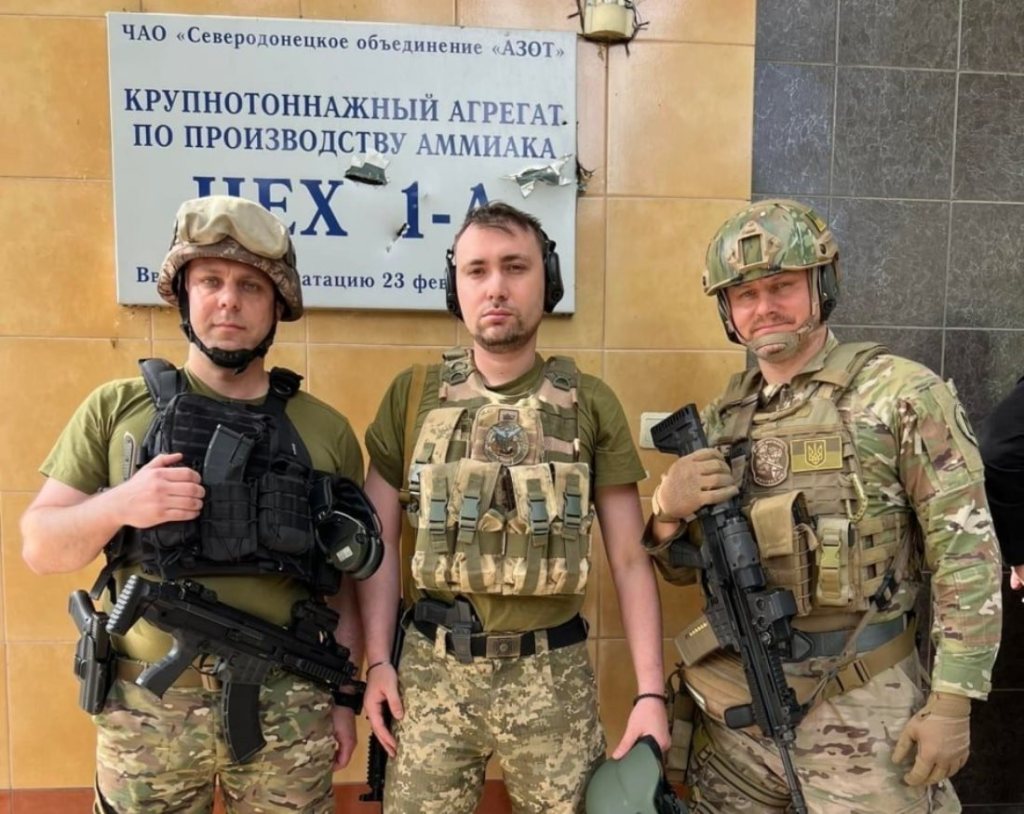
Ukrainian GUR chief, Kyrylo Budanov, and associates during a June 2022 visit to Sievierodonetsk. One individual has a 5.56x45mm CZ BREN 2 and the other a rare 7.62x39mm BREN 2 with an 8in barrel and telescoping stock (via social media)
Currently the only other country which has a similar arrangement with CZ is Hungary which has established Colt CZ Hungary to enable Hungary’s HM Arzenal to assemble/manufacture BREN 2s for the Hungarian armed forces. This isn’t the first time Ukraine has worked with external firearms manufacturers with an earlier partnership seeing Ukrainian small arms manufacturer Fort assemble Israeli IWI weapons under license in the 2000s. See our earlier look at the Ukrainian Fort Tavor bullpup rifles here.
The future significance of CZ’s establishment of an assembly line in Ukraine remains to be seen but as Ukraine seeks to further integrate with its Western allies and take up NATO standards the ability to produce a NATO calibre rifle, which is already in widespread Ukrainian service, will be extremely useful. From the statements released it appears that assembly of the rifles may be the first step towards localised production, it will be interesting to track CZ and Ukroboronprom’s partnership.
In an earlier video/article we examined the M14s which appeared in Ukraine back in March 2022, since then there have been a number of intriguing sightings of what, at a glance, appear to be Mk14 Enhanced Battle Rifles or M39 Enhanced Marksman Rifles. The EBR and EMR emerged during the Global War on Terror in the early 2000s as an improved variant of the 7.62x51mm M14.
The project to develop a more compact, improved M14 reportedly evolved from a request from US Navy SEALs in 2000 for a rifle for Arctic warfare. This eventually developed into what became the Mk14 EBR with development led by Naval Special Warfare Centre Crane and input from commercial specialists and manufacturers including Smith Enterprise, Inc. and Sage International. The result was a rifle with a 18 inch barrel and new flash hider, with changes to the operating rod guide, a new stock chassis and a raft of accessories. A number of different variants were built including the Mk14 Mod 0, Mod 1 and Mod 2, the M14 EBR-RI and the USMC’s M39 EMR. In total between 2003 and 2011 just over 9,000 of these upgraded variants were assembled.
Given the significant number assembled and the fact they have been replaced by rifles such as the M110 Semi Automatic Sniper System (which has already been seen in Ukraine) and the M110A1 CSASS it would not be unsurprising to see Mk14 EBR variants turn up in Ukraine.
Over the past two years I’ve been tracking sightings of what appear to be Mk14 EBR variants but on closer examination some of them are not what they initially seemed to be, several were in fact kit builds using the standard configuration M14s which reached Ukraine in early 2022. Some, however, do appear to be surplus Mk14s.
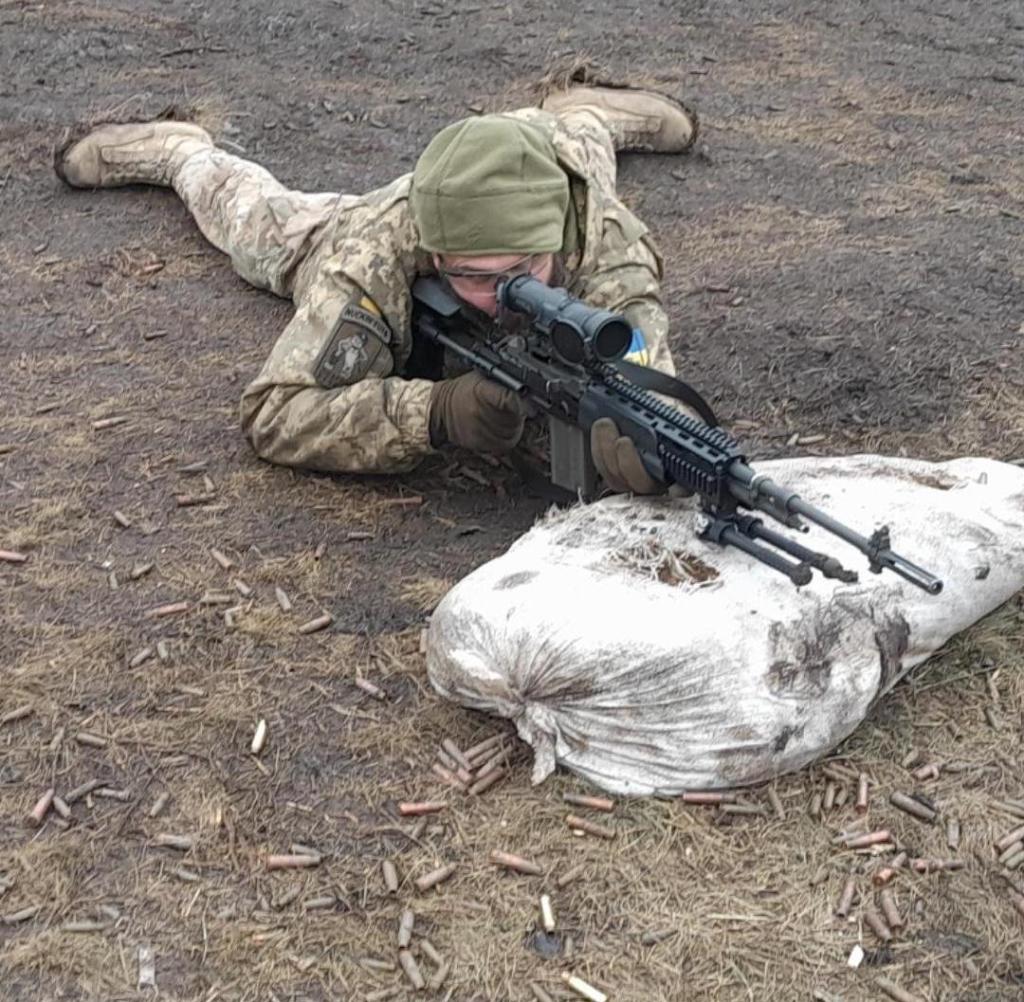
Yuri’s Mk14 EBR clone at the range (Nucking_Futs_Yuri)
First, let’s examine some of the kit builds seen in theatre. The first appears to have been assembled by Nucking_Futs_Yuri, an American volunteer who enlisted in the Ukrainian Army in early 2022. Yuri explained to me that in late 2022, following combat experience where he wasn’t satisfied with how well 5.56x45mm suppressed a Russian position he decided to assemble an EBR clone using a donated chassis. Yuri noted that parts for the rifle began to arrive in December 2022 and by January the rifle had been assembled. Yuri was seen with the rifle in numerous photographs and in several configurations. It had a standard 22 inch barrel, a Sage International M14ALCS chassis and a M14DCSB (Detachable Cantilevered Sight Base). He mounted a 1.5-6x Elcan SpectreDR optic on the rifle, opting for more of a battle rifle-style set up. The rifle was damaged in February 2023 by a Kornet ATGM blast which bent both the barrel and the chassis.
Yuri’s damaged Mk14 EBR clone (Nucking_Futs_Yuri)
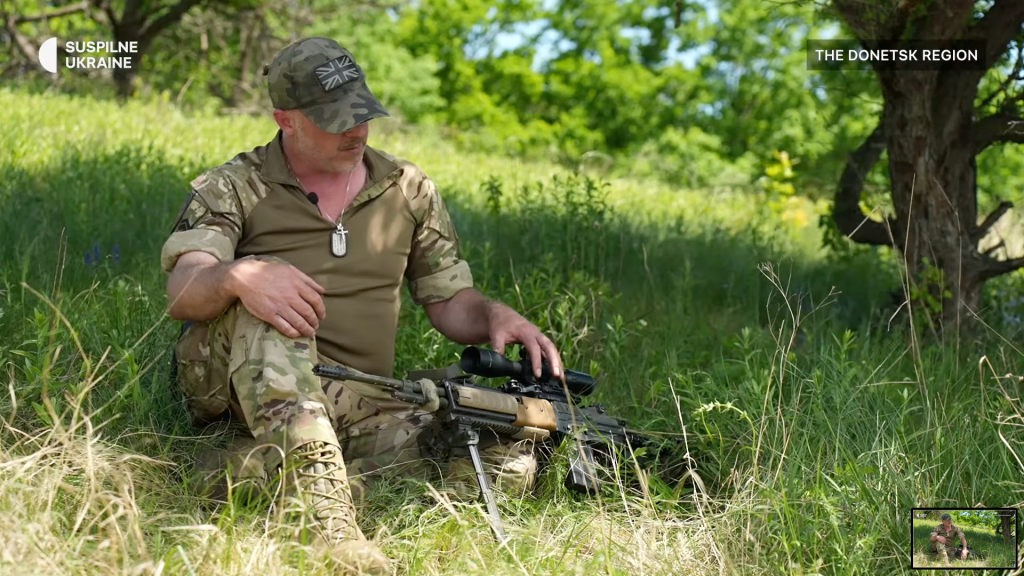
In early May 2023, another rifle which resembled an M14 EBR-RI, with a 22in barrel and a black Sage International M14ALCS chassis, appeared in use with a member an International Legion team. This individual and his rifle was seen again in May 2024 appearing in a number of interviews with Ukrainian media. His callsign was revealed to be ‘Solo’ and he was described as a marksman and a squad leader with a unit of the International Legion’s 3rd Special Purpose Battalion. In the interview he explained that the rifle has originally been a wooden stocked M14 converted with a SAGE chassis sent to him by a friend in the US. Interestingly, between May 2023 and May 2024, it appears the rifle’s set up has evolved with new FDE rail covers added and a short tan Kydex handguard replacing the initial black longer handguard. These parts were likely acquired in Ukraine.
‘Solo’ with his Mk14 clone built off a standard M14 (Суспільне Донбас)
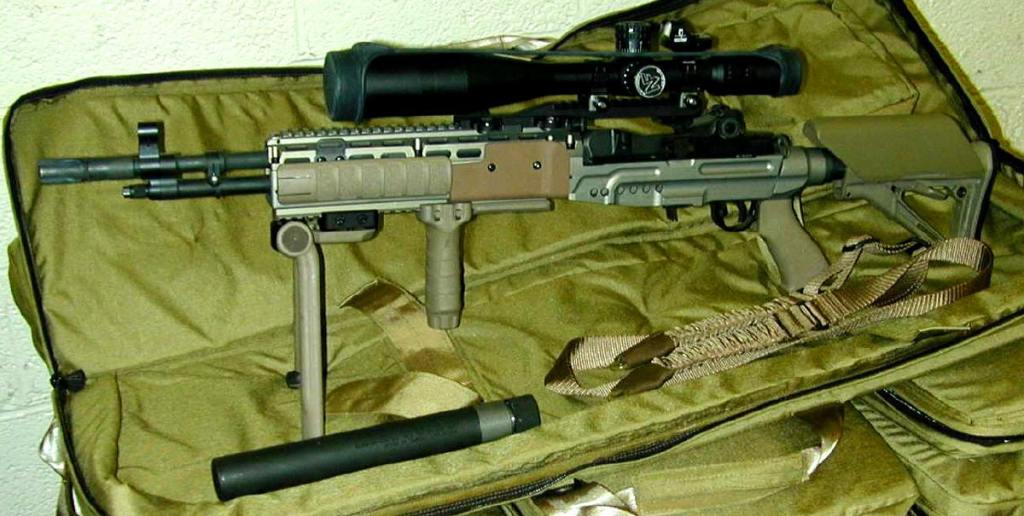
Most intriguingly, in November 2023, the first Mk14 Mod 1 appeared. Mod 1s are characterised by their shorter 18in barrels, a Sage M14ALCS/CV-BS with Magpul CTR FDE stock (with a cheek riser) mounted on a buffer tube extension rather than the earlier collapsing stock. The rifles also have LaRue LT-608 extended Picatinny risers and short tan handguards. The rifle is equipped with a Schmidt & Bender PMII 5-25×56 scope.
A Mk14 Mod 1 EBR with Schmidt & Bender PMII, Nov. 2023 (via social media)
The Mk14 Mod 1 was assembled at NSWC Crane in 2006, around 500 were assembled. The shorter barrel and the general configuration of parts and accessories suggest that this may be a surplus rifle transferred by the US.
A recent sighting of a Mk14 Mod 1 EBR (via Tysk)
Most recently, on 18 October, Ukrainian telegram channel Tyskshared a series of photos of a Ukrainian combatant at the range with another Mk14 Mod 1. This rifle’s parts and accessories closely match those assembled by Crane for the Mod 1, including: an 18in barrel with a SureFire FH762KM14 muzzle device, a TangoDown BG-16 FDE pistol grip, a Sage M14ALCS/CV-BS with a Magpul CTR FDE stock (this time without the cheek riser), a TangoDown BGV-MK46 FDE vertical foregrip, and a TangoDown ACB-4 FDE bipod. The rifle is also equipped with a NightForce NXS 2.5-10x24mm optic and a DOCTER MS01 3.5 MOA red dot sight which were selected to be paired with the Mod 1. [It has been noted that the Mod 1s may also be clones due to some small differences in the chassis profile and accessories used – for instance the model of VFG, scope rings, cheek riser, and the machining on the chassis. If this is the case someone has gone to an improbable amount of trouble to ‘clone’ a Mod 1, a considerable level of effort to expend in a war zone. Thanks to tanodized for input.]
From the very limited imagery available of Mk14 EBR-pattern rifles in Ukraine it appears that numerous clone builds have been assembled in-country and that the only EBRs which can be identified as potential US transfers are the two Mk14 Mod 1 variants seen so far.
A squad designated marksman with an Mk14 EBR-RI (the most common EBR variant), 5th Battalion, 20th Infantry Spin Boldak, Afghanistan, 2012 (US Army)
If the US was to transfer a significant number of Mk14-pattern rifles I would expect them to be the Mk14 EBR-RI, the most common variant, some 6,000 of which were assembled by Rock Island Armory – TACOM [Tank-automotive and Armaments Command]. It is unsurprising clone rifles have been assembled by combatants in Ukraine as Sage International and a number of other US manufacturers offer EBR-pattern chassis which do offer some improvements over the traditional M14 configuration.
Since February 2022, France has provided Ukraine with a wide range of weapon systems and military equipment including self-propelled artillery, armoured personnel carriers, anti-tank guided missiles, hand grenades and air defence systems. In this article/video we’ll look at the rarely seen machine guns which France has provided.
In the summer of 2022 France announced the transfer of armoured personnel carriers and AMX-10 RC armoured fighting vehicles. The APCs appear to have largely consisted of Véhicule de l’Avant Blindé (VAB)s, a wheeled 4×4 which entered French service in the late 1970s and is set to be replaced by the VBMR Griffon. The VABs are largely operated by the 46th Separate Airmobile Brigade and the 47th Mechanised Brigade and have been seen in action since July 2022.
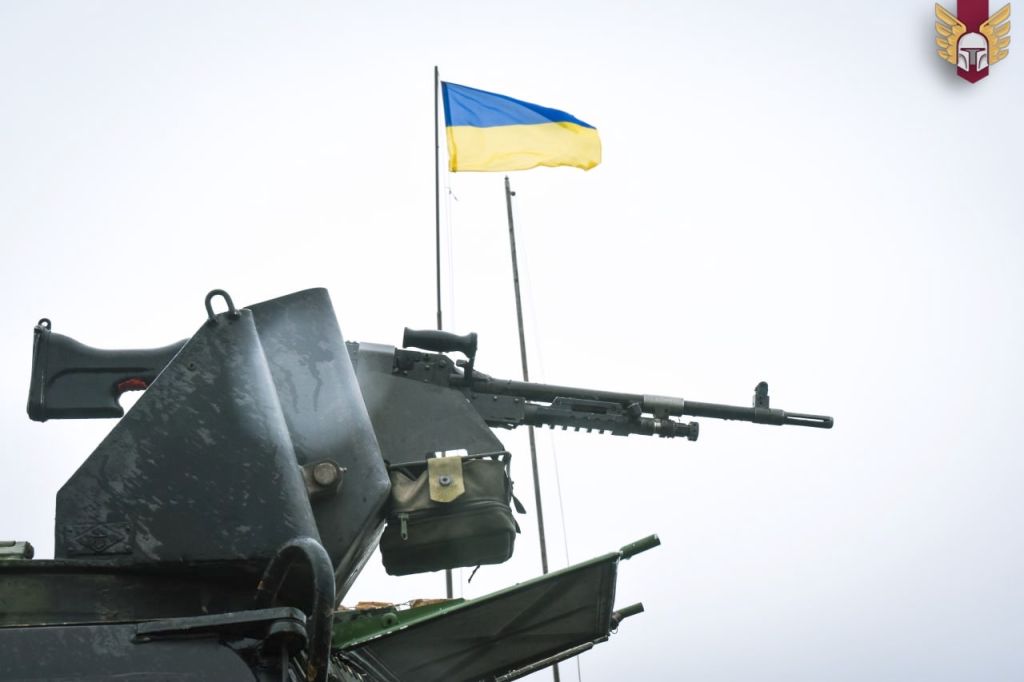
A French FN MAG mounted on a VAB (46 OAeMBr)
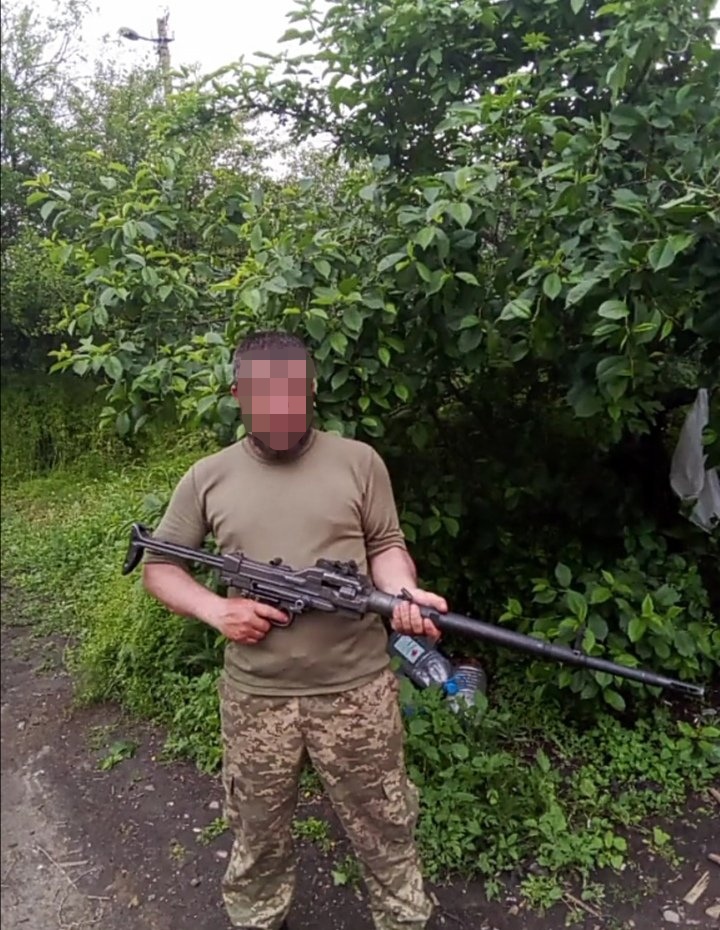
The majority of the VABs in Ukrainian service appear to be equipped with 12.7x99mm Browning M2 heavy machine guns, however, some have been seen equipped with 7.62x51mm general purpose machine guns. Most intriguingly, in late May 2023 a photograph of a Ukrainian soldier holding an AANF1 emerged. An earlier video, shared in July 2022, of a VAB in the field may have been mounted with an AANF1 but due to low resolution it is difficult to be definitive. The later May 2023 photograph, however, confirms that France has supplied an unknown quantity of GPMGs. It is likely that the AANF1 was provided along with a VAB, notably the weapon is without its bipod. At the time of writing there have been no further sightings of AANF1s.
Ukrainian combatant with an AANF1 (via social media)
The AANF1 is the 7.62×51mm variant of AA-52, a lever-delayed blowback operated belt-fed machine gun introduced in the 1950s. Since the 2010s, the AANF1 has slowly been superseded by the FN MAG. French FN MAGs have been seen in use with members of the 46th Separate Airmobile Brigade. They have been seen both mounted and dismounted from the VABs. While a significant number of MAG-patterned guns have been provided to Ukraine by numerous countries including the US (M240), Sweden (Ksp 58) and the UK (L7A2) the French MAG 58s are identifiable by the their railed top cover and a handguard attached to the gas tube which provides additional rail space.
A dismounted French FN MAG (46 OAeMBr)
In early November 2022, a video showed the best part of a mechanised battalion equipped with VABs, which are armed with a mix of M2 heavy machine guns and GPMGs. Later in November the 46th Separate Airmobile Brigade shared photos of troops training including several photos of French MAG 58s mounted on VABs. In late January 2023, the Brigade shared a photo of the guns being used in the dismounted role while conducting urban warfare training. Several days later another photo was shared of a dismounted French MAG at a range. Another training photograph of a MAG mounted on a VAB was shared in March 2023.
The French MAGs haven’t been seen in use with any other Ukrainian units so far. But with significant numbers of French armoured vehicles its possible we’ll see further MAGs and AANF1s in the future.
Update 21/10/23:
Another French AANF1 in #Ukraine. Likely provided along with the VAB APCs from France. It appears that a shop-made bipod has been added to allow it to be used in the ground roll.
— Matthew Moss | Historical Firearms (@historicfirearm) October 21, 2023
Update – 10/3/24: The French government has released an updated document listing the equipment and some of the quantities provided to Ukraine. The document states that 210 ‘Mitrailleuse 7.62mm’ (the pattern of gun is not stated) and 710 ‘Mitrailleuse 12.7mm’ (likely M2 Brownings) have been provided between 1 March, 2022 and 1 May, 2024.
Support Us: If you enjoyed this video and article please consider supporting our work here. We have some great perks available for Patreon Supporters – including early access to custom stickers and early access to videos! Thank you for your support!
Sources:
Model 1958 general support machine gun – MAG 58, French Ministry of Defence, (source)
NATO automatic weapon model F1 caliber 7.62 mm (AANF1), French Ministry of Defence, (source)
Joint declaration of France and Ukraine, Élysée, (source)
Arms For Ukraine: French Weapons Deliveries To Kyiv, Oryx, (source)
Thank you to Recon UAV on twitter for flagging the French MAGs and to Ukraine Weapons Warfare for bringing the AAFN1 to my attention. Special thanks to Dragonists Society for insights.
We’ve examined a number of 5.56x45mm rifles in use with Ukrainian forces, notably the Colt Canada C7 and C8 and the M16A4 with many others to be covered in future articles/videos. In this article/video we’re going to examine HK416 use by Ukrainian personnel.
HK416s are far from a common weapon in Ukraine but recently there has been an increase in the frequency with which they have been seen. Since the beginning of 2023, there have been various configurations seen in the field with most being earlier variants of the HK416, likely with either 14.5 inch or 10.4 inch barrels paired with quad rail forends. There also seems to have been a small number of MR223, the civilian-market semi-automatic only version of the rifle, appear in imagery from the conflict.
One of the first HK416-pattern rifles seen in imagery from the conflict was shared in mid-May 2022 by a female Ukrainian combatant. An MR223 with a 16.5 inch barrel is seen leaning against a wall in the background of a photograph. What is believed to be the same rifle has been seen in another photograph mounted with a bipod and fitted with a long, over-barrel suppressor.
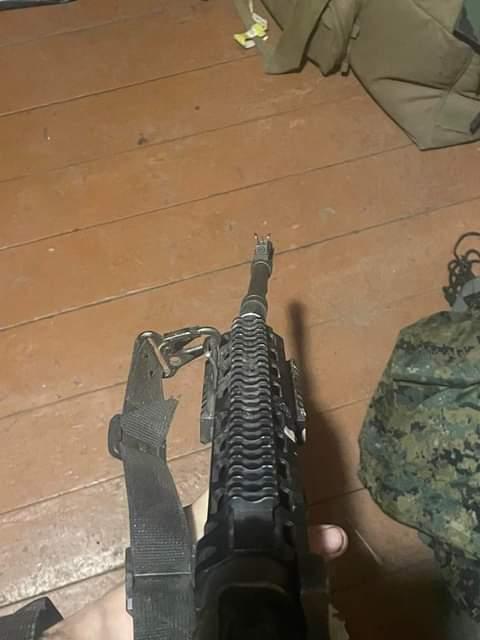
In January 2023, a photograph of a pair of SBU members wearing Saint Javelin shirts also featured an MR223A1. Another interesting photograph that appeared in January, features Ukrainian SOF members, one has an accessorised HK416 A5, identified by its adjustable gas block and less flat magazine well angle, with a Surfire SOCOM 556 [Correction: B&T Rotex] suppressor, a Sig Sauer Romeo4T or potentially a Holding 515 and a Stiener DBAL A3N laser module.
A Ukrainian combatant fires a HK GLM-pattern UBGL attached to an HK416 (via social media)
In March, a member of a Ukrainian special operations unit shared a photograph of himself with an HK416 with an 10.4 inch barrel and what appears to be an Aimpoint Comp. The same individual shared another photograph with the same rifle in early May, this time the carbine was fitted with what appears to be a Vortex Crossfire.
A note on nomenclature: the majority of the HK416s seen in Ukraine appear to be HK416 A2s, potentially of Dutch origin. Some sources describe these rifles using the ‘DxxRS’ designations such as D10RS for a 10.4 inch barrel carbines and D14.5RS for a 14.5 inch barrel rifles. This designation, however, doesn’t represent the various iterative changes in the rifles.
Another photograph believed to have been taken in early Spring features another unpainted HK416 A2 with a 10.4 inch barrel, note the folded front sight on the gas block which, fitted with an EOTech 5-series H WS. Another interesting photo, shared by a Japanese volunteer with the International Legion also features an HK416 fitted with a weapon light, a vertical foregrip and a Holosun HS510c reflex sight.
In April, a Taiwanese volunteer with the International Legion, shared several photos of his HK416 A2 with a 14.5 inch barrel fitted with an Aimpoint CompM5. In one photograph it has been paired with a GLM, 40mm underbarrel grenade launcher.
A Dutch HK416 A2 with a Swedish Aimpoint Comp M5 used by a member of the International Legion (via social media)
In response to questions he said he preferred the rifle to the FN SCAR-L as it is more durable but also noted that the HK416 was much heavier than the M4A1 he also used in Ukraine. He also shared a photograph of the rifle equipped with a EOTech 5 series holographic weapon sight. In one of the photographs he shared the rifle has an armoury ID tag on the left side of the magazine housing. This tag is similar to those used by the Dutch military, as seen on the C7A1 rifles which have been provided to Ukraine in large numbers. On many of the images of the rifles there are no clear markings to definitively indicate their country of origin. So the armoury ID tags with QR codes are potential indicators of Dutch origin.
On the 15 April the GUR shared an image with the International Legion, the GUR and the 10th Special Detachment to publicise a TV news piece about the Shaman Battalion. The context and date when photograph was taken remains unclear but the combatant featured in the image appears to have an HK416 with a 14.5 inch barrel. This photo may be a stock image and not one of Ukrainian origin.
In late April photographs of members of the 92nd Mechanised Brigade featured several combatants holding HK416 A2 w ith 14.5 inch barrels. The rifles are seen equipped with EOTech holographic weapons sights. Another photo, also believed to have been taken by a member of 92 OMBR, shows an HK416 A2, with a 14.5 inch barrel, a camouflage paint job, a Knights Armament Company-style vertical foregrip and an EOTech sight and EOTech G33 magnifier.
A suppressed HK416 A2, with 14.5 inch barrel, used by Elite Global Response (via social media)
In early May, Elite Global Response, a group which describes itself as a ‘private security company’, operating in Ukraine shared a number of posts on their Instagram page featuring several HK416 A2s. The rifles are seen fitted with a variety of suppressors (including Ukrainian Tihon suppressors) and optics including an TA11 ACOG and a Holosun AEMS. When asked about the rifles Elite Global Response said they’re “a lot lighter than previous weapons we’ve run [AK-74s and MSBS GROTs], less stoppages and easy to maintain.”
In mid May another photograph of an HK416 A2 was shared online equipped with a small optic. A member of a Ukrainian special operations unit shared a photograph on 18 May, showing a group of combatants, two of which have what appear to be HK416s, one unpainted and another painted with an ACOG mounted, both appear to have 10.4 inch barrels.
In late May photos of another 10.4 inch HK416 A2 were shared by a member of the 1st Assault Battalion of the 3rd Assault Brigade. The combatant’s rifle has a Surefire or possibly a Dead Air muzzle device and is mounted with a Leupold LCO optic and a magnifier. In one photograph the carbine is seen loaded with a 60-round D-60 drum magazine. Earlier footage shared in early May on TikTok suggests he’s been using the rifle since early 2023 and originally received it unpainted. When asked what he thought of the rifle he described it as “the best assault rifle there could be”. A short clip of the same combatant also shows him firing an HK GLM-pattern 40mm underbarrel grenade launcher. This older video also shows the rifle with a different muzzle device.
A Ukrainian combatant with an HK416 with a 10.3 inch barrel, Leupold LCO and D-60 drum magazine (via social media)
On the 5 June, a short clip of members of the Polish Volunteer Corps was shared showing a member of the unit clearing Russian positions with an HK416-pattern rifle – when the video was filmed is unclear. While the resolution is low the camouflage painted rifle appears to have a magnified optic, possibly an Aimpoint Comp and a CQB red dot sight. A few days later a body camera video of combatants from the International Legion showed another HK416-pattern rifle clearly with an armoury tag. While undated the video is said to have been filmed during fighting near Bakhmut. Most recently, on 12 June, another member of Ukraine’s special operations forces was seen with an HK416 A2 outfitted with an EOTech optic and magnifier.
While a number of countries that use the HK416 have provided military aid to Ukraine it seems that a significant proportion of the rifles seen in theatre originate from the Netherlands, with the rifles configurations, HK416 A2s with ambidextrous selectors and the presence of armoury QR tags, matching those used by the Dutch military. The Dutch Ministrie Van Defensie initially procured HK416s for their special forces in 2010 and have since procured further HK416 A5s. Regardless of origin how many of the Heckler & Koch rifles have been transferred to Ukraine is currently unclear.
HK417
Ukrainian marksman with an HK417 (via social media)
There have also been a smaller number of 7.62x51mm chambered HK417s seen in use with various Ukrainian units. These rifles are believed to also have been transferred by the Dutch military with the configuration of the rifles matching those used by the Dutch. With few so far seen in theatre research is still ongoing. These will be the topic of a future video/article when more information is available.
Update – 19/6/23: Footage of a 10.3in HK416 A2 in use near Bakhmut, date unknown.
A short engagement featuring a suppressed HK416, likely an A2 with a 10.3 inch barrel. Said to be from recent fighting on the edges of Bakhmut.
— Historical Firearms | Matthew Moss (@historicfirearm) June 19, 2023
Support Us: If you enjoyed this video and article please consider supporting our work here. We have some great perks available for Patreon Supporters – including early access to custom stickers and early access to videos! Thank you for your support!
Bibliography:
Thank you to the guys at Streaking Delilah for sharing images they sourced and providing technical detail. Check out their instagram page here. Thanks also to Jonathan Ferguson for additional technical information.
We’ve looked at a number of different bullpups currently in use with Ukrainian forces, ranging from Tavors to the locally developed Malyuk/Vulcan – check out those articles/videos if you haven’t already.
In this article/video we’re going to take a look at another Ukrainian development which converts a standard AK-74 into a bullpup. The Black Storm BS-series of kits has been around since the mid 2010s and in recent months more and more imagery of Ukrainian personnel with Black Storm bullpup AKs has been emerging.
The Black Storm kits are compatible with both AKM and AK-74 pattern rifle and the relatively simple designs allows the conversion of a conventional rifle into the bullpup with not alterations to the base rifle.
A suppressed AK-74 next a suppressed BS-3 illustrating the overall length difference (via Black Storm)
To convert the rifle the stock furniture is removed, the pistol grip, forend and butt. The trigger transfer bar is then put in place and the lower receiver of the chassis is then attached which holds it in place. The new lower receiver has the pistol grip already attached. The butt assembly is then slide into place – this also covers the original trigger but leaves the magazine release exposed. There is a hinged cheek piece attached to the butt assembly. This can be pivoted out the way for access into the receiver and to allow the gas piston and bolt assembly and receiver cover to be placed. Finally, a top cover is slotted into place and retained by a catch to the lower. This covers the gas tube and barrel.
The kit appears to be made from simple sheet metal stampings and is held together by slotting into pre-existing parts of the rifle’s original receiver and a couple of screws. While the chassis obviously adds weight to the weapon it does have the benefit of shortening the rifle and also shifting its centre of balance back.
The BS3 adds no additional controls to the rifle and the weapon is manipulated using it’s existing charging handle and safety-selector lever. The BS4 was developed in 2017 and introduced in 2018, adds a number of new ergonomic features with a left-side forward charging handle which makes the rifle much easier to cock and a new thumb actuated safety – which probably acts on the trigger transfer bar. A new extension to the magazine release lever has also been added to make magazine changes easier. Black Storm describe the BS4 as: “easy to put on and take off in the field, without intruding into the weapon. It is enough to remove the butt and stock, and you can install the Bullpup with one mounting bolt.” Both the BS-3 and BS-4 have a length of Picatinny rail under the lower receiver and require an optic riser rail for mounting an optic.
A BS-3 c.November 2022 (via Black Storm)
How well an optic mounted on a rifle in a Black Storm kit retains zero is unknown but the mount is fitted over the rifle’s rear sight block and held in place by a bracket under the barrel. This is then secured by four small bolts.
The company says that both the BS-3 and BS4 are made from 1mm stamped steel and polymer. Black Storm list the weight of an AK-74 with the BS-3 kit installed, but without a magazine, as 3.4kgs. The weight of the BS-3 kit’s components is 1.2kg. A 2018 video, however, suggests that the kit’s components weigh just over 1.6kg (not including the rifle’s receiver, barrel and bolt assembly).
Black Storm list the weight of an AK-74 with the BS-4 kit installed, but without a magazine, as 3.9kgs. The weight of the BS-4 kit’s components is 1.7kg. Once installed with either kit the rifle has an overall length of 70cm (27.5in) down from 94cm (37in) for a standard configuration AK-74.
A video review of the kit by one of the Ukrainian soldiers who has used it in the field
Black Storm list the BS-3 at 14,250 UAH ($387) and the BS-4 at 21,500 UAH ($585). From the information available it appears that the kits are purchased by servicemen privately, to adapt their issued service rifles.
A BS-5 has been developed, it’s unclear if this is in production but it is listed on Black Storm’s site and is said to be available. It has a length of rail along its top cover removing the need for an optic riser and also allowing the use of back up iron sights. It’s price is listed at 28,500 UAH ($775).
BS-3 with an EOTECH HWS XPS2, a laser/light module and a custom green camouflage paint job (via social media)
Photos of the BT-2 were shared in January 2015 and an early version of the kit was displayed at a Ukrainian military exhibition in 2015, the BT-3 and BS-3 variants were introduced in 2017 and 2018. The guns have seen combat use since at least 2017, with Black Storm sharing photos of a BS-3e used in Donbas in July 2017. Since Russia’s invasion in February 2022, a number of photos and videos have shown the conversion kits in use with personnel from a variety of units.
During the first week of April combatants from the Georgian Legion shared a photo featuring a BS-3. In July a member of Azov Dnipro was photographed with a BS-3 outfitted with a thermal optic, bipod and suppressor. Interestingly you can see the remains of a green paint on the AK-74 receiver while the Black Storm kit has not been painted.
In October 2022 a series of photo featuring rifles outfitted with the kits were shared. Two were shared by a member of ‘Cats Squad Special Company’ showing a BS-3 with an EOTECH HWS XPS2, a laser/light module and a custom green camouflage paint job.
A Black Storm BS-4 photographed at the front around Bakhmut, February 2023 (via Yuri)
The member of the Cats Squad shared another photo in November 2022, the rifle can now be seen fitted with a suppressor. On 7 January, photographer Viktor Fridshon took photos of Ukrainian soldiers in Krasna Hora, Donetsk. One of the soldiers had a BS-3 fitted with a micro red dot sight and painted in a green camouflage scheme. A the beginning of February a video of a Ukrainian combatant showing off his BS-3 was shared on line, in it he explains its features and demonstrated how handy it is. He has a vertical foregrip fitted and an Aimpoint red dot.
Most recently in early February, Yuri was kind enough to share some photos he took of a Ukrainian soldier’s BS-4, identifiable by the visible left-side charging handle and safety on the pistol grip. The rifle was kitted out with a vertical foregrip, suppressor, a thermal optic, laser/light module and a red dot sight on a 45-degree mount.
It’s unclear just how many of these Black Storm kits are being used by Ukrainian personnel and this brief look at examples from the field can’t be considered a representative survey. The kit itself, while heavy, does have the advantage of shortening the rifle’s overall length which is useful in some of the urban and close quarter fighting that’s ongoing. The fact the base rifle doesn’t have to be modified is also useful and means that users don’t have to physically modify issued service weapons.
Update – 8/1/24: Some additional photos of Blackstorm conversions in use.
More pictures of BlackStorm BS-4 bullpup conversion kits for AK-74 in Ukrainian service, 2022-23 period. pic.twitter.com/fKEkeKopYG
— Matthew Moss | Historical Firearms (@historicfirearm) April 21, 2024
Support Us: If you enjoyed this video and article please consider supporting our work here. We have some great perks available for Patreon Supporters – including early access to custom stickers and early access to videos! Thank you for your support!
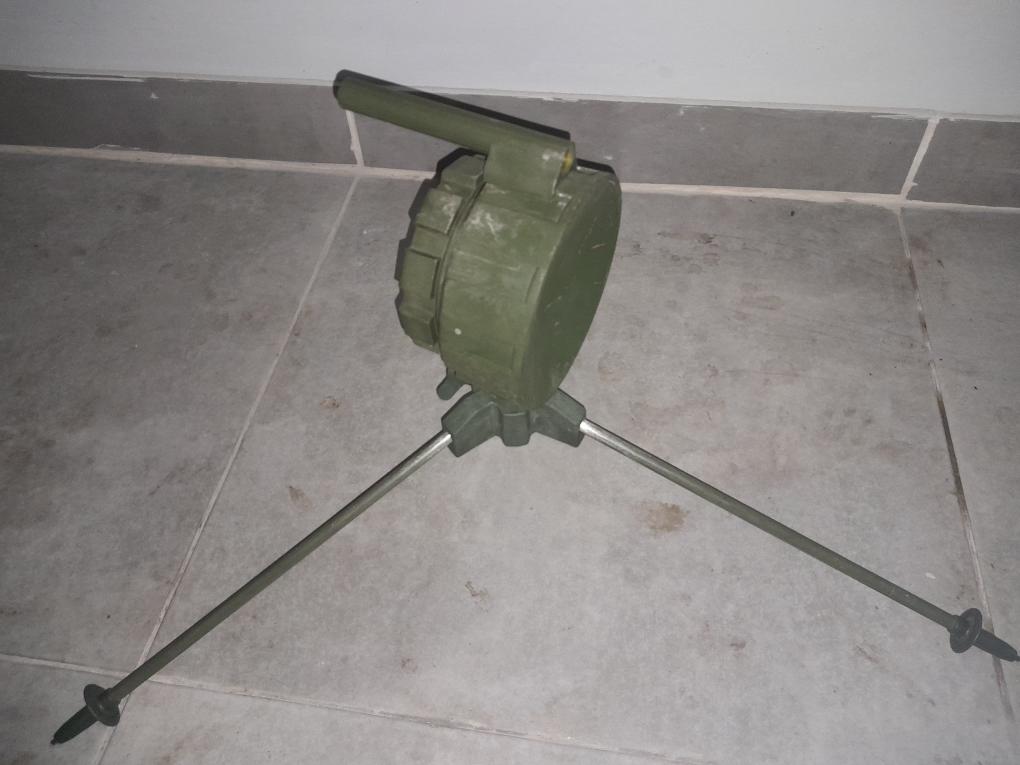
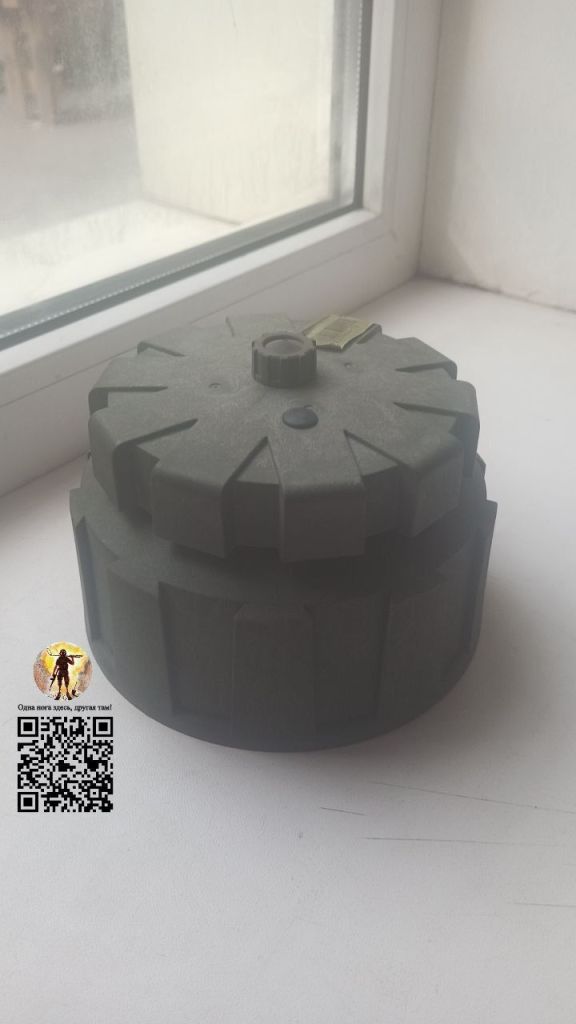
Recently another interesting anti-tank mine was spotted in use in Ukraine. The Estonian PK-14 or M14 directional mine appeared in photographs which were shared online around 9 September. The PK-14 is a directional mine capable of penetrating about 50mm of armour at a distance of 50 meters.
Photos of the PK-14 in the field were shared for the first time on 9 September (via Social Media)
Unlike the German DM22, which is also in service with Ukrainian forces, the PK-14 utilises the Misznay–Schardin effect with 1.5kg charge of PBX used to create an explosively formed penetrator. The PK-14 is capable of damaging most light IFVs and AFVs. It can be set up on a small tripod or even mounted to a tree, telephone poll or post – useful for attacking targets from above.
The Estonian defence company who manufactures the mine list it as both the PK-14 and M14. The mine is produced by Terramil under license from another Estonian defence company, Eesti Arsenal, who also offer several training systems.
The PK-14 assembled (nucking_futs_yuri)The PK-14 assembled, tripod in the tall configuration (nucking_futs_yuri)The PK-14 assembled, tripod in the low configuration (nucking_futs_yuri)
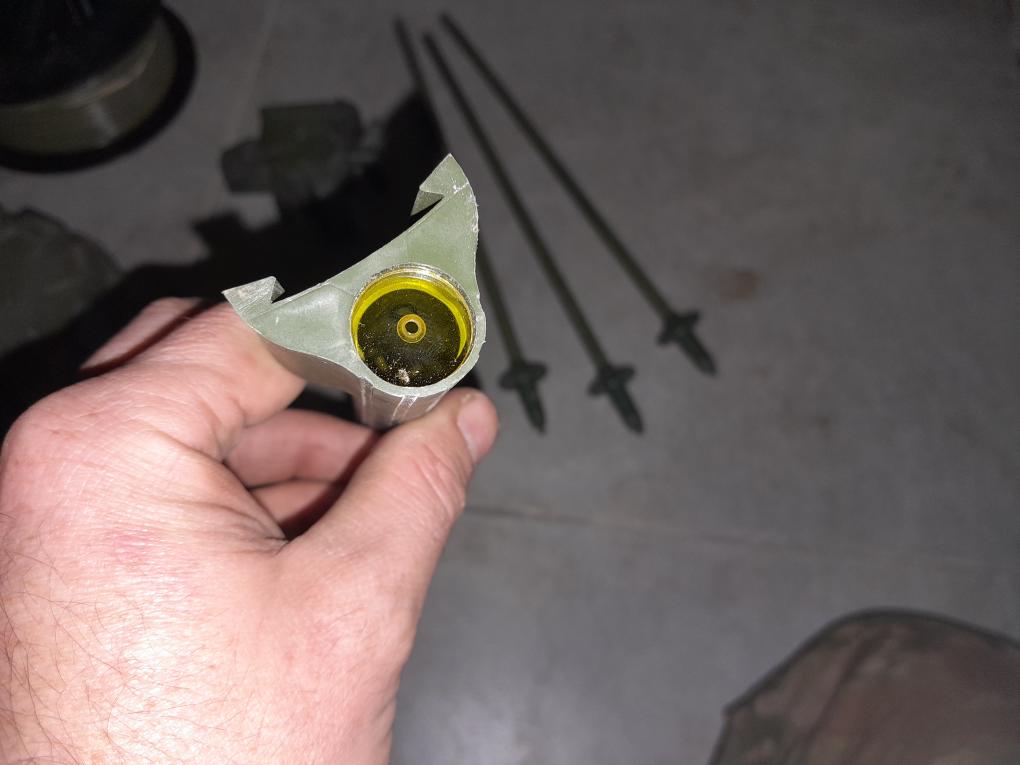
The PK-14 has a diopter sight which attaches to the top of the mine and allows it to be laid across the expected path of a target. The sight itself is a inexpensive moulded plastic tube with a narrow aperture which was described to us by an American serving with the Ukrainian armed forces as looking “like a scope you would find on a cheap toy gun at the corner store”. The mine’s casing is cleverly designed with a series of grooves that allow the sight to be slid into place and for the mine itself to be mounted on its tripod.
The PK-14’s sight tube (nucking_futs_yuri)
This instructional video from the manufacturers shows how the mine can be set up. The mine is command-initiated using a shock tube integrated system (STIS). This means that the mine isn’t tripped by a wire like the German DM-22 or by movement as in the Russian PTKM-1R, but in person by an operator. In practice the operator would set up the mine at a location the enemy is expected to pass, unspool the shock cord back to a concealed position and wait for the enemy vehicle to move within range of the mine.
In theory it is possible to rig the mines up with a makeshift pressure plate detonation system you could take the pressure plate from a conventional anti-tank mine like a TM-46 or TM-57 and wrap some detcord with a blasting cap at the end around it so when a vehicle rolls over it detonates the mine. The mine can be set up to strike from above so it hits the tank’s weak top armour or buried in the middle of the road so it can strike up through the vehicle’s belly armour.
The PK-14’s basic components (nucking_futs_yuri)
Special thanks to nucking_futs_yuri, who is best known as the turret gunner who ran an M2 Browning and was handed some AT4s by his vehicle crew when he called for more ammunition in a recent viral video. Yuri has provided photos and video of a PK-14 in his units inventory. Check out his video showing the components of the mine here.
It’s a small, affordable mine but it is currently unknown how many PK-14 mines have been sent to Ukraine but Estonia, along with the other Baltic states, has been a significant supporter of Ukraine since before Russia’s invasion in February. Estonia began procuring the mines for the Estonian Defence Force in 2015.
nucking_futs_yuri’s video showing the components and set up of the PK-14
In terms of how they may be deployed in Ukraine, the small size and light weight of the PK-14 may be useful for small Ukrainian reconnaissance and special forces teams operating behind Russian lines. Yuri explained that they’re preferred over convention Soviet TM mines as they’re lighter, he stated that:
“normally we each take 2 or more with us, set up our ambush and wait. We could mount them high if need be and get the top of the turret or even bury them in the middle of the road… so it explodes under the center of the tank.”
— Historical Firearms | Matthew Moss (@historicfirearm) February 7, 2023
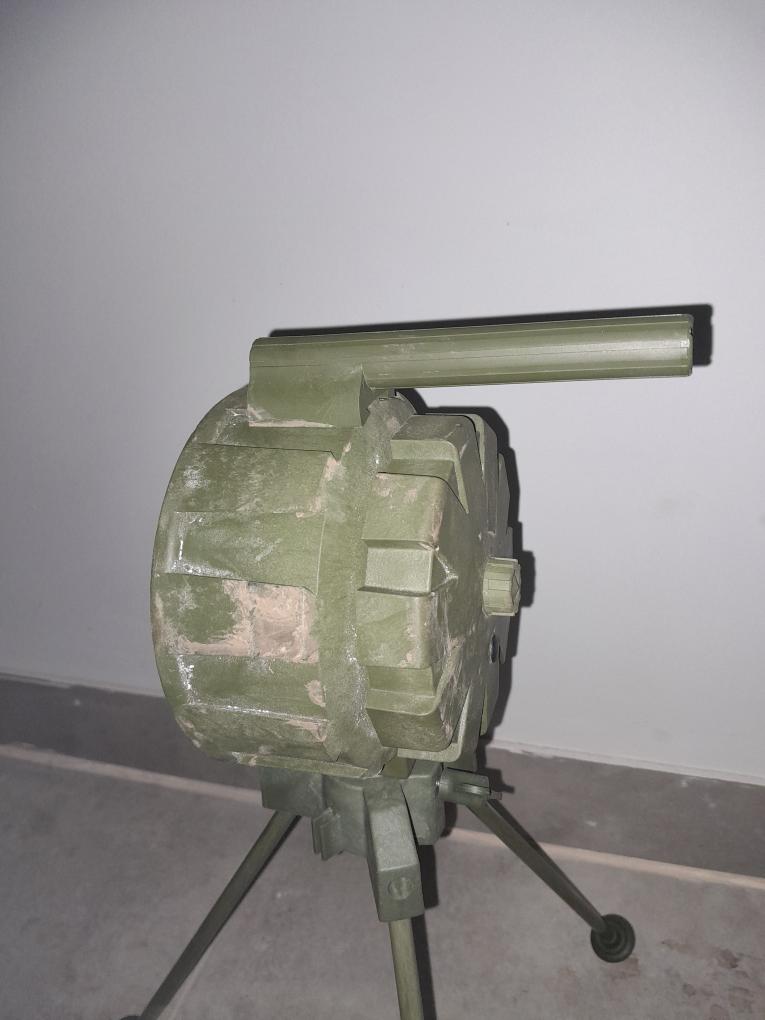
Update – 18/09/24: A rare sighting of a PK-14, reportedly said to be in Ukraine.
If you enjoyed this video and article please consider supporting our work here. We have some great perks available for Patreon Supporters – including custom stickers and early access to videos! Thank you for your support!








 The Armourers Bench