Since our last article/video on gun-armed drones in September 2024, both sides have continued to develop the technology. We’ll be taking a look at the latest develeopments in gun-armed rotor-powered drones in a future article/video, in this video we’re going to take a look at the latest development: a gun-armed fixed wing UAV.
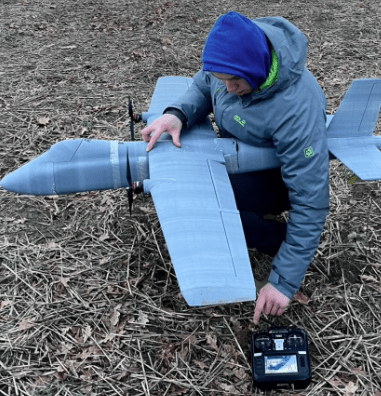
The first imagery of the ‘ZigZag’ UAV developed by Ukrainian drone manufacturer Sky Defenders was shared on social media 15 March. Shared on Sky Defenders’ official social media channels the minute long video shows a fixed wing UAV being launched, once in the sky the video cuts to an onboard camera view which features a crude but unmistakable sighting ring. In the nose of the UAV we can see a pair of tubes set side by side. The video shows a test flight of the twin prop UAV.
The ZigZag during flight testing, without its guns mounted, February 2025 (via Sky Defenders)
This appears to be the second fixed-wing drone developed by Sky Defenders. the first is the Vyryi M7 which is now said to be being delivered to Ukrainian units. The M7 is a loitering, or one-way, munition, powered by a single rear prop it has a 33km range and a warhead in its nose.
In an earlier video shared by a Misha a member of the Sky Defender’s team, posted on 5 March, we get a closer look at the ZigZag gun-armed drone. The video’s caption reads: “Please support the combat tests of the Zigzag interceptor aircraft. This UAV is quite an achievement for my small but really awesome team. We put all our resources into this project.”
The ZigZag firing its left, top, gun barrel during testing (via Sky Defenders)
The ZigZag has been in development since at least February 2025, with Sky Defenders sharing a short video from flight testing of the drone with the UAV seen without its four guns.
It appears that the drone actually has four rather than two gun barrels. There is only a short clip of the drone’s guns being tested and it doesn’t appear that the drone’s flight is impacted by the recoil of the gun. From the fuselage design it appears that the drone will not be using the counterweight recoilless gun designs used by the quadcopter gun-armed drones. It’s likely the the ZigZag is powerful enough to fire conventional-type ‘shotgun’ and withstand the recoil.
A close up of the ZigZag’s four-gun barrels and gimbal mounted camera (via Sky Defenders)
In the video we can see the aiming post and ring and behind it a camera on a 360-degree gimbal mount which enables aiming. While the M7 drone is a one-way-munition and not designed to return the ZigZag appears to be more robust and intended for repeated sorties. The range, weight and loitering time of the UAV is currently unknown. The role of the ZigZag appears to be as a dedicated drone hunter able to rapidly intercept opposing drones and engage them with its guns. It will be interesting to see how the ZigZag is employed.
The Sky Defenders ZigZag represents another interesting step in the rapidly evolving gun-armed drone space in Ukraine.
On the 27 December, a Ukrainian fundraising charity posted a series of short videos featuring a drone with a pair of gun barrels. The Lesia UA Foundation provide Ukrainian units with vehicles, bikes, drones and personal equipment procured with the funds they raise. It appears that they have helped to fund the development or fielding of an unknown number of gun-armed drones.
The footage of the gun-drone in action was shared on 27 December with the telegram post stating [machine translated]:
“For the first time on video – drones and hard drives shot down other drones Defenders of Ukraine test #LesiaUAtechnology developments Stay tuned and we’ll show you even more exclusive shots! Together to victory!”
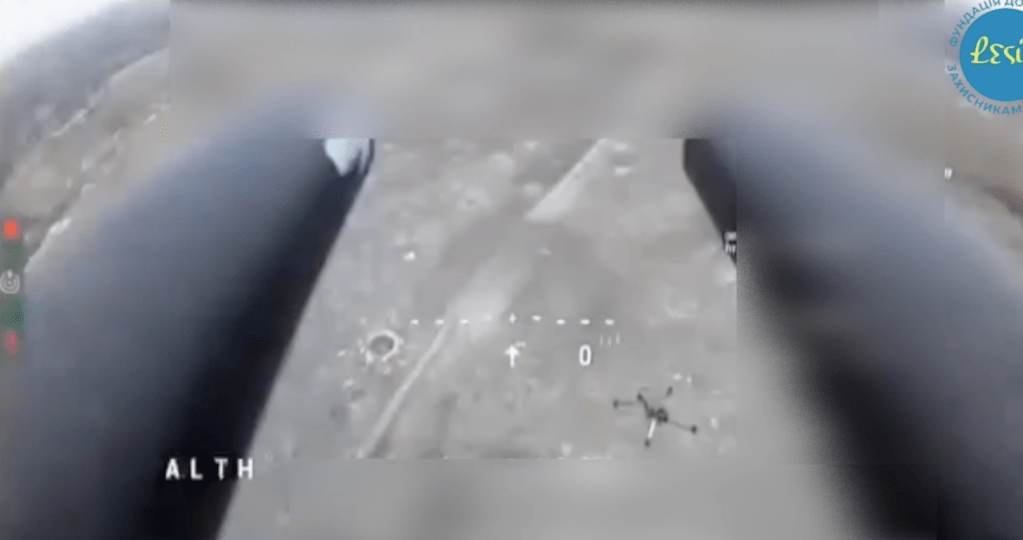
In the first video the gun-drone follows a quadcopter with the drone’s camera panning up and down several times between what appear to be a pair of barrels. The quadcopter is downed with damage to one of its rotors and appears to be trailing smoke as it spirals to the ground.
View between the barrels of a Ukrainian gun drone (via social media)
In the second short clip what appears to be a bomber drone, carrying an explosive hanging beneath it, is shot down as very close range as it hovers. Similarly, the third video shows a bomber drone which is shot down at close range as it hovered with damage to its rotor blades. At the time of writing the Lesia UA Foundation have not released any additional clips of the drone in action or any images of what the drone looks like.
While in recent months we have seen drones armed with both RPGs and AK-74s these have been used in the air-to-ground role. The shotgun-like blasts seen in these clips are more useful for close range air-to-air engagements. From the lack of recoil seen in the clips, the large bore diameter of the barrels and their positioning on the drone, either side of a camera gimbal, it would appear that the gun used by the drone follows a recoilless principal. The recoilless guns work along the premise of Newton’s Third Law of Motion, that all things have an equal and opposite reaction – as such two guns are connected back to back, with the backwards-facing gun firing a counter-weight – mitigating recoil which prevents the drone’s flight from being destabilised.
A Russian recoilless gun drone developed in 2024 (via social media)
Why a recoilless gun and not a conventional shotgun? Principal factors governing this are likely weight, effectiveness and recoil. The recoilless guns have a larger bore diameter meaning larger load and increased hit probability. Additionally they are simpler with no-working or recoiling parts (as they load is likely electrically ignited) and they are lighter allowing the drone to stay in the air for longer and/or travel further. The key downside to the use of a single shot recoilless gun is that it can fire only one round. The Ukrainian drones have sought to mitigate this by seemingly equipping their drone with two of the guns.
While we haven’t yet seen an image of the Ukrainian gun-armed drone, we have seen a Russian example which was developed in the summer of 2024, tested but reportedly not yet fielded. The Russian drone was developed by the BRT company who, in a recent telegram post, expressed their frustration at seeing a Ukrainian recoilless gun drone in use.
While successfully engaging an enemy drone with a gun is difficult it is the detection and tracking of enemy drones which is likely the most challenging part. This may lead to these recoilless gun-equipped drones being used in a sort of combat air patrol role, seeking out and hunting down enemy drones over an area where they have been reported. It remains to be seen if these recoilless gun-armed drones will proliferate as a method of countering the huge number of small drones used by both sides but from the limited footage of them in action that is available the concept seems proven.
Update – 10/1/24: Additional footage has surfaced showing the drone firing on Russian infantry.
In an unsurprising turn of events the Ukrainian recoilless gun drone has now been seen firing on infantry. Looks like an FPV also targeted the Russian.
— Matthew Moss | The Armourer's Bench (@historicfirearm) January 10, 2025
Update – 15/1/25: Additional footage of the Ukrainian drone in action, shared by a drone unit with the 2nd Mechanized Battalion of the 30th Mechanized Brigade.
A compilation of footage from the Ukrainian 'shotgun' drone which I covered in a video a few weeks ago. The footage was shared by a drone unit with the 2nd Mechanized Battalion of the 30th Mechanized Brigade.
Earlier this summer, Polish PGN-60 rifle grenades began to appear in the hands of various Ukrainian units. These 68mm fin-stabilised, High-Explosive Anti-Tank (HEAT) grenades were developed in the 1950s, to provide Polish infantry with a ranged anti-tank and anti-personnel weapon.
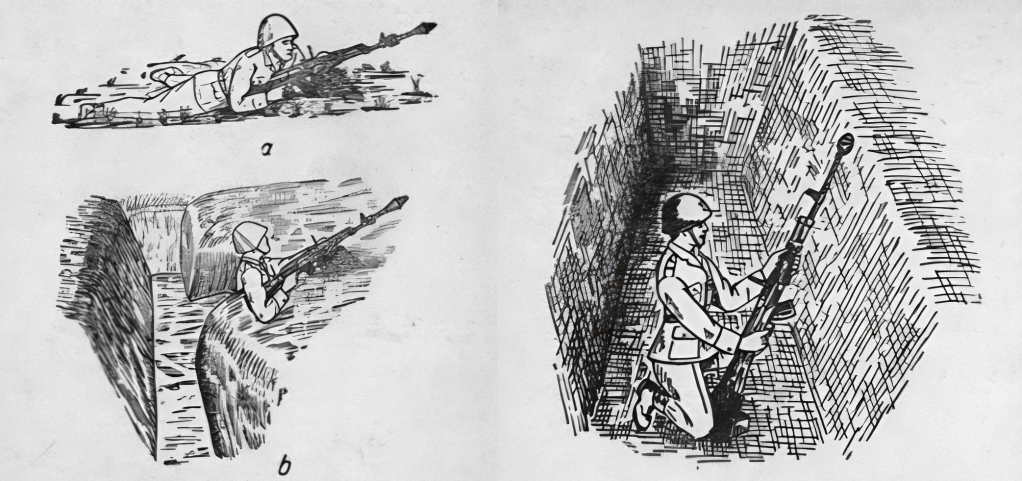
Introduced in the early 1960s they were used in conjunction with the specially adapted Karabinek-granatnik wzór 1960 (Carbine-grenade launcher M1960) which had a spigot onto which the grenade’s tail was slid. The grenade was launched by a blank UNM ‘Universal Propellant Cartridge’. The 7.62×39mm wz.1960 and later wz.1960/72 are long out of Polish service, but it seems that the Polish military decided to retain the rifle grenades in storage. The rifle grenade concept was superseded in Polish service by the issuing of the lightweight RPG-76 Komar anti-armour rocket propelled grenade. These have also appeared in Ukraine.
Polish manual illustrations showing PGN-60 and KGN rifle grenades (source)
The stated penetrating power of the PGN-60 varies depending on the source; some say 160mm others suggest up to 200mm of RHA plate. The grenade itself is either Impact or Graze fuze initiated.
While we have seen use of improvised rifle grenades in Ukraine, it is unlikely the PGN-60s have been used for their original purpose, instead they appear to have been either harvested for their explosive content or used as warheads for FPV (First Person View) drones.
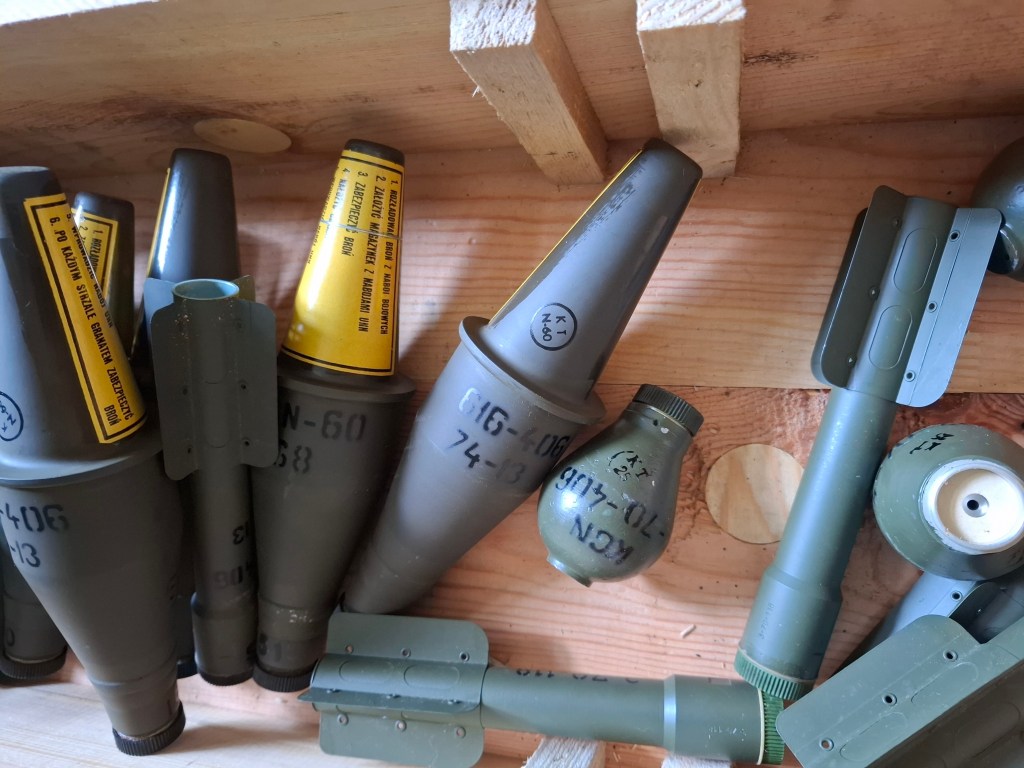
One example of the use of the rifle grenades by a drone team was shared by Joe McDonald, a British volunteer serving with the Ukrainian Marines in Kherson. Joe kindly shared some photos of a consignment of Polish rifle grenades his unit received in July. Included in the consignment were not only the PGN-60 HEAT grenades but also Polish KGN anti-personnel grenades. The first sighting of one of the KGN grenades came earlier, back in mid-April 2024. Sources suggest that the KGN grenades contain nearly 250 fragmentation pieces. One of Joe’s photograph shows 10 PGN-60s and five KGNs, along with their detached tail assemblies.
PGN-60 & KGN rifle grenades, July 2024 (Joe McDonald)
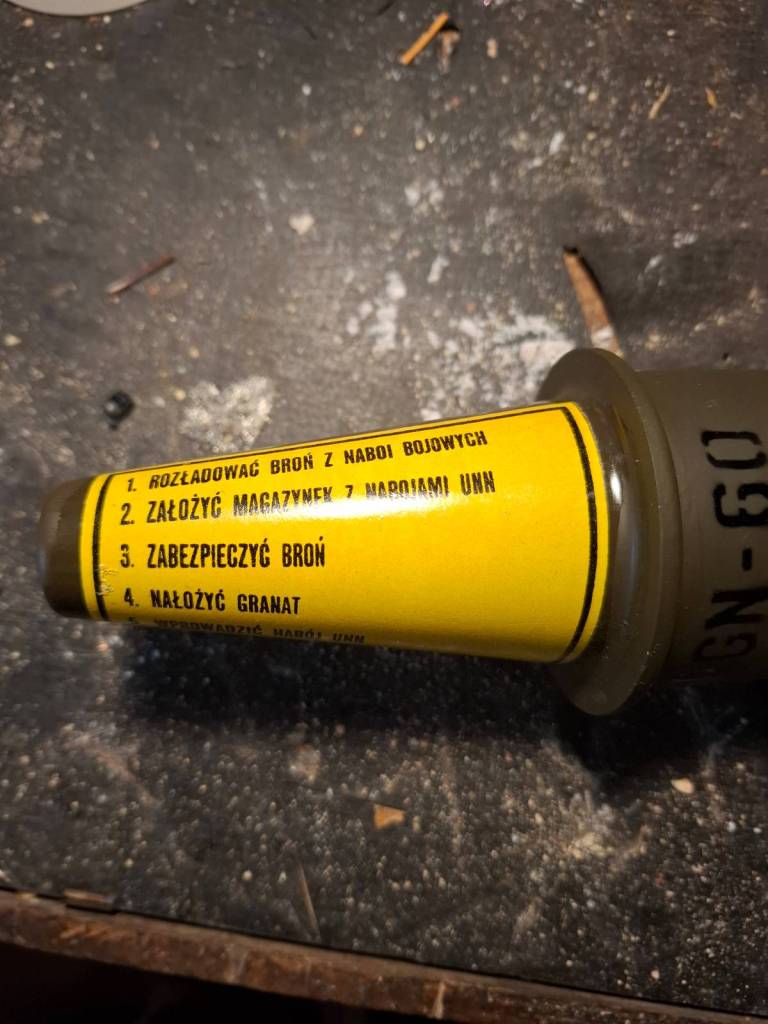
The yellow label markings are instructions on how to use the rifle grenade, they read [machine translated]:
Unload the rifle
Load magazine with propellant cartridges
Put the rifle on safe
Seat the grenade
Chamber a propellant cartridge
After each shot put the weapon on safe
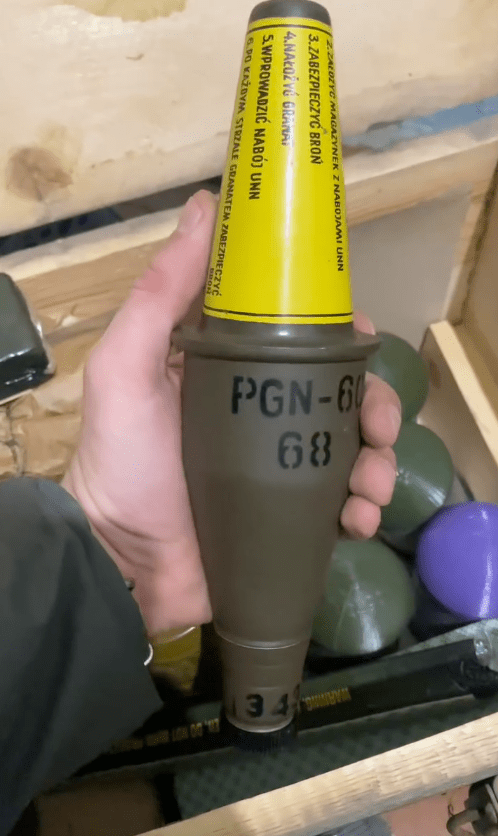
Other markings include various factory, year and lot markings.
PGN-60 markings (Joe McDonald)
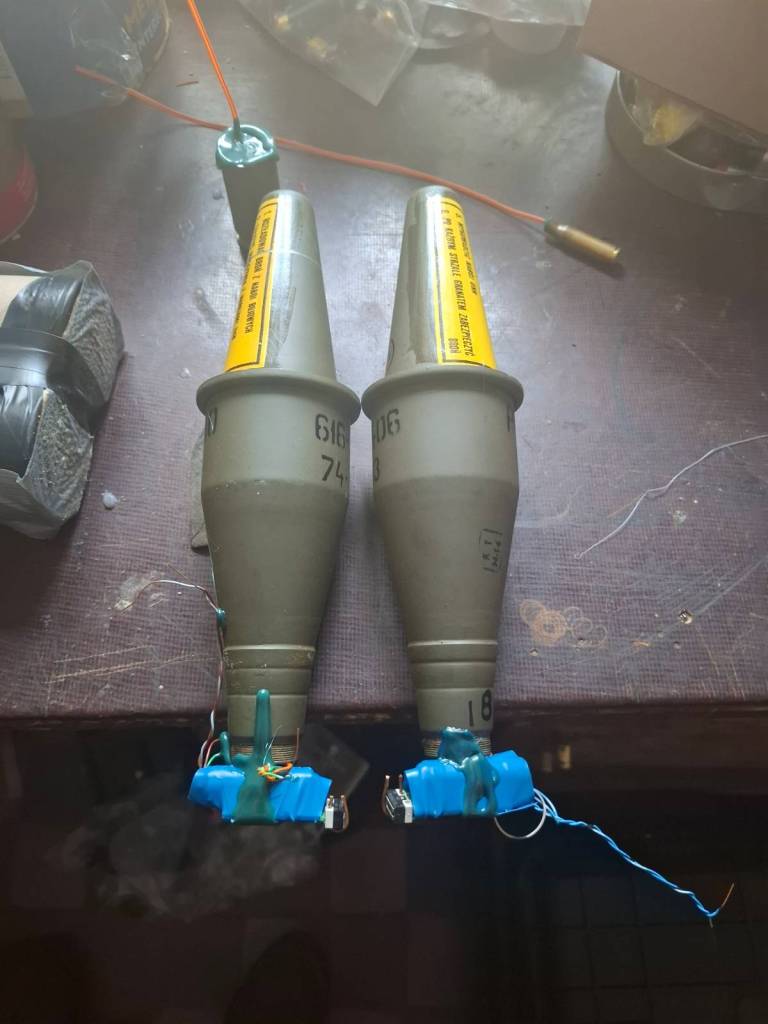
Joe noted that the KGN grenades have either been used as drone-dropped munitions or have been mounted on 7-inch first person view (FPV) drones in addition to a quantity of additional plastic explosive. Joe recently shared some video of five of the PGN-60 warheads electronically wired and ready for mounting on an FPV drone, these are some of the last of the grenades his unit received in July.
PGN-60 rifle grenades prepared for mounting on FPV drones (Joe McDonald)
The PGN-60s aren’t the only interesting rifle grenades to turn up. In September a photograph of a 1990-dated French 58mm PAB F2 anti-tank rifle grenade was shared. France may have provided them for their explosive content or to accompany the 1,000 FAMAS F1 Valorise rifles which have been transferred to Ukraine. Only one image of this type of rifle grenade has surface so far but from the image it appears it’s tail assembly has been removed and is likely to be utilised as part of an FPV.
It is currently unclear just how many Polish and French rifle grenades have been transferred to Ukraine. The imagery sample featured in this article/video represents all of the imagery I have been able to find. If you have come across any additional sightings of the grenades I’d love to hear from you.
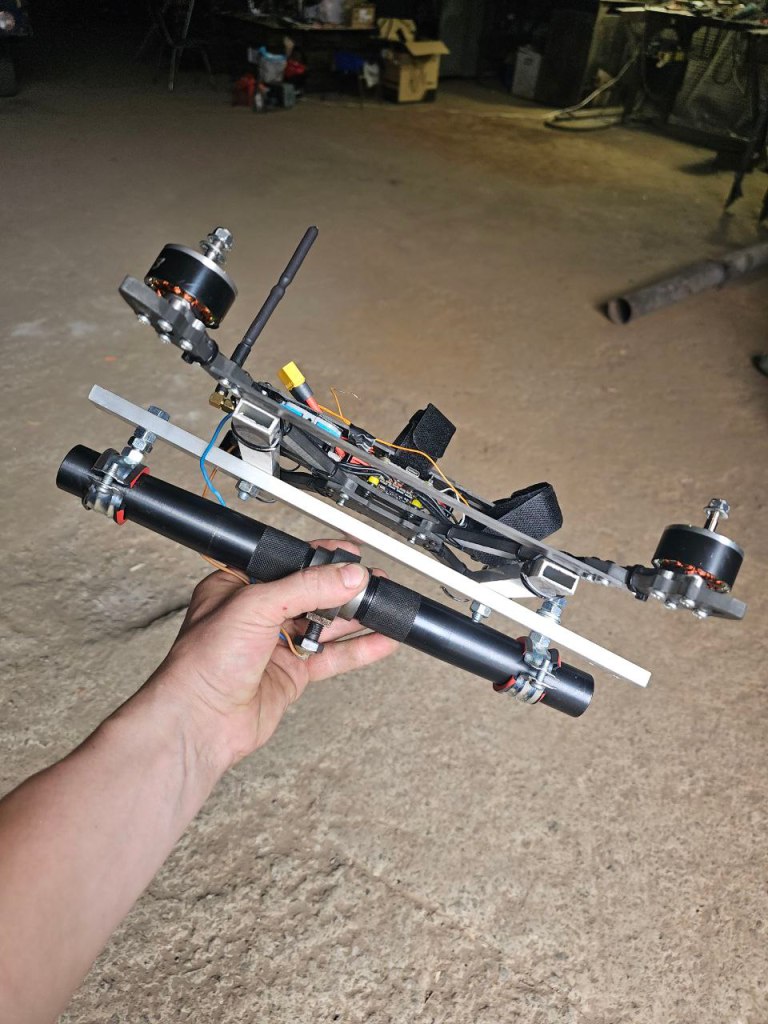
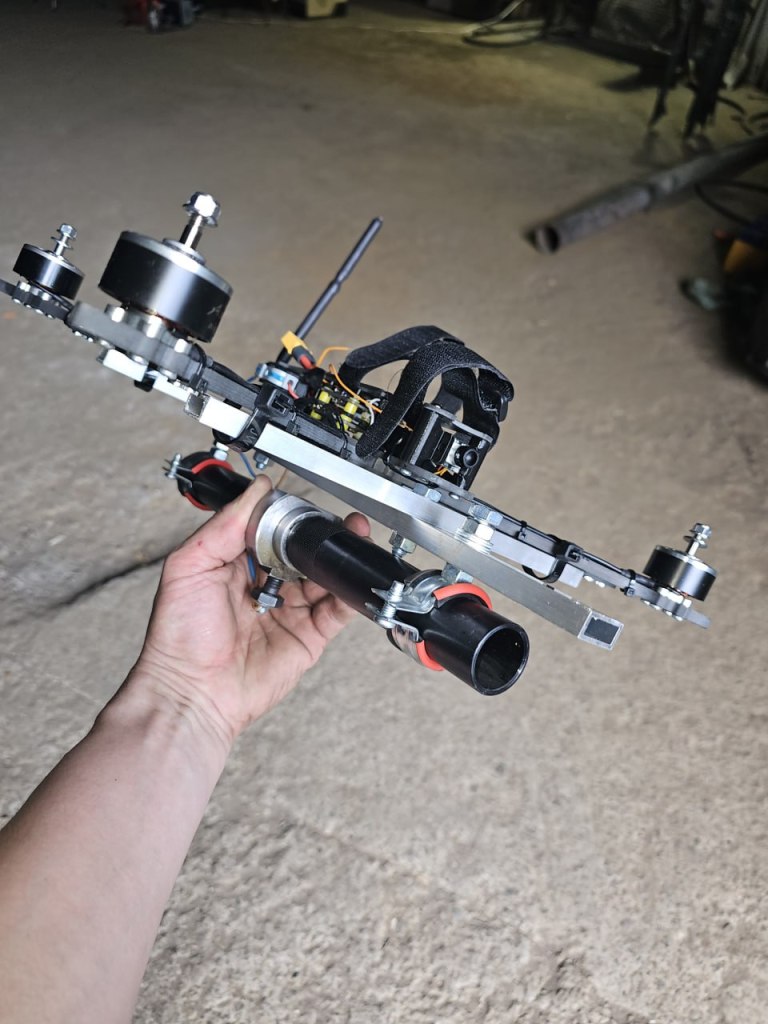
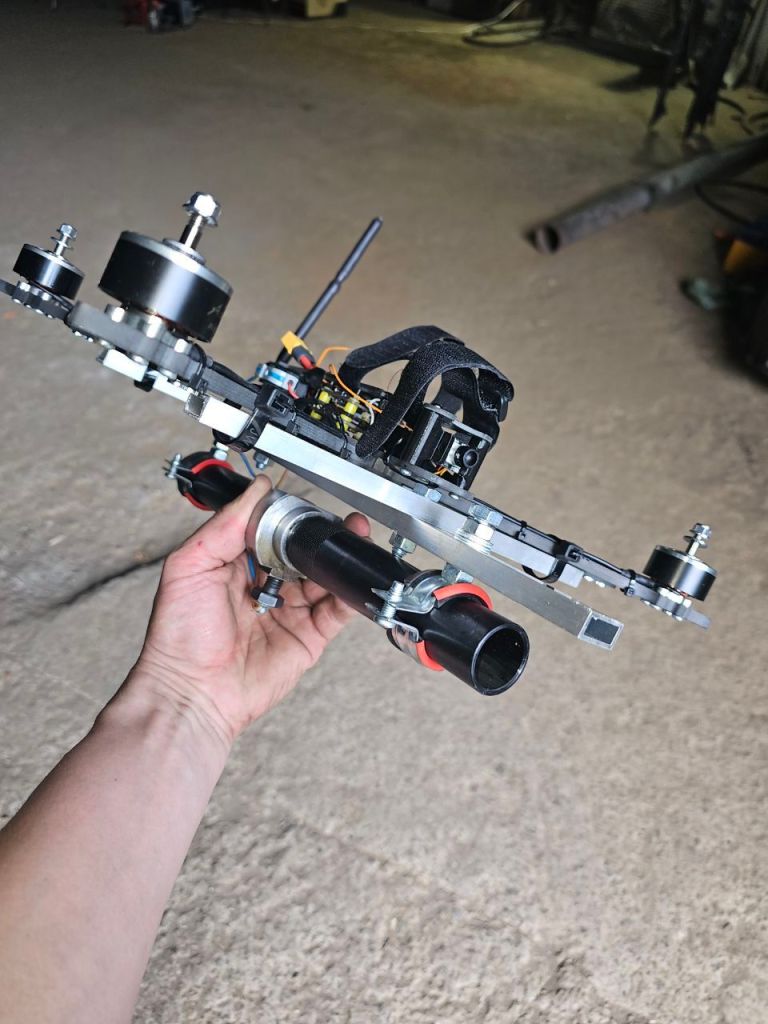
What is old is new. On 12 September, Russian journalist Alexander Kots shared a photograph of a recoilless gun mounted on a drone on his Kotsnews telegram channel channel. The idea certainly isn’t a new one. The use of a recoilless gun on aerial platforms dates back to the 1910s with the development of a series of recoilless guns by Commander Cleland Davis (US Navy) which were experimentally mounted on a variety of early military aircraft.
While the Davis Gun was abandoned shortly after the end of World War One, it was influential and its principle of operation was utilised in later recoilless guns. Essentially it worked along the premise of Newton’s Third Law of Motion, that all things have an equal and opposite reaction – as such Davis connected two guns back to back, with the backwards-facing gun firing a counter-weight.
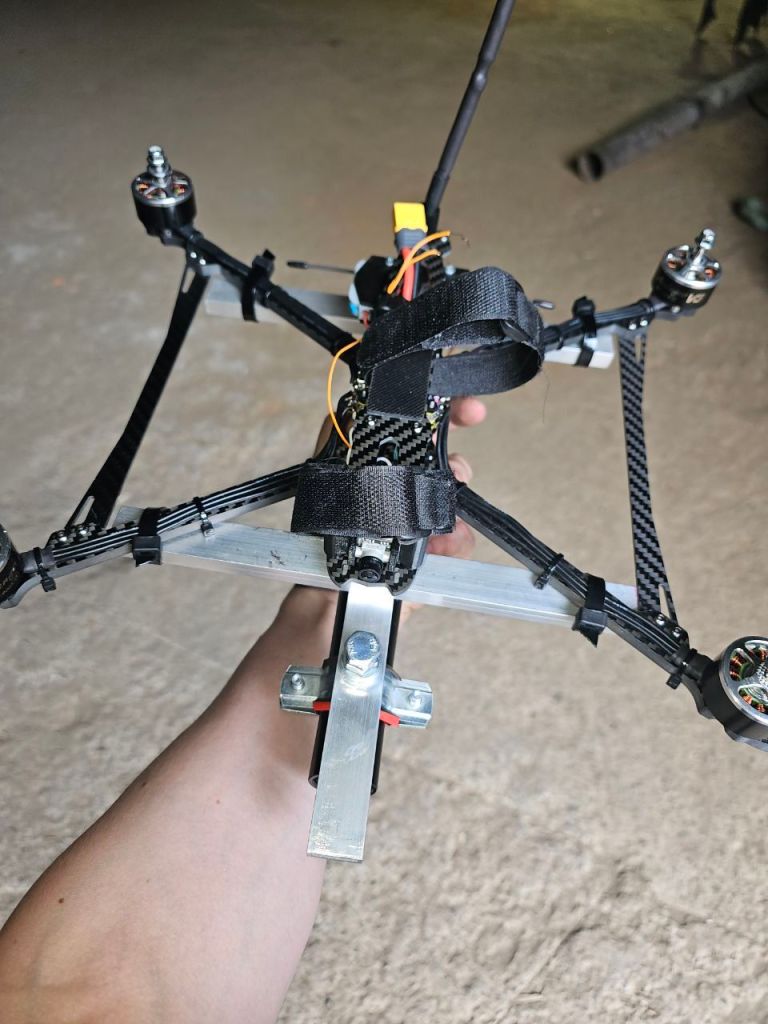
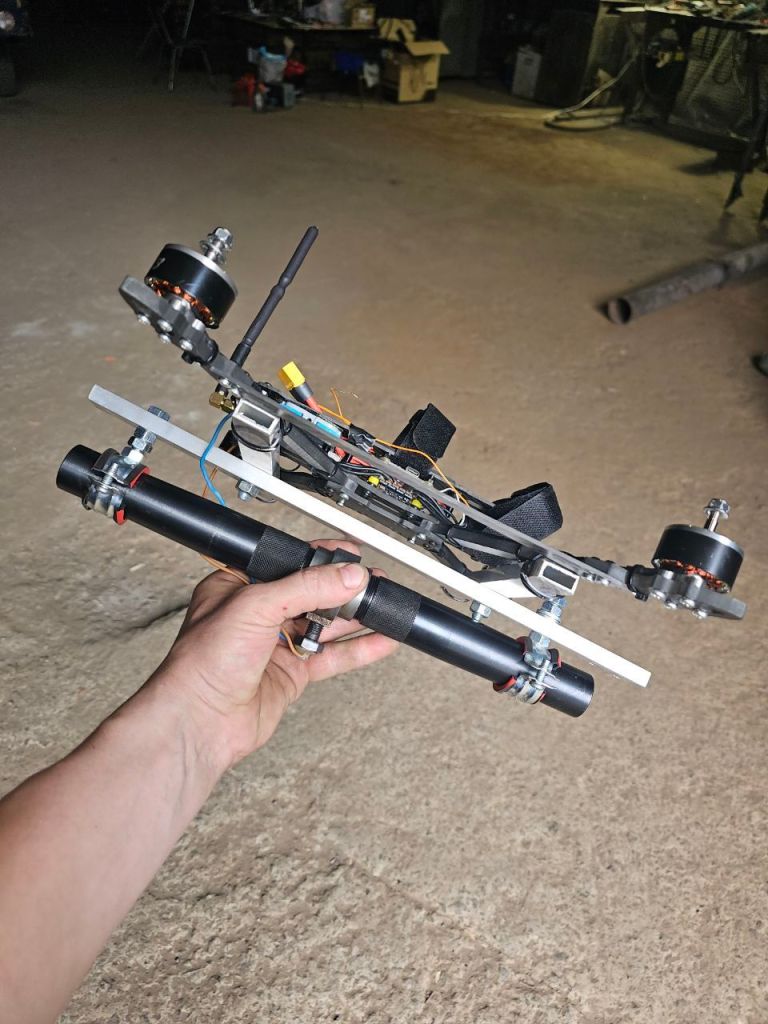
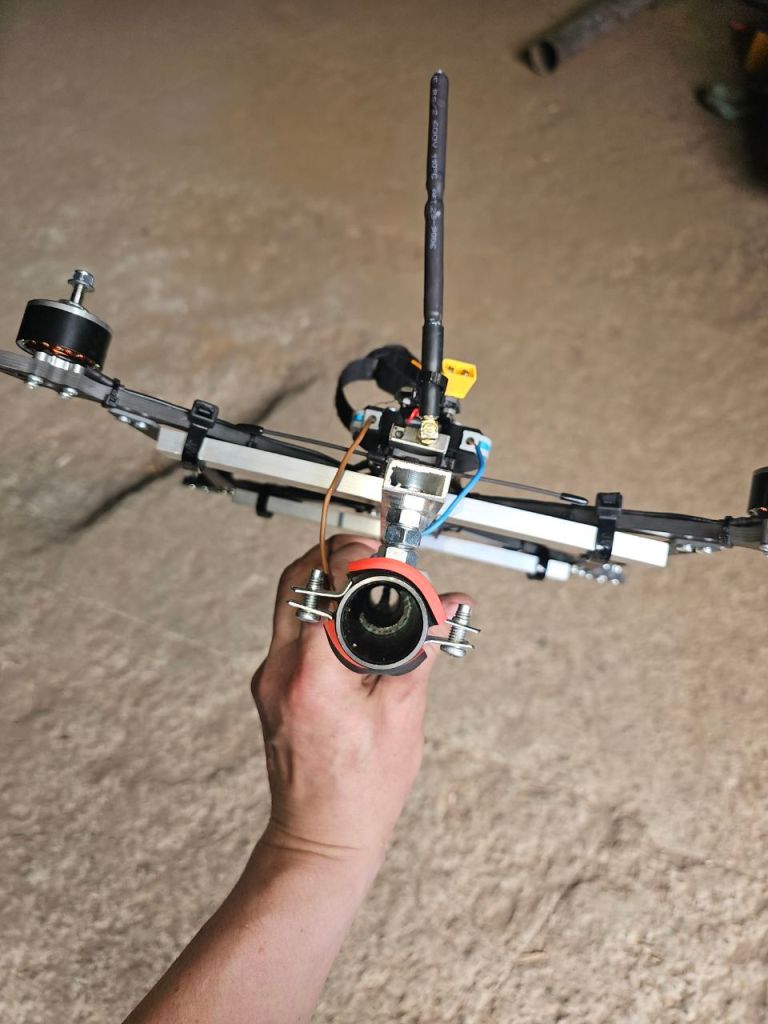
Fast-forward over a century and the concepts is again revisited in miniature and mounted on a quadcopter drone. Kots described the recoilless gun in his post [machine translated]: “Large pellets are loaded in the front, and an equal counterweight is loaded in the back. Thus, a lightweight drone becomes capable of hitting small air targets without the risk of falling into a tailspin from the recoil.” The image shared appears to show a smoothbore weapon attached to the drone with plumbing clamps with several electrical wires running to it, likely for ignition of the charge.
The developer of the drone, the chief engineer of Russian company BRT, shared Kots’ post commenting [machine translated]: “Our BUBUKA hit the news. I made it, taught it to shoot, and gave it to our FPV players… – I don’t fly myself, it’s not my thing,” lamenting that “since then – no response, no greetings. I’m not even sure they tried to test it.”
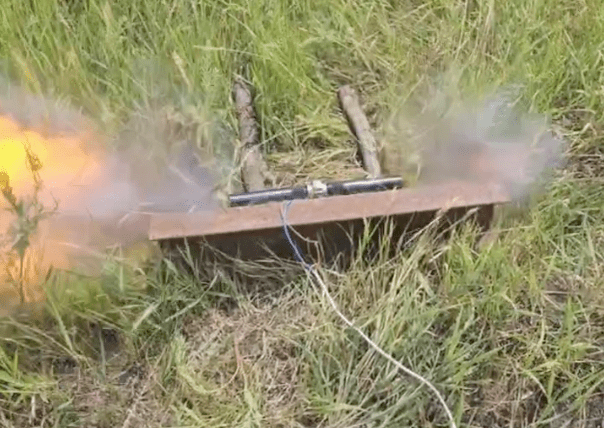
The engineer followed this up by posting footage of a test of the recoilless gun, explaining [machine translated]:
“The principle is fully functional. And it was used more than 100 years ago, on plywood planes. On the FPV, as I see it, for its use, you need to solve 2 main problems: – – aiming at the target. – correct ballistics of shot ammunition (dispersion, mass of shot charge, etc.).”
In the video the engineer exclaims that ‘both ways [fired] just fine’ with the grass in front of both barrels clearly impacted by the test. It’s unclear what kind of shot the recoilless gun is designed to use likely a buckshot-style round able to spread on leaving the barrel and sufficiently damage a drone to down it.
It appears that the ‘Bubuka’ may not yet have been tested or used in the field but it is an interesting design mitigating one of the major factors of firing a weapon from a drone – recoil. However, the recoilless gun has a number of drawbacks too. While the gun allows the drone to engage another drone kinetically without having to fly into it, the gun only has one shot which magnifies the difficulty of scoring a hit when aiming is difficult. It’s clear, however, that the evolution of drone warfare in Ukraine is continuing at pace with recent efforts by both sides to mount AK-pattern rifles to drones and the increasing number of drone vs drone engagements occurring.
Update 28/12/24: It appears that a Ukrainian team has also developed a recoilless gun-armed drone. Several videos were shared of an FPV drone equipped with a pair of barrels which are likely electrically initiated and have counter-weight charges as the earlier Russian drone did. The videos show a series of successful drone vs drone engagements.
This Ukrainian footage of an drone armed with a pair of "shotgun" barrels is intriguing. We'll know more if a photo of the drone appears but it may be using a recoilless system, with a counterweight charge. 1/ pic.twitter.com/GLOypaojNG
— Matthew Moss | Historical Firearms (@historicfirearm) December 28, 2024
Update – 3/1/25: A telegram associated with BRT has posted additional photos of their recoilless gun drone developed in early 2024 and expressed Thier frustration that a similar Ukrainian drone has had operational success.
Drone warfare has evolved massively in Ukraine since the Russian invasion in February, moving from commercial drones spotting enemies and dropping grenades to First Person View (FPV) drones capable of taking out a tank. One branch of the possible evolution of drones which hasn’t seen a great deal of development or practical use is the mounting of small arms on them.
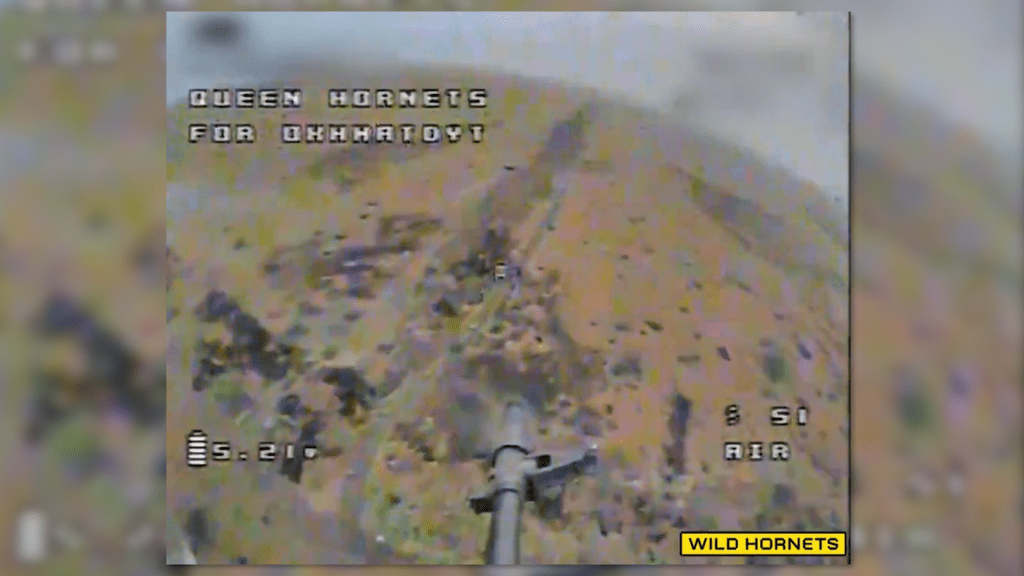
On 4 September, Wild Hornets, a Ukrainian drone manufacturing initiative, shared footage of what they claim is the first use of their gun-armed drone in combat. The video was shared with the caption [machine translated]: “this time, the first combat deployment was carried out—targeting a position with Russian forces. This test indicated the direction in which this project should move forward.”
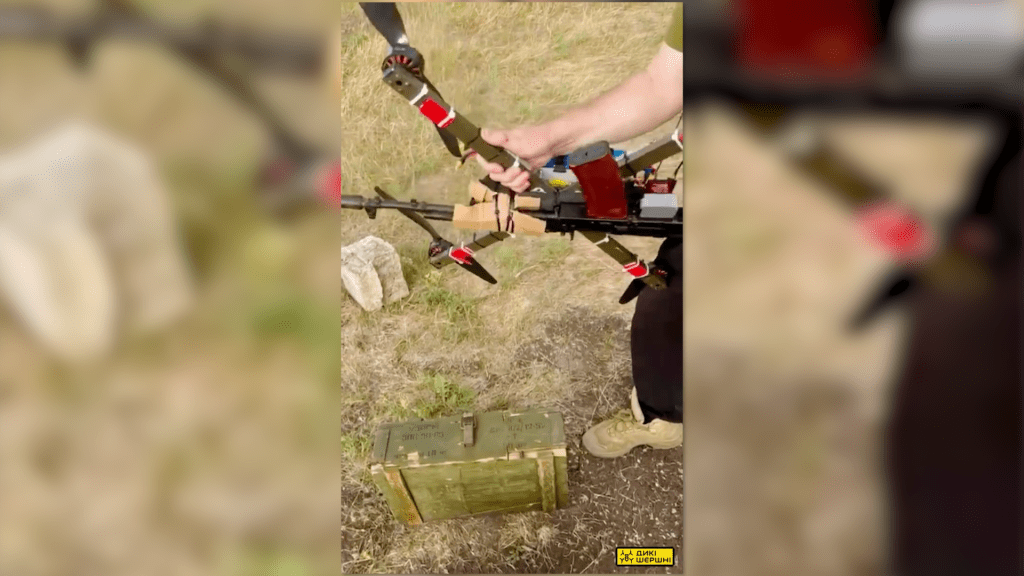
The grainy footage from an FPV drone’s camera shows the barrel of an AK-74, mounted tilted to the right, at the bottom center of the frame. It is seen firing several full-auto bursts towards the ground but it’s difficult to see at what exactly. The drone is believed to be operated by the Bulava (Mace) drone team, which is believed to be attached to the Ukrainian Presidential Brigade.
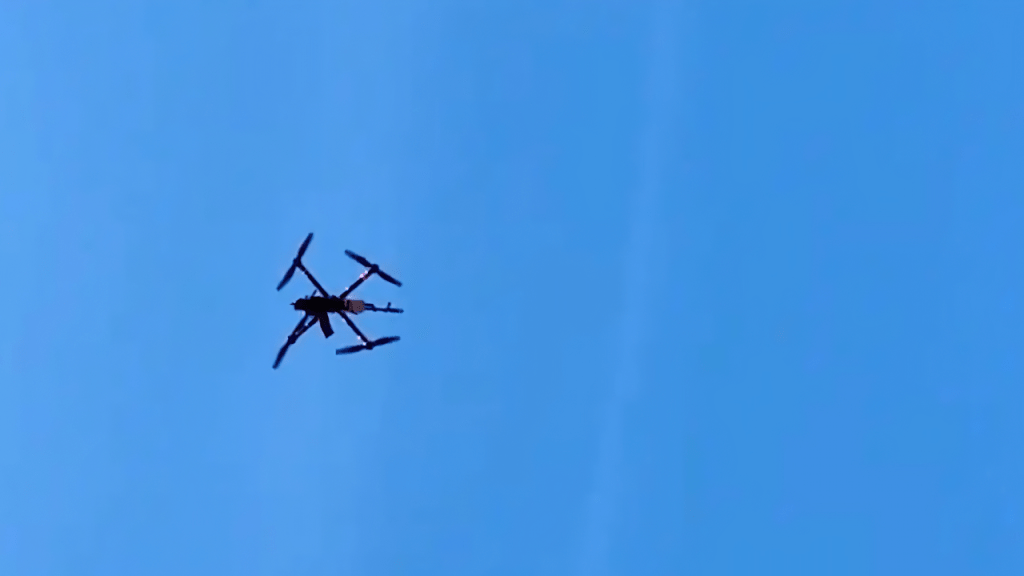
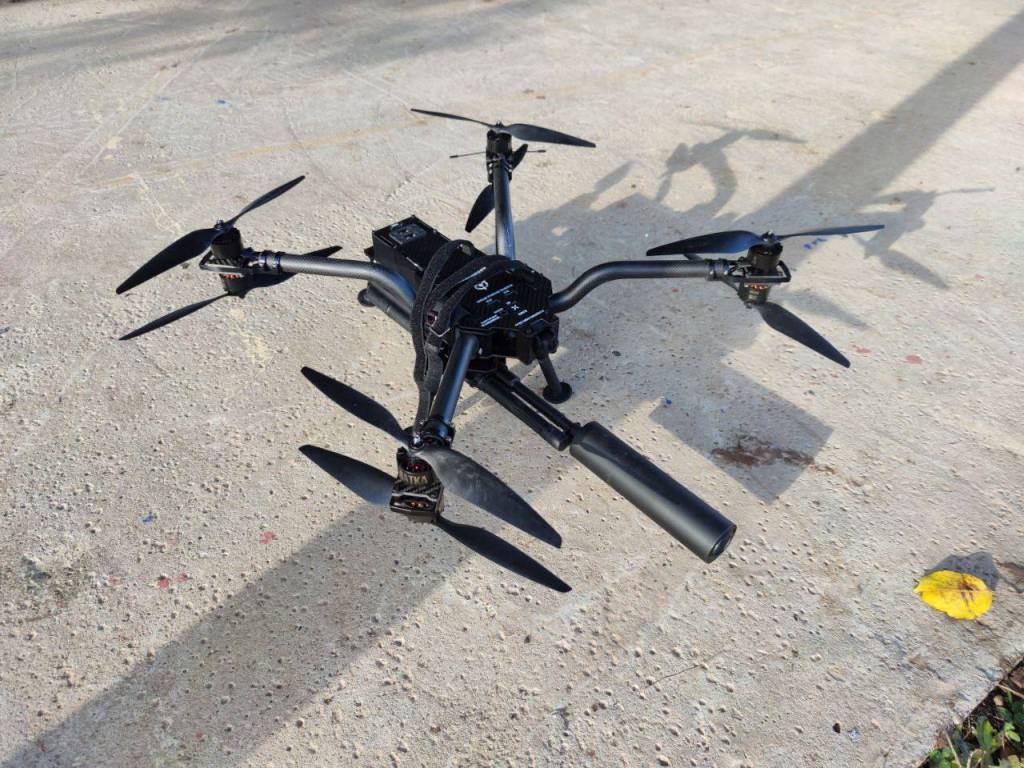
Wild Hornets note that the rifle is mounted on one of their largest FPV drones, a Queen Hornet. The Queen Hornet FPVs can reportedly carry up to 9.5kg (21lbs) of payload so an AK-74 with a loaded magazine (even a 40-round RPK-74 magazine) would be no issue. The drone also has to contend with the rifle’s recoil and from the video it appears that on firing the drone’s flight is only slowed momentarily. The Queen Hornet was unveiled in March 2024, and began to appear on the frontline in July and have been used not only to drop munitions but to also deliver smaller drones downrange – acting as a carrier, and also as signal repeaters to enable other drones to travel further from their operators.
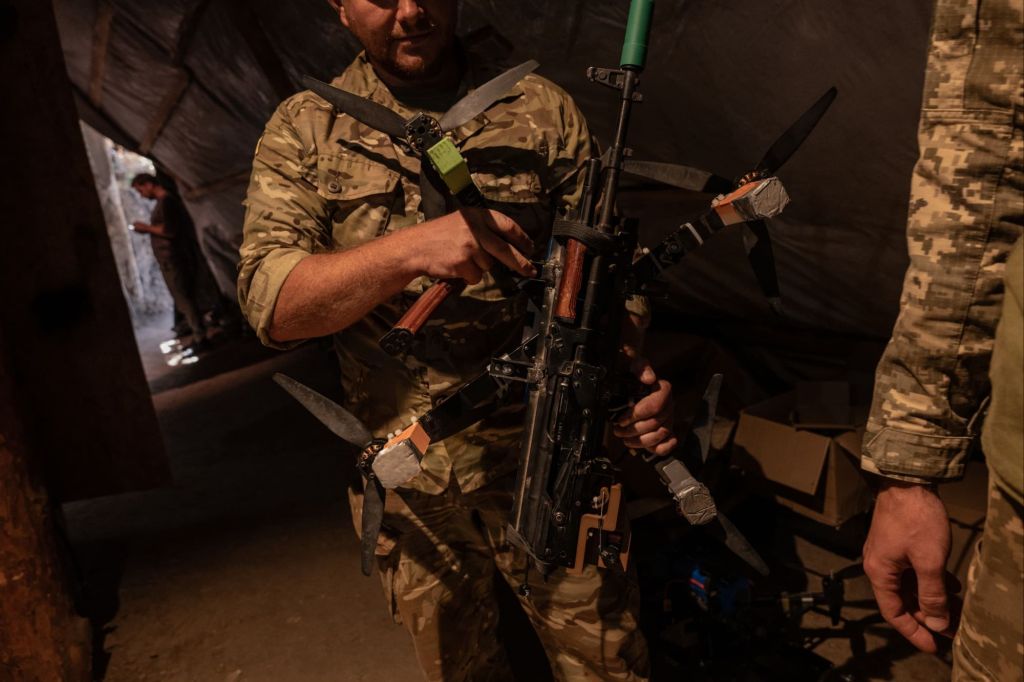
The gun-armed FPV was first seen in a video shared on 16 August. Wild Hornets shared a video showing a Queen Hornet returning to Ukrainian lines with an AK-74 hanging below it – Wild Hornets claim that the rifle was a Russian AK salvaged with a magnet. A montage then shows the salvaged rifle being mounted on a Queen Hornet, with its stock removed to save weight, and test fired. The rifle appears to be held onto the drone with zip ties and a small grey box encloses the trigger – likely containing a servo to pull the trigger.
There have been efforts to mount firearms on drones outside of Ukraine and there is also some earlier evidence of Ukrainian drone teams attempting to mount guns on the large Baba Yaga heavy drones earlier with imagery appearing in April of a large, possibly gun-armed, drone being filmed from above. In May, footage of what could also lay claim to the first use of a gun-armed drone in combat was shared. The footage was shared by the 74th Battalion of the 102nd Territorial Defense Brigade and shows a Baba Yaga drone equipped with a firearm, again firing bursts, the weapon appears to have a sighting post attached to allow the weapon to be aimed using the drone’s camera. The footage of the drone firing on Russian positions was reportedly filmed northwest of Marfopil, in Zaporizhzhia.
There is also evidence that the Russians have experimented similarly with gun-armed drones with Russian drone company Molot Aero sharing a video of their Vatya X8 drone equipped with a suppressed AK-74 in June. There is no evidence currently available to suggest this configuration has yet been used in the field. Photographs of the drone show a similar configuration to that assembled by Wild Hornets with a stock-less AK-74 mounted on its side on the underside of the drone. The footage shows the Molot Aero drone hovering over a range successfully shooting several balloon targets at relatively close range before it lands.
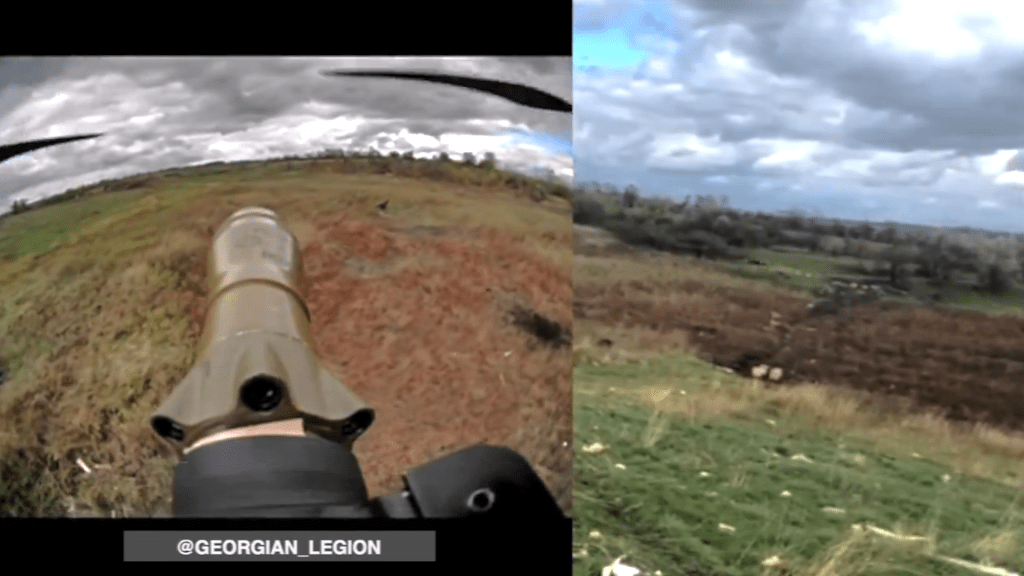
Most recently, in direct response to Wild Hornets’ video the Georigian Legion, a unit composed of volunteers from Georgia fighting for Ukraine, shared a short video of a drone armed with an RPG-7. The footage appears to show the launcher being tested but on speaking with the Georgian Legion they confirmed that the RPG-FPV has been used during combat operations. They have reportedly used it against vehicles, fixed positions and infantry but are looking to improve the design with better optics and increased engagement range.
One key reason we probably haven’t seen more gun-equipped drones is that mounting a firearm is a relatively poor use of a heavy lift drone. These larger, more powerful drones can be better utilised as bombers carrying large payloads over significant distances. Bombs dropped on vehicles and defensive positions have more impact than a drone equipped with a rifle-calibre firearm. It is likely very difficult to accurately aim the weapon and the magazine capacity is limited. To aim effectively the drone will probably have to fly lower than it would when bombing, thus making it more susceptible to fire from the ground.
Update – 11/9/24:
A brief clip of a quadcopter FPV drone equipped with an RPG-18 anti-armour weapon mounted upside down. Few other details currently available.
Since the February 2022 invasion the war in Ukraine has been characterised by the use of drones and remote systems. While we’ve seen aerial drone use expand and evolve extremely rapidly and naval drones have proven themselves very effective, ground based drone use has been much slower to evolve with unmanned ground vehicles (UGVs) seeing some limited use delivering explosive charges, mines and taking on logistical roles.
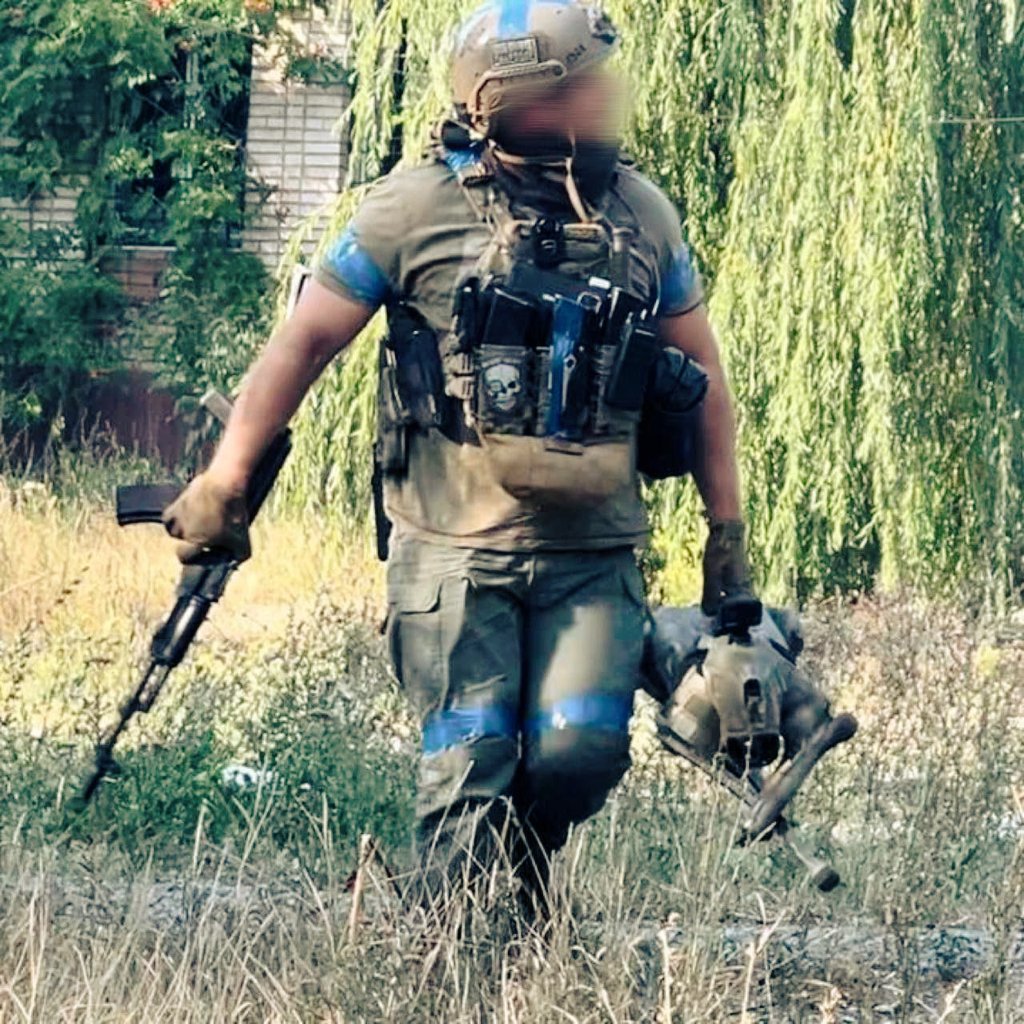
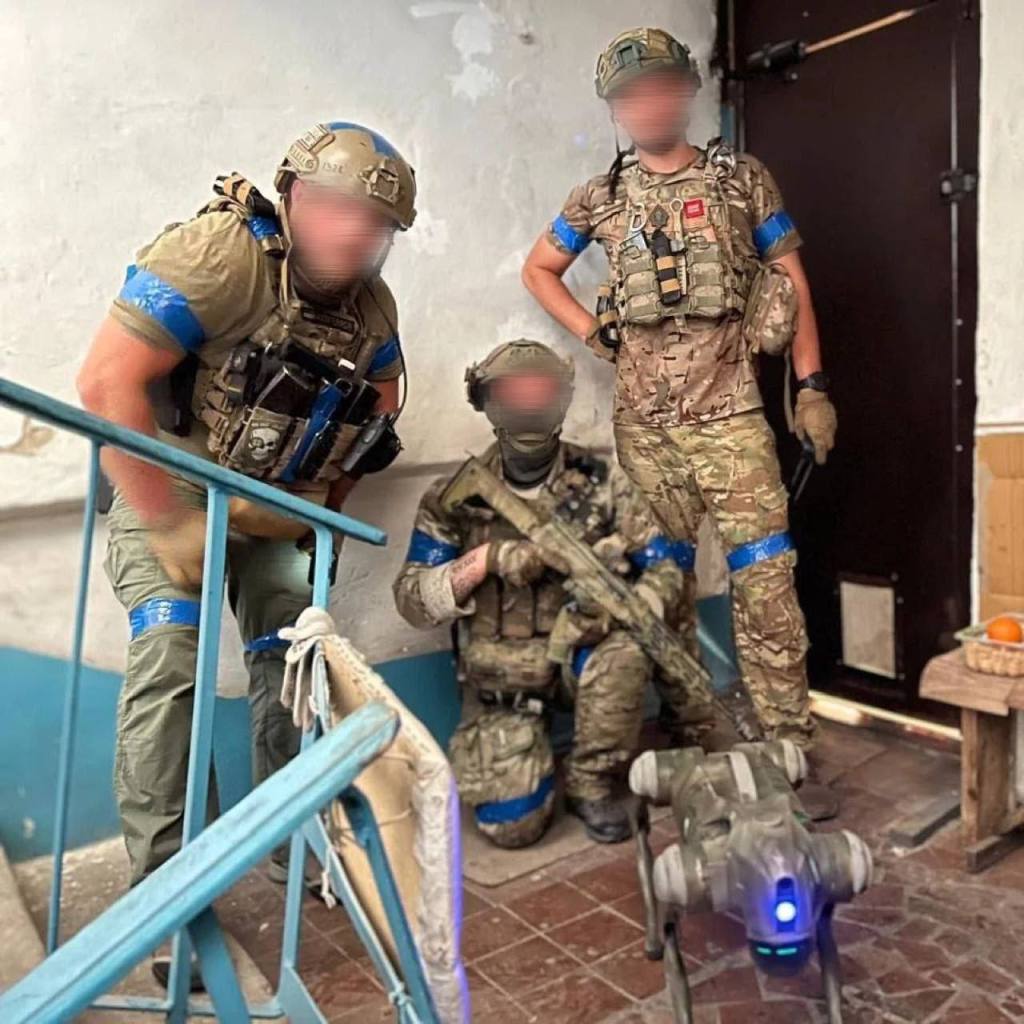
One unmanned ground system which I didn’t expect to see is the use of ‘robot dogs’ (робот-собака). These quadrupedal, remotely operated systems were seen for the first time earlier this month, most notably with Ukraine’s 28th Mechanised Brigade.
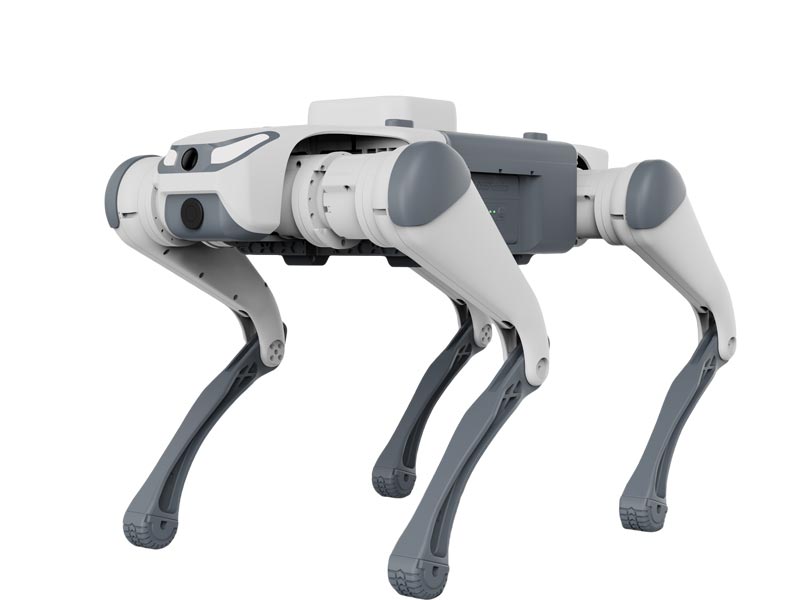
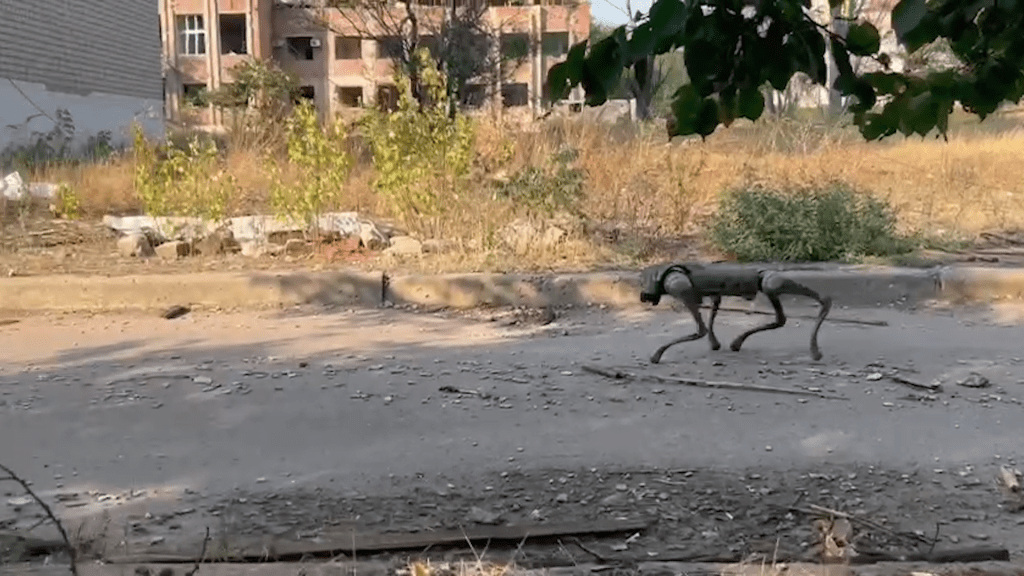
A Unitree Go-2 robot dog being tested in Ukraine (via social media)
The first footage of the robot dogs in Ukraine was shared by members of Kurt & Company (a unit with the 28th Mechanised Brigade) on 2 August, it shows one of the dogs being demonstrated in a field navigating though fields and woodland, through brush and righting itself when it got stuck trying to climb over a fallen branch.
Another video appeared on 5 August, with the robot dog seen moving along a bombed out residential street and being carried by its operator, a member of Kurt & Company. The footage does not show the dog operating inside any buildings. The post claims the footage was filmed in Toretske, Donetsk.
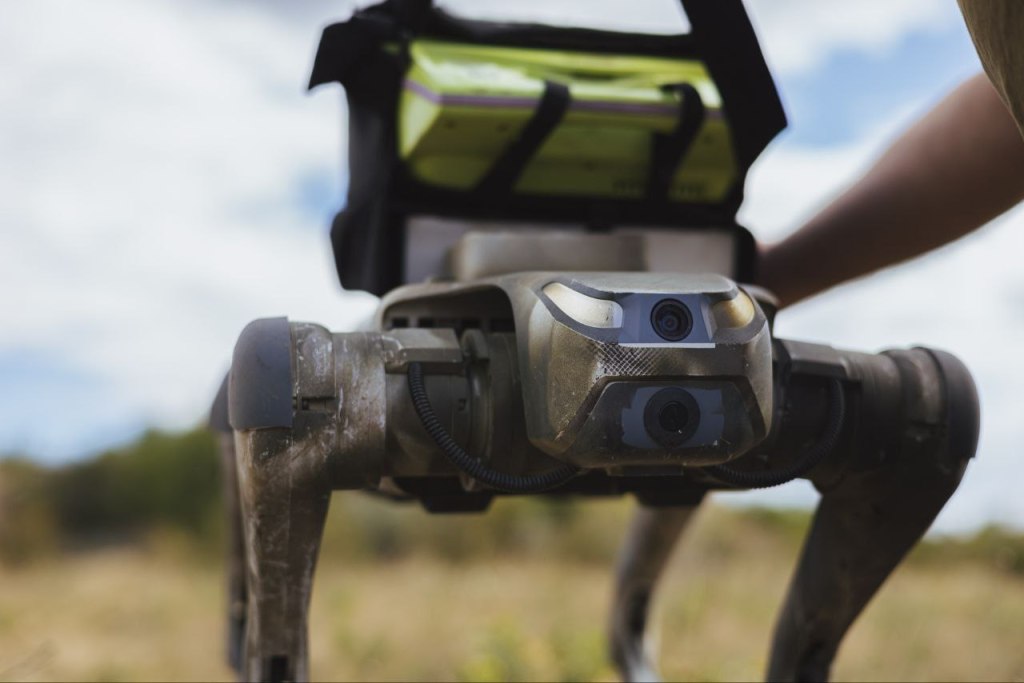
On the 8 August, France24, published an article based on a demonstration of one of the robot dogs during which the model of dog was referred to as “BAD 1” and a second model “BAD 2” was referenced but described as more advanced and “could not be shown for security reasons”. The article also noted that if one of the dogs ever fell “into Russian hands… an emergency switch allows the operator to erase all its data.” AFPshared a short video from the demonstration which noted that the drones were provided by BRIT Alliance, a UK-based security company which specialises in deploying drone systems. Interestingly, some articles describe the robot dogs as ‘British built’, however, they actually appear to be Chinese Unitree Go-2 robot dogs. The Unitree name can be seen below the dog’s camera sensor in the AFP video, as well as a Kurt & Company sticker on its right side.
Ukrainian troops of the 28th Mechanised Brigade with a Go-2 robot dog (via social media)
The Unitree Go-2 has a number of interesting features including the ability to map areas using LIDAR scanning, an AI mode that helps it navigate complex terrain and a live camera feed. Unitree’s site lists them as available from $1,850 for a Go-2 air and $3,050 for a Go-2 Pro. The Go-2 Pro model weighs around 15kg, has an 8kg payload, a battery life of up to 2 hours and a top speed of just under 8mph. Intriguingly back in 2022, Russia displayed the M-81, a robot dog armed with an RPG-26, at the Army 2022 defence exposition. The M-81 was actually based on Unitree’s Go-1 robot dog.
A further video was shared on 12 August, the drone is seen camouflaged with what may be a Ukrainian digicam shirt. In the same video the word ‘B.A.D.2.’ can be seen stenciled on the body of the dog.
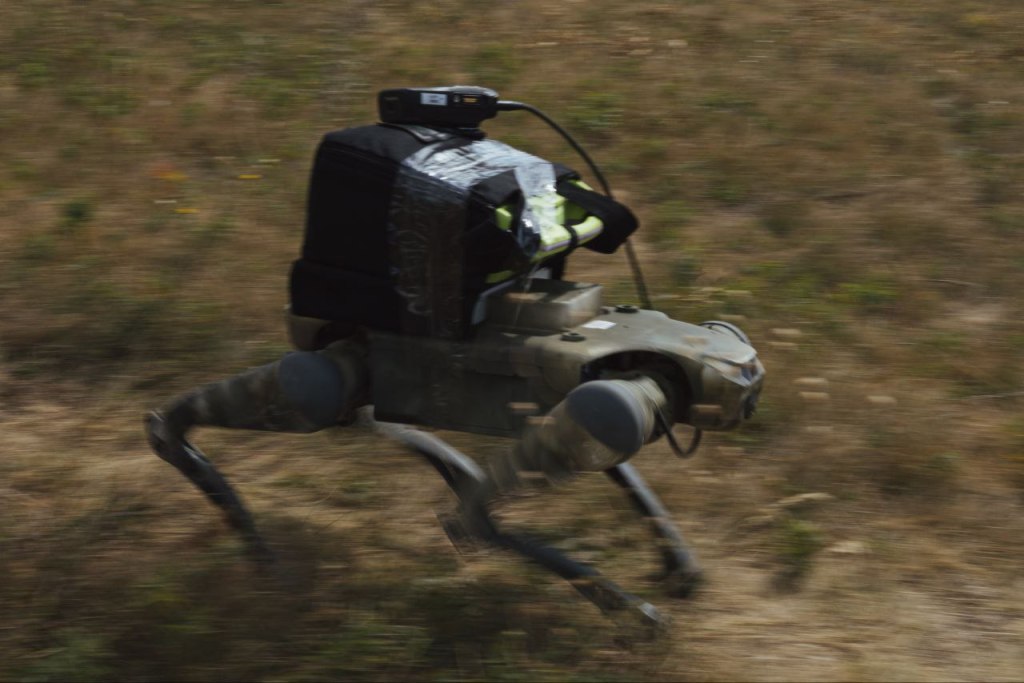
On the 14 August, Kurt & Company shared a series of photos of a robot dog and operator with the caption [machine translated] “Better to buy robots than lose soldiers”. In several of the photos the dog has a backpack and radio strapped and taped to its back. On examination of the images this dog appears to be of a different design and resembles the DeepRobotics Lite3 Venture model, DeepRobotics are another Chinese manufacturer. This model weighs in at 12.2kg and has a 2 hour endurance.
A DeepRobotics Lite3 Venture demonstrated in Ukraine, August 2024 (via Ukrainian Army)
The same day the brigade’s official telegram page shared another video of the robot dog being demonstrated with the caption [machine translated]:
“Asymmetric responses are effective against the enemy’s numerical superiority in manpower, and they are possible thanks to technologies and innovative approaches in the conduct of hostilities. As an example – this robot dog at the service of “Kurt&Company”. He has many talents and a wide potential for use on the battlefield. Just as drones once changed warfare, so our four-legged robotic friends will influence the course of hostilities.”
The short video included clips of the dog on the move, doing backflips, and walking along a bombed out residential street.
Also on the 14 August, Ukrainian Army social media channels also shared the same photographs previously shared with a caption quoting the commander of Kurt & Company as saying: “Such a dog should be in every unit”.
It’s unclear how many of the robot dogs might be in use in Ukraine, or if they’ve been used on operations yet. A BILD article published on 14 August, claimed that as many as 30 have been deployed but there’s no further evidence to support this. A Новини ФАКТ article stated they had been used operationally in Toretsk but this remains unconfirmed.
While the quadrupedal design of the robot dogs means they are, in theory at least, more capable of climbing stairs than tracked or wheeled UGVs their utility remains to be seen. They have less capability to carry payloads and its unclear if they’ll be used in a one-way role with explosive payloads – though given every other unmanned system in Ukraine has, it is probably a just matter of time. Unlike some of the simpler tracked and wheeled UGVs the Go-2 robot dogs are probably more expensive, harder to maintain and have a larger profile making them more vulnerable to enemy fire. It has been noted that they will also likely be utilised in reconnaissance of enemy trenches ahead of assault teams but again evidence of this has not yet surfaced.
A Unitree Go-2 robot dog being tested in Ukraine (via social media)
It seems that the role the dogs would be best used for is reconnaissance in urban areas where aerial drones can’t easily navigate inside structures, removing the need to send troops to recce buildings to locate the enemy. It seems that this is the role that the Ukrainians have in mind for the dogs. While China, the US and a range of other militaries have tested robot dogs, including the mounting of small arms and even light anti-armour weapons, if they are utilised in combat in Ukraine this will represent a battlefield first for this type of system.
Update – 20/8/24: An another video of one of the Chinese Robot Dogs, a Unitree Go-2, in Ukraine posted on 19 August.
Another video of one of the Robot Dogs in #Ukraine. This model is a Chinese Unitree Go-2 which has reportedly been provided via a UK-based security company, BRIT Alliance.
— Matthew Moss | Historical Firearms (@historicfirearm) September 8, 2024
Update – 15/1/25:
RoboCopDog.A robot dog with what appears to be a thermal camera with the Rapid Operational Response Unit (KORD) of the Ukrainian National Police.More on these robot dogs in #Ukraine here: armourersbench.com/2024/08/16/w…
Since Russia’s invasion of Ukraine in February 2022 the use of drones for reconnaissance and tactical missions has evolved so rapidly it has come to characterise the war. The tactic of dropping hand grenades from commercial drones has evolved into the use of larger drones and larger munitions and the use of first person view (or FPV) one-way, kamikaze drones.
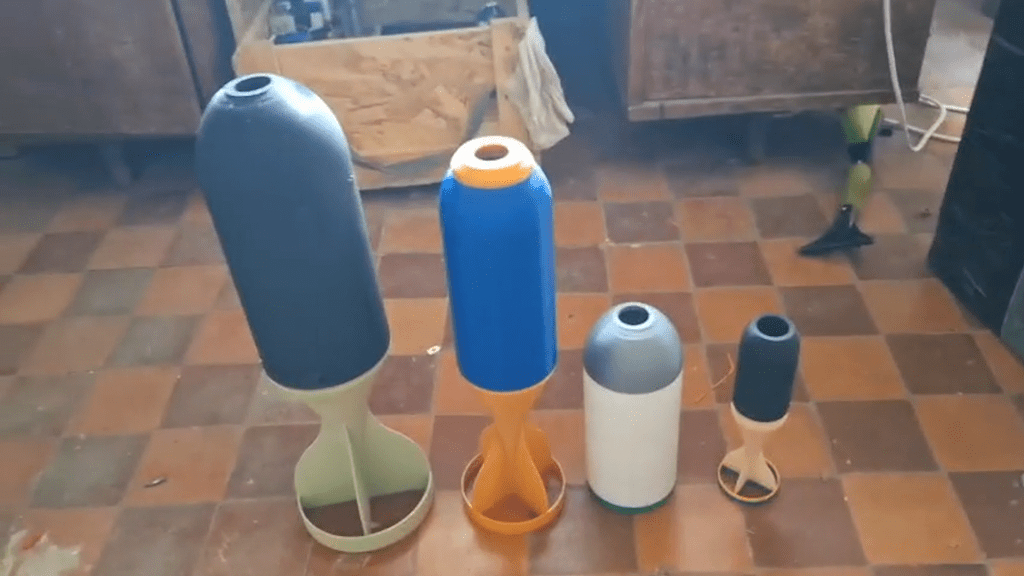
L-R: V3 XL ‘Big Mac’, V2, V1 & small VOG-sized casing (via Joe MacDonald)
Joe MacDonald, a British volunteer currently fighting in Ukraine, has kindly shared a short video showing some of the newest munitions that have been in use with his drone team for some time. Joe has led the development of a series of munitions of varying sizes. These range from small 450g bombs up to 3.5kgs which are dropped from a range of drones, small Mavic-type drones up to the ‘Baba Yaga’ heavy bomber drones.
This short video from Joe just goes to illustrate the importance of 3D printing in the development and manufacture of drone dropped munitions. The 3D printed casings are loaded with explosives and shrapnel which can then be fuzed ready for deployment in the field. The 3D printed designs have only grown more sophisticated, evolving originally from printed trail sections and nose cones.
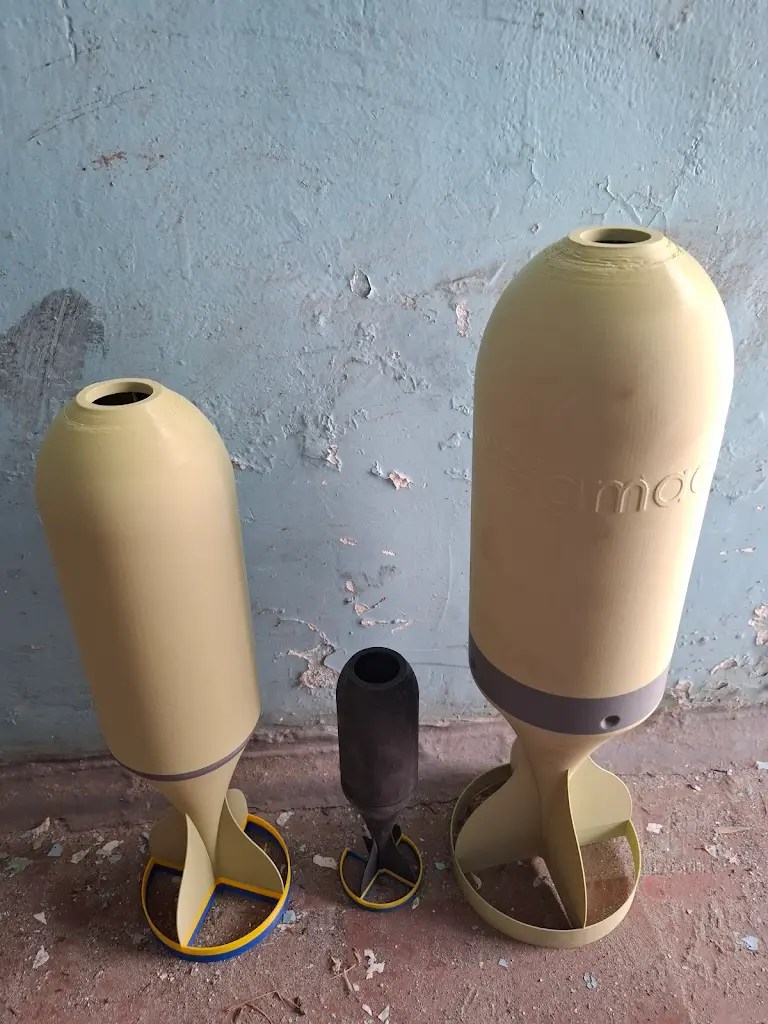
3D printed drone munition casings with tail assemblies (via Joe MacDonald)
Importantly, the use of 3D printing allows for the casings and tails to be standardised and consistent. The 3.5kg V3 takes up to 24 hours to print, they could be printed faster but Joe explained that this sacrifices rigidity and robustness and he prefers the munitions his unit uses to be soldier-proof and capable of standing up to handling. Joe also noted that packing the casings with plastic explosive takes force which the cases have to be able to stand up to. While there are plenty of other case and tail designs in use the designs Joe led the refinement and development have been used by numerous Ukrainian brigades.
Special thanks to Joe for sharing the video and taking the time to explain how drone munitions are assembled, I highly recommend checking out Joe’s channel, Big Mac’s Battle Blogs, he regularly shares some really interesting insights.
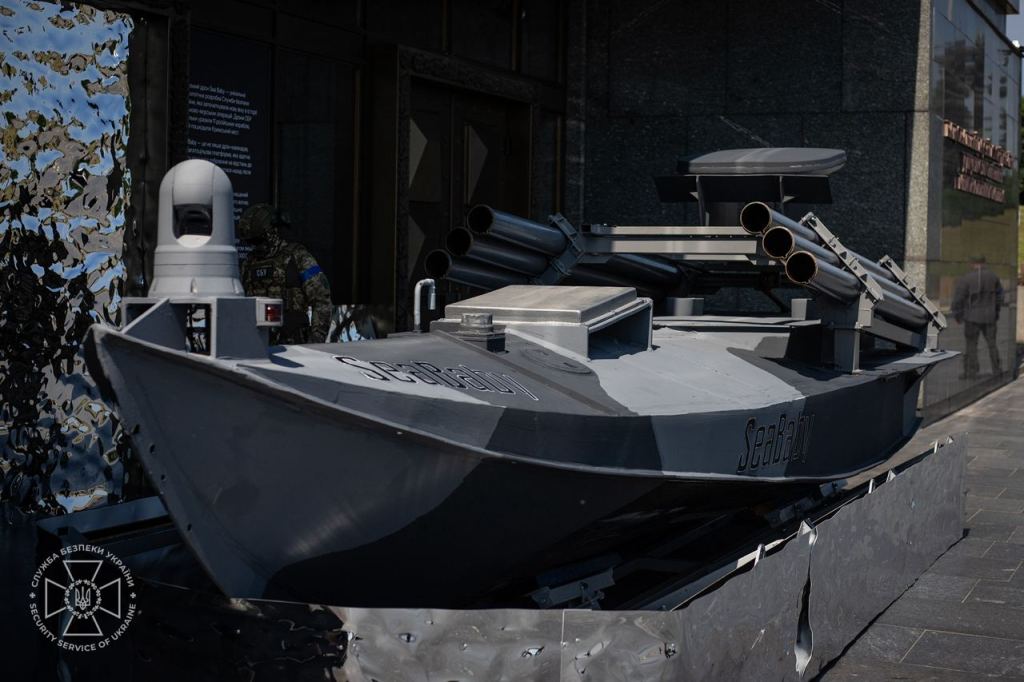
Ukraine’s family of unmanned surface vessels (USVs) continues to grow as the Security Service of Ukraine (SBU) have developed a Grad rocket-armed Sea Baby drone. The one-way or kamikaze USVs deployed by Ukraine in the Black Sea have been instrumental in engaging the Russian Navy, however, more recently new variants have emerged as Russia has begun to adapt and successfully engage the Sea Babies which in turn has seen the Ukrainians seek to adapt.
The first video of the rocket-armed USV in action recently emerged and the SBU has released some photographs which appear to show the drone in testing. On 22 May, an anonymous SBU source toldThe Kyiv Independent that the new drones have been used in combat “against Russian positions on the Kinburn spit,” a stretch of often fought over land on the coast near Mykolaiv. “This technological solution is already showing powerful results,” with the source adding “Our Sea Baby is not just a drone, but a multifunctional platform that is constantly being improved.” So far it seems the rocket-armed USV has been used against shore targets rather than to engage the Russian Black Sea Fleet, firing on a moving target from an unstable platform may be much more of a challenge. It remains to be seen if this USV variant has been put to use engaging vessels at sea. The Grad Sea Baby gives the SBU the useful ability to strike shore targets anywhere along the Russian-occupied Black Sea coast. From available imagery, at least three of the rocket-armed variants have been built.
Ukrainian Sea Baby surface drone in the Black Sea launches a volley of missiles towards Russian positions. pic.twitter.com/CQFaLKB9B6
— WarTranslated (Dmitri) (@wartranslated) May 22, 2024
The drones have been equipped with six 122mm Grad rocket launch tubes. The BM-21 multiple rocket launch system is used by both Ukraine and Russia. It’s size, ubiquity and relative cheapness makes it an obvious choice for mounting on the six meter long Sea Baby. The latest versions of the Sea Baby are reportedly able to carry 400 kg warheads over 500 miles at speeds of up to 48 knots.
The Grad rockets have a range of anywhere between 20 and 50 km depending on the type of rocket used. It’s unclear if a sea-based launch impacts the rocket’s range or accuracy but depending on sea conditions dispersion of the munitions is almost certainly affected. While accuracy may be impacted the rockets still give the Sea Baby a useful stand off capability, allowing the USVs to engage targets at a distance rather than having to make it physically all the way to the target to detonate its payload. How the rockets are aimed or the launcher is zeroed isn’t yet clear. The tubes do not appear to be adjustable for elevation as photos appear to show them fixed in place at a slight angle. Available photos show the launcher being tested ashore at a range, perhaps the tubes are bore sighted.
Sea Baby drones equipped with "Grad" rocket launchers. Now, these drones have become even deadlier for the russian fleet.
This isn’t the first time rockets have been fired from a Ukrainian USV, back in January 2024, footage of a USV firing smaller rockets at a Russian patrol vessel emerged. The rockets are believed to be RPV-16 or RPO-A thermobaric rockets. Some of this footage, along with other older video, was included in a short clip which showed off the rocket-armed Sea Babies. While this footage may not show a Grad launch Vasyl Malyuk, head of the SBU, has said during a press event with UNITED24, that “For the first time, the SBU used the “Sea baby” drone, equipped with the “Grad” rocket salvo fire systems, in December 2023,” adding that this represented a “new milestone in the history of sea battles.” Newsweekreported that the Sea Babies fitted with Grad launchers were paid for using United24 donations, with each USV estimated to be worth $221,000.
Another short video of the Grad rocket-equipped Sea Baby USV, likely filmed yesterday during a United24 event.
— Matthew Moss | Historical Firearms (@historicfirearm) May 24, 2024
Most recently we also saw another curious Ukrainian USV emerge, equipped with an improvised air-defense system with two repurposed AA-11 ARCHER (R-73) air to air missiles. The air defense USV emerged as Russian helicopters began to effectively engage the Ukrainian USVs. Given the rapid evolution of Ukraine’s USVs it would not be surprising to eventually see one equipped with an anti-ship missile, such as a small RBS-17.
Sea Baby equipped with six Grad tubes (via SBU)
The small cross section and speed of the Sea Baby drones allow them to infiltrate and approach Russian Black Sea vessels both at sea and in port. However, Russia has developed rudimentary tactics for successfully engaging them either with helicopters or with small arms and other defensive fire from vessels. A stand off capability, be it a USV equipped with unguided Grad rockets or an anti-ship missile, adds another dimension the Russians will have to adapt to. The Grad-armed Sea Baby is the latest indicator that Ukraine’s USV fleet is continuing to diversify to meet new threats and operational requirements.
An earlier version of this article first appeared at OvertDefense.com.
Support Us: If you enjoyed this video and article please consider supporting our work here. We have some great perks available for Patreon Supporters – including early access to custom stickers and early access to videos! Thank you for your support!
Drone warfare in Ukraine is one of the war’s most rapidly evolving elements with considerable innovation and improvisation. In recent weeks several videos have been shared showing large drones dropping TM-62 anti-tank mines.
The first video shared on 3 September showed how a mine could be carried and released by a large six-rotor drone. The TM-62M is seen loaded into a cradle tray which is then remotely triggered causing the floor plate to hinge and release the mine. The video also shows how the TM-62 is fuzed with a UZRG-pattern hand grenade fuze, pushed directly into the mine’s explosive through a hole cut in the side of its casing.
The TM-62M is a high-explosive blast landmine designed to immobilise or destroy vehicles. The mine is packed with 7.5kg (17lbs) of explosive and is normally centrally fuzed by a pressure fuze. The TM-62M is a significant payload for a bomber drone and when dropped they have significant blast effect.
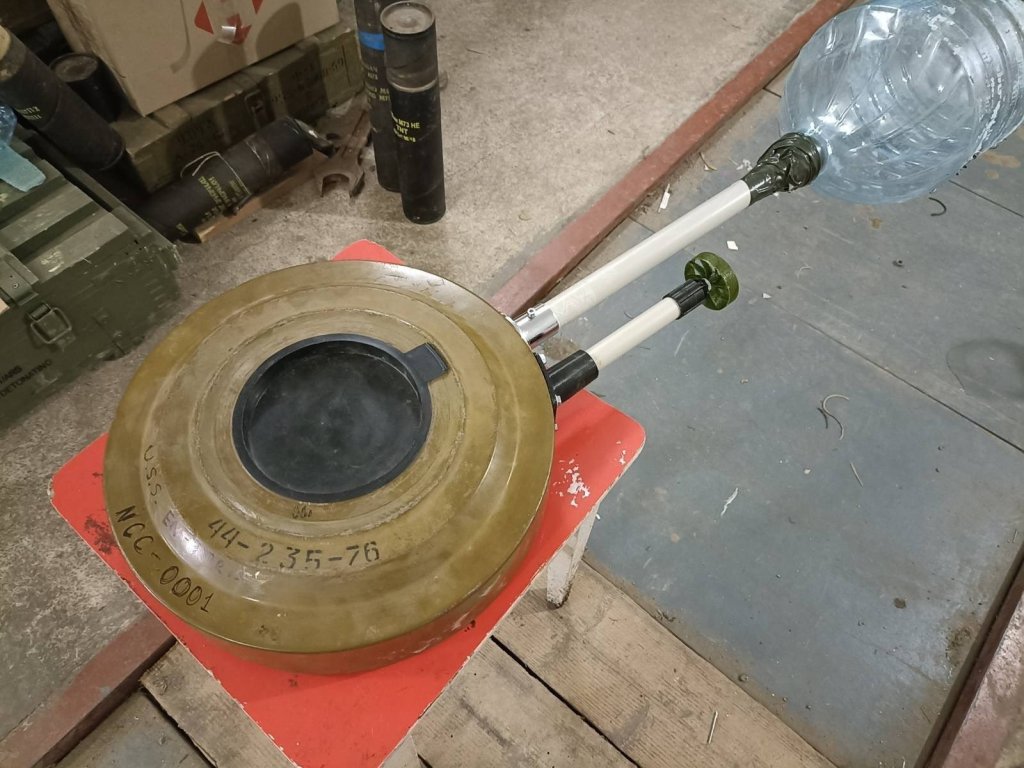
A subsequent video, shared on 6 September, shows a series of clips filmed by the bomber drone’s camera showing the TM-62 being dropped on numerous targets. The mines in this video have been significantly adapted with a stabilising tail added. The tail appears to be made up of a length of PVC pipe and a large water battle with its base cut off. The tail appears to be quite effective especially given the mine’s considerable weight and poor aerodynamics. It is also notable that the fuzing system appears to be different in the second video. Rather than a hand grenade fuze it appears that a larger fuze has been used, positioned next to the stabilising tail.
With the tail and its cut down water bottle its unlikely the release system for this munition is the same as that seen in the first video. A system which would allow for a smooth release and not snag the tail assembly would be needed. In several of the clips in the second video a strap swings past the drone’s camera perhaps suggesting there is a sling system in use.
A subsequent photograph shared on social media shows one of the mines in much better resolution. The tail is indeed made from PVC piping and a water bottle and the fuze appears to be vane-armed. The makers also have a sense of humour likening the odd-looking munition to the ‘USS Enterprise’ from Star Trek, they’ve written ‘USS Enterprise NCC-0001’ on the forward section of the mine.
At the same time as the photograph a number of additional videos showing the TM-62 based bombs being dropped were shared. These videos were originally shared towards the end of August and show a series of successful munition drops.
We are seeing a trend towards more sophisticated and more capable drone bombers which can carry either greater numbers of smaller bombs or larger singular bombs like the TM-62 munition.
Update – 1/10/23
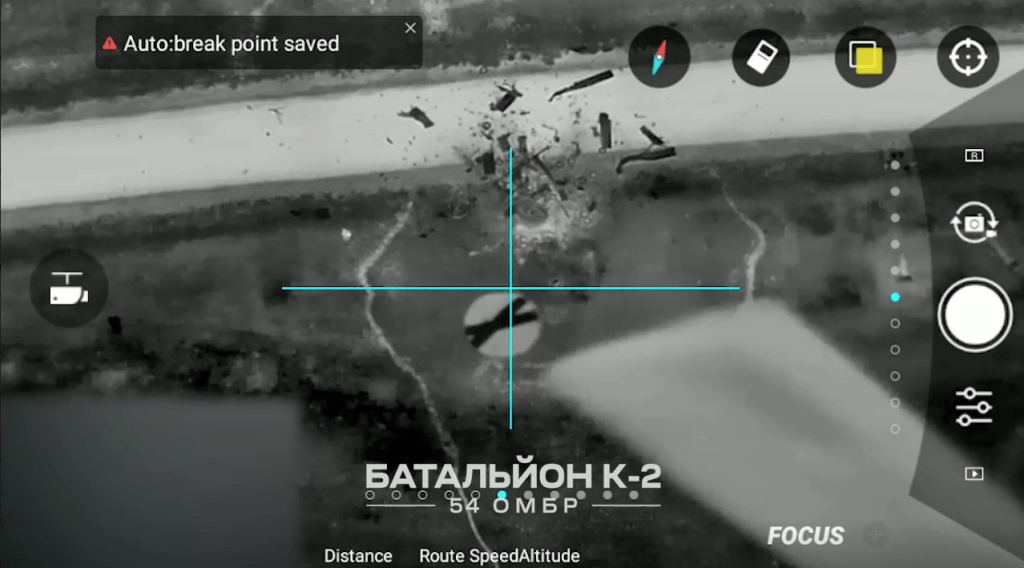
Just today the K-2 drone team with the 54th Brigade has shared footage of one of their drones dropping TM-62s mines on a Russian storage position. These mines don't appear to have a tail assembly and are more simply fuzed like those seen in initial videos. pic.twitter.com/W7plTbDIKQ
— Matthew Moss | Historical Firearms (@historicfirearm) October 1, 2023
The K-2 drone team with the 54th Brigade has shared footage of one of their drones dropping TM-62s mines on a Russian checkpoint and storage position. The drone appears to drop several unadapted TM-62s, though the lag time between landing and detonation would indicate they are not equipped with an impact fuze but perhaps a grenade fuze as seen in the initial videos featuring TM-62s. The resolution of the thermal cameras does not make it possible to identify the method of fuzing.
Note the falling TM-62 (with tape) and the swinging drop tray (K-2)
The release system appears to consist of a tray which holds the mine which is suspended by straps which are released to drop the munition. The tray can be seen swinging beneath the drone after one of the drops. The munitions appear to have tape around them, the reason for this is unclear, perhaps protecting the fuze system.
Update – 5/1/24: A video compilation showing numerous drops of TM-62s was shared on 5 January 2024. It begins with a demonstration of a light weight drop tray being released. The tray appears to be made from a metal grill (perhaps from an oven or an animal cage). The compilation shows mines being dropped without tail assemblies like those seen in earlier videos. Their are also visible puffs of gases/smoke from the mine’s fuze being triggered as it descends.
— Matthew Moss | Historical Firearms (@historicfirearm) January 11, 2024
Update -17/1/24: Further footage of TM-62 pattern mines being dropped from drones. Note a tail stabiliser is not used.
Ukraine's feared mammoth drone Baba Yaga, capable of carrying and precisely dropping four TM-62 mines, each with a 7.5kg (17 lbs) explosive charge. pic.twitter.com/twkZnYnKQR
Support Us: If you enjoyed this video and article please consider supporting our work here. We have some great perks available for Patreon Supporters – including early access to custom stickers and early access to videos! Thank you for your support!
During my recent video with author and journalist David Hambling discussing drone warfare in Ukraine, we briefly touched on the phenomena of drone dogfighting. Drone use in Ukraine has been a prominent feature of the conflict and drones have been used in roles ranging from Intelligence, Surveillance, and Reconnaissance (ISR) to direct action against targets – either through one-way loitering/kamikaze drones or by drone-dropped munitions.
Naturally, the threat drones pose, either from information gathering, artillery forward observation or direct attacks, means that both sides have sought to interdict and destroy the other’s drones. In some cases, this has seen opposing drones attacking one another in dogfights. This raises some fascinating parallels with early military aviation, during the First World War, which saw initially unarmed observation aircraft begin to carry weapons and attack one another.
Some of the earliest instances of these drone dogfights were reported in October 2022, with an initial video featuring a pair of DJI Mavic quadcopters, with the Ukrainian drone destroying the Russian drone by breaking its rotors. Another video posted on 18 October, reportedly shows a Ukrainian drone dive down onto a Russian quadcopter damaging it. Several more similar videos were shared in November. One shared around 14 November again shows a drone attacking from above. Towards the end of the month, on 25 November, a DJI Mavic clearly marked with a ‘Z’ was rammed from above by a Ukrainian drone.
Check out our earlier video on drone warfare:
In early December, a different technique was demonstrated with a drone from the separatist 1st Donetsk Army Corps dropping a weighted net onto a Ukrainian drone below it. This has the benefit of not having to use a valuable asset to ram, and potentially lose while attempting to attack an enemy drone. It also has the advantage that it presumably uses the same munition release mechanism used to drop munitions on ground targets. The drawback to net dropping, however, is the increased chances of missing the target and a limit to how many attempts the operator has to attack a target. In mid-December another video was shared, this time by Ukraine’s 54th Mechanised Brigade, showing the ramming of another drone.
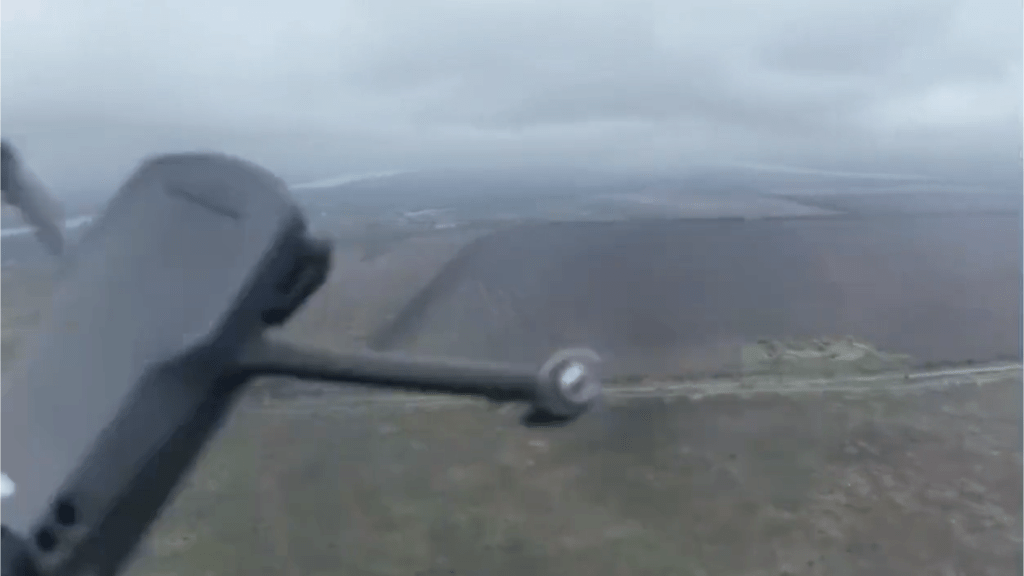
A Russian drone seen via the feed from an attacking Ukrainian drone (via social media)
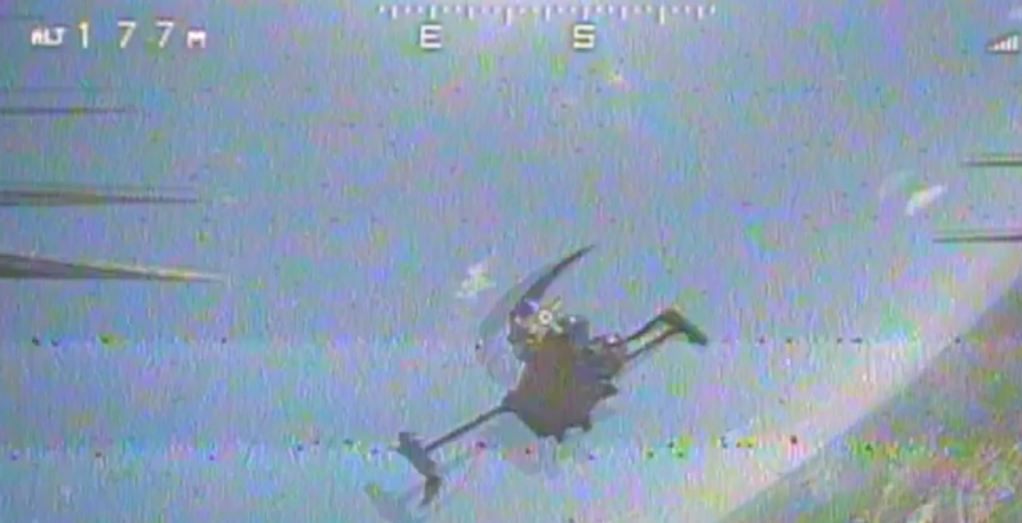
February 2023 saw further videos of drone dogfights, in another piece of footage shared on 24 February, we can see the attacking Russian drone taking its time to line up on its target before attacking, it is possible to the attacked Ukrainian drone fall to the ground.
As can be seen in videos like this one from mid-February, aiming a drone for a ramming run at an opposing drone below can be difficult. In our earlier video, David explained the favoured tactic of attacking from above has a number of advantages in that it allows the attacking drone to maintain visual contact with the drone’s camera and also avoid being seen by the target drone’s camera which is also unable to look upwards. The more robust body of the drone is what makes contact with the target drone’s rotors – increasing the attacking drone’s survivability. In some of the videos, the target drone appears unaware it’s about to be attacked.
DJI Mavic struck by another drone damaging its rotor blades (via social media)
This was again demonstrated in a video posted by the Ukrainian 10th Mountain Division in March, which showed a drone making numerous ramming runs on a Russian quadcopter. In early May, a video of a Russian DJI Matrice 30 series drone being hunted by a Ukrainian DJI Mavic was shared. While the Ukrainian drone was destroyed too, the loss of a ≈$2,000 Mavic to destroy a Matrice worth approximately $12,000 makes tactical sense. On 25 March, Russian telegram channels shared a video from a team called Project Krechet featuring a test showing a fast-moving First Person View (FPV) drone ramming a larger quadcopter. The telegram posts noted that the ‘Small anti-drone fighter aircraft’ are much cheaper and better suited to the role than DJI Mavics.
In late April, footage of another drone dogfight was shared showing a Russian Mavic being downed by a Ukrainian drone. In early May, the Russian news agency RIAshared footage of a clash between a Russian drone and a Ukrainian DJI Mavic, reportedly in the Donetsk, Adviivka region. On 24 May, Escadrone, a Ukrainian manufacturer and supplier of FPV kamikaze drones shared what is believed to be the first video of a Ukrainian FPV drone attacking a Russian reconnaissance quadcopter.
An FPV drone attacks a Russian quadcopter (Escadrone)
While not a drone vs drone dogfight on 30 June, a video of a Ukrainian drone dropping a munition on a Russian Zala 421-16E2 which was on the ground, shows another nuance to drone vs drone engagements. This video is similar to the popular tactic of ‘drone demolition’, the dropping of munitions into enemy vehicles that have been mobility killed. In both the case of the Zala and ground vehicles the demolition missions deny the enemy the asset’s recovery and future use.
With drones playing a fundamentally important role for both sides instances of drone vs drone combat are only likely to increase. We may also see the emergence of more complex onboard methods of drones attacking other drones.
Support Us: If you enjoyed this video and article please consider supporting our work here. We have some great perks available for Patreon Supporters – including early access to custom stickers and early access to videos! Thank you for your support!







 The Armourers Bench