Switzerland Chooses the SIG Sauer P320 – Here’s Every Military Using It Now

On Thursday (4 December) Armasuisse, Switzerland’s Federal Office for Defence Procurement, announced the selection of the SIG Sauer P320 to replace the venerable P75 (SIG Sauer P220), which has been in service since 1975. So I thought it was a good time to break down all of the major militaries that have adopted the SIG Sauer P320 over the last 10 years.

The SIG P320 is a modular, striker-fired pistol that uses the typical short-recoil, tilting barrel action, with a serialised trigger group available in varying grip-frame sizes. It evolved from the hammer-fired SIG Sauer P250 and entered production in 2014.
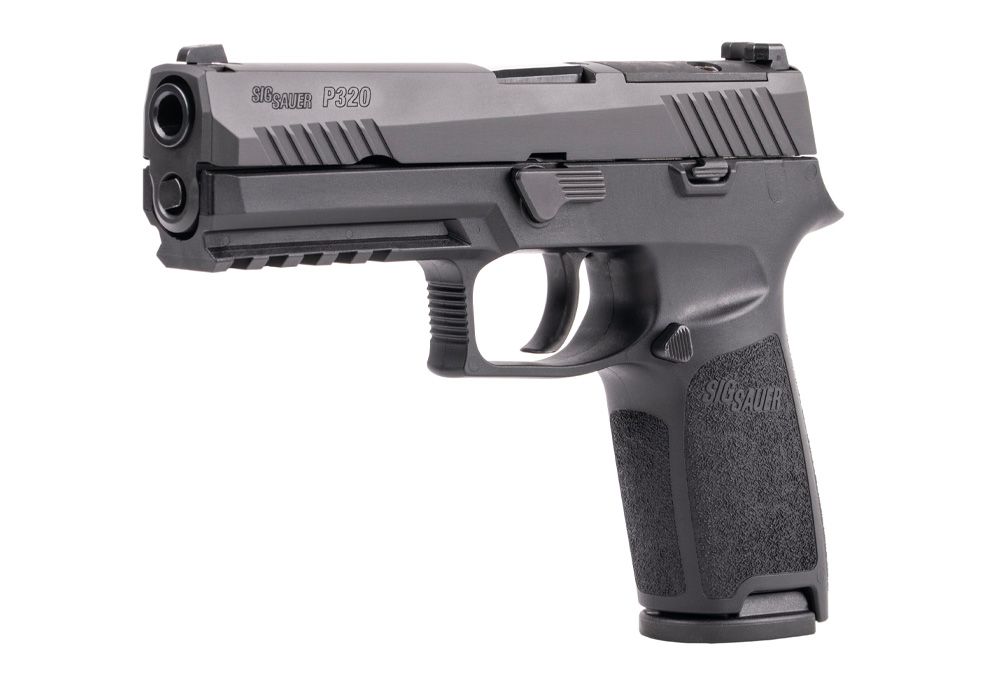
Full-size SIG Sauer P320 (SIG Sauer)

In September 2015, the United States Army and United States Air Force released a Request for Proposals for a new service pistol. This launched the Modular Handgun System program seeking to replace the Beretta M9 which entered service in 1990. The P320 faced off against a broad field of competitors including: the Beretta APX, CZ P-07, FN FNS, Smith & Wesson M&P M2.0, Glock 17 MHS and the STI Detonics STX. Down-selection and further testing took place in 2016, before the winner was announced in January 2017. The 101st Airborne were the first unit to be issued the new MX17 and compact XM18 pistols, and fielding continued into the 2020s. The M17 and M18 have a frame mounted safety and their slides are optics ready. The USAF and US Navy procured the smaller M18, with its 3.9in barrel. The USMC also eventually selected the M18 to replace the M9, M9A1, M45A1 and M007 (Glock 19) in September 2020.
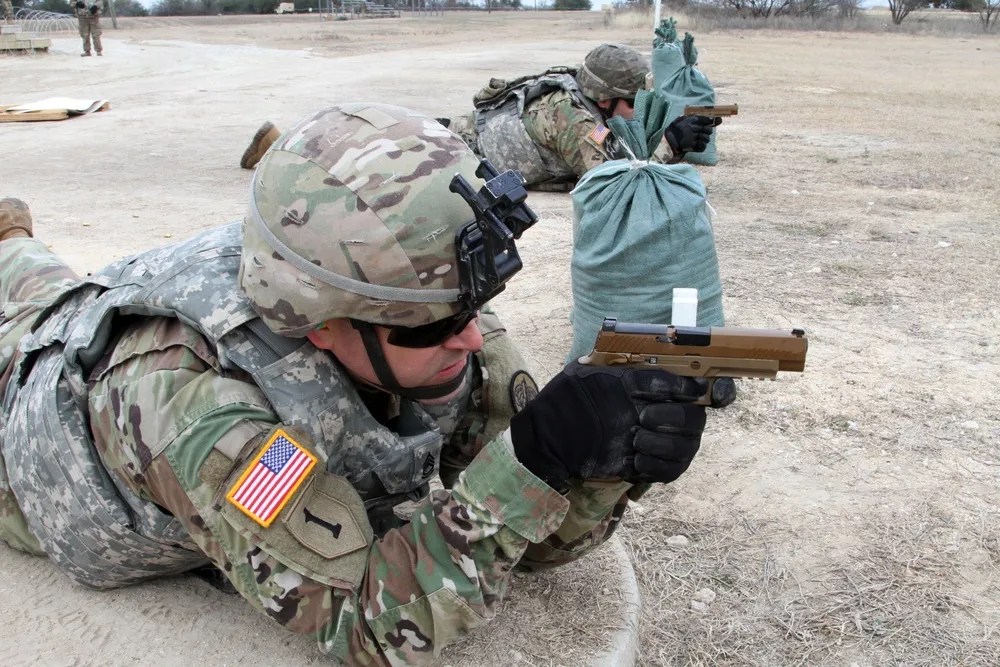
US troops training with M17 pistols (US Army)

Almost 10 years after the US Army launched the Modular Handgun System program, it was announced that the MHS General Forces Configuration had been approved. The MHS GFC introduces new parts and accessories for the M17 and M18. This system allows units and soldiers to customise their sidearms to a greater degree. The new parts and accessories include new grip frames, flared magazine wells, gas pedal take-down levers, slide-mounted or stand-alone Romeo M17 Pistol Red Dot Sights and special barrels. The GFC introduces elements seen in the popular X-Carry variants.
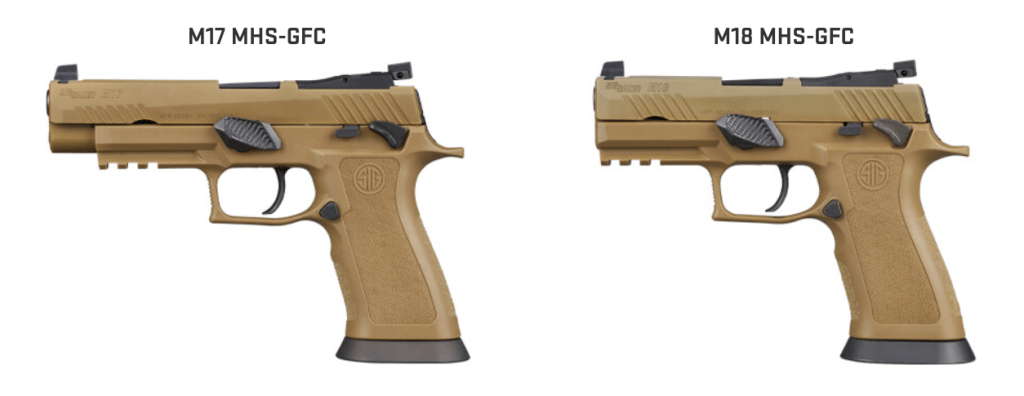
US Army’s MHS General Forces Configuration (SIG Sauer)

In April 2018, the Danish armed forces became the second military to select the P320. The Danish Ministry of Defense selected the P320 X-Carry variant of the pistol. The Danish Army pistol trials began in 2017 and the P320 X-Carry beat competition from the Glock 17 Gen 5, Beretta APX and Canik TP 9 SF to replace Denmark’s P/49 (SIG P210) pistols. The Danish pistols have the enhanced X-Carry polymer grip frame, a flat trigger, an extended beaver tail, an extended removable magwell, an optics-ready slide, and a deep trigger guard undercut. The pistols do not have a frame-mounted manual safety. At the time of the adoption, Major Tom Elvius-Brisson, Chief of Weaponry Branch, Danish Defense Acquisition and Logistics Organization, said: “By far SIG SAUER’s P320 X-Carry outperformed the competition throughout our rigorous and stringent testing process… the pistol is the modern firearm we were looking for to support our soldiers. The P320 X-Carry has a larger magazine capacity, comes reflex red-dot ready for sighting, and has the ability to incorporate a suppressor – all extremely important features to our soldiers for their sidearm today.” It’s unconfirmed just how many pistols Denmark procured, likely under 10,000, and fielding of the Sig Sauer P320 was anticipated to have been completed by the end of 2019.

One of the less widely reported adoptions of the P320 came in 2019 when Mexico’s National Guard reportedly acquired 50,000 P320s. Some sources suggest that the pistol is also used by elements of the Mexican military. The pistols were procured in 2019 and appear listed in the National Guard’s 2021 Annual Activity Report. They can also be regularly seen as standard issue equipment in imagery shared by the Mexican government. Some photos of the pistols show the slides engraved with ‘SDN’ for Secretaría de la Defensa Nacional, Mexico’s defence department. The pistols otherwise appear to be stock, full-size duty model P320s in black with no manual safety present.
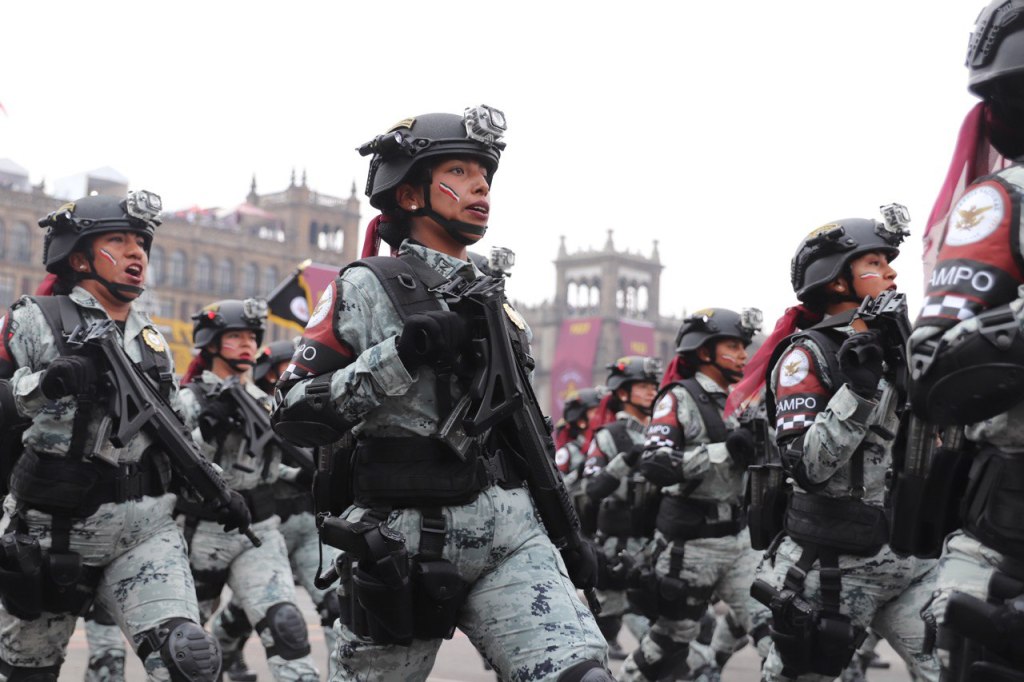
National Guard on parade with SIG Sauer P320s and FX-05 Xiuhcoatl (Mexican National Guard)

Canada became the next nation to select the P320, replacing their 80 year old Inglis-made Browning Hi-Powers. Opting for a full-size pistol with a 4.7in barrel, the pistol differs from the M17-pattern pistol in that it lacks a frame-mounted manual safety, and its rear sight is fixed on the slide, with the optics-mounting place located separately just ahead of it. It also has unique Canadian engravings on the slide, and both slide and frame are completely cerakoted in an FDE colour. The Canadian Armed Forces adopted the P320 as the C22, with an initial order for 7,000 pistols for the Canadian Army announced in October 2022. At the time of the announcement, Anita Anand, Minister of National Defence, said: “The Government of Canada is committed to providing the Canadian Armed Forces with the equipment they need when they need it. Replacing the Browning 9mm with the C22 full-frame modular pistol (Sig Sauer P320) will help ensure the continued operational readiness and effectiveness of all our members.” 

There is an additional option for a further 9,500 pistols to support Royal Canadian Air Force, Royal Canadian Navy and Military Police requirements. Canada’s transition to the C22 began in June 2023, when it was also confirmed that the Canadian Government was also in the process of procuring an additional 2,272 pistol and holster systems for the Canadian Army, 1,550 for the Royal Canadian Navy and 2,478 for the Royal Canadian Air Force. In December 2023, the Canadian Armed Forces also announced that they would start issuing the carry-size C24 pistol in early 2024.
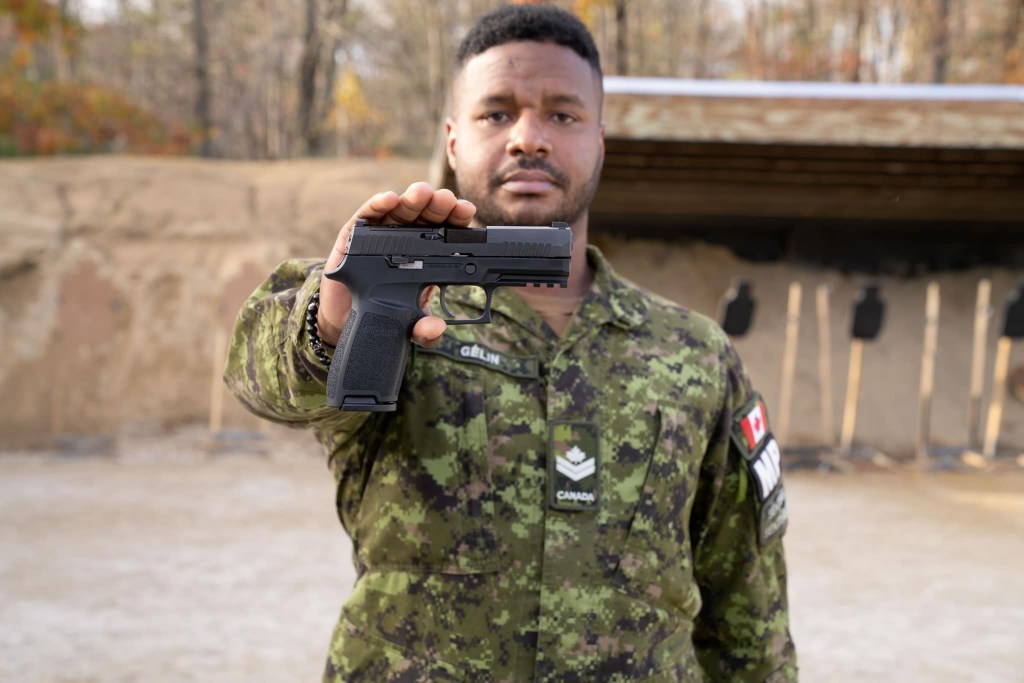
Canada’s C24 pistol, introduced in 2024 (Canadian Army)

At the beginning of October 2022, the Australian Department of Defence announced that under its Lethality System Project LAND 159, a raft of new small arms were selected for the Australian Defence Force’s dismounted combatants. The P320 was chosen to replace Australia’s Browning Hi-Power Mk3s. The X-Carry Pro was selected as the platform for the Sidearm Weapon System requirement. The Australian pistol has a manual safety, suppressor height sights and a 3.9” barrel. It comes mounted with a SIG Romeo 2 (half shroud) reflex sight and Foxtrot 2 white light illuminator (which itself is designated the F10). In September 2024, this package was designated the F9. Unlike the X-Carry selected by the Danish, the X-Carry Pro chosen by Australia has its rear sight mounted on the slide rather than the optics-cut plate. Elements of the ADF’s 7th Brigade became some of the first Australian units to begin training with the pistols in August 2025.
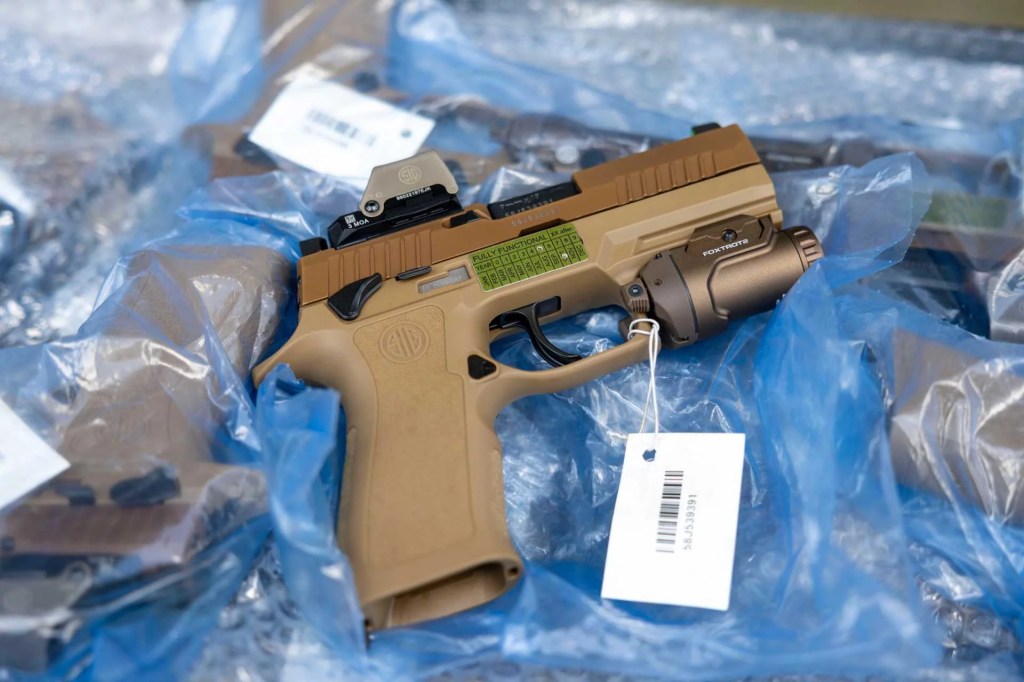
Australian F9 pistols (Australian Defence Force)

As mentioned at the start of the video, Most recently, the Swiss Army has selected the P320 X-Carry Pro to replace the P75 (SIG Sauer P220). The Swiss sought a pistol with modern ergonomics, modularity and a 30 year service life. The tender for a new pistol was launched in 2024, from the pistols submitted five were selected for evaluation and three were down-selected. After further testing the P320 beat out competition from the Glock 45 Gen 5 and Heckler & Koch’s SFP9. Intriguingly, Armasuisse, the Swiss Federal Office for Defence Procurement, noted that initially only the Glock 45 met all the mandatory criteria and was classified as suitable for service. The SIG, however, was selected following a cost-benefit analysis and Armasuisse notes that SIG Sauer are contractually obliged to resolve any issues and establish production of the pistols locally in Switzerland. The Swiss have set aside “a mid-range double-digit million amount” for the procurement of 140,000 SIG Sauer P320s, with the initial lot numbering 50,000 pistols. The image shared by the Swiss Army showed an FDE pistol while a subsequent photo shared by SIG Sauer Switzerland showed one with a black slide and a green frame with a Swiss Cross on the grip.
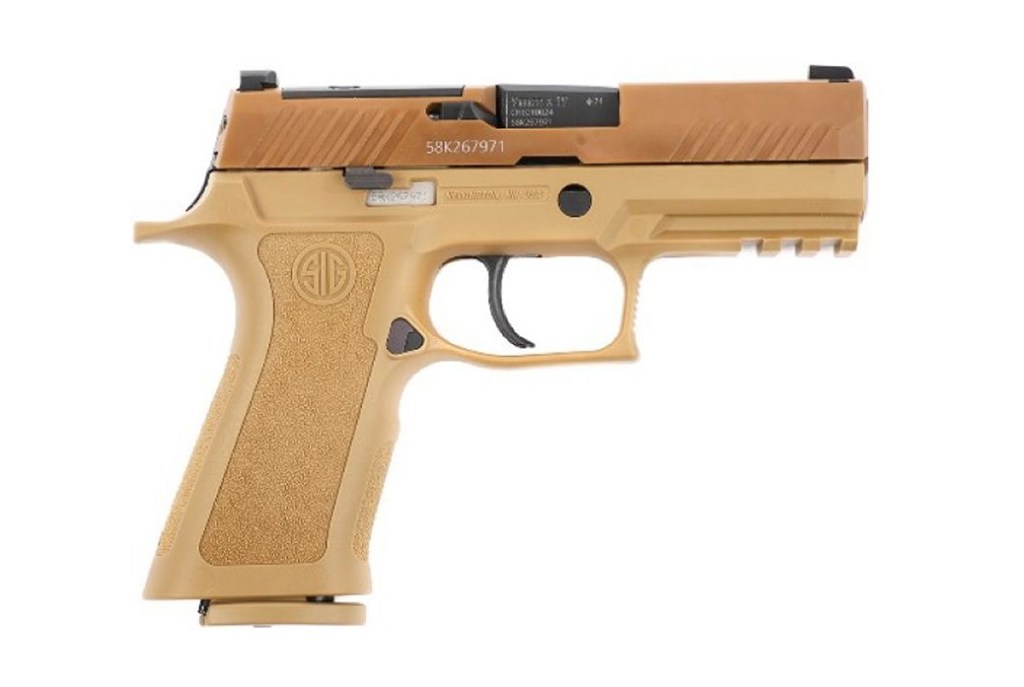
Image shared by the Armasuisse – a P320 X-Carry (Armasuisse)

Despite controversies surrounding the pistol, and SIG Sauer’s ongoing response, the P320 continues to win major military contracts around the world. SIG have optimised their approach: partnering on a number of occasions with credible local companies and offering a capable but, perhaps most importantly, affordable sidearm, as such at the time of writing the P320 is involved in a number of ongoing and upcoming pistol trials.

Special thanks to Greg Knowles for assistance.


Support Us: If you enjoyed this video and article please consider supporting our work here. We have some great perks available for Patreon Supporters – including exclusive videos, custom stickers and early access to videos! Thank you for your support!
Ukrainians Training with Bulgarian Arsenal AKs

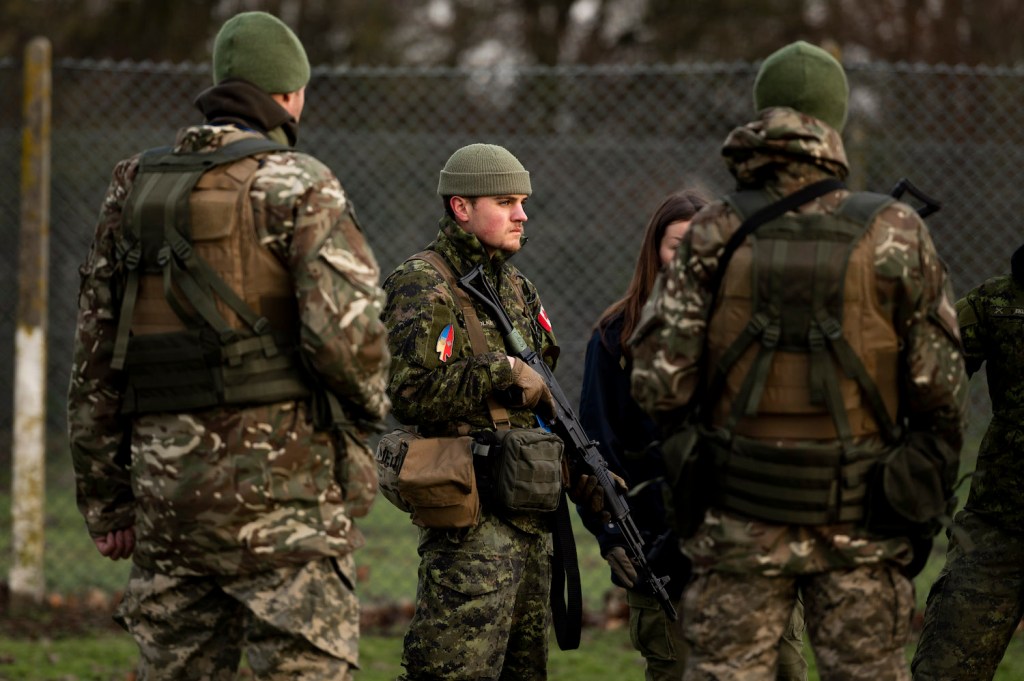
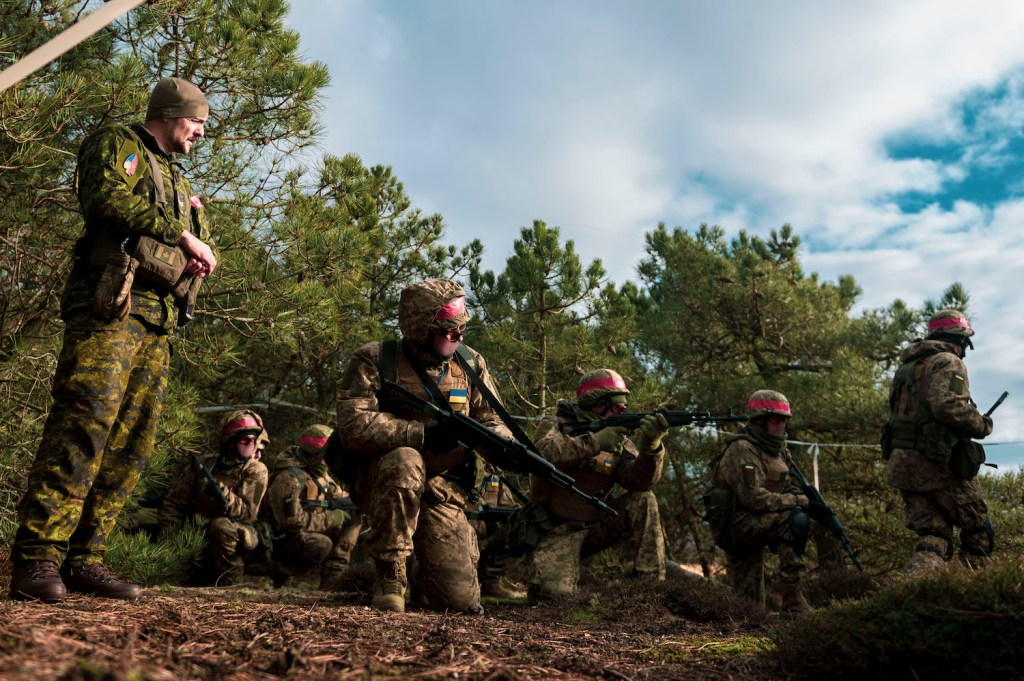
At the end of January a series of photographs taken by Canadian Army photographers showed Ukrainian troops being trained at sites in the UK as part of Operation Unifier. Unifier is a training mission carried out by the Canadian Armed Forces with training currently taking place in the UK alongside the multi-national training mission Operation Interflex.

What is interesting about the new imagery is that the Ukrainian troops in training are all armed with Bulgarian-made Arsenal AK-pattern rifles. This is the firs time this particular AK has been seen in use. If you saw our earlier videos looking at the other types of AK-pattern rifles procured by the UK for their training of Ukrainian personnel you’ll have seen Zastava M70s, Chinese Type 56s and East German MPi KMS-72s are in use.

The rifles were almost certainly procured by the UK Ministry of Defence and like the other AK-pattern rifles being used for training they will probably remain in the UK to be used in the training of future Ukrainian personnel. 

A soldier with the 3rd Battalion, Princess Patricia’s Canadian Light Infantry, instructs Ukrainian recruits during a weapons class as part of Operation UNIFIER in the United Kingdom, on January 26, 2023. (Corporal Eric Greico/Canadian Armed Forces)

The Arsenal AKs were seen for the first time in photographs taken on the 23 January, during a lesson on field craft. The Ukrainian troops can be seen taking notes with the rifles slung at their sides. 

The rifles appeared in photographs again  on 25 January, when Canadian medics were instructing Ukrainian recruits on the application of tourniquets. One of the rifles was seen slung over the shoulder of a Ukrainian soldier rendering aid. 

Subsequently on 26 January, soldiers from the 3rd Battalion, Princess Patricia’s Canadian Light Infantry were photographed instructing Ukrainian recruits during a weapons class. The class saw Ukrainian troops learning how to operate NLAWs, grounded on the floor next to them are their Arsenal AKs.

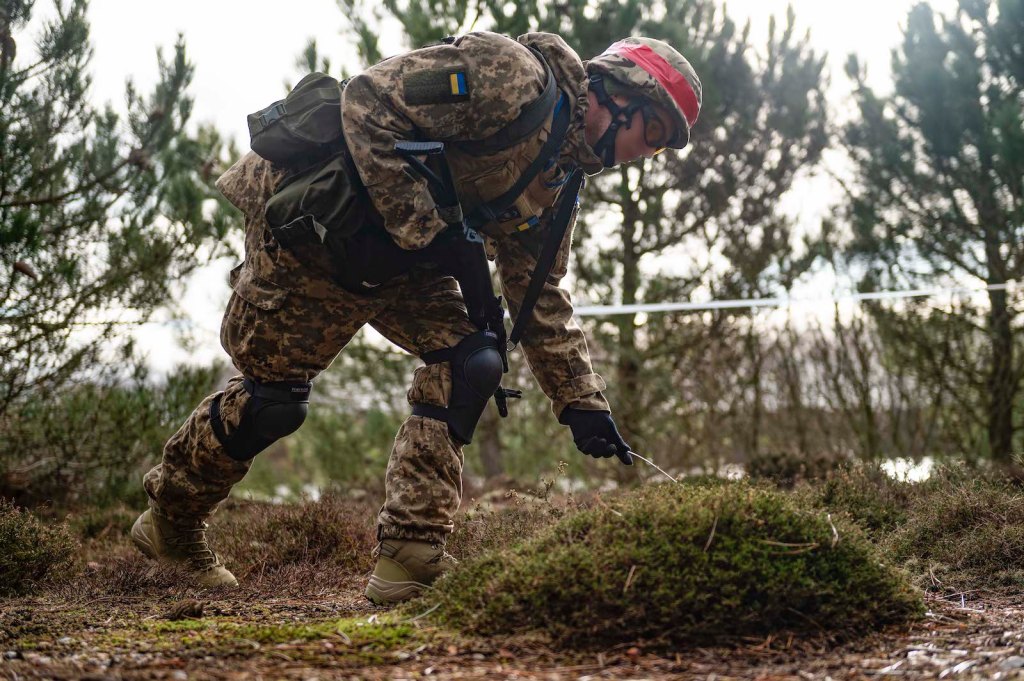
A series of images from a counter-explosive training session on searching and spotting mines and booby traps showed a platoon of Ukrainian trainees equipped with the Bulgarian AKs.

Ukrainian recruits under the supervision of Canadian soldiers from 1 Combat Engineer Regiment practice searching for and identifying booby traps, during Operation UNIFIER on 28 January 2023 in the United Kingdom. (Corporal Eric Greico/Canadian Armed Forces)

The rifles seen in all of the photographs appear to be basic model rifles, none of the weapons have railed handguards or Picatinny on the receiver cover for mounting optics. This suggests that they are either AR-M9Fs or AR-M14Fs (at least according to Arsenal’s website). The ‘F’ refers to the folding tube metal stock which helps identify the rifles as Arsenal-made AKs. The characteristic flash hider and furniture also identify them as Arsenal rifles.  It is difficult to identify what calibre the rifles are chambered in as the Ukrainians are never seen with magazines loaded into their weapons (as they’re unnecessary for the training being carried out). 

The AR-M9 and M14 are bother available chambered in 5.56x45mm and 7.62x39mm. Logical arguments could be made for either calibre: the UK MoD has confirmed that other AK-pattern rifles that have been procured are chambered in 7.62x39mm so this chambering would give them ammunition commonality with other AK-pattern rifles in use. Alternatively, the UK has ample stocks of 5.56x45mm and this would also more closely mimic the 5.45x39mm AK-74 rifles the Ukrainians are likely to be issued when they return home. Either way they are AK-pattern rifles which enable training on manual of arms, handling and firing with similar weapons the trainees will probably be equipped with.

Ukrainian recruits under the supervision of Canadian soldiers from 1 Combat Engineer Regiment practice searching for and identifying booby traps, during Operation UNIFIER on 28 January 2023 in the United Kingdom. (Corporal Eric Greico/Canadian Armed Forces)

The rifles have black polymer furniture and appear to be either new or in excellent condition with few visible scratches or scrapes to the finish or furniture. Notably each rifle has green tape around the base of the folding stock onto which a rack number has been written in black marker pen. 

Addendum:

As is sometimes the case with writing these articles and videos while in the process of research and production new source material emerges. On 1 February, the UK MoD shared a series of new photographs from the training of Ukrainian troops. In these a number of the Arsenal AKs were seen fitted with blank firing adapters (BFAs). This is interesting for a number of reasons – previously we have seen Ukrainian trainees using British L85A2s with BFAs for the elements of their training which required blank fire. We have covered this in an earlier article/videos – it requires additional, and largely unnecessary training on the use of the British bullpup.

Australian soldiers demonstrate section level attacks and how to handle captured enemy personnel to Ukrainian recruits during the first rotation of Operation Kudu in the United Kingdom. (UK MoD/Crown Copyright)

BFAs for the 7.62x39mm AK pattern rifles procured earlier by the UK appear to have been deemed either unsafe for use in British training areas or BFAs and blank 7.62x39mm ammunition haven’t been readily available. The new photographs show that BFAs are in use with these Bulgarian AKs – likely because they were procured with the rifles direct from the manufacturer.

These UK MoD photographs also show the rifles with magazines – which indicate the rifles are chambered in 5.56x45mm. As I theorised earlier the UK has ample stocks of both blank and ball 5.56x45mm which would simplify the logistics of training the nearly 20,000 Ukrainian soldiers expected to be trained in the UK in 2023.

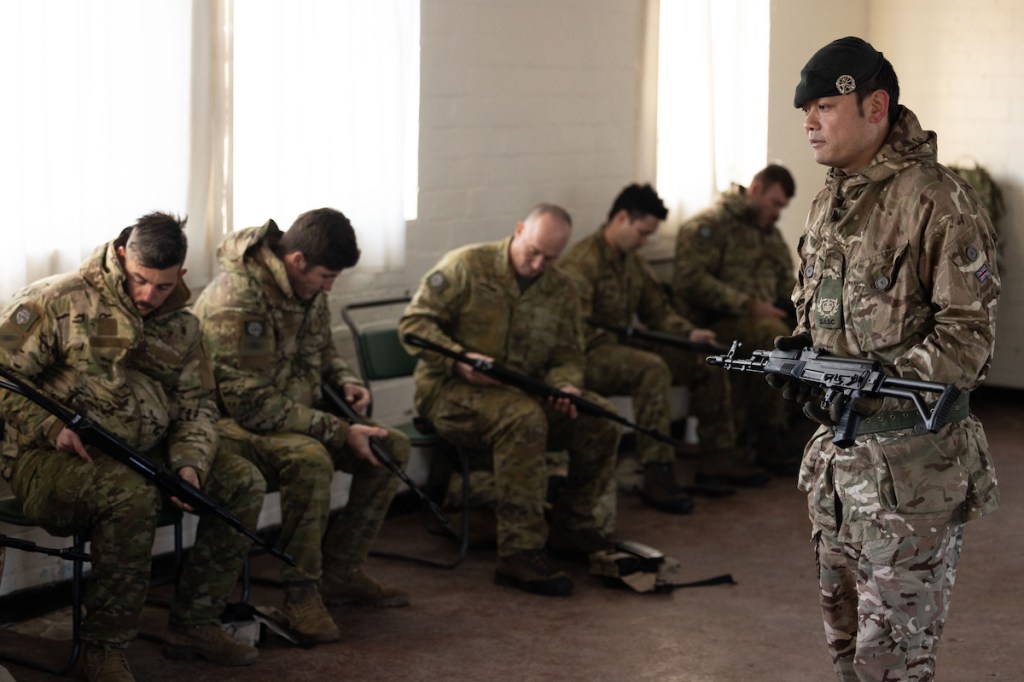
Australian Army soldiers from the 5th Battalion, Royal Australian Regiment, receive weapon handling lessons from the British Army’s Small Arms School Corps as part of the “train the trainer” portion of Operation KUDU in the United Kingdom (Australian Department of Defence/Commonwealth copyright)

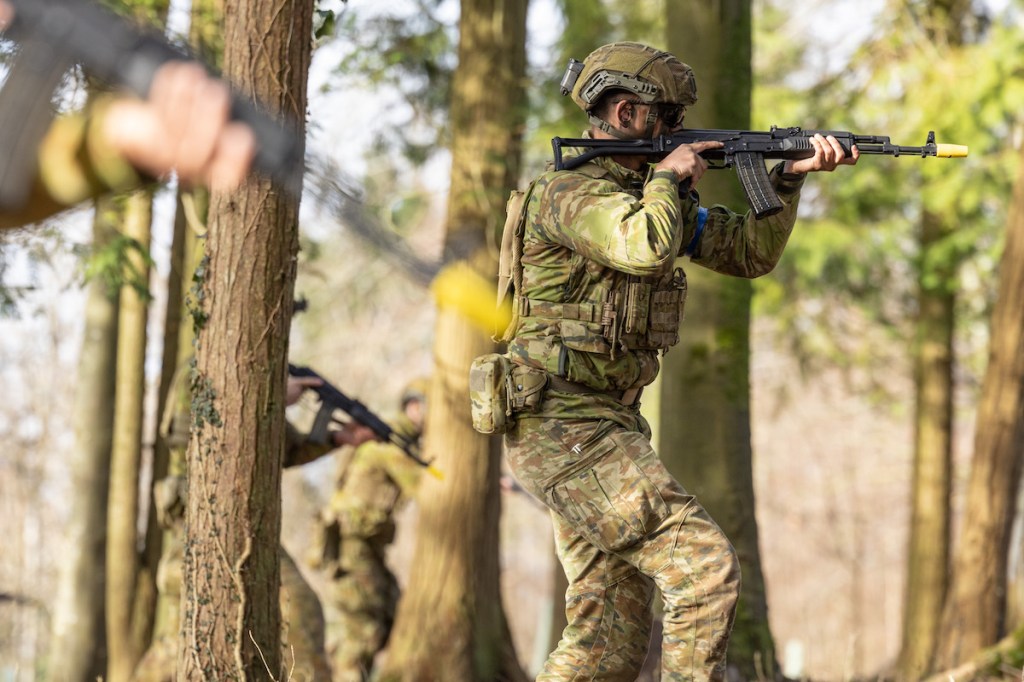
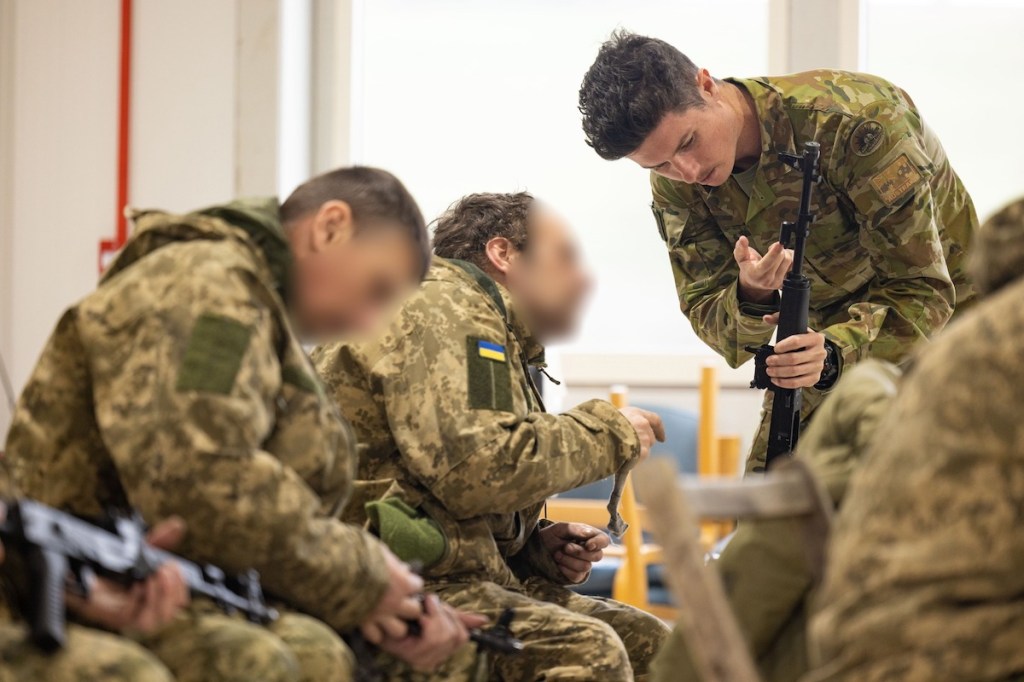
The Australian Army has also shared a large number of photographs from their involvement in the training of Ukrainian troops in the UK. The Australian military have dubbed their effort Operation Kudu. They describe Kudu as: “A contingent of up to 70 Australian Defence Force (ADF) personnel are deployed on Operation KUDU to assist with the UK-led and based training program.” The Australian photographs show the training and familiarisation of Ukrainian troops with the Arsenal AKs with both Australian and British instructors seen in the photographs.

An Australian Army soldier from the 5th Battalion, Royal Australian Regiment, assists Ukrainian recruits with cleaning their rifles during Operation KUDU (Australian Department of Defence/Commonwealth copyright)

The photographs feature members of the 5th Battalion, Royal Australian Regiment and senior instructors from the British Army’s Small Arms School Corps, instructing trainees in the classroom before undertaking some fire and movement drills with blanks.


Update 08/02/23:

The Canadian Ministry of National Defense has released a short video showing some of the training Canadian personnel in the UK are delivering to Ukrainian troops as part of Operation Unifier (the Canadian element of the international Operation Interflex.)

The video focuses on some of the field exercises and urban training being provided and heavily features Bulgarian Arsenal AR-M9F (5.56x45mm) AK-pattern rifles.

Update – 14/02/23: A video shared by the Australian Department of Defence showed Australian troops training Ukrainians with Arsenal AKs during Operation Kudu.

Update 15/02/23: The Danish Army has also shared several photographs of Danish troops training Ukrainians in the UK, Arsenal AKs can again be seen in the photographs (fitted with BFAs).


Support Us: If you enjoyed this video and article please consider supporting our work here. We have some great perks available for Patreon Supporters – including early access to custom stickers and early access to videos! Thank you for your support!

Bibliography:

Assault Rifles, Arsenal, (source)

Operation Unifier, Canadian Armed Forces, (source)

Operation Kudu, Australian Defence Force, (source)

F1 Submachine Gun

The Australian military adopted the F1 submachine gun in 1962, with the first guns reaching troops in April 1963, it replaced the venerable Owen gun. Like the earlier Owen the F1 had a top-mounted magazine – a position that lent itself to prone firing and more comfortable carrying when slung. But it also shared some similarities with the British L2A3 Sterling.

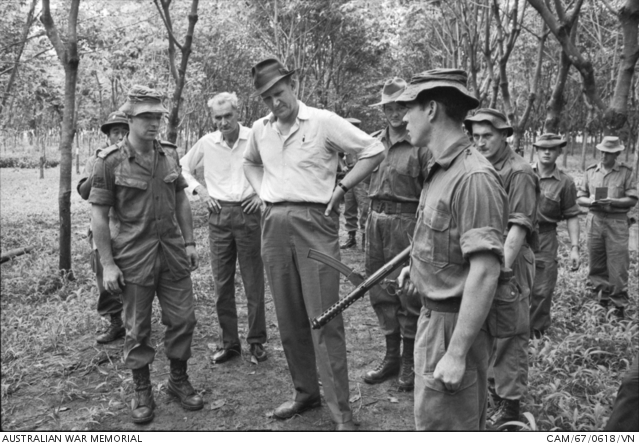
NUI DAT, VIETNAM, 7TH BATTALION, THE ROYAL AUSTRALIAN REGIMENT (7RAR) with F1 SMG
Men of the 7th Battalion, The Royal Australian Regiment demonstrate the F1 to the Australian Army Minister, Malcolm Fraser, in Vietnam in 1967 (Australian War Memorial)

The F1 entered service alongside the Australian L1A1 (self-loading rifle/FN FAL), it shared the rifles butt plate and pistol grip – slightly minimising additional unique parts needed by the submachine gun. Australian Ordnance had begun searching for a replacement for the ageing Owen gun after the Korean War. The Owen had been made quickly and cheaply during the Second World War and while it was well liked by Australian troops it was felt it could be improved upon. Maintenance of the older Owen guns proved difficult as each weapon had been hand fitted to speed up production and some parts proved not to be interchangeable.

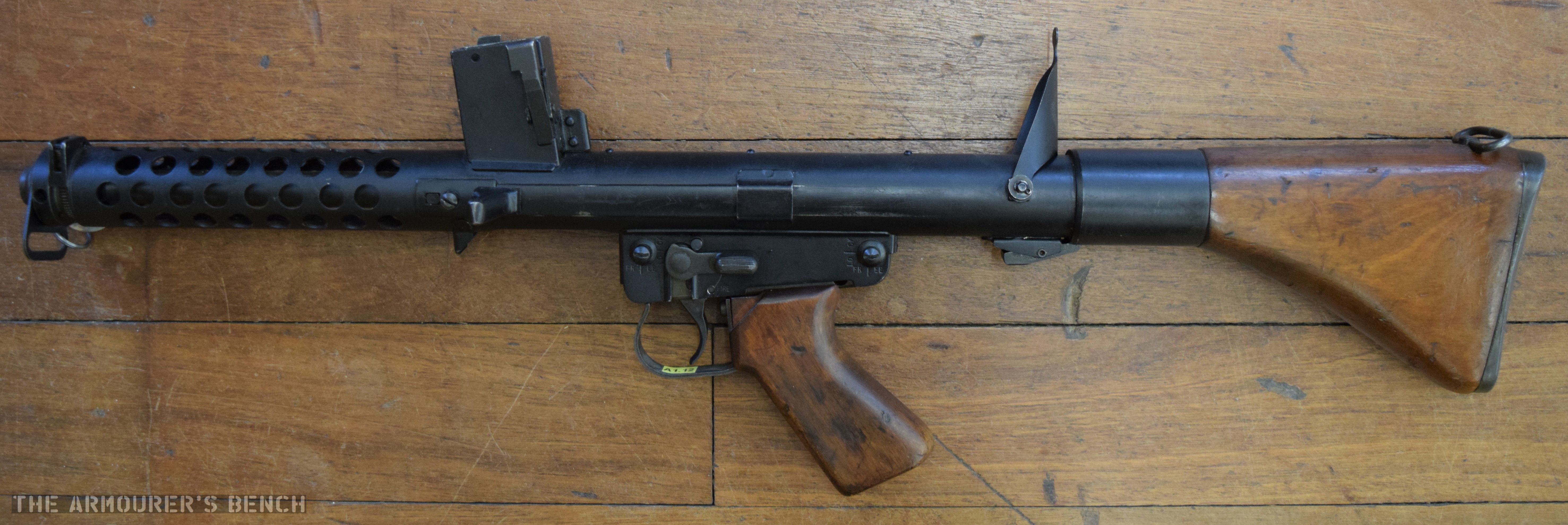
F1 SMG (Matthew Moss)
Left side view of an Australian F1 submachine gun, from the 1970 production run (Matthew Moss)

A number of designs were developed including one designated the Kokoda (presumably after the Kokoda Trail campaign fought by Australian troops in 1942). This design was lighter than the Owen but suffered from overheating problems. A series of designs from the Australian Design Establishment, designated the ‘X’ series, were then developed. These weapons incorporated elements from both the Owen and the British Sterling. Including the Sterling’s perforated barrel jacket and magazine and the Owen’s bolt, magazine orientation and forward pistol grip – a feature many troops with experience with both the Owen and F1 lamented to loss of with the adoption of the F1. The first two ‘X’ series weapons developed into the X3 which in 1962, after successful trials, became the F1.

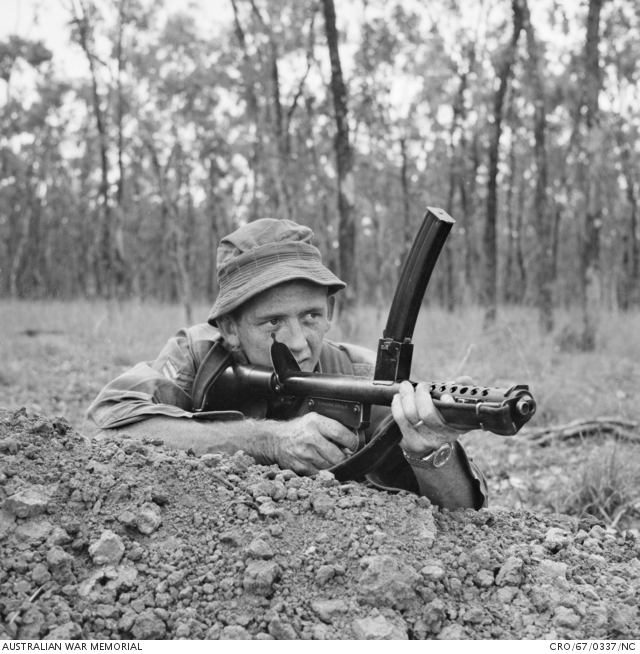
8RAR with F1 SMG (AWM)
Member of 8th Royal Australian Regiment stood too with his F1 SMG (Australian War Memorial)

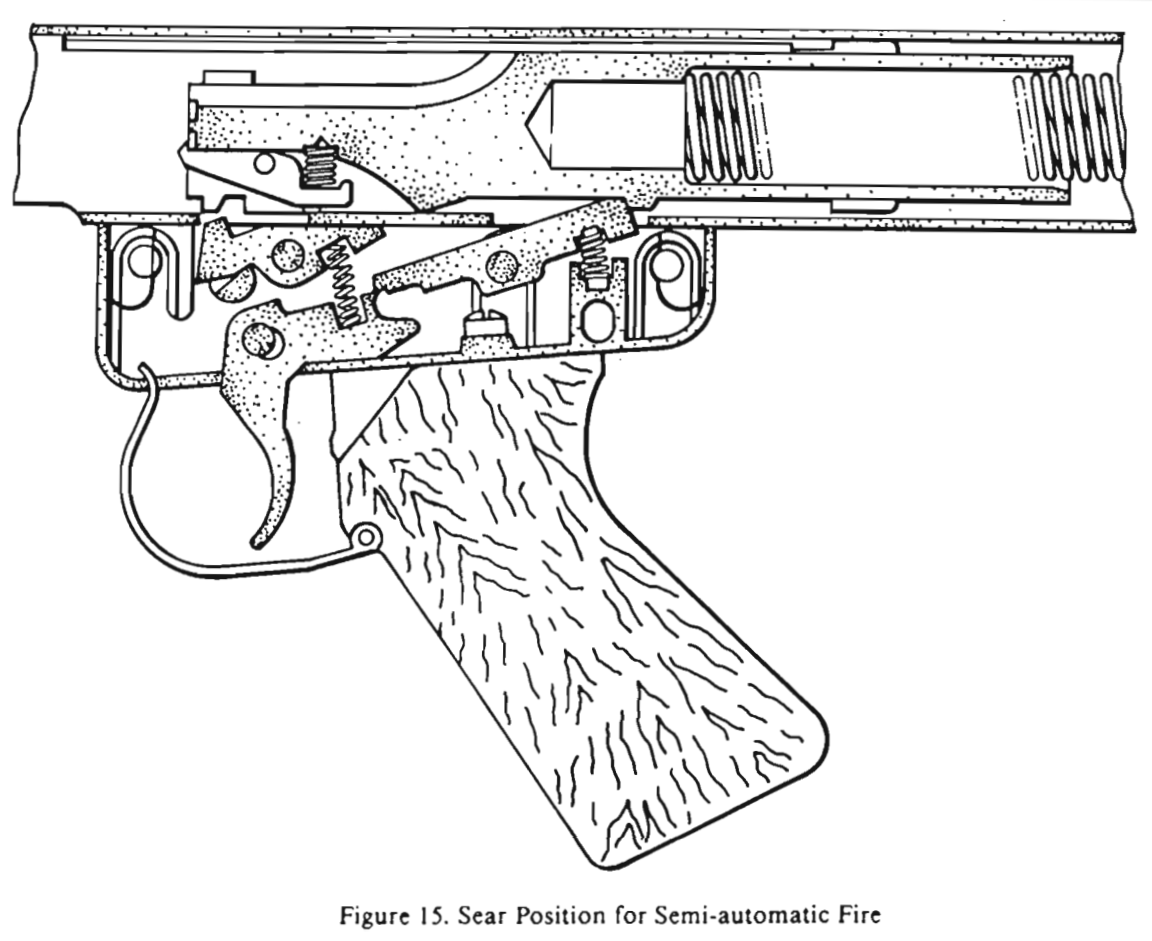
The F1 used a standard blowback action with a non-reciprocating charging handle. The charging/cocking handle was positioned on the left side of the receiver with its slot protected from the ingress of dirt by a dust cover. The F1 has a two-position fire selector with up for ‘safe’ and down for ‘fire’. The trigger mechanism allowed for firing single shots by pulling the trigger to the half-way point, this allowed the sear to trip into the semi-automatic position (see the diagram below).

Semi-Auto sear position in F1 SMG
Diagram from Australian Army Parts List showing how the F1’s semi-automatic mode works (source)

Chambered in 9x19mm, the F1 fed from a 34-round curved magazine, although it could use straight, single-feed, Sten or Owen magazines. In the 1960s, in order to achieve commonality with Britain and other Commonwealth nations, that used the Sterling Submachine Gun, the Australian government contacted the Sterling Armaments Company to enquire how much a license to produce Sterling’s magazines would cost, only to be quoted an exorbitant fee. The Australian government were unwilling to pay for the license and produced them anyway. And as Sterling could not afford to take legal action were able to continue to do so – with the understanding they would not sell any commercially. The Australian government would later purchase a number of suppressed Mark 5 Sterling-Patchetts, also adopted by the British army as the L34A1.

The weapon’s ejection port was located on the bottom of the receiver ahead of the trigger guard. A small piece of metal was added in front of the ejection port, as a hand stop, to prevent the operator from inadvertently moving their hand over the port. The F1 had an in-line stock fitting into the rear of the tube receiver. The sights were offset to the right, the rear peep sight folded against the receiver when not in use while the front sight, rather than over the muzzle, projected from the right side of the magazine housing.  The F1 could also mount the L1A1 self-loading rifle’s standard L1A2 sword bayonet.

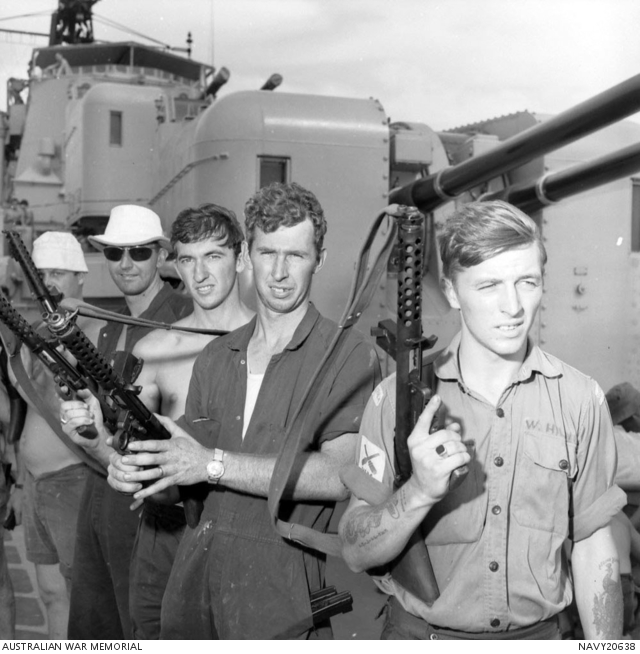
Australian Sailors with F1 SMG
Australian sailors aboard the destroyer HMAS Duchess wait to take part in a live firing exercise with their unloaded F1 submachine guns, c.1969. (Australian War Memorial)

The F1 weighed just over 7lbs (3.2kg), was 28 inches long and had a cyclic rate of approximately 600 rounds per minute. It had a solid butt stock, unlike the Sterling which had a folding stock. The F1 was produced solely by the Lithgow Small Arms Factory with most sources suggesting 25,000 were produced for the Australian military between 1963 and 1973. The Lithgow Small Arms Factory Museum were kind enough to look into the exact number made for us, and reported that there is some uncertainty surrounding the exact number produced with production report totals varying, giving a total of either 21,916 or 24,828.

The F1s saw extensive service in Vietnam and later with Australian peacekeeping troops through to the 1990s. It was issued to rear echelon troops, ACP and aircraft crews and to infantry sections. While the F1 was appreciated for its reliability, for those troops who had experience with the venerable Owen Gun, the F1 lacked a certain something.  Colonel Warren Feakes noted that “every time I picked up an F1 I had the feeling that something was missing.” Another Australian veteran, Warrant Officer Kevin Konemann, who served in Vietnam in 1966-67, recalled: “It was awkward to fire from the shoulder and more awkward to fire from the hip” and that “the F1 wasn’t popular. Soldiers found it more difficult to point and bring on target than the OMC [Owen Gun] and firing from the shoulder… was decidedly more difficult without the front hand grip.”

Despite the shortcomings identified by some troops the F1 remained in service alongside the L1A1 self-loading rifle into the early 1990s, when both were phased out of use as the 5.56x45mm F88 (Steyr AUG) was adopted.

If you enjoyed the video and this article please consider supporting our work here.


Technical Specifications:

Length: 28 inches (71cm)
Weight (unloaded): 7lbs (3.2kg)
Barrel Length: 8.35 inches (19.8cm)
Action: Blowback
Calibre: 9x19mm
Feed: 34 round box magazine
Cyclic Rate: ~600 rpm


Bibliography:


1966 Infantry Training Pamphlet, Platoon Weapons, Sub-machine Gun 9mm, F1, Australian Army, (source)

Repair Parts Scale, 9mm, F1 SMG, Australian Army, (source)

Vietnam ANZACs Australian & New Zealand Troops in Vietnam 1962-1972, K. Lyles (2004)

Military Small Arms of the 20th Century, I. Hogg & J. Weeks (1985)

‘Another Australian Native: The 9mm F1 Submachine Gun’, Arms & Militaria Collector No.21, pp. 53-56, I. Skennerton, (source)

Modern Small Arms, F. Myatt (1979)

The Owen Gun, W. Wardman, (1991)

F1 Sub-machine Carbine, Lithgow Museum, (source)


Please do not reproduce photographs taken by Matthew Moss without permission or credit. ©The Armourer’s Bench 2018.