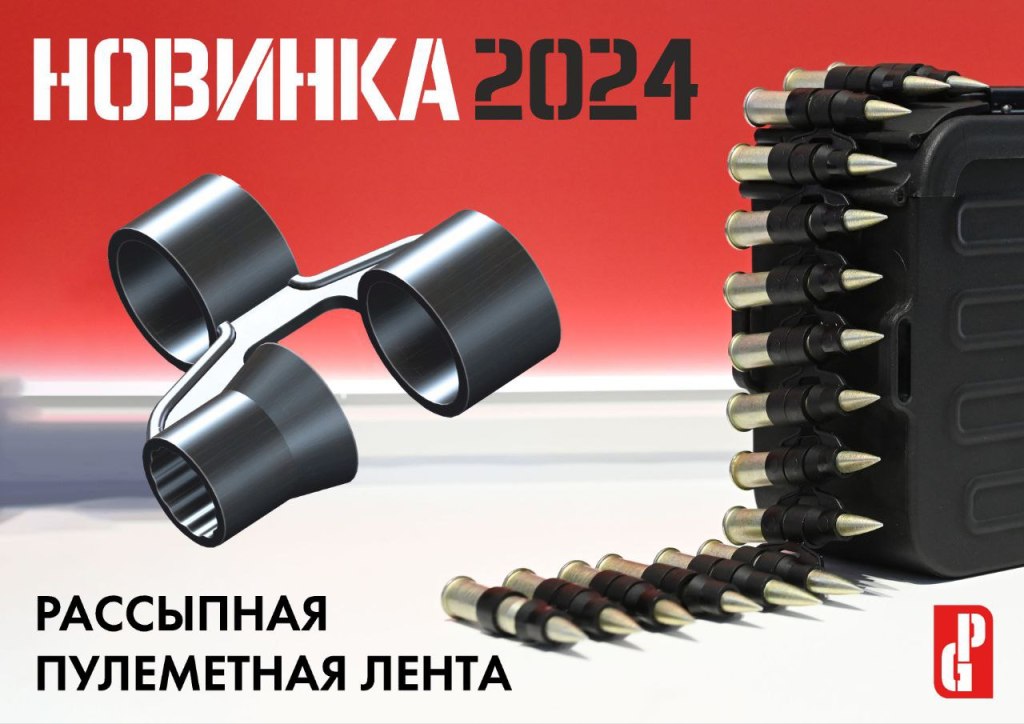
In previous videos we’ve looked at Ukrainian efforts to manufacture polymer belts for PK-pattern general purpose machine guns. These were developed by Ukrainian company RAROG who has been selling them since the summer of 2022. Now PUFGUN, a Russian company has also developed a polymer PK belt.
Traditionally, the 7.62x54mmR belts used by the PK series of guns have been made from metal and are non-disintegrating, meaning they remain linked together after they’ve been used, while NATO machine guns tend to use disintegrating belts that fall apart once the rounds held in them have been fired.
On 3 September, PUFGUN announced the introduction of the new disintegrating belts, explaining some of their features:
“The tape is made of high-strength polymer – a light and durable material. 3 times lighter than metal analogues. The total weight of the package for 100 links is 220g Due to the physical properties of the polymer, the loading of the PUFGUN loose belt is carried out faster than that of a metal belt. Maintains functionality in temperature conditions from -40C to +70C. Not subject to corrosion, does not require special conditions for long-term storage.”
Packs of 100 links are being sold for 548 Rubles or $5.75 on PUFGUN’s website.
PUFGUN shared a pair of photos, on 10 September, comparing the weight of a loaded traditional metal belt with one of their non-disintegrating belts, with the metal belt weighing 2.8kgs while the polymer belt weighed in at 2.37kgs. In the caption they claim that the photos were taken by Russian special forces unit Grom. OSN “Thunder”, who they state has been testing the belts since late August. The post claims Grom’s first impression was ‘quite good’. The post on PUFGUN’s telegram has since been deleted.
On 14 September a video showcasing the belts was posted by Mikha Mikhalych, a Russian gun content-creator, reviewing the belts. In the video two types of belt are featured; the disintegrating belt and a non-disintegrating one. The video also features a polymer belt box developed by PUFGUN, which is said to weigh around 150g. Combining the box with the polymer belts appears to be a meaningful push towards reducing the weight of the PK’s ammunition carriage system.
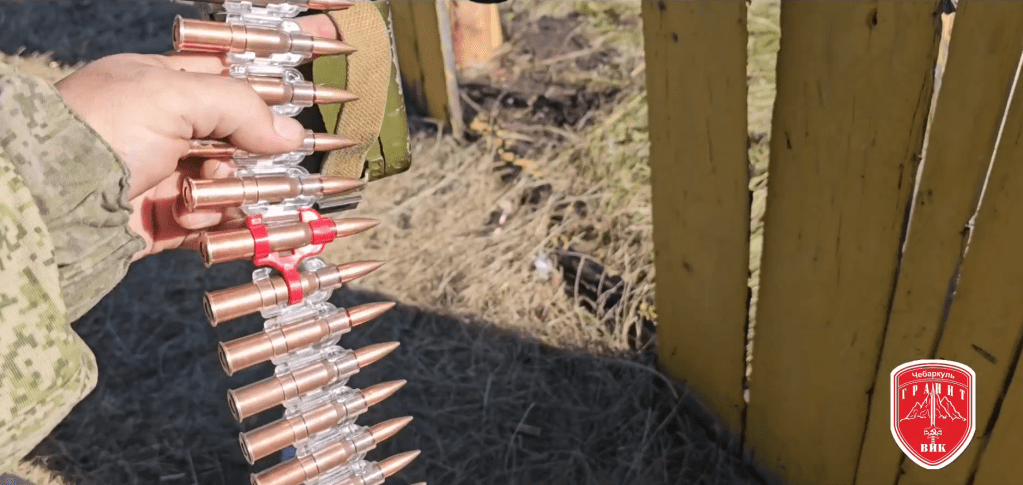
On 26 September, PUFGUN announced the non-disintegrating polymer belts on their social media. These belts share the same technical specifications as the disintegrating belts but notable are made from a clear plastic rather than a black plastic. While these have previously appeared in the earlier video they are not, at the time of publication, available for purchase on the company’s site. It appears that the links will be sold in packs of 100, with a starter tab and four disintegrating connector links which allows 25-round belts to be linked together.
On 9 October, PUFGUN shared a short clip showing their non-disintegrating belt being loaded by an Rakov belt-filling machine. This video was made in collaboration with ‘Granit’, a Russian living history group which appears to have links to the Russian military. Granit also shared their own longer video showing the belts being used in a variety of old and new Russian machine guns ranging from a vintage SG-43 to the latest PK variant the 6P41M.
Much like the Ukrainian KS-122 polymer belts from RAROG, the PUFGUN belts do significantly reduce the weight on the gun itself and more broadly for transporting ready ammunition. PUFGUN have sought to address the need for both disintegrating belts, useful for troops on the move that don’t want to be encumbered by trailing empty belts, while the non-disintegrating belts are more easily reloaded and better suited to use in vehicles or static positions. It’s interesting to see both sides commercially developing polymer belts to address a perceived need shared by both sides.
In early March we looked at the Black Storm Defender, a Ukrainian conversion kit, which turned GP-25 under-barrel grenade launchers into standalone weapons. Since then further research has discovered a very similar conversion design originating from Russia. Developed by a company called RGL (redgreenlight.ru). RGL have developed a number of products including a sight mount for RPG/RPO pattern shoulder-fired launchers and a small light which can illuminate turrets on optics for use in lowlight conditions. They developed their stock for the GP25 and GP34 in 2019, with refinements in 2022. It was reportedly developed independently of the Black Storm Defender – with both companies developing very similar products.
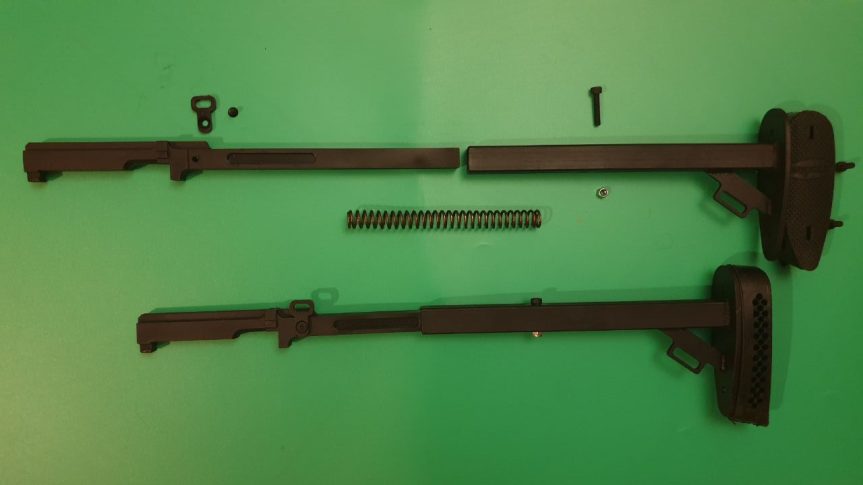
Comparison between Север 1 (top) & Blackstorm Defender (bottom)
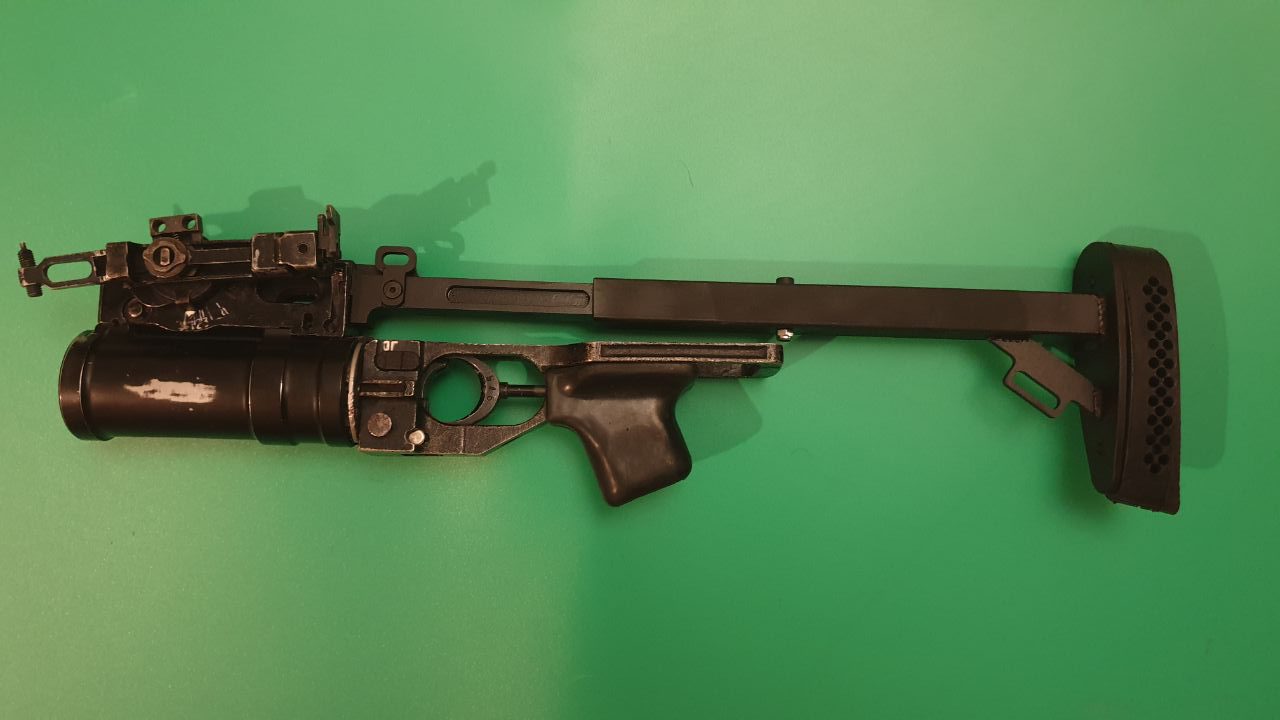
RGL’s website has some specs on their system – the Север 1, noting its length is 480mm and its weight is ‘no more 1100g’. The stock adapter is priced at 17,000 Russian Ruble (or around $220).
Photos of the Север 1 with GP-25 fitted and disassembled (via RGL)
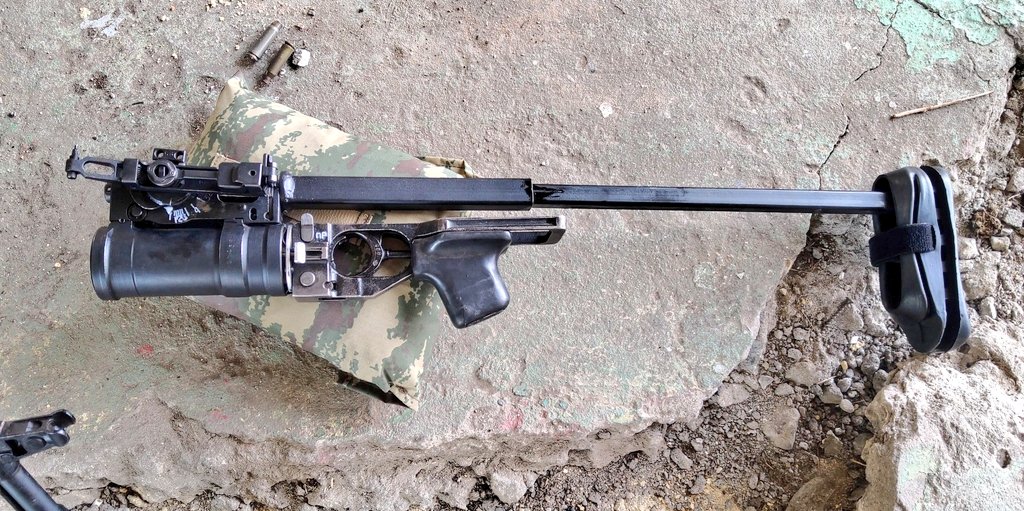
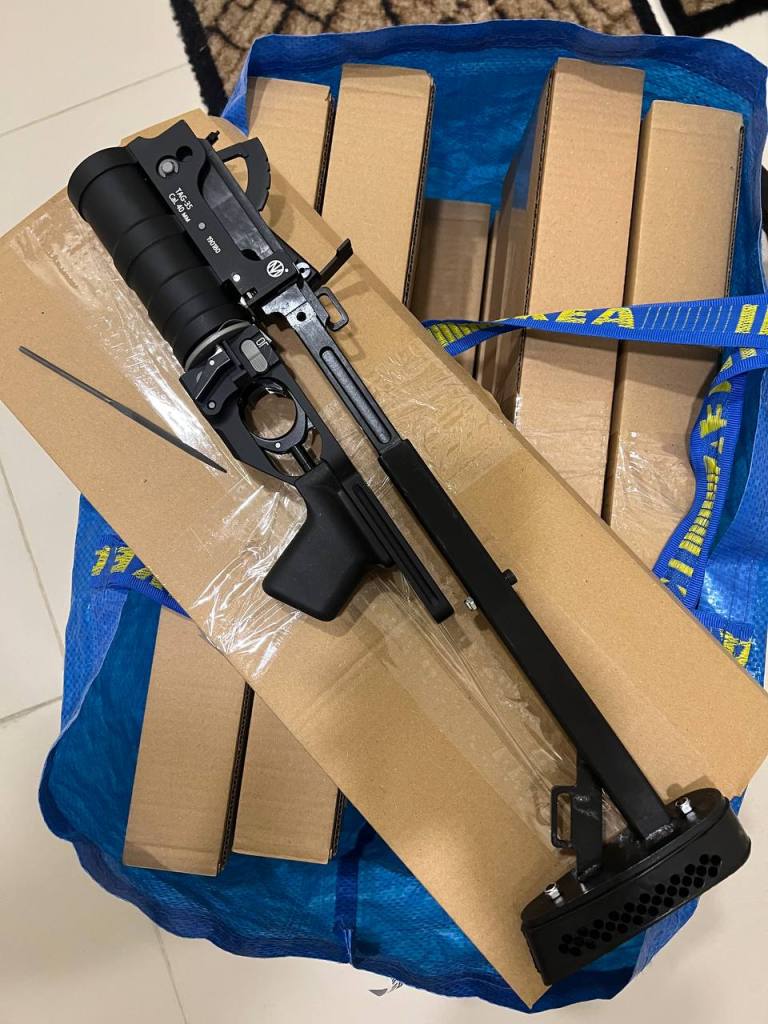
So similar are the two designs that images at 5:21 and a clip at 6:55 actually show Север 1s rather than Defenders. A Wagner-affiliated Telegram channel posted the photo below, with the caption: “For those who want to order – mid-May production time, place an order in advance.”
An RGL Север 1 fitted with a TAG-35, an airsoft clone of the GP-34 grenade launcher (via social media)
The key differences between the two appear to be a different kind of butt pad, the positioning of the sling loops, some machining on the extension which attaches to the launcher and most fundamentally a reversal of which parts of the stock telescope. On the Defender the rear section telescopes inside the front while on the Север the front portion appears to telescope inside the rear section. The Север 1 does not appear to come with a frontgrip or a grip extension. The Север 1 has been seen in use in Ukraine with Russian combatants.
Update – 14/07/23: Russian military ‘influencer’ Razvedos shared several photos of the RGL Север 1 standalone stock for GP series underbarrel grenade launchers. Razvedos recommended it saying: “I recommend the best solution in this niche today from RGL.”
Razvedos sharing photos of the RGL Север 1 standalone stock for GP series underbarrel grenade launchers.
— Historical Firearms | Matthew Moss (@historicfirearm) July 14, 2023
Support Us: If you enjoyed this video and article please consider supporting our work here. We have some great perks available for Patreon Supporters – including early access to custom stickers and early access to videos! Thank you for your support!
The Russian A-545 is perhaps the rarest of assault rifles in use in Ukraine. Since Russia’s full-scale invasion last year there have only been a handful of sightings of the rifle which features an internal recoil mitigation system.
The A-545, also known as the 6P67 Kord, is the latest iteration of a long line of rifles which began development back in the late 1970s with the first iteration designated AEK-971, developed for Project Abakan.
The A-545 is a select-fire rifle with an ambidextrous selector with settings for safe, single shot, 2 round burst and fully-automatic. The rifle is gas-operated and uses a rotating bolt locking action coupled with the BARS recoil mitigation system. The rifle has a reported cyclic rate of 900 RPM.
Russian troops with A-545 (via social media)
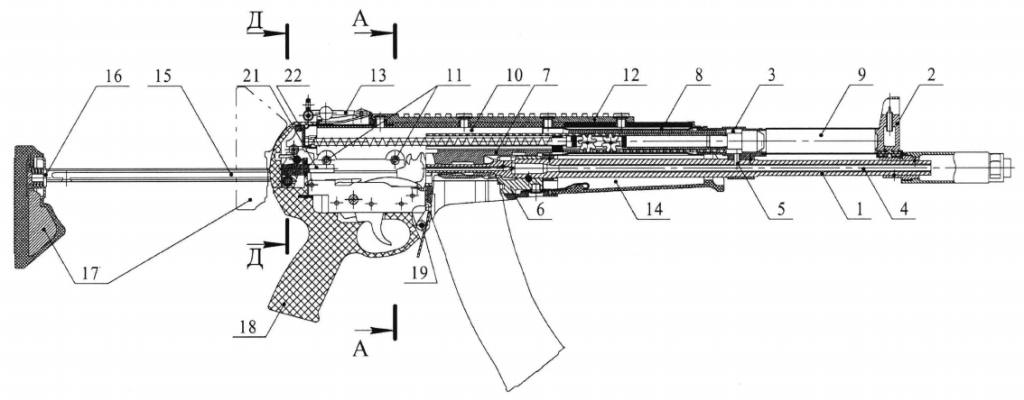
BARS (Balanced Automatic Recoil System) works by shifting mass towards the muzzle-end of the rifle to counter-balance the mass of the bolt and carrier moving towards the rear of the receiver. A pair of synchronised gears in a rack-and-pinion system move the counterweight forward during cycling, powered by the the movement of the bolt carrier as well as gas tapped from the barrel.
Designed by Stanislav Koksharov and developed at the ZiD/Degtyarev Plant in Kovrov. The A-545 development was completed in 2014, adding a new collapsing stock, new furniture and lengths of Picatinny rail. The rifle was tested during the Ratnik equipment trials in 2015 onwards which saw it tested against the AK-12 from Kalashnikov Concern.
The A-545 reportedly faired well in the trials but its more complicated action meant that the AK-12 was selected for wide scale issue while the A-545 was earmarked for elements of the Border Service, special forces, and the national guard (Rosgvardiya). Serial production of the rifles reportedly began in the summer 2020. There is also a 7.62x39mm chambered version, the A-762 or 6P68.
Patent drawing showing the internal layout of the A-545, note the pair of gears just ahead of the trunnion (Russian Patent)
Before the war the A-545 was also seen with the Rosgvardiya’s SOBR Rys, the VDV’s 45th Independent Guards Spetsnaz Brigade, the 810th Naval Infantry Brigade and elements of Russia’s Ministry of Internal Affairs (MVD),
Since Russia’s full-scale invasion of Ukraine last year it has been seen on just a handful of occasions.
Numerous photos have been posted by RAZVEDOS, a well-known Russian SOF veteran. On 9 April, RAZVEDOS posted a pair of photos featuring himself holding an A-545 along with a short ‘review’, reading:
“Reviews are positive, BUT! Firstly, “KORD” is much more complicated than AK, so it is hardly suitable for a simple soldier – and this applies not only to “conscripts”, because many “contract soldiers” left not far from them.Secondly, if we turn to the facts, i.e. to the test numbers, the combat characteristics of the “KORD”, although higher than those of the AK, are by no means head and shoulders above.“
Given the review is likely based on feedback from VDV Spetsnaz RAZVEDOS visited in April after the Battle of Hostomel the opinion could be based on battlefield experience.
The location these first photos were take is unclear. Several days later, on 13 April, RAZVEDOS shared several more photos featuring an A-545, which appears to be the same rifle, on top of a sleeping bag on a camp bed, in what appears to be a tent. This has frequently been cited as with VDV Spetsnaz at Hostomel (but the original post does not claim this). The rifle is fitted with a 1P87 red dot optic. A third photo, seemingly taken inside a tent, appears to be the same rifle fitted with the 1P87.
A-545 mounted with a 1P87 red-dot optic (via social media)
Late October saw the Russian Ministry of Defense share imagery of recently mobilised troops undergoing training led by an instructor with an A-545. In late December a photo seemingly taken on the back of a moving vehicle shows a A-545 fitted with a Holosun 403/503 red dot sight.
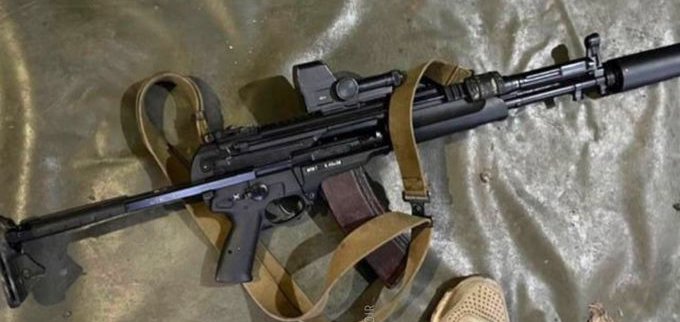
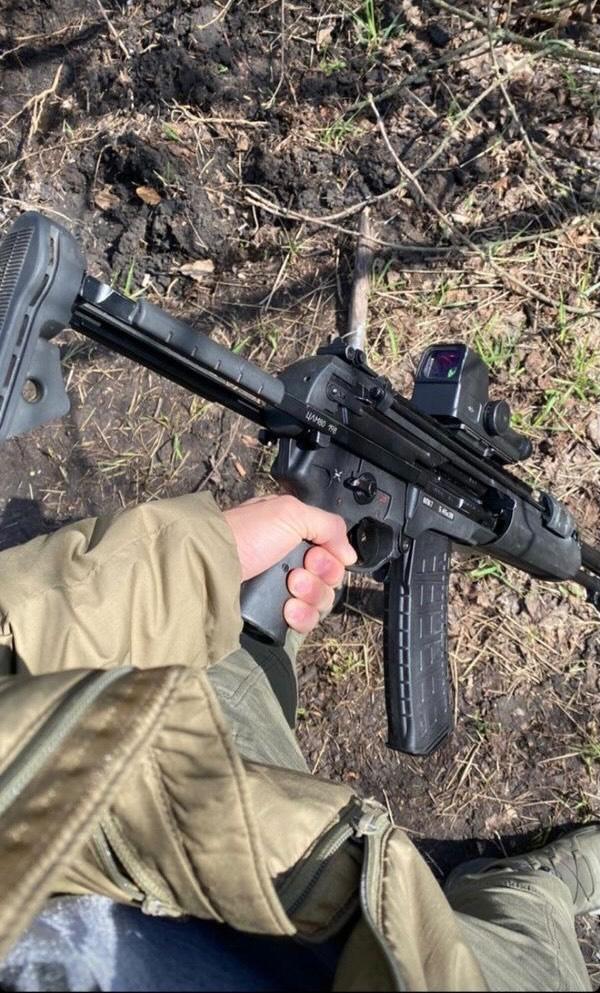
Most recently a photograph of an A-545 in a fighting position said to be in Ukraine was shared. The rifle is seen equipped with 45 round magazine, a suppressor and a Holosun 403/503. This is potentially the same rifle seen in December.
A-545 fitted with Holosun optic reportedly photographed in Ukraine (via social media)
Another question which is regularly asked is – have their been any sightings of the AN-94? The AN-94 was developed to meet the same requirements laid out by Project Abakan. It reportedly passed state trials and was adopted for service but its complex design means it is rarely seen. There haven’t yet been any confirmed sighting of the AN-94 in Ukraine or with troops training in Russia. If any of the rifles ever appear they’ll definitely be the subject of an article/video.
The A-545 is undoubtedly a more advanced weapon than the more common AK-12 but how many of the rifles are in service is unclear and the extent of their use in Ukraine remains unknown. In the past several months there have been a number of Russian news reports on the rifle including a feature length report from Zvezda and a shorter piece from HTB on production of the rifle. From the limited imagery available it would seem that they have seen some limited in theatre use while instructors back in Russia may also be using the rifles.
Update 17/04/23:
A pair of photos of A-545 in use with the VDV have been shared with TAB by nrxnb. The first photo was reportedly taken by a member of 175th Reconnaissance Battalion with the 76th Guards Air Assault Division (VDV). The 175th took part in the battle of Hostomel. The rifle has been fitted with an 1P87 red-dot optic and has a polymer magazine normally issued with AK-12s.
The second photo was said to have been taken in April, post Battle of Hostomel, by a member of the 45th Guards Spetsnaz Brigade (VDV). Again it appears to have been fitted with an 1P87 red-dot optic and a suppressor.
Update – 23/12/23: A Russian telegram channel shared a photograph of a 6P67 Kord which has been modified, with a rail cut into the handguard, to allow it to mount a grip and bipod.
The individual that modified the rifle provided the caption (machine translated):
“The body kit, of course, is not like that of those who posted it earlier, and there is literally no body kit for it on the market at all. Even the Picatinny rail had to be cut into the standard forend using a small drill, straight arms and such and such a mother. Alpha Arms can, Magpul belt, Magpul fire transfer handle, Atlas bipod, Vortex Viper pen and Vector Optics collimator. Overall, the machine is excellent, there are pros and cons.”
A new photo of an A-545, also known as the 6P67 Kord, which has been modded by adding a cut in 6 o'clock rail on the hand guard to mount a vertical front grip & a bipod.
— Matthew Moss | Historical Firearms (@historicfirearm) December 23, 2023
Update – 9/10/24: A recent image of an A-545 shared by Russian suppressor company Hexagon Tactical. Reportedly shared with them by the rifles user who has equipped the weapon with one of their 5.45mm suppressors. The optic appears to be a ThermTech VIDAR 2.0.
One I forgot to share, a recent sighting of a Russian A-545 fitted with Hexagon's 5.45 suppressor (20,000 of which have reportedly been shipped to the front).
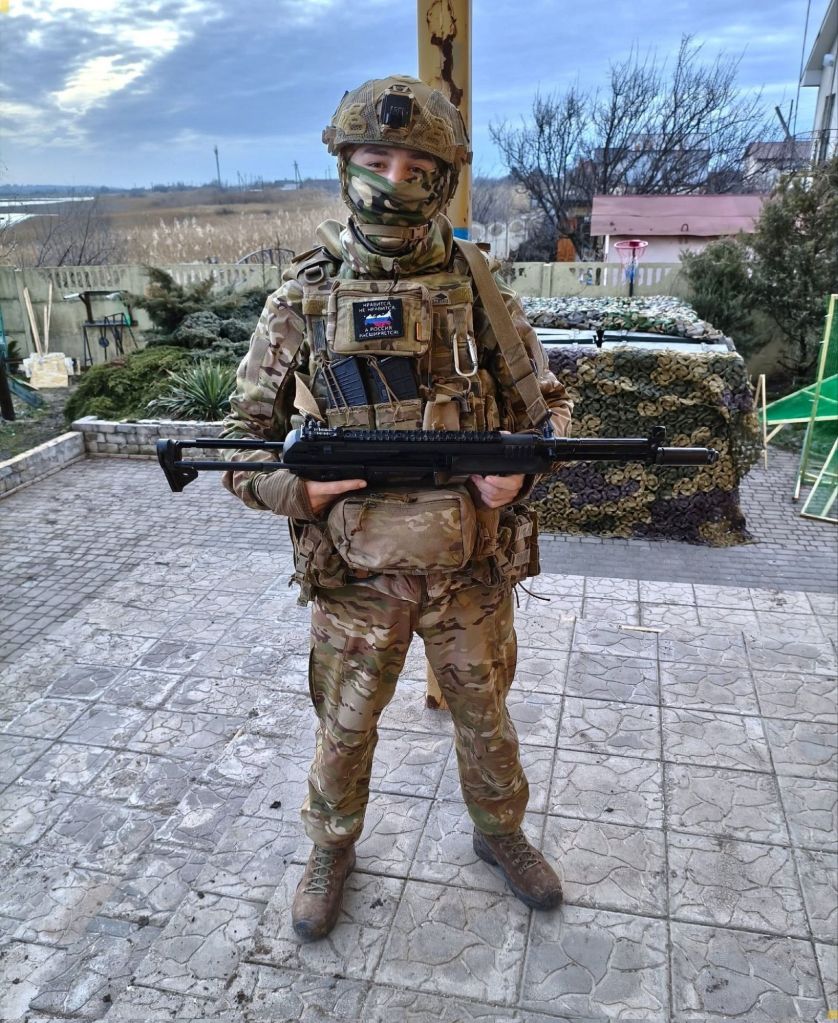
A photo of a Russian serviceman armed with an A-545, claimed to have been taken somewhere in Donbass was recently shared online, but it’s unclear when the photo was taken.
Specifications (via Rosoboronexport)
Calibre
5.45x39mm
Weight (unloaded)
3.5kg (7.3lbs)
Stock Collapsed
720mm (28in)
Stock Extended
960mm (38in)
Maximum Range
800m
Feed
30 round magazine
Cyclic Rate
900 RPM
Support Us: If you enjoyed this video and article please consider supporting our work here. We have some great perks available for Patreon Supporters – including early access to custom stickers and early access to videos! Thank you for your support!
Bibliography:
Military Acceptance “Balanced Avtomat”, 12 Feb. 2023, Zvezda Live, (source)
6P67/6P67-1 KORD Assault Rifle, Rosoboronexport, (source)
Automatic Small Arms with Balanced Automatics, Russian Patent #2482417, (source)
BREAKING: Russian Army Accepts Both AK-12 And AEK-971, TFB, (source)
The Russian Balanced-Action A545 Rifle In Action, TFB, (source)
Meeting Government Orders: Unusually Designed Russian Rifles, M. Popenker, SADJ, (source)
6P68/6P68-1 KORD Assault Rifle, Rosoboronexport, (source)
Serial Production of An Assault Rifle, a Competitor to the AK-12, Has Started in Russia, 1 Jul. 2020, RIA, (source)
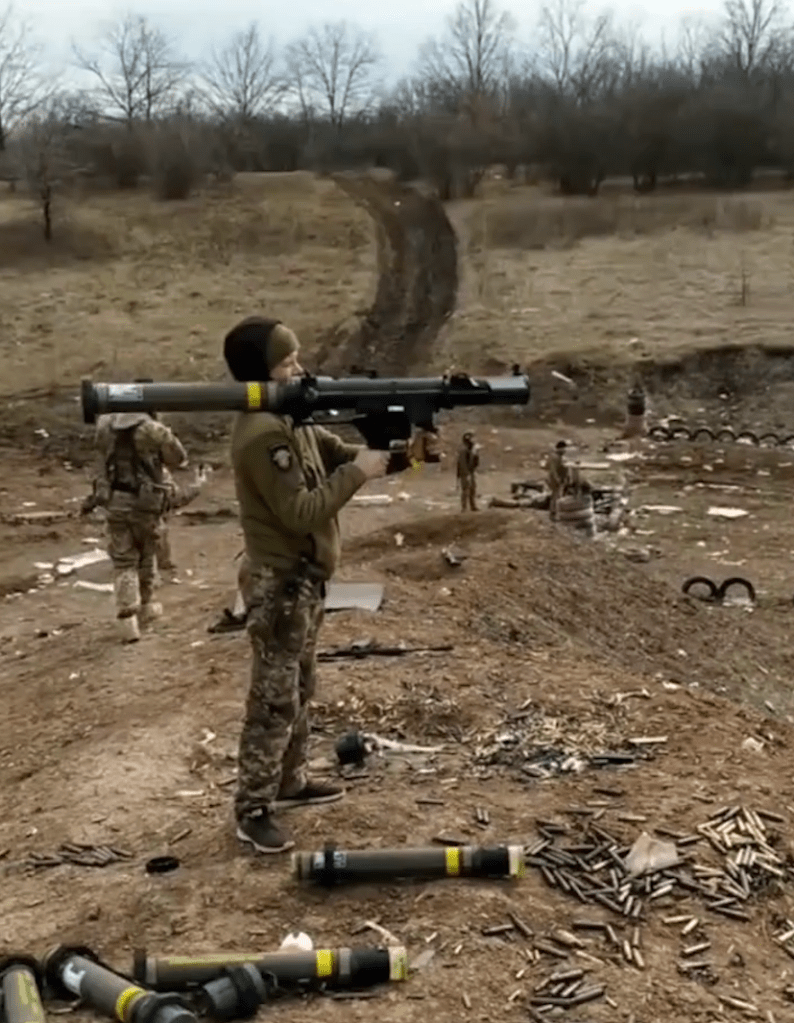
Recent imagery confirms the presence of the Mk153 SMAW in Ukraine. In the last couple of months there have been sightings of the Mk153 in use at the front and at a Ukrainian Armed Forces training ground. The Mk153 is a shoulder-fired rocket launcher capable of engaging structures and armoured vehicles.
The Mk153’s cousin munition – the one-shot, disposable M141 SMAW-D has been seen in theatre in fairly small numbers since February 2022. We have an earlier article/video looking at the SMAW-D, check that out if you haven’t already.
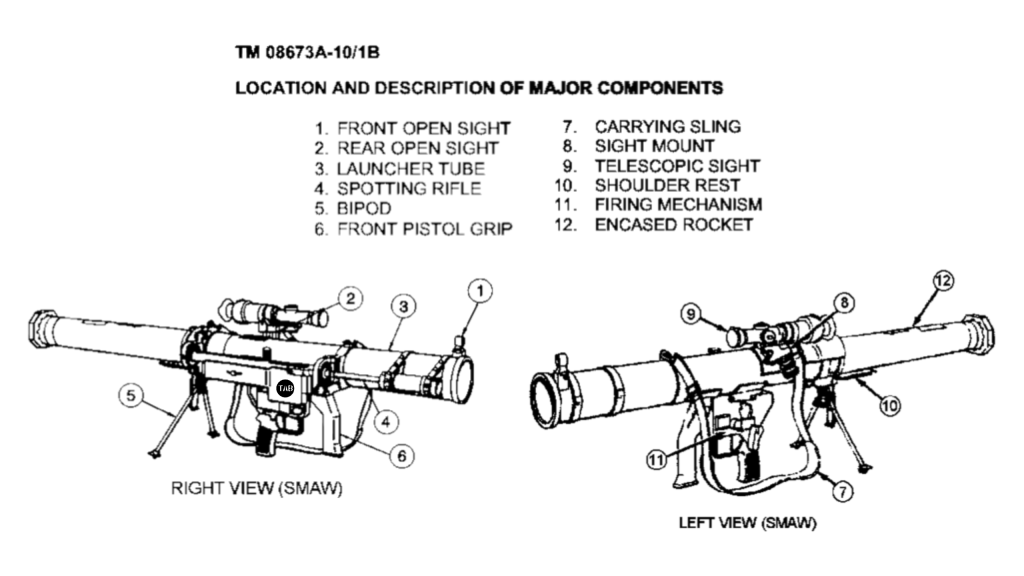
The Mk153 is primarily used by the USMC and was developed from the Israeli IMI B-300 and introduced in the mid-1980s. So what actually is a Mk153? The USMC describes the SMAW as:
“a one-man operable, 83 mm smooth bore, shoulder-fired, rocket launcher with a spotting rifle attached to the right side of the launcher tube. The encased rocket is fitted into the aft end of the launcher, and the fiberglass encasement is discarded after use. The spotting rifle, which improves firstround hit probability, is fed 9 mm tracers by a magazine, which holds six rounds. The 9 mm round is ballistically matched to the 83mm rocket.”
The SMAW (or Shoulder-Launched Multi-Purpose Assault Weapon-Disposable) can fire Encased High-Explosive, Dual Mode (HEDM) and Encased High-Explosive, Anti-Armor (HEAA) rockets. The HEDM is an anti-structure and anti-light armour munition with a warhead containing 2.4 pounds Aluminized Comp A-3 capable of penetrating 200mm (8 in) of concrete. The HEDM has a maximum effective range of 250m. The HEAA is a dedicated anti-armour round able to penetrate up to 600mm (23.6in) of rolled homogeneous steel, with a maximum effective range of 500m. It uses a shaped charge warhead with 1.89 lbs Octol explosive. The Novel Explosive (SMAW-NE) has a 4lbs enhanced-blast warhead, containing PBXN-113, designed for bunker busting which the USMC manual describes as “designed to provide enhanced-blast lethality to defeat personnel in reinforced structures and caves.”
Mk153 in Ukraine (via Social Media)
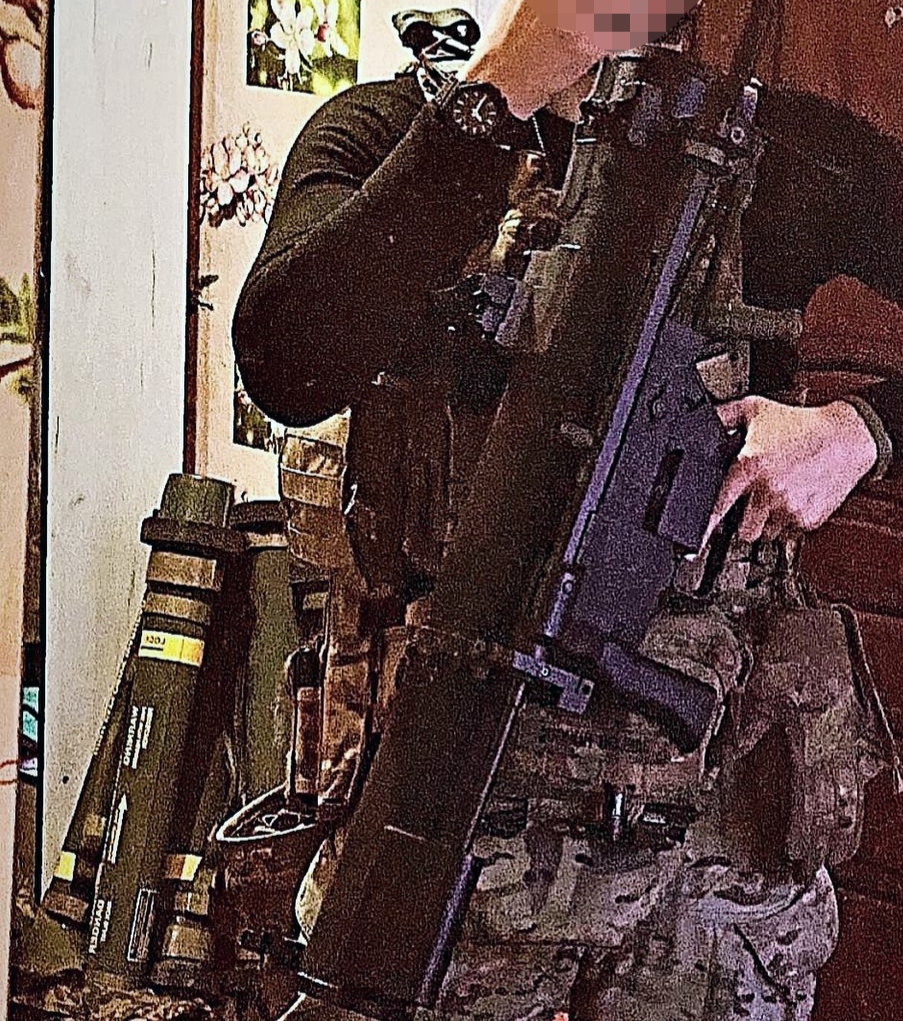
The Mk153 has iron sights and a Mk42 3.8× magnified optic and a 9mm spotting rifle on the side of the launch unit. This spotting rifle fires tracer rounds which match the rocket’s ballistics and can help range the target and aid the operator in applying the right hold for the target. The tracer cartridge that contains a 9mm jacketed bullet with an aft burning .22 calibre tracer element. Spotting rifle magazines for the rockets are supplied on the outside of the rocket carry tube end cap.
The first sighting of a Mk153 in the field came from some B roll footage of a UK Channel 4 News report published on 28 February. It showed men of the Ukrainian 68th Jager Brigade on the front-line near Vuhledar. Several soldiers are seen preparing a Mk153 to fire.
On 17 March a video featuring a Mk153 SMAW being fired at a range was shared on Telegram. It shows a SMAW being fired and a pile of spent tubes and unfired rockets on the ground. The fired and unfired rockets all appear to have yellow bands indicating high explosive munitions – the Mk153’s practice round has a brown band. Sadly, we can’t make out the other markings which would indicate the type of rounds being fired.
Mk153 in Ukraine (via Social Media)
At the end of March another video of Ukrainian soldiers preparing a Mk153 for firing was shared again at the range. The video gives us the best close up of the launcher in theatre so far and shows not one but two launch units. We get a good look at the tube and the launch unit’s spotting gun on the right hand side. This video shows the weapon being prepared to fire, the rocket is inserted into the launcher and rotated clockwise a quarter-turn to lock it in place before the Ukrainian soldier fires at a target down range.
Another interesting detail we can see is the white paper hang ing from the rocket. This is a humidity indicator which allows quick visual inspection to see if the rocket might have been compromised by moisture. The indicator on this rocket appears to have pink in all three of its indicators circles, meaning the munition might be compromised, in USMC service this would mean the rocket needs to be returned to the ammunition supply point. Despite this the rocket appears to fire normally and detonate down range. It’s worth noting that the launch unit isn’t fitted with an optic in any of the clips.
Update – 24/05/23: An additional clip of a SMAW being fired in an urban environment, perhaps during the defence of Bakhmut, date unknown.
A very rare sighting of a Mk153 SMAW in action in Ukraine. Telegram source simply captioned it Bakhmut, date unknown.
— Matthew Moss | Historical Firearms (@historicfirearm) August 8, 2023
Update – 3/9/23: An interesting video showing a phone mounted onto a SMAW MK153, this allows a clinometer app to be used to enable the SMAW to be used in the in-direct role, angling the weapon upwards.
Really interesting video showing a phone mounted onto a SMAW MK153, this allows a clinometer app to be used to allow the SMAW to be used as a in-direct weapon. Not sure if the MK153 rounds have a max range detonation feature.
— Matthew Moss | Historical Firearms (@historicfirearm) April 3, 2024
Update – 3/4/23: A combatant from Ukraine’s 3rd Assault Brigade shared video on 27 March of a firing of a SMAW Mk153 at a range, filming date unconfirmed.
A combatant from #Ukraine's 3rd Assault Brigade firing a SMAW Mk153 at a range, recently posted but filming date unconfirmed.
— Matthew Moss | Historical Firearms (@historicfirearm) April 3, 2024
Mk153 Specifications (per USMC):
Rocket Launcher
Length
29.9 inches
Weight
16.9 pounds
Encased rocket (as carried)
Length
27.3 inches
Weight
12.7 pounds
Caliber
83mm
Weapon Ready to Fire
Length
53.1 inches
Weight
29.0 pounds
Range
Maximum effective (HEDM)
250m
Maximum effective (HEAA)
500m
Time of flight to 250m
1.6 sec
Support Us: If you enjoyed this video and article please consider supporting our work here. We have some great perks available for Patreon Supporters – including early access to custom stickers and early access to videos! Thank you for your support!
Bibliography
Ukraine War: on the front lines with the 68th Brigade, C4 News, (source)
Introduction to Crew Served Weapons, USMC, (source)
Launcher, Assault Rocket, 83mm (SMAW) MK153 Mod 0, USMC, (source)







 The Armourers Bench