US Army Adopts New M111 Offensive Hand Grenade

It is 58 years since the US Army adopted a new offensive grenade, the M111 Offensive Hand Grenade is intended to provide enhanced capability in confined spaces and augment the venerable M67 fragmentation grenade which has been in service since 1968. The new grenade was developed by the Army’s Capabilities Program Executive Ammunition and Energetics in conjunction with the U.S. Army Combat Capabilities Development Command Armaments Center at Picatinny Arsenal. The new M111 replaces the Mk3A2 hand grenade, which the US Army notes has a body containing asbestos and is now considered ‘obsolete’. The M111 has been in development since at least 2020, appearing in the US Army’s Grenades and Pyrotechnic Signals book in 2021.

Diagram from the US Army’s Grenades and Pyrotechnic Signals book, 2021 (US Army)

The desire for a new blast grenade may have been somewhat informed by lessons learned from Ukraine where troops have been manufacturing their own enhanced blast grenades. M111 has an intriguing octagonal shape with a tapering neck, not dissimilar to the specialist Mk14 anti-structure grenades – which have also seen use in Ukraine.

“One of the key lessons learned from the door-to-door urban fighting in Iraq was the M67 grenade wasn’t always the right tool for the job. The risk of fratricide on the other side of the wall was too high,” explained Col. Vince Morris, Project Manager Close Combat Systems, CPE A&E. “But a grenade utilizing BOP can clear a room of enemy combatants quickly leaving nowhere to hide while ensuring the safety of friendly forces.”
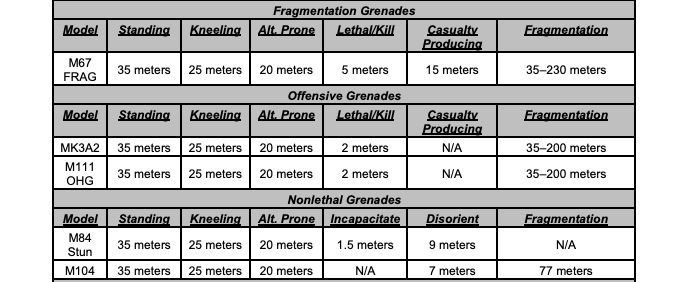
Comparison of kill, casualty and fragmentation radius for M67, legacy MK3A2 and M111 (US Army)

What Are Offensive & Defensive Grenades?

Essentially, offensive grenades rely on blast while defensive grenades use fragmentation. Blast grenades like the M111 limit the radius of fragments, this is useful in confined spaces where friendly forces may be near the blast. It also allows the user to quickly follow up and the nature of blast over-pressure means that even an enemy behind moderate cover inside a room where a blast grenade has detonated is likely to feel increased effect. Conversely, defensive fragmentation grenades like the M67 spread out a wide arc of lethal fragments from the body of the grenade. This is ideal for engaging enemy in the open who may be assaulting the user’s position. These are best employed from cover where the user and friendly forces are less at risk of being wounded by their own grenade. This is something that has been part of Russian doctrine for decades with the RGN offensive grenade and RGO defensive grenade complimenting each other.

Improvised blast grenades made from bottles and drinks cans (via social media)

The M111 is 4.41 inches in length and 2.37 inches in diameter and is manufactured by Texas-based Day & Zimmermann, Inc.. It appears to use the same M213 pyrotechnic delay fuze and safety lever assembly – meaning the new grenade has the same five-step arming process as the M67, simplifying training, manufacture and logistics. From the markings seen in the new photographs of the grenade the M111’s filling is the RDX-based Composition A-3 high explosive with Aluminum powder, the M67 uses Composition B. The Aluminum powder acts to enhance the Comp A-3’s explosive energy. The amount of explosive filling hasn’t been disclosed but the grenade’s overall weight is listed as 12.6 oz, so the filling weight can be estimated to be around ??? It’s also worth noting that US Army’s Grenades and Pyrotechnic Signals book, published in 2021, listed the explosive filling as PAX-3 suggesting a subsequent move to Comp A-3.

New M111 and M112 grenades (US Army)

The new grenade provides soldiers with the ability to fight more effectively in close-quarter and urban environments by leveraging blast overpressure, instead of fragmentation to deliver lethality. It provides an alternative to using the M67 high explosive fragmentation grenade which in close-quarters could injure the user or any friendlies in the blast radius. In addition to the new M111 grenade a new inert, blue-colored, training grenade – the M112, has also been adopted.

New M111 grenade (US Army)

Support Us: If you enjoyed this video and article please consider supporting our work here. We have some great perks available for Patreon Supporters – including exclusive videos, custom stickers and early access to videos! Thank you for your support!


This is an expanded version of an earlier version of this article published at Overt Defense.

US & Canadian M67 Grenades In Ukraine

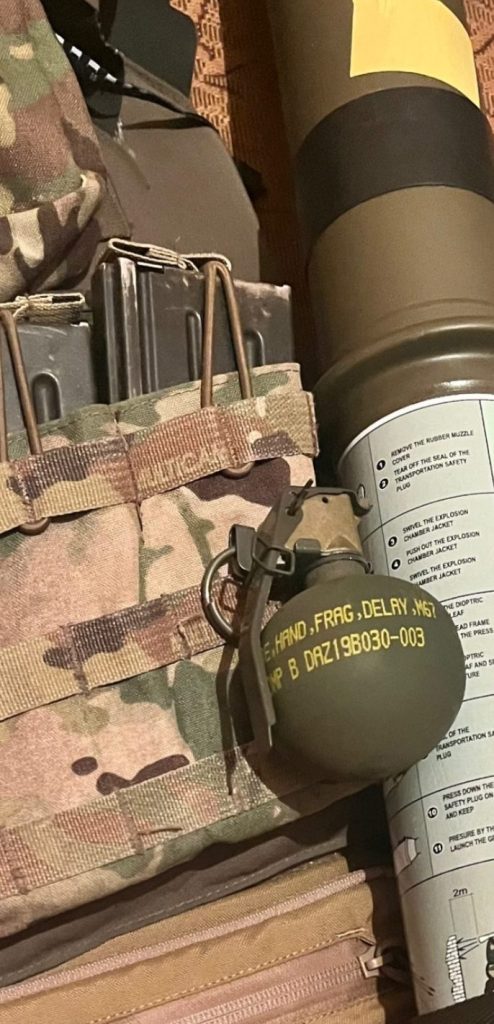
A range of Western, Eastern European and Russian hand grenades have been seen in use in Ukraine over the last eight months. One of these is the M67 Fragmentation Grenade which are believed to have been provided by the US and Canada.

The M67 evolved from the earlier M33, it began to be fielded in 1968. They are produced by Day & Zimmermann, who state they have produced over 43 million of the grenades. It is a spherical anti-personnel fragmentation grenade which has a Composition B filling. Composition B is made up for a RDX and TNT mix. The M67 explosive filling weighs in at 6.5oz (180g). It uses the M213 fuze which provides a 4 to 5 second delay after deployment.

There is a spring clip which interacts with the spoon and safety pin. On detonation the grenade’s steel outer body fragments to create an injury radius of around 15 metres (50 feet). The fragmentation is caused by scoring on the inside of of the grenade’s outer body.

A captured M67 Grenade (via Social Media)

The US government has confirmed that hand grenades have been provided to Ukraine but specific mentions of them in the regular fact sheets breaking down aid have not been common since the spring when it was said that ‘over 1 million grenade, mortar and artillery rounds’ had been provided. Canada has previously, on 3 March, confirmed the supply of 7500 hand grenades of an unspecified type.

M67 shared 29 April 2023 (via social media)

Imagery of the grenades first began to be circulated online in May with the Azov-Dnipro 98th Territorial Defence Battalion sharing several videos featuring them. In their first video they showed a couple of transit chests, each containing 30 individually packed grenades. They then showed the individual packaging of the grenades. In another video posted a few days later the show an M67 alongside a French OF37.

On the 15 June, Russia’s Zvezda News shared a short interview with a soldier from the separatist Luhansk People’s Republic showing off captured weapons including an 66mm M72 LAW and an M67 grenade. Describing the grenade he said: “We are already walking around with American [grenades]. The grenade is convenient, it flies far.”

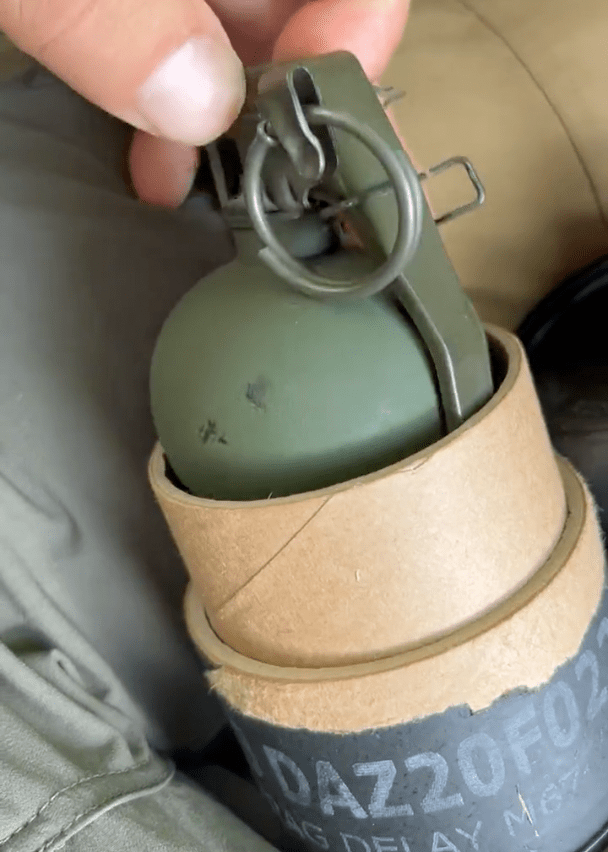
M67 Grenade in its cardboard transit tube (via Social Media)

A short video of one of the grenades was shared in late June and in late July the 98th Territorial Defence Battalion shared a clip showing soldiers training with live grenades. On the 18 August, Valgear shared a short video showing an M67 he believed has been provided by Canada. An M67 and its individual packaging was shown in another video posted by a Ukrainian soldier on 23 August.

In August several videos featuring M67s were also shared by Russian forces. The first video showing off a captured example of the M67 was posted on 3 August, featuring a DPR officer examining a grenade. On the 28 August another brief clip of a captured grenade was also shared.

M67 in a 73rd Mechanised Brigade trench (source)

In September the Russian YouTube channel ‘Big Calibre Trouble’ published a video testing the blast effect of several grenades including an M67. Similarly, Ukrainian YouTube Channel ‘Boys from the Forest’ also demonstrated the M67 and German DM51. Most recently several photos of M67s have been shared. Ukrainian serviceman Valgear notes that the M67 is highly prised amongst Ukrainian personnel including with drone teams.

M67 Grenade (via Social Media)

From the sources available it appears that Canadian-made grenades are marked with a ‘CA’ prefix. So far the grenades we’ve identified in the photos and footage from the field all of the grenades appear to have US markings. Exactly how many M67s have been provided to Ukraine, and by whom, remains unclear but the number seems likely to be in the tens of thousands.  

Research Note: several lots of M67 grenades have been visually confirmed from available imagery:

DAZ13C002-003 – 1 confirmed example

DAZ14D002-011 – 2 confirmed example

DAZ20F022-006 – 7 confirmed examples

DAZ21C022-014 – 6 confirmed examples

DAZ21J022-017 – 1 confirmed example

DAZ19B030-002 – 2 confirmed example

DAZ19B030-003 – 1 confirmed example

DAZ12J001-003 – 1 confirmed example

DAZ14F002-012 – 2 confirmed example

DAZ21D022-015 – 1 confirmed example

DAZ20M022-012 – 2 confirmed examples

DAZ22F023-002 – 1 confirmed example

Update 30/01/23:


Support Us: If you enjoyed this video and article please consider supporting our work here. We have some great perks available for Patreon Supporters – including early access to custom stickers and early access to videos! Thank you for your support!


Bibliography:

M67 Hand Grenade, Day & Zimmerman, (source)

M33, M59, M67 & M68, Lexpev.nl, (source)

C13 Fragmentation, Lexpev.nl, (source)

M67 Hand Grenade, CAT-UXO, (source)