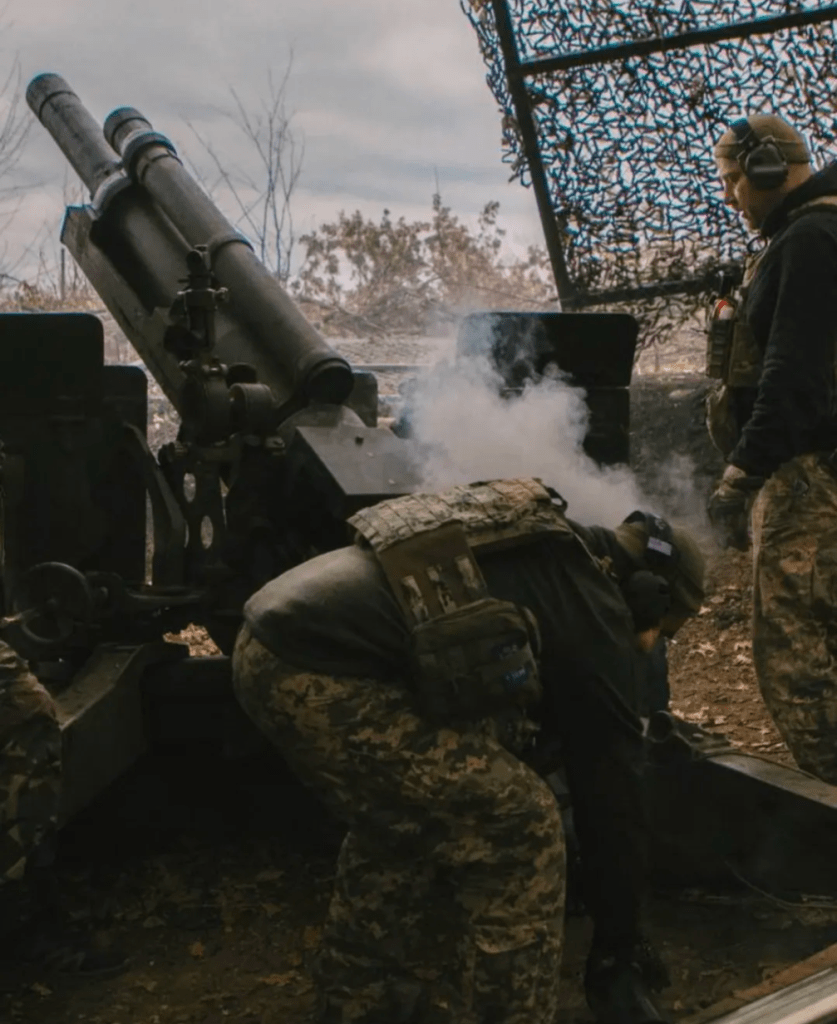
OTO Melara Mod 56 In Ukraine

We’ve examined a number of artillery systems in use in Ukraine, including the venerable M101 howitzers and the MT-100s mounted on MT-LBs, one of the smallest and most interesting howitzers in use is the OTO Melara Mod 56.

The Mod 56 is a small 105mm pack howitzer. It weighs in at 1.29 metric tons and it can be towed by light vehicles. It has a split trail gun carriage and a hydro-pneumatic recuperator assembly. Developed by Italy’s OTO Melara the gun entered service in the mid-1950s and has seen service with countries around the world including Italy, the UK, Australia, Spain, Pakistan and the Philippines.
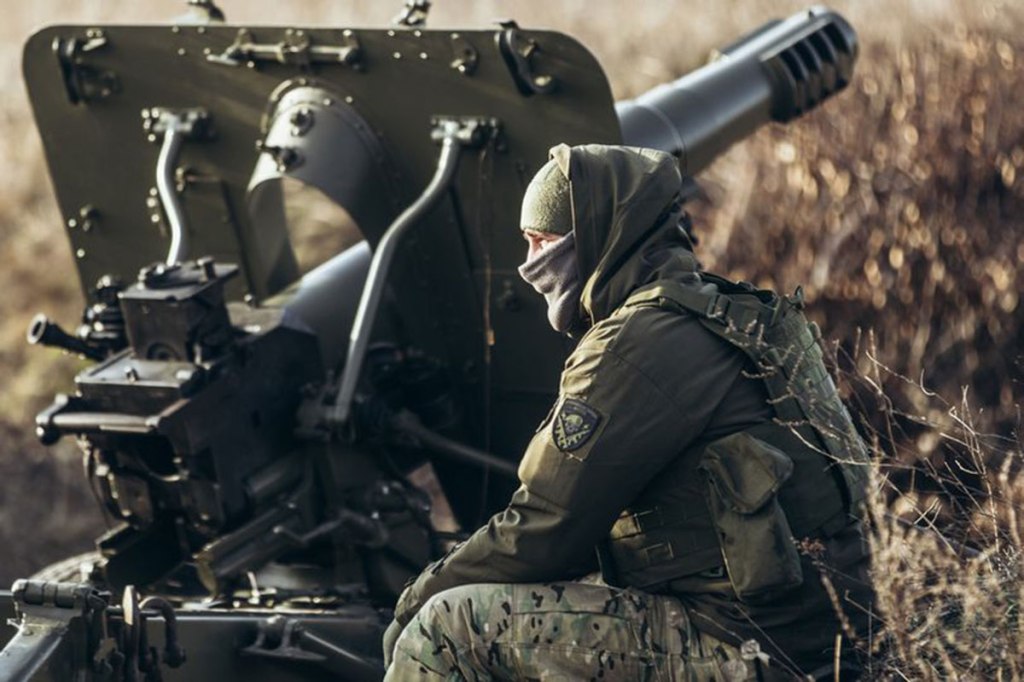
An OTO Melara Mod 56 (Ukraine National Guard)

Much like the heavier M101 howitzers, transferred to Ukraine by Lithuania, the Mod 56 can use any M1 105mm ammunition. With its short 1.47 metre-long barrel, the Mod 56 has a maximum effective range of around 10,000 metres (10km/6 miles). While this puts it at a severe disadvantage compared to the larger 155mm howitzers used by Ukraine and the 152mm guns used by Russia the small Mod 56 has the advantage of being lightweight and can be deployed forward under cover. The most useful role it could likely fulfil is as an infantry support gun.

In November 2022, Spain’s Defence Minister Margarita Robles confirmed that Spain would send a battery of six light howitzers and also provide training for Ukrainian gun crews. Subsequently, a brief clip of Ukrainian gunners training on the Mod 56 was shared in late November.

A Mod 56 in action (via social media)

The guns were seen in Ukraine for the first time in early January, with a short clip of one of the guns firing being shared on 11 January. It appears the gunner is wearing a National Guard patch but its unclear which unit the gun belongs to. On 12 January, the 1st Mechanized Battalion of Ukraine’s 3rd Assault Brigade posted an info-graphic giving some basic detail on the Mod 56.

On 20 February, a brief clip of a Mod 56 was shared, the footage was believed to have been taken in the vicinity of Bakhmut. However, photographs taken by an AP photographer, Libkos, of the same gun showed that the gun was actually in action in Avdiivka, Donetsk. The series of photographs also showed that the gun was being operated by a National Guard unit and the crew was using drone footage to select their targets. One photograph was also shared by President Zelensky on 5 March. Interestingly, the gun is seen without its shield.

Another video of one of the guns in action was shared on 16 April. It was several months before more imagery of the Mod 56s in use appeared but on 1 June, the Ukrainian National Guard shared a photograph of one of the guns and several days later, on 3 June, a short video of a gun in action was shared.

A Mod 56 in action (via social media)

Most recently on 19 July, a Ukrainian National Guard unit shared a brief clip of a Mod 56 firing. It also nicely illustrates the gun’s breech mechanism.

From the available imagery, it appears that the guns are operated by Ukraine’s National Guard, though which artillery unit is unclear. While it has been confirmed that Spain has provided at least 6 Mod 56 howitzers, it remains unknown if any other countries, such as Italy, have provided the small guns.

Update 29/12/23:

An undated sighting of a Mod 56 in operation in Ukraine. Notably half of the gun shield appears to be missing.

Update – 17/04/24: A clip posted on 7 April, date of recording unconfirmed, showing a Mod 56 in action. The howitzer’s gunshield has been removed.

Update – 29/5/24:

Update – 23/07/24:


Support Us: If you enjoyed this video and article please consider supporting our work here. We have some great perks available for Patreon Supporters – including early access to custom stickers and early access to videos! Thank you for your support!
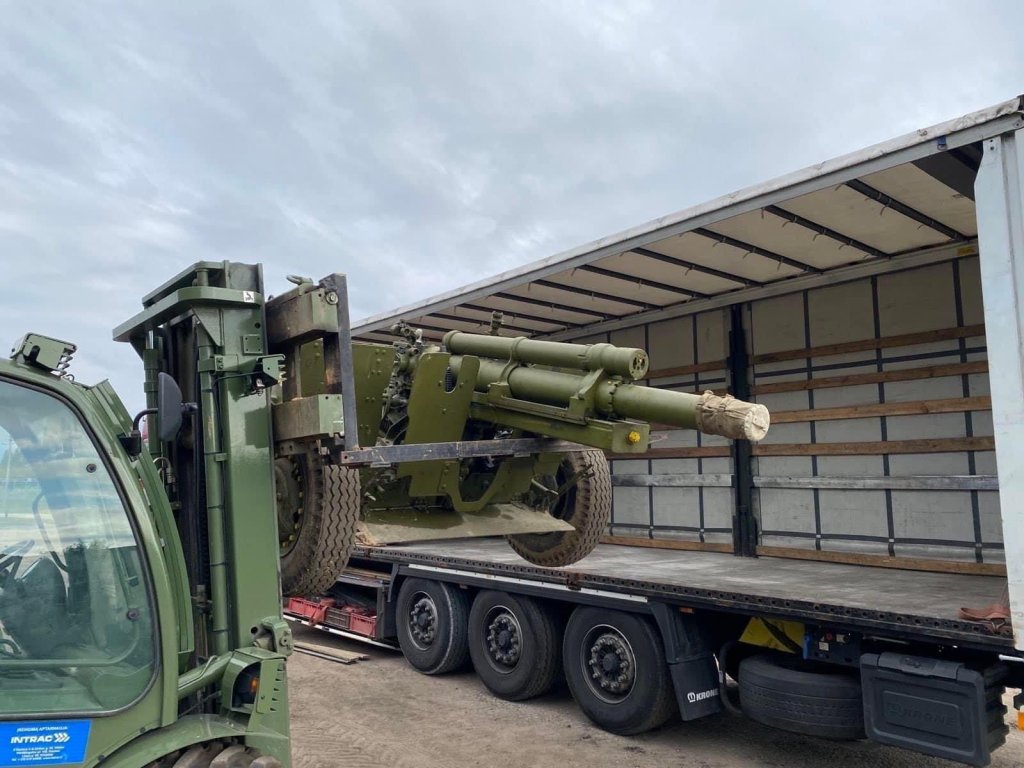

Ukraine’s Newest Howitzer Is An Antique

Plenty of old weapon systems are in use in Ukraine and artillery is no exception. This week the first footage of a batch of 105mm howitzers from Lithuania in action was shared online.

Lithuania has transferred an undisclosed number of M101 towed howitzers. While the 105mm gun lacks the range and punch of the 155mm M777s, Caesars, AHS Krabs and PzH 2000s which have made headlines in recent months, the venerable M101 is a proven weapon.

Introduced in 1941 as the M2A1, the gun has seen service around the world. First during the Second World War and later in Korea, Vietnam and in dozens of regional conflicts around the world. Now it finds itself equipping Ukrainian Army batteries.

The M101 weighs in at 2.5 tons or 2,260 kg and firing conventional M1 high explosive shells has a maximum range of 11,500 metres or just over 7 miles. The M1 round is made up of the  the M1 High Explosive projectile, the M14 Cartridge Case, the M67 Propelling Charges and the M28 Percussion Primer.

The Baltic nation of Lithuania, has been a staunch supporter of Ukraine throughout the conflict providing equipment, arms and training. Lithuania  originally received 54 of the guns from Denmark in 2002. Now, as Lithuania upgrades to 155mm systems the old guns have found a new home. While it is unconfirmed whether Ukrainian troops trained to use the guns in Lithuania, Ukrainian troops have been training in the Baltic nation.

The first guns were shipped in September, with the Lithuanian Minister of Defence announcing the transfer on his social media, but the first footage of them in action in Ukraine didn’t surface until late November.

While the M101 may be old it has the major advantage in that if fires the readily available family of 105mm NATO ammunition. This 105mm ammunition is used by a number of light artillery systems including the more modern US M119A3 and L119 towed 105mm howitzers. As of November 2022, the US has provided 180,000 rounds of 105mm. 

While the M101 may seem like a step down from the 155mm systems in use it has a number of factors which mean the guns are still effective. Firstly, they are used in conjunction with drones which help adjust fire in real time to produce improve effect on target. Secondly, they can use M927 rocket-assisted projectiles which increase the gun’s range by 40%, around 17km. M927’s were first seen in late August being used in conjunction with L119 light guns.

The M101 is certainly an improvement over the 85mm D-44 guns that some Ukrainian Territorial Defense Force units have been seen using and the venerable 100mm MT-12 which has a range of just over 5 miles. While the M101 can’t hope to go toe to toe with Russian 152mm artillery, if used in its original role as an infantry support gun the venerable M101s will prove useful. 


Update 07/12/22: Another short clip of an M101 in action was shared on the 7 December, showing the more closely than previous footage.

Update 12/01/23: Gunners of the 66th Separate Mechanized Brigade practice firing 105mm M101 howitzers.

Update 13/04/23: Some more footage of am M101 in action.

Update – 11/6/23: A rare video of a 105mm M101 howitzer in action. Date and location filmed unknown.

Update – 11/11/23: Another siting of an M101 in action.

Update – 20/06/24: a recent photo of an M101 in a position in the Kharkiv Region.

Update – 9/9/24:

Update – 1/11/24: 71st Brigade with an M101A1. (Source)

Update – 13/12/24: An M101 was seen in service with the 28th OMBR in a series of photos recently shared by the Ukrainian army.


Support Us: If you enjoyed this video and article please consider supporting our work here. We have some great perks available for Patreon Supporters – including early access to custom stickers and early access to videos! Thank you for your support!
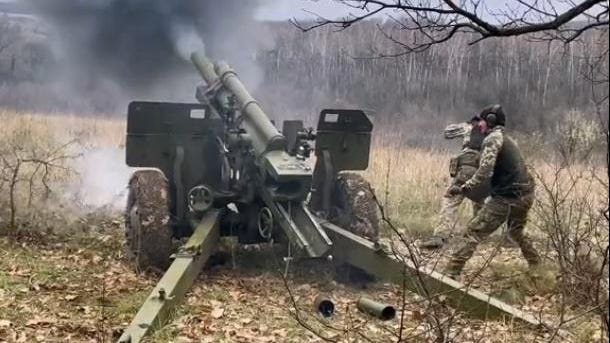

Bibliography:

M101s for Ukraine, Arvydas Anusauskas, (source)

Lithuania sends howitzers from its reserve to Ukraine, LRT, (source)

Ukraine Aid Fact Sheet 23 November 2022, US Department of Defense, (source)

Ukraine received 105mm M927 high-explosive rocket-assisted projectiles, Mil.In.UA., (source)