
The 2A28 Grom is the main armament of the BMP-1 and BMD-1 infantry fighting vehicles, it is essentially a 73mm low-pressure gun which fires a variety rounds ranging from HEAT to HE-Frag. Developed in the early 1960s it has been in Russian service ever since.
While it is the same calibre as its tripod-mounted cousin the SPG-9 it is designed to fire rounds with less propellant charge. In the last six months there have been a series of sightings of Russian troops testing 2A28s which have been dismounted from vehicles and mounted on craft-made or repurposed carriages for use as infantry support guns.
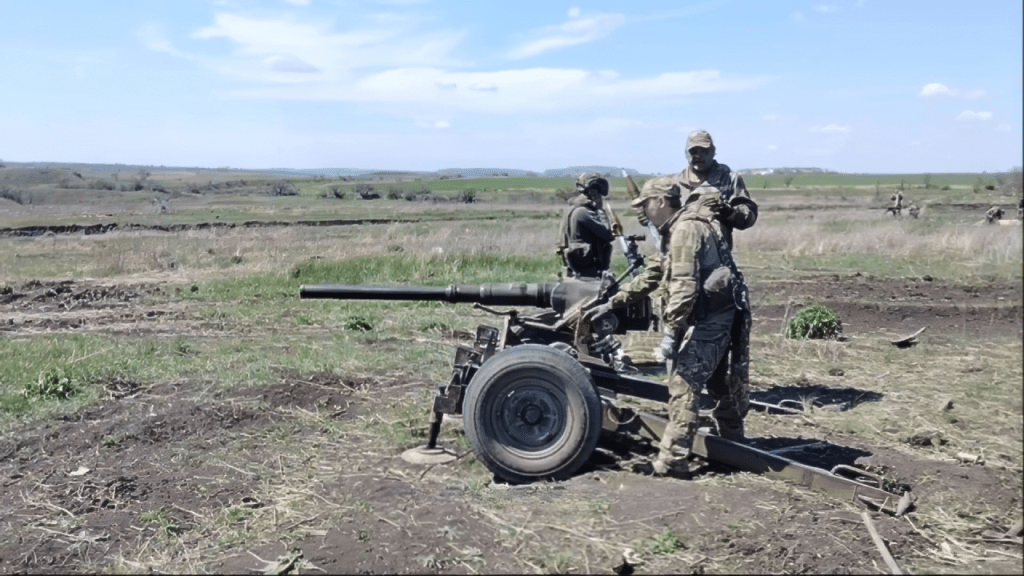
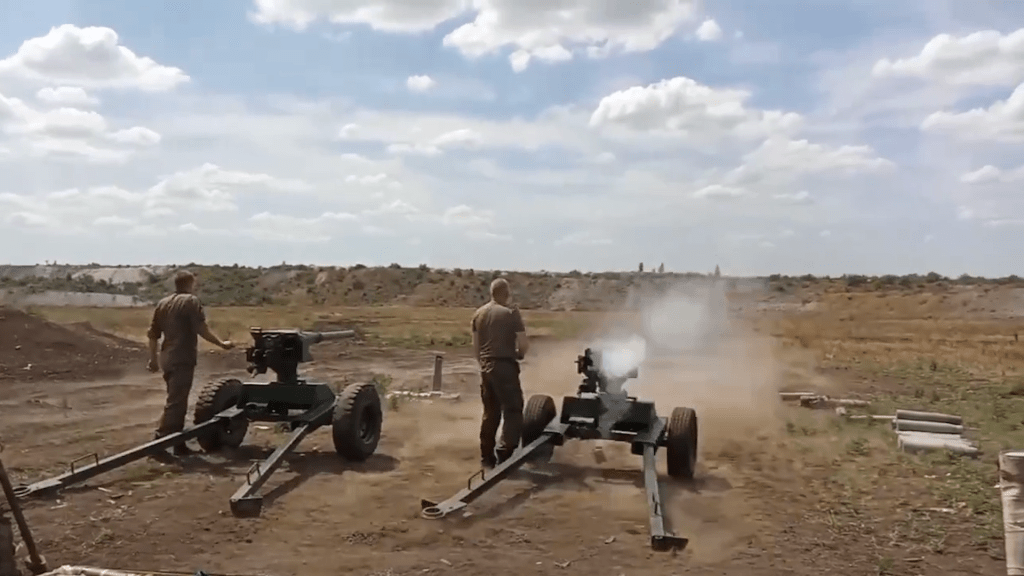
The first of these I’ve been able to find appeared on 27 May, this example was seen in a short video being test fired. The gun itself appears to have been mounted on a carriage similar to that used by the 2B9 Vasilek automatic mortar, though there are some differences in the trails. The crew of a gunner and loader are able to get of 10 rounds in 40 seconds with the gunner adjusting his aim several times. In the background there appears to be a team training with a conventional SPG-9. It could be argued that the wheeled carriage offers and advantage over the SPG-9 which has to be deployed on foot by its crew. The dismounted 2A28s could be seen as DIY analogues of the old Swedish PV-1110s which have seen limited service with the Ukrainians.
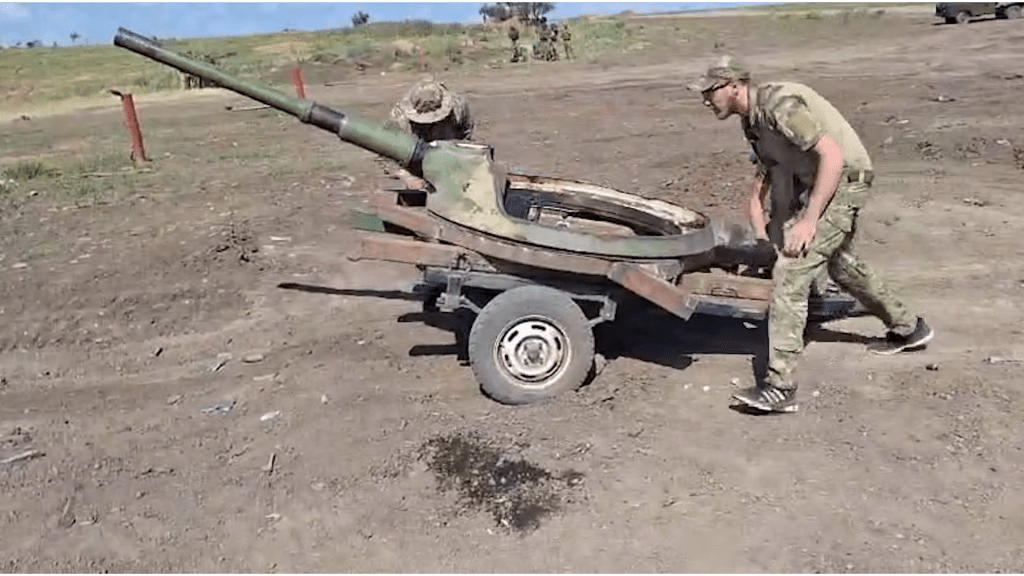
Several months later on the 1 July, another dismounted 2A28 appeared. The first of two videos showed the gun being towed into position by a tractor. The 2.37 minute-long video shows the crew bringing the gun into action: uncoupling it from the tractor, fitting the trails and front support. The carriage itself has been fabricated using a commercial trailer which is removed from a frame once the trials and supports have been fitted. The frame is built around a ring for the BMP-1’s original turret ring to sit on. This appears to allow rotation using the turret ring. The BMP-1’s turret has been cutaway to enable the gunner to access the breech. A couple of photographs of the salvaged turret being adapted were also shared with the videos. It takes the crew approximately 1 minute 40 seconds to bring the gun into action, the design is quite ingenious if unwieldy. The video concludes with the gunner refusing a lanyard and firing the gun personally.
The second shorter video shows a gunner operating the gun alone loading and firing another four rounds in 17 seconds. The gun jumps and moves back significantly despite the carriage’s trails having spades to reduce recoil movement. Some sources claim the unit is part of the 25th Combined Arms Army, the Russian combatant filming the video mentions the ‘3rd Battalion’ but does not mention a regiment or brigade.
On the 26 July, a short video of a pair of 2A28s mounted on well built craft-made carriages, which appear to share a common design, was shared. While the design of the carriage appears to be the same they have different sized tyres.
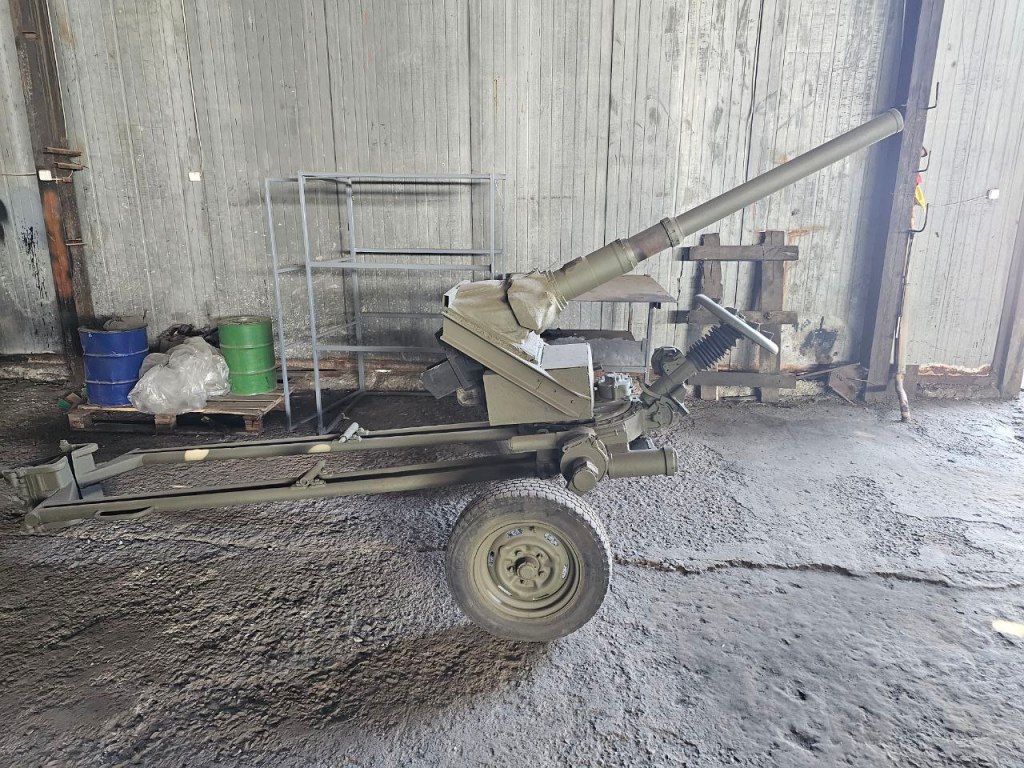
Most recently, on 6 September, a Russian engineer shared a couple of photos of a carriage-mounted 2A28 he came across at a unit near the front. The carriage again appears to be from a 2B9 Vasilek mortar. The 2A28’s trunion appears to be mounted directly on to the carriage.
The idea of re-purposing the 2A28 isn’t a new one with the guns seen dismounted around the world with examples from past and current conflicts in Libya, Syria and Africa. According to open source figures from Oryx an estimated 824 Russian BMP-1s had been damaged or destroyed. These knocked out BMP-1s and others which have broken down in the field are likely the source of the 2A28s in use in the craft-made support guns.
The rarity with which these DIY support guns have appeared on social media suggests that they may not be an entirely practical weapon system though their existence points to a perceived need for infantry support guns in the field. The 2A28’s effective battlefield range is likely around 500 yards, but given the guns are now unstably mounted on ad-hoc carriages, rather than a 13 tonne BMP-1 they suffer from greater recoil which may be a detriment to their effectiveness.
If the guns are to be used to harass, suppress or saturate a target at medium ranges they may be more effective but the Ukrainian battlefield is not an ideal space for an exposed crew to be manning a 2A28. With large stretches of open ground dominated by artillery and drones the dismounted 2A28s are likely to be of little value, even if crews attempted to tow them into optimal range. The dismounted 2A28, however, might prove more effective in the urban battlespace where support guns are valuable for dislodging enemy defenders from positions. Given I’ve not been able to find any verified footage of the guns in use in combat so far it is difficult to objectively gauge their effectiveness without speculation.
Update – 17/2/25:
Update – 7/10/25:
A Russian ad hoc technical with a 73mm 2A28 cannon mounted on what appears to be a chopped Moskvich 412. Date and location of the video is unconfirmed.
Support Us: If you enjoyed this video and article please consider supporting our work here. We have some great perks available for Patreon Supporters – including early access to custom stickers and early access to videos! You can also find us on the History of Weapons & War app. Thank you for your support!
 The Armourers Bench