APILAS in Ukraine

The APILAS or Armour-Piercing Infantry Light Arm System, developed by France’s GIAT Industries in the early 1980s, is perhaps one of the rarest shoulder-fired anti-armour weapon systems to appear in Ukraine. APILAS is a 112mm anti-armour weapon with a 1.5kg shaped charge warhead capable of penetrating more than 750mm or rolled homogeneous armour.

The APILAS seen in Ukraine are most likely to have originated from either France or Finland, with Finland being the more likely.

In late February 2022, with Russian forces massed on Ukraine’s borders, the Finnish government made a rare public declaration of military aid to Ukraine. This included figures for a number of different weapon systems. The announcement stated: “Finland will deliver 2,500 assault rifles, 150,000 cartridges for the assault rifles, 1,500 single-shot anti-tank weapons.” The announcement didn’t specify the type of anti-tank weapons to be sent; however, and from Finish inventory these may have included APILAS, M72 LAWs or even NLAWs.

An APILAS seen in a video dating from 2021, filmed during fighting on the Donbas line of contact (via social media)

APILAS have been seen in Ukraine before Russia’s invasion in 2022, one was seen in a video dating from November 2021. It is unclear when the first APILAS were first transferred to Ukraine, and the weapons seen subsequently may originate from an earlier, pre-2022 invasion transfer.

APILAS in a Ukrainian armoury, c.2023 (via social media)

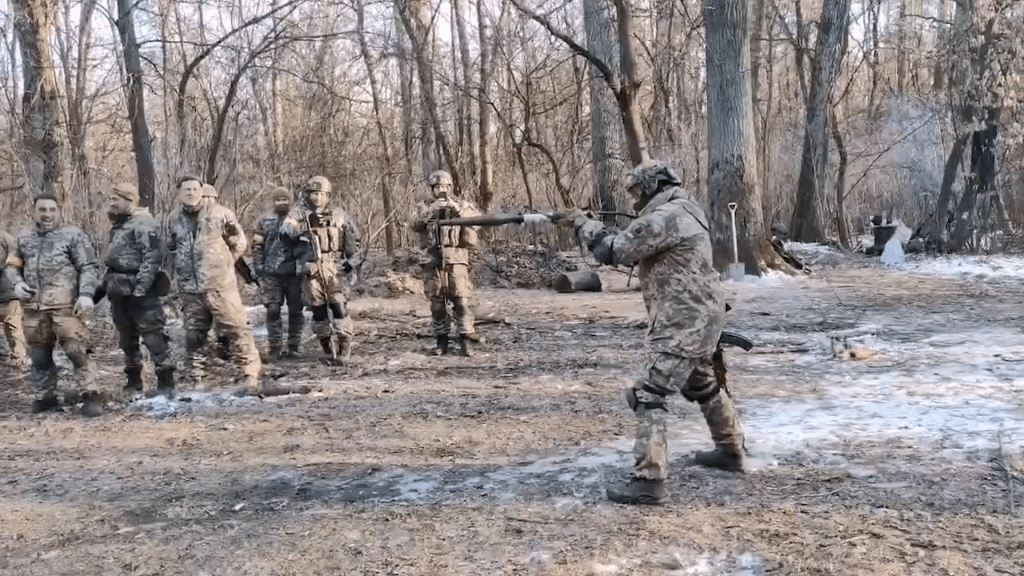
In April 2023 a photo of an APILAS in a Ukrainian armoury surfaced, sadly no markings are visible in the image. Several months later, on 19 and 20 June, Red Line Team, a unit affiliated with the Ukrainian security services special forces unit, SBU-Alpha, shared imagery from a range trip where a wide variety of anti-armour systems were fired. One of the weapons featured in the video was an APILAS.
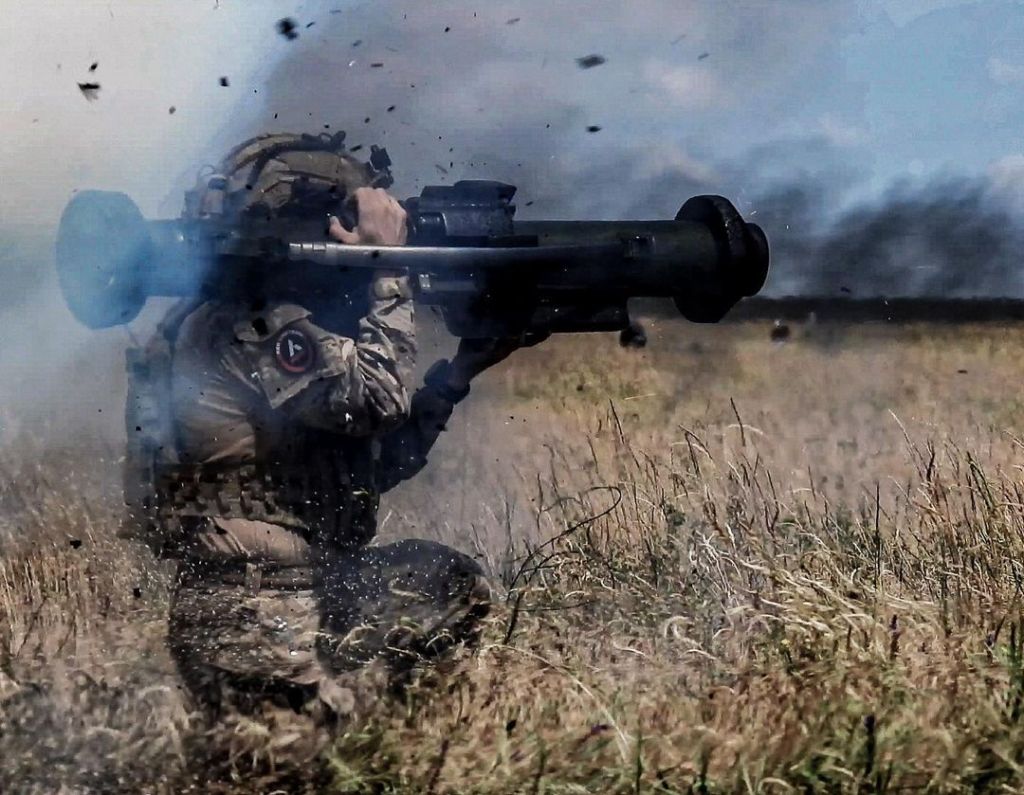
(Red Line Team)

APILAS have also been seen with the Assault Bastards, a unit believed to be part of the Kraken Regiment’s 2nd Assault Company, which is part of the Department of Active Operations of Ukraine’s Intelligence Directorate (the GUR). On 13 May, the unit shared a group photo which also featured three APILAS.
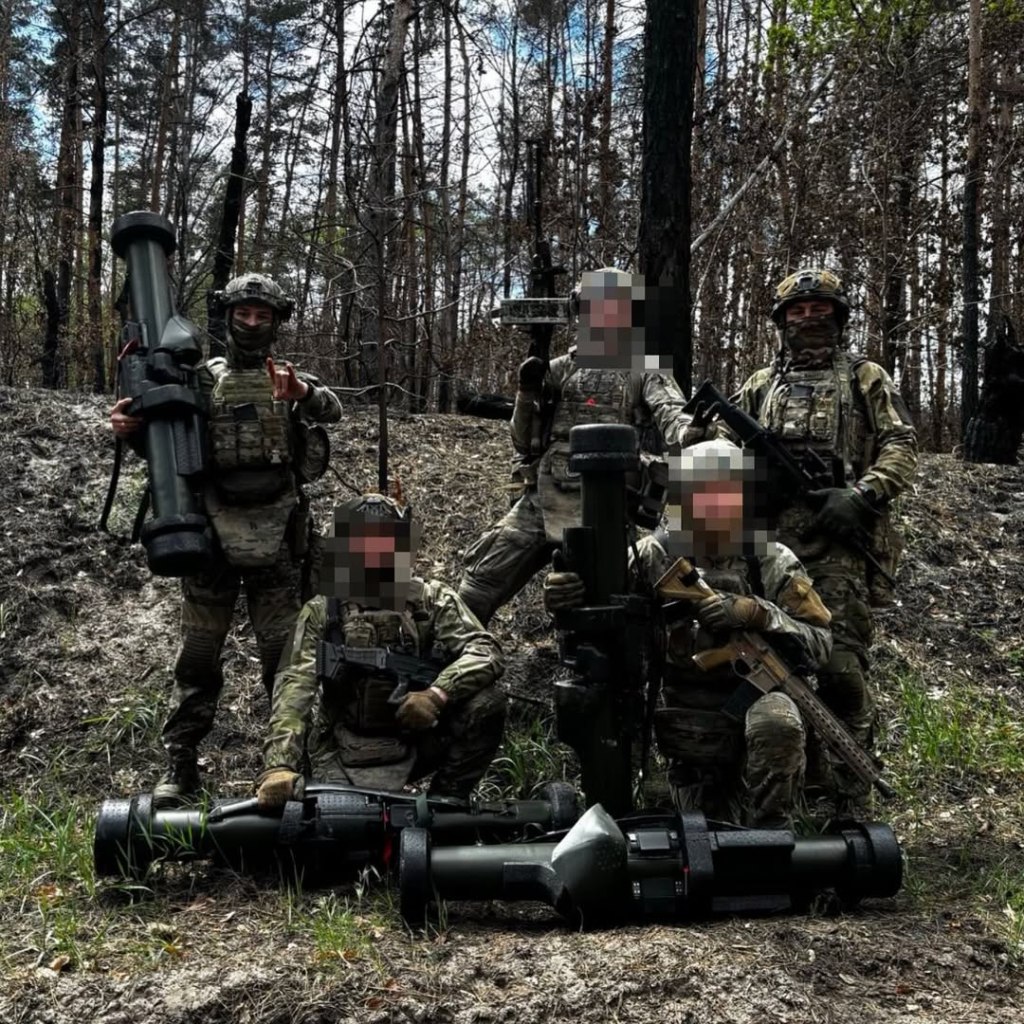
(Assault Bastards)

Most recently Shybenyk.Squad, another unit with Kraken’s 2nd Assault Company, shared a photo of an APILAS. This photo also appears to have possibly been taken at a range rather than in the field. Speaking to Shybenyk.Squad they explained that they have a decent number of APILAS in store and have used them operationally.
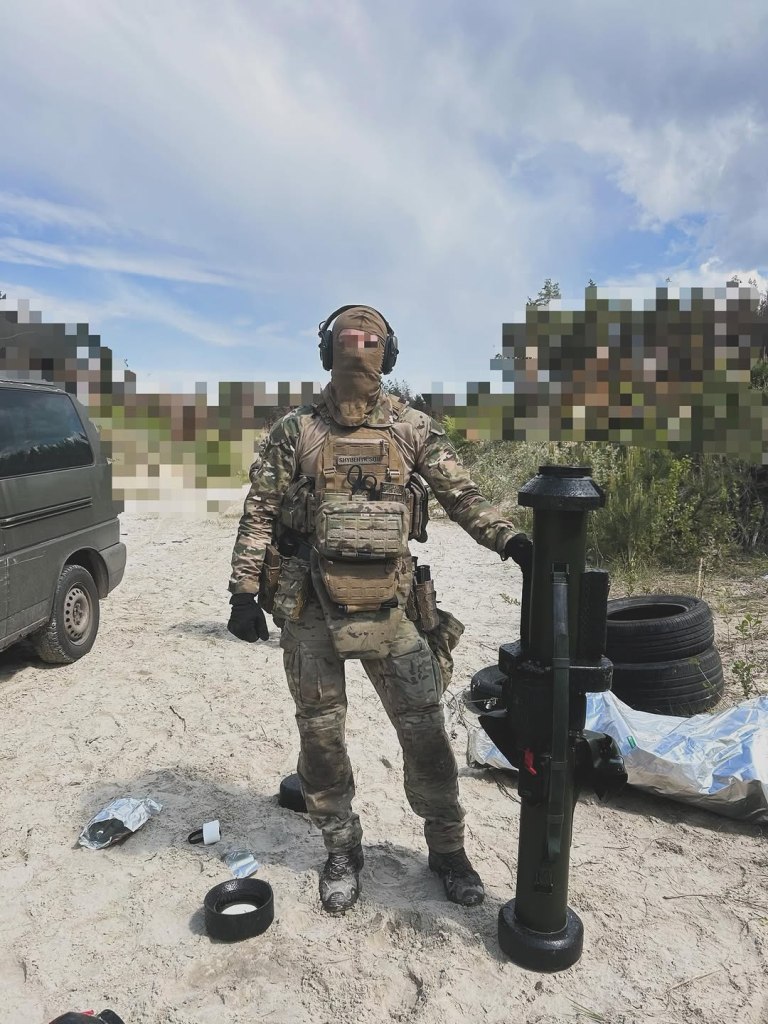
(Shybenyk.Squad)

APILAS has a reputation for having considerable concussive force when firing but Shybenyk.Squad noted that it’s blast isn’t that bad comparatively, describing it as ‘not critical’, during a recent trip to the training range the unit test fired 6 APILAS.

While APILAS are rarely seen in imagery from the conflict Shybenyk.Squad noted that they have a significant number of them in stores. They favour them for operations where more expensive complex systems, like NLAW or Javelin, may be lost. Shybenyk.Squad explained that “they can definitely be useful in certain situations… [systems such as] NLAW are much more expensive, high-tech, more effective, but losing it is much more problematic and in some risky tasks it is better to take a less expensive weapon.” In general they noted that they favour the AT4 and RGW-90 Matador “due to the weight to the corresponding firepower and ease of use.”
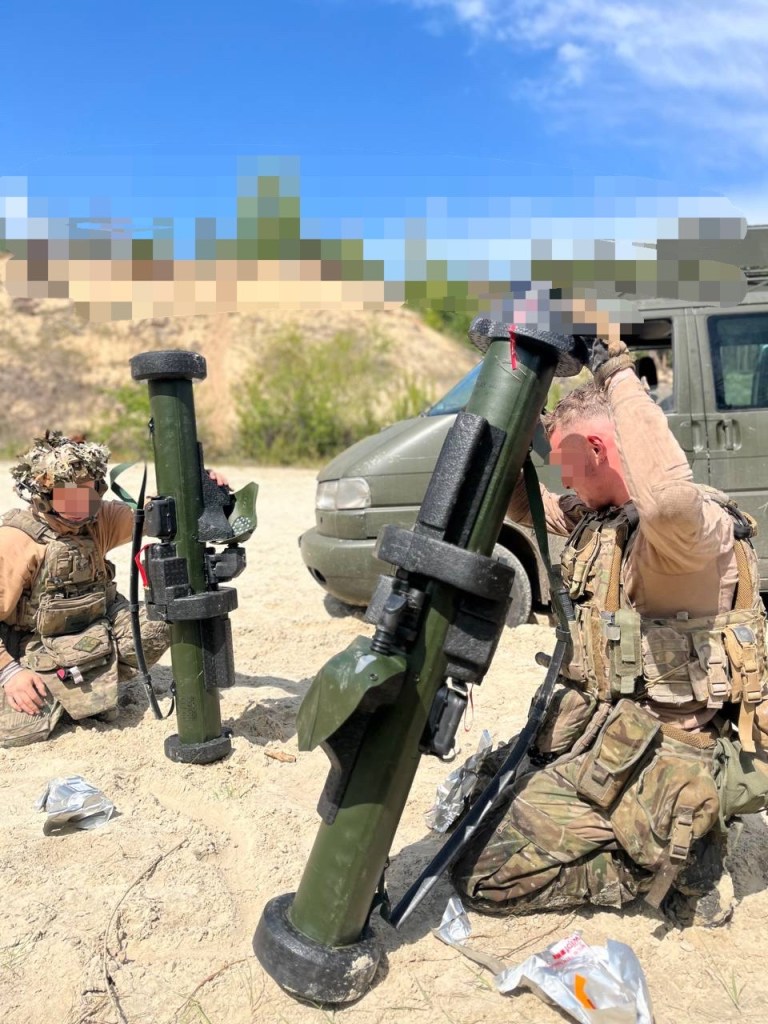
(Shybenyk.Squad)

Operationally they favour the APILAS’ for its penetration capabilities, with sources suggesting it can penetrate around 2 metres of concrete, making it is an excellent weapon for mouse-holing – breaching structures. Shybenyk.Squad explained that they “once used it to break through a small wall to storm a building from a blind side not protected by the enemy.”

APILAS is one of the most rarely seen anti-armour weapons currently being fielded in Ukraine so I’m pleased to be able to share some good first hand imagery and feedback on its capabilities.

Special thanks to Shybenyk.Squad for sharing additional imagery and sharing their thoughts on APILAS.


Support Us: If you enjoyed this video and article please consider supporting our work here. We have some great perks available for Patreon Supporters – including early access to custom stickers and early access to videos! Thank you for your support!

Ukrainian Training Videos: RPG-18

Since the war in Ukraine began on 24 February, the Ukrainian armed forces have been hastily putting together and sharing training films for various weapon systems. we’re sharing these so they’re saved for the historical record and so they can be easily found by those who might need them. We’ll try and give some context on the weapon’s origins and on who made the training video.

Demonstrating how to deploy the RPG-18, the tube isn’t fully extended as its a live weapon

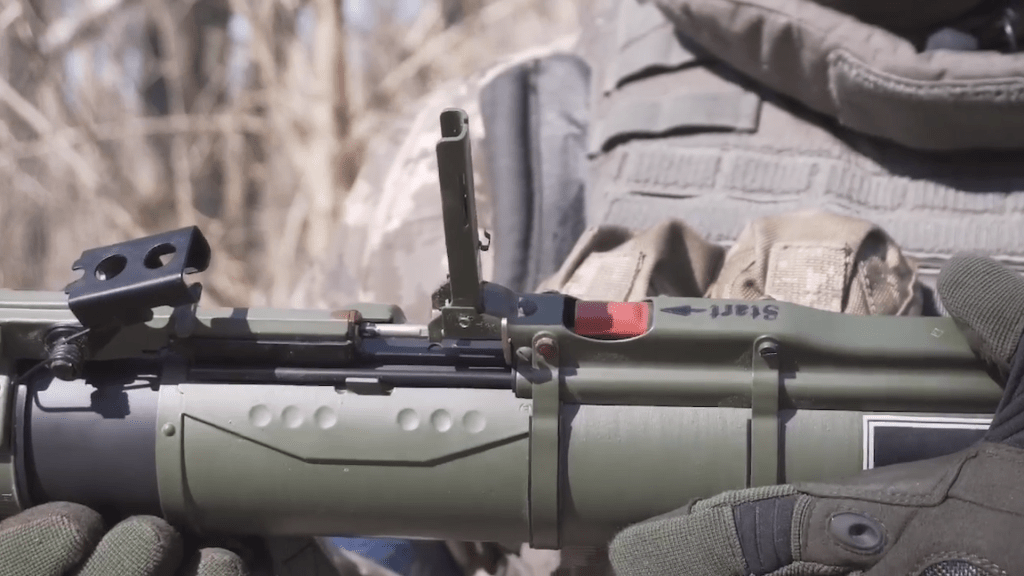
In this well shot video a Ukrainian soldier demonstrates the features and handling of an RPG-18. The RPG-18 (‘Mukha’ or ‘fly’) was the first of the Soviet/Russian family of extendable tube launchers (very similar to the US M72 LAW). The RPG-18 was developed in the late-1960s and was introduced in the early 1970s. It has since largely been replaced by larger calibre and more capable launchers. The weapon is a simple, smoothbore, single-use launcher. It is constructed from an aluminium tube with an outer layer of fibreglass.

A close up of the RPG-18’s locking system, rear sight and trigger

It isn’t clear how many RPG-18 the Ukrainian Armed Forces’ may have had in inventory before the war began but it appears that the weapon seen in this video was made in East Germany and probably transferred by Germany as part of Germany’s military aid shipments to Ukraine. While Greece have also reportedly transferred a quantity of RPG-18s, we have seen other examples in the field with identical German instructions stickers.

The video first surfaced around the 21st March, posted by Vadim Kodachigov (the director of Kort, a military industrial company) on Facebook, though he may not be the original creator. Kodachigov appears to be part of a Territorial Defence Force unit. The video identifies the unit as part of the 112th Territorial Defense Brigade (Kyiv). The production value of the video is relatively high, with a title card, good editing, close ups and some interesting footage of the weapon being fired.

RPG-18 Specifications:

Warhead64mm HEAT 
Weight (round and launcher)5.7lbs (2.6kg)
Length27.8in (705mm) – collapsed 41.3in (1050mm) – extended
Effective Range220yd (200m)
Penetration11.8in (300mm) against RHA

If you enjoyed this video and article please consider supporting our work here. We have some great perks available for Patreon Supporters – including custom stickers and early access to videos! Thank you for your support!

Bibliography:

Earliest video source found: Vadim Kodachigov via facebook (source)

RPG-18, Military-Today, (source)

Ukrainian Training Video: RPG-76 Komar

Since the war in Ukraine began on 24 February the Ukrainian armed forces have been hastily putting together and sharing training films for various weapon systems. One of the most interesting weapons to be transferred to Ukraine is the Polish RPG-76 Komar (‘Mosquito’).

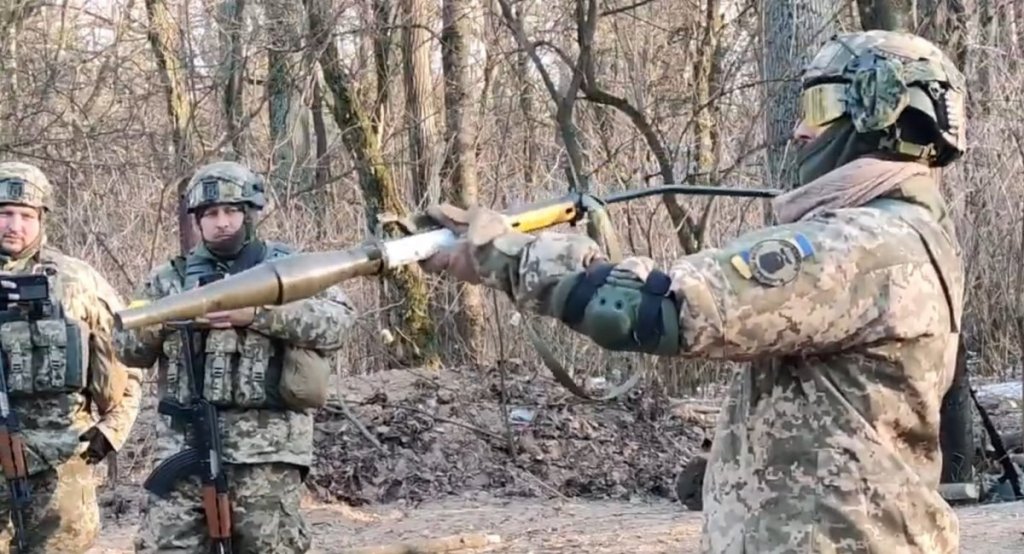
Demonstrating the controls of the RPG-76

The RPG-76 is essentially a smaller, lighter single-shot RPG-7, it has a folding stock and its round is adapted so its rocket nozzles are angled at 45-degrees to protect the user when firing. The RPG-76 was developed in the mid-1970s and entered production at Niewiadów in the mid-1980s. It was eventually withdrawn from general issue in 2003 but remained in Polish Army stores and saw some use with Polish troops during operations in Iraq and Afghanistan.

While the RPG-76 can reportedly penetrate up to 260mm of Rolled homogeneous armour (RHA) it lacks a tandem charge round which could engage targets, such as tanks, with explosive reactive armour. Despite this it should be more than capable of taking on most Russian light armoured vehicles and soft-skin vehicles like trucks.

Demonstrating aiming the RPG-76

The small number of examples seen in the field so far appear to date to the late 1980s. Poland announced they would be transferring military aid to Ukraine in early February and has since transferred ammunition, anti-tank and anti-aircraft weapons, mortars and provided medical supplies.

Another example of an RPG-76 in the field:

The video first surfaced around the 11th March, posted on Facebook by Vadim Kodachigov (the director of Kort, a military industrial company), though he may not be the original creator. Kodachigov appears to be part of a Territorial Defence Force unit, who may also feature in the video.

RPG-76 Specifications:

Warhead: 40mm HEAT 
Weight (round and launcher): 4.6lbs (2.1kg)
Length32in (805mm) – folded 43in (1190mm) – extended
Effective Range273yd (250m)
Penetration10.2in (260mm) against RHA

Watch the training video for the Stinger MANPADS here


If you enjoyed this video and article please consider supporting our work here. We have some great perks available for Patreon Supporters – including custom stickers and early access to videos! Thank you for your support!

Bibliography:

Earliest source found: Vadim Kodachigov via facebook (source)

RPG-76 Komar – Polish miniature grenade launcher: how to shoot with this weapon, Defense Express, (source)

Ukrainian Forces Takes Delivery of Polish RPG-76 Komar Rocket-propelled Grenade, MilitaryLeaks, (source)

Poland pledges to send weapons to Ukraine, Independent, (source)

Translation of video adapted from @mdmitri91’s translation

The SMAW-D In Ukraine

In recent days, with the news that a shipment of M141 SMAW-D anti-structure weapons have arrived in Ukraine as part of the US military aid shipments, a number of media articles and videos have been made on the subject which seem to confuse the SMAW-D with the AT-4 and even the M72. So, I thought it would be useful to take a look at the SMAW-D in a little detail. 

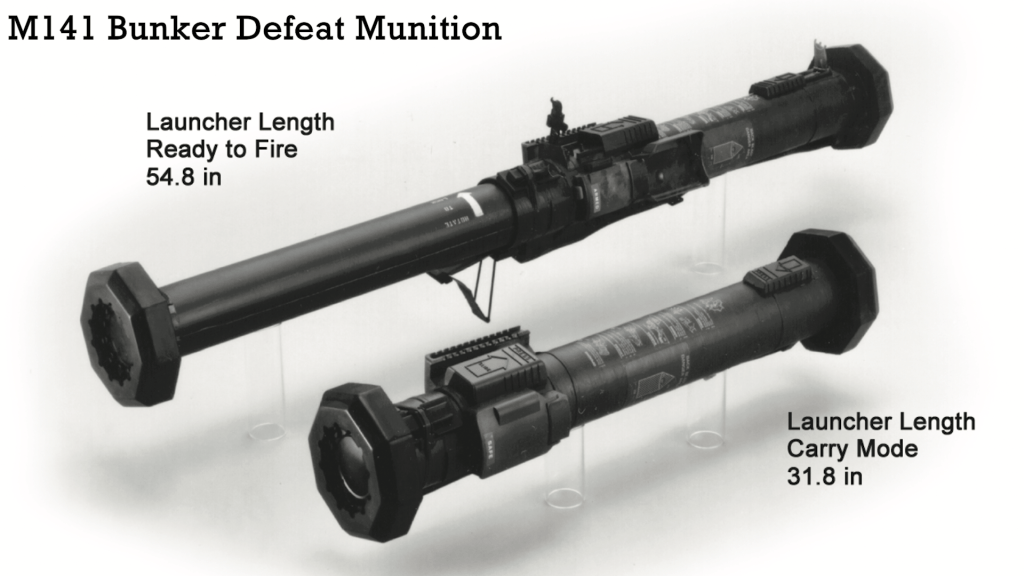
M141 (SMAW-D) (US Army Manual)

So What is the SMAW-D?  

Its official designation is ‘Rocket and Launcher, 83mm HEDP Bunker Defeat Munition (BDM), M141 (SMAW-D)’ SMAW-D stands for Shoulder-Launched Multi-Purpose Assault Weapon-Disposable. This isn’t to be confused with the Mk 153 Shoulder-Launched Multipurpose Assault Weapon used by the US Marine Corps. Those the SMAW-D did evolve from the SMAW.

The initial Mk 153 SMAW evolved from the Israeli IMI B-300. During the early-1980s McDonnell Douglas further developed the system and it entered service with the US Marine Corps as the Mk 153 in 1984. The SMAW-D shares the same warhead as the Mk 153 SMAW. The SMAW-D was originally developed by McDonnell Douglas and the design was acquired by Talley Defense Systems, whom were subsequently acquired by Norwegian company Nammo.

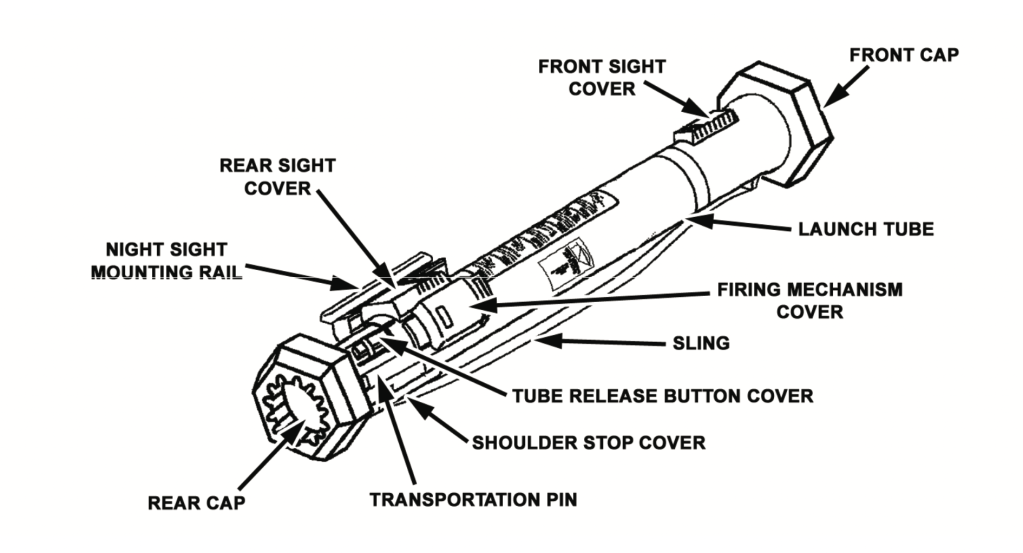
M141 (SMAW-D) (US Army Manual)

The Mk 153 has a reusable forward launch tube and firing mechanism which has a spotting rifle and can be mounted with an optic. The warhead element of the SMAW is attached at the rear of the launcher. The US Army was initially interested in the Mk153 but preferred a lighter, single use weapon.

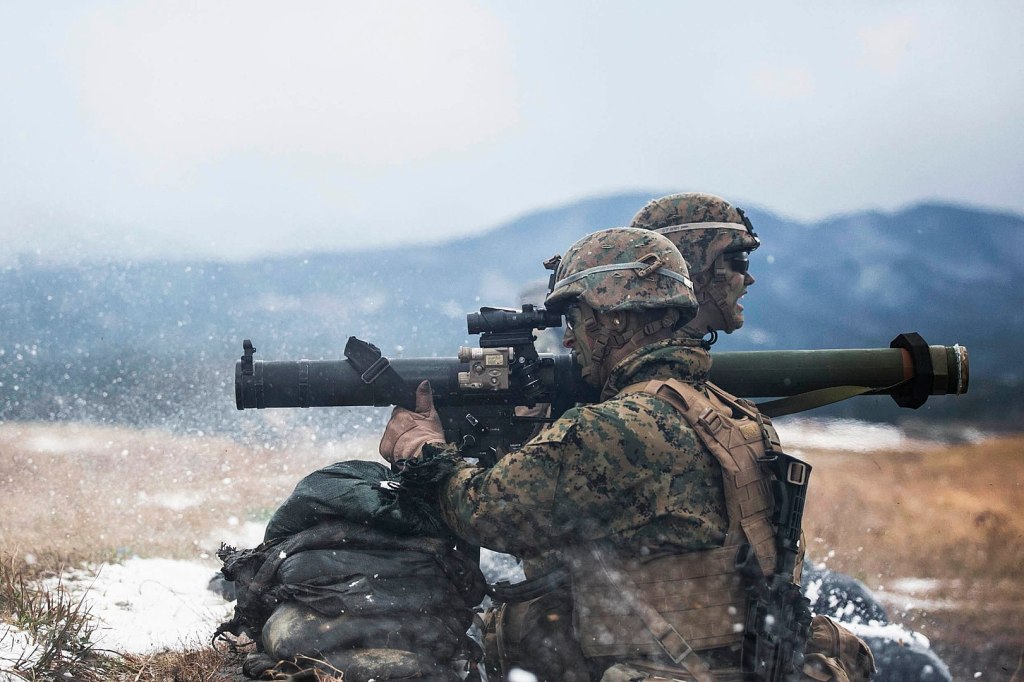
A Marine fires a Mk 153 SMAW (USMC/Cpl. Drew Tech)

In the early 1990s the US Army began the search for a disposable Shoulder-launched Multipurpose Assault Weapon. McDonnell Douglas offered a lighter, disposable version of the Mk 153, taking the Mk 153’s High Explosive, Dual Purpose warhead and pairing it with shorter burn rocket. In 1996 the US Army selected the SMAW-D, beating a Swedish design, the FFV AT8, and the Hunting Engineering LAW80. The SMAW-D entered service in 1999.

US Army advisor demonstrates how to deploy the M141 (Ukraine MoD)

The SMAW-D is similar to the 66mm M72 in that it telescopes with the launch tube extended before firing. When collapsed it measures just under 32 inches in length but extending the inner tube gives the weapon an overall length of 55 inches. The launch tube and rocket weigh 15.7 lbs.

The tube has the firing mechanism mounted on the side under a plastic cover which when opened arms the rocket ready to fire. The weapon has front and rear iron sights for aiming. The SMAW-D can also be fitted with an AN/PVS-4 nightsight and various infrared aiming lasers for night fighting.

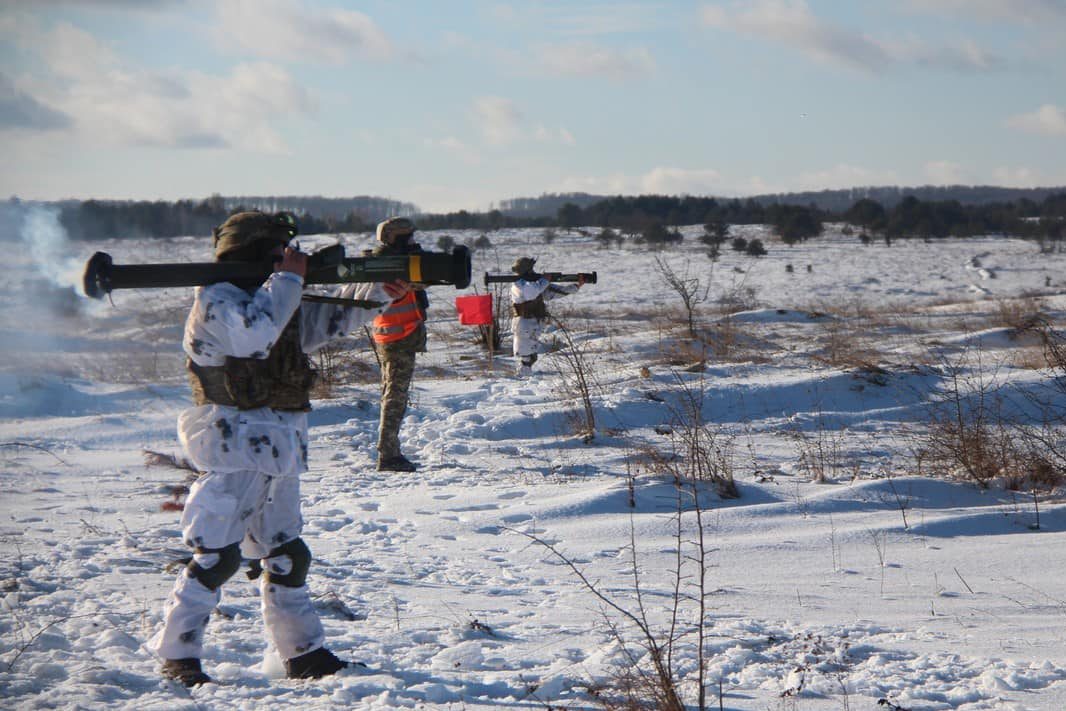
Ukrainian soldiers fire M141 BDMs (Ukrainian MoD)

To fire the M141 the operator removes the locking pin from the front of the launch tube, depresses the tube release button and extends the inner tube rearward. The operator then raises the weapon onto the right shoulder, slides the front sight cover forward and then the same for the rear sight. Then opening the firing mechanism cover pivoting it forward, flush with the tube, this arms the weapon. The operator should then check the backlist area and fire when ready by depressing the safety button and then the red trigger button. The rocket is ignited by an electrical impulse sent by the firing mechanism. Once ignited the rocket burns out before it leaves the muzzle, this protects the operator.

M141 (SMAW-D) (US Army Manual)

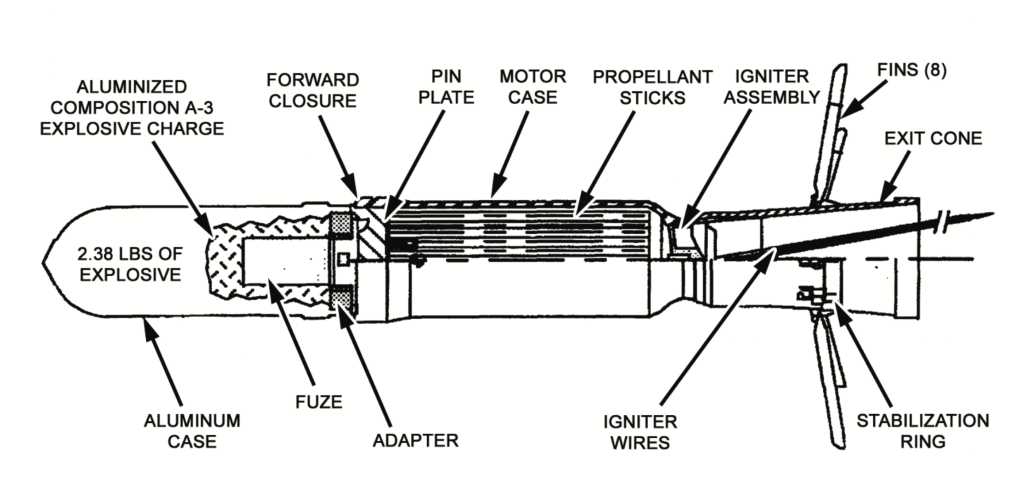
The M141 can engage targets out to 500 metres but is most effective out to 300. Its 83mm unguided, fin-stabilised round has an integral high-explosive, dual-mode warhead with 2.38 lbs of explosive. Detonation is instantaneous when impacting on a hard target, such as a brick or concrete wall, or an armored vehicle. Impact with a softer target, such as a sandbagged bunker, results in a fuze time delay that permits the rocket to penetrate into the target before warhead detonation. It can penetrate up to 200mm (8 inches) of concrete, 300mm (12 inches) of brick and 2m (6 feet 6.74 inches) of earth or sandbags. It can also perforate up to 20mm (0.8 inches) of rolled homogenous steel giving the SMAW-D the ability to take on soft and light armoured vehicles. For training at the range a 21mm sub calibre training system can be used. While the usefulness of the M141 might be questioned, as it isn’t an anti-tank weapon and could be considered more of an offensive rather than defensive weapon it would no doubt prove very useful during urban fighting, which Ukraine anticipates in the event of an invasion.

The SMAW-D saw service with the US Army during the War in Afghanistan and during the Iraq War. Some 6,000 units were initially procured, with an unknown number procured since. It remains an active part of Nammo’s product line. 

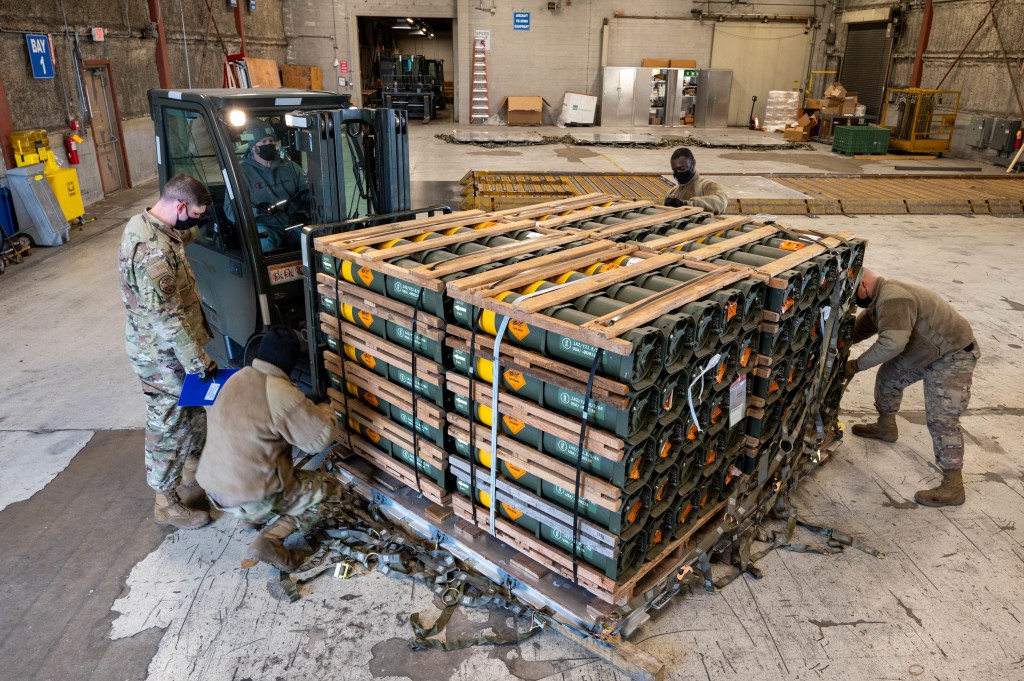
Airmen and civilians from the 436th Aerial Port Squadron palletize ammunition, weapons and other equipment bound for Ukraine during a foreign military sales mission at Dover Air Force Base, Delaware, Jan. 21, 2022. (U.S. Air Force photo by Mauricio Campino)

It is estimated that perhaps 100 M141 BDMs have been shipped to Ukraine so far as part of military aid, alongside small arms and ammunition, Javelin Anti-Tank Guided Missiles and NLAW anti-tank weapons from the UK. From the US Department of Defense’s packaging configuration table for the SMAW-D we know that each metal container holds one round and that 25 containers can be placed on a pallet. This appears to match up to the photos of the weapons being prepared for shipment. The Ukrainian Ministry of Defence and media have shared photographs of Ukrainian personnel training with M141s under the supervision of US troops. The training took place over two days at the 184th Training Center and the International Center for Peacekeeping and Security of the National Ground Forces Academy. These personnel will likely be tasked with then training other Ukrainian units on how to use the weapon.

M141/SMAW-D Specifications:

Length (extended/ready to fire): 1,371mm (54.8inches)
Length (closed/carry): 792mm (31.8inches)
Weight (ready to fire): 7.12 kilograms (15.7 pounds)
Rocket muzzle velocity: 217 meters per second (712 feet per second)
Rocket diameter:83mm (3.26 inches)
Minimum arming range: 15 meters
Maximum effective range: 300 meters
Maximum range: 500 meters


If you enjoyed this video and article please consider supporting our work here. We have some great perks available for Patreon Supporters – including custom stickers and early access to videos! Thank you for your support!

Bibliography: 

FM 3-23.25 Shoulder-Launched Munitions, 2006, US Army

Bunker Defeat Munition (BDM), Nammo, (source)

M141 Training, Ukraine Ministry of Defence, (source)

M141 Training, Ukraine Land Forces, (source)

Thank you to Amael for sharing some of the documents and manuals used to make this video.

Footage/Imagery: 

Marines fire SMAW, have a blast, USMC, (source)

Dover supports strategic partnership with Ukraine, US Air Force, (source)

Dover AFB supports US, Ukraine strategic partnership, US Air Force, (source)

Sadr City 2008 SMAW D, Gold 5 Publishing, (source)
SMAW-D (AT-4) fired in combat Sadr City, Iraq, Bowen11b, (source)