RPG-30: Russia’s Dual Tube Rocket Launcher

The RPG-30 is one of Russia’s more advanced disposable anti-armour weapons. Developed in the early 2000s by Bazalt it is designed to overcome reactive armour and active protection systems. It entered service in 2012 and has seen extensive use during the fighting in Ukraine. 

The 7P53 RPG-30 “Kryuk” or ‘Hook’ is a 105mm fin and spin stabilised rocket propelled munition with a tandem HEAT shaped charge warhead. The RPG-30 overcomes ERA and APS by using a 42mm IG-30 decoy projectile, which is believed to be inert, coupled with the main rocket’s tandem warhead. This can be seen in a secondary, thinner tube running along the side of the weapon. The precursor decoy causes premature activation of the APS and allows the main warhead to exploit the gap in the tank’s protection. The theory being that the target’s APS takes some time, perhaps half a second, before it can engage again. The gap between the firing of the two rockets is measured in milliseconds and the lag, while noticeable, does not appear to be significant enough to effect the user’s aim or accuracy on target.
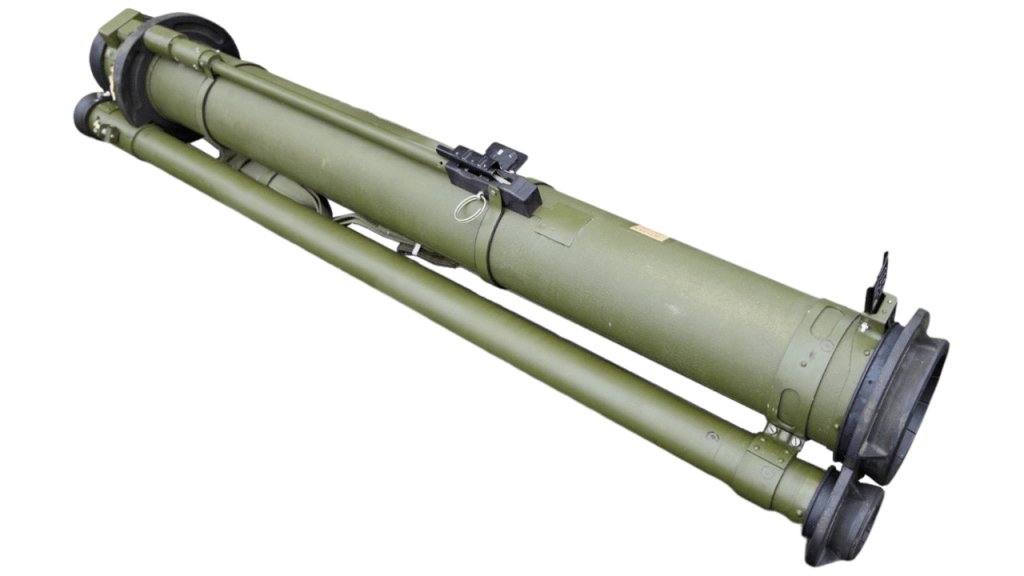
RPG-30 (Vitaly Kuzmin CC BY-SA 4.0)

The RPG-30 uses the PG-30 tandem HEAT warhead, similar to the PG-27 used by the RPG-27. It can reportedly penetrate 750mm of rolled homogeneous armour and up to 650mm of rolled homogeneous armour after ERA. Effective range estimates vary with the average suggesting 200m.

The weapon’s sights are simple and consist of a folding ladder front sight and rear sight – there does not appear to be provision for mounting optics. Flipping up the rear sight also cocks the weapon. The disposable tube(s) is made of aluminium with a fibreglass outer layer. Sources suggest it weighs around 10.3kg (22.7lbs) and has an overall length of just over 1m (1,135mm/44.7in). 

A pair of RPG-30s captured in April 2022 (via Social Media)

Unlike other Russian weapon systems few videos of its use have been shared by Russian state media or Russia’s defence exports corporation Rosoboronexport. The ongoing war in Ukraine, however, has provided our first real look at the weapon in action. As soon as the Russian invasion was launched on 24 February, RPG-30s began to be seen in use with Russian forces. By late February and early March imagery of captured examples was shared on social media. 
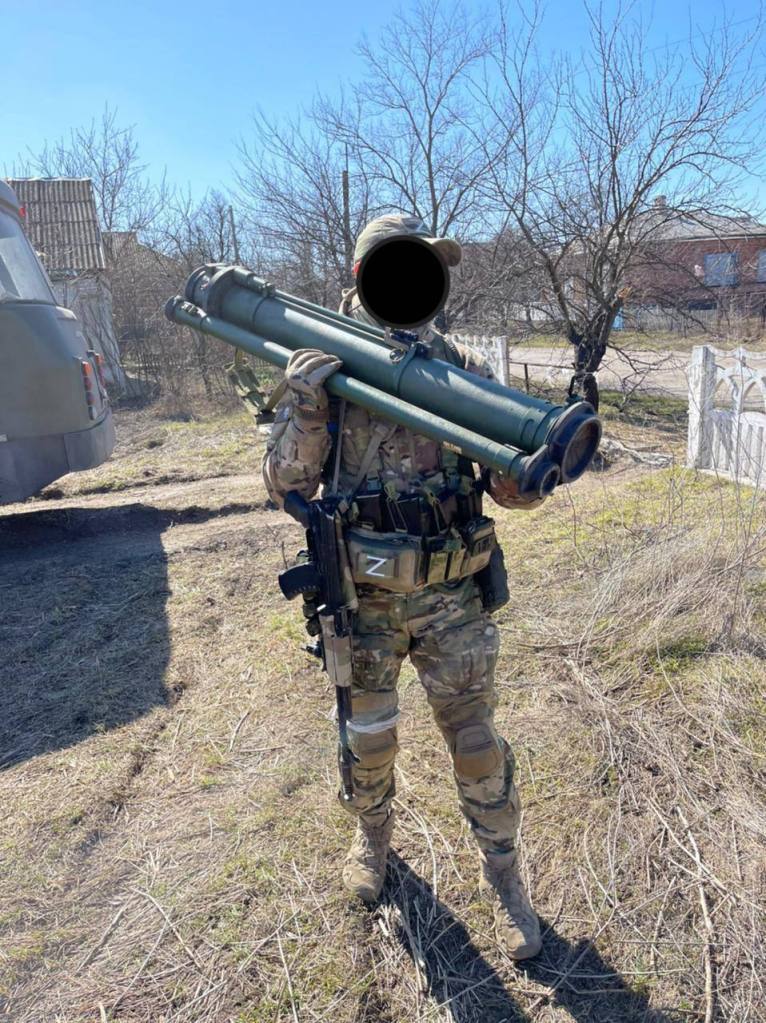
Russian soldier posing with RPG-30, March 2022 (via Social Media)

The first images of the weapon came from Russian sources in late February, just after the invasion. This was quickly followed by imagery of captured examples, most notably from the column of Tigr-M armoured infantry mobility vehicles in Kharkiv.  A photograph of a further two captured RPG-30s appeared in April, while another example was photographed in Donbas in early May. Later in May a photo of a Russian soldier posing with one was shared on social media and in September significant caches of weapons were captured in Kherson and Balakliya. 
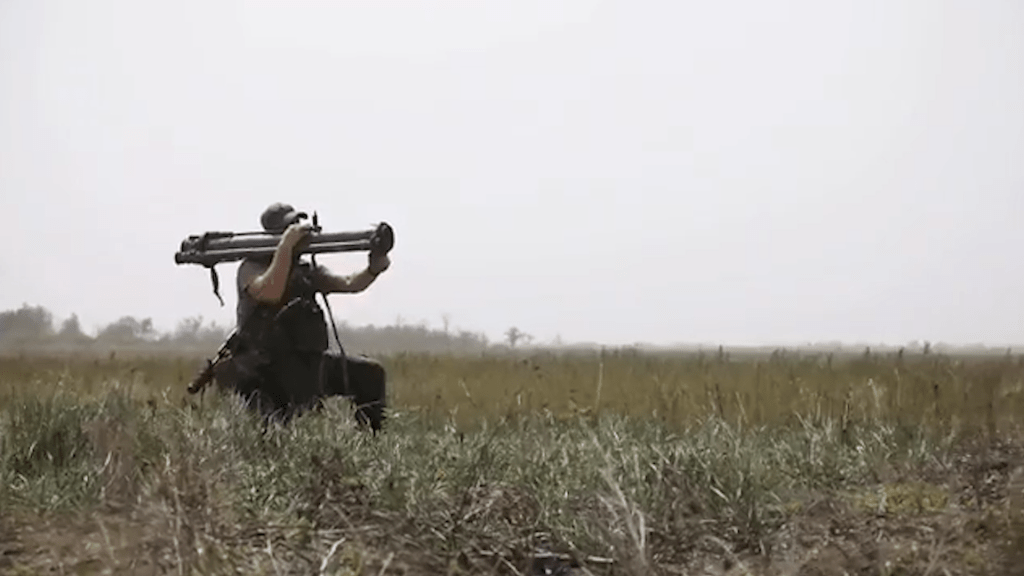
Still of a Russian soldier firing an RPG-30, August 2022 (via Social Media)

In late August we got our first brief look at the RPG-30 being fired in a montage video of VDV weapon systems (see image above). Earlier in mid-August a sort of ‘unboxing video’ was shared giving us a good close up look at some of the packaging the RPG-30s are shipped in and the markings on the side the weapon. Most recently in some further video of the RPG-30 being fired on a Russian Western Military District range also surfaced giving us a good look at the weapon in action.

RPG-30s captured in April (via Social Media)

Of course the weapon is designed to be simple to use, anyone with training on a similar shoulder-fired disposable anti-armour weapon can operate it. While it has been said that its widespread use in Ukraine is somewhat ironic given that Ukraine does operate any APS equipped tanks, the weapon is still useful against less sophisticated tanks. While the precursor might potentially deliver some limited kinetic damage to the ERA block, the RPG-30’s tandem warhead is capable of defeating the ERA fitted to most Ukrainian tanks, though of course, the same can be said of Russia’s other anti-armour weapons which use tandem warheads.

Update 27/10/22:

The Georgian Legion recently shared a short video looking at a captured RPG-30. The video also includes firing footage of the weapon.

Update 15/09/23:

Clip of a Ukrainian combatant firing a captured RPG-30 at the range.

Update – 20/8/24:


If you enjoyed this video and article please consider supporting our work here. We have some great perks available for Patreon Supporters – including custom stickers and early access to videos! Thank you for your support!


Bibliography:

105mm PG-30 Rocket, CAT UXO, (source)

RPG-30 Kryuk (Hook), US Army TRADOC, (source)

Russian Army receives cutting-edge antitank rocket launchers, TASS, (source)
PTKM-1R: Russia’s Most Advanced Anti-Tank Mine

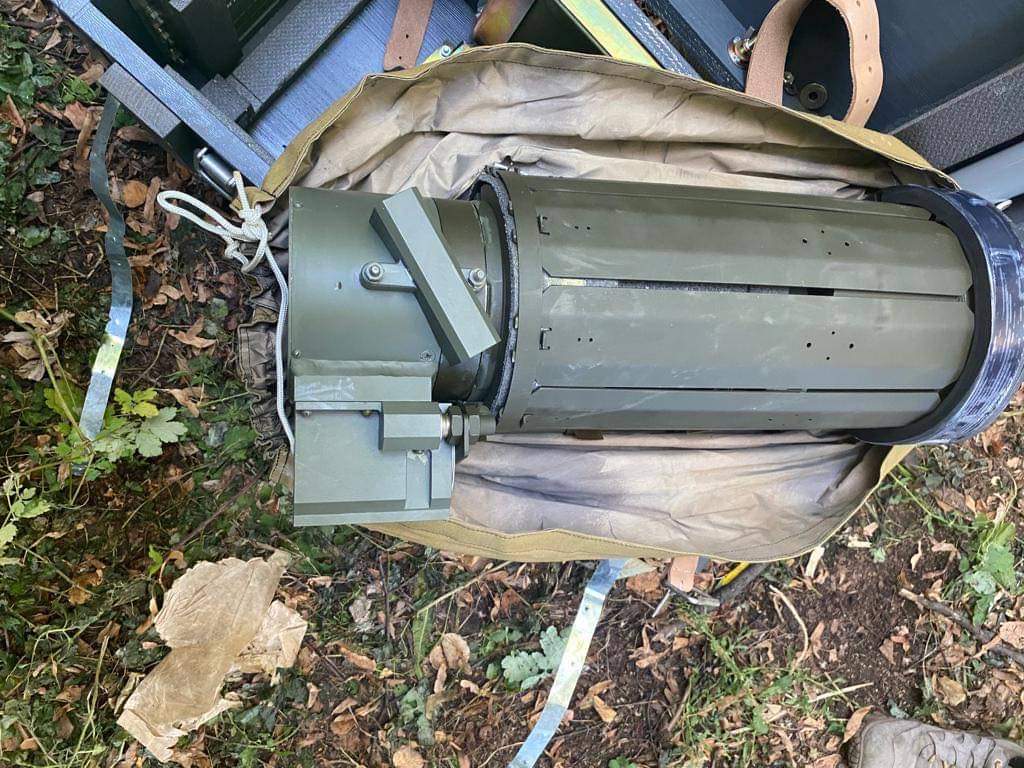
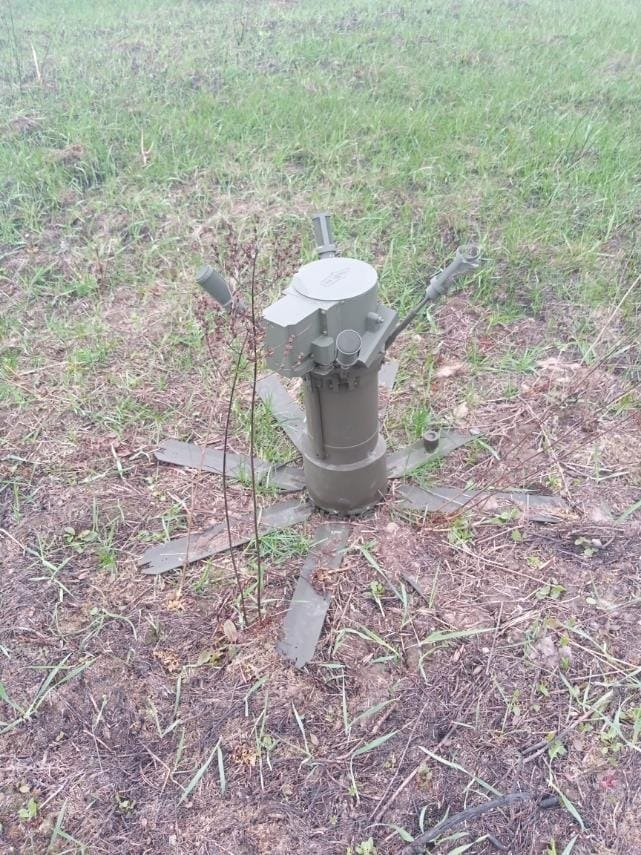
In recent weeks Ukrainian forces have shared photographs of captured PTKM-1R mines. These are without doubt Russia’s most advanced anti-tank mine design. The PTKM-1R’s main feature is that it is a top attack munition, much like a Javelin or NLAW. It can strike down from above at a tank’s least protected point – its roof and engine deck.  

PTKM-1R photographed in Ukraine in April 2022 (via social media)

The mines essentially brand new and were only publicly unveiled by Rosoboronexport in November 2021 at the Army 2021 exposition and later at EDEX 2021. They have been adopted by the Russian armed forces on a limited basis. The PTKM-1R was first seen in Ukraine back in late April, appearing to show it deployed. Russia have released no footage of the mines in action.

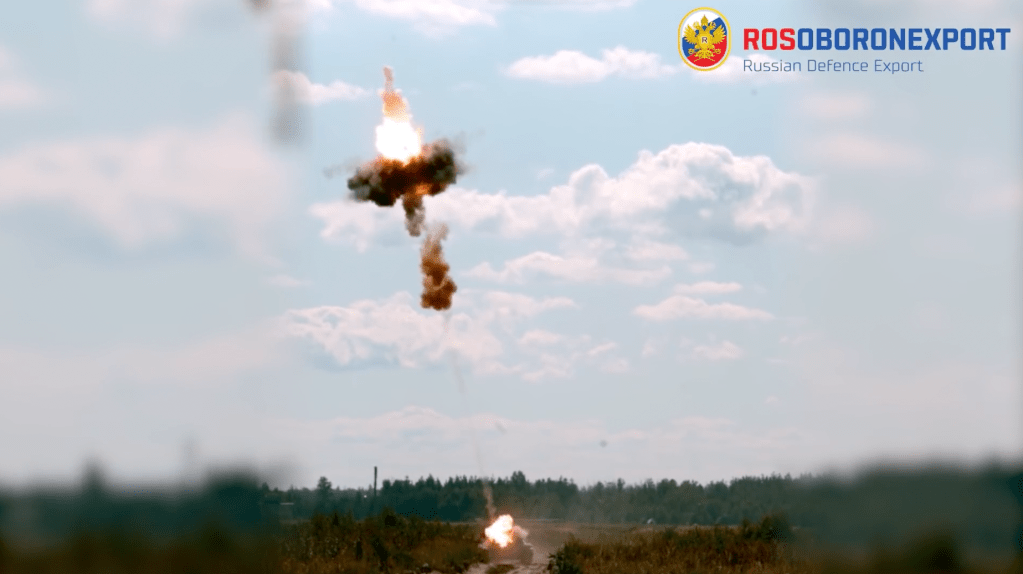
PTKM-1R submunition detonating and projecting its EPR down on a target during a 2021 demonstration (Rosoboronexport)

The PTKM-1R is a top-attack anti-tank/anti-vehicle mine which is designed to detect the passage of target vehicles using acoustic and seismic sensors. The launching charge then detonates and projects a submunition up into the air toward the target. As the sensor-fuzed submunition flies over the target and detects movement below it detonates firing an explosively formed penetrator (EFP) down onto the vehicle – attacking it where its armour is weakest. 

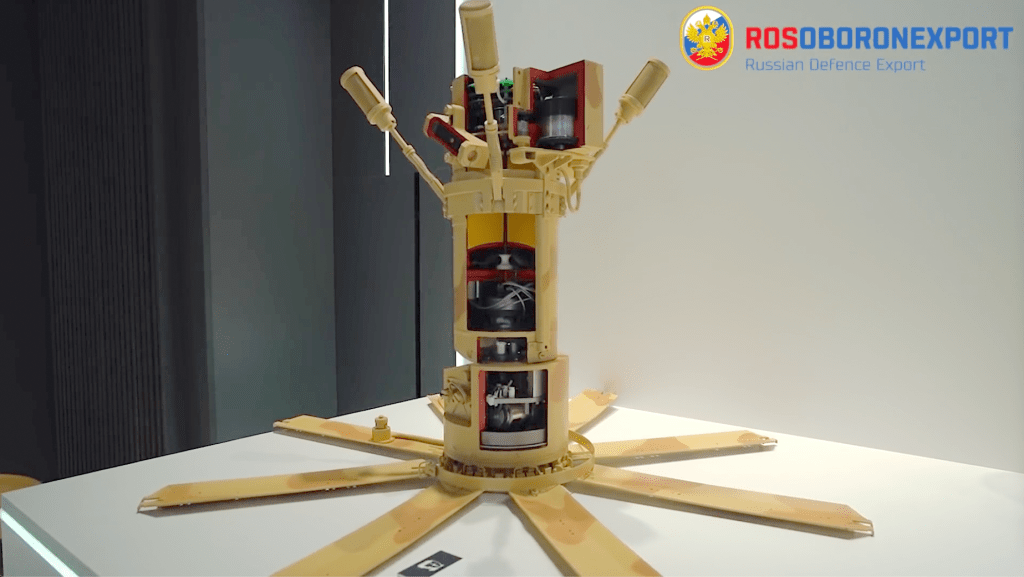
Sectioned PTKM-1R (Rosoboronexport)

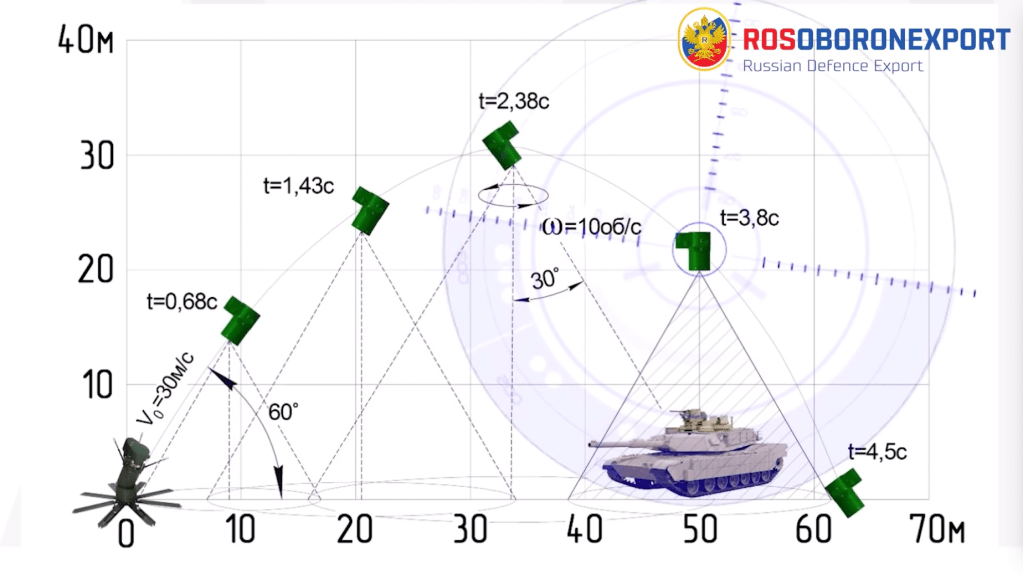
The mine can engage targets at between 5 and 50m but can detect a target out to 100m. Targets are initially identified by the mine by comparing the detected signature with acoustic and seismic signatures in its internal database. Once a target is detected the mine calculates a flight path and the launch unit tilts 30-degrees toward the target to create a parabolic ballistic trajectory over the target. While the mine can detect targets in a 360-degree arc the mine itself has a limited arc, limited by the need to tilt before firing, the mine has a an arrow with ‘towards target’ for orientating the mine in the direction of expected engagement but in an Army 2021 presentation Rosoboronexport suggest that the mine can turn itself to face its target, and track it if needed.

Rosoboronexport graphic showing the trajectory of the PTKM-1R (Rosoboronexport)

The submunition is launched into the air at a speed of 30m/s to a height of approximately 30 metres. It then uses infrared sensors and radar to pinpoint its target before detonating its shaped charged to create an explosively formed penetrator. Rosoboronexport claim the mine can penetrate ‘at least 70mm’ of armour. 

The PTKM-1R can be considered an off-route mine like the German DM-22 and Estonian PK14s which are known to be in use with Ukrainian forces but its ability to strike from above sets it apart. The nearest similar system is the short-lived US M93 Hornet developed by Textron in the 1980s.

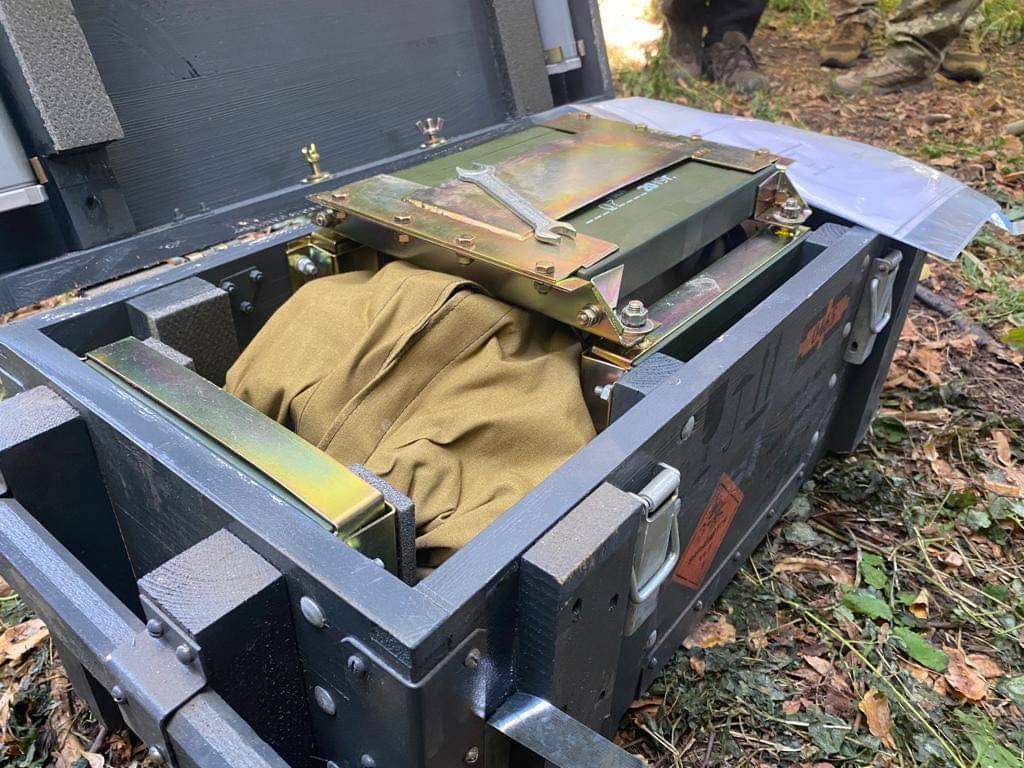
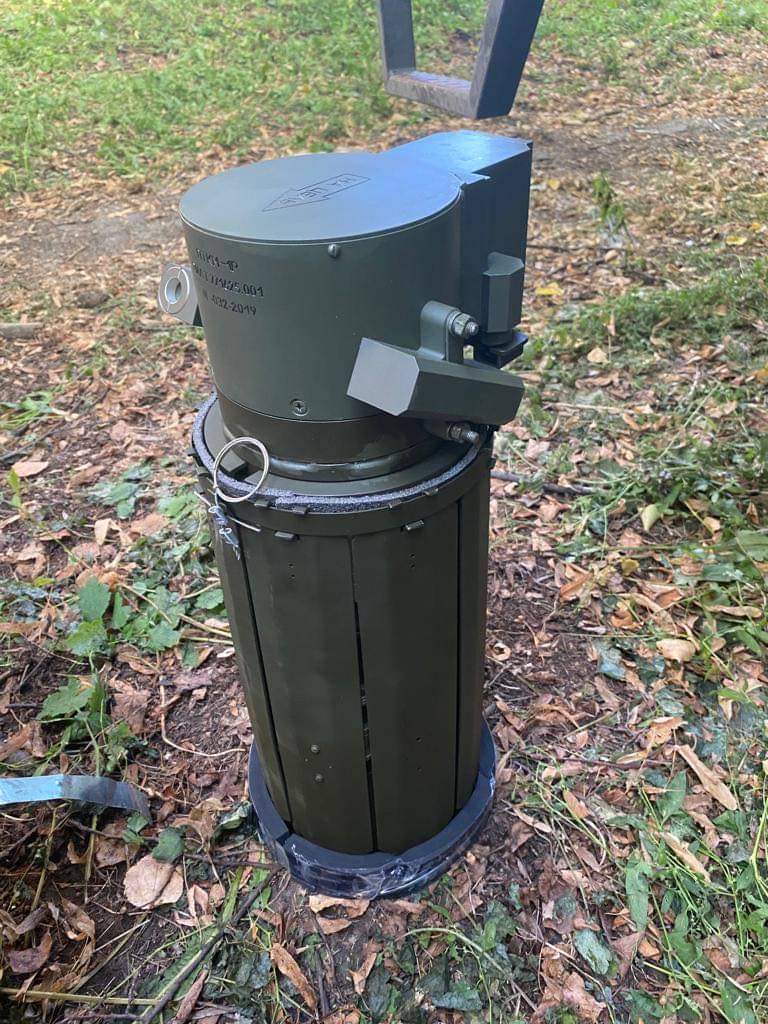
PTKM-1R captured in its transit chest, 10 September (via social media)

The launch unit (or transporter-launcher) incorporates eight feet that are lowered when the mine is deployed these provide a stable platform. According to Rosoboronexport the PTKM-1R weighs 19.9kg while its payload is said to be around 2.8kg of explosive. Two seismic sensors, which sense the vibrations caused by approaching vehicles, are deployed and there are also four cardiod microphones at the top of the unit which listen for the sounds of heavy armoured vehicles.

PTKM-1R captured by Ukrainian forces during Kharkiv offensive, 10 September (via social media)

On around the 10th September a second mine was photographed showing an undeployed PTKM-1R still in its transit chest. The mine was captured, reportedly by SSO, in the Kharkiv region on the eastern front where fighting has been significant and Russian forces appear to be rapidly falling back.

Update 17/10/22: On the 17th October, Ukrainian Telegram channels began sharing a short video of a PTKM-1R which appears to have launched its top-attack munition. The Telegram posts did not state where the footage was filmed. In the video we can see that the mine’s base unit has angled (supposedly towards its target) and has launched its munition.

Update: 23/11/22: A video from the DPR/DNR People’s Militia Press Office featuring a Russian sapper (possibly from the 56th Guards Air Assault Regiment operating in the Zaporizhzhia Oblast) explaining the deployment of the advanced Russian PTKM-1R top-attack mine. [Machine translation in video captions] H/t – Patrick Senft.

Update 26/11/22: Photographs of a deployed and detonated PTKM-1R have surfaced online.

Update 5/12/22:

Update – 2/02/2023: A short clip was shared on Telegram showing an intact and unfired PTKM-1R said to be in the Kherson region.

Update – 07/06/23: A recent sighting on a PTKM-1R from drone footage.


If you enjoyed this video and article please consider supporting our work here. We have some great perks available for Patreon Supporters – including custom stickers and early access to videos! Thank you for your support!


Bibliography

Russian PTKM-1R Top-attack Anti-vehicle Mine Documented in Ukraine, ARES, (source)

PTKM-1R: Top-Attack Anti-Tank Mine, Rosoboronexport, (source)

PTKM-1R Landmine, Cat-UXO, (source)

PTKM-1R, Fenix Insight, (source)