Since Russia’s invasion of Ukraine in February 2022 the use of drones for reconnaissance and tactical missions has evolved so rapidly it has come to characterise the war. The tactic of dropping hand grenades from commercial drones has evolved into the use of larger drones and larger munitions and the use of first person view (or FPV) one-way, kamikaze drones.
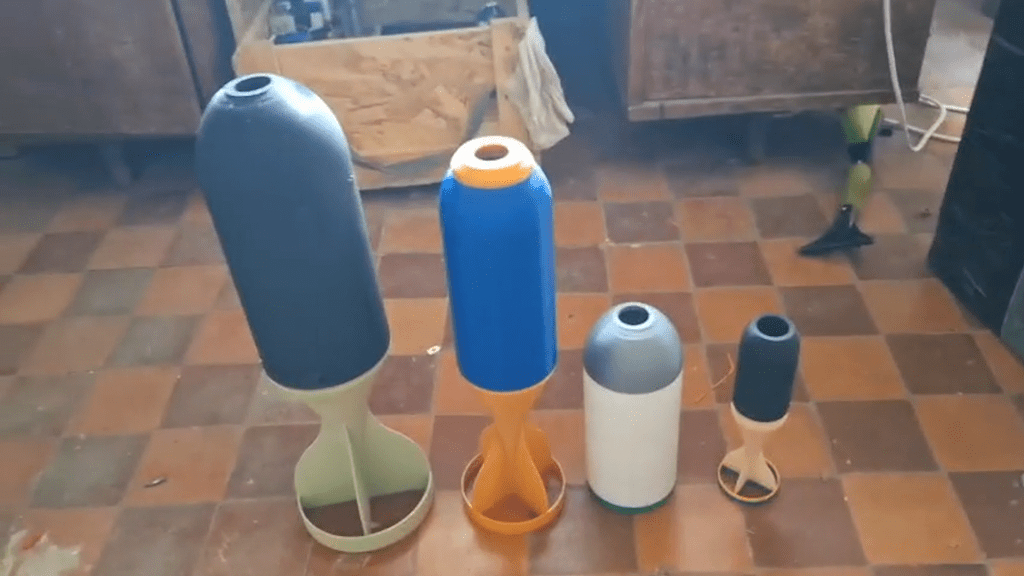
L-R: V3 XL ‘Big Mac’, V2, V1 & small VOG-sized casing (via Joe MacDonald)
Joe MacDonald, a British volunteer currently fighting in Ukraine, has kindly shared a short video showing some of the newest munitions that have been in use with his drone team for some time. Joe has led the development of a series of munitions of varying sizes. These range from small 450g bombs up to 3.5kgs which are dropped from a range of drones, small Mavic-type drones up to the ‘Baba Yaga’ heavy bomber drones.
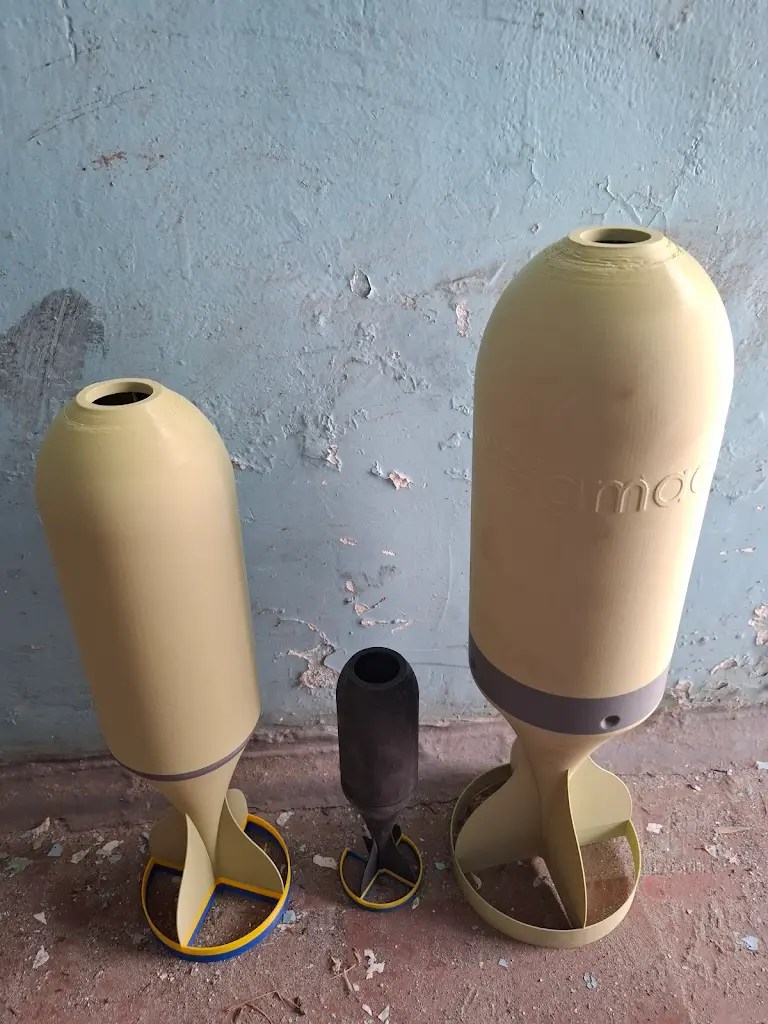
This short video from Joe just goes to illustrate the importance of 3D printing in the development and manufacture of drone dropped munitions. The 3D printed casings are loaded with explosives and shrapnel which can then be fuzed ready for deployment in the field. The 3D printed designs have only grown more sophisticated, evolving originally from printed trail sections and nose cones.
3D printed drone munition casings with tail assemblies (via Joe MacDonald)
Importantly, the use of 3D printing allows for the casings and tails to be standardised and consistent. The 3.5kg V3 takes up to 24 hours to print, they could be printed faster but Joe explained that this sacrifices rigidity and robustness and he prefers the munitions his unit uses to be soldier-proof and capable of standing up to handling. Joe also noted that packing the casings with plastic explosive takes force which the cases have to be able to stand up to. While there are plenty of other case and tail designs in use the designs Joe led the refinement and development have been used by numerous Ukrainian brigades.
Special thanks to Joe for sharing the video and taking the time to explain how drone munitions are assembled, I highly recommend checking out Joe’s channel, Big Mac’s Battle Blogs, he regularly shares some really interesting insights.
In recent weeks there have been a spate videos showing Russian troops using TM-62 anti-tank mines as improvised satchel charges. We’ve already seen TM-62s used as drone dropped munitions and as demolition charges. The videos shared most recently show the dramatic effect that the TM-62s can have on structures. But they aren’t the first videos of the mines being used in this way to emerge from the conflict.
Back in April 2023, overwatch drone footage was shared which showed a Ukrainian soldier using a satchel charge, which appears to be a TM-62, to destroy a Russian fighting position. The charge detonates about 10 seconds after it’s tossed into the position. Almost a year later in early March 2024, another piece of drone footage showed troops from the 2nd mechanised battalion of the 30th mechanised brigade destroying what appears to be the entrance to a cellar near Syn’kivka, in Kharkiv Oblast, with a TM-62 satchel charge.
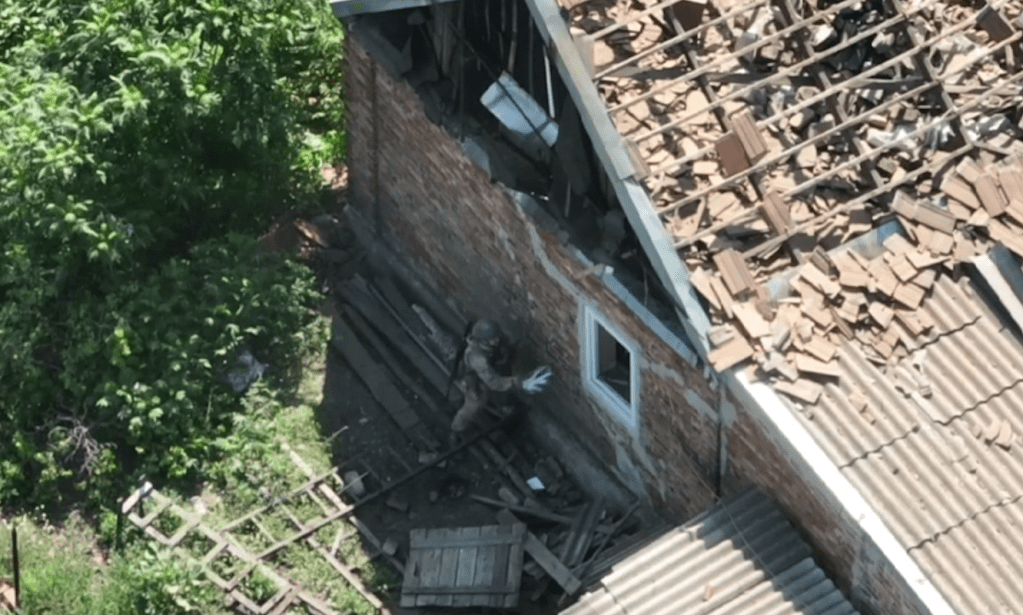
A Russian soldier posts a TM-62 through a window (via social media)
Several days later another video showed a member of the 81st Airmobile Brigade using a TM-62 to destroy Russian dugouts near Bilohorivka. In the video a Ukrainian serviceman can be seen lighting a length of safety fuze which appears to be taped to the body of the mine. He then throws the mine into a hole in the roof of a dugout and takes cover – approximately 20 seconds later it detonates. Several grenades are thrown into the dugout and another mine is brought up, we can see the mine is being carried by its attachable webbing carrying handle. The safety fuze on the mine is lit and thrown into a covered section of trench and detonated approximately 22 seconds later.
On 12 April, the 109th Territorial Defense Brigade shared video of urban operations in which Ukrainian troops, with covering fire from HMMWVs, used satchel charges to destroy several buildings. The drone footage of the operation isn’t clear enough to make out if the satchel charges used are TM-62 based but the charges clearly have a significant blast effect.
Depending on the variant TM-62s mine are packed with 7.5kg (17lbs) of explosive and is normally centrally fuzed by a mechanical MVCh-62 pressure fuze. It is a High-Explosive Blast (HE-Blast) mine typically with a TNT filling. While extremely potent they aren’t designed to be thrown, weighing 9.5–10kg (20-22lbs).
A Ukrainian soldier lights a safety fuze to ignite a TM-62 (via social media)
While in some videos its clear that some sort of cord fuze was used to initiate the mine in some of the more recent footage it appears that grenade fuzes may have been used. This gives the user very little time to escape the blast radius.
On 2 July, a Russian telegram channel shared the first of several videos of Russian troops using TM-62s to clear positions. The location of the video isn’t stated but it shows Russian soldiers tossing a pair of what appear to be a TM-62Ps (which have a red-orange Bakelite case). Two days later another drone video showed [better quality version] a Russian soldier run up to a building and throw a TM-62 through a ground floor window, he runs clear but the mine detonates just three seconds later. It’s unclear from the video when he initiated the fuze, likely before approaching the building. The charge effectively collapses the corner of the two storey structure’s outer wall.
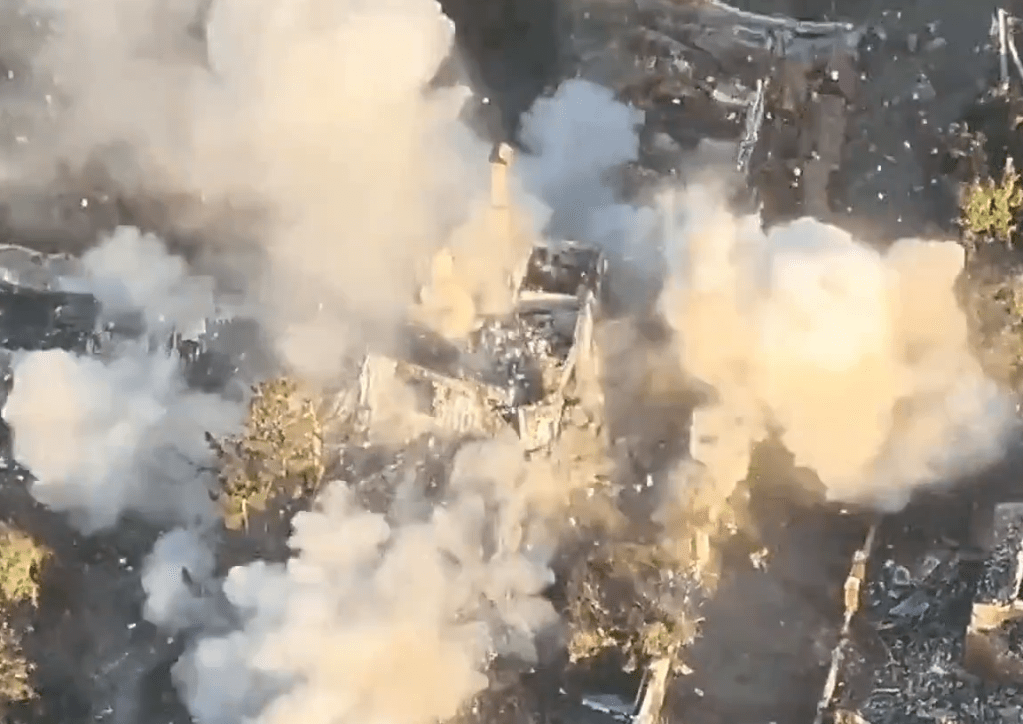
A TM-62 satchel charge destroys the corner of a building (via social media)
Russia telegram channel WarGonzoshared another video on 5 July, reportedly filmed in Niu-York, Ukraine, showing a member of the 9th Separate Guards Motor Rifle Brigade using a TM-62 to destroy a building which was said to have been occupied by Ukrainian troops. The Russian soldier can be seen pulling a pin on what may be a grenade fuze just before throwing the mine through a window. The mine detonates just three seconds later completely destroying the small building.
Another spectacular video was shared on around 7 July, showing two Russian soldiers deploying a pair of TM-62s against a large building, the location of which isn’t stated. They are seen approaching the building, pulling fuze pins and tossing the mines in. As they turn and run the mines detonate just three seconds later demolishing the building.
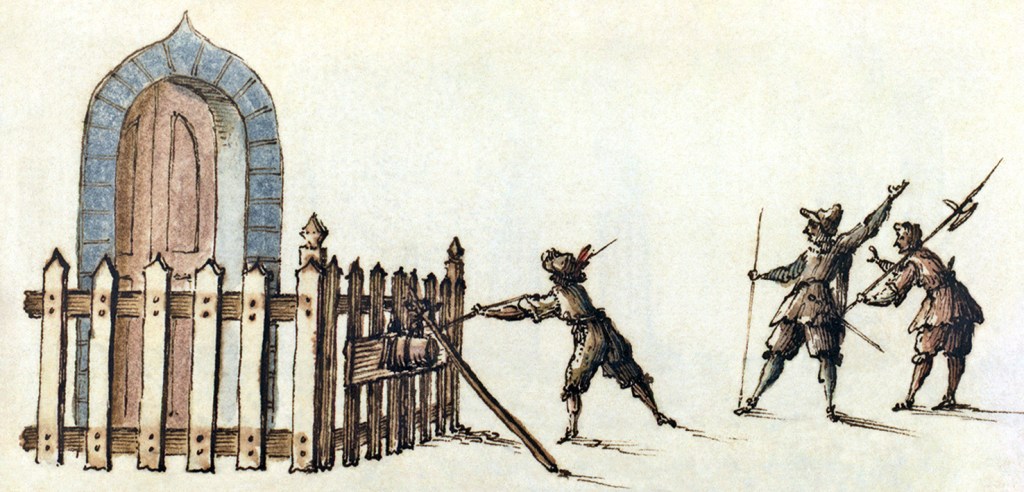
While in most of these videos the men deploying the mines appear to get clear they do beg the age old question of whether some of the soldiers deploying the mines are inevitably ‘hoist by their own petards’ – the etymology of that phrase being a reference the the dangerous business of 16th century sappers being killed or injured while deploying Petards, a historic equivalent to a modern demolition or satchel charge.
16th century engineer deploying a petard (via Library of Congress)
It’s clear from the available imagery that both Russia and Ukraine have utilised TM-62s as ad-hoc satchel or demolition charges since at least early 2023 (and likely earlier). It’s unclear how widespread of a practice the use of the mines is but it is clearly highly effective and while it puts the user deploying the mine at significant risk it appears an effective way of clearing enemy positions if the charge can be delivered successfully.
Update – 30/09/24: Footage of what may be an assault demolition, of an apartment block in Toretsk, using TM-62s.
— Matthew Moss | Historical Firearms (@historicfirearm) October 21, 2024
Update – 5/12/24:
Omega Team, an SOF unit with Ukraine’s National Guard, employ multiple TM-62s during a hit and run raid on a Russian strong point in an apartment block.
— Matthew Moss | Historical Firearms (@historicfirearm) December 5, 2024
Update – 12/12/24:
An recent video of Ukrainian combatants using multiple TM-62 (or similar) anti-armour mines (минированию) as satchel charges in Toretsk was shared. The video shows half a dozen charges comprised of a pair of mines taped together with a delay fuze. These charges are thrown into the ground floor of a damaged building.
Double TM-62 (or similar) anti-tank mines used as satchel charges.
The RPG-30 is one of Russia’s more advanced disposable anti-armour weapons. Developed in the early 2000s by Bazalt it is designed to overcome reactive armour and active protection systems. It entered service in 2012 and has seen extensive use during the fighting in Ukraine.
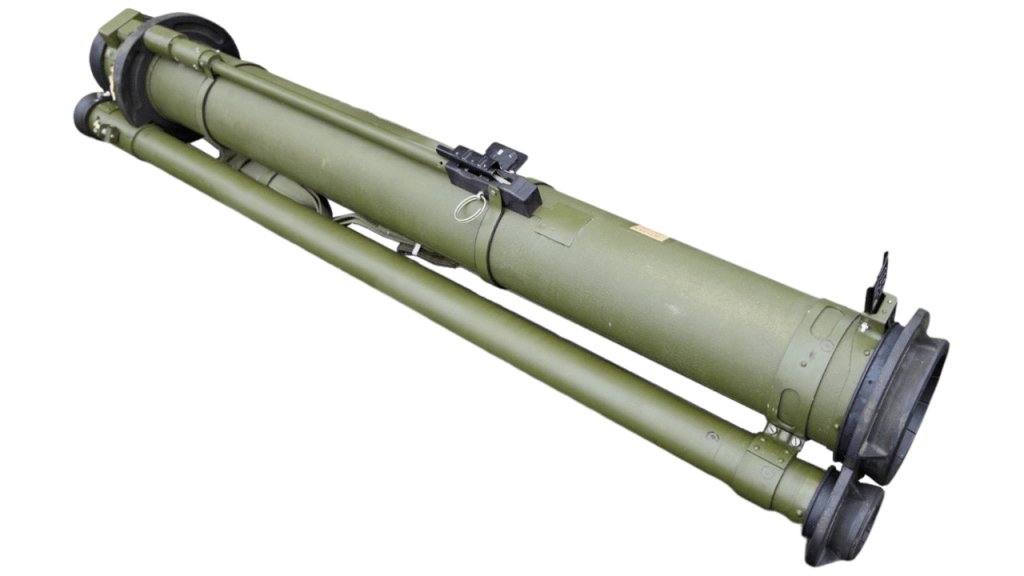
The 7P53 RPG-30 “Kryuk” or ‘Hook’ is a 105mm fin and spin stabilised rocket propelled munition with a tandem HEAT shaped charge warhead. The RPG-30 overcomes ERA and APS by using a 42mm IG-30 decoy projectile, which is believed to be inert, coupled with the main rocket’s tandem warhead. This can be seen in a secondary, thinner tube running along the side of the weapon. The precursor decoy causes premature activation of the APS and allows the main warhead to exploit the gap in the tank’s protection. The theory being that the target’s APS takes some time, perhaps half a second, before it can engage again. The gap between the firing of the two rockets is measured in milliseconds and the lag, while noticeable, does not appear to be significant enough to effect the user’s aim or accuracy on target.
RPG-30 (Vitaly Kuzmin CC BY-SA 4.0)
The RPG-30 uses the PG-30 tandem HEAT warhead, similar to the PG-27 used by the RPG-27. It can reportedly penetrate 750mm of rolled homogeneous armour and up to 650mm of rolled homogeneous armour after ERA. Effective range estimates vary with the average suggesting 200m.
The weapon’s sights are simple and consist of a folding ladder front sight and rear sight – there does not appear to be provision for mounting optics. Flipping up the rear sight also cocks the weapon. The disposable tube(s) is made of aluminium with a fibreglass outer layer. Sources suggest it weighs around 10.3kg (22.7lbs) and has an overall length of just over 1m (1,135mm/44.7in).
A pair of RPG-30s captured in April 2022 (via Social Media)
Unlike other Russian weapon systems few videos of its use have been shared by Russian state media or Russia’s defence exports corporation Rosoboronexport. The ongoing war in Ukraine, however, has provided our first real look at the weapon in action. As soon as the Russian invasion was launched on 24 February, RPG-30s began to be seen in use with Russian forces. By late February and early March imagery of captured examples was shared on social media.
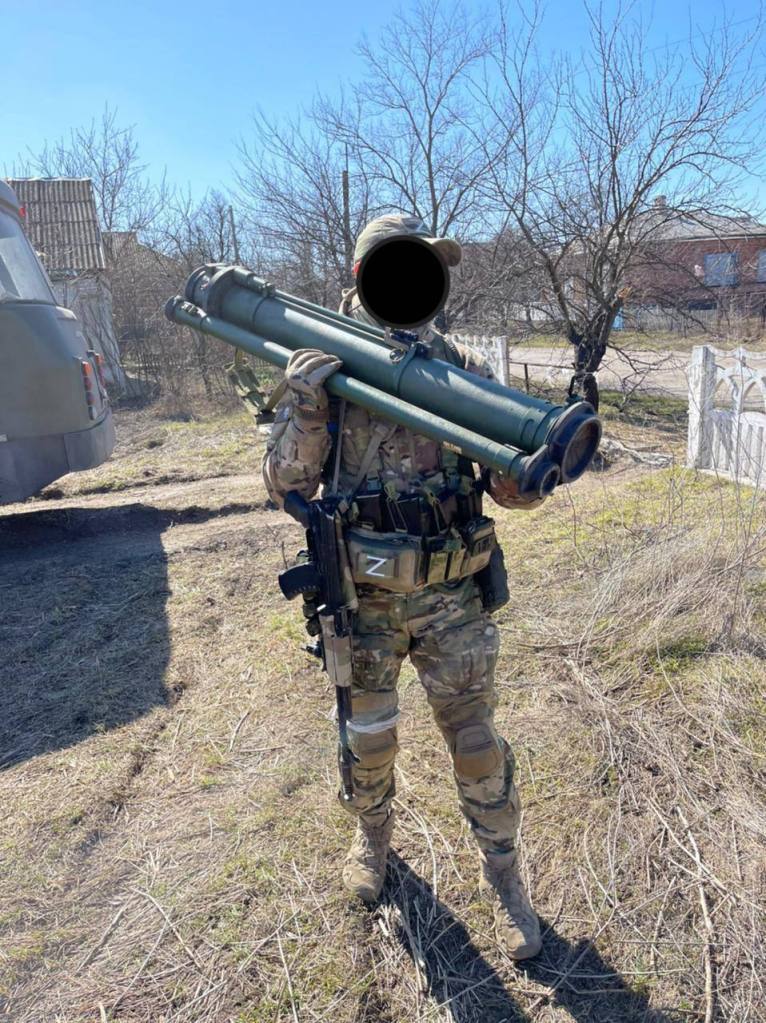
Russian soldier posing with RPG-30, March 2022 (via Social Media)
The first images of the weapon came from Russian sources in late February, just after the invasion. This was quickly followed by imagery of captured examples, most notably from the column of Tigr-M armoured infantry mobility vehicles in Kharkiv. A photograph of a further two captured RPG-30s appeared in April, while another example was photographed in Donbas in early May. Later in May a photo of a Russian soldier posing with one was shared on social media and in September significant caches of weapons were captured in Kherson and Balakliya.
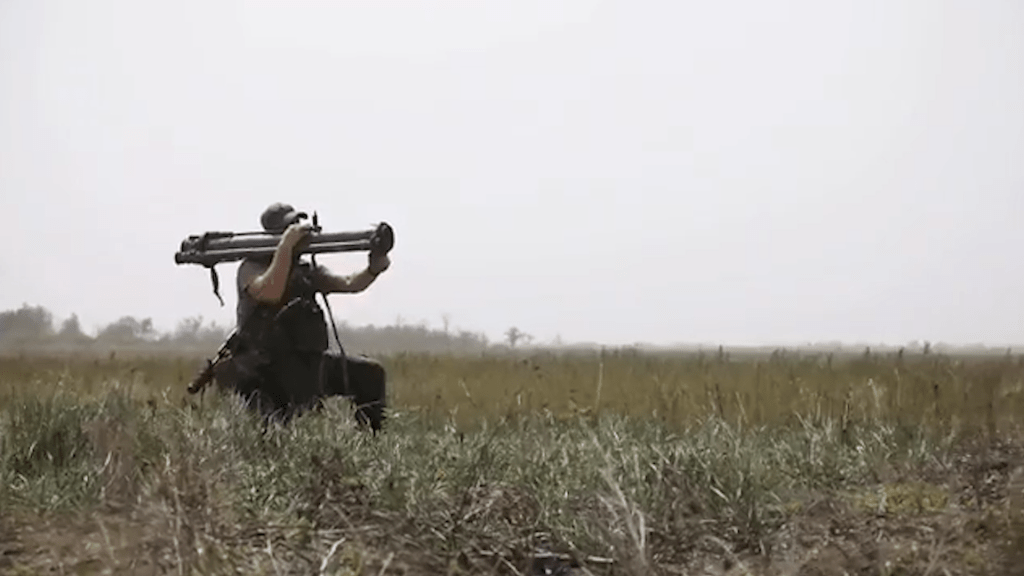
Still of a Russian soldier firing an RPG-30, August 2022 (via Social Media)
In late August we got our first brief look at the RPG-30 being fired in a montage video of VDV weapon systems (see image above). Earlier in mid-August a sort of ‘unboxing video’ was shared giving us a good close up look at some of the packaging the RPG-30s are shipped in and the markings on the side the weapon. Most recently in some further video of the RPG-30 being fired on a Russian Western Military District range also surfaced giving us a good look at the weapon in action.
RPG-30s captured in April (via Social Media)
Of course the weapon is designed to be simple to use, anyone with training on a similar shoulder-fired disposable anti-armour weapon can operate it. While it has been said that its widespread use in Ukraine is somewhat ironic given that Ukraine does operate any APS equipped tanks, the weapon is still useful against less sophisticated tanks. While the precursor might potentially deliver some limited kinetic damage to the ERA block, the RPG-30’s tandem warhead is capable of defeating the ERA fitted to most Ukrainian tanks, though of course, the same can be said of Russia’s other anti-armour weapons which use tandem warheads.
Update 27/10/22:
The Georgian Legion recently shared a short video looking at a captured RPG-30. The video also includes firing footage of the weapon.
Extract from a recent Georgian Legion video examining a captured RPG-30.
— Matthew Moss | Historical Firearms (@historicfirearm) August 20, 2024
If you enjoyed this video and article please consider supporting our work here. We have some great perks available for Patreon Supporters – including custom stickers and early access to videos! Thank you for your support!




 The Armourers Bench